
PODCAST · technology
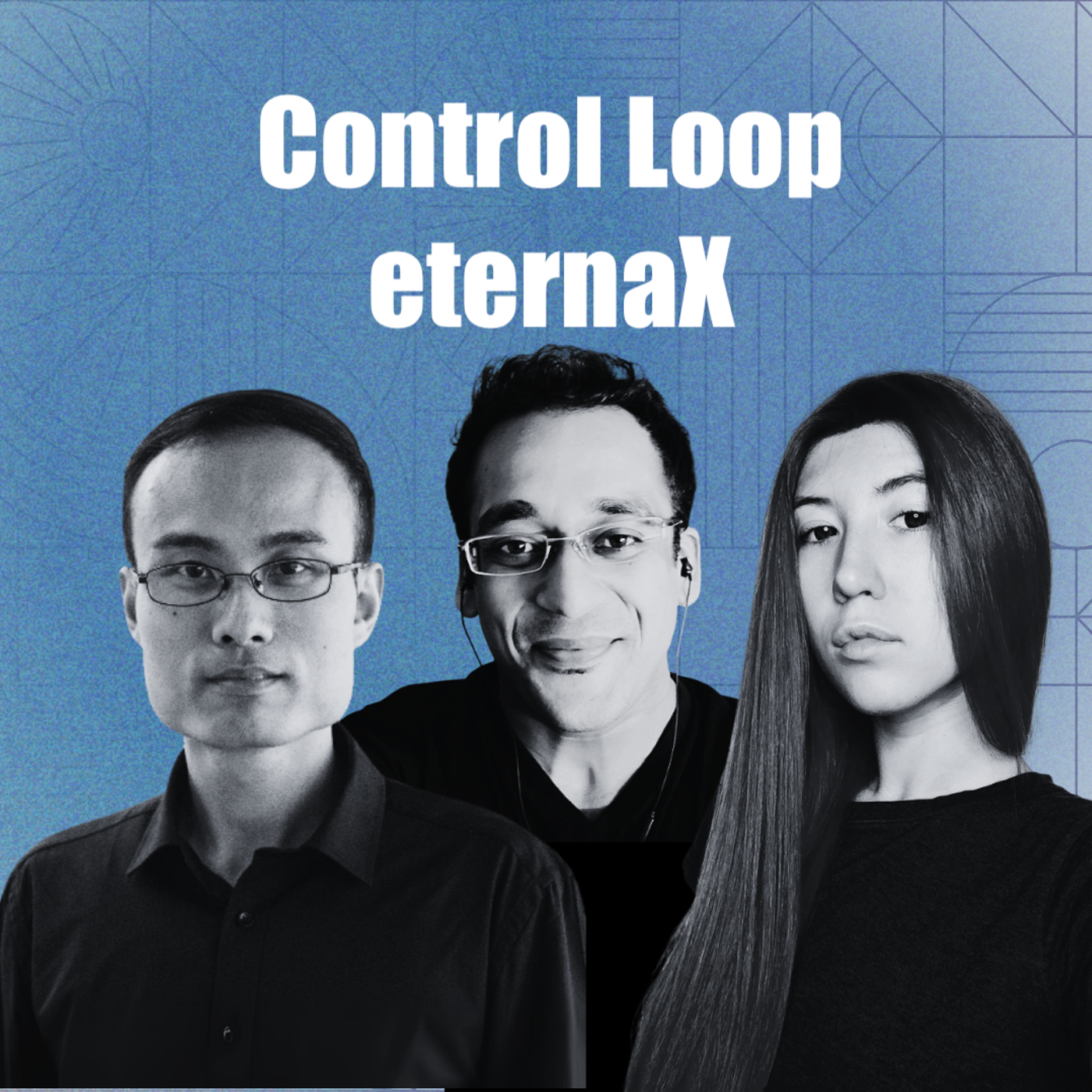
Control Loop
by Dariia Porechna
EternaX's Dariia Porechna and Parthh Birla discuss crypto, web3, finance, AI challenges, news and solutions.
-
13
The $26B Tokenization Lie: BlackRock, JPMorgan & Securitize Are Building on the Wrong Layer
Read the full report by Mansi Birla: https://mansibirla.substack.com/p/the-tokenization-mispricing-why-theThe $26 billion tokenized RWA headline is wrong. $13 billion of it is one company's internal loan book on a private blockchain. It does not trade. It cannot be pledged. It is a database entry being counted as a financial instrument.In this episode of The Control Loop, Dariia Porechna and Parth Birla sit down with Mansi Birla, digital assets and financial services lawyer, former Gemini, and author of "The Tokenization Mispricing" — the institutional report reframing how tokenization should be measured, valued, and underwritten.00:00 — "$13 billion of tokenized credit is a filing cabinet"01:20 — The $26B headline is 40% fiction: distributed vs represented value03:20 — Securitize at $1.25B: who captures the toll road, who builds the car05:20 — Four verticals with real PMF, everything else is a fundraising story07:20 — JPMorgan clears more before lunch than the entire RWA market — ever09:10 — Wrapper and jurisdiction beat blockchain selection: the Reg S proof10:50 — The Securitize-shaped hole in Luxembourg, Ireland, Hong Kong, and ADGM12:10 — Google, Coinbase, and the liability that compounds with every successful month13:40 — The most confidently wrong belief in institutional tokenization14:40 — Five sentences that should permanently change how you underwrite
-
12
Coinbase Says PREPARE NOW. Google Says $200B Exposed.
Coinbase Advisory Board Paper on Quantum Computing and Blockchain: https://assets.ctfassets.net/sygt3q11s4a9/6EjYavuGdtJDYCqaJrASj9/9f464a8bf26f44bd6c85710fe7e4a29f/Quantum_Computing_and_Blockchain_v10.3_15April2026.pdf EternaX Cryptographic Migration Debt Report: https://eternax.ai/post-quantum-cryptography-risk-framework-for-institutions.htmlCoinbase's advisory board just said it: "waiting for it to be urgent is not a good idea."Google's March 2026 paper says $200 billion in Ethereum stablecoins and tokenized assets sit behind admin keys that a quantum computer could derive in under 15 hours. This is now a BlackRock, JPMorgan, Franklin Templeton, Visa, DTCC, Fidelity, and stablecoin problem.EternaX Labs co-founders Dariia Porechna and Paarrthhh break down the full institutional blast radius, what cryptographic migration debt means, and why the winning category is post-quantum market infrastructure.⏱️ CHAPTERS0:00 Why Coinbase just made this impossible to ignore2:15 What Coinbase is really saying: 3 core messages7:30 Google quantifies the blast radius: $200B exposed15:00 Cryptographic migration debt: the EternaX diagnosis22:30 The solution: post-quantum market infrastructure30:00 5 things institutions should do next week38:00 The bottom line and highest-velocity takeaways
-
11
Google: $200B Stablecoins and Tokenisation Are Not Ready. Why Institutions Should Worry Now?
Full Report: Post-Quantum Cryptography Risk Framework for Institutionshttps://eternax.ai/post-quantum-cryptography-risk-framework-for-institutions.htmlGoogle said it is setting a 2029 post-quantum cryptography migration timeline and wants to create the clarity and urgency needed to accelerate the shift. Days later, Google Quantum AI said future quantum computers may break the elliptic-curve cryptography used across crypto with far fewer resources than previously estimated. NIST’s first major post-quantum cryptography standards are already finalized, and NIST says organizations should begin transitioning now.Cryptographic Migration Debt: The Post-Quantum Exposure Framework for Institutional Digital Asset ProgrammesPost-quantum cryptography risk starts before the first public theft.00:00 Google changed the timeline00:38 Why this matters for stablecoins, RWAs, and custody01:42 Post-quantum risk starts before the first theft03:08 The real risk is the control plane04:40 What migration debt actually means06:05 Why privacy also has to survive quantum threat07:18 The quotes and numbers that matter08:38 Solana, performance, and retrofit risk09:42 What institutions should do now10:40 Read the EternaX report before the next architecture decision
-
10
Google Just Warned Q-day: Bitcoin, Ethereum, Solana and $16T of Tokenization Face Quantum Risk
Google Crypto Quantum Threat Reporthttps://arxiv.org/abs/2603.28846Oratomic Neutral-Atom Paperhttps://arxiv.org/html/2603.28627v1EternaX Research Reporthttps://eternax.ai/already-broken-quantum-risk-report-q1-2026.htmlIn this EternaX Labs episode, we break down Google’s new post-quantum crypto report, the new neutral-atom acceleration signal, and why this is no longer just a Bitcoin conversation.Google’s report does three things the market cannot ignore:1. It says tokenization is projected to open markets exceeding $16 trillion by 2030.2. It says the cryptographic foundations under that market remain quantum-vulnerable.3. It says tokenization could push quantum-vulnerable value above too-big-to-fail thresholds.That is why this conversation now reaches Bitcoin, Ethereum, BNB Chain, Solana, Canton Network, TRON, Hyperliquid, Base, Stellar, Avalanche, stablecoins, RWAs, tokenized funds, exchanges, payment rails, and financial market infrastructure.This episode covers:Google’s updated resource estimates for breaking secp256k1Why Google says Taproot / P2TR is a quantum-security regressionWhy Ethereum admin keys, stablecoins, bridges, oracle nodes, and guardians matterWhy tokenization and stablecoins turn this from a crypto-native issue into a market-infrastructure issueWhy the hardware side is still acceleratingWhy EternaX argues the clean answer is post-quantum-native issuance from day one
-
9
Trump Crypto Reset: SEC Reclassifies $2.8 Trillion | XRP, Solana, Cardano
Trump is now part of the biggest crypto regulatory reset in years.In this special episode of The Control Loop, Dariia Porechna is joined by Mansi Birla and Paarrthhh Birla of EternaX Labs to break down the claimed SEC-CFTC shift that could reprice up to $2.8 trillion across crypto markets.f this framework holds, it changes how the market thinks about XRP, Solana, Cardano, Bitcoin, Ethereum, Avalanche, Polkadot, Chainlink, Dogecoin, Hedera, Aptos, Algorand, staking, wrapped assets, DeFi, perpetual futures, custody, debanking, bank access, and U.S. crypto market structure.This episode covers:Trump and the new U.S. crypto political backdropThe SEC-CFTC interpretive frameworkWhy XRP, Solana and Cardano matter mostThe $2.8 trillion repricing thesisOperation Chokepoint 2.0 and the debanking warJPMorgan, Jamie Dimon and the institutional reversalThe attachment-detachment framework for tokensWhat changes for holders, founders, exchanges and advisorsWhy perpetual futures, ETFs and institutional capital may be nextHow EternaX is positioning for the next era of crypto market infrastructure
-
8
Monero and Zcash Are Not Private Forever. Quantum Can Expose History and Steal Funds
Private chains are not automatically private forever.In this episode of The Control Loop, Dariia and Parthh break down one of the biggest myths in crypto: hidden is not the same as safe.This is the core argument:Zcash quantum risk is not just a privacy issueMonero quantum risk is not just a future issueFalse privacy is privacy that only works until the old cryptographic assumptions breakTrue privacy must be built for the future threat model from day oneWe also explain the difference between:harvest now, decrypt laterarchive now, solve later, deanonymize later, steal laterprivacy today vs durable post-quantum-safe auditable privacyThe episode closes with the stricter standard EternaX is pushing toward:post-quantum-safe authorization, post-quantum-safe settlement, and post-quantum-safe auditable privacy from day one.Chapters00:00 The myth of private chains01:30 Hidden is not the same as safe02:40 Harvest now, decrypt later04:05 Zcash quantum risk explained07:10 Monero quantum risk explained10:20 What happens if the break existed today12:10 Why the whole market should care13:25 False privacy vs true privacy15:15 Final takeawaySubscribe to The Control Loop for deep research on:post-quantum crypto, privacy, stablecoins, RWAs, market infrastructure, AI x crypto, Monero, Zcash, and EternaXViews are our own. This is for education and analysis, not investment advice.
-
7
OCC Proposed Rule: Stablecoin Yield War, Bank Backlash, Trump Saves Crypto
The OCC GENIUS Act proposed rule just changed the stablecoin game. But here is the real shock: even if stablecoin yield survives, most new issuers still cannot beat USDT or USDC.00:00 The OCC stablecoin rule changes everything00:38 The real thesis: stablecoins can grow, but lazy distribution is over01:12 What the OCC actually proposed02:20 The yield line: what the OCC is trying to stop03:35 Affiliate and third-party workarounds04:28 Why this became a banking and political fight05:40 The stablecoin scoreboard: USDT, USDC, and the cliff07:00 Why most new issuers still cannot win08:20 Yield allowed vs yield constrained: incumbents win both ways09:35 Safety as distribution. If $1 is not safe, it is $010:45 Why auditable privacy matters for serious capital11:45 How distribution is actually won without passive yield13:00 Where EternaX fits in the next market structure14:10 Final takeaway: utility vs irrelevance
-
6
Post-Quantum Is Not Enough: AI Could Break Crypto Before Quantum
Post-quantum cryptography is necessary. It is not sufficient.Dariia explains why the real migration is bigger than ECC to PQC. The next threat is also AI-accelerated mathematical discovery.This episode breaks down:Why ECC is not a permanent foundationWhy Dilithium and Falcon are important PQ steps, but still structured computational assumptionsWhy SPHINCS+ is more conservative, but still not assumption-freeWhy the quantum cost curve against ECC is moving in the wrong directionWhy signature size is not an implementation detail. It is market infrastructureWhy EternaX is building a different path with post-assumption transaction-signing design and market-speed performanceEternaX thesis:Post-quantum protects you from the computer you expect.Post-assumption design protects you from the breakthrough you do not expect.00:00 Post-Quantum Is Not Enough00:45 The second threat: AI-accelerated math01:10 Why post-quantum is necessary but not final01:55 Why AI changes the threat model02:55 Why Dilithium and Falcon do not end the story04:10 Why SPHINCS+ is more conservative, but still not final05:00 The qubit wall is falling06:10 Why migration is a timeline problem, not a last-minute switch07:20 What EternaX is doing differently08:35 Why signature size is not a side detail09:35 Why stablecoins, RWAs, and market infrastructure should care now10:35 Myth vs reality
-
5
Ethereum 2029 Looks Late: Quantum Risk Is a Cost Curve: Why EternaX Built PQ-Native Day One
Quantum risk is not a date. It is a cost curve.20M to 1M to 100K qubits. Ethereum targets 2029. IonQ targets 200K qubits by 2029. Bitcoin migration may take years.In this episode, we break down why post-quantum cryptography (PQC) is now a real market infrastructure issue for Bitcoin, Ethereum, stablecoins, RWAs, custody, and exchanges.We cover the full chain of evidence:RSA-2048 resource estimate compression from ~20M to1M to 100K (under stated assumptions)Why qLDPC and the Pinnacle Architecture matterWhy “these are resource estimates, not lab demos” is the right caveatWhy Ethereum’s 2029 PQ plan can be structurally late if migration takes yearsWhy IonQ’s 2029 roadmap matters even if exact dates moveWhy Bitcoin’s governance clock is the cleanest warning for cryptoWhy post-quantum signature overhead can reduce throughput / TPSWhy EternaX is built for PQ-native day one + market-speed execution + auditable privacyCore thesis: attacker capability can improve in jumps. Ecosystem migration moves slowly. If you wait for certainty, you are already late.Timestamps00:00 Quantum risk is a cost curve, not a cliff00:40 The uncomfortable truth in one line01:05 20M to 1M to 100K. The compression trend02:35 Scott Aaronson reality check. Serious work, uncertain timeline03:25 Why crypto is uniquely exposed (keys + irreversible settlement)04:25 Ethereum 2029. Why a roadmap can become a risk05:55 Bitcoin governance clock. Why migration can take years07:45 Signature size shock. Why PQ can cut throughput / TPS09:25 Why EternaX. PQ-native day one at market speed11:10 Final recap. What actually matters now
-
4
Ethereum PQ by 2029. Stablecoins Can’t Wait: Mint PQ-Native Day One
“Migrate later” is not a stablecoin plan. It is a liquidity fracture event.This episode explains why post-quantum (PQ) is a coordination race, why Ethereum targets PQ upgrades by 2029 (as stated in the transcript you shared), and why stablecoins must be PQ-native day one to avoid a forced perimeter migration under stress.Dariia answers issuer-grade questions from Parthh. The episode is grounded in the transcript you provided featuring Justin Drake and Chris Peikert (hosted by Laura Shin), including their most issuer-relevant points: systemic cryptographic risk, timeline uncertainty, quiet attack dynamics, and the throughput cliff created by PQ signature size.Key takeaways (facts + issuer translation)What quantum breaks (systemic): elliptic-curve cryptography used across transaction signing and other chain layers.Timelines are uncertain, migration is not: multi-year upgrades must start before certainty arrives.Ethereum’s stated roadmap target: PQ upgrades by 2029 (per the transcript you shared).Quiet attacks are real: keys can be derived privately once public keys are exposed, then funds move suddenly.The PQ throughput cliff: signatures go from ECDSA ~64 bytes to Falcon-class ~666 bytes (as discussed). If blockspace is scarce, throughput can drop by ~10x without redesign.Stablecoin horror scenario: rushed perimeter migrations split integrations across exchanges, custodians, and payment rails. Deposits/withdrawals pause, liquidity fragments, and “rail reliability” becomes a solvency narrative.Issuer wedge: PQ-native day one increases acceptance and distribution because it removes the future “emergency migration” overhang.
-
3
$3 Trillion Must Migrate: Making Bitcoin & Ethereum Day-One PQ-Safe
Post-quantum security is no longer a theory.It is becoming a forced migration problem for over $3 trillion in crypto assets.In this episode, we break down why post-quantum cryptography (PQC) is not a drop-in upgrade, and how signature size and verification cost quietly destroy TPS, liquidity, and decentralization when implemented incorrectly.Most “just upgrade signatures” narratives ignore the core constraint:PQC imposes a throughput tax.At scale, this shows up as:Slower executionHigher validator hardware costsWider spreads and worse liquidityCollateral haircuts and higher marginForced asset migration
-
2
3,200 BANKS Want STABLECOIN YIELD BANNED | Coinbase Walks Away
Guest Mansi Birla: Legal and regulatory expert who converts Senate bill language into concrete compliance outcomes, risk boundaries, and what teams must change in architecture and go-to-market.If you hold stablecoins, trade DeFi, or care about tokenized stocks, this is the highest-stakes U.S. crypto fight of 2026.Coinbase pulled support. Banks show 3,200+ signatures to ban rewards. A “day-one commodity” clause could split crypto into two tiers overnight.In this 20-minute, crypto-wide legal breakdown, Mansi (Crypto Legal Expert) explains what the Senate “crypto market structure” draft is trying to do, why Coinbase says it is worse than the status quo, and how the most controversial provisions could reshape stablecoin yield, DeFi compliance, tokenized equities, and token classification.This episode is not “pro-Coinbase.” It is about what happens to users, builders, exchanges, and protocols if Congress hard-codes the wrong defaults.What we cover (high-signal, no fluff)Coinbase walks back support: the concrete deal-breakers, in plain EnglishStablecoin yield ban mechanics: “interest for holding” vs activity-based incentivesBank lobbying pressure: the 3,200+ banks number and what it signals politicallyDeFi compliance perimeter: the “control person” and KYC/AML chess matchTokenized equities: why the draft can function like a practical freeze on crypto railsAmendment flood risk: why one late change can flip entire product categories overnight“Day-one commodities”: why ETP/ETF status can create a fast lane for some tokens and a slow lane for everyone elseForward scenarios: compromise pass, slip, or “bad clarity” that exports innovation offshore
-
1
$33T Stablecoin Volume. Don’t Mint Cryptographic Debt. Go PQ-Native
Minting new dollars onchain is now a post-quantum decision.If you mint on legacy signatures, you are not minting an asset. You are minting a liability with embedded cryptographic debt. Because once that dollar is widely distributed across exchanges, wallets, custody, and DeFi, there is no clean “exit” from a forced, ecosystem-wide migration later.This is not a theory shift. It is a posture shift.In the last 6 months:The G7 published a coordinated post-quantum cryptography roadmap for the financial sector.The internet is already migrating at scale. Cloudflare reports 52% of human web traffic is post-quantum encrypted.Stablecoins are already monetary rails at global scale: $33T in transaction volume in 2025 (Artemis, reported).Tokenized U.S. Treasuries are already a real onchain category at around $10B.The trap most teams miss:Post-quantum signatures impose two taxes.Throughput tax: larger signatures and heavier verification reduce bandwidth and throughput.Coordination tax: upgrading a live ecosystem is multi-year, fragmented, and failure-prone.Issuer nightmare in one sentence:Imagine a $5B stablecoin across 12 chains and 40+ venues, then a forced signature migration under stress. That is a depeg event waiting to happen.The rule:Mint right once. Mint PQ-native.
No matches for "" in this podcast's transcripts.
No topics indexed yet for this podcast.
Loading reviews...
ABOUT THIS SHOW
EternaX's Dariia Porechna and Parthh Birla discuss crypto, web3, finance, AI challenges, news and solutions.
HOSTED BY
Dariia Porechna
CATEGORIES
Loading similar podcasts...
URL copied to clipboard!