
PODCAST · education
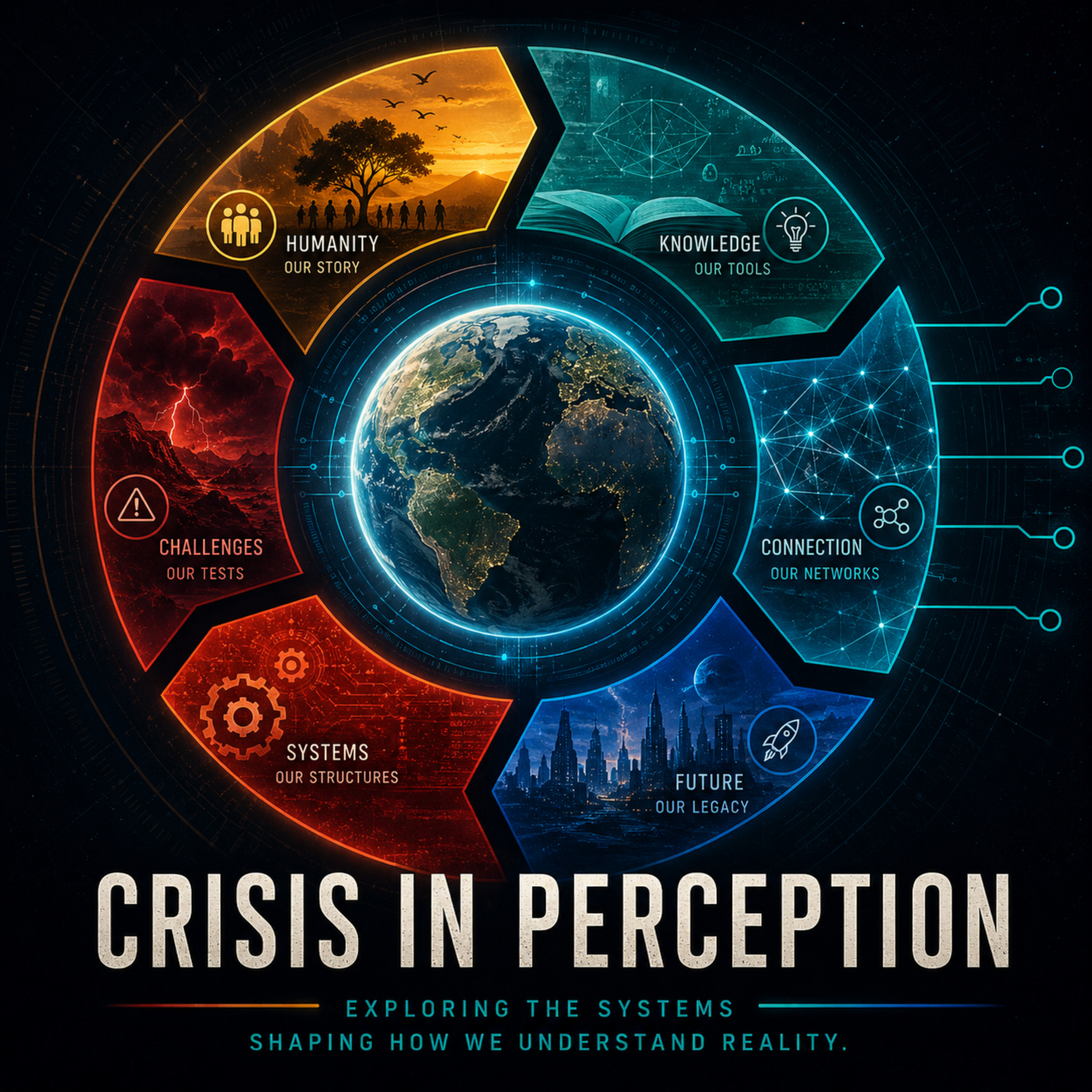
Crisis in Perception
by Crisis in Perception
Crisis in Perception is a long-form educational podcast examining how we misunderstand the world around us. Using books as entry points, each episode explores history, psychology, economics, science, and power structures to reveal how systems actually work—and why our perceptions so often fail. Clear, evidence-based, and non-tribal.Crisis in Perception uses AI-assisted tools for narration and synthesis in service of long-form educational analysis.
-
1000
We Are the Leaders We Have Been Looking For — Why Democracy Can't Be Outsourced
What happens when democratic responsibility becomes concentrated in the people we call leaders?Welcome to Crisis in Perception, where we examine the systems shaping our world.Using We Are the Leaders We Have Been Looking For by Eddie S. Glaude Jr. as our lens, this investigation examines the relationship between leadership, self-trust, historical inheritance, and democratic agency.Glaude develops the idea of Black democratic perfectionism through encounters with Martin Luther King Jr., Malcolm X, Ella Baker, John Dewey, Ralph Waldo Emerson, and others. Rather than treating prophecy and heroism as the exclusive property of extraordinary individuals, he asks what changes when ordinary people understand themselves as capable of moral imagination, self-creation, and democratic action.The deeper system involves the concentration of political and symbolic authority. Charismatic leadership can inspire collective action, but hero worship and custodial politics can also encourage dependency, narrow dissent, and weaken participation. Glaude's reading of Ella Baker offers another possibility: leadership that develops leadership in others and cultivates the capacities of people working together close to the ground.Central themes include democratic agency, charismatic authority, self-trust, moral imagination, historical memory, hero worship, custodial politics, and distributed leadership.📺 Watch on YouTube:https://youtu.be/04v1RRBYKns❤️ Support / Episode Post on Patreon:https://www.patreon.com/CrisisinPerception/posts/we-are-leaders-169727472?utm_medium=clipboard_copy&utm_source=copyLink&utm_campaign=postshare_creator&utm_content=join_linkIf these ideas resonate, consider reading the work yourself or borrowing it from your local library. Supporting authors and libraries helps keep critical inquiry accessible.If you value systems-level analysis like this, please follow, rate, and share the project.This content was created using AI-assisted tools for research synthesis, structuring, and narration support. All analysis, framing, and editorial decisions are guided by human judgment as part of the Crisis in Perception project.
-
999
Abe: Abraham Lincoln in His Times — How Culture Shaped Lincoln
What if Abraham Lincoln’s political power came not from rising above his culture, but from understanding it deeply enough to reshape it?Welcome to Crisis in Perception, where we examine the systems shaping our world.Using Abe: Abraham Lincoln in His Times by David S. Reynolds as our lens, this Deep Dive explores Lincoln as both a product and an interpreter of nineteenth-century American culture. Reynolds places him inside the frontier religion, literature, humor, popular entertainment, reform movements, racial conflicts, and sectional identities that helped shape his political development.At a systems level, the investigation follows a feedback loop between culture and leadership. Lincoln absorbed the language and assumptions surrounding him, translated competing perspectives, and used familiar cultural materials to communicate across a fractured political environment. Reynolds’s tightrope metaphor captures the structural tension between responsiveness and direction: how does a leader remain politically viable while attempting to move public sentiment?The episode examines cultural formation, political identity, sectional conflict, slavery, public opinion, persuasion, institutional constraints, and the tension between moderation and structural change.📺 Watch on YouTube:https://youtu.be/XEeCZZ6vRxI❤️ Support / Episode Post on Patreon:https://www.patreon.com/CrisisinPerception/posts/abe-abraham-in-169723300?utm_medium=clipboard_copy&utm_source=copyLink&utm_campaign=postshare_creator&utm_content=join_linkIf these ideas resonate, consider reading the work yourself or borrowing it from your local library. Supporting authors and libraries helps keep critical inquiry accessible.If you value systems-level analysis like this, please follow, rate, and share the project.This content was created using AI-assisted tools for research synthesis, structuring, and narration support. All analysis, framing, and editorial decisions are guided by human judgment as part of the Crisis in Perception project.
-
998
Abolition Now!: Ten Years of Strategy and Struggle Against the Prison Industrial Complex
What has to be built before a society can become less dependent on punishment?Welcome to Crisis in Perception, where we examine the systems shaping our world.Using Abolition Now!: Ten Years of Strategy and Struggle Against the Prison Industrial Complex by The CR10 Publications Collective as our lens, this episode examines the abolitionist framework developed through Critical Resistance’s first decade of organizing.The collection presents abolition not simply as eliminating prisons, but as a continuing process of dismantling carceral structures, understanding how those structures change and adapt, and building other institutions capable of addressing safety, accountability, healing, and social harm.The investigation focuses on institutional dependency: how policing, surveillance, criminalization, imprisonment, social policy, and community institutions interact in ways that can reinforce established responses. It also examines one of the collection’s hardest internal tensions—whether reducing reliance on coercive institutions is possible without first developing credible alternatives for responding to serious interpersonal violence.Central themes include abolition and reform, institutional lock-in, policy feedback, gender violence, survivor safety, community accountability, reentry, healing, and the challenge of replacing entrenched systems rather than merely removing them.📺 Watch on YouTube:https://youtu.be/fibc9P1McNA❤️ Support / Episode Post on Patreon:https://www.patreon.com/CrisisinPerception/posts/abolition-now-of-169686217?utm_medium=clipboard_copy&utm_source=copyLink&utm_campaign=postshare_creator&utm_content=join_linkIf these ideas resonate, consider reading the work yourself or borrowing it from your local library. Supporting authors and libraries helps keep critical inquiry accessible.If you value systems-level analysis like this, please follow, rate, and share the project.This content was created using AI-assisted tools for research synthesis, structuring, and narration support. All analysis, framing, and editorial decisions are guided by human judgment as part of the Crisis in Perception project.
-
997
Elite Capture: How the Powerful Took Over Identity Politics (And Everything Else) — Captured Power
What if a movement can become more representative while the deeper distribution of power barely changes?Welcome to Crisis in Perception, where we examine the systems shaping our world.Using Elite Capture: How the Powerful Took Over Identity Politics (And Everything Else) by Olúfẹ́mi O. Táíwò as our lens, this investigation examines how political movements and institutions can be redirected by people who already possess disproportionate access to resources, attention, and decision-making power.Táíwò describes elite capture not simply as corruption or conspiracy, but as a recurring pattern produced by unequal social structures. His argument distinguishes the coalitional identity politics associated with the Combahee River Collective from practices in which symbolic recognition, representation, or interpersonal deference can become substitutes for structural change.The deeper investigation follows institutional selection, cumulative advantage, incentive structures, information control, representation versus redistribution, and Táíwò's distinction between regulating interactions inside inherited institutions and building new structures capable of changing material outcomes.📺 Watch on YouTube:https://youtu.be/WEVqCiu7sAU❤️ Support / Episode Post on Patreon:https://www.patreon.com/CrisisinPerception/posts/elite-capture-169685540?utm_medium=clipboard_copy&utm_source=copyLink&utm_campaign=postshare_creator&utm_content=join_linkIf these ideas resonate, consider reading the work yourself or borrowing it from your local library. Supporting authors and libraries helps keep critical inquiry accessible.If you value systems-level analysis like this, please follow, rate, and share the project.This content was created using AI-assisted tools for research synthesis, structuring, and narration support. All analysis, framing, and editorial decisions are guided by human judgment as part of the Crisis in Perception project.
-
996
Boss: Richard J. Daley of Chicago — How Political Machines Turn Service Into Power
How does political power become durable enough to survive criticism, social change, and even the people who originally built it?Welcome to Crisis in Perception, where we examine the systems shaping our world.Using Boss: Richard J. Daley of Chicago by Mike Royko as our lens, this episode investigates the political Machine that helped Richard J. Daley dominate Chicago while overseeing one of the most consequential periods of physical development in the city’s history.Royko’s portrait complicates the simple distinction between competent government and machine politics. Daley could point to expressways, O’Hare Airport, public works, downtown development, and a transformed skyline. Yet political authority was also reinforced through patronage jobs, precinct organizations, ward loyalty, contracts, personal favors, and institutional control.The larger pattern emerges when these elements are viewed as a feedback loop. Government resources strengthened political loyalty. Loyalty generated votes. Electoral success preserved control over government resources. Urban renewal, housing segregation, policing, civil-rights conflict, and relationships with developers reveal how differently the benefits and costs of that system could be distributed.The episode examines patronage, reciprocal obligation, centralized authority, political dependency, urban development, racial inequality, institutional persistence, and the tension between governmental effectiveness and democratic independence.📺 Watch on YouTube:https://youtu.be/yN_hDrXxmt4❤️ Support / Episode Post on Patreon:https://www.patreon.com/CrisisinPerception/posts/boss-richard-j-169638171?utm_medium=clipboard_copy&utm_source=copyLink&utm_campaign=postshare_creator&utm_content=join_linkIf these ideas resonate, consider reading the work yourself or borrowing it from your local library. Supporting authors and libraries helps keep critical inquiry accessible.If you value systems-level analysis like this, please follow, rate, and share the project.This content was created using AI-assisted tools for research synthesis, structuring, and narration support. All analysis, framing, and editorial decisions are guided by human judgment as part of the Crisis in Perception project.
-
995
Race: How Blacks and Whites Think and Feel About the American Obsession — The Feedback Loop of Bias
Racism is often treated as something people consciously believe. Studs Terkel's interviews reveal a more difficult possibility: racial assumptions can continue shaping perception even when people consciously reject prejudice.Welcome to Crisis in Perception, where we examine the systems shaping our world.Using Race: How Blacks and Whites Think and Feel About the American Obsession by Studs Terkel as our lens, this investigation explores an extraordinary collection of voices reflecting on race, work, neighborhoods, education, policing, friendship, economic insecurity, affirmative action, and historical memory.Rather than reducing these voices to a single position, the episode examines the system emerging between them. Inherited expectations can shape attention; selective experiences can appear to confirm stereotypes; segregation limits corrective contact; and institutions distribute the consequences of those perceptions unevenly.The investigation also examines how such systems can change. Terkel's account of C. P. Ellis and Ann Atwater shows how sustained cooperation and recognition of shared interests can place inherited categories in direct conflict with experience.Central systems include stereotype reinforcement, social separation, historical memory, institutional inequality, selective attention, group pressure, economic scarcity, and belief revision.📺 Watch on YouTube:https://youtu.be/qfz1eZ1NAz8❤️ Support / Episode Post on Patreon:https://www.patreon.com/CrisisinPerception/posts/race-how-blacks-169637545?utm_medium=clipboard_copy&utm_source=copyLink&utm_campaign=postshare_creator&utm_content=join_linkIf these ideas resonate, consider reading the work yourself or borrowing it from your local library. Supporting authors and libraries helps keep critical inquiry accessible.If you value systems-level analysis like this, please follow, rate, and share the project.This content was created using AI-assisted tools for research synthesis, structuring, and narration support. All analysis, framing, and editorial decisions are guided by human judgment as part of the Crisis in Perception project.
-
994
The Untold History of the United States — How American Power Became a System
What if American foreign policy is shaped not only by presidents and crises, but by institutions inherited from earlier generations?Welcome to Crisis in Perception, where we examine the systems shaping our world.Using The Untold History of the United States by Oliver Stone and Peter Kuznick as our lens, this Deep Dive investigates the historical development and persistence of American global power.Stone and Kuznick deliberately focus on parts of U.S. history they believe conventional narratives often minimize: imperial expansion, economic interests, military intervention, nuclear strategy, covert power, repression of dissent, and the growth of the national security state. Their work is presented as a corrective rather than a complete account of American history.The larger systems question is one of path dependence. Wars and crises can produce military capabilities, bureaucracies, alliances, doctrines, economic constituencies, and political narratives that remain after the original circumstances disappear. Those inherited structures can then influence what later administrations consider possible, necessary, or politically realistic.This investigation traces the relationship between historical memory, exceptionalism, military power, institutional incentives, the military-industrial complex, and the national security state while distinguishing the authors' interpretation from the broader systems analysis it makes possible.📺 Watch on YouTube:https://youtu.be/EVknc-3mZWE❤️ Support / Episode Post on Patreon:https://www.patreon.com/CrisisinPerception/posts/untold-history-169636868?utm_medium=clipboard_copy&utm_source=copyLink&utm_campaign=postshare_creator&utm_content=join_linkIf these ideas resonate, consider reading the work yourself or borrowing it from your local library. Supporting authors and libraries helps keep critical inquiry accessible.If you value systems-level analysis like this, please follow, rate, and share the project.This content was created using AI-assisted tools for research synthesis, structuring, and narration support. All analysis, framing, and editorial decisions are guided by human judgment as part of the Crisis in Perception project.
-
993
Working — Why Some Jobs Give Dignity and Others Take It Away
What if the deepest problem with work is not how hard we labor, but whether we can still see ourselves in what we do?Welcome to Crisis in Perception, where we examine the systems shaping our world.Using Working by Studs Terkel as our lens, this episode investigates work as more than an economic transaction. Through the voices of ordinary workers, Terkel reveals how employment can distribute dignity, recognition, autonomy, identity, and meaning—or gradually strip them away.The investigation traces the systems beneath those experiences: specialization, bureaucracy, organizational hierarchy, surveillance, economic dependence, craftsmanship, and automation. The central tension is between efficiency and human meaning. A system may become increasingly productive while making individual contribution harder to see.By contrasting workers who can recognize the lasting results of their effort with those performing repetitive or fragmented tasks, Working raises a deeper question: what conditions allow labor to become something more than survival?Central systems include autonomy, recognition, specialization, organizational control, automation, and the relationship between work and personal identity.📺 Watch on YouTube:https://youtu.be/5GMi0-SQXvc❤️ Support / Episode Post on Patreon:https://www.patreon.com/CrisisinPerception/posts/working-why-some-169574957?utm_medium=clipboard_copy&utm_source=copyLink&utm_campaign=postshare_creator&utm_content=join_linkIf these ideas resonate, consider reading the work yourself or borrowing it from your local library. Supporting authors and libraries helps keep critical inquiry accessible.If you value systems-level analysis like this, please follow, rate, and share the project.This content was created using AI-assisted tools for research synthesis, structuring, and narration support. All analysis, framing, and editorial decisions are guided by human judgment as part of the Crisis in Perception project.
-
992
The Power of Myth — How Stories Become Social Infrastructure
What happens when a society outgrows the stories that once helped people understand who they are—but has not yet developed new ones?Welcome to Crisis in Perception, where we examine the systems shaping our world.Using The Power of Myth by Joseph Campbell with Bill Moyers as our lens, this investigation explores mythology as more than ancient storytelling. Campbell presents myths as symbolic structures that connect inner experience, ritual, social order, nature, and the recurring transitions of human life.The episode examines Campbell’s four functions of myth, his distinction between metaphor and literal fact, and his comparison of religious traditions to different kinds of cultural “software.” It also asks what happens when inherited stories stop adapting to changing social conditions.At a systems level, mythology can produce both cohesion and exclusion. Shared symbols help communities establish identity, obligation, and meaning, but those same symbolic boundaries can divide insiders from outsiders. Campbell ultimately pushes the discussion toward the possibility of a planetary mythology capable of expanding belonging beyond tribe, nation, or religion.Central themes include symbolic framing, ritual reinforcement, cultural transmission, social identity, metaphor, adaptation, and the relationship between human culture and the living planet.📺 Watch on YouTube:https://youtu.be/Xzkma229BRY❤️ Support / Episode Post on Patreon:https://www.patreon.com/CrisisinPerception/posts/power-of-myth-169571722?utm_medium=clipboard_copy&utm_source=copyLink&utm_campaign=postshare_creator&utm_content=join_linkIf these ideas resonate, consider reading the work yourself or borrowing it from your local library. Supporting authors and libraries helps keep critical inquiry accessible.If you value systems-level analysis like this, please follow, rate, and share the project.This content was created using AI-assisted tools for research synthesis, structuring, and narration support. All analysis, framing, and editorial decisions are guided by human judgment as part of the Crisis in Perception project.
-
991
Bury My Heart at Wounded Knee: An Indian History of the American West — When the Frontier Closed In
The American West is often remembered as a frontier being opened. Dee Brown asks us to turn around and examine what that same expansion looked like to the peoples already living there.Welcome to Crisis in Perception, where we examine the systems shaping our world.Bury My Heart at Wounded Knee: An Indian History of the American West reconstructs the conquest of the nineteenth-century West through Native testimony, treaty councils, eyewitness accounts, and government records. Brown shifts the historical viewpoint away from the familiar mythology of settlement and toward the experiences of Native nations confronting shrinking territory, broken agreements, forced removal, resource destruction, military coercion, and reservation confinement.This Deep Dive examines the larger system connecting those events. Treaties established boundaries, but expanding settlement, mineral discoveries, transportation networks, political pressure, and economic incentives repeatedly made those boundaries vulnerable. Resistance could then be defined as hostility, coercion could be justified as security, and territorial loss became the new baseline from which expansion continued.The central systems include asymmetric bargaining power, institutional incentives, path dependence, resource pressure, treaty enforcement, military power, and reinforcing cycles of encroachment and resistance.📺 Watch on YouTube:https://youtu.be/xV05OIyb_gg❤️ Support / Episode Post on Patreon:https://www.patreon.com/CrisisinPerception/posts/bury-my-heart-at-169570564?utm_medium=clipboard_copy&utm_source=copyLink&utm_campaign=postshare_creator&utm_content=join_linkIf these ideas resonate, consider reading the work yourself or borrowing it from your local library. Supporting authors and libraries helps keep critical inquiry accessible.If you value systems-level analysis like this, please follow, rate, and share the project.This content was created using AI-assisted tools for research synthesis, structuring, and narration support. All analysis, framing, and editorial decisions are guided by human judgment as part of the Crisis in Perception project.
-
990
With Liberty and Justice for Some: How the Law Is Used to Destroy Equality and Protect the Powerful
What happens when the law remains the same on paper, but accountability changes according to who has power?Welcome to Crisis in Perception, where we examine the systems shaping our world.Using With Liberty and Justice for Some: How the Law Is Used to Destroy Equality and Protect the Powerful by Glenn Greenwald as our lens, this episode investigates his argument that the American justice system has developed a profound divide between formal legal equality and actual enforcement.Greenwald traces a pattern running through presidential pardons, political scandals, warrantless surveillance, corporate immunity, Wall Street, and the criminal justice system. His central contention is that the problem extends beyond wealthy defendants having superior representation: political and financial elites can sometimes avoid meaningful legal accountability altogether.At a systems level, the investigation focuses on selective enforcement, institutional discretion, regulatory capture, political incentives, path dependence, and the feedback loop through which power can help secure immunity while immunity helps preserve power.📺 Watch on YouTube:https://youtu.be/P1nYCSAYchk❤️ Support / Episode Post on Patreon:https://www.patreon.com/CrisisinPerception/posts/with-liberty-and-169569628?utm_medium=clipboard_copy&utm_source=copyLink&utm_campaign=postshare_creator&utm_content=join_linkIf these ideas resonate, consider reading the work yourself or borrowing it from your local library. Supporting authors and libraries helps keep critical inquiry accessible.If you value systems-level analysis like this, please follow, rate, and share the project.This content was created using AI-assisted tools for research synthesis, structuring, and narration support. All analysis, framing, and editorial decisions are guided by human judgment as part of the Crisis in Perception project.
-
989
The Hidden History of American Democracy — Who Invented Democracy?
Where do democratic ideas actually come from—and what disappears when history reduces their origins to a single intellectual tradition?Welcome to Crisis in Perception, where we examine the systems shaping our world.Using The Hidden History of American Democracy: Rediscovering Humanity’s Ancient Way of Living by Thom Hartmann as our lens, this Deep Dive investigates the cultural and intellectual pathways through which ideas about liberty, consent, equality, and self-government developed and circulated.Hartmann challenges the familiar account that emphasizes Greece, Rome, and the European Enlightenment by bringing Indigenous political traditions into the picture. He examines encounters involving Haudenosaunee/Iroquois, Wendat, and Cherokee societies, along with figures such as Kandiaronk, Benjamin Franklin, and Thomas Jefferson.The investigation does not treat the U.S. Constitution as a direct copy of any Indigenous political system. Instead, it asks how political knowledge travels between societies and how later historical narratives determine which influences remain visible. From that question emerges a larger systems problem: how political power becomes distributed, concentrated, legitimized, and remembered.Central systems and tensions include cultural transmission, consent versus coercion, distributed versus concentrated power, historical memory, institutional design, and the feedback loops connecting political participation with democratic accountability.📺 Watch on YouTube:https://youtu.be/5elqqF5ugk4❤️ Support / Episode Post on Patreon:https://www.patreon.com/CrisisinPerception/posts/hidden-history-169532232?utm_medium=clipboard_copy&utm_source=copyLink&utm_campaign=postshare_creator&utm_content=join_linkIf these ideas resonate, consider reading the work yourself or borrowing it from your local library. Supporting authors and libraries helps keep critical inquiry accessible.If you value systems-level analysis like this, please follow, rate, and share the project.This content was created using AI-assisted tools for research synthesis, structuring, and narration support. All analysis, framing, and editorial decisions are guided by human judgment as part of the Crisis in Perception project.
-
988
The Hidden History of Big Brother in America — How Surveillance Becomes Power
What happens when the institutions watching us become increasingly powerful while the systems doing the watching remain largely invisible?Welcome to Crisis in Perception, where we examine the systems shaping our world.Using The Hidden History of Big Brother in America: How the Death of Privacy and the Rise of Surveillance Threaten Us and Our Democracy by Thom Hartmann as our lens, this Deep Dive investigates privacy as more than a personal preference. Hartmann argues that privacy helps preserve autonomy, dissent, political participation, and the ability to act without constantly anticipating how powerful institutions may judge or manipulate us.The investigation traces a recurring mechanism across different forms of social control: information creates leverage. From religious enforcement and slavery-era restrictions to J. Edgar Hoover, government surveillance, data brokers, facial recognition, algorithmic scoring, and surveillance capitalism, the technologies change while the underlying relationship between observation and power persists.Hartmann’s discussion of the panopticon and “social cooling” reveals another layer. Surveillance does not need to produce direct punishment to influence behavior. When people know—or merely suspect—that their actions are being recorded, scored, or permanently stored, they may become more cautious, more conformist, and less willing to take social or political risks.At a systems level, the central tension is between convenience, security, and commercial efficiency on one side, and privacy, autonomy, transparency, and democratic accountability on the other.📺 Watch on YouTube:https://youtu.be/k7WuY32rriI❤️ Support / Episode Post on Patreon:https://www.patreon.com/CrisisinPerception/posts/hidden-history-169530010?utm_medium=clipboard_copy&utm_source=copyLink&utm_campaign=postshare_creator&utm_content=join_linkIf these ideas resonate, consider reading the work yourself or borrowing it from your local library. Supporting authors and libraries helps keep critical inquiry accessible.If you value systems-level analysis like this, please follow, rate, and share the project.This content was created using AI-assisted tools for research synthesis, structuring, and narration support. All analysis, framing, and editorial decisions are guided by human judgment as part of the Crisis in Perception project.
-
987
The Healing of America: A Global Quest for Better, Cheaper, and Fairer Health Care — Who Gets Care?
What if the defining question in health care is not whether government or markets should run the system, but who the system is obligated to include?Welcome to Crisis in Perception, where we examine the systems shaping our world.Using The Healing of America: A Global Quest for Better, Cheaper, and Fairer Health Care by T. R. Reid as our lens, this investigation compares the institutional structures wealthy democracies use to finance and distribute medical care.Reid’s global investigation examines systems built around private insurance, government insurance, taxation, private doctors, public hospitals, nonprofit sickness funds, regulated prices, and mandatory participation. France, Germany, Japan, Britain, and Canada use different combinations, but Reid identifies a common principle beneath those differences: medical coverage is extended across the population rather than divided according to insurance status or ability to pay.The United States already contains elements of nearly every major health-care model. The deeper problem Reid identifies is fragmentation. Different populations encounter different payers, eligibility rules, prices, incentives, and levels of financial protection.This Deep Dive traces how those rules shape access, administrative complexity, risk pooling, cost control, patient choice, and rationing—and why the debate over “socialized medicine” can obscure the more fundamental institutional question.Central systems and tensions include universal coverage, public versus private financing, nonprofit versus for-profit insurance, fragmented administration, price regulation, individual choice, collective risk, and health care as a social guarantee versus a market commodity.📺 Watch on YouTube:https://youtu.be/ZTVHsLG1iDw❤️ Support / Episode Post on Patreon:https://www.patreon.com/CrisisinPerception/posts/healing-of-quest-169527956?utm_medium=clipboard_copy&utm_source=copyLink&utm_campaign=postshare_creator&utm_content=join_linkIf these ideas resonate, consider reading the work yourself or borrowing it from your local library. Supporting authors and libraries helps keep critical inquiry accessible.If you value systems-level analysis like this, please follow, rate, and share the project.This content was created using AI-assisted tools for research synthesis, structuring, and narration support. All analysis, framing, and editorial decisions are guided by human judgment as part of the Crisis in Perception project.
-
986
The Opioid Fix: America’s Addiction Crisis and the Solution They Don’t Want You to Have
What happens when an effective medical treatment exists, but the system surrounding addiction makes it unusually difficult to receive?Welcome to Crisis in Perception, where we examine the systems shaping our world.Using The Opioid Fix: America’s Addiction Crisis and the Solution They Don’t Want You to Have by Barbara Andraka-Christou as our lens, this Deep Dive investigates why medications for opioid addiction remain stigmatized, restricted, and underused despite substantial evidence supporting their effectiveness.Andraka-Christou examines buprenorphine, methadone, and extended-release naltrexone alongside the institutions that determine whether people can actually obtain them: physicians, treatment centers, twelve-step communities, regulators, prisons, courts, insurers, and the broader culture surrounding addiction.The deeper system is institutional gatekeeping. American addiction treatment developed through layers of punitive drug policy, abstinence-oriented recovery culture, professional separation from mainstream medicine, provider shortages, and legal restrictions. These forces can reinforce one another until an effective treatment exists in theory while remaining difficult to access in practice.The investigation also examines an important distinction between physical dependence and addiction. Methadone and buprenorphine can produce physical dependence while reducing the compulsive, destructive opioid use that defines addiction. Confusing those concepts helps sustain the belief that medication is simply “replacing one drug with another.”Through the experiences of people such as Jackson, the book also demonstrates why medication and psychosocial recovery should not be treated as competing approaches. Physiological stability can make it possible to address trauma, mental health, relationships, employment, and the broader work of rebuilding a life.The episode traces the historical roots of these barriers, the tension between abstinence and person-centered treatment, the persistence of MAT stigma, and international evidence showing that treatment systems can be designed very differently.📺 Watch on YouTube:https://youtu.be/eMsZ2ygykqk❤️ Support / Episode Post on Patreon:https://www.patreon.com/CrisisinPerception/posts/opioid-fix-and-169479895?utm_medium=clipboard_copy&utm_source=copyLink&utm_campaign=postshare_creator&utm_content=join_linkIf these ideas resonate, consider reading the work yourself or borrowing it from your local library. Supporting authors and libraries helps keep critical inquiry accessible.If you value systems-level analysis like this, please follow, rate, and share the project.This content was created using AI-assisted tools for research synthesis, structuring, and narration support. All analysis, framing, and editorial decisions are guided by human judgment as part of the Crisis in Perception project.
-
985
Attack from Within: How Disinformation Is Sabotaging America — How Lies Become Power
What happens when disinformation stops being merely false information and becomes a system for exercising power?Welcome to Crisis in Perception, where we examine the systems shaping our world.Using Attack from Within: How Disinformation Is Sabotaging America by Barbara McQuade as our lens, this Deep Dive investigates how deliberate falsehoods can exploit human psychology, technological amplification, political incentives, and institutional distrust.McQuade argues that disinformation is not simply a collection of inaccurate claims. It can become part of a larger strategy of power: provoke fear or outrage, repeat emotionally compelling narratives, strengthen group identity, undermine confidence in institutions capable of correcting errors, and make accountability increasingly difficult.The investigation traces a reinforcing loop connecting disinformation, emotional engagement, repetition, social reinforcement, institutional distrust, and further vulnerability to manipulation. It examines the authoritarian playbook, confirmation bias and conformity, the “liar’s dividend,” attacks on corrective institutions, social-media amplification, artificial intelligence, deepfakes, political violence, and the rule of law.At the center of the episode is a structural tension: democratic societies depend on open disagreement and freedom of expression, but collective self-government also requires enough shared factual reality to conduct elections, enforce laws, evaluate evidence, and resolve disputes peacefully.The deeper question is not merely whether people can distinguish truth from falsehood. It is what happens when political and technological systems create incentives to undermine the very mechanisms society uses to determine what is reliable.📺 Watch on YouTube:https://youtu.be/tADTHsBRLQU❤️ Support / Episode Post on Patreon:https://www.patreon.com/CrisisinPerception/posts/attack-from-how-169479534?utm_medium=clipboard_copy&utm_source=copyLink&utm_campaign=postshare_creator&utm_content=join_linkIf these ideas resonate, consider reading the work yourself or borrowing it from your local library. Supporting authors and libraries helps keep critical inquiry accessible.If you value systems-level analysis like this, please follow, rate, and share the project.This content was created using AI-assisted tools for research synthesis, structuring, and narration support. All analysis, framing, and editorial decisions are guided by human judgment as part of the Crisis in Perception project.
-
984
Confidence Man: The Making of Donald Trump and the Breaking of America — Power as Performance
What if the political style associated with Donald Trump makes more sense when we trace the systems that rewarded it decades before he reached Washington?Welcome to Crisis in Perception, where we examine the systems shaping our world.Using Confidence Man: The Making of Donald Trump and the Breaking of America by Maggie Haberman as our lens, this Deep Dive examines the environments and relationships that Haberman argues shaped Trump long before his presidential campaigns.Her account moves through New York real estate, political machines, tabloid media, celebrity culture, business disputes, and influential figures such as Fred Trump and Roy Cohn. Across those environments, Haberman traces recurring patterns involving attention, transactional relationships, loyalty, confrontation, and repeated efforts to test institutional limits.Viewed structurally, the episode follows a reinforcing loop: provocation can generate attention; attention can create visibility and leverage; leverage can encourage accommodation and loyalty; and surviving resistance can strengthen confidence in using the same tactics again. The deeper tension emerges when strategies developed within personalized systems of power encounter institutions designed around formal rules, divided authority, and competing centers of influence.The investigation explores attention as leverage, transactional loyalty, media feedback loops, institutional resistance, personalized authority, and the transfer of learned behavior between systems.📺 Watch on YouTube:https://youtu.be/gGu63b31wp0❤️ Support / Episode Post on Patreon:https://www.patreon.com/CrisisinPerception/posts/confidence-man-169477463?utm_medium=clipboard_copy&utm_source=copyLink&utm_campaign=postshare_creator&utm_content=join_linkIf these ideas resonate, consider reading the work yourself or borrowing it from your local library. Supporting authors and libraries helps keep critical inquiry accessible.If you value systems-level analysis like this, please follow, rate, and share the project.This content was created using AI-assisted tools for research synthesis, structuring, and narration support. All analysis, framing, and editorial decisions are guided by human judgment as part of the Crisis in Perception project.
-
983
Into Thin Air: A Personal Account of the Mt. Everest Disaster — When Safety Margins Collapse
What happens when a system designed to manage extreme risk begins consuming its own margin for error?Welcome to Crisis in Perception, where we examine the systems shaping our world.Using Into Thin Air: A Personal Account of the Mt. Everest Disaster by Jon Krakauer as our lens, this Deep Dive examines the interacting pressures behind the 1996 Mount Everest disaster.Krakauer arrived on Everest as both an experienced climber and a journalist investigating the growing commercialization of the mountain. His account ultimately became something more difficult: a reconstruction of catastrophe from inside a system where ambition, professional guiding, client expectations, crowding, finite oxygen, deteriorating weather, physical exhaustion, and severe cognitive impairment were operating at the same time.Viewed structurally, the disaster was not simply a matter of one storm or one disastrous decision. Time was being lost at bottlenecks. Climbers continued upward as critical turnaround thresholds approached or passed. Oxygen supplies were finite. Physical reserves were shrinking. Communication became more difficult. And above 25,000 feet, the same people responsible for recognizing danger were increasingly vulnerable to hypoxia and impaired judgment.The central tension is between summit achievement and preserved resilience. Fixed ropes, bottled oxygen, Sherpa support, professional guides, and sophisticated logistics made Everest more accessible, but they could not remove the mountain’s underlying constraints. Each layer of support reduced some risks while creating confidence that the system might be more controllable than it really was.Krakauer also complicates the search for a clean explanation. Exhaustion, oxygen deprivation, trauma, and conflicting memories made the events difficult to reconstruct even for people who experienced them firsthand. The result is a powerful case study in how complex failures emerge—and why hindsight can make causation appear simpler than it was in the moment.This investigation traces shrinking safety margins, organizational hierarchy, commercial incentives, high-altitude cognition, bottlenecks, turnaround discipline, and the interaction between human systems and an unforgiving physical environment.📺 Watch on YouTube:https://youtu.be/FQWg6if8_Yg❤️ Support / Episode Post on Patreon:https://www.patreon.com/CrisisinPerception/posts/into-thin-air-of-169435036?utm_medium=clipboard_copy&utm_source=copyLink&utm_campaign=postshare_creator&utm_content=join_linkIf these ideas resonate, consider reading the work yourself or borrowing it from your local library. Supporting authors and libraries helps keep critical inquiry accessible.If you value systems-level analysis like this, please follow, rate, and share the project.This content was created using AI-assisted tools for research synthesis, structuring, and narration support. All analysis, framing, and editorial decisions are guided by human judgment as part of the Crisis in Perception project.
-
982
Into the Wild — The Hidden Cost of Radical Self-Reliance
What happens when the pursuit of independence removes the very systems that make independence sustainable?Welcome to Crisis in Perception, where we examine the systems shaping our world.Using Into the Wild by Jon Krakauer as our lens, this Deep Dive investigates Christopher McCandless’s pursuit of radical self-reliance and the tension between autonomy and human interdependence.Krakauer’s account resists the simple choice between seeing McCandless as a heroic idealist or a reckless amateur. He presents a young man who was intelligent, resourceful, intensely principled, and capable of surviving extraordinary hardship, but who also deliberately removed many of the safeguards that normally help people recover from mistakes.At a systems level, the deeper issue is resilience. McCandless rejected money, possessions, conventional obligations, regular communication, institutional assistance, and detailed navigational information in pursuit of a life he considered more authentic. Each removed dependency increased his freedom in one sense while narrowing his margin for error in another.That tension became critical when he attempted to leave the Alaskan wilderness. The Teklanika River, easily crossed when frozen earlier in the season, had become a dangerous torrent. Unknown to McCandless, a cable crossing existed nearby. Without a detailed map, he had no reason to know it was there. What appeared to be an impassable wilderness obstacle was also an information problem.The investigation traces autonomy, feedback, redundancy, error correction, wilderness idealism, shrinking margins for recovery, and the possibility that McCandless’s final months were changing his understanding of human connection.📺 Watch on YouTube:https://youtu.be/G5gP6JHece4❤️ Support / Episode Post on Patreon:https://www.patreon.com/CrisisinPerception/posts/into-wild-hidden-169434032?utm_medium=clipboard_copy&utm_source=copyLink&utm_campaign=postshare_creator&utm_content=join_linkIf these ideas resonate, consider reading the work yourself or borrowing it from your local library. Supporting authors and libraries helps keep critical inquiry accessible.If you value systems-level analysis like this, please follow, rate, and share the project.This content was created using AI-assisted tools for research synthesis, structuring, and narration support. All analysis, framing, and editorial decisions are guided by human judgment as part of the Crisis in Perception project.
-
981
How Democratic Is the American Constitution? — Political Equality and Constitutional Design
What should give a constitution democratic legitimacy: its historical endurance, or how well its institutions serve democratic values in the present?Welcome to Crisis in Perception, where we examine the systems shaping our world.Using How Democratic Is the American Constitution? by Robert A. Dahl as our lens, this Deep Dive examines the American constitutional system not as a finished blueprint, but as an evolving set of institutions shaped by eighteenth-century constraints, later democratic reforms, and political practices the Framers could not have anticipated.Dahl argues that the Framers were talented political innovators working without the accumulated experience of modern representative democracy. The system they created was subsequently transformed by amendments, political parties, popular presidential elections, judicial interpretation, and other elements of what Dahl treats as the broader constitutional system.At the center of the investigation is institutional path dependence: how arrangements created under one historical set of conditions can persist long after political expectations and democratic values have changed. Dahl examines equal representation in the Senate, the Electoral College, presidentialism, judicial review, electoral rules, and constitutional amendment while comparing the American framework with other established democracies.The central systems include institutional persistence, veto points, representation, majority rule, minority protection, and the tension between constitutional stability and political equality.📺 Watch on YouTube:https://youtu.be/66FvWEL6DwY❤️ Support / Episode Post on Patreon:https://www.patreon.com/CrisisinPerception/posts/how-democratic-169397192?utm_medium=clipboard_copy&utm_source=copyLink&utm_campaign=postshare_creator&utm_content=join_linkIf these ideas resonate, consider reading the work yourself or borrowing it from your local library. Supporting authors and libraries helps keep critical inquiry accessible.If you value systems-level analysis like this, please follow, rate, and share the project.This content was created using AI-assisted tools for research synthesis, structuring, and narration support. All analysis, framing, and editorial decisions are guided by human judgment as part of the Crisis in Perception project.
-
980
A Power Governments Cannot Suppress — Why Authority Depends on Obedience
Governments appear powerful because their authority is visible: laws, courts, police, armies, budgets, and political offices. Howard Zinn asks us to look beneath those institutions at the cooperation that allows them to function.Welcome to Crisis in Perception, where we examine the systems shaping our world.Using A Power Governments Cannot Suppress by Howard Zinn as our lens, this Deep Dive investigates where political power actually comes from and why institutions that appear overwhelmingly strong can become vulnerable when people withdraw obedience, legitimacy, labor, or cooperation.Across essays on labor struggles, civil rights, war, class, civil disobedience, historical memory, and official deception, Zinn challenges a top-down view of history. His emphasis falls repeatedly on ordinary people who organize, resist, refuse, strike, protest, and sometimes force institutions to respond.At a systems level, the central tension is between coercive authority and social legitimacy. Governments possess enormous material power, but that power is exercised through networks of citizens, workers, soldiers, administrators, journalists, and institutions. When official narratives lose credibility and isolated dissatisfaction becomes organized collective action, systems that once appeared immovable can become unexpectedly fragile.The investigation traces legitimacy, obedience, grassroots organization, institutional dependence, historical memory, civil disobedience, and the feedback loops that can either stabilize authority or weaken it.📺 Watch on YouTube:https://youtu.be/rIIq4m0lXM8❤️ Support / Episode Post on Patreon:https://www.patreon.com/CrisisinPerception/posts/power-cannot-why-169396548?utm_medium=clipboard_copy&utm_source=copyLink&utm_campaign=postshare_creator&utm_content=join_linkIf these ideas resonate, consider reading the work yourself or borrowing it from your local library. Supporting authors and libraries helps keep critical inquiry accessible.If you value systems-level analysis like this, please follow, rate, and share the project.This content was created using AI-assisted tools for research synthesis, structuring, and narration support. All analysis, framing, and editorial decisions are guided by human judgment as part of the Crisis in Perception project.
-
979
The Perfect War: Technowar in Vietnam — When Metrics Replace Reality
What happens when a military can measure almost everything except whether its theory of victory corresponds to reality?Welcome to Crisis in Perception, where we examine the systems shaping our world.Using The Perfect War: Technowar in Vietnam by James William Gibson as our lens, this episode investigates Gibson’s concept of Technowar: the transformation of warfare into a high-technology, capital-intensive production system organized around measurement, management, and escalation.Gibson rejects both the argument that American forces were prevented from winning by political restraint and the idea that Vietnam can be understood primarily as a sequence of policymaking mistakes. Instead, he traces a deeper institutional logic. Search-and-destroy operations, body counts, kill ratios, the crossover point, bombing campaigns, and increasingly sophisticated systems of military reporting created a framework in which technological output could be mistaken for political progress.The episode examines how incentives, bureaucratic information systems, and feedback loops can produce what Gibson describes as competing realities—especially when events such as the Tet Offensive expose a widening gap between what institutional measurements report and what is actually happening.Central themes include Technowar, mechanistic anticommunism, search-and-destroy, body counts, the Tet Offensive, escalation, technological superiority, political legitimacy, and the dangers of confusing measurable proxies with underlying goals.📺 Watch on YouTube:https://youtu.be/CVmSyeZypcM❤️ Support / Episode Post on Patreon:https://www.patreon.com/CrisisinPerception/posts/perfect-war-in-169366273?utm_medium=clipboard_copy&utm_source=copyLink&utm_campaign=postshare_creator&utm_content=join_linkIf these ideas resonate, consider reading the work yourself or borrowing it from your local library. Supporting authors and libraries helps keep critical inquiry accessible.If you value systems-level analysis like this, please follow, rate, and share the project.This content was created using AI-assisted tools for research synthesis, structuring, and narration support. All analysis, framing, and editorial decisions are guided by human judgment as part of the Crisis in Perception project.
-
978
Greedy Bastards: How We Can Stop Corporate Communists, Banksters, and Other Vampires from Sucking America Dry — How Rigged Incentives Reward Extraction
What happens when an economy becomes better at rewarding the extraction of value than the creation of it?Welcome to Crisis in Perception, where we examine the systems shaping our world.Using Greedy Bastards: How We Can Stop Corporate Communists, Banksters, and Other Vampires from Sucking America Dry by Dylan Ratigan as our lens, this Deep Dive investigates the institutional incentives that Ratigan argues can transform productive capitalism into what he calls “extractionism.”Ratigan’s target is not wealth itself. His distinction is between making money by creating useful goods, services, investment, and innovation—and making money by manipulating rules, hiding costs, shifting risks, restricting competition, or using political influence to capture economic value without creating comparable value in return.The investigation traces that pattern across banking, international trade, health care, education, energy, and politics. Ratigan’s “Very Bad Deal” model helps reveal how something can appear inexpensive or efficient at the point of purchase while larger costs are transferred elsewhere in the system.At the center of the episode is a recurring structural problem: misaligned incentives. When private rewards remain concentrated while risks and long-term costs are pushed onto customers, taxpayers, workers, or future generations, extraction can become more profitable than productive investment.The episode also examines Ratigan’s VICI framework—Visibility, Integrity, Choice, and Interests—as his proposed method for restoring transparency, meaningful competition, accurate pricing, and better alignment between institutions and the people they are supposed to serve.The book was published in 2012 in the aftermath of the financial crisis, so its statistics and policy debates reflect that historical moment. Ratigan’s strongest causal claims are treated as his arguments rather than assumed to be uncontested conclusions.📺 Watch on YouTube:https://youtu.be/t6DqzutnTTE❤️ Support / Episode Post on Patreon:https://www.patreon.com/CrisisinPerception/posts/greedy-bastards-169365281?utm_medium=clipboard_copy&utm_source=copyLink&utm_campaign=postshare_creator&utm_content=join_linkIf these ideas resonate, consider reading the work yourself or borrowing it from your local library. Supporting authors and libraries helps keep critical inquiry accessible.If you value systems-level analysis like this, please follow, rate, and share the project.This content was created using AI-assisted tools for research synthesis, structuring, and narration support. All analysis, framing, and editorial decisions are guided by human judgment as part of the Crisis in Perception project.
-
977
Merchants of Misery: How Corporate America Profits From Poverty — The Poverty Industry
What happens when financial exclusion becomes a profitable market?Welcome to Crisis in Perception, where we examine the systems shaping our world.Merchants of Misery: How Corporate America Profits From Poverty, edited by Michael Hudson, investigates the high-cost financial economy that developed around consumers frequently excluded from conventional banking and affordable credit during the period documented by the book.The investigation moves beyond individual examples of predatory lending to examine the system that makes those transactions possible. When banks withdraw from disadvantaged communities or reject borrowers with limited credit histories, finance companies, pawnshops, check cashers, high-cost mortgage lenders, rent-to-own businesses, auto lenders, and other alternatives can fill the resulting vacuum.These businesses may provide services that customers genuinely need. But the source documents how limited alternatives, information asymmetry, repeated refinancing, credit-insurance sales, high fees, and aggressive collection practices can transform financial vulnerability into a highly profitable business model.The deeper feedback loop is especially important: exclusion from mainstream finance can push borrowers toward more expensive credit; higher costs can increase debt and financial instability; worsening finances can then make affordable mainstream credit even harder to obtain.The episode also examines racial and geographic inequality. The book documents redlining, bank-branch withdrawal, lending disparities, appraisal and insurance practices, and other mechanisms that could leave minority communities disproportionately exposed to high-cost financial services.At the center of the investigation is a structural tension: lenders legitimately face different levels of risk, but when customers have few meaningful alternatives, how much of the higher price reflects risk—and how much reflects market power?📺 Watch on YouTube:https://youtu.be/mMeSjDJnlSY❤️ Support / Episode Post on Patreon:https://www.patreon.com/CrisisinPerception/posts/merchants-of-how-169354209?utm_medium=clipboard_copy&utm_source=copyLink&utm_campaign=postshare_creator&utm_content=join_linkIf these ideas resonate, consider reading the work yourself or borrowing it from your local library. Supporting authors and libraries helps keep critical inquiry accessible.If you value systems-level analysis like this, please follow, rate, and share the project.This content was created using AI-assisted tools for research synthesis, structuring, and narration support. All analysis, framing, and editorial decisions are guided by human judgment as part of the Crisis in Perception project.
-
976
Super Imperialism: The Origin and Fundamentals of U.S. World Dominance — When Deficits Become Power
What if the financial weakness that should constrain a debtor nation can instead reinforce its global power?Welcome to Crisis in Perception, where we examine the systems shaping our world.Using Super Imperialism: The Origin and Fundamentals of U.S. World Dominance by Michael Hudson as our lens, this episode investigates how the dollar-centered international monetary system altered the conventional relationship between national debt and financial constraint.Hudson traces the development of this system from World War I intergovernmental debts and Bretton Woods through Cold War military spending, the end of dollar-gold convertibility in 1971, and the emergence of what he calls the Treasury bill standard.His central argument is that dollars flowing overseas increasingly accumulated in foreign central banks and were recycled into U.S. government securities. In Hudson’s interpretation, that arrangement allowed U.S. liabilities to become international reserve assets—and enabled persistent American deficits to function very differently from those of ordinary debtor countries.The investigation examines reserve-currency dependence, creditor-debtor asymmetry, exchange-rate incentives, the IMF and World Bank, military spending, and the possibility that financial infrastructure itself can become a form of geopolitical leverage.📺 Watch on YouTube:https://youtu.be/ErKlMnpZ8b4❤️ Support / Episode Post on Patreon:https://www.patreon.com/CrisisinPerception/posts/super-origin-and-169353469?utm_medium=clipboard_copy&utm_source=copyLink&utm_campaign=postshare_creator&utm_content=join_linkIf these ideas resonate, consider reading the work yourself or borrowing it from your local library. Supporting authors and libraries helps keep critical inquiry accessible.If you value systems-level analysis like this, please follow, rate, and share the project.This content was created using AI-assisted tools for research synthesis, structuring, and narration support. All analysis, framing, and editorial decisions are guided by human judgment as part of the Crisis in Perception project.
-
975
The Confederate and Neo-Confederate Reader: The “Great Truth” about the “Lost Cause” — Public Memory
What happens when the explanation of a historical cause changes after the cause itself becomes difficult to defend?Welcome to Crisis in Perception, where we examine the systems shaping our world.Using The Confederate and Neo-Confederate Reader: The “Great Truth” about the “Lost Cause,” edited by James W. Loewen and Edward H. Sebesta, this Deep Dive investigates how collective memory can change across generations.The collection places secession declarations, political speeches, sermons, Confederate constitutional material, Reconstruction-era writings, commemorative arguments, and twentieth-century neo-Confederate documents alongside one another. That structure makes it possible to compare what Confederate leaders said about slavery and racial hierarchy while secession and war were unfolding with the explanations that became increasingly prominent afterward.The deeper system is historical memory. As slavery and explicit racial hierarchy became harder to defend publicly, Lost Cause narratives increasingly emphasized states’ rights, constitutional principle, regional honor, and heritage. The episode traces how textbooks, monuments, commemorative organizations, political rhetoric, and repetition can preserve a revised interpretation long after the original circumstances have disappeared.At the center of the investigation is historiography: how we determine not only what happened, but how particular versions of history were constructed, transmitted, and normalized. Comparing statements made during an event with explanations offered decades later can reveal changing incentives, identities, and power relationships.Central systems and tensions include collective memory, political incentives, historical revision, institutional reinforcement, identity preservation, and the tension between inherited heritage and primary evidence.📺 Watch on YouTube:https://youtu.be/L3Rigumiero❤️ Support / Episode Post on Patreon:https://www.patreon.com/CrisisinPerception/posts/confederate-and-169349727?utm_medium=clipboard_copy&utm_source=copyLink&utm_campaign=postshare_creator&utm_content=join_linkIf these ideas resonate, consider reading the work yourself or borrowing it from your local library. Supporting authors and libraries helps keep critical inquiry accessible.If you value systems-level analysis like this, please follow, rate, and share the project.This content was created using AI-assisted tools for research synthesis, structuring, and narration support. All analysis, framing, and editorial decisions are guided by human judgment as part of the Crisis in Perception project.
-
974
The Creative Spark: How Imagination Made Humans Exceptional — Creativity, Cooperation & Evolution
What if humanity’s evolutionary advantage was not simply intelligence, strength, or competition—but the ability to imagine possibilities together and turn them into new ways of living?Welcome to Crisis in Perception, where we examine the systems shaping our world.Using The Creative Spark: How Imagination Made Humans Exceptional by Agustín Fuentes as our lens, this Deep Dive explores how creative collaboration became a powerful force in human evolution.Fuentes challenges simplified accounts of human nature built around aggression, selfish competition, cooperation alone, or genetic determinism. Instead, he presents human evolution as an interactive process involving imagination, shared intentionality, social learning, multiple forms of inheritance, and niche construction.Humans did not merely adapt to environments. We increasingly altered them. Stone tools changed access to food. Fire transformed diet, safety, and social interaction. Cooperative childcare changed the developmental conditions of childhood. Communities preserved knowledge across generations. These innovations changed the pressures acting on later humans, creating feedback loops between behavior, culture, bodies, brains, and environments.The deeper system is niche construction: humans repeatedly solve problems by modifying their surroundings, then grow and develop within the worlds previous generations helped create.Fuentes also emphasizes that creativity has no automatic moral direction. The same capacities that produced compassion, technology, art, religion, and science also expanded the possibilities for warfare, exploitation, and environmental destruction.This investigation traces creative collaboration, evolutionary feedback loops, genetic and cultural inheritance, cumulative learning, cooperative care, technological innovation, and the tension between humanity’s constructive and destructive capacities.📺 Watch on YouTube:https://youtu.be/oX9zC4kRgtE❤️ Support / Episode Post on Patreon:https://www.patreon.com/CrisisinPerception/posts/creative-spark-169348688?utm_medium=clipboard_copy&utm_source=copyLink&utm_campaign=postshare_creator&utm_content=join_linkIf these ideas resonate, consider reading the work yourself or borrowing it from your local library. Supporting authors and libraries helps keep critical inquiry accessible.If you value systems-level analysis like this, please follow, rate, and share the project.This content was created using AI-assisted tools for research synthesis, structuring, and narration support. All analysis, framing, and editorial decisions are guided by human judgment as part of the Crisis in Perception project.
-
973
Circe — When Immortality Becomes a Cage
What if mortality is not simply a weakness, but one of the conditions that makes genuine transformation possible?Welcome to Crisis in Perception, where we examine the systems shaping our world.Madeline Miller’s Circe reimagines the mythological witch as an outsider born into a divine world of enormous power, rigid hierarchy, and seemingly endless life.Using Circe as our lens, this Deep Dive examines the tension between permanence and growth. The gods possess beauty, immortality, and effortless power, yet many remain locked inside the same identities, rivalries, cruelties, and social hierarchies across eternity. Circe’s path develops differently. Her witchcraft requires attention, experimentation, failure, labor, and knowledge of the natural world—activities that gradually reshape not only what she can do, but who she becomes.Her encounters with Prometheus, Glaucos, Scylla, Odysseus, motherhood, and the changing lives of mortals reveal a deeper systems question: can meaningful agency exist without vulnerability, consequence, and the possibility of loss?At the center of the investigation are divine hierarchy, structural lock-in, exile, unintended consequences, learned power, responsibility, mortality, and transformation.📺 Watch on YouTube:https://youtu.be/6Y6WHIrhym4❤️ Support / Episode Post on Patreon:https://www.patreon.com/CrisisinPerception/posts/circe-when-cage-169312085?utm_medium=clipboard_copy&utm_source=copyLink&utm_campaign=postshare_creator&utm_content=join_linkThis episode discusses key plot outcomes from the referenced fictional work in order to analyze its underlying social, economic, and systemic themes.If these ideas resonate, consider reading the work yourself or borrowing it from your local library. Supporting authors and libraries helps keep critical inquiry accessible.If you value systems-level analysis like this, please follow, rate, and share the project.This content was created using AI-assisted tools for research synthesis, structuring, and narration support. All analysis, framing, and editorial decisions are guided by human judgment as part of the Crisis in Perception project.
-
972
Challenges to Equality: Poverty and Race in America — How Inequality Reproduces Itself
Legal equality can change the rules without immediately changing the systems that distribute opportunity.Welcome to Crisis in Perception, where we examine the systems shaping our world.Challenges to Equality: Poverty and Race in America, edited by Chester Hartman with a foreword by Congressman John Lewis, brings together one hundred contributions examining the relationship between racial inequality and poverty in the United States.Rather than treating poverty, segregation, education, political participation, environmental justice, transportation, and finance as separate problems, this Deep Dive investigates how those systems can interact. Hartman describes an “intersectional trap” in which economic hardship and racial subordination can reinforce one another through institutions that distribute resources, mobility, risk, and political influence.The anthology does not speak with one voice. Its contributors disagree over integration, community control, universal versus race-conscious policies, and the relative importance of racial and economic inequality. Those disagreements make the collection especially useful for examining a larger systems question: how can formal equality coexist with persistent differences in life chances?Central mechanisms include metropolitan fragmentation, concentrated poverty, unequal access to financial services, educational disparities, political power, and institutional feedback loops. Because the essays were written primarily between 1997 and 2000, statistics and policy conditions discussed in the source should be understood in that historical context.The deeper investigation is not simply whether inequality exists, but how disadvantages in one institution can affect access to others—and how those effects can accumulate over time.📺 Watch on YouTube:https://youtu.be/UZAe9Z8dfMA❤️ Support / Episode Post on Patreon:https://www.patreon.com/CrisisinPerception/posts/challenges-to-in-169311786?utm_medium=clipboard_copy&utm_source=copyLink&utm_campaign=postshare_creator&utm_content=join_linkIf these ideas resonate, consider reading the work yourself or borrowing it from your local library. Supporting authors and libraries helps keep critical inquiry accessible.If you value systems-level analysis like this, please follow, rate, and share the project.This content was created using AI-assisted tools for research synthesis, structuring, and narration support. All analysis, framing, and editorial decisions are guided by human judgment as part of the Crisis in Perception project.
-
971
Responsible Citizens, Irresponsible States: Should Citizens Pay for Their State’s Wrongdoings?
When a state is ordered to compensate its victims, who actually pays?Welcome to Crisis in Perception, where we examine the systems shaping our world.Using Responsible Citizens, Irresponsible States: Should Citizens Pay for Their State’s Wrongdoings? by Avia Pasternak as our lens, this investigation examines the distributive effect of state responsibility—the process by which obligations assigned to a state ultimately fall on the people living within it.Pasternak treats states as corporate moral agents capable of incurring obligations to repair the harms they cause. But reparations and compensation require resources, and those resources normally come from public budgets. That creates a fundamental tension between satisfying the legitimate claims of victims and avoiding unjust burdens on citizens who may not have caused, supported, or even known about the wrongdoing.Her concept of intentional citizenship offers a framework for thinking through that problem. Genuine participation in maintaining a state can provide grounds for sharing its remedial obligations. But the relationship changes where repression, political exclusion, coercion, or manipulation weaken citizens’ participation—especially in authoritarian regimes.The larger question is therefore not simply whether citizens are collectively guilty. It is how responsibility should be distributed when the state owes repair but its population contains people with radically different relationships to the actions for which the state is responsible.Central themes include corporate state agency, intentional citizenship, proportional and nonproportional liability, reparations, regime type, coercion, historical wrongdoing, and the institutional distribution of responsibility.📺 Watch on YouTube:https://youtu.be/D-PHP1hPjkI❤️ Support / Episode Post on Patreon:https://www.patreon.com/CrisisinPerception/posts/responsible-pay-169310455?utm_medium=clipboard_copy&utm_source=copyLink&utm_campaign=postshare_creator&utm_content=join_linkIf these ideas resonate, consider reading the work yourself or borrowing it from your local library. Supporting authors and libraries helps keep critical inquiry accessible.If you value systems-level analysis like this, please follow, rate, and share the project.This content was created using AI-assisted tools for research synthesis, structuring, and narration support. All analysis, framing, and editorial decisions are guided by human judgment as part of the Crisis in Perception project.
-
970
The Song of Achilles — What Glory Erases
What if the qualities that make someone immortal in public memory are not the qualities that made their life meaningful?Welcome to Crisis in Perception, where we examine the systems shaping our world.Using The Song of Achilles by Madeline Miller as our lens, this Deep Dive investigates how heroic culture turns reputation into a system of incentives, expectations, and constraints. Through Patroclus’ perspective, Miller gives us an Achilles who is more than the warrior preserved by legend: a musician, companion, lover, student, and young man trying to reconcile happiness with the greatness expected of him.At a systems level, prophecy alone does not determine Achilles’ path. Divine lineage, masculine expectation, aristocratic honor, political hierarchy, warfare, and competition for reputation continually narrow the choices available to him. Glory offers immortality, but it also creates obligations. The more valuable Achilles’ public identity becomes, the more difficult it becomes to step outside it.The novel’s final movement turns cultural memory itself into part of the investigation. Achilles’ tomb preserves scenes of battlefield killing, while Patroclus remembers the person behind those victories—the laughter, music, tenderness, loyalty, fear, compassion, and ordinary moments that heroic memory cannot easily measure. The question becomes not simply why Achilles is remembered, but what the system of remembrance chooses to forget.Central systems and tensions include heroic reputation, status incentives, prophecy and expectation, public glory versus private meaning, grief and escalation, and the selective construction of cultural memory.📺 Watch on YouTube:https://youtu.be/Kf_EP_n7p4M❤️ Support / Episode Post on Patreon:https://www.patreon.com/CrisisinPerception/posts/song-of-achilles-169272136?utm_medium=clipboard_copy&utm_source=copyLink&utm_campaign=postshare_creator&utm_content=join_linkThis episode discusses key plot outcomes from the referenced fictional work in order to analyze its underlying social, economic, and systemic themes.If these ideas resonate, consider reading the work yourself or borrowing it from your local library. Supporting authors and libraries helps keep critical inquiry accessible.If you value systems-level analysis like this, please follow, rate, and share the project.This content was created using AI-assisted tools for research synthesis, structuring, and narration support. All analysis, framing, and editorial decisions are guided by human judgment as part of the Crisis in Perception project.
-
969
Right Turn: The Decline of the Democrats and the Future of American Politics — Beyond the Mandate
What if America’s shift to the right was driven by more than a change in what voters believed?Welcome to Crisis in Perception, where we examine the systems shaping our world.Using Right Turn: The Decline of the Democrats and the Future of American Politics by Thomas Ferguson and Joel Rogers as our lens, this Deep Dive investigates the transformation of the American political system from the decline of the New Deal coalition through the rise of conservative power in the late 1970s and 1980s.Ferguson and Rogers challenge the idea that voters simply abandoned liberalism and pushed both parties rightward. Drawing on public-opinion data, electoral behavior, campaign finance, economic history, and institutional change, they argue that policy realignment cannot be understood through election results alone.Their alternative focuses on the political importance of organized resources. The book’s “investment” approach examines how major investors, business coalitions, organized labor, political organizations, and other resource-rich constituencies help shape which candidates, institutions, and policy programs can compete effectively. From this perspective, the weakening of the New Deal order was connected to economic crisis, internationalization, declining labor power, changing business alliances, and the political mobilization of corporate interests.At the center of the investigation is a structural tension between democratic responsiveness and unequal organizational capacity. The key mechanisms include investor realignment, campaign finance, business mobilization, labor decline, institutional access, and the feedback loops that allow concentrated resources to reinforce political influence.📺 Watch on YouTube:https://youtu.be/R0x2PIJ5mXM❤️ Support / Episode Post on Patreon:https://www.patreon.com/CrisisinPerception/posts/right-turn-of-of-169222812?utm_medium=clipboard_copy&utm_source=copyLink&utm_campaign=postshare_creator&utm_content=join_linkIf these ideas resonate, consider reading the work yourself or borrowing it from your local library. Supporting authors and libraries helps keep critical inquiry accessible.If you value systems-level analysis like this, please follow, rate, and share the project.This content was created using AI-assisted tools for research synthesis, structuring, and narration support. All analysis, framing, and editorial decisions are guided by human judgment as part of the Crisis in Perception project.
-
968
History of the Great American Fortunes — How Wealth Becomes Power
What happens when accumulated wealth begins increasing the power to shape the conditions under which future wealth is created?Welcome to Crisis in Perception, where we examine the systems shaping our world.Using History of the Great American Fortunes by Gustavus Myers as our lens, this Deep Dive investigates the historical machinery behind some of America’s largest concentrations of private wealth.Myers challenges explanations that reduce great fortunes either to exceptional talent and thrift or to the moral failures of individual magnates. Instead, he traces recurring relationships among land ownership, government authority, monopoly, finance, labor, inheritance, and political influence.From colonial land grants and the Astor real-estate fortune to Vanderbilt and Gould’s railroad empires and Morgan’s financial networks, a reinforcing pattern emerges: accumulated property can create institutional leverage; institutional advantages can help generate additional property and control; and those gains can expand the ability to influence future rules and opportunities.The central systems explored include wealth concentration, political access, monopoly, inheritance, path dependence, public-private exchange, and the feedback loop between economic and institutional power.📺 Watch on YouTube:https://youtu.be/9LZbHL4Yki0❤️ Support / Episode Post on Patreon:https://www.patreon.com/CrisisinPerception/posts/history-of-great-169222100?utm_medium=clipboard_copy&utm_source=copyLink&utm_campaign=postshare_creator&utm_content=join_linkIf these ideas resonate, consider reading the work yourself or borrowing it from your local library. Supporting authors and libraries helps keep critical inquiry accessible.If you value systems-level analysis like this, please follow, rate, and share the project.This content was created using AI-assisted tools for research synthesis, structuring, and narration support. All analysis, framing, and editorial decisions are guided by human judgment as part of the Crisis in Perception project.
-
967
The Betrayal of American Prosperity — When Cheap Becomes Expensive
What if an economy can become richer at the checkout counter while becoming weaker underneath?Welcome to Crisis in Perception, where we examine the systems shaping our world.Using The Betrayal of American Prosperity: Free Market Delusions, America’s Decline, and How We Must Compete in the Post-Dollar Era by Clyde Prestowitz as our lens, this Deep Dive investigates whether cheap consumption can conceal the erosion of the productive systems that support long-term prosperity.Writing in 2010, Prestowitz argues that the United States gradually moved away from an economic model centered on production, investment, infrastructure, industrial development, and technological capability toward one increasingly organized around consumption, finance, open markets, and multinational corporations.His argument becomes particularly vivid at the Port of Long Beach. Using 2008 trade figures, Prestowitz contrasts roughly $46 billion in Chinese computer-equipment exports to the United States with about $7.6 billion in American exports of waste paper and scrap metal to China. For him, the imbalance raises a deeper question: not simply how much a country trades, but what kinds of productive capability are accumulating on either side of that trade.At a systems level, manufacturing connects to supplier networks, skilled labor, engineering, research and development, infrastructure, investment, and economies of scale. Prestowitz argues that when production migrates, portions of this broader innovation ecosystem may migrate with it.The structural tension is between immediate efficiency and long-term capability. Lower-cost imports can produce real gains for consumers, while possible costs to wages, domestic investment, technological capacity, resilience, and strategic independence emerge more slowly and may be distributed throughout the economy.The investigation also traces Prestowitz’s historical contrast between modern laissez-faire assumptions and the earlier American System associated with Alexander Hamilton, where infrastructure, patents, tariffs, procurement, and industrial development were deliberately used to build national productive capacity.The central systems include industrial ecosystems, trade incentives, economies of scale, multinational corporate behavior, infrastructure, foreign borrowing, and the relationship between economic capacity and geopolitical power.📺 Watch on YouTube:https://youtu.be/U9_zYWQgLlc❤️ Support / Episode Post on Patreon:https://www.patreon.com/CrisisinPerception/posts/betrayal-of-when-169182670?utm_medium=clipboard_copy&utm_source=copyLink&utm_campaign=postshare_creator&utm_content=join_linkIf these ideas resonate, consider reading the work yourself or borrowing it from your local library. Supporting authors and libraries helps keep critical inquiry accessible.If you value systems-level analysis like this, please follow, rate, and share the project.This content was created using AI-assisted tools for research synthesis, structuring, and narration support. All analysis, framing, and editorial decisions are guided by human judgment as part of the Crisis in Perception project.
-
966
Post Corona: From Crisis to Opportunity — The System Behind the Great Acceleration
What if the pandemic’s most lasting economic effect was not creating a new world, but accelerating the systems already shaping the old one?Welcome to Crisis in Perception, where we examine the systems shaping our world.Using Post Corona: From Crisis to Opportunity by Scott Galloway as our lens, this Deep Dive investigates the pandemic as what Galloway calls an accelerant—a shock that compressed years of technological, economic, and institutional change into a matter of weeks.Ecommerce adoption surged. Remote work and telemedicine moved toward the mainstream. Digital infrastructure became more valuable almost overnight. At the same time, businesses with strong balance sheets, scalable technology, flexible cost structures, and access to cheap capital gained significant advantages over firms already carrying greater financial vulnerability.The deeper system is acceleration under unequal starting conditions. Crisis does not affect every participant equally. Organizations with cash, scale, data, network effects, and digital infrastructure can often convert disruption into expansion, while weaker competitors absorb losses, shed workers, or disappear altogether.Galloway extends this argument beyond business. He examines higher education, inequality, monopoly power, government capacity, and the relationship between capitalism and the commonwealth. The same disruption capable of generating innovation can also reinforce concentration, shift risk downward, and widen existing social divides.The central question becomes less about what COVID-19 created and more about what it revealed: when a shock hits, which systems were already positioned to accelerate?Central themes include crisis-driven acceleration, digital transformation, market concentration, resilience, inequality, remote work, institutional capacity, and second-order effects.📺 Watch on YouTube:https://youtu.be/oz0wqOUtV2c❤️ Support / Episode Post on Patreon:https://www.patreon.com/CrisisinPerception/posts/post-corona-from-169171755?utm_medium=clipboard_copy&utm_source=copyLink&utm_campaign=postshare_creator&utm_content=join_linkIf these ideas resonate, consider reading the work yourself or borrowing it from your local library. Supporting authors and libraries helps keep critical inquiry accessible.If you value systems-level analysis like this, please follow, rate, and share the project.This content was created using AI-assisted tools for research synthesis, structuring, and narration support. All analysis, framing, and editorial decisions are guided by human judgment as part of the Crisis in Perception project.
-
965
The Four: The Hidden DNA of Amazon, Apple, Facebook, and Google — How Platforms Become Power
What happens when convenience, connection, knowledge, and status become inputs to systems that grow stronger every time we use them?Welcome to Crisis in Perception, where we examine the systems shaping our world.Using The Four: The Hidden DNA of Amazon, Apple, Facebook, and Google by Scott Galloway as our lens, this investigation examines how four companies translated technological innovation into extraordinary economic and cultural power.Writing in 2017, Galloway connects Amazon, Apple, Facebook, and Google to fundamental human drives while also examining the mechanisms that magnify their dominance. Usage generates data, transactions, trust, and network effects. Success attracts capital and talent. Capital finances experimentation, infrastructure, acquisitions, and competitive moats. Those advantages can make the platforms better—and make effective competition increasingly difficult.The central tension is therefore not innovation versus exploitation. Galloway presents something more complicated: companies capable of delivering tremendous consumer value while simultaneously contributing to privacy loss, job displacement, market concentration, and an increasingly unequal distribution of economic rewards.This Deep Dive traces human instinct, network effects, behavioral data, visionary capital, competitive moats, platform scale, and the tension between consumer benefit and concentrated private power.📺 Watch on YouTube:https://youtu.be/3qGS-3sYh-M❤️ Support / Episode Post on Patreon:https://www.patreon.com/CrisisinPerception/posts/four-hidden-dna-169170461?utm_medium=clipboard_copy&utm_source=copyLink&utm_campaign=postshare_creator&utm_content=join_linkIf these ideas resonate, consider reading the work yourself or borrowing it from your local library. Supporting authors and libraries helps keep critical inquiry accessible.If you value systems-level analysis like this, please follow, rate, and share the project.This content was created using AI-assisted tools for research synthesis, structuring, and narration support. All analysis, framing, and editorial decisions are guided by human judgment as part of the Crisis in Perception project.
-
964
Everything Was Forever, Until It Was No More: The Last Soviet Generation — Stable Forms, Changing Meaning
How can a political system appear permanent while the meanings people attach to it are quietly changing?Welcome to Crisis in Perception, where we examine the systems shaping our world.Using Everything Was Forever, Until It Was No More: The Last Soviet Generation by Alexei Yurchak as our lens, this Deep Dive investigates one of the defining paradoxes of late Soviet socialism: why the system could seem essentially immutable before perestroika, yet become surprisingly easy to reinterpret once transformation began.Yurchak challenges the familiar picture of Soviet life as a simple opposition between true believers and hidden dissidents. Many people participated in official institutions, rituals, meetings, elections, and ideological language while simultaneously developing relationships, cultural worlds, ethical commitments, and identities that were not fully determined by official doctrine.At the center of the investigation is Yurchak’s concept of the performative shift. As Soviet ideological discourse became increasingly standardized, reproducing the proper form of speeches, reports, votes, slogans, and rituals often became more important than preserving one fixed literal meaning. Those forms continued to reproduce institutions and the appearance of stability while creating room for new and sometimes unpredictable interpretations of everyday life.The central tension is therefore not simply conformity versus resistance. It is the relationship between institutional continuity and semantic change: how stable forms can preserve a system while simultaneously creating conditions in which that system is being reinterpreted from within.The episode traces authoritative discourse, Lefort’s paradox, performative ritual, Komsomol participation, cultural milieus, the Imaginary West, and the feedback loop connecting apparent permanence with internal transformation.📺 Watch on YouTube:https://youtu.be/gkKxNarWdIs❤️ Support / Episode Post on Patreon:https://www.patreon.com/CrisisinPerception/posts/everything-was-169123979?utm_medium=clipboard_copy&utm_source=copyLink&utm_campaign=postshare_creator&utm_content=join_linkIf these ideas resonate, consider reading the work yourself or borrowing it from your local library. Supporting authors and libraries helps keep critical inquiry accessible.If you value systems-level analysis like this, please follow, rate, and share the project.This content was created using AI-assisted tools for research synthesis, structuring, and narration support. All analysis, framing, and editorial decisions are guided by human judgment as part of the Crisis in Perception project.
-
963
The Face of Imperialism — Who Gains and Who Pays?
What if empire looks economically irrational only because we are counting its costs and benefits from the wrong perspective?Welcome to Crisis in Perception, where we examine the systems shaping our world.Using The Face of Imperialism by Michael Parenti as our lens, this Deep Dive investigates his argument that modern imperialism is more than military dominance or a series of disconnected foreign-policy decisions. Parenti describes it as a political-economic system in which military, financial, and institutional power help secure access to resources, labor, markets, and investment opportunities for transnational capital.At the center of the investigation is a distributional question: who receives the gains, and who absorbs the costs? Parenti argues that military spending can simultaneously protect overseas economic interests and create profitable contracts while taxpayers and public institutions carry much of the expense. Internationally, he examines World Bank and IMF lending, structural-adjustment programs, privatization, wage pressures, reduced public services, and market-opening policies as mechanisms that can increase the leverage of foreign investors over debtor nations.Rather than assuming that policies producing poverty, debt, or weakened public institutions have simply “failed,” Parenti asks whether those outcomes may look different when evaluated from the standpoint of the actors receiving concentrated benefits.The investigation traces concentrated gains and dispersed costs, military power and capital accumulation, debt and structural adjustment, privatization, economic sovereignty, and the feedback loop between overseas investment and the institutions created to protect it.📺 Watch on YouTube:https://youtu.be/P1dySTxOwn8❤️ Support / Episode Post on Patreon:https://www.patreon.com/CrisisinPerception/posts/face-of-who-and-169087215?utm_medium=clipboard_copy&utm_source=copyLink&utm_campaign=postshare_creator&utm_content=join_linkIf these ideas resonate, consider reading the work yourself or borrowing it from your local library. Supporting authors and libraries helps keep critical inquiry accessible.If you value systems-level analysis like this, please follow, rate, and share the project.This content was created using AI-assisted tools for research synthesis, structuring, and narration support. All analysis, framing, and editorial decisions are guided by human judgment as part of the Crisis in Perception project.
-
962
JFK and the Unspeakable: Why He Died and Why It Matters — The Security State
What happens when a president begins trying to reverse the assumptions of the security system around him?Welcome to Crisis in Perception, where we examine the systems shaping our world.Using JFK and the Unspeakable: Why He Died and Why It Matters by James W. Douglass as our lens, this Deep Dive investigates John F. Kennedy’s movement from Cold War confrontation toward dialogue, arms control, and de-escalation—and Douglass’s argument that this transformation brought him into increasingly serious conflict with elements of the American national-security establishment.The episode separates Kennedy’s documented policy initiatives from Douglass’s much more contested conclusion about why Kennedy was assassinated. Rather than treating that conclusion as settled history, the investigation examines how Douglass constructs his case and what the evidence can—and cannot—establish.At a systems level, the deeper question concerns institutional momentum. Intelligence agencies, military bureaucracies, covert programs, secrecy, and established threat assumptions can acquire continuity beyond any single administration. Douglass uses Thomas Merton’s idea of the “Unspeakable” to describe a deeper structure in which violence, secrecy, plausible deniability, and fragmented responsibility can make power difficult to see and accountability difficult to assign.The investigation traces civilian authority versus institutional autonomy, secrecy and information asymmetry, Cold War path dependence, plausible deniability, threat-driven feedback loops, and the difficulty of reversing institutions organized around persistent conflict.📺 Watch on YouTube:https://youtu.be/wgKtvi833-I❤️ Support / Episode Post on Patreon:https://www.patreon.com/CrisisinPerception/posts/jfk-and-why-he-169084389?utm_medium=clipboard_copy&utm_source=copyLink&utm_campaign=postshare_creator&utm_content=join_linkIf these ideas resonate, consider reading the work yourself or borrowing it from your local library. Supporting authors and libraries helps keep critical inquiry accessible.If you value systems-level analysis like this, please follow, rate, and share the project.This content was created using AI-assisted tools for research synthesis, structuring, and narration support. All analysis, framing, and editorial decisions are guided by human judgment as part of the Crisis in Perception project.
-
961
Rise of the Warrior Cop: The Militarization of America’s Police Forces — The Institutional Ratchet
Police militarization is easy to recognize when it appears as armored vehicles, tactical uniforms, and battlefield-style weapons. The harder question is how extraordinary capabilities gradually become ordinary features of civilian law enforcement.Welcome to Crisis in Perception, where we examine the systems shaping our world.Using Rise of the Warrior Cop: The Militarization of America’s Police Forces by Radley Balko as our lens, this Deep Dive investigates how decades of political choices, court decisions, drug-war policies, federal funding, specialized tactical units, and institutional incentives transformed American policing.Balko traces SWAT from its origins as a response to extraordinary threats such as snipers, barricades, and violent unrest into an era when paramilitary tactics increasingly became part of routine warrant service. The broader system includes no-knock raids, narcotics task forces, Byrne grants, asset forfeiture, military training and equipment, and later homeland-security funding.At the center of the investigation is institutional path dependence. Once police agencies acquire specialized units, equipment, budgets, training systems, and professional identities, those capabilities develop momentum of their own. The resulting tension is difficult: police need the ability to confront genuine extreme danger, but the same capacity can encourage exceptional tactics to migrate into ordinary enforcement.The episode examines mission creep, incentive structures, police culture, civil liberties, community trust, and the feedback loops that make institutional change difficult to reverse.📺 Watch on YouTube:https://youtu.be/m35agQw0s50❤️ Support / Episode Post on Patreon:https://www.patreon.com/CrisisinPerception/posts/rise-of-warrior-169083042?utm_medium=clipboard_copy&utm_source=copyLink&utm_campaign=postshare_creator&utm_content=join_linkIf these ideas resonate, consider reading the work yourself or borrowing it from your local library. Supporting authors and libraries helps keep critical inquiry accessible.If you value systems-level analysis like this, please follow, rate, and share the project.This content was created using AI-assisted tools for research synthesis, structuring, and narration support. All analysis, framing, and editorial decisions are guided by human judgment as part of the Crisis in Perception project.
-
960
The Strangest Secret — Agency, Attention, and the Limits of Positive Thinking
Can changing what you think about change your life—or does it mainly change what you notice, attempt, practice, and persist at?Welcome to Crisis in Perception, where we examine the systems shaping our world.Using The Strangest Secret by Earl Nightingale as our lens, this episode investigates one of the foundational claims of modern personal development: that “we become what we think about.”Nightingale defines success as the progressive realization of a worthy ideal and argues that clear goals, positive thought, imagination, persistence, service, and action can transform a person's direction in life. His 30-day experiment asks readers to focus repeatedly on a single goal while replacing fearful or negative thinking with purposeful attention.Viewed structurally, the more interesting question is how that process might work. Repeated attention can influence which opportunities we notice, which actions we prioritize, how persistently we pursue goals, and how we respond to setbacks. Those behaviors can then create reinforcing feedback loops.But the source also raises a deeper tension between agency and circumstance. Nightingale sometimes presents mindset and service as universal laws of success. This investigation asks where those claims illuminate real behavioral mechanisms—and where they risk overlooking institutions, resources, luck, social conditions, and other constraints beyond the individual.The result is a more nuanced model: thought may not command reality, but attention can function as a powerful steering mechanism within it.📺 Watch on YouTube:https://youtu.be/4WwZI-5u0jk❤️ Support / Episode Post on Patreon:https://www.patreon.com/CrisisinPerception/posts/strangest-secret-169027198?utm_medium=clipboard_copy&utm_source=copyLink&utm_campaign=postshare_creator&utm_content=join_linkIf these ideas resonate, consider reading the work yourself or borrowing it from your local library. Supporting authors and libraries helps keep critical inquiry accessible.If you value systems-level analysis like this, please follow, rate, and share the project.This content was created using AI-assisted tools for research synthesis, structuring, and narration support. All analysis, framing, and editorial decisions are guided by human judgment as part of the Crisis in Perception project.
-
959
Decent Interval — When Intelligence Fails to Become Action
How can an institution possess increasingly accurate warnings of collapse and still behave as though there is more time?Welcome to Crisis in Perception, where we examine the systems shaping our world.Using Decent Interval by Frank Snepp as our lens, this investigation examines the fall of Saigon through the institutional systems that shaped American decision-making during the final months of the Vietnam War.Snepp, a former CIA strategy analyst in Vietnam, argues that warnings about the deterioration of South Vietnam were repeatedly filtered through diplomatic expectations, political constraints, organizational hierarchy, and assumptions that an orderly negotiated outcome might still be possible. His account shifts the question from whether information existed to whether the institutions receiving that information were capable of revising their model quickly enough to act.The episode traces institutional error correction, information asymmetry, bureaucratic incentives, delayed contingency planning, and the structural tension between maintaining diplomatic calm and preparing visibly for collapse. Snepp’s later legal conflict with the CIA also raises a related question about secrecy and accountability: when institutions fail, who gets to define the official record?📺 Watch on YouTube:https://youtu.be/VBRJizIuWCQ❤️ Support / Episode Post on Patreon:https://www.patreon.com/CrisisinPerception/posts/decent-interval-168993240?utm_medium=clipboard_copy&utm_source=copyLink&utm_campaign=postshare_creator&utm_content=join_linkIf these ideas resonate, consider reading the work yourself or borrowing it from your local library. Supporting authors and libraries helps keep critical inquiry accessible.If you value systems-level analysis like this, please follow, rate, and share the project.This content was created using AI-assisted tools for research synthesis, structuring, and narration support. All analysis, framing, and editorial decisions are guided by human judgment as part of the Crisis in Perception project.
-
958
Capital and Imperialism: Theory, History, and the Present — Capitalism Needs an Outside
What if capitalism’s apparent ability to sustain itself depends on economic relationships that conventional models leave outside the frame?Welcome to Crisis in Perception, where we examine the systems shaping our world.Using Capital and Imperialism: Theory, History, and the Present by Utsa Patnaik and Prabhat Patnaik as our lens, this Deep Dive investigates the authors’ argument that capitalism cannot be adequately understood as a closed, self-contained economic system.Their analysis begins with money. Because wealth can be held in monetary form rather than immediately spent, they argue that aggregate demand can remain deficient, involuntary unemployment can persist, and falling capacity utilization can discourage further investment. Growth therefore requires stimuli that do not simply arise from growth itself.The Patnaiks connect this theoretical problem to the history of imperialism. Colonial expansion supplied markets and primary commodities while arrangements such as taxation, surplus transfers, and income deflation shifted economic pressures toward peripheral regions. In their framework, these relationships helped capitalism reconcile its need for demand with its need to protect monetary stability.The investigation then follows that system through postwar dirigisme and into neoliberal globalization. State expenditure once supplied a dependable source of demand. Under neoliberalism, the authors argue, global finance constrains that role, while debt and asset-price bubbles increasingly provide unstable substitutes.At the center of the episode is a systems question: when an economy appears self-contained, are the regions, resources, institutions, and populations supporting it really external—or have we simply drawn the boundary in the wrong place?Central mechanisms include the wealth demand for money, demand deficiency, exogenous stimulus, primary-commodity supply, colonial transfers, state demand management, global finance, and asset-price bubbles.📺 Watch on YouTube:https://youtu.be/qxBgzjzh-yY❤️ Support / Episode Post on Patreon:https://www.patreon.com/CrisisinPerception/posts/capital-and-and-168983256?utm_medium=clipboard_copy&utm_source=copyLink&utm_campaign=postshare_creator&utm_content=join_linkIf these ideas resonate, consider reading the work yourself or borrowing it from your local library. Supporting authors and libraries helps keep critical inquiry accessible.If you value systems-level analysis like this, please follow, rate, and share the project.This content was created using AI-assisted tools for research synthesis, structuring, and narration support. All analysis, framing, and editorial decisions are guided by human judgment as part of the Crisis in Perception project.
-
957
Why More Mormons Should Be Democrats: And Why America Should Pay Attention — Inherited Politics
How much of political identity is consciously chosen—and how much arrives already embedded in history, family, and community?Welcome to Crisis in Perception, where we examine the systems shaping our world.Using Why More Mormons Should Be Democrats: And Why America Should Pay Attention by Daniel C. Friend as our lens, this investigation explores the relationship between religious belief, historical memory, political identity, and partisan tradition.Friend argues from the political landscape of 2016 that Democratic policies in a number of areas aligned more closely with principles he identifies in Latter-day Saint scripture and institutional practice than Republican policies did. He also acknowledges important disagreements and repeatedly distinguishes his argument from the official political neutrality of The Church of Jesus Christ of Latter-day Saints.The deeper system is partisan path dependence. Friend traces experiences of persecution, inadequate government protection, territorial conflict, and federal intervention in nineteenth-century Mormon history and asks how those experiences may have hardened into cultural memory. Once transmitted through families and communities, political affiliation can become connected to belonging and identity rather than functioning only as a fresh comparison of policies at each election.The investigation therefore moves beyond the question of which party Friend preferred. It asks how historical experience becomes political tradition—and how people can distinguish enduring principles from inherited affiliations when political coalitions themselves change.Friend’s descriptions of the parties, policies, politicians, and legal environment are treated as historically situated in 2016 rather than automatically applied to the present.Central systems include historical path dependence, social identity, cultural memory, institutional trust, political polarization, and belief formation.📺 Watch on YouTube:https://youtu.be/_GIa9rmOxDE❤️ Support / Episode Post on Patreon:https://www.patreon.com/CrisisinPerception/posts/why-more-mormons-168978441?utm_medium=clipboard_copy&utm_source=copyLink&utm_campaign=postshare_creator&utm_content=join_linkIf these ideas resonate, consider reading the work yourself or borrowing it from your local library. Supporting authors and libraries helps keep critical inquiry accessible.If you value systems-level analysis like this, please follow, rate, and share the project.This content was created using AI-assisted tools for research synthesis, structuring, and narration support. All analysis, framing, and editorial decisions are guided by human judgment as part of the Crisis in Perception project.
-
956
Should Race Matter? Unusual Answers to the Usual Questions — When Race Is Morally Relevant
Race is often treated as though it presents one overarching moral choice: either it should matter, or it shouldn't. David Boonin asks whether that framing survives careful examination.Welcome to Crisis in Perception, where we examine the systems shaping our world.Using Should Race Matter? Unusual Answers to the Usual Questions by David Boonin as our lens, this investigation examines slave reparations, affirmative action, hate speech restrictions, hate crime laws, and racial profiling.Rather than beginning with a commitment to either color-blind or color-conscious policy, Boonin considers each controversy independently. He works from moral premises that people on opposing sides frequently accept in less politically charged contexts, then asks where those premises lead once race becomes relevant.His conclusions resist conventional ideological sorting: support for reparations, a position between the familiar poles of the affirmative-action debate, opposition to hate speech restrictions, support for hate crime laws, and a limited defense of rational racial profiling under certain circumstances.At a systems level, the episode explores moral decision architecture—the interaction among rights, harms, motives, historical responsibility, institutional obligations, evidence, and consequences. The deeper question becomes whether consistency means reaching the same answer whenever race appears, or applying the same principles even when they produce different answers.Central tensions include universal rules versus relevant context, historical responsibility versus present agency, expression versus sanction, equality versus differentiated treatment, and security versus individual burden.📺 Watch on YouTube:https://youtu.be/NNwtD9ebpgE❤️ Support / Episode Post on Patreon:https://www.patreon.com/CrisisinPerception/posts/should-race-to-168927170?utm_medium=clipboard_copy&utm_source=copyLink&utm_campaign=postshare_creator&utm_content=join_linkIf these ideas resonate, consider reading the work yourself or borrowing it from your local library. Supporting authors and libraries helps keep critical inquiry accessible.If you value systems-level analysis like this, please follow, rate, and share the project.This content was created using AI-assisted tools for research synthesis, structuring, and narration support. All analysis, framing, and editorial decisions are guided by human judgment as part of the Crisis in Perception project.
-
955
Means and Ends: The Revolutionary Practice of Anarchism in Europe and the United States
What if the methods used to change society are already helping determine what comes next?Welcome to Crisis in Perception, where we examine the systems shaping our world.Using Means and Ends: The Revolutionary Practice of Anarchism in Europe and the United States by Zoe Baker as our lens, this investigation explores the revolutionary theory and strategy of the historical anarchist movement and the systems logic connecting its methods to its goals.Baker’s central framework is the theory of practice: human beings simultaneously transform their circumstances and themselves through activity. Political organizations therefore do more than pursue external objectives. Their structures and practices can cultivate particular habits, capacities, relationships, expectations, and forms of authority.This becomes the foundation for the anarchist principle of the unity of means and ends. Baker reconstructs why historical anarchists argued that horizontal organization, direct action, and collective self-management could develop capacities for a free society, while hierarchical methods risked reproducing hierarchical relationships.The episode also traces disagreements between insurrectionist anarchism, mass anarchism, syndicalism, and organizational dualism. Those disagreements reveal a larger question that extends beyond anarchism itself: how do institutions shape the people who participate in them, and how do those people then reproduce or transform the institutions around them?Central systems include institutional reproduction, feedback loops between practice and character, prefigurative organization, political authority, path dependence, and the tension between immediate effectiveness and long-term self-governing capacity.📺 Watch on YouTube:https://youtu.be/J3zoScgygkM❤️ Support / Episode Post on Patreon:https://www.patreon.com/CrisisinPerception/posts/means-and-ends-168838834?utm_medium=clipboard_copy&utm_source=copyLink&utm_campaign=postshare_creator&utm_content=join_linkIf these ideas resonate, consider reading the work yourself or borrowing it from your local library. Supporting authors and libraries helps keep critical inquiry accessible.If you value systems-level analysis like this, please follow, rate, and share the project.This content was created using AI-assisted tools for research synthesis, structuring, and narration support. All analysis, framing, and editorial decisions are guided by human judgment as part of the Crisis in Perception project.
-
954
Ready for Revolution: The Life and Struggles of Stokely Carmichael (Kwame Ture) — Rights vs. Power
What turns a political right into the actual capacity to exercise power?Welcome to Crisis in Perception, where we examine the systems shaping our world.Ready for Revolution: The Life and Struggles of Stokely Carmichael (Kwame Ture), by Stokely Carmichael with Ekwueme Michael Thelwell, provides Ture’s first-person account of his political development from the civil-rights movement through Black Power and eventually Pan-Africanism.This investigation focuses on the organizational system beneath that journey. Ture repeatedly distinguishes between gaining formal access and building the collective capacity required to make that access meaningful. His conception of Black Power emphasized self-definition, political and economic organization, community control, and the creation of institutions capable of sustaining action beyond individual leaders or temporary campaigns.Lowndes County offers a concrete example: voter registration altered formal political possibilities, while local organizing, independent candidates, and long-term institution-building attempted to convert those possibilities into power.The episode also examines integration versus self-determination, grassroots leadership versus media-centered politics, organizational independence versus funding dependence, and Ture’s eventual expansion of the organizational model toward Pan-Africanism.📺 Watch on YouTube:https://youtu.be/ZmCTpibck8Q❤️ Support / Episode Post on Patreon:https://www.patreon.com/CrisisinPerception/posts/ready-for-life-168837740?utm_medium=clipboard_copy&utm_source=copyLink&utm_campaign=postshare_creator&utm_content=join_linkIf these ideas resonate, consider reading the work yourself or borrowing it from your local library. Supporting authors and libraries helps keep critical inquiry accessible.If you value systems-level analysis like this, please follow, rate, and share the project.This content was created using AI-assisted tools for research synthesis, structuring, and narration support. All analysis, framing, and editorial decisions are guided by human judgment as part of the Crisis in Perception project.
-
953
Blood in My Eye — Repression, Legitimacy, and Revolutionary Politics
When does a political system stop looking reformable to the people who most distrust it?Welcome to Crisis in Perception, where we examine the systems shaping our world.Blood in My Eye by George L. Jackson presents a revolutionary Marxist interpretation of prisons, racial hierarchy, class power, property relations, and the state. Jackson argues that reforms cannot produce liberation when the underlying structures of economic ownership and coercive power remain intact.This episode investigates the system behind that argument. At its center is a reinforcing relationship between repression and radicalization: institutional coercion can strengthen the perception that peaceful change is impossible, while increasingly militant resistance can provoke further coercion. Each response then becomes evidence for the worldview of the opposing side.The investigation traces Jackson’s critique of reformism, his understanding of political legitimacy, his theory of fascism, and his effort to connect racial oppression with a broader class struggle. His interpretations are examined as source-grounded political claims rather than treated as established conclusions.Central systems and tensions include political legitimacy, institutional coercion, property relations, class power, repression–radicalization feedback loops, and reform versus revolution.📺 Watch on YouTube:https://youtu.be/FOk3rFFaIPM❤️ Support / Episode Post on Patreon:https://www.patreon.com/CrisisinPerception/posts/blood-in-my-eye-168834294?utm_medium=clipboard_copy&utm_source=copyLink&utm_campaign=postshare_creator&utm_content=join_linkIf these ideas resonate, consider reading the work yourself or borrowing it from your local library. Supporting authors and libraries helps keep critical inquiry accessible.If you value systems-level analysis like this, please follow, rate, and share the project.This content was created using AI-assisted tools for research synthesis, structuring, and narration support. All analysis, framing, and editorial decisions are guided by human judgment as part of the Crisis in Perception project.
-
952
Should America Pay? Slavery and the Raging Debate on Reparations — Who Inherits the Debt?
If institutions can inherit property, contracts, authority, and accumulated wealth across generations, can they also inherit obligations created by the past?Welcome to Crisis in Perception, where we examine the systems shaping our world.Should America Pay? Slavery and the Raging Debate on Reparations, edited by Raymond A. Winbush, brings together historians, legal scholars, activists, legislators, and dissenting commentators to examine whether slavery and subsequent racial exclusion created obligations that survived the generations responsible for them.Viewed structurally, the deeper question is one of institutional continuity. Governments, corporations, property systems, and legal institutions can persist long after individuals die. Their assets and authority can compound across generations. This Deep Dive asks whether liabilities can travel through those same institutions—and what would count as genuinely repairing them.The anthology explores Reconstruction-era land redistribution and its reversal, the ex-slave pension movement, slave-related public revenue, corporate involvement, H.R. 40, legal obstacles to reparations, and proposed remedies ranging from education and healthcare to land restitution, trust funds, institutional investment, formal study, and apology.It also preserves substantial disagreement. Some contributors warn that reparations can strengthen victim identity, racial pessimism, or dependence, while others argue that personal innocence does not resolve questions of institutional benefit or inherited responsibility.At the center of the investigation is a difficult systems problem: if historical assets can continue producing benefits long after their creation, what principle determines when the obligations associated with those assets have expired?📺 Watch on YouTube:https://youtu.be/ApL5BTj80Ng❤️ Support / Episode Post on Patreon:https://www.patreon.com/CrisisinPerception/posts/should-america-168830480?utm_medium=clipboard_copy&utm_source=copyLink&utm_campaign=postshare_creator&utm_content=join_linkIf these ideas resonate, consider reading the work yourself or borrowing it from your local library. Supporting authors and libraries helps keep critical inquiry accessible.If you value systems-level analysis like this, please follow, rate, and share the project.This content was created using AI-assisted tools for research synthesis, structuring, and narration support. All analysis, framing, and editorial decisions are guided by human judgment as part of the Crisis in Perception project.
-
951
Shutdown: How Covid Shook the World’s Economy — How a Virus Exposed the Global System
Covid-19 did more than trigger a recession. It exposed how deeply economic activity depends on public health, social behavior, financial stability, political institutions, and global networks.Welcome to Crisis in Perception, where we examine the systems shaping our world.Using Shutdown: How Covid Shook the World’s Economy by Adam Tooze as our lens, this episode investigates the historically unusual economic shock of 2020 and Tooze’s important distinction between “lockdown” and “shutdown.”The familiar story emphasizes government restrictions. Tooze traces a more distributed process. Consumers stayed home. Businesses closed or shifted operations. Workers reacted to risk. Investors fled toward safety. Governments sometimes led these changes and sometimes followed them. The shutdown emerged from millions of constrained decisions interacting across a tightly connected global system.Covid was also what Tooze describes as a “gray rhino”: a foreseeable danger that institutions recognized but failed to prepare for adequately. Systems optimized for efficiency—hospitals with limited excess capacity, tightly synchronized supply chains, highly leveraged financial markets—suddenly confronted conditions they were not designed to absorb.The response revealed another apparent contradiction. Economic doctrines often emphasized limits on government intervention, yet when systemic stability was threatened, states and central banks mobilized extraordinary fiscal and monetary resources. At the same time, the capacity to survive the crisis remained profoundly unequal among workers, firms, households, and countries.Central systems and tensions include pandemic risk, global interdependence, efficiency versus resilience, financial backstops, state capacity, inequality, and the distribution of crisis costs.📺 Watch on YouTube:https://youtu.be/oyyprOuYnAY❤️ Support / Episode Post on Patreon:https://www.patreon.com/CrisisinPerception/posts/shutdown-how-how-168828213?utm_medium=clipboard_copy&utm_source=copyLink&utm_campaign=postshare_creator&utm_content=join_linkIf these ideas resonate, consider reading the work yourself or borrowing it from your local library. Supporting authors and libraries helps keep critical inquiry accessible.If you value systems-level analysis like this, please follow, rate, and share the project.This content was created using AI-assisted tools for research synthesis, structuring, and narration support. All analysis, framing, and editorial decisions are guided by human judgment as part of the Crisis in Perception project.
We're indexing this podcast's transcripts for the first time — this can take a minute or two. We'll show results as soon as they're ready.
No matches for "" in this podcast's transcripts.
No topics indexed yet for this podcast.
Loading reviews...
ABOUT THIS SHOW
Crisis in Perception is a long-form educational podcast examining how we misunderstand the world around us. Using books as entry points, each episode explores history, psychology, economics, science, and power structures to reveal how systems actually work—and why our perceptions so often fail. Clear, evidence-based, and non-tribal.Crisis in Perception uses AI-assisted tools for narration and synthesis in service of long-form educational analysis.
HOSTED BY
Crisis in Perception
CATEGORIES
Loading similar podcasts...
Frequently Asked Questions
How many episodes does Crisis in Perception have?
Crisis in Perception currently has 50 episodes available on PodParley. New episodes are automatically indexed when they're published to the podcast feed.
What is Crisis in Perception about?
Crisis in Perception is a long-form educational podcast examining how we misunderstand the world around us. Using books as entry points, each episode explores history, psychology, economics, science, and power structures to reveal how systems actually work—and why our perceptions so often fail....
How often does Crisis in Perception release new episodes?
Crisis in Perception has 50 episodes. Check the episode list to see recent publication dates and frequency.
Where can I listen to Crisis in Perception?
You can listen to Crisis in Perception on PodParley by clicking any episode. We provide an embedded audio player for direct listening, and you can also subscribe via your preferred podcast app using the RSS feed.
Who hosts Crisis in Perception?
Crisis in Perception is created and hosted by Crisis in Perception.
URL copied to clipboard!