
PODCAST · society
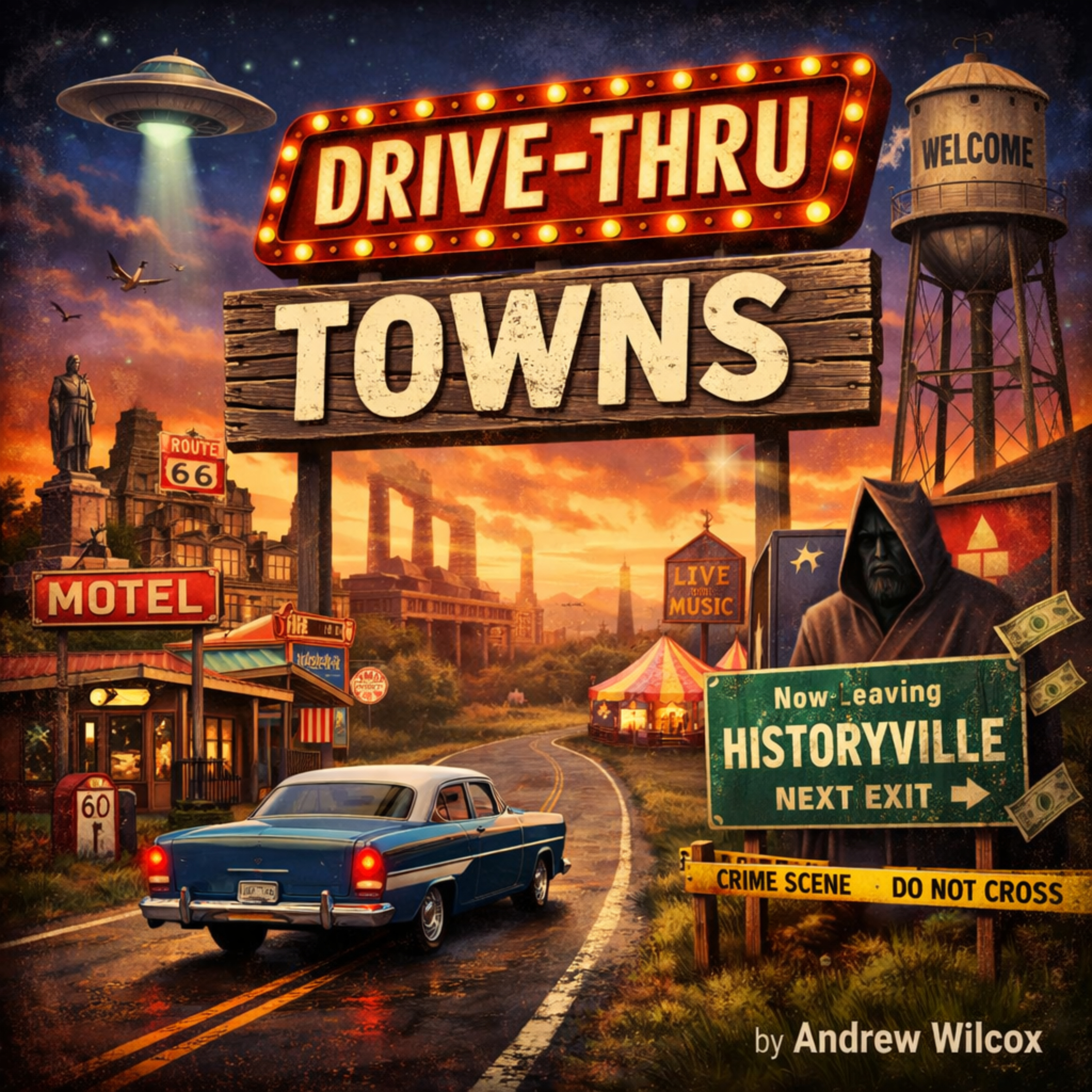
Drive-Thru Towns
by Andrew Wilcox
“Drive-Thru Towns” is about the places you only slow for a red light or a gas stop—tiny dots where something huge once happened. A forgotten invention, a vanished boomtown, a cult, a crime ring, a spiritualist camp, a song lyric, a ghost story. Each episode unpacks who, what, where, when, why, and how to reveal why that “nothing” town once mattered—and why it’s still worth pulling over for today.
-
31
Wiscasset, Maine
Wiscasset: The Nuclear Piggy Bank at the Prettiest Village in MaineWiscasset’s nuclear power plant didn’t explode. It just stopped paying the town. From 1972 to 1996, the Maine Yankee nuclear power plant on Bailey Peninsula generated roughly 119 billion kilowatt-hours of electricity—and in the process, it funded some of the lowest property taxes in the United States. Thanks to this reactor-fueled piggy bank, a tiny coastal village was able to spend decades living like a small town with a Silicon Valley address, punching far above its weight in school systems, public services, and grand civic infrastructure.In this episode of Drive-Thru Towns, host Andrew Wilcox looks past the glossy, postcard-perfect windshield view of "The Prettiest Village in Maine." Route 1 drivers know Wiscasset for its stunning early 19th-century historic district and the legendary, standing-room-only tourist pilgrimage to Red’s Eats for lobster rolls. But beneath the scenic facade lies a complex, permanent conversation about what happens when an infrastructure giant leaves.When safety issues forced Maine Yankee to shut down permanently in 1996, the town was left to face the brutal math of maintaining an oversized civic blueprint on a regular small-town tax base. We explore the geographic logic that brought the reactor to the tidal waters of the Sheepscot River, the hangover of a disappearing municipal patron, and the ongoing legal battles surrounding the 550 metric tons of radioactive spent nuclear waste that Uncle Sam legally promised to move—but left behind in concrete-capped steel canisters.The Postcard and the Post-Nuclear: Balancing the title of "The Prettiest Village in Maine" with a massive, multi-decade legacy of nuclear power and fiscal imagination.The Nuclear Golden Age: How a 900-megawatt pressurized water reactor became the town's ultimate financial savior, funding top-tier schools and a multimillion-dollar community center.Oversized and Decoupled: The harsh reality of a town struggling to preserve an infrastructure built during a 25-year boom after the benefactor suddenly dies.The 550-Ton Hangover: Inside the legal gridlock over the Independent Spent Fuel Storage Installation, and how a nuclear waste repository is ironically utilizing pollution-control laws to sue the town for tax exemptions.The American Thread: A cautionary tale of municipal infrastructure and imagination, echoing small towns nationwide that expand their expectations during an industrial boom only to inherit a landscape of compromise.If you want to pull back the curtain on the unexpected industries and hidden economics that fund America's most picturesque destinations, follow the show on Spotify.Instagram: @50statefamilyLinkedIn: Andrew WilcoxEmail: [email protected] the EpisodeConnect & Follow
-
30
Flagstaff, Maine
Flagstaff: The Town They Burned Before They Drowned ItThey set the town on fire—house by house, beam by beam—so that when the water finally came, there would be nothing left to float. No doors bobbing like driftwood. No roofs breaking loose like memory refusing to sink. Fire first. Then water.In this episode of Drive-Thru Towns, host Andrew Wilcox pulls over in western Maine, where the windshield view reveals nothing but Flagstaff Lake—a wide, quiet, postcard-perfect body of water. But beneath that placid surface lies a community that didn’t die of natural economic decay; it was systematically removed.We explore the deep roots of a once-thriving agricultural and timber valley whose name traces back to a flag planted by a pre-treason Benedict Arnold in 1775. We chronicle the early 20th-century push for hydropower, when Central Maine Power president Walter Wyman looked at the natural basin of the Dead River valley and saw a battery for downstream factories rather than a home for families. It is a haunting look at the cost of progress, the literal erasure of a town in 1949, and the modern ghost landscape that stubbornly reappears whenever the water level drops.The Pioneer Bowl: How a generous, fertile valley along the ominously named Dead River built a century of weight, permanence, and community before the grid arrived.Arnold’s Flag: The 1775 revolutionary origin story behind the town's name, born from a starving army's march toward Quebec.The Wyman Equation: Inside the quiet, boardroom decisions of the 1920s and 1940s where downstream electricity officially outweighed upstream lives.The 1949 "Clearance": The heartbreaking reality of residents holding funerals for their own town as crews torched homes and barns to ensure an efficient reservoir floor.The Shallow Memory: What happens when seasonal droughts pull back the curtain, exposing submerged brick foundations, standing chimneys, and old apple trees that still bloom out of the mud.The Unorganized Territory: A look at how a living community was bureaucratically reclassified into an official absence, now frozen over by winter ice-fishing huts.If you want to uncover the heavy human costs and hidden decisions buried beneath America's most beautiful landscapes, follow the show on Spotify.Instagram: @50statefamilyLinkedIn: Andrew WilcoxEmail: [email protected] the EpisodeConnect & Follow
-
29
Bucksport, Maine
Bucksport: The Paper Town with a Cursed ExoskeletonWhen Bucksport lost its massive paper mill, the town did what communities do when the giant in the room dies: it started telling better stories. For more than 80 years, the Verso mill was the entire point of Bucksport—it was the boilers, the skyline, and the steady union payroll that anchored generations of families on the Penobscot River. Then, in 2014, the mill shut down, taking 500 jobs with it and leaving a hole in the civic ledger big enough to change the town’s structural gravity.In this episode of Drive-Thru Towns, host Andrew Wilcox takes us to a Maine river town that refuses to become a museum of itself. We look past the windshield view of this industrial landscape to explore Bucksport's complicated transition from pulp to aquaculture—rebuilding its waterfront on the promise of massive, land-based salmon tanks.But hanging over this modern economic hustle, like a local joke that refuses to stay dead, is the town's original brand identity: The Curse of Colonel Buck. We visit the grave of the town's 1760s founder, Jonathan Buck, to see the infamous, inexplicable leg-shaped stain on his monument that folklore attributes to a condemned witch—a haunting reminder that this town has always understood the value of an unsettling story.The Founder’s Shadow: The legend vs. the ledger of Colonel Jonathan Buck, and why his "cursed" monument remains Maine's most enduring roadside oddity.Reprogramming the Penobscot: A look at the layered industrial history of a waterfront that successfully pivoted from a steel mill to a tanning company, to Maine Seaboard Paper, and finally to Verso.The Death of the Fortress: How the 2014 mill closure hit Bucksport like a structural failure disguised as a corporate business decision, silencing the grammar of labor.Salmon on the Bones: Inside the audacious, land-based aquaculture pivot by Whole Oceans to hatch the town's future in high-tech fish tanks.The Scale of Anxiety: How Bucksport utilizes both hard-nosed economic diversification and its rich folklore to navigate the modern coastal squeeze.If you want to hear more stories about the gritty American towns rewriting their futures after the factory whistles go silent, follow the show on Spotify.Instagram: @50statefamilyLinkedIn: Andrew WilcoxEmail: [email protected] the EpisodeConnect & Follow
-
28
Durham, Maine
Durham: The Holy City on a Barren Sand HillThey built a holy city on a sand hill, then watched it collapse under the weight of one man’s certainty. That is the story of Shiloh—a sprawling, four-story religious empire that once dominated the skyline of Durham, Maine. At its absolute peak, this was not a mere camp meeting; it was a closed, self-contained city of up to 1,000 people governed by doctrine instead of zoning laws, complete with its own bakery, blacksmith, hospital, and textiles. Today, almost all of the massive compound has been reduced to brush and buried foundations, save for one striking anomaly: a grand chapel topped by the gleaming, gilded Jerusalem Tower, rising above the tree line like an architectural dare.In this episode of Drive-Thru Towns, host Andrew Wilcox pulls off Route 136 to examine a town that keeps its secrets buried deep in the ditch line. To the casual driver, the hilltop structure looks like any historic New England church. But this building has witnessed more radical belief, institutional coercion, and catastrophic collapse than many nations see in a century.We untangle the legacy of Frank W. Sandford, a magnetic Baptist minister who convinced hundreds of followers that he was the biblical prophet Elijah returned to Earth. Followers surrendered every earthly possession to build his kingdom on a barren stretch of sandy soil near the Androscoggin River. We chronicle the dark "scandal years" of forced fasts and child neglect that culminated in the infamous 1911 voyage of the racing yacht Coronet—a horrific maritime tragedy where Sandford's absolute certainty that God would provide groceries resulted in six of his followers dying of scurvy, earning the prophet a manslaughter conviction and a cell in federal prison.The Root System of a Cult: How a 19th-century religious compound left a permanent physical and cultural footprint on a rural Maine town that wanted to be left out of the argument.The Elijah of Bowdoinham: Inside the mind and terrifying charisma of Frank Sandford, the Bates College graduate who turned real estate into a staging ground for salvation.Fortress on the Sand: The geographic irony of building a massive spiritual kingdom on terrain so agriculturally ungenerous it would rather be a beach than a farm.The Tragically Deficient Voyage: The harrowing true story of the yacht Coronet, where a global missionary cruise turned into a floating theology experiment ending in death by a lack of vitamin C.The Fifty-Year Pruning: How the grand, hundreds-of-rooms Shiloh campus fractured after Sandford's prison sentence, leading to the dramatic demolition of the empire’s wings in the 1950s.The Practical Mercy Pivot: How modern Durham has engaged in "aftermath management," turning a notorious landmark into an independent church that handles food pantries and community car shows.If you want to unearth the hidden, complicated histories behind America's most unusual architectural landmarks, follow the show on Spotify.Instagram: @50statefamilyLinkedIn: Andrew WilcoxEmail: [email protected] the EpisodeConnect & Follow
-
27
York, Maine
York: The Town That Rented Itself by the WeekYork, Maine, is a town that has been destroyed, invented, abandoned, and sold back to the summer in three different centuries. Today, it looks like coastal New England pulled straight from a glossy brochure—complete with lobster shacks, sandy beaches, historic inns, and a traffic pattern that turns summer into a full-body civic condition.In this episode of Drive-Thru Towns, host Andrew Wilcox pulls off the highway to show you a village that is actually built over ruins twice over. Long before it became a seasonal city where the population swells from 12,000 to over 50,000 every June, York was Gorgeana—one of the earliest, most powerful English cities in America and a serious colonial port.We unearth the heavy layers of York’s history, from the devastating Candlemas Massacre of 1692 to the imposing timber walls of the Old Gaol (the oldest public building in the United States). Discover how the Embargo Act of 1807 broke York's maritime empire, and how the town pulled off the ultimate American survival trick: when the global shipping economy stops paying rent, you can always learn how to dress up your past and rent the view by the week.The First City: How Sir Ferdinando Gorges attempted to build an empire in the Maine woods, creating a political and commercial hub that once rivaled the biggest ports on the Atlantic.The Candlemas Massacre: A look at the brutal 1692 raid that burned the town to the ground, and how York's historic elegance is indelibly layered over early colonial violence and erasure.The Old Gaol: The architecture of timber, iron, and fear. Why the oldest public building in the country stands as a dryly ironic tourist attraction that forgot to retire.The Geographic Trap: How the very river that connected inland timber to seaborne wealth left York utterly exposed to global blockade, weather, and shifting markets.The Resort Pivot: The post-Civil War social invention that saved a stagnant village by transforming its historic homes into "heritage" and its scenic coast into a high-stakes vacation economy.If you want to look past the postcard and discover the gritty, adaptive history under America’s favorite summer destinations, follow the show on Spotify.Instagram: @50statefamilyLinkedIn: Andrew WilcoxEmail: [email protected] the EpisodeConnect & Follow
-
26
Presque Isle and Caribou, Maine
Presque Isle & Caribou: The Potato Empire with a HeartbeatIn Presque Isle and Caribou, the soil isn’t just dirt—it is destiny with frost on it. For a generation, Aroostook County, Maine, was the potato capital of the world. These two northern strongholds sat at the dead center of that agrarian empire—railroad hubs, harvest havens, and military outposts where the rhythm of the school calendar bent to the soil, and the soil bent to the calendar.This is a deeply personal episode of Drive-Thru Towns. Host Andrew Wilcox reveals that without "The County," this podcast wouldn't exist. This is the dirt his mother was raised on, where his parents met on a blind date at the historic Northeastland Hotel while his father was stationed at the Presque Isle Air Force Base.From the bloodless Aroostook War of the 1830s that drew the international border to the sprawling runway of a Cold War missile base, we hit the brakes on the wide boulevards of Maine's deep north. We explore what happens to a proud region when the empire moves west, the machinery takes over, and a community has to learn the humiliating art of surviving after you’ve already been the absolute best at something.The Mother Road: Why Presque Isle and Caribou represent the literal origin story of Drive-Thru Towns, complete with childhood climbs up Haystack Mountain.The Bloodless War: How a 19th-century timber dispute with Great Britain drew a border around some of the richest agricultural soil in the United States before anyone knew what a spud was worth.The "Garden County" Empire: A look at the sprawling infrastructure of an industrial potato boom that saw Presque Isle threaded by three separate railroads.The Harvest Break: The unique, enduring tradition where schools close for weeks to let local teenagers work the mechanized fields—proving that the community still makes room for the crop.The Strategic Threshold: How the Presque Isle Air Base served as a critical Lend-Lease launchpad to Europe in WWII and later became the nation's very first operational intercontinental missile base.An Afterlife of Angels: A poignant reflection on the enduring spirit of northern Maine labor, tracing the legacy of local names like the Condons, Spragues, and Sheas, and a grandfather who could map incoming train tracks by memory well into his nineties.If you're drawn to the wide-open, oversized spaces of America's forgotten industrial and agricultural peaks, follow the show on Spotify so you never miss a milestone.Instagram: @50statefamilyLinkedIn: Andrew WilcoxEmail: [email protected]
-
25
Millinocket and East Millinocket, Maine
Millinocket: The Paper Town That Burned Without FireIt was called "The Magic City"—a massive industrial marvel carved entirely out of the deep Maine woods in just 18 months. Millinocket and its sister town, East Millinocket, rose to become one of the most powerful paper-making centers on the planet, turning out the physical sheets that carried the nation's news, catalogs, and daily words.In this episode of Drive-Thru Towns, host Andrew Wilcox explores the anatomy of a company town that built its entire identity around a 24/7 payroll. We trace the region's evolution from a single log cabin visited by Henry David Thoreau in 1846 to a high-tech industrial empire built by global immigrant labor. When global competition and a shrinking print economy forced the mills to go dark in 2008 and 2014, the town didn't disappear—it rearranged its gravity.We look at the complex legacy of industrial paternalism, the rhythm of the historic Ambajejus Boomhouse, and Millinocket's modern reinvention as the rugged gateway to Mount Katahdin and the terminus of the Appalachian Trail.The Wilderness Myth Meets the Machine: How a town that began with a wilderness guide for Henry David Thoreau transformed into a mega-mill that swallowed the forest whole.The Magic City: A look at Great Northern Paper Company’s audacious 1899 timeline, building a world-class industrial hub from scratch practically overnight.Assembled by Migration: The lesser-known history of the international workforce—including hundreds of Italian, Polish, Finnish, and French-Canadian laborers—who built the town's civic spine.The Ambajejus Boomhouse: The mechanical nerve center out on the West Branch of the Penobscot River that managed millions of downstream logs.From Pulp to Pedometers: The irony and resilience of a town shifting its economy from heavy industrial manufacturing to hosting footsore hikers emerging from the 100-Mile Wilderness.If you love exploring the places where America's industrial grit meets its frontier legends, follow the show on Spotify so you never miss a detour.Instagram: @50statefamilyLinkedIn: Andrew WilcoxEmail: [email protected]
-
24
Season 3 Trailer: Maine
Drive Thru Towns — Season 3 TrailerHosted by Andrew WilcoxThis season, we’re heading back into the places that made me, the roads that raised me, and the Maine that started as a few weeks old in the back seat and never really let go. From roadside rest stops and ham-and-cheese lunches with orange soda to Katahdin on the horizon, these towns are part of the map and part of the memory.We’ll explore the towns, people, industries, and legends that shaped this season’s journey through Maine’s drive-through towns.Featured in this season’s stories:Flagstaff and Dead River.Madrid.Durham’s Shiloh.Swan Island.Freeman Township.Millinocket and East Millinocket.Presque Isle and Caribou.York.Kittery.Monson.Bucksport.Eastport.Wiscasset.Special thanks to Chloe Jones for the music.Hosted by Andrew Wilcox.Contact: [email protected]
-
23
The ALCAN: Drive-Thru towns through the Alaska-Canada Highway
The ALCAN: The Road That Connected a Country and Erased the People Who Built ItOne thousand, three hundred, and eighty-seven miles. Built in just eight months during the height of World War II, the Alaska Highway (ALCAN) is more than an engineering marvel—it is a landscape of compressed history, wartime urgency, and human endurance.In this special extended episode of Drive-Thru Towns, host Andrew Wilcox drives the entire length of the highway, from the wheat fields of Dawson Creek, BC, to the bison crossings of Delta Junction, AK. We uncover the stories the monuments often omit: the 3,000 Black soldiers in segregated regiments who built the most grueling sections of the road, the 5,000-year-old Indigenous trading villages displaced by the route, and the homesick 21-year-old soldier who nailed one sign to a post and accidentally created a global landmark.Mile Zero (Dawson Creek, BC): Why a humble grain elevator is the true heart of the highway's origin.The Sign Post Forest (Watson Lake, YT): How one soldier’s sign for Danville, Illinois, turned into a collection of over 100,000 hometown memories.The Meeting Place (Champagne, YT): The tragic story of Shadhäla-ra, a village that survived 5,000 years of history only to be "killed" twice by the highway’s arrival and its eventual bypass.Tok, Alaska: The town of three names (none of them certain) and the "miracle wind" that saved it from a wildfire.The Terminus (Delta Junction, AK): Ending the journey among a herd of Montana bison that treat the highway like a temporary neighbor.We take a deep look at the racial dynamics of the construction effort. In 1942, the U.S. Army was still segregated. Black regiments, like the 93rd, 95th, and 388th Engineers, were often given the most difficult, swampy, and remote terrain to conquer. Despite facing systemic doubt from their own leadership, these men completed the most challenging bridges and mountain passes, physically connecting the continent at the legendary "handshake" near Beaver Creek.Whether you’re planning your own Northward pilgrimage or listening from your armchair, follow us on Spotify for more stories of the roads that shape us.Instagram: @50statefamilyLinkedIn: Andrew WilcoxEmail: [email protected]: Andrew WilcoxTheme Music: A profound thanks to Chloe Jones for the music. Hear her work at chloejonesmusic.co.uk.
-
22
Utqiagvik, Alaska
Utqiagvik: The Top of the World, Where America Ends and the Dark BeginsThere is no road to Utqiagvik. There never has been, and likely never will be. To reach the northernmost city in the United States, you must fly over hundreds of miles of roadless tundra or arrive by barge during the brief summer window when the Arctic Ocean isn't frozen solid.In this episode of Drive-Thru Towns, host Andrew Wilcox journey’s to the edge of the world. While Utqiagvik (formerly Barrow) might look like a temporary pioneer outpost to the uninitiated, it is actually one of the oldest permanent settlements in North America, with a history of Iñupiat habitation stretching back to 500 AD.We explore the duality of a place that endures 65 days of total polar night and 80 days of never-setting sun. From the tragic 1935 plane crash that claimed the lives of American icons Will Rogers and Wiley Post to the "Cold War miracle" of 1988 where Soviet and American crews joined forces to save trapped whales, Utqiagvik is a place where history is as deep as the permafrost.65 Days of Night: Why the polar dark isn't something the Iñupiat "endure," but rather a culturally significant season for storytelling and community.The Rogers-Post Crash: The story of the Iñupiat hunter who witnessed the death of a national icon in a frozen lagoon 15 miles from town.The 1961 "Duck-In": One of the earliest Native civil rights protests in American history, where the community defied federal hunting bans to protect their food security.Operation Breakthrough: How two trapped gray whales briefly thawed the Cold War in 1988, capturing the world's attention.Reclaiming the Name: The 2016 vote to restore the name Utqiagvik—"the place to gather wild roots"—and reject the name of a British bureaucrat who never visited.If you’re drawn to the stories of the Far North and the resilience of the people who call the Arctic home, follow the show on Spotify.Instagram: @50statefamilyLinkedIn: Andrew WilcoxEmail: [email protected]: Andrew WilcoxTheme Music: Special thanks to Chloe Jones for the music Explore more at chloejonesmusic.co.uk.
-
21
Portlock, Alaska
Portlock: The Village Everyone Fled FromDeep on the Gulf of Alaska coast, on the rugged southern tip of the Kenai Peninsula, lies a ghost town that didn't die because the fish ran out or the economy collapsed. It died because of fear.In this episode of Drive-Thru Towns, host Andrew Wilcox takes us to Portlock (also known as Port Chatham), a place so unsettling that an entire community abandoned it simultaneously in 1950. Settled in the 1920s as a thriving salmon cannery town, Portlock’s story took a dark turn in the 1940s when mutilated animal carcasses, missing hunters, and bodies with inexplicable wounds began to appear.We explore the legend of the Nantiinaq—a large, hairy, human-like creature rooted in Alutiiq tradition—and the chilling reality of a town that simply walked away, leaving buildings standing and artifacts scattered, never to return.The Cannery Boom: How Portlock briefly thrived as a commercial hub for the Gulf of Alaska’s fishing fleet.The "Nantiinaq" Reports: The chilling accounts from the late 1940s that led local elders to believe a traditional Indigenous cryptid had claimed the area.The Great Exodus: Why the entire population fled by 1950, leaving a working fishing village to rot in the salt air without an official explanation.Modern Echoes: The unsettling experience of modern visitors who find the "Unga-type" isolation of Portlock still carries the weight of its abandoned history.If you have a taste for the strange and the unexplained corners of the American map, follow the show on Spotify to catch every stop on our journey.Instagram: @50statefamilyLinkedIn: Andrew WilcoxEmail: [email protected]: Andrew WilcoxTheme Music: Special thanks to Chloe Jones for the music. Discover more of her work at chloejonesmusic.co.uk.
-
20
Eagle, Alaska
Eagle: The Last American Town Before Everything Became CanadaSituated on the banks of the Yukon River, just 12 miles from the Canadian border, sits a town that was once the "Gateway to the Interior." Today, it is a quiet sentinel of history at the end of the Taylor Highway.In this episode of Drive-Thru Towns, host Andrew Wilcox explores Eagle, Alaska—the first incorporated city in the Interior and the last American stop for fortune-seekers heading to the Klondike. We trace Eagle’s journey from a bustling hub of 1,700 residents to a peaceful community of 87, where the median age is 70 and the log cabins settle slowly into the permafrost.We also recount the incredible 1905 detour of legendary explorer Roald Amundsen, who mushed 800 miles across the frozen wilderness just to reach Eagle’s telegraph station and tell the world he had finally conquered the Northwest Passage.The Border's Edge: Why Eagle became the seat of justice and the primary customs port for the entire Yukon River corridor.Fort Egbert: A look at the five surviving buildings of the military post that once maintained order on the edge of the world.Amundsen’s Telegram: The story of the Norwegian explorer who left his ship frozen in the ice to find the nearest "send" button—located right here in Eagle.The Melancholy Beauty of Aging: How Eagle watched the gold rushes of Nome and Fairbanks pass it by, choosing instead to grow old gracefully along the river.If you're drawn to the quiet corners of the map and the towns that time forgot, follow the show on Spotify for more stories from the edge of the frontier.Instagram: @50statefamilyLinkedIn: Andrew WilcoxEmail: [email protected]: Andrew WilcoxTheme Music: Special thanks to Chloe Jones for the music. Explore her work at chloejonesmusic.co.uk.
-
19
Chicken, Alaska
Chicken: Too Remote to Spell PtarmiganDeep in the Interior of Alaska, at the end of the Taylor Highway, sits a town that owes its name to a spelling bee that never happened.In this episode of Drive-Thru Towns, host Andrew Wilcox takes us to Chicken, Alaska—a community founded by gold miners a full decade before the Klondike became a household name. When it came time to name the post office in 1902, the locals wanted to honor the ptarmigan, the ubiquitous game bird that kept them fed through brutal subarctic winters. There was just one problem: nobody could agree on how to spell it. Rather than risk the embarrassment of a misspelled official document, they settled on "Chicken."We explore the history of the "Sixteen Liars" (the area's first legendary storytellers), the life of Anne Hobbs Purdy (the famed schoolteacher known as "Tisha"), and the modern-day absurdity of a fast-food giant claiming to "buy" a town for 10,000 sandwiches.The "Sixteen Liars": Why the first 16 prospectors on the Fortymile River were more famous for their tall tales than their gold.Gold the Size of Cracked Corn: A look at the 1898 USGS report suggesting the name "Chicken" might actually refer to the size of the local gold nuggets.Anne Hobbs Purdy: The incredible story of the woman who arrived by pack train in 1927, married a miner, and raised 11 children in a town with no power grid.The Jack in the Box "Takeover": How a 2021 ad campaign "bought" the town to end the "Chicken Wars," and the $10,000 donation that actually helped the 12 year-round residents.If you’re ready to visit a place where outhouses are still the standard and the "Chickenstock" music festival is the highlight of the year, follow us on Spotify.Instagram: @50statefamilyLinkedIn: Andrew WilcoxEmail: [email protected]: Andrew WilcoxTheme Music: Special thanks to Chloe Jones for the music. Hear more at chloejonesmusic.co.uk.
-
18
Seldovia, Alaska
Seldovia: The Boardwalk Town the Highway Killed Before the Earthquake CouldThis is the only episode of Drive-Thru Towns where you actually cannot drive through the town. There is no road to Seldovia. To get here, you have to cross Kachemak Bay by boat or drop out of the sky by floatplane, arriving in a community that has been defined by its isolation since 1787.In this episode, host Andrew Wilcox explores the "herring bay" that was once the bustling commercial heart of the region. We tell the story of the lost Seldovia boardwalk—a wooden main street suspended above the tides—and how it was "killed" twice: first by the arrival of the Sterling Highway in neighboring Homer, and finally by the catastrophic 1964 Good Friday Earthquake.We also look at how Seldovia lives on in the popular imagination as the fictional town of "Kaneq" in Kristin Hannah’s The Great Alone, and why the real-life residents still choose the "island that isn't an island" long after the herring and the original boardwalk have vanished.If you enjoyed this journey to a town beyond the pavement, please follow the show on Spotify to catch our next stop.Instagram: @50statefamilyLinkedIn: Andrew WilcoxEmail: [email protected]: Andrew WilcoxTheme Music: A special thanks to Chloe Jones for the fluid, atmospheric score. Hear more of her work at chloejonesmusic.co.uk.Connect & FollowCredits
-
17
Hope, Alaska
Hope: Named After a 17-Year-Old Boy, Forgotten Like One TooAt Mile 56.3 of the Seward Highway, a 17-mile spur road dead-ends into a town that time—and the gold rush—nearly left behind. While the rest of the world remembers the Klondike, the real story of Alaska’s first major gold strike began here, on the shores of Turnagain Arm.In this episode of Drive-Thru Towns, host Andrew Wilcox takes us down the Hope Highway to a community of 70 people that outlasted its own history. We trace the steps of Alexander King, the mysterious prospector who found the first "color" and then vanished, and Percy Hope, the 17-year-old traveler who gave the town its name before fading into obscurity.We compare the quiet survival of Hope with the ghost of Sunrise City, which was briefly the largest city in Alaska in 1898 with 800 residents, two saloons, and a brewery—only to be swallowed by the spruce forest just a few years later. It’s a story of "sister towns," lopsided luck, and the original path of the Iditarod Trail.If you enjoyed this detour into the birthplace of the Alaska Gold Rush, please follow the show on Spotify to ensure you never miss a stop.Instagram: @50statefamilyLinkedIn: Andrew WilcoxEmail: [email protected]: Andrew WilcoxTheme Music: Special thanks to Chloe Jones for the evocative, rolling score. Visit her at chloejonesmusic.co.uk.Connect & FollowCredits
-
16
Eklutna, Alaska
Eklutna: The Oldest Living Place No One Drives ToTwenty-six miles from the glass towers of Anchorage sits a village that has been continuously inhabited for over 800 years. While thousands of commuters blast past the Eklutna exit at 65 miles per hour every morning, they are passing a site that was already ancient when Marco Polo left Venice.In this episode of Drive-Thru Towns, host Andrew Wilcox invites you to hit the brakes at the oldest inhabited place in the metropolitan area. We explore the vibrant, painted Spirit Houses of the Eklutna cemetery—a unique architectural synthesis of Dena’ina Athabascan tradition and Russian Orthodox ritual.We also uncover the heavy history of the 1915 influenza epidemic that silenced seven of the eight Dena'ina villages in the region, leaving Eklutna as a lone, resilient survivor. From the 1870s log church (the oldest building in the Anchorage area) to the diverted waters of Eklutna Lake, this episode is a meditation on continuity, memory, and the radical act of staying put.If you enjoyed this look at the intersection of ancient history and modern highways, please follow the show on Spotify.Instagram: @50statefamilyLinkedIn: Andrew WilcoxEmail: [email protected]: Andrew WilcoxTheme Music: A special thanks to Chloe Jones for the spare, haunting score that mirrors the Alaskan landscape. Discover her music at chloejonesmusic.co.uk.
-
15
Ninilchik, Alaska
Ninilchik: Where Russia Never Really LeftHigh on a bluff overlooking Cook Inlet, five gold onion domes catch the Alaskan sun, looking like a piece of the Old World that drifted across the Pacific and simply took root. This is Ninilchik, a town that the Russian Empire retired from—and then forgot to take with it.In this episode of Drive-Thru Towns, host Andrew Wilcox explores the "pensioner settlement" established in 1847 by the Russian-American Company. While the Tsar sold Alaska to the U.S. in 1867, the people of Ninilchik remained in a state of crystalline isolation for another century. We dive into the mystery of Ninilchik Russian, a unique linguistic "time capsule" spoken nowhere else on Earth, and the haunting local legend of the Moose Lady—a folklore warning about the dangers of drifting too far into the wilderness.Join us as we pull off the Sterling Highway to hear the stories of a community that stayed put while empires rose and fell around them.If you enjoyed this journey into the Kenai Peninsula's hidden history, please follow the show on Spotify and join our community of road-trippers and history buffs.Instagram: @50statefamilyLinkedIn: Andrew WilcoxEmail: [email protected]: Andrew WilcoxTheme Music: Special thanks to Chloe Jones for the evocative music that brings these landscapes to life. Hear more of her work at chloejonesmusic.co.uk.Connect & FollowCredits
-
14
Whittier, Alaska
Whittier: The Town That Was a Secret, Then a Bunker, Then ItselfMost towns have a "welcome" sign. Whittier has a schedule. To enter this town, you must drive through a single-lane, two-and-a-half-mile mountain tunnel that only opens for cars once an hour. If you miss your window, the mountain simply says "no."In this episode of Drive-Thru Towns, host Andrew Wilcox takes us through the Anton Anderson Memorial Tunnel and into a vertical community tucked away in a radar-invisible Alaskan fjord. Originally built as a top-secret WWII military base to provide a deep-water, ice-free port, Whittier was designed for isolation. Today, nearly the entire population lives under one roof in the 14-story Begich Towers, a former Army barracks turned civilian "city."From the haunting, asbestos-filled ruins of the Buckner Building to the interior hallways that connect the school, post office, and police station, we explore what happens when a military fortress becomes a hometown.If you’re fascinated by the "City Under One Roof," follow the show on Spotify for more stories from the road less traveled.Instagram: @50statefamilyLinkedIn: Andrew WilcoxEmail: [email protected]: Andrew WilcoxTheme Music: Special thanks to Chloe Jones for the atmospheric and resonant score. Visit her at chloejonesmusic.co.uk.Connect & FollowCredits
-
13
Portage, Alaska
Portage: The Town the Earth SwallowedAt Mile Marker 79 on the Seward Highway, a skeletal "ghost forest" stands frozen in the tidal mudflats. These white, salt-drowned trees are the only remaining headstones for Portage, Alaska—a town that quite literally sank into the earth.In this episode of Drive-Thru Towns, host Andrew Wilcox uncovers the story of a roadside junction where travelers once drank bourbon chilled with 1,000-year-old glacier ice. That all changed on Good Friday, 1964, when the second-largest earthquake in recorded history struck. In just four minutes and thirty-eight seconds, the ground beneath Portage liquefied, dropping the entire town eight to ten feet and handing it over to the relentless tides of Turnagain Arm.We explore the terrifying geology of liquefaction, the irony of a town built on a recurring disaster site, and the quiet erasure of a place that infrastructure created and nature reclaimed.If you enjoyed this deep dive into Alaska’s sunken history, please follow the show on Spotify to catch every stop on our journey through America's disappeared places.Instagram: @50statefamilyLinkedIn: Andrew WilcoxEmail: [email protected]: Andrew WilcoxTheme Music: Special thanks to Chloe Jones for providing the atmospheric score. Discover more of her music at chloejonesmusic.co.uk.
-
12
Dyea, Alaska
Dyea, Alaska: The Town That Lost a Race and Died of ItThere is a cemetery in Southeast Alaska where almost every headstone shares the same date: April 3, 1898.In this episode of Drive-Thru Towns, host Andrew Wilcox takes us to a flat river delta near Skagway that was once home to 8,000 people. During the height of the Klondike Gold Rush, Dyea was the gateway to the brutal Chilkoot Pass—the "Golden Stairs" to wealth or ruin.We explore the "Palm Sunday Avalanche," a disaster that buried dozens of stampeders under walls of white, and the subsequent rise of the railroad that ultimately rendered the town obsolete. It wasn't the mountain that killed Dyea; it was a surveyor’s decision ten miles away.If you enjoyed this journey into Alaska’s "ghost" geography, please follow the show on Spotify to catch every stop on our map.Instagram: @50statefamilyLinkedIn: Andrew WilcoxEmail: [email protected]: Andrew WilcoxTheme Music: A special thanks to Chloe Jones for the hauntingly beautiful score. Explore more of her work at chloejonesmusic.co.uk.
-
11
Season 2: Alaska- Trailer
Drive Thru Towns — Season 2 Trailer: AlaskaWelcome to Drive Thru Towns.Season 2 is here — and we're heading somewhere bigger, wilder, and colder than anywhere we've been before.Alaska.This season, we leave the moss-draped back roads of Florida behind and drive north — all the way to the edge of the continent, and sometimes beyond it. We're talking about a town the earth swallowed whole in under five minutes. A road built in eight months by soldiers whose names were literally erased from the photographs. A village everyone abandoned — and nobody can fully explain why. A bunker city carved into a mountain by a Cold War military that needed a secret. And the very top of the world, where America simply runs out of road.Alaska has always been the place where history went to disappear. This season, we're going to find it.This season covers:The earthquake ghost town of Portage — swallowed by the tides of Turnagain Arm in 1964Dyea — the gold rush boomtown that lost a race to its neighbor and vanished inside a single seasonWhittier — the secret WWII bunker city where most of the town still lives under one roofNinilchik — a Russian colonial settlement where an Imperial-era dialect of Russian is still spoken todayThe ALCAN — the highway that connected a continent, built on a history it spent 75 years trying to eraseUtqiagvik (Barrow) — 1,500 years of continuous habitation at the top of the world, where America ends and the dark beginsAnd much moreSeason 2 of Drive Thru Towns drops soon. Follow now so you don't miss the first episode.Connect with the ShowHost: Andrew WilcoxFollow for more episodes: [Click Follow on Spotify]Instagram: @50statefamilyLinkedIn: Andrew WilcoxEmail: [email protected] thanks to Chloe Jones for the music: chloejonesmusic.co.uk
-
10
Havana and Quincy, FL
Havana & Quincy: The Millionaires of Shade TobaccoWelcome to Drive Thru Towns. In this episode, we travel the rolling hills of Gadsden County to explore Havana and Quincy, Florida—two towns built on the "green gold" of shade tobacco and a single, legendary investment that changed the face of the American South.This isn't just a story about farming; it’s a masterclass in risk, vision, and the "fads" that end up defining centuries. We pull over to look at:The Shade Tobacco Empire: How a specific, fragile leaf grown under massive tapestries of cheesecloth turned Gadsden County into the cigar-wrapper capital of the world.The Coca-Cola Millionaires: The incredible true story of Pat Munroe, the Quincy banker who pressured his neighbors to buy shares of a "failing" soda company during the Great Depression—turning a small Florida town into the wealthiest per-capita community in the United States.The "Fad" That Lasted: A personal look at the skepticism of those who passed on the Coca-Cola stock, including the host's own family history at the Salem cemetery.The Architecture of Wealth: From the grand Victorian "Coca-Cola Mansions" of Quincy to the repurposed tobacco barns of Havana that now house the state's premier antique collections.A Landscape of Ghosts: Moving through the "Havana Curves" where the ghosts of the tobacco industry still whisper from the shadows of abandoned curing barns.Havana and Quincy remind us that history is often made by the things we can’t see coming—and that sometimes, the best move you can make is betting on the thing everyone else calls a "fad."Host: Andrew WilcoxFollow for more episodes: [Click Follow on Spotify]Instagram: @50statefamilyLinkedIn: Andrew WilcoxEmail: [email protected] thanks to Chloe Jones for the music: chloejonesmusic.co.uk
-
9
Micanopy, FL
Micanopy: The Town That Time ForgotWelcome to Drive Thru Towns. In this episode, we pull off US-441 and move under a canopy of ancient live oaks to visit Micanopy, Florida—a place where the humidity feels like history and the light moves as slow as the traffic.Micanopy isn't just an antique capital; it is the oldest inland town in Florida and a landscape that has inspired Pulitzer Prize winners and Hollywood directors alike. We explore the deep layers of the "Florida Gothic" aesthetic, including:The Namesake Chief: The story of Micanopy, the "High Chief" of the Seminole Nation, and the fierce resistance that defined the Second Seminole War.A Lost Utopia: The 1820s experiment of "Alachua," one of the few Jewish communitarian agricultural colonies in the antebellum South.The Hollywood Transformation: How this quiet village stood in for South Carolina in the 1991 film Doc Hollywood, and why its "moss-draped perfection" made it the ultimate cinematic backdrop.The Literary Edge: The town’s connection to Marjorie Kinnan Rawlings and the rugged, beautiful "scrub" life that defined her world-famous writing.Bison in the Prairie: The prehistoric feel of the adjacent Paynes Prairie, where wild horses and bison still roam a landscape documented by naturalists over 250 years ago.Micanopy is a town that doesn't just preserve the past; it lives in it. It’s a place where you don't go to see sights—you go to remember a version of Florida that existed long before the first theme park was even a dream.Host: Andrew WilcoxFollow for more episodes: [Click Follow on Spotify]Instagram: @50statefamilyLinkedIn: Andrew WilcoxEmail: [email protected] thanks to Chloe Jones for the music: chloejonesmusic.co.ukConnect with the ShowCredits
-
8
Cedar Key/ Rosewood, FL
Cedar Key & Rosewood: Pencils, Clams, and a Buried TownWelcome to Drive Thru Towns. In this episode, we travel to the end of State Road 24 to visit two towns forever linked by a railroad, a swamp, and a silence that took decades to break: Cedar Key and Rosewood, Florida.This isn't just a trip to a quiet fishing village; it’s a journey through the tools that wrote American history and the stories that were nearly erased from it. We explore:The Pencil Capital of the World: How the towering cedar forests of these islands provided the wood for billions of pencils, fueling American education and bureaucracy until the trees simply ran out.Atsena Otie: The "original" Cedar Key, now a ghost island of ruins and cisterns, abandoned after the devastating hurricane of 1896 proved that nature always has the final say.The Tragedy of Rosewood: A somber look at the self-sufficient, prosperous African American community that was destroyed in a week of violence in 1923—and the brave railroad conductor who risked everything to spirit women and children to safety.Breaking the Silence: How a town "erased" from the map for sixty years finally had its story told, leading to a historic act of state restitution.The Clam Resurrection: How a community that lost its timber and its nets reinvented itself as a world-class aquaculture hub, proving that resilience is the true local industry.The road into Cedar Key is the same road out, but after hearing these stories, you’ll never look at the Florida hammock—or a Number Two pencil—the same way again.Host: Andrew WilcoxFollow for more episodes: [Click Follow on Spotify]Instagram: @50statefamilyLinkedIn: Andrew WilcoxEmail: [email protected] thanks to Chloe Jones for the music: chloejonesmusic.co.uk
-
7
Fernandina Beach. FL
Fernandina Beach: The Isle of Eight FlagsWelcome to Drive Thru Towns. In this episode, we steer toward the northeastern tip of Florida to Fernandina Beach on Amelia Island—a place that has seen more flags, more pirates, and more reinventions than perhaps any other spot in America.Fernandina Beach isn't just a charming Victorian escape; it is a survivor of centuries of global tug-of-war. We explore the high-stakes history of this deep-water harbor, including:The Pirate Republic: The wild story of Luis Aury, a French privateer who claimed the island for a Mexican Republic that didn't even know he existed, just to provide cover for his smuggling operations.The Eight Flags: Why this small island holds the unique distinction of having been under eight different national flags—from France and Spain to the short-lived "Republic of the Floridas."The Manhattan of the South: How Senator David Levy Yulee built the state's first cross-peninsula railroad and envisioned a metropolis that would rival New York, only to have his dreams derailed by the Civil War.The Palace Saloon: A look inside the oldest continuously operated bar in Florida, which survived Prohibition by selling "medicinal" ice cream and gasoline, and where a ghost bartender reportedly still keeps watch.Victorian Resilience: How a town that once thrived on shrimping and shipping preserved its stunning "gingerbread" architecture to become a masterclass in historic preservation.Fernandina Beach is a town that empires wanted, pirates stole, and locals saved. It’s a reminder that even the most beautiful places are often forged in the fires of conflict and ambition.Host: Andrew WilcoxFollow for more episodes: [Click Follow on Spotify]Instagram: @50statefamilyLinkedIn: Andrew WilcoxEmail: [email protected] thanks to Chloe Jones for the music: chloejonesmusic.co.uk
-
6
Mount Dora, FL
Mount Dora: Where the Map LiesWelcome to Drive Thru Towns. In this episode, we climb to one of the highest points in Florida to discover Mount Dora—a town that defies every geological and cultural expectation of the Sunshine State.Mount Dora isn't just a quaint village of antique shops and bed-and-breakfasts; it is a place of inland lighthouses, cinematic history, and Cold War secrets. We explore the fascinating contradictions of this lakeside "mountain" town, including:The Mountain and the Light: How a town at 184 feet above sea level became a Florida "peak" and why it maintains a proud, freshwater lighthouse miles from any coastline.The Catacombs of Mount Dora: The incredible story of the "Catacombs," a 5,000-square-foot private bomb shelter built during the height of nuclear anxiety—complete with a 2,000-pound steel door hidden beneath a croquet court.The Pinkest Disaster in Hollywood: A look back at the time Hollywood painted the entire town Pepto-Bismol pink for the film Honky Tonk Freeway, and how the town survived the movie’s spectacular box-office failure.Pat Alasnas’s Ghost: The literary legacy of the novel Alas, Babylon, which used Mount Dora as the inspiration for a town surviving nuclear annihilation.A Legacy of Stubbornness: How Mount Dora has maintained its identity—and its afternoon tea—against the relentless pull of nearby Orlando’s theme park gravity.Mount Dora is a masterclass in being exactly yourself, regardless of what the map or the neighbors say. It is a town built on a ridge that looks out over a landscape it refuses to conform to.Host: Andrew WilcoxFollow for more episodes: [Click Follow on Spotify]Instagram: @50statefamilyLinkedIn: Andrew WilcoxEmail: [email protected] thanks to Chloe Jones for the music: chloejonesmusic.co.uk
-
5
Port St. Joe, FL
Port St. Joe: The Town That Wrote Florida’s Soul—Then VanishedWelcome to Drive Thru Towns. In this episode, we explore the "Forgotten Coast" to uncover the story of a city that was once the largest and most ambitious in Florida—only to be wiped off the map in less than a decade.Port St. Joe (formerly St. Joseph) isn't just a quiet waterfront town; it is the birthplace of Florida’s legal identity. We look at the rise, fall, and resurrection of a city that refused to stay buried:The Rivalry of the Century: How a group of defiant businessmen built St. Joseph from scratch just to spite the neighboring town of Apalachicola.The Constitutional Convention: The incredible story of how the legal soul of Florida was written in 1838 in a grand hall that no longer exists.The Triple Crown of Disaster: A harrowing look at how yellow fever, a devastating fire, and a massive storm surge erased a city of 12,000 residents in a matter of years.The Great Migration: How the few surviving houses were literally floated on barges across the bay to start over in other cities.Modern Resilience: A visit to the Port St. Joe of today—a place of pristine scallops, working waterfronts, and a museum where mannequins tell the story of a vanished empire.Port St. Joe reminds us that while cities can be erased by the elements, the ideas and laws they leave behind can govern for centuries.Host: Andrew WilcoxFollow for more episodes: [Click Follow on Spotify]Instagram: @50statefamilyLinkedIn: Andrew WilcoxEmail: [email protected] thanks to Chloe Jones for the music: chloejonesmusic.co.uk
-
4
Everglades City, FL
Welcome to Drive Thru Towns. In this episode, we journey to the edge of the map to Everglades City, Florida—a town where the line between the wilderness and the law has always been as thin as a mangrove leaf.Everglades City isn't just a gateway to a National Park; it’s a monument to stubbornness, isolated ambition, and a local history that reads like a thriller. We dive into:The Vision of Barron Collier: How a self-made advertising tycoon bought a county’s worth of swamp and tried to build a corporate utopia in the middle of nowhere.The Tamiami Trail: The brutal, explosive saga of building the "Impossible Road," a feat of engineering that required millions of pounds of dynamite to blast through solid limestone.The "Square Grouper" Era: A look at the 1970s and 80s, when the town’s labyrinth of mangroves became the primary entry point for a multi-million dollar marijuana smuggling trade.Operation Everglades: The 1983 federal raid that saw nearly every able-bodied man in town arrested, leaving a legacy of local defiance and silence.Survival and Stone Crabs: How a community that has survived world-changing hurricanes and massive federal stings continues to reinvent itself as the "Stone Crab Capital of the World".Everglades City is a place where nature eventually wins every argument, but the people here have never stopped talking back. It is a town defined by what it chose to keep out—and what it was brave enough to let in.Host: Andrew WilcoxFollow for more episodes: [Click Follow on Spotify]Instagram: @50statefamilyLinkedIn: Andrew WilcoxEmail: [email protected] thanks to Chloe Jones for the music: chloejonesmusic.co.uk
-
3
Apalachicola, FL
Apalachicola: The Town That Froze the WorldWelcome to Drive Thru Towns. In this episode, we travel to the "Forgotten Coast" to visit Apalachicola, Florida—a place that proves you don't need a theme park to have a world-changing story.Apalachicola isn't just a picturesque fishing village; it’s a town built on ice, cotton, and a fierce sense of survival. We explore the layers of history hidden beneath the oyster shells, including:The Ice Man of Florida: How Dr. John Gorrie accidentally invented mechanical refrigeration and the air conditioner in 1844 while trying to cure yellow fever.A National Tragedy: The story of the "Apalachicola Ice Queen"—the ship that was supposed to bring Gorrie's invention to the world but sank, leaving him to die in poverty and obscurity.The Cotton Kingdom: How this small port once handled more cotton than almost anywhere else in the South, creating a skyline of brick warehouses that still stand today.The Oyster Capital: The rise and fall of the legendary Apalachicola Bay oyster industry and the town's ongoing battle to save its ecological heart.Botany and Rebellion: The legacy of Alvan Wentworth Chapman, the world-famous botanist who stayed in Apalachicola through the Civil War despite his Union sympathies.Apalachicola is a town that the 20th century largely forgot to pave over. It remains a masterclass in "Florida Gothic"—weathered, beautiful, and deeply human.Host: Andrew WilcoxFollow for more episodes: [Click Follow on Spotify]Instagram: @50statefamilyLinkedIn: Andrew WilcoxEmail: [email protected] thanks to Chloe Jones for the music: chloejonesmusic.co.uk
-
2
Cassadaga, FL
Cassadaga: Where Mayberry Meets the Twilight ZoneWelcome back to Drive Thru Towns. In this episode, we venture off the fluorescent path of Florida’s theme parks and into a 57-acre historic community that has spent over 130 years talking to the other side.Cassadaga, Florida, isn't your typical roadside attraction. It is a National Register of Historic Places site and the oldest continuously active Spiritualist community in the Southeast. We go beyond the "Certified Medium On Duty" signs to explore:The Founding Ghost: How a young medium named George Colby followed a spirit guide named Seneca from the frozen lakes of Minnesota to the healing springs of Florida to cure his tuberculosis.The "Seer of Spiritualism": The story of a man who built a town on land shown to him in a séance and then deeded it all to the community.A Religion, Not a Gimmick: Understanding Spiritualism as a recognized religion that believes in the survival of personality after death and the healing power of communication.The Legend of the Devil’s Chair: Uncovering the true, heartbreaking history of a cemetery bench built for a grieving man with arthritis—and the urban legends that followed.The Golden Age and the Hotel: A look at the Cassadaga Hotel, its 1926 fire, and "Arthur," the cigar-smoking spirit who reportedly never checked out.Cassadaga was built on the universal human ache of grief, born from a need to prove that the people we love do not simply cease to exist. Whether you're a skeptic or a seeker, the silence here has something to say.Host: Andrew WilcoxFollow for more episodes: [Click Follow on Spotify]Instagram: @50statefamilyLinkedIn: Andrew WilcoxEmail: [email protected] thanks to Chloe Jones for the music: chloejonesmusic.co.uk
-
1
St. Marks, Florida
St. Marks: Small Town, Enormous TabWelcome to Drive Thru Towns. In this episode, we pull over at the end of the road in North Florida to explore St. Marks—a town of 300 people with enough history to fill a library.From Spanish forts plastered in lime to look like stone to a pirate who declared his own sovereign nation in a swamp , St. Marks is a place where geography becomes destiny. We dive deep into:The "New Pocahontas": The tragic and heroic story of Milly Francis, a fifteen-year-old girl who saved a soldier's life only to have her own father executed at the same fort.The Railroad that Killed a Town: How a simple track alignment in 1837 caused the neighboring town of Magnolia to vanish into thin air.The Lighthouse that Refused to Die: A structure built from the ruins of a "recycled empire" that survived hurricanes, Civil War shelling, and a direct attempt at demolition.The Modern Refuge: How a mosquito-choked "fever swamp" transformed into a world-class restorative landscape for migratory birds and monarch butterflies.History isn't behind glass in St. Marks—it's under your feet. Next time you see the sign, don’t just drive through. Pull over.Host: Andrew WilcoxFollow for more episodes: [Click Follow on Spotify]Instagram: @50statefamilyLinkedIn: Andrew WilcoxEmail: [email protected] thanks to Chloe Jones for the music: chloejonesmusic.co.uk
-
0
Drive-Thru Towns Season 1- Florida-Trailer
Drive‑Thru Towns – TrailerHosted by: Andrew WilcoxMusic by: Chloe JonesEver blown past a tiny town, slowed only by a red light or a gas pump, and thought, “There’s nothing there”?Drive‑Thru Towns is here to prove you wrong.I’m Andrew Wilcox, a sixth‑generation Floridian who grew up on the back roads while my mom made me read every historical marker out loud. Season One stays in Florida, but not the theme‑park, brochure version. We dive into forgotten ports and ghosted boomtowns, island villages that went from pencil wood to world‑champion chowder, back‑road crossroads where entire communities were erased and later remembered, swamp outposts built on stone crab claws and smuggling, psychic camps with “Medium On Duty” signs in the yard, lakeside “mountains” that once let Hollywood paint downtown pink, and hill towns where shade‑grown tobacco and Coca‑Cola stock quietly made millionaires.Each episode starts in the driver’s seat—what you’d see through the windshield today if you blew right past. Then we pull over, wander the streets, find one local food you have to try and exactly where to sit a spell, and dig into the odd, human, often ridiculous stories underneath—how these towns rose, fell, got weird, and why they still matter.If you love back roads, overlooked history, and the feeling that every dot on the map is hiding something, you’re in the right place.Hosted byAndrew WilcoxMusic byChloe Jones – hear more at: https://www.chloejonesmusic.co.uk/Connect with AndrewInstagram: @50StatefamilyLinkedIn: https://www.linkedin.com/in/wilcoxlegal/Email: [email protected]: Wilcox‑legal.comIf you enjoyed the trailer:Follow Drive‑Thru Towns on Spotify so you don’t miss Season One.Rate and review the show to help other curious travelers find it.Share the trailer with a friend who always takes the scenic route—or should.
We're indexing this podcast's transcripts for the first time — this can take a minute or two. We'll show results as soon as they're ready.
No matches for "" in this podcast's transcripts.
No topics indexed yet for this podcast.
Loading reviews...
ABOUT THIS SHOW
“Drive-Thru Towns” is about the places you only slow for a red light or a gas stop—tiny dots where something huge once happened. A forgotten invention, a vanished boomtown, a cult, a crime ring, a spiritualist camp, a song lyric, a ghost story. Each episode unpacks who, what, where, when, why, and how to reveal why that “nothing” town once mattered—and why it’s still worth pulling over for today.
HOSTED BY
Andrew Wilcox
Loading similar podcasts...
Frequently Asked Questions
How many episodes does Drive-Thru Towns have?
Drive-Thru Towns currently has 32 episodes available on PodParley. New episodes are automatically indexed when they're published to the podcast feed.
What is Drive-Thru Towns about?
“Drive-Thru Towns” is about the places you only slow for a red light or a gas stop—tiny dots where something huge once happened. A forgotten invention, a vanished boomtown, a cult, a crime ring, a spiritualist camp, a song lyric, a ghost story. Each episode unpacks who, what, where, when, why, and...
How often does Drive-Thru Towns release new episodes?
Drive-Thru Towns has 32 episodes. Check the episode list to see recent publication dates and frequency.
Where can I listen to Drive-Thru Towns?
You can listen to Drive-Thru Towns on PodParley by clicking any episode. We provide an embedded audio player for direct listening, and you can also subscribe via your preferred podcast app using the RSS feed.
Who hosts Drive-Thru Towns?
Drive-Thru Towns is created and hosted by Andrew Wilcox.
URL copied to clipboard!