
PODCAST · science
Earthsight
by cr458
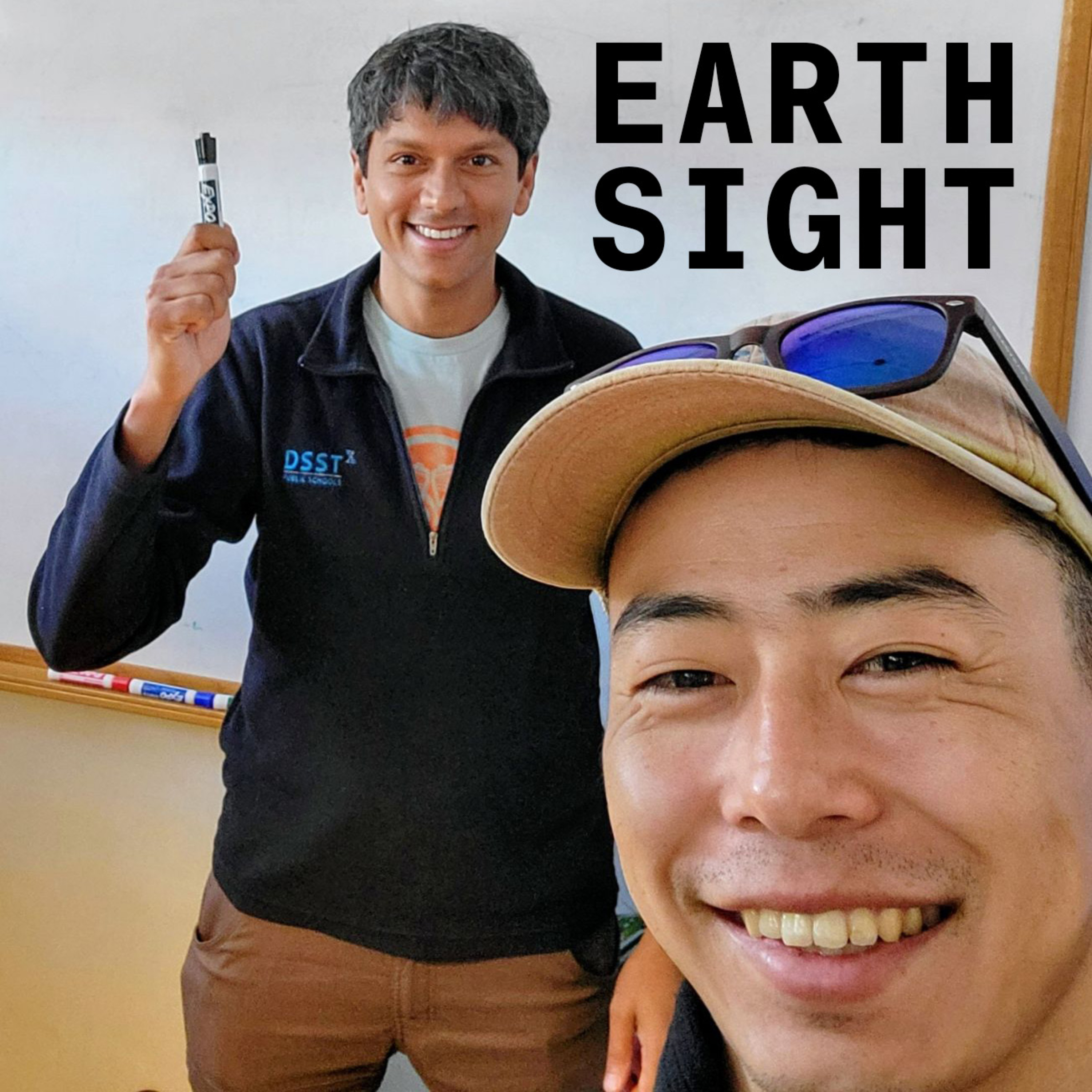
Chris and Krishna share big thoughts about the geospatial industry.Chris is a data scientist currently working in weather, but has previously worked at Los Alamos National Lab, The Earth Genome, Gro Intelligence and Demeter Labs. At those places he used earth observation data to solve problems such as crop mapping, yield prediction, change detection etc... Krishna is a data journalist who uses satellite imagery for news coverage. Previously he worked at Descartes Labs, Impact Observatory, The Earth Genome, Ceres Imaging and more. Krishna is an adjunct professor at The Cooper Union.
-
8
Live from New York: Are Geospatial Platforms Dead?
(00:00) Sick New Jingle(00:20) Double IPA (01:20) The Gang Struggles to Define a Platform: Metadata, Storage, Compute, APIs(11:20) The Value of a Platform(16:00) What If, What If, What If We Replaced Geospatial Platforms with Claude(24:00) Custom Use Case Development vs Platforms(27:00) Money Money Money, Chris' time as a traveling Google Cloud Salesman, Analytics Companies, Skytruth's Sentinel-1 Pipeline, Honestly This Conversation Kind of Meanders a Bit.(34:00) Ask Not What Platforms Can Do For You
-
7
Time-series, Landtrendr, Bayesian Deforestation Detection and Anomalous Change Detection
(00:00) Time series, Landtrendr, New Mexico, Cuba. Is medium/low-resolution imagery underrated?(15:00) Bayesian Deforestation Detection, operation-oriented algorithms and platforms(27:00) Landtrendr in the West Bank, CCDC(35:00) Anomalous Change Detection
-
6
Spatial Intelligence, The Ideal Geospatial Journal, Weather Data and Opus 4.5
No pre-prepared discussion subject this time, we just winged it.(00:00) Imagine useful geospatial models, it's easy if you try.(08:00) Academic papers, life at the paper mill, distilled .pub for geospatial.(24:30) Weather data vs earth observation data consumption. Differences in value and monetization, difficulty in forecasting products. (49:30) Opus 4.5, Claude code, AI tools and the death of meaning and effort at work.
-
5
Krishna talks high-resolution imagery, Chris asks questions
(00:00) Differences between medium-res and high-res worlds: data sizes, off-nadir imaging, co-registration issues(28:42) High-res SAR/Umbra data detour: building damage estimation in Jamaica, matching imagery up to vector datasets(34:33) Embeddings mentioned(37:10) Differences in seasonality, illumination and histogram matching: foundation models mentioned, discussions around Krishna's model performance over Gaza
-
4
Geospatial Failures, Problem Selection, Being an Analyst/Scientist is Hard
(00:00) Experimental failures. Krishna won't let Chris forget about his failed SimCLR experiments.(04:30) Geographic generalization discussion. Husky vs Malamute vs Wellpad.(11:32) Chris fails to map coconut palm because it's hard. Read the paper carefully.(15:30) Krishna maps oil slicks, but it's hard.(20:30) Cognitive debt, problem selection and failure modes in geospatial. (31:00) The sales cycle, promises, inflated expectations. Limitations in geospatial.(34:00) Problem selection in journalism. Are we running out of ideas?(37:00) Turning a failure into a success. Cover crop mapping is hard. (45:00) Turning failure into a success: predicting sugarcane yield is hard.(49:00) Is building tooling easier than solving modeling problems?(53:00) Vertical seems better than horizontal. Solutions are multi-modal.
-
3
Case Studies in Validating Maps: Oil Palm and Land Cover
Chris and Krishna talk about validation as a practical part of developing geospatial analytics, focussing on their personal experiences mapping oil palm and land cover at scale. A central theme in throughout this conversation is the use of auxiliary geospatial products, science and human intuition to validate maps.(00:00) Introduction, what is validation?(02:30) Chris talks about mapping oil palm using Sentinel-1(25:00) Krishna talks about global land cover mapping using Sentinel-2(51:00) What tools do Krishna and Chris use for validation. (Krishna loves QGIS)
-
2
Geospatial Platforms, Career Paths, Questions from Ep 1.
In this episode Chris and Krishna talk a little about their career paths, reply to some questions from listeners about Episode 1 concerning embeddings, and profess their undying love for Google Earth Engine.Throughout this conversation, a common theme explored is the nature of the abstractions implemented in Google Earth Engine, vs the open-source ecosystem.If anyone from Google sees this: we would love more export tasks.(00:00) Introductions and career paths(08:00) Questions from Episode 1(17:00) Geospatial platform discussion. Descartes Labs, Google Earth Engine, the Impact Observatory pipeline and more!
-
1
Embeddings in Context: Tools for Geospatial Problem Solving
Chris and Krishna discuss their experiences working with geospatial embeddings, search and remote sensing in general, and how they think through problems.Timestamps sustainably sourced and hand crafted.(0:00) Intro(2:30) Background, earth observation and existing algorithms and the embedding fallacy.(9:49) Validation, how to solve problems, seductive embeddings, the museum of cool demos.(19:22) What are embeddings?(21:00) Search vs embeddings, the development of Earth Index. (25:00) Expert embeddings: the dumbest embeddings that work.(30:25) Computer vision embeddings/ImageNet. Experiments in pre-training, how to spend $40,000 in cloud credits.(37:22) Should we pre-train on satellite imagery? DINO v3 (44:30) What properties should embeddings have for search? Recall vs Precision/Landcover+(50:00) Real world consequences of mapping(54:00) Future outlook, Krishna is jaded
No matches for "" in this podcast's transcripts.
No topics indexed yet for this podcast.
Loading reviews...
ABOUT THIS SHOW
Chris and Krishna share big thoughts about the geospatial industry.Chris is a data scientist currently working in weather, but has previously worked at Los Alamos National Lab, The Earth Genome, Gro Intelligence and Demeter Labs. At those places he used earth observation data to solve problems such as crop mapping, yield prediction, change detection etc... Krishna is a data journalist who uses satellite imagery for news coverage. Previously he worked at Descartes Labs, Impact Observatory, The Earth Genome, Ceres Imaging and more. Krishna is an adjunct professor at The Cooper Union.
HOSTED BY
cr458
CATEGORIES
Loading similar podcasts...
URL copied to clipboard!