
PODCAST · education
Economies: rights and access to work (Forced Migration Review 58)
by Oxford University
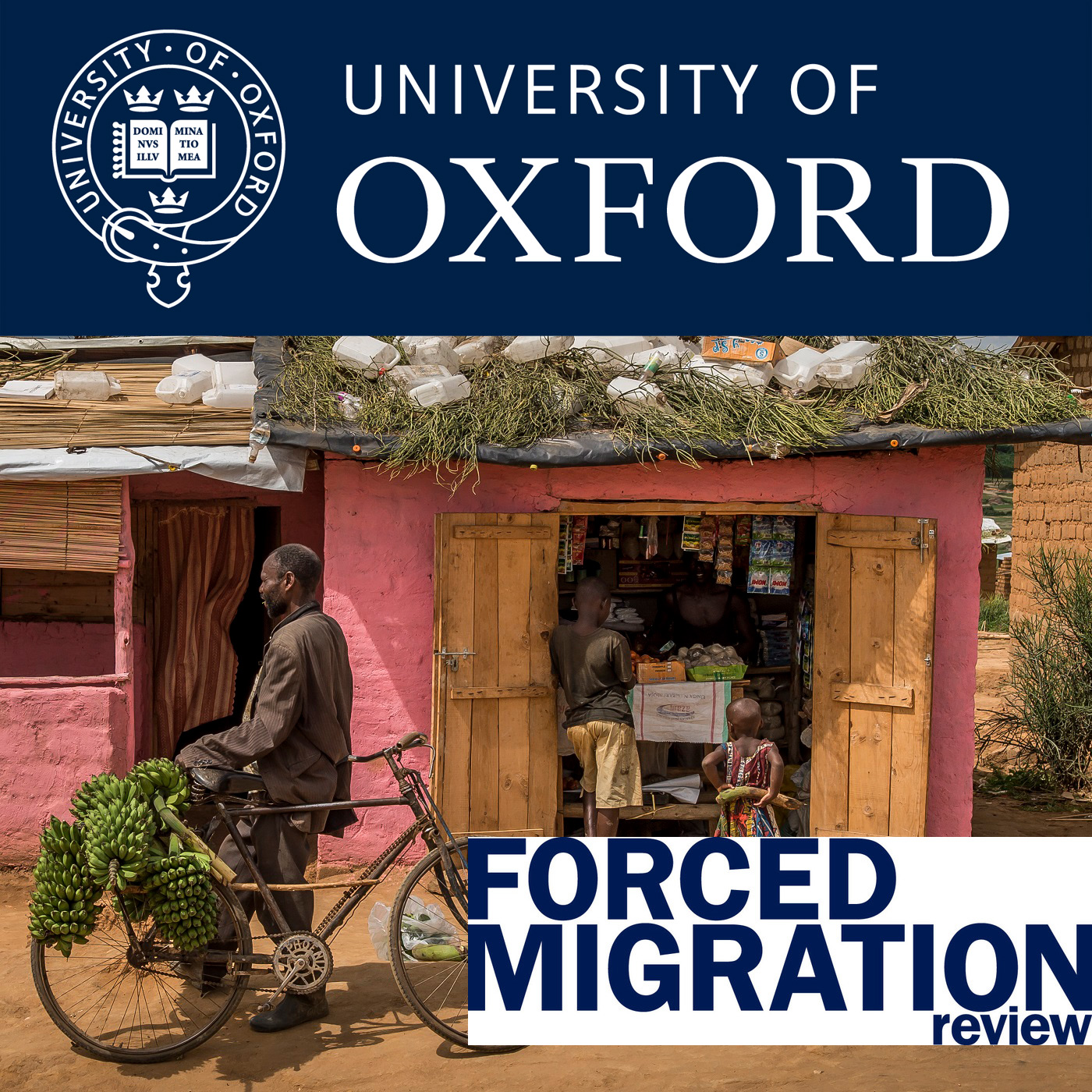
When people are forced to leave their homes, they usually also leave behind their means of economic activity. In their new location, they may not be able, or permitted, to work. This has wide-ranging implications. This issue includes 22 articles on the main feature theme of Economies: rights and access to work. It also includes two ‘mini-features’, one on Refugee-led social protection and one on Humans and animals in refugee camps. See more at: www.fmreview.org/economies.
-
36
FMR 58 Humans and animals in refugee camps - A field study of migration and adversity
The migratory journeys of birds can reflect the same complexity of issues that trigger and affect human displacement.
-
35
FMR 58 Humans and animals in refugee camps - Animal and human health in the Sahrawi refugee camps
Health challenges in the Sahrawi refugee camps in the Algerian desert are faced by both human and animal populations, and therefore responses must function for the benefit of both.
-
34
FMR 58 - Refugees’ right to work and access to labour markets: constraints, challenges and ways forward
Host countries need to assess the potential for opening their labour markets to refugees, and enhancing access to decent work.
-
33
FMR 58 - Supporting recently resettled refugees in the UK
Organisations supporting recently resettled refugees to find employment should focus on providing them with the tools to navigate the employment market in a sustainable way that leads to their personal development.
-
32
FMR 58 - Integrating refugees into the Turkish labour market
The granting to Syrian refugees in Turkey of the right to access formal work was a first step towards their economic integration but a number of challenges remain.
-
31
FMR 58 - From refugee to employee: work integration in rural Denmark
The launch of Red Cross Denmark’s Fast Track programme, which focuses on early refugee employment, offers an opportunity to explore the relationship between local employment of refugees and the sustainability of rural life.
-
30
FMR 58 - Integrating refugee doctors into host health-care systems
Refugee doctors face a number of barriers to practising medicine, despite the significant contributions that they can make.
-
29
FMR 58 - Refugees’ engagement with host economies in Uganda
Multi-sited fieldwork in Uganda allows for an exploration of the complex patterns of engagement between refugees’ economic activities and local economies, in urban, emergency and protracted settings.
-
28
FMR 58 - Refugees and host communities in the Rwandan labour market
In Rwanda, Congolese refugees have the same freedom of movement and right to work as Rwandans but the experiences and economic activities of these two populations are very different.
-
27
FMR 58 - The role of rural grocery stores in refugee reception
Our research with rural grocery store managers in Denmark suggests that the integration of asylum centres into the local social and economic life in rural areas is a key factor in successful refugee reception.
-
26
FMR 58 - Collaboration with criminal organisations in Colombia: an obstacle to economic recovery
Those seeking to support economic development for internally displaced people in Colombia need to understand how and why many IDPs collaborate with armed groups and criminal organisations.
-
25
FMR 58 - Syrian economies: a temporary boom?
Some displaced people and their host communities have benefited economically from the consequences of conflict in Syria’s Raqqa province. Others need support – and the type of support needed will change as circumstances change.
-
24
FMR 58 - Obstacles to refugees’ self-reliance in Germany
The majority of Germany’s refugees and asylum seekers rely on government welfare and face serious obstacles to self-reliance. Integration policies must eliminate these obstacles to promote mutual long-term benefits for refugees and their new communities.
-
23
FMR 58 - The new world of work and the need for digital empowerment
References are often made to forced migrants’ digital literacy, including use of smartphones to organise journeys and communicate once at their destinations. Other digital skills, including those relating to the workplace, are of greater relevance.
-
22
FMR 58 - Investing in refugees: building human capital
Investing in refugees’ well-being is a global public good, and the international community should work to reduce malnutrition and increase access to education for refugees in order to help build human capital and achieve better economic outcomes for all.
-
21
FMR 58 - Towards greater visibility and recruitment of skilled refugees
Showcasing refugees’ skills connects refugees to global work opportunities, and also shifts narrative from one of refugees being burdens to host countries to one in which refugees are recognised as skilled workers for whom countries should be competing.
-
20
FMR 58 - Validating highly educated refugees’ qualifications
Qualification certificates play a central role in the labour market integration of highly educated refugees but validating them presents considerable challenges. Sweden and Norway have introduced some positive developments to address such difficulties.
-
19
FMR 58 - Refugee livelihoods: new actors, new models
The international community is increasingly emphasising the need to bridge the humanitarian–development gap. But what does this mean on the ground in terms of refugees’ livelihoods and economic inclusion?
-
18
FMR 58 - The macro-economic impacts of Syrian refugee aid
A new study on the effects of humanitarian assistance in response to the Syria crisis finds significant positive impacts for regional economic growth and job creation.
-
17
FMR 58 - Quality of work for Syrian refugees in Jordan
Work permits have been at the centre of the policy debate on the hosting of Syrian refugees in Jordan. This approach needs also to involve ensuring decent working conditions for all.
-
16
FMR 58 - The gig economy in complex refugee situations
Research with Syrian women refugees in Jordan suggests that, despite significant challenges, the gig economy has some potential to help refugees participate in host communities and to bolster their economic participation.
-
15
FMR 58 - The power of markets: lessons from Uganda
Market-based approaches in northern Uganda demonstrate the benefits of supporting local markets instead of distributing in-kind aid.
-
14
FMR 58 - Livelihoods programming and its influence on secondary migration
Improving access to work, as well as livelihoods programming itself, is required if the lives and livelihoods of Eritrean refugees in Ethiopia are to improve.
-
13
FMR 58 - The shortcomings of employment as a durable solution
The refugee assistance regime that prevails today seems to insist that the best, or only, solution to protracted refugee situations is firmly rooted in improving access to employment.
-
12
FMR 58 Refugee-led social protection - Refugee-led social protection: reconceiving refugee assistance
The help and assistance that refugees offer each other is central to the lives of many displaced people. Recognising this allows support for displaced people to be reconceived in more sustaining and empowering ways.
-
11
FMR 58 Refugee-led social protection - Refugee paralegals
Refugees in Kenya face multiple barriers to accessing their rights. The work of paralegals who are themselves refugees and who support and facilitate refugees’ access to justice offers a vital service.
-
10
FMR 58 Refugee-led social protection - Kobciye: empowering Somali refugees in Nairobi
Established by a resettled Somali refugee and now under the leadership of his children, Kobciye resource centre works to empower Somali refugees in Eastleigh, Nairobi.
-
9
FMR 58 Refugee-led social protection - Syrian refugee-led organisations in Berlin
Many of the approximately 50,000 Syrian refugees living in Berlin continue to depend largely on State assistance; some refugees have also created and found additional support in active, vibrant community initiatives.
-
8
FMR 58 Refugee-led social protection - Refugee-led education in Indonesia
Refugee-led education initiatives in West Java, Indonesia, show how refugee communities can work with supporters to overcome service gaps faced in host countries.
-
7
FMR 58 Humans and animals in refugee camps - Humans and animals in refugee camps
More research is needed, across disciplines, to better understand the important and varied roles that animals play in the lives of people in refugee camps.
-
6
FMR 58 Humans and animals in refugee camps - The role of livestock in refugee-host community relations
In South Sudan, tensions arose when refugees arrived with their livestock, disrupting the existing relationships between the local population and nomadic peoples.
-
5
FMR 58 Humans and animals in refugee camps - Working equids in refugee camps
Refugee camps offer good opportunities for cooperation between humanitarian and animal welfare organisations for the benefit of displaced people and their working animals.
-
4
FMR 58 Humans and animals in refugee camps - Sheltering animals in refugee camps
Animals play an important role in many people’s lives in displacement. Camp planners and managers need to take animals’ needs into greater account in order for displaced people to continue to benefit from this interaction.
-
3
FMR 58 Humans and animals in refugee camps - Understanding risk in human–animal interactions
There needs to be better understanding not only of the importance of animals in the lives of displaced people but also of the potential risks incurred by human–animal interactions and how best to mitigate these risks.
No matches for "" in this podcast's transcripts.
No topics indexed yet for this podcast.
Loading reviews...
ABOUT THIS SHOW
When people are forced to leave their homes, they usually also leave behind their means of economic activity. In their new location, they may not be able, or permitted, to work. This has wide-ranging implications. This issue includes 22 articles on the main feature theme of Economies: rights and access to work. It also includes two ‘mini-features’, one on Refugee-led social protection and one on Humans and animals in refugee camps. See more at: www.fmreview.org/economies.
HOSTED BY
Oxford University
CATEGORIES
Loading similar podcasts...
URL copied to clipboard!