
PODCAST · society
First Person Podcast
by United States Holocaust Memorial Museum
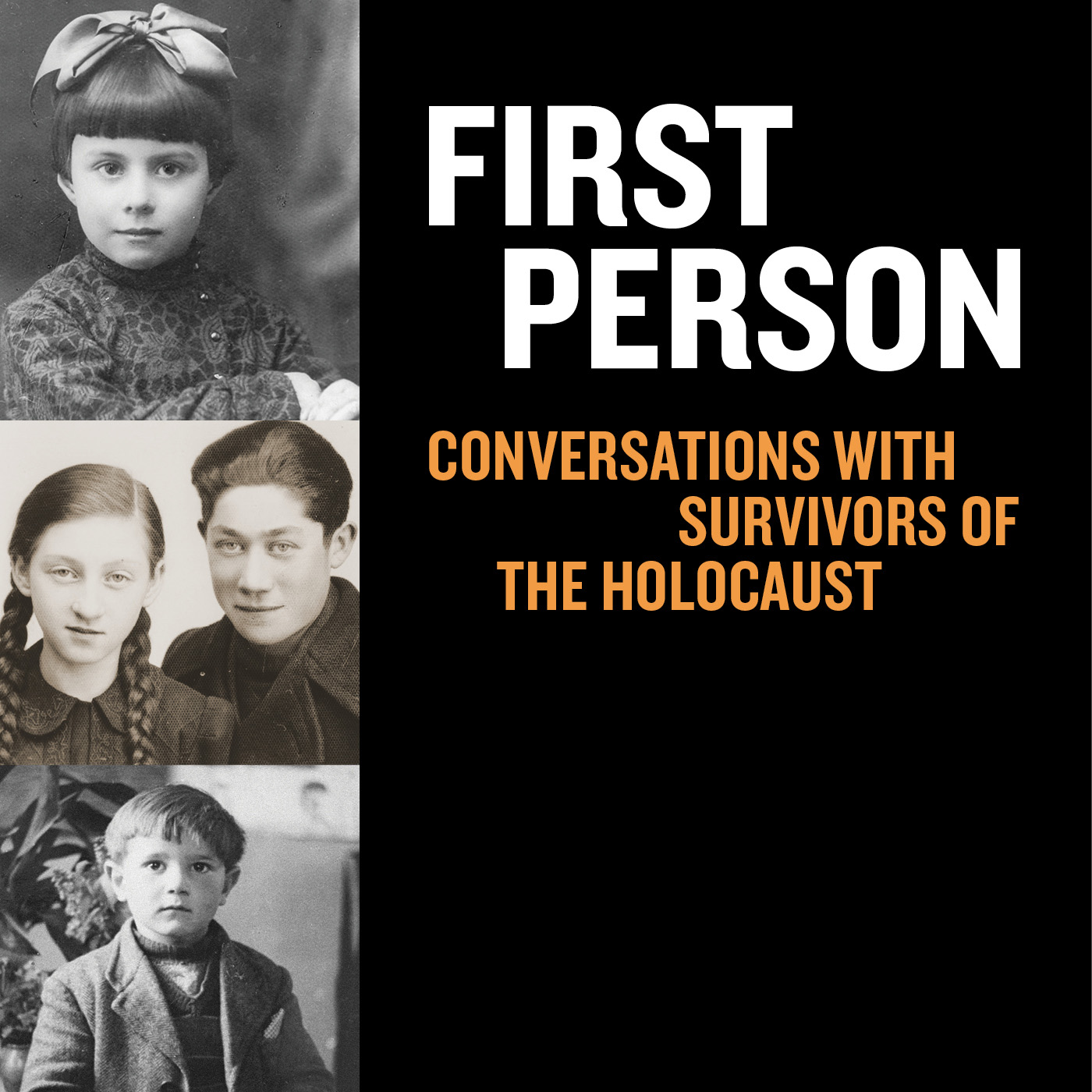
This podcast series features excerpts from interviews with Holocaust survivors presented at the United States Holocaust Memorial Museum's public program, First Person -- Conversations with Holocaust Survivors.
Episodes
-
Holocaust Survivors’ Reflections and Hopes for the Future
In today's episode, Holocaust survivors share their thoughts on the importance of speaking about their experiences. It is our tradition at First Person that each guest speaker ends the program with their "final words." In our final podcast of the series, we close with those thoughts, reflections,...
-
Theodora Klayman: Shelter in Ludbreg
Theodora (Dora) Klayman discusses surviving the war in hiding with her brother in Ludbreg, Yugoslavia. After her parents were deported in 1941, she spent the war first with her maternal aunt and then, after her aunt was denounced and deported, with non-Jewish neighbors.
-
Haim Solomon: Hiding during the Pogrom in Iasi
Haim Solomon discusses hiding during the pogrom that Romanian authorities staged against the Jewish population in Iasi, Romania, within days of the German invasion of the Soviet Union in June 1941. Haim and his family hid in various different locations across the city. At least 4,000 Jews were...
-
Margit Meissner: Flight from Paris on a Bicycle
Margit Meissner discusses her flight from Paris just before the city fell to the Germans in June 1940. Margit and her mother were Austrian citizens living in Paris, which meant they were considered “enemy aliens” because Austria was annexed by Germany in 1938. They were ultimately separated and...
-
Gerald Schwab: A German Jewish Refugee Returns as an American Soldier
Gerald Schwab discusses his experience being drafted into the US Army in 1944 after fleeing Nazi Germany just four years earlier. After the war, he assisted with the trials of leading German officials before the International Military Tribunal at Nuremberg.
-
Emanuel (Manny) Mandel: Wearing the Yellow Star as a Child in Hungary
Manny Mandel discusses wearing a yellow star as a young boy in Budapest. Hungary fell increasingly under the influence of Germany in the 1930s and joined the Axis alliance in 1940. During this time, Jews in Hungary were increasingly subjected to discriminatory anti-Jewish laws modeled on those in...
-
Frank Liebermann: Changes in Germany After Nazi Rise to Power
Frank Liebermann discusses life in Germany after the Nazis came to power in 1933. Shortly after taking power, the Nazis began to eliminate individual rights and freedoms for Jews in Germany. This changed daily life for Frank and his family in many ways. Frank's father was a physician and it…
more -
Regina Spiegel: Separation at Auschwitz
Regina Spiegel discusses her deportation from the ghetto in Pionki, Poland, and her arrival at Auschwitz-Birkenau, the largest Nazi killing center. She and her boyfriend, Sam, were deported together in 1944 but were separated upon arrival at Auschwitz.
-
Julius Menn: Flight from Invading German Troops
Julius Menn discusses his family's flight eastward from advancing German troops invading Poland in September 1939. Julius's family escaped from Bialystok, Poland, to Vilna, Lithuania, eventually making their way through the Soviet Union to Palestine, where they had previously lived.
-
Fritz Gluckstein: Berlin in the Aftermath of World War II
Fritz Gluckstein discusses life immediately after World War II in Berlin and his eventual immigration to the United States. Born to a Jewish father and Christian mother, he was classified under Nazi law as Mischlinge, of mixed ancestry, or part Jewish. He spent the war in Berlin assigned to…
more -
Helen Luksenburg: Forming a Friendship in Gleiwitz
Helen Luksenburg discusses forming a close friendship with Welek, now William Luksenburg, a fellow prisoner in Gleiwitz, a subcamp of the Auschwitz concentration camp.
-
David Bayer: Life After the German Invasion of Poland
David Bayer discusses life in his hometown of Kozienice after the German invasion of Poland in September, 1939. Shortly after the invasion David and his family were harassed, humiliated, and subjected to acts of violence by the German occupiers and their collaborators.
-
Morris Rosen: Forced Evacuation
Morris Rosen discusses his evacuation and forced march on foot in February 1945 from a subcamp of the Gross Rosen concentration camp in Poland to the Theresienstadt camp in Czechoslovakia. In an effort to cover up their crimes and prevent prisoners from falling into enemy hands, Nazi officials...
-
Manya Friedman: Death March to Ravensbrück
Manya Friedman discusses her evacuation from Gleiwitz, a subcamp of Auschwitz, to the Ravensbrück concentration camp in January 1945. In an effort to cover up their crimes and prevent prisoners from falling into enemy hands, the Nazis evacuated prisoners in what became known as death marches.
-
Gerald Liebenau: Memories of Kristallnacht
In today’s episode Gerald Liebenau discusses his memories of Kristallnacht, also known as the “Night of Broken Glass.” On November 9-10, 1938, a wave of violent anti-Jewish pogroms erupted around Germany, leaving Jewish owned businesses and synagogues plundered and destroyed.
-
Inge Katzenstein: Refuge In Kenya
Inge Katzenstein discusses fleeing Nazi Germany in 1939 and finding refuge along with her family in Kenya, where they remained during the war.
-
Martin Weiss: Selection at Auschwitz
Martin Weiss discusses his deportation in May 1944 from the ghetto in Munkacs, then part of Hungary, and his arrival at Auschwitz-Birkenau, the largest Nazi killing center.
-
Leon Merrick: Evacuation and Arrival at Buchenwald
In December 1944, as the Soviet army approached the slave labor camp in Poland where Leon Merrick was imprisoned, the Germans evacuated him to the Buchenwald concentration camp in Germany. Leon shares his recollections of the evacuation and his first day in Buchenwald.
-
Marcel Drimer: Escaping the “Concert of Death”
Marcel Drimer, his sister, and mother hid in a wheat field while a German aktion—a violent operation against Jewish civilians— occurred in their town of Drohobycz, Poland, in August 1942.
-
Erika Eckstut: A Young Girl’s Experience in the Ghetto
Erika Eckstut discusses the difficulties and dangers of life in the Czernowitz ghetto in what was then Romania (and today is western Ukraine). Erika was an adventurous teenager and her father went to great lengths to protect her and maintain her education.
-
Leon Merrick: Importance of Work in the Lodz Ghetto
Leon Merrick's job delivering mail in the Lodz ghetto became all the more difficult over time as Nazi deportations to the extermination camps increased and he was often given the task of delivering notices for deportation.
-
Helen Goldkind: Arrival at Auschwitz
Helen Goldkind discusses her deportation and arrival at Auschwitz-Birkenau, the largest Nazi killing center.
-
Helen Luksenburg: Survival in the Camps
Helen Luksenburg discusses daily life, spiritual resistance, and forced labor in Gleiwitz, a subcamp of the Auschwitz concentration camp.
-
Martin Weiss: Reflections on Liberation
Martin Weiss discusses his liberation from Gunskirchen, a subcamp of Mauthausen, in 1945 and the days immediately following.
-
Fanny Aizenberg: A Mother’s Agonizing Decision
Fanny Aizenberg discusses life for Belgian Jews after the German invasion in May 1940. Fanny’s husband heeded the call of the Royal Air Force asking for Belgian volunteers while Fanny took care of their young daughter in Belgium.
-
Halina Peabody: Hiding in Plain Sight
Halina Peabody discusses her mother’s decision to go into hiding as a family following the German invasion of Poland in 1939. Halina spent the war in Poland living under false papers identifying her as a Catholic.
We're indexing this podcast's transcripts for the first time — this can take a minute or two. We'll show results as soon as they're ready.
No matches for "" in this podcast's transcripts.
No topics indexed yet for this podcast.
Loading reviews...
ABOUT THIS SHOW
This podcast series features excerpts from interviews with Holocaust survivors presented at the United States Holocaust Memorial Museum's public program, First Person -- Conversations with Holocaust Survivors.
HOSTED BY
United States Holocaust Memorial Museum
Loading similar podcasts...
Frequently Asked Questions
How many episodes does First Person Podcast have?
First Person Podcast currently has 47 episodes available on PodParley. New episodes are automatically indexed when they're published to the podcast feed.
What is First Person Podcast about?
This podcast series features excerpts from interviews with Holocaust survivors presented at the United States Holocaust Memorial Museum's public program, First Person -- Conversations with Holocaust Survivors.
How often does First Person Podcast release new episodes?
First Person Podcast has 47 episodes. Check the episode list to see recent publication dates and frequency.
Where can I listen to First Person Podcast?
You can listen to First Person Podcast on PodParley by clicking any episode. We provide an embedded audio player for direct listening, and you can also subscribe via your preferred podcast app using the RSS feed.
Who hosts First Person Podcast?
First Person Podcast is created and hosted by United States Holocaust Memorial Museum.
URL copied to clipboard!