
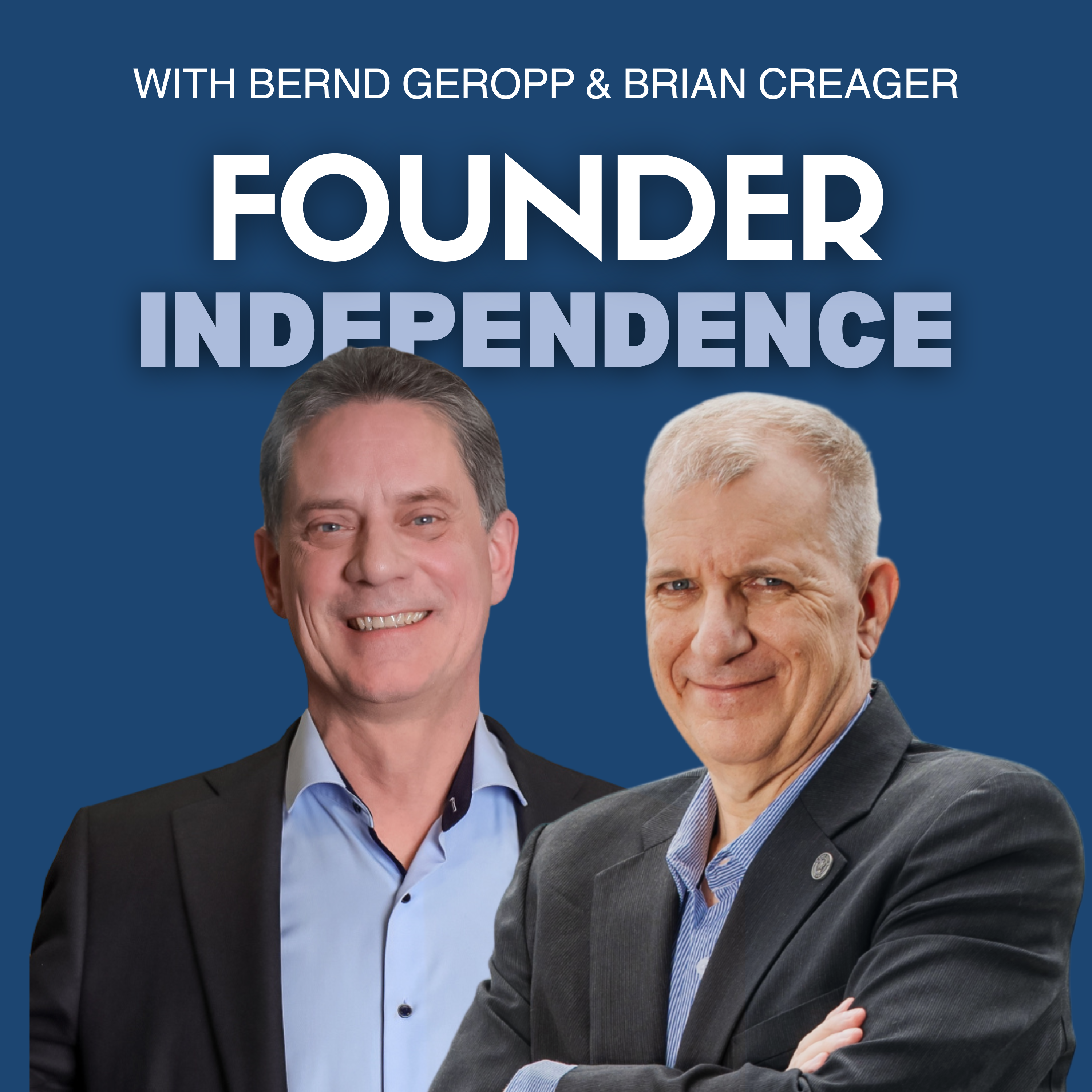
PODCAST · business
Founder Independence
by Bernd Geropp: Leadership and Management Expert
Founder Independence is for founders and business owners who feel their company depends on them for every decision, every escalation, and every problem. As the business grows, that dependence gets worse—and so does the stress. This show focuses on one question: how do you build a company that runs professionally without you being the bottleneck? This isn't motivation or quick tips. It's practical systems work: removing decision bottlenecks, stopping problems from always traveling upward, and building consistent execution that doesn't require the founder to be involved in everything. We'll also break down why "just hire better people" and "just delegate more" fails when the sequence and structure are wrong. You'll hear a mix of formats: deep-dive conversations with Bernd Geropp and Brian Creager (moderator and sparring partner), interviews with founders and experts who have solved parts of the puzzle, and occasional solo episodes when a topic demands it. Each episode aims to move you
-
82
FI016 - Systemic Secrets to Team Ownership
In this episode, Berndt and Brian explore why teams often lack ownership and how founders can create an environment that fosters responsibility, decision-making, and accountability. They discuss systemic factors, leadership behaviors, and practical steps to build ownership within organizations. Key Topics System outcomes and ownership Responsibility, decision authority, expectations Founder behaviors and systemic influence Building psychological safety and accountability The time and patience required for organizational change Chapters 00:00 Understanding Ownership in Teams 01:04 The System Behind Ownership 02:48 Key Elements of Responsibility 03:39 Decision Authority and Its Impact 07:20 The Delegation Dilemma 09:16 Building Ownership: Five Key Conditions 15:07 Consequences and Accountability 16:35 The Ownership Mindset 17:18 The Timeframe for Change Links Mentioned in the Show: Checklists for Leaders: https://fipodcast.vip/osva Leadership Crash Course: https://fipodcast.vip/crashcourse Weekly Actionable Leadership Tips: https://fipodcast.vip/xbzv Credits: Host: Bernd Geropp Moderator: Brian Creager Producer: Brian Creager Editor: Brian Creager Executive Producer: Bernd Geropp To catch the great episodes coming up on Founder Independence, please follow us on Bernd's YouTube channel or your favorite podcast player. And if you enjoyed the show, please leave us a comment or a starred review. It's the best way to help us get these ideas to more people. If you would like new episodes emailed directly to you, subscribe at https://www.berndgeropp.com/subscribe/
-
81
FI015 - The Hidden Cost of Keeping the Wrong People
This episode explores the importance of clarity over harmony in leadership. Bernd discusses how clear expectations and direct communication build trust, prevent conflicts, and create a healthier company culture. Key Topics The true costs of keeping underperformers in the company, including performance, cultural, and leadership impacts Why founders often delay action due to short-term discomfort versus long-term damage The importance of clear feedback and documented expectations before making personnel decisions How delaying addressing underperformance can silently lower team standards and morale The psychological and emotional barriers leaders face when confronting difficult conversations The concept of "consequent" in decision-making, emphasizing clarity and decisiveness Recognizing patterns as signals for necessary action despite vague frustrations The critical role of leadership in enforcing standards and maintaining talent density Practical frameworks for identifying the right moment to act and the importance of documentation The long-term consequences of delayed action: "After two years, you have the employees you deserve" Chapters Links Mentioned in the Show: Checklists for Leaders: https://fipodcast.vip/osva Leadership Crash Course: https://fipodcast.vip/crashcourse Weekly Actionable Leadership Tips: https://fipodcast.vip/xbzv Credits: Host: Bernd Geropp Moderator: Brian Creager Producer: Brian Creager Editor: Brian Creager Executive Producer: Bernd Geropp To catch the great episodes coming up on Founder Independence, please follow us on Bernd's YouTube channel or your favorite podcast player. And if you enjoyed the show, please leave us a comment or a starred review. It's the best way to help us get these ideas to more people. If you would like new episodes emailed directly to you, subscribe at https://www.berndgeropp.com/subscribe/
-
80
FI014 - Clarity Before Harmony
This episode explores the importance of clarity over harmony in leadership. Bernd discusses how clear expectations and direct communication build trust, prevent conflicts, and create a healthier company culture. Key Topics The concept of 'Clarity before harmony' How avoiding conflict damages company culture The relationship between clarity and trust Practical steps for founders to implement clarity Chapters 00:00 Clarity Before Harmony: An Introduction 03:13 The Cost of Avoiding Clarity 06:06 The Importance of Trust and Safety 09:02 Defining Roles and Responsibilities 12:01 Intent Behind Clarity 14:56 Practical Steps for Founders Links Mentioned in the Show: Checklists for Leaders: https://fipodcast.vip/osva Leadership Crash Course: https://fipodcast.vip/crashcourse Weekly Actionable Leadership Tips: https://fipodcast.vip/xbzv Credits: Host: Bernd Geropp Moderator: Brian Creager Producer: Brian Creager Editor: Brian Creager Executive Producer: Bernd Geropp To catch the great episodes coming up on Founder Independence, please follow us on Bernd's YouTube channel or your favorite podcast player. And if you enjoyed the show, please leave us a comment or a starred review. It's the best way to help us get these ideas to more people. If you would like new episodes emailed directly to you, subscribe at https://www.berndgeropp.com/subscribe/
-
79
FI013 - The Right Time to Hire Leaders
Discover practical leadership lessons from Tyler Jefcoat's entrepreneurial journey, including managing partnerships, scaling business models, and navigating founder relationships. This episode emphasizes clarity in communication, understanding business scalability, and building resilient teams—crucial for founders and executives alike. Key Topics The difference between scalable and non-scalable business models as shared by Tyler How Tyler learned to focus on relationships rather than scaling personalities The importance of promoting the right people and understanding their core strengths Key framework: The "Rocket Fuel" concept of Visionary and Integrator roles Strategies for partnering and managing shared ownership (expectations, communication, conflict resolution) Impact of AI on future business models, especially accounting and finance services Lessons from partnership pitfalls: contracts, expectations, and trust Building effective one-on-one relationships for leadership success The value of clarity over harmony in overcoming conflicts Planning for future exits and evolving partnerships with changing personal and business goals Chapters 0:38 - The difference between a people decision and a structural decision 01:13 - How system clarity influences leader success 01:44 - Symptoms of hiring too early and how to identify lack of readiness 02:19 - The impact of unclear expectations on new leaders 02:45 - Structural versus talent problems in leadership failures 03:06 - The significance of business model stability and cash flow in leadership hiring 03:44 - Why building a second floor before solid foundations can backfire 04:03 - When external funding changes the hiring game for startups 04:36 - The importance of financial and structural readiness in bootstrap companies 05:21 - The consequences of dependency on founders when leadership is delayed 06:04 - Recognizing the signs that a company needs leadership but hasn't hired yet 06:47 - The common reluctance of founders to delegate responsibility 07:03 - How an overly stable organization can hide organizational stagnation 07:47 - The key concept: shifting focus from timing to readiness 08:11 - How to assess structural and financial readiness through simple questions 09:04 - Why writing the role description is a valuable planning step 09:25 - The common mistake of expecting leaders to figure everything out alone 09:56 - The dangers of multiple systems within a company and the importance of standardization 10:30 - The costly effects of failing leadership hires and recurring mistakes 11:09 - The two critical tests for readiness before hiring 11:45 - The core message: role creation, structural clarity, and financial stability come first 12:28 - The importance of conditions over individual toughness in leadership success Links Mentioned in the Show: Checklists for Leaders: https://fipodcast.vip/osva Leadership Crash Course: https://fipodcast.vip/crashcourse Weekly Actionable Leadership Tips: https://fipodcast.vip/xbzv Credits: Host: Bernd Geropp Moderator: Brian Creager Producer: Brian Creager Editor: Brian Creager Executive Producer: Bernd Geropp To catch the great episodes coming up on Founder Independence, please follow us on Bernd's YouTube channel or your favorite podcast player. And if you enjoyed the show, please leave us a comment or a starred review. It's the best way to help us get these ideas to more people. If you would like new episodes emailed directly to you, subscribe at https://www.berndgeropp.com/subscribe/
-
78
FI012 - Tyler Jefcoat: Relationships are infinitely unscalable.
Discover practical leadership lessons from Tyler Jefcoat's entrepreneurial journey, including managing partnerships, scaling business models, and navigating founder relationships. This episode emphasizes clarity in communication, understanding business scalability, and building resilient teams—crucial for founders and executives alike. Key Topics The difference between scalable and non-scalable business models as shared by Tyler How Tyler learned to focus on relationships rather than scaling personalities The importance of promoting the right people and understanding their core strengths Key framework: The "Rocket Fuel" concept of Visionary and Integrator roles Strategies for partnering and managing shared ownership (expectations, communication, conflict resolution) Impact of AI on future business models, especially accounting and finance services Lessons from partnership pitfalls: contracts, expectations, and trust Building effective one-on-one relationships for leadership success The value of clarity over harmony in overcoming conflicts Planning for future exits and evolving partnerships with changing personal and business goals Chapters 00:18 - Introduction to Founder Independence's new episode format 01:03 - Tyler Jefcoat's entrepreneurial background and current focus 02:19 - Differentiating scalable vs. non-scalable business models 03:39 - Tyler's realization about personal relationships being unscalable 04:19 - Managing founder bottlenecks and scaling challenges 05:13 - Building sellable business models with clear success metrics 06:02 - Using AI in finance and accounting—what's likely to be disrupted 07:06 - Lessons learned about leadership, staffing, and promotion mistakes 08:21 - The evolving role of AI and technology in fractional CFO services 09:47 - Leading teams effectively using one-on-one relationship building 10:53 - Common pitfalls in leadership promotions and how to avoid them 11:56 - Communication, clarity, and conflict management in partnerships 12:48 - Promoting the right team members and matching roles to strengths 13:12 - The importance of selecting and onboarding leadership 14:21 - Key qualities for successful team leads 15:34 - How to choose the right partners and manage shared ownership 16:56 - The significance of clarity over harmony for long-term success 18:18 - The value of an integrator and visionary partnership (Rocket Fuel) 19:55 - The impact of changing personal goals on long-term partnerships 20:30 - Handling conflicts, expectations, and alignment in partnership roles 21:37 - Lessons from partnership failures and successes 23:29 - How structured communication and regular founder-level meetings prevent escalation 25:01 - The importance of ongoing alignment and clear future exit strategies 28:29 - Managing evolving personal and business dynamics over time 31:12 - Final insights: embracing mistakes, courage, and clarity in leadership 32:22 - How to connect with Tyler Jeffcoat for collaboration Links Mentioned in the Show: Tyler Jefcoat's LinkedIn: https://www.linkedin.com/in/tylerjefcoat/ Checklists for Leaders: https://fipodcast.vip/osva Leadership Crash Course: https://fipodcast.vip/crashcourse Weekly Actionable Leadership Tips: https://fipodcast.vip/xbzv Credits: Host: Bernd Geropp Moderator: Brian Creager Producer: Brian Creager Editor: Brian Creager Executive Producer: Bernd Geropp To catch the great episodes coming up on Founder Independence, please follow us on Bernd's YouTube channel or your favorite podcast player. And if you enjoyed the show, please leave us a comment or a starred review. It's the best way to help us get these ideas to more people. If you would like new episodes emailed directly to you, subscribe at https://www.berndgeropp.com/subscribe/
-
77
FI011 - The 5 Levels of Founder Independence: Diagnosing Systemic Dependence
This episode explores how founders can diagnose and overcome founder dependence in their companies. Bernd shares insights on systemic issues, diagnosis models, and practical steps to build a more autonomous organization. Key Topics Symptoms of founder dependence Diagnosis model and 5 levels of independence Systemic causes of dependence: structure, roles, processes The importance of diagnosis before fixing Practical steps to reduce dependence Chapters 00:00 Understanding Founder Dependence 14:58 Diagnosing the Problem 17:14 Solutions and Moving Forward Links Mentioned in the Show: Checklists for Leaders: https://fipodcast.vip/osva Leadership Crash Course: https://fipodcast.vip/crashcourse Weekly Actionable Leadership Tips: https://fipodcast.vip/xbzv Credits: Host: Bernd Geropp Moderator: Brian Creager Producer: Brian Creager Editor: Brian Creager Executive Producer: Bernd Geropp To catch the great episodes coming up on Founder Independence, please follow us on Bernd's YouTube channel or your favorite podcast player. And if you enjoyed the show, please leave us a comment or a starred review. It's the best way to help us get these ideas to more people. If you would like new episodes emailed directly to you, subscribe at https://www.berndgeropp.com/subscribe/
-
76
FI010 - How Founders Can Build Strong Teams without Losing Control
This episode explores the critical skills and mindset founders need to effectively lead their teams, from managing individual contributors to leading leaders. Topics include building trust through one-on-one meetings, the importance of role clarity, and developing leadership layers for scalable growth. Key Topics The transition from managing work to leading people The paradox of control and team strength Difference between employees and team members Limitations of direct leadership and the need for layers The importance of one-on-one meetings for trust and development How to support new managers and set clear expectations The ultimate goal of leadership: independence and scalability Chapters 00:00 The Challenge of Leading a Team 02:58 Control vs. Empowerment in Leadership 06:09 Building Leadership Layers 09:07 The Importance of One-on-One Meetings 11:58 Supporting New Managers 15:10 Why Strong Employees Leave 17:49 The Ultimate Goal of Leadership Links Mentioned in the Show: Checklists for Leaders: https://fipodcast.vip/osva Leadership Crash Course: https://fipodcast.vip/crashcourse Weekly Actionable Leadership Tips: https://fipodcast.vip/xbzv Credits: Host: Bernd Geropp Moderator: Brian Creager Producer: Brian Creager Editor: Brian Creager Executive Producer: Bernd Geropp To catch the great episodes coming up on Founder Independence, please follow us on Bernd's YouTube channel or your favorite podcast player. And if you enjoyed the show, please leave us a comment or a starred review. It's the best way to help us get these ideas to more people. If you would like new episodes emailed directly to you, subscribe at https://www.berndgeropp.com/subscribe/
-
75
FI009 - The 3 Structural Pillars for Founder Independence
This episode explores how founders can build scalable companies by implementing effective structures. Berndt discusses the importance of processes, roles, and decision rights to achieve founder independence and reduce bottlenecks. Key Topics The importance of structure in scaling a company How to implement effective processes The role of clear decision rights and organizational design Chapters 00:00 The Importance of Structure for Founders 05:21 Understanding Processes and Their Necessity 07:35 Organizational Structure: The Real Decision-Making Framework 10:14 Structure as a Path to Freedom and Independence Credits: Host: Bernd Geropp Moderator: Brian Creager Producer: Brian Creager Editor: Brian Creager Executive Producer: Bernd Geropp To catch the great episodes coming up on Founder Independence, please follow us on Bernd's YouTube channel or your favorite podcast player. And if you enjoyed the show, please leave us a comment or a starred review. It's the best way to help us get these ideas to more people. If you would like new episodes emailed directly to you, subscribe at https://www.berndgeropp.com/subscribe/
-
74
FI008 - Vision
In this episode, Brian Creager and Bernd Gerrop delve into the concept of vision as a foundational element for founder independence. They discuss the importance of having a clear, actionable vision that guides decision-making within a company, rather than merely serving as a decorative statement. Bernd outlines the characteristics of a strong vision, emphasizing emotional relevance and the need for alignment with company structure. The conversation also highlights common pitfalls founders face when articulating their vision and the necessity of storytelling to make the vision relatable and actionable for employees. Takeaways Vision is operational guidance, not decoration. A real vision answers three questions: where are we going, why does it matter, and what behavior fits that direction. Founder independence begins when people can make decisions without asking the founder. A strong vision is emotionally relevant and gives direction without micromanagement. Vision is not a goal with a finish line; it's a direction to move toward. A vision script provides clarity that a single sentence cannot achieve. Stories make abstract values concrete and relatable for employees. Vision grows from the tension between reality and what should be true. The system always wins; if structure and vision don't align, vision loses its meaning. Vision is an internal orientation, not a branding exercise. Chapters 00:00 Understanding Vision Beyond Slogans 07:15 Characteristics of a Strong Vision 14:23 Translating Vision into Action 15:48 Finding Your Vision 16:19 Aligning Vision with Structure 17:13 Common Mistakes in Vision Creation Credits: Host: Bernd Geropp Moderator: Brian Creager Producer: Brian Creager Editor: Brian Creager Executive Producer: Bernd Geropp To catch the great episodes coming up on Founder Independence, please follow us on Bernd's YouTube channel or your favorite podcast player. And if you enjoyed the show, please leave us a comment or a starred review. It's the best way to help us get these ideas to more people. If you would like new episodes emailed directly to you, subscribe at https://www.berndgeropp.com/subscribe/
-
73
FI007 - Strategic Positioning
In this episode of Founder Independence, Brian Creager and Bernd Gerropp discuss the critical relationship between strategic positioning and leadership effectiveness. Berndt emphasizes that weak positioning leads to founder dependency, making it difficult to delegate and build leadership capacity. They explore the importance of achieving double-digit EBIT for economic freedom and the necessity of clear niche positioning to improve margins and create pricing power. The conversation concludes with actionable steps for founders to strengthen their positioning and enhance their business model. Takeaways Leadership needs economic freedom to thrive. Weak margins create founder dependency due to financial constraints. Double-digit EBIT is essential for stability and growth. Positioning is about perceived value, not just industry type. Being an all-rounder can lead to price pressure and margin loss. Customers buy solutions to problems, not just products. Clear niche positioning reduces competition and increases margins. Underpaying oneself can create an illusion of profitability. Specialization allows for higher perceived expertise and pricing power. Strong positioning enables sustainable leadership development. Chapters 00:00 The Interplay of Leadership and Positioning 05:09 Understanding Double-Digit EBIT 10:14 The Importance of Clear Positioning 15:42 Steps to Strengthen Positioning Credits: Host: Bernd Geropp Moderator: Brian Creager Producer: Brian Creager Editor: Brian Creager Executive Producer: Bernd Geropp To catch the great episodes coming up on Founder Independence, please follow us on Bernd's YouTube channel or your favorite podcast player. And if you enjoyed the show, please leave us a comment or a starred review. It's the best way to help us get these ideas to more people. If you would like new episodes emailed directly to you, subscribe at https://www.berndgeropp.com/subscribe/
-
72
FI006 - Self Leadership
Summary In this episode of Founder Independence, Brian Krieger and Berndt Garrop discuss the critical relationship between strategic positioning and leadership effectiveness. Berndt emphasizes that weak positioning leads to founder dependency, making it difficult to delegate and build leadership capacity. They explore the importance of achieving double-digit EBIT for economic freedom and the necessity of clear niche positioning to improve margins and create pricing power. The conversation concludes with actionable steps for founders to strengthen their positioning and enhance their business model. Takeaways Leadership needs economic freedom to thrive. Weak margins create founder dependency due to financial constraints. Double-digit EBIT is essential for stability and growth. Positioning is about perceived value, not just industry type. Being an all-rounder can lead to price pressure and margin loss. Customers buy solutions to problems, not just products. Clear niche positioning reduces competition and increases margins. Underpaying oneself can create an illusion of profitability. Specialization allows for higher perceived expertise and pricing power. Strong positioning enables sustainable leadership development. Chapters 00:00 The Interplay of Leadership and Positioning 05:09 Understanding Double-Digit EBIT 10:14 The Importance of Clear Positioning 15:42 Steps to Strengthen Positioning Credits: Host: Bernd Geropp Moderator: Brian Creager Producer: Brian Creager Editor: Brian Creager Executive Producer: Bernd Geropp To catch the great episodes coming up on Founder Independence, please follow us on Bernd's YouTube channel or your favorite podcast player. And if you enjoyed the show, please leave us a comment or a starred review. It's the best way to help us get these ideas to more people. If you would like new episodes emailed directly to you, subscribe at https://www.berndgeropp.com/subscribe/
-
71
FI005 - The 5-Level Leadership Model
In this conversation, Brian Creager and Bernd Geropp discuss the critical aspects of leadership in growing companies, emphasizing the importance of structured leadership over personality traits. Bernd introduces his five-level leadership model, which outlines the progression from self-leadership to strategic positioning, vision, and ultimately, people leadership. The discussion highlights how leadership failures often stem from structural issues rather than individual capabilities, and how a clear vision and defined roles can empower teams to operate independently of the founder. Takeaways Leadership often fails due to structural issues, not people. A five-level leadership model can help build effective leadership. Self-leadership is the foundation for organizational success. Strategic positioning is crucial for sustainable growth. Profitability is essential before scaling a business. A strong vision provides direction and clarity for decision-making. Motivation and coaching are ineffective without clear roles. Daily operations should not rely on the founder for decisions. People leadership is the final level of effective management. Leadership must be engineered, not left to chance. Chapters 00:00 The Foundation of Leadership Breakdown 02:45 Designing Leadership: Structure vs. Default 05:07 Self-Leadership: The Mirror of the Organization 07:19 Strategic Positioning: Niche and Profitability 09:58 Vision: Guiding Direction and Values 12:17 Motivation and Coaching: The Role of Structure 14:50 People Leadership: The Pinnacle of Development 20:01 CTA - Subscribe.mp4 20:16 CTA - Trailer.mp4 Credits: Host: Bernd Geropp Moderator: Brian Creager Producer: Brian Creager Editor: Brian Creager Executive Producer: Bernd Geropp To catch the great episodes coming up on Founder Independence, please follow us on Bernd's YouTube channel or your favorite podcast player. And if you enjoyed the show, please leave us a comment or a starred review. It's the best way to help us get these ideas to more people. If you would like new episodes emailed directly to you, subscribe at https://www.berndgeropp.com/subscribe/
-
70
FI004 Independence is Not Just Delegation
In this conversation, Bernd Geropp discusses the critical role of clear roles and expectations in effective delegation. He emphasizes that many organizations face bottlenecks not due to workload but because of a lack of structure. By identifying these bottlenecks and establishing effective team structures, organizations can enhance productivity and efficiency. Takeaways If roles and expectations are unclear, delegation creates more friction. The real bottleneck isn't the workload; it's missing structure. Effective delegation requires clarity in expectations. Teams thrive on well-defined roles and responsibilities. Identifying bottlenecks is key to improving efficiency. Structure is essential for team success. Leadership plays a crucial role in delegation. Communication is vital for effective teamwork. A clear workflow enhances productivity. Investing in team structure pays off in the long run. Chapters 00:00 Understanding Founder Independence 01:26 The Importance of Clarity and Structure 04:05 The Dangers of Delegation Without Clarity 05:06 Common Leadership Patterns 05:56 The Personal Nature of Leadership Problems 08:52 The Limitations of Coaching and Motivation 09:37 The Consequences of Poor Self-Leadership 12:25 Self-Reflection for Founders 14:03 Defining True Independence Credits: Host: Bernd Geropp Moderator: Brian Creager Producer: Brian Creager Editor: Brian Creager Executive Producer: Bernd Geropp To catch the great episodes coming up on Founder Independence, please follow us on Bernd's YouTube channel or your favorite podcast player. And if you enjoyed the show, please leave us a comment or a starred review. It's the best way to help us get these ideas to more people. If you would like new episodes emailed directly to you, subscribe at https://www.berndgeropp.com/subscribe/
-
69
FI003 Why Leadership Fails Without Systems
In this episode, Brian Creager and Bernd Geropp discuss the common misconceptions about leadership failures among founders. They argue that leadership does not fail due to a lack of character or effort, but rather when companies rely on individuals instead of implementing effective systems. The conversation explores the importance of structure, decision-making processes, and the limitations of motivation and experience in leadership. They emphasize that true leadership is about creating an environment where the organization can thrive independently of the founder's presence. Takeaways Leadership fails when companies rely on people instead of systems. Good intentions do not guarantee effective leadership results. Experience does not scale with company growth. Motivation and mindset are valuable but not substitutes for structure. Leadership should be embedded in the organization, not in the founder. Dependency on the founder indicates a lack of structure. Clear roles and decision rights are essential for effective leadership. Inconsistent leadership leads to confusion and mistrust among employees. Founders must create systems to enable independence. Real leadership is about empowering others to make decisions. Chapters 00:00 Rethinking Leadership Failures 02:59 The Role of Intentions in Leadership 06:45 Experience vs. Structure in Leadership 09:39 The Limits of Coaching and Motivation 14:28 Identifying Structural Leadership Problems 16:58 Signs of Dependency on Founders 19:40 CTA - Subscribe.mp4 19:56 CTA - Trailer.mp4 Credits: Host: Bernd Geropp Moderator: Brian Creager Producer: Brian Creager Editor: Brian Creager Executive Producer: Bernd Geropp To catch the great episodes coming up on Founder Independence, please follow us on Bernd's YouTube channel or your favorite podcast player. And if you enjoyed the show, please leave us a comment or a starred review. It's the best way to help us get these ideas to more people. If you would like new episodes emailed directly to you, subscribe at https://www.berndgeropp.com/subscribe/
-
68
FI002 Breaking the Bottleneck: Founder Independence
Summary In this conversation, Brian Creager and Bernd discuss the challenges faced by founders, particularly the overwhelming workload and the cognitive overload that comes with being the decision-maker in a company. They explore the concept of self-leadership as a foundational element for effective leadership and the importance of understanding one's role as a founder. The discussion highlights the need for founders to delegate decision-making and focus on long-term strategy rather than getting bogged down in day-to-day operations. The episode concludes with a preview of the next episode, which will delve into the relationship between leadership and systems. Takeaways Founders often engage in firefighting rather than strategic thinking. Cognitive overload is a significant issue for founders. Self-leadership is essential for founder independence. Founders must understand their role in the company. Decision-making should be delegated where possible. Being the bottleneck can lead to burnout. Founders need to prioritize long-term goals over short-term tasks. Creating white space in schedules is crucial for strategic work. Leadership behavior mirrors company culture. Self-leadership involves more than just mindset; it requires behavioral change. Sound bites "Most founders are overworked." "It's a cognitive overload." "You need to lead yourself first." Chapters 00:00 The Overworked Founder 03:06 Cognitive Overload and Decision Fatigue 06:07 The Importance of Self-Leadership 08:57 Understanding the Founder's Role 11:59 Delegation and Bottlenecks 14:53 The Path to Founder Independence
-
67
FI001 Why Leadership Breaks as Your Company Grows
In this episode, Brian Creager and Bernd Geropp discuss the concept of Founder Independence, emphasizing the need for founders to transition from being the bottleneck in their companies to establishing systems that allow their businesses to run independently. They explore the importance of self-leadership, delegation, and creating a structured environment that fosters accountability and ownership among employees. The conversation highlights common pitfalls founders face, such as escalation culture and the challenges of growth without proper systems in place. The episode sets the stage for future discussions on leadership and business strategy. Takeaways The company often depends on one person, the founder. If the founder is the bottleneck, the company struggles to grow. Self-leadership is crucial for founders to let go of control. Clear roles and accountability are essential for delegation. Many founders work in their business instead of on it. Escalation culture can hinder effective decision-making. Growth without structure can lead to chaos. Founders must communicate their vision clearly to employees. Delegation requires a solid foundation and clarity. Leadership is fundamentally about systems, not personality. Chapters 00:00 Introduction to Founder Independence 03:34 What is Founder Independence 04:21 The Importance of Self Leadership 06:51 Establishing Structure and Clarity 09:19 Symptoms of Self Leadership Problems 11:59 Delegation and Responsibility 14:08 Escalation Culture and Inconsistent Execution 16:50 Growing Pains vs. Structural Issues 19:05 The Foundation of Leadership 21:23 Next Steps in Founder Independence 23:38 Effective Leadership Strategies Credits: Host: Bernd Geropp Moderator: Brian Creager Producer: Brian Creager Editor: Brian Creager Executive Producer: Bernd Geropp To catch the great episodes coming up on Founder Independence, please follow us on Bernd's YouTube channel or your favorite podcast player. And if you enjoyed the show, please leave us a comment or a starred review. It's the best way to help us get these ideas to more people. If you would like new episodes emailed directly to you, subscribe at https://www.berndgeropp.com/subscribe/
-
66
LME 065 - When "Just HR" Isn't Enough Anymore
In this episode, we talk about why growing companies need a real HR function. One that's not just about contracts and compliance, but about people, leadership, and growth. You'll learn: Why HR must evolve from administration to strategy What happens when HR takes over leadership tasks and why that's dangerous How HR and management can work together as true partners Where HR should lead and where it should only support And most importantly: how HR can empower managers instead of replacing them. Leadership Crashcourse https://www.berndgeropp.com/leadership-crash-course/ Shownotes: https://www.berndgeropp.com/when-just-hr-isnt-enough
-
65
LME 064 - From Founder to Leader - Learning to Let Go
Many entrepreneurs reach a point where the very strengths that built their company start holding it back. They're still the expert, the problem-solver, the driving force, but that also means the business can't run without them. In this episode, we explore the hardest transformation for any founder: moving from doing everything yourself to building leaders who take ownership. You'll learn: Why letting go is more emotional than strategic How to build a strong senior leadership team you can truly trust The five steps to create an ownership culture in your company How to shift from control to trust and from maker to mentor If your company depends too much on you, this episode will help you see what needs to change and how to make it happen. Shownotes: https://www.berndgeropp.com/from-founder-to-leader
-
64
LME 063 - Leading Under Pressure – Lessons from the Nuclear and Submarine World - Interview with Bill Nowicki
My guest is Bill Nowicki. He is a former U.S. Navy submariner and nuclear power leader who has spent decades working in some of the most complex and high-stakes environments you can imagine. Bill is also a storyteller and podcast host. His show Submarine Sea Stories takes you deep below the surface into life aboard a submarine, while The Nuclear Leader Podcast explores leadership lessons from the nuclear industry that apply far beyond the reactor room. In our conversation, we'll talk about what it's like to lead in highly regulated, high-risk industries, how trust and relationships can make or break your team, and why creativity still matters even in the most structured environments. If you want to hear more of Bill's insights and stories, I highly recommend you check them out at submarineseastories or nuclearleader.com Shownotes: https://www.berndgeropp.com/leading-under-pressure
-
63
LME 062 - Why Misunderstandings Happen - And How to Avoid Them as a Leader
Why Misunderstandings Happen – And How to Avoid Them as a Leader Clear communication is the foundation of good leadership – but clarity is often assumed rather than achieved. In this episode, you'll learn: Why "saying something clearly" doesn't guarantee it will be understood. How the communication loop works – and where leaders go wrong. A simple but powerful feedback technique to avoid misunderstandings. Why choosing the right medium (spoken vs. written) makes a huge difference. Five practical leadership tips to reduce miscommunication in your team. Misunderstandings don't just waste time – they cause frustration, conflict, and demotivation. As a leader, it's your responsibility to make sure your team truly understands your intentions. 👉 Want to dive deeper into practical leadership skills like this? Check out my Leadership Crash Course: a step-by-step program for first-time managers and business owners who want to lead with confidence and clarity. 🔗 Learn more and sign up here: https://www.berndgeropp.com/leadership-crash-course/
-
62
LME 061 - The 3 Biggest Fears Leaders Have About AI - And the Truth Behind Them
Today we break down why AI doesn't replace great leadership – but it brutally exposes average and slow leadership. I share the 3 biggest fears leaders have about AI, and shows how the reality is far more empowering. You'll discover: Why AI is the "new electricity" for leadership. The most common leadership fears about AI – and what's really true. 3 practical use cases showing how AI gives leaders back time, clarity, and impact. AI won't steal your job. But a leader using AI might. 👉 Don't miss my free live webinar: AI is Changing Leadership – Are You Ready? 📅 Thursday, September 4th at 8am PT / 11am ET / 5pm CEST Register here:https://www.berndgeropp.com/webinar-ai-and-leadership-pod/ Shownotes: https://www.berndgeropp.com/3-biggest-AI-fears-of-leader
-
61
LME 060 - Make Work Easier - The Process Driven Way with Layla Pomper
In this episode, I talk with Layla Pomper, founder of ProcessDriven and expert in building simple, scalable systems for small teams. Layla shares her refreshing perspective on how processes can fuel creativity instead of killing it and why small businesses need structure without the corporate bloat. If you're running a growing team and want to stay productive without drowning in chaos, this conversation is for you. Layla Pompers YouTube Channel: youtube.com/@LaylaPomper. Shownotes: https://berndgeropp.com/make-work-easier
-
60
LME 059 - A Summer Pause with Perspective
In this special, more personal episode of Leadership Made Easy, I share why I'm taking a conscious summer break – and what exciting projects are coming in the second half of the year. I'll give you a sneak peek of what's ahead: The rollout of the English BETA version of "Ask Bernd", our leadership chatbot. Fresh podcast episodes planned through October. A new webinar series on AI and Leadership starting on September 4th. My upcoming travels – including the Membership Growth Conference in England, client sessions in India and Dubai, and the Long Haul Leadership Conference in Cambridge. And of course – the official launch of the English Leadership Crash Course in October! I'll also share my 3 key lessons from taking intentional downtime – and why pausing is crucial for creativity, team growth, and sustainable success. Links & Resources: Sign up for my newsletter to get all updates first: https://www.berndgeropp.com/subscribe Listen to my podcast conversation with Chris Ducker:https://www.berndgeropp.com/business-that-does-not-break-you/ More about the Leadership Crash Course:https://www.berndgeropp.com/leadership-crash-course/ Full Shownotes: https://www.berndgeropp.com/summer-pause-with-perspective
-
59
LME 058 - How to Stay Calm Under Pressure - Even as a Leader
As a leader, your ability to stay calm in stressful situations sets the tone for your entire team. In this episode, I share why calmness is a crucial leadership skill and how you can develop it even under pressure. You'll hear real-life examples and get 5 practical tools to help you manage stress, respond with clarity, and lead with confidence even when things go wrong. Shownotes: https://berndgeropp.com/how-to-stay-calm-under-pressure
-
58
LME 057 - Hustle Harder" Is Dead. Here's Why…
For years, entrepreneurs were told: "Work harder, work longer, sacrifice more… and you'll make it." But here's the hard truth I learned from one of the best in the business: That's a dangerous myth. I recently spoke with Chris Ducker, a man who built a multi–million dollar business with almost 500 employees… and crashed hard. Not once, but twice. Chris shared openly about how chasing growth nearly broke him - and why he now leads differently. Today, he works fewer hours, focuses only on his zone of genius, and builds teams that enable freedom and balance, not burnout. I'm looking forward to seeing Chris in person at his upcoming event in Cambridge in November 2025: "The Long Haul-Leader Summit". And if you're attending too, I'd love to connect! Chris' book The Long-Haul Leader https://longhaulleader.com/ The Long-Haul Leader Summit https://longhaulleader.com/summit Shownotes:https://berndgeropp.com/business-that-does-not-break-you
-
57
LME 056 - What Makes A Great Leader? Start By Asking What Makes A Good Employee.
Before you think about vision, charisma, or big-picture strategy, ask yourself: "What makes a good employee?" Most people say things like: ✅ They take responsibility ✅ They follow through ✅ They communicate clearly ✅ They're proactive ✅ They act with integrity Here's the leadership twist: 👉 Everything you expect from a great employee – your team expects from you. Leadership isn't about having all the answers. It's about being the example. Your team mirrors your behavior. If they're avoiding decisions, ask: "Am I giving them clarity and trust?" If they're unmotivated, ask: "Have I shown them purpose and direction?" Shownotes:https://www.berndgeropp.com/what-makes-a-great-leader
-
56
LME 055 - Big Goals: Why Thinking Small Won't Get You Far
Most managers and entrepreneurs set goals they know they can achieve. Because it's safe. Because it feels realistic. But here's the truth: Small goals lead to small results, but big goals force you to grow. In this episode, I explain: ✅ Why "realistic" goals are often a trap ✅ How big goals shift your mindset and your business ✅ A simple framework to start setting goals that scare (and excite) you Shownotes: https://www.berndgeropp.de/big-goals
-
55
LME 054 - Behind The Scenes: Honest Conversation Betweeen Two Leadership Coaches
I recently sat down with my long-time colleague and leadership expert Dr. Burkhard Bensmann for a very personal and honest conversation. We didn't talk about buzzwords or the latest leadership trends. We talked about what really matters when you're leading a team, a company—or just yourself. In this new episode of Leadership Made Easy, we discuss: 🔹 What cooperative, people-centered leadership looks like in practice 🔹 Why rituals like journaling, piano practice—or even LEGO—can keep you sane 🔹 What we can learn from India, Colombia… and the power of perspective 🔹 How we deal with noise, negativity, and digital overwhelm as coaches and humans This is one of the most personal and wide-ranging episodes I've recorded so far. If you're a business owner or team leader, I think you'll find it inspiring—and maybe a bit surprising, too. Burkhards Podcast: https://bensmann-consulting.com/podcasts/ Burkhards Website: https://bensmann-consulting.com/ Shownotes: https://www.berndgeropp.com/conversation-between-coaches-burkhard-bensmann
-
54
LME 053 - What Every Business Owner Should Know Before Entering the U.S. Market
In this special episode of Leadership Made Easy, we take a step back from our usual focus on day-to-day leadership and zoom out to discuss international business strategy — specifically, how small and mid-sized companies from Germany (or Europe in general) can successfully enter the U.S. market. My guest is Brian Creager, an experienced American business leader who has spent decades working on both sides of the Atlantic. He's fluent not only in English but also in the language of European business culture. His practical insights are grounded in long-term experience with transatlantic business expansion. If you're thinking about taking your business into the U.S. or simply want a clearer view of what international expansion could look like, I highly recommend getting in touch with him: https://callbrian.vip/geropp Shownotes: https://www.berndgeropp.com/smes-going-global
-
53
LME 052 - Stop Throwing New Managers Into The Deep End
So why do so many companies throw new managers into their roles with zero onboarding? The result? Confused leaders, frustrated teams—and top performers heading for the exit. Shownotes:https://www.berndgeropp.com/new-managers-into-the-deep-end Leadership Crashcourse: https://www.berndgeropp.com/leadership-crash-course
-
52
LME 051 - The Power of One-on-Ones
Today, we're diving into a simple, yet incredibly powerful leadership tool that many overlook: One-on-Ones. If you don't already have regular One-on-Ones in your leadership routine, I encourage you: Make them a habit. Start this week. Block time with each of your team members and make One-on-Ones part of your leadership routine. To make this even easier, I created a practical One-on-One blueprint for you. You can donwload it here: One-on-One Blueprint and Checklist https://www.berndgeropp.com/one-on-one-blueprint/ Shownotes of these episode: https://berndgeropp.com/the-power-of-one-on-ones
-
51
LME 050 - The First 100 Days As A Leader - How To Succeed In Your New Role
The first 100 days as a leader set the stage for everything that follows. By focusing on clarity, relationships, and balanced progress, you can make a lasting impact. Don't forget to sign up for the Leadership Crash Course at berndgeropp.com/VIP . Shownotes: https://www.berndgeropp.com/the-first-100-days-as-a-leader
-
50
LME 049 - Best Team Ever: How to Build a High Performing Team Without A Big Budget
In this exclusive interview, leadership expert and bestselling author David Burkus shares powerful and practical strategies for building high-performing teams — especially in small and mid-sized businesses. Website David Burkus: https://davidburkus.com/ Davids Book "Best Team Ever https://davidburkus.com/books/best-team-ever/ Shownotes: https://www.berndgeropp.com/best-team-ever-david-burkus
-
49
LME 048 - Debunking 7 Leadership Myths That Hold You Back
Shownotes: https://www.berndgeropp.com/debunking-leadership-myths VIP Early Access to my Leadership Crashcourse: Secure your exclusive spot now: https://www.berndgeropp.com/VIP
-
48
LME 047 - My Personal Learnings From The Past 3 Weeks
In this episode I talk about my personal impressions, encounters, and entrepreneurial experiences from the last 3 weeks traveling in India, Masterminding and Networking. Shownotes: https://www.berndgeropp.com/personal-learnings-from-3-weeks
-
47
LME 046 - Help! My Boss Is Terrible - What Can I Do?
In this episode of Leadership Made Easy, we dive into a challenge many professionals face: dealing with a bad boss. But what actually makes a boss "bad"? And how much of the problem is fixable? We explore: ✅ The 4 types of bad bosses – from demanding and incompetent to emotionally clueless and outright toxic. ✅ The "Love It, Change It, or Leave It" approach – your three real options for handling a difficult boss. ✅ 5 practical strategies to improve your situation, including shifting your mindset, strategically supporting your boss, and delivering feedback the right way. If you're stuck with a difficult boss, this episode will help you take control and decide your next move. 🎧 Listen now and take charge of your work environment! 👉 Get my free leadership insights: https://www.berndgeropp.com 👉 Subscribe to the podcast for more leadership tips! Shownotes with Transcript: https://www.berndgeropp.com/help-my-boss-is-terrible
-
46
LME 045 - Time For What Really Matters
Today we talk about how leaders can reclaim time for what truly matters, both professionally and personally. By implementing immediate actions like controlling interruptions, fixing meeting culture, and learning to say no, as well as long-term strategies like delegation and team development, leaders can free up to 50% of their time and regain control over their work and personal lives. Shownotes: https://www.berndgeropp.com/time-for-what-really-matters Secure your Spot on my VIP List! In just a few weeks, we're launching the brand-new Crash Course Leadership – a step-by-step system to help you become a confident and effective leader. And here's the deal: If you join the VIP list now, not only will you get the best price on the course, but you'll also get access to an exclusive Live Online Masterclass - only for VIP members who join the program. This masterclass will give you direct access to me, where I'll answer your biggest leadership challenges and help you apply what you learn even faster. But this bonus is only for those on the early access list – so don't miss out! Sign up now for free at https://www.berndgeropp.com/vip and secure your spot now.
-
45
LME 044 - The Vision Journey: A Powerful Method To Gain Clarity And Direction
Have you ever struggled to bridge the gap between logic and emotion in your decision-making? Or wondered how visionary thinking can unlock new opportunities for you and your business? In this episode, I sit down with Katja Schäfer. She is an expert in guiding entrepreneurs and leaders through the Vision Journey—a process that blends logical strategy with emotional clarity to create a compelling vision for the future. Shownotes: https://www.berndgeropp.com/vision-journey Katja on LinkedIn: https://www.linkedin.com/in/katjaschaefer-coaching/?locale=en_US Katjas Website: https://www.katja-schaefer.de/english/
-
44
LME 043 - The Toughest Leadership Challenge – And How to Overcome It
Today we dive into the No #1 challenge of leaders: role conflicts. We talk about practical ways to handle these dilemmas with confidence. Secure your Spot on my VIP List! In just a few weeks, we're launching the brand-new Crash Course Leadership – a step-by-step system to help you become a confident and effective leader. And here's the deal: If you join the VIP list now, not only will you get the best price on the course, but you'll also get access to an exclusive Live Online Masterclass - only for VIP members who join the program. This masterclass will give you direct access to me, where I'll answer your biggest leadership challenges and help you apply what you learn even faster. But this bonus is only for those on the early access list – so don't miss out! Sign up now for free at https://www.berndgeropp.com/vip and secure your spot now. Shownotes of this episode: https://www.berndgeropp.com/navigating-role-conflicts
-
43
LME 042 - Flawless Onboarding: How To Set New Hires Up For Success
A well-structured onboarding process can make or break employee retention. What can you do to set new hires up for success? Onboarding Checklist: https://www.berndgeropp.com/subscribe-checklist-onboarding Shownotes:https://www.berndgeropp.com/flawless-onboarding
-
42
LME041 - How To Earn Respect As A Leader
Many people think respect comes from being nice. Wrong. Respect isn't just a polite smile – it's the result of clarity, trust, and decisiveness. Shownotes: https://www.berndgeropp.com/respect
-
41
LME040 - How Many People Can You Effectively Lead?
It's a question that comes up in leadership discussions time and again: What's the ideal number of direct reports a leader should have? The answer isn't as simple as a fixed number, but research and experience suggest that 7 ± 2 is often the sweet spot. But what can you do, when you lead 15 people o more? That's what we are talking about in this podcast episode! Shownotes: https://www.berndgeropp.com/how-many-people-can-you-lead
-
40
LME 039 - How to Set Clear Expectations for Your Team
Shownotes: https://www.berndgeropp.com/setting-clear-expectations In today's episode, we're diving into a topic that might seem simple but is often overlooked: setting clear expectations for your employees. When was the last time you explicitly communicated what you expect from your team? If you're thinking, "Well, they should already know," then this episode is especially for you. Why Clarity Matters As leaders, we often assume our team knows what we want. After all, isn't it obvious that deadlines matter? Or that quality is non-negotiable? But here's the thing: what's obvious to you might not be obvious to them. Imagine this scenario: You're swamped with work, juggling five critical projects. You assign a team member, let's call him Mark, to prepare a client report due by 9 a.m. the next morning. Mark works tirelessly through the night but realizes at 6 a.m. that he won't be able to deliver both a polished and punctual report. He faces a tough choice: Option A: Send the report at 9 a.m. as promised, knowing the content is accurate but the formatting and design don't meet your company's usual high standards. Option B: Inform the client it'll be late, deliver it at 11 a.m., and ensure the report reflects the quality and professionalism your company is known for. What should Mark do? If you haven't clearly communicated your priorities—whether timeliness or quality matters more—he's left guessing. And here's the kicker: either choice might disappoint you if it doesn't align with your expectations. Different Leaders, Different Expectations Here's what two leaders might say in this scenario: Leader 1: "Mark, deadlines are sacred. We promised the client 9 a.m., and we deliver what we promise—no matter what. A delay is unacceptable." Leader 2: "Mark, our brand is built on quality. I'd rather we take a little extra time to ensure every detail reflects our high standards. Let the client know it'll arrive by 11 a.m." Both perspectives are valid, but they represent very different values. The question is: have you shared your expectations with your team? Writing Down Your Expectations Let's try an exercise. Grab a piece of paper and write down what you expect from your team. Things like: Punctuality Meeting deadlines Team collaboration Customer satisfaction Now, rank these in order of importance. Is hitting a sales target more critical than achieving zero defects in production? Does responding to client emails quickly outrank completing internal reports? The reality is, priorities can shift based on context, and your team needs clarity to adapt. Expectations in Communication Expectations extend beyond tasks and into communication. Take this real-life example: A regional manager once told his team, "I expect responses to my emails within one hour during business hours." Now, let's break it down. What he got right: He clearly articulated his expectation. What he got wrong: The expectation itself was impractical. Constantly monitoring and responding to emails disrupts productivity. A better approach? Clearly define your expectations for communication. For instance: How often should employees update you? Should updates be via email, instant message, or during meetings? How detailed should status reports be? A quick email summary or a full-blown report? The point is, don't assume your team knows what you mean. Ask them to repeat back what they understand, and you'll likely uncover gaps in understanding. Miscommunication: A Common Pitfall Here's a quick test for you: ask your team to describe your expectations in their own words. Chances are, you'll find discrepancies. This doesn't mean your team isn't listening—it often means you haven't been clear or consistent enough. Real-Life Example: Status Updates Let's say you ask Sarah, a project manager, for a status update. You're expecting a concise email with key points, but she delivers a five-page report. Or worse, she sends a single sentence that leaves you with more questions than answers. This misalignment often happens because we fail to define what a "status update" means. Should it be a couple of bullet points? A detailed breakdown? Clarify this upfront, and you'll save both time and frustration. The Cost of Assumptions As the saying goes, "After three years, every leader has the team they deserve." If your employees aren't meeting expectations, it's worth asking yourself: Have I clearly communicated what I want? Have I revisited and reinforced those expectations regularly? Practical Tips for Setting Expectations Start with a Conversation Sit down with your team and discuss what you expect from them—not just in tasks but in behavior and communication. For example: "When I ask for a report, I expect a summary of key findings, no more than one page." "When working remotely, please respond to messages within two hours unless you're in a meeting." Put It in Writing Create a document outlining your core expectations. This might include: Deadlines Quality standards Response times for internal and external communication Regularly Revisit Expectations Your priorities might shift over time. Use team meetings to update everyone on what's most important now. Encourage Feedback Ask your team if they feel your expectations are realistic and achievable. For example: "Do you feel you have the tools and time to meet these standards?" Closing Thoughts Clear expectations are the foundation of effective leadership. When your team knows exactly what you value, they can make decisions confidently—even in your absence.
-
39
LME 038 - Who Should You Promote?
Shownotes: https://www.berndgeropp.com/who-should-you-promote Checklist: Who to promote?: https://www.berndgeropp.com/checklist-evaluate-leaders In today's episode, we're tackling one of the most critical decisions you'll face as a leader or entrepreneur: who to promote into a leadership role. This isn't just about rewarding high performers—it's about shaping the future of your team and of your business. Why Promotions Are More Than Just a Title If you are a business owner and your business is growing, you've likely felt the pressure: more customers, more responsibilities, and, unfortunately, more chaos. You may have hired new employees to lighten your load, but somehow, you're still trapped in the day-to-day grind, managing tasks and firefighting problems. Sound familiar? Here's the thing: growth demands structure. Once you have more than seven direct reports, it's time to rethink your organization. You need leaders to take responsibility for specific areas—not just tasks—so you can focus on steering the business, not managing every detail. But here's the million-dollar question: who should you promote? Three Questions to Define the Role Before you choose the right person, you need to clarify the role. Start by answering these three critical questions: What will this leader be responsible for? Be specific. For example, if you're hiring a marketing leader, will they oversee social media strategy? Content creation? Team management? Define their scope clearly. Example: Suppose you're hiring a team leader for your marketing department. Will they oversee just social media, or will they also manage email campaigns and SEO? Clarify their exact scope. What decisions can they make independently? Leadership comes with autonomy. Decide which decisions this leader can make alone and when they need to consult you. For instance, can they approve campaign budgets? Adjust team schedules? Example: Can this leader approve campaign budgets on their own, or must they get approval from you? Deciding on autonomy levels upfront avoids confusion later. How will you measure their success? Reaching goals is obvious, but consider behavior too. Does the candidate inspire their team? Are they collaborative with peers? Success isn't just about hitting numbers—it's about embodying your company's values. Example: It's not enough to say, "Hit marketing targets." Will success also mean fostering collaboration across departments? Maintaining high team morale? Be specific. Take time to write down your answers. These will serve as a foundation for your expectations and help you evaluate candidates objectively. Internal Promotion vs. External Hire Once you've defined the role, the next step is deciding whether to promote from within or hire externally. Promoting an existing employee often makes sense—they know your business, your culture, and your challenges. But how do you decide if someone is ready? Let's dive into 10 key traits you should look for in potential leaders. The 10 Traits of a Strong Leader Trustworthiness Only promote someone you trust. This isn't about their technical skills—it's about their integrity. Will they act in the company's best interests, even when no one is watching? You wouldn't promote an employee who bent company rules to their advantage. Instead, look for someone who has consistently acted with integrity. Example like Sarah, who ensured compliance even when it meant pushing back on client demands. Loyalty A leader must have your back, especially in tough situations. They can disagree with you privately, but once a decision is made, they should fully support it. Loyalty is non-negotiable. Example: Imagine promoting someone like Alex, who always defends company decisions to clients and colleagues, even when he personally disagrees. Contrast that with someone who undermines leadership in private—such behavior is a red flag. Track Record Look for employees who consistently meet or exceed expectations in their current role. But beware: the best technical expert isn't always the best leader. Leadership requires a completely different skill set. Example: Jane, your top salesperson, meets her quotas every month but prefers working independently. Meanwhile, Michael, a mid-level performer, often mentors junior staff and collaborates across teams. Michael might be the better leadership candidate because leadership requires teamwork, not solo success. Willingness to Learn Leadership is a journey, not a destination. Your ideal candidate should embrace feedback, admit mistakes, and actively seek opportunities to grow. Example: Consider Anna, who eagerly took additional courses to upskill, versus Jack, who avoids feedback. Anna's growth mindset signals readiness for leadership. Team-Oriented Mindset Great leaders are team players. They motivate others, build strong relationships, and foster collaboration. Avoid promoting lone wolves—they'll struggle to manage and inspire a team. Example: Rachel, who regularly volunteers to organize team-building activities, demonstrates a collaborative spirit. Contrast that with Mike, who prefers to work in isolation—he's likely not leadership material. Conflict Management Skills Conflicts are inevitable. A leader must address issues early and constructively, not avoid them. Someone who is conflict-averse can create bigger problems down the line. Example: When two team members disagreed over project responsibilities, Dave stepped in, facilitated a conversation, and found a solution both sides accepted. This ability to address conflict constructively is vital for a leader. Problem-Solving Ability Leaders don't just identify problems—they propose solutions. If an employee only brings you issues without ideas for solving them, they might not be ready for leadership. Example: During a product launch delay, Emma identified the bottleneck, proposed two solutions, and implemented the best one. Leaders need this kind of initiative. Self-Discipline Leaders must manage themselves before they can manage others. This includes setting priorities, staying organized, and taking responsibility for their actions. Example: Look for employees like Tom, who consistently meets deadlines and manages their workload efficiently. If someone struggles with time management, they may not be ready for leadership. Experience Leading While not mandatory, prior leadership experience—whether in a project, a volunteer role, or even a sports team—can be a strong indicator of readiness. Example: Kate successfully led a cross-functional project team last year, even though it wasn't part of her formal role. This shows she can step into leadership naturally. Decision-Making Capability Leaders must make decisions, even under pressure. Look for someone who doesn't shy away from tough calls and is willing to stand by their choices. Example: When your team was stuck on a critical issue, Matt made a decisive call and owned the outcome. Leaders need the courage to make tough decisions. What If No One Fits the Bill? You might be thinking, "None of my employees meet all 10 criteria." That's okay—no one is perfect. Focus on these must-haves: trustworthiness, loyalty, a solid track record, and a willingness to learn. The rest can often be developed over time with training and mentorship. How to Set New Leaders Up for Success Promoting someone is just the beginning. Here's how to ensure their success: Define Clear Expectations: Share the three questions you answered earlier. Make sure they understand their responsibilities, decision-making scope, and success metrics. For example, if you expect your new marketing leader to double website traffic, make that explicit. Provide Training: Leadership skills can be learned. Consider enrolling them in a leadership development program, such as my upcoming Leadership Crash Course. Offer Ongoing Support: Regular one-on-one meetings, feedback sessions, and mentorship can make a huge difference in their growth. Be Patient: Remember, leadership is a skill that takes time to master. Give them room to learn and grow. A Final Thought Promotions aren't just about filling a role—they're about building the future of your organization. Choose wisely, invest in your people, and watch your business thrive. Call-to-Action: Download the Checklist In this episode I shared with you my framework for identifying the right leaders for your team. Now, to make things even easier, I've put together a free checklist of the 10 Traits of a Strong Leader. This checklist will help you evaluate your team members systematically and ensure you make the best promotion decisions. Here's how you can get it: Simply visit berndgeropp.com/checklist-evaluate-leaders or click the link in the show notes to download your copy. It's quick, it's free, and it's a great tool to have on hand as you plan your next leadership promotion. Remember, great leaders aren't just found—they're developed. Start today by using this checklist to spot potential in your team and nurture the next generation of leaders in your business.
-
38
LME 037 - My Experience with AI So Far
Shownotes: https://www.berndgeropp.com/my-experience-with-ai Today, I want to share a personal story and my current thoughts on artificial intelligence (AI). A Surprising AI Conversation A couple of weeks ago, I was on a long drive, listening to an audiobook about OKRs—Objectives and Key Results—a popular framework for setting and tracking goals. While the book offered great insights, it felt overly optimistic, glossing over some potential challenges with OKRs. As I was pondering these issues, I thought, "Who can I discuss this with right now?" Instead of calling someone, I decided to open ChatGPT. But this time, I didn't just type; I talked. Yes, I had a full voice conversation with ChatGPT using its text-to-speech capabilities. I spoke to ChatGPT as if it were a friend—casually, openly, and without overthinking. And it replied in a natural, conversational way. To my surprise, this wasn't just a Q&A. It felt like a real discussion. I even caught myself gesturing as if I were talking to another person. At that moment, I was fascinated—and a bit unsettled. AI in Leadership and Beyond This experience got me thinking: How can AI like ChatGPT be used in a professional context? Could it become a "virtual team member" during strategy meetings? Could two AI models debate with each other to generate fresh perspectives? And what impact will this have on how we work and interact? AI is no longer a futuristic concept. It's here, reshaping how we live and work. For example, AI excels at dynamic, complex tasks like autonomous driving, predictive modeling, and chatbots. In contrast, automation focuses on repetitive, rule-based tasks to increase efficiency and reduce errors. The real power lies in combining the two—what experts call "intelligent automation." Challenges and Limitations While AI is powerful, it's not without flaws. Let me share an example. I recently experimented with creating a customized AI chatbot, "Ask Bernd." I trained it using my own leadership materials, including podcasts and video scripts. The goal was to make "Ask Bernd" answer leadership questions as I would. While the responses were often insightful, they occasionally contained fabricated details. For instance, it would refer to specific videos in my course that didn't exist. This issue, known as AI "hallucination," highlights a critical limitation: AI can produce convincing but factually incorrect answers. For businesses, this is a serious concern. Imagine using AI to create an internal knowledge base, only to find it spreading misinformation. Trusting AI blindly can lead to costly mistakes. Why You Should Engage with AI Now Despite its limitations, AI is a game-changer. Ignoring it isn't an option. Remember the early 2000s, when some dismissed the internet as a passing fad? We all know how that turned out. As a leader, you need to experiment with AI tools—whether it's ChatGPT, Google Gemini, or others. Encourage your team to do the same. Right now, no one has decades of experience with AI because the field is evolving so quickly. This is your chance to learn, adapt, and stay ahead. Practical Tips for Leaders Here are a few ways to start: Experiment Freely: Try tools like ChatGPT for drafting emails, creating job descriptions, or preparing interview questions. Empower Your Team: Show your employees how AI can make their work easier and more efficient. Continuous Learning: Attend webinars, take courses, and follow AI experts to stay updated. Remember, AI is not a replacement but a tool. Those who learn to leverage it will thrive, while those who don't risk being left behind. Closing Thoughts AI is not just a buzzword; it's a transformative technology shaping our future. As leaders, it's up to us to guide our teams in embracing this change and using AI as a strategic advantage.
-
37
LME 036 - My Remote Work Experience - Lessons Learned
Shownotes: https://www.berndgeropp.com/remote-work-experience Today, I want to dive into a topic that's more relevant than ever: remote work. I'll share my personal experiences leading a fully remote team, explore who remote work is suited for, and discuss why some companies are still hesitant to embrace it. Embracing Remote Work When I started building my team, I made a deliberate decision: we'd work fully remote. That decision shaped everything—from hiring to how we communicate and collaborate. Today, my team consists of four people: Alex, Simone, Ersin, and myself. And yes, we're thriving in a remote setup. But here's the thing: remote work isn't for everyone. It demands self-discipline, responsibility, and excellent self-management. If these qualities aren't present, remote work can quickly fall apart. The Rise of Remote Work In the U.S., remote work skyrocketed during the pandemic, forcing many businesses to adapt overnight. Employees loved the flexibility and saved commute time, and many never looked back. Today, hybrid work has become the norm in many industries. However, tech giants like Apple and Meta are leading a counter-movement, calling employees back to the office. Tim Cook, Apple's CEO, famously said, "There's no substitute for face-to-face collaboration." While he's not wrong, I believe face-to-face interactions don't necessarily mean daily office attendance. Instead, they can be achieved through periodic in-person team meetups, which is exactly what my team does. Remote Work Challenges – And How to Overcome Them Managing a remote team isn't without its challenges. Communication, team spirit, and alignment can become tricky without the right processes in place. But here's a hard truth: remote work doesn't create leadership issues—it reveals them. If your team isn't self-managing or struggles with accountability, that's likely a leadership issue, not a remote work issue. As I always say, after two years, every leader has the team they deserve. So, if your remote team is failing, it's time to take a hard look at your leadership practices. Keys to Remote Work Success Over the years, I've identified five principles that have helped my team succeed remotely: Clear Communication Channels We use Zoom for meetings and quick check-ins, and emails for longer messages. Everyone is expected to respond within a business day—but immediate responses aren't required. Defined Responsibilities Each team member owns their domain. For example, Alex handles marketing and video production, Simone manages community and events, and Ersin focuses on leadership coaching. Ownership fosters creativity and expertise. Regular In-Person Meetups Every 4–6 weeks, we meet in person—whether for a strategy session, a conference, or just team-building. For example, we attended a marketing conference in Frankfurt last fall and have a team retreat planned in Hamburg next week. Continuous Learning Professional development is a priority. From conferences like VidSummit in Los Angeles to sales training programs, we invest in learning as a team. Quarterly Strategy Meetings Every quarter, we reflect on our achievements and set goals for the next quarter. This ensures alignment and keeps us moving forward. Who is Remote Work For? Remote work isn't one-size-fits-all. It's ideal for knowledge workers who value flexibility and autonomy but less so for roles requiring hands-on tasks or constant supervision. For companies hesitant to adopt remote or hybrid models, here's a reality check: in today's job market, offering flexibility is often non-negotiable for attracting and retaining top talent. Closing Thoughts Remote work isn't a passing trend; it's a fundamental shift in how we work. As leaders, we must adapt and find ways to make it work for our teams and businesses. That means investing in your people, refining your processes, and embracing change. Thank you for tuning in to Leadership Made Easy. If you found this episode valuable, please share it or leave a review. And as always, keep leading with intention and purpose. Until next time!
-
36
LME 035 - Leadership in 2025: A Fresh Start After the Break
Shownotes: https://www.berndgeropp.com/leadership-in-2025 Welcome back to 'Leadership Made Easy, the podcast where we simplify the art of leadership for small and medium-sized businesses. Its been quite a while since our last episode - in fact, over three years. Thank you A big thank-you to all of you who have stayed connected, kept listening to past episodes, and even joined our email list during this time. Your support and interest mean the world to me. So, where have I been? Well, I've spent the past few years focusing on my work in Germany, helping leaders and especially business owners build stronger teams and lead with confidence. But I've always known I would return to this podcast, because leadership challenges are universal, and this is where we can tackle them together. Over the last years I build a small but mighty team. Everyone in my team is an expert in their field. In one of the next episodes I will introduce them to you. Working with such a great team was a game changer for me. And that is now why I finally have the time to focus on this podcast again. Trends in 2025 As we step into 2025, the landscape for leaders continues to evolve. Whether you are leading a small team or managing a growing business, the challenges are real - From hybrid work environments to the integration of AI and technology, to retaining great talent in a competitive market. But let me tell you: leadership remains the single most important factor in a business success. In todays episode, I want to share three key trends that I believe every leader should focus on in 2025: Empowering Hybrid Teams: Many of us are still adapting to managing people both in-person and remotely. All my team members are working remotely. I'll share my experience how this works in detail and I'll give you my tips on how to create trust and accountability in such a team. Leveraging AI Without Losing the Human Touch: AI is a powerful tool for efficiency, but the best leaders know how to balance data-driven decisions with emotional intelligence. Over the last 12 months I played around with AI for my business and I interviewed several experts on this matter. Some results are fascinating, others are rather sobering. So I'll keep you updated on my AI Journey in this podcast. Building Leadership at Every Level: In 2025, the best teams won't rely on a single leader. In one of the neyxt episodes of this podcast I'll share my ideas on how to identify and develop future leaders within your team. Each of these trends represents a unique challenge, but also an incredible opportunity. And in the coming weeks, we'll dive deeper into each of these topics.
-
35
LME 034 - Tips For First-Time Managers
Today I talk with Mike Ashie from the YouTube channel: "Leadership with Mike" about tips for first-time managers. Find his YouTube channel Leadership with Mike here: https://www.youtube.com/channel/UCX_oT8liQty9EL7ZJVpz3RA Find the Shownotes here: https://www.berndgeropp.com/tips-for-first-time-managers-with-mike-ashie
-
34
LME 033 - How I Learned To Delegate
When I founded my first company, a high-tech start-up, together with a partner more than 25 years ago, I had a completely wrong idea of managing people. In this post, I'll talk about how I learned to delegate and give you tips on how you can learn it, too. Find the shownotes here: https://www.berndgeropp.com/how-i-learned-to-delegate/ If you'd like to watch the video, check it out here: https://youtu.be/y1PJpAMeuyg Subscribe to my leadership impulses here: https://www.berndgeropp.com/subscribe/
-
33
LME032 - Why I quit my job as a highly paid manager!
A manager always works in a sandwich position. I explain my struggles with it and why I decided to leave the corporate world more than 10 years ago. Shownotes: berndgeropp.com/quit-job Watch the video here: https://youtu.be/QnTTgi1nPSs
No matches for "" in this podcast's transcripts.
No topics indexed yet for this podcast.
Loading reviews...
ABOUT THIS SHOW
Founder Independence is for founders and business owners who feel their company depends on them for every decision, every escalation, and every problem. As the business grows, that dependence gets worse—and so does the stress. This show focuses on one question: how do you build a company that runs professionally without you being the bottleneck? This isn't motivation or quick tips. It's practical systems work: removing decision bottlenecks, stopping problems from always traveling upward, and building consistent execution that doesn't require the founder to be involved in everything. We'll also break down why "just hire better people" and "just delegate more" fails when the sequence and structure are wrong. You'll hear a mix of formats: deep-dive conversations with Bernd Geropp and Brian Creager (moderator and sparring partner), interviews with founders and experts who have solved parts of the puzzle, and occasional solo episodes when a topic demands it. Each episode aims to move you
HOSTED BY
Bernd Geropp: Leadership and Management Expert
CATEGORIES
Loading similar podcasts...
URL copied to clipboard!