
PODCAST · society
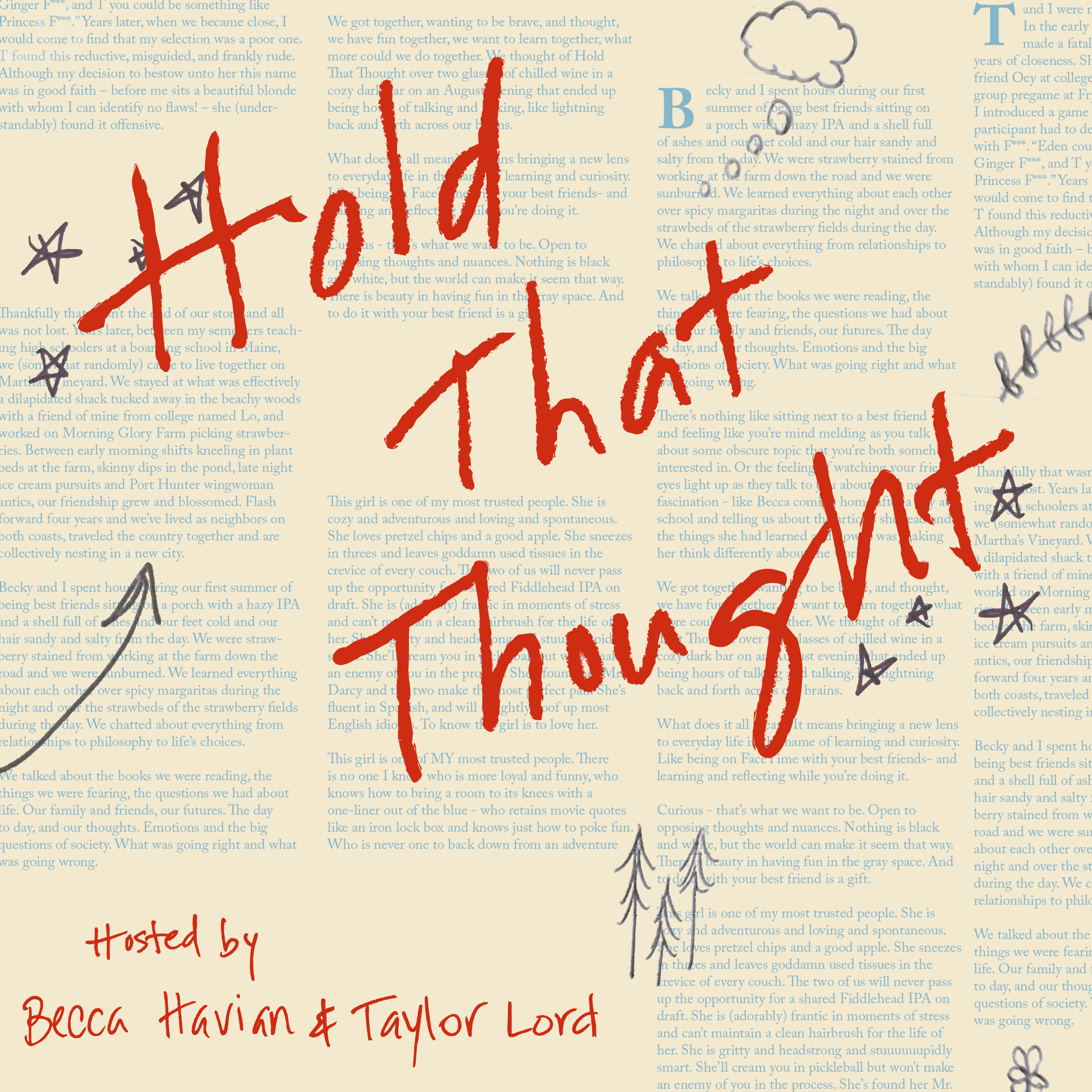
Hold That Thought
by Becca Havian and Taylor Lord
On this podcast, we investigate those lingering questions stuck in a faraway corner of your mind, or currently collecting dust in your notes app.
-
16
The Sage: The Difference Between Wisdom and Intelligence
"Knowing yourself is the beginning of all wisdom." — AristotleIn this episode of Hold That Thought, hosts Becca and Taylor kick off their fourth mini-series ‘Archetypes of a Village’, where they will be exploring and celebrating the different character motifs that make up our proverbial village. The first episode focuses on the archetype of the Sage, exploring teachings, perspectives and philosophies on wisdom, how we acquire it, and the people who portray it best. They also discuss wise teachers they’ve experienced in their own lives and reflect on ways to bring knowledge of self, and by extension wisdom, into our village each day. Topics: Wisdom, sage, archetypes, philosophy, spirituality, motifs, characters, learningResources:The Sage Archetype (and why our world needs it)5 Techniques To Develop Wisdom Over TimeWhat is an Archetype?Richard Rohr: Center for Action and ContemplationTara Brach: Accessing Innate Wisdom
-
15
Paying Attention: Capturing Small Moments in Mental Snapshots
“I don’t know exactly what a prayer is. I do know how to pay attention”. -Mary OliverIn this episode of Hold That Thought hosts Taylor and Becca explore the power of paying attention. They admire artists and authors who bring the practice of noticing alive through their work and capture micro-moments themselves by sharing three mental snapshots from their own lives. They share the stories and follow the ideas sparked by the act of noticing. Topics: Mindfulness, Journaling, Art, Noticing, Stillness, Friendship, Meditation, Sonder, Photography, Ross Gay, Poetry Resources:The Dictionary of Obscure SorrowsIt’s the 1970s Again. Democrats Should Study Up on Reagan.Why Is Everyone Talking About Brown?How Ross Gay Finds Joy In The Smallest of 'Delights'How to Strengthen Your Happiness MuscleHow Can We Break the Cycle of Focusing on Negative Experiences?STILL: The Art of Noticing with Mary Jo HoffmanAfter the Fire: Rebuilding After Loss and Making Life a Total Work of Art with Steve & Mary Jo HoffmanPursuit of Happiness: Martin Seligman
-
14
You’re Playing a Rigged Game: How Algorithms and Incentives Stack the Odds Against You
At the intersection between outcome and agency is a hidden world of untold factors: Dating app algorithms. Sport betting odds. Consumer finance incentives. They impact our lived experience, but we often don’t know they exist at all. In this episode of Hold That Thought hosts Taylor and Becca explore everyday situations where hidden mechanics and misaligned incentives are rigging the odds and changing outcomes, right under our noses without us even knowing. From the matches we see on Hinge, to stock prices traded on the NYSE, the devil is in the factors behind the scenes. Topics: Algorithms, Odds, Stacked Odds, Sports Betting, Dating Apps, Ticketmaster, Stock Exchange, CFBP, Consumer Finance Resources:The Algorithms of Dating Apps, ExplainedLegal Issues to Know Before Offering a Sale or CouponHinge’s CEO insists the app doesn’t have an ‘attractiveness score’ after users’ frustration. Here’s how he says the algorithm works—and why the free version is ‘sacred’FTC Sues Live Nation and Ticketmaster for Engaging in Illegal Ticket Resale Tactics and Deceiving Artists and Consumers about Price and Ticket LimitsJustice Department and Live Nation reach settlement over Ticketmaster illegal monopoly caseWho Benefits from Trump’s Move to Shut Down Consumer Financial Protection Bureau?Trump administration attempts to close the CFPB, block agency’s workAgainst the Rules: The Seven Minute RuleAgainst the Rules: The Magic Shoebox“Who Is Government? The Untold Story of Public Service” by Michael Lewis
-
13
The US Postal Service: The Hidden Backbone of American Life and Democracy
The new Postmaster General said that the USPS is a beautiful ballet that nobody understands. It’s a machine that chugs behind the scenes to connect us from coast to coast, but the mechanics are a mystery. In this episode of Hold That Thought hosts Taylor and Becca peek behind the curtain to understand how USPS works. They discuss the nostalgia of letter writing and the symbolism of USPS’ service mandate. They explore the postal service’s history, from the first post office in the 13 colonies to the pivotal role mail played in the American Revolution and building the political ethos of the US. They unpack how the voting power of millions relies on USPS, and the sobering fact that that right is in jeopardy today. Topics: USPS, Postal Service, United States History, Mail, In Plain Sight, Universal Service Mandate, Democracy, PoliticsResources:Quadruple increase in rejected California mail-in ballots signals problems with Trump meddling in future electionsHow we generated a response rate of 63% by ignoring the brand guidelinesMIT Election LabWhy the Short-Lived Pony Express Still Fascinates UsVoting by Mail: Center for Election ConfidenceOn mail, meaning and the artwork that appears on US postageThe Citizens’ Stamp Advisory CommitteeHow the US Post Office Has Delivered the Mail Through the DecadesBBC: Denmark postal service to stop delivering lettersUSPS: Postal FactsThe US Postal Service's Fiscal Crisis
-
12
Invisible Women: How the Gender Data Gap Shapes Everyday Life
We accept as reality (and even forget to recognize) the everyday ways our modern world has been built for men. But as soon as you peek under the hood, the perniciousness of the male default emerges in plain sight. In this episode of Hold That Thought hosts Taylor and Becca discuss the role of the gender data gap in creating this inequity. From healthcare practices and medication, to automobile development and snow clearing practices, they unpack how a dearth of data on women impacts our policies, innovations and daily life. Topics: Gender data gap, data bias, inequity, bias, clinical trials, modern day, inequity, circadian rhythms, infradian rhythms, human biologyResources:Invisible Women: Data Bias in a World Designed for Men by Caroline Criado-Perez“If men didn’t exist, who would protect you?”AT,TP x The Dish: Cycle SyncingInfradian Rhythms: What They Are and Why They MatterHow Period Tracking Birthed the CalendarBuckle Up Women; Cars Still Aren’t Built For YouWhy we know so little about women’s healthBarriers to Accessing Effective Treatment and Support for Menopausal Symptoms: A Qualitative Study Capturing the Behaviours, Beliefs and Experiences of Key StakeholdersDr. Paula Johnson Is Breaking Down the Barriers to Better HealthDr. Paula Johnson: When Does Medicine Leave Women BehindAre Cars More Dangerous for Women? Understanding the Risks and How to Protect YourselfPodcast 186: The Gender Gap in Research – And How It's Affecting Women’s HealthLife-Saving Intel: Amanda's Breast Cancer Surgeon Dr. Lucy De La CruzHow Sex and Gender Bias Skews Medical Research with Dr. Kate Womersley
-
11
Why Airplanes Make Us Weird: Etiquette and Myths
Airplanes, airports, air travel: it’s all anyone can talk about these days. In this episode of Hold That Thought hosts Taylor and Becca chat through the rules, regulations and human idiosyncrasies that dictate flying. They discuss the history of the first air travel and consider how airplanes and travel expose fundamental elements of human behavior and social interaction. They dive into the roots of one of our most common fears and how news today has us questioning timeless protocol.Topics: Plane etiquette, Social norms, The social contract, Boeing Whistleblower, Behavioral psychology, Travel culture Resources:This Is Your Captain SpeakingBoeing 737 Max Factory Was Plagued With Problems, Whistle-Blower SaysHow To Avoid The Dreaded Post-Flight BreakoutAir Travel: CDCPortable Electronic Devices PresserAir Rage: What Factors Influence Airline Passenger Anger?Stuff You Should Know: A Brief History of Air Travel It's been 20 years since smoking was completely banned on all US flights. Here's how smoking on planes went from normal to banned.Why do we put seatbacks up for landing? An aviation expert explains.WKYC Channel 3 TikTokDelta is replacing engines on Airbus aircraft to address toxic fumes issueWhy Boeing’s Problems with the 737 MAX Began More Than 25 Years Ago
-
10
Why Their Moods Feel Like Your Problem (Codependency)
What is codependency? Who experiences it? Where does it come from? And how do you make it better? In this episode of Hold That Thought hosts Taylor and Becca explore these questions and more, unpacking the origins, critiques, nuances and power of the psychological model of codependency. In the end, they discuss how doing your homework on codependency can help you not only understand your relationship to others, but also help you understand yourself. Topics: Codependency, relationships, family systems, addiction, psychology, relationshipsResources:The Lived Experience of Codependency: an Interpretive Phenomenological AnalysisLiving with Addicted Men and Codependency: The Moderating Effect of Personality TraitsAn Overview of the Historical and Empirical Antecedents in the Development of the Codependency ConceptDiagnostic Criteria for CodependencyWhat Is Codependency? And What Does This Buzzword Really Mean?Mental Health America: CodependencyTikTok: Relational AlchemyWe Can Do Hard Things: Breaking Codependency and Letting LIfe Happen with Melody BeattieThe dopaminergic reward system underpins gender differences in social preferences16 Codependent Traits That Go Beyond Being a People PleaserCodependency A Helpful Concept Turned Toxic: A Lesson from Our Own History
-
9
Oversharing or Vulnerability? The Psychology of Being Seen Online
Vulnerability is the key to connection. But social media confuses the line between true connection and oversharing.In this episode of Hold That Thought, hosts Becca and Taylor unpack the power of vulnerability through the work of researcher Brené Brown. They consider how social media has changed our perception of vulnerability and created a tension between finding connection and seeking validation. They explore the ubiquity of social media outrage and policing, and talk through their own experiences of vulnerability online.Topics: Vulnerability, connection, social media, Brené Brown, sharing, community, psychology, courage, moral outrage, validation Resources:‘Likes’ and ‘shares’ teach people to express more outrage onlineHow to Nurse an Oversharing HangoverDoing Good or Feeling Good? Justice Concerns Predict Online Shaming Via Deservingness and SchadenfreudeThe Power of VulnerabilityOprah Super Soul Sunday: The Power of VulnerabilityUnderstanding Social Media Addiction: A Deep DiveVulnerability: Validation, Appreciation, and Reciprocation in Business, Personal, and Health Context
-
8
Jealousy vs Envy: The Psychology Behind Our Most Uncomfortable Emotions
“Comparison is the thief of joy.”“Jealous is a green-eyed monster.”We’re so often told, subliminally and overtly, that jealousy and envy are emotions that we should avoid. But if we get close to jealousy and envy (and yes they’re slightly different), these emotions just might be teaching us something valuable. In this episode of Hold That Thought, hosts Becca and Taylor explore the origins of Jealousy and Envy and unpack how these emotions that we’re often taught to fear can be powerful in their own way. This episode is part of the Hold That Thought mini-series— Working Together: Elements of Interpersonal Relationships.Key Topics: Jealousy, Envy, Yearning, Motivation, Evolutionary Psychologists, Emotions, Vulnerability, Evil EyeSources:On Our Best Behavior: The Seven Deadly Sins and the Price Women Pay to be Good by Elise LoehnenChoosing Wholeness Over Goodness: A Process for Reclaiming Your Full Self by Elise LoehnenThe Evolutionary Psychology of Envy and JealousyRobert Leahy || The Jealousy CureSibling Rivalry, A HistoryYearning: the ache at the center of our livesJealous Vs. EnviousHard Won and Easily Lost: A Review and Synthesis of Theory and Research on Precarious ManhoodEvil EyeNazar: Energies Exchanged in a Glance
-
7
Why We Follow Rules: Social Contracts, Trust and Cooperation
How can we be free and live together? What binds humans into a society?In this episode of Hold That Thought hosts Becca and Taylor explore these central questions and other foundational principles of Social Contract Theory. They unpack how The Social Contract may or may not be the underpinning that dictates our implicit following of ever-day-rules. They take it back to the early Social Contract theorists and critiques of their philosophy, exploring what may be the innate human instinct to follow rules to protect stability and each other, while interrogating what happens when they don’t. This episode is part of the Hold That Thought mini-series— Working Together: Elements of Interpersonal Relationships.Key Topics: Social Contract Theory, Rule Following, Philosophy, Psychology, Joint Commitment, Political Theory, Politics, Democracy, Pro-Social, Anti-Social, Behavioral Economics Resources:The Social Contract Explained SimplyPsychopathic, Sociopathic, or Antisocial Personality?The Social Contract Only Works If It Protects PeopleEvaluating social contract theory in the light of evolutionary social scienceProspect Theory: How We Make Decisions Under RiskStudy finds apes mind their manners much like humansA Big-Picture Look at Social RulesSocial Contract Theory in Education: Rules, Rights and Responsibilities
-
6
How We Learn Language: Brain Science, Rhythm and Meaning Making
In one of the most remarkable feats of the human brain we use language everyday to communicate, build relationships and craft realities using nothing but our own words. But have you ever stopped and wondered how language works?In this episode of Hold That Thought, hosts Taylor Lord and Becca Havian explore the principles of language and language learning. They start with a quick primer on the neurophysiology, the machinery on which our brains code the building blocks of language. They walk through a new way of teaching language that uses these principles and discuss the power of learning a new language on our brain health. Finally, they chat about how multiple languages can broaden and change our perception of the world and give quick tips if you’re looking to learn as an adult. This episode is part of the Hold That Thought mini-series— Working Together: Elements of Interpersonal Relationships.Topics Include: language learning, language, neurophysiology, linguistics, language research, bilingulaism, polyglotsResources: Does the Linguistic Theory at the Center of the Film ‘Arrival’ Have Any Merit?Sapir-Whorf HypothesisMultilingual Education: A Key to Quality and Inclusive LearningBerkeley Voices: One brain, two languagesLearning Language Changes Your BrainLanguage Shapes How We Perceive TimeThe positive lexicophy Dr. Eddie Chang - Huberman LabThe Glottal StopReal Fast SpanishCuentame PodcastBabbel
-
5
No Bad Parts: An Introduction to Internal Family Systems (IFS)
You know the voices inside your head – the one that tells you you’re not good enough, the one that makes you check your teeth for gunk before leaving the house, or maybe the one that has an outsized temper tantrum when slighted. The noise can be unrelenting. But what if you could befriend these chatter boxes, our roommates inside our minds? Enter Internal Family Systems (IFS). In this episode of Hold That Thought, hosts Becca Havian and Taylor Lord explore the basics of IFS, a model of psychotherapy that helps us better understand ourselves by identifying and getting close to our sub-personalities or “parts.”This episode is the fifth and final episode in the first Hold That Thought mini-series — Building a Home in Your Mind. Come back next week for the start of our second mini-series about connecting to others.Topics Include: Internal Family Systems, IFS, therapy, mental health and wellness, identity, meditation, relationships, personal development, parts work.Resources:The IFS Institute“What is IFS Therapy? | Intro to Internal Family Systems” YouTube video by Dr. Tori Olds"The Huberman Lab" episode with Dr. Schwartz"We Can Do Hard Things" episode with Dr. Schwartz"The Untethered Soul" by Michael Singer“No Bad Parts: Healing Trauma and Restoring Wholeness with the Internal Family Systems Model” by Richard Schwartz
-
4
From Secure to Anxious: The Intersection of Attachment Styles and Modern Dating
Compulsively checking your texts to see if your crush has responded? Always waiting for the other shoe to drop? Caught between relationship labels? Dying to DTR? Been there!! In this episode, hosts Taylor Lord and Becca Havian explore the psychology of Attachment Styles, a model that characterizes types of interpersonal emotional bonding, trust and behavior. They chat through the modern dating scene to better understand how emotional commitment– or the lack thereof– may be impacting our bonding and behavior and they discuss why healing ourselves often means healing in relationship to others. This episode is the fourth in the Hold That Thought mini-series— Building a Home in your Mind. Topics Include: Attachment styles, modern dating, anxious attachment, secure attachment, situationships, relationships, mental health and wellness, identity, personal development.Resources:From the Cradle to the Grave: Age Differences in Attachment From Early Adulthood to Old Age. Adult Attachment Theory and Research - A Brief Overview.Most women say they are finished with 'situationships', Hint App data shows. Cooperative Agency.If you want the milk, buy the cow: A study of young Black women (Master’s thesis, University of Memphis). America Is in Its Insecure-Attachment Era: Discomfort with intimacy seems to be on the rise—and no one’s quite sure why. Attached: The new science of adult attachment and how it can help you find—and keep—love. Levine, A., & Heller, R. (2010).
-
3
The Placebo Effect: How Belief Triggers the Body’s Healing Response
The placebo effect isn’t fake—and it isn’t just “positive thinking.”In this episode of Hold That Thought, hosts Taylor and Becca explore the connection between belief, anticipation, and healing. They delve into studies around the placebo effect and the lesser known nocebo effect, unpacking research that points to the power of the body’s own healing mechanism and discussing the power of belief, community, and ritual in treatment and health.This episode is the third in the Hold That Thought mini-series— Building a Home in your Mind.Topics Include: Placebo effect, nocebo effect, clinical research, healing, community, parasympathetic nervous system, medicine.Resources:Dr. Ted Kaptchuk TedMed TalkPlacebo Effects Beyond DopamineThe Placebo Effect- Amazing and RealThe Power of the Placebo EffectDr. Lissa RankinMind Over Medicine by Dr. Lissa RankinAnd, finally, channel your feelings of hopelessness, sadness and anger about the atrocities in Minnesota this week with action against ICE– see the resources below.Support Minnesota NowCall Your Reps! Demand Defunding of Ice Now
-
2
Freedom in a Box: The Psychology of Choice and Decision Paralysis
Though we’re taught that freedom comes from limitless choice, research shows too many options often leave us feeling stuck, anxious, and disconnected from what we want and our own intuition.In this episode of Hold That Thought we unpack Freedom in a Box, the concept that structure and boundaries can actually unlock clarity and liberate us to make decisions. From adolescence to adulthood, from creativity to control, we unpack why having a “box” can help us take the next right step. This episode is the second in the Hold That Thought mini-series— Building a Home in your Mind. Topics Include: Decision paralysis, choice overload, boundaries, creativity, intuition Resources: Born to Choose: The Origins and Value of the Need for ControlCan Constraints Improve Our Creativity?Structure and Freedom in Creativity: The interplay between externally imposed structure and personal cognitive styleRelating to Adolescents: Educators in a Teenage World by Susan Eva PorterThe Paradox of Choice (Why More Is Less) by Barry Schwartz
-
1
Tell Me Who I Am: Personality Tests, Diagnoses and the Search for Self
Why do we crave labels, and when do they fail us? In the debut episode of Hold That Thought, hosts Taylor Lord and Becca Havian explore our cultural obsession with self-definition. From popular personality tests like Myers-Briggs Type Indicator (MBTI) and the Big Five Personality Inventory to casual labeling games played with friends, they unpack the rise of self-categorization and the power and pitfalls of self-imposed labels in the search for self. The conversation also dives into the growing desire for formal mental health diagnoses, examining the comfort, clarity and limitations they can bring. This episode is the first of the Hold That Thought mini-series— Building a Home in your Mind. Topics Include: personality tests, MBTI, Big Five, identity, mental health diagnoses, self-discovery, labeling, psychology, cultureResources: The New Yorker: “Why We’re Turning Psychiatric Labels Into Identity”Poog: “Poison Has Its Place”A Third Thin Place: “Tell Me Who I Am” A Third Thin Place: “Naked in the Town Square”Granted: “MBTI, If You Want Me Back, You Need to Change Too”MBTI Personality TypesThe Big 5 Inventory The HiTOP modelWhy do you love personality tests?Mary Oliver: “Our World” Listen, rate, comment and subscribe to Hold That Thought wherever you get your podcasts. Your feedback helps more people find the show.
No matches for "" in this podcast's transcripts.
No topics indexed yet for this podcast.
Loading reviews...
Loading similar podcasts...
URL copied to clipboard!