
PODCAST · health
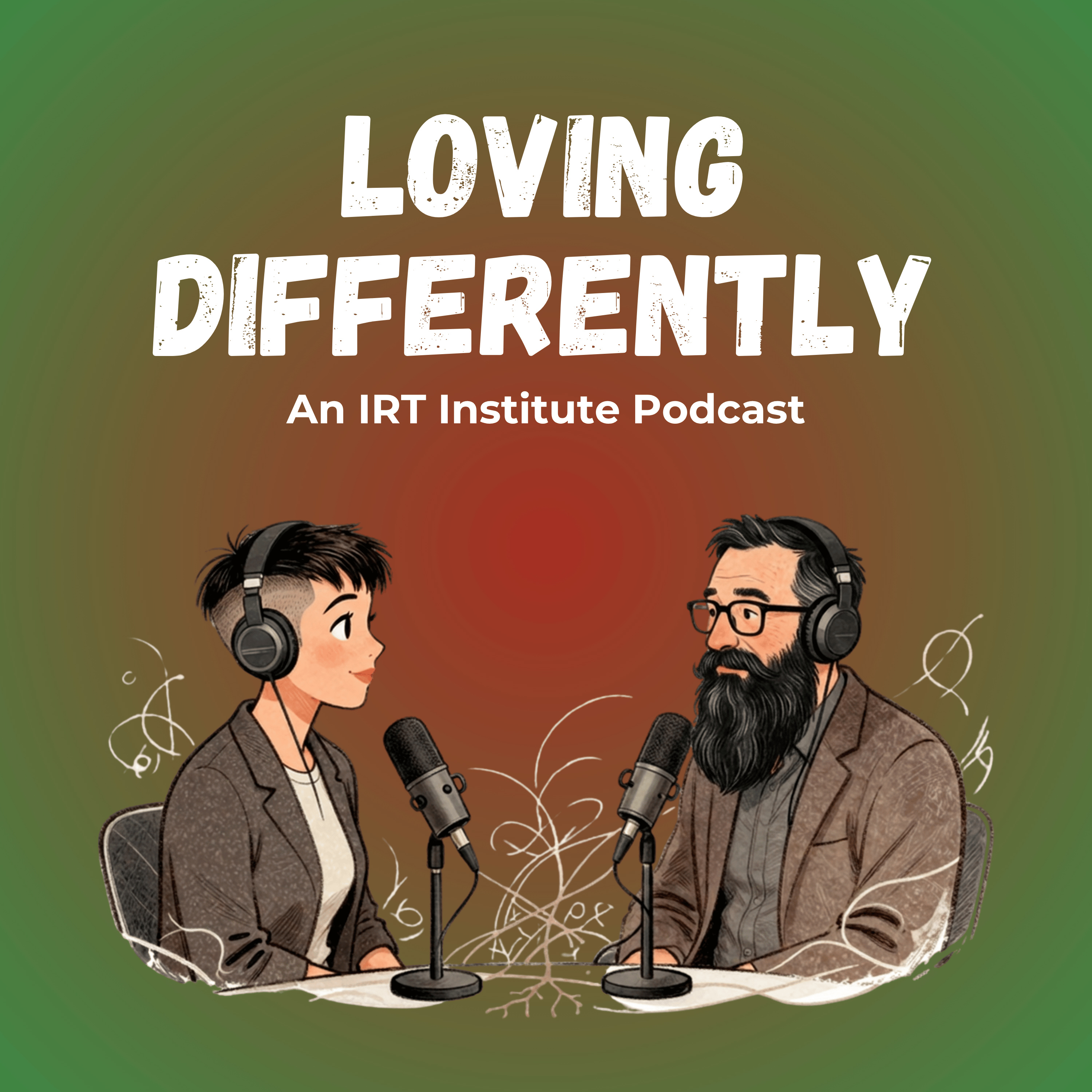
Loving Differently Podcast
by Dr. Kenneth Critchfield and Dr. Eliza Stucker-Rozovsky
The Loving Differently Podcast is a podcast created by two licensed clinical psychologists who are leading practitioners of Interpersonal Reconstructive Therapy, known as IRT for short. In this podcast, Drs. Critchfield and Stucker-Rozovsky unpack the theory and practice of IRT, showing how IRT offers a novel way to work in psychotherapy towards unlearning maladaptive ("Red") patterns and building up their adaptive, growth-oriented ("Green") self. We discuss ways that psychological symptoms can be thought of as a love story gone wrong and how we can learn to love differently.
-
15
Trailer
Welcome to Loving Differently, a podcast co-hosted by Drs. Ken Critchfield and Eliza Stucker-Rozovsky.
-
14
Episode 012 - Narcissistic and Antisocial Personality Disorders Through an IRT Lens
Summary:In Episode 12 of the Loving Differently Podcast, Dr. Kenneth Critchfield, Ph.D., and Dr. Eliza Stucker-Rozovsky, Psy.D., continue their Personality Harmonics series with a deep dive into Narcissistic Personality Disorder (NPD) and Antisocial Personality Disorder (ASD) through the lens of Interpersonal Reconstructive Therapy (IRT).Rather than treating DSM-5 personality disorders as flat labels, Ken and Eliza explore how these patterns can be understood as developmental and relational adaptations. This episode walks through the prototypic pattern, developmental histories, and exclusionary and inclusionary criteria for both NPD and ASD.This episode is especially relevant for clinicians working with trauma, interpersonal patterns, personality disorders, and challenging therapeutic alliances. It offers an IRT-informed way to hold empathy and accountability together while thinking carefully about case formulation, therapist adherence, and treatment timing.Note: The Loving Differently Podcast is for educational and informational purposes only. The content discussed in each episode is not a substitute for professional mental health care, diagnosis, or treatment. Listening to this podcast does not create a therapist-client relationship with either of the hosts. If you are experiencing psychological distress, relationship difficulties, or a mental health emergency, please seek support from a licensed mental health provider in your area or contact your local emergency services.Subscribe for more IRT-focused discussions. Send us your questions at [email protected]:00:00 LDP Episode 012 final02:39 Narcissistic Personality Disorder Overview08:23 NPD Developmental History30:26 IRT Treatment Approach for NPD48:13 Antisocial Personality Disorder57:28 ASPD Developmental History01:09:36 IRT Treatment Approach for ASPD01:21:21 Wrap-Up & What's Next
-
13
Episode 011 - Interpersonal Harmonics Mini Series Ep 3 - Histrionic Personality Disorder and Borderline Personality Disorder
Summary:This episode continues our personality disorder prototype series by exploring histrionic personality disorder (HPD) and its relationship to borderline personality disorder (BPD) through an Interpersonal Reconstructive Therapy (IRT) lens. Clinical Psychologists Ken and Eliza examine how both patterns center around fears of abandonment, but diverge in how individuals attempt to meet those needs—highlighting coercive dependency in HPD and shifting relational dynamics in BPD. The episode also addresses gendered assumptions in diagnosis and the importance of case formulation over labels. Clinicians will gain a deeper understanding of how interpersonal patterns develop, how they present in therapy, and how to respond without reinforcing maladaptive cycles. This discussion offers practical insight into working with personality disorders in a way that is compassionate, nuanced, and clinically effective within an IRT framework.If you like this episode, please subscribe, like, and share with your friends. Let us know what you want to hear us talk about in future episodes - we are listening! Check out the IRT Institute website for more information on IRT, including training for mental health professionals. We have also created an episode guide that gives more detailed information about each episode.Note: The Loving Differently Podcast is for educational and informational purposes only. The content discussed in each episode is not a substitute for professional mental health care, diagnosis, or treatment. Listening to this podcast does not create a therapist–client relationship with either of the hosts. If you are experiencing psychological distress, relationship difficulties, or a mental health emergency, please seek support from a licensed mental health provider in your area or contact your local emergency services.Timestamps:00:00 Introduction to the series and rationale02:30 Framing personality disorders through IRT and SASB05:00 Overview of borderline personality dynamics08:00 Introducing histrionic personality disorder12:00 DSM vs interpersonal understanding16:00 Developmental history of histrionic patterns21:00 Similarities and differences between HPD and BPD27:00 Clinical implications and therapy dynamics35:00 Countertransference and therapist awareness45:00 Closing thoughts and preview of next episodeReferences: for specific references
-
12
Episode 010 - Interpersonal Harmonics Mini-Series Ep 2 - Borderline and Passive Aggressive Personality Disorders
Summary:In Episode 010, we (Dr. Ken Critchfield and Dr. Eliza Stucker-Rozovsky, licensed clinical psychologists) continue our personality prototype series through the lens of Interpersonal Reconstructive Therapy (IRT). We focus on borderline personality disorder (BPD) and passive-aggressive patterns, exploring how developmental trauma and complex interpersonal learning shape enduring patterns seen in DSM-5 personality disorders.We unpack core IRT concepts such as complex codes, copy processes, and the “gift of love,” illustrating how interpersonal patterns—like fear of abandonment, coercive care-seeking, and self-sabotage—develop and persist. We also examine how developmental trauma contributes to paradoxical dynamics (e.g., love paired with fear, autonomy paired with punishment), and how these patterns play out in therapy.This episode is designed for clinicians seeking a deeper, formulation-driven understanding of personality disorders beyond symptom checklists. We emphasize how recognizing interpersonal patterns can guide more effective, compassionate treatment.If you like this episode, please subscribe, like, and share with your friends. Let us know what you want to hear us talk about in future episodes - we are listening! Check out the IRT Institute website for more information on IRT, including training for mental health professionals. We have also created an episode guide that gives more detailed information about each episode.Note: The Loving Differently Podcast is for educational and informational purposes only. The content discussed in each episode is not a substitute for professional mental health care, diagnosis, or treatment. Listening to this podcast does not create a therapist–client relationship with either of the hosts. If you are experiencing psychological distress, relationship difficulties, or a mental health emergency, please seek support from a licensed mental health provider in your area or contact your local emergency services.Timestamps:0:00 — Intro1:35 — Episode Introduction1:38 — Personality Prototype Series Overview3:34 — Understanding Complex Codes5:50 — BPD Interpersonal Summary7:12 — BPD Developmental History25:33 — BPD Necessary & Exclusionary Conditions42:47 — Transition to Passive-Aggressive PD43:35 — Passive-Aggressive PD Overview48:38 — Passive-Aggressive Interpersonal Summary1:03:45 — Passive-Aggressive Treatment Approach1:13:40 — BPD vs. Passive-Aggressive: Comparing Patterns1:19:15 — ClosingReferences:
-
11
Episode 009 - Interpersonal Harmonics Mini Series Ep 1 - Avoidant, Dependent, and Obsessive Compulsive Personality Disorders
In this episode, Ken Critchfield, PhD and Eliza Stucker-Rozovsky, PsyD begin a new miniseries on Interpersonal Harmonics—a core concept in Interpersonal Reconstructive Therapy (IRT)—by exploring Cluster C personality disorders through an interpersonal lens.We walk through avoidant, dependent, and obsessive-compulsive personality patterns, highlighting how these presentations extend beyond DSM-5 symptom lists into deeply rooted interpersonal patterns shaped by developmental trauma and learning histories. Using SASB-informed thinking and copy process theory, we examine how early caregiving environments shape internal self-criticism, fears of rejection or incompetence, and rigid perfectionism.Throughout the episode, we emphasize a central IRT principle: these are not “disordered people,” but adaptive love stories gone wrong. By understanding the interpersonal logic behind these patterns, clinicians can move beyond diagnosis toward meaningful case formulation and compassionate, effective treatment.Note: The Loving Differently Podcast is for educational and informational purposes only. The content discussed in each episode is not a substitute for professional mental health care, diagnosis, or treatment. Listening to this podcast does not create a therapist–client relationship.Timestamps(00:00) – Launching the Interpersonal Harmonics miniseries(02:00) – Why Cluster C personality patterns first(04:30) – Avoidant personality: beyond anxiety(06:30) – Fear of rejection, humiliation, and longing for connection(09:00) – Developmental origins and criticism(17:30) – Therapy stance with avoidant patients(43:30) – Transition to dependent personality(45:00) – Developmental pathways to dependency(52:00) – DSM vs interpersonal patterns in dependency(01:01:00) – Transition to obsessive-compulsive personality(01:03:00) – Perfectionism and fear of imperfection(01:08:00) – Living in the courtroom(01:14:00) – Therapy stance for OCPD(01:24:00) – Experiencing life beyond perfectionism(01:28:30) – Summary of Cluster C
-
10
Episode 008 - Highlight Reel
Check out episode 008 where we review an upcoming publication and its implications.Paper referenced: Panizo, M. T., Harrison, E. G., & Critchfield, K. L. (in press, 2026). Interpersonal Diagnosis of Personality Disorders: Explaining Comorbidity and Enhancing Clinical Relevance. Journal of Psychotherapy Integration.
-
9
Episode 008 - Personality Disorder through an Interpersonal Lens – Validating Lorna Benjamin’s Approach
SummaryIn this episode of the Loving Differently Podcast, we (Dr. Ken Critchfield and Dr. Eliza Stucker-Rozovsky) dive into a newly accepted paper examining the interpersonal diagnosis of personality disorders through the lens of Interpersonal Reconstructive Therapy (IRT). Using the SASB model, we explore how longstanding debates in the DSM-5—categorical versus dimensional models of personality disorder—can be reframed through interpersonal patterns and developmental histories.We discuss how personality disorders are best understood not as fixed traits, but as learned relational strategies that once served adaptive purposes in difficult environments. Drawing on empirical findings from Panizo et al. (2025), we examine interpersonal hostility, comorbidity, and how overlapping personality disorder features emerge naturally when viewed dimensionally. We also explore how interpersonal case formulation offers clinicians greater empathy, specificity, and hope for change.Throughout the episode, we connect theory to clinical practice—highlighting how IRT helps clinicians move beyond symptom management toward helping patients reconstruct deeply ingrained relational patterns rooted in developmental trauma. We also preview an upcoming series focused on specific personality disorder prototypes and their interpersonal harmonics.Send us your questions at [email protected] and subscribe for more IRT-focused discussions.Note: The Loving Differently Podcast is for educational and informational purposes only. The content discussed in each episode is not a substitute for professional mental health care, diagnosis, or treatment. Listening to this podcast does not create a therapist–client relationship with either of the hosts. If you are experiencing psychological distress, relationship difficulties, or a mental health emergency, please seek support from a licensed mental health provider in your area or contact your local emergency services.Timestamps(00:00) – Introduction and context for the Panizo et al. paper(02:30) – Why personality disorders remain a central clinical challenge(05:00) – Categorical vs dimensional models in the DSM-5(08:30) – How SASB conceptualizes interpersonal patterns(12:00) – Developmental trauma and adaptive origins of personality patterns(16:00) – Interpersonal hostility as a core feature of personality disorders(20:00) – Understanding comorbidity through interpersonal overlap(25:00) – Five interpersonal clusters identified in the research(32:00) – Clinical implications of interpersonal diagnosis(40:00) – Hope, change, and reconstruction in IRT(48:00) – Bridging DSM language with interpersonal case formulation(55:00) – Preview of upcoming personality disorder series(63:00) – Final reflections on empathy and clinical relevance
-
8
Year-End Thanks, Merch, and What We’re Working On
In this short update, we (Ken and Eliza) wanted to pause and say thank you to everyone who has listened to Loving Differently this year. When we started the podcast, we genuinely didn’t know if anyone would be listening — and the thoughtful feedback, engagement, and curiosity from clinicians and learners alike has meant more to us than we can easily put into words.We also share a quick update about our limited merch campaign, which was created to help support the podcast as we upgraded our recording setup and production quality. From mugs to t-shirts and totes, we wanted to offer items that were genuinely well-made and meaningful — things we’d actually want to use ourselves — as a small way of saying thanks while also covering some of the real costs of running the podcast.Link to merch: https://linktr.ee/irtinstituteFinally, we give a preview of what’s coming next on Loving Differently, including upcoming episodes on personality disorder, personality measurement, and the SASB interpersonal framework, as well as deeper clinical conversations grounded in Interpersonal Reconstructive Therapy (IRT) and the work of Lorna Benjamin. We’re also beginning to plan more in-depth IRT training opportunities and workshops for those who want to go further.Send us your questions at [email protected] and subscribe to this podcast for more IRT-focused discussions.Note: The Loving Differently Podcast is for educational and informational purposes only. The content discussed is not a substitute for professional mental health care, diagnosis, or treatment, and listening does not create a therapist–client relationship.Timestamps(00:00) – Ken and Eliza share a quick update and say thank you(00:35) – Why we launched the merch campaign and upgraded our recording(01:15) – What the merch means to us and why we chose quality items(02:05) – Gratitude for listeners and feedback over the past year(02:45) – How long the merch campaign runs and what happens next(03:05) – Upcoming episodes on personality disorder and SASB(03:35) – Future plans for IRT training and workshops(04:00) – Holiday wishes and closing thanks
-
7
Trailer - Episode 007
A preview of our most recent episode, all about what is reconstruction mean (the "R" of IRT).
-
6
Episode 007 - What Is the “R” in IRT? Reconstruction, Red & Green, and the Gift of Love
In this episode, we unpack the “R” in Interpersonal Reconstructive Therapy: Reconstruction—what it means, why it matters, and how it reshapes identity, relationships, and the patterns we carry forward from early life. We explore the dynamics of Red and Green, the powerful pull of the Gift of Love, and why change can feel both destabilizing and deeply transformative. Using clinical examples and personal reflections from practice, we illuminate how IRT helps people move from old, loyalty-driven patterns toward their birthright selves.If you like this episode, please subscribe, like, rate/review, and share with your friends and colleagues. Let us know what you want to hear us talk about in future episodes - we are listening! Check out the IRT Institute website for more information on IRT, including training for mental health professionals. We have also created an episode guide that gives more detailed information about each episode.Note: The Loving Differently Podcast is for educational and informational purposes only. The content discussed in each episode is not a substitute for professional mental health care, diagnosis, or treatment. Listening to this podcast does not create a therapist–client relationship with either of the hosts. If you are experiencing psychological distress, relationship difficulties, or a mental health emergency, please seek support from a licensed mental health provider in your area or contact your local emergency services.Timestamps:(00:00) – Introducing the episode: what “reconstruction” means in IRT(01:15) – Housekeeping, listener feedback, and new platform availability(02:10) – What makes IRT’s take on personality and change unique(03:00) – Defining reconstruction: patterns vs identity(04:30) – Fear of losing oneself when patterns change(06:05) – Red and Green explained: behavioral templates under stress(07:15) – The “regressive loyalist” and how Red protects old bonds(09:00) – The Gift of Love: why patterns persist across a lifetime(10:40) – Lorna Benjamin’s quote: “Every psychopathology is a gift of love”(12:10) – Applying IRT concepts: example of OCP patterns and learned control(14:20) – How early caregiving shapes perfectionism and self-neglect(16:00) – Why other therapies get “stuck”: insight vs motivation(18:00) – Understanding attachment motivations to unlock change(20:00) – The shift from Red to Green: awareness, blocking, choice(22:45) – Exploring Green: flexibility, tolerance, authenticity(25:10) – Practicing alternative patterns: behavioral vs existential change(27:40) – Creativity, play, and exercises that support Green(30:00) – Rehearsal, repetition, and neurobiological restructuring(32:10) – The deeper transformation: identity, grief, and loss(34:00) – Courage, mistrust, and the leap into the unknown(37:00) – Honoring patients’ bravery and the therapist’s role(38:30) – Wrapping up + preview of Episode 008 on personality disorders
-
5
Episode 003- Introduction to the Structural Analysis of Social Behavior (SASB), part 1
Summary:Welcome back, folks! We are almost through with the beginning, didactic-like episodes where we introduce all the IRT/SASB lingo. Today's episode is introducing SASB and key concepts/terms associated with SASB. The intro to SASB topic is actually broken into two episodes, to make it easier to listen!If you like this episode, please subscribe, like, and share with your friends. Let us know what you want to hear us talk about in future episodes - we are listening! Check out the IRT Institute website for more information on IRT, including training for mental health professionals.Timestamps/Notes:3 axes of SASB: Focus, Affiliation, and Interdependence(08:52) - Axes of SASBAxis 1 - Focus: Is this about you, or is this about me? (10:00) - Focus on other(10:35) - Focus on self relative to other(11:35) - Focus on selfAxis 2 - Affiliation: Are we in friendly space, or are we in hostile space? Axis 3 - Interdependence: Do we go our separate ways or do we share?(12:56) - Describing SASB visually, with axes of affiliation (13:00) and interdependence (19:17)(26:52) - Goals of IRT using SASB - flexibility(30:40) - The “dances” within SASB -Principles of similarity, opposites, and complementarity(38:15) - Baseline of healthy relatednessReferences:Critchfield, K. L., & Benjamin, L. S. (2024). Structural analysis of social behavior: A primer for clinical use. American Psychological Association (APA).
-
4
Episode 006 - How Change Happens in IRT: The Gift of Love
Summary:In this episode of Loving Differently, Dr. Ken Critchfield and Dr. Eliza Stucker-Rozovsky unpack one of the most important empirical contributions to Interpersonal Reconstructive Therapy (IRT): The Gift of Love as a Candidate Mechanism of Psychopathology and Change in IRT. Published in Psychotherapy (APA), this study investigates how deeply entrenched interpersonal patterns—rooted in early attachment experiences and developmental trauma—shape symptoms in individuals with high acuity clinical needs.Rather than comparing IRT to a control condition, this research examines therapist adherence to IRT principles and whether aligning treatment with case formulation, supporting “green” over “red,” and engaging the Gift of Love motivations leads to meaningful clinical improvement. The sample includes patients with repeated hospitalizations, suicidality, and longstanding personality disorder diagnoses—individuals often labeled “difficult,” “treatment-resistant,” or “non-responders” in traditional DSM-5 frameworks.Dr. Critchfield and Dr. Stucker-Rozovsky discuss how adherence predicts better outcomes, including higher retention and significant recovery rates. They also explore how the Gift of Love framework provides a structure for understanding unconscious loyalty, symptom meaning, relational patterns, and why clients struggle to change despite genuine desire to feel better.Send your questions to [email protected] and subscribe for more IRT-focused discussions.Timestamps:(05:00) - General takeaways from GOL paper(14:15)- GOL Awareness and Choice Scale(16:20) - The importance of learning history in IRT; why some modern day therapy is present focused(22:22) - Meanings of ‘symptom’ in IRT, in relation to the GOL(31:39) - Adherence in IRT(34:34) - 5 Steps of IRT(36:15) - What IRT addresses that TAU does not(39:10) - Supporting Green over Red(53:40) - Collaboration in case formulation development(55:00) - Choosing to love differently(58:30) - Mediation effect in IRT paper(61:00) - GOL and “treatment resistance”(64:40) - Paucity of research studying individuals with high acuity clinical needsReferences:Critchfield, K. L., Gornish, A., Epstein, L., Mackaronis, J. E., & Benjamin, L. S. (2025). The "gift of love" as a candidate mechanism of psychopathology and change in interpersonal reconstructive therapy for patients with high-acuity clinical needs. Psychotherapy (Chicago, Ill.), 10.1037/pst0000556. Advance online publication. https://doi.org/10.1037/pst0000556Karpiak, C. P., & Benjamin, L. S. (2004). Therapist Affirmation and the Process and Outcome of Psychotherapy: Two Sequential Analytic Studies. Journal of Clinical Psychology, 60(6), 659–676. https://doi.org/10.1002/jclp.10248
-
3
Episode 005 - What is a personality disorder, anyway?
Summary:Welcome back! In today’s episode, we take a bird’s eye view of personality disorders. We look at the categorical definition of a personality disorder in the DSM-5 TR and compare and contrast it to an IRT understanding of personality disorders. We discuss stigma related to the term ‘personality disorder’ and our own ambivalence around this terminology. Over the course of the episode, we talk about ways IRT helps to destigmatize personality disorders and humanize our patients, through working to understand a person’s specific learning history and relational patterns as ways of adapting at one time. We also discuss the role of trauma in development of personality disorders, ways IRT holds hope for positive, meaningful change, the role of finding the Green self in fostering this change, and our musings about what exactly changes in a person undergoing IRT treatment. This is a fun episode - we hope you enjoy!If you like this episode, please subscribe, like, and share with your friends. Let us know what you want to hear us talk about in future episodes - we are listening! Check out the IRT Institute website for more information on IRT, including training for mental health professionals.Timestamps:(4:02) - General PD definition DSM-5 TR(8:25) - Stigma around personality disorders(11:30) - Some relational summaries for avoidant, schizoid, dependent(13:30) - 1993 Lorna book(15:45) - Our ambivalence about PD labels(24:45) - Relational signatures of personality disorders(29:00) - Trait theory vs Red(31:30) - Copy processes making problem patterns specific to learning history(33:33) - Role of trauma in personality disorders(34:35) - Lorna’s metaphor of relational harmonics and letting go of GOL (37:31) - Does IRT change the core of a person?References:Benjamin, L.S. (1993/1996). Interpersonal Diagnosis and Treatment of Personality Disorder. New York: Guilford Press. Stucker-Rozovsky, E. (2022). Operationalizing the Gift of Love (GOL) in Interpersonal Reconstructive Therapy (IRT): An examination of the role of meaning reconstruction in therapeutic change. [Doctoral dissertation, James Madison University]. ProQuest Dissertations & Theses Global.
-
2
Episode 004 - Introduction to SASB, part 2 - Touring the SASB Model
Summary:Welcome back! We could talk about SASB for WAY longer than this, but this is part 2 of what we'll call the introduction to SASB. In today's episode, we take each of the eight positions of the cluster model one at a time and discuss each, complete with applications in everyday life as well as within therapy conversations! If you like this episode, please subscribe, like, and share with your friends. Let us know what you want to hear us talk about in future episodes - we are listening! Check out the IRT Institute website for more information on IRT, including training for mental health professionals.Timestamps:(2:35) Overview of the positions of SASB, starting with cluster 2 (“I’m ok and you’re ok”)(5:09) Cluster 3 - love(8:39) Cluster 4 - protect/teach (13:08) Cluster 5 - control(19:17) Cluster 6 - blame (30:29) Cluster 7 - attack (38:59) Cluster 8 - ignore(47:14) Cluster 1 - emancipateReferences:Benjamin, L. S. (2018). Interpersonal Reconstructive Therapy for Anger, Anxiety and Depression: It’s about broken hearts, not broken brains. American Psychological Association (APA).Critchfield, K. L., & Benjamin, L. S. (2024). Structural analysis of social behavior: A primer for clinical use. American Psychological Association (APA).
-
1
Episode 002 - What is Interpersonal Reconstructive Therapy (IRT), anyway?
Summary: Welcome back! In today's episode, we give a general overview of some key terms and concepts underlying IRT as both a theory of psychopathology and a principles-based therapy approach. We discuss the goals of therapy in IRT, how to identify maladaptive behaviors linked to loved ones, and how to help build the adaptive part of the self that is able to let go and (you guessed it!) love differently. We also define key concepts unique to IRT, such as copy processes and the gift of love (GOL), and how they are incorporated into a case formulation.We discuss the contentious label of "treatment resistance" within the mental health community and provide a re-frame of how mental illness can be understood through an IRT lens. If you like this episode, please subscribe, like, and share with your friends. Let us know what you want to hear us talk about in future episodes - we are listening! Check out the IRT Institute website for more information on IRT, including training for mental health professionals.Timestamps:(04:40) - Definition of ‘symptoms’ from an IRT point of view (05:16) - Red and Green parts of the self(08:30) - Goal of IRT - the adaptive self(13:10) - SASB description of Green behaviors(13:40) - SASB description of Red behaviors(18:00) - Function of enacting Red (19:10) - Love, protection, and approval (20:49) - Reframing treatment resistance(21:57) - GOL, defined(26:35) - Introjection as copy process(28:00) - Recapitulation as copy process(34:20) - Case formulation components in IRTReferences:Benjamin, L.S. Interpersonal Diagnosis and Treatment of Personality Disorder. N.Y: Guilford Press. 1st edition, 1993; 2nd 1996; paperback 2003.Benjamin, L. S. Interpersonal Reconstructive Therapy (IRT): an integrative personality-based treatment for complex cases. New York: Guilford Press. (2003; paperback edition 2006)Benjamin, L.S. (2018). Interpersonal Reconstructive Therapy for Anger, Anxiety and Depression: It’s about Broken Hearts, Not Broken Brains. Washington, D. C.: American Psychological Association
-
0
Episode 001 - Introduction to the Loving Differently Podcast
Summary:In this premiere episode of Loving Differently, clinical psychologists Dr. Ken Critchfield and Dr. Eliza Stucker-Rozovsky introduce listeners to the spirit of Interpersonal Reconstructive Therapy (IRT)—a way of understanding how our earliest relationships shape the patterns of love we repeat throughout life. Through stories of mentorship under IRT founder Lorna Smith Benjamin and their own paths into the field, Ken and Eliza explore what it means to “love differently”: to move beyond blame, understand the meaning behind behavior, and transform even painful attachment patterns into growth and connection.If you like this episode, please subscribe, like, and share with your friends. Let us know what you want to hear us talk about in future episodes - we are listening!Check out the IRT Institute website for more information on IRT, including training for mental health professionals.
We're indexing this podcast's transcripts for the first time — this can take a minute or two. We'll show results as soon as they're ready.
No matches for "" in this podcast's transcripts.
No topics indexed yet for this podcast.
Loading reviews...
ABOUT THIS SHOW
The Loving Differently Podcast is a podcast created by two licensed clinical psychologists who are leading practitioners of Interpersonal Reconstructive Therapy, known as IRT for short. In this podcast, Drs. Critchfield and Stucker-Rozovsky unpack the theory and practice of IRT, showing how IRT offers a novel way to work in psychotherapy towards unlearning maladaptive ("Red") patterns and building up their adaptive, growth-oriented ("Green") self. We discuss ways that psychological symptoms can be thought of as a love story gone wrong and how we can learn to love differently.
HOSTED BY
Dr. Kenneth Critchfield and Dr. Eliza Stucker-Rozovsky
Loading similar podcasts...
Frequently Asked Questions
How many episodes does Loving Differently Podcast have?
Loving Differently Podcast currently has 16 episodes available on PodParley. New episodes are automatically indexed when they're published to the podcast feed.
What is Loving Differently Podcast about?
The Loving Differently Podcast is a podcast created by two licensed clinical psychologists who are leading practitioners of Interpersonal Reconstructive Therapy, known as IRT for short. In this podcast, Drs. Critchfield and Stucker-Rozovsky unpack the theory and practice of IRT, showing how IRT...
How often does Loving Differently Podcast release new episodes?
Loving Differently Podcast has 16 episodes. Check the episode list to see recent publication dates and frequency.
Where can I listen to Loving Differently Podcast?
You can listen to Loving Differently Podcast on PodParley by clicking any episode. We provide an embedded audio player for direct listening, and you can also subscribe via your preferred podcast app using the RSS feed.
Who hosts Loving Differently Podcast?
Loving Differently Podcast is created and hosted by Dr. Kenneth Critchfield and Dr. Eliza Stucker-Rozovsky.
URL copied to clipboard!