
PODCAST · science
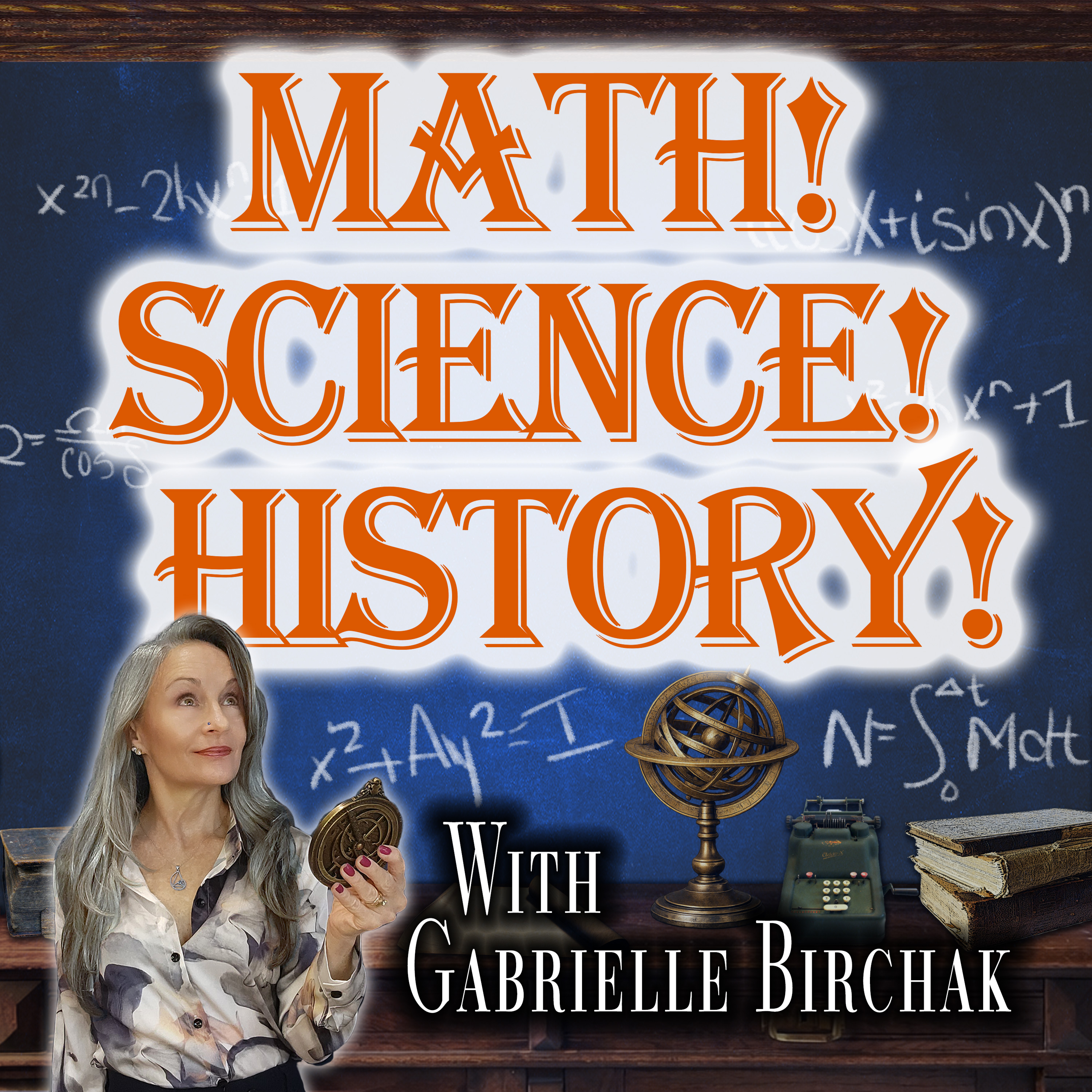
Math! Science! History!
by Gabrielle Birchak
Why do some scientific breakthroughs look different up close than they do in our textbooks? How did math quietly shape the modern world?Math! Science! History! explores the human side of discovery, including the rivalries, the failed attempts, the bold ideas, and the marginalized voices behind the equations and experiments that changed science, technology, and everyday life.Hosted by Gabrielle Birchak, who holds degrees in mathematics and journalism, the show connects codebreaking, astronomy, probability, physics, and innovation to the world we live in today.If you enjoy science stories, historical investigations, and clear math grounded in context, clarity, and research, this show is for you.New episodes twice weekly. Visit www.MathScienceHistory.com for more information.
-
216
MOMENTUM! 3 Success Lessons from John Dalton That Will Change Your Week
Success doesn't begin with talent, it begins with the habits you practice when no one is watching. This week, I share three powerful life lessons from chemist John Dalton that can help you build momentum, overcome obstacles, and develop the kind of character that earns lasting respect. 🌐 Website: https://www.MathScienceHistory.com☕Support the show: https://paypal.com/ncp/payment/PR7F7ST49GDNA You'll learn: • How to move forward even when opportunities seem out of reach. • Why consistent daily habits create extraordinary results over time. • How humility and genuine relationships build a legacy that lasts. Follow the podcast, subscribe on your favorite platform, and leave a review to help more people discover Math, Science, and History. Momentum Music: All music is Public Domain Mark 1.0 Universal and has no Copyright and no rights reserved. Selections from Violin Machine: A Deconstruction of the Bach Concerto by Lloyd Rodgers Subscribe on your favorite podcast platform Leave a review! It helps more people discover the show! Share this episode with friends & fellow history buffs! Until next time, carpe diem!
-
215
REPOST: How John Dalton's Atomic Theory Changed Science Forever
I'm revisiting one of my first episodes: the story of John Dalton, the self-taught Quaker schoolteacher who never attended university yet gave modern atomic theory its first real momentum. Barred from English universities for his faith, Dalton turned stubborn curiosity into world-changing science, mapping colorblindness before anyone understood it and sketching the first table of elements in a notebook. This is how one weaver's son carried science from a Cumberland village to the Large Hadron Collider. You'll learn: • How a Quaker weaver's son barred from university built the foundation of atomic theory • The stockings mix-up that led Dalton to discover, and later name, colorblindness • Why his five-element notebook sketch from 1803 still echoes inside the Large Hadron Collider 🌐 Website: https://www.MathScienceHistory.com ☕Support the show: https://paypal.com/ncp/payment/PR7F7ST49GDNA Follow or subscribe so you never miss an episode. Please leave a review, it helps more curious minds find the show! Music & Closing Credits Music: All music is public domain and has no Copyright and no rights reserved. Selections from The Little Prince by Lloyd Rodgers Subscribe on your favorite podcast platform Leave a review! It helps more people discover the show! Share this episode with friends & fellow history buffs! Until next time, carpe diem! - Gabrielle
-
214
MOMENTUM! Paul Erdős's Secret to Beating Burnout and Staying Focused
The fastest way to solve your toughest problem isn't to grind harder on it, it's to rotate your focus across a few problems at once, the way legendary mathematician Paul Erdős juggled hundreds of unsolved problems at a time. In this episode, I break down the neuroscience of why this "interleaving" beats multitasking, and I hand you seven simple tools to build this Erdős Method into your work week and your home life. By the end, you'll have a system for turning stuck, vague problems into ones your brain quietly keeps solving in the background. 🌐 Website: https://www.MathScienceHistory.com ☕Support the show: https://paypal.com/ncp/payment/PR7F7ST49GDNA Three Things Listeners Will Learn Why interleaving deep, undivided focus on one problem at a time, rotated across several, outperforms multitasking How to build a personal "Erdős List" and use the 45/15 focus block to make steady progress on several problems each week How small habits like the Wall Log, the Thinking Walk, and an End-of-Day Briefing turn your brain's background processing into visible progress Subscribe to Math! Science! History! on your favorite podcast app and leave a review! It really does help more people find the show! Momentum Music: All music is Public Domain Mark 1.0 Universal and has no Copyright and no rights reserved. Selections from Violin Machine: A Deconstruction of the Bach Concerto by Lloyd Rodgers Subscribe on your favorite podcast platform Leave a review! It helps more people discover the show! Share this episode with friends & fellow history buffs! Until next time, carpe diem! - Gabrielle
-
213
FLASHCARDS! You Are a Game Theorist!
What if the negotiation strategies, workplace rhythms, and relationship instincts you've relied on your whole life already had names in mathematics? In today's FLASHCARDS! episode of Math! Science! History!, I break down three foundational concepts from game theory: dominant strategy, tit for tat, and Nash equilibrium, and connect each one to the everyday decisions, compromises, and unspoken social contracts you navigate all the time. Whether you're a math enthusiast or someone who swore they "weren't a math person," this episode reveals that you've been doing game theory your entire life without even knowing it. 🃏 In This Episode, You Will Learn: What a dominant strategy is and how to recognize when you're already using one, from sending that follow-up email to ordering your favorite dish at a restaurant. The fascinating history of tit for tat, the surprisingly simple strategy that beat out complex algorithms in Robert Axelrod's famous 1980s tournament, and how it mirrors the unspoken rules of your closest relationships. How a Nash equilibrium shows up in everyday conflict, and why the moment you and someone else silently agree to "stop pushing" is actually a mathematically stable outcome. 📚 Sources Von Neumann's 1928 minimax theorem is widely considered the founding document of modern game theory. https://en.wikipedia.org/wiki/Minimax_theorem John Nash received the Nobel Prize in Economic Sciences in 1994 for his pioneering analysis of equilibria in the theory of non-cooperative games. https://www.nobelprize.org/prizes/economic-sciences/1994/nash/facts Robert Axelrod's landmark book The Evolution of Cooperation (1984) explored how cooperation can emerge among self-interested agents, using his famous computer tournament in which tit for tat won. https://en.wikipedia.org/wiki/The_Evolution_of_Cooperation 📣 Calls to Action Subscribe & Review: If today's episode made you see your everyday decisions in a whole new light, please subscribe to Math! Science! History! and leave a review wherever you listen. It helps more curious minds find the show! Share This Episode: Know someone who loves psychology, strategy, or really nails the follow-up email? Send them this episode; they're already game theorists and don't know it yet. Keep Learning: Catch up on last week's full episode on the birth of game theory and Monday's episode on using these strategies in the workplace! 🔗 Explore more on our website: mathsciencehistory.com 📚 To buy my book Hypatia: The Sum of Her Life on Amazon, visit https://a.co/d/g3OuP9h 🎧 Enjoying the Podcast? 🔗 Explore more on our website: mathsciencehistory.com ☕ Support the Show: Coffee!! PayPal Leave a review! It helps more people discover the show! Share this episode with friends & fellow history buffs! Subscribe on your favorite podcast platform. Check out our merch: https://www.mathsciencehistory.com/the-store Music: All music is public domain and has no Copyright and no rights reserved. Selections from The Little Prince by Lloyd Rodgers Until next time, carpe diem!
We're indexing this podcast's transcripts for the first time — this can take a minute or two. We'll show results as soon as they're ready.
No matches for "" in this podcast's transcripts.
No topics indexed yet for this podcast.
Loading reviews...
ABOUT THIS SHOW
Why do some scientific breakthroughs look different up close than they do in our textbooks? How did math quietly shape the modern world?Math! Science! History! explores the human side of discovery, including the rivalries, the failed attempts, the bold ideas, and the marginalized voices behind the equations and experiments that changed science, technology, and everyday life.Hosted by Gabrielle Birchak, who holds degrees in mathematics and journalism, the show connects codebreaking, astronomy, probability, physics, and innovation to the world we live in today.If you enjoy science stories, historical investigations, and clear math grounded in context, clarity, and research, this show is for you.New episodes twice weekly. Visit www.MathScienceHistory.com for more information.
HOSTED BY
Gabrielle Birchak
CATEGORIES
Loading similar podcasts...
Frequently Asked Questions
How many episodes does Math! Science! History! have?
Math! Science! History! currently has 4 episodes available on PodParley. New episodes are automatically indexed when they're published to the podcast feed.
What is Math! Science! History! about?
Why do some scientific breakthroughs look different up close than they do in our textbooks? How did math quietly shape the modern world?Math! Science! History! explores the human side of discovery, including the rivalries, the failed attempts, the bold ideas, and the marginalized voices behind the...
How often does Math! Science! History! release new episodes?
Math! Science! History! has 4 episodes. Check the episode list to see recent publication dates and frequency.
Where can I listen to Math! Science! History!?
You can listen to Math! Science! History! on PodParley by clicking any episode. We provide an embedded audio player for direct listening, and you can also subscribe via your preferred podcast app using the RSS feed.
Who hosts Math! Science! History!?
Math! Science! History! is created and hosted by Gabrielle Birchak.
URL copied to clipboard!