
PODCAST · technology
Mayorga Podcast
by Mayorga
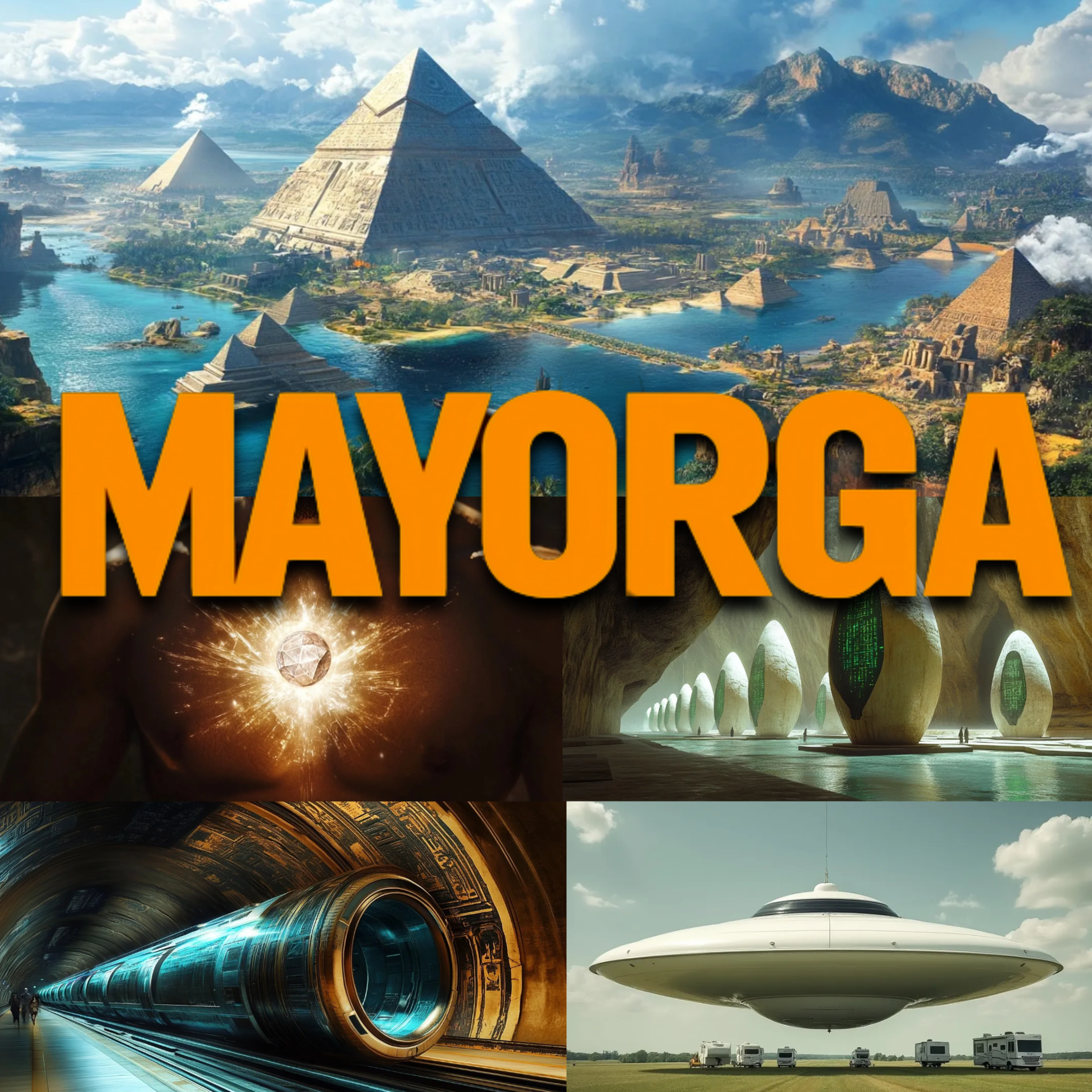
Mayorga is the working title of the TV show "Mayorga" by creator Tom Schaefer, https://mayorga.pro. The show's logline: "When benevolent aliens arrive to save humanity from self-destruction, a centuries-old hybrid human becomes Earth's ambassador through an unprecedented migration of humanity to the stars, leading to both utopian possibilities and dangerous resistance." "Mayorga" tells an epic science fiction story spanning over 150 years, centered on John Henry Foster - a hybrid human-ET who becomes humanity's ambassador during Earth's transition from a dying world to an intergalactic civilization. Set primarily between 1925 and 2055, the story combines elements of first contact, cosmic exploration, and humanity's evolution under the guidance of an advanced alien race known as the Zi.
-
8
Mayorga - Acclimation Through Science Fiction
Briefing on the "Acclimation" Hypothesis for Extraterrestrial Disclosure Mayorga Story Author & Creator Tom Schaefer Executive Summary The source context outlines a central hypothesis termed "acclimation," which posits that science fiction has been strategically utilized to prepare an unwitting public for an eventual revelation about extraterrestrial (ET) contact. This theory argues that in the face of a government "truth embargo," the film and television industry, particularly Hollywood, has served as a "Plan B" for disclosure. By exploring complex themes related to ETs, space travel, and associated dangers, science fiction has allegedly communicated more to the public than official sources. This process is driven by widespread public interest stemming from UFO sightings and ET abductions, for which official answers are lacking. Key historical touchstones proposed for investigation include Gene Roddenberry's connections to ET contactees, phenomena from 1980s USENET groups such as the writings of Jon Winston and the MJ-12 documents, and an alien autopsy video that has reportedly never been fully debunked. The hypothesis also suggests that science fiction embeds deeper philosophical lessons concerning universal concepts of "oneness" and "good vs evil." -------------------------------------------------------------------------------- 1. The "Acclimation" Hypothesis: Science Fiction as Public Preparation The core concept presented is that of "acclimation"—a comprehensive effort to prepare the general public for the future disclosure of extraterrestrial contact. The central argument is that the genre of science fiction has been the primary vehicle for this preparatory conditioning. It is framed as a potential long-term strategy to introduce complex and potentially disruptive ideas to the masses in a controlled, fictional environment, thereby softening the impact of an official future reveal. • Primary Goal: To ready an "unwitting public" for the reality of ET existence and interaction. • Primary Medium: Science fiction, specifically movies and television, with an emphasis on influential works over "awful bad scifi." 2. Hollywood as "Plan B" for Disclosure A significant theme is the positioning of Hollywood and the broader science fiction industry as a substitute for official government disclosure. This argument is predicated on the belief that a "truth embargo" is in effect, with government entities possessing knowledge they are unwilling to share. • The Information Void: The source contends that a lack of official information regarding UFO sightings and ET abductions has created a vacuum. • Hollywood's Role: Hollywood is described as having "stepped up" to fill this void where government would not. It is asserted that "Hollywood has shown mankind more about ETs than we have gotten from the very people who should tell us - and who DO know the truth." • The "Plan B" Theory: Science fiction is therefore framed as a potential "Plan B"—an unofficial channel to communicate truths that "cannot be communicated officially." This channel is used to convey the complex, strange, and even dangerous aspects associated with extraterrestrials and space travel. 3. Key Historical Cases and Phenomena The source identifies several specific individuals, events, and artifacts as potentially significant evidence supporting the acclimation hypothesis. These cases are presented as crucial areas for investigation. Subject of Interest Description Context / Significance Gene Roddenberry The creator of Star Trek. Investigation into his alleged "connections to ET contactees" is proposed. Jon Winston An author on 1980s USENET newsgroups. Within alt.conspiracyarea51 groups, Winston wrote about an alleged ET base inside Mt. Shasta, which was said to house a "galactic council base." MJ-12 Documents A set of alleged classified government documents. The "reveal" of these documents on USENET, purportedly from the 1980s, is cited as a key event in unofficial disclosure. Alien Autopsy Video A controversial film released in the 1990s. The source notes that this video emerged alongside other phenomena and makes the specific claim that it "has never been completely debunked." 4. Driving Forces and Philosophical Messaging The public's sustained interest in extraterrestrial phenomena is identified as the driving force behind the demand for information that Hollywood and science fiction have ostensibly met. Key Drivers of Public Interest: • Persistent UFO sightings. • Reports of ET abductions. • A chronic "lack of information" and absence of official answers regarding these phenomena. Beyond narrative and spectacle, the source suggests that science fiction serves a didactic purpose, communicating philosophical and moral "lessons" to the audience. Identified Philosophical Themes: • Oneness: Conveying a sense of universal interconnectedness. • Universal Good vs. Evil: Presenting and exploring fundamental moral conflicts on a cosmic scale.
-
7
Mayorga - Reviewing Tu & The Collectors
Briefing Document: The Mayorga Universe - Mayorga Story Author & Creator Tom Schaefer Executive Summary The Mayorga narrative presents an epic science fiction saga spanning over 150 years, detailing humanity's transition from a dying Earth to a nascent interstellar civilization. Faced with irreversible ecological collapse, resource wars, and societal breakdown, humanity is offered a stark bargain by an ancient, advanced alien race known as the Zi: planetary relocation in exchange for mentorship and integration into a galactic community. The central figure is John Henry Foster, a human-Nordic ET hybrid born in 1901, who is groomed to become humanity's ambassador and leader through this monumental exodus. The story explores complex themes of utopian versus dystopian futures, the philosophical tension between benevolent guidance and free will, and the societal transformation inherent in a post-scarcity economy driven by technologies like matter replication and genetic regeneration. The narrative is set primarily between 1925 and 2055, chronicling Foster's rise and fall, the massive logistical and psychological challenges of migrating nine billion people to 3,500 new colony worlds, and the emergence of opposition factions like the "Holdouts" who resist the Zi intervention. The initial phase of preparation is detailed through the "Collectors" program, a covert Zi operation on Earth tasked with procuring key personnel, technologies, and resources, providing a ground-level view of the events leading up to open contact. Ultimately, Mayorga is a story of redemption—for a self-destructive humanity given a second chance, and for the Zi, who see their mentorship as penance for past failures in guiding the species. Core Narrative and World Building The Premise: A New Mythology "Mayorga" is a science fiction/action-drama television series concept created by Tom Schaefer. It aims to create a "new inspirational mythology" that imagines a positive, utopian future for mankind, moving beyond prevalent dystopian narratives. The original 2014 story, "Tu & The Collectors," has been integrated as a foundational chapter within the broader Mayorga saga, exploring the early stages of the Zi plan through the eyes of its Earth-based operatives. The complete narrative arc spans from 1900 to 2055, focusing on the life of John Henry Foster and humanity's evolution. Earth's Crisis and The Zi Intervention The narrative begins with Earth in an "irreversible death spiral." The planet's ecosystems are in terminal decline due to centuries of devastation, resulting in: • Runaway climate change and catastrophic sea-level rises. • Mega-droughts and the collapse of major agricultural systems. • Massive refugee migrations and brutal resource wars. • A complete breakdown of international governance, reducing civilization to fragmented enclaves. Into this crisis enter the Zi, representatives of the Galactic Council's Sentient Species Preservation Initiative. After a multi-generational assessment, their advanced neural-computational models identify humanity's "extraordinary adaptive potential"—a rare combination of technological creativity, resilience, and unpredictable evolutionary capacity that makes the species valuable despite its self-destructive tendencies. The Zi present humanity with "The Bargain": a complete planetary transfer and species relocation. The terms require abandoning the dying Earth in exchange for interstellar protectorates, advanced technology, and a guaranteed pathway to survival and potential galactic citizenship. Planet Tu: Humanity's New Home The initial destination for humanity is Planet Tu, a "Super Earth" meticulously prepared by the Zi. Planet Tu Specifications Galaxy M32 Andromeda Type X2.3 Super Earth (2.5x Earth Mass, 5x Earth Size) Solar Position 4th of 8 planets; within "Goldilocks Zone" Period 385 Earth Days Local Star Solaria Proxima-1 Moons 2 (Tu Ono is habitable; Tu Ono Ka is a rocky military base) Originally a hot, lifeless planet, Tu underwent a 700-year terraforming process starting around 1170 AD. The Zi used massive ships to alter the planet's core to reduce its gravity to be Earth-like, adjust its orbit to create a 24-hour day, and seed a complete, balanced ecosystem. The first inhabitants were not from Earth. Around 1862 AD, a Zi scout ship rescued nearly 2,000 humans from a damaged vessel escaping enslavement by another alien race, the Annunaki, from their home world of Nibiru. The Zi transplanted these humans to Tu. Later, between the 1920s and 1950s, the Zi covertly relocated another 1,000 humans from Earth, establishing a separate colony before eventually integrating the two populations. The Mass Migration (Operation Exodus) "Operation Exodus" is the official name for the plan to relocate over nine billion humans to 3,500 Zi Protectorates, with Tu serving as the initial training and resettlement hub. The colony selection process involves sophisticated computational models analyzing over 50,000 planetary systems for factors including: • Atmospheric composition and gravitational stability. • Genetic compatibility for human life. • Resource potential and existing ecological systems. • Long-term evolutionary trajectories for human flourishing. Key Factions and Groups The Zi The Zi are an ancient, pan-galactic race who serve as humanity's mentors and rescuers. • Origin: The planet Didiza in the Andromeda galaxy, millions of years older than humanity. • Physiology: Humanoid in form with pale complexions, long hair (which they believe is linked to psychic ability), and an average lifespan of several thousand years. They possess advanced regenerative abilities, capable of regrowing any body part. • Abilities: They are primarily telepathic and possess extreme psychic and emotional sensitivity. The "raw emotional makeup of humans" is physically painful for them, causing nosebleeds and exhaustion. This hypersensitivity necessitated the creation of Zi-human hybrids to act as liaisons. • Philosophy: Their culture is a blend of science, philosophy, and spirituality. They are on a quest to find "The Prime Creator" and see their mission to help "lower worlds" as a way to gain a "karmic boost." They believe in non-interference unless a species faces imminent self-destruction. Their guidance of humanity is framed as a "penance" for their past failures in mentoring the species, where they provided religion instead of science, leading to Earth's "retarded" development. • Governance on Tu: They practice minimalist governance, providing infrastructure and sound guidance while encouraging human autonomy. The highest governing body is "The Top 5," composed of two pure Zi, two Zi-human hybrids, and one human (John Foster). The Annunaki The Annunaki are a powerful, giant-like alien race from the planet Nibiru who historically enslaved humanity. Ancient Sumerian tablets and biblical references to the "Nephilum" are cited as evidence of their presence on Earth, where they used humans as slave labor for gold mining. While the majority were tyrannical, a sympathetic minority created an "underground railroad" to help humans escape, leading to the first human settlement on Tu. Humanity's Factions • The Tu: The general term for the human population on Planet Tu, initially composed of descendants from Nibiru and early Earth colonists. • The Collectors: A covert Zi organization on Earth operating under the front company "Global Acquisitions Inc." Its mission is to procure personnel, resources, animals, and technology in preparation for the mass migration. Collectors are recruited from all walks of life and are chosen for their unique skills and psychological profiles. • Holdouts: Communities on Earth that refuse relocation, viewing the Zi's plan as a threat or a malevolent intervention. John Foster's sister, Shannon, becomes a prominent Holdout leader. • Anti-ReGens: Philosophical and religious groups that oppose the Zi's regeneration technology, viewing it as a violation of spiritual principles and divine order. Transformative Technologies The Zi provide a suite of technologies that fundamentally reshape human existence, creating a post-scarcity society. • Replication: Replicators convert energy into matter, allowing for the instantaneous creation of any object—from food and clothing to tools and even human organs—from a vast digital database called the "Replicator Library." This technology eliminates manufacturing, economic scarcity, and poverty. Newcomers must learn "replicator discipline" to want less despite being able to have anything. • Regeneration ("Re-gen"): This technology resets an individual's genetic structure to its optimal state, effectively conquering aging, reversing degenerative processes, and eliminating inherited diseases. A key plot point involves a "DNA Upgrade" that grants enhanced longevity. • Space Travel & Propulsion: The Zi utilize quantum navigation, multidimensional mapping, and travel through "the singularity" for near-instantaneous interstellar movement. Their fleet includes small, teleporting "Jump Ships" for planetary transit and massive "Ark Ships" (3km in diameter, carrying 60,000 people) for the mass migration. • Advanced Infrastructure: On Tu, the Zi have built a network of high-speed underground "tube transports" capable of traveling over 3,000 mph. They also use robotic tractors that create underground piping via replication and transporter technology without digging. • Zi-Specific Technologies: Technology Description Comms Crystal A personal communication device bonded to the user's DNA, powered by body heat. It offers non-local communication, language translation, voice mist, and video storage using the body as a storage device. The Link A quantum entanglement-based crystal on Didiza that provides a real-time view of any location in the universe. It is protected by 5,000+ smaller "Link Children" spheres in shielded, hidden areas. Gravity Crystals Non-standard crystals that can generate powerful anti-gravity fields. A group of 30 humans holding crystals can jump a 3km ark ship. A full Zi star-man can use one to generate a "colder than space" cogvortex spot. Lockheed SM1 "Smoker" Human-engineered jump ships reverse-engineered from Zi technology. Initially part of a black market after the Zi replicated early models as a "nice attempt." Principal Characters John Henry Foster ("El Gato") Attribute Description Born 1901, Arkansas Heritage Human-Nordic ET Hybrid Special Abilities ESP (telepathy, clairvoyance, telekinesis), enhanced longevity from DNA upgrade. Key Traits Charismatic, adaptable, philosophical, visionary. Internal Conflicts Navigating his dual identity; balancing his immense duty against the needs of his family. The central protagonist of the saga, Foster is groomed from a young age by his Nordic ET mentor, Edwin Tellemere. His unique hybrid genetics and ESP abilities make him the perfect bridge between humanity and the Zi. He is chosen to be the "Prime Interface" in 1925 and becomes humanity's ambassador, leading the species through Open Disclosure and the Great Migration. His dedication comes at a great personal cost, leading to the fracturing of his family and his eventual removal from office in 2035 by his rival, Michael Stetson. He then founds a new colony, Imhotep, entering a new phase of legacy-building and attempting to reconcile with his family. Michael Stetson Attribute Description Role Leader of the Collectors program; becomes Foster's political rival and successor ("Prime"). Background Military intelligence. Key Traits Efficient, ambitious, complex, loyal to the mission but not necessarily to Foster. Internal Conflicts Loyalty vs. ambition; deep emotional trauma from his DNA upgrade recovery. Special Status DNA upgrade survivor. Stetson is a highly effective "procurement guy" for the Collectors program on Earth. While initially allied with Foster, a rivalry develops, fueled by professional jealousy of Foster's charisma and their shared history in a racist world. Stetson leverages his political position and colonial support to orchestrate a vote of no-confidence against Foster in 2035, becoming the new Prime and changing humanity's policies. Ana Foster Attribute Description Background Brilliant scientist. Speciality Astrophysics. Key Traits Traumatized, determined, brilliant. Internal Conflicts The struggle between the cold logic of science and the overwhelming reality of her experiences. Special Status DNA upgrade survivor who suffered a severe psychological reaction and deep trauma from her visit to the Zi homeworld. John Foster's wife, Ana, is a key scientific mind involved in the First Contact events. The trip to the Zi homeworld Didiza shatters her scientific worldview, leaving her with deep psychological trauma that strains her family. She isolates herself, focusing on her research and eventually making significant breakthroughs, becoming a scientific leader in her own right. Her journey is one of healing, reconciliation with her family, and accepting her new identity. Shannon Foster Attribute Description Role Holdout Leader; Foster family matriarch. Background Experienced an ET abduction prior to disclosure. Key Traits Determined, traumatized, protective. Internal Conflicts A desire to protect humanity from what she perceives as a threat versus her brother's path of progress and collaboration. Special Status ET abduction survivor. John's sister, Shannon, is deeply impacted by a traumatic abduction experience, causing her to diverge ideologically from her brother. Believing the Zi may be a malevolent force, she organizes the Holdout resistance movement on Earth, establishing a fortified underground network. Her deep family bond with John is strained by their opposing views. Her death has a lasting impact on John and reveals hidden truths. Edwin Tellemere Attribute Description Role Nordic ET Mentor. Cover Small-town psychic. Key Traits Mysterious, wise, strategic. Purpose To guide and prepare John Henry Foster for his destiny. Special Status Advanced being. Tellemere is Foster's mentor, a powerful Nordic ET who conceals his identity while training John in the use of his ESP abilities. He is a master strategist and secret-keeper who executes a long-term plan for humanity's future. He makes a calculated departure, only to return at a critical moment to support Foster, reveal truths, and confirm the legacy of their shared plan. Jackson Attribute Description Role Holdout Empire Builder; antagonist. Background Former scientist who feels rejected by the system. Key Traits Brilliant, bitter, ambitious. Internal Conflicts The drive for revenge against the system versus a lust for power. Special Status DNA upgrade recipient. A former scientist, Jackson becomes a powerful antagonist. Driven by personal loss and a sense of rejection, he builds a formidable empire based in Montana, complete with a fleet of "Smoker" ships. He orchestrates a "Drop Core" scheme and ultimately confronts Foster in a hostage situation before meeting his final fate. Chronological Plot Synopsis 1. Origins - The Aforetime (c. 500,000 BC - 1862 AD): The Zi seed plant and animal life on Earth millions of years ago. Around 500,000 years ago, they monitor humanity's progress but ultimately abandon the planet due to its warlike tendencies. In 1170 AD, the Zi begin a 700-year terraforming project on Planet Tu. In 1862, they rescue a damaged ship of humans escaping the Annunaki on Nibiru and settle them on Tu. 2. Foster's Early Life (1901 - 1925): John Henry Foster is born in Arkansas. He is mentored by the Nordic ET Edwin Tellemere, who helps him develop his "super powers" of ESP. He meets and marries Ana. In 1925, he has his First Contact experience with the Zi and is chosen to be their "Prime Interface." He receives a regenerative DNA upgrade. 3. The Collectors Program (1925 - 2029): The Zi establish a covert program on Earth to procure people, resources, and knowledge for the coming migration. The story "Tu and The Collectors" provides a detailed look at this period, following operative Michael Stetson as he recruits two new members, Bob Willets and Amy Noble, by luring them with a UFO-themed website contest. Recruits are shown the truth, transported to an ark ship for a "Planetarium Experience" musical show by a Pink Floyd-loving Zi named Miresa, and given 10 days to disappear from their lives on Earth. 4. Open Disclosure & The Great Migration (2030): The Zi arrive en masse and reveal themselves to the world, an event dubbed "The Reveal." They present "The Deal" to a failing human civilization: relocation to new worlds. The mass migration, "Operation Exodus," begins, with millions responding to the offer to travel to Tu. 5. Prime Fail (2035): After five years of leading the migration, John Foster is ousted in a non-confidence campaign led by Michael Stetson, who becomes the new "Prime." Disillusioned and depressed, Foster retreats and founds a new settlement, Colony Imhotep on Mayorga. Later, his ex-wife Ana and son are kidnapped, forcing him to rise to the occasion to rescue them. 6. Mayorga & The Valley Of The Sun (2055): Twenty years later, Foster delivers a "Founder's Day Speech" at Colony Imhotep. He has built a thriving, self-sufficient colony that engages in trade (boutique wines, farm goods) with the wider network. This period marks Foster's later years, focused on legacy building, reconciliation, and managing new challenges. NotebookLM can be inaccurate; please double check its responses.
-
6
ALIEN SAVIORS and the GREAT EXODUS
Briefing Document: The Mayorga Universe - Mayorga Story Author & Creator Tom Schaefer Executive Summary The Mayorga narrative presents an epic science fiction saga spanning over 150 years, detailing humanity's transition from a dying Earth to a nascent interstellar civilization. Faced with irreversible ecological collapse, resource wars, and societal breakdown, humanity is offered a stark bargain by an ancient, advanced alien race known as the Zi: planetary relocation in exchange for mentorship and integration into a galactic community. The central figure is John Henry Foster, a human-Nordic ET hybrid born in 1901, who is groomed to become humanity's ambassador and leader through this monumental exodus. The story explores complex themes of utopian versus dystopian futures, the philosophical tension between benevolent guidance and free will, and the societal transformation inherent in a post-scarcity economy driven by technologies like matter replication and genetic regeneration. The narrative is set primarily between 1925 and 2055, chronicling Foster's rise and fall, the massive logistical and psychological challenges of migrating nine billion people to 3,500 new colony worlds, and the emergence of opposition factions like the "Holdouts" who resist the Zi intervention. The initial phase of preparation is detailed through the "Collectors" program, a covert Zi operation on Earth tasked with procuring key personnel, technologies, and resources, providing a ground-level view of the events leading up to open contact. Ultimately, Mayorga is a story of redemption—for a self-destructive humanity given a second chance, and for the Zi, who see their mentorship as penance for past failures in guiding the species. Core Narrative and World Building The Premise: A New Mythology "Mayorga" is a science fiction/action-drama television series concept created by Tom Schaefer. It aims to create a "new inspirational mythology" that imagines a positive, utopian future for mankind, moving beyond prevalent dystopian narratives. The original 2014 story, "Tu & The Collectors," has been integrated as a foundational chapter within the broader Mayorga saga, exploring the early stages of the Zi plan through the eyes of its Earth-based operatives. The complete narrative arc spans from 1900 to 2055, focusing on the life of John Henry Foster and humanity's evolution. Earth's Crisis and The Zi Intervention The narrative begins with Earth in an "irreversible death spiral." The planet's ecosystems are in terminal decline due to centuries of devastation, resulting in: • Runaway climate change and catastrophic sea-level rises. • Mega-droughts and the collapse of major agricultural systems. • Massive refugee migrations and brutal resource wars. • A complete breakdown of international governance, reducing civilization to fragmented enclaves. Into this crisis enter the Zi, representatives of the Galactic Council's Sentient Species Preservation Initiative. After a multi-generational assessment, their advanced neural-computational models identify humanity's "extraordinary adaptive potential"—a rare combination of technological creativity, resilience, and unpredictable evolutionary capacity that makes the species valuable despite its self-destructive tendencies. The Zi present humanity with "The Bargain": a complete planetary transfer and species relocation. The terms require abandoning the dying Earth in exchange for interstellar protectorates, advanced technology, and a guaranteed pathway to survival and potential galactic citizenship. Planet Tu: Humanity's New Home The initial destination for humanity is Planet Tu, a "Super Earth" meticulously prepared by the Zi. Planet Tu Specifications Galaxy M32 Andromeda Type X2.3 Super Earth (2.5x Earth Mass, 5x Earth Size) Solar Position 4th of 8 planets; within "Goldilocks Zone" Period 385 Earth Days Local Star Solaria Proxima-1 Moons 2 (Tu Ono is habitable; Tu Ono Ka is a rocky military base) Originally a hot, lifeless planet, Tu underwent a 700-year terraforming process starting around 1170 AD. The Zi used massive ships to alter the planet's core to reduce its gravity to be Earth-like, adjust its orbit to create a 24-hour day, and seed a complete, balanced ecosystem. The first inhabitants were not from Earth. Around 1862 AD, a Zi scout ship rescued nearly 2,000 humans from a damaged vessel escaping enslavement by another alien race, the Annunaki, from their home world of Nibiru. The Zi transplanted these humans to Tu. Later, between the 1920s and 1950s, the Zi covertly relocated another 1,000 humans from Earth, establishing a separate colony before eventually integrating the two populations. The Mass Migration (Operation Exodus) "Operation Exodus" is the official name for the plan to relocate over nine billion humans to 3,500 Zi Protectorates, with Tu serving as the initial training and resettlement hub. The colony selection process involves sophisticated computational models analyzing over 50,000 planetary systems for factors including: • Atmospheric composition and gravitational stability. • Genetic compatibility for human life. • Resource potential and existing ecological systems. • Long-term evolutionary trajectories for human flourishing. Key Factions and Groups The Zi The Zi are an ancient, pan-galactic race who serve as humanity's mentors and rescuers. • Origin: The planet Didiza in the Andromeda galaxy, millions of years older than humanity. • Physiology: Humanoid in form with pale complexions, long hair (which they believe is linked to psychic ability), and an average lifespan of several thousand years. They possess advanced regenerative abilities, capable of regrowing any body part. • Abilities: They are primarily telepathic and possess extreme psychic and emotional sensitivity. The "raw emotional makeup of humans" is physically painful for them, causing nosebleeds and exhaustion. This hypersensitivity necessitated the creation of Zi-human hybrids to act as liaisons. • Philosophy: Their culture is a blend of science, philosophy, and spirituality. They are on a quest to find "The Prime Creator" and see their mission to help "lower worlds" as a way to gain a "karmic boost." They believe in non-interference unless a species faces imminent self-destruction. Their guidance of humanity is framed as a "penance" for their past failures in mentoring the species, where they provided religion instead of science, leading to Earth's "retarded" development. • Governance on Tu: They practice minimalist governance, providing infrastructure and sound guidance while encouraging human autonomy. The highest governing body is "The Top 5," composed of two pure Zi, two Zi-human hybrids, and one human (John Foster). The Annunaki The Annunaki are a powerful, giant-like alien race from the planet Nibiru who historically enslaved humanity. Ancient Sumerian tablets and biblical references to the "Nephilum" are cited as evidence of their presence on Earth, where they used humans as slave labor for gold mining. While the majority were tyrannical, a sympathetic minority created an "underground railroad" to help humans escape, leading to the first human settlement on Tu. Humanity's Factions • The Tu: The general term for the human population on Planet Tu, initially composed of descendants from Nibiru and early Earth colonists. • The Collectors: A covert Zi organization on Earth operating under the front company "Global Acquisitions Inc." Its mission is to procure personnel, resources, animals, and technology in preparation for the mass migration. Collectors are recruited from all walks of life and are chosen for their unique skills and psychological profiles. • Holdouts: Communities on Earth that refuse relocation, viewing the Zi's plan as a threat or a malevolent intervention. John Foster's sister, Shannon, becomes a prominent Holdout leader. • Anti-ReGens: Philosophical and religious groups that oppose the Zi's regeneration technology, viewing it as a violation of spiritual principles and divine order. Transformative Technologies The Zi provide a suite of technologies that fundamentally reshape human existence, creating a post-scarcity society. • Replication: Replicators convert energy into matter, allowing for the instantaneous creation of any object—from food and clothing to tools and even human organs—from a vast digital database called the "Replicator Library." This technology eliminates manufacturing, economic scarcity, and poverty. Newcomers must learn "replicator discipline" to want less despite being able to have anything. • Regeneration ("Re-gen"): This technology resets an individual's genetic structure to its optimal state, effectively conquering aging, reversing degenerative processes, and eliminating inherited diseases. A key plot point involves a "DNA Upgrade" that grants enhanced longevity. • Space Travel & Propulsion: The Zi utilize quantum navigation, multidimensional mapping, and travel through "the singularity" for near-instantaneous interstellar movement. Their fleet includes small, teleporting "Jump Ships" for planetary transit and massive "Ark Ships" (3km in diameter, carrying 60,000 people) for the mass migration. • Advanced Infrastructure: On Tu, the Zi have built a network of high-speed underground "tube transports" capable of traveling over 3,000 mph. They also use robotic tractors that create underground piping via replication and transporter technology without digging. • Zi-Specific Technologies: Technology Description Comms Crystal A personal communication device bonded to the user's DNA, powered by body heat. It offers non-local communication, language translation, voice mist, and video storage using the body as a storage device. The Link A quantum entanglement-based crystal on Didiza that provides a real-time view of any location in the universe. It is protected by 5,000+ smaller "Link Children" spheres in shielded, hidden areas. Gravity Crystals Non-standard crystals that can generate powerful anti-gravity fields. A group of 30 humans holding crystals can jump a 3km ark ship. A full Zi star-man can use one to generate a "colder than space" cogvortex spot. Lockheed SM1 "Smoker" Human-engineered jump ships reverse-engineered from Zi technology. Initially part of a black market after the Zi replicated early models as a "nice attempt." Principal Characters John Henry Foster ("El Gato") Attribute Description Born 1901, Arkansas Heritage Human-Nordic ET Hybrid Special Abilities ESP (telepathy, clairvoyance, telekinesis), enhanced longevity from DNA upgrade. Key Traits Charismatic, adaptable, philosophical, visionary. Internal Conflicts Navigating his dual identity; balancing his immense duty against the needs of his family. The central protagonist of the saga, Foster is groomed from a young age by his Nordic ET mentor, Edwin Tellemere. His unique hybrid genetics and ESP abilities make him the perfect bridge between humanity and the Zi. He is chosen to be the "Prime Interface" in 1925 and becomes humanity's ambassador, leading the species through Open Disclosure and the Great Migration. His dedication comes at a great personal cost, leading to the fracturing of his family and his eventual removal from office in 2035 by his rival, Michael Stetson. He then founds a new colony, Imhotep, entering a new phase of legacy-building and attempting to reconcile with his family. Michael Stetson Attribute Description Role Leader of the Collectors program; becomes Foster's political rival and successor ("Prime"). Background Military intelligence. Key Traits Efficient, ambitious, complex, loyal to the mission but not necessarily to Foster. Internal Conflicts Loyalty vs. ambition; deep emotional trauma from his DNA upgrade recovery. Special Status DNA upgrade survivor. Stetson is a highly effective "procurement guy" for the Collectors program on Earth. While initially allied with Foster, a rivalry develops, fueled by professional jealousy of Foster's charisma and their shared history in a racist world. Stetson leverages his political position and colonial support to orchestrate a vote of no-confidence against Foster in 2035, becoming the new Prime and changing humanity's policies. Ana Foster Attribute Description Background Brilliant scientist. Speciality Astrophysics. Key Traits Traumatized, determined, brilliant. Internal Conflicts The struggle between the cold logic of science and the overwhelming reality of her experiences. Special Status DNA upgrade survivor who suffered a severe psychological reaction and deep trauma from her visit to the Zi homeworld. John Foster's wife, Ana, is a key scientific mind involved in the First Contact events. The trip to the Zi homeworld Didiza shatters her scientific worldview, leaving her with deep psychological trauma that strains her family. She isolates herself, focusing on her research and eventually making significant breakthroughs, becoming a scientific leader in her own right. Her journey is one of healing, reconciliation with her family, and accepting her new identity. Shannon Foster Attribute Description Role Holdout Leader; Foster family matriarch. Background Experienced an ET abduction prior to disclosure. Key Traits Determined, traumatized, protective. Internal Conflicts A desire to protect humanity from what she perceives as a threat versus her brother's path of progress and collaboration. Special Status ET abduction survivor. John's sister, Shannon, is deeply impacted by a traumatic abduction experience, causing her to diverge ideologically from her brother. Believing the Zi may be a malevolent force, she organizes the Holdout resistance movement on Earth, establishing a fortified underground network. Her deep family bond with John is strained by their opposing views. Her death has a lasting impact on John and reveals hidden truths. Edwin Tellemere Attribute Description Role Nordic ET Mentor. Cover Small-town psychic. Key Traits Mysterious, wise, strategic. Purpose To guide and prepare John Henry Foster for his destiny. Special Status Advanced being. Tellemere is Foster's mentor, a powerful Nordic ET who conceals his identity while training John in the use of his ESP abilities. He is a master strategist and secret-keeper who executes a long-term plan for humanity's future. He makes a calculated departure, only to return at a critical moment to support Foster, reveal truths, and confirm the legacy of their shared plan. Jackson Attribute Description Role Holdout Empire Builder; antagonist. Background Former scientist who feels rejected by the system. Key Traits Brilliant, bitter, ambitious. Internal Conflicts The drive for revenge against the system versus a lust for power. Special Status DNA upgrade recipient. A former scientist, Jackson becomes a powerful antagonist. Driven by personal loss and a sense of rejection, he builds a formidable empire based in Montana, complete with a fleet of "Smoker" ships. He orchestrates a "Drop Core" scheme and ultimately confronts Foster in a hostage situation before meeting his final fate. Chronological Plot Synopsis 1. Origins - The Aforetime (c. 500,000 BC - 1862 AD): The Zi seed plant and animal life on Earth millions of years ago. Around 500,000 years ago, they monitor humanity's progress but ultimately abandon the planet due to its warlike tendencies. In 1170 AD, the Zi begin a 700-year terraforming project on Planet Tu. In 1862, they rescue a damaged ship of humans escaping the Annunaki on Nibiru and settle them on Tu. 2. Foster's Early Life (1901 - 1925): John Henry Foster is born in Arkansas. He is mentored by the Nordic ET Edwin Tellemere, who helps him develop his "super powers" of ESP. He meets and marries Ana. In 1925, he has his First Contact experience with the Zi and is chosen to be their "Prime Interface." He receives a regenerative DNA upgrade. 3. The Collectors Program (1925 - 2029): The Zi establish a covert program on Earth to procure people, resources, and knowledge for the coming migration. The story "Tu and The Collectors" provides a detailed look at this period, following operative Michael Stetson as he recruits two new members, Bob Willets and Amy Noble, by luring them with a UFO-themed website contest. Recruits are shown the truth, transported to an ark ship for a "Planetarium Experience" musical show by a Pink Floyd-loving Zi named Miresa, and given 10 days to disappear from their lives on Earth. 4. Open Disclosure & The Great Migration (2030): The Zi arrive en masse and reveal themselves to the world, an event dubbed "The Reveal." They present "The Deal" to a failing human civilization: relocation to new worlds. The mass migration, "Operation Exodus," begins, with millions responding to the offer to travel to Tu. 5. Prime Fail (2035): After five years of leading the migration, John Foster is ousted in a non-confidence campaign led by Michael Stetson, who becomes the new "Prime." Disillusioned and depressed, Foster retreats and founds a new settlement, Colony Imhotep on Mayorga. Later, his ex-wife Ana and son are kidnapped, forcing him to rise to the occasion to rescue them. 6. Mayorga & The Valley Of The Sun (2055): Twenty years later, Foster delivers a "Founder's Day Speech" at Colony Imhotep. He has built a thriving, self-sufficient colony that engages in trade (boutique wines, farm goods) with the wider network. This period marks Foster's later years, focused on legacy building, reconciliation, and managing new challenges.
-
5
MAYORGA - Character Dynamics - Rivals in Space
https://mayorga.pro Mayorga Story Author & Creator Tom Schaefer MAYORGA (C) 2014 TOM SCHAEFER MAYORGA Character Map & Dynamics Pulling back the curtain on the complex web of relationships that drive the narrative, putting a spotlight on the central rivalry between John Foster and Michael Stetson. At the heart of the political landscape in the Zi Planets Network, especially concerning humanity, lies the intense dynamic between Foster and Stetson. These two men share a significant history; they were peers, involved in the first contact, part of the initial group of 50 humans chosen to visit the Zi homeworld, DiDiza. Both were recipients of the Zi's DNA upgrade procedure. This shared experience, however, led them down divergent paths. While Foster seemed to adapt remarkably well to the changes and the overwhelming positivity of the Zi, Stetson, like others who received the upgrade, suffered negative side effects, including deep depression and delusions, requiring rehabilitation. This difference in reaction, perhaps coupled with inherent ambition or differing philosophies, sowed the seeds of their rivalry. Foster, initially humanity's ambassador, led the monumental migration from Earth to Tu, known as The Great Exit. He became the first human Prime, tasked with guiding humanity through this unprecedented transition under Zi guidance. Stetson, meanwhile, founded the Collectors program, dedicated to preserving Earth's heritage. This mission placed him in a position of influence, and his political acumen grew. Stetson engineered Foster's fall from grace around 2035, elevating a narrative that Foster had "sold out humanity" by facilitating the abandonment of Earth. This political pressure successfully ousted Foster, and Stetson became the new Prime. Even after Foster retreats to Mayorga to found Colony Imhotep, the rivalry persists. A scene from the Pyramid Club on Mayorga vividly illustrates this tension: Foster, enjoying civilian life, is approached by Stetson. Their conversation is laced with dry wit, undertones of past conflict, and a reluctant acknowledgment of their intertwined destinies. Despite their history and mutual awareness of the larger threats like the Den'Shah, cooperation is challenging due to their past and differing approaches. Stetson becomes the leader facing immediate crises while Foster builds his vision on Mayorga. Their dynamic evolves from rivalry to a potential, albeit reluctant, alliance when faced with existential threats. Now, how do other characters interact with this central dynamic? • Ana Foster: John's ex-wife and a leading astrophysicist. She was also one of the original group who visited DiDiza and experienced the DNA upgrade, suffering similar trauma to Stetson. Her scientific work is crucial to understanding Zi technology and potential dangers, often intersecting with both Foster's activities and Stetson's administration as Prime. Her relationship with John is complex, moving from estrangement towards understanding. While not explicitly stated how she interacts with Stetson personally after he becomes Prime, her scientific role likely requires interaction with the planetary leadership. • Shannon Foster: John's older sister and a prominent figure in the Holdout movement. She represents resistance to the Zi plan and contrasts sharply with Foster's role as humanity's leader under Zi guidance. Her abduction trauma fuels her distrust. Her conflict is primarily with her brother, Foster, rather than Stetson, though her actions and the existence of the Holdouts are a challenge to the official human governance structure headed by Stetson. Her tragic death further impacts Foster. • Edwin Tellemere: Foster's early mentor, an ET (Nordic) disguised as a small-town psychic. He was part of Foster's "First Contact" experience, returning with Zi representatives. Tellemere is primarily tied to Foster's origin story and serves as a guide or catalyst at crucial moments. His influence is less directly on Stetson, though both are part of the larger, long-term plan Tellemere is involved in. • Brother & Sister: These are Zi representatives who act as intermediaries with human leadership. They interact directly with both Foster (during his time as Prime and likely as a founder) and Stetson (as the current Prime). They implement Zi policy, manage relations, and communicate with the human leaders. They represent the ultimate authority overseeing the human experiment. • Jackson: A significant Holdout leader who emerges after Shannon. He builds an independent network and fleet. His actions represent a direct challenge to the Zi-backed human governance, creating crises that both Stetson (as Prime) and Foster (involved due to his history and influence) must confront. He is an antagonist to both men, forcing them into difficult choices and interactions. • Bronner: Involved in the underground network, including smuggling Drop Cores and restricted technology. He operates outside the official governance structure managed by Stetson and represents the challenges of enforcing Zi restrictions. He becomes entangled with Foster during events related to the Holdouts and Jackson. In essence, the character dynamics in Mayorga are heavily influenced by the foundational rivalry between Foster and Stetson, born from shared trauma and differing responses to cosmic change. Other characters like Ana, Shannon, Jackson, and Bronner operate within or react to the world shaped by the Zi intervention and the leadership struggles of these two men, creating layers of conflict, loyalty, and the exploration of humanity's potential and its resistance to transformation. The interplay between the official governance (Stetson, Zi) and the forces operating outside or in opposition (Foster's alternative vision, Holdouts, underground networks) forms the backbone of the story's dramatic tension.
-
4
Character Dynamics - The Good Guy, His Horse & His Wife
Briefing Document: The Mayorga Universe Mayorga Story Author & Creator Tom Schaefer Executive Summary The Mayorga narrative presents an epic science fiction saga spanning over 150 years, detailing humanity's transition from a dying Earth to a nascent interstellar civilization. Faced with irreversible ecological collapse, resource wars, and societal breakdown, humanity is offered a stark bargain by an ancient, advanced alien race known as the Zi: planetary relocation in exchange for mentorship and integration into a galactic community. The central figure is John Henry Foster, a human-Nordic ET hybrid born in 1901, who is groomed to become humanity's ambassador and leader through this monumental exodus. The story explores complex themes of utopian versus dystopian futures, the philosophical tension between benevolent guidance and free will, and the societal transformation inherent in a post-scarcity economy driven by technologies like matter replication and genetic regeneration. The narrative is set primarily between 1925 and 2055, chronicling Foster's rise and fall, the massive logistical and psychological challenges of migrating nine billion people to 3,500 new colony worlds, and the emergence of opposition factions like the "Holdouts" who resist the Zi intervention. The initial phase of preparation is detailed through the "Collectors" program, a covert Zi operation on Earth tasked with procuring key personnel, technologies, and resources, providing a ground-level view of the events leading up to open contact. Ultimately, Mayorga is a story of redemption—for a self-destructive humanity given a second chance, and for the Zi, who see their mentorship as penance for past failures in guiding the species. Core Narrative and World Building The Premise: A New Mythology "Mayorga" is a science fiction/action-drama television series concept created by Tom Schaefer. It aims to create a "new inspirational mythology" that imagines a positive, utopian future for mankind, moving beyond prevalent dystopian narratives. The original 2014 story, "Tu & The Collectors," has been integrated as a foundational chapter within the broader Mayorga saga, exploring the early stages of the Zi plan through the eyes of its Earth-based operatives. The complete narrative arc spans from 1900 to 2055, focusing on the life of John Henry Foster and humanity's evolution. Earth's Crisis and The Zi Intervention The narrative begins with Earth in an "irreversible death spiral." The planet's ecosystems are in terminal decline due to centuries of devastation, resulting in: * Runaway climate change and catastrophic sea-level rises. * Mega-droughts and the collapse of major agricultural systems. * Massive refugee migrations and brutal resource wars. * A complete breakdown of international governance, reducing civilization to fragmented enclaves. Into this crisis enter the Zi, representatives of the Galactic Council's Sentient Species Preservation Initiative. After a multi-generational assessment, their advanced neural-computational models identify humanity's "extraordinary adaptive potential"—a rare combination of technological creativity, resilience, and unpredictable evolutionary capacity that makes the species valuable despite its self-destructive tendencies. The Zi present humanity with "The Bargain": a complete planetary transfer and species relocation. The terms require abandoning the dying Earth in exchange for interstellar protectorates, advanced technology, and a guaranteed pathway to survival and potential galactic citizenship. Planet Tu: Humanity's New Home The initial destination for humanity is Planet Tu, a "Super Earth" meticulously prepared by the Zi. Planet Tu Specifications Galaxy M32 Andromeda Type X2.3 Super Earth (2.5x Earth Mass, 5x Earth Size) Solar Position 4th of 8 planets; within "Goldilocks Zone" Period 385 Earth Days Local Star Solaria Proxima-1 Moons 2 (Tu Ono is habitable; Tu Ono Ka is a rocky military base) Originally a hot, lifeless planet, Tu underwent a 700-year terraforming process starting around 1170 AD. The Zi used massive ships to alter the planet's core to reduce its gravity to be Earth-like, adjust its orbit to create a 24-hour day, and seed a complete, balanced ecosystem. The first inhabitants were not from Earth. Around 1862 AD, a Zi scout ship rescued nearly 2,000 humans from a damaged vessel escaping enslavement by another alien race, the Annunaki, from their home world of Nibiru. The Zi transplanted these humans to Tu. Later, between the 1920s and 1950s, the Zi covertly relocated another 1,000 humans from Earth, establishing a separate colony before eventually integrating the two populations. The Mass Migration (Operation Exodus) "Operation Exodus" is the official name for the plan to relocate over nine billion humans to 3,500 Zi Protectorates, with Tu serving as the initial training and resettlement hub. The colony selection process involves sophisticated computational models analyzing over 50,000 planetary systems for factors including: * Atmospheric composition and gravitational stability. * Genetic compatibility for human life. * Resource potential and existing ecological systems. * Long-term evolutionary trajectories for human flourishing. Key Factions and Groups The Zi The Zi are an ancient, pan-galactic race who serve as humanity's mentors and rescuers. * Origin: The planet Didiza in the Andromeda galaxy, millions of years older than humanity. * Physiology: Humanoid in form with pale complexions, long hair (which they believe is linked to psychic ability), and an average lifespan of several thousand years. They possess advanced regenerative abilities, capable of regrowing any body part. * Abilities: They are primarily telepathic and possess extreme psychic and emotional sensitivity. The "raw emotional makeup of humans" is physically painful for them, causing nosebleeds and exhaustion. This hypersensitivity necessitated the creation of Zi-human hybrids to act as liaisons. * Philosophy: Their culture is a blend of science, philosophy, and spirituality. They are on a quest to find "The Prime Creator" and see their mission to help "lower worlds" as a way to gain a "karmic boost." They believe in non-interference unless a species faces imminent self-destruction. Their guidance of humanity is framed as a "penance" for their past failures in mentoring the species, where they provided religion instead of science, leading to Earth's "retarded" development. * Governance on Tu: They practice minimalist governance, providing infrastructure and sound guidance while encouraging human autonomy. The highest governing body is "The Top 5," composed of two pure Zi, two Zi-human hybrids, and one human (John Foster). The Annunaki The Annunaki are a powerful, giant-like alien race from the planet Nibiru who historically enslaved humanity. Ancient Sumerian tablets and biblical references to the "Nephilum" are cited as evidence of their presence on Earth, where they used humans as slave labor for gold mining. While the majority were tyrannical, a sympathetic minority created an "underground railroad" to help humans escape, leading to the first human settlement on Tu. Humanity's Factions * The Tu: The general term for the human population on Planet Tu, initially composed of descendants from Nibiru and early Earth colonists. * The Collectors: A covert Zi organization on Earth operating under the front company "Global Acquisitions Inc." Its mission is to procure personnel, resources, animals, and technology in preparation for the mass migration. Collectors are recruited from all walks of life and are chosen for their unique skills and psychological profiles. * Holdouts: Communities on Earth that refuse relocation, viewing the Zi's plan as a threat or a malevolent intervention. John Foster's sister, Shannon, becomes a prominent Holdout leader. * Anti-ReGens: Philosophical and religious groups that oppose the Zi's regeneration technology, viewing it as a violation of spiritual principles and divine order. Transformative Technologies The Zi provide a suite of technologies that fundamentally reshape human existence, creating a post-scarcity society. * Replication: Replicators convert energy into matter, allowing for the instantaneous creation of any object—from food and clothing to tools and even human organs—from a vast digital database called the "Replicator Library." This technology eliminates manufacturing, economic scarcity, and poverty. Newcomers must learn "replicator discipline" to want less despite being able to have anything. * Regeneration ("Re-gen"): This technology resets an individual's genetic structure to its optimal state, effectively conquering aging, reversing degenerative processes, and eliminating inherited diseases. A key plot point involves a "DNA Upgrade" that grants enhanced longevity. * Space Travel & Propulsion: The Zi utilize quantum navigation, multidimensional mapping, and travel through "the singularity" for near-instantaneous interstellar movement. Their fleet includes small, teleporting "Jump Ships" for planetary transit and massive "Ark Ships" (3km in diameter, carrying 60,000 people) for the mass migration. * Advanced Infrastructure: On Tu, the Zi have built a network of high-speed underground "tube transports" capable of traveling over 3,000 mph. They also use robotic tractors that create underground piping via replication and transporter technology without digging. * Zi-Specific Technologies: Technology Description Comms Crystal A personal communication device bonded to the user's DNA, powered by body heat. It offers non-local communication, language translation, voice mist, and video storage using the body as a storage device. The Link A quantum entanglement-based crystal on Didiza that provides a real-time view of any location in the universe. It is protected by 5,000+ smaller "Link Children" spheres in shielded, hidden areas. Gravity Crystals Non-standard crystals that can generate powerful anti-gravity fields. A group of 30 humans holding crystals can jump a 3km ark ship. A full Zi star-man can use one to generate a "colder than space" cogvortex spot. Lockheed SM1 "Smoker" Human-engineered jump ships reverse-engineered from Zi technology. Initially part of a black market after the Zi replicated early models as a "nice attempt." Principal Characters John Henry Foster ("El Gato") Attribute Description Born 1901, Arkansas Heritage Human-Nordic ET Hybrid Special Abilities ESP (telepathy, clairvoyance, telekinesis), enhanced longevity from DNA upgrade. Key Traits Charismatic, adaptable, philosophical, visionary. Internal Conflicts Navigating his dual identity; balancing his immense duty against the needs of his family. The central protagonist of the saga, Foster is groomed from a young age by his Nordic ET mentor, Edwin Tellemere. His unique hybrid genetics and ESP abilities make him the perfect bridge between humanity and the Zi. He is chosen to be the "Prime Interface" in 1925 and becomes humanity's ambassador, leading the species through Open Disclosure and the Great Migration. His dedication comes at a great personal cost, leading to the fracturing of his family and his eventual removal from office in 2035 by his rival, Michael Stetson. He then founds a new colony, Imhotep, entering a new phase of legacy-building and attempting to reconcile with his family. Michael Stetson Attribute Description Role Leader of the Collectors program; becomes Foster's political rival and successor ("Prime"). Background Military intelligence. Key Traits Efficient, ambitious, complex, loyal to the mission but not necessarily to Foster. Internal Conflicts Loyalty vs. ambition; deep emotional trauma from his DNA upgrade recovery. Special Status DNA upgrade survivor. Stetson is a highly effective "procurement guy" for the Collectors program on Earth. While initially allied with Foster, a rivalry develops, fueled by professional jealousy of Foster's charisma and their shared history in a racist world. Stetson leverages his political position and colonial support to orchestrate a vote of no-confidence against Foster in 2035, becoming the new Prime and changing humanity's policies. Ana Foster Attribute Description Background Brilliant scientist. Speciality Astrophysics. Key Traits Traumatized, determined, brilliant. Internal Conflicts The struggle between the cold logic of science and the overwhelming reality of her experiences. Special Status DNA upgrade survivor who suffered a severe psychological reaction and deep trauma from her visit to the Zi homeworld. John Foster's wife, Ana, is a key scientific mind involved in the First Contact events. The trip to the Zi homeworld Didiza shatters her scientific worldview, leaving her with deep psychological trauma that strains her family. She isolates herself, focusing on her research and eventually making significant breakthroughs, becoming a scientific leader in her own right. Her journey is one of healing, reconciliation with her family, and accepting her new identity. Shannon Foster Attribute Description Role Holdout Leader; Foster family matriarch. Background Experienced an ET abduction prior to disclosure. Key Traits Determined, traumatized, protective. Internal Conflicts A desire to protect humanity from what she perceives as a threat versus her brother's path of progress and collaboration. Special Status ET abduction survivor. John's sister, Shannon, is deeply impacted by a traumatic abduction experience, causing her to diverge ideologically from her brother. Believing the Zi may be a malevolent force, she organizes the Holdout resistance movement on Earth, establishing a fortified underground network. Her deep family bond with John is strained by their opposing views. Her death has a lasting impact on John and reveals hidden truths. Edwin Tellemere Attribute Description Role Nordic ET Mentor. Cover Small-town psychic. Key Traits Mysterious, wise, strategic. Purpose To guide and prepare John Henry Foster for his destiny. Special Status Advanced being. Tellemere is Foster's mentor, a powerful Nordic ET who conceals his identity while training John in the use of his ESP abilities. He is a master strategist and secret-keeper who executes a long-term plan for humanity's future. He makes a calculated departure, only to return at a critical moment to support Foster, reveal truths, and confirm the legacy of their shared plan. Jackson Attribute Description Role Holdout Empire Builder; antagonist. Background Former scientist who feels rejected by the system. Key Traits Brilliant, bitter, ambitious. Internal Conflicts The drive for revenge against the system versus a lust for power. Special Status DNA upgrade recipient. A former scientist, Jackson becomes a powerful antagonist. Driven by personal loss and a sense of rejection, he builds a formidable empire based in Montana, complete with a fleet of "Smoker" ships. He orchestrates a "Drop Core" scheme and ultimately confronts Foster in a hostage situation before meeting his final fate. Chronological Plot Synopsis 1. Origins - The Aforetime (c. 500,000 BC - 1862 AD): The Zi seed plant and animal life on Earth millions of years ago. Around 500,000 years ago, they monitor humanity's progress but ultimately have to leave the planet in the hands of others such as the Annunaki & The Elohim. In 1170 AD, the Zi begin a 700-year terraforming project on Planet Tu. In 1862, they rescue a damaged ship of humans escaping the Annunaki on Nibiru and settle them on Tu. 2. Foster's Early Life (1901 - 1925): John Henry Foster is born in Arkansas. He is mentored by the Nordic ET Edwin Tellemere, who helps him develop his "super powers" of ESP. He meets and marries Ana. In 1925, he has his First Contact experience with the Zi and is chosen to be their "Prime Interface." He receives a regenerative DNA upgrade. 3. The Collectors Program (1925 - 2029): The Zi establish a covert program on Earth to procure people, resources, and knowledge for the coming migration. The story "Tu and The Collectors" provides a detailed look at this period, following operative Michael Stetson as he recruits two new members, Bob Willets and Amy Noble, by luring them with a UFO-themed website contest. Recruits are shown the truth, transported to an ark ship for a "Planetarium Experience" musical show by a Pink Floyd-loving Zi named Miresa, and given 10 days to disappear from their lives on Earth. 4. Open Disclosure & The Great Migration (2030): The Zi arrive en masse and reveal themselves to the world, an event dubbed "The Reveal." They present "The Deal" to a failing human civilization: relocation to new worlds. The mass migration, "Operation Exodus," begins, with millions responding to the offer to travel to Tu. 5. Prime Fail (2035): After five years of leading the migration, John Foster is ousted in a non-confidence campaign led by Michael Stetson, who becomes the new "Prime." Disillusioned and depressed, Foster retreats and founds a new settlement, Colony Imhotep on Mayorga. Later, his ex-wife Ana and son are kidnapped, forcing him to rise to the occasion to rescue them. 6. Mayorga & The Valley Of The Sun (2055): Twenty years later, Foster delivers a "Founder's Day Speech" at Colony Imhotep. He has built a thriving, self-sufficient colony that engages in trade (boutique wines, farm goods) with the wider network. This period marks Foster's later years, focused on legacy building, reconciliation, and managing new challenges.
-
3
Mayorga - From Saint To Starseed - Origins
Briefing Document: The Mayorga Narrative Mayorga Story Author & Creator Tom Schaefer Executive Summary This document synthesizes the core themes of the "Mayorga" science fiction narrative, a story chronicling humanity's transition to an intergalactic civilization under the guidance of a benevolent alien race, the Zi. The narrative's central figure is John Henry Foster, a hybrid human-ET who serves as humanity's ambassador. The story's namesake, the planet Mayorga, has a complex origin rooted in a "quantum butterfly effect" initiated in the 16th century by the real historical figure Saint Turibius of Mogrovejo. His compassionate stories about his Spanish hometown of Mayorga inspired a Peruvian Shaman, who, in a time-traveling rescue mission, saved a group of 1280s-era Hopi people. Though the Shaman perished, the Hopi survivors were relocated by the Zi to a new world, which they named Mayorga in his honor. This colony, the Anasazi, was deliberately isolated by the Zi for centuries as a "Foundational DNA reference." The primary conflict of the modern era is triggered when John Foster's son, Aiden, accidentally crashes into the Anasazi territory, breaking the isolation, sparking a romance, and creating an "interstellar incident" that forces the Zi to intervene and reconcile the two disparate human cultures sharing the planet. -------------------------------------------------------------------------------- 1. The Core Narrative: Humanity's Intergalactic Transition The "Mayorga" story is an epic science fiction saga spanning over 150 years, primarily set between 1925 and 2055. It details humanity's evolution from a self-destructive species on a dying Earth to a star-faring civilization. • Logline: "When benevolent aliens arrive to save humanity from self-destruction, a centuries-old hybrid human becomes Earth's ambassador through an unprecedented migration of humanity to the stars, leading to both utopian possibilities and dangerous resistance." • Protagonist: John Henry Foster, a hybrid human-ET, is the central character, serving as humanity's ambassador and a key figure in the Zi's "Plan To Save Earth." • Guiding Force: An advanced, benevolent alien race known as the Zi, from the planet Didiza in Andromeda, orchestrates humanity's migration and development among the stars. • Scope: The story encompasses themes of first contact, cosmic exploration, political intrigue, and the evolution of humanity, which has spread to over 3,500 colonies. 2. The Quantum Origins of the Name "Mayorga" The name of the pivotal planet is not arbitrary but is the result of a centuries-spanning chain of events described as a "quantum butterfly effect," merging historical fact with fictional narrative. Saint Turibius of Mogrovejo: The Historical Anchor • Biography: Turibius de Mogrovejo (1538–1606) was a real historical figure born in Mayorga, Spain. He was a layman whose brilliance and humility led King Phillip II of Spain to appoint him Archbishop of Lima, Peru. He was installed in 1581 and served for 25 years. • Character and Impact: He was known for his profound respect for human dignity and his compassionate work to protect and evangelize the indigenous peoples of Peru. He traveled his vast archdiocese on foot, learned native languages, and commissioned the first book printed in South America, a trilingual catechism. His actions sought to establish "communion between the settlers and natives." The Quantum Butterfly Effect • The Quantum Information Bridge: During his 25-year mission in Peru, Turibius engaged in profound cultural exchanges. He encountered pre-Incan sites vibrating with "unseen quantum potential" and witnessed shamanic practices. As he shared heartfelt stories of his simple, traditional hometown of Mayorga, Spain, with a revered Peruvian Shaman, he "inadvertently initiated the formation of a subtle, yet powerful, quantum information bridge across cultures and dimensions." • The Shaman's Perception: The Shaman perceived Turibius's descriptions of Mayorga not as simple anecdotes but as "vivid, energetic imprints." In the Shaman's mind, Mayorga, Spain, became a mystical, idealized place, akin to "the Emerald City," that produced extraordinary men like Turibius. • The Quantum Echo: Turibius's favorite saying, "Time is not our own," is presented as a "profound quantum echo." This phrase resonated through time, eventually influencing the hybrid consciousness of John Foster centuries later, serving as a key to "unlocking humanity's pathway to the stars by aligning him with the temporal mechanics of the cosmos." • Cosmic Significance: The name "Mayorga"—derived from the Latin maior ("greater") and implying a "greater field" or "greater matrix"—became imbued with mystical significance. This "quantum signature," combined with a rare astronomical alignment during Mayorga's Feast of Fire in 1901, created a "temporal anchor point" that enabled the Zi to finally locate Earth and initiate contact. 3. The Founding of the Anasazi Colony The planet Mayorga's first human inhabitants were not from the modern era but were a group of Hopi people rescued from 13th-century Earth. The Portal Incident • The Crisis (1280s AD): A small group of 100 Hopi people were trapped in a cave, which also housed their shaman's portal, as warring enemies closed in. Their shaman was dead, and their cries of fear were transmitted through the portal into the "ethereal realms of consciousness." • The Vision (Late 1500s AD): The Peruvian Shaman, influenced by Turibius, heard these cries in a vision. The portal transmitted the sound 258 years into his future, but he did not realize the cries were from the past or from North America. He only knew he had to help. • The Rescue: The Shaman used his own cave portal to travel to the source of the cries, unwittingly going back in time 258 years and arriving in the 1280s Hopi cave. He quickly assessed the situation and motioned for the Hopi to follow him back through the portal to what he envisioned as the safety of "Mayorga." The Misguided Journey and Intervention • Portal Inaccuracy: The portal's magic was sometimes inaccurate. Instead of arriving at the Shaman's idealized destination, the group materialized on a planet inhabited by Mantids. • The Shaman's Sacrifice: The Shaman's life energy was drained by the portal jump, and he died a few hours after arriving. Before passing, he told the Hopi of the "wonderous city, Mayorga" and of Turibius's stories. • Intervention of the Zi: The Mantids, realizing the humans had arrived by mistake, contacted the advanced Zi race from Andromeda to re-home the refugees. The Zi relocated the Hopi group to a planet they had groomed for colonization, which at the time was unnamed. Naming the Planet In honor of the Peruvian Shaman who sacrificed his life to save them and in remembrance of the mystical city he described, the Hopi survivors named their new home "Mayorga." They founded the Anasazi colony and would live there in isolation for approximately 800 years before the arrival of modern humanity. 4. The Modern Era on Planet Mayorga Centuries later, the planet Mayorga becomes a refuge for the politically exiled John Foster and the site of a burgeoning human colony, existing in ignorance of the long-established Anasazi settlement. John Foster's Arrival and Exile • Political Washout: John Foster arrives on Mayorga as a "broken man." After serving for five years as "Prime of the Colonies" and leading humanity's expansion, he was politically sabotaged and ousted by his peer, Michael Stetson, through a successful no-confidence campaign. • Personal Crisis: Foster's political failure coincided with the breakup of his family. His wife, Ana, left for archaeological work on planet Y'ung. • Depression and Seclusion: For about a year, Foster sequestered himself on Mayorga with no interest in outside contact. His primary activities were building a tiki bar and "staying drunk and stoned most of the time." The Zi's Mandate: The Anasazi Exclusion Zone • The Edict: Upon his arrival, Foster was given one strict order by the Zi: "stay away from the Anasazi Territories." • The Purpose: The Zi had intentionally set aside this older human bloodline as a "Foundational DNA reference, unpolluted by modern industry" and the genetic changes that had occurred since the 13th century. The colony was to be off-limits to modern humanity. Foster's Resurgence • A New Vision: Foster is pulled from his depression by a vision from "Old Father" concerning "The Storms Of Gravity" and the coming threat of the Den'Sha. • Rebuilding: Realizing he had to "get back in the game of life," Foster spends the next 20 years transforming his settlement, Colony Imhotep, into a major power. He increases its defense and interplanetary networking capabilities, making Mayorga the strongest planet in the colonies next to Planet Tu. • Future Imperative: Foster understood that to face the Den'Sha threat, humanity's 3,500+ colonies would have to unite, which would require him to eventually make peace with his rival, Michael Stetson. 5. The Interstellar Incident Approximately 20 years after the founding of Colony Imhotep, an accident shatters the centuries-long isolation of the Anasazi and creates a complex political and personal crisis. The Catalyst: Aiden Foster's Accident • High-Altitude Experiment: John Foster's son, Aiden, was testing a personal antigravity suit at high altitude. • Malfunction and Crash: The suit's anti-gravity system malfunctioned just long enough for Aiden to be caught in Mayorga's powerful jet stream. He was dropped "unceremoniously" and knocked unconscious inside the forbidden Anasazi territory. The Complications • Contamination of the Bloodline: The crash breaks the "seal" on the Zi's isolated human DNA reserve, creating a huge incident for John Foster and the Zi to manage. • Anasazi Cultural State: Aiden discovers that the Anasazi colony, while retaining its native heritage, has advanced in its "own private bubble." With Zi assistance, they possess the same advanced technology as modern colonies, including replication and regeneration. • Information Asymmetry: The Anasazi, who had been on the planet for 800 years, had not been informed that Foster's colony was established on their world 20 years prior. The boundary violation prompts them to contact the Zi for guidance. • Personal Entanglement: While recovering from amnesia, Aiden is nursed back to health by an Anasazi woman with whom he falls in love. This "Romeo & Juliet" scenario further complicates the political incident. • Zi Intervention: With the two human cultures now in contact and intertwined, the Zi are forced to step in and "adjust everything."
-
2
Mayorga - Going Deeper - Story Breakdown
https://mayorga.pro Mayorga Story Author & Creator Tom Schaefer A whole new set of high concept ideas about what humanity's future might look like if ET didn't invade - but rescued humanity. If we can dream of dystopia, why not dream of utopia. The entire saga is huge, and we're diving deeper - breaking down the story. There's so much material here - we can easily do 5 seasons and more.
-
1
Mayorga - First Look - Synopsis And Summary
Briefing Document: The Mayorga Universe Mayorga Story Author & Creator Tom Schaefer Executive Summary The Mayorga narrative presents an epic science fiction saga spanning over 150 years, detailing humanity's transition from a dying Earth to a nascent interstellar civilization. Faced with irreversible ecological collapse, resource wars, and societal breakdown, humanity is offered a stark bargain by an ancient, advanced alien race known as the Zi: planetary relocation in exchange for mentorship and integration into a galactic community. The central figure is John Henry Foster, a human-Nordic ET hybrid born in 1901, who is groomed to become humanity's ambassador and leader through this monumental exodus. The story explores complex themes of utopian versus dystopian futures, the philosophical tension between benevolent guidance and free will, and the societal transformation inherent in a post-scarcity economy driven by technologies like matter replication and genetic regeneration. The narrative is set primarily between 1925 and 2055, chronicling Foster's rise and fall, the massive logistical and psychological challenges of migrating nine billion people to 3,500 new colony worlds, and the emergence of opposition factions like the "Holdouts" who resist the Zi intervention. The initial phase of preparation is detailed through the "Collectors" program, a covert Zi operation on Earth tasked with procuring key personnel, technologies, and resources, providing a ground-level view of the events leading up to open contact. Ultimately, Mayorga is a story of redemption—for a self-destructive humanity given a second chance, and for the Zi, who see their mentorship as penance for past failures in guiding the species. Core Narrative and World Building The Premise: A New Mythology "Mayorga" is a science fiction/action-drama television series concept created by Tom Schaefer. It aims to create a "new inspirational mythology" that imagines a positive, utopian future for mankind, moving beyond prevalent dystopian narratives. The original 2014 story, "Tu & The Collectors," has been integrated as a foundational chapter within the broader Mayorga saga, exploring the early stages of the Zi plan through the eyes of its Earth-based operatives. The complete narrative arc spans from 1900 to 2055, focusing on the life of John Henry Foster and humanity's evolution. Earth's Crisis and The Zi Intervention The narrative begins with Earth in an "irreversible death spiral." The planet's ecosystems are in terminal decline due to centuries of devastation, resulting in: • Runaway climate change and catastrophic sea-level rises. • Mega-droughts and the collapse of major agricultural systems. • Massive refugee migrations and brutal resource wars. • A complete breakdown of international governance, reducing civilization to fragmented enclaves. Into this crisis enter the Zi, representatives of the Galactic Council's Sentient Species Preservation Initiative. After a multi-generational assessment, their advanced neural-computational models identify humanity's "extraordinary adaptive potential"—a rare combination of technological creativity, resilience, and unpredictable evolutionary capacity that makes the species valuable despite its self-destructive tendencies. The Zi present humanity with "The Bargain": a complete planetary transfer and species relocation. The terms require abandoning the dying Earth in exchange for interstellar protectorates, advanced technology, and a guaranteed pathway to survival and potential galactic citizenship. Planet Tu: Humanity's New Home The initial destination for humanity is Planet Tu, a "Super Earth" meticulously prepared by the Zi. Planet Tu Specifications Galaxy M32 Andromeda Type X2.3 Super Earth (2.5x Earth Mass, 5x Earth Size) Solar Position 4th of 8 planets; within "Goldilocks Zone" Period 385 Earth Days Local Star Solaria Proxima-1 Moons 2 (Tu Ono is habitable; Tu Ono Ka is a rocky military base) Originally a hot, lifeless planet, Tu underwent a 700-year terraforming process starting around 1170 AD. The Zi used massive ships to alter the planet's core to reduce its gravity to be Earth-like, adjust its orbit to create a 24-hour day, and seed a complete, balanced ecosystem. The first inhabitants were not from Earth. Around 1862 AD, a Zi scout ship rescued nearly 2,000 humans from a damaged vessel escaping enslavement by another alien race, the Annunaki, from their home world of Nibiru. The Zi transplanted these humans to Tu. Later, between the 1920s and 1950s, the Zi covertly relocated another 1,000 humans from Earth, establishing a separate colony before eventually integrating the two populations. The Mass Migration (Operation Exodus) "Operation Exodus" is the official name for the plan to relocate over nine billion humans to 3,500 Zi Protectorates, with Tu serving as the initial training and resettlement hub. The colony selection process involves sophisticated computational models analyzing over 50,000 planetary systems for factors including: • Atmospheric composition and gravitational stability. • Genetic compatibility for human life. • Resource potential and existing ecological systems. • Long-term evolutionary trajectories for human flourishing. Key Factions and Groups The Zi The Zi are an ancient, pan-galactic race who serve as humanity's mentors and rescuers. • Origin: The planet Didiza in the Andromeda galaxy, millions of years older than humanity. • Physiology: Humanoid in form with pale complexions, long hair (which they believe is linked to psychic ability), and an average lifespan of several thousand years. They possess advanced regenerative abilities, capable of regrowing any body part. • Abilities: They are primarily telepathic and possess extreme psychic and emotional sensitivity. The "raw emotional makeup of humans" is physically painful for them, causing nosebleeds and exhaustion. This hypersensitivity necessitated the creation of Zi-human hybrids to act as liaisons. • Philosophy: Their culture is a blend of science, philosophy, and spirituality. They are on a quest to find "The Prime Creator" and see their mission to help "lower worlds" as a way to gain a "karmic boost." They believe in non-interference unless a species faces imminent self-destruction. Their guidance of humanity is framed as a "penance" for their past failures in mentoring the species, where they provided religion instead of science, leading to Earth's "retarded" development. • Governance on Tu: They practice minimalist governance, providing infrastructure and sound guidance while encouraging human autonomy. The highest governing body is "The Top 5," composed of two pure Zi, two Zi-human hybrids, and one human (John Foster). The Annunaki The Annunaki are a powerful, giant-like alien race from the planet Nibiru who historically enslaved humanity. Ancient Sumerian tablets and biblical references to the "Nephilum" are cited as evidence of their presence on Earth, where they used humans as slave labor for gold mining. While the majority were tyrannical, a sympathetic minority created an "underground railroad" to help humans escape, leading to the first human settlement on Tu. Humanity's Factions • The Tu: The general term for the human population on Planet Tu, initially composed of descendants from Nibiru and early Earth colonists. • The Collectors: A covert Zi organization on Earth operating under the front company "Global Acquisitions Inc." Its mission is to procure personnel, resources, animals, and technology in preparation for the mass migration. Collectors are recruited from all walks of life and are chosen for their unique skills and psychological profiles. • Holdouts: Communities on Earth that refuse relocation, viewing the Zi's plan as a threat or a malevolent intervention. John Foster's sister, Shannon, becomes a prominent Holdout leader. • Anti-ReGens: Philosophical and religious groups that oppose the Zi's regeneration technology, viewing it as a violation of spiritual principles and divine order. Transformative Technologies The Zi provide a suite of technologies that fundamentally reshape human existence, creating a post-scarcity society. • Replication: Replicators convert energy into matter, allowing for the instantaneous creation of any object—from food and clothing to tools and even human organs—from a vast digital database called the "Replicator Library." This technology eliminates manufacturing, economic scarcity, and poverty. Newcomers must learn "replicator discipline" to want less despite being able to have anything. • Regeneration ("Re-gen"): This technology resets an individual's genetic structure to its optimal state, effectively conquering aging, reversing degenerative processes, and eliminating inherited diseases. A key plot point involves a "DNA Upgrade" that grants enhanced longevity. • Space Travel & Propulsion: The Zi utilize quantum navigation, multidimensional mapping, and travel through "the singularity" for near-instantaneous interstellar movement. Their fleet includes small, teleporting "Jump Ships" for planetary transit and massive "Ark Ships" (3km in diameter, carrying 60,000 people) for the mass migration. • Advanced Infrastructure: On Tu, the Zi have built a network of high-speed underground "tube transports" capable of traveling over 3,000 mph. They also use robotic tractors that create underground piping via replication and transporter technology without digging. • Zi-Specific Technologies: Technology Description Comms Crystal A personal communication device bonded to the user's DNA, powered by body heat. It offers non-local communication, language translation, voice mist, and video storage using the body as a storage device. The Link A quantum entanglement-based crystal on Didiza that provides a real-time view of any location in the universe. It is protected by 5,000+ smaller "Link Children" spheres in shielded, hidden areas. Gravity Crystals Non-standard crystals that can generate powerful anti-gravity fields. A group of 30 humans holding crystals can jump a 3km ark ship. A full Zi star-man can use one to generate a "colder than space" cogvortex spot. Lockheed SM1 "Smoker" Human-engineered jump ships reverse-engineered from Zi technology. Initially part of a black market after the Zi replicated early models as a "nice attempt." Principal Characters John Henry Foster ("El Gato") Attribute Description Born 1901, Arkansas Heritage Human-Nordic ET Hybrid Special Abilities ESP (telepathy, clairvoyance, telekinesis), enhanced longevity from DNA upgrade. Key Traits Charismatic, adaptable, philosophical, visionary. Internal Conflicts Navigating his dual identity; balancing his immense duty against the needs of his family. The central protagonist of the saga, Foster is groomed from a young age by his Nordic ET mentor, Edwin Tellemere. His unique hybrid genetics and ESP abilities make him the perfect bridge between humanity and the Zi. He is chosen to be the "Prime Interface" in 1925 and becomes humanity's ambassador, leading the species through Open Disclosure and the Great Migration. His dedication comes at a great personal cost, leading to the fracturing of his family and his eventual removal from office in 2035 by his rival, Michael Stetson. He then founds a new colony, Imhotep, entering a new phase of legacy-building and attempting to reconcile with his family. Michael Stetson Attribute Description Role Leader of the Collectors program; becomes Foster's political rival and successor ("Prime"). Background Military intelligence. Key Traits Efficient, ambitious, complex, loyal to the mission but not necessarily to Foster. Internal Conflicts Loyalty vs. ambition; deep emotional trauma from his DNA upgrade recovery. Special Status DNA upgrade survivor. Stetson is a highly effective "procurement guy" for the Collectors program on Earth. While initially allied with Foster, a rivalry develops, fueled by professional jealousy of Foster's charisma and their shared history in a racist world. Stetson leverages his political position and colonial support to orchestrate a vote of no-confidence against Foster in 2035, becoming the new Prime and changing humanity's policies. Ana Foster Attribute Description Background Brilliant scientist. Speciality Astrophysics. Key Traits Traumatized, determined, brilliant. Internal Conflicts The struggle between the cold logic of science and the overwhelming reality of her experiences. Special Status DNA upgrade survivor who suffered a severe psychological reaction and deep trauma from her visit to the Zi homeworld. John Foster's wife, Ana, is a key scientific mind involved in the First Contact events. The trip to the Zi homeworld Didiza shatters her scientific worldview, leaving her with deep psychological trauma that strains her family. She isolates herself, focusing on her research and eventually making significant breakthroughs, becoming a scientific leader in her own right. Her journey is one of healing, reconciliation with her family, and accepting her new identity. Shannon Foster Attribute Description Role Holdout Leader; Foster family matriarch. Background Experienced an ET abduction prior to disclosure. Key Traits Determined, traumatized, protective. Internal Conflicts A desire to protect humanity from what she perceives as a threat versus her brother's path of progress and collaboration. Special Status ET abduction survivor. John's sister, Shannon, is deeply impacted by a traumatic abduction experience, causing her to diverge ideologically from her brother. Believing the Zi may be a malevolent force, she organizes the Holdout resistance movement on Earth, establishing a fortified underground network. Her deep family bond with John is strained by their opposing views. Her death has a lasting impact on John and reveals hidden truths. Edwin Tellemere Attribute Description Role Nordic ET Mentor. Cover Small-town psychic. Key Traits Mysterious, wise, strategic. Purpose To guide and prepare John Henry Foster for his destiny. Special Status Advanced being. Tellemere is Foster's mentor, a powerful Nordic ET who conceals his identity while training John in the use of his ESP abilities. He is a master strategist and secret-keeper who executes a long-term plan for humanity's future. He makes a calculated departure, only to return at a critical moment to support Foster, reveal truths, and confirm the legacy of their shared plan. Jackson Attribute Description Role Holdout Empire Builder; antagonist. Background Former scientist who feels rejected by the system. Key Traits Brilliant, bitter, ambitious. Internal Conflicts The drive for revenge against the system versus a lust for power. Special Status DNA upgrade recipient. A former scientist, Jackson becomes a powerful antagonist. Driven by personal loss and a sense of rejection, he builds a formidable empire based in Montana, complete with a fleet of "Smoker" ships. He orchestrates a "Drop Core" scheme and ultimately confronts Foster in a hostage situation before meeting his final fate. Chronological Plot Synopsis 1. Origins - The Aforetime (c. 500,000 BC - 1862 AD): The Zi seed plant and animal life on Earth millions of years ago. Around 500,000 years ago, they monitor humanity's progress but ultimately abandon the planet due to its warlike tendencies. In 1170 AD, the Zi begin a 700-year terraforming project on Planet Tu. In 1862, they rescue a damaged ship of humans escaping the Annunaki on Nibiru and settle them on Tu. 2. Foster's Early Life (1901 - 1925): John Henry Foster is born in Arkansas. He is mentored by the Nordic ET Edwin Tellemere, who helps him develop his "super powers" of ESP. He meets and marries Ana. In 1925, he has his First Contact experience with the Zi and is chosen to be their "Prime Interface." He receives a regenerative DNA upgrade. 3. The Collectors Program (1925 - 2029): The Zi establish a covert program on Earth to procure people, resources, and knowledge for the coming migration. The story "Tu and The Collectors" provides a detailed look at this period, following operative Michael Stetson as he recruits two new members, Bob Willets and Amy Noble, by luring them with a UFO-themed website contest. Recruits are shown the truth, transported to an ark ship for a "Planetarium Experience" musical show by a Pink Floyd-loving Zi named Miresa, and given 10 days to disappear from their lives on Earth. 4. Open Disclosure & The Great Migration (2030): The Zi arrive en masse and reveal themselves to the world, an event dubbed "The Reveal." They present "The Deal" to a failing human civilization: relocation to new worlds. The mass migration, "Operation Exodus," begins, with millions responding to the offer to travel to Tu. 5. Prime Fail (2035): After five years of leading the migration, John Foster is ousted in a non-confidence campaign led by Michael Stetson, who becomes the new "Prime." Disillusioned and depressed, Foster retreats and founds a new settlement, Colony Imhotep on Mayorga. Later, his ex-wife Ana and son are kidnapped, forcing him to rise to the occasion to rescue them. 6. Mayorga & The Valley Of The Sun (2055): Twenty years later, Foster delivers a "Founder's Day Speech" at Colony Imhotep. He has built a thriving, self-sufficient colony that engages in trade (boutique wines, farm goods) with the wider network. This period marks Foster's later years, focused on legacy building, reconciliation, and managing new challenges.
We're indexing this podcast's transcripts for the first time — this can take a minute or two. We'll show results as soon as they're ready.
No matches for "" in this podcast's transcripts.
No topics indexed yet for this podcast.
Loading reviews...
ABOUT THIS SHOW
Mayorga is the working title of the TV show "Mayorga" by creator Tom Schaefer, https://mayorga.pro. The show's logline: "When benevolent aliens arrive to save humanity from self-destruction, a centuries-old hybrid human becomes Earth's ambassador through an unprecedented migration of humanity to the stars, leading to both utopian possibilities and dangerous resistance." "Mayorga" tells an epic science fiction story spanning over 150 years, centered on John Henry Foster - a hybrid human-ET who becomes humanity's ambassador during Earth's transition from a dying world to an intergalactic civilization. Set primarily between 1925 and 2055, the story combines elements of first contact, cosmic exploration, and humanity's evolution under the guidance of an advanced alien race known as the Zi.
HOSTED BY
Mayorga
CATEGORIES
Loading similar podcasts...
Frequently Asked Questions
How many episodes does Mayorga Podcast have?
Mayorga Podcast currently has 8 episodes available on PodParley. New episodes are automatically indexed when they're published to the podcast feed.
What is Mayorga Podcast about?
Mayorga is the working title of the TV show "Mayorga" by creator Tom Schaefer, https://mayorga.pro. The show's logline: "When benevolent aliens arrive to save humanity from self-destruction, a centuries-old hybrid human becomes Earth's ambassador through an unprecedented migration of humanity to...
How often does Mayorga Podcast release new episodes?
Mayorga Podcast has 8 episodes. Check the episode list to see recent publication dates and frequency.
Where can I listen to Mayorga Podcast?
You can listen to Mayorga Podcast on PodParley by clicking any episode. We provide an embedded audio player for direct listening, and you can also subscribe via your preferred podcast app using the RSS feed.
Who hosts Mayorga Podcast?
Mayorga Podcast is created and hosted by Mayorga.
URL copied to clipboard!