
PODCAST · education
Med Ed Matters, Insights and Innovations
by Omar Young
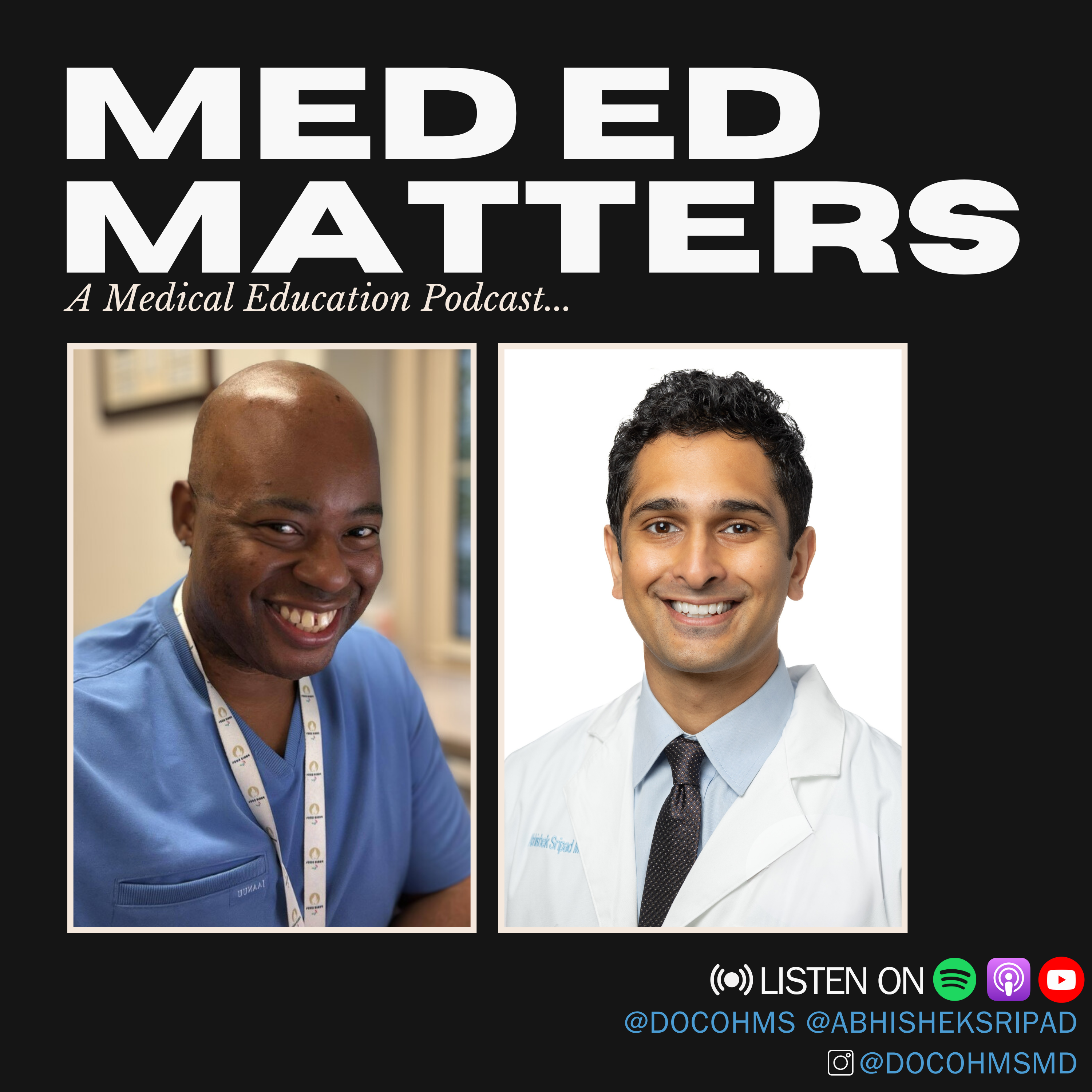
Med Ed Matters: Insights and Innovations, is a podcast hosted by Dr. Omar Young and co-hosted by Dr. Abhishek Sripad. This series aims to provide educators with valuable tips and tricks to enhance their effectiveness as medical educators, featuring special guests who will share their expertise.
-
5
The Role of Advanced Practice Providers in Academic Medicine
In this episode, hosts Drs. Omar Young and Abhi Sripad explore the expanding role of advanced practice providers, or APPs, in academic medicine. With more than 60% of physician training now occurring in outpatient settings and APPs representing the fastest-growing segment of the academic clinical workforce, this conversation highlights why their contributions to education and patient care matter more than ever.Guests Erin Huprich, WHNP, and Meg Berreth, CNM, share how APPs became part of the academic medicine landscape and how their roles as clinicians and educators have evolved. They walk listeners through a typical teaching day in the ambulatory setting, discuss who they teach and how, and reflect on what medical students and residents often misunderstand about APP roles before stepping into clinic.The group takes a deeper look at collaboration between APPs and physicians, moving past the buzzword to describe what effective teamwork looks like in practice. They also address questions of hierarchy, training, and capabilities, and share teaching moments that have made a lasting impact. From the physician perspective, Drs. Young and Sripad discuss models of collaboration they have seen work best in academic settings.As always, the episode concludes with a Med Ed Moment, as each guest names one systemic challenge and offers one practical call to action for listeners, especially program directors and department chairs seeking to better integrate APPs into their training programs.
-
4
Solidifying Surgical Training in the Era of Decreased TAH/TVH Volume
In this episode of MED ED MATTERS, hosts Dr. Omar Young and Dr. Abhi Sripad sit down with Dr. Leslie Clark, academic gynecologic oncologist, to unpack what’s changing in surgical training—and what must be protected. Together, they explore whether core surgical skills are being lost or simply concentrated, how competency should really be assessed, and why case numbers alone don’t tell the full story. Dr. Clark shares how a deep dive into resident case logs revealed meaningful gaps in exposure—and how intentional case assignment, autonomy tracking, and faculty alignment can help close them. The conversation spans everything from entrustment versus volume, to what residents uniquely gain from open surgery, to advice for trainees worried about their numbers. 🎧 Listener note: This episode includes timestamps so you can jump directly to questions of interest, including: 2:42 - How do we ensure residents graduate competent in open and vaginal techniques when those cases are less common? 3:45 - When you think about surgical training today versus ten years ago, what feels most different? 5:03- Are we truly losing these skills, or are they just becoming concentrated in certain hands? 6:37 - As an attendee, how do you determine whether a learner is competent? 8:42 - When we look at resident case logs at UNC, what patterns did you notice that made you think intervention was necessary? 9:47 - What do residents uniquely learn during an open hysterectomy that they may not fully develop in a purely minimally invasive environment? 11:35 - How do you train individuals who are not being exposed to certain procedures? How do you get your trainee to teach you? 15:35 - How does Dr. Clark implement learners into these opportunities: 16:58 - How was Dr. Clark's model developed? 18:17 - Should entrustment and autonomy tracking carry more weight than raw volume? 20:33 - Residency Tracking and Initiatives for Surgical Education: 23:28 - What advice would you give a resident who is concerned about Their surgical volume numbers? 28:13 - What skills should a resident have to be able to perform a TAH/TVH? What is the most under-taught surgical skill? 32:39 - What is your Med Ed Moment?
-
3
Technology and Simulation in Medical Training
In this episode, Drs. Omar Young and Abhishek Sripad sit down with Dr. Lauren Siff, a double board-certified urogynecologist and Chief of Gynecology and Chief of Urogynecology at the Central Virginia VA Health Care System. She also serves as Associate Professor at the VCU School of Medicine and is affiliated with the VCU Institute of Engineering.Dr. Siff shares her journey into medical training and education, reflecting on how her early experiences shaped her passion for simulation-based learning. The conversation explores the evolving role of technology in medical education, including an overview of augmented reality (AR) and how it enhances learner engagement and skill development.The discussion dives into the purpose and advantages of simulators in medical training, highlighting the key principles that make simulation effective—from psychological safety to deliberate practice and structured feedback. Dr. Siff also discusses how stakeholder input and logistical considerations reshaped the initial simulation vision, offering valuable insight into implementation challenges and successes.For educators and program leaders, this episode provides practical guidance on incorporating simulation into teaching and key considerations for program directors integrating technology-driven learning into their curricula.Audio Notice: Several brief portions of the recording were not captured due to technical issues. This can happen with technology, especially with our doctors and guests traveling and working nationwide. We appreciate your patience and understanding.
-
2
Holistic Review in Medical Education
In this episode, co-host Abhishek Sripad, MD sits down with host Dr. Omar Young for an in-depth conversation on holistic review in medical school admissions. Dr. Young shares his personal journey into medical education and what led him to focus on admissions practices and evaluation frameworks.Together, they unpack the concept of holistic review, offering clear takeaways for listeners and explaining how it addresses long-standing flaws in standardized testing and score-based evaluations. The discussion traces the evolution of admissions frameworks, examining the advantages and shortcomings of traditional models and the challenges institutions face when adopting holistic review.The episode also focuses on real-world implementation, from training individual interviewers to balance experiences, attributes, and metrics, to guiding program leaders in developing mission-driven value statements and program-wide evaluation strategies. This conversation provides practical insight for anyone involved in medical education, admissions, or applicant evaluation.Timestamps:1:50 How did you get involved in Medical Education?6:12 What is holistic review? 8:34 Step 1 Testing Experience11:23 Medical School Testing Flaws12:45 Benefits of Hollistic Review15:30 What Hollistic Review Does18:18 Omar Young Real life Example of Hollistic Review 21:11 Advantages to the older framework 23:00 disadvantages of evaluating via scores25:36 Alignment Check-Index27:50 How would you instruct/guide the individual interviewer to conduct their interviews?32:50 as a program leader, how do you move towards developing holistic review as the method of applicant evaluation for the entire program?40:10 Med Ed Moment
-
1
Teaching Advocacy in 21st-Century Medical Education
Teaching Advocacy in 21st-Century Medical EducationIn this powerful episode, we dive into one of the most urgent and evolving topics in medical training today: how to teach advocacy as a core clinical competency. Host Dr.Young is joined by two leading voices in Complex Family Planning—Dr. Clayton Alfonso, MD, and Dr. Amy Bryant, MD—to explore what advocacy looks like in modern medical practice and why it matters now more than ever.Across the conversation, Dr. Alfonso and Dr. Bryant reflect on how they first stepped into advocacy work, how their clinical experiences shaped that evolution, and what today’s trainees need to understand about their power and responsibility as physician-advocates. Listeners will hear practical guidance for residents, fellows, and educators—including how to begin building advocacy skills, where to find mentors, how to engage with legislators and communities, and how professional organizations like ACOG can support early-career physicians.Episode Timestamps & Key Questions2:20 — What Is Complex Family Planning? The guests unpack what Complex Family Planning involves and how advocacy naturally intersects with their clinical practice.5:30 — “What was the moment you realized advocacy needed to be part of your career?”11:35 — “How were you taught advocacy? How would you teach it now?” Both physicians discuss their early exposures to advocacy and the gaps they aim to fill for today’s trainees.17:50 — “What is different now about teaching advocacy compared to 10–15 years ago?”21:45 — “Why should I care about advocacy?” The guests respond to the question trainees most commonly ask, reframing advocacy as a skill that protects both patients and physicians.23:51 — “How can advocacy skills support long-term careers and well-being?”29:39 — “If a trainee asked you what the highest-priority advocacy issues in OBGYN are today, how would you answer?”42:04 — “What is the first concrete step a resident can take tomorrow?”48:27 — MED ED MOMENTS Each guest offers a final message—one key insight they hope listeners carry with them as they step into advocacy roles of their own.
-
0
You Belong: Creating Equitable Clinical Learning Environments
In this episode, our guests explore what health equity truly means—why it matters, how it shows up in training environments, and what it takes to build systems where all learners and patients can thrive. We begin by defining equity from the perspectives of clinicians and educators, then shift to the realities of the clinical learning environment, highlighting how structural barriers, cultural norms, and subtle interpersonal dynamics can create exclusion.Our panel shares candid examples of inequities that often go unnoticed, discusses how bias shows up in evaluation and feedback, and reflects on how work environments can either promote belonging or reinforce disparities.The conversation then moves to actionable solutions: structural reforms in curriculum and policy, the power of mentorship and sponsorship, strategies for fair assessment, and the responsibilities of leaders in shaping equitable training spaces.We close with each guest offering one key takeaway— Med Ed Moment!3:10 What does Health Equity mean to you?7:08 What does health equity mean in the clinical learning environment?11:39 What are the biggest barriers you see to creating equity in the clinical learning environment?17:56 Have you had any experience where the environment was not equitable?24:25 When do we see inequities in clinical learning environments?28:01 What strategies have you seen make a real difference in promoting equity and belonging31:45 What role do mentorship and sponsorship play?34:56 How have you changed evaluation systems or feedback culture to promote fairness?41:59 What is the one key nugget (Med Ed Moment) you would want our listeners/viewers to take away?
We're indexing this podcast's transcripts for the first time — this can take a minute or two. We'll show results as soon as they're ready.
No matches for "" in this podcast's transcripts.
No topics indexed yet for this podcast.
Loading reviews...
ABOUT THIS SHOW
Med Ed Matters: Insights and Innovations, is a podcast hosted by Dr. Omar Young and co-hosted by Dr. Abhishek Sripad. This series aims to provide educators with valuable tips and tricks to enhance their effectiveness as medical educators, featuring special guests who will share their expertise.
HOSTED BY
Omar Young
CATEGORIES
Loading similar podcasts...
URL copied to clipboard!