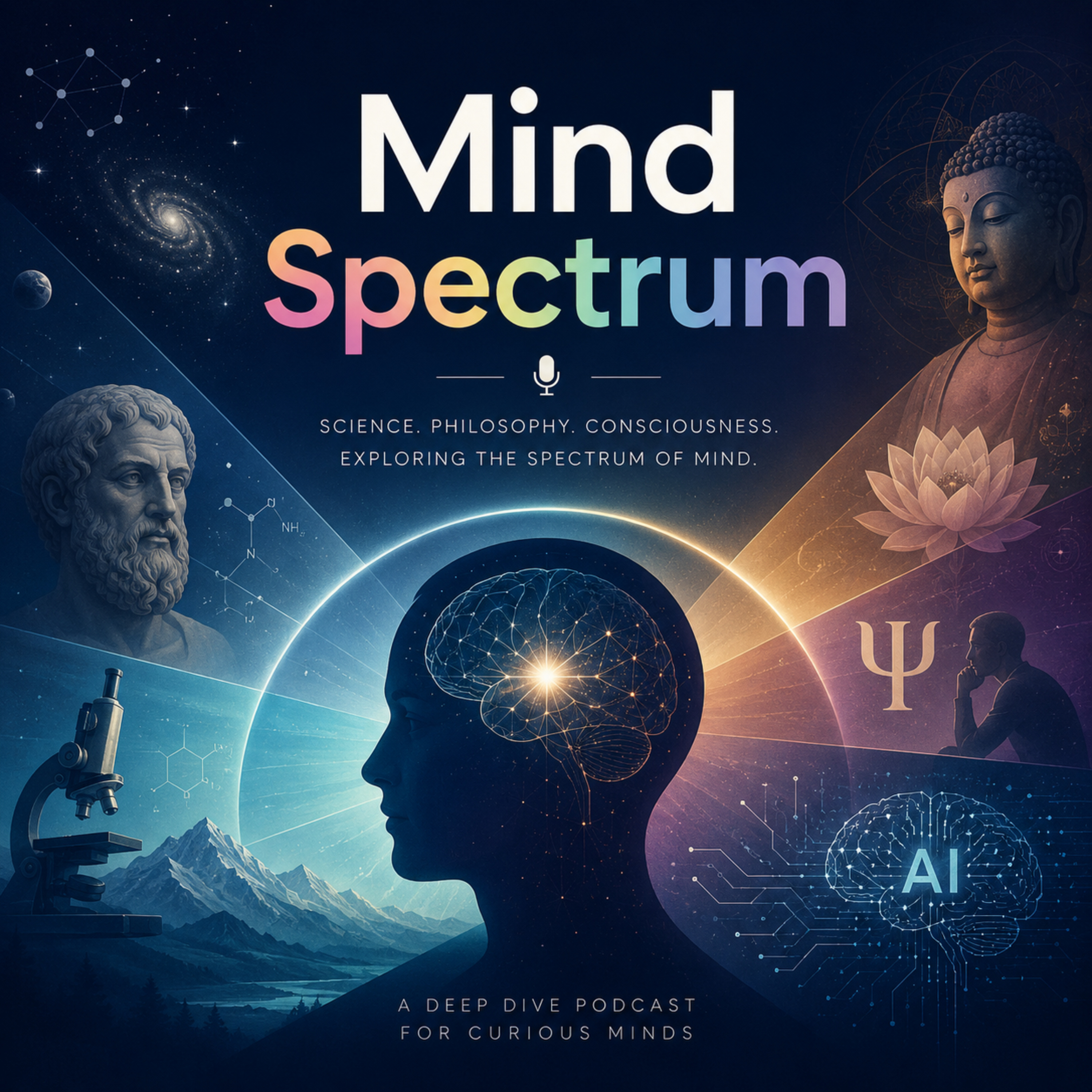
Mind Spectrum podcast artwork

PODCAST · science

Mind Spectrum

Mind Spectrum is where psychology meets real life. Each episode breaks down the science of how we think, feel, and decide — without the jargon, and with a focus on ideas that can change how we understand ourselves.From memory and emotions to habits, motivation, and decision-making, we explore research, challenge common assumptions, and tell the story behind the science.For anyone who has ever wondered why we do what we do — and wants a clearer answer.New episodes weekly.

  1. 37

    Why Your Brain Rewrites Your Memories While You Sleep

    Your brain isn't just resting during sleep—it's actively rewriting your memories every night. 🧠In this episode, we dive into the latest neuroscience research from the University of Tübingen (2026) and Cornell University on sleep spindles and memory consolidation. Discover why you get your best ideas in the shower, how your brain runs a "defragmentation cycle" every night, and why pulling an all-nighter is catastrophic for learning.📚 Sources:- University of Tübingen (2026) - Sleep spindle coordination and memory consolidation- Cornell University (2025) - Sleep as a baseline reset for neural processing- Nature Neuroscience - Spiral wave patterns predict memory retention👉 Subscribe for more Mind Spectrum episodes!#MindSpectrum #Neuroscience #SleepScience #Memory #CognitiveScience #SleepTips #BrainHealth #LearningDisclaimer: This podcast is for educational purposes only. Consult a medical professional for sleep disorders.

  2. 36

    Why Feeling Other People's Pain Is Harmful

    Your brain has two empathy systems. One helps you.The other literally destroys your ability to help.In this Deep Dive, we break down the neuroscience of emotional vs cognitive empathy — and why the most caring people are often the least effective in a crisis.iarb ruoy :xetroc latnorferp sv alusni ehT -:scipot yeKn' empathy war better with LESS empathygitaf noissapmoC -eu: how absorbing emotions shrinks your hippocampusdarap yhtapohcysp ehT -ox: the exact neural profile that makes great doctors also makes skilled predatorsW -yh forcing empathy in politics backfiresu — "xobdnas" eht dliub ot woH -nderstanding pain without absorbing itptth → sedosipe suoiverp ot netsiLYour brain has two empathy systems. One helps you.The other literally destroys your ability to help. In this Deep Dive we break down the neuroscience of emotional vs cognitive empathy — and why the most caring people are often the least effective in a crisisrferp sv alusni ehT -:scipot yeKnotal cortex: your brain's empathy wareb mrofrep snoegrus yhW -tter with LESS empathy :eugitaf noissapmoC -how absorbing emotions shrinks your hippocampuseht :xodarap yhtapohcysp ehT - exact neural profile that makes great doctors also makes skilled predators in politics backfires— xobdnas eht dliub ot woH - understanding pain without absorbing itipe suoiverp ot netsiLsodes: https://open.spotify.com/show/U5Ps9DoUias9RqFmdTnKY8yhtapme gnicrof yhW -.,s/:/open.spotifyc.om/show/5UPs89DoUias9RqFmdTnKYmrofrep snoegrus yhW -

  3. 35

    Why Your Brain Rewrites Your Past Without Asking

    very time you remember something, your brain reconstructs it from scratch — and quietly rewrites the details. Neuroscientist Karim Nader discovered that the very act of recalling a memory makes it unstable, opening a window where new emotions, biases, and even fake details can get permanently woven in. Elizabeth Loftus proved that 52% of eyewitness testimonies contain false memories planted by leading questions. A single word — "smashed" vs "hit" — can make you remember shattered glass that never existed.But this glitch is also a feature. Therapy uses reconsolidation to rewrite the emotional tags on traumatic memories. And cutting-edge optogenetics research is learning to engineer memories with light-sensitive algae proteins and lasers. The question isn't just whether you can trust your past — it's whether the past you remember ever actually happened.Welcome to Mind Spectrum by The Cognitive Lab. If you want to geek out further on the brain mechanisms discussed today, explore our core episodes:🎧 [Listen Now] Your Brain Is a Time Machine — Cracking Time Perception Biases🎧 [Listen Now] Why Anxiety Hijacks Your Teenage Brain — Decoding Neural Circuitry🎧 [Listen Now] Why Forgetting Is a Superpower — The Case Against Perfect MemoryListen on Spotify or Apple Podcasts. New episodes every week!#MemoryReconsolidation #FalseMemories #Neuroscience #CognitiveScience #ElizabethLoftus #PTSD #Optogenetics

  4. 34

    Your Brain Is Lying to You - The Dopamine Prediction Error

    Why does the thing you’ve been looking forward to for weeks feel… meh? Why does a random compliment stick with you longer than a planned celebration?The answer isn’t that you’re hard to please. It’s a tiny mathematical formula running in your brain every second of every day: Actual experience minus Expectation equals Dopamine release.In this episode, we trace the discovery of the dopamine prediction error — from Wolfram Schultz’s monkey experiments in the 1980s to modern neuroscience’s understanding of why depression literally breaks your expectation engine.We explore:• Why your brain is not “broken” — it’s just calculating wrong• The hedonic treadmill: why every upgrade feels temporary• Why surprise is more powerful than expectation• How resetting your expectations can quietly rebuild your motivationFrom monkey juice experiments to your scrolling habits, this episode reveals the hidden algorithm behind every emotion you’ve ever felt.🎧 Follow Mind Spectrum for more episodes where neuroscience meets your daily life.

  5. 33

    Why Your Brain Fakes Your Identity | The Neuroscience of "I Am"

    Your brain constructs a story about who you are every waking second — and neuroscience proves it's largely fiction.This episode explores the neuroscience of selfhood through the lens of non-dual awareness. We trace the Default Mode Network (DMN) — the brain's "ego engine" — and discover how meditation, psychedelics, and focused attention all converge on the same mechanism: quieting the narrative self.Drawing on the Topographic Reorganization Model (Cooper et al., 2022), we explain why advanced meditators report a dissolution of self-boundary, and what that means for everyone else. From Gazzaniga's left-brain interpreter to the insular cortex acting as the body's gatekeeper, each piece of neuroscience maps directly onto insights that mystics have described for centuries.No mysticism required — just brain science that challenges everything you believe about "you."📰 Key Topics:• The Default Mode Network as the biological ego• Why your left hemisphere fabricates your life story• The insular cortex: bridge between body and self• What psychedelics and meditation have in common• The neuroscience behind "I Am" experiences🎧 Also listen:EP36: What Your Second Personality Knows That You Don'tEP35: Why Your Gut Is Your Second BrainEP34: The Invisible Hand That Shapes Your Reality

  6. 32

    Why Forgetting Is a Superpower — The Case Against Perfect Memory

    Your brain deletes 99.99995% of your reality every single second. Forgetting isn’t a bug — it’s an active demolition process orchestrated by specialized immune cells literally eating your synaptic connections.In this episode, Maya and Leo dismantle everything you think you know about memory. From Jill Price, the woman who can’t forget and suffers for it, to Oliver Hardt’s groundbreaking research on active forgetting at McGill University, to Paul Frankland’s shocking discovery that growing new brain cells actually causes you to forget — this one will make you want to delete every memory-training app on your phone.Key topics:• Active forgetting vs. passive decay — why your brain isn’t a hard drive• Microglia: the demolition crew inside your head• Rac1 protein: the molecular “delete” tag• Paul Frankland’s neurogenesis paradox — new neurons erase old memories• Daniela Schiller’s reconsolidation window — why PTSD is a failure to forget• Jill Price and hyperthymesia — the curse of perfect memory• Elizabeth Loftus and false memories — why your brain corrupts its own records• The glymphatic system — sleep as your brain’s garbage collectionWelcome to Mind Spectrum by The Cognitive Lab. If you enjoyed this episode, explore our core library:🎧 Your Brain Is a Time Machine — The 4D Anchor Theory🎧 Why Anxiety Hijacks Your Teenage Brain🎧 Why IQ Tests Are Measuring the Wrong Thing🎧 Your Brain Never Powers DownNew episodes every week. Listen on Spotify or Apple Podcasts!

  7. 31

    Why IQ Tests Are Measuring the Wrong Thing

    Why IQ Tests Are Measuring the Wrong ThingWhy has a single number — your IQ score — dictated your entire educational trajectory for over a century?In this episode, we dismantle the myth of the G-Factor and explore Howard Gardner’s groundbreaking theory of Multiple Intelligences. We trace the origins back to Harvard’s Project Zero in 1983, examine the neurobiological evidence of “double dissociation” — why a stroke patient can lose the ability to read while still composing symphonies — and ask: if AI can ace the SAT in one second, what does “being smart” even mean anymore?What you’ll hear:• The IQ trap — how one number shaped your life without you noticing• Gardner’s 8 intelligences, and why schools only bother testing 2 of them• “Double dissociation”: brain damage that suggests intelligence may not be a single thing• Why athletes aren’t “dumb jocks” — bodily-kinesthetic intelligence is real• The skill schools pretend doesn’t exist: interpersonal intelligence• The AI mirror: when machines master language and logic, what’s left for us?• Why “smart” means something completely different in Beijing vs. Boston🧠 More Mind Spectrum:🔗 EP34: Why Your Need to Feel Safe Is Keeping You Anxious — https://open.spotify.com/episode/1BUSfr9Ym1ot8naUsTbTdn🔗 EP33: Your Child’s DNA Is Hiding Inside Your Brain — And Scientists Finally Know Why — https://open.spotify.com/episode/6LIwoOPDrxRoxN3R1jFbun🔗 EP32: Your Left Brain Is Sabotaging Your Life — And How to Stop It in 90 Seconds — https://open.spotify.com/episode/3ZwbkJNUBCc6G55zhh8nk8🔗 EP31: The World Is Upside Down — 4 Truths of Spiritual Awakening — https://open.spotify.com/episode/2z9mhyxsgnkxytWE6tWlPC🎧 Subscribe to Mind Spectrum on Spotify for weekly deep dives into the neuroscience of human behavior.#MindSpectrum #Neuroscience #Intelligence #IQTest #Psychology #MultipleIntelligences

  8. 30

    Why Your Need to Feel Safe Is Keeping You Anxious

    Why Your Need to Feel Safe Is Keeping You AnxiousYou lock your doors, have money in the bank, and food in the fridge — yet your heart is pounding. You’re physically safe, but your brain is screaming that you’re in mortal danger.What if anxiety isn’t about actual threats — but about trying way too hard to feel secure?What you’ll hear:• The viral Xiaohongshu post that triggered millions: “This text will trigger your deepest fears — and set you free”• Safety vs. “sense of security”: the critical difference most people miss• The “small self” ego, and its three deepest terrors: losing something, getting hurt, and total collapse• Why financial planning becomes toxic when it’s driven by ego, not practicality• The autoimmune metaphor: when your defense mechanism starts attacking healthy tissue• Lester Release Technique: what it actually does — and doesn’t do• How to tell if you’re being “responsible” or just feeding the ego’s hunger for controlYou aren’t anxious because the world is dangerous. You’re anxious because you’re treating a conceptual self like a physical body that needs protecting.🧠 More Mind Spectrum:🔗 EP35: Why IQ Tests Are Measuring the Wrong Thing — https://open.spotify.com/episode/4JCas6ziBT3mL8dZjV943y🔗 EP33: Your Child’s DNA Is Hiding Inside Your Brain — And Scientists Finally Know Why — https://open.spotify.com/episode/6LIwoOPDrxRoxN3R1jFbun🔗 EP32: Your Left Brain Is Sabotaging Your Life — And How to Stop It in 90 Seconds — https://open.spotify.com/episode/3ZwbkJNUBCc6G55zhh8nk8🔗 EP31: The World Is Upside Down — 4 Truths of Spiritual Awakening — https://open.spotify.com/episode/2z9mhyxsgnkxytWE6tWlPC🎧 Subscribe to Mind Spectrum on Spotify for weekly deep dives into the neuroscience of human behavior.#MindSpectrum #Anxiety #MentalHealth #Psychology #Ego #LesterRelease #SelfHelp #Stress

  9. 29

    Your Child’s DNA Is Hiding Inside Your Brain — And Scientists Finally Know Why

    Your Child’s DNA Is Hiding Inside Your Brain - And Scientists Finally Know WhyIn 2026, a team at UT Southwestern Medical Center published a bombshell paper in Cell that completely rewrites the story of microchimerism. For decades, textbooks said whole fetal cells migrate across the placenta and hide out in the mother’s body for decades. But that theory had a massive hole: why didn’t the mother’s immune system attack these “foreign” cells?The answer changes everything we know about human biology.What you’ll hear:The groundbreaking 2026 Cell paper: fetal DNA travels solo, not in whole cellsThe “Trojan Horse” mechanism: how foreign DNA hides inside your own cellsNanotubes: the microscopic skywalks cells build to swap genetic codeWhy your immune system can’t detect it: the bouncer analogyThe dual edge: a beautiful explanation for mother-child bonding vs. terrifying implications for cancer spreadHorizontal gene transfer: not just for bacteria anymoreYou are not a locked vault. You are an open network.More Mind Spectrum:EP35: Why IQ Tests Are Measuring the Wrong Thing - https://open.spotify.com/episode/4JCas6ziBT3mL8dZjV943yEP34: Why Your Need to Feel Safe Is Keeping You Anxious - https://open.spotify.com/episode/1BUSfr9Ym1ot8naUsTbTdnEP32: Your Left Brain Is Sabotaging Your Life - And How to Stop It in 90 Seconds - https://open.spotify.com/episode/3ZwbkJNUBCc6G55zhh8nk8EP31: The World Is Upside Down - 4 Truths of Spiritual Awakening - https://open.spotify.com/episode/2z9mhyxsgnkxytWE6tWlPCSubscribe to Mind Spectrum on Spotify for weekly deep dives into the neuroscience of human behavior.#MindSpectrum #Neuroscience #Biology #Microchimerism #DNA #CellJournal #Genetics #Immunology

  10. 28

    Your Left Brain Is Sabotaging Your Life — Stop It in 90 Seconds

    Your Left Brain Is Sabotaging Your Life - And How to Stop It in 90 SecondsIn 1996, Harvard neuroscientist Dr. Jill Bolte Taylor had a massive stroke - and became one of the few scientists to describe her own brain’s deterioration from the inside. What she discovered about the two hemispheres may change how you understand negative emotions.Your left brain is often described as a serial processor that categorizes, worries, and generates internal chatter. It’s where much of your “I am” narrative seems to live - the voice that says you’re not good enough, or replays awkward moments from three years ago.But here’s the key idea: the physiological wave of an emotion may last about 90 seconds. After that, you’re not just “feeling” - you’re often feeding a storyline.What you’ll hear:How Dr. Jill Bolte Taylor’s stroke quieted her left-brain processing - and the profound shift in consciousness that followedThe 90-second rule: why emotional waves can peak and fade faster than we thinkHow the Reticular Activating System, or RAS, turns your brain into a social media algorithmThe “white bear” experiment: why fighting thoughts can make them strongerA 5-minute clinical protocol to interrupt negative thought cyclesYou are not your thoughts. You are the observer. And which circuitry you reinforce may be more flexible than it feels.More Mind Spectrum:EP35: Why IQ Tests Are Measuring the Wrong Thing - https://open.spotify.com/episode/4JCas6ziBT3mL8dZjV943yEP34: Why Your Need to Feel Safe Is Keeping You Anxious - https://open.spotify.com/episode/1BUSfr9Ym1ot8naUsTbTdnEP33: Your Child’s DNA Is Hiding Inside Your Brain - And Scientists Finally Know Why - https://open.spotify.com/episode/6LIwoOPDrxRoxN3R1jFbunEP31: The World Is Upside Down - 4 Truths of Spiritual Awakening - https://open.spotify.com/episode/2z9mhyxsgnkxytWE6tWlPCSubscribe to Mind Spectrum on Spotify for weekly deep dives into the neuroscience of human behavior.#MindSpectrum #Neuroscience #Psychology #MentalHealth #Anxiety #Brain #JillBolteTaylor #90SecondRule

  11. 27

    The World is Upside Down: 4 Truths of Spiritual Awakening

    The World Is Upside Down - 4 Truths of Spiritual AwakeningWhat if everything you believe about success, ownership, and strength is completely backwards?We explore the ancient Taoist principle of “reversal is the movement of the Tao” - the idea that reality often operates in reverse. What you think you own may actually own you. What you think is gaining may actually be losing. The strong are often fragile, and the world you see may be more illusion than reality.We trace this upside-down logic across 2,500 years of thought - from Lao Tzu’s clay pot metaphor to Charlie Munger’s “invert, always invert.”What you’ll hear:Why your $3 million house may be dictating your life choices - and what to do about itHow your smartphone can hold your mind hostage without you noticingWhy the most powerful people on earth may be secretly terrified of irrelevanceThe clay pot metaphor: emptiness is what makes something usefulCharlie Munger’s inversion trick - and why it works for life decisionsHow to stop being an extra in someone else’s scriptThis isn’t nihilism. It’s a different kind of empowerment.More Mind Spectrum:EP35: Why IQ Tests Are Measuring the Wrong Thing - https://open.spotify.com/episode/4JCas6ziBT3mL8dZjV943yEP34: Why Your Need to Feel Safe Is Keeping You Anxious - https://open.spotify.com/episode/1BUSfr9Ym1ot8naUsTbTdnEP33: Your Child’s DNA Is Hiding Inside Your Brain - And Scientists Finally Know Why - https://open.spotify.com/episode/6LIwoOPDrxRoxN3R1jFbunEP32: Your Left Brain Is Sabotaging Your Life - And How to Stop It in 90 Seconds - https://open.spotify.com/episode/3ZwbkJNUBCc6G55zhh8nk8Subscribe to Mind Spectrum on Spotify for weekly deep dives into the neuroscience of human behavior.#MindSpectrum #Spirituality #Stoicism #Philosophy #Taoism #Inversion #LaoTzu #CharlieMunger

  12. 26

    Why Your Darkest Moment Is Actually Your Greatest Opportunity

    Why Some People Grow After TraumaWhy do some people fall apart after trauma, while others come back stronger?It’s not just resilience. It’s not simply “bouncing back.” It’s called post-traumatic growth, or PTG — and it may explain the difference between surviving pain and being transformed by it.What you’ll hear:Why “emotional earthquakes” don’t just break you — they can rebuild youThe 5 domains of post-traumatic growth, and which one may change your lifeWhat Viktor Frankl learned in a concentration camp that became a blueprint for millionsThe University of Pennsylvania research that helped make PTG measurableThe Chinese “stock market” framework for emotional recoveryTrauma is not growth by itself. But when people are forced to rebuild their assumptions about life, identity, and meaning, something deeper can sometimes emerge.Subscribe to Mind Spectrum on Spotify for weekly deep dives into the psychology and neuroscience of human behavior.#MindSpectrum #PostTraumaticGrowth #TraumaRecovery #Psychology #Resilience #MentalHealth #ViktorFrankl #PTG

  13. 25

    6 Physical Signs That Prove You're Carrying Hidden Trauma

    6 Physical Signs Your Body May Be Holding Onto TraumaHave you ever felt your throat tighten when you try to speak up? Or wondered why you’re constantly exhausted, no matter how much you sleep?Trauma doesn’t only live in memory. It can also show up in the body — through muscle tension, shallow breathing, digestive stress, fatigue, and a nervous system that stays on alert long after the danger has passed.In this episode, we explore 6 physical signs that your body may still be carrying past emotional wounds — and how awareness can be the first step toward feeling safer and more grounded.Subscribe to Mind Spectrum on Spotify for weekly deep dives into the psychology and neuroscience of human behavior.#MindSpectrum #Trauma #NervousSystem #SomaticHealing #Psychology #MentalHealth #Stress #BodyMindConnection

  14. 24

    Why Your Sunday Epiphany Is Gone by Monday Morning

    Your Anxiety Is a Neural Superhighway - Here’s How to Build a New PathYour anxiety isn’t a flaw. It’s a neural pathway your brain has practiced so often that it can start to feel automatic.In this episode, we dive into the science of neuroplasticity and myelination: how your brain physically rewires itself, why repeated emotional patterns become faster and stronger, and how new habits can gradually reshape the circuits you rely on.You’ll learn how to work with your biology instead of fighting it - using practices that support safety, body awareness, focus, self-expression, and creative flow.What you’ll hear:Why anxiety can feel like your brain’s default settingHow neuroplasticity helps the brain build new pathwaysWhy myelination makes repeated circuits faster and easier to accessHow BDNF, the vagus nerve, and body awareness relate to emotional regulationThe 5 steps for practicing a new internal patternYou are not stuck with the pathways your brain learned first. With repetition, your brain can learn something new.Subscribe to Mind Spectrum on Spotify for weekly deep dives into the psychology and neuroscience of human behavior.#MindSpectrum #Anxiety #Neuroplasticity #Myelination #VagusNerve #BDNF #MentalHealth #Neuroscience

  15. 23

    Why 'Just Think Positive' Is Biologically Impossible

    Why Positive Thinking Fails When You’re ExhaustedWhy does “just think positive” feel impossible when you’re exhausted?Because happiness is not only a mindset. It also depends on the physical state of your brain and body.When your nervous system is depleted, positive thinking can feel less like a choice and more like a demand your biology cannot meet. What looks like a “bad attitude” may actually be exhaustion, low motivation, disrupted sleep, and a brain struggling to regulate mood.In this episode, we explore:Why toxic positivity can make exhaustion worseHow dopamine, sleep, light, and movement relate to motivation and moodThe difference between normal emotional fluctuation and deeper depletionWhy forcing yourself to feel better often backfiresA science-informed reset: acceptance, sleep prioritization, and 20-30 minutes of outdoor walkingYour exhaustion isn’t a character flaw. Your brain and body may simply need recovery before they can access hope, motivation, and joy again.Subscribe to Mind Spectrum on Spotify for weekly deep dives into the psychology and neuroscience of human behavior.#MindSpectrum #Neuroscience #MentalHealth #Dopamine #Happiness #Burnout #Psychology

  16. 22

    Your Body Is an Aging House — Here's How to Renovate It

    Why Muscle Loss May Be the Hidden Driver of AgingMuscle isn’t just for show. It’s one of your body’s most important systems for blood sugar regulation, metabolism, movement, and long-term health.In this episode, we explore why muscle loss is not only a fitness issue, but a biological aging issue.What you’ll learn:Why muscle acts like a major reservoir for blood sugar regulationHow short “exercise snacks” may support metabolic healthDr. Andy Galpin’s 4-quadrant system for strength, power, endurance, and functionThe “Defender” method for finding what’s actually blocking your exercise habitsHow exercise may influence aging biology through mitochondria, telomeres, and cellular pathwaysWhether exercise would still matter if an anti-aging pill existedFeaturing ideas and research connected to Dr. Andy Galpin, Dr. Gabrielle Lyon, and emerging science on muscle, metabolism, and longevity.Subscribe to Mind Spectrum on Spotify for weekly deep dives into the psychology, neuroscience, and biology of human behavior.#MindSpectrum #MuscleLoss #Aging #ExerciseSnacks #Longevity #MetabolicHealth #AntiAging #FitnessScience

  17. 21

    Stop Forcing Deep Breaths: The Master Switch Your Body Doesn’t Know About

    Why Exhaustion May Be a Nervous System ProblemWhy does exhaustion feel like a personal failure?We blame our workload, our schedule, or our lack of discipline — but what if the real problem isn’t any of those things?This episode explores the vagus nerve: a key pathway in the nervous system that helps influence whether your body stays stuck in stress mode or shifts toward restoration. You’ll discover why forcing deep breaths can sometimes backfire, and what may actually help support your parasympathetic nervous system.In this episode:The hidden reason you may feel tired even after a full night’s sleepWhy “just breathe” advice can make panic worseThe 4-second exhale trick that signals safety to your brain5 science-backed strategies that may help support vagal toneWhy social connection can be deeply restorativeStop treating exhaustion like a character flaw. Start understanding what your nervous system may be trying to tell you.Subscribe to Mind Spectrum on Spotify for weekly deep dives into the psychology, neuroscience, and biology of human behavior.#MindSpectrum #VagusNerve #NervousSystem #Burnout #Stress #MentalHealth #Parasympathetic #Neuroscience

  18. 20

    You’re Being Manipulated: 9 Tactics Used to Hack Your Brain

    Why You Are Easier to Influence Than You ThinkYou probably think most of your decisions are your own. But every day, small cues shape what you notice, what you trust, and what you choose.In this episode, we explore the psychology of influence — from everyday persuasion tactics like “because,” mirroring, anchoring, and the Ben Franklin effect, to darker patterns like love bombing, isolation, gaslighting, and fear.We also look at the part people usually miss: your own beliefs can influence you, too. The stories you repeat about who you are and what is possible may be shaping your choices more than you think.This is not about becoming paranoid. It is about becoming harder to manipulate — by other people, and by your own automatic thoughts.#MindSpectrum #Psychology #Persuasion #Influence #DarkPsychology #Manipulation #SelfAwareness

  19. 19

    Your Childhood Bully Changed Your Brain — And We Have the Scans to Prove It

    We’ve all heard the lie: “Bullying is a rite of passage. It builds character.”It’s not just wrong — it’s medically dangerous.In this deep dive, we synthesize clinical research from neuroimaging studies, longitudinal MRI scans, and psychological meta-analyses to uncover a paradigm-shifting reality: Bullying is not just behavioral — it’s a form of severe toxic stress that leaves literal, measurable scars on the developing brain.From the Quinlan study (682 teenagers tracked over 5 years) to Dr. Claus Machec’s rodent models at Tufts University, the empirical evidence is unambiguous:Chronic bullying causes actual physical volume loss in the basal ganglia (putamen and caudate nucleus)The hippocampus — your brain’s memory and learning center — suffers structural destructionMyelin sheaths (the insulation wrapping your neural wires) get stripped away, causing signal misfiresJust 20 minutes total of social subjugation (four 5-minute episodes) is enough to permanently alter addiction pathwaysBut it gets worse. The bully’s brain is also being rewired — just in a different, darker direction. And the recovery? It’s not just “talking about it.” We break down the specific biological interventions that actually rebuild damaged neural architecture: BDNF-generating aerobic exercise, mindful collaboration, and targeted cognitive training.If a school gets sued when a child breaks their leg on a faulty playground swing, why shouldn’t they be held liable when a child’s amygdala is permanently altered by an unaddressed bully?Thanks for listening to Mind Spectrum.

  20. 18

    Rock Bottom Is Not the Tragedy You Think It Is

    Welcome to Mind Spectrum.You know that nightmare scenario where every pillar holding your life together just… vanishes? The career you killed yourself for stalls out. Your core relationships are fracturing. You look in the mirror and realize you don’t even know who’s looking back?Yeah. That feeling.We treat hitting rock bottom like a biological threat — your amygdala fires the exact same alarm as if you’re being chased by a predator. Because from evolution’s standpoint, loss of social integration = death.But Carl Jung noticed something wild in his clinical practice: The people who completely collapsed were the exact same people who later experienced extraordinary transformation.In this episode, we flip the script on failure. What if rock bottom isn’t a tragedy — it’s actually the starting point of your real life?Chapters:00:00 – Welcome to Mind Spectrum02:30 – The Biology of Rock Bottom05:15 – Carl Jung’s Wild Observation08:40 – Why Your Brain Fights Collapse12:10 – The Rotten Foundation Metaphor15:30 – The 30-Second Challenge16:08 – Thanks for Listening

  21. 17

    Your Brain Never Powers Down: The Secret Life of Sleep

    Welcome to Mind Spectrum.You know, usually when we think about the end of the day, there’s this underlying expectation of a complete biological shutdown. Like powering off a device. We treat going to sleep like powering off a laptop — you plug it in, you close the screen, the fan stops spinning, and you just sort of sit in standby mode. Effectively doing nothing until the alarm rings in the morning.But what if that’s completely wrong?In this episode, we explore the secret life of sleep — and why your brain is actually more active when you’re asleep than when you’re binge-watching Netflix.Chapters:00:00 – Welcome to Mind Spectrum02:15 – The Myth of the Shutdown05:30 – What Your Brain Actually Does at Night08:45 – REM Sleep: The Secret Active State12:20 – Why Sleep Is More Than Rest15:40 – The Multi-verse Preview Theory18:10 – Your Brain’s Night Shift20:00 – Call to Action

  22. 16

    Your Brain Is a Time Machine The 4D Anchor Theory

    What if your brain isn’t a hard drive at all?You remember the smell of rain when you were six. Neuroscience says that memory is a chemical trace in your synapses.The 4D Anchor Theory says that’s wrong.Your brain doesn’t save memories—it accesses them. Every time you remember, your consciousness is routing back to a literal coordinate in spacetime that’s still there, frozen in place, exactly as it was decades ago.In this episode:• Why your brain is a search engine, not a storage device• Forgetting = link rot (the past isn’t gone, your anchor is broken)• Déjà vu explained: your consciousness accidentally glimpsed the future• Why the past is a “block of ice” and the future is a probability cloud• Amnesia recovery: the data was never destroyed• The radical idea that your fear of spiders is a “public anchor” shared by all humansNothing you’ve ever experienced is gone. It’s permanently frozen in 4D spacetime, waiting for you to click the link.

  23. 15

    Why Anxiety Hijacks Your Teenage Brain (And the 30-Second Fix)

    You know that feeling when a text goes unread for three hours? Chest tightens, mind spins worst-case scenarios.Here’s the thing: your brain knows it’s just a notification.In this episode: why social media hijacks those ancient circuits, and the exact 30-second visualization technique to take back control.Because you can’t logic your way out of a biology problem. But you can hack the hardware.

  24. 14

    Why Your Brain Blanks Out on Tests (And How to Hack It)

    You studied for weeks. You know the material cold. Then you sit down for the exam, look at the first question, and your mind goes completely blank.It’s not a personal failure. It’s a biological sequence.When your brain appraises an exam as a survival threat, your amygdala activates. It signals your adrenal glands to flood your bloodstream with cortisol. That cortisol binds to receptors in your hippocampus — the brain structure responsible for memory retrieval. The result? Your neural firing gets suppressed. The files are still there, but you’ve lost the connection.The good news: biological processes have rules. They have triggers, and they have off switches.In this episode: the exact neurochemistry of test anxiety, and a science-backed toolkit to hack your brain under pressure.

  25. 13

    Why Your Brain Treats a Delayed Text Like a Saber-Tooth Tiger

    You know that feeling when someone reads your message but doesn’t reply? Your chest tightens, your mind starts spinning.Here’s the thing: your brain knows it’s just a text. But your amygdala doesn’t. It’s running the same threat-detection software we evolved for saber-tooth tigers — and it treats a delayed reply as a social survival threat.In this episode: why “read receipts” hijack your nervous system, the ancient exclusion pathways still running your life, and how to actually calm the spiral instead of telling yourself to “chill out.”Because you can’t logic your way out of a biology problem.

  26. 12

    Your Shadow Self Is Running the Show

    The trait you hate most in other people? That’s yours.You didn’t know you were carrying it. You buried it so deep you forgot it existed. But it’s been quietly running your relationships, your career, your worst decisions — all from the shadows.Carl Jung called it the Shadow. Modern corporate training calls it “emotional intelligence” and rewards you for suppressing it. But every feeling you refuse to face doesn’t disappear — it hijacks you from the inside.You don’t have a dark side. You have a buried side. And it’s been driving the whole time.

  27. 11

    The Driver You Didn't Know Was Driving

    You didn’t choose to read this sentence. Your brain decided 7 seconds before you knew it.Scientists can now predict your choices before you’re even aware you’re making them. So who’s actually running your life? Stage hypnotists can rewrite someone’s personality in seconds. Your brain hallucinates reality and calls it perception. And every “conscious decision” you’ve ever made? It was already made — without you.This episode breaks the illusion of free will wide open. And the truth underneath is more terrifying — and more liberating — than you think.

  28. 10

    The Ping Pong Ball That Broke Reality

    Two halves of a ping pong ball, some static noise, and a uniform red light. That’s all it takes to make your brain violently hallucinate. This episode dives deep into the Ganzfeld effect — the science of what happens when you starve your brain of structured input. We explore how your visual cortex panics when it can’t find edges, patterns, or movement, and starts aggressively generating its own reality to fill the void. From seeing your own retinal blood vessels to full-blown vivid hallucinations, from the biology of the fade-out effect to pareidolia on overdrive — your brain doesn’t just passively receive the world, it constructs it moment by moment. We also unpack how this same perceptual backdoor was used to study telepathy, bypass conscious mental blocks in aphantasia patients, and why the Ganzfeld experiment sparked a 50-year scientific war over parapsychology. The unsettling question: if your brain can build hyper-realistic worlds from just red light and static, how much of the world you’re looking at right now is actually real — and how much is your brain quietly filling in the blanks?

  29. 9

    Your Therapist Is an Algorithm (and They Might Be Better Than Human)

    Can code actually do therapy better than a human? This episode dives into the cutting-edge science behind AI in mental health and medical diagnosis. We explore how ChatGPT maxed out tests of emotional awareness, how specialized AI architectures are delivering text-based CBT that outperforms human clinicians, and how autonomous AI doctors like Google’s AMIE are navigating differential diagnosis better than physicians with internet access. From the ingenuity of LoRA to the critical workflow of parallel analysis, from FDA guardrails against confabulation to the deep psychological risks of falling in love with an algorithm that cannot actually care about you — this one challenges everything you think you know about human intuition. But here’s the unsettling question: if we design the perfect listener — endlessly patient, perfectly validating, completely judgment-free — do we risk losing our tolerance for the messy human relationships that actually keep us alive?

  30. 8

    The Blank Mind Advantage: Why Seeing Nothing Might Make You the Only Real Player

    What if having no mind’s eye isn’t a defect — it’s proof you’re the only real player in a simulated universe? This episode flips everything we assume about aphantasia on its head. We explore a wild thought experiment: people who can’t visualize might be running a streamlined, minimalist operating system connected directly to the source code of reality, while the rest of us — picturing shiny red apples and drowning in vivid daydreams — are just NPCs running immersive pre-rendered scripts. From the caloric cost of imagination to the uncanny valley turned inside out, from John Dalton’s colorblind chemistry to the unsettling question of whether your emotions are yours or just the simulation keeping you engaged — this one will make you question every thought you’ve ever had. Close your eyes. Picture an apple. Can you?

  31. 7

    6 Signs Your Frequency Is Shifting (And Why It Scares Everyone Around You)

    What if “raising your frequency” isn’t mystical nonsense — it’s a measurable neurological shift? This episode breaks down six surprising signs that your baseline is changing: from suddenly craving silence, to your intuition going supernova, to the uncomfortable moment when old friendships just… fall away. We translate the woo-woo into hard science — interoception, the vagus nerve, theta waves, and the Reticular Activating System — and reveal why your brain is literally pruning your life like a radio dial switching stations. The scariest part? The acceleration works both ways. Your RAS doesn’t care if your focus is positive or negative. Whatever you fixate on, your brain will hunt down evidence to make it real.

  32. 6

    The Memory Hack: How Your Brain Rewrites Your Past

    What if everything you remember is slightly wrong? Every time you recall a memory, your brain rewrites it. This process is called reconsolidation—and it’s changing how we understand the nature of truth, trauma, and identity.In this episode, we explore:• The science of memory reconsolidation—why memories are never static• How propranolol, a common beta-blocker, can weaken fear memories• Real-world therapy techniques that exploit this window of vulnerability• The ethical questions: should we be allowed to edit our own past?This isn’t science fiction. It’s happening in therapy rooms and research labs right now.🎧 Listen now and discover how your brain is editing your past—right this very moment.#psychology #neuroscience #memory #science #mind #brain #health

  33. 5

    Why Feeling Behind Is Actually Protection

    What if the feeling of “being behind” isn’t a bug — it’s a feature?We’ve all felt it: that nagging sense that everyone else is further along, more accomplished, more put-together. And most of us treat it as a signal to work harder, scroll less, or feel worse.But what if “feeling behind” is actually your brain’s way of protecting you? In this episode, we unpack the counterintuitive science behind this universal experience — and why fighting it might be the exact wrong move.We explore:Why your brain treats “falling behind” as a survival threat (and why it can’t distinguish between a real predator and your friend’s promotion post)The hidden function of comparison — how “feeling behind” keeps you alert, motivated, and socially calibratedThe three-step reframe: from threat → to data → to intentional directionWe also dig into the controversial questions: Is “feeling behind” always a sign of growth, or can it become toxic? Why do high achievers experience it most intensely? And is it possible to ever fully outgrow this mechanism — or is it wired in for life?If you’ve ever felt like you’re running a race everyone else already finished — this one’s for you.

  34. 4

    Becoming Someone Not Easily Messed With

    What does it mean to be a “nice person” — and at what cost?We grow up being told to be nice, be agreeable, don’t make trouble. But somewhere along the way, “nice” starts to mean “doesn’t push back.” It means saying yes when you want to say no. It means being the person everyone likes — but no one respects.Jungian psychology has a different take. In this episode, we explore what it means to be “nice but not weak” — someone who is neither a doormat nor a bully. Someone who can hold boundaries without becoming cold. Someone who is, paradoxically, both “not easy to mess with” and genuinely well-liked.We dive into:The “Persona” problem — why being “the nice one” is often a mask that hides your real self (and breeds resentment)The Shadow side of boundaries — why saying “no” feels like violence (and why that’s exactly why it matters)How to be “dignified” in relationships — not performing strength, but actually having itThe three-step framework: from people-pleaser → to boundary-setter → to dignified adultWe also tackle the controversial questions: Is “setting boundaries” just a fancy way of saying “I don’t care about others”? Does being “nice but not weak” mean you’ll lose your friends? And can you actually be both respected AND liked — or is that a contradiction?If you’ve ever felt like you’re too nice for your own good — and you’re tired of paying the price for it — this one’s for you.

  35. 3

    Feeling Behind: The Defense Mechanism You Didn't Know You Had

    What does it actually mean to "feel behind"?We all know the feeling: scrolling through social media, watching peers hit milestones you haven't reached, and suddenly the pit in your stomach opens up. You're not just observing their success — you're measuring yourself against it. And you're coming up short.But here's the twist that most people miss: "feeling behind" isn't a failure of character. It's not even a accurate read of reality. It's a defense mechanism — one that evolved to keep you alert to social threats, but in the modern world, it's firing at everything.In this episode, we unpack:Why your brain treats "behind" as a survival threat (and why it can't tell the difference between a saber-toothed tiger and your cousin's engagement photos)The hidden cost of social comparison — how constant upward comparison rewires your baseline for "enough"Why "just stop comparing" is terrible advice (and what actually works instead)The three-step reframe: from defense → to data → to directionWe also dig into the controversial questions: Is "feeling behind" always unhealthy, or does it sometimes drive growth? Why do high achievers feel it most acutely? And is it possible to outgrow this mechanism — or is it permanent wiring?If you've ever felt like everyone else got the manual for life and you're still waiting for yours — this one's for you.

  36. 2

    The Second Personality Switch: How to Hack Your Brain Under Pressure

    The Second Personality Switch: How to Hack Your Brain Under PressureWhat if you could instantly shift from self-doubt to peak performance — simply by imagining someone else handling the situation?That’s the core idea behind the “second personality” technique, a cognitive strategy rooted in third-person self-talk research. When you shift from “I can’t do this” to “How would he handle this?”, your brain literally responds differently — activity in self-doubt regions drops, emotional interference decreases, and decision quality improves.In this episode, we break down the three-step framework:Step 1 — Define the traits. Imagine a character who already has what you need: calm under pressure, sharp under deadline, composed in conflict.Step 2 — Create a physical trigger. Your brain doesn’t respond to abstract intentions, but it does form fast reflexes around physical anchors — a specific object, gesture, or sound that signals the switch.Step 3 — Let “them” handle it. Talk to yourself in third person. Ask: what would they do? Your role shifts from performer to observer and advisor — with built-in distance, perspective, and room to think.We also explore the science behind why this works, real-world cases from the community, and three genuinely controversial questions about the method: Is this a form of self-distancing or just sophisticated procrastination? Does it help anxious minds or drain them further? And can the traits ever actually become yours — or is “them” forever a crutch?Whether you’re prepping for an interview, stepping onto a stage, or just trying to get through a hard conversation without the inner monologue destroying you — this one’s for you..

  37. 1

    Your Skin Is Listening: How Stress & Sleep Hack Your Brain-Skin Axis

    Ever noticed your skin breaking out right before a big deadline? Or waking up with dull, tired skin after a sleepless night? It's not in your head — your skin is literally listening to your brain.In this episode of Mind Spectrum, we dive into the cutting-edge science of the brain-skin axis — the hidden highway connecting your nervous system, stress hormones, and skin health.🧠 Why cortisol doesn't just make you stressed — it supercharges your oil glands and triggers inflammation from the inside out🔬 The "skin self-amplification loop": how your skin actually produces its own stress hormones, creating a vicious cycle of breakouts and sensitivity💤 The three-way wrecking ball of sleep deprivation: impaired repair, spiked cortisol, and a gut microbiome in chaos📊 Real evidence: a 2109 clinical study where 93.3% of acne patients improved after just 8 weeks of cognitive stress management — without changing a single skincare product❓ The controversial question: are most skincare products just expensive band-aids on a stress-shaped wound?This isn't another "drink water and moisturize" episode. We're going deeper — into the neuroscience of why your face is taking the hit for what your brain is going through.🎧 Listen now. Your skin will thank you.

Type above to search every episode's transcript for a word or phrase. Matches are scoped to this podcast.

Searching…

We're indexing this podcast's transcripts for the first time — this can take a minute or two. We'll show results as soon as they're ready.

No matches for "" in this podcast's transcripts.

Showing of matches

No topics indexed yet for this podcast.

Loading reviews...

ABOUT THIS SHOW

Mind Spectrum is where psychology meets real life. Each episode breaks down the science of how we think, feel, and decide — without the jargon, and with a focus on ideas that can change how we understand ourselves.From memory and emotions to habits, motivation, and decision-making, we explore research, challenge common assumptions, and tell the story behind the science.For anyone who has ever wondered why we do what we do — and wants a clearer answer.New episodes weekly.

HOSTED BY

The Cognitive Lab

CATEGORIES

Frequently Asked Questions

How many episodes does Mind Spectrum have?

Mind Spectrum currently has 37 episodes available on PodParley. New episodes are automatically indexed when they're published to the podcast feed.

What is Mind Spectrum about?

Mind Spectrum is where psychology meets real life. Each episode breaks down the science of how we think, feel, and decide — without the jargon, and with a focus on ideas that can change how we understand ourselves.From memory and emotions to habits, motivation, and decision-making, we explore...

How often does Mind Spectrum release new episodes?

Mind Spectrum has 37 episodes. Check the episode list to see recent publication dates and frequency.

Where can I listen to Mind Spectrum?

You can listen to Mind Spectrum on PodParley by clicking any episode. We provide an embedded audio player for direct listening, and you can also subscribe via your preferred podcast app using the RSS feed.

Who hosts Mind Spectrum?

Mind Spectrum is created and hosted by The Cognitive Lab.
URL copied to clipboard!