
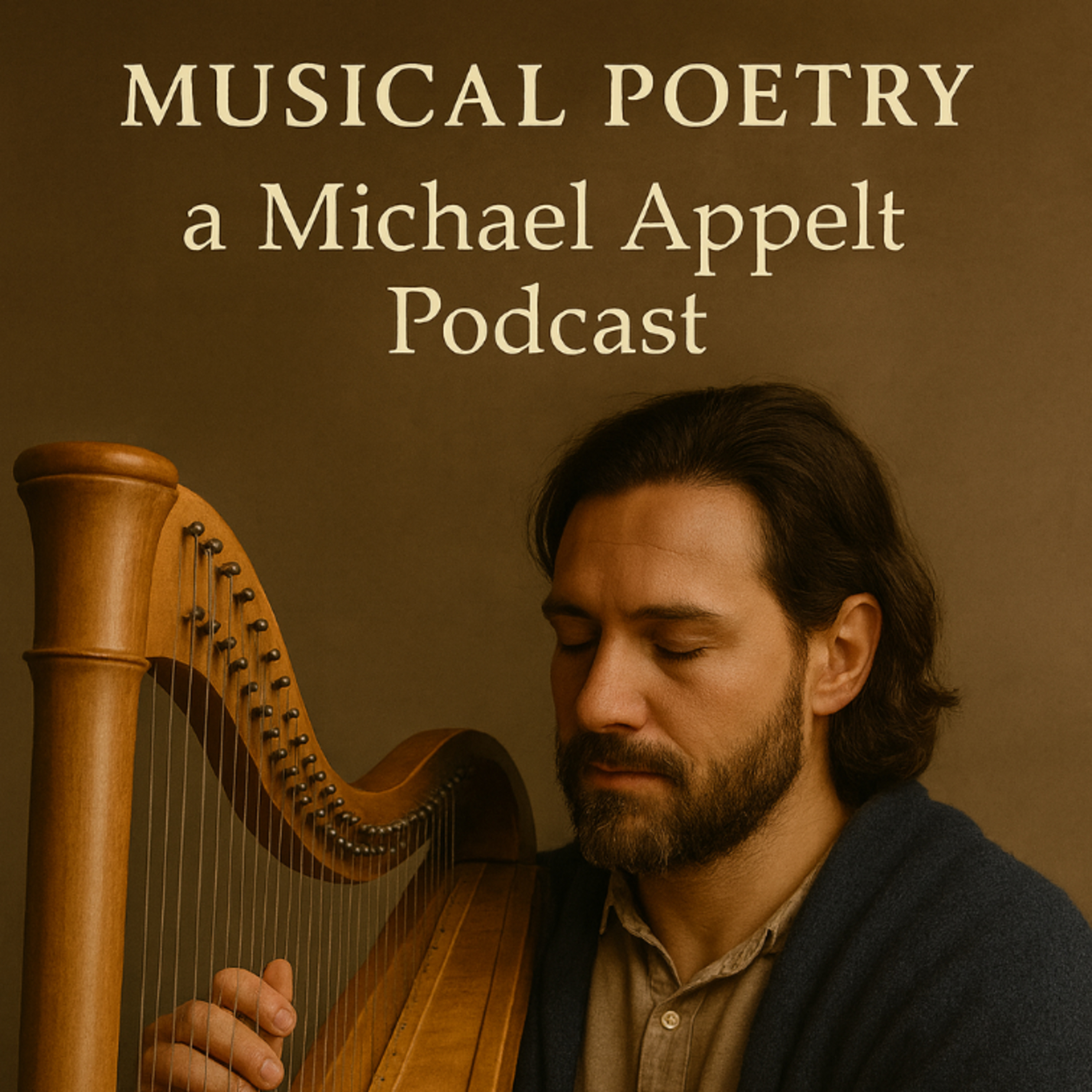
PODCAST · society
Musical Poetry
by Michael Appelt
“Musical Poetry” is a podcast where each episode brings one poem and then recites it in the form of a song. Words and music intertwine to create moments of reflection, beauty, and peace.
-
26
The Still, Sad Music: Wordsworth, Harmony and the Tired Soul
In this second contribution to our Musical Poetry series linking poetry with King Charles III’s concept of Harmony, we turn to William Wordsworth’s “Lines Written a Few Miles above Tintern Abbey.”This episode explores nature, memory, exhaustion of the soul, and the hope of restoration. Wordsworth’s phrase “the still, sad music of humanity” becomes the emotional centre of the discussion and inspires the song featured at the end of the episode.Our colleagues from Google’s NotebookLM discuss the attached letter, which reflects on Wordsworth, King Charles’s idea of Harmony, and the need not only to cope with the world we have created, but to become bearers of harmony ourselves.Featuring the song: “The Still, Sad Music.”Read the full companion letter attached to this episode here:The Still, Sad Music: Wordsworth, Harmony and the Tired Soul
-
25
Each and All — after Ralph Waldo Emerson
In this episode of Musical Poetry, we begin a new series on harmony, inspired in part by the documentary Finding Harmony: A King’s Vision, which explores King Charles III’s lifelong concern for nature, sustainability, and the idea that humanity is part of nature, not apart from it. That idea led us to Ralph Waldo Emerson’s poem “Each and All.” At its heart are the unforgettable lines:“All are needed by each one;Nothing is fair or good alone.”Emerson, who lived from 1803 to 1882, reminds us that beauty does not exist in isolation. A bird needs the river and the sky. A shell needs the shore and the sea. And perhaps we, too, need one another more deeply than we usually admit.For this episode, “Each and All” has been transformed into a contemporary Irish folk song, carrying Emerson’s message into a new musical form.A reflection on beauty, belonging, nature, community, and the quiet truth that harmony begins when we understand that nothing is fair or good alone.
-
24
Work, Work, Work (The Song of the Shirt)
A modern adaptation of The Song of the Shirt by Thomas Hood, reimagined as a solemn South African–inspired Afro-soul lament.First published in 1843, Hood’s poem exposed the hidden cost of labour: exhaustion, poverty, and lives quietly worn away behind everyday goods. More than a century later, its message still resonates.While workers today benefit from rights fought for over generations, those protections face new pressures. In a world driven by efficiency, automation, and artificial intelligence, the question is no longer only how we treat workers — but whether we still see them at all.This song transforms one woman’s silent struggle into a communal voice. The repeated words “Work, work, work” become a chant — not just of labour, but of endurance, dignity, and warning.Released for Labour Day, this piece asks:What is the true cost of work when the worker is slowly broken — or replaced?
-
23
She Walks in Beauty (A Musical Interpretation of Byron)
A quiet kind of love.In this episode of Musical Poetry, Michael Appelt brings Lord Byron’s timeless poem “She Walks in Beauty” into a new space, a reflective, 90s-inspired ballad shaped by restraint, warmth, and emotional honesty.Written in 1814, when Byron was just 26, the poem captures a fleeting moment:a woman seen in candlelight, where light and darkness exist in perfect balance.This musical interpretation leans into that stillness,stripping away excess, allowing the words to breathe,and letting quiet admiration take the lead.🎧 Best experienced with headphones🎬 Video version available with visuals and subtitles (where supported)
-
22
Spring Song by Paul Laurence Dunbar
A light returns.In this episode of Musical Poetry, we bring Spring Song by Paul Laurence Dunbar into a new space—set to a warm jazz big band arrangement that lets the poem breathe, swing, and gently unfold.Written in the early years of Dunbar’s career in the 1890s, Spring Song captures something simple and timeless:the quiet shift from cold to warmth, from stillness to movement, from waiting to beginning again.No grand statements.No heavy weight.Just the sound of life returning.This interpretation leans into that simplicity—carried by rhythm, lifted by brass, and held together by a sense of understated joy.
-
21
We didn’t … you loved anyway.
We talk about love.This short Musical Poetry episode explores what remains when everything else falls away.A modern poem, an indie rock track,and a truth that refuses to leave:love anyway.
-
20
End of the Road (But Not Quite)
In this episode we present a deeply reflective piece written just moments before Michael's 60th birthday.Born under the impression of unfolding events in the United States, and with little improvement since, this text is less a poem and more an emotional short essay shaped into music.“End of the Road (But Not Quite)” explores aging, fragile systems, shifting societies, and the quiet ways things drift before they break—while holding on to a small, stubborn sense of hope.If your platform supports video, this episode includes visuals with subtitles in English and German.
-
19
One poem. One dawn. Many languages | A multilingual Haiku on the Middle East
A haiku.Three lines.One moment.In this episode of Musical Poetry, the same poem is spoken across multiple languages: English, German, French, Italian, Spanish, Hebrew, Aramaic, Arabic, and Persian.The journey moves toward the Middle East, ending in a quiet Persian stanza where only one word remains:Sahar - dawn.This multilingual poem reflects on current tensions in the region, but ultimately points to something deeper: a shared human longing for light after darkness.Come and listen.One Dawn — Many TonguesMissiles cross night skies,Oil waters choke the silence,the desert waits for dawn.Raketen durch die Nacht,Ölwasser würgt die Stille,die Wüste wartet auf Morgen.Missiles dans la nuit,les eaux de pétrole étouffent le silence,le désert attend l’aube.Missili nella notte,le acque del petrolio soffocano il silenzio,il deserto attende l’alba.Misiles cruzan la noche,las aguas del petróleo ahogan el silencio,el desierto espera el alba.Tilim chotzim layla,mei ha-neft chonkim et ha-dmama,ha-midbar mamtin la-shachar.Gere avrin lelaya,maya d’nefta chanqin shalya,madbara maska l-safra.Sawārīkh taʿbur laylan,miyāh an-naft takhnuq as-samt,as-sahraʾ tantazir al-fajr.Moshak-hâ dar shab,sokut bar kavir,sahar.
-
18
on the Nile, before the lock
In this episode of Musical Poetry, Michael Appelt reflects on one of the most powerful travel experiences of his life: one unforgettable week in Egypt.From the Pyramids of Giza and the newly opened Grand Egyptian Museum (GEM), to the monumental temples of Abu Simbel near Aswan, relocated in a remarkable UNESCO-led rescue between 1964 and 1968 to protect them from the rising waters of the Aswan High Dam, each day felt iconic.But this musical poem is not about monuments.It is about a moment.Anchored before the lock of Esna during a Nile cruise, the ship waits its turn. Around it, life unfolds: the layered calls to prayer from nearby mosques, an episcopal church standing quietly apart, blue rowing boats circling the hull as traders throw tablecloths skyward, diesel smoke mixing with the scent of burning sugar cane.Ancient faith, modern engineering, daily survival, all negotiating space along the timeless river.The episode explores pause, movement, control, coexistence, and what it means to flow, even when redirected.
-
17
Nothing beside remains
When power grows impatient with restraint, poetry remembers. This episode of Musical Poetry brings together three voices from three centuries in a single musical conversation:Ozymandias by Percy Bysshe Shelley — written in the shadow of Napoleon’s fall, reflecting on power after history has passed judgment.The Second Coming by W. B. Yeats — written after the First World War, sensing a world where balance fails and something ancient begins to stir.Coriolanus by William Shakespeare — offering the human voice of authority convinced that necessity excuses everything.Rather than adapting or modernising these works, this episode lets them speak to one another — as prophecy, personality, and aftermath.At the centre of the episode is an original musical piece built entirely from their words, arranged to reveal a pattern that repeats across history:how power rises, how it justifies itself, and how time eventually responds.This is not a political argument.It is not a prediction.It is a listening exercise, across centuries.Stay with the episode to the end, where the three voices converge and the question they leave us with becomes unavoidable.
-
16
The Darkling Thrush, by Thomas Hardy
These are the days between Christmas and New Year, when celebration has faded, time slows, and the future has not yet begun.In this episode of Musical Poetry, we present “The Darkling Thrush” by Thomas Hardy.Written at the very end of 1900 and first published in 1901, the poem stands at the threshold between centuries. Hardy looks at a winter landscape that feels exhausted and silent, and then hears a small bird sing, without reason, without explanation.This episode sets Hardy’s words against a melancholic, minimalist R&B soundscape, paired with a black-and-white animation that moves slowly, allowing silence and stillness to speak.
-
15
Dulce et Decorum Est by Wilfried Owen
The bells of war are sounding louder again — and yet, have they ever really stopped?In this episode of Musical Poetry, we present Dulce et Decorum Est by Wilfred Owen, one of the most powerful anti-war poems ever written.Owen wrote this poem during the First World War, after witnessing combat at close range. Before the war, he was a teacher and a poet. He was killed in action on 4 November 1918, just one week before the war ended. The poem was published after his death, in 1920.Its final line comes from an old Latin saying:“It is sweet and fitting to die for one’s country.”Owen called this idea the old lie.This reading is offered in remembrance of those who suffer today — in Sudan, in Ukraine, and wherever the bells of war continue to sound.It is also a refusal to ask the young to give their lives for the comfort, possessions, or survival of the old.This is not a call to action.It is an act of witness.
-
14
Christina Rossetti's A Christmas Carol (1872)
Immerse yourself in the quiet beauty of Christmas with this special episode of Musical Poetry. Today’s reading features Christina Rossetti’s beloved poem “A Christmas Carol” — better known by its opening line, “In the bleak midwinter.”Through tender words and timeless imagery, Rossetti captures the holiness of a winter night, the humility of the manger, and the simple, profound truth that the greatest gift we can offer is the gift of our heart.This episode includes a beautifully crafted visual journey:❄️ A winter landscape set in the quiet of midwinter🕯️ A warm and intimate Christmas setting🐂 A serene manger scene with gentle animals✨ Angels watching over the nativity💛 A child holding a glowing light, symbolizing love freely givenLet these images and Rossetti’s word bring stillness, warmth, and wonder into your Christmas season.Wishing you a warm, joyful Merry Christmas.And remember… where words fail, poetry still speaks.
-
13
A Visit from St. Nicholas by Clement Clarke Moore
In this festive edition of Musical Poetry, Michael invites the ever-charming Opa Cohen to open and close the episode with his warm, storytelling voice. Together, they bring to life one of the most beloved Christmas poems of all time: “A Visit from St. Nicholas” by Clement Clarke Moore.Set against gentle jazz tones and supported by cinematic winter imagery, this episode captures the magic, mischief, and timeless wonder of Christmas Eve — from the silent snowy house to Santa’s moonlit departure.Perfect for your morning, afternoon, evening, or night, this poetic journey offers a moment of calm and joy during the Advent season.Sit back, relax, and rediscover the poem that shaped the modern image of Santa Claus.
-
12
Dover Beach by Matthew Arnold (1867)
Today’s poem is “Dover Beach” by Matthew Arnold — a timeless piece from 1867 that speaks with quiet power about a world losing its sense of unity. Arnold, a poet and cultural critic of the Victorian era, captured the feeling of a society drifting apart long before our modern age gave it new forms. His imagery of the calm moonlit sea, slowly revealing deeper currents of uncertainty and longing, still resonates deeply with us today.This episode blends a gentle "hip/hop r&b" reading of the poem with atmospheric music and imagery, creating a space to breathe, think, and feel.
-
11
Sonnet 73 - William Shakespeare
In this episode of Musical Poetry, we explore one of Shakespeare’s most intimate and contemplative works: Sonnet 73. Through images of fading autumn leaves, dying daylight, and a fire resting on its own ashes, the sonnet reflects on time, aging, and the deepening strength of love in the face of impermanence.Join me as we journey through these powerful metaphors — from bare winter branches to the last glow of a campfire — and experience how Shakespeare captures the fragile beauty of life’s late season.This episode includes a video version with atmospheric visuals and English and German subtitles to enrich the poetic experience.
-
10
The Canterbury Tales - Prologue
In this episode of Musical Poetry, we travel back to 14th-century England and step into the world of Geoffrey Chaucer’s Canterbury Tales — one of the greatest journeys ever written in the English language.The episode begins with a brief reflection on the Prologued, a living tapestry of medieval society, where knights, friars, merchants, and storytellers share the same road toward Canterbury. Then, something unexpected happens:a soul band from the 1970s is accidentally sent back in time and commanded by the king himself to perform Chaucer’s Prologue.What follows is a playful fusion of centuries, a rhythm-filled recitation of Middle English poetry, alive with groove, fire, and imagination.
-
9
People of the world, unite
This poem is a call for unity in a world divided by pride, labels, and self-interest.It reminds us that all our problems — from war to hunger to environmental collapse — share one root: our separation from one another.Through vivid imagery and honest reflection, “People of the World, Unite” invites us to remember who we are meant to be — caretakers, not conquerors; peacemakers, not profiteers.Let love be the law that binds us,the light that leads us home.And let our reflections of the heart and mindlead us into each other’s arms.If you like reggae then this episode is for you!
-
8
To Autumn, by John Keats
In this episode of Musical Poetry, Michael Appelt turns to a timeless classic — “To Autumn” by John Keats.Written in 1819, this masterpiece captures the season’s golden abundance and quiet surrender, celebrating life’s ripeness just before it fades into rest.Let the words and music carry you through fields heavy with fruit, the hum of bees growing slower, and skies alive with the last song of swallows.
-
7
I was the highest leaf
A leaf speaks — from its birth in spring to its fiery farewell in autumn.Carried by the wind, it journeys far beyond the tree that once held it, discovering beauty in release and freedom in letting go.“I was the highest leaf” — a piece of musical poetry by Michael Appelt, where nature becomes a voice for the soul’s quiet courage to move on.If the poem moves you, share it, comment, and subscribe for more musical poetry — where words and sound meet in reflection and wonder.
-
6
I will not give you my children
“I Will Not Give You My Children” is a dramatic poem set to music — a litany of words naming greed, tyranny, deception, and despair, broken again and again by a single unyielding refrain:“I will not give you my children.”It is both lament and defiance, resistance and promise.A cry that innocence will not be surrendered.If the words move you, please share, comment, and subscribe, so you won’t miss the next poem in this series.
-
5
Poem of despair
In this episode of Musical Poetry, I share The Poem of Despair.It is not a poem of answers, but of wounds — emptiness, hunger, illness, guilt, and mistrust — spoken in words pared down to their essence. It names the weight many of us carry, yet ends with the simple, stubborn act of rising again, and the haunting question: Who will lift me?If this poem speaks to you, I invite you to share your thoughts, and subscribe so you can join me again for the next poem.Because where words fail, poetry still speaks.
-
4
The measure of a wave
How do we measure a wave when we are caught inside it? How do we measure a movement in our world — by its noise, its rules, or by what it leaves behind? This reflection weaves the storm on the Sea of Galilee, when the men in the boat saw Christ walking toward them, with questions about strength, freedom, and what endures after the storm.If this poem speaks to you, please share it, leave a comment, and subscribe so you won’t miss future episodes.Because where words fail, poetry still speaks.
-
3
The coin and the Kingdom
In this episode, I share The Coin and the Kingdom — a chant-like poem inspired by Christ’s miracle of the coin in the fish. It weaves universal longings for peace and justice with wisdom from many traditions, and ends with my own choice to anchor my life in Christ.
-
2
Beyond complaint
In this episode I share a new piece titled Beyond Complaint. Born from the noise of a fractured public space — where politicians, public figures, and social media have made true dialogue almost impossible — this poem turns instead to spirituality and song as a path of healing.Beyond Complaint weaves images of rivers, seeds, and dawn with Christ calming the storm. It reflects on the difference between complaint and prayer, the courage to take the first step, the grace of forgiveness, and the horizon of hope that awaits us all.Through poetry set to music, I hope to offer not argument but restoration, not division but grace — a vision of a decent future for all mankind.
-
1
Already free in the waiting
In this episode, Michael shares his poem Already Free in the Waiting. Written in the stillness of a late-summer garden, the poem reflects on what it means to wait—not with restlessness, but with peace.While the world often tells us that freedom begins at retirement, the poem listens for another voice: the quiet promise of Christ, who reminds us that freedom is not postponed. It is already here, where hearts rest in Him.This episode is an invitation to pause, breathe, and rediscover freedom in the present moment.
We're indexing this podcast's transcripts for the first time — this can take a minute or two. We'll show results as soon as they're ready.
No matches for "" in this podcast's transcripts.
No topics indexed yet for this podcast.
Loading reviews...
Loading similar podcasts...
Frequently Asked Questions
How many episodes does Musical Poetry have?
Musical Poetry currently has 26 episodes available on PodParley. New episodes are automatically indexed when they're published to the podcast feed.
What is Musical Poetry about?
“Musical Poetry” is a podcast where each episode brings one poem and then recites it in the form of a song. Words and music intertwine to create moments of reflection, beauty, and peace.
How often does Musical Poetry release new episodes?
Musical Poetry has 26 episodes. Check the episode list to see recent publication dates and frequency.
Where can I listen to Musical Poetry?
You can listen to Musical Poetry on PodParley by clicking any episode. We provide an embedded audio player for direct listening, and you can also subscribe via your preferred podcast app using the RSS feed.
Who hosts Musical Poetry?
Musical Poetry is created and hosted by Michael Appelt.
URL copied to clipboard!