
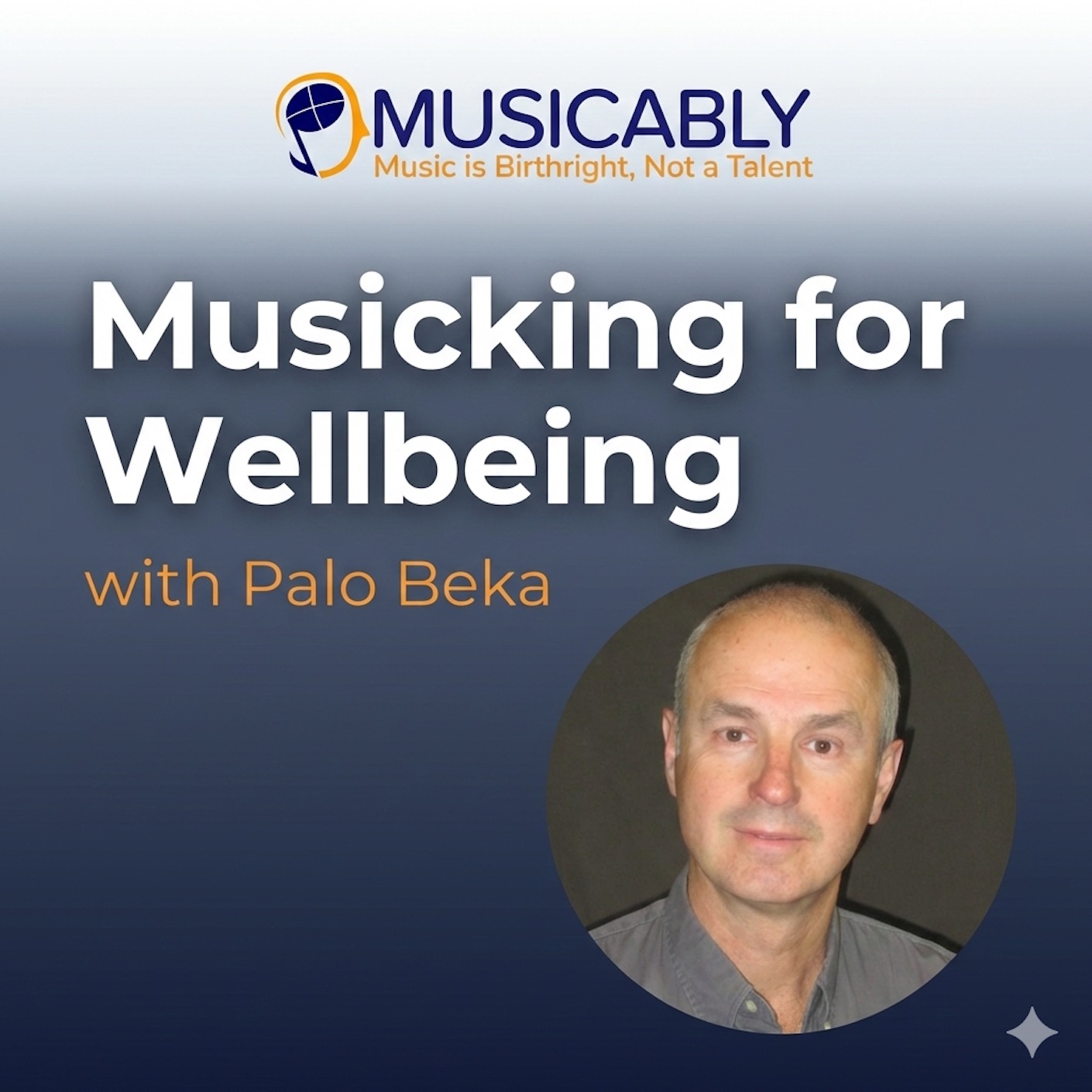
PODCAST · health
Musicking for Wellbeing
by Palo Beka | Musicably
On the Musicking for Wellbeing podcast, we reclaim your “sonic sovereignty” with simple, science-informed sound and music practices you can actually use in daily life.Drawing on a decade of research into somatic sound and the new 2026 wellness guidelines, I’ll help you move beyond passive playlists and into active musicking. Each week, you’ll learn how to use your own voice and simple rhythms to calm your nervous system, ease stress, and gently reshape your habits and brain over time.Whether you’re an overwhelmed professional or focused on active longevity, you’ll get practical, 10-minute “Sonic Resets” you can do at home—no musical background required. It’s time to stop just listening and start living Musicably.
-
9
I Have Been Saying This for Years. You Are a Musical Being (And Science Proves It)
Forget everything you know about "primitive" drums. In this episode, Palo Beka explores a major paradigm shift in musicology: the discovery that humans were communal singers and complex harmonizers long before we ever picked up a drumstick.Featuring the disruptive research of Steven Mithen, Joseph Jordania, and Victor Grauer, this episode explains why music is your original "operating system"—and why the silence was taught to you, but the sound was always there.
-
8
Music Harmony as the Operating System of the Western Civilization
Most people think of harmony as something that happens in music. This episode argues it happens in you — and has been shaping human brains for at least four thousand years.We trace the real history of Western musical harmony: past the 11th-century monks who get the official credit, back to the Babylonians who were tuning seven-note scales two millennia before Pythagoras, and forward into the neuroscience of tension and resolution that makes music a literal feelings engine.Along the way, we ask some bigger questions. Why does dissonance create a stress response in the body — and why does resolution trigger dopamine? How did the structure of polyphony provide a sonic blueprint for democracy? What does Equal Temperament have to do with the Industrial Revolution? And what actually happens to a nervous system that was wired for active music-making and then told to just sit and listen?This one covers a lot of ground. But it all comes back to the same place: your body, your voice, and the oldest lesson harmony has to teach — that tension is not the destination.
-
7
The Room That Sings Back
Why does your voice sound so much better in the bathroom?It's not your imagination — and it's not the bathroom. It's something far older.In this episode, Palo traces a single thread from two young women singing in a stairwell, through the neuroscience of reverb, all the way back to Paleolithic caves where our ancestors painted their walls in the most acoustically alive spots they could find. The instinct to seek out resonant spaces is at least fifty thousand years old. You carry it too.You'll learn what reverberant spaces actually do to your voice (hint: they reveal it, not improve it), why modern buildings have been quietly lying to you for decades, and how stone, tile, and even a parking garage can return something the music industry has spent a century trying to sell back to you artificially.Plus: a simple, practical exercise you can do today — no instrument, no training, no audience required.Musicably is for anyone who has ever felt music slip out of reach. New episodes every week.Music is your birthright.
-
6
The Breath of Melody_The Art of Whistling
Whistling is our most portable, intimate instrument. Join Palo Beka to explore how this "lost art" connects us to our past and our personal wellbeing.In this episode, we step away from the stage and the studio to focus on the simplest form of musicking: the human whistle. I share the story of my father—Ocko—who used whistling not just to fill the silence, but to share a "pure melody" that transcended words. It was a bridge between generations, and for many of us, it remains our first true experience of making music.Whistle with Me: I invite you to try the "2-Minute Whistle" exercise shared in this episode.Learn More: Visit Musicably.com for resources on active music-making for mental health.
-
5
Whose Name Is On Your Back?
A Toronto politician once proposed renaming a street after Taylor Swift. Swift is worth 1.6 billion dollars. She did not need the street. But the fans would have loved it — and that reaction tells us something important about what music fandom has quietly become.In this episode, Palo Beka takes a hard look at the difference between loving music and living it. Drawing on a provocative idea from the world of professional sports — that wearing another person's name on your back while calling their victories "ours" reveals something uncomfortable about how we've outsourced our identities — he asks whether music fans are doing exactly the same thing. The band t-shirt. The memorabilia. The playlist that defines your personality. The artist whose new album you say "we" released.None of it requires you to make a single sound.Palo traces how music shifted over four centuries from something humans did together into something they consume alone — and how the artists being worshipped have largely moved on to selling tequila, makeup, and chocolate bars, while the fans keep buying the jersey.But this episode doesn't end in cynicism. It ends with a question worth sitting with: what would it feel like to put your own name on your back? To stop borrowing someone else's musical identity and start building your own?If that question lands — this podcast exists for you.
-
4
Is 'Saving the Music' Actually Killing It?
Why $75 Million Can't Buy What Your Grandmother Had for FreeWhen Apple recently scaled up its partnership with the Save The Music Foundation, the headlines celebrated another win for music education. And the numbers are genuinely impressive — over $75 million invested in more than 2,800 school programs across underserved American communities, with a new $10 million endowment securing the future.But here is the question nobody is asking: if the goal is the transformative power of making music, why does the model consist almost entirely of buying things?In this episode, Palo explores the gap between what well-intentioned music philanthropy funds — instruments, technology, equipment — and what actually kept music alive in communities for generations. Drawing on the work of music educators and researchers, he examines how four pillars — family, faith community, school, and the texture of daily communal life — sustained participatory musical culture without a single grant application.He also asks the harder question: did we lose music because we lacked instruments, or because we lost permission? And what does it take — in the age of AI, streaming, social media, and professional perfectionism — to reclaim a musical life that was always ours to begin with?Throughout the episode you'll hear Palo play some of the simple, accessible instruments he talks about — not to perform, but to prove the point.Want to go deeper? Visit Musicably.com
-
3
My 10 Best Music Books of 2025
Every year I go back through the best music writing of the previous twelve months and choose the books that genuinely stayed with me. This year, ten titles stood out - and together they tell a surprisingly coherent story about where music is heading, and what that means for all of us.From Liz Pelly's devastating account of what Spotify has done to music, to Marc Duby's academic exploration of musicking as embodied action; from the social history of the human voice to the science of how we learn to hear - these books cover technology, tradition, wellbeing, and the oldest question in music: what is it actually for?I have grouped them into three clusters - warnings, understanding, and practice - and added one personal bonus that has nothing to do with scholarship, and everything to do with why music matters in the first place.The blog post on Musicably.com includes links to all books.Keep musicking.
-
2
Creativity Isn't a Gift. It's a Dare.
You've told yourself you're not creative. Maybe for years. This episode is here to prove you wrong — and to show you that the very thing you think disqualifies you from making music is actually your greatest advantage.In this companion episode to our latest blog post, we unpack what creativity actually is — not the divine gift we've been sold, but a simple, human, learnable dare. Drawing on composer Guy Michelmore's four-step creative framework and the Musicably philosophy of mindful musicking, we explore why beginners are often the most naturally creative people in the room, why nothing you make needs to be finished or good, and why the only thing standing between you and a genuinely creative life is one small, brave sound.Ready to take the dare?
-
1
The Reveal - The Musicking Pyramid
Music is a birthright, not a talent—and in this final episode of our “musical malnutrition” series, we flip the food pyramid upside down and apply it to sound. We explore the Musicking Pyramid: from the “protein” of communal singing and simple shared rhythms, through somatic self‑care with easy instruments, all the way down to passive streaming as a tiny bit of “auditory spice.” You’ll learn why your nervous system and social brain crave hands‑on musicking, and how to start weaving small, doable musical moments back into everyday life—no talent, theory, or performance anxiety required.
-
0
The “Shared Brain” and the Loneliness Cure
Why are we lonelier than ever despite having infinite music at our fingertips? The answer lies in something neuroscientists call "brain-to-brain coupling"—and it's the missing ingredient in your Spotify playlist.This week, we explore the Social Brain Hypothesis and discover why passive listening can't cure loneliness. We look at the groundbreaking hyperscanning research showing what happens when humans make music together (hint: your brainwaves literally synchronize). And we reveal why the modern music industry has created the largest service failure in human wellness history.The solution isn't more playlists. It's reclaiming your 60,000-year-old birthright.Next week: The Musicably Musicking Pyramid—your complete nutritional guide to musical health.
-
-1
The 60,000-Year-Old Secret in Your Throat
In this episode of Musicably, we travel from a Slovenian cave to the back of your own throat to ask a radical question: what if music isn’t a talent at all, but a 60,000‑year‑old survival technology wired into your body. Drawing on the Divje Babe Neanderthal flute, the tiny floating hyoid bone in your throat, and the FOXP2 gene, we explore why your voice and hands are biologically built for song and rhythm—not just for speech or scrolling. Along the way, we dismantle Steven Pinker’s “auditory cheesecake” idea, show why every known human culture has music, and introduce the thought that musical communication may be older than language itself.You’ll also get a simple piece of “homework”: a tiny, concrete act of musicking that reconnects you to the same vibrational behaviors your ancestors used tens or even hundreds of thousands of years ago. This episode is an invitation to drop the shame around “not being musical,” and to start reclaiming music as your birthright—not as performance, not as product, but as an ancient nervous‑system and social technology living in your own body.
-
-2
The Great Musical Malnutrition — Why Playlists Aren’t Enough
In this inaugural episode, Palo Beka introduces the concept of "The Great Musical Malnutrition." We live in an era of infinite access to music, yet we have never been more disconnected from its true power. Most of us have become "passive spectators" of sound—consuming "Sonic Sugars" that provide a temporary hit of dopamine but leave our nervous systems unregulated and our creativity dry.It's time to reclaim your Sonic Sovereignty.In this episode, you will learn:The fundamental difference between Listening and Musicking.Why modern "passive consumption" leads to musical malnutrition.How to identify "Sonic Sugars" in your daily life.A simple, 60-second Somatic Reset to ground your nervous system.Whether you are an overwhelmed professional seeking focus or simply looking to age with more vitality, this episode is your first step toward a more resonant life. Stop just listening to music. Start living Musicably.
We're indexing this podcast's transcripts for the first time — this can take a minute or two. We'll show results as soon as they're ready.
No matches for "" in this podcast's transcripts.
No topics indexed yet for this podcast.
Loading reviews...
ABOUT THIS SHOW
On the Musicking for Wellbeing podcast, we reclaim your “sonic sovereignty” with simple, science-informed sound and music practices you can actually use in daily life.Drawing on a decade of research into somatic sound and the new 2026 wellness guidelines, I’ll help you move beyond passive playlists and into active musicking. Each week, you’ll learn how to use your own voice and simple rhythms to calm your nervous system, ease stress, and gently reshape your habits and brain over time.Whether you’re an overwhelmed professional or focused on active longevity, you’ll get practical, 10-minute “Sonic Resets” you can do at home—no musical background required. It’s time to stop just listening and start living Musicably.
HOSTED BY
Palo Beka | Musicably
Loading similar podcasts...
Frequently Asked Questions
How many episodes does Musicking for Wellbeing have?
Musicking for Wellbeing currently has 12 episodes available on PodParley. New episodes are automatically indexed when they're published to the podcast feed.
What is Musicking for Wellbeing about?
On the Musicking for Wellbeing podcast, we reclaim your “sonic sovereignty” with simple, science-informed sound and music practices you can actually use in daily life.Drawing on a decade of research into somatic sound and the new 2026 wellness guidelines, I’ll help you move beyond passive playlists...
How often does Musicking for Wellbeing release new episodes?
Musicking for Wellbeing has 12 episodes. Check the episode list to see recent publication dates and frequency.
Where can I listen to Musicking for Wellbeing?
You can listen to Musicking for Wellbeing on PodParley by clicking any episode. We provide an embedded audio player for direct listening, and you can also subscribe via your preferred podcast app using the RSS feed.
Who hosts Musicking for Wellbeing?
Musicking for Wellbeing is created and hosted by Palo Beka | Musicably.
URL copied to clipboard!