
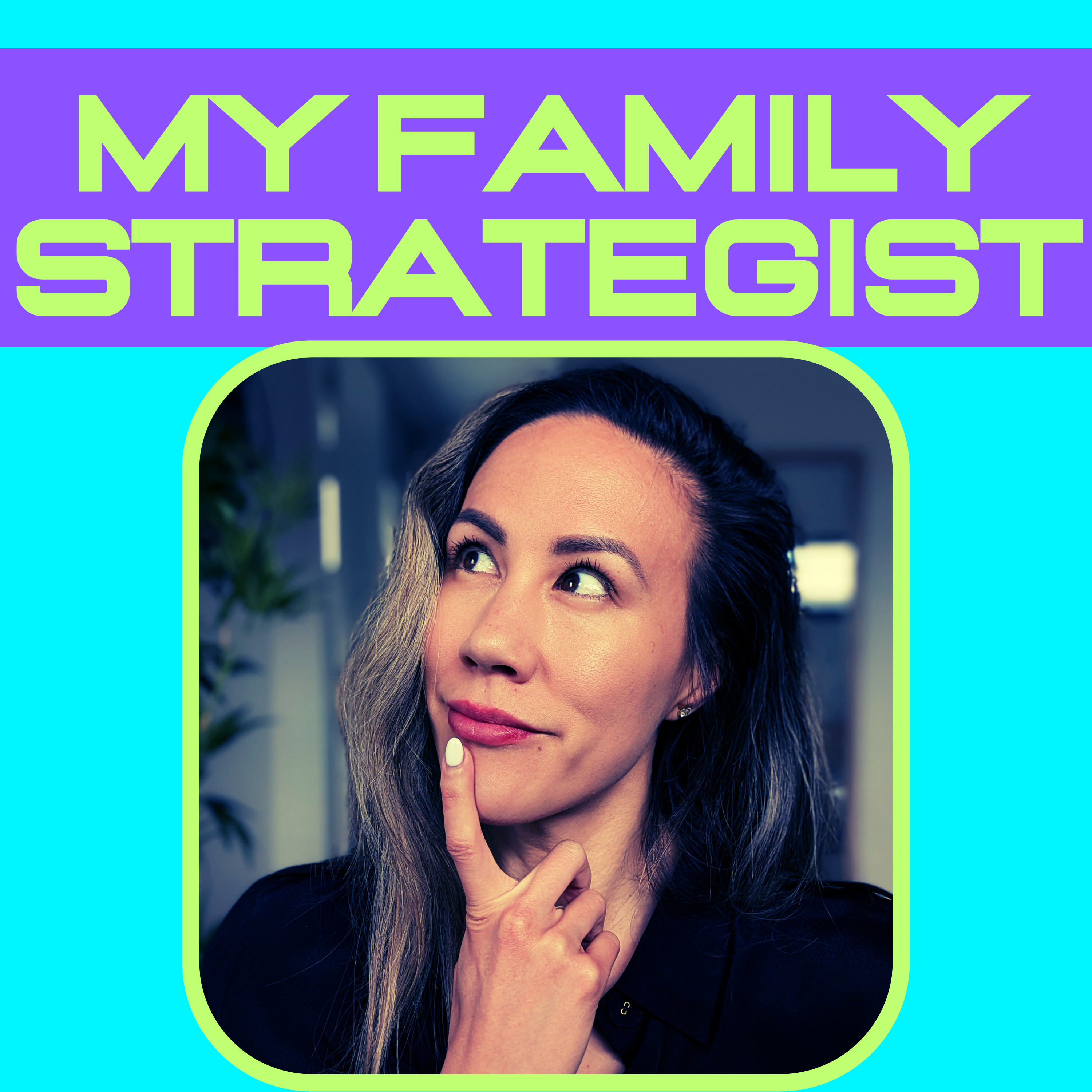
PODCAST · business
My Family Strategist
by Christina Spark
This podcast is where financial strategy meets the chaos of parenting. Many of us weren't taught personal finance from our own parents, yet we’re expected to navigate a complex, costly world while raising the next generation. Hosted by a former CPA and mother with 15 years of business experience, this podcast bridges the gap between the "Heart" and the "Balance Sheet." Whether you're deciding on a second child, a second mortgage, or a new career path, this podcast gives you the data and knowledge to stop deciding from a place of overwhelm and to start leading from a place of confidence
-
14
Double Income, But Still Broke? A Simple Budget for Families
Are you earning more than ever but feel like your bank account has a hole in the bottom? You aren’t alone. Even for households earning $200k+, lifestyle inflation and the "unconscious spending" of the 2026 economy can leave you living paycheck to paycheck.In this episode, Christina Spark (former Chartered Accountant and "Family COO") breaks down a simple Budgeting System. Learn how to set up a 5-account structure that automates your wealth, why it’s time to fire your credit cards and a step-by-step tutorial on using AI to categorize 12 months of expenses and save you money, in seconds. Strategy over stress starts here.00:00 – Why High Earners Feel Broke 01:21 – Disclaimer 01:40 – Budgeting is a Trade-Off, Not a Sacrifice 3:28 – The 50/30/20 Rule in the Current Economy 4:15 – Tip: Using AI to Categorise 12 Months of Expenses06:21 – Calculating Your Household Income06:43 – Acct # 1) Savings - Pay Yourself First07:43 – Acct #2) Needs 08:22 – Is Mortgage Savings or an Expense? 09:55 – Acct #3) Wants 10:28 – Acct # 4 & 5) - Your Struggle Accounts 13:34 – Breaking the Habit of Impulse Spending15:19 – Why Credit Card Points are Actually Costing You 16:27 – US vs. Australia: The Credit Score Myth 17:29 – Bridging the Gap to a Gold Standard Budget 19:33 –It’s Not What You Make, It’s What You KeepDisclaimer: The information provided in this podcast is for general education and entertainment purposes only, and does not constitute financial tax or legal advice. While I am a former Chartered Accountant, I am not your accountant and I do not know your specific financial situation. You should always consult with a licensed financial advisor or professional before making any significant financial decisions. Connect with Christina: myfamilystrategist.com
-
13
Why I'm "One and Done": What No One Tells You
I think being "One & Done" is a very misunderstood decision. It isn’t about being selfish; it’s about a purposeful allocation of my time, mental health, marriage, and our financial freedom. The decision to have another child is often led by emotion or social pressure without a real look at the facts. In this episode, I’m peeling back the curtain on why my husband and I decided to be "One and Done"—and why it was a strategic choice to help our family thrive, not just survive.I’m sharing the five data-backed reasons why we are standing firm in this decision, including a deep dive into the "Big 5" structural financial changes that many parents overlook. I also walk you through the Ann Davidman's framework of separating "Desire" from "Decision," and how understanding the Focusing Illusion helped me stop daydreaming about the "fantasy" of a larger family and start focusing on the reality of the child right in front of me.If you’ve ever felt stuck in a pros-and-cons list regarding your family size, this episode will give you the strategist’s playbook to find clarity.Episode Chapters00:00 - The Most Misunderstood Decision 00:56 - The Desire vs. Decision Framework03:56 - Disclaimer04:35 - Debunking the Sibling Myth 05:56 - Prioritising a Mentally Well Parent 07:03 - Reinvesting Time into Marriage and Family 08:29 - Financial Freedom & The "Big 5" Costs11:17 - Accelerating Retirement by 15 years13:06 - Managing the Downsides 14:17 - “Focusing Illusion”: a Happiness Paradox17:05 - Fear of Future Regret🛑 IMPORTANT DISCLAIMER: While I am a former Chartered Accountant, the math I’m sharing today is based on general data and my own family's risk assessment. Every family portfolio is unique. This is not formal financial advice; it is a framework to help you do your own due diligence. Always consult your own licensed advisor before making major financial moves.
-
12
How I Save 10 Hours a Week: 5 Lessons from a Google Career
Why is it that we can manage 20-person teams and million-dollar budgets at work, but fall apart when our toddler misses a nap? In this episode, I’m revealing how I moved from just reacting to the daily juggle of parenting to finding a sense of calm and clarity by applying the high-level strategies I learned during my decade-long career at Google to my home life.These are the exact frameworks I use that save me over 10 hours every single week. I'm breaking down the exact systems I use from Parenting Modes to AI as your Executive Assistant, to the “Yes, And” Negotiation Tool.If you feel like you’re constantly "on" but never productive, this episode is your manual for reclaiming 10 hours of your week.Episode Summary0:00 – How to Buy Back 10 Hours This Week 0:53 – Disclaimer 1:08 – Strategy 1: High-Performance Parenting Modes 2:56 – The "Do One Thing Well" Rule 3:46 – Why Multitasking is a Myth 5:05 – Transition Rituals: Closing the "Work Tabs" 6:53 – Strategy 2: Automation & Decision Autopilot 8:22 – Using AI to Clear the "Mental Load" 11:14 – Strategy 3: Delegation 12:33 – Why We Outsource Cooking 15:24 – Fair Play: Ending Household Resentment16:48 – Strategy 4: The 80/20 Rule 18:12 – The "Good Enough" Science (Donald Winnicott) 18:33 – Strategy 5: Boundary Setting20:23 – The "Yes, And" Negotiation Hack 22:07 – Recap: Your Weekly Time Audit 26:26 – Final Takeaway: Building a Sustainable SystemResources Mentioned: Fair Play Deck: The system we use to split the "mental load" cards.Google Gemini: My go-to tool for life admin Connect with Christina: myfamilystrategist.comDisclaimer:The frameworks shared are based on personal experience and a professional background in strategy and accounting. This content is for educational purposes and does not constitute professional financial, legal, or medical advice. Please consult your own advisors for your specific family needs.
-
11
The 4% Rule: How to "Retire" Early with Simple Math
Are you counting down the days to a retirement that's 30 years away? In this episode, I’m breaking down the "Micro-Retirement" strategy that allowed me to exit the $500k corporate grind at age 39.In 2026, 70% of Australians are reaching burnout, and 91% of parents feel they aren't spending enough quality time with their kids. We’ve been sold a 19th-century myth that we have to wait until 65 to rest. But the math says otherwise.[What You'll Learn] In this deep dive, I explain:The Scam: Why the retirement age of 65 was actually a 19th-century political bribe.The 4% Rule & 25x Multiple: How to calculate your "Safety Floor" and your personal Freedom Number.The Passion Accelerator: How a $40k "passion job" can delete $1M from your retirement target.Geographic Arbitrage: How selling a $2.5M city home can fund your entire life tax-free.The Private School Trade-off: Is a school crest worth 10 years of your freedom?AI for Planning: How to use Gemini for Monte Carlo simulations and spending audits.Episode Summary00:00 Are you part of the 70% Burnout Crisis? 00:48 Inside the Episode 01:36 Disclaimer01:54 Why Retirement at 65 is a Myth 02:56 What is FIRE? (And Why it’s Different for Parents) 04:18 Micro-Retirement vs. The Traditional Sabbatical 04:57 Defining Freedom: It’s Not About Never Working Again 05:40 My $500k Job Exit: The Point of Diminishing Returns 09:16 The 4% Golden Rule 11:06 The 25X Freedom Number 13:47 Recap: When Can I Retire? 14:27 How a $40k Job Deletes $1M in Savings 16:44 Lifestyle Tradeoffs16:56 Geographic Arbitrage (The $1M Equity Unlock)18:49 The Private School "Tax" & Building Resilient Kids 21:01 Why We Spend to Survive the Grind 22:23 Practical Tips for Retirement (Tax Hacks, Mortgages, and Negative Gearing)23:42 The Mortgage Debate: Paying it Off vs. Investing for Risk 25:42 AI as Your Personal Financial Analyst 26:31 Taking Your First Step Toward Freedom[Resources & Links]All Episode: myfamilystrategist.comEpisodes Mentioned in this Deep Dive: 📊 Is Your Family Financially Healthy? How to Track Your Net Worth (S1E2)🎓 Is Australian Private School a Million Dollar Mistake (S1E3)💼 I Quit My $500K Corporate Job After Learning 5 Things (S1E6)DISCLAIMERThe information provided in this podcast and on the My Family Strategist website is for general information purposes only. It does not constitute personal financial, taxation, or legal advice. While Christina Spark is a former Chartered Accountant, she is not your personal accountant or financial adviser. This content has been prepared without taking into account your individual objectives, financial situation, or needs. Before acting on any information from this episode, you should consider its appropriateness to your circumstances and seek independent advice from a qualified professional (such as a licensed financial planner or tax agent).
-
10
Investing 101: 0 to Investor in 15 Minutes (A Busy Mum’s Guide)
Why do so many smart, capable women completely outsource their family’s financial future to their partners? If you’ve ever felt "behind" with money, intimidated by the stock market, or overwhelmed by investing jargon, this episode is for you.As a former Chartered Accountant, Corporate Strategist and Mum, I am going to break down the exact steps to go from $0 to investor in just 15 minutes. We are stripping away the complex finance speak and replacing it with actionable strategies designed for busy, high-earning power couples and parents (specifically time poor mums) who want to build serious generational wealth.Whether you are looking to understand how ETFs actually work, want to leverage your mortgage offset account, or need to know how to claim your Superannuation "catch-up" credits after a career break, this 20 min episode is packed with strategies to help you and your partner become a true financial power couple. Episode Chapters00:00 — "My Partner Handles It": Breaking the Investing Taboo0:59 — What You'll Learn: The 15-Minute Investor Blueprint1:50 — Disclaimer2:08 — How to Have a Better Marriage, Greater Wealth & Higher Confidence4:19 — What are Stocks, Dividends, ETFs & Index Funds? (Explained Simply)7:57 — How to Start Investing Today (CommSec Pocket & Pearler)10:16 — Saving vs. Investing: The Offset Account Strategy13:18 — Superannuation Catch-Ups: Your Ultimate Wealth Builder15:56 — Good Debt vs Bad Debt: Should You Invest or Pay it Off17:00 — Where Should My Money go First? (Prioritising Debt, Super & ETFs) 18:12 — The "Me, You, Us" Model for Power Couples19:35 — Next Steps for Your Family Strategy💡 Disclaimer: Christina Spark is a former Chartered Accountant and corporate strategist, but she is not your personal financial advisor. This content is for educational and entertainment purposes only. Finance is deeply personal, so please do your own research or speak to a licensed professional before making any major moves with your money.🔗 Resources Mentioned:Official Hub: https://myfamilystrategist.comCommSec Pocket & Pearler: Beginner-friendly micro-investing apps in AustraliaATO via myGov: Log in here to check your Superannuation carry-forward contribution limits.💡 Disclaimer: Christina Spark is a former Chartered Accountant and corporate strategist, but she is not your personal financial advisor. This content is for educational and entertainment purposes only. Finance is deeply personal, so please do your own research or speak to a licensed professional before making any major moves with your money.
-
9
The True Cost of a Baby in Sydney
Feel Broke? It’s Because You’re a Parent. Most Google searches will tell you a baby costs $10,000 in their first year. They are wrong. In this episode, I perform a full financial audit on the first year of my own son’s life in Sydney, Australia. Moving past the "stuff" like prams and onesies, I dive into the massive structural changes that result when you become a parent: lost wages, housing upgrades, "motherhood penalty" on superannuation, childcare and more.75% of Parents admit that having children is significantly more expensive than they originally budgeted for and 37% confessed they had no idea what the actual cost would be before they started. 45-50% of Working Parents report that they find it "unaffordable" to have children in the current economic climate.Whether you are family planning or already in the thick of it, this episode provides a realistic 2026 roadmap for family finances and how to best prepare for the big financial & structural changes that happen when you become a parent. Episode Chapters(00:00) The $200K "Hidden” Price Tag of Parenthood (03:50) Disclaimer (04:15) Conception: The Financial Reality of Fertility Issues(06:23) Pregnancy & Birth: Breaking down Private vs. Public Birth Costs(07:10) Prenatal Classes, Physio, Mental Health, Maternity Essentials & Baby Shower(09:05) My $10,300 Baby Registry(10:10) The Big Three: Car Upgrades, Housing, and Lost Wages(12:10) Building a Village: The Cost of Postpartum Support (14:23) Where I Saved Money as a New Parent(15:09) Beyond Year 1: Childcare, Education & Lost Super(18:09) Final Takeaways & Tips (21:14) Spending Unapologetically on What Matters
-
8
How to Invest for your Kids (Without the Entitlement)
How can you give your kids a financial headstart, without spoiling them? The idea of a handout is uncomfortable, but past generations in Australia got plenty of handouts - university was free in the 70s & 80s, you could buy a home for 3x your salary (now it's 12-15x). In an AI driven economy that will massively disrupt the workforce, our kids will most likely have an even steeper climb than we had. Investing for your kids is one of the most powerful things you can do to remove that structural handicap and give them a fair start at life. Today, I’m breaking down the 'Family Strategist' playbook for my own son. In this episode, I’m comparing the 6 biggest investment strategies for kids—from Family Trusts to Education Bonds—and why we chose an Investment bond for our own son as the smartest strategy. I'm also sharing my personal philosophy around inheritance and raising kids that are not entitled.EPISODE CHAPTERS(00:00) 1980 vs. 2040: Why the Rules have Changed (01:44) Disclaimer (02:17) 4 Traditional Investing Strategies: Pros & Cons (03:47) The 66% "Minor Tax Trap" Explained (04:56) Why we Discredited Family Trusts (05:39) What's an Investment Bond? (06:44) The 125% Rule: Don't Reset Your Clock (07:15) Investment Bond Benefits (Tax Arbitrage, Low Effort & Control) (11:07) Drawbacks of the Investment Bond (13:12) Summary Investment Strategy (13:43) Getting Started with the Investment Bond (14:17) Education Bonds: Is the Rebate Worth the Effort? (16:07) Downsides of the Education Bond (17:20) The $50k Superannuation Hack (FHSSS) (19:20) Downsides to Child’s Super (20:25) My Personal Investment Strategy for my Own Child (22:13) Raising "Grounded" Kids in a Wealthy Home (27:16) The Matching Principle: Building Grit, Not Entitlement (28:46) Future-Proofing Your Kids Against AIDISCLAIMERThe information in this episode is for general information and education purposes only. It does not constitute personal financial, legal, or tax advice. I am a former Chartered Accountant, but I am not your accountant and not a licensed financial advisor. Please seek independent professional advice before making financial decisions.
-
7
I Quit My $500K Corporate Job After Learning 5 Things
EPISODE SUMMARYI walked away from a compensation package of well over $500K per year. There was so much financial pressure to stay in my job, I had a mortgage, I had just had a child. Some people thought it was brave. A lot of people thought it was crazy, but it was not a rash decision. It was such a well-informed, intentional one based on 5 life lessons that I'm sharing in this podcast.In this episode, I’m pulling back the curtain on why "Golden Handcuffs" are a trap for modern parents and how to know when money has stopped delivering on its core promise: improving your life. This isn't just about quitting a job; it’s about a total reallocation of capital (time, energy, and money) to build a family unit that actually thrives.If you’ve ever felt "trapped" by a high salary or wondered how to bridge the gap between career ambition and being the parent you want to be, this episode is for you.EPISODE CHAPTERS:(00:00) Walking Away from a $500k Package(01:24) The Golden Handcuffs: Why Gold Doesn't Equal Freedom(03:09) The Opportunity Cost of "Having it All(05:25) The MRI That Changed Everything: A Lesson in Urgency(06:44) 5 Regrets of the Dying (and how to avoid them)(07:41) Redefining “Success” (10:44) Why Quitting isn't Permanent: Type 1 vs. Type 2 Decisions(11:48) The "Safe Exit" Blueprint: A Financial Strategy to Quit(14:20) Lessons from 6 Months of "Freedom"DISCLAIMER:This podcast is for educational and entertainment purposes only. I am sharing my personal journey and financial strategy as a former Chartered Accountant, but this does not constitute personal financial, legal, or tax advice. Every family's situation is unique. Please consult with a qualified professional before making significant financial decisions or career changes.
-
6
Nanny, Daycare, or Au Pair? Australian Childcare in 2026
EVERY CHILDCARE MODEL, HIDDEN COSTS & STRATEGYChildcare is the biggest expense for most Australian families, but very few people understand the true ROI of each model. In this episode, I’m breaking down every major childcare model—from daycares, nannies, au pairs, community preschools, and even the stay-at-home-parent path—to reveal the true 'Total Cost' for each. We aren't just looking at the sticker price; we’re diving into the hidden costs you haven't considered yet, like the fact that you might legally be on the hook for your nanny's superannuation.I’ll also explain how the 2026 Child Care Subsidy reforms have changed the game, and saving parents thousands of dollars. Whether you're a high-income earner facing the $535k subsidy cliff or a parent trying to avoid the "Daycare Germ Factory" during the newborn phase, this episode gives you the framework to choose the right model for your wallet and your mental health.HELPFUL LINKS:Official CCS Calculator Start Strong EPISODE CHAPTERS:(00:00) The High Stakes of Childcare Decisions (01:00) Disclaimer (01:17) Daycare: The Full Service Model (02:00) Hidden Costs of Daycare (02:20) 2026 CCS: The New 3-Day Guarantee (03:00) The $535k Cliff: Are You Eligible? (03:40) What Counts as Income? (It's more than your salary!) (05:00) Sibling Bonus: Unlocking 95% Subsidy (05:40) NSW Start Strong: How to Save $4K (06:40) Daycare Wins & Tradeoffs: High Convenience vs. High Stimulation(07:40) Community Preschool: The School Prep Model (09:00) Preschool Wins & Tradeoffs: Top Tier Education vs. Short Day Limits(09:40) Hidden Costs of Preschool (10:40) Nannies: One-on-One Support(11:20) Hidden Costs of Nannies (13:00) Nanny Wins & Tradeoffs: Custom Care vs. Premium Cost(13:40) Au Pairs: Live-In Help (14:20) Hidden Costs of Au Pairs (15:20) Au Pair Wins & Tradeoffs: Extra Hands vs. Extra Housemate(16:20) Stay at Home Parenting: Should I Quit My Job? (17:40) The Motherhood Penalty (18:40) Stay-at-Home Wins & Tradeoffs: Full Control vs. Full Schedule(19:40) The Strategist’s Final Verdict (27:20) BONUS Q&ADISCLAIMER:The information in this episode is for general educational and entertainment purposes only. It does not take into account your personal objectives, financial situation, or specific needs. While I am a former accountant, I am not your accountant.Please seek independent professional advice from a licensed financial advisor or a tax agent before making any decisions based on the content of the show.
-
5
Rent vs. Buy Australia: Does Your Family Actually Need to Own?
WE NEED MORE SPACE 😳 It’s the phrase every parent says right before making a massive financial commitment—but is buying a home actually the best move for your family right now?In this episode, I’m breaking down the Rent vs. Buy Debate through the lens of wealth, time, and family joy. As a former Accountant who has been on all three sides of this (I’ve rented, I’ve owned, and I’m a landlord), I’ve seen exactly how homeownership can transform your financial future. However, there are also significant risks to buying, especially for growing families.Don’t believe the blanket advice that "renting is dead money" or that buying is always better. The right choice depends entirely on your location, your financial situation, and your current phase of life.Whether you are navigating the high-stakes Sydney market like I am, or looking at housing globally, this episode provides the strategic framework you need to make a confident decision for your family’s future.EPISODE SUMMARY:The 5 Major Benefits of Homeownership (and how they build wealth).The 5 Strategic Advantages of Renting (including a few hacks most people ignore).A 5-Question Framework to help you decide what is truly the smartest move for your family today.EPISODE CHAPTERS:00:00 Introduction 0:31 Episode Overview1:56 Disclaimer2:20 🏠The 5 Main Benefits of Home Ownership2:48 #1) The Appreciation Advantage4:12 #2) Forced Savings Equity4:31 #3) The Power of Leverage5:18 #4) Tax-Free Capital Gains6:17 #5) Family Joy & Stability7:21 🔑 The 5 Main Benefits of Renting7:50 #1) Lifestyle & School Flexibility9:34 #2) Less Problems (The Maintenance Time-Tax)10:44 #3) Purchasing Power & Cash Flow11:03 ❗The Biggest Mistake Renters Make12:21 #4) Shielded from Economic Downturns14:03 #5) No High Upfront Taxes (Stamp Duty)15:18 🧠Questions to Ask Yourself Before You Buy15:45 Q1: Can I afford this now and in the future?16:08 Q2: Do I have a 12-month mortgage buffer?16:40 Q3: Do we have the additional time and money?17:09 Q4: Do we plan to live here for ~10 years?17:45 Q5: Do I have the financial discipline to save?18:07 Q6: Flexibility or Stability?18:37 Q7: What is our primary financial goal?19:06 ✨ Final Takeaways⚠️DISCLAIMER:This content is for educational and entertainment purposes only and does not constitute personalised financial, tax, or legal advice. Examples are based on my personal experience and Australian market conditions, which vary by state and change over time. Past performance is not a guarantee of future results. Always consult with a licensed professional before making significant financial decisions.
-
4
Is Your Family Financially Healthy? How to Track Your Net Worth
EPISODE SUMMARY:How much do you spend per month? How much debt do you still have to pay off? If you own your home, how much equity is in it? Do you roughly know when you can retire? Most people have absolutely no idea the answer to any of these questions, but I do. And the reason is because I have built my family's financial scorecard and it was one of the best, things I have ever done for my family to ensure that we are set up for the future. And guess what? It only took me about an hour. In this Episode, I break down the exact "Financial Scorecard" I use (as a former Chartered Accountant) to manage my own family’s financial portfolio. Forget tracking every latte; we’re diving into the 20,000-foot view of your assets, your debts, and the ratios that actually matter to banks. Whether you’re underwater with a new mortgage or ready to start investing, the 60-minute "Financial Scorecard" will give you the clarity you’ve been craving.EPISODE CHAPTERS:00:00 4 Questions to Test Your Financial Health00:51 My Journey from Corporate Strategist to Mum01:16 Why This Topic Feels Scary03:04 Why I Don't Budget03:57 Disclaimer04:22 Part 1: How to Build Your Family Balance Sheet05:19 Assets: Tracking What You Own06:50 Debts: Listing Who You Owe07:17 Is Your Net Worth Growing?08:02 The Debt-to-Equity Ratio: Your Risk Report Card09:18 Credit Cards: Why Minimum Payments Are a Trap12:02 Part 2: How to Build Your Family Income Statement15:17 AI Hack: Categorise 6 Months of Bills in 2 Minutes16:35 The 50/30/20 Rule and Paying Yourself First19:59 The Safety Net: Building Your 6-Month Buffer21:43 How to Increase Your Income23:10 Your Money Date: How to Take Action TogetherDISCLAIMERThis podcast is for educational and entertainment purposes only and should not be taken as professional financial, legal, or tax advice. Every family's situation is unique; please consult with a qualified professional before making major financial decisions.
-
3
Is Australian Private School a Million Dollar Mistake?
IS PRIVATE SCHOOL ACTUALLY WORTH IT? (A CPA'S HONEST ANALYSIS)As a former Accountant and mum, I'm analysing the financial trade-offs of a private vs public school education to determine if private school is actually worth it. We'll explore the the significant opportunity cost involved when choosing between elite schooling and investment for child education; as well as dive into what the research actually says. While we are using Sydney, Australia as our primary case study, this math is a "wake-up call" for any major global market where the cost of elite schooling is skyrocketing. Whether you are in London, New York, Hong Kong, Singapore, or Dubai, the principles of compounding and opportunity cost remain the same.This video provides crucial financial planning for parents, showing you how to balance educational aspirations with long-term wealth building for your family's future.EPISODE CHAPTERS:(00:00) From CPA to Parent: Why I'm doing the math(00:27) My personal story: The pregnancy "school panic"(02:08) Episode Overview(03:55) Important Disclaimer(04:17) The true sticker price of Private School(04:37) Watch out for the "Hidden Costs"(06:45) Understanding Opportunity Cost(07:14) Scenario A: Investing the "Average" tuition(08:01) Scenario B: The "Elite" school investment trap(09:18) What does the research actually say?(11:44) Meritocracy vs. The "Old Boys" network(13:17) My conclusion: Is it actually worth it?(13:39) The "Best of Both Worlds" financial strategy(15:30) Final reflections on the two-tier systemDISCLAIMERGeneral info only. The figures and scenarios presented in this video are based on historical averages and hypothetical calculations for illustrative purposes only. Past performance is not a reliable indicator of future results. While I am a former CPA, I am not your financial adviser. You should consider whether the information is appropriate for your circumstances and seek independent professional advice regarding your specific financial situation.Does not consider your personal circumstances. Consult a licensed adviser before making investment decisions.
-
2
Welcome to the My Family Strategist Podcast!
BRINGING SMART FINANCIAL STRATEGY TO THE CHAOS OF PARENTINGI’m your host, Christina Spark. As a former Chartered Accountant with a Master’s in Professional Accounting, I know numbers—but as a mum, I know the reality of being time-poor and overwhelmed. I’m here to help you navigate the skyrocketing costs of childcare and housing while reclaiming your time.Each week, I’ll help you answer questions like:Is private school actually worth the cost?Should I buy or rent my family home?How do I build a meaningful $$ nest egg for my children?Subscribe now and let me do the boring research for you, so we can make your family richer in your bank account and in life.
No matches for "" in this podcast's transcripts.
No topics indexed yet for this podcast.
Loading reviews...
ABOUT THIS SHOW
This podcast is where financial strategy meets the chaos of parenting. Many of us weren't taught personal finance from our own parents, yet we’re expected to navigate a complex, costly world while raising the next generation. Hosted by a former CPA and mother with 15 years of business experience, this podcast bridges the gap between the "Heart" and the "Balance Sheet." Whether you're deciding on a second child, a second mortgage, or a new career path, this podcast gives you the data and knowledge to stop deciding from a place of overwhelm and to start leading from a place of confidence
HOSTED BY
Christina Spark
Loading similar podcasts...
URL copied to clipboard!