
PODCAST · health
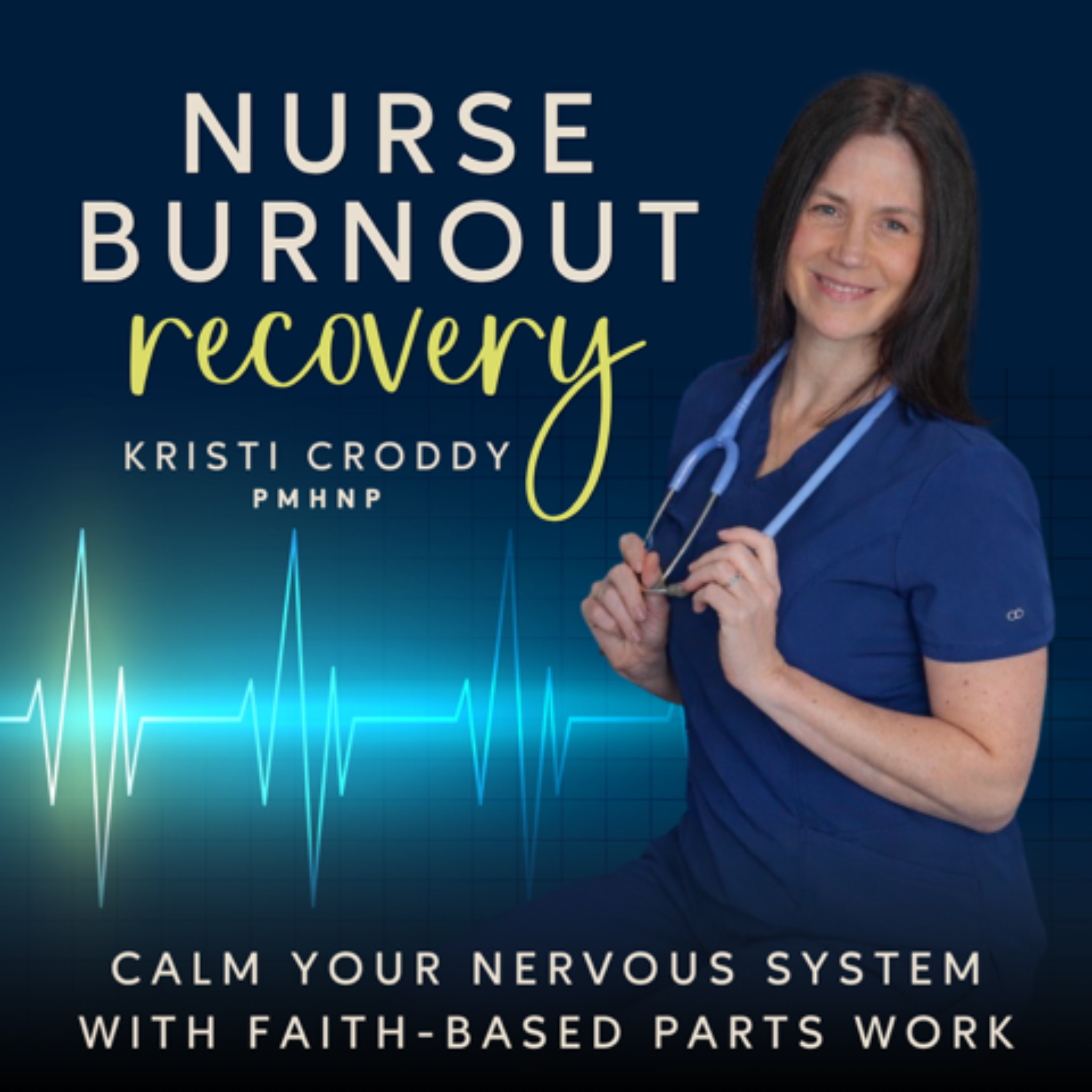
Nurse Burnout Recovery | Burnout, Stress, Trauma, Nervous System, Boundaries
by Kristinacroddy
A podcast for nurses and caregivers ready to recover from burnout, stress, and emotional exhaustion. Hosted by Kristi Croddy, ER nurse and Mental Health Nurse Practitioner, you’ll learn how to heal burnout regulate your nervous system, and finally feel like yourself again. Using a blend of Internal Family Systems, somatic work and faith-based tools, each episode gives you practical strategies to reduce stress, set boundaries, and restore peace--without leaving the career you once loved.
-
10
10. The 3-Part Cycle that Keeps Caregivers Stuck in Burnout (And How to Interrupt it)
Have you ever driven home from a 12-hour shift with your nervous system still on high alert… too wired to sleep — and then spent your day off completely depleted on the couch? That’s not weakness. That’s the burnout cycle — and it’s one that many caregivers and nurses are stuck in without realizing it. In today’s episode, I break down the three-phase burnout cycle that keeps high-performing nurses trapped in chronic stress and trauma: the Activation Phase, the Suppression Phase, and the Collapse Phase. When you understand how your nervous system is moving through this loop, you can finally stop blaming yourself — and start interrupting the pattern. Because burnout isn’t about lack of resilience. It’s about a nervous system that has been overloaded for too long without recovery, without support, and often without clear boundaries. In the second half of this episode, we walk through exactly how to begin healing — using my three pillars: Internal Family Systems (IFS), somatic nervous system regulation, and faith-based restoration. I’ll give you three concrete tools you can use immediately to reduce stress, process trauma, and begin stepping out of burnout. If you’ve been stuck in the cycle of pushing through at work… collapsing at home… and wondering why you can’t sustain it anymore — this episode is for you. IN THIS EPISODE ◆ Why burnout in nurses and caregivers is not a personal failure — and what current CDC data reveals about rising stress and trauma in healthcare ◆ The three-phase burnout cycle and how your nervous system moves through activation, suppression, and collapse ◆ What hypervigilance in trauma actually looks like in high-functioning nurses (and why it often looks like competence) ◆ How IFS protector and firefighter parts keep burnout cycles and stress patterns running ◆ What’s happening in your nervous system and body during each phase — from HPA axis activation to dorsal vagal shutdown ◆ The role of boundaries in preventing burnout — and why many caregivers struggle to maintain them ◆ The Elijah pattern: why God responds to burnout and collapse with rest and care, not correction ◆ Three immediate tools to regulate your nervous system, reduce stress, and interrupt the trauma cycle ◆ Why lament prayer may be one of the most powerful practices for healing burnout and emotional exhaustion EPISODE BREAKDOWN ◆ 0:00 – 4:30 Intro — Burnout, stress, and trauma are part of a cycle, not a character flaw ◆ 4:30 – 11:00 Phase 1: Activation — When your nervous system won’t turn off ◆ 11:00 – 19:30 Phase 2: Suppression — Functioning through stress without processing trauma ◆ 19:30 – 25:00 Phase 3: Collapse — Nervous system shutdown and burnout exhaustion ◆ 25:00 – 30:00 Interruption Tools — How to regulate your nervous system and rebuild boundaries SCRIPTURE REFERENCED “Come to me, all you who are weary and burdened, and I will give you rest.” — Matthew 11:28 (NIV) “Trust in him at all times, you people; pour out your hearts to him, for God is our refuge.” — Psalm 62:8 (NIV) “He came to a broom bush, sat down under it and prayed that he might die… Then he lay down… and an angel touched him and said, ‘Get up and eat.’” — 1 Kings 19:4–5 (NIV) “How long, Lord? Will you forget me forever? … How long must I wrestle with my thoughts?” — Psalm 13:1–2 (NIV) RESEARCH CITED CDC (2023) — Health Worker Mental Health Decline Nurses experienced greater increases in burnout, stress, and poor mental health than any other profession from 2018–2022 Frontiers in Public Health — Secondary Traumatic Stress in Nurses 91.2% of nurses reported exposure to traumatic events; 25.3% met criteria for secondary traumatic stress Hodgdon et al. (2022) — IFS Therapy for PTSD IFS significantly reduces trauma symptoms, emotional dysregulation, and improves self-compassion Buys (2025) — IFS Research Review IFS validated as an evidence-based approach for stress, trauma, depression, and nervous system healing Ge et al. (2023) — Global Nursing Burnout Meta-Analysis Burnout and emotional exhaustion remain the strongest predictors of nurses leaving the profession Balban et al. (2023) — Physiological Sigh Study Double inhale + extended exhale produced the fastest reduction in nervous system stress Mindfulness & Burnout Study (2025) Significant reductions in burnout and stress, with 10% of nurses no longer meeting burnout criteria post-intervention Work with Kristi 1:1** If you’re ready to go deeper — to understand your system, regulate your nervous system, and heal the patterns keeping you stuck in burnout — I currently have openings for one-on-one coaching. → Work with me 1:1 **Join the Nurse Burnout Recovery Course Waitlist/Email list** The course walks you step-by-step through the nervous system work, the parts work, the identity work, and the faith integration — all designed specifically for nurses. Waitlist members get a **free post-shift recovery audio** and **early access** when doors open. Join the email and nurse burnout recovery course waitlist Disclaimer: This podcast is for educational purposes only and is not a substitute for medical or mental health care. Please seek support from a licensed professional for your individual needs.
-
9
9. The Unprotected Caregiver: Why your Nervous System Never Gets a Break
If you've ever clocked out and still felt completely "on" — jaw tight, brain still running triage, body too wired to rest — this episode is the one. Kristi Croddy, ER nurse and psychiatric nurse practitioner, breaks down exactly what chronic activation does to your nervous system, your brain, and your soul. Using her three-pillar framework of IFS parts work, somatic body awareness, and Christian faith, she walks through the neuroscience of nurse burnout, the reality of secondary traumatic stress, and three concrete tools you can use this week. This one goes deep. Come ready. Research Referenced: ◆ MDPI Chronobiology Review, 2025 — Burnout, Circadian Rhythm & HPA Axis Dysregulation in Healthcare Professionals ◆ Journal of Clinical Medicine, 2025 — Cortisol, Insomnia & Stress in Emergency Department Nurses (University of Pécs) ◆ University of Arizona DNP Research, 2024 — Burnout, Prefrontal Cortex Suppression & Breathwork Interventions ◆ European Journal of Psychotraumatology, 2024 — Xu et al. — Secondary Traumatic Stress in Emergency Nurses: Systematic Review & Meta-Analysis ◆ APA Psychological Trauma Journal, 2024 — Comeau et al. — Group-Based IFS/PARTS Intervention for PTSD (Cambridge Health Alliance / Harvard) ◆ American Journal of Medicine, 2024 — Ring et al. — Integrative Approaches to HPA Axis Dysfunction; Bio-Psycho-Social-Spiritual Model Work with Kristi 1:1** If you’re ready to go deeper — to understand your system, regulate your nervous system, and heal the patterns keeping you stuck in burnout — I currently have openings for one-on-one coaching. → Work with me 1:1 **Join the Nurse Burnout Recovery Course Waitlist/Email list** The course walks you step-by-step through the nervous system work, the parts work, the identity work, and the faith integration — all designed specifically for nurses. Waitlist members get a **free post-shift recovery audio** and **early access** when doors open. Join the email and nurse burnout recovery course waitlist Disclaimer: This podcast is for educational purposes only and is not a substitute for medical or mental health care. Please seek support from a licensed professional for your individual needs.
-
8
8. Why Caring So Much is Quietly Rewiring Your Nervous System and What You Need to Start doing Today
Most nurses don't recognize they have secondary traumatic stress — because it progresses so slowly they've already normalized it by the time it becomes a crisis. In this episode, Kristi Croddy applies Dr. Karen Foli's Middle-Range Theory of Nurses' Psychological Trauma to trace the four stages of the silent STS progression — from the Absorbed Shift through the Crisis Point — and explores what healing looks like through IFS parts work, somatic nervous system practices, and Christian faith. This episode is for the nurse who has stopped asking what's wrong with her, because this has just become who she is. IN THIS EPISODE: ◆ Karen Foli's Middle-Range Theory of Nurses' Psychological Trauma — and the concept of nurse-specific trauma ◆ How the expectations gap (unmet and unrealistic expectations vs. reality) drives STS accumulation ◆ Insufficient resource trauma — what it is and why it's different from compassion fatigue ◆ The four stages of the silent STS progression: Absorbed Shift, Protective Shift, Normalization, Crisis ◆ Foli's concept of allostatic load — how repeated trauma changes the nervous system's baseline ◆ IFS: the parts behind each stage and what they needed that they never received ◆ Three somatic practices for interrupting the progression at each stage ◆ Faith: how God's presence accompanies every stage — even the ones we didn't know we were in SCRIPTURE REFERENCED: ◆ Proverbs 4:23 — Guard your heart ◆ Psalm 18:16 — He drew me out of deep waters ◆ Isaiah 43:2 — When you pass through the waters ◆ Hebrews 10:24–25 — Not giving up meeting together ◆ Psalm 56:8 — You have collected all my tears ◆ Lamentations 3:22–23 — His compassions are new every morning RESEARCH & CITATIONS: ◆ Foli, K.J. (2022). A Middle-Range Theory of Nurses' Psychological Trauma. Advances in Nursing Science, 45(1), 86–98. doi: 10.1097/ANS.0000000000000388 ◆ Foli, K.J. & Thompson, J.R. (2019). The Influence of Psychological Trauma in Nursing. Sigma. ◆ Foli, K.J., Reddick, B., Zhang, L., & Krcelich, K. (2020). Nurses' Psychological Trauma: 'They Leave Me Lying Awake at Night.' Archives of Psychiatric Nursing, 35(2), 134–140. ◆ Gill, M.S. & Foli, K.J. (2024). Nurse Practitioner's Liminal Space: Applying Foli's Theory of Psychological Trauma. The Journal for Nurse Practitioners. ◆ Depicting Occupational Trauma Concepts Impacting Nurse Well-Being During COVID-19: A Concept Delineation Using Foli's NPT Framework. International Journal of Qualitative Methods (2024). ◆ Schwartz, R.C. (1994). Internal Family Systems Therapy. Guilford Press. ◆ Porges, S.W. (2022). Polyvagal Theory: A Science of Safety. Frontiers in Integrative Neuroscience. Work with Kristi 1:1** If you’re ready to go deeper — to understand your system, regulate your nervous system, and heal the patterns keeping you stuck in burnout — I currently have openings for one-on-one coaching. → Work with me 1:1 **Join the Nurse Burnout Recovery Course Waitlist/Email list** The course walks you step-by-step through the nervous system work, the parts work, the identity work, and the faith integration — all designed specifically for nurses. Waitlist members get a **free post-shift recovery audio** and **early access** when doors open. Join the email and nurse burnout recovery course waitlist Disclaimer: This podcast is for educational purposes only and is not a substitute for medical or mental health care. Please seek support from a licensed professional for your individual needs.
-
7
7. Stop People Pleasing! Finally Set Boundaries to Prevent Nurse Burnout
If you’ve ever said yes when every part of you wanted to say no — and then driven home exhausted, resentful, and wondering what is wrong with you — this episode is for you. In this episode, Kristi goes beneath the nervous system conversation from last week and gets to the root of why people-pleasing runs so deep in nurses. This isn’t about discipline or willpower. It’s about a survival pattern your nervous system learned long before nursing — one that the culture of caregiving has been quietly reinforcing ever since. Through the lens of IFS (Internal Family Systems), somatic healing, and Christian faith, Kristi walks you through exactly what is happening inside you in the moment you say yes when you mean no — and how to begin to change it. Not through force, but through understanding, curiosity, and the truth of who God says you already are. ----- IN THIS EPISODE, YOU’LL LEARN - What the fawn response is — and why it’s the trauma pattern most nurses never hear about - Why people-pleasing is not your personality, but a learned survival strategy that nursing culture actively rewards - What Internal Family Systems (IFS) reveals about the manager, firefighter, and exile parts driving the pattern - The core wound underneath people-pleasing — and the question that begins to heal it - Three somatic anchors to use *in the moment* a boundary is needed - Why the fawn response gets physically stored in the shoulders, jaw, and stomach — and how to release it - What the Bible actually says about giving under compulsion — and why it’s not what you think - The story of Elijah in 1 Kings 19 and what it means for the part of you that has had enough - Four practical steps to begin shifting from the inside out ----- KEY CONCEPTS FROM THIS EPISODE **The Fawn Response** First named by therapist Pete Walker, the fawn response is a trauma-based survival strategy where the nervous system learns that keeping everyone else okay is the safest way to be okay. Unlike fight, flight, or freeze — fawn appeases. And in nursing, it gets rewarded constantly. **Internal Family Systems (IFS)** Developed by Dr. Richard Schwartz, IFS understands the mind as naturally multiple — made up of parts, each with a role and a positive intent. The people-pleasing pattern involves three key parts working together: - **The Manager** — anticipates conflict and over-functions proactively to prevent pain - **The Firefighter** — reacts in the moment to make discomfort stop fast - **The Exile** — the younger, vulnerable part carrying the core wound (*“I am only valued when I am useful”*) **Self-Energy** The calm, compassionate core at the center of who you are — what Schwartz calls the Self. When the Self leads, the protector parts can finally rest. **Affect Labeling** Naming what you’re experiencing — even internally — measurably reduces amygdala activation (Lieberman et al.). Simply asking *“which part of me is showing up?”* shifts your brain state. **The Extended Exhale** Breathing out longer than you breathe in stimulates the vagus nerve and activates the parasympathetic nervous system — the body’s brake. A physiological intervention, not just a coping skill. ----- SCRIPTURE IN THIS EPISODE *“Each of you should give what you have decided in your heart to give, not reluctantly or under compulsion, for God loves a cheerful giver.”* — 2 Corinthians 9:7 (NIV) *“Get up and eat, because the journey is too much for you.”* — 1 Kings 19:7 (NIV) *“For you created my inmost being; you knit me together in my mother’s womb. I praise you because I am fearfully and wonderfully made.”* — Psalm 139:13-14 (NIV) *“Two are better than one… for if either of them falls, one can help the other up.”* — Ecclesiastes 4:9-10 (NIV) ----- RESEARCH REFERENCED IN THIS EPISODE - **Dall’Ora, C., et al. (2020).** *Burnout in nursing: A theoretical review.* Human Resources for Health. — Nurses in high-demand, low-control environments consistently over-function as a way of managing anxiety. - **Foley et al. (2025).** *Exploring the evidence for Internal Family Systems therapy: a scoping review.* Clinical Psychologist. — IFS identified as a promising therapeutic approach for PTSD, depression, and developing self-compassion. - **Lieberman, M.D., et al.** — Affect labeling (naming the emotion) measurably reduces amygdala activation and shifts brain state. - **Community Resiliency Model somatic intervention in nurses (PMC, 2025).** — 80% of nurses showed sustained improvement in well-being, resilience, and reduced secondary traumatic stress at one year follow-up. - **Murray, S. (Ellis Hospital).** Systematic review on diaphragmatic breathing — reduces cortisol and physiological stress markers in clinical populations. - **Walker, P.** — *Complex PTSD: From Surviving to Thriving.* Fawn response as a trauma adaptation in survivors of childhood and complex trauma. - **Van der Kolk, B.** — *The Body Keeps the Score.* Trauma stored somatically; healing requires body-based work. - **Schwartz, R.C.** — *No Bad Parts.* IFS model foundations: managers, firefighters, exiles, and Self-energy.
-
6
6. Boundaries for Caregivers: Why they Feel so Hard
You’ve read the books. You’ve heard the advice. You know you’re supposed to say no. And yet — when the moment comes, you say yes again. And then you go home exhausted, resentful, and wondering what is wrong with you. Here’s the truth: nothing is wrong with you. Boundaries don’t feel hard because you’re weak or undisciplined. They feel hard because of what’s happening in your nervous system, in your parts, and in the deepest places of your identity — and until we address all three, no script or strategy is going to be enough. In this episode, I walk you through the real reason boundaries feel impossible when you’re burned out — from the neuroscience of what chronic stress does to the nurse’s brain, to the IFS parts that are running your “yes” before you can think, to the spiritual lies that dress overgiving up as faithfulness. And I give you a practical, three-step framework to start building boundaries that actually hold — not by trying harder, but by becoming someone whose whole system is safe enough to support them. ----- In This Episode You’ll Learn - Why standard boundary advice fails burned-out nurses — and what’s actually missing - What research shows about how chronic burnout physically changes the brain, including prefrontal cortex depletion and amygdala hyperactivation - How secondary traumatic stress and cortisol dysregulation keep nurses locked in a chronic threat response - The nervous system loop that makes burnout and boundary failure feed each other — and how to interrupt it - The three IFS parts driving your “yes”: the manager, the firefighter, and the exile underneath them both - The core wound most caregivers carry — and why it makes every “no” feel like a threat to your identity - What Jesus actually modeled about withdrawal, rest, and right order — and why boundaries are not selfish - The Regulate, Reflect, Respond framework: a practical three-step approach you can use right away - Why micro-boundaries matter and exactly where to start ----- Scriptures Referenced - **Psalm 23:2–3** — *“He makes me lie down in green pastures. He leads me beside still waters. He restores my soul.”* - **Mark 1:35** — *“Very early in the morning, while it was still dark, Jesus got up, left the house and went off to a solitary place, where he prayed.”* - **Luke 5:15–16** — *“But Jesus often withdrew to lonely places and prayed.”* - **Psalm 139:13–14** — *“For you created my inmost being; you knit me together in my mother’s womb. I praise you because I am fearfully and wonderfully made.”* - **Ephesians 4:26** — *“Be angry, and do not sin; do not let the sun go down on your anger.”* - **Proverbs 4:23** — *“Above all else, guard your heart, for everything you do flows from it.”* - **Romans 12:2** — *“Do not conform to the pattern of this world, but be transformed by the renewing of your mind.”* ----- Research Referenced - Neuroimaging research on burnout and structural brain changes, including reduced prefrontal cortex activity and amygdala hyperactivation in healthcare workers experiencing chronic burnout (Deligkaris et al., *PLOS ONE*, 2021) - Secondary traumatic stress and PTSD symptomology rates in emergency room nurses - Cortisol dysregulation research in high-acuity nursing populations, showing patterns consistent with chronic trauma exposure ----- **Work with Kristi 1:1** If you’re ready to go deeper — to understand your system, regulate your nervous system, and heal the patterns keeping you stuck in burnout — I currently have openings for one-on-one coaching. → Work with me 1:1 **Join the Nurse Burnout Recovery Course Waitlist/Email list** The course walks you step-by-step through the nervous system work, the parts work, the identity work, and the faith integration — all designed specifically for nurses. Waitlist members get a **free post-shift recovery audio** and **early access** when doors open. Join the email and nurse burnout recovery course waitlist
-
5
5. From Snapping to Settled: 3 Ways to Calm your Irritable Part
If you’ve been snapping more than you want to… losing patience faster than you used to… feeling like you’re one comment away from losing it — this episode is for you. But not in the way you might expect. Because today we’re not talking about how to control your irritability. We’re talking about what it actually *is* — and why it showing up might be the most honest thing your body has done in a long time. In this episode, we walk through the neuroscience of what burnout does to a nurse’s brain, the Internal Family Systems framework that reframes irritability as a *protector* rather than a flaw, and the faith perspective that gives you permission to heal without shame. You’ll leave with three tools you can use today — and a completely different relationship with the part of you that’s been trying so hard to hold everything together. - Why your irritability is not a behavior problem — it’s a protective response - What Internal Family Systems (IFS) calls a “manager part” and why yours is exhausted - The 2023 brain imaging research showing what burnout *literally* does to a nurse’s brain - Why you cannot think your way out of a nervous system problem - The secondary traumatic stress statistic that no one is talking about - Why irritability is not a spiritual failure — and what Jesus actually modeled - A contextual reframe of Philippians 4:13 that might change how you read it - Three practical tools to settle your irritable part — without suppressing it Research Referenced **Brain Changes in Nurse Burnout** Frontiers in Psychiatry (2023) — Brain imaging research on nurses with burnout syndrome showed reduced gray matter volume in the prefrontal cortex (emotional regulation, impulse control, decision-making) and the anterior cingulate cortex (conflict monitoring, emotional processing). Chronic stress also produces structural changes to the amygdala, increasing threat-detection reactivity. → *Frontiers in Psychiatry:* https://www.frontiersin.org/journals/psychiatry **Affect Labeling Reduces Amygdala Activation** Matthew Lieberman, PhD — UCLA psychologist whose research demonstrated that labeling emotional states reduces amygdala activation. The act of naming what you’re feeling — particularly as a “part” rather than an identity — engages the prefrontal cortex and begins to quiet the threat response. → *Lieberman et al., “Putting Feelings Into Words”:* https://www.scn.ucla.edu **Self-Compassion and the Soothing System** Kristin Neff, PhD — Research showing that self-compassion gestures (such as a hand on the chest with gentle pressure) activate the same physiological soothing system as physical comfort from another person, including oxytocin release. → *Self-Compassion research:* https://self-compassion.org **Secondary Traumatic Stress in Nurses** Studies on secondary traumatic stress — particularly in ER and ICU nurses — show prevalence rates of 60–65%. The majority of nurses are functioning with a nervous system carrying unprocessed secondary trauma. → *Journal of Traumatic Stress and related nursing literature* **Internal Family Systems (IFS)** Developed by Richard Schwartz, PhD. IFS understands the mind as a system of parts — each with a protective role — and a core Self that is calm, curious, and compassionate. No part is bad. Every part developed for a reason. → *IFS Institute:* https://ifs-institute.com ----- Scripture Referenced Romans 12:2 |“Be transformed by the renewing of your mind.” Psalm 46:10 |“Be still and know that I am God.” Psalm 34:18 |“The Lord is close to the brokenhearted and saves those who are crushed in spirit.” Philippians 4:13 |“I can do all things through Christ who gives me strength.” Contextual reframe — Paul wrote this from prison about contentment, not immunity from burnout| Genesis 2:7 |“The Lord God formed the man from the dust of the ground and breathed into his nostrils the breath of life.”|Returning to the breath as returning to the place of first life 1 Corinthians 6:19|“Do you not know that your body is a temple of the Holy Spirit?” Hebrews 12:1 |“Run with endurance the race marked out for us.” Matthew 22:39 |“Love your neighbor as yourself.” Isaiah 40:31 |“Those who wait on the Lord will renew their strength. They shall mount up with wings like eagles.” |A promise for people who have stopped pretending they don’t need renewal | ----- Work With Me **One-on-One Sessions** Real, specific work for your specific life. We walk through your parts, your nervous system, and your healing together — not a formula, but a process built around you. Book with me: Click here to book **Nurse Burnout Recovery Course** A step-by-step process for recovering from burnout at your own pace. Grounded in IFS, nervous system regulation, and faith — everything covered in this episode, and so much more. Sign up for email alerts for the course: Coming soon ----- Share This Episode Do you know a nurse who has been snapping more than she wants to? Who has been carrying more than she can explain? Who has been wondering what is wrong with her? Send her this episode. Because this is happening to more of us than we ever say out loud. ----- *Nurse Burnout Recovery Podcast* *New episodes Mondays and Thursdays* → **Subscribe** so you never miss an episode → **Leave a review** if this helped you — it helps other nurses find this work Disclaimer: This podcast is for educational purposes only and is not a substitute for medical or mental health care. Please seek support from a licensed professional for your individual needs.
-
4
4. Your Brain on Burnout: What's Actually Happening and Why it's Not Your Fault
EPISODE SUMMARY If you’ve been feeling more irritable, more numb, less sharp, or like you don’t fully come back to yourself after a shift, this episode will put words to that experience. Kristi breaks down what burnout actually is—and what it isn’t—through the lens of secondary trauma and neuroscience. She walks through how repeated exposure to distress reshapes the brain over time, affecting emotional regulation, memory, and cognitive clarity. This is not a motivation problem. It is not a discipline problem. It is a nervous system under chronic load. Drawing on current research, Internal Family Systems (IFS), and the truth that God designed the brain with the capacity to both adapt and heal, this episode reframes burnout from something you need to push through to something you need to understand and work with. IN THIS EPISODE Why so many nurses quietly think, “I don’t feel like myself anymore” The difference between burnout and secondary traumatic stress—and why that distinction matters A 2024 systematic review showing ~65% of emergency nurses experience secondary traumatic stress What chronic stress does to the amygdala, hippocampus, and prefrontal cortex How prolonged cortisol exposure reshapes brain function—and why those changes are not fixed What these changes look like in real life: irritability, brain fog, emotional shutdown, and difficulty “coming home” after work Why the parts of you that feel the most frustrating are often the ones protecting you How IFS creates the conditions for real neurological change A personal reflection on recognizing protective parts in real time Why quick fixes don’t work—and what actually begins to shift the nervous system The role of faith in restoration, renewal, and returning to peace Three practical starting points you can use immediately SCRIPTURES REFERENCED Psalm 139:14 — “I am fearfully and wonderfully made.” Isaiah 40:31 — “Those who hope in the Lord will renew their strength.” Romans 12:2 — “Be transformed by the renewing of your mind.” Matthew 11:28 — “Come to me, all who are weary… and I will give you rest.” Psalm 23:2–3 — “He leads me beside quiet waters… He restores my soul.” RESEARCH REFERENCED 2024 Systematic Review & Meta-Analysis Secondary traumatic stress in emergency nurses (~65% prevalence) Chronic Stress & Neuroplasticity Research Long-standing evidence showing stress-related changes in: Amygdala (increased reactivity) Hippocampus (memory + context disruption) Prefrontal cortex (reduced executive function) Bruce McEwen (2017) — Annual Review of Medicine Describes cortisol-driven structural brain changes under chronic stress (allostatic load) Renzo Bianchi et al. — Frontiers in Psychology Burnout associated with reduced gray matter in the prefrontal cortex Emerging MRI-Based Burnout Research (2025) Suggests patterns of: Amygdala enlargement Prefrontal cortex reduction Disrupted network connectivity in burnout populations (Note: Neuroimaging in burnout is still developing, but findings are increasingly consistent with chronic stress models.) LINKS MENTIONED IN THIS EPISODE 🔗 Work with Kristi (1:1 Support): Click here to book 🔗 Weekly Nervous System Tools Email List: Coming soon 🔗 Nurse Burnout Recovery Course Waitlist (Launch June 1) ABOUT KRISTI Kristi Croddy is an ER nurse and psychiatric nurse practitioner specializing in burnout, trauma, and nervous system healing. Through a combination of Internal Family Systems, trauma-informed care, and faith-based integration, she helps nurses and caregivers recover from burnout and reconnect with clarity, stability, and peace. ENJOYED THIS EPISODE? If this episode gave you language for something you’ve been carrying, consider leaving a review. It helps more nurses find this work. And if someone comes to mind while you’re listening—someone who has said, “I don’t feel like myself anymore”—send this to her. She’s not the only one feeling it. Disclaimer: This podcast is for educational purposes only and is not a substitute for medical or mental health care. Please seek support from a licensed professional for your individual needs.
-
3
3. IFS For Nurse Burnout: The Part of You that Is Completely Shut Down
There’s a part of you that learned how to stop feeling. And if you’re a nurse—especially in the ER, ICU, or any high-acuity setting—you probably know exactly what I mean. In this episode, I’m sharing something deeply personal… my own experience with what I call my “wall part.” The part of me that learned early on how to block emotions so I could keep going. And for a long time, I thought that meant I was strong. Resilient. Handling it. But what I didn’t realize was that this part had gotten so good at protecting me… that it wasn’t just blocking the hard things anymore. It was blocking everything. This episode is a deeper look at nurse burnout through the lens of Internal Family Systems (IFS), trauma, and the nervous system. We’re talking about the part of you that shuts down—why it exists, how it helped you survive, and why it might now be the very thing keeping you feeling disconnected, flat, or emotionally exhausted. I also walk you through what’s actually happening underneath the surface—from secondary trauma and chronic stress to nervous system overload—and why burnout isn’t just about doing too much… it’s about carrying too much without ever processing it. And most importantly, I’ll show you where healing actually begins. Not by forcing yourself to feel everything. Not by breaking down. But by learning how to gently reconnect—with safety. If you’ve been feeling numb, disconnected, or like you can show up for everyone else but not fully for your own life… this one is for you. In this episode, we talk about: Nurse burnout and emotional shutdown The nervous system and chronic stress Secondary trauma in healthcare workers Internal Family Systems (IFS) and protector parts The “wall part” and why it forms Why pushing through leads to disconnection How to begin healing safely without overwhelm Reconnecting with presence, emotion, and even your spiritual life If this spoke to you: You’re not broken. Your system adapted. And you don’t have to stay shut down to survive. If you want deeper support, I share practical nervous system and burnout recovery tools each week—things you can actually use after a shift. Join the Facebook Group: https://www.facebook.com/share/g/1B8EFjBJzR/ Work with me one on one: Kristi's Calendar to work 1:1 Add me to the email list for updates: Coming soon Disclaimer: This podcast is for educational purposes only and is not a substitute for medical or mental health care. Please seek support from a licensed professional for your individual needs.
-
2
2. The Hidden Driver of Nurse Burnout: Secondary Trauma
We talk about burnout all the time in nursing… but what if burnout isn’t the full story? In this episode, I break down how secondary trauma—the repeated exposure to suffering, fear, and loss—may be one of the hidden drivers of nurse burnout. Through the lens of Internal Family Systems (IFS), we explore how your nervous system adapts to trauma by creating protective parts—like the “just keep going” part, the numbing part, and the hypervigilant part—and how those parts may be keeping you stuck in cycles of stress, exhaustion, and disconnection. Drawing from the work of Karen Foli, we also unpack how nurses experience real psychological trauma through their work—and why naming that matters for true healing. If you’ve ever felt emotionally exhausted, numb, on edge, or like you’ve “lost yourself” in nursing, this episode will help you understand why—and what your system may actually need. What You’ll Learn Why burnout and secondary trauma are not the same How repeated exposure to trauma impacts your nervous system The difference between Big T and little t trauma in nursing The most common IFS parts that form in caregivers Why you may feel numb, anxious, or disconnected (and what that means) How trauma gets stored in the body and shows up as burnout symptoms Why surface-level fixes like time off don’t always work What real healing looks like at the level of trauma, parts, and the nervous system Key Takeaway Burnout is not always just about workload. Sometimes burnout is what it feels like when your system has been carrying unprocessed trauma for too long. Want More Support? Join the Facebook Group: https://www.facebook.com/share/g/1B8EFjBJzR/ Work with me one on one: Kristi's Calendar to work 1:1 Add me to the email list for updates: Coming soon Disclaimer This podcast is for educational purposes only and is not a substitute for medical or mental health treatment. If you are struggling, please seek support from a qualified professional.
-
1
1. Nurse Burnout: Why You Feel This Way (And Why It's Not Your Fault)
Feeling exhausted before your shift even starts? In this episode, we break down burnout in nurses and caregivers—and why it’s not a personal failure. This isn’t just stress. It’s what happens when your nervous system is under constant pressure, emotional load, and secondary trauma. You’ll learn what’s actually happening in your body, why caregiver stress builds over time, and how IFS (Internal Family Systems) explains the different parts of you trying to cope. What You’ll Learn What caregiver stress really is How stress turns into burnout What’s happening in your nervous system How trauma impacts caregivers (secondary trauma) How IFS explains overwhelm, shutdown, and irritability Where boundaries fit into healing Key Takeaway Burnout isn’t weakness. It’s your nervous system responding to chronic stress and trauma. Follow, share, and leave a review to help more caregivers heal burnout, regulate their nervous system, and build healthier boundaries. **Email waitlist for course coming soon** ⚠️ Disclaimer This podcast is for educational and informational purposes only and is not a substitute for medical or mental health advice, diagnosis, or treatment. Listening to this episode does not establish a provider-patient relationship. Please consult your healthcare provider for individualized care.
-
0
Trailer to Nurse Burnout Recovery Podcast
If you’re a nurse or caregiver running on empty, this podcast is for you. In this short trailer, you’ll get a glimpse into how you can heal burnout at the root—not just manage it. Hosted by a psychiatric nurse practitioner and ER nurse, this show blends nervous system regulation, Internal Family Systems (IFS), and faith-based tools to help you reduce stress, set boundaries, and feel like yourself again. You don’t need a new career. You need your peace back. Follow now—episode one is coming April 1!
We're indexing this podcast's transcripts for the first time — this can take a minute or two. We'll show results as soon as they're ready.
No matches for "" in this podcast's transcripts.
No topics indexed yet for this podcast.
Loading reviews...
ABOUT THIS SHOW
A podcast for nurses and caregivers ready to recover from burnout, stress, and emotional exhaustion. Hosted by Kristi Croddy, ER nurse and Mental Health Nurse Practitioner, you’ll learn how to heal burnout regulate your nervous system, and finally feel like yourself again. Using a blend of Internal Family Systems, somatic work and faith-based tools, each episode gives you practical strategies to reduce stress, set boundaries, and restore peace--without leaving the career you once loved.
HOSTED BY
Kristinacroddy
Loading similar podcasts...
URL copied to clipboard!