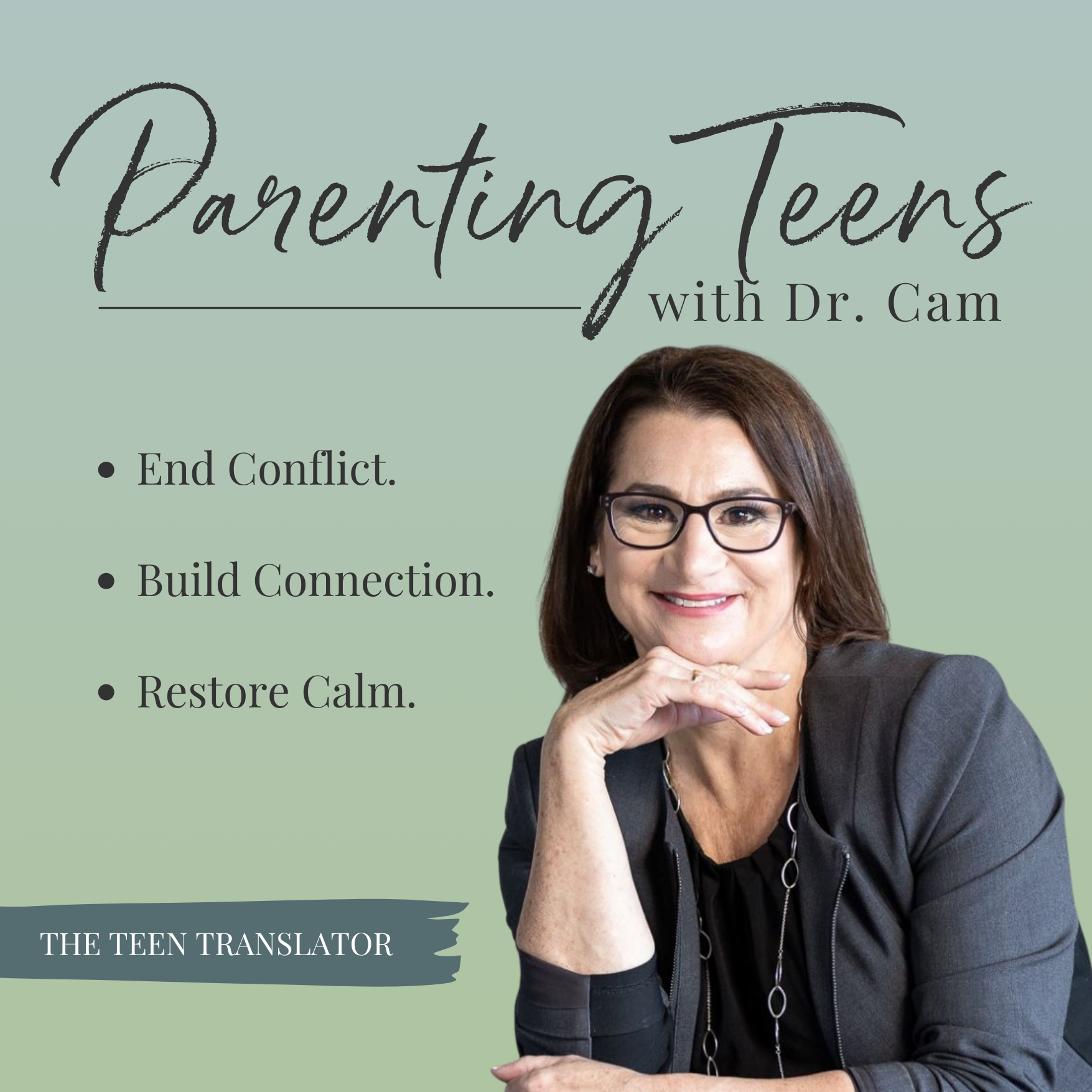
Parenting Teens with Dr. Cam podcast artwork

PODCAST · kids

Parenting Teens with Dr. Cam

Parenting Teens with Dr. Cam is the go-to podcast for parents who are ready to get real about raising teenagers. Hosted by Dr. Cam Caswell—adolescent psychologist, certified parenting coach, and mom of a teen—this podcast is all about honest conversations that dive deep into the challenges parents face and providing actionable solutions that actually work.Dr. Cam doesn’t just talk theories—she shares real-life insights and strategies based on over a decade of experience and the struggles she faces as a mom herself. Every episode offers practical, science-backed solutions to help you understand your teen, improve communication, and build a stronger relationship. Whether you’re dealing with mood swings, defiance, anxiety, or social media issues, you’ll find easy-to-apply advice that makes a difference.No interviews here—just authentic conversations that get to the heart of what parents are really dealing with. With a mix of expert tips and Dr. Cam’s own relatable stories, you’ll walk a

  1. 285

    Co-Parenting with a Narcissist: Expert Strategies to Protect Your Children and Your Sanity

    Co-parenting is challenging enough when both parents are working together. But when you're dealing with a narcissistic co-parent—or someone who constantly turns parenting into a competition—it can leave you feeling exhausted, second-guessing yourself, and worried about your child's well-being. In this episode, Dr. Cam sits down with clinical psychologist Dr. Kibby McMahon, CEO of Kula Mind and expert in personality disorders, to discuss practical strategies for navigating one of the most difficult parenting dynamics. Together, they unpack why narcissistic co-parents thrive on power struggles, how to stop getting pulled into the drama, and what you can do to protect your child while maintaining your own peace of mind. If you're tired of defending yourself, feeling manipulated, or wondering how to create stability for your child despite a difficult co-parent, this episode offers actionable tools and much-needed reassurance.   WHAT YOU'LL LEARN IN THIS EPISODE How to recognize narcissistic co-parenting behaviors and avoid getting trapped in endless power struggles Why the Gray Rock technique can help you respond to a narcissistic co-parent without escalating conflict How to set healthy boundaries and communicate effectively when collaboration feels impossible What parents can do to protect children from unhealthy parenting dynamics and build resilience   🎧❤️ ENJOYING THE SHOW? Don't keep it to yourself! Share your favorite episode and leave a rating and review to help other parents find the support they need. Your feedback helps me create even more episodes filled with practical tips for you and your family! Thanks so much for your support! 🙏💫 🔔 Remember to hit SUBSCRIBE so you never miss another solution-packed episode! 🙌   RESOURCES MENTIONED IN THIS EPISODE Gray Rock Communication Technique   CONNECT WITH OUR GUEST: Dr. Kibby McMahon Website: https://coolamind.com Instagram: @dr.kibby Podcast: A Little Help for Our Friends   CONNECT WITH YOUR HOST: Dr. Cam Caswell Website: askdrcam.com Instagram: @DrCamCaswell TikTok: @the.teen.translator YouTube: Parenting Teens with Dr. Cam Facebook: @DrCamCaswell   EPISODE CHAPTERS 00:00 Navigating Co-Parenting with a Narcissist 01:10 Meet Dr. Kibby McMahon 02:50 What Narcissism Really Is 05:21 Why Narcissistic Dynamics Become a Competition 09:14 How to Stop Getting Pulled Into the Fight 10:50 The Gray Rock Technique Explained 15:05 Using Collaborative Communication 18:17 Handling Different Parenting Styles 20:56 Helping Kids Navigate Two Households 23:02 Making Requests That Actually Work 25:34 Can Kids Develop Narcissistic Traits? 28:35 Avoiding the Counter-Reaction Trap 30:42 Final Advice for Parents 32:16 Resources and Closing Thoughts     ABOUT THE SHOW The Parenting Teens with Dr. Cam Podcast is your go-to resource for navigating the challenges of raising teenagers. Hosted by Dr. Cam Caswell, an adolescent psychologist and certified parenting coach, this podcast offers practical parenting strategies, expert advice, and real-world insights to help you build a stronger relationship with your teen and support their emotional growth. Whether you're struggling with teenage behavior or looking to improve communication, each episode provides actionable tips to make parenting teens easier and more rewarding. Perfect for both new and seasoned parents, this podcast helps you build the confidence to handle teen challenges and thrive together. #theteentranslator #drcamcaswell #parentingteenswithdrcam #coparenting #narcissisticabuse

  2. 284

    How to Support a Grieving Teen While You're Still Grieving

    Grief in teens rarely looks the way parents expect. Instead of tears and open conversations, it often shows up as irritability, withdrawal, risk-taking, or emotional distance. That can leave parents wondering whether their teen is grieving at all—or how to help if they are. In this episode, Dr. Cam sits down with grief expert and Master Certified Life Coach Krista St. Germain to unpack what grief really looks like in adolescents and why many common approaches to helping grieving teens can unintentionally make things harder. Together, they explore the latest understanding of grief, the impact loss has on the brain and body, and practical ways parents can support their teens through difficult life transitions and losses. Whether your teen is grieving the death of a loved one, the loss of a friendship, a major life change, or simply the challenges of growing up, this conversation will help you feel more confident supporting them with compassion and understanding.   WHAT YOU’LL LEARN IN THIS EPISODE Why grief in teenagers often looks like typical adolescent behavior and how to recognize the hidden signs The Dual Process Model of Grief and why the traditional five stages of grief are outdated What parents should say—and avoid saying—to support a grieving teen How modeling healthy emotional expression helps teens build resilience and emotional intelligence 🎧❤️ ENJOYING THE SHOW? Don't keep it to yourself! Share your favorite episode and leave a rating and review to help other parents find the support they need. Your feedback helps me create even more episodes filled with practical tips for you and your family! Thanks so much for your support! 🙏💫 🔔 Remember to hit SUBSCRIBE so you never miss another solution-packed episode! 🙌   WHAT YOU’LL LEARN IN THIS EPISODE Why teens naturally pull away from parents during adolescence — and what it actually means for your relationship How emotional safety and nervous system regulation improve communication with teenagers The parenting shift that helps teens become more independent, responsible, and emotionally resilient Practical ways to build stronger family relationships without control, pressure, or constant conflict   RESOURCES MENTIONED IN THIS EPISODE Dual Process Model of Grief (Stroebe & Schut) Post-Traumatic Growth Research The Widowed Mom Podcast CONNECT WITH OUR GUEST: Krista St. Germain Website: https://coachingwithkrista.com Podcast: The Widowed Mom Podcast Instagram: @lifecoachkrista YouTube: KristaSt-Germain Facebook: CoachingwithKrista   CONNECT WITH YOUR HOST: Dr. Cam Caswell Website: AskDrCam.com Instagram: @DrCamCaswell TikTok: @the.teen.translator YouTube: Parenting Teens with Dr. Cam Facebook: @DrCamCaswell   EPISODE CHAPTERS 00:00 Understanding Grief in Teens 02:57 Krista's Personal Journey with Grief 05:51 Outdated Beliefs About Grief 08:53 The Dual Process Model of Grief 12:04 Navigating Grief as Parents 15:00 Recognizing Grief in Teenagers 17:53 The Importance of Shared Grief Experiences 18:41 Navigating Emotions as Parents 20:00 Supporting Grieving Children 22:31 Empowering Children Through Grief 24:41 Believing in Resilience 26:49 Trusting the Process of Growth 30:42 Finding Meaning in Hardship     ABOUT THE SHOW The Parenting Teens with Dr. Cam Podcast is your go-to resource for navigating the challenges of raising teenagers. Hosted by Dr. Cam Caswell, an adolescent psychologist and certified parenting coach, this podcast offers practical parenting strategies, expert advice, and real-world insights to help you build a stronger relationship with your teen and support their emotional growth. Whether you're struggling with teenage behavior, communication challenges, anxiety, motivation, or emotional well-being, each episode provides actionable tips to make parenting teens easier and more rewarding. Perfect for both new and seasoned parents, this podcast helps you build the confidence to handle teen challenges and thrive together. #theteentranslator #drcamcaswell #parentingteenswithdrcam #TeenGrief #ParentingThroughGrief

  3. 283

    How Parents Are Accidentally Damaging Their Teen's Mental Health

    Are today’s teens experiencing a true mental health crisis—or are parents being encouraged to label normal adolescent struggles as disorders? In this thought-provoking episode of the Parenting Teens with Dr. Cam Podcast, adolescent psychologist sits down with renowned child and adolescent psychiatrist, author of Searching for Normal, to unpack the rising diagnoses of ADHD, anxiety, depression, and autism in teens. Parents today are overwhelmed trying to determine when teenage mood swings, defiance, anxiety, and emotional outbursts are “normal” and when they signal something more serious. Dr. Timimi challenges the growing trend of pathologizing ordinary adolescent behavior and explains why over-labeling teens may actually hurt resilience, confidence, and emotional growth. If you’re worried about your teen’s mental health, struggling with constant conflict, or wondering whether therapy, medication, or diagnosis is the right next step, this episode offers a refreshing and deeply practical perspective. Learn how to support your teen without overreacting, how to identify true mental health red flags, and why strengthening your relationship with your teen may be more powerful than trying to “fix” them. WHAT YOU’LL LEARN IN THIS EPISODE How to tell the difference between normal teenage behavior and serious mental health concerns Why anxiety, moodiness, and teen defiance are often part of healthy adolescent development The hidden dangers of over-diagnosing ADHD, anxiety, and depression in teenagers How parents can build resilient, emotionally healthy teens without overprotecting or over-controlling   🎧❤️ ENJOYING THE SHOW? Don’t keep it to yourself! Share your favorite episode and leave a rating and review to help other parents find the support they need. Your feedback helps create even more episodes packed with practical parenting strategies and emotional support for families navigating the teen years. Thanks so much for your support! 🙏💫 🔔 Remember to hit SUBSCRIBE so you never miss another solution-packed episode! 🙌 RESOURCES MENTIONED IN THIS EPISODE Searching for Normal by Dr. Sami Timimi   CONNECT WITH OUR GUEST: Dr. Sami Timimi Website: samitamimi.co.uk  Instagram: @samitamimi CONNECT WITH YOUR HOST: Dr. Cam Caswell Website: AskDrCam.com Instagram: @DrCamCaswell TikTok: @the.teen.translator YouTube: Parenting Teens with Dr. Cam Facebook: @DrCamCaswell EPISODE CHAPTERS 00:00 — Understanding the Rise in Teen Mental Health Diagnoses 05:41 — Are Parents Over-Pathologizing Teen Behavior? 11:04 — Building Resilience Instead of “Fixing” Teens 16:25 — Why Modern Parenting Is Fueled by Fear 21:56 — How Clinical Labels Are Changing Teen Identity ABOUT THE SHOW The Parenting Teens with Dr. Cam Podcast is your go-to resource for navigating the challenges of raising teenagers. Hosted by , an adolescent psychologist and certified parenting coach, this podcast offers practical parenting strategies, expert advice, and real-world insights to help you build a stronger relationship with your teen and support their emotional growth. Whether you’re struggling with teenage behavior, communication issues, anxiety, or emotional overwhelm, each episode provides actionable parenting tools to make raising teens easier and more rewarding. #theteentranslator #drcamcaswell #parentingteenswithdrcam #TeenMentalHealth #ParentingTeens  

  4. 282

    The Real Reason Your Teen Pushes You Away — And Why It Has Nothing to Do With You

    If your teenager suddenly seems distant, emotional, or wants nothing to do with you, you’re not failing as a parent — and you’re definitely not alone. In this eye-opening episode of the Parenting Teens with Dr. Cam Podcast, Dr. Cam Caswell sits down with Aliyah Singh, Hannah Ticajo, and Caitlin Severin from CultivaTeen Roots to unpack the real reason teens push parents away — and why it’s actually a normal part of adolescent development. Together, they explore the science behind parenting teens, emotional safety, communication, self-regulation, and healthy family relationships. You’ll learn why controlling behavior often damages connection, how social media impacts parenting expectations, and why the key to raising confident, independent teens is shifting from managing them to supporting them. This conversation is packed with practical parenting strategies to help parents reduce conflict, strengthen trust, improve communication with teenagers, and rediscover joy in the teen years. If you’re exhausted by constant power struggles, worried about losing connection with your child, or wondering how to support your teen without pushing them further away, this episode will give you hope, clarity, and actionable tools you can start using immediately.   WHAT YOU’LL LEARN IN THIS EPISODE Why teens naturally pull away from parents during adolescence — and what it actually means for your relationship How emotional safety and nervous system regulation improve communication with teenagers The parenting shift that helps teens become more independent, responsible, and emotionally resilient Practical ways to build stronger family relationships without control, pressure, or constant conflict   5 KEY TAKEAWAYS FOR PARENTS OF TEENS 1. Connection Grows Through Presence, Not Pressure Spending calm, low-pressure time together helps teens feel emotionally safe and more willing to connect naturally. 2. Teens Need Support More Than Control Shifting from “manager” to “consultant” helps teenagers build confidence, independence, and problem-solving skills. 3. Regulated Parents Create Safer Relationships Parents who practice self-regulation model emotional safety and help reduce tension and conflict at home. 4. Reflective Listening Builds Trust Teens open up more when parents listen without interrogating, fixing, or immediately offering advice. 5. The Teen Years Shape Long-Term Family Relationships How parents respond during adolescence strongly impacts future adult relationships with their children.   🎧❤️ ENJOYING THE SHOW? Don’t keep it to yourself! Share your favorite episode and leave a rating and review to help other parents find the support they need. Your feedback helps us create even more episodes filled with practical parenting strategies and encouragement for families raising teens. Thanks so much for your support! 🙏💫 🔔 Remember to hit SUBSCRIBE so you never miss another solution-packed episode!   RESOURCES MENTIONED IN THIS EPISODE Listeners can use the code CONNECT to get 20% off of our foundational online course, Making AdoleSense.   CONNECT WITH OUR GUESTS Aliyah Singh, Hannah Ticajo & Caitlin Severin — Cultivate Teen Roots Website: Cultivate Teen Roots Instagram: @CultivateTeenRoots   CONNECT WITH YOUR HOST Dr. Cam Caswell Website: AskDrCam.com Instagram: @DrCamCaswell TikTok: @the.teen.translator YouTube: Parenting Teens with Dr. Cam Facebook: @DrCamCaswell   EPISODE CHAPTERS 00:00 Introduction to Joyful Parenting 02:59 Understanding the Challenges of Parenting Teens 05:50 Reframing Connection with Teens 08:42 Shifting from Control to Support 11:21 The Importance of Emotional Safety 14:29 Finding Joy in the Teen Years 17:07 The Role of Curiosity in Parenting 19:56 Navigating Insecurities and Building Trust 22:58 Creating a Safe Space for Communication 25:45 Letting Go of Control and Embracing Change 28:40 Finding Community and Support 31:40 Conclusion and Resources   ABOUT THE SHOW The Parenting Teens with Dr. Cam Podcast is your go-to resource for navigating the challenges of raising teenagers. Hosted by Dr. Cam Caswell, an adolescent psychologist and certified parenting coach, this podcast offers practical parenting strategies, expert advice, and real-world insights to help you build stronger family relationships and support your teen’s emotional growth. Whether you’re struggling with communication, teenage behavior, emotional outbursts, or parenting stress, each episode provides actionable tools to help parenting teens feel more connected, calm, and rewarding. #theteentranslator #drcamcaswell #parentingteenswithdrcam #ParentingTeens #FamilyRelationships

  5. 281

    Simple Wisdom from Mothers Who Raised Extraordinary Humans with Sheinelle Jones

    What does it actually take to raise a confident, resilient, successful teen? In this episode of Parenting Teens with Dr. Cam, I sit down with Sheinelle Jones, co-host of Today with Jenna and Sheinelle and author of Through Mom's Eyes: Simple Wisdom From Mothers Who Raised Extraordinary Humans, to unpack what she learned from interviewing the moms behind some of the most extraordinary humans, including Lady Gaga, Serena and Venus Williams, Steph Curry, and the Jonas Brothers. And here’s what stood out: it’s not about perfect parenting, strict rules, or doing everything “right.” It’s about presence, trust, and knowing what actually matters in the moments that feel hardest. We talk about what these moms did differently, the biggest regrets they shared (especially around screen time), and why your teen not appreciating you right now is not a sign you’re failing. If you’ve ever wondered, “Am I doing this right?” this episode will give you clarity, perspective, and a whole lot of relief.   WHAT YOU’LL LEARN IN THIS EPISODE The surprising common traits mothers of highly successful people share. Why presence matters more than anything else (and what that actually looks like with teens today) The biggest parenting regrets —and how to course-correct now Why your teen’s lack of appreciation is completely normal—and what it really means about your relationship   🎧❤️ ENJOYING THE SHOW? Don’t keep it to yourself! Share your favorite episode and leave a rating and review to help other parents find the support they need. Your feedback helps me create even more episodes filled with practical tips for you and your family! Thanks so much for your support! 🙏💫 🔔 Remember to hit SUBSCRIBE so you never miss another solution-packed episode! 🙌   RESOURCES MENTIONED IN THIS EPISODE 📘 Through Mom's Eyes: Simple Wisdom From Mothers Who Raised Extraordinary Humans   CONNECT WITH OUR GUEST: Sheinelle Jones Website/Profile: NBC Insider Instagram: Sheinelle Jones   CONNECT WITH YOUR HOST: Dr. Cam Caswell Website: AskDrCam.com Instagram: @DrCamCaswell YouTube: Parenting Teens with Dr. Cam   EPISODE CHAPTERS: 00:00 Why parents question themselves more than ever 02:45 What moms of extraordinary humans did differently 06:10 The power of presence over perfection 09:00 Parenting regrets around screens and connection 12:00 Why teens don’t show appreciation (and why that’s okay) 15:00 Letting go of control and trusting your teen 18:00 Building resilience and “fighting for your joy”   ABOUT THE SHOW The Parenting Teens with Dr. Cam Podcast is your go-to resource for navigating the challenges of raising teenagers. Hosted by Dr. Cam Caswell, an adolescent psychologist and certified parenting coach, this podcast offers practical parenting strategies, expert advice, and real-world insights to help you build a stronger relationship with your teen and support their emotional growth. Whether you’re struggling with teenage behavior or looking to improve communication, each episode provides actionable tips to make parenting teens easier and more rewarding. Perfect for both new and seasoned parents, this podcast helps you build the confidence to handle teen challenges and thrive together. #theteentranslator #drcamcaswell #parentingteenswithdrcam #raisingteens #parentingadvice

  6. 280

    Teen Secrecy: Why Your Teen Isn’t Telling You Everything (And What to Do About It)

    If your teen is hiding things or not telling you the full truth, it can feel like you’re losing them. And your instinct? Tighten the rules. Ask more questions. Stay on top of everything. But here’s the part most parents aren’t told: Teen secrecy isn’t usually about rebellion or disrespect. It’s about development. In this episode, I’m breaking down why teens keep secrets, what’s actually going on in their brain, and why common parenting reactions like punishment, pressure, or constant checking often make things worse.  WHAT YOU’LL LEARN IN THIS EPISODE Why teen secrecy does not always mean what you think it means The response that often makes teens hide even more What parents miss when they focus only on getting the truth How to become the person your teen comes to when it matters most 🎧❤️ ENJOYING THE SHOW? Don’t keep it to yourself! Share your favorite episode and leave a rating and review to help other parents find the support they need. Your feedback helps me create more episodes filled with real-life, practical strategies that actually work. 🔔 Hit SUBSCRIBE so you never miss another solution-packed episode. RESOURCES MENTIONED IN THIS EPISODE The COLLABORATE Method Parenting Program 👉 https://www.askdrcam.com/collaboratemethod CONNECT WITH YOUR HOST: Dr. Cam Caswell Website: AskDrCam.com Instagram: @DrCamCaswell TikTok: @the.teen.translator YouTube: Parenting Teens with Dr. Cam Facebook: @DrCamCaswell EPISODE CHAPTERS 00:00 Why Teen Secrecy Feels So Scary 04:30 What’s Actually Going On in Your Teen’s Brain 09:00 Why Punishment Backfires 13:30 How to Make Honesty Feel Safer 18:00 Shifting from Control to Connection ABOUT THE SHOW The Parenting Teens with Dr. Cam Podcast is your go-to resource for navigating the challenges of raising teenagers. Each episode gives you practical tools to reduce conflict, build connection, and help your teen grow into a capable, confident adult. #theteentranslator #drcamcaswell #parentingteenswithdrcam #teencommunication #parentingteens

  7. 279

    What to Do If Your Teen Is In Crisis (Advice from a Sandy Hook Mom)

    What would you do if your teen told you a classmate was making threats? Most parents freeze — unsure whether to panic, dismiss it, or act. In this episode, Dr. Cam sits down with Nicole Hockley, co-founder of Sandy Hook Promise and mother who lost her six-year-old son Dylan in the 2012 Sandy Hook tragedy, to talk about one of the most important skills a parent can develop: knowing when something is wrong with your teen before it becomes a crisis. Nicole has spent over a decade studying the warning signs that precede school violence and teen crisis — and what she shares might surprise you. The signs are rarely dramatic. They're quiet. Easy to explain away. And most parents miss them. In this episode, you'll learn: The difference between subtle and overt warning signs — and why the subtle ones are more dangerous Why dismissing your teen's feelings ("you're overreacting") actually makes things worse The single most powerful protective factor against teen crisis (hint: it's not monitoring) What to do when a peer reports something concerning about your child How to secure lethal means at home — and why this one step saves lives The tiered response framework that helps you stay calm and act appropriately at every level of concern A word from Nicole that every parent needs to hear: "I would much rather be embarrassed by being wrong than be horrified by being right." Connect with Nicole Hockley & Sandy Hook Promise: 🌐 sandyhookpromise.org 📘 facebook.com/SandyHookPromise 📸 instagram.com/sandyhookpromise 🐦 twitter.com/sandyhook 🎵 tiktok.com/@sandyhookpromise ▶️ youtube.com/channel/UCl5MxshIyRwoFNsFut6UZdA Resources mentioned: Sandy Hook Promise's UnTargeting initiative & latest report with Children and Screens: sandyhookpromise.org If you or your teen is in crisis: 988 Suicide & Crisis Lifeline: call or text 988 Crisis Text Line: text HOME to 741741 Emergency: 911 Your instinct to reach out for help is never an overreaction. This episode could change how you see your teen — and how they see you.  

  8. 278

    Why Consequences Stop Working with Teens (And What to Do Instead)

    If consequences used to work… and now they just lead to more attitude, shutdowns, or the same fights on repeat—this episode will explain why. If you’re parenting a teen and struggling with defiance, power struggles, or constant pushback… you’re not alone. Because it’s not that your teen suddenly stopped caring. It’s that their brain has changed—and the tools that worked before don’t work the same way anymore. In this episode, Dr. Cam sits down with Charle Peck, LCSW, M.Ed., an international keynote speaker, clinical therapist, and former educator who specializes in helping people stay calm and effective under pressure. Charle works with parents, educators, and professionals to transform high-stress situations into opportunities for growth using practical, science-backed strategies. Together, they unpack what’s really going on when consequences backfire—and the simple shift that can completely change how your teen responds. What you’ll learn in this episode: 👉 Why teens push back harder the more you try to control them 👉 What your teen actually needs in high-conflict moments 👉 The hidden reason your reactions may be escalating things 👉 A powerful question that instantly lowers defensiveness 👉 What to do instead of consequences to get better behavior If you’re tired of power struggles, walking on eggshells, or feeling like nothing is working anymore… this episode will give you a whole new way to understand—and respond to—your teen. Because your teen isn’t broken. They’re developing. And they need a different approach.   🎧 Enjoying the show? Follow and leave a quick review so more parents can find the support they need. Connect with Charle Peck: 🌐 Website: https://www.thrivingeducator.org/ 📘 Facebook: https://www.facebook.com/charlepeck 📸 Instagram: https://www.instagram.com/charlepeck 🐦 X: https://twitter.com/CharlePeck   🎁 Resource Mentioned: Rapid Resets: https://www.charlepeck.com/pl/2148694979 Connect with your host, Dr. Cam: 🌐 Website: www.askdrcam.com 📸 Instagram: https://www.instagram.com/drcamcaswell

  9. 277

    Stop Punishing Your Teen’s Bad Choices What Actually Builds Better Decision-Making Skills

    Are you constantly worried your teen is making bad choices—and feel like consequences are the only way to “teach them a lesson”? You’re not alone. And you’re not wrong to care. But what if the very thing you’re doing to prevent bad decisions is actually making them worse? In this episode, we’re digging into one of the biggest parenting traps: punishing behavior instead of teaching the skills behind it. Because when your teen makes a risky, impulsive, or frustrating choice, it’s easy to assume they’re being careless, defiant, or just not thinking. But there’s something much deeper going on—and once you see it, everything about how you respond will start to shift. This isn’t about letting your teen “get away with it.” And it’s definitely not about lowering your standards. It’s about understanding what your teen actually needs in those moments so they can learn to make better decisions without you hovering, nagging, or constantly stepping in. Because the goal isn’t to control their choices forever… It’s to raise a teen who can think for themselves when you’re not there. If you’ve ever: Replayed a bad decision your teen made and wondered, “What were they thinking?” Felt stuck between being too strict or too lenient Worried that giving more freedom will just lead to worse choices This episode is going to give you a completely different lens—and a better way forward. WHAT YOU’LL LEARN IN THIS EPISODE Why teens make choices that don’t make sense to you (but make perfect sense to them) The hidden reason punishment often leads to more lying, hiding, and disconnection What your teen actually needs in the moment of a bad decision (hint: it’s not a lecture) How to help your teen build real decision-making skills—without constant power struggles A simple mindset shift that changes how you respond immediately 🎧❤️ ENJOYING THE SHOW? Don’t keep it to yourself! Share your favorite episode and leave a rating and review to help other parents find the support they need. Your feedback helps me create even more episodes filled with practical tips for you and your family! Thanks so much for your support! 🙏💫 🔔 Remember to hit SUBSCRIBE so you never miss another solution-packed episode! 🙌 RESOURCES MENTIONED IN THIS EPISODE ✨ The COLLABORATE Method™ Parenting Program A step-by-step system to help you stay calm, understand your teen, and guide better choices—without power struggles. www.askdrcam.com/collaboratemethod CONNECT WITH YOUR HOST: Dr. Cam Caswell Website: AskDrCam.com Instagram: @DrCamCaswell TikTok: @the.teen.translator YouTube: Parenting Teens with Dr. Cam Facebook: @DrCamCaswell ABOUT THE SHOW The Parenting Teens with Dr. Cam Podcast is your go-to resource for navigating the challenges of raising teenagers. Each episode gives you practical strategies, real-life scripts, and expert insights to help you build a stronger relationship with your teen—without yelling, nagging, or walking on eggshells. #parentingteens #teenbehavior #drcamcaswell

  10. 276

    Teaching Your Teen to Drive: How to Help an Anxious Teen Driver Build Confidence

    Teaching your teen to drive can feel terrifying. If your teen is nervous behind the wheel—or keeps delaying getting their license—you’re not alone. Many teens today feel anxious about driving, and the way parents approach practice can either build confidence… or make that anxiety worse. In this episode of Parenting Teens with Dr. Cam, Dr. Cam talks with Nigel Tunnacliffe, CEO and co-founder of Coastline Academy, the largest driving school in the country, about how parents can help anxious teen drivers feel more confident and capable behind the wheel. Nigel shares what professional driving instructors know about teaching teens to drive safely—and why well-meaning parents sometimes make the process harder without realizing it. If teaching your teen to drive has felt stressful, frustrating, or overwhelming, this episode will help you turn practice drives into confidence-building learning experiences instead of power struggles. What You’ll Learn in This Episode Why many teens today delay getting their driver’s license How parent anxiety can accidentally increase teen driving anxiety The biggest mistake parents make when teaching teens to drive How professional driving instructors build confidence in anxious teen drivers When teens are truly ready to start driving independently How to make practice drives calmer and more productive for both of you Why Teaching Teens to Drive Feels So Stressful Learning to drive is one of the biggest steps toward independence for teens—and one of the most anxiety-provoking moments for parents. When parents shift their role from critic to coach, teens learn faster, build confidence, and develop safer habits on the road. This conversation will help you approach this milestone with more calm, clarity, and confidence for both you and your teen. About Our Guest Nigel Tunnacliffe is the co-founder and CEO of Coastline Academy, the largest driving school in the United States. Coastline has helped more than 250,000 teens learn to drive safely across hundreds of cities. Nigel founded Coastline with the mission of reducing car crashes through better driver education and safer driving habits. Learn more: https://coastlineacademy.com Follow Coastline Academy: Instagram: https://www.instagram.com/coastlineacademy Facebook: https://www.facebook.com/coastlineacademy Episode Chapters 00:00 Why Teaching Teens to Drive Feels So Stressful 00:53 Why Many Teens Are Delaying Their Driver’s License 03:41 Helping Anxious Teen Drivers Build Confidence 05:23 Encouraging Teens Without Creating Resistance 07:09 Managing Parent Anxiety During Practice Drives 09:56 Creating a Supportive Learning Environment 12:34 Celebrating Small Driving Wins 15:25 Teaching Through Observation and Empathy 19:02 Recognizing Responsibility in Teen Drivers 21:29 Building Safe Driving Habits 24:11 Helping Teens Gain Confidence Behind the Wheel 27:32 Setting Boundaries for New Drivers 29:19 Practical Tips for Safe Driving Practice Connect with Dr. Cam Website: https://www.askdrcam.com Instagram: https://www.instagram.com/drcamcaswell YouTube: Parenting Teens with Dr. Cam   🎧 Enjoying the podcast? Share your favorite episode and leave a rating and review on Apple Podcasts. Your support helps more parents find practical strategies to strengthen their relationship with their teens. 🔔 Subscribe so you never miss another episode of Parenting Teens with Dr. Cam.   parenting teens, teaching teens to drive, anxious teen driver, teen driving anxiety, parenting teenagers, helping teens gain confidence, teen independence, safe teen drivers

  11. 275

    Why Is My Teen So Entitled? The Truth About Teaching Gratitude

    Is your teen acting entitled, ungrateful, or selfish — no matter how much you do for them? You’re not alone. And it may not mean what you think. In this episode, Dr. Cam explains why teen entitlement is often a normal part of adolescent development — rooted in brain changes, identity formation, and intense self-focus — not bad character. You’ll learn: • Why lectures and guilt trips about gratitude backfire • The psychology behind teen self-centered behavior • How to teach gratitude without shame or comparison • Practical ways to build empathy, responsibility, and perspective If you want to raise a grateful teen without damaging your relationship, this episode will give you a research-backed, connection-focused approach that actually works. Hit play to understand what’s really behind teen entitlement — and how to respond in a way that builds character, not resentment.   Chapters 00:00 Introduction to Teen Behavior and Entitlement 01:46 Understanding Self-Focus in Teens 04:27 The Role of Gratitude in Development 08:34 Building Perspective Through Experience 12:08 Teaching Gratitude as a Skill 13:33 Reframing Parental Responses to Teen Behavior 14:58 Conclusion and Next Episode Teaser   🎧 Enjoying the Show? Hit SUBSCRIBE so you never miss practical, research-backed strategies for parenting teens. If this episode helped, a quick review helps more parents find support.   🔗 Resource Mentioned The COLLABORATE Method™ Parenting Program A step-by-step system for building responsibility, gratitude, and maturity — without shame or power struggles. 👉 AskDrCam.com/collaboratemethod   Previous Episodes in Series: Episode 269: Attitude Episode 271: Refusing to do chores Episode 273: Arguing all the time about everything Next Episode Preview: Episode 5 will cover "Making risky and bad choices" and how changing your approach can improve your teen's rational decision-making abilities.   About the Podcast Parenting Teens with Dr. Cam blends brain science, practical tools, and real-life scripts so you can parent smarter — not harder.

  12. 274

    Teen Son Won’t Talk? Why He Shuts Down—and How to Get Him to Open Up Again

    Teen boys shutting down can feel like rejection, but it’s usually self-protection. If your teen son won’t talk, gives one-word answers, or avoids conversations completely, this episode will help you understand what’s going on—and what actually works. Dr. Cam Caswell (adolescent psychologist + certified parenting coach) and licensed professional counselor Jarrod Hoffman break down teen communication, emotional withdrawal, and trust-building strategies that help parents reconnect with teen boys. You’ll learn how to stop the lecture cycle, use reflective listening, and create emotional safety so your teenage son opens up again. What You’ll Learn: Why teen boys shut down emotionally during puberty (and why it’s not rejection) The #1 communication mistake parents make that pushes teen boys further away How to use reflection instead of rapid-fire questions to build trust The “10-Minute Play Rule” that strengthens parent-teen connection What to say when your teen goes silent (without panicking or lecturing) Why teens already know what they “should” be doing—and why more advice backfires How to build trust with your teenage son so he talks to you again Connect with Jarrod Hoffman: Website: jarrodhoffman.com Newsletter: Jarrod’s Monthly Newsletter Blog: jarrodhoffman.com/blog LinkedIn: Jarrod Hoffman Connect with Dr. Cam Caswell: Website: AskDrCam.com Instagram: @DrCamCaswell YouTube: Parenting Teens with Dr. Cam (search “Parenting Teens with Dr. Cam”) Enjoying the show? Share your favorite episode and leave a rating and review so other parents can find the support they need. Hit SUBSCRIBE so you never miss a solution-packed episode. About the show: The Parenting Teens with Dr. Cam Podcast is your go-to resource for navigating the challenges of raising teenagers. Hosted by Dr. Cam Caswell, adolescent psychologist and certified parenting coach, each episode delivers practical parenting tools, expert insights, and real-world strategies to help you improve communication, reduce power struggles, and build a stronger relationship with your teen. #theteentranslator #drcamcaswell #parentingteenswithdrcam #teencommunication #parentingteenboys  

  13. 273

    The Shocking Truth About Teen Defiance: What Science Says About Kids Who Talk Back

    If it feels like every conversation with your teen turns into a debate… you’re not alone. In this episode, Dr. Cam flips the script on what “talking back” really means. What if your teen’s arguing isn’t disrespect… but development? What if those debates are actually signs of growing critical thinking, identity formation, and moral reasoning? You’ll learn why shutting down arguments with “because I said so” may create more power struggles, not fewer—and how to transform daily battles into opportunities to build confidence, connection, and real-life skills. If you’re tired of feeling like the bad guy every time your teen pushes back, this episode will help you respond with clarity, authority, and calm—without losing your leadership. WHAT YOU'LL LEARN IN THIS EPISODE Why teen arguing is often a sign of healthy brain development—not defiance The hidden cost of “because I said so” parenting How to separate disagreement from disrespect The difference between debatable topics and non-negotiable boundaries Phrases that keep conversations open without giving up authority How healthy arguing prepares teens to resist peer pressure and advocate for themselves   RELATED EPISODES IN THIS SERIES This episode is part of the series: “7 Teen Behaviors Parents Often Punish That Are Actually Signs of Healthy Development.” Be sure to check out: Episode 269: Attitude, eye rolls, and tone as signs of developing nervous systems Episode 271: Why teens resist chores (missing skills vs. laziness) Upcoming: Acting selfish and entitled as healthy development RESOURCE MENTIONED The COLLABORATE Method™ Parenting Program A step-by-step system for parents who are tired of constant power struggles and second-guessing themselves. Inside, you’ll learn how to: Stay in charge without escalating Allow disagreements without losing authority Respond with clarity instead of reacting in frustration Learn more at: https://www.askdrcam.com/collaboratemethod 🎧❤️ ENJOYING THE SHOW? Don’t keep it to yourself! Share your favorite episode and leave a rating and review to help other parents find the support they need. Your feedback helps me create even more episodes filled with practical tips for you and your family! Thanks so much for your support! 🙏💫 🔔 Remember to hit SUBSCRIBE so you never miss another solution-packed episode! 🙌 CONNECT WITH YOUR HOST: Dr. Cam Caswell Website: AskDrCam.com Instagram: @DrCamCaswell YouTube: Parenting Teens with Dr. Cam EPISODE CHAPTERS 00:00 Introduction to Healthy Development Behaviors 01:18 Why Arguing Feels So Frustrating 03:56 Arguing as Executive Function Development 06:36 Teaching Respectful Disagreement 09:51 Debatable vs. Non-Negotiable Topics 12:09 The COLLABORATE Method™ ABOUT THE SHOW The Parenting Teens with Dr. Cam Podcast is your go-to resource for navigating the challenges of raising teenagers. Hosted by Dr. Cam Caswell, an adolescent psychologist and certified parenting coach, this podcast offers practical parenting strategies, expert advice, and real-world insights to help you build a stronger relationship with your teen and support their emotional growth. Whether you’re struggling with teenage behavior or looking to improve communication, each episode provides actionable tools to make parenting teens easier—and more connected. #theteentranslator #drcamcaswell #parentingteenswithdrcam #TeenDevelopment #ParentingTeens

  14. 272

    Biggest Screen Time Mistakes Parents Make (and What Actually Works Instead)

    Fighting with your teen about screens doesn’t mean you’re failing. It usually means you’re focusing on the wrong thing. In this episode of Parenting Teens with Dr. Cam, I’m joined by Stephen Balkam, Founder and CEO of the Family Online Safety Institute, who brings 30 years of experience helping families navigate online safety without fear or power struggles. We break down why traditional screen time rules backfire, why screen use matters more than minutes, and how parents can stay influential in a world where teens are using AI tools like ChatGPT and Claude for school, problem-solving, and decision-making. If you want to protect your teen online without losing trust or connection, this episode will help you rethink your approach. What You’ll Learn The biggest screen time mistake parents make (and what works better) Why quality of screen use matters more than quantity How the “co-pilot” approach keeps you involved without controlling Why involving teens in rule-setting increases follow-through What parents need to know about AI and critical thinking Simple boundaries that protect both safety and connection Resources Mentioned Family Online Safety Institute: https://www.fosi.org Seven Steps to Good Digital Parenting Digital Parenting Contract Template FOSI YouTube Channel AI tools discussed: ChatGPT, Claude Apps referenced: Pokémon Go, nature and star identification apps About the Guest Stephen Balkam is the Founder and CEO of the Family Online Safety Institute, a nonprofit working with major tech companies to make the online world safer for kids and families. He has been at the forefront of online safety for three decades and has witnessed the evolution from the early web to social media to today’s AI age. About the Show Parenting Teens with Dr. Cam helps parents stay calm, connected, and confident while navigating the challenges of raising teens. Hosted by Dr. Cam Caswell, adolescent psychologist and certified parenting coach. 👉 Learn more and access free resources at AskDrCam.com 📱 For daily parenting tools, follow @DrCamCaswell on Instagram

  15. 271

    The Chore Strategy That Got My Teen to Help Around the House (Without Having to Nag!)

    If you’ve asked your teen to do a chore and they responded like you just requested a kidney… welcome. 🫠 Because here’s the thing: the chore battle usually isn’t about the chore. It’s about what happens after you ask—the stalling, the eye rolls, the “in a minute,” the sudden deep commitment to scrolling, and you repeating yourself until your voice hits a pitch only dogs can hear. In this episode of Parenting Teens with Dr. Cam, Dr. Cam breaks down the real reason chores blow up in so many homes—and why most of the common fixes (punishment, consequences, rewards, bribing, threatening, lecturing) often backfire long-term. You’ll learn the simple shift that can turn chores from a power struggle into cooperation—without begging, nagging, or doing it all yourself—plus the one mistake that accidentally teaches teens to avoid chores (and you) even more. If chores have become the hill your household dies on… this episode will change how you look at it—and what you do next. This is Part 2 of the series: 7 Behaviors Parents Often Punish That Are Actually Signs of Healthy Development. WHAT YOU’LL LEARN IN THIS EPISODE Why “clean your room” can feel impossible to a teen brain (even when they want to do it) The hidden reason punishment makes chore resistance worse over time The mindset shift that gets teens to help without the constant reminders How to build responsibility in a way that doesn’t destroy your relationship 🎧❤️ ENJOYING THE SHOW? Don’t keep it to yourself! Share your favorite episode and leave a rating and review to help other parents find the support they need. Your feedback helps me create even more episodes filled with practical tips for you and your family! 🙏💫 🔔 Remember to hit SUBSCRIBE so you never miss another solution-packed episode! 🙌 RESOURCES MENTIONED IN THIS EPISODE Website: https://www.askdrcam.com The COLLABORATE Method™ Parenting Program – A step-by-step approach that helps you respond confidently to any teen struggle (chores, motivation, attitude, school stress, and more): https://www.askdrcam.com/collab CONNECT WITH YOUR HOST: Dr. Cam Caswell Website: AskDrCam.com Instagram: @DrCamCaswell  YouTube: Parenting Teens with Dr. Cam  EPISODE CHAPTERS: Why chores trigger so many power struggles The surprising reason your teen avoids starting (even when it’s simple) The parenting response that quietly increases resistance The “nag-free” strategy that changes cooperation How to build responsibility without resentment ABOUT THE SHOW The Parenting Teens with Dr. Cam Podcast is your go-to resource for navigating the challenges of raising teenagers. Hosted by Dr. Cam Caswell, an adolescent psychologist and certified parenting coach, this podcast offers practical parenting strategies, expert advice, and real-world insights to help you build a stronger relationship with your teen and support their emotional growth. Whether you’re struggling with teenage behavior or looking to improve communication, each episode provides actionable tips to make parenting teens easier and more rewarding. Perfect for both new and seasoned parents, this podcast helps you build the confidence to handle teen challenges and thrive together. #theteentranslator #drcamcaswell #parentingteenswithdrcam #teenchores #parentingteens

  16. 270

    Is Roblox Safe for Teens? What Parents Need to Know

    A lot of parents see the hours, hear the headphones, and picture the worst: strangers, predators, secret chats, and “Is my kid addicted to this?!” So in this episode, I brought in someone who actually knows what’s happening behind the scenes at Roblox: Tami Bhaumik, Vice President of Civility and Partnerships at Roblox. And let me tell you—this conversation will either calm your nervous system… or at least give you a real plan. WHAT YOU’LL LEARN IN THIS EPISODE The one thing most parents misunderstand about Roblox… and why it matters for safety A major safety feature rolling out that could change how teens connect with others online The screen-time question parents obsess over—and what actually signals a real problem Why “play with your teen” isn’t cheesy advice… it’s a shortcut to better conversations and more honesty How to set limits that don’t instantly trigger eye rolls, blowups, or shutdowns 🎧❤️ ENJOYING THE SHOW? Don’t keep it to yourself! Share your favorite episode and leave a rating and review to help other parents find the support they need. Your feedback helps me create even more episodes filled with practical tips for you and your family! Thanks so much for your support! 🙏💫 🔔 Remember to hit SUBSCRIBE so you never miss another solution-packed episode! 🙌   RESOURCES MENTIONED IN THIS EPISODE Roblox Safety Center: https://corp.roblox.com/safety Parental controls, safety guides, video tutorials, and wellbeing resources for families. CONNECT WITH OUR GUEST: Tami Bhaumik Vice President of Civility and Partnerships, Roblox LinkedIn: @tamibhaumik   CONNECT WITH YOUR HOST: Dr. Cam Caswell Website: https://AskDrCam.com Instagram: @DrCamCaswell YouTube: Parenting Teens with Dr. Cam  EPISODE CHAPTERS 00:00 – Roblox: What It Really Is (And Why Parents Misread It) 05:41 – The Safety Stuff You Actually Need to Know 11:47 – The Parenting Move That Changes Everything 16:49 – Screen Time: What’s Normal vs. What’s Not 22:38 – How to Work With Your Teen on Safety 28:18 – Tools, Next Steps, and Where Parents Should Start   ABOUT THE SHOW The Parenting Teens with Dr. Cam Podcast is your go-to resource for navigating the challenges of raising teenagers. Hosted by Dr. Cam Caswell, adolescent psychologist and certified parenting coach, this show gives you science-backed insights and real-life parenting tools you can actually use—so you can stop second-guessing yourself and start leading with more calm, clarity, and connection. #theteentranslator #drcamcaswell #parentingteenswithdrcam #Roblox #onlinesafety #digitalliteracy

  17. 269

    That “Nasty Attitude”: Why Punishing Your Teen's Tone Is Backfiring (And What Actually Works)

    Eye rolls. Heavy sighs. That sharp, snarky tone that flips your nervous system in half a second. If your teen’s “nasty attitude” instantly makes you think disrespect, defiance, or this needs to stop now, this episode will change how you see everything. In Episode #269 of Parenting Teens with Dr. Cam, I kick off a brand-new series unpacking teen behaviors parents punish — even though they’re often signs of healthy development. And we’re starting with the one that triggers parents the fastest: attitude. Here’s the uncomfortable truth most parents were never told: What feels like disrespect in the moment is often your teen’s nervous system in overload, paired with a brain that’s wired for emotion but still learning regulation. When we shut it down with consequences or lectures, we don’t teach respect — we teach defense. And that’s where the power struggles, shutdowns, and distance begin. In this episode, I don’t just explain why this happens, I walk you through the critical choice every parent faces in those heated moments… and how one response builds walls while the other builds trust. I also introduce the response framework I teach parents inside my COLLABORATE Method™ Parenting Program — the approach that helps you hold boundaries without escalating, shutting down, or saying something you regret five minutes later. If you’ve ever wondered: Why does my teen get snarky over the smallest things? Am I accidentally making the attitude worse? How do I stop the tone without starting a war? This episode is your wake-up call. Because tonight’s “attitude” isn’t just about tonight. It’s shaping how safe your teen feels communicating with you tomorrow. WHAT YOU’LL LEARN IN THIS EPISODE Why teen “attitude” often usually has nothing to do with disrespect — and everything to do with brain development The hidden reason even well-intended questions can trigger snark and shutdown The parenting response that escalates attitude (most parents default to it without realizing) The moment-by-moment choice that determines whether your teen opens up… or closes off  WHY THIS MATTERS MORE THAN YOU THINK Every time your teen gets mouthy, snappy, or sarcastic, one of two things happens. You either: reinforce fear, control, and emotional shutdown or teach regulation, communication, and real respect Most parents were taught the first path. In this episode, I show you the second and explain why it works even when your teen is not at their best.   🔑 WANT A STEP-BY-STEP PLAN FOR THESE MOMENTS? This episode gives you the why. The COLLABORATE Method™ Parenting Program gives you the how — across every teen challenge, not just attitude. Inside the program, parents learn how to: Stay calm and grounded when emotions run high Respond instead of react — even in triggering moments Hold boundaries without power struggles Build respect that actually lasts If you’re done guessing what to say and want a clear, repeatable system you can trust in real life, this is where to start. 👉 Learn more here: https://askdrcam.com/collaboratemethod UPCOMING EPISODE Next up in this series: Why “Not Doing Chores” Is Rarely About Laziness (and how nagging accidentally trains teens to avoid responsibility) ABOUT THE SHOW Parenting Teens with Dr. Cam is your go-to podcast for understanding teen behavior and responding in ways that build connection not conflict. Hosted by Dr. Cam Caswell, adolescent psychologist, parenting coach, and “The Teen Translator,” each episode delivers science-backed insight and real-life parenting tools you can actually use.  Instagram: @drcamcaswell Website: askdrcam.com

  18. 268

    Is Your Teen Confiding in AI Instead of You? The Truth About Teens Using ChatGPT

    Generative AI like ChatGPT is now woven into nearly every part of teen life, and many parents feel unsettled by how fast it all happened. Are teens using AI tools like ChatGPT or Google Gemini to learn, to cheat, or something in between? Are they turning to AI for emotional support? And what should parents actually be worried about versus reacting out of fear? In this episode, Dr. Cam pulls back the curtain on how teens are really using generative AI. You will hear what teens told researchers directly, what surprised even the experts, and why most parents are focusing on the wrong risks. Dr. Cam is joined by Alanna Powers-O’Brien, Research and Program Specialist at the Family Online Safety Institute and co-author of the national report Generative AI in Uncertain Times: How Teens Are Navigating a New Digital Frontier. Together, they break down what teen AI use looks like in real life, why many teens do not want to cheat, why 42% are using AI to talk through emotions, and what teens wish parents understood before reacting.   WHAT YOU’LL LEARN IN THIS EPISODE   How teens are actually using ChatGPT and generative AI tools for school, learning, and everyday problem-solving Why many teens feel genuinely confused about what counts as cheating with AI The real reasons teens turn to AI for emotional support and what it does and does not replace Teens’ top concern about AI use and why it is not what most parents assume   Want support navigating tech, AI, and tough conversations with your teen? The Parenting Teens Academy gives you practical scripts, science-backed tools, and clear guidance to help you stay calm, confident, and connected, even when parenting feels overwhelming. 👉 Learn more at AskDrCam.com   🎧❤️ ENJOYING THE SHOW? Share this episode with another parent who is worried about AI, screens, or tech. Leaving a rating and review helps more families find support and real answers. 🔔 Hit SUBSCRIBE so you never miss an episode packed with practical strategies for modern parenting.   RESOURCES MENTIONED IN THIS EPISODE Generative AI in Uncertain Times: How Teens Are Navigating a New Digital Frontier https://www.fosi.org/research Family Online Safety Institute https://www.fosi.org   CONNECT WITH OUR GUEST: Alanna Powers-O’Brien Organization: Family Online Safety Institute Website: https://www.fosi.org   CONNECT WITH YOUR HOST: Dr. Cam Caswell Website: https://www.askdrcam.com Instagram: @DrCamCaswell TikTok: @the.teen.translator YouTube: Parenting Teens with Dr. Cam Facebook: @DrCamCaswell   EPISODE CHAPTERS 00:00 Teens and Generative AI Explained 01:03 Inside the Research on Teen AI Use 02:40 How Teens Use ChatGPT and AI Tools 05:22 AI and Cheating Concerns 08:22 Ethical Gray Areas Parents Should Understand 10:13 Teens’ Fears About Losing Critical Thinking Skills 12:05 AI and the Future Job Market 12:59 Why Teens Talk to AI About Their Feelings 15:59 Why AI Feels Human to Teens 17:16 Data Privacy and Safety Concerns 18:40 Why AI Is So Appealing to Teens 20:52 AI Dependency and Social Connection 24:16 Accessibility and Emotional Support 25:54 What Teens Wish Parents Knew 27:56 Practical Advice for Parents    ABOUT THE SHOW The Parenting Teens with Dr. Cam Podcast is your go-to resource for navigating the challenges of raising teenagers in today’s world. Hosted by Dr. Cam Caswell, adolescent psychologist and certified parenting coach, the show delivers real-world strategies, expert insight, and practical tools to help you build a stronger relationship with your teen. Each episode helps parents respond with confidence, reduce power struggles, and support teens’ emotional growth without shame or fear-based parenting. 👉 Learn more and explore resources at https://www.askdrcam.com/parenting-teens-podcast #theteentranslator #drcamcaswell #parentingteenswithdrcam #ChatGPTandTeens #AIParenting #DigitalParenting

  19. 267

    Why Your Teen Can’t Sleep: Ayurvedic Secrets to Fix Late Nights and Morning Struggles

    Struggling with your teen’s late nights, groggy mornings, and endless battles over bedtime? You’re not alone—and you’re not imagining it. In this powerful episode of Parenting Teens with Dr. Cam, certified Ayurvedic practitioner Nidhi Pandya breaks down why traditional sleep rules fail with teenagers and reveals a compassionate, science-backed approach that finally works. She explains how teen circadian rhythms shift during adolescence, why the 11 PM–2 AM “power hours” matter more than total sleep, and how stress—not screens—is the real culprit behind poor sleep. Nidhi shares practical tools rooted in ancient Ayurvedic wisdom and modern neurobiology, giving parents simple ways to reduce resistance, build connection, and help their teens naturally reset their sleep schedule—without nagging, yelling, or forcing bedtime.   WHAT YOU'LL LEARN IN THIS EPISODE Why your teen's late nights are biological—not behavioral—and how to work with their changing circadian rhythm instead of fighting it The real reason screens aren’t the biggest sleep disruptor for teens (and what is sabotaging their rest instead) How to create calming evening rituals that reduce stress, strengthen connection, and help your teen unwind naturally The counterintuitive morning strategy that builds responsibility—and why parents must stop being the household alarm clock   🎧❤️ ENJOYING THE SHOW? Don’t keep it to yourself! Share your favorite episode and leave a rating and review to help other parents find the support they need. Your feedback helps me create even more episodes filled with practical tips for you and your family! Thanks so much for your support! 🙏💫 🔔 Remember to hit SUBSCRIBE so you never miss another solution-packed episode! 🙌   RESOURCES MENTIONED IN THIS EPISODE Whoop – Biometric tracker for sleep, stress, and recovery Resonance Breathing – Nasal breathwork with longer exhales Legs Up the Wall (Viparita Karani) Chamomile tea, magnesium balm, lavender essential oil NYT Crossword – Parent–teen connection activity   CONNECT WITH OUR GUEST: Nidhi Pandya Website: nidhipandya.com Instagram: @my_ayurvedic_life Focus Areas: Ayurvedic wellness, nutrition, lifestyle practices, meditation, breathwork Framework: Inner Climate Framework – Rhythms-based Ayurvedic approach for families   CONNECT WITH YOUR HOST: Dr. Cam Caswell Website: AskDrCam.com Instagram: @DrCamCaswell TikTok: @the.teen.translator YouTube: Parenting Teens with Dr. Cam Facebook: @DrCamCaswell   EPISODE CHAPTERS 00:00 Understanding Teen Sleep Challenges 02:53 The Importance of Circadian Rhythms 05:39 Creating Healthy Sleep Environments 08:40 Negotiating Bedtime with Teens 11:28 Tools for Better Sleep 14:18 Building Trust and Cooperation 17:16 Morning Routines and Responsibility 20:03 The Role of Parental Influence 22:55 Practical Tips for Better Sleep 26:00 Creating a Supportive Home Environment   ABOUT THE SHOW The Parenting Teens with Dr. Cam Podcast is your go-to resource for navigating the challenges of raising teenagers. Hosted by Dr. Cam Caswell, an adolescent psychologist and certified parenting coach, this podcast offers practical parenting strategies, expert insights, and real-world tools to help you build a stronger relationship with your teen and support their emotional growth. Whether you’re struggling with communication, motivation, behavior, or confidence, each episode is filled with actionable tips to make parenting easier and more rewarding. Perfect for both new and seasoned parents, this podcast helps you build the skills and confidence to thrive during the teen years. #theteentranslator #drcamcaswell #parentingteenswithdrcam #teensleep #ayurvedaforteens 

  20. 266

    The Teen Skincare Craze: What Every Parent Needs to Know (from a Dermatologist Mom) - SPONSORED by Bright Girl

    Is your teen’s bathroom counter starting to look like a Sephora exploded? You’re not imagining it—the teen skincare craze is real, and TikTok is fueling it. But here’s what most parents don’t realize: all those trendy products, harsh ingredients, and 10-step routines can actually damage teen skin. In this must-hear episode, Dr. Cam sits down with Dr. Angela Casey, double board-certified dermatologist, skin cancer surgeon, mom of three, and founder of Bright Girl Skincare, to break down what teens really need (and absolutely don’t need) to keep their skin healthy. Dr. Casey brings the perfect mix of expert science and mom-level realness—giving parents the confidence to guide their teens away from harmful trends and toward lifelong skin health.   WHAT YOU'LL LEARN IN THIS EPISODE Why 6–8 step “SkinTok” routines backfire The 3 products teens actually need: cleanse, moisturize, protect How to talk to your teen about toning down the trends (without a power struggle)   🌟 Get 15% off Bright Girl products My teen is obsessed with Bright Girl Skincare — and she finally stopped raiding my bathroom counter.  Dr. Casey set up a special discount just for our community so you can grab some for your teen too. They make perfect stocking stuffers. 👉 Discount link: https://brightgirl.com/discount/DRCAM 🌟 Use code: DRCAM   RESOURCES MENTIONED IN THIS EPISODE Bright Girl Skincare (15% OFF): https://brightgirl.com/discount/Drcam American Academy of Dermatology (Sunscreen Safety): www.brightgirl.com Facebook: @brightgirlbeauty/ Instagram: @brightgirlbeauty/ LinkedIn: @/angela-casey-md/ YouTube: https://www.youtube.com/channel/UCz8_5HypUs0X2thsAzCN1ag TikTok: @brightgirlbeauty   CONNECT WITH YOUR HOST: Dr. Cam Caswell Website: AskDrCam.com Instagram: @DrCamCaswell YouTube: Parenting Teens with Dr. Cam   EPISODE CHAPTERS  00:00 – Why teen skincare is suddenly out of control 04:52 – The real dangers behind TikTok skincare 10:19 – The three-step routine every teen needs 17:44 – How early sun exposure leads to adult skin cancer 26:02 – What to avoid: acids, beads, scrubs, retinols 34:11 – How to talk to your teen about skincare without lecturing 40:08 – Bright Girl Skincare: Why it was created for teens   🎧❤️ ENJOYING THE SHOW? Don’t keep it to yourself! Share your favorite episode and leave a rating and review to help other parents find the support they need. And remember—hit SUBSCRIBE so you never miss another solution-packed episode!   ABOUT THE SHOW Parenting Teens with Dr. Cam is your go-to guide for raising today’s teens with more connection, confidence, and calm. Every episode brings expert insights and real-world strategies to help families thrive—not just survive—the teen years.   #theteentranslator #drcamcaswell #parentingteenswithdrcam #TeenSkincare #BrightGirlSkincare

  21. 265

    ADHD & Homework: Your Teen Isn’t Stubborn—They’re Stuck

    If homework has turned into an exhausting nightly standoff, this episode is for you. Dr. Cam and neurodivergent therapist Holly Blanc Moses reveal why ADHD teens aren’t “stubborn” or “unmotivated”—they’re stuck due to executive functioning challenges like task initiation, time blindness, working memory, and overwhelm. You’ll learn how shame and the expectation–capacity gap make starting feel impossible, and you’ll get brain-based, neurodiversity-affirming tools to move from standoff to small wins: time timers, body doubling, task analysis, and collaborative problem-solving. Walk away with practical scripts and strategies that protect your relationship while helping your teen start—and finish—homework with more confidence and less conflict.   WHAT YOU'LL LEARN IN THIS EPISODE Why “stubborn” and "lazy" are the wrong story  5 neuroscience-backed strategies that end homework battles The 2-minute trick that finally got my ADHD teen to clean their room How to tell if you’re accidentally hurting your teen’s mental health (even good parents do this)   🎧❤️ ENJOYING THE SHOW? If this helped, share it with a friend and leave a rating/review so more parents can find it. Don’t miss an episode—subscribe!   RESOURCES MENTIONED IN THIS EPISODE Time Timer Flown (body doubling platform) The 135 School Accommodations for Autistic & ADHD Students (50% off)   CONNECT WITH OUR GUEST: Holly Blanc Moses Website: hollyblancmoses.com/connect Practice (Raleigh, NC): crossvinecounseling.com Facebook: @hollyblancmoses Instagram: @hollyblancmoses LinkedIn: @holly-blanc-moses-378a78104 YouTube: @autismadhdtvwithholly FB Group for Parents: WiredDifferentlyGroup   CONNECT WITH YOUR HOST: Dr. Cam Caswell Website: AskDrCam.com Instagram: @DrCamCaswell TikTok: @the.teen.translator YouTube: Parenting Teens with Dr. Cam Facebook: @DrCamCaswell   EPISODE CHAPTERS 00:00 Why Homework Feels Impossible: Executive Functioning 101 12:29 The Expectation–Capacity Gap (and how to close it) 24:37 Motivation vs. Task Analysis: Mapping the first step 36:05 From Shame to Support: Language that lowers defenses 37:01 Co-Regulation and Trust: Teaching when your teen is stressed 41:42 Tools That Work: Time timers, body doubling, and collaboration   ABOUT THE SHOW The Parenting Teens with Dr. Cam Podcast is your go-to resource for navigating the challenges of raising teenagers. Hosted by Dr. Cam Caswell, an adolescent psychologist and certified parenting coach, this podcast offers practical parenting strategies, expert advice, and real-world insights to help you build a stronger relationship with your teen and support their emotional growth. Whether you’re struggling with teenage behavior or looking to improve communication, each episode provides actionable tips to make parenting teens easier and more rewarding. Perfect for both new and seasoned parents, this podcast helps you build the confidence to handle teen challenges and thrive together. #theteentranslator #drcamcaswell #parentingteenswithdrcam #ADHD #executivefunction #homework

  22. 264

    How To Love The Teen You Have

    Struggling to connect with your teenager? You’re not alone. In this episode of Parenting Teens with Dr. Cam, pediatric psychologist Dr. Ann-Louise Lockhart shares transformative, brain-based strategies to help parents rebuild connection with defiant, distant, or disconnected teens. Learn why the phrase “I love my teen, but I don’t like them right now” resonates so deeply with parents—and how to move from constant conflict to calm, connected communication. Dr. Lockhart explains the neuroscience behind teen behavior, comparing the adolescent brain to the toddler years to help you understand why your teen’s reactions can seem “illogical and irrational.” Together, Dr. Cam and Dr. Lockhart unpack the emotional toll of disrespect, withdrawal, and conditional love, offering parents science-backed tools to restore trust and strengthen relationships. You’ll walk away with actionable steps to stop the yelling cycle, repair emotional wounds, and reconnect with your teen—without losing your authority or your sanity.     WHAT YOU'LL LEARN IN THIS EPISODE Why your teen acts “irrational” (and what brain science reveals about it) How to stop the yelling and nagging cycle—and retrain your teen to listen The difference between conditional and unconditional love in parenting Simple, curiosity-based conversations that rebuild trust and connection How to repair a broken relationship—even when your teen won’t talk   🎧❤️ ENJOYING THE SHOW? Don’t keep it to yourself! Share your favorite episode and leave a rating and review to help other parents find the support they need. Your feedback helps me create even more episodes filled with practical tips for you and your family! Thanks so much for your support! 🙏💫 🔔 Remember to hit SUBSCRIBE so you never miss another solution-packed episode! 🙌   RESOURCES MENTIONED IN THIS EPISODE 📘 Love the Teen You Have by Dr. Ann-Louise Lockhart (on Sale Now ) 📗https://read.macmillan.com/fib/lovetheteenpreorder/ (The Work Book)   CONNECT WITH OUR GUEST: Dr. Ann-Louise Lockhart 🌐 Website: www.anewdaysa.com 📸 Instagram: @doctor.annlouise.lockhart 🎥 YouTube: Dr. Ann-Louise Lockhart     CONNECT WITH YOUR HOST: Dr. Cam Caswell 🌐 Website: AskDrCam.com 📸 Instagram: @DrCamCaswell 🎵 TikTok: @the.teen.translator 🎥 YouTube: Parenting Teens with Dr. Cam 📘 Facebook: @DrCamCaswell EPISODE CHAPTERS 00:00 – Introduction to Parenting Challenges with Teens 03:03 – Understanding Teen Behavior and Development 05:54 – The Importance of Connection Over Control 08:51 – Navigating Conditional Love and Acceptance 11:41 – The Impact of Parenting Styles on Relationships 14:35 – Repairing Relationships with Teens 17:30 – The Role of Humility in Parenting 20:30 – Breaking the Cycle of Miscommunication 23:16 – The Power of Apology and Accountability 26:08 – Creating a Supportive Environment for Teens 28:59 – Final Thoughts and Key Takeaways   ABOUT THE SHOW The Parenting Teens with Dr. Cam Podcast is your go-to resource for navigating the challenges of raising teenagers. Hosted by Dr. Cam Caswell, an adolescent psychologist and certified parenting coach, this podcast offers practical parenting strategies, expert advice, and real-world insights to help you build a stronger relationship with your teen and support their emotional growth. Whether you’re struggling with teenage behavior or looking to improve communication, each episode provides actionable tips to make parenting teens easier and more rewarding. Perfect for both new and seasoned parents, this podcast helps you build the confidence to handle teen challenges and thrive together. #theteentranslator #drcamcaswell #parentingteenswithdrcam #parentingteens #parentteenconnection

  23. 263

    Your Teen Isn’t Triggering You—Your Inner Teen Is

    Ever wonder why your teen’s backtalk or eye roll hits you harder than it should? 🧠 In this powerful episode of Parenting Teens with Dr. Cam, adolescent psychologist Dr. Cam Caswell sits down with Shelly Robinson, certified conscious parenting coach and founder of Raising Yourself, to uncover why your child’s behavior often activates your deepest wounds—and how healing your own past can completely transform your relationship. Shelly shares her personal journey from reactive parenting and yelling matches to fostering calm, emotionally intelligent conversations with her now-15-year-old son. You’ll discover the link between your inner teen and your actual teen, learn to identify emotional triggers before they explode, and walk away with tools to break generational cycles of shame, guilt, and control. If you’ve ever thought, “Why do I lose it over something so small?”, this episode will help you find compassion for yourself—and create a more peaceful, connected home. 💛   WHAT YOU’LL LEARN IN THIS EPISODE 🔍 How unresolved childhood wounds fuel conflict with your teen — and why recognizing your “inner teen” is the first step to calmer parenting 💬 The art of repair after conflict, including Shelly’s “No-But Apology Formula” that teaches accountability and emotional maturity 🧘‍♀️ How to recognize physical cues of emotional triggers (like that racing heart or heat surge) before they hijack your reactions 🌱 The self-compassion shift that transforms parent-teen communication, helping you raise emotionally intelligent, confident kids   🎧❤️ ENJOYING THE SHOW? Don’t keep it to yourself! Share your favorite episode and leave a rating and review to help other parents find the support they need. Your feedback helps me create even more episodes filled with practical tips for you and your family! Thanks so much for your support! 🙏💫 🔔 Remember to hit SUBSCRIBE so you never miss another solution-packed episode! 🙌   RESOURCES MENTIONED IN THIS EPISODE Shelly Robinson: About Raising Yourself Book Mentioned: Rewire (on neuroplasticity and changing thought patterns)   CONNECT WITH OUR GUEST: Shelly Robinson Website: About Raising Yourself Instagram: @raisingyourself Facebook: @raisingyourself TikTok:  @raisingyourself       CONNECT WITH YOUR HOST: Dr. Cam Caswell Website: askdrcam.com Instagram: @DrCamCaswell TikTok: @the.teen.translator YouTube: Parenting Teens with Dr. Cam Facebook: @DrCamCaswell   EPISODE CHAPTERS 00:00 Understanding Parental Triggers 02:45 The Journey to Conscious Parenting 05:46 Inner Child Work and Its Importance 08:43 Recognizing Emotional Triggers 11:31 Navigating Teen Behavior 14:31 The Cycle of Self-Criticism 17:27 Reparenting Yourself 20:10 Empowering Your Voice 23:12 Building Healthy Communication   ABOUT THE SHOW The Parenting Teens with Dr. Cam Podcast is your go-to resource for navigating the challenges of raising teenagers. Hosted by Dr. Cam Caswell, an adolescent psychologist and certified parenting coach, this podcast offers practical parenting strategies, expert advice, and real-world insights to help you build a stronger relationship with your teen and support their emotional growth. Whether you’re struggling with teenage behavior or looking to improve communication, each episode provides actionable tips to make parenting teens easier and more rewarding. Perfect for both new and seasoned parents, this podcast helps you build the confidence to handle teen challenges and thrive together. #theteentranslator #drcamcaswell #parentingteenswithdrcam #consciousparenting #parentingteens  

  24. 262

    When Teen Drama Divides Parents: How to Rebuild Connection & Trust

    When parenting teenagers becomes a battleground between parents, everyone suffers—including your teen. Dr. Cam and couples therapist Dr. Tracy Dalgleish tackle the common problem of parental division, where one parent becomes the “tough one” while the other takes on the “soft” role, creating conflict that teens often exploit. This episode reveals why parents frequently end up on opposite sides of the parenting spectrum, especially during the teenage years when stakes feel higher and emotions run deeper. The experts explain how family triangulation occurs—when relationship tension between parents gets redirected toward the teenager, creating dysfunction for everyone involved. Key insights include understanding that both parents typically share the same core values and goals for their children, even when their approaches differ dramatically. The solution isn’t forcing identical parenting styles, but rather establishing shared values while allowing different expressions of those values. Dr. Tracy emphasizes the critical importance of relationship repair—acknowledging mistakes and their impact—as a foundational skill for both marriage and parenting. Parents learn practical strategies for supporting each other even during disagreements, including validation techniques and behind-the-scenes communication that maintain unity. The discussion addresses common challenges like shame spirals, resentment over unequal parenting burdens, and interference from extended family members. Most importantly, parents discover that focusing on their own relationship with their teen—rather than trying to control their partner’s approach—creates more positive outcomes for everyone involved.   💡 WHAT YOU’LL LEARN IN THIS EPISODE Why teen conflict often divides parents—and how to stop it How family triangulation quietly damages your family dynamic Ways to stay emotionally connected even when parenting styles clash Tools for rebuilding trust and communication with your partner   🎧❤️ ENJOYING THE SHOW? Don’t keep it to yourself! Share your favorite episode and leave a rating and review to help other parents find the support they need. Your feedback helps me create even more episodes filled with practical tips for you and your family! Thanks so much for your support! 🙏💫 🔔 Remember to hit SUBSCRIBE so you never miss another solution-packed episode! 🙌   📚 RESOURCES MENTIONED IN THIS EPISODE Book: You, Your Husband and His Mother by Dr. Tracy Dalgleish Podcast: Dear Dr. Tracy (Top 100 Podcast   🤝 CONNECT WITH OUR GUEST: Dr. Tracy Dalgleish Website: drtracyd.com Instagram: @DrTracyD   👩‍🏫 CONNECT WITH YOUR HOST: Dr. Cam Caswell Website: AskDrCam.com Instagram: @DrCamCaswell TikTok: @the.teen.translator YouTube: Parenting Teens with Dr. Cam Facebook: @DrCamCaswell   ⏱️ EPISODE CHAPTERS 00:00 Understanding Parenting Divides 02:51 The Impact of Parenting Styles on Relationships 05:59 Navigating Conflict and Communication 08:53 The Role of Self-Reflection in Parenting 11:49 Building a Stronger Partnership 14:22 Empathy and Understanding in Parenting 17:16 Addressing Shame and Responsibility 20:25 Aligning Values for Effective Parenting 23:10 Managing Old Patterns in Parenting 25:21 Navigating Disagreements in Parenting 29:20 Strengths and Teamwork in Parenting 30:19 Dealing with External Pressures 33:37 The Importance of Affirmation 37:45 Modeling Self-Reflection and Self-Care 42:02 Empowerment Through Acceptance and Control   🧭 ABOUT THE SHOW The Parenting Teens with Dr. Cam Podcast is your go-to resource for navigating the challenges of raising teenagers. Hosted by Dr. Cam Caswell, an adolescent psychologist and certified parenting coach, this podcast offers practical strategies, expert advice, and real-world insights to help you build a stronger relationship with your teen and support their emotional growth. Whether you’re struggling with teenage behavior or looking to improve communication, each episode provides actionable tips to make parenting teens easier and more rewarding. Perfect for both new and seasoned parents, this podcast helps you build the confidence to handle teen challenges and thrive together. #theteentranslator #drcamcaswell #parentingteenswithdrcam #ParentingTeens #CoParenting #FamilyDynamics

  25. 261

    5 Tactics to Calm Your Explosive Teenager (That Actually Work)

    Is your teenager melting down after school, snapping at you, or shutting down completely? You’re not alone—and it’s not “bad behavior.” In this episode of Parenting Teens with Dr. Cam, adolescent psychologist Dr. Cam Caswell sits down with Dr. Jim Costello, creator of the Costello Method, to reveal why teen emotional explosions are actually neurological responses to overload—not disrespect. You’ll discover why “sit still and listen” makes things worse, how parents can become a safe haven instead of a trigger, and five body-based tactics you can use immediately to calm your teen, rebuild connection, and reduce household stress. 🧠 WHAT YOU’LL LEARN IN THIS EPISODE Why your teen’s after-school meltdown is a sign of nervous system overload—not bad manners How movement and co-regulation unlock calmer communication and emotional safety at home Simple joint-pressure and grounding techniques parents can use to defuse high-stress moments How to spot “neurological soft signs” like fidgeting or posture changes before a blow-up happens 🎧❤️ ENJOYING THE SHOW? Don’t keep it to yourself! Share your favorite episode and leave a rating and review to help other parents find the support they need. Your feedback helps me create even more episodes filled with practical tips for you and your family. 🙏💫 🔔 Remember to hit SUBSCRIBE so you never miss another solution-packed episode! 🙌 📚 RESOURCES MENTIONED IN THIS EPISODE Dr. Jim Costello’s Website The Brain Follows by Dr. Jim Costello The Costello Method – focus on developmental plasticity & primitive reflex integration 🤝 CONNECT WITH OUR GUEST: Dr. Jim Costello Website: DrJimCostello.com Instagram: @dr.jimcostello 👩‍⚕️ CONNECT WITH YOUR HOST: Dr. Cam Caswell Website: askdrcam.com Instagram: @DrCamCaswell TikTok: @the.teen.translator YouTube: Parenting Teens with Dr. Cam Facebook: @DrCamCaswell ⏱️ EPISODE CHAPTERS 00:00 Introduction to Teen Emotional Challenges 03:56 The Evolution of Teen Regulation 07:53 Understanding Emotional Dysregulation 13:54 Tools for Co-Regulation 18:39 Navigating Parent-Child Dynamics 24:15 Creating Collaborative Movement Routines 30:31 Reframing Behavior and Understanding Dysregulation 43:13 Key Takeaways for Parents   📌 ABOUT THE SHOW The Parenting Teens with Dr. Cam Podcast is your go-to resource for navigating the challenges of raising teenagers. Hosted by Dr. Cam Caswell, an adolescent psychologist and certified parenting coach, this podcast offers practical parenting strategies, expert advice, and real-world insights to help you build a stronger relationship with your teen and support their emotional growth. Whether you’re struggling with teenage behavior or looking to improve communication, each episode provides actionable tips to make parenting teens easier and more rewarding. Perfect for both new and seasoned parents, this podcast helps you build the confidence to handle teen challenges and thrive together. #theteentranslator #drcamcaswell #parentingteenswithdrcam #teenemotionalregulation #CostelloMethod  

  26. 260

    The Secret To Truly Connecting With Your Teen (From a Foster Dad of 47)

    If your teen feels distant, defiant, or shuts you out, you’re not alone — and there’s hope. In this powerful episode of Parenting Teens with Dr. Cam, foster and adoptive dad Peter Mutabazi shares life-changing strategies for reconnecting with even the most resistant teenagers. A survivor of childhood abuse and homelessness who’s since fostered 47 children, Peter explains why teens are actually “easier” to parent than younger kids and how shifting from an authoritarian approach to a mentorship mindset transforms relationships. You’ll discover practical, trauma-informed parenting tools that help you lower conflict, rebuild trust, and guide your teen without power struggles. Whether you’re overwhelmed by defiance, craving deeper connection, or simply want to better understand your teen, this episode gives you the roadmap to start fresh and help your teen thrive. 📚 WHAT YOU’LL LEARN IN THIS EPISODE How a foster dad successfully parents 47 teenagers using mentorship instead of control. Why your teen’s “acting out” isn’t about you — and how understanding hormones, trauma, and development changes your response. Simple daily habits that build trust and confidence in defiant or withdrawn teens. The “three-person approach” to teen behavior that makes even tough parenting moments feel manageable. 🎧❤️ ENJOYING THE SHOW? Don’t keep it to yourself! Share your favorite episode and leave a rating and review to help other parents find the support they need. Your feedback helps me create even more episodes filled with practical tips for you and your family! Thanks so much for your support! 🙏💫 🔔 Remember to hit SUBSCRIBE so you never miss another solution-packed episode! 🙌 🛠 RESOURCES MENTIONED IN THIS EPISODE @fosterdadflipps Facebook: Foster Dad Flipper TikTok: Now I Am Known 🧑‍⚕️ CONNECT WITH YOUR HOST: Dr. Cam Caswell Website: askdrcam.com Instagram: @DrCamCaswell TikTok: @the.teen.translator YouTube: Parenting Teens with Dr. Cam Facebook: @DrCamCaswell ⏱ EPISODE CHAPTERS 00:00 Introduction to Parenting Challenges with Teens 01:20 Peter’s Inspiring Journey from Uganda 06:50 The Impact of Being Seen and Known 09:55 Navigating the Foster Care System 12:09 Building Trust with Foster Teens 13:35 Mentorship vs. Parenting: A New Approach 17:41 Understanding Teen Trauma and Behavior 20:21 The Importance of Not Projecting Past Experiences 23:50 Celebrating Small Wins in Parenting 28:14 Finding Time and Patience in a Busy Household 29:57 Using Social Media to Change Narratives 35:01 Finding Joy in Parenting 38:38 Key Takeaways for Parents 💡 5 KEY TAKEAWAYS FOR PARENTS OF TEENS Start Fresh Daily – Treat each incident as new and avoid bringing up past mistakes. Celebrate Small Wins – Notice and praise even minor positive behaviors to build momentum. Schedule Individual Connection Time – One-on-one outings strengthen trust without distractions. Apply the Three-Person Approach – View your teen as a mix of hormones, trauma, and typical development to respond with empathy. Shift from Parent to Mentor – Guide rather than control, meeting your teen where they are emotionally and developmentally. 📝 ABOUT THE SHOW The Parenting Teens with Dr. Cam Podcast is your go-to resource for navigating the challenges of raising teenagers. Hosted by Dr. Cam Caswell, an adolescent psychologist and certified parenting coach, this podcast offers practical parenting strategies, expert advice, and real-world insights to help you build a stronger relationship with your teen and support their emotional growth. Whether you’re struggling with teenage behavior or looking to improve communication, each episode provides actionable tips to make parenting teens easier and more rewarding. Perfect for both new and seasoned parents, this podcast helps you build the confidence to handle teen challenges and thrive together. #theteentranslator #drcamcaswell #parentingteenswithdrcam #traumainformedparenting #teenmentorship    

  27. 259

    Why Your Teen Stinks (and Doesn’t Seem to Care)—and How to Fix It Without Nagging

    Struggling with your teen’s hygiene habits? You’re not alone. Many parents face daily battles over showers, deodorant, and brushing teeth—leaving everyone frustrated. In this episode of Parenting Teens with Dr. Cam, I sit down with Carly Broderick, founder of Myles Personal Care, a gender-inclusive hygiene brand created just for teens and tweens. Carly shares how her own experience parenting through puberty inspired her to create practical solutions for families. We dive into the real reasons teens resist basic hygiene—from puberty’s “hurricane effect” to product sensitivities and even rebellion. More importantly, Carly provides science-backed strategies and her simple SSB routine that transforms daily fights into lasting healthy habits. Whether your teen is entering puberty or in the thick of it, this episode will give you compassionate, effective strategies to replace nagging and shaming with empowering routines that help your teen feel confident in their own skin.   WHAT YOU'LL LEARN IN THIS EPISODE Why nagging and shaming actually backfire when it comes to teen hygiene The science behind why teens often don’t notice their own body odor Carly’s proven SSB routine that makes hygiene habits stick How to reframe hygiene as confidence and maturity—not just compliance 🎧❤️ ENJOYING THE SHOW? Don’t keep it to yourself! Share your favorite episode and leave a rating and review to help other parents find the support they need. Your feedback helps me create even more episodes filled with practical tips for you and your family! 🙏💫 🔔 Remember to hit SUBSCRIBE so you never miss another solution-packed episode! 🙌   RESOURCES MENTIONED IN THIS EPISODE Myles Personal Care Amazon Store – Use code DRCAMFAN20 for 20% off   CONNECT WITH OUR GUEST: Carly Broderick Website: hey-miles.com Facebook: @hey.miles.teen Instagram: @heymilesbrand LinkedIn: Carly Broderick TikTok: @heymilesbrand Amazon Store: Myles Personal Care (use code DRCAMFAN20 for 20% off)   CONNECT WITH YOUR HOST: Dr. Cam Caswell Website: AskDrCam.com Instagram: @DrCamCaswell TikTok: @the.teen.translator YouTube: Parenting Teens with Dr. Cam Facebook: @DrCamCaswell EPISODE CHAPTERS: 00:00 Understanding Teen Hygiene Resistance 02:41 Creating Inclusive Personal Care Products 05:34 The Importance of Effective Deodorants 08:36 Navigating the Spectrum of Masculinity and Femininity 11:30 Building Healthy Hygiene Routines 14:18 Addressing Social Pressures and Body Odor Awareness 17:05 Encouraging Ownership of Personal Care 19:51 Simplifying Shower Routines 22:40 Final Thoughts and Practical Tips   ABOUT THE SHOW The Parenting Teens with Dr. Cam Podcast is your go-to resource for navigating the challenges of raising teenagers. Hosted by Dr. Cam Caswell, an adolescent psychologist and certified parenting coach, this podcast offers practical parenting strategies, expert advice, and real-world insights to help you build a stronger relationship with your teen and support their emotional growth. Whether you’re struggling with teenage behavior or looking to improve communication, each episode provides actionable tips to make parenting teens easier and more rewarding. Perfect for both new and seasoned parents, this podcast helps you build the confidence to handle teen challenges and thrive together. #theteentranslator #drcamcaswell #parentingteenswithdrcam #teenhygiene #parentingtips

  28. 258

    How to Talk to Your Teen About Porn Before the Internet Does

    🎙️ Episode #258: How to Talk to Your Teen  About Porn Before the Internet Does Guest: Greta Eskridge 🎧 Episode Summary As parents, discovering that your teen has been exposed to pornography can spark fear, anger, or even shame. But here’s the truth: nearly every teen will encounter porn at some point—and how you respond matters far more than whether it happens. In this must-listen episode of Parenting Teens with Dr. Cam, I’m joined by Greta Eskridge, author of It’s Time to Talk to Your Kids About Porn, to break down the right (and wrong) ways to handle these tough moments. Greta shares her personal journey and explains why shaming or punishing kids backfires, pushing them toward secrecy and guilt. Instead, she equips parents with compassionate, practical strategies to build connection and guide teens through the challenges of today’s digital world. If you’ve ever worried about your child’s online safety or felt unsure how to talk about porn without making it worse, this conversation will give you the tools, language, and confidence you need. 💡 What You’ll Learn in This Episode Why shaming your teen about porn often increases secrecy and risky behavior How to use the “Check Your Face” method to stay calm during hard conversations The best questions to spark open dialogue and build trust with your teen How to shift from being your child’s adversary to their trusted ally online 🎧❤️ Enjoying the Show? Don’t keep it to yourself! Share your favorite episode and leave a rating and review to help other parents find the support they need. Your feedback helps me create even more episodes filled with practical tips for you and your family! Thanks so much for your support! 🙏💫 🔔 Hit SUBSCRIBE so you never miss another solution-packed episode! 🙌 📚 Resources Mentioned in This Episode It’s Time to Talk to Your Kids About Porn by Greta Eskridge Adventuring Together by Greta Eskridge 100 Days of Adventure by Greta Eskridge 🔗 Connect with Our Guest: Greta Eskridge Website: @greta.eskridge Podcast: The Greta Eskridge Podcast 👩‍👧‍👦 Connect with Your Host: Dr. Cam Caswell Website: AskDrCam.com Instagram: @DrCamCaswell TikTok: @the.teen.translator YouTube: Parenting Teens with Dr. Cam Facebook: @DrCamCaswell 📖 Episode Chapters 00:00 – Introduction to the episode 02:30 – Why parents fear talking about porn 07:15 – Greta’s personal journey and motivation 14:00 – Why shame backfires with teens 20:45 – Tools for calm and connected conversations 29:00 – How to rebuild trust when it’s been broken 38:15 – Resources and next steps 📌 5 Key Takeaways for Parents of Teens Shaming teens for looking at porn doesn’t prevent the behavior—it pushes it underground. Your body language and tone matter—practice “Check Your Face” to stay calm and connected. Replace lectures with curious questions that open the door to trust. Position yourself as your teen’s teammate in the digital world, not their enemy. Regular, nonjudgmental conversations about online safety prepare teens to make healthier choices. 📺 About the Show The Parenting Teens with Dr. Cam Podcast is your go-to resource for navigating the challenges of raising teenagers. Hosted by Dr. Cam Caswell, an adolescent psychologist and certified parenting coach, this podcast delivers practical strategies, expert advice, and real-world insights to help you build a stronger relationship with your teen and support their emotional growth. Whether you’re struggling with teenage behavior or looking to improve communication, each episode provides actionable tips to make parenting teens easier and more rewarding. Perfect for both new and seasoned parents, this podcast helps you build the confidently to handle teen challenges and thrive together. #theteentranslator #drcamcaswell #parentingteenswithdrcam #parentingteens #teenparenting

  29. 257

    Breaking the Endless Argument Cycle With Your Teen (Without More Consequences)

    PODCAST SHOW NOTES FORMAT Are you stuck in what feels like an emotional Groundhog Day with your teen—where the same arguments, defiance, and standoffs keep repeating? You’re not alone. In this episode of Parenting Teens with Dr. Cam, I sit down with therapist and bestselling author Kati Morton to uncover why punishment-based parenting fails with teenagers and how to finally break these frustrating cycles. Kati explains that adolescence is about independence-seeking, not rebellion—and when parents try to control teens with consequences, they often fuel the very behaviors they want to stop. Instead, she offers science-backed strategies that shift the focus from control to influence, using curiosity and connection to build lasting respect and trust. From handling risky teen behaviors to creating space for authentic conversations, this episode gives you practical tools and a fresh perspective. If you’re tired of repeating the same exhausting battles, this conversation will help you hit reset and start building a calmer, more connected relationship with your teen. WHAT YOU'LL LEARN IN THIS EPISODE Why punishing your teen often makes behavior worse, not better The game-changing shift from control to influence How to stay calm and use “wise mind” during heated conflicts Simple ways to spark honest conversations without forcing it 🎧❤️ ENJOYING THE SHOW? Don’t keep it to yourself! Share your favorite episode and leave a rating and review to help other parents find the support they need. Your feedback helps me create even more episodes filled with practical tips for you and your family! Thanks so much for your support! 🙏💫 🔔 Remember to hit SUBSCRIBE so you never miss another solution-packed episode! 🙌 RESOURCES MENTIONED IN THIS EPISODE Kati Morton’s upcoming book: Why Do I Keep Doing This? (Releases December 9) Dialectical Behavior Therapy (DBT): Emotion Mind vs. Wise Mind Skinner Box research on punishment effectiveness Parts work therapy for emotional responses CONNECT WITH OUR GUEST: Kati Morton 🌐 Website 📘 Facebook 📸 Instagram ▶️ YouTube 🎵 TikTok CONNECT WITH YOUR HOST: Dr. Cam Caswell Website: AskDrCam.com Instagram: @DrCamCaswell TikTok: @the.teen.translator YouTube: Parenting Teens with Dr. Cam Facebook: @DrCamCaswell EPISODE CHAPTERS 00:00 Breaking the Emotional Groundhog Day Cycle 03:01 Understanding the Illusion of Control in Parenting 05:56 Navigating Independence and Communication with Teens 08:46 The Importance of Honesty and Vulnerability 11:44 Empathy and Understanding in Parenting Teens 14:50 Addressing Risky Behaviors in Teens 20:11 Understanding Risky Behaviors in Teens 21:27 The Ineffectiveness of Punishment 23:49 Curiosity Over Judgment 25:16 The Importance of Understanding Teen Behavior 27:09 Building Trust and Influence 29:21 The Role of Communication in Parenting 31:38 Repairing Relationships After Mistakes 38:40 The Power of Curiosity in Parenting ABOUT THE SHOW The Parenting Teens with Dr. Cam Podcast is your go-to resource for navigating the challenges of raising teenagers. Hosted by Dr. Cam Caswell, an adolescent psychologist and certified parenting coach, this podcast offers practical parenting strategies, expert advice, and real-world insights to help you build a stronger relationship with your teen and support their emotional growth. Whether you’re struggling with teenage behavior or looking to improve communication, each episode provides actionable tips to make parenting teens easier and more rewarding. Perfect for both new and seasoned parents, this podcast helps you build the confidence to handle teen challenges and thrive together. #theteentranslator #drcamcaswell #parentingteenswithdrcam #parentingteens #teenbehavior

  30. 256

    How to Stop Walking on Eggshells With Your Teenager: A Clinical Psychologist's Game-Changing Approach

    Do you feel like you’re constantly walking on eggshells with your teen—afraid that one wrong word will set off an argument? You’re not alone. In this episode of Parenting Teens with Dr. Cam, I sit down with Dr. Jenny Hwang, a clinical psychologist and parent coach with more than 20 years of experience helping families navigate emotional chaos and conflict. Dr. Hwang reveals why traditional “boundaries” backfire with teens, the surprising truth about why parents end up feeling walked over, and how to set limits in a way that actually works. Her grounded, no-nonsense approach is a game-changer for parents who are tired of power struggles and ready for peace. If you’re ready to stop the exhausting cycle of battles and create a calmer, more respectful home, this episode is for you.   WHAT YOU'LL LEARN IN THIS EPISODE Why most parents misunderstand what boundaries actually are The difference between rules that control vs. boundaries that empower How to handle disrespectful communication without losing your cool Why your teen’s push for independence isn’t rebellion—it’s healthy development 🎧❤️ ENJOYING THE SHOW? Don’t keep it to yourself! Share your favorite episode and leave a rating and review to help other parents find the support they need. Your feedback helps me create even more episodes filled with practical tips for you and your family! Thanks so much for your support! 🙏💫 🔔 Remember to hit SUBSCRIBE so you never miss another solution-packed episode! 🙌   CONNECT WITH OUR GUEST: Dr. Jenny Hwang Instagram: @ProjectParentCoach YouTube: @ProjectParentCoach   CONNECT WITH YOUR HOST: Dr. Cam Caswell Website: AskDrCam.com Instagram: @DrCamCaswell TikTok: @the.teen.translator YouTube: Parenting Teens with Dr. Cam Facebook: @DrCamCaswell EPISODE CHAPTERS 00:00 – Understanding Boundaries with Teens 04:27 – Defining Boundaries: What Parents Need to Know 08:01 – Overstepping Boundaries: The Parent-Teen Dynamic 12:17 – Navigating Emotional Triggers and Responses 17:37 – The Importance of Mutual Respect 21:39 – Learning to Say No: Establishing Limits 25:45 – The Challenge of Control in Parenting 30:34 – The Power of Presence and Attention 35:08 – Social Media and Parenting: A New Frontier 38:43 – Key Takeaways: Empowering Parents to Set Boundaries   ABOUT THE SHOW The Parenting Teens with Dr. Cam Podcast is your go-to resource for navigating the challenges of raising teenagers. Hosted by Dr. Cam Caswell, an adolescent psychologist and certified parenting coach, this podcast offers practical strategies, expert advice, and real-world insights to help you build a stronger relationship with your teen and support their emotional growth. Whether you’re struggling with teenage behavior or looking to improve communication, each episode provides actionable tips to make parenting teens easier and more rewarding. Perfect for both new and seasoned parents, this podcast helps you build the confidence to handle teen challenges and thrive together. #theteentranslator #drcamcaswell #parentingteenswithdrcam #teenboundaries #parentingteens

  31. 255

    Feel Like You’re Failing as a Parent? Here’s What You’re Missing

    If you’ve ever ended the day thinking, “Ugh, I was way too impatient… I didn’t handle that well… I need to do better,” you’re not alone. Parenting teens has a way of making even the most loving parents feel like we’re constantly falling short. But what if you could quiet that inner critic—even just a little—and start noticing what’s actually going right? In this heartfelt episode of Parenting Teens with Dr. Cam, counselor and author Erin Morrison—creator of @itsTheConsciousMom and author of Three Minutes for Mom—offers science-backed insight and deeply reassuring advice for parents who feel like they’re failing. We dive into why our brains focus on the negative, how to stop taking our teen’s behavior so personally, and what it really means to be “doing enough.” Erin also shares a simple 3-minute daily mindset practice that can help you reconnect with yourself—and your teen. If you’re constantly hard on yourself, overwhelmed by parenting pressure, or just tired of feeling like you’re not enough… this episode is your reset. WHAT YOU'LL LEARN IN THIS EPISODE Why your teen's boundary-pushing is actually a good thing The secret to feeling like a “good parent” again (in just 3 minutes a day) How to shift your mindset from constant criticism to quiet confidence What you’re getting right—even if it doesn’t feel like it 🎧❤️ ENJOYING THE SHOW? Don’t keep it to yourself! Share your favorite episode and leave a rating and review to help other parents find the support they need. Your feedback helps me create even more episodes filled with practical tips for you and your family! Thanks so much for your support! 🙏💫 🔔 Remember to hit SUBSCRIBE so you never miss another solution-packed episode! 🙌 RESOURCES MENTIONED IN THIS EPISODE Three Minutes for Mom by Erin Morrison (Simon & Schuster) “Catch Them Being Kind” 5-Day Challenge The “Friend Perspective” & “It’s Not Personal, It’s Developmental” reminders CONNECT WITH OUR GUEST: Erin Morrison Website: https://theconsciousmom.com Instagram: @itsthe.consciousmom CONNECT WITH YOUR HOST: Dr. Cam Caswell Website: AskDrCam.com Instagram: @DrCamCaswell TikTok: @the.teen.translator YouTube: Parenting Teens with Dr. Cam Facebook: @DrCamCaswell EPISODE CHAPTERS: 00:00 The Struggles of Parenting Teens 03:05 Reframing Our Perspective on Parenting 05:42 Recognizing Wins in Parenting 08:46 The Importance of Self-Recognition 11:24 Responding vs. Reacting to Our Teens 14:25 The Impact of Parental Self-Perception 17:28 Building Positive Relationships with Teens 20:25 Practical Steps for Self-Care 23:19 Finding Balance in Parenting 26:36 Grounding in Parental Truth 29:09 Tiny Shifts for Big Changes 32:35 Balancing Business and Pleasure in Parenting 35:40 Understanding Developmental Stages 37:59 Letting Go for Connection 46:20 Ownership and Independence in Parenting ABOUT THE SHOW The Parenting Teens with Dr. Cam Podcast is your go-to resource for navigating the challenges of raising teenagers. Hosted by Dr. Cam Caswell, an adolescent psychologist and certified parenting coach, this podcast offers practical parenting strategies, expert advice, and real-world insights to help you build a stronger relationship with your teen and support their emotional growth. Whether you’re struggling with teenage behavior or looking to improve communication, each episode provides actionable tips to make parenting teens easier and more rewarding. Perfect for both new and seasoned parents, this podcast helps you build the confidence to handle teen challenges and thrive together. #theteentranslator #drcamcaswell #parentingteenswithdrcam #consciousparenting #parentingfailnomore

  32. 254

    The 3-Step Pause That Stops Teen Meltdowns—and Parent Burnout

    Ever wish you had a pause button—for your teen or yourself? When you’re caught in a meltdown, shutdown, or power struggle, it’s easy to spiral into reactivity and regret. In this episode of Parenting Teens with Dr. Cam, Jennie Phillips—coach, fitness pro, mom of four, and author of Yellow Light Moments—introduces a science-backed framework that empowers families to slow down and reset before emotions explode. Jennie shares her 3-step “Yellow Light Moment” method (Yield-Listen-Move), giving parents the language, tools, and mindset shifts needed to manage teen stress, model emotional regulation, and create a calmer home. If your family is running on exhaustion and conflict, this episode will help you pump the brakes—with just a few intentional minutes that can shift everything.   WHAT YOU'LL LEARN IN THIS EPISODE A 3-step process to prevent teen blowups before they start How to create shared emotional language with your teen (like “caterpillar” or “question quota”) Why your teen’s “laziness” might actually be healthy self-regulation How guilt around self-care is secretly sabotaging your parenting   🎧❤️ ENJOYING THE SHOW? Don’t keep it to yourself! Share your favorite episode and leave a rating and review to help other parents find the support they need. Your feedback helps me create even more episodes filled with practical tips for you and your family! 🙏💫 🔔 Remember to hit SUBSCRIBE so you never miss another solution-packed episode! 🙌   RESOURCES MENTIONED IN THIS EPISODE Yellow Light Moments Book YLM Toolbox for Teens   CONNECT WITH OUR GUEST: Jennie Phillips Website: www.jenniephillipscoaching.com Instagram: @jenniephillipscoaching Facebook: Jennie Phillips Coaching LinkedIn: Jennie Phillips   CONNECT WITH YOUR HOST: Dr. Cam Caswell Website: AskDrCam.com Instagram: @DrCamCaswell TikTok: @the.teen.translator YouTube: Parenting Teens with Dr. Cam Facebook: @DrCamCaswell   EPISODE CHAPTERS: 00:00 The Need for a Pause 01:09 Introducing Yellow Light Moments 06:38 Understanding the Concept of Yellow Light Moments 12:27 The Importance of Pausing 20:24 Training Ourselves to Yield 25:44 Benefits of Taking a Pause 29:37 Modeling for Our Teens 33:56 Final Thoughts and Action Items   ABOUT THE SHOW The Parenting Teens with Dr. Cam Podcast is your go-to resource for navigating the challenges of raising teenagers. Hosted by Dr. Cam Caswell, an adolescent psychologist and certified parenting coach, this podcast offers practical parenting strategies, expert advice, and real-world insights to help you build a stronger relationship with your teen and support their emotional growth. Whether you’re struggling with teenage behavior or looking to improve communication, each episode provides actionable tips to make parenting teens easier and more rewarding. #theteentranslator #drcamcaswell #parentingteenswithdrcam #teenmeltdowns #parentburnout

  33. 253

    How to Protect Your Teen from Online Predators Without Controlling Their Every Move

    Worried your teen might fall into the wrong hands online? You’re not being overprotective—you’re being smart. In this powerful episode of Parenting Teens with Dr. Cam, I’m joined by Nate Lewis, founder of The Innocent, a nonprofit on a mission to protect kids from trafficking, exploitation, and abuse right here in the U.S. A former law enforcement officer with 20+ years of global experience in anti-trafficking operations, Nate shares expert-backed, real-world strategies for protecting your teen—without shutting them down or locking everything down. If you’ve ever felt helpless watching your teen scroll through social media or worried about who’s DMing them behind the scenes, this episode gives you clarity and next steps. We dig into the grooming process, why emotionally vulnerable teens are at greater risk, and what subtle online red flags parents often miss. But most importantly, we talk about how to build the kind of connection that keeps your teen safe. Because the best safety tool isn’t an app—it’s trust. WHAT YOU'LL LEARN IN THIS EPISODE The #1 predictor of whether a predator can gain access to your teen Why controlling devices can backfire—and what to do instead How to talk to your teen about safety without triggering defensiveness The role of male mentors and modeling in reducing vulnerability 🎧❤️ ENJOYING THE SHOW? Don’t keep it to yourself! Share your favorite episode and leave a rating and review to help other parents find the support they need. Your feedback helps me create even more episodes filled with practical tips for you and your family! Thanks so much for your support! 🙏💫 🔔 Remember to hit SUBSCRIBE so you never miss another solution-packed episode! 🙌   CONNECT WITH OUR GUEST: Nate Lewis Website: theinnocent.org Instagram: @theinnocent.usa LinkedIn: Nate Lewis TikTok: @theinnocent.usa CONNECT WITH YOUR HOST: Dr. Cam Caswell Website: askdrcam.com Instagram: @DrCamCaswell TikTok: @the.teen.translator YouTube: Parenting Teens with Dr. Cam Facebook: @DrCamCaswell EPISODE CHAPTERS 00:00 Understanding the Risks of Online Predators 02:55 Nate Lewis’s Journey and Motivation 05:48 The Psychology of Grooming and Exploitation 08:45 Building Trust and Communication with Teens 11:31 Navigating Social Media Safely 14:35 Identifying Vulnerabilities in Teens 17:18 Empowering Teens Against Manipulation 20:09 The Role of Parents in Prevention 23:04 Modeling Healthy Relationships 25:55 Addressing the Issue of Consent 28:54 Supporting Teens After Trauma 31:56 Creating a Community Response 34:44 The Importance of Education and Awareness   ABOUT THE SHOW The Parenting Teens with Dr. Cam Podcast is your go-to resource for navigating the challenges of raising teenagers. Hosted by Dr. Cam Caswell, an adolescent psychologist and certified parenting coach, this podcast offers practical parenting strategies, expert advice, and real-world insights to help you build a stronger relationship with your teen and support their emotional growth. Whether you’re struggling with teenage behavior or looking to improve communication, each episode provides actionable tips to make parenting teens easier and more rewarding. Perfect for both new and seasoned parents, this podcast helps you build the confidence to handle teen challenges and thrive together. #theteentranslator #drcamcaswell #parentingteenswithdrcam #onlinepredators #teensafety

  34. 252

    Why Smart Parents Argue With Their Teens (And How to Do It Right) | Conflict Resolution Tips from a Harvard Expert

    Constantly clashing with your teen? It’s not the conflict—it’s how you handle it. But here’s the good news: conflict isn’t the problem—it’s how you handle it. Harvard Law negotiation expert Bob Bordone reveals how the same conflict resolution strategies used by world leaders can transform your parent-teen relationship. 🎧 In this episode of Parenting Teens with Dr. Cam, you’ll learn how to move from power struggles and emotional blowups to productive conversations that build trust, strengthen your bond, and teach teens lifelong skills. Avoiding conflict might feel easier in the moment—but it actually weakens your connection over time. Bob explains how to use everyday disagreements as opportunities to teach problem-solving, perspective-taking, and emotional resilience.   WHAT YOU'LL LEARN IN THIS EPISODE Why avoiding conflict with your teen may hurt more than help The science of “affective labeling” to calm heated arguments How to stop power struggles and spark better problem-solving Why teens who know how to argue are more resilient and confident 🎧❤️ ENJOYING THE SHOW? Don’t keep it to yourself! 👉 Share your favorite episode 👉 Leave a rating and review 👉 SUBSCRIBE so you never miss another solution-packed episode! Your feedback helps other parents find the support they need—and helps me create even more practical tips for real-life parenting. 🙏💫   RESOURCES MENTIONED IN THIS EPISODE Book: Conflict Resilience by Bob Bordone Research: Matt Lieberman (UCLA) on Affective Labeling Judd Brewer’s “Bigger Better Offer” (BBO) on Motivation Website: bobBordone.com Family Activity: Try reading Conflict Resilience as a family book club to practice conflict resolution skills together!   CONNECT WITH OUR GUEST: Bob Bordone Website: bobbordone.com Instagram: @bobbybordone Facebook: facebook.com/bordone LinkedIn: Robert Bordone X: @bobbordone YouTube: Bob Bordone   CONNECT WITH YOUR HOST: Dr. Cam Caswell Website: AskDrCam.com Instagram: @DrCamCaswell TikTok: @the.teen.translator YouTube: Parenting Teens with Dr. Cam Facebook: @DrCamCaswell   EPISODE CHAPTERS: 00:00 – The Power of Conflict in Parenting 05:48 – Understanding Conflict Avoidance 11:35 – Reframing Conflict as Collaboration 15:41 – Effective Communication Strategies 20:37 – Navigating Technology and Boundaries 28:03 – Building Trust in Parent-Teen Relationships 35:37 – The Journey of Conflict Resolution   ABOUT THE SHOW The Parenting Teens with Dr. Cam Podcast is your go-to resource for navigating the challenges of raising teenagers. Hosted by Dr. Cam Caswell, an adolescent psychologist and certified parenting coach, this podcast offers practical parenting strategies, expert advice, and real-world insights to help you build a stronger relationship with your teen and support their emotional growth. Whether you’re struggling with teenage behavior or looking to improve communication, each episode provides actionable tips to make parenting teens easier and more rewarding. Perfect for both new and seasoned parents, this podcast helps you build the confidence to handle teen challenges and thrive together. #theteentranslator #drcamcaswell #parentingteenswithdrcam #teenconflict #conflictresolution #parentingteens #teennegotiation #teentips #bobbordone #parentingstrategies #podcastforparents

  35. 251

    Is College the Only Road to Success? Smarter Career Paths for Teens That Don’t Involve Student Debt

    Does your teen seem unmotivated, disconnected from school, or uninterested in college? You're not alone—and it doesn’t mean they’re lazy or doomed. In this powerful episode of Parenting Teens with Dr. Cam, I’m joined by Hannah Maruyama, founder of Degree Free, who’s helping parents rethink success and explore real-world alternatives to the traditional college path. If you're tired of power struggles, student loan fear, and outdated definitions of “making it,” this conversation will give you practical tools and a fresh perspective to help your teen find their way—without unnecessary debt, pressure, or burnout. Hannah breaks down why the college industrial complex is crumbling, how to spot smarter options, and how to support your teen in creating a future that fits them.   WHAT YOU'LL LEARN IN THIS EPISODE Why pushing college as the only option is backfiring on many teens How to motivate your teen without using grades, guilt, or fear What the job market actually values (hint: it’s not always a degree) 5 alternative paths your teen can take to succeed without student loans 🎧❤️ ENJOYING THE SHOW? Don’t keep it to yourself! Share your favorite episode and leave a rating and review to help other parents find the support they need. Your feedback helps me create even more episodes filled with practical tips for you and your family! 🙏💫 🔔 Remember to hit SUBSCRIBE so you never miss another solution-packed episode! 🙌   RESOURCES MENTIONED IN THIS EPISODE Degree Free Website 5 Pathways to Great Work (YouTube Episode)   CONNECT WITH OUR GUEST: Hannah Maruyama 🌐 Website: degreefree.com 📸 Instagram: @degreefree 🎥 YouTube: @DegreeFree 🎵 TikTok: @degreefree   CONNECT WITH YOUR HOST: Dr. Cam Caswell 🌐 Website: AskDrCam.com 📸 Instagram: @DrCamCaswell 🎵 TikTok: @the.teen.translator 📺 YouTube: Parenting Teens with Dr. Cam 📘 Facebook: @DrCamCaswell   EPISODE CHAPTERS: 00:00 Rethinking Success: The Outdated College Path 01:28 Hannah's Journey: From College to Career Freedom 04:15 The Pressure to Conform: College as the Only Option 10:10 The Financial Burden: Student Loans and Their Impact 21:19 Changing Job Market: The Shift Away from Degrees 36:36 Strategic Career Planning 42:25 Navigating Career Choices 52:13 Alternative Pathways to Success   ABOUT THE SHOW The Parenting Teens with Dr. Cam Podcast is your go-to resource for navigating the challenges of raising teenagers. Hosted by Dr. Cam Caswell, an adolescent psychologist and certified parenting coach, this podcast offers practical parenting strategies, expert advice, and real-world insights to help you build a stronger relationship with your teen and support their emotional growth. Whether you’re struggling with teenage behavior or looking to improve communication, each episode provides actionable tips to make parenting teens easier and more rewarding. #degreefree #parentingteenswithdrcam

  36. 250

    Why Teen Weed Use Is Rising (Spoiler: It’s NOT Peer Pressure)—And What Parents Can Do About It

    Think your teen is using weed because of peer pressure? Think again. In this powerful episode, Dr. Cam sits down with Dr. Jessica Willoughby and Dr. Stacey Hust from the WSU Media Adolescent Cannabis (MAC) Lab to unpack the real reasons behind rising teen cannabis use—and what parents can actually do about it. Backed by groundbreaking research, this episode explores how savvy marketing, social media influence, and misleading packaging—not just peer dynamics—are shaping teen decisions. If you've ever felt unsure about how to talk to your teen about weed, you're not alone. This episode gives you the insights, tools, and language to have real, meaningful conversations without losing the connection. WHAT YOU’LL LEARN IN THIS EPISODE Why peer pressure is notthe main reason teens are using weed today How marketing, packaging, and perceived norms shape your teen’s choices What THC-labeled gummies and “natural” branding are really doing to teen perception Harm reduction strategies that actually work when prevention isn’t enough    🎧❤️ ENJOYING THE SHOW? If this episode gave you clarity, confidence, or just made you feel a little more understood, hit that ⭐️ and leave a review! Your feedback helps more parents find support and lets me keep delivering real-talk episodes that make a difference. 🔔 Make sure to hit SUBSCRIBE so you never miss an episode.   RESOURCES MENTIONED IN THIS EPISODE WSU MAC Lab SAMHSA National Helpline NIDA—Cannabis CDC—Cannabis and Teens Teens, Sex and Media Effects: Understanding Media's Influence on Adolescent Sexuality, Sexual Health, and Advocacy CONNECT WITH OUR GUESTS Dr. Stacey Hust Email: [email protected] LinkedIn: Stacey Hust BlueSky: [email protected] Dr. Jessica Willoughby Email: [email protected] LinkedIn: Jessica Fitts Willoughby BlueSky: @jwilloughby.bsky.social    CONNECT WITH YOUR HOST: Dr. Cam Caswell Website: AskDrCam.com Instagram: @DrCamCaswell TikTok: @the.teen.translator YouTube: Parenting Teens with Dr. Cam Facebook: @DrCamCaswell   EPISODE CHAPTERS 00:00 Understanding Teen Cannabis Use 03:06 The Impact of Cannabis on the Adolescent Brain 07:30 Navigating Conversations with Teens 12:15 Harm Reduction Strategies for Parents 19:53 The Role of Marketing in Teen Cannabis Use 25:17 Addressing the Challenges of Edibles 30:29 Ethical Dilemmas in Parenting and Cannabis 32:28 Starting Early: Conversations About Cannabis   ABOUT THE SHOW Parenting Teens with Dr. Cam is your go-to podcast for real-world parenting strategies backed by psychology, neuroscience, and a whole lot of empathy. Hosted by adolescent psychologist Dr. Cam Caswell, each episode delivers practical tips and honest conversations that help you better understand your teen—and yourself. Whether you're facing eye rolls or emotional breakdowns, this show is here to help you parent smarter, not harder. #theteentranslator #teenweeduse #parentingteenswithdrcam

  37. 249

    Breaking Up with “Good Mom” Guilt: Redefining Success in the Teen Years

    In this must-listen episode of Parenting Teens with Dr. Cam, adolescent psychologist and parenting coach Dr. Cam Caswell sits down with writer and professor Nancy Reddy, author of The Good Mother Myth, to unpack the crushing weight of unrealistic parenting expectations. Together, they explore how outdated beliefs about “good” parenting are fueling unnecessary guilt and stress—especially for moms of teens. You’ll learn the difference between helpful guilt and harmful shame, how to let go of perfectionism, and how to reframe your role as your teen grows more independent. Nancy also shares the liberating truth about asking for help and why showing vulnerability is one of the best lessons you can teach your teen. This episode is both a sigh of relief and a wake-up call. If you're tired of feeling like you're not doing enough, listen in. WHAT YOU'LL LEARN IN THIS EPISODE How outdated “good mom” myths create toxic guilt for modern parents. The truth about your role in your teen’s happiness (and why it’s not what you think) Why modeling imperfection and asking for help makes you a better parent Practical tips to release shame, reclaim calm, and parent from your values 5 KEY TAKEAWAYS FOR PARENTS OF TEENS Guilt ≠ Shame: Guilt can spark change, but shame keeps you stuck in self-blame Use a values check when guilt creeps in—what matters to your family, not to others Build a “friend family” of supportive adults to share the emotional and logistical load Ask for help—and watch how it gives your teen permission to do the same Focus on the relationship, not your performance. You’re a parent, not a perfectionist   🎧❤️ ENJOYING THE SHOW? Don’t keep it to yourself! Share your favorite episode and leave a rating and review to help other parents find the support they need. Your feedback helps me create even more episodes filled with practical tips for you and your family! Thanks so much for your support! 🙏💫 🔔 Remember to hit SUBSCRIBE so you never miss another solution-packed episode! 🙌   RESOURCES MENTIONED IN THIS EPISODE The Good Mother Myth by Nancy Reddy Write More, Be Less Careful Newsletter Work Like a Mother by Laura Bazelon Unfit Parent by Jessica Slice Research by Erica Boothby on “the liking gap” Anthropological research by Margaret Mead   CONNECT WITH OUR GUEST: Nancy Reddy Website: nancyreddy.com Instagram: @nancy.o.reddy Newsletter: Write More, Be Less Careful CONNECT WITH YOUR HOST: Dr. Cam Caswell Website: AskDrCam.com Instagram: @DrCamCaswell TikTok: @the.teen.translator YouTube: Parenting Teens with Dr. Cam Facebook: @DrCamCaswell EPISODE CHAPTERS 00:00 The Pressure of Perfection in Motherhood 03:12 Navigating the Transition to Parenting Teens 06:05 Understanding and Overcoming Mom Guilt 09:01 The Myth of the Perfect Mother 12:03 Distinguishing Guilt from Accountability 14:48 Letting Go of Guilt and Embracing Trust 18:11 The Role of Community and Co-Parenting 21:22 Navigating New Motherhood and Guilt 24:38 The Role of Community in Parenting 26:10 Understanding Guilt in Parenting 30:09 The Importance of Asking for Help 33:11 Modeling Vulnerability for Our Children 38:34 Defining Values to Combat Guilt   ABOUT THE SHOW The Parenting Teens with Dr. Cam Podcast is your go-to resource for navigating the challenges of raising teenagers. Hosted by Dr. Cam Caswell, an adolescent psychologist and certified parenting coach, this podcast offers practical parenting strategies, expert advice, and real-world insights to help you build a stronger relationship with your teen and support their emotional growth. Whether you’re struggling with teenage behavior or looking to improve communication, each episode provides actionable tips to make parenting teens easier and more rewarding. Perfect for both new and seasoned parents, this podcast helps you build the confidence to handle teen challenges and thrive together. #theteentranslator #drcamcaswell #parentingteenswithdrcam #momguilt #parentingteens #mentalhealthformoms #parentinghelp

  38. 248

    Parenting a Defiant Teen: How to Set Limits When Consequences Don't Work

    Are you stuck in constant battles with your teen—no matter how many consequences you hand out? You're not alone. In this episode of Parenting Teens with Dr. Cam, I sit down with renowned psychologist and TEDx speaker Dr. Paul Sunseri, author of Gentle Parenting Reimagined. With over 40 years of experience, Dr. Sunseri offers parents a powerful shift: how to stay calm, set firm boundaries, and transform behavior—without yelling or giving in. If you’ve got a strong-willed or defiant teen, this episode will be a game-changer.   WHAT YOU'LL LEARN IN THIS EPISODE What to do when consequences no longer work with your teen How to set effective boundaries without yelling or power struggles The difference between gentle parenting and permissiveness How to tie privileges (like screen time) to responsibility   5 KEY TAKEAWAYS FOR PARENTS OF TEENS Shift from “Fixing the Kid” to Changing the Dynamic: Teen defiance is often about the relationship, not just behavior. Focus on how you respond. Speak Calmly and Clearly: Avoid emotional reactions. Use matter-of-fact requests to maintain authority without fueling conflict. Use Privileges Strategically: Tie screen time and other privileges to daily responsibilities—then follow through consistently. Expect Resistance, But Stay the Course: Change won’t happen overnight. Stay patient and consistent even when it’s tough. Believe in Their Ability to Grow: Set high (yet compassionate) expectations. Let them fail and learn—it’s how resilience is built.   🎧❤️ ENJOYING THE SHOW? Don’t keep it to yourself! Share your favorite episode and leave a rating and review to help other parents find the support they need. Your feedback helps me create even more episodes filled with practical tips for you and your family! 🙏💫 🔔 SUBSCRIBE so you never miss another solution-packed episode! 🙌   RESOURCES MENTIONED IN THIS EPISODE Gentle Parenting When to Lean Out Instead of Leaning In – Psychology Today Consequences Don’t Work With My Kid – Psychology Today Gentle Parenting Deserves Another Chance – Today’s Parent   CONNECT WITH OUR GUEST: Dr. Paul Sunseri Website: myIFFT.org Instagram: @dr_paul_challengingkids YouTube: Dr. Paul Sunseri   CONNECT WITH YOUR HOST: Dr. Cam Caswell Website: AskDrCam.com Instagram: @DrCamCaswell TikTok: @the.teen.translator YouTube: Parenting Teens with Dr. Cam Facebook: @DrCamCaswell   EPISODE CHAPTERS: 00:00 Understanding Defiance in Teens 05:13 The Bi-Directional Influence of Behavior 10:05 Common Mistakes Parents Make 18:10 Navigating Emotional Regulation 28:03 Strategies for Managing Household Responsibilities 30:36 The Autonomy Dilemma in Parenting 32:26 Effective Communication Strategies with Teens 34:20 Flexibility and Boundaries in Parenting 36:12 Motivation and Homework Challenges 39:00 Understanding Teen Resistance to Homework 42:31 Balancing Privileges and Responsibilities 45:41 Negotiating Homework and Screen Time 48:56 Navigating Homework Expectations 51:17 Establishing Behavioral Habits 54:36 Setting Realistic Parenting Goals 57:38 The Importance of Limits and Expectations 01:01:29 Building Resilience Through Challenges 01:05:33 Parenting Across Generations   ABOUT THE SHOW The Parenting Teens with Dr. Cam Podcast is your go-to resource for navigating the challenges of raising teenagers. Hosted by Dr. Cam Caswell, an adolescent psychologist and certified parenting coach, this podcast offers practical parenting strategies, expert advice, and real-world insights to help you build a stronger relationship with your teen and support their emotional growth. Whether you’re struggling with teenage behavior or looking to improve communication, each episode provides actionable tips to make parenting teens easier and more rewarding. Perfect for both new and seasoned parents, this podcast helps you build the confidence to handle teen challenges and thrive together. #theteentranslator #parentingdefiantteens  

  39. 247

    Supporting Your Teen Through Love, Heartbreak, and All the Feels

    When your teen falls in love for the first time—or goes through their first heartbreak—it can be emotional for everyone. You want to protect them, guide them, and maybe even stop them from getting hurt. But if you're not careful, your good intentions can push them away. In this episode, I’m joined by journalist, professor, and fellow mom Lisa A. Phillips, author of First Love: Guiding Teens Through Relationships and Heartbreak. Lisa shares powerful insight from her personal and professional journey helping teens—and parents—navigate the emotional rollercoaster of young love. If you’re wondering how to talk to your teen about dating, heartbreak, or those “red flag” relationships without causing shutdown or secrecy, this conversation is a must-listen.   WHAT YOU'LL LEARN IN THIS EPISODE Why teens hide their relationships—and how to keep the conversation open How to support your teen through their first heartbreak without minimizing their pain What to say when you’re worried about who your teen is dating How sharing your relationship experiences can actually help your teen make better choices   5 KEY TAKEAWAYS FOR PARENTS OF TEENS Validation builds trust: When your teen opens up about a relationship, resist the urge to fix it. Just listen first. Judgment shuts teens down: Even one negative comment can drive their dating life underground. Ask, don’t assume: “Dating” might just mean texting or walking to class together—so ask what it means to them. Help them reflect, not rebel: Instead of telling them who not to date, ask how that person makes them feel. Model real-life lessons: You don’t have to be perfect—just honest. Your own dating history can be a powerful teaching tool.   🎧❤️ ENJOYING THE SHOW? Don’t keep it to yourself! Share your favorite episode and leave a rating and review to help other parents find the support they need. Your feedback helps me create even more episodes filled with practical tips for you and your family! Thanks so much for your support!   🔔 Remember to hit SUBSCRIBE so you never miss another solution-packed episode!     RESOURCES MENTIONED IN THIS EPISODE First Love: Guiding Teens Through Relationships and Heartbreak by Lisa A. Phillips 🛒 Use Discount Code: RLFANDF30 for 30% off 🔗 Buy the book here   CONNECT WITH OUR GUEST: Lisa A. Phillips Website: lisaamyphillips.com Instagram: @lisaamyphillips18 Facebook: lisa.a.phillips.73 LinkedIn: lisa-a-phillips-978a78124   CONNECT WITH YOUR HOST: Dr. Cam Caswell Website: AskDrCam.com Instagram: @DrCamCaswell YouTube: Parenting Teens with Dr. Cam TikTok: @the.teen.translator Facebook: @DrCamCaswell   EPISODE CHAPTERS 00:00 Navigating Teen Relationships: A New Era 02:57 Understanding Parental Fears in Teen Dating 06:03 The Importance of Validating Teen Emotions 09:09 Setting Boundaries: When Teens Want to Date 11:55 Over-Enmeshment: Balancing Relationships and Independence 14:50 Building Self-Worth Beyond Romantic Attention 17:56 Handling Unfavorable Partners: A Delicate Approach 24:22 Navigating Difficult Conversations with Teens 27:33 Understanding Teen Relationships and Parental Influence 30:19 Conflict Resolution in Teen Relationships 33:19 Coping with Breakups: Supporting Teens in Pain 36:59 The Importance of Reflection and Growth 40:19 First Loves: Shaping Future Relationships   ABOUT THE SHOW The Parenting Teens with Dr. Cam Podcast is your go-to resource for navigating the challenges of raising teenagers. Hosted by Dr. Cam Caswell, an adolescent psychologist and certified parenting coach, this podcast offers practical parenting strategies, expert advice, and real-world insights to help you build a stronger relationship with your teen and support their emotional growth. Whether you’re struggling with teenage behavior or looking to improve communication, each episode provides actionable tips to make parenting teens easier and more rewarding. Perfect for both new and seasoned parents, this podcast helps you build the confidence to handle teen challenges and thrive together. #parentingteens #teenrelationships

  40. 246

    Setting Boundaries Your Teen Will Actually Respect

    If setting boundaries with your teen feels like trying to nail Jell-O to a wall—you’re not alone. In this episode of Parenting Teens with Dr. Cam, I sit down with Matilda Gosling, social scientist and author of Teenagers: The Evidence Base, to break down the science behind boundary-setting that actually works. No more power struggles. No more guessing games. Just real, research-backed strategies to help you protect your teen and prepare them for the real world. Matilda brings both the data and the empathy, helping parents understand where to draw the line, when to back off, and how to keep the relationship strong while doing it. If you’ve ever asked yourself, “Am I being too strict? Too lenient?”—this episode is your answer. WHAT YOU'LL LEARN IN THIS EPISODE Why boundaries help teens feel safe, not smothered How to focus on the rules that really matter (and ditch the ones that don’t) The difference between control and influence—and why one actually works How to set your own boundaries without feeling guilty or selfish 5 KEY TAKEAWAYS FOR PARENTS OF TEENS Prioritize the big stuff: Health, safety, and emotional well-being come first. Let go of the small battles. Your boundaries matter too: You’re allowed to have limits—and your teen needs to see them. Respect their privacy: Snooping leads to secrets. Trust builds openness. Explain, don’t dictate: When teens understand the why, they’re more likely to follow through. Mistakes are part of the process: Boundaries aren’t about perfection—they’re about growth. 🎧❤️ ENJOYING THE SHOW? Don’t keep it to yourself! Share your favorite episode and leave a rating and review to help other parents find the support they need. Your feedback helps me create even more episodes filled with practical tips for you and your family! Thanks so much for your support! 🙏💫 🔔 Remember to hit SUBSCRIBE so you never miss another solution-packed episode! 🙌   RESOURCES MENTIONED IN THIS EPISODE Matilda Gosling's Substack (Sign up to get a free PDF Q&A on teen mental health!) Book: Teenagers: The Evidence Base by Matilda Gosling Book: The Anxious Generation by Jonathan Haidt   CONNECT WITH OUR GUEST: Matilda Gosling Website: matildagosling.substack.com Instagram: @matilda.gosling LinkedIn: Matilda Gosling X/Twitter: @matildagosling   CONNECT WITH YOUR HOST: Dr. Cam Caswell Website: AskDrCam.com Instagram: @DrCamCaswell TikTok: @the.teen.translator YouTube: Parenting Teens with Dr. Cam Facebook: @DrCamCaswell   EPISODE CHAPTERS: 00:00 Understanding Teen Boundaries 02:59 The Importance of Independence 05:48 Defining Boundaries vs. Rules 09:04 Negotiating Boundaries with Teens 12:02 Common Mistakes Parents Make 15:02 The Role of Safetyism 18:08 Respecting Teen Privacy 20:56 Identifying Important Boundaries 23:46 Setting Parental Boundaries 27:06 The Importance of Modeling Behavior 29:57 Navigating Emotional Responses 32:49 Final Thoughts on Boundaries   ABOUT THE SHOW The Parenting Teens with Dr. Cam Podcast is your go-to resource for navigating the challenges of raising teenagers. Hosted by Dr. Cam Caswell, an adolescent psychologist and certified parenting coach, this podcast offers practical parenting strategies, expert advice, and real-world insights to help you build a stronger relationship with your teen and support their emotional growth. Whether you’re struggling with teenage behavior or looking to improve communication, each episode provides actionable tips to make parenting teens easier and more rewarding. Perfect for both new and seasoned parents, this podcast helps you build the confidence to handle teen challenges and thrive together. #theteentranslator #parentingteenswithdrcam #teenboundaries #parentingteens

  41. 245

    Real Talk: 3 Moms Share What Finally Worked to Reconnect with Their Teens

    In this powerful and heartfelt episode, Dr. Cam sits down with three courageous moms—Heather, Lara, and Maria—who open up about the emotional rollercoaster of raising teens through tough issues like self-harm, emotional regulation struggles, vaping, and academic burnout. These women, all members of Dr. Cam’s Inner Circle, share what it was like before they found support, and how everything changed when they stopped trying to control their teens and started learning how to truly connect. If you’re feeling frustrated, scared, or unsure how to help your teen without pushing them away, this episode offers real hope and practical guidance from parents who’ve been there.   WHAT YOU'LL LEARN IN THIS EPISODE How to reconnect with your teen when communication has broken down Why letting go of control can strengthen your relationship with your teenager The impact of emotional regulation challenges on teen behavior—and how to respond What a supportive parenting community can do for your confidence and peace of mind   5 KEY TAKEAWAYS FOR PARENTS OF TEENS Letting go of control builds trust and makes space for connection with your teen Choosing one parenting value helps guide consistent, intentional responses Allowing natural consequences helps teens learn from experience without constant lecturing Empathetic listening without jumping in to fix builds emotional safety Having a parenting support group offers relief, encouragement, and real-life strategies   🎧❤️ ENJOYING THE SHOW? Don’t keep it to yourself! Share your favorite episode and leave a rating and review to help other parents find the support they need. Your feedback helps me create even more episodes filled with practical tips for you and your family! Thanks so much for your support! 🙏💫 🔔 Remember to hit SUBSCRIBE so you never miss another solution-packed episode! 🙌   RESOURCES MENTIONED IN THIS EPISODE Dr. Cam's Inner Circle - A weekly support group for parents of teenagers where they can share challenges, learn strategies, and receive guidance from Dr. Cam and other parents. Join us at: https://www.askdrcam.com/innercircle   CONNECT WITH YOUR HOST: Dr. Cam Caswell Website: AskDrCam.com Instagram: @DrCamCaswell TikTok: @the.teen.translator YouTube: Parenting Teens with Dr. Cam Facebook: @DrCamCaswell   ABOUT THE SHOW The Parenting Teens with Dr. Cam Podcast is your go-to resource for navigating the challenges of raising teenagers. Hosted by Dr. Cam Caswell, an adolescent psychologist and certified parenting coach, this podcast offers practical parenting strategies, expert advice, and real-world insights to help you build a stronger relationship with your teen and support their emotional growth. Whether you’re struggling with teenage behavior or looking to improve communication, each episode provides actionable tips to make parenting teens easier and more rewarding. Perfect for both new and seasoned parents, this podcast helps you build the confidence to handle teen challenges and thrive together. #theteentranslator #drcam #parentingteensupport #reconnectwithyourteen

  42. 244

    Teen Friendships: How Peer Pressure Really Works—and What Parents Must Know

    Worried about the impact your teen’s friends are having on them? You’re not alone—and it’s not as simple as “good” or “bad” peer pressure. In this episode of Parenting Teens with Dr. Cam, I sit down with peer influence expert Dr. Brett Laursen to unpack how friendships actually shape teen behavior (often for the better!) and how parents can stay influential without being controlling. Dr. Laursen, who has decades of research tracking teen friendships across multiple countries, shares surprising insights that can help you guide your teen through the tricky world of social dynamics, middle school transitions, and online influence. If you’ve ever wondered, "Am I losing my teen to their friends?" — this conversation is a must-listen. WHAT YOU'LL LEARN IN THIS EPISODE Why peer pressure isn't always a bad thing and can actually drive positive behavior in teens How to stay relevant as a parent even when friends seem to have more influence What to do (and NOT do) if you're worried about your teen's friends How online and real-world friendships impact vulnerable teens differently 5 KEY TAKEAWAYS FOR PARENTS OF TEENS Friendship first, influence second: Teens choose friends who are similar to them, not the other way around. Middle school changes everything: The shift from adult-centered to peer-centered social life demands a new parenting approach. Stay connected, don't compete: Your teen needs a supportive parent, not a rival for attention. Opportunities, not ultimatums: Help your teen find better friendships by fostering their interests, not forcing social changes. Humanize yourself: Teens respect advice more when they see you as a real person, not just an authority figure. 🎧❤️ ENJOYING THE SHOW? Don’t keep it to yourself! Share your favorite episode and leave a rating and review to help other parents find the support they need. Your feedback helps me create even more episodes filled with practical tips for you and your family! Thanks so much for your support! 🙏💫 🔔 Remember to hit SUBSCRIBE so you never miss another solution-packed episode! 🙌   CONNECT WITH OUR GUEST: Dr. Brett Laursen Website: https://www.fau.edu/science/psychology/laursen-lab/ Email: [email protected] CONNECT WITH YOUR HOST: Dr. Cam Website: AskDrCam.com Instagram: @DrCamCaswell YouTube: Parenting Teens with Dr. Cam Facebook: @DrCamCaswell EPISODE CHAPTERS 00:00 Understanding Peer Pressure in Teens 03:01 The Dual Nature of Peer Influence 05:46 Navigating Friendships: The Parent's Dilemma 08:53 The Shift to Peer-Driven Social Structures 12:12 The Importance of Positive Relationships 15:10 Managing Friendships: When to Intervene 18:12 Supporting Kids Who Struggle to Make Friends 21:08 The Role of Online Influences 23:54 Building Trust and Communication with Teens 27:01 Humanizing Parental Relationships 29:55 Final Thoughts on Peer Influence and Parenting ABOUT THE SHOW The Parenting Teens with Dr. Cam Podcast is your go-to resource for navigating the challenges of raising teenagers. Hosted by Dr. Cam Caswell, an adolescent psychologist and certified parenting coach, this podcast offers practical parenting strategies, expert advice, and real-world insights to help you build a stronger relationship with your teen and support their emotional growth. Whether you’re struggling with teenage behavior or looking to improve communication, each episode provides actionable tips to make parenting teens easier and more rewarding. Perfect for both new and seasoned parents, this podcast helps you build the confidence to handle teen challenges and thrive together. #theteentranslator #drcamcaswell #teenpeerpressure #parentingteenfriendships

  43. 243

    Grieving a Child: A Mother's Journey of Healing and Hope After Suicide Loss

    When you lose a child, everything changes. In this powerful episode of Parenting Teens with Dr. Cam, we meet Kristen Schindler, a courageous mother who shares her journey through the devastating loss of her 21-year-old son, Gavin, to suicide. Kristin opens up about navigating grief while parenting her other children, how undiagnosed physical and mental health issues played a hidden role, and the steps she’s taken to find healing, hope, and purpose. If you're a parent terrified of missing warning signs or struggling to support a grieving family, Kristen’s story reminds us that love alone can't shield our kids from life's hardest battles—and that healing, while messy, is possible. This conversation offers real tools, deep compassion, and hope for anyone touched by loss. Kristen Schindler is a passionate advocate for suicide awareness, a mother of faith, and a living example of resilience. Through her story, she helps other parents navigate the unimaginable with grace, honesty, and strength. WHAT YOU'LL LEARN IN THIS EPISODE Why even the most attentive parents can’t always predict or prevent teen suicide How hidden physical health issues (like undiagnosed heart problems) can impact mental health Why “grief masking” hurts more than it helps—and how to truly process loss How to create new family traditions that honor lost loved ones and foster healing 5 KEY TAKEAWAYS FOR PARENTS OF TEENS You can be a great parent and still face unimaginable loss: Kristen’s story removes shame and blame from grief. Physical health affects mental health: Undiagnosed conditions can silently worsen depression and anxiety. Grief isn't linear or tidy: Healing doesn't follow a timeline—and that's normal. "Grief masking" backfires: Hiding your pain for others' comfort only deepens long-term wounds. Honoring loved ones through new traditions brings hope: Small acts of kindness can keep memories alive and help families heal together. 🎧❤️ ENJOYING THE SHOW? Don’t keep it to yourself! Share your favorite episode and leave a rating and review to help other parents find the support they need. Your feedback helps me create even more episodes filled with practical tips for you and your family! Thanks so much for your support! 🙏💫 🔔 Remember to hit SUBSCRIBE so you never miss another solution-packed episode! 🙌 RESOURCES MENTIONED IN THIS EPISODE Free Space for Grace Workbook Gavin’s Celebration of Life Tribute Watch on YouTube CONNECT WITH OUR GUEST: Kristen Schindler Website: www.kristenleeschindler.com Facebook: @kristen.schindler.3 Instagram: @all.the.things.kls LinkedIn: https://www.linkedin.com/in/kristen-schindler-2a8b755/ YouTube: @kristenschindler9786e CONNECT WITH YOUR HOST: Dr. Cam Caswell Website: AskDrCam.com Instagram: @DrCamCaswell TikTok: @the.teen.translator YouTube: Parenting Teens with Dr. Cam Facebook: @DrCamCaswell EPISODE CHAPTERS: 00:00 Navigating Grief: A Personal Journey 03:02 The Impact of Loss on Family Dynamics 06:04 Understanding Mental Health Challenges 08:58 The Role of Faith in Healing 11:59 The Complexity of Grief and Healing 15:00 Lessons Learned from Loss 18:14 The Importance of Open Communication 21:04 Finding Joy Amidst Grief 23:59 Empowering Parents in the Face of Loss 32:06 Navigating Grief and Loss 34:55 The Impact of Addiction on Families 37:04 Finding Purpose in Pain 39:54 The Importance of Community and Support 43:14 Transforming Grief into Empathy 48:00 Honoring Loved Ones Through Kindness 52:39 Lessons for Parents in Grief ABOUT THE SHOW The Parenting Teens with Dr. Cam Podcast is your go-to resource for navigating the challenges of raising teenagers. Hosted by Dr. Cam Caswell, an adolescent psychologist and certified parenting coach, this podcast offers practical parenting strategies, expert advice, and real-world insights to help you build a stronger relationship with your teen and support their emotional growth. Whether you’re struggling with teenage behavior or looking to improve communication, each episode provides actionable tips to make parenting teens easier and more rewarding. Perfect for both new and seasoned parents, this podcast helps you build the confidence to handle teen challenges and thrive together. #theteentranslator #drcamcaswell #parentingteenswithdrcam #grievingaparent #suicidelossawareness

  44. 242

    Sibling Rivalry, Birth Order & Fairness Fights: What Every Parent of Teens Needs to Know

    Ever feel like your kids are growing up in totally different households—even though they share the same last name and dinner table? Your oldest follows all the rules, your middle child avoids conflict like it’s their full-time job, and your youngest? Total chaos with a side of charm. In this episode, Dr. Cam sits down with Dr. Kelly Jameson, a therapist, speaker, and expert on birth order psychology and sibling dynamics, to decode what’s really going on behind your kids’ clashing personalities—and what to do when fairness feels impossible. If you’ve ever second-guessed how you parent each child (spoiler: you're not imagining it), this episode is packed with eye-opening truths and practical solutions.   WHAT YOU'LL LEARN IN THIS EPISODE How birth order shapes your teen’s personality and behavior Why sibling rivalry is normal—and how to handle it without picking sides What “fair” parenting really looks like (and why it’s not the same for every child) How to parent your firstborn, middle, and youngest without losing your mind 5 KEY TAKEAWAYS FOR PARENTS OF TEENS Birth order isn’t just theory—it deeply influences how each child behaves, connects, and competes Sibling rivalry often stems from a fight for limited parental attention—not bad behavior Fairness in parenting means meeting each child where they are developmentally, not treating them identically Older siblings shouldn’t be forced to parent younger ones—it breeds resentment, not responsibility Creating rituals, one-on-one time, and shared experiences helps reduce tension and build sibling bonds 🎧❤️ ENJOYING THE SHOW? Don’t keep it to yourself! Share your favorite episode and leave a rating and review to help other parents find the support they need. Your feedback helps me create even more episodes filled with practical tips for you and your family! Thanks so much for your support! 🙏💫 🔔 Remember to hit SUBSCRIBE so you never miss another solution-packed episode! 🙌   RESOURCES MENTIONED IN THIS EPISODE Dr. Kelly Jameson’s Website   CONNECT WITH OUR GUEST: Dr. Kelly Jameson Website: drkellyjameson.com Instagram: @drkellyjameson   CONNECT WITH YOUR HOST: Dr. Cam Caswell Website: AskDrCam.com Instagram: @DrCamCaswell YouTube: Parenting Teens with Dr. Cam Facebook: @DrCamCaswell   EPISODE CHAPTERS: 00:00 Understanding Birth Order Dynamics 06:11 Sibling Rivalry and Parental Attention 08:47 Navigating Fairness in Parenting 12:38 Intervening in Sibling Conflicts 18:05 Supporting Siblings Through Challenges 20:39 The Dynamics of Sibling Relationships 24:49 Navigating Sibling Rivalry and Conflict 29:36 Understanding Birth Order and Its Impact 32:35 Tailoring Parenting Strategies by Birth Order 39:45 Key Takeaways for Parents   ABOUT THE SHOW The Parenting Teens with Dr. Cam Podcast is your go-to resource for navigating the challenges of raising teenagers. Hosted by Dr. Cam Caswell, an adolescent psychologist and certified parenting coach, this podcast offers practical parenting strategies, expert advice, and real-world insights to help you build a stronger relationship with your teen and support their emotional growth. Whether you’re struggling with teenage behavior or looking to improve communication, each episode provides actionable tips to make parenting teens easier and more rewarding. Perfect for both new and seasoned parents, this podcast helps you build the confidence to handle teen challenges and thrive together. #birthorderpsychology #siblingrivalrytips

  45. 241

    Digital Detox Strategies That Actually Work (Even With Stubborn Teens)

    Tired of fighting over screen time with your teen?  Then this episode is for you. Dr. Cam sits down with digital wellness expert Nicole Rawson, founder of Screen Time Clinic, to tackle one of today’s biggest parenting challenges: teen screen addiction.  Nicole shares why traditional limits don’t work anymore, how to spot warning signs early, and what a real digital detox looks like (hint: it’s not just unplugging the Wi-Fi).  If you're ready to take back control, reconnect with your teen, and restore peace in your home, don’t miss this conversation. WHAT YOU'LL LEARN IN THIS EPISODE How excessive screen time rewires your teen’s brain and behavior Why some teens are more sensitive to screen addiction than others What actually works when a teen is addicted to their phone or gaming How to do a digital detox with your teen instead of against them   5 KEY TAKEAWAYS FOR PARENTS OF TEENS Complete digital detox is more effective than moderation for addicted teens Structure and planning are essential for a successful screen break Withdrawal is a red flag—not just “normal teen stuff” Parents must model healthy digital habits to help their teens reset Replacing screen time with meaningful, engaging activities is key to long-term success 🎧❤️ ENJOYING THE SHOW? Don’t keep it to yourself! Share your favorite episode and leave a rating and review to help other parents find the support they need. Your feedback helps me create even more episodes filled with practical tips for you and your family! Thanks so much for your support! 🙏💫 🔔 Remember to hit SUBSCRIBE so you never miss another solution-packed episode! 🙌   RESOURCES MENTIONED IN THIS EPISODE Reset Your Child’s Brain by Dr. Victoria Dunckley ScreenTimeClinic.com Free Digital Detox Newsletter & Guide   CONNECT WITH OUR GUEST: Nicole Rawson Website: ScreenTimeClinic.com Instagram: @screentimeclinic   CONNECT WITH YOUR HOST: Dr. Cam Caswell Website: AskDrCam.com Instagram: @DrCamCaswell TikTok: @the.teen.translator YouTube: Parenting Teens with Dr. Cam Facebook: @DrCamCaswell   EPISODE CHAPTERS 00:00 Understanding Screen Time Concerns 03:04 The Impact of Screen Time on Teens 05:53 Identifying Sensitivity to Digital Media 08:54 Implementing Digital Detox Strategies 12:00 Navigating Resistance from Teens 15:02 Recognizing Signs of Addiction 18:12 Healthy Coping Mechanisms for Teens 26:54 The Impact of Screen Time on Family Dynamics 31:10 Understanding Teen Addiction to Screens 36:49 Building Healthy Structures for Teens 41:54 The Role of Parents in Digital Detox   ABOUT THE SHOW The Parenting Teens with Dr. Cam Podcast is your go-to resource for navigating the challenges of raising teenagers. Hosted by Dr. Cam Caswell, an adolescent psychologist and certified parenting coach, this podcast offers practical parenting strategies, expert advice, and real-world insights to help you build a stronger relationship with your teen and support their emotional growth. Whether you’re struggling with teenage behavior or looking to improve communication, each episode provides actionable tips to make parenting teens easier and more rewarding. Perfect for both new and seasoned parents, this podcast helps you build the confidence to handle teen challenges and thrive together. #screentime #digitaldetox #parentingteens #theteentranslator #drcamcaswell #parentingteenswithdrcam

  46. 240

    How to Help Your Teen Overcome Gaming Addiction: Proven Strategies

    In this compelling episode of Parenting Teens with Dr. Cam, host Dr. Cam interviews Cam Adair, the founder of Game Quitters and a renowned expert in gaming addiction recovery. Drawing from his own experience as a teen who once played video games for 16 hours a day, Cam shares invaluable insights that every parent needs to hear. This episode tackles the pressing concerns parents have about their teens' gaming habits and provides practical, actionable strategies to help foster a healthy relationship with gaming.    WHAT YOU'LL LEARN IN THIS EPISODE Understanding the spectrum of gaming addiction and how it affects teens. Effective communication strategies to engage your teen about gaming. Practical tips for fostering a balanced relationship with gaming. The importance of family values in guiding discussions around gaming behavior.   5 KEY TAKEAWAYS FOR PARENTS OF TEENS Recognize Gaming Disorder: Understand the criteria defined by the World Health Organization to identify gaming addiction. Focus on Overall Functioning: Assess your teen's engagement in school, friendships, and family activities beyond just gaming hours. Create Safe Communication Spaces: Have important conversations outside the home or away from gaming devices to ensure openness. Educate Yourself on Games: Learn about the games your teen plays to set realistic expectations and boundaries. Facilitate Smooth Transitions: Allow your teen time to decompress after gaming before switching to other activities.   🎧❤️ ENJOYING THE SHOW? Don’t keep it to yourself! Share your favorite episode and leave a rating and review to help other parents find the support they need. Your feedback helps me create even more episodes filled with practical tips for you and your family! Thanks so much for your support! 🙏💫 🔔 Remember to hit SUBSCRIBE so you never miss another solution-packed episode! 🙌   RESOURCES MENTIONED IN THIS EPISODE Game Quitters: A comprehensive resource for parents and teens dealing with gaming issues Cam Adair's TEDx Talk   CONNECT WITH OUR GUEST: Cam Adair Instagram: @GameQuitters Facebook: Game Quitters LinkedIn: Cam Adair X: @GameQuitters YouTube: Game Quitters   CONNECT WITH YOUR HOST: Dr. Cam Caswell Website: AskDrCam.com Instagram: @DrCamCaswell TikTok: @the.teen.translator YouTube: Parenting Teens with Dr. Cam Facebook: @DrCamCaswell   EPISODE CHAPTERS: 00:00 Understanding Gaming Addiction 03:01 The Spectrum of Gaming Behavior 06:00 Identifying Healthy vs. Problematic Gaming 08:58 Finding Balance in Gaming 11:59 Effective Communication with Teens 15:05 Navigating Power Struggles 18:08 Building Family Values Around Gaming 21:09 Collaborative Solutions for Gaming Limits 24:09 Setting Up for Healthy Gaming Habits 26:45 Transitioning from Gaming to Other Activities 30:00 Handling Meltdowns Over Gaming Limits 33:03 Encouraging Exploration Beyond Gaming 36:00 Modeling Healthy Tech Use 38:51 Resources for Parents and Final Thoughts   ABOUT THE SHOW The Parenting Teens with Dr. Cam Podcast is your go-to resource for navigating the challenges of raising teenagers. Hosted by Dr. Cam Caswell, an adolescent psychologist and certified parenting coach, this podcast offers practical parenting strategies, expert advice, and real-world insights to help you build a stronger relationship with your teen and support their emotional growth. Whether you’re struggling with teenage behavior or looking to improve communication, each episode provides actionable tips to make parenting teens easier and more rewarding. Perfect for both new and seasoned parents, this podcast helps you build the confidence to handle teen challenges and thrive together. #theteentranslator #drcamcaswell #parentingteenswithdrcam #GamingAddiction #TeenParenting

  47. 239

    The #1 Secret to Getting Your Teen Into a Top College (It’s Not GPA!)

    In this episode of Parenting Teens with Dr. Cam, college admissions coach Dyllen Nellis reveals the secret to crafting standout college applications—authentic storytelling. Forget obsessing over GPAs—top schools want students who can articulate their core values, intellectual curiosity, and unique experiences. Dyllen shares expert strategies to help your teen write compelling essays, develop passion projects, and stand out in a competitive admissions landscape—without parental hovering.   WHAT YOU'LL LEARN IN THIS EPISODE Why authenticity matters more than perfect essays How to help your teen find their unique story The role of passion projects in top college applications The right way to support your teen—without taking over   5 KEY TAKEAWAYS FOR PARENTS OF TEENS Story Over Stats – Grades alone won’t get your teen into top schools. Their story and values matter more. Authenticity Wins – Admissions officers can spot fake or forced narratives. Encourage honesty. Passion Projects Stand Out – Schools want students who create real impact through their interests. Curiosity is Key – Support your teen’s genuine interests instead of pushing “impressive” activities. Guide, Don’t Hover – Give your teen space to explore, make mistakes, and develop their own voice.   ❤️ ENJOYING THE SHOW? Don’t keep it to yourself! Share this episode and leave a rating & review. Your support helps other parents find expert advice to help their teens thrive.   RESOURCES MENTIONED IN THIS EPISODE Free Masterclass: The Top School Admissions Formula Dyllen’s Website: NextGen Admit   CONNECT WITH OUR GUEST: Dyllen Nellis Instagram: @nextgenadmit YouTube: Dyllen Nellis TikTok: @nextgenadmit LinkedIn: Dyllen Nellis   CONNECT WITH YOUR HOST: Dr. Cam Caswell Website: AskDrCam.com Instagram: @DrCamCaswell TikTok: @the.teen.translator YouTube: Parenting Teens with Dr. Cam FULL TRANSCRIPT Dr. Cam (00:00.942) Hey parents, Dr. Cam here. College admissions are no joke, trust me. I'm right in the thick of it with my own teen and it is stressful. And if you're like most parents, you're probably think that the GPA and your test scores are the golden ticket to getting into the top school. But what if I told you they're not the most important things? In this episode, I'm joined by Dyllen Nellis, a college admissions coach and founder of NextGen Admin who helps students craft applications that make them stand out beyond just grades. After getting accepted to every single school she applied to, including Stanford, yes, parents, she now helps students around the world to do the same. So we're gonna talk about the number one thing that gives your teens a competitive edge. You wanna hear it? Keep listening, welcome Dylan.   Dyllen Nellis (00:52.595) Thank you for having me.   Dr. Cam (00:54.698) This is such a hot topic, especially now. I know right now my daughter's waiting back to hear back from school. She's hearing from schools and a lot of juniors are in that like frantic mode of, my gosh, grades, grades, grades, grades, grades, building my resume. Why are you telling us that's not the most important thing?   Dyllen Nellis (01:16.501) Well, I think people are so focused on grades, especially parents, you know, when putting a lot of pressure on their kids to do well in school. That's a very normal thing. And it is important, yes, to have good grades, but they are not the thing that's going to help you stand out at a top school, especially, you know, I know a lot of people are really excited about hopefully getting into a really competitive school. That's what I help people do. And what they have to understand is that the people applying to those schools will have those top grades and top test scores. Maybe not perfect, so you don't have to be ultra perfect in terms of grades and scores. the thing is, it's not going to be like, what's the difference between you and some other kid who has the same exact score? So the stats don't show the admissions officers who you are as a person or what you're going to contribute to their university. And that's what they want to know. So what I teach students is that their superpower is their story and it's their unique core values and how they can effectively articulate them in standout, powerful college essays.   Dr. Cam (02:40.396) Right? So now parents are going, okay, so how do I craft a great story for my teen? How do I make sure my teen has a great story? What do you say to that?   Dyllen Nellis (02:51.143) The first thing they need to do is understand who they are. A lot of students will think, okay, what do I write my college essay about? Let me just pick the worst thing that's ever happened to me and write about that. Or the parents will force something onto them and be like, well, you did that one leadership thing that one time, right? So shouldn't you write about that? I guess. And then a lot of times there's this, like, this force in a way that you try to contrive a narrative that doesn't quite express who they really are. And so that's why I say don't don't just start writing the essay, you have to do all of this work that comes beforehand. And so that work is first really sitting down and reflecting, reflecting on who you are, what makes you unique why do you do the things that you do? I think that's the most important part. Like I will get on a call with a student and they'll tell me they're interested in a certain major. And I'm like, okay, that's awesome. Why? Why are you interested in that? And they freeze and they have no idea what to tell me. And then sometimes they'll answer with like experiences that they had or clubs that they were in or things that they did. And I'm like, no, no, no, no, I'm not asking you what you did. I'm asking you like something much deeper, like what is it about this thing that makes you so excited, that makes you intellectually curious? So those are the questions we have to start asking. And that takes a lot of reflection that I think students at that age are not used to. They're not thinking about what are my values as a person? What's my identity?   Dr. Cam (04:42.606) They're trying to figure it out, they don't know yet.   Dyllen Nellis (04:45.873) Exactly. And especially like, it's really cool once they start to understand this, because when they see the patterns of like, all of my experiences in my life actually line up in a way that made me the way I am today. And that's super cool. And I help them identify those patterns and what the values are that like connect all of their experiences together. And then those values become the themes or their college essay. So that's something that I don't think is talked about enough, or like rarely at all, is that college essay should have a theme. Like every single essay needs to have a different theme and that theme is whatever the core value is or whatever the main lesson or you know, how their mindset shifted, how they grew. That is what the essay needs to focus on. So not entirely about a certain challenge that they went through or a certain experience. It's more about what they learned from it because those values and skills that they gained are the things that they are going to contribute to the university. So then the university is like, oh, that's how you're going to make me look good.   Dr. Cam (05:58.85) Right? I want to work backwards from this. So what you're saying is the essay and even the interviews, like my daughter has a lot of interviews, which I think is a similar thing, where they're asking her who she is, what she's passionate about, why she wants to go to that school. And the challenge that I'm seeing with a lot of the kids I work with is they don't know because a lot of them are going where they're supposed to be going and doing what they're doing because that's what they're told they should be doing. And that's what they, so they don't have an inner passion value, everything else. It's like the bottom line is cause my parents told me, right? So do you hear this? Do you see that answer?   Dyllen Nellis (06:31.146) Yes, and that's honestly the hardest part, like especially if they're a senior in high school, that's when things get really hard because we're trying to like pull from nothing, or not nothing, but like there's not much there. And of course, when I work with a student, I can only work with what is actually inherently there because I care a lot about telling authentic stories. So I think this is a really good point to mention, especially for parents of students who are younger, you know, like younger in high school, freshmen, sophomore year, it's important that they're doing things that they actually care about and that lights them up. Because yeah, as we see later down the line, if they don't have that like inner motivation or passion, then it's really hard to craft stories. I actually have an anecdote of this quite recently I worked with a student, she booked a call with me and she presented me her essay and I was like, okay, cool. Let's look at it. But I could tell something was off about the essay. was about like a leadership experience. But for some reason, the story wasn't quite, it didn't seem real to me in a lot of ways. And it didn't seem like we didn't get to those deeper core values as I've been mentioning. So I started asking her about it and suddenly she starts breaking down and crying in front of me and she's like, you know, I don't know like this wasn't a good experience at all for me. Actually, I didn't learn much and my parents just told me that I should write about this and I don't know what I should do. And I was just like, my gosh, it made me so sad. Honestly, I will say I don't think that students in that case are like a lost cause. We can revitalize it, we can fix it. And that's why it takes someone who can help them realize the amazing qualities that they do have, the amazing experiences that they have gone through. Because I don't think, you know, it's exclusive to people who've been high giving their whole life. Like, everybody has a story to tell, it just takes someone to help them realize that instead of forcing a narrative onto   Dr. Cam (08:58.658) We have this belief that we want to force a narrative that makes them sound really good and really high achieving and everything else. And I'm hearing parents already going, okay, so you're telling me my kid needs to do what they're really passionate about. Well, great. They're passionate about playing on their games all day or scrolling TikTok. That's all they're passionate about. So what do I do with that?   Dyllen Nellis (09:27.657) I think that's really interesting if like, instead of maybe shutting down those interests, get curious, get curious about them. So especially with the TikTok one, I'd be like, what kinds of videos are you watching on TikTok? Because I know me, I will get really interesting. I don't know, people get such neat interests on TikTok. And like I would just the other day, I was like learning about manifesting and quantum leaps or whatever and how that relates to quantum physics. Like that was coming up on my feed and I was like, that's so interesting. So I started going down a rabbit hole on that. So your kid might actually be interested in these very niche things that are coming up on their feeds. And I would get curious about that, know, ask them, have conversations, just to learn a little bit more about what's going on in their head? What are the topics that they're thinking about? What are the questions that they have in the world? I think that's a great one. Pursue the questions. What are you thinking of? What are you curious about? What problems do you care about? Our generation is a lot more interested in social issues and mental health. So lean into those things. Does your kid really care about that? All of those things can, you can find some rich insights from there.   Dr. Cam (10:58.124) Right, and I'm gonna take this Dylan and just kind of re-word what I heard to make sure I got this right. I'm hearing rather than fighting with your teen going, you should not be doing this, which you love, because that's not gonna look good and that's a waste of your time. You should want to do this and be doing this because this is gonna look better and this looks like you're being more productive. But when we do that, we're now pushing kids into something that they don't want to be doing. So when they have to talk about it passionately and their interests and what they love, they're like, I don't, I had to do it. So we really want to lean in. And when we lean in and you're right, a lot of kids discover things through TikTok and through other, and I share this too, like my daughter's really into Broadway and she follows all these Broadway stars and gets them, watch them prepare behind the scenes, she knows what like seats, how many seats they sold and what they're doing. And I don't know any of them, like all then sales and all that. Like she knows all this information and all this detail about the business that she learned through TikTok. And it's building and building and that's where she's going for school. That's what she wants to focus on because she so loves it. Right? So I think that that is such a great inlet into what they love.   Dyllen Nellis (12:15.615) Yeah, you nailed it. You nailed it at summarizing that. I also think like, this is not to say like, don't, you know, help them do things that are going to look good. I would just say do so in a way that is still nurturing their interests. You know, so if a kid is really interested in, I don't know, physics, for example, great. What kind of research opportunities can we get for that kid? Like what kind of summer programs exist? Maybe they can start a physics club like, you know, help them learn the things that they are already interested in learning.   Dr. Cam (12:57.526) Yeah, and I want to reiterate it's help not do.   Dyllen Nellis (13:02.389) Yes, my gosh, yes.   Dr. Cam (13:05.637) That's one of the things I know I'm working with a group of kids who are amazing and they're doing projects. And some of the projects you can tell the kids are doing and some of the projects you can tell are 100 % the parents. And you know, you know when it's the parents, because you're like, I'm sorry, there's no way, no matter how brilliant your kid is, that they're coming up with something that takes a college PhD to be able to do, right? What do you say to parents who are like, I want to make sure my teen is competitive and stands out, but I don't think on their own they are competitive and stand out that way.   Dyllen Nellis (13:47.967) Ooh, okay. That's a good question. think, well, first understand that like growth is possible. We can, we can work on it. We can make them more competitive and more positioned to stand out in application season. So I would recommend if, they're earlier in high school, then it's a lot about extracurricular development. Things that really stand out are research, research opportunities. If you can work on your own research project, like independently led, that's awesome. Or work with a university and that takes a lot of like cold emailing usually. That looks awesome too. I know those things are also more challenging to acquire. Another thing I would highly recommend is a passion project as you kind of just mentioned, projects, right? Like projects are great and let your kid like tinker around and fail, you know, trial and error, play around, like explore their interests with projects and projects that especially relate to their interests. Number one, it's great if it can relate to their intended major because that helps them create a more cohesive application.   Dr. Cam (15:08.685) Yeah.   Dyllen Nellis (15:13.043) But projects that also solve problems. I know I mentioned earlier, like having questions, being curious. What are you curious about in the world? What are the problems that exist? What are the problems that you care about? And then create a project to try to solve it or work on it, you know? And so colleges want to see why not that you're not just that you are pursuing your intellectual interests, but that you're also trying to make an impact. Impact is so important to colleges and if you've been able to help your school community or your city or your entire country or internationally like those things look amazing and so just lean into how you can create positive change in the world because that's honestly what we need right now and universities are looking for students who are going to be change makers.   Dr. Cam (16:06.05) Right. And it doesn't have to be big. Like, we don't have to go change the world. I think it's really little things. And as I said, the kids that I'm working with, it's the focus obviously is mental health. That's what my whole thing is. And they're going into their school or their community and doing a small, either a report or a cookie bake sale or something to bring awareness to mental health in their schools because that's something that they just, they want to do. Is that what you're talking about? Doing things like that?   Dyllen Nellis (16:37.589) Yes, I think absolutely start small. Like don't, I know even get so overwhelmed and it will really freak you out. Like I'm speaking from experience, you know, when I was in high school, it's like, oh God, I have to create some like humongous thing. I don't know how to do any of that. Start small. You don't have to make an empire in one day. So it could start off with like making a club at your school. That works. I would recommend taking it further than bake sales though. just cause you want to make sure that this is something that creates real impact and can stand out. So, you know, whether that's like an educational program and then you're teaching in. Like I had a student who really leaned into robotics and she taught these classes in robotics to middle schoolers and she took it to farmers markets and displayed her robots and they had so many outreach efforts and she went to a conference and like chatted with all these other people to get signups for this other program that they put on. So as you can see there, she was able to help so many students in her community and at large. So yeah, as much as you can scale your impact, but you don't need to be at the finish line from the start, like starting small.   Dr. Cam (17:57.59) Right. Now let me ask you Dylan, how involved should parents get into this? Because I think when kids are already, they're struggling with grades and parents are already very involved in trying to get their kids just to get good grades, right? And now they're going, okay, do I have to make sure I'm still on them about their grades? And now do I need to be on them about getting this passion project done?   Dyllen Nellis (18:22.547) Yeah, I feel like also the language of on them feels so harsh.   Dr. Cam (18:27.448) Thank you. Please address that. I would like for you to address that because I did that on purpose.   Dyllen Nellis (18:34.221) well on them feels like you're hovering over them and like breathing on them, which doesn't feel good to the student and it doesn't make them want to like do the things that, I don't know. It makes them self-conscious also. Like I can, I can even just close my eyes and like step into that of like being with the student with the parent being like, you know, staring at me hovering over my whatever. So it doesn't feel good. It makes me feel like I can't make mistakes. It makes I'm literally just channeling right now. Like, what does this make me feel? It? Yeah, it makes me feel like I can't make mistakes. It makes me feel like I'm going to like for every decision that I have, I'm going to get faced with like a million, you know, have you thought about this? What about that? What about that? Like, well, here's the reality of that situation. So   Dr. Cam (19:11.788) Good, I want you to be. That was my goal. I love it.   Dyllen Nellis (19:33.651) For me, I feel like it would make it harder for me to dream big, honestly, because I feel like I'd be faced with a lot of backlash or objections before I even got started. But I need to just try things and fail at them in order to discover that for myself. Plus, like, those are where the experiences come, you know, like you get experience and then those experiences, guess what, can be the content for the college essay. Just saying.   Dr. Cam (20:01.102) Correct. So even the failure makes a better essay when it's their authentic not succeeding at it, then succeeding at it, but their parents made them, did it for them, right? Okay. So the other thing now, how can parents best support their kids? First of all, if their kids are interested in doing this first, and then we're going to talk about if they're not. If their kids are like driven and they want to get into Stanford, they want to get into Yale, they want to look good, they want to do a passion project, how do we support them in that?   Dyllen Nellis (20:41.533) Yeah, I think you should support your kid, first of all. I know we just said, don't be hovering over them, don't be on to them. But I think parents should absolutely still be part of the process. And it's wonderful when they are. I am grateful for the support that my parents gave me throughout high school. because my dad, for example, found Girls Who Code, that program, and showed it. Introduced that opportunity to me and I was like, yeah, I'm gonna apply to that and I did and it was awesome and I only knew about it because he had done some research online about that. So that's awesome. I would recommend just nurture their intellectual curiosity, lean into the things that they're already interested in and yeah, if you want to like look up opportunities online, find things that might interest them, that's great. And then you present them to your student.   And then if they want to do it, you can take that next step. Right, right, exactly. Yeah, and then I think another important thing is for parents to understand a little bit more about the college application process and how it works. And that's a big problem is that parents are giving all this advice or not even advice, but like telling kids to do things in a certain way because they think that they know how the college application process works when I don't know if it's entirely true. Like they might know some of the   Dr. Cam (22:12.174) So what are some big, big misconceptions parents have?   Dyllen Nellis (22:16.19) Well, that's like the story thing that I was mentioning, but like they understand that a college essay needs to have a good narrative. And yes, that's true, right? But that doesn't mean that you like fabricate certain parts of the narrative to make it sound like a narrative because when I read those essays, I've read thousands and thousands of college essays. If I read one of those, I will know in an instant like, this is not what actually happened. I need to talk to the student. Or maybe it did happen, but like not in that way, or they didn't actually think or feel those feelings that is written on the college essay. So I'll often talk to the kid and then find out what the truth was. And I'm like, my God, let's write about that. That's actually so much more interesting. I helped them outline a whole new essay that's still on the same topic. It's still telling essentially the same story, but now it's true. It's authentic and it rings and it sounds great. I have an example of when my dad, at one point, I was writing my college essay for the UCs, the University of California schools, and we needed a turning point. It was like I was having this in the essay. It's like I was experiencing this problem and I needed inspiration to like take action. And he recommended me, right?   And then I walked outside and stood underneath my big tree and the expansive like branches, the branches like inspire me to like expand my thinking. And I literally like wrote part of that in that essay. And now I look back and I'm like, this is the cheesiest thing I ever wrote. Thank God I didn't use that specific line in my essay to Stanford because I actually did use that same essay for Stanford, but I had to cut it down and I cut out that part and I made it better. But yeah, that's a great example of like, okay, if I read that, I would roll my eyes. I'm like, you did not stand under a tree and all of a sudden, like you decided to expand your thinking. What?   Dr. Cam (24:24.065) Sounds very poetic. Not true. Yeah. So the messiness is good. We can have messiness.   Dyllen Nellis (24:43.047) It depends. would recommend... I don't know. It's more about... I wouldn't say like having messiness.   Dr. Cam (24:51.798) Not messiness in writing, but messiness in story. Like the story doesn't have to be a perfect story or can it be a messy situation.   Dyllen Nellis (25:01.269) It doesn't have to be entirely linear and like, here's a bow tied around it like and then everything was solved. Everything was fixed. I think a lot of students think that they have to get there by the end of the essay. I'm like, just be real. What like, okay, if you're still experiencing whatever problem that was introduced in the beginning, you don't have to say, everything is solved. My life is perfect. But like, here's what I'm working on. Here's the lessons that I'm learning. Here's how I have started to take action in my life or improve my life in certain ways. Great. Like if you're on that journey, you've taken steps, then that's great. Yeah. I would be careful with the word messy though. I feel like I want to be very...   Dr. Cam (25:48.29) Okay, I appreciate that. What you said is what I was thinking of just like real, but yeah, I guess when my life is real, I think messy, but that's my life. So let me ask you this. If you have a kid and you're like, they're smart, I know they have what it takes to get into the school, but they're just not motivated to do this. What do you recommend parents do in those situations?   Dyllen Nellis (26:15.975) if they're not motivated to about the college application process or.   Dr. Cam (26:21.432) Well, just about like doing a passion project or doing something or like exploring that situation where it's gonna have this great story. Or I talk to kids too, or like, I'm just boring. I've had kids that I've worked with who are struggling, and I mean, in a mental health capacity, but this comes up because that's what's stressing them out, right? And they're like, I don't know what's right, I'm boring. Like there's nothing exciting, or I'm not motivated to do all this stuff.   So how do parents address that in your mind?   Dyllen Nellis (26:53.235) Yeah. First of all, they're not boring. And I've had people tell me that too. And I'm like, no, no, no, no, you just haven't figured out what makes you unique yet. And let's figure that out. I can help you do that in an hour. Yeah. In terms of like motivating students, I think the most important thing is for them to understand why, why we want them to do this in the first place and what are the benefits of it. Right. Instead of just   Dr. Cam (27:01.42) Yeah. It's fun to do that.    Dyllen Nellis (27:22.163) You have to do this because it looks good to colleges. It's okay. A passion project I think is so awesome. First of all, because you get to learn more about the thing that you're interested in. You got to feel a sense of purpose, which is huge. You're like getting to do something that matters and really investing your all into it. And this is something that is self led. You get to be the leader in this. Like it's not a school assignment you have creative freedom, that's awesome. You're going to learn so many things along the way. So many things like once again, through the trial and error and failures, like those things are going to help you develop skills and lessons in life that you're going to use for the rest of your life. They're going to benefit you in so many other ways beyond college applications. And then it'll look good to colleges for your extracurriculars list. And then also because you have all of these new experiences that are not conventional, right? Because this is a project that you started. Not every other kid is doing this. This gives you such great content for your college essays. You know, if you want to focus in one of your essays on this passion project, but more specifically what you went throug how your mindset changed and how you grew as a person. That's so awesome. So if a student understands that and sees like all of the opportunities that can come from pursuing a passion project like that, then I think they'll be more motivated to want to take action.   Dr. Cam (29:04.172) And we can't make them motivated to do it. We can give them all that information and feed that, but if they're not motivated at all, what do you say to that?   Dyllen Nellis (29:20.469) Oh, I think I know where you're trying to take me, but you can, you can... Oh, really? Okay. Well, here's what I think. If you're like, my kid needs to get into a top school in order to be successful in life, then that is not true. They do not have to go to Stanford. They do not have to go to Harvard, you know, like...   Dr. Cam (29:23.914) I'm not going to take you anywhere. I'm just asking because I know there's a lot of kids that are not motivated at all.   Dyllen Nellis (29:49.841) they can get really great education and be so successful in their lives no matter where they go to college. So not everyone has to achieve at the same level, you know, and if that's just not like met for your kid, then that's fine. That's literally totally fine. So they don't have to get into a top school. So you don't need to force that onto them. If you know your kid would do better at a different type of school, great.   You know, there's like so much great education out there. And, I, I honestly will say I've learned the most, not from college. I know I went to Stanford. I learned some great things there, but, you know, I started my entire business and company and like everything that I know about how to run a business. I learned online because I was just like, let me go on YouTube and, you know, here's another rabbit hole. And then I learned from online business owners. Like these are things that college couldn't really teach me.   Dr. Cam (30:52.588) Yeah. And thank you for that. You kind of are right. That's kind of where I was trying to get you at. But I think the key is like listening to this. If you have a child or a teen who really personally themselves want to get into these schools and they really do or trying everything they can, this is a great piece of information that you can share with them. The story, the passion project, the essay are really core to differentiating themselves. If you have a kid that does not want to do this, even though you want them to do it, we can't force them and push them to do that. And that's okay. There's a lot of other ways that they can go about and find their path in life. Is that correct? Great. Okay. So I want to hear from you. How were your parents and what did your parents, because you're still so young,   Dyllen Nellis (31:41.737) Yeah, absolutely.   Dr. Cam (31:50.55) What did your parents do that you found were the most supportive and helped you the most when you were driven for your own success?   Dyllen Nellis (31:50.943) My parents were great, first of all. I really appreciate all the things that they've done and how they helped me throughout my education. They never really, yeah, they didn't really force anything on me in high school. It's funny, I was just so high achieving and I put pressure on myself and that was just a me thing and I, yeah, it's kind of funny. But like I said, my dad found certain opportunities for me by searching online. I think he was proactive in understanding that you even, not had to, but it would look great if you did do a project, right? And so I didn't know that at all. And nobody at my school was talking about that. Like none of the kids were talking about that. Like nobody, no one was like. No one was very understanding of the college application process at my high school. Like that wasn't the thing. And so he introduced those ideas to me. I said, just just being exposed to those ideas or knowing that that is something, right? Like then I was interested in taking those steps. And if I had an idea, we would work on it, we would discuss it, we would brainstorm it together that was wonderful and if there were any resources that my parents thought that I would benefit from or people who they knew then they could introduce me. So that's yeah that's like a great thing. And then on my essays my parents definitely looked at my essays and helped me edit them as I mentioned before I don't think that they're perfect but that's okay.   Dr. Cam (33:48.814) You can take some of their suggestions and not take some of their suggestions.   Dyllen Nellis (33:54.011) Yes. And I also understand that some students may not want to share their essays with their parents. I think that is totally fine too. Because sometimes students are writing about really personal things. Sometimes it is about the relationship with their parents. Yeah. So I am really grateful for how my parents helped me with that. So it's just like, yeah. And any way that they can support providing resource doing research themselves or like presenting ideas, talking with me about certain ideas, that's all helpful.   Dr. Cam (34:31.352) Yeah, I love that part of it. It's fun to do the brainstorming and just kind of throwing ideas around and then watching them go, watching them take it and go. And that's it's so cool. So Dylan, how do people find you if they want your support in this?   Dyllen Nellis (34:47.793) Yes, you can visit nextgenadmit.com. That's my website. It has everything, all of my programs, all my services, all of that. I'm actually open to working with private clients now for sophomores and juniors in high school. So if that's something you're interested in, then you can book a free call with me on my website as well. And I do want to offer everyone here my free masterclass. I have a full hour long master class where I talk about the top school admissions formula. That's what I call it. And so I'll break down like these very specific parts that it takes to get into a top school. And that's super valuable. You'll get a lot of insight from that. So you can visit nextgenadmit.com slash master class and register for free.   Dr. Cam (35:37.43) Right. I have a feeling a lot of my listeners are going to be jumping over to that because I know we've got, we've got a lot of high achieving kids. So thank you so much, Dylan. What is the one thing that you want people to walk away with from this conversation?   Dyllen Nellis (35:54.047) Ooh, it's that competitive colleges admit students who can effectively articulate their core values, their intellectual curiosity, and their potential to succeed at their institution. That's what these colleges want. And so don't force a fake narrative. You want to tell an authentic story. Because if you're not telling an authentic story, you're telling a cliche one.   Dr. Cam (36:19.362) Yeah, I love that. That is so important. Dylan, thank you so much for jumping on. This was great. Very helpful. Very inspiring.   Dyllen Nellis (36:25.247) Thank you.   ABOUT THE SHOW The Parenting Teens with Dr. Cam Podcast is your go-to resource for navigating the challenges of raising teenagers. Hosted by Dr. Cam Caswell, an adolescent psychologist and certified parenting coach, this podcast offers practical parenting strategies, expert advice, and real-world insights to help you build a stronger relationship with your teen and support their emotional growth. Whether you’re struggling with teenage behavior or looking to improve communication, each episode provides actionable tips to make parenting teens easier and more rewarding. Perfect for both new and seasoned parents, this podcast helps you build the confidence to handle teen challenges and thrive together. #CollegeAdmissions #ParentingTeens #AuthenticStorytelling

  48. 238

    Navigating the IEP Maze: How to Advocate for Your Teen & Overcome School System Barriers

    Is your teen struggling in school, but you’re hitting roadblocks trying to get them the support they need? The IEP (Individualized Education Program) process can be overwhelming—especially for minority parents facing additional challenges. In this episode, I sit down with Maria Davis-Pierre, a licensed mental health counselor, autism advocate, and founder of Autism in Black. Maria shares her personal journey navigating the special education system for her neurodivergent children and exposes the hidden biases that often prevent Black and minority children from getting the right diagnosis and accommodations. She also provides practical strategies for parents to advocate effectively, empower their teens, and navigate the IEP process with confidence.   WHAT YOU'LL LEARN IN THIS EPISODE The biggest mistakes parents make when advocating for their child’s IEP—and how to avoid them Why Black and minority children are often mislabeled as behavioral problems instead of receiving proper support How to involve your teen in their IEP process and teach them self-advocacy skills The hidden biases in school support systems that every parent should know about 5 KEY TAKEAWAYS FOR PARENTS OF TEENS Know Your Rights – Understanding the IDEA (Individuals with Disabilities Education Act) is crucial for effective advocacy. Cultural Bias Exists – Many minority children are misdiagnosed or overlooked, making advocacy even more critical. Empower Your Teen – Teens who participate in their own IEP process develop stronger self-advocacy skills for the future. Leverage Their Strengths – Connecting accommodations to your teen’s interests can make learning more engaging. Give Yourself Grace – The IEP process is challenging, but you are your child's best advocate.   🎧❤️ ENJOYING THE SHOW? Don’t keep it to yourself! Share your favorite episode and leave a rating and review to help other parents find the support they need. Your feedback helps me create even more episodes filled with practical tips for you and your family! Thanks so much for your support! 🙏💫 🔔 Remember to hit SUBSCRIBE so you never miss another solution-packed episode! 🙌   CONNECT WITH OUR GUEST: Maria Davis-Pierre Website: autisminblack.org Instagram: @autisminblack   CONNECT WITH YOUR HOST: Dr. Cam Caswell Website: AskDrCam.com Instagram: @DrCamCaswell TikTok: @the.teen.translator YouTube: Parenting Teens with Dr. Cam Facebook: @DrCamCaswell   ABOUT THE SHOW The Parenting Teens with Dr. Cam Podcast is your go-to resource for navigating the challenges of raising teenagers. Hosted by Dr. Cam Caswell, an adolescent psychologist and certified parenting coach, this podcast offers practical parenting strategies, expert advice, and real-world insights to help you build a stronger relationship with your teen and support their emotional growth. Whether you’re struggling with teenage behavior or looking to improve communication, each episode provides actionable tips to make parenting teens easier and more rewarding.   ✅ Follow for expert guidance on parenting teens   EPISODE CHAPTERS 00:00 Navigating the IEP Process: A Personal Journey 02:49 Cultural Responsivity in Autism Support 05:52 Advocacy: The Unique Challenges for Minority Parents 09:04 Understanding the Special Education Process 12:00 Identifying Signs of Learning Difficulties in Teens 14:58 Overcoming Stigma: Supporting Teens with IEPs 17:52 Empowering Teens to Advocate for Themselves 20:54 Leveraging Interests for Learning 23:52 Finding Support and Resources 26:53 The Importance of Grace in Parenting   FULL TRANSCRIPT Dr. Cam (00:00) As a mom who's been through the school IEP process dozens of times at least, I can tell you it's quite overwhelming. Whether it's figuring out the process, understanding what support is available, or just trying to advocate for your teen or help them advocate for themselves, it's a lot. That's why I'm so excited for today's episode. I'm joined by Maria Davis-Pierre, a licensed mental health counselor, autism advocate, and the founder of Autism in Black. Her work has been featured in Forbes, USA Today, PBS and more. Today she's gonna do, give us the insight we need to navigate IEPs with confidence. Welcome Maria.   Maria Davis-Pierre, LMHC (00:39) Thank you for having me. I'm so excited.   Dr. Cam (00:42) Me too. So especially as someone that's been through this process a lot, I know that is so challenging. But let's first start with you. Tell us a little bit about you and how you got into just autism and black, especially.   Maria Davis-Pierre, LMHC (00:57) Sure. So our story starts with our oldest child, Malia, who is now 12, almost 13, my goodness. And it started when she was about 10 months. I started to see the signs of characteristics of autism in her. And I knew with my experience as a licensed therapist, I was like, we need to get you know, in front of this and my husband who is a internal medicine physician, first he was like, you know, keep that over there with your patients. Don't come over here and diagnose my kid. But we started the process, went to our pediatrician, went to early steps program, which you know, every state has just might not be called early steps. And then eventually went to the pediatric neurologist trying to get this diagnosis for her.   And it ended up with me actually boycotting in the pediatric neurologist office for a week because everybody was agreeing she was autistic, but nobody wanted to give her the official diagnosis because she was young. But we're all agreeing, we know it, we can't get certain services through insurance without this official diagnosis. And now you're saying wait a year and a half when we know she's still gonna be autistic. So boycotted in his office, he gave me the paperwork after a week of seeing him from the he came in to the time he left. And then, you know, started the service process. My colleagues start coming into our house and not understanding cultural responsivity, not understanding that you need to incorporate your client's culture into the work that you do. So it was, they were making it seem like we were resistant when in fact, they just weren't using interventions that were culturally responsive. And in talking to other individuals, we found that this was a norm, that we weren't the only ones experiencing this. So that's how we initially started Autism in Black. And now here we are, many years later with our podcast, our conference, our webinars and trainings. Now I have twins as well. have twins who are also neurodivergent and I got my own diagnosis.   Dr. Cam (02:49) It's a family affair that you have turned into helping everyone else, which I love so much that you take your own story and your own pain and frustration and you help other people with it. And I know, I mean, I just talked to so many people that are so frustrated, not only with the system, but just as you were saying, the diagnoses and knowing what to do and finding people that they relate to and understand. I'm curious too, let's just dig in a little bit. Like what do you see as some of the differences that we may not know? Because I know there's a lot of microaggressions, there's a lot of little things that people are just not aware of that people should be aware of.   Maria Davis-Pierre, LMHC (03:52) One, when it comes to Black children in the school system, we are often not categorized as we should be, and we are deemed then a behavioral problem. So we are not even getting to the point to where we can get IUPs and 504s because it's not being seen as this child has a disability. It's more this child has behavior problems, they're bad, they're a bad seed type of thing biases that get in the way of thinking that black people can have disabilities, know, these children have disabilities that need supports in the school system. So that's one of the major factors as we see is that getting to the point to where we have the, can get the supports is a struggle.   Dr. Cam (04:46) Yeah, I think this is such a big thing and I see this across many different cultures, right, where we just, we look at the behavior and we're very quick to make an assumption that there's something behavioral really destructive about them and not that there's a learning need, right, or not that there's neurodivergence and the system's not working for them. I mean, again, I've been through this with my daughter too and it's hard as a parent because you're like, is this just behavior that I should be dealing with or is this something different that they need support that they need? So when you're in that line, even as a parent, you're going, I'm not sure either. How do you know or how do you move forward with just that uncertainty?   Maria Davis-Pierre, LMHC (05:16) One, we have to advocate differently than the typical parent who isn't a minority, have to advocate completely different. That means we have to go above and beyond. Like me sitting in that office for a week, you know, to get the paperwork, you know, us constantly staying on the schools, making sure that, you're going through this process, reading the actual paperwork and looking for any of those kind of adjectives that describe our children in a manner that can then hurt them down the line, right? So we have to make sure that we are going above and beyond every step. For any parent in general dealing with special education process, you're advocating in a different manner. You're having to go in there. You add in intersectionality and it just makes that process much, harder. It makes the advocating much, much harder because oftentimes we're not understanding if it's racism or ableism that we're dealing with because they're so intertwined with us. So having to tease that back and know what point we're advocating from is also something that, you know, is a difficult process.   Dr. Cam (06:49) So you're sitting there going, I'm not an expert, so I don't even know if they have a diagnosis, let alone what they need for it. But I'm also going up a system that's making it really hard for me to even figure that out. And even if I do have it, I'm still needing resistance. I mean, parents are just exhausted as it is, so they're like, probably a many give up their children struggle and the whole time through school. And then again, the schools often, I mean, it just becomes a cycle, right? So now this child is seen as misbehaving and they're treated as misbehaving. It's just this whole huge thing, self-esteem plummets. So we don't want this to happen. So what is the first step that we need to do when we're at that stage of, I think something needs to be done?   Maria Davis-Pierre, LMHC (07:28) That's what it is. I'm a big advocate for getting the medical diagnosis.   Dr. Cam (07:48) Where do I go first?   Maria Davis-Pierre, LMHC (07:57) I think, you know, that can sometimes be an easier route because we can take that into the school and, you know, start that leverage from there. But I know that there so many costs associated and also the wait times and, you know, there's so much that we're going through when we're thinking about that medical diagnosis. So if that is not a route that you were able to do prior to starting with the school, then go the route we're supposed to with, hey, something's wrong. Hey, let me speak to the sped-ed director. That's what we call them here in Florida. Sometimes they're case managers in other states. Speaking with that person, starting the process, getting everything in writing. You're going to have to go over and over and over again sometimes. Sometimes you might have to go through the tiered system of how they go through the process to make sure your child needs the support. But whatever the way is for that school, that district, that county, start there and then continue it. Sometimes our children are categorized in that EBD category and not in the category that they should be and then you have to start your fight from that way. So you have to figure out first how do I first get them to understand that my child needs these supports and then see where they're going to go with the category and then that will change your trajectory of how you're going to advocate.   Dr. Cam (09:04) We have to do a lot of pre-education before we even go in there because we need to know what to expect, what is our rights, what is available, and what the process is. So before we even start the process, we've got to research and understand the process. Now, what are some things that you recommend parents make sure they educate themselves on and be aware about, especially if they're concerned about microaggressions.   Maria Davis-Pierre, LMHC (09:52) Mm-hmm one is IDEA I mean that's really kind of going to be your leverage for everything what I think is a disadvantage to everyone is the fact that Schools don't really know IDEA they have the culture of what's in the school that they go by but a lot of times It's not what's in the actual IDEA policies and the guidance and then when it comes to the black community, we're not even given the information of how the process works or should I get my child supports? Is this going to hinder my child? So there's so much that we don't know that that pre-education doesn't happen for us. It's after the fact of my child, the school has said my child has been identified or I'm thinking your child can be identified. So it's really kind of a disadvantage for our community because oftentimes we don't do the pre-education first because we don't know we should do the pre-education first, right? If you do have the opportunity, one, you are in a good place because now you know I can protect myself. Now I know that there is a set of laws that can guide how this process works. And in IDEA, parent is said more than any other team member. So that just shows how much of a pivotal point you are in the process. So making sure you know what is the rights for you, making sure you know what the rights is for your child, getting it in writing and constantly letting the school know, I know my rights. I know the rights for my child because that can make it easier for you.   Dr. Cam (11:31) Now, when we're working with teenagers, there's a whole new many levels of complicated things that complicate the process. Because now we have the teens, when they're little, it's like, okay, this is what we need. This is what we need for our kid. And we're speaking for our kid. Now that we have a teenager, the first thing is we see that our teen is struggling in school and we don't know why. And a lot of times our assumption again is they're not making an effort. They don't care. They're being defunct. We put a lot of those labels on them first. Parents do, teachers do, right? Rather than going, what's going on? So let's first look at what are some signs that maybe we can look for? And I don't know if this is the right question for you, but what are some signs we can look for maybe that says, you know what, maybe we need to look if there's some learning difficulty here that's getting in their way.   Maria Davis-Pierre, LMHC (12:31) No, I think that's the perfect question, especially from a mental health standpoint, because one of the biggest signs is change in behavior. If your child is having what is considered a sudden change in behavior, they are struggling when they weren't struggling before, right? Because middle school and up is a different ballgame for children. is, middle school is one of the hardest transitions for children because they're going from elementary where they're handheld through everything and then pushed into middle school and now you are independent. Okay, you do it type of thing, right? So that would be a big turning point for a lot of parents because then they see there's something going on here, right? My child has to be taking the lead on making sure they're getting their stuff done, right? They're the ones who have to make sure that they're transitioning from period to period just fine, right? You know, so we'll start to see a lot of those signs and then you're like, well, what's going on here? And at first, like you said, it can be, why are you not getting it done? What's really going on here? Why, you know, because teens, I'm on my phone, I'm on social media, I'm everything, right? So it's oftentimes like you just don't want to do it. But, you know, those sudden changes are also behavior as a form of communication. So also go beneath that iceberg of the tip of what you're seeing and discover is there something more there because that behavior is going to be the first red flag for you.   Dr. Cam (14:00) I can't stress that and underscore that enough with a lot of the teens I'm working for. They're getting in trouble all the time. It's blamed on the phone and they're struggling just to focus or just to like understand. And so it doesn't help when there's more punishment and criticism and everything else. So it's stopping and going, okay, they're struggling. Let's figure this out. Now let's get to the next step, the stigma. I live in a very well-educated, high, you know, esteem place where, my gosh, everyone wants to be all straight AAP students and to say, my child actually needs extra support and an IEP. A lot of people have trouble with that and a lot of teens have trouble with that. So how do we overcome the stigma to get the help we need?   Maria Davis-Pierre, LMHC (14:39) One, very good question. And it's so difficult because when your teen is, you know, at that age, everything can be kind of embarrassing for them. And they're like, this is shame. I don't want people to think that I'm different. I don't want to be different, right? When we're adults, we understand that that was a moment in time. But for teens, it's like everything at that moment, right? I don't want to be different. I don't want this spotlight on me. I don't want people to see that I need accommodations and modifications.   And that can be a difficult thing because as a parent you're over here something needs to be done. I want to advocate. I want to do this. But when your teen is like, please mom don't don't right? It's not anything for you to be concerned about. I'm going to get it together. And they are taking on all of that added stress and pressures because middle school and above is so much pressure for these kids that it is to I'm like you're stressing these children out, right? So my thing is therapy can also help in that aspect of understanding that, hey, there's nothing wrong with me getting some support. There's nothing wrong with me getting accommodations that then can, one, take stress off of me, two, help me be on equal playing field with my peers. So it's one about changing that mindset for you and your child, and then going from there.   Dr. Cam (16:22) There's this belief that we're either smart or not smart. And if we can't do it, we're not smart. But if you think about it, if you went to learn a new sport, of course, you're going to get a coach to help you do better. Of course, you're going to look at where your strengths are and where your weaknesses are. But in education, for some reason, we think if we can't figure it out on our own, that just means we're dumb or it's embarrassing to need somebody. So I think it is getting through that. Now we've got the parents are on board and I know parents struggle with it too, because they don't sometimes want to admit, my child's not this straight A getting everything student, my child needs help. But now we're getting to the point where we see what is available and our teen is really, really resistant. Because of mostly because of what you just said. How can parents address that resistance in a way that doesn't create more arguments and frustration? Because I see that a lot too.   Maria Davis-Pierre, LMHC (17:23) One is open communication with your child. I think finding out an equal balance of where they can get the accommodations, but if they can be where it's not such a big spotlight, right? Where they can like, for instance, my daughter has a thing where she can have a certain signal that the teacher knows that she needs help. So the teacher doesn't have to come over and be like, do you need help with this? Do we need to do this A, B, and C? But she can give a signal to where then they know she needs help, right? So we're some of these things to where they're getting the assistance, but it's not such a big spotlight on that. And the team can feel secure in knowing that I know that when I need certain things that this is what I can do. And nobody has to know my business because a lot of times that's what it is because we know bullying happens. We know teasing happens, right? And we don't want to feel like that outsider. So having that communication with your team, asking them what they need, because sometimes parents go into school and they're advocating, not knowing that that is not something that their team is going to work with, that that accommodation is not going to be something that they feel OK with. It doesn't work for them. So having that communication and involving them makes it a lot easier because now they feel like they've had input in their life, which they should.   Dr. Cam (18:46) That is so key and so important. Your teen has to be involved. End of story. If we're doing this behind their back, just what you said, we don't necessarily know what they need and they feel like even less in control. I've always told people, my daughter's had an IEP before she could barely talk because she had speech difficulties. We've been in the system from the get-go. But she has been in our meetings advocating herself since she could talk. Like she was always there and now she does all of it. And I just go, do you want me there for support? I'm not going to say anything because you've got this. And she's so great at advocating for herself now. And it feels so empowered about it, but she's done it. So it's about her, not about what I need for her. It's about what she needs for her. And I think the other thing is normalizing it. That was another big thing that's always been a part of our conversations. It's not that she's dumb. It's not that she's struggling. It's that she needs different ways to learn that the school doesn't necessarily provide to everyone. So now she has these. So it's become empowering to her to be able to ask for these and have it, which is amazing.But I don't see that a lot. see a lot of kids feel like this is a sign of weakness.   Maria Davis-Pierre, LMHC (20:14) Because in this, like you said, because it's not normalized, or it's normalized in our homes because it is normal for us, but in other homes to where the child doesn't have a disability, it's not normalized, right? So they don't understand that people are different, and then that makes it more difficult because, yes, in my house, this is normalized, but when I leave my house and others are talking about me, I'm seeing that, okay. This is not, they don't understand that it's not normal, right? They don't understand that what their experience is, is not the norm, right? So they're thinking to me that I'm the different one, right? No. That's where it comes to everybody really getting that education. There's when it comes to really understanding that schools should have accommodations weaved in to the system so that students, especially when it comes to students who don't get identified, and it can make it easier. It makes the whole school system easier for everybody, for the teachers, for the admins, for the students, because there are so many students who are not identified, especially as we're getting older because they're looking at more behavioral issues. So the conversations have to just go more than outside of homes where we're dealing with it. They need to be in homes where they're not dealing with it, where that is not their norm, you know. So it comes with that as well. I love that your daughter advocates for herself to their mom's a therapist right so they advocate in completely different ways because their parents have taught them completely different the way that my children advocate people know that their mom is a therapist that is just no like   Dr. Cam (21:46) So is mine.     Maria Davis-Pierre, LMHC (22:02) Your mom must be in this work. Yes, because of how they advocate, because of how I raise them. That's not the norm. The way that my children and your child is not the norm, but because their parents are in the field, it's the norm for them. So that's where the conversations have to go beyond these households.   Dr. Cam (22:07) I want this conversation because I want everyone else to know, listen, this is extraordinarily empowering when your child has control and ability to advocate for themselves. And we've normalized the fact that there are going to be places that you're going to struggle. Everyone does. And I think this, we struggle in all kinds of different things in the world for some reason, because everyone has to go to school and everyone is compared to everyone at the exact same time based on age, that really magnifies differences and they're stuck in this place. So the comparisons are really huge when in everything else, the differences are just as vast, but we're not in a microcosm, right? We're not in this little Petri dish looking at every single person. So the people that particularly struggle in that one area, Let's be real, it's one area of type of learning. Get stigmatized, right? And looked at, right? So the other thing, and I want to ask you how you do this too, is we focus on this is one way that you learn and that's not the best way that you learn. So we're going to find all the other ways that you are super strong in and all your other strengths that may not show up in school, but we're going to really magnify those in the rest of your life. And that builds her confidence.   Tell me about how you do that with your kids, because I know you do.   Maria Davis-Pierre, LMHC (23:52) We do that by their interest really. So for example, my preteen almost teenager loves culinary. She wants to be a chef. She's in the culinary program at her middle school. That's she chose that middle school based on them having that culinary program. That's her thing. And we utilize her love for culinary to help with other things because when you're doing a recipe, there's math, there's reading, there's all of that. So when we're able to weave it into her interest, she can then apply it in other areas, right? Of course, she's dealing with fractions. She's dealing with having to be able to comprehend the recipe to know this comes first, this comes second, this comes third. So when you take it with their interest and weave it into there, it makes it fun for them, because they're like, I'm doing my interest, but they're also learning and you're getting both of the good things happening at once. So weaving it in with their interest, I find has been very easy for me to get the learning in, but also making sure that they're not bored, they're not tired, they're not feeling like I can't get this type of thing because they're invested in their interest.   Dr. Cam (25:06) It's amazing that they will do things that they struggle with in school without any problem at all. Because my daughter is all theater, right? So she has to do reading comprehension in school and struggles with it, but she will go read an article and give me every little detail and memorize everything about it when it's about theater. She knows like the price, the cost. I don't even understand it all. Like she just knows everything about it. And I'm like, how'd you know that? Well, I read that whole thing, but you can't read this paragraph and say, no, that's boring.   It has nothing to do with comprehension, it has to do with that's boring.   Maria Davis-Pierre, LMHC (25:40) Preferred, fast-spirited. And I'll tell you, I am a 41-year-old who is autistic and has ADHD. I have non-preferred and preferred things, and I will avoid something that I don't like to do, but something that I am heavily invested in. I will know every single, it will be done on time, get it in, anything else. The executive functioning skills start, and I have to learn, okay, I need to implement my coping skills, have to implement my accommodations, right? And for children who don't have fully formed brains, who don't have the emotional regulation of adults, we can't hold them to higher standards of, you gotta get this done. They don't want to, because it's not fun.   Dr. Cam (26:23) Thank you for saying that, the higher standards, because I do, again, see this a lot where we lose our crap, but get upset when our kids do. And our kids have less ability to regulate their emotions than we do. We get upset when our kids don't get everything done right when we want them to get it done. But I mean, I've been tripping over my Christmas tree in the foyer for months now, because I don't feel like putting it away. If that had been my daughter's, I would have been really annoyed with her forever and ever because she hasn't put it away yet. So I think we do have to look at what standards are we setting for our kids and what priorities, right? Like our priorities are different from theirs. So when they're struggling at school and when they're struggling at different things, we need to take all this into account, right? They're doing their best. They really, really are.   Maria Davis-Pierre, LMHC (27:16) They really are. Exactly. And weave those things into their IEPs. My son, he likes to stand to do his work. It's in his IEP that he can stand and do. If he's not bothering anybody, don't bother him, right? He has a spin disc. The things that he needs, weave it in there because then it makes it easier for them to be able to learn.   If they're constantly not regulated, not feeling comfortable, then they're not going to do it. But if you're weaving in those things that are going to help them, that they enjoy, it makes it easier for everybody involved.   Dr. Cam (28:02) Yeah, and that's just in real life, you can do that. So it's just advocating so they can do that in school where they're learning how to do it. So Maria, tell us how can people find you, especially if they need to learn from you because you're going to help them navigate this, which is very complicated.   Maria Davis-Pierre, LMHC (28:06) Yes, it is. Listen, it's complicated thing, but we try to make it enjoyable over here at Autism in Black. So you could go to our website, autisminblack.org, and it has everything. has how you can work with me, how you can get access to our conferences, podcasts, all of our social media handles. It has everything there. You just go to autisminblack.org and you can connect with me.   Dr. Cam (28:48) I love it. Thank you so much. And what is one key takeaway that out of all this, which was a lot, what do you really want parents to remember from this?   Maria Davis-Pierre, LMHC (28:55) One is grace. Give yourself grace and give your kids grace. I think oftentimes society places these expectations that we feel we have to live by and it makes it so hard for us and our kids. And understanding that grace will help. I think it makes it less stressful for you and them.   Dr. Cam (29:03) It's so important. It really is. We have a lot of shoulds that we live by and the shoulds need to be trashed because they they're pile on. So yeah, I love that. So give ourselves grace. Thank you, Maria, for joining us. We really appreciate it.   Maria Davis-Pierre, LMHC (29:25) This was fun. Thank you for having me.       #theteentranslator #drcamcaswell #parentingteenswithdrcam #IEPadvocacy #specialeducation

  49. 237

    Unlock Teen Motivation: Science-Backed Strategies with Dr. David Yeager

    In this episode, Dr. David Yeager, a psychology professor at the University of Texas, shares groundbreaking insights from his book 10 to 25: The Science of Motivating Young People. He challenges common misconceptions about teen motivation and presents research-based strategies for parents and teachers to encourage teens. Dr. Yeager explains how understanding the teenage brain, using autonomy-supportive language, and practicing "do-overs" can improve communication and motivation.   WHAT YOU'LL LEARN IN THIS EPISODE The science behind motivating teenagers and turning procrastination into action. Why the teenage brain isn't "incompetent" and how it responds to different stimuli than adults. How to use autonomy-supportive language to connect with your teen and boost motivation. The importance of aligning your arguments with your teen’s values. How to use “do-overs” to repair communication breakdowns and strengthen your relationship with your teen.   5 KEY TAKEAWAYS FOR PARENTS OF TEENS Motivate by understanding, not controlling: The teenage brain is wired differently but isn’t "broken." Understanding their perspective and values leads to better motivation. Autonomy matters: Teens need to feel in control of their choices, so use autonomy-supportive language to encourage responsibility. Teen emotions are powerful: Harness the intensity of teen emotions instead of fearing them. These emotions can be a source of motivation if managed well. Communication is key: When communication breaks down, practice “do-overs” to repair the situation and strengthen your relationship. Don’t fear the challenges: The struggle to motivate teens is not a sign of failure—it's an opportunity to connect and guide them more effectively.   🎧❤️ ENJOYING THE SHOW? Don’t keep it to yourself! Share your favorite episode and leave a rating and review to help other parents find the support they need. Your feedback helps me create even more episodes filled with practical tips for you and your family! Thanks so much for your support! 🙏💫 🔔 Remember to hit SUBSCRIBE so you never miss another solution-packed episode! 🙌   RESOURCES MENTIONED IN THIS EPISODE 10 TO 25, the Science of Motivating Young People by Dr. David Yeager   EPISODE CHAPTERS 00:00 Introduction: Unlocking the Science of Motivating Young People 03:41 Understanding the Teenage Brain: A New Perspective 06:27 Motivating Teenagers: The Power of Autonomy Support 14:44 Building Stronger Connections with Teenagers: Practicing Do-Overs   CONNECT WITH OUR GUEST: Dr. David Yeager Website: DavidYeager.com Twitter: @DavidYeager   CONNECT WITH YOUR HOST: Dr. Cam Caswell Website: AskDrCam.com Instagram: @DrCamCaswell TikTok: @the.teen.translator YouTube: Parenting Teens with Dr. Cam Facebook: @DrCamCaswell   FULL TRANSCRIPT Dr. Cam (00:01.513) If you're like most parents, motivating your teen to do anything productive can feel like a daily struggle. But what if we could unlock the secret to turning procrastination into action, disinterest into engagement, and resistance into enthusiasm? That’s what we’re going to talk about today. I’m thrilled to be joined by Dr. David Yeager, a professor of psychology at the University of Texas at Austin, renowned for his influential research alongside esteemed colleagues like Carol Dweck, Angela Duckworth, and Greg Walton. In his latest book, 10 to 25: The Science of Motivating Young People, Dr. Yeager dives deep into the science of adolescent motivation. He’s going to share some of his findings with us today. Dr. Yeager, welcome to the show! Dr. David Yeager (00:46.424) Thanks for having me. I was a middle school teacher right out of college, teaching sixth through eighth-grade English at a low-income school. I also taught K through eighth-grade PE, meaning I had seven or eight preps a day. I struggled with all the challenges you can imagine—everything from getting third graders to line up for dodgeball to getting seventh graders to read The Once and Future King and The Outsiders, and turn in essays on time. I felt frustrated by the advice I was given by the scientific community and research, which led me to want to do better research. I’ve spent my career trying to conduct applied research that provides parents and teachers concrete suggestions on what to say (and what not to say) based on rigorous experiments. Dr. Cam (01:49.151) You’ve definitely piqued everyone’s interest. I’m curious, what was the advice you received earlier that didn’t work? Dr. David Yeager (02:02.478) Think back 20 years. The big ideas around motivation for young people were about their traits—some kids are motivated, others aren’t. Some kids are helpless, some are extroverted, others are reserved. Yes, there are individual differences, but that’s not useful for me. I’m not going to give a personality test on the first day of class and say, “Okay, you’re the type who’s just going to sit there doing nothing.” The other advice was abstract and didn’t have experimental backing. It would say things like, “Set a mastery goal” or “Promote intrinsic motivation over extrinsic motivation,” but real life is more nuanced. For example, if someone asked me how to motivate an eight-year-old, I’d say, “I use a lot of Pokemon cards and candy.” With younger kids, you need something to get them over the initial hump. Once they realize success feels good, you can build intrinsic motivation over time. The advice I received was either too simplistic or not useful. I wanted clarity on what to say to make kids more intrinsically motivated or persistent, and that’s what we’ve focused on in our randomized experiments. Dr. Cam (03:41.47) I love this and can’t wait to hear more. Let’s talk quickly about why it feels so hard to motivate our teenagers in the first place. Dr. David Yeager (03:53.74) A traditional narrative is that something’s wrong with this generation—brainwashed by phones, distracted by political unrest, and so on. While there are differences compared to when we were growing up, I think a lot of the complaints are overstated. For example, think about how much more attention we can give now with technology—like when you’re driving, you don’t have to worry about getting lost because you have Google Maps. We used to spend so much time with physical maps or printing out directions from MapQuest, hoping the printer worked. Sure, there are distractions now, but we wasted a lot of time in the past, too. Dr. Cam (04:30.849) Thank God for that! I remember getting lost a lot more. Dr. David Yeager (04:51.212) Right? I think a lot of what’s happening now is a net even. Older generations have always complained about younger ones—this goes back to Aristotle and Plato. What I want to focus on is the timeless aspects of the adolescent brain that haven’t changed over the course of hundreds of thousands of years, and how they respond to cultural and technological shifts. Fundamentally, young people’s brains, from the onset of puberty, start craving experiences of status. The feeling of earning a prestigious reputation in the eyes of someone they care about has never felt as good as it does during puberty. On the flip side, the humiliation of being rejected or failing publicly at something important never feels worse. Given the intensity of these emotions, we as parents can’t just tell kids to “get over it.” We have to understand it and figure out how to harness it. Dr. Cam (06:26.913) I love this because it speaks to how parents often say, “Well, this is how I was raised, and it worked for me.” But 20 years ago, we didn’t know nearly as much as we know now about the brain and teen development. We know so much more now that can help us avoid some of the trauma many adults are still recovering from. If we can prevent that, why wouldn’t we? Let’s talk about the teen brain. I’m with you—evolution doesn’t change that quickly. The world around teens today has changed drastically, and they’re doing the best they can in this world we’ve created. Dr. David Yeager (07:42.146) The most important thing to keep in mind is that there are different metaphors for what the teenage brain is doing. The metaphor we choose shapes how we deal with it. One common view is that young people are neurobiologically incompetent—that the moment puberty strikes, they get a “frontal lobotomy,” can’t plan ahead, can’t reason logically, are short-sighted, impulsive, and selfish. That view goes back to Plato’s Phaedrus, where young people were compared to unruly horses needing to be controlled by a charioteer. Neuroscientists have used this view, partly because it has served as a convenient legal argument for youth offenders. It’s true that kids don’t always think about the lifelong consequences of their actions, but that doesn’t mean they aren’t thinking. They’re just thinking about different things, not long-term self-interest. The updated view is a neurobiological competence model. Teens are really good at some things—just not what adults expect. The teenage brain is like the R&D engine for our culture. As society and technology change, teens have to adapt quickly and figure out how to succeed in our world—and they do this far faster than adults. What adults may see as a short attention span is often the brain at the frontier of innovation. Think about it: The same adults who complain about kids loitering at the mall might be served by an excellent 16-year-old waiter without even noticing. The teenage brain is paying attention to different things, and once we understand what those things are, we can communicate more effectively, inspiring independence and motivation in young people. Dr. Cam (10:46.249): That’s fantastic. It’s so true. Their priorities are different from ours, but that doesn’t make them wrong; it makes them different. My understanding is that the prefrontal cortex is still developing during adolescence, forming connections. So, complex skills like emotional regulation and problem-solving are still being developed. It doesn’t mean they can’t do these things, but they’re primed to learn how to do them better. This is a time for practicing those skills, but we can’t expect them to have it all figured out yet. Is that correct? Dr. David Yeager (11:28.268): Yes, that’s mostly correct. The brain’s emotional regulation is an experience-dependent process. Some things, like bone growth from drinking milk, happen automatically, but emotional regulation depends on experiences. You learn to regulate emotions by actually going through emotional experiences. The old model suggested that logical reasoning in the prefrontal cortex dampens the impulsive emotional regions of the brain, but now we know that the emotional areas teach the prefrontal cortex what to care about. Carol Dweck, who developed growth mindset theory, recently published a paper showing that goal-directedness, driven by emotions, guides the brain’s development. Teenagers can focus their cognitive resources when motivated by something important to them, and that experience changes their brain and their mindset. The challenge for us as adults is that when there’s a conflict, it’s often because their goal isn’t to regulate their emotions to meet our demands. Their brain won’t be receptive to our goals unless they perceive them as important. Dr. Cam (13:53.183): This ties right into motivation. We’re not saying kids aren’t motivated; they just aren’t motivated to do what we want them to. When we talk about kids being unmotivated or lazy, it’s not that they lack motivation or drive, it’s that they’re focused on things we don’t care about. Dr. David Yeager (14:18.574): Exactly. The same parents who complain about their kids not doing homework or practicing the cello will find that their kids are excellent at planning how to sneak out to a party. That’s goal-directed behavior. Teenagers are incredibly good at setting and achieving goals. It’s like watching a 17-year-old Canadian win gold in swimming at the Olympics. Teenagers can absolutely focus when it matters to them, but their priorities are different. Our task as adults is to figure out what matters to them, which often comes back to social reputation or status—not in a superficial way, like social media likes, but in a deep, meaningful way. The question they’re asking is: How am I a valuable contributor in the eyes of people whose opinions I care about? And adults often don’t care about that; they just want compliance. They want kids to listen because we said so. That’s fine when they’re little and we need them to get their shoes on for school, but as they grow, we can’t expect them to simply obey without question. That doesn’t help them be the innovators we need for the future. Dr. Cam (16:01.181): It makes so much sense. When we project them into the future, do we want kids who just do what they’re told? We see this now in the workforce, where many complain that kids can’t think for themselves and only do the bare minimum. But it’s not because something’s wrong with them; it’s how we’ve raised them. Dr. David Yeager (16:25.014): Yes, we’ve done it to them. The emotional development of the brain is an experience-dependent process. If kids grow up thinking they should listen to adults without question just because they said so, they’ll either stop listening to anyone or, worse, they’ll become compliant without thinking. We’ve seen this problem in society, where people just pick a side and repeat what their team says without engaging in real discussion. What we need are young people who can think critically, consider nuanced alternatives, and apply them in their lives. If we raise kids like that, society will benefit greatly, not just in terms of parenting, but because those kids will become innovators who can solve the world’s biggest problems. Dr. Cam (17:27.263): Right. One thing that trips us up is perceiving their attempts to express their opinions or what’s important to them as disrespect. We shut it down and say, “You’re not allowed to say that.” I see this often, and I think it sends a harmful message that their opinion is wrong just because it differs from ours. That creates someone who can’t think independently. Dr. David Yeager (17:56.118) Yeah, I think the biggest confusion I see is around the word "respect" or "listen." This is influenced by Rosalyn Wiseman, a thoughtful parenting leader. When parents say "respect," they usually mean unquestioned obedience. When kids say "respect," they mean being heard and valued as real people. Same with "listening." When kids say, "Nobody listens to me," they mean nobody cares about their perspective or why they might have legitimate reasons for being reluctant. What I’d love is to have a shared definition of respect, where people are treated as adult-like humans with independent thoughts and feelings. The reason adults view it one way and kids view it another is due to the neurobiological incompetence model. If adults think young people can’t think, that they’re impulsive or short-sighted, then why would we care about their opinions? We assume we’ve already figured it out. But if we adopt a neurobiological competence model, where we see young people as adapting to culture before we are, understanding things we don’t yet see, it makes more sense to ask questions, listen, and see where they’re coming from. Dr. Cam (19:52.37) I love that. It explains so well that we need to value them as unique individuals with their own minds and needs, not as extensions of us who just need to do what we want. This is where I see a lot of friction between parents and teens. Dr. David Yeager (20:12.172) Yeah, there’s a study I talk about in the book where I look at a phenomenon I call "grown-splaining"—kind of like mansplaining, but it’s grown-ups telling kids what to do. The logic behind it is, "If only you would listen to my clear, logical reasons, you’d change." But that doesn’t work. In the study, they recorded moms nagging their teenage daughters and then put the daughters in an fMRI scanner to see what happens in the brain. What they found is that the logical reasoning regions of the brain actually go down. The anger regions go up, meaning the teenage girls are getting more frustrated. But what’s most interesting is that the social cognition regions of the brain, the areas related to understanding the meaning behind what’s being said, were less active. So when a teenager hears nagging, they’re not processing the reasoning—it’s like the words go in one ear and out the other. But this is situational—it’s about the tone of our voice, how we tell them what to do, and not involving them in the conversation. When we impose our goals and values without their input, they check out. But if we create a different context, we can see much better engagement. Dr. Cam (22:20.543) I want to flip this a bit because I can already hear parents asking, "So, should we just let them do whatever they want? Are we always wrong and they’re always right?" They’re worried about things like video games taking over their kids’ lives while homework or chores get ignored. These are real concerns. How do we address that? Dr. David Yeager (22:45.55) For sure. The wrong response is to say, "We should have no standards and let the kids run everything." That’s not what I’m suggesting. In my book, I talk about experts who work with young people, like the best manager at Microsoft for 20-year-olds or a top high school physics teacher. I also spoke with a coach who works with teenage NBA draft prospects. What they do is nothing like letting young people run wild. They have incredibly high expectations, but they provide the support for kids to meet those expectations. What we’ve learned is that there are two ways to get this wrong. One is what we call an "enforcer mindset," where the goal is to enforce high standards and leave the kids to meet them on their own. This can make parents come across as authoritarian—compliance might happen, but it’s not willful. The other extreme is the "protector mindset," where parents focus on protecting kids from distress and low self-esteem, leading to low expectations and kids walking all over them. The middle ground is the "mentor mindset." In this model, you have very high standards but also high support. This combination helps kids develop into meaningful contributors to society, able to follow rules but doing so because they understand the reasons and internalize the values. It’s not about dictating rules—it’s about helping them take ownership. I’ve seen this in action, and it works. There are many examples and practices from these mentor-leaders in the book, and fortunately, anyone can start applying them. Dr. Cam (25:24): So, give us some examples because I think there’s a very fine line to walk here. People really struggle with the difference between mentoring and controlling—or maybe more accurately, micromanaging. I see a lot of micromanaging, where parents think they’re helping and teaching. What’s the difference? Dr. David Yeager (25:48): Yeah. Well, I think if you hold a high standard for things like personal conduct—like cleaning your room or helping around the house—young people will complain. They don’t want to do those things. And the easiest way to stop the complaints is to just lower the standard. "Okay, fine, I’ll do it," right? I have four kids, so I get that. But sometimes, when we hold the standard, it turns into a shouting match. And we’re left thinking, “Who have I become?” What I’ve learned is a couple of things. One is that a big reason for complaints is that we’re often not transparent about why we’re holding the standard. We might just say, “Do this,” and when they ask why, we say, “Because I said so.” We don’t explain. But explanations show respect. If I asked you to do something for me without giving a reason, I’d come across like a jerk. I’d be manipulating you. But we talk to teenagers this way all the time, which would be totally inappropriate with other adults. The problem is that we still think they’re children, and they think they’re adults. So, there’s this two- to three-year gap in communication. They feel talked down to, and we feel like we’re being appropriate. So, sometimes, you can ask for the same thing but be clear about your intentions. Show them how what you’re asking will help them become a better person or contribute to their happiness. Transparency is one simple step. Another, a bit harder, but very important, is questioning. Instead of just telling them, try asking for their perspectives. Avoid questions like, “What were you thinking?” because that implies they weren’t thinking. Instead, show curiosity by asking authentic questions that invite them to share their reasoning. When you do this, they feel respected and heard, and they’ll often start telling you what you want. I’ll tell you, a lot of this comes from negotiation tactics, like those used in hostage situations. Sometimes talking to a teenager about going to a party feels like a hostage negotiation! And it turns out, the same tactics that work for negotiating with hostages also work with teenagers. Dr. Cam (28:51): That’s so true. The power of empathy and validating their feelings is key. We struggle with this because some people confuse it with agreeing with them. It doesn’t mean agreeing with their anger or frustration—it just means acknowledging that their feelings are real, which is non-negotiable. What they feel is what they feel. Dr. David Yeager (29:08): Exactly. Dr. Becky has a great phrase: the "most charitable interpretation." When your teenager does something frustrating, pause and try to think, “What’s the most charitable possible interpretation of this behavior?” Often, their behavior is just their way of seeking status and respect, either from you or from their peers. If you start with curiosity, trying to understand what they want, it doesn’t mean you have to agree with them. But understanding them puts you in a better position to negotiate. The problem with negotiations is offering something they don’t want. If you understand what they want, you can offer a deal they’re more likely to accept. That’s often what it’s like talking to teenagers. Dr. Cam (30:03): I tell parents all the time, you might be offering a solution, but you’re solving for your problem, not theirs. Then, when they don’t agree with it, you get upset. That happens a lot. So, I know parents are still wondering, “How do we actually motivate them to do their homework?” Dr. David Yeager (30:21): Well, there’s 380 pages in the book on this! But I’ll say there are different reasons why they don’t do their homework. Sometimes it’s because the homework feels too hard, and they fear failure. They worry that trying hard will just expose their lack of ability, which is the fixed mindset in action. Another reason could be time pressure. If the homework is due the next day, they feel overwhelmed—racing heart, sweaty palms. That’s anxiety. In one paper I published in Nature a few years ago, we reframed difficulty. We showed that difficulty actually means you’re doing something ambitious. It’s a sign you care about something important. And those physical symptoms—the racing heart, the sweaty palms—are actually your body mobilizing resources to help you perform better. Your body sweats to cool itself down, and that helps you think more clearly. Your heart races to get oxygenated blood to your brain, which helps you think faster. So, reframing anxiety as excitement can help. There are other reasons they don’t do homework, like not seeing the point, but I cover those in detail in the book, with practical tools. Dr. Cam (32:16): That’s great. So, let’s break it down into the three key takeaways for parents—things they can use to connect better and understand their teen. Dr. David Yeager (32:37): Sure. The three main takeaways I’d suggest are: Tone and word choice matter in tough conversations. The difference between autonomy-supportive language and controlling language is huge. For example, saying “You might consider” or “Have you thought about this?” is autonomy-supportive. Saying “You should do this” or “You must do this” is controlling. Tiny changes in how we phrase things can make a big difference. Align your argument with their values. Often, we try to get them to care about things that don’t resonate with them. But there are values they care about that can align with your goals. For example, instead of saying, “You need to do your homework so you can get into a good college,” say, “This homework will help you build skills that you’ll need to solve real-world problems.” You can connect what they’re doing to a value they care about. Give yourself do-overs when you mess up. We’re all raised in a culture that’s been getting teenagers wrong for a long time. Don’t expect yourself to get it perfect every time. But it’s not like a failure that you can’t recover from—there are endless do-overs. I’ve started telling my kids, “I didn’t handle that the way I should’ve. I should have asked you about your reasons for not doing it. Can you share that with me, so we can figure it out together?” When you do that, they often forget the initial frustration, and you’re able to work through things together. Those do-over conversations get easier and faster over time. Dr. Cam (35:54): And those are great things to model for our teens. When we do it, they’ll start doing it for us. Most of the time, that’s what we’ve been trying to get them to do anyway! When we take control of ourselves and how we show up, everything changes. I could talk to you for hours more—there’s so much more I want to ask you. This has been so enlightening and interesting. But how can people find you, and tell us about your book? Dr. David Yeager (36:25): The book is called 10 to 25: The Science of Motivating Young People. If you care about or know anything about young people ages 10 to 25, this book is for you. We want to stop the miscommunications and frustration that cause so much tension between generations. It’s available at Barnes & Noble, Amazon, and Simon & Schuster. You can also get bulk discounts if you want to buy it for all your friends. I’m on LinkedIn, and you can find me through the University of Texas at Austin, where I have a professor website. Dr. Cam (37:06): What are you researching? Dr. David Yeager (37:10): I’ve always focused on kids in school—how they transition from middle school to high school, high school to college. Now, we’re thinking about the workforce. Are 20-year-olds entering workplaces where the managers know how to motivate them? And what about the 70% of kids who don’t go to four-year colleges? Do they have bosses who understand what young people need in terms of status and respect? Or are they stuck with bad jobs and bad managers? We’re looking at alternative pathways to the workforce, regardless of college education, and trying to help managers understand how to inspire and motivate young people. Dr. Cam (38:02): That’s amazing! And when they’re inspired, their employees thrive. Thank you so much for joining me today. I really appreciate it.   About the Show: The Parenting Teens with Dr. Cam Podcast is your go-to resource for navigating the challenges of raising teenagers. Hosted by Dr. Cam Caswell, an adolescent psychologist and certified parenting coach, this podcast offers practical parenting strategies, expert advice, and real-world insights to help you build a stronger relationship with your teen and support their emotional growth. Whether you’re struggling with teenage behavior or looking to improve communication, each episode provides actionable tips to make parenting teens easier and more rewarding. Perfect for both new and seasoned parents, this podcast helps you build the confidence to handle teen challenges and thrive together. #theteentranslator #drcamcaswell #parentingteenswithdrcam   8ZJHwifRB1GNYHRMdzvw

  50. 236

    How to Teach Teens Media Literacy & Critical Thinking with Carl Azuz

    In this episode, former CNN anchor Carl Azuz joins Dr. Cam to explore how to teach teens media literacy and critical thinking in today's news-driven world. Carl shares strategies for helping teens navigate bias, develop independent opinions, and manage anxiety caused by negative news. They discuss the importance of fostering open conversations, promoting respectful discourse, and exposing teens to diverse perspectives to encourage empathy and tolerance. Learn how to help your teen separate fact from opinion, engage in thoughtful discussions, and gain a broader understanding of the world around them.   WHAT YOU'LL LEARN IN THIS EPISODE How to teach your teen to fact-check and recognize bias in media The impact of the news on teen anxiety and how to alleviate it Why open, respectful conversations about tough topics are vital The importance of exposing your teen to multiple perspectives to broaden their views How to shift the focus from negative news to solutions and positive stories   5 KEY TAKEAWAYS FOR PARENTS OF TEENS Teach teens to seek information from multiple sources to avoid bias and develop critical thinking. Engage in open conversations, modeling respectful discussions and encouraging them to form their own opinions. Highlight positive stories and solutions to counteract anxiety from negative news. Expose teens to a variety of news topics and perspectives to foster empathy and understanding. Focus on starting with the facts, then exploring different perspectives without bias.   🎧❤️ ENJOYING THE SHOW? Don’t keep it to yourself! Share your favorite episode and leave a rating and review to help other parents find the support they need. Your feedback helps me create even more episodes filled with practical tips for you and your family! Thanks so much for your support! 🙏💫  🔔 Remember to hit Follow so you never miss another solution—packed episode! 🙌   RESOURCES MENTIONED IN THIS EPISODE The World from A to Z with Carl Azuz   EPISODE CHAPTERS 00:00 - Introduction and Carl Azuz’s Background 03:02 - Teaching Media Literacy & Critical Thinking 08:00 - Navigating Bias & Multiple Perspectives 13:04 - Open Conversations & Respectful Behavior 18:08 - Alleviating Anxiety & Fear in Teens 23:46 - Widening World Perspectives & Fostering Gratitude   CONNECT WITH OUR GUEST: Carl Azuz Website: www.theworldfromatoz.com X (Twitter): @CarlAzuzCNN   CONNECT WITH YOUR HOST: Dr. Cam Caswell Website: AskDrCam.com Instagram: @DrCamCaswell TikTok: @the.teen.translator YouTube: Parenting Teens with Dr. Cam Facebook: @DrCamCaswell   FULL TRANSCRIPT Dr. Cam (00:02.039) Are your teens overwhelmed by today's chaotic news cycle? Do you wonder how to help them separate fact from opinion in a world full of bias? Today, we've got Carl Azuz, former CNN 10 anchor and new creator of the world from A to Z. Here to share how we can teach our teens media literacy, civil discourse, and critical thinking. So let's dive in. Carl, welcome to the show.   Carl Azuz (00:26.594) Hey, it's fantastic being here with you, Dr. Cam. Thank you for having me on.   Dr. Cam (00:30.161) Absolutely. let's start. You were on CNN for a while and then you have started the world from A to Z. Can you tell us a little bit about that first and how did that become in how did that come into reality?   Carl Azuz (00:43.022) Absolutely, I had spent my entire career at CNN up until about the fall of 2022. I was gonna say October is probably around September, October of 2022. I was recruited to work there right out of college. I'd studied video and film production, not specifically broadcast news, though the University of Georgia had a strong broadcast news major you could focus on. But CNN was recruiting.   And I went for it because I'd been familiar with the network. I'd watched at home as I was growing up and everything. And I'd started at the very entry level two days after I graduated college. In fact, Ted Turner, who founded CNN, spoke at my college graduation coincidentally, and I didn't attend it because I was moving back to Atlanta to work for that man two days later. So that was like my little Ted Turner story, but everybody had one in those days. that was up.   Dr. Cam (01:32.621) that's funny.   Carl Azuz (01:38.126) You know, that was my career. I got on the air there and spent about 15 years on the air hosting CNN student news. It rebranded to CNN 10 around 2017. Then left the network in the fall of 2022. I freelanced for a year working with Sunlight Homeschool Curriculum, working with the Poynter Institute as a media ambassador, media literacy being my focus and did some public speaking. And then in the fall of 23, we launched the world from A to Z. And it's such an exciting thing because   We are independently produced. We are able to cover the news. can cover whatever's happening, whatever the story of the day might be, whether it's here or abroad. We want it to be very international, because after all, it's the world from A to Z. But we are able to do that without any sort of partisan bias. And that's really my priority when covering anything controversial, anything political. I don't want the show to lean to the left or the right.   I'm not saying I'm perfect, but is my intention to be as perfect as we can in, know, treating multiple viewpoints the same way without prioritizing one side over the other, especially when it comes to politics.   Dr. Cam (02:49.543) imagine that's incredibly hard right now because everything is so completely at opposite ends. So how do you even do that? Where do you find middle ground? I don't even know where it is anymore.   Carl Azuz (03:03.566) It's a challenge and I'm grateful to have had, you know, so many years of experience when I was training to write. I remember I had a really good piece of advice. and this was, this is many years ago. This is before I was even on the air, but I remember that there was an executive who sat down with us and said, don't just make sure every story is balanced. Make sure they're weighted the same. If you give a minute, 20 seconds to one political party and 15 seconds to the other, you could argue that you had balance. had multiple perspectives.but you're not weighting them the same. And so in those days, the priority was to have balance and weight. And so those are things I look for, but you, I mean, you hit the nail on the head. I mean, these are incredibly divided times and you know, folks in media, and this isn't a knock on any one network. This is media wide. People are increasingly telling news through blue or red tinted glasses. And so for us, you're right, it is a challenge. It is more challenging to write. today than it was when I started in news because so much of this information is either one sided or it's favoring one political partisan viewpoint over another. And so for me, it's like, well, look, I have an audience of students. I don't assume they watch the news every day. So my first thing is what are the facts? Just glean the facts. What happened? Is there a new law? What is it? What does it say? And then after you've established what's going on, why people care about it, why it's making news, then we can get into the different perspectives if there's time to talk about, okay, well, this is why supporters of this new law say it's gonna be great. This is why opponents of this new law say it's gonna be awful. But to try to do that in a way that doesn't land on one side or the other, so often, if we're doing a story that has a political, if it's politically charged, if on Monday we cover this story and I say, well, Democrats say this, Republicans say this,   If we revisit that on Wednesday or Thursday, I'll flip the order so that no one party always has the last word. So they're all part of the strategies to start first with the facts, then get into different perspectives, but do so in a way that, look, I don't want people to think I'm leaning one way or another. The only way I can get our audience to trust this show and to back up what we say when we say we're nonpartisan is to make sure we're representing those different viewpoints in a way that doesn't favor one.   Dr. Cam (05:03.511) I think one of the things that's really hard too is we as adults and as parents have a very polarized view at this point, even if we think we're, I think I'm in the middle. I think I'm rational, but I know I'm not, right? I know for a fact that there's no way I am, right? You kind of pick your side, I guess. I feel like everything has a side, but then what you consume and how you consume it all is done in a way that's towards what you already believe. It's not something where we're open to understanding other sides, right? There's a big issue with that. So how is parents, when we are, even if we want to admit it or not, when we're biased, how do we teach our kids critical thinking and to come up with their own opinions, which again, I think is really hard for parents because they want their kids to have their opinions. There was a lot in there.  How do we teach our kids to think for themselves in a situation where it's very difficult to think for ourselves?   Carl Azuz (06:34.338) Well, I don't think there's, personally don't think there's something wrong in a parent sharing, you know, his or her opinion with the child. But that said, when it comes to media literacy, I always encourage our audience to have multiple sources and multiple credible sources. If you go to social media, you look at TikTok and Instagram, some of these folks are very gifted. Some of them, you know, could be journalists or reporters, but there are a lot of people, because anyone can say anything at any time on social media, there are a lot of people who are just, holding up a phone and spouting off a bunch of opinions or maybe some facts that line up on one side of an argument, but ignore the other. And they're becoming incredibly influential. So I'm always telling folks, look, it helps to start with major news organizations you have heard of because a lot of those big organizations, they do have reputations to protect and they want to, as those that are established, they want to make sure that their viewers, their readers, their consumers are trusting them. But to have multiple sources. Never let one organization be all your source for news because as we've talked about as reporters who are human beings increasingly put their opinion or their bias into their reporting, these different networks, it's very difficult at that level unless your whole network has just said, we're going to just explore this side, this is going to be our approach. It's very difficult for them to be nonpartisan or objective when so many people there aren't. And so I'm always encouraging people, young people, have multiple sources, multiple credible sources, get your news from different places, regardless of whether you personally lean left or right, read from both sides. Because oftentimes, the overlap is where the truth is. And to extend that to parents, I would just encourage them to say,   This is why I believe what I do. I mean, I think if parents are transparent, I think that that helps too to say, look, I mean, we're seeing these news, we're seeing these different viewpoints. This is what one side says, this is what another side says. But, you know, I personally believe this and you can make up your own mind. But I think that if parents and teachers did that, that conversation alone can help a student, a young person think critically because they are hearing multiple viewpoints, at least initially without judgment.   And I think that's key to understanding.   Dr. Cam (09:00.437) That is a very difficult thing to do these days is listen without judgment. feel like judgment is just woven into the conversations at this point. so being able to separate that and wanting our kids to grow up without like we're raising them, I feel like in this very separated world and they're learning to think that way. So how do we have a conversation with them that opens that up and says, okay, here's some signs that we can look at to know that this is very biased or here's some things to think about if you're thinking this way that you could be stuck in a bias, right? So what are some things we can teach them and ourselves?   Carl Azuz (09:40.749) It’s kind of using my show as an example. If we're covering a controversial story and you're hearing multiple perspectives, I think one thing that helps is to ask them, okay, what did you get out of that? What different opinions did you hear about this subject? I think basically just establishing the fact that there are different arguments, there are different opinions, just to talk about, just in a conversation, I think gets, you know, kind of the wheels turning among young people. mean, one thing on our show, try to, you we want to encourage critical thinking. We want people who watch our show to consume our show to say, look, there are different views on anything and every human idea, human invention, human law, it has pros and cons. There are side effects to the things that we come up with and the solutions that people come up with.   So I think that by watching our show, they'll get a sense of that, whether it's something politically controversial or maybe it's just a new initiative to use AI technology to test local bacteria levels and waterways. Okay, but who's paying for that? Will that impact water bills of people around? Just think in terms of broader, bigger picture so that when you hear about a new invention,   So often I've seen my colleagues in the media get caught up in all the pros. you know, I remember in the early days of self -driving cars and as the technology was developing, you know, there were people who'd get caught up and say, this is the solution. It'll eliminate human error and it'll be greener and cleaner. It'll get everybody where they want to go. And there won't be any accidents and all that stuff. And then as the reality has played out, first of all, it's taken a lot longer than anyone thought to develop that technology. And then of course we've seen in some places where they've gone whole hog on these, there have been some problems, even in parking lots with the self -driving cars themselves at the end of the day, looking to park themselves and struggling with that. So I'm not saying I'm looking to dump on new ideas, but I'm looking to provide what supporters say is going to be great about it, and then what's the critical angle so that they can have those conversations. And extending that to parents, extending that to teachers, to be able to say, what are you getting out of this story? Did you hear something that it sounds like   Here's a problem and here's the one solution and everything's all sorted out. So let's just do that. Or did you hear, wait a minute, some people are saying, let's pump the brakes on this. There are other angles, whether it's the cost of something, whether it's the impact, the side effects it has, like, you you've seen the advertisements for new medications and they always have this list of side effects they give. Correct. Exactly. It's fast, but at least it's there. And so the hope is, you know, to have a show that gives those multiple perspectives that could be used as a jumping off point for parents to say, okay, look, you heard one side that said this, but you heard another side that said this, and if possible, you know, bringing a whole bunch of viewpoints on it. But I want people to have discussions and to think critically about it. And I don't want folks to depend on any one media organization, including my own, as their sole source for information. I think that as people consider different perspectives, especially if those are presented without judgment, we're able to have a conversation about it. And now, I mean, as you and I have discussed, Dr. Kam, I mean, people aren't looking to converse. They're looking to say, this is the reason I believe this, and I want to shut you down. And I'm like, that's not helping the divide we have. That's not going to help us democratically, where, you know, throughout the past, we've always seen whether it's legislation, a new government initiative or whatever, it often moves forward with compromise because neither party has figured all this stuff out. And so hopefully in a small way, our show could be a jumping off point for those discussions.   Dr. Cam (13:30.267) I love that and I think it's so important to realize that we are looking at, we have to look at multiple sources. And I think there's a lot of distrust with the media these days too. Why do you think that is?   Carl Azuz (13:45.494) It's fascinating, you're exactly right in saying that. There've been a couple studies over the past couple of years that say Americans' trust in media is either at or close to a record low. So we have seen those studies over and over again. Personally, I believe, having spent my whole career in broadcast media, that it's because opinions have infiltrated broadcasts. And I think to some extent, you've got, again, this isn't a knock on any one network. This is media wide, but I think to some extent, different organizations want to serve specific audiences. They want to say, okay, well, we know that more people on the left or on the right are watching us and they're paying for us. So let's, cover news. That's exciting to them. You look at what you're fed on social media. That's meant to get your click. And so if Facebook, for instance, or TikTok or whatever, if it's learning about you that you always are watching something that's a rant against one party, it wants to feed you that to get the click and to help with their advertising and to show their advertisers that, we can drive you traffic that you're looking for. That's just the world we live in. And so that's why I'm always just like, don't have just one source.   Make sure you are looking to other places so you're getting those contrasting viewpoints.   Dr. Cam (15:09.707) When let's go into a scenario, because I've heard this a lot, where the parents have one very strong point of view and the teenager has a very strong point of view that is different from the parent. And there's multiple reasons why. I mean, there's a generational thing. There's just a, you're my parent, so I want to disagree with you. This can cause a lot of tension in a household and a lot of shutting down of kids because we're like, you're wrong, right? You're just wrong. I'm the adult, you're wrong. So how do we have these conversations with our kids when they're bringing up situations or saying arguments that just make our skin crawl because it's so opposed to what we believe in? How do we have that conversation? Because this is true with anybody, right? But I think it's really important to be able to do this with our team because we can't just unfollow our team like we do with a lot of people on social media.   So how do we have these conversations where they become more productive and teach them to think critically and not just trying to convince them that we're right and they're wrong?   Carl Azuz (16:15.758) think first and foremost, it's have the discussion, talk to the kids. mean, like there were a number of studies. I mean, when I was with CNN for a while, I did education reporting in addition to hosting CNN student news and CNN 10. And one conclusion that we saw in so many of these studies, whether it was, you know, risky behavior by teens or teens skipping school or teens dropping out or whatever, one thing we saw in all of these studies, I became a broken record, I was repeating myself, was that those young people who said their parents wouldn't really care either way were far more likely, always by double digits, to engage in the risky behavior, the controversial behavior or whatever it was. Whereas those students who said, my mom, my dad would totally freak out if they caught me doing this, were by double digits less likely. So what that taught me is that parents, teachers, you are influential, you have more influence than you might think you do, even if the kid, know, is contrarian, if we want to borrow a diplomatic term or if, you know, they're just antagonistic. You do have that influence. So I think first of all, is to have those conversations. Don't think, well, you know, so and so will just shut down or that's just how things are. And so I'm not even going to bring it up or I'm going to snipe at the child or the child's going to constantly snipe at me. So first, keep the lines of communication open.  Second, I think to have a civil discussion in a way that says, listen, I understand where you're coming from. I understand maybe you've heard this or maybe they process, they're processing something they heard at school on TikTok, whatever it might be. And to say, listen, I understand why you would think that, but I want you to think bigger picture here because there is another viewpoint and that viewpoint says A, B and C, or there are side effects to making a law that says everybody must do this. And those side effects include D, E and F.   And I think that conversations like that, especially if they're kept civil, help the child understand, okay, look, dad's not gonna agree with me on this, but I kind of see why other people are saying what they do. At least they were able to have that conversation. And so I think that, you know, that's an important starting point. And I think that goes beyond the parent kid relationship. I'd like to see a classroom, even if 29 students line up on one side of a controversy and one lines up on the other.   I would hope that they could have a civil discussion at the end. Maybe nobody's opinion has changed. That's okay. But to also be able to see, I don't agree with you, dude. I can't see things the way you see them, but I understand where you're coming from. And I don't need to hate you because we're different in that viewpoint. Dr. Cam (18:57.017) How do we get there? I think we're modeling not that as adults. We're not modeling that behavior. And to teach it to our kids is a difficult thing when we're not modeling it. So I think being able to listen to somebody else's without feeling the need to convince, because I think we're stuck in convincing mode, right? So how do we even as parents listen to our teens' perspective?   Because our team may have points that we don't know about because they're listening to other resources. I mean, they're tapped in too.   Carl Azuz (19:30.147) Yes, sure they are. they have so it's not, you know, we're not in an era anymore where you have the family gathered around the evening news for half an hour and then discussing it. It's like people are being flooded with information from the moment they wake up and look at a screen. And so you're exactly right. The parents and teens are dealing with that. But again, I mean, I think that, you know, it comes back to what you're saying about modeling the behavior and there are a number of health reports that we've aired on the world from A to Z that discuss the importance of modeling behavior. you know, it's like, it starts with parents. It's fine for you to consume what you want to consume and have your opinion. But if all your child hears is you grumbling about a political party, can't believe they're doing this, you know, grumbling about a candidate all the time. Yeah, I mean, I think that that's It's not going to encourage the conversations that I think that folks need to be having in a civil way. So I totally agree. think that it does start with modeling that behavior. It does start with sitting down and just having conversations and saying, look, this is where I stand on this. And this is why, because of what, you know, what I grew up or what I saw are because of you and the future and all these other things, but it's all right if you disagree, but just understand that there are other opinions and try to respect them. I think if adults model respect, I think kids are more likely to be susceptible to it and hopefully model that themselves, hopefully have that themselves. But to respect the fact that there are other viewpoints, I think you're right, I think it starts with us.   Dr. Cam (21:11.839) I want to hit another thing, Carl, that comes up a lot is, I mean, there's a lot of really horrific stories in the news. And like you just said, we're bombarded by it from everywhere and almost makes it sound like this is happening all the time everywhere, right? And so how do we help our kids? Because I've seen this a lot where teenagers now are far more impacted by what's going on in the news than we were growing up when we didn't have, you know, we didn't, had television and we just didn't watch it. And now it's like, you can't even avoid it. How do we help our kids who are actually struggling from anxiety and fear from all these stories that they're being bombarded by?   Carl Azuz (21:56.738) That is an excellent question. The short answer again, I believe it's so important for parents and students, teens, children, whatever it might be, to converse, to talk about it. Open those lines of communication. Let them know if there's something that's bugging you, if there's something you're struggling with, talk to me about it. Feel like you can talk to me or another parent, a trusted aunt, whoever it might be. But first off, keep those lines of communication open. I think that's so important. And that's what we've seen.   In news, mean, I'm not a psychologist, but we've reported on so many of these psychological studies and they're always like converse and be able to have civil discussions with students. I think that's first and foremost. Another thing too is look at the news sources. If you have a highly partisan organization that's trying to drive people to, and I mean, they do this in the left and the right. So I'm not like picking on one side or another, but they'll try to drive people. to fear and get out there and vote or else they're gonna take away your right to do anything. mean, there's so much of that, so much fear mongering in mass media that I think, you one thing that we try to do on our show is, okay, you know, like Mr. Rogers used to say, look for the helpers. And I'm sorry if I've misquoted that, but the general sense is there. But to find out what's being done to remedy these different things. I remember, you know, when I was reporting on the early days of COVID. I mean, we were, we didn't want to terrify our audience. I my audience in news is very unique and we're looking at middle school students, high school students, it's international. And so I don't want to terrify them. I want to give them a sense of the fact that yeah, there are problems in the world, but there are people working on those problems. If it's big scale geopolitical upheaval, it might help them to hear, there are other countries involved trying to get Russia and Ukraine to have peace talks, Israel and Hamas to have peace talks. But also when it comes to some of these stories, whether it's a new disease that's spreading or something like that, I'm not looking to be a fear monger in this. I'm looking to give them knowledge of the fact that, look, there are people who are finding solutions. There are new medicines being tested out, new treatments being tested out. Some people stay at home, drink a lot of water and that's helping. Whatever it might be, I wanna make sure to include the fact that there are efforts being taken to address the problems they see. And hopefully that'll alleviate a little bit of that anxiety. I'm not saying that we should put trust in every solution that people have instantly as the one size fits all thing. But I think it's important for students to know when they hear about bad things happening, even if it's a plane crash because of a technical problem, what's being done about it? What does the company say? Is the government investigating? Are there efforts being made to solve this and keep it from happening again. I think hearing that, as we always try to include on the world from A to Z, is something that can help with that anxiety.   Dr. Cam (24:55.343) I love that Carl and I think that is such a great way to shift it from blame, know, the blame and the worry and it's this person's fault and that person's fault and if they had done that too, how are we solving it? Which then it's even can go a little step further and it's like, well, how can we, what can the two of us, me and you, what can we do? Is there anything we can do about it? Is there any groups that we can support? Is there anyone we can donate to? Is there anything?   And now it turns into this proactive, have some control over something and I can do something towards the solution rather than just yelling at somebody that I think is to blame, which does nothing, right? And now I've got, I love that. That really creates that critical thinking. What else have I not asked that parents need to know about talking to kids about the news and being literate with the media? Carl Azuz (25:52.31) I mean, one thing I just, I always underscore is to just make sure that you are having those conversations. You do, as I mentioned, have more influence in so many cases than you think you do. And, you know, to encourage your student, look, if you see something on the news that troubles you, we can talk about it, but look for different perspectives on it. Look to see how different major news networks are covering topics.   And one thing I think that's kind of fun to do, especially when it comes to major news networks, and this is, you know, whether it's CNN, ABC, CBS, NBC, MSNBC, Fox News, whatever it might be, if you go online during a slow news day, there's not one big overarching international story, right? On a day when there's not a lot going on in the world, if you go online and you just click all the homepages, you can tell so much about these different news organizations and the stories that they prioritize tells you so much about where their leanings might be, where their priorities might be, what stories that they think people really ought to care about when there's not a big central event. And I think that that can help with students understanding students' media literacy, that these different networks bring different strengths and weaknesses to the table. I think that those are fascinating things. And I also think when it comes to news, and this is one thing I love about working on the world from A to Z is that it's not all politics. It's not all tragedy and war and gloom and doom and missing planes and horrible things. Yes. Well, in many cases it does. think, you I would argue for a student audience, you know, especially where teachers are the gatekeepers in a homeschool environment, parents are the gatekeepers. I would argue that they do want a variety. They want young people to see that there is a breadth.   Dr. Cam (27:25.495) But that's what sells.   Carl Azuz (27:42.7) to news that includes sometimes the news is some dude setting a Guinness World Record by bungee jumping off a bridge to dip a biscuit in tea. I mean, that was an actual Guinness World Record I reported on years ago. And so sometimes goofy things like that make news. Sometimes there's a dog that goes viral because it can't stop sneezing. And so like, you know, that's fun to look at. Sometimes there are events, you know, we've recovered a fashion show in a slum in Nigeria where the designer is like, I wanna open people's minds. I grew up in this slum. And now I wanna open people's minds up to the broader world. As a fashion designer, I'm able to have an outfit on the back of someone in a far flung place. And yet I'm showing that off right here in the slum where I grew up. We've had so many different international components and slice of life, cultural components that give students a sense of it's a big, broad, colorful world. And there are a lot of people doing things that might not directly impact laws in the United States and might not directly impact what you drive or the doctor you see or how you vote or whatever that might be, but they show you how people are coping. They show you how people are celebrating. They show you how people are interacting with each other. I think that's so important for students to see to have a well -rounded view of news and media in general. And also to kind of know that, you know, there are so many things going on outside our own bubble. And I think it's important for them to see that, that in some places, you know, well, there many countries where people aren't allowed to vote, or if they do, it's kind of rigged to begin with, okay, how are they coping? What are they doing? Do they have things they celebrate or festivals or, you know, events that they can get involved in? I think that a show that portrays all of that helps students just to kind of get outside their own community and their own locked mindset that we build around ourselves and to have hope.   Dr. Cam (29:41.525) Yeah. I love that. And it gives them an opportunity to just widen their world perspective too, which makes us have more tolerance towards people that are different than us. And I think that's extremely important too, to see that and to balance because we do, if we just looked at the news and the stories, it would sound like the world is just shot and everyone is evil or weird. And that's scary, right? Instead of going, there's actually, that's a small percentage, hopefully, of what's going on. We're just focused on that, but there's so much more. Carl.   Carl Azuz (30:14.168) Dr. Cam, I you raise a good point. And one thing I would add to that to kind of illustrate what we're talking about is in today's show, we had a story about Ukraine, obviously Ukraine and Russia being involved in a full scale war since 2022. And we can cover that big headline and many major media organizations will major on that headline, major on the violence, destruction and death and that sort of thing. We had a slice of life piece where Yes, we acknowledge that this has been going on and why it started and what different people say about it, but then it goes into students attending school underground. And what is that like? How are they coping? And obviously, how do you, there are no windows in the schools. They painted all the walls bright colors. They have teachers focusing and teachers teaching students, look, we have to do the best we can with what we have each day. This is it. This is a lesson. Let's focus on this. Let's learn. Let's get this education, despite the fact. that there might be bombs falling nearby above ground. It's an underground school. think just seeing that, seeing how people are coping in the worst of circumstances can hopefully inspire us in much better circumstances here in the United States where things are generally peaceful outside our doors. I think stories like that can make people grateful can help people see how others are coping, how other people, their lives are going on. They're still managing to get an education despite tremendous adversity they're facing in places like Ukraine or Afghanistan or anywhere else. And I think that just seeing that helps students get outside, maybe their comfort zone a little bit, but also, you know, the perspective they have every single day that, know what, maybe we should be grateful or this is better here or, you know,   Obviously we're mad about all these politics and all these other things. There are some people who have it worse and yet are still getting an education like I am. I think that does something for a student's perspective.   Dr. Cam (32:14.999) It's so important to get a perspective like that too, because I think it's very easy to compare yourself to the person right next to you and you forget that there's so much more going on in the world where even the person next to you, you've got so much more than so many other people. And I think it's hard to get that perspective. Especially again, when you're following on social media and everyone has more than you, you start feeling like you have nothing, right? That's hard.   Carl Azuz (32:42.69) Right, absolutely. We are in two places. Our homepage is worlda -z .org. And that's where I think the bulk of our viewership is at worlda -z .org. We encourage people, you you can sign up for a daily email that gives you a newsletter. It just gives you a preview of what's coming in each day's show. Any announcements we have, like if we're off the air for Labor Day or something like that, we let folks know. So that's where you can watch the show. You can sign up for the newsletter. You can request a shout out for your class.   Dr. Cam (32:43.691) So how do we find your show?   Carl Azuz (33:12.938) And then we're also on YouTube at youtube .com slash at the world A to Z. You need that little ad in there, but it's youtube .com slash at the world A to Z. And that's where people can also subscribe and watch there. And if they subscribe, they'll get the little notification when each new show posts. But that's where, you know, we'd love to see you. We'd love to get your feedback, which you can send us through our homepage. And we love to hear how people are watching and consuming the world from A to Z.   Dr. Cam (33:39.081) I love it. I'm going to show that to my daughter who's actually a news junkie. She tells me what's going on in the world because I am not a news junkie. But doing that, but even having something where at the dinner table you just say, hey, what interesting story came up. That's not like who got the most strangest, bizarre or happy story or anything like that would be fun and kind of teach kids to dig a little bit deeper too than just the headline.   Carl Azuz (34:06.442) Exactly. One of the most gratifying pieces of feedback I've received is that, you know, when students are watching our show, parents will come to us and say, my kid can discuss the news at the dinner table. My kid brought up an event that happened in some far flung place that we were able to discuss at the dinner table. That is an incredibly fulfilling thing that I'm grateful to have heard more than once. And I   You know, I'm excited to work on a show, grateful to work on a show like The World from A to Z that allows me to bring that to young people.   Dr. Cam (34:39.637) That's great and such a better topic than how was school today. No kid wants to answer that question. Carl, thank you so much for joining us today. I really appreciate it.   Carl Azuz (34:44.11) It's a start! It's a start!   Carl Azuz (34:53.89) Dr. Cam, it's been a pleasure. Thank you and thank you for everything you're doing to help make things better.    ABOUT THE SHOW The Parenting Teens with Dr. Cam Podcast is your go-to resource for navigating the challenges of raising teenagers. Hosted by Dr. Cam Caswell, an adolescent psychologist and certified parenting coach, this podcast offers practical parenting strategies, expert advice, and real-world insights to help you build a stronger relationship with your teen and support their emotional growth. Whether you’re struggling with teenage behavior or looking to improve communication, each episode provides actionable tips to make parenting teens easier and more rewarding. Perfect for both new and seasoned parents, this podcast helps you build the confidence to handle teen challenges and thrive together. #ParentingTeens #MediaLiteracy #CriticalThinking #DrCamCaswell

Type above to search every episode's transcript for a word or phrase. Matches are scoped to this podcast.

Searching…

We're indexing this podcast's transcripts for the first time — this can take a minute or two. We'll show results as soon as they're ready.

No matches for "" in this podcast's transcripts.

Showing of matches

No topics indexed yet for this podcast.

Loading reviews...

ABOUT THIS SHOW

Parenting Teens with Dr. Cam is the go-to podcast for parents who are ready to get real about raising teenagers. Hosted by Dr. Cam Caswell—adolescent psychologist, certified parenting coach, and mom of a teen—this podcast is all about honest conversations that dive deep into the challenges parents face and providing actionable solutions that actually work.Dr. Cam doesn’t just talk theories—she shares real-life insights and strategies based on over a decade of experience and the struggles she faces as a mom herself. Every episode offers practical, science-backed solutions to help you understand your teen, improve communication, and build a stronger relationship. Whether you’re dealing with mood swings, defiance, anxiety, or social media issues, you’ll find easy-to-apply advice that makes a difference.No interviews here—just authentic conversations that get to the heart of what parents are really dealing with. With a mix of expert tips and Dr. Cam’s own relatable stories, you’ll walk a

HOSTED BY

Dr. Cam

Frequently Asked Questions

How many episodes does Parenting Teens with Dr. Cam have?

Parenting Teens with Dr. Cam currently has 50 episodes available on PodParley. New episodes are automatically indexed when they're published to the podcast feed.

What is Parenting Teens with Dr. Cam about?

Parenting Teens with Dr. Cam is the go-to podcast for parents who are ready to get real about raising teenagers. Hosted by Dr. Cam Caswell—adolescent psychologist, certified parenting coach, and mom of a teen—this podcast is all about honest conversations that dive deep into the challenges parents...

How often does Parenting Teens with Dr. Cam release new episodes?

Parenting Teens with Dr. Cam has 50 episodes. Check the episode list to see recent publication dates and frequency.

Where can I listen to Parenting Teens with Dr. Cam?

You can listen to Parenting Teens with Dr. Cam on PodParley by clicking any episode. We provide an embedded audio player for direct listening, and you can also subscribe via your preferred podcast app using the RSS feed.

Who hosts Parenting Teens with Dr. Cam?

Parenting Teens with Dr. Cam is created and hosted by Dr. Cam.
URL copied to clipboard!