
PODCAST · health
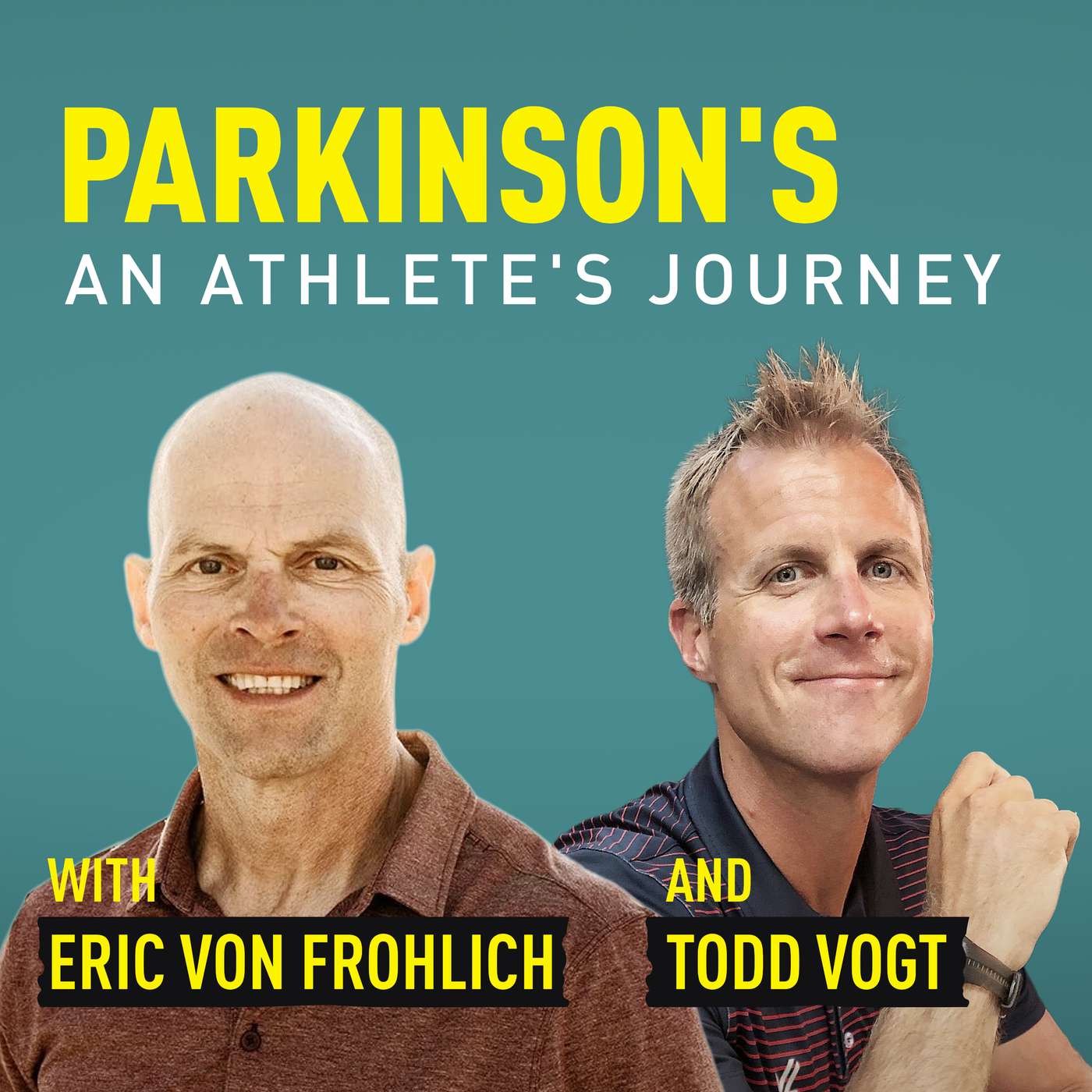
Parkinson's: An Athlete's Journey
by Eric Von Frohlich and Todd Vogt
Parkinson’s: An Athlete’s Journey is for athletes navigating Parkinson’s, the coaches and clinicians who train them, and anyone who wants real-world strategies for performance and longevity. Hosted by Eric Von Frohlich and Todd Vogt, the show focuses on tactical takeaways: how to train, recover, manage symptoms, and stay consistent when the rules keep changing. Expect honest conversations, tested routines, and guest experts who go deeper on what works.
-
20
Life Is Not a Sprint, It’s 100 Marathons | Larry Grogin
Larry Grogin is nearing the end of one of the most demanding endurance challenges imaginable: 100 marathons in 100 consecutive days.With only a few runs left, Eric catches up with Larry as he nears the end of a journey that has taken him more than 2,500 miles across the United States. What began as a challenge built around Parkinson’s, exercise, and possibility has become something more personal, more practical, and more revealing. Larry has learned what happens when the body hurts, the mind gets tired, the weather turns, and the road still has to be covered.In this conversation, Larry reflects on what the first 97 days have taught him about adaptation, support, medication, movement, and the mental tools that help him keep going. He talks about slow warm-ups, hard miles, music, nature, community, and the surprising strength that comes from doing the work day after day.Key Takeaways➡️ Hard days connect the easy days.Larry describes the rough stretches of the challenge as temporary, not permanent. Over 97 days, he learned that the bad miles, low-energy windows, and painful moments always shifted if he kept moving.➡️ Adaptation happens through repetition.The daily marathons forced Larry to respect slow warm-ups, listen to his body, and let his running improve through consistent use. By the end, he felt smoother, stronger, and more like a runner than when he started.➡️ Support made the challenge possible.Larry is clear that the run was not done alone. Sponsors, drivers, family, Parkinson’s groups, and strangers across the country helped carry the effort, reminding him that accepting help is part of endurance.➡️ The diagnosis is not the finish line.When speaking to newly diagnosed people, Larry’s message is direct: Parkinson’s changes things, but it does not mean life is over. Movement, community, and the willingness to try can still create a path forward.Key Moments00:31 Reconnecting with Larry Grogin near the end of 100 marathons in 100 days01:02 What the challenge taught him about pain, overuse, and time02:03 Tough days connect the easy days02:48 The 40% of dopamine-producing nerves still doing their job09:34 The support team behind the run10:31 Returning to the site of Larry’s first triathlon12:14 Medication consistency and changes during the challenge13:05 Why slow warm-ups became even more important14:22 Looking stronger at the end of each marathon15:32 Parkinson’s Warriors, Durango, and the power of community18:42 Learning to accept help21:45 Mental tools for hard miles: music, calls, nature, and birds25:25 The role of rhythm, music, and running cadence27:06 What Larry would tell someone newly diagnosed29:25 Running for people who think they cannot32:17 The people Larry met across the country37:19 What Larry would tell his 2019 self38:00 Learning that every downtime ends39:11 What an athlete’s mindset means after Parkinson’s41:41 “Larry is running for people who think they cannot, but they’ll try”Connect with Larry GroginStrides for Humanity / Run Larry Run: https://dpf.org/runlarryrunIG: @runlarryrun26Follow the journey: #RunLarryRunAbout the HostEric Von Frohlich is a fitness entrepreneur, coach, and athlete living with Parkinson's who founded EVF Performance and Row House before his diagnosis in 2020. On the podcast he talks with athletes, experts, and people refusing to let a diagnosis be the end of the story.Parkinson’s: An Athlete’s Journey📩 Join our Community: https://evfmethod.com/subscribe-to-podcast-community🎧 Listen and Subscribe: Parkinson's An Athlete's Journey🎬 Watch on YouTube: @parkinsonsathletepodcast📸 Instagram: @parkinsonsathletepodcast🤝 LinkedIn: Parkinson's An Athlete's Journey🌐 Website: www.evfmethod.comDisclaimerThis podcast shares personal experience and general education, not medical advice. Always talk with a qualified healthcare professional before making changes to medication, treatment, or exercise.
-
19
Find What Keeps You Moving | Ryan Cotton
Ryan Cotton has been part of Rock Steady Boxing since it was thirty boxers in an aerobics room.With more than 20 years of clinical experience and a Doctorate in Health Science, he joined as a board member before becoming Chief Scientific Officer and eventually President and CEO. When his father was diagnosed with Parkinson's, the work became personal.By then he already understood what the research said and what the gym floor proved: that people who keep moving do better, and that engaging with the disease early changes its trajectory.This episode covers what changes after a diagnosis and what helps people stay engaged in the life they still want to live. Exercise as daily medicine, building the right medical team, and the support systems that offer both understanding and accountability.Key Takeaways➡️ Exercise is part of the treatment plan, not an optional add-on.Ryan explains why consistent, moderate-to-high intensity exercise has become central to Parkinson’s care, with benefits that can show up physically, emotionally, and neurologically.➡️ The best exercise is the one you will keep doing.Boxing is one model, but Ryan is clear that movement can take many forms. Cycling, rowing, dancing, strength work, etc., or a mix of disciplines can all matter if they keep someone engaged.➡️ Community turns exercise into accountability.The gym becomes more than a place to train. It becomes a place where people compare notes, check on each other, offer encouragement, and sometimes give the push someone needs to keep going.➡️ Early action changes the experience of diagnosis.Ryan encourages newly diagnosed people to build the right team, take medication consistently, find their form of exercise, and surround themselves with support before isolation or apathy take over.Key Moments00:33 Ryan Cotton’s background and early involvement with Rock Steady Boxing02:33 When Parkinson’s became personal through Ryan’s father04:44 Why Ryan became a physical therapist06:22 How Rock Steady Boxing connected Ryan’s clinical work to Parkinson’s08:14 PT, OT, speech therapy, neurologists, and the team approach to Parkinson’s10:31 The “lottery no one wants to win” and the range of Parkinson’s symptoms11:31 What newly diagnosed people should focus on first13:52 Eric’s morning routine, mindset, breath work, and stackable wins18:39 Ryan’s path from board member to Chief Scientific Officer to CEO22:50 The early growth of Rock Steady Boxing24:20 Why exercise matters so much for Parkinson’s26:58 Physical, emotional, and neurological benefits of consistent exercise28:29 Apathy, dopamine, and finding exercise you actually enjoy32:07 Social and emotional transformation through Rock Steady Boxing33:36 Accountability, support, and peer-to-peer knowledge in the gym35:38 A retired Marine’s shift from isolation to a half marathon38:13 Why some people become thankful for what diagnosis brought into their life40:17 Reflections from the World Parkinson’s Congress41:19 Scaling Rock Steady Boxing while protecting the mission46:22 Exercise collaboration across the Parkinson’s community49:23 Ryan’s definition of resilienceConnect with RyanLinkedIn: Ryan CottonInstagram: @rock_steady_boxingWebsite: www.rocksteadyboxing.orgAbout the HostEric Von Frohlich is a fitness entrepreneur, coach, and athlete living with Parkinson's who founded EVF Performance and Row House before his diagnosis in 2020. On the podcast he talks with athletes, experts, and people refusing to let a diagnosis be the end of the story.Parkinson’s: An Athlete’s Journey📩 Join our Community: https://evfmethod.com/subscribe-to-podcast-community🎧 Listen and Subscribe: Parkinson's An Athlete's Journey🎬 Watch on YouTube: @parkinsonsathletepodcast📸 Instagram: @parkinsonsathletepodcast🤝 LinkedIn: Parkinson's An Athlete's Journey🌐 Website: www.evfmethod.comDisclaimerThis podcast shares personal experience and general education, not medical advice. Always talk with a qualified healthcare professional before making changes to medication, treatment, or exercise.
-
18
Challenge the Body Enough to Adapt | Jorge Quintero
Jorge Quintero’s work with Parkinson’s began in the operating room.As an electrical engineer working in neurotechnology, he supported deep brain stimulation surgeries and watched people with severe tremors experience immediate changes once stimulation was turned on. That experience led him deeper into clinical neuroscience and into a question that now shapes much of his work: how much can the brain change when it is trained with the right demands?Jorge is now a clinical neuroscientist, NASM certified personal trainer, and founder of NeuroGym, an athletics gym built around mental health and brain performance. His approach blends neuroscience, fitness, and practical movement training for people dealing with brain conditions, including Parkinson’s.Eric and Jorge explore what Parkinson’s changes in the brain and body, and why varied, athletic training can help people keep building capacity after diagnosis. They get into deep brain stimulation, neuroplasticity, cognitive reserve, proprioception, progressive muscle relaxation, rope flow, learned helplessness, and the value of doing things that are challenging enough to wake the system up.Key Takeaways➡️ The brain needs challenge to keep adapting.Jorge returns to neuroplasticity throughout the conversation, especially the idea that the brain can keep changing when it is asked to learn, coordinate, remember, balance, and move in new ways.➡️ Parkinson’s training has to go beyond cardio and strength.Eric and Jorge talk about the value of varied athletic training, including balance, footwork, proprioception, reaction, rope flow, cognitive load, and skills that keep the body solving problems.➡️ Confidence is part of movement.Freezing, shuffling, and hesitation are connected to how clearly the brain reads the body and the environment. Better sensory input, balance work, and body awareness can help rebuild trust in movement.➡️ Learned helplessness can shape the diagnosis experience.Jorge and Eric discuss how quickly people can begin living inside the limits they expect. The conversation pushes toward action, curiosity, social connection, and training that gives people evidence they can still adapt.Key Moments00:50 Jorge’s background in engineering, neuroscience, DBS, NeuroGym, and Parkinson Power Protocol03:24 What deep brain stimulation is and when it becomes an option04:25 Seeing tremor suppressed during DBS surgery07:42 Current treatment options and adaptive deep brain stimulation09:06 Stem cell therapy, bemdaneprocel, and the exPDite trial10:45 Cognitive reserve, neuroplasticity, and proactive brain health16:04 Neuroplasticity as a double-edged sword20:41 Feet, gait, freezing, and the brain’s body map23:20 Balance as a neurological task: proprioception, vision, and vestibular input27:09 Why athletic, multimodal training matters for Parkinson’s29:42 Why Jorge started NeuroGym32:06 Learned helplessness and the diagnosis mindset33:42 Breath work, interoception, and progressive muscle relaxation36:23 Rope flow, spatial awareness, proprioception, and coordination38:25 Motor reserve and why adults need more movement variety43:58 Self-directed neuroplasticity and living well with Parkinson’s44:17 Group exercise, social engagement, and brain health45:29 Jiu-jitsu, pickleball, and building motor reserve through sport49:44 Cognitive load through memory, reaction, and coordination drills52:43 Intensity, lactate, and the brain benefits of exercise56:33 What newly diagnosed people should understand about adaptability58:30 Parkinson’s as a movement disorder and why movement remains essential59:34 How to connect with Jorge and NeuroGymConnect with JorgeLinkedIn: Jorge QuinteroWebsite: https://theneurogym.orgInstagram: @theneurogymYouTube: @theneurogymAbout the HostEric Von Frohlich is a fitness entrepreneur, coach, and athlete living with Parkinson's who founded EVF Performance and Row House before his diagnosis in 2020. On the podcast he talks with athletes, experts, and people refusing to let a diagnosis be the end of the story.Parkinson’s: An Athlete’s Journey📩 Join our Community: https://evfmethod.com/subscribe-to-podcast-community🎧 Listen and Subscribe: Parkinson's An Athlete's Journey🎬 Watch on YouTube: @parkinsonsathletepodcast📸 Instagram: @parkinsonsathletepodcast🤝 LinkedIn: Parkinson's An Athlete's Journey🌐 Website: www.evfmethod.comDisclaimerThis podcast shares personal experience and general education, not medical advice. Always talk with a qualified healthcare professional before making changes to medication, treatment, or exercise.
-
17
The Brain Has to Get the Memo | Garrett Salpeter
Garrett Salpeter’s work began with a personal injury and a question that stayed with him: why did recovery often feel so limited?As a hockey player and engineering student, he became interested in the nervous system, direct current stimulation, and the ways the body responds after injury. That path eventually led him to found NeuFit, where his work focuses on helping people improve movement, recovery, activation, and function by working directly with the nervous system.His work has extended beyond sports performance into neurological conditions, including early research on how NeuFit treatments affect sleep quality in people with Parkinson's.Garrett joins Eric to talk about neuroplasticity, recovery, performance, and direct current stimulation. They also discuss autonomic function, the nervous system's role in movement, and what it means to create enough input to maintain or rebuild capacity over time.Key Takeaways➡️ The nervous system sits at the center of movement.Garrett explains how recovery, activation, coordination, and performance all depend on the signals moving between the brain and body.➡️ Neuroplasticity depends on repeated input.Creating change requires enough stimulation, repetition, and consistency for the nervous system to recognize which pathways are worth maintaining or rebuilding.➡️ Recovery and performance are closely connected.Good rehab and good performance training often share the same goals: restore movement patterns, address weak links, load tissues well, and build capacity over time.➡️ Sleep and autonomic function matter for Parkinson’s.Garrett and Eric discuss sleep disruption, recovery, parasympathetic function, and early research exploring NeuFit treatments and sleep quality in people with Parkinson’s.Key Moments00:00 Garrett’s background in hockey, injury, and recovery04:21 Early patient work and major turning points05:20 Spinal cord injury, neuroplasticity, and learning to walk again08:18 The impact of helping one person09:24 Fascia, direct current, and the nervous system16:42 The brain-body connection goes both ways18:40 Eric on morning symptoms, mindset, and Parkinson’s20:34 MS, neuropathy, and neurological case work23:01 Diabetic peripheral neuropathy and nerve function25:46 Early Parkinson’s sleep quality research26:43 Sleep, recovery, autophagy, and brain cleanup28:10 Parkinson’s research, Phoenix, and Linda Denny29:41 Neuroplasticity and how the nervous system adapts31:36 Habits, repetition, and building new pathways33:49 Creating enough input for the nervous system36:28 Recovery, activation, and performance37:24 Vagus nerve, parasympathetic function, and autonomic reset41:11 What gives Garrett hope44:13 Recovery and performance as overlapping worldsConnect with GarrettLinkedIn: Garret SalpeterInstagram: @neufitrfpYouTube: @NeufitWebsite: www.neu.fit.comAbout the HostEric Von Frohlich is a fitness entrepreneur, coach, and athlete living with Parkinson's who founded EVF Performance and Row House before his diagnosis in 2020. On the podcast he talks with athletes, experts, and people refusing to let a diagnosis be the end of the story.Parkinson's: An Athlete's Journey📩 Join our Community: https://evfmethod.com/subscribe-to-podcast-community🎧 Listen and Subscribe: Parkinson's An Athlete's Journey🎬 Watch on YouTube: @parkinsonsathletepodcast📸 Instagram: @parkinsonsathletepodcast🤝 LinkedIn: Parkinson's An Athlete's Journey🌐 Website: www.evfmethod.comDisclaimerThis podcast shares personal experience and general education, not medical advice. Always talk with a qualified healthcare professional before making changes to medication, treatment, or exercise.
-
16
100 Marathons, 100 Days, and a Honda Odyssey Named Herbie | Larry Grogin
Larry Grogin is halfway through running 100 marathons in 100 consecutive days.He started in New Jersey on March 24 and is making his way toward Southern California as part of Strides for Humanity, a run raising awareness and support for people living with Parkinson’s. Each day starts with the same challenge: cover 26.2 miles, manage what Parkinson’s brings, and get up the next morning to do it again.Larry has spent decades around movement as a chiropractor, acupuncturist, and endurance athlete, having completed more than 300 marathons and 30 Ironman triathlons. Having been diagnosed in 2019 with Parkinson's, he marked his 71st birthday with the start of his run to show what movement can still look like after diagnosis.He talks about the long warmups, the moments when his stride has to shorten, and the people along the road who help him keep going. At the center of the run is a simple hope: that someone sees what he is doing and decides to walk a mile, get out of bed, or do a little more than they thought they could.Key Takeaways➡️ Movement starts before the miles do.Larry spends hours warming up before his body begins to feel available. The early work is patience, rhythm, and staying with it long enough to get moving.➡️ Adaptation can be small and practical.When his body resists, Larry shortens his stride, changes the pace, or gives himself time to rest. The goal is to keep moving in a way his body can handle.➡️ One person moving can help someone else start.Larry wants people with Parkinson’s to see the run and try something of their own. That might mean walking, running, getting out of bed, or doing a little more than yesterday.➡️ Past challenges become tools.Larry draws on decades of marathons, triathlons, and difficult races. Those experiences remind him that hard moments shift, and the next mile can feel different from the last.Key Moments01:43 Eric introduces Larry and his 100 marathons in 100 days challenge02:49 Larry’s athletic background and getting into triathlon04:36 Living with Parkinson’s instead of trying to beat it06:38 The first signs of Parkinson’s and getting diagnosed in 201908:06 Why exercise can be hard to start with Parkinson’s08:35 Larry’s long warmups and what running every day is teaching him14:09 Why Larry decided to run 100 marathons in 100 days15:52 What happens when the body says no17:39 Running 100 consecutive marathons and reaching day 5019:23 Lessons from long endurance races21:19 Purpose, resilience, and the human spirit28:47 The route, the support vehicle, and how Larry chooses places to run30:05 Learning his off times and when to stop fighting the body31:18 Medication, exercise, and managing Parkinson’s day to day33:32 What 50 straight marathons have taught him about adaptation36:35 Planning the finish in Calabasas38:23 Larry’s message for someone newly diagnosed with Parkinson’s43:58 Dreaming big and refusing to limit the goal too early45:01 The hard moments behind the optimismLarry Grogin:Strides for Humanity / Run Larry Run: https://dpf.org/runlarryrunIG: @runlarryrun26Follow the journey: #RunLarryRunAbout the Host:Eric Von Frohlich is a fitness entrepreneur, coach, and athlete living with Parkinson's who founded EVF Performance and Row House before his diagnosis in 2020. On the podcast he talks with athletes, experts, and people refusing to let a diagnosis be the end of the story.Parkinson's: An Athlete's Journey📩 Join our Community: https://evfmethod.com/subscribe-to-podcast-community🎧 Listen and Subscribe: Parkinson's An Athlete's Journey🎬 Watch on YouTube: @parkinsonsathletepodcast📸 Instagram: @parkinsonsathletepodcast🤝 LinkedIn: Parkinson's An Athlete's Journey🌐 Website: www.evfmethod.comDisclaimerThis podcast shares personal experience and general education, not medical advice. Always talk with a qualified healthcare professional before making changes to medication, treatment, or exercise.
-
15
You Are Not Fragile | Gaia Forlani
Before Gaia Forlani became a neuroscientist, she was a professional ballerina.Ballet gave her a direct understanding of movement at a high level: control, rhythm, timing, strength, coordination, and the constant feedback between the brain and the body.That background still shapes how she sees Parkinson’s.Today, she works at the intersection of neuroscience, coaching, and Parkinson’s performance, helping people think differently about movement, training, and identity after diagnosis.Eric and Gaia talk about why so many people with Parkinson’s are treated as fragile, even when they are strong, capable, and willing to train.They also get into purposeful training, recovery, sleep, overtraining, cognition, and the difficult overlap between Parkinson’s and aging.Key Takeaways➡️ People with Parkinson’s are not fragile.Gaia challenges the way people with Parkinson’s are often treated as passive, incapable, or already declining, especially when many are still strong, capable, and willing to train.➡️ Training needs purpose, not just effort.Eric and Gaia separate general activity from purposeful training, including strength, power, coordination, and movement that is matched to the person’s goals and capacity.➡️ Recovery is part of performance.More exercise is not always better. Gaia and Eric talk about sleep, recovery, overtraining, and why athletes with Parkinson’s need to take rest as seriously as training.➡️ Identity shapes how people adapt.The language people use around Parkinson’s matters. Gaia talks about seeing people as athletes rather than patients, while also recognizing that the constant “fight” mindset can become exhausting.Key Moments00:01 — Eric asks about Gaia’s “You Are Not Fragile” message00:22 — Why Gaia pushes back on people with Parkinson’s being treated as fragile03:15 — Eric reflects on mindset, gratitude, and not feeling like a victim05:34 — Gaia’s path from ballerina to neuroscientist10:32 — How ballet shaped Gaia’s understanding of the brain and body12:46 — Treating the whole person as an athlete13:00 — Language, identity, and not calling people with Parkinson’s patients13:56 — Sleep, recovery, and neurological regulation14:55 — The risk of doing too much after diagnosis17:28 — When exercise becomes harmful without the right foundation18:44 — General movement versus exercise medicine20:27 — Cognition, strength training, and metabolic health23:25 — Aging versus Parkinson’s symptoms24:53 — Muscle loss, strength, power, and bradykinesia28:34 — Looking at the person before the diagnosis29:15 — Training professionals to understand Parkinson’s movement31:01 — Gaia’s work moving online and reaching a wider audience32:02 — Coaching as a two-way learning process32:34 — Eric compares Parkinson’s adaptation to jiu-jitsu34:20 — Why the “fight” against Parkinson’s can be motivating but also exhausting36:16 — Eric on balancing jiu-jitsu, pickleball, recovery, and downtime37:00 — Education, family support, and the social side of Parkinson’s38:38 — Beliefs, mindset, and defining your own story39:53 — Eric on small wins, daily resets, and moving forwardAbout Gaia Forlani:Gaia is a neuroscientist specializing in sensorimotor, clinical, and movement neuroscience. A former professional ballerina, she brings together movement science, coaching, and performance experience in her work with people living with Parkinson’s. She is the co-founder of the Parkinson Performance Centre and creator of the Parkinson Power Protocol.Connect with Gaia:Website: http://parkinsonperformancecentre.com/LinkedIn: Gaia ForlaniInstagram: gaia.forlani.ppcFacebook: Gaia ForlaniParkinson's: An Athlete's Journey📩 Join our Community: https://evfmethod.com/subscribe-to-podcast-community🎧 Listen and Subscribe: Parkinson's An Athlete's Journey🎬 Watch on YouTube: @parkinsonsathletepodcast📸 Instagram: @parkinsonsathletepodcast🤝 LinkedIn: Parkinson's An Athlete's Journey🌐 Website: www.evfmethod.comDisclaimerThis podcast shares personal experience and general education, not medical advice. Always talk with a qualified healthcare professional before making changes to medication, treatment, or exercise.
-
14
Ankle Weights and Stackable Wins | Jay Freyensee
Jay Freyensee has always moved through life as an athlete.Cycling, mountain biking, martial arts, Muay Thai, cross-country skiing, running, and Spartan-style events have all shaped how he understands effort, progress, and identity. His athletic life has never been about one discipline. It has been about staying active, learning what a sport asks of him, and finding the next way to challenge himself.After being diagnosed with Parkinson’s in his late 40s, Jay had to rethink what it meant to stay competitive and keep trusting his body.Kickboxing remains a key part of his training because it demands power, speed, coordination, reaction, and focus in the same session. He runs with ankle weights to help reinforce his gait, keeps strength work in the week, and uses races like Spartan DECA as a reason to keep building.Jay gets into his diagnosis, adaptation, clinical trials, support groups, and the importance of finding people who understand young-onset Parkinson’s. He also shares what he would tell someone newly diagnosed: get tested, stay close to the research, keep exercising, and do not try to handle it alone.Key Takeaways➡️ Training became the anchor after diagnosis.Exercise shifted from athletic routine to daily structure, giving him a way to stay capable, measure progress, and keep fighting back.➡️ Adaptation became part of the athlete’s job.Jay uses tools like ankle weights, kickboxing, strength training, and Spartan DECA goals to keep challenging his body while adjusting to what Parkinson’s changes.➡️ Community made the diagnosis easier to carry.Finding people who understood young-onset Parkinson’s gave Jay support, perspective, and a place where he did not have to explain every part of the experience.➡️ Newly diagnosed people need action, testing, and connection.Jay encourages genetic testing, staying aware of clinical trials, continuing to exercise, and telling trusted people instead of trying to carry the diagnosis alone.Key Moments:00:45 — Jay’s athletic background and competitive history03:30 — Training Muay Thai in Thailand07:20 — First signs of gait changes08:16 — Foot cramping during runs10:36 — Receiving the Parkinson’s diagnosis11:52 — Searching for better information after diagnosis14:34 — Jay’s weekly training routine14:55 — Running with ankle weights16:34 — Spartan DECA as a training target18:36 — Young-onset Parkinson’s and work19:00 — Hand function, typing, and career change21:52 — Navigating disability and insurance31:22 — Presence, breathing, and mindset36:52 — Clinical trials and future treatments41:28 — Genetic testing and advice for newly diagnosed people43:46 — Sharing the diagnosis with community44:46 — Parkinson’s, identity, and athletic confidence48:47 — Finding support from people who understandConnect with JayLinkedIn: https://www.linkedin.com/in/james-jay-freyensee-6193a7/Instagram: https://www.instagram.com/freyguys_redlines/About the HostsEric Von Frohlich and Todd Vogt are athletes living with Parkinson’s, sharing the day to day reality of training, adapting, and figuring it out as they go. Through honest conversations, they explore what helps, what does not, and how to keep moving forward with purpose.Follow / Connect📩 Join our Community: https://evfmethod.com/subscribe-to-podcast-community🎧 Listen and Subscribe: Parkinson's An Athlete's Journey🎬 Watch on YouTube: @parkinsonsathletepodcast📸 Instagram: @parkinsonsathletepodcast🤝 LinkedIn: Parkinson's An Athlete's Journey🌐 Website: www.evfmethod.comDisclaimerThis podcast shares personal experience and general education, not medical advice. Always talk with a qualified healthcare professional before making changes to medication, treatment, or exercise.
-
13
From Diagnosis to Saying It Out Loud | Jeff Martin
Jeff Martin helped shape what group fitness looks like today.Over nearly five decades, he built one of the early studio environments in New York City where people trained together, showed up consistently, and stayed connected to the work. That model spread, and companies like Equinox and Crunch grew out of foundations that started in studios like his.For 47 years, Jeff has been teaching classes. Tens of thousands of sessions. Movement has been a daily part of how he lives and works.He is now sharing publicly for the first time that he has Parkinson’s.In this conversation, Jeff speaks about his diagnosis, the hesitation around saying it out loud, and what shifted once he did. He reflects on how his relationship with training has changed, why exercise has become non-negotiable, and how he is adjusting to changes that show up day to day.While his experience with Parkinson’s is still new, he is actively working through it in real time and beginning to open up to others while continuing to train.Key Moments:00:32 — Reconnecting and Jeff’s background in NYC fitness02:18 — First public disclosure of Parkinson’s diagnosis02:47 — Early symptoms and initial misdiagnosis03:25 — Receiving the diagnosis04:26 — Hesitation around engaging with the Parkinson’s community06:13 — Humility and asking for help06:44 — Changes in daily behavior and awareness13:00 — Lifestyle shifts and consistency with exercise17:15 — Processing the diagnosis and perspective shifts19:30 — Changes in social life and routine21:08 — Decision to share publicly23:57 — Redefining strength and showing up28:58 — Managing outside advice and information32:00 — Training, coordination, and staying active36:08 — What he continues to hold ontoConnect with Jeff:Website: https://jeffmartinfitness.comAbout the HostsEric Von Frohlich and Todd Vogt are athletes living with Parkinson’s, sharing the day to day reality of training, adapting, and figuring it out as they go. Through honest conversations, they explore what helps, what does not, and how to keep moving forward with purpose.Follow / Connect📩 Join our Community: https://evfmethod.com/subscribe-to-podcast-community🎧 Listen and Subscribe: Parkinson's An Athlete's Journey🎬 Watch on YouTube: @parkinsonsathletepodcast📸 Instagram: @parkinsonsathletepodcast🤝 LinkedIn: Parkinson's An Athlete's Journey🌐 Website: www.evfmethod.comDisclaimerThis podcast shares personal experience and general education, not medical advice. Always talk with a qualified healthcare professional before making changes to medication, treatment, or exercise.
-
12
Stacked Days Add Up | Greg Schaefer
Greg Schaefer is used to long races. Kona, Ironman, and years of knowing what his body could do.When that started to change, he noticed.In 2023, he was diagnosed with Young-Onset Parkinson’s. He still trains and races, but the approach is different, and some days require more adjustment than others.He speaks openly about the days when he pulls back, when patience runs thin, and when the mental side is harder than anything physical. He also talks about what helps. Structure, training partners, and having someone waiting for you at 7 a.m. so you actually show up.Greg is clear about his “why.” Being present for his wife. Setting an example for his kids. Showing them what it looks like to keep going, even when things aren’t going well.What comes through is how he keeps showing up, and how those days, one at a time, still stack up.Key Takeaways:➡️ You can’t rely on motivation to carry you.When someone’s expecting you at a set time, you show up. That structure matters more than how you feel that day.➡️ Your reason has to be specific.For Greg, it’s his wife and his kids, and that’s who he shows up for every day.➡️ Some days just aren’t there.Energy, movement, focus, they don’t always line up. Learning to recognize that without turning it into failure is part of it.➡️ Adjusting is part of staying in it.The training is still there, but the expectations shift. Showing up and finishing start to matter more than performance.➡️ Over time, those days stack.Not every day is strong, but the consistency builds when you keep showing up across all of them.Key Moments:01:40 — Realizing something was off during Kona preparation02:39 — Finishing Kona hours later than expected05:38 — Diagnosis in March 202309:11 — Training changes and adjusting expectations10:48 — First race back and a different experience of racing13:41 — “What you do during the calm…”16:17 — The idea of “stacked days”23:09 — Daily routine and disrupted sleep29:49 — Managing good days and bad days35:51 — Accountability and training with others37:08 — Starting the Forward Motion Fund41:08 — The role of caregiversAbout Greg SchaeferGreg Schaefer is a 19-time Ironman athlete, entrepreneur, and keynote speaker living with Young-Onset Parkinson’s disease. Diagnosed in 2023, Greg continues to train and compete, while managing the day-to-day realities of the condition.He shares his journey publicly and co-founded the Forward Motion Fund with his wife to support families affected by Parkinson’s and contribute to research and awareness.Connect with GregInstagram: @gschaeferundefinedFacebook: GSchaeferDefinedLinkedIn: linkedin.com/in/gregory-schaeferAbout the Forward Motion Fund: https://gregoryschaefer.com/forward-motion-fund/About the HostsEric Von Frohlich and Todd Vogt are athletes living with Parkinson’s, sharing the day to day reality of training, adapting, and figuring it out as they go. Through honest conversations, they explore what helps, what does not, and how to keep moving forward with purpose.Follow / Connect📩 Join our Community: https://evfmethod.com/subscribe-to-podcast-community🎧 Listen and Subscribe: Parkinson's An Athlete's Journey🎬 Watch on YouTube: @parkinsonsathletepodcast📸 Instagram: @parkinsonsathletepodcast🤝 LinkedIn: Parkinson's An Athlete's Journey🌐 Website: www.evfmethod.comDisclaimerThis podcast shares personal experience and general education, not medical advice. Always talk with a qualified healthcare professional before making changes to medication, treatment, or exercise.
-
11
Trying to Run Again (And Hitting the Same Wall)
Eric and Todd check in on training, setbacks, and where things are at right now.Eric shares how rethinking his heart rate approach has allowed him to start pushing intensity again. Todd talks through the cycle of trying to return to running and encountering the same knee issue tied to motor control on his left side.They also touch on the early phase of Parkinson's after diagnosis, when you're still training, still functioning, and it doesn't always feel as serious as you expected.Along the way, they reflect on recent conversations with other athletes living with Parkinson’s and how similar many of those early experiences can be.Key Takeaways➡️ You can keep pushing and get the same result every time.Trying to run again keeps ending the same way, which means something else has to change.➡️ Early on, it doesn’t always feel as serious as you expected.When you’re still training and functioning well, it’s easy to think things might stay that way.➡️ Physical training is only part of it.Mindset and the people around you play just as big a role as what you’re doing physically.Key Moments00:00 – Training updates and current routines02:30 – Running setbacks and knee issues05:30 – Reflections since starting the podcast06:30 – Early diagnosis experiences08:30 – The early phase and shifting expectations10:00 – Adjusting training vs pushing through11:30 – Mental side and communityAbout the HostsEric Von Frohlich and Todd Vogt are athletes living with Parkinson’s, sharing the day to day reality of training, adapting, and figuring it out as they go. Through honest conversations, they explore what helps, what does not, and how to keep moving forward with purpose.Follow / Connect📩 Join our Community: https://evfmethod.com/subscribe-to-podcast-community🎧 Listen and Subscribe: Parkinson's An Athlete's Journey🎬 Watch on YouTube: @parkinsonsathletepodcast📸 Instagram: @parkinsonsathletepodcast🤝 LinkedIn: Parkinson's An Athlete's Journey🌐 Website: www.evfmethod.comDisclaimerThis podcast shares personal experience and general education, not medical advice. Always talk with a qualified healthcare professional before making changes to medication, treatment, or exercise.
-
10
How a Birthday Challenge Became a $43M Mission for Parkinson’s | Patrick Morrissey and Brendan Cusick
Brendan Cusick wanted to do something big for his 50th birthday.That idea led him to ocean rowing, a four-man team, and eventually a 2,800-mile row from Monterey to Kauai. Patrick Morrissey came into the picture as Brendan’s friend, a fellow endurance-minded athlete, and someone recently diagnosed with Parkinson’s who initially thought he might help as a spokesperson. A couple months later, he was on the team.Eric and Todd talk with Patrick and Brendan about how the team came together, what the row asked of them physically and mentally, and how the mission took on a life beyond the boat.They get into seasickness, sleep deprivation, medication, teamwork, and the growing sense that the crossing was no longer just about finishing in Hawaii. It had become something much larger, with families, supporters, and the Parkinson’s community invested in every mile.What You’ll HearHow Brendan’s birthday challenge turned into a Pacific crossingHow Patrick went from possible spokesperson to full team memberWhat the row demanded physically and mentally once they were out thereHow the team handled sleep deprivation, stress, and the daily rhythm of the boatHow the mission grew into something bigger than the four men rowingHow support from family, followers, and the Parkinson’s community became part of the effortKey Takeaways➡️ The row became bigger than the original plan.What started as a bold challenge between friends grew into a major fundraising effort for Parkinson’s research.➡️ Teamwork carried the mission.The crossing depended on trust, honesty, and knowing when one person needed the others to step in.➡️ Endurance is not only physical.A huge part of this episode is what sleep loss, stress, and uncertainty do to the mind over time.➡️ Community changed the experience.The people following along from home gave the team something bigger to pull for.➡️ Parkinson’s should not shrink the picture of what is possible.Patrick’s story pushed back on the idea that a diagnosis puts someone in a small box.Key Moments00:31 — Introduction to Patrick, Brendan, and the scale of the row02:32 — How the team came together08:20 — Patrick’s diagnosis, early involvement, and saying yes to the boat12:59 — What training looked like leading into the row14:18 — Two hours on, two hours off, and the reality of sleep21:39 — The first week, big water, blisters, seasickness, and mental stress28:40 — Finding rhythm after two difficult weeks31:13 — The para anchor moment and realizing the row was bigger than the four of them39:30 — Support from the Parkinson’s community and what it meant mid-row42:35 — Landing in Hawaii and being met by family and the local Parkinson’s community44:54 — Post-expedition blues, recovery, and what came next48:16 — The next Human Powered Potential expedition49:53 — Raising $43 million for The Michael J. Fox Foundation54:08 — Race placement and redefining what an athlete with Parkinson’s can look likeAbout the GuestsPatrick Morrissey and Brendan Cusick are endurance athletes and co-founders of Human Powered Potential. In 2024, they were part of the four-man team that rowed 2,800 miles across the Pacific from California to Hawaii in 41 days, raising $43 million for The Michael J. Fox Foundation. Patrick, who lives with Parkinson’s, became the first person diagnosed with the disease to row the Pacific. Today, they continue that work through Human Powered Potential, building endurance events that raise funds for Parkinson’s research and challenge assumptions about what’s possible.Learn more about Human Powered PotentialInstagram: https://www.instagram.com/humanpoweredpotentialFacebook: https://www.facebook.com/humanpoweredpotentialAbout the HostsEric Von Frohlich and Todd Vogt are athletes living with Parkinson’s, sharing the day-to-day reality of training, adapting, and figuring it out as they go. Through honest conversations, they explore what helps, what does not, and how to keep moving forward with purpose.Follow / Connect📩 Join our Community: https://evfmethod.com/subscribe-to-podcast-community🎧 Listen and Subscribe: Parkinson's An Athlete's Journey🎬 Watch on YouTube: @parkinsonsathletepodcast📸 Instagram: @parkinsonsathletepodcast🤝 LinkedIn: Parkinson's An Athlete's Journey🌐 Website: www.evfmethod.comDisclaimerThis podcast shares personal experience and general education, not medical advice. Always talk with a qualified healthcare professional before making changes to medication, treatment, or exercise.
-
9
You Don’t Conquer the Mountain in a Day | Mike McCastle
Mike McCastle doesn’t talk about strength the way most people do.His definition of strength was shaped by watching his dad live with Parkinson’s. Watching the effort, patience, and composure it took to get through everyday moments most people barely think about.That stayed with him.It also inspired the Twelve Labors Project, Mike’s mission to take on a series of extreme endurance and strength challenges in honor of his father’s life with Parkinson’s.The scale of it is hard to miss. World records. Long efforts. Hard things stacked on hard things.But Mike does not talk about those efforts like stunts. He talks about them as a way to honor what he saw his father carry for years.Eric and Todd talk with Mike about endurance, failure, and how quickly a challenge can feel too big when your mind gets out ahead of you. They get into a failed pull-up world record attempt, what it took to come back from it, and the habit of breaking hard things down before they swallow you whole.You do not conquer the mountain in a day.You win the morning. You take the next step. You stay with what is in front of you.That applies to training. It applies to Parkinson’s. It applies to any stretch where progress is uneven and your body or mind is not cooperating.What You’ll HearWhy Mike built the Twelve Labors Project around his father’s experience with Parkinson’sWhat failure taught him after a pull-up record attempt fell apartWhy “win the morning” is more useful than thinking too far aheadHow he handles bad training days without turning them into zero daysWhat he learned from watching his dad carry himself in publicWhy community matters, even for athletes who are used to doing hard things aloneKey Takeaways➡️ You don’t conquer the mountain in a day.Big things get handled in small pieces. The next step matters more than the full picture.➡️ Strength shows up in the response.Not when things are easy. When they’re slow, frustrating, or out of your control.➡️ Resilience can be trained.Through repetition, pressure, and learning how to stay with the moment.➡️ Bad days still count.Doing something is different than doing nothing.Key Moments00:00 — Introduction00:30 — The Twelve Labors Project and where it came from02:00 — Parkinson’s, fatherhood, and what kids absorb03:00 — First labor: 50K with a weighted pack04:30 — “Win the morning”07:00 — Failed pull-up world record attempt08:30 — “The brain is a liar”10:30 — Staying in the moment under pressure21:00 — Completing a labor after his father passed22:00 — The bank story24:00 — Caretaking as a teenager26:30 — Fatherhood and example38:00 — What to do on bad days45:00 — Community and support49:30 — Closing reflectionsAbout the GuestMike McCastle is a U.S. Navy veteran, 7-time world record-setting endurance athlete, and founder of the Twelve Labors Project, a long-running mission built around extreme feats of strength and endurance.He has a background in sport psychology and works as a mental strength coach, personal trainer, USA Weightlifting coach, and Rock Steady Boxing coach. His work focuses on helping people build physical capacity and mental durability under pressure.The Twelve Labors Project was inspired in part by his father’s experience with Parkinson’s, and that connection runs through the way Mike thinks about resilience, discipline, and what strength actually looks like.Follow / ConnectInstagram: @mikemccastleFacebook: https://www.facebook.com/michael.mccastleLinkedIn: https://www.linkedin.com/in/mikemccastleAbout the HostsTodd Vogt and Eric Von Frohlich are athletes living with Parkinson’s who share what they’re learning in real time: what helps, what doesn’t, and how to keep adapting.Follow / Connect📩 Join our Community: https://evfmethod.com/subscribe-to-podcast-community🎧 Listen and Subscribe: Parkinson's An Athlete's Journey🎬 Watch on YouTube: @parkinsonsathletepodcast📸 Instagram: @parkinsonsathletepodcast🤝 LinkedIn: Parkinson's An Athlete's Journey🌐 Website: www.evfmethod.comDisclaimerThis podcast shares personal experience and general education, not medical advice. Always talk with a qualified healthcare professional before making changes to medication, treatment, or exercise.
-
8
There Are No Shortcuts with Parkinson’s | Jimmy Choi
Jimmy Choi is known for doing things most people do not associate with Parkinson’s. Ultramarathons. Triathlons. American Ninja Warrior. World records.What comes through in this conversation is everything underneath that.Jimmy talks openly about the years after his diagnosis, when depression, apathy, and anger took over. He shares the reality of trying to live with a progressive disease, and the slow, unglamorous work of changing his life over time.Eric and Todd talk with Jimmy about exercise, mental health, medication, daily routines, and why he believes there are no shortcuts to living well with Parkinson’s. They also get into the gap between what people see from the outside and what it actually takes to manage this disease day after day.➡️ Content note: This conversation includes discussion of depression, suicide, and the mental health side of Parkinson’s. We’re grateful to Jimmy for speaking so openly. Please take care while listening and reach out for support if needed.Key Takeaways:The mental side of Parkinson’s can be as hard as the physical side. Jimmy speaks candidly about depression, apathy, and the importance of getting help and talking more openly about mental health, especially for men.There are no shortcuts. Jimmy has a clear message for people looking for a quick fix. Learn your body. Track what helps. Pay attention to medication, food, exercise, and recovery. Put in the work over time.What people see is only part of it. Jimmy is open about the difference between how he functions on medication and how hard he has worked to build routines around movement, nutrition, and training.Key Moments:00:00 — Introduction01:15 — Jimmy’s diagnosis and athletic accomplishments04:00 — Early symptoms and Young-Onset Parkinson’s07:00 — Family, relationships, and life after diagnosis08:40 — Mental health, depression, and turning points16:00 — Parkinson’s as an endurance event23:00 — Identity, perspective, and personal growth27:00 — The moment that sparked lifestyle change29:30 — The 10% rule and building momentum31:30 — Training for American Ninja Warrior35:00 — Showing what’s possible with Parkinson’s39:00 — Medication tracking and personal routines46:00 — Rigidity, dystonia, and daily variability50:30 — A day in Jimmy’s life with Parkinson’s55:00 — Why there are no shortcuts1:03:00 — Mental health and community supportAbout the Guest:Jimmy Choi is an endurance athlete, Guinness World Records title holder, and one of the most recognizable athlete-advocates in the Parkinson’s community. Diagnosed with Young-Onset Parkinson’s disease in 2003 at age 27, Jimmy spent years in denial before a wake-up call in 2010 pushed him to fully overhaul his lifestyle and commit to the work of living well with Parkinson’s. At the time, he was walking with a cane and weighed 250 pounds.Since then, Jimmy has become a competitive ultramarathoner, cyclist, and triathlete. He was the first person with Parkinson’s on record to complete a 100-mile bike ride in under five hours and has competed on multiple seasons of NBC’s American Ninja Warrior. He uses his platform to challenge assumptions about what’s possible with Parkinson’s while remaining honest about the realities of both on and off days.Beyond performance, Jimmy is deeply committed to advocacy and research. He has participated in clinical trials, supports fundraising efforts through Team Fox and The Michael J. Fox Foundation, and serves in advisory roles within the Parkinson’s community.Connect with Jimmy:Instagram: https://www.instagram.com/jcfoxninjaAbout the Hosts:Eric Von Frohlich and Todd Vogt are athletes living with Parkinson’s, sharing the day-to-day reality of training, adapting, and figuring it out as they go. Through honest conversations, they explore what helps, what doesn’t, and how to keep moving forward with purpose.Follow / connect:📩 Join our Community: https://evfmethod.com/subscribe-to-podcast-community🎧 Listen and Subscribe: Parkinson's An Athlete's Journey🎬 Watch on YouTube: @parkinsonsathletepodcast📸 Instagram: @parkinsonsathletepodcast🤝 LinkedIn: Parkinson's An Athlete's Journey🌐 Website: www.evfmethod.comDisclaimer:This podcast contains personal experience and education only, not medical advice. Always consult a qualified healthcare professional for medical decisions.
-
7
Why Exercise Works Like Medicine for Parkinson’s | Julie Hershberg
Parkinson’s changes how the brain controls movement. But movement can also change the brain. In this episode, Todd Vogt and Eric Von Frohlich sit down with Julie Hershberg, neurological physical therapist and founder of re+active therapy & wellness, to talk about why exercise may be one of the most powerful tools we have for living with Parkinson’s. They get into neuroplasticity, symptom variability, training the nervous system, and what it means to adapt when the body does not always respond the same way twice.This conversation is about learning to work with what is there, train what is possible, and keep moving with purpose.Key Takeaways:Exercise can support brain change, not just physical fitnessParkinson’s requires adaptable training because symptoms varyProgress starts with working from what is real, not what is idealKey Moments:00:00 Introduction to Julie Hershberg and re+active therapy & wellness 03:40 Why exercise matters so much in Parkinson’s 08:15 Neuroplasticity and how movement affects the brain 13:35 Training the nervous system, not just the muscles 18:20 Symptom variability and adapting day to day 23:10 How athletes approach Parkinson’s differently 28:00 Why meaningful movement works better than going through the motions 33:10 Working with what is there, not what you wish was there 38:00 Final thoughts on training, adaptation, and purposeAbout the Guest:Julie Hershberg is a neurological physical therapist and founder of re+active therapy & wellness, where she helps people with Parkinson’s and other neurologic conditions rebuild trust in their bodies and nervous systems, while keeping movement creative, challenging, and fun.She is passionate about interdisciplinary care, creative movement, and helping people return to the activities that make life meaningful.Connect with Julie:Website: https://www.reactivept.comLinkedIn: https://www.linkedin.com/in/julie-hershberg-pt-dpt-ncs-40481545/Instagram: https://www.instagram.com/reactivept/Facebook: https://www.facebook.com/neurologicptlosangelesYouTube: https://www.youtube.com/@reactiveptTikTok: https://www.tiktok.com/@reactivetherapyAbout the hosts:Todd Vogt and Eric Von Frohlich are athletes living with Parkinson’s who share what they’re learning in real time: what’s working, what’s frustrating, and how to keep moving forward with an athlete’s mindset.Follow / connect:📩 Join our Community: https://evfmethod.com/subscribe-to-podcast-community🎧 Listen and Subscribe: Parkinson's An Athlete's Journey🎬 Watch on YouTube: @parkinsonsathletepodcast📸 Instagram: @parkinsonsathletepodcast🤝 LinkedIn: Parkinson's An Athlete's Journey🌐 Website: www.evfmethod.comDisclaimer:This podcast contains personal experience and education only, not medical advice. Always consult a qualified healthcare professional for medical decisions.
-
6
Apathy Is Not Laziness
In this episode, Eric and Todd catch up on Eric’s latest health updates, including how he is managing AFib, recent cardiac testing, and the way those challenges are shaping his training. They talk through what it feels like when the numbers do not quite line up, including HRV, unexpected heart rate spikes, and body composition readings, and how they are learning to navigate uncertainty without spiraling.The conversation then shifts to one of the hardest Parkinson’s symptoms to explain: apathy. Not laziness. Not weakness. More like a neurological freeze that can make even the things you love feel difficult to start. They explore how apathy shows up in daily life, how it impacts identity, and a few simple experiments they are trying to create momentum and keep moving forward.Key Takeaways:Chronic health management can feel like a constant cycle: adapt, reassess, repeat.Apathy is real and neurological. It is not a character flaw.Some days are about progress. Other days are about maintenance.Rating your day helps reduce emotion in decision-making.You do not have to solve everything. You just have to keep showing up.Key Moments:00:31 – Bloodwork, testosterone changes, and tracking baselines01:09 – AFib, cardiac testing, CT scan results, and shifting to steady-state training03:30 – HRV confusion: when “high” numbers may not mean what you think06:09 – Body composition data, skepticism, and humor as coping08:50 – Sleep disruption, travel fatigue, and symptom flare-ups11:30 – Diet talk, protein timing, and fueling as endurance athletes (personal experience)21:20 – Rating symptoms 1–10: defining “worst day” vs “best day”22:48 – The reality of apathy: lack of motivation even for things you love24:00 – Movement as a reset: shaking the body to break the freeze28:20 – The Iboga story: processing dopamine loss and identity (personal experience)33:40 – THC, sleep, tremor, and shifting perspective (personal experience)Follow / Connect:📩 Join our Community: https://evfmethod.com/subscribe-to-podcast-community🎧 Listen and Subscribe: Parkinson's An Athlete's Journey🎬 Watch on YouTube: @parkinsonsathletepodcast📸 Instagram: @parkinsonsathletepodcast🤝 LinkedIn: Parkinson's An Athlete's Journey🌐 Website: www.evfmethod.comDisclaimer:This podcast reflects personal experience and educational discussion only. It is not medical advice. Always consult a qualified healthcare professional before making decisions related to medications, supplements, training, or treatment.
-
5
How Are You...Really? Parkinson’s, Honesty, and the Athlete Mindset
“How are you doing?”For most people, it’s small talk. With Parkinson’s, it can feel like an exercise in figuring out what people really want to hear, and how much truth is too much.Todd Vogt and Eric Von Frohlich talk through the lived experience of that moment, when you want to answer honestly, but the honest answer can come out sounding like a list of what isn’t working. They unpack how the answer changes depending on who you’re talking to: acquaintances get the quick “I’m doing alright,” while family and people you love can be harder, because you don’t want to overburden them either.From there, the conversation shifts to what anchors them: training. They discuss Concept2 rankings, chasing benchmarks, and Todd's latest results while training in an altitude room.They also talk wrist dexterity limitations, compensation patterns that can quietly lead to tendonitis, and why athlete-level body awareness can be an unexpected advantage when navigating a progressive condition.This one is all about navigating honesty and continuing to show up, even when the answer isn’t simple.Key Takeaways:“How are you?” isn’t small talk when you live with Parkinson’s. Navigating honesty is part of the training.Athlete awareness helps distinguish Parkinson’s symptoms from normal soreness, fatigue, and aging.Compensation patterns (like wrist limitations leading to arm overuse) can create secondary issues.You don’t stop chasing performance. You just adjust the math.Key Moments:00:40 – Weekly check-in: symptoms vs. soreness03:15 – The “How are you?” dilemma: how honest is too honest?08:20 – Athlete body awareness as an advantage14:05 – Concept2 logbook + global ranking (16th/17th worldwide)18:40 – Altitude-room training and performance metrics24:10 – Wrist dexterity, compensation, and tendonitis31:55 – The balance between realism and resilience39:20 – Closing mindset: keep training, adjust expectationsFollow / Connect:📩 Join our Community: https://evfmethod.com/subscribe-to-podcast-community🎧 Listen and Subscribe: Parkinson's An Athlete's Journey🎬 Watch on YouTube: @parkinsonsathletepodcast📸 Instagram: @parkinsonsathletepodcast🤝 LinkedIn: Parkinson's An Athlete's Journey🌐 Website: www.evfmethod.comDisclaimer:Personal experience and education only, not medical advice. Always consult a qualified healthcare professional for medical decisions.
-
4
Mindset Under Pressure: Parkinson’s, Performance & Purpose
Parkinson’s doesn’t just challenge your body. It challenges your identity.In this episode, Todd Vogt and Eric Von Frohlich talk candidly about what happens when Parkinson’s forces a shift in career, competition, and self-perception: what do you do when the thing that defined you starts changing?They explore nostalgia, gratitude, job hunting, and the difference between outcome goals and process goals. They discuss the mental highs and lows of not giving up, and redefining what competing looks like now.Key Takeaways:The present moment matters most. Anxiety lives in the future; regret lives in the past. Training happens now.Process > outcome. Focusing on daily actions compounds more than chasing times, rankings, or validation.Athletic identity evolves. At some point, every athlete faces decline: Parkinson’s just accelerates the timeline.Grace is part of the work. Transitions require patience with yourself.Say yes. Community and new experiences (like inclusive sailing) can shift perspective fast.Key Moments:00:32 – Atmospheric river story + environmental exposure questions03:30 – Genetics vs. environment: the “what caused it?” conversation05:17 – Inclusive sailing + saying yes to opportunity07:28 – Mindset shift: openness, gratitude, and community11:20 – Nostalgia vs. fear of the future13:37 – “Any day on the water is a good day”15:48 – Ego, aging, and athletic decline18:18 – Process goals vs outcome goals22:28 – AFib update + training limitations23:10 – Career limbo + Parkinson’s and employment29:46 – Forced retirement vs choosing to walk awayFollow / Connect:📩 Join our Community: https://evfmethod.com/subscribe-to-podcast-community🎧 Listen and Subscribe: Parkinson's An Athlete's Journey🎬 Watch on YouTube: @parkinsonsathletepodcast📸 Instagram: @parkinsonsathletepodcast🤝 LinkedIn: Parkinson's An Athlete's Journey🌐 Website: www.evfmethod.comDisclaimer:Personal experience and education only, not medical advice. Always consult a qualified healthcare professional for medical decisions.
-
3
Treat the Athlete, Not the Diagnosis | Ellen Minzner
Adaptive sport asks a simple question: what does the sport require, and how do you build the athlete to meet it. Todd Vogt and Eric Von Frohlich sit down with Ellen Minzner, elite rowing coach and leader in adaptive and Paralympic sport, to discuss coaching athletes with disabilities through standards, structure, and respect. From Parkinson’s to para rowing to the Paralympic Games, the conversation centers on competition, training, and an athlete-first approach.Ellen shares why being treated like an athlete matters, how competition supports development, and why Parkinson’s presents unique challenges in training because it is progressive and unstable. Coaching decisions, sport demands, and measurable progress remain central throughout.What You’ll Learn:Why adaptive athletes don’t want to be “coddled.” They want standards, structure, and the chance to improve.How competition functions as a training tool, not just a finish line.What makes Parkinson’s different from other disabilities in sport and why coaching has to adapt.How elite coaches separate sport demands from limitations.Why the Paralympics normalize disability in a way everyday life often doesn’t.Key Takeaways:➡️ Treat the person like an athlete, not a diagnosis. Expectations matter, and so does respect.➡️ Competition drives integration. Skills, nerves, fitness, and mindset have to show up together.➡️ Adaptive sport requires precision. Progressive conditions like Parkinson’s require constant adjustment.➡️ Improvement fuels motivation. Athletes need evidence they are getting better, not just “participating.”Key Moments:00:00 – Introduction to Ellen Minzner and her background in rowing and adaptive sport03:10 – Why the Paralympic Games are so powerful and surprisingly accessible as a fan experience06:45 – “The world is built for them.” Disability normalized at the Paralympics10:20 – What adaptive athletes actually want from coaches14:05 – Competition as a tool for growth, not just medals18:40 – The spectrum of disability in adaptive sport including congenital, acquired, and progressive23:15 – Parkinson’s as a non-stable condition and what that means for training27:30 – Defining sport demands versus limitations. What must be trained, adapted, or accepted31:10 – “They just want to be treated like an athlete”34:50 – Why hard work and visible improvement matter more than inspiration38:20 – The danger of lowering standards in adaptive sport42:00 – Closing thoughts on respect, effort, and doing meaningful workAbout the guest:Ellen Minzner is the Para High Performance Director at USRowing, where she leads the U.S. Para national team program. She was named the U.S. Olympic & Paralympic Committee’s 2023 Paralympic Coach of the Year, and under her leadership, Team USA earned two silver medals at the 2023 World Rowing Championships and qualified boats for the 2024 Paralympic Games in Paris.A former elite athlete, Ellen is a two-time World Champion in the lightweight women’s pair (1995, 1996) and a Pan American Games gold medalist. She has also held leadership roles focused on inclusion and access in rowing, including work at Community Rowing, Inc.Connect with Ellen:Instagram: https://www.instagram.com/ellenminzner/?hl=enLinkedIn: https://www.linkedin.com/in/ellenminzner/About the hosts:Todd Vogt and Eric Von Frohlich are athletes living with Parkinson’s who share what they’re learning in real time: what’s working, what’s frustrating, and how to keep moving forward with an athlete’s mindset.Follow / connect:📩 Join our Community: https://evfmethod.com/subscribe-to-podcast-community🎧 Listen and Subscribe: Parkinson's An Athlete's Journey🎬 Watch on YouTube: @parkinsonsathletepodcast📸 Instagram: @parkinsonsathletepodcast🤝 LinkedIn: Parkinson's An Athlete's Journey🌐 Website: www.evfmethod.comThis podcast contains personal experience and education only, not medical advice. Always consult a qualified healthcare professional for medical decisions.
-
2
Gamify Your Day
Parkinson’s doesn’t only show up during workouts; it shows up when you’re putting on a shirt, tying shoes, walking the dog, or getting up off the floor. In this episode, Todd Vogt and Eric Von Frohlich share how they “gamify” everyday tasks to turn normal life into training: adding constraints, timing tasks, using the non-dominant hand, and stacking small challenges that build mobility, coordination, confidence, and consistency.What You’ll Learn:How to turn daily tasks into “tests” you can repeat and improve (without needing more gym time).Why adding load / biofeedback, balance constraints, and the non-dominant side can make movement practice more effective and engaging.Simple “scoreboard” examples: the t-shirt challenge, timing your dog walk, shoe-tying reps, and “get ups.”A mindset shift: choose your challenge on purpose, instead of feeling like Parkinson’s is choosing it for you.Key Takeaways:Treat chores like training. “Gamification” makes daily work more engaging and helps skills that are already eroding show up stronger in real life.Repeat the test. Do a task multiple times to refine technique and efficiency (instead of just “getting through it”).Add constraints (load, balance, eyes closed, non-dominant hand) to create neurological + physical demand without fancy equipment.The floor is training. Practicing getting up and down builds confidence and reduces fear around falls and floor transitions.Do the work; don’t chase the outcome. The consistency compounds.Key Moments:00:32 – Weekly training check-in + medicine ball warmup ideas02:27 – Theme setup: movement practice “wherever you find it” + PT discussion (includes a mention of Jimmy Choi at the clinic)03:15 – Physical therapy tactics: add load, time tasks, and build “tests” (t-shirt/vest drill)05:28 – Why daily-life training matters: you notice PD more in day-to-day tasks than the gym06:00 – Stretching, mobility, juggling as cognitive/neurological work08:35 – Biofeedback + load (ankle/hand weights, trekking pole idea)09:47 – “Get ups” (Dan John) and why floor practice matters12:09 – Dog-walk gamification: 18 minutes → 15 minutes (move with purpose)36:22 – Shoe-tying reps + non-dominant hand + cognitive challenges38:49 – Shirt-on/off becomes training; add balance/load/eyes closed; “limited by imagination”43:18 – Why this is underappreciated + closing mindset (“do the work…”)Follow / Connect:📩 Join our Community: https://evfmethod.com/subscribe-to-podcast-community🎧 Listen and Subscribe: Parkinson's An Athlete's Journey🎬 Watch on YouTube: @parkinsonsathletepodcast📸 Instagram: @parkinsonsathletepodcast🤝 LinkedIn: Parkinson's An Athlete's Journey🌐 Website: www.evfmethod.comDisclaimer:Personal experience and education only, not medical advice. Always consult a qualified healthcare professional for medical decisions.
-
1
When the Clock Stops Defining You
What happens when you’ve spent your whole life letting a time or a ranking define you as an athlete, and then Parkinson’s changes the rules?In this episode of Parkinson’s: An Athlete’s Journey, we talk about performance pressure, athlete identity, and how the “clock” can quietly become your self-worth. Todd breaks down why sports like rowing (and even swimming) can wire your brain to chase tenths of a second, and how that can mess with you when things shift.We also get real about motivation. Parkinson’s can dull that internal “rocket fuel,” and sometimes you have to brute-force your way into the work. We talk about redefining the metric: effort, consistency, and showing up, even when your best today isn’t your best from ten years ago.A few takeaways:The clock can be a tool, or a trap (especially for lifelong competitors).Parkinson’s can change your access to “rocket fuel,” even when your grit is still there.Sometimes the hardest lift isn’t the barbell, but walking through the front door.Shift the metric: how hard you can go today matters more than how fast the clock says you went.Connect:📩 Join our Community: https://evfmethod.com/subscribe-to-podcast-community🎧 Listen and Subscribe: Parkinson's An Athlete's Journey🎬 Watch on YouTube: @parkinsonsathletepodcast📸 Instagram: @parkinsonsathletepodcast🤝 LinkedIn: Parkinson's An Athlete's Journey🌐 Website: www.evfmethod.comMedical note: This podcast shares personal experience only. It is not medical advice. Always consult qualified healthcare professionals for medical decisions, including medications and training choices.
-
0
Good Day. Bad Day. Train Anyway.
Some days you wake up and feel sharp. Other days, you can barely get through the warm-up. In this episode of Parkinson’s: An Athlete’s Journey, we talk about the real day-to-day variability of Parkinson’s, and how we keep training anyway.We get into what helps most (and what’s just “interesting”): the basics like training and sleep quality, plus recovery tools like foam rolling, massage guns, sauna, cold exposure, and the tradeoffs of time and energy. We also talk about things we’ve personally tried or considered, and why the best plan is usually the one you’ll actually do consistently.What we cover“Good day / bad day” check-in and why the gym can change the whole day Training environments: Parkinson’s community and being around serious athletes “Cardio fiesta” Zone 2: making long sessions mentally tolerable Sleep: broken nights, REM sleep behavior, and why sleep has the biggest payoff Personal experience with sleep supports (CBD/THC, magnesium, mouth taping, nasal strips) Recovery tools: foam roller, massage gun, hyperbaric naps Sauna vs cold plunge vs cold shower (benefit vs effort)Connect📩 Join our Community: https://evfmethod.com/subscribe-to-podcast-community🎧 Listen and Subscribe: Parkinson's An Athlete's Journey🎬 Watch on YouTube: @parkinsonsathletepodcast📸 Instagram: @parkinsonsathletepodcast🤝 LinkedIn: Parkinson's An Athlete's Journey🌐 Website: www.evfmethod.comMedical disclaimerThis episode reflects personal experience only and is not medical advice. Always consult qualified healthcare professionals for decisions about medications, supplements, and treatment.
-
-1
Just Got Diagnosed. Now What?
What did Parkinson's look like before we knew it was Parkinson's? In this first episode, Todd and Eric walk through the early signs they noticed, what the diagnostic process looked like, and the strange moment you leave an appointment with a folder of pamphlets and no real game plan. They talk about the athlete brain and how it helps you push through hard days, but also how Parkinson’s adds a hidden “energy tax” to everything: movement, speech, expression, and even showing up socially as your best self. What we coverEarly “canary in the coal mine” signs during training: fatigue, slower splits, feeling off Arm swing changes, a small tremor, and realizing it wasn’t just stress Bloodwork, neurology, and the dopamine transporter scan that led to diagnosis The mental hit of diagnosis (and the weird “I feel fine but now I’m not” effect) How losing exercise (injury + life chaos) can change everything fast Depression, isolation, and why community/support matters more than most people realize A lived-experience conversation about treatments and experimenting, without pretending there’s one answer Connect📩 Join our Community: https://evfmethod.com/subscribe-to-podcast-community🎧 Listen and Subscribe: Parkinson's An Athlete's Journey🎬 Watch on YouTube: @parkinsonsathletepodcast📸 Instagram: @parkinsonsathletepodcast🤝 LinkedIn: Parkinson's An Athlete's Journey🌐 Website: www.evfmethod.comMedical disclaimerThis episode reflects personal experience only and is not medical advice. Always consult qualified healthcare professionals for decisions about medications, supplements, and treatment.
-
-2
Parkinson's: An Athlete's Journey (Official Trailer)
Parkinson’s changes everything.But if you’re an athlete (or you’ve got that athlete mindset), you don’t just stop: you adapt, get strategic, and keep training.In this short trailer, hosts Eric Von Froehlich (EVF Fitness, Row House) and Todd Vogt (Paralympic rower + coach) introduce Parkinson’s: An Athlete’s Journey, a podcast built for people navigating Parkinson’s in real time, with a focus on what actually helps in day-to-day life and training.What this podcast is about:Eric and Todd compare notes on the realities of living and performing with Parkinson’s, including:Training and performance adjustmentsRecovery strategiesSleep and energy managementSupplement and medication conversations (from lived experience, not medical advice)The everyday problem-solving required to keep moving well and living fullyWhat to expect:You’ll hear straight talk, practical strategies, and honest conversations, plus guests and experts who can help:Break down what matters mostChallenge assumptionsTranslate current research into usable, real-world takeawaysWho it’s for:Anyone living with Parkinson’s (and the people supporting them) who wants to stay strong, sharp, and functional, with an athlete’s mindset leading the way.Connect:📩 Join our Community: https://evfmethod.com/subscribe-to-podcast-community🎧 Listen and Subscribe: Parkinson's An Athlete's Journey🎬 Watch on YouTube: @parkinsonsathletepodcast📸 Instagram: @parkinsonsathletepodcast🤝 LinkedIn: Parkinson's An Athlete's Journey🌐 Website: www.evfmethod.comDisclaimer:This podcast may include personal experiences with treatments and medications, but it does not provide medical advice. Always talk with your healthcare team before making changes to your care.
We're indexing this podcast's transcripts for the first time — this can take a minute or two. We'll show results as soon as they're ready.
No matches for "" in this podcast's transcripts.
No topics indexed yet for this podcast.
Loading reviews...
ABOUT THIS SHOW
Parkinson’s: An Athlete’s Journey is for athletes navigating Parkinson’s, the coaches and clinicians who train them, and anyone who wants real-world strategies for performance and longevity. Hosted by Eric Von Frohlich and Todd Vogt, the show focuses on tactical takeaways: how to train, recover, manage symptoms, and stay consistent when the rules keep changing. Expect honest conversations, tested routines, and guest experts who go deeper on what works.
HOSTED BY
Eric Von Frohlich and Todd Vogt
Loading similar podcasts...
Frequently Asked Questions
How many episodes does Parkinson's: An Athlete's Journey have?
Parkinson's: An Athlete's Journey currently has 23 episodes available on PodParley. New episodes are automatically indexed when they're published to the podcast feed.
What is Parkinson's: An Athlete's Journey about?
Parkinson’s: An Athlete’s Journey is for athletes navigating Parkinson’s, the coaches and clinicians who train them, and anyone who wants real-world strategies for performance and longevity. Hosted by Eric Von Frohlich and Todd Vogt, the show focuses on tactical takeaways: how to train, recover,...
How often does Parkinson's: An Athlete's Journey release new episodes?
Parkinson's: An Athlete's Journey has 23 episodes. Check the episode list to see recent publication dates and frequency.
Where can I listen to Parkinson's: An Athlete's Journey?
You can listen to Parkinson's: An Athlete's Journey on PodParley by clicking any episode. We provide an embedded audio player for direct listening, and you can also subscribe via your preferred podcast app using the RSS feed.
Who hosts Parkinson's: An Athlete's Journey?
Parkinson's: An Athlete's Journey is created and hosted by Eric Von Frohlich and Todd Vogt.
URL copied to clipboard!