
PODCAST · news
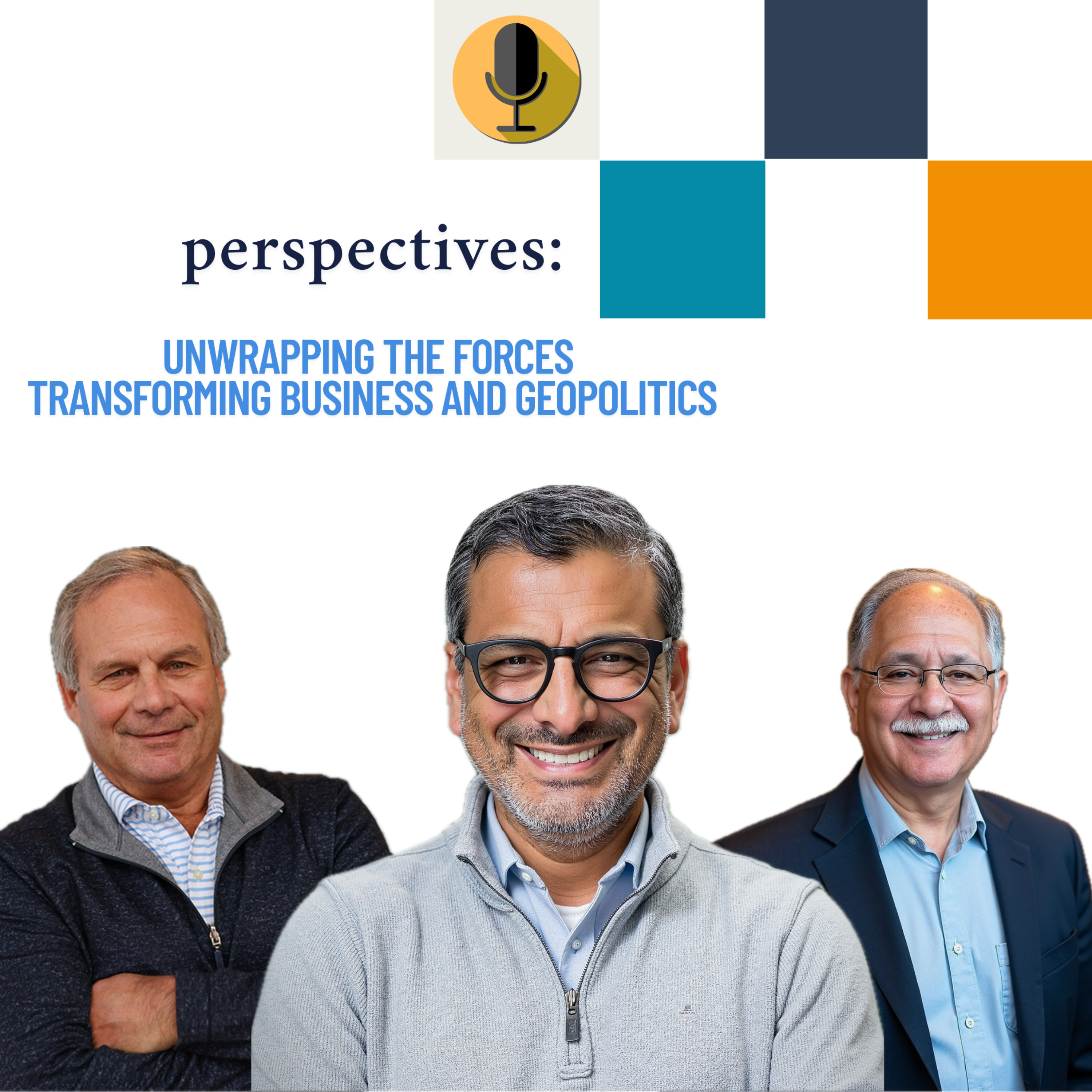
Perspectives: Unwrapping The Forces Transforming Business and Geopolitics.
by The Transformation Circle
Business and geopolitics are transforming at breakneck speed, faster than institutions can adapt and leaders can react. Every day, the ground shifts beneath us: boardrooms collide with battlefields, markets move with geopolitics, and strategy is rewritten in real time. Perspectives: Unwrapping the Forces Reshaping Business and Power pulls back the curtain on these seismic shifts. In 15 to 30 minutes, we cut through the noise to expose the raw, unfiltered transformation of business and geopolitics where competition is ruthless, power is contested, and the future is already here.
-
35
Episode 35: The War Lab: Ukraine, Iran, and the Future of Conflict
In this episode, we break down three major geopolitical flashpoints shaping the world right now: Ukraine’s rapid rise as a military technology hub, the shifting power dynamic between China, Russia, and North Korea, and the intensifying confrontation between Iran, Israel, and the United States.The conversation begins with Ukraine’s evolving battlefield capabilities, from European fighter systems and long-range missiles to drones, electronic warfare, and counter-drone innovation. Ukraine is no longer just defending itself. It is becoming a real-time defense technology laboratory for Europe, testing new tactics and systems under the harshest conditions imaginable.We also explore reports of advanced military robots being tested in Ukraine for logistics and casualty extraction, along with alleged covert operations inside Russia that may be changing the psychological balance of the war.From there, we turn to the China-Russia-North Korea triangle, where North Korea’s growing relationship with Russia may be weakening China’s influence and increasing regional instability.Finally, we examine the escalating Iran-Israel-US conflict, including missile exchanges, proxy warfare, ceasefire uncertainty, and the strategic importance of the Strait of Hormuz.At its core, this episode is about how modern conflict is changing. Wars today are being shaped by technology, deception, alliances, drones, covert action, and the ability to adapt faster than the enemy.
-
34
Episode 34: Pressure Across the Map
In this episode, Randy and the Colonel examine a world where military power, technology, geography, and political will are all being tested at once.The conversation begins with the Russia Ukraine war and Ukraine’s continued technological edge on the battlefield. From drones to electronic warfare, Ukraine continues to frustrate Russian operations and expose weaknesses in Moscow’s strategy. The discussion looks at the role of Ukraine’s “Lima” electronic warfare system, Russia’s limited air tactics, and how Ukrainian strikes deeper into Russian territory are changing the pressure on Putin.From there, the episode widens into the broader consequences of the war, including the limits of sanctions, the future of air power, and why modern conflict is no longer just about who has the biggest military. Speed, precision, adaptability, and battlefield innovation are becoming just as important as size.The conversation then shifts to the Indo Pacific, where tensions are rising around China, Taiwan, Japan, and the Philippines. Japan’s support for the Philippines is discussed as part of a larger effort to counter China’s maritime pressure, while North Korea is examined as a possible destabilizing force that could stretch American attention and planning.A major question runs through the episode: can the United States manage pressure in Europe, the Middle East, and the Indo Pacific all at once? The discussion explores the limits of military capacity, the importance of alliances, and the need to think beyond confrontation alone.The episode closes by looking at economic strategy as a tool of power, including the Indo Middle East Europe Economic Corridor and the role of infrastructure, trade routes, ports, rail lines, and energy corridors in shaping the next global order.At its core, this episode is about a world in transition. The battlefield is changing. The map is tightening. And the next major conflict may not begin with one dramatic moment, but through a series of connected moves already unfolding across the globe.
-
33
Episode 33: When the Map Starts to Shake
This week’s episode steps back from the noise of the headlines and looks at the deeper pattern forming underneath them. From Ukraine to the Middle East, from Taiwan to global trade routes, the world is being reshaped by pressure points, chokepoints, and nations fighting to protect their own strategic interests.We begin with the escalating war between Russia and Ukraine, where the battlefield continues to evolve from traditional ground warfare into a contest of drones, missiles, infrastructure attacks, and psychological endurance. Russia’s recent large-scale strike campaign against Ukraine raises difficult questions about where the war is headed and how both sides are now targeting not only military assets, but the systems that keep nations functioning. Energy, water, ports, refineries, and civilian infrastructure have become part of the fight, making this conflict less about a single front line and more about the ability of a country to withstand sustained pressure.The conversation then moves into the Middle East, where Iran remains at the center of a widening regional conflict through its support of proxies including Hamas, Hezbollah, and the Houthis. We discuss how the war that began with the October 7 attack has grown into something much larger, pulling in Gaza, Lebanon, Israel, Iran, the United States, and global energy markets. The Strait of Hormuz becomes a major focus as we examine how geography can become leverage, how oil flows can become weapons, and how one narrow passage of water can shake economies far beyond the region.From there, we turn to China and Taiwan, where diplomacy, military posture, and semiconductor dependence collide. Taiwan is not only a democracy under pressure, but also a critical player in the global technology supply chain. We explore whether China is truly ready for conflict, what risks Beijing would face, and why any move against Taiwan would carry consequences far beyond Asia. The question is not just whether China can take Taiwan, but whether the cost would be worth the fire it would start.The episode closes by looking at the new alliances and trade arrangements forming around the world. India, the European Union, Sweden, Mexico, and others are building partnerships shaped less by ideology and more by national interest. Countries are learning from today’s wars and disruptions that survival depends on resilient supply chains, flexible partnerships, and deals that serve their people first.At the heart of this episode is one idea: the map is changing. Power is no longer measured only by armies, weapons, or speeches. It is measured by control of infrastructure, energy routes, technology, trade, and the ability to endure pressure when the world starts to shake.
-
32
Episode 32: When Power Miscalculates: Iran, Ukraine, China, and the New Global Pressure Points
The question is no longer whether the world is changing.The question is whether leaders understand the consequences of the moves they are making.This episode is about more than headlines. It's about strategy, power, miscalculation, and the fragile balance holding today’s world together. From oil routes to drone warfare to Taiwan’s future, the old world order is being tested in real time.In this episode, we unpack three major pressure points shaping the global order: the U.S.-Iran stalemate, the shifting battlefield in Russia and Ukraine, and the escalating strategic dilemma between the United States and China over Taiwan.The conversation begins with the growing crisis in the Strait of Hormuz, where unresolved tensions between the U.S. and Iran are creating ripple effects across the global economy. What began as a military confrontation has become a strategic stalemate with consequences far beyond the region. Energy markets are tightening, countries are stockpiling resources, and fears of inflation, recession, and supply chain disruption are rising. At the center of the discussion is a hard question: was there a clear endgame, or did the United States enter a conflict without fully accounting for Iran’s ability to retaliate economically through one of the world’s most important shipping lanes? From there, the episode examines the changing dynamics of the Russia-Ukraine war. Ukraine’s expanded use of drone warfare has pushed the conflict deeper into Russian territory, striking infrastructure and bringing the reality of war closer to the Russian public. The discussion explores what this means for Vladimir Putin, the pressure building inside Russia, and the growing argument that Ukraine’s battlefield experience has made it not only a candidate for Western support, but a potential strategic asset to NATO and the European Union.The final segment turns to China, Taiwan, and the dangerous chessboard forming in the Pacific. After renewed warnings from Beijing over potential U.S. arms sales to Taiwan, the United States faces a difficult choice: continue supporting Taiwan and risk escalating tensions with China, or pull back and send a troubling message to allies around the world. The conversation also explores the idea of the “Thucydides Trap” and whether China’s ambitions could expose its own vulnerabilities, especially if military action against Taiwan triggers economic strain, social instability, or a broader regional conflict.
-
31
Episode 31: Global Power Under Pressure
In this episode, the conversation moves beyond headlines and into the deeper forces reshaping global power. What begins as a debate over U.S. troop reductions in Europe quickly opens into something much larger: a question of how nations reassess threats, alliances, and priorities in a world that no longer plays by old rules.At the center is a tension that feels familiar yet unresolved. Has Russia truly diminished as a strategic threat, or are we underestimating the long game of global power? One perspective argues that the United States must pivot its focus toward rising challenges in China and Iran, reallocating resources and redefining military posture for a new era. The other warns that sudden shifts risk weakening alliances that have taken decades to build, leaving cracks in a system that depends on trust as much as strength.From there, the discussion widens. What does it mean to maintain a $1.5 trillion defense budget in a world of evolving threats? Are hundreds of global military bases still a necessity or a relic of a different time? And perhaps most importantly, where is the clear, unified strategy that ties all of this together?The conversation then turns to the Middle East, where strategy and humanity collide in real time. The conflict between Israel and Hezbollah is examined not just as a military engagement, but as a cycle with lasting consequences. Territorial control, security zones, and proxy warfare are weighed against the lived reality of displaced families, destroyed homes, and the emotional aftermath that shapes future generations. The question lingers beneath it all: can security ever be achieved without addressing the human cost that fuels continued conflict?
-
30
Episode 30: The Irony of War Power Without Control
This episode takes a hard look at the shifting dynamics of global conflict, where power is no longer as clear as it once seemed and victory is defined in unexpected ways.The conversation opens with rising tensions around Iran, but quickly moves beyond headlines into something deeper. What happens when a nation appears strong on the surface but lacks true leadership at its core? The discussion explores the idea that Iran is no longer operating as a traditional state, but as a power structure driven by military control rather than the will of its people. That shift changes everything, from negotiations to strategy to how the United States and its allies respond.At the center of the dialogue is a powerful concept: in modern conflict, a country can win simply by not losing, while another can lose by failing to achieve clear outcomes. This lens reframes how we think about war, patience, and pressure.From there, the conversation expands across the global stage. Russia’s ongoing struggle in Ukraine reveals the cost of internal corruption and misalignment, while Ukraine’s innovation and resilience show what adaptability looks like in real time. Meanwhile, China’s position becomes more complicated as economic dependencies begin to tighten.A surprising turn comes with Moldova, a smaller nation making bold strategic moves that could reshape regional power and challenge Russia’s long-term ambitions. It is a reminder that influence is not always about size, but about timing, alignment, and clarity of direction.Throughout the episode, the discussion weaves together military strategy, political reality, and human impact. It highlights how uncertainty, fractured leadership, and economic pressure are redefining what strength actually looks like in today’s world.This is not just a conversation about conflict. It is a conversation about control, endurance, and the quiet forces that determine who rises, who falls, and who simply outlasts.
-
29
Episode 29: Signals Beneath the Headlines
It starts in the Strait of Hormuz, but it does not stay there.In this episode, we unpack the rising tension between the United States and Iran, beginning with the naval movement that is placing one of the world’s most critical shipping routes under strain. What seems like a regional issue quickly reveals itself as something far more expansive.We explore what is happening inside Iran, where fractured leadership and internal conflict are creating uncertainty at the highest levels. At the same time, global energy flow, economic stability, and regional relationships are all being tested in ways that feel familiar, yet different.From there, the conversation opens up.We examine whether the United States is rethinking its role in the world, including its commitment to NATO and a possible shift in focus toward China. If that shift is real, it raises deeper questions. What happens to long-standing alliances? Who carries the responsibility that the United States may step away from? And how do other nations respond?The discussion moves across regions and connects what often feels disconnected. The war in Ukraine. The positioning of countries across Asia. The uncertainty surrounding Taiwan. Each situation is complex on its own. Together, they begin to tell a broader story.Not randomness. Not isolated events.A world in transition.This episode brings clarity to the bigger picture by connecting the signals behind the headlines. It is a grounded, thoughtful conversation about what is changing, what may come next, and why it feels like everything is moving at once.If you have been paying attention and sensing that something deeper is unfolding, this conversation will help you see it more clearly.
-
28
Episode 28: The Truth About Transformation: Hype, Fatigue, and What Actually Works
In this episode, Randy sits down with Professor Chad Huemme for a conversation on business transformation; what it is, what it isn’t, and why so many organizations may be getting it wrong.They begin by challenging the word itself. Like “strategy,” transformation has become a buzzword—overused, diluted, and often misunderstood. But beneath the noise lies a real question: does transformation happen in bold, sweeping moves, or is it built quietly, piece by piece, over time?From there, the conversation turns to the human side of change. Are organizations pushing too hard, too fast? Is constant reinvention creating disruption that outpaces people’s ability to adapt? Randy and Chad explore the growing reality of change fatigue and what it means for leadership, execution, and long-term performance.They also put the idea of manufacturing “coming back” under the microscope, with a clear-eyed look at how robotics and automation are reshaping what work actually looks like. This isn’t a return to the past; it’s a reinvention of it.The discussion expands globally, diving into the accelerating AI race between the United States and China, and the strategic importance of Taiwan as the epicenter of semiconductor production. What’s at stake is more than technology—it’s economic power, national security, and the future of global influence.This episode connects the dots between culture, capability, and competition, offering a grounded, thought-provoking perspective on transformation in a world that refuses to stand still.
-
27
Episode 27: The Boiling Strait: Power, النفط, and Global Stakes
This episode dives into the rising tension between the United States and Iran at the Strait of Hormuz, following the US President’s announcement of a potential naval blockade. The conversation breaks down the strategic and legal differences between a “blockade” and a “quarantine,” and what each signal means on the global stage.From there, the discussion expands into Iran’s growing pressure points, from internal unrest in regions like Khuzestan to shifting defense dynamics across the Middle East. The hosts examine how these factors expose deeper vulnerabilities, while also unpacking the fragile nature of any US-Iran ceasefire in the face of Iran’s broader proxy-driven strategy.The lens then widens to the global chessboard. China’s reliance on Iranian oil and its quiet support, Russia’s weakening position in Ukraine, and the rise of adaptive, drone-driven warfare all point to a world that is rapidly reshaping itself.This is not just a conversation about conflict. It is a look at how power is shifting, how strategies are evolving, and what may come next.
-
26
Episode 26: At the Edge of Escalation: The Strait of Hormuz Standoff
In our podcast this week, we covered Week 5 of the Iran conflict.Over the weekend, Donald Trump stated that if Iran does not open the Strait of Hormuz, the United States would “rain hell” on the country. The Iranian leadership responded by warning they would create widespread instability across the Middle East.Randy raised concerns about the precedent this sets and the level of anxiety it is creating globally. The rhetoric alone is beginning to shape markets, behavior, and sentiment well beyond the region.The Colonel outlined several strategic options for applying pressure on Iran, including ways to effectively choke off key economic and operational pathways. At the same time, he pointed out a critical dynamic: Iran is currently benefiting financially by charging higher fees for “safer” passage of oil tankers through the region.On Tuesday, April 7th, President Trump escalated his stance further, stating that the U.S. would target and destroy Iran’s energy infrastructure.For now, the world watches and waits to see how this unfolds.
-
25
Episode 25: Iran, Escalation, and the Shifting Balance of Power
In week four of the escalating conflict with Iran, this episode brings a grounded, strategic conversation between Randy and the Colonel as they break down the widening implications of the war. They examine how tensions are evolving across the region, including proxy dynamics, maritime chokepoints, and the broader positioning of global powers such as Russia, China, and the United States.The discussion explores how historical patterns of conflict are re-emerging in modern form, what strategic miscalculations may be unfolding, and how alternative pathways, both military and economic, could reshape the balance of power. From the Strait of Hormuz to shifting alliances, the conversation highlights how this moment fits into a much larger geopolitical chessboard.As the situation continues to evolve, this episode offers a clear, unfiltered look at the forces driving the conflict and what they may mean for the future of global stability.
-
24
Episode 24: Chokepoints and Consequences: From the Strait of Hormuz to Cuba’s Edge
The world does not shift all at once. It moves through pressure points.In this episode, we begin in South Asia, breaking down the rising tensions between Pakistan and Afghanistan and the TTP's growing influence. What looks like a regional issue quickly reveals itself as something larger, tied to instability, borders, and the quiet persistence of insurgency.From there, we turn to Iran and the Strait of Hormuz, where history reminds us that chokepoints have always shaped the outcome of conflict. The Colonel walks through a powerful but underexplored idea: what if the answer is not confrontation, but circumvention? By leveraging existing infrastructure such as the Habshan pipeline in the United Arab Emirates and a northern pipeline route in Saudi Arabia, there may be a path to reduce reliance on the strait altogether. It is not simple or cheap, but it changes the leverage equation in a meaningful way.We widen the lens to explore how strategic waterways have shaped warfare over time and what that might mean for the Strait of Taiwan as global tensions continue to build.And then we end somewhere unexpected. Cuba. Quiet, strained, and sitting just ninety miles off the U.S. coast, it may be closer to a turning point than most realize.
-
23
Episode 23: The Economic Shockwaves of the Iran War
In week two of the escalating conflict with Iran, Randy and his father, a retired Lieutenant Colonel, step back to examine the widening consequences of the war, not just on the battlefield, but across the global economy and geopolitical landscape.Randy focuses on the economic chaos rippling around the world: rising oil prices, inflation pressures, and growing instability in global markets. As tensions intensify in the Middle East, the potential threat to the Strait of Hormuz raises serious questions about energy supply and the fragility of the global economy.The Colonel brings historical perspective to the conversation, arguing that American involvement in conflicts abroad follows patterns that have played out for decades. Together they debate whether this conflict is truly America’s war or primarily Israel’s, and what that distinction means for U.S. strategy and global perception.The conversation also explores the expanding scope of the conflict: drone operations crossing into neighboring states, reports that Russia may be feeding intelligence to Iran regarding U.S. military targets, and China’s quiet but potentially destabilizing economic posture as the crisis unfolds.President Trump’s chilling remark that the war will end “when he feels it in his bones” has become a focal point of discussion, raising deeper questions about leadership, decision-making, and the uncertainty surrounding the conflict's endgame.The episode then turns toward the Western Hemisphere, where Randy and the Colonel wrestle with another pressing question: why Cuba is once again entering the geopolitical conversation. If the United States were to escalate pressure or move toward taking control of the island, what would the actual objective be? What strategic value does Cuba hold today?Most importantly, they examine the human cost. If the Cuban people are suffering under economic pressure and sanctions, what is the ultimate purpose? And what responsibility does the United States bear when policy harms ordinary citizens without a clearly defined outcome?This episode is a wide-ranging and candid discussion about war, power, strategy, and the unintended consequences that ripple far beyond the battlefield.If you’re trying to understand how a regional conflict can shake the entire world, this conversation connects the dots.
-
22
Episode 22: War Without a Declaration: The Legal and Strategic Reality of the Iran Conflict
In this episode, Randy and his father break down the rapidly escalating conflict with Iran and debate a fundamental question: Is it truly a war if Congress hasn’t declared it?They explore Iran’s strategy of attacking neighboring countries to pressure them to push the United States to stop the conflict, and how those attacks may actually be strengthening regional alliances instead.The conversation also dives into the growing role of drone warfare, Iran’s increasing accuracy, and whether the United States could learn from Ukraine’s advanced battlefield drone tactics.Finally, they discuss China’s surprising silence and whether it may be tied to U.S. forces successfully bypassing Chinese radar systems installed in Iran.It’s a candid discussion about law, strategy, and how modern wars are fought — even when they aren’t officially declared.
-
21
Episode 21: The Eve of War — Just War Theory and the Weekend We Saw Coming
On the eve of the first strike, my dad and I sat down for a conversation that felt less like commentary and more like preparation.We unpacked the rising tension around Iran, the signals coming from global powers, and the patterns history tends to repeat when diplomacy thins and deterrence hardens. But this wasn’t just geopolitics. We anchored the discussion in Just War Theory — wrestling with the moral framework behind armed conflict.What qualifies as just cause?What does proportional response really mean?When can a nation claim “last resort”?And who ultimately bears the cost of those decisions?By the end of our conversation, we both arrived at the same uneasy prediction: if action was coming, it would likely come over the weekend.Then it happened.This episode is not about cheering or condemning. It’s about examining how two generations process the weight of war in real time, through history, ethics, and hard questions that don’t have easy answers.When theory becomes reality, what still holds?We talk it through.
-
20
Episode 20: Military Posture and Global Pressure Points
In this short but wide-ranging episode, we examine the growing US military presence in the waters surrounding Iran and ask a direct question: Is this a final window for negotiation, or the positioning of force before action?We break down what a strategic military buildup actually signals, whether deterrence is still the objective, and how narrow the diplomatic runway may be.The conversation expands beyond the Middle East. We look at Japan increasing its military training posture in response to regional instability. We return to the ongoing Russia-Ukraine war and discuss the reported assassination attempt on President Volodymyr Zelensky.From the Persian Gulf to Eastern Europe to the Pacific, this episode connects the pressure points shaping today’s geopolitical landscape and asks what happens when diplomacy and deterrence collide.
-
19
Episode 19: Entering a New Trump-Era Doctrine: Isolating the Axis of Evil
In this episode, we examine the current situation in Iran through the lenses of power, legitimacy, and moral authority. We explore two strategic paths confronting the international community: sustained pressure designed to marginalize the Iranian regime or decisive action aimed at removing it entirely.The conversation confronts a stark reality. The Iranian regime has been responsible for the deaths of nearly 30,000 of its own citizens. That fact raises a fundamental question not only of policy but also of legitimacy, and it forces a deeper inquiry into whether a government that wages violence against its own people can genuinely negotiate in their best interests.Using Just War Theory as a framework, we assess whether negotiation remains morally and strategically viable or whether the regime has forfeited that standing altogether.We then widen the lens. If the Iranian regime collapses, if Russia continues to fail in projecting power, and if China is left increasingly isolated within the region, does the old Axis of Evil framing introduced under George W Bush begin to unravel?Finally, we ask whether this moment reflects a distinct foreign policy logic. Is this effectively a Trump-era doctrine focused on minimizing rival superpowers within their own spheres of influence rather than expanding American dominance? And if so, what does that mean for Iran, Russia, China, and the future balance of power itself?This episode challenges conventional thinking and asks whether we are witnessing an escalation or a quiet contraction of global influence and the reshaping of the world order.
-
18
Episode 18: Inside China’s Taiwan Calculus
Two of China’s top generals are removed in rapid succession, but this is no sudden shock. For years, Xi Jinping has been methodically reshaping the People’s Liberation Army with one goal in mind: readiness. Not loyalty for ceremony but loyalty for action.In this episode, we move past the headlines to examine the real strategic driver behind a potential move on Taiwan. Is this about nationalism, legitimacy, deterrence, or something deeper inside China’s long-term survival calculus?We explore how internal military reform, demographic pressure, economic slowdown, and global positioning converge into a narrowing window of decision, and what the true consequences would be, not just for China but for global supply chains, regional security, and the future of the world order.History teaches us a quiet lesson. Armies are not prepared for peace. They are prepared for moments leaders believe cannot be postponed.This episode asks the question many avoid. If not now, when?
-
17
Episode 17: Business on the Frontlines: Trade, Tariffs, and the New Economic Battleground
In this episode, we sit down with Professor Chad Huemme to tackle the evolving role of business in today’s geopolitical and economic tensions. We begin by examining what corporate America should do to address concerns regarding immigration enforcement and the broader issues associated with ICE agents in communities and workplaces.We examine the economic war that appears to be unfolding, assessing the real impact of tariffs on businesses across North America and the strategic choices Canada is making as it explores deeper trade relationships with China, while remaining tightly linked to the U.S. supply chain.We assess the consumer reality that underpins all of this: as consumers in a global marketplace, we absorb Chinese-made products. The truth is that even if we wanted to peel back deep consumerism, dependency on China’s goods and materials runs far deeper than finished products—it extends into raw materials essential to manufacturing.Professor Huemme and I break down the challenge of bringing manufacturing back to the United States, the hurdles businesses face in reshoring production, and why disentangling from an interconnected global economy is far more complex than headlines suggest.This is a business conversation with no easy answers—just hard questions about supply chains, trade, policy, and the future role of commerce in shaping economic and social stability.
-
16
Episode 16: After Davos: Europe at a Crossroads—Power, Pressure, and the Price of Security
Coming off Davos, this episode examines rising tensions between the United States and Europe as tariffs and geopolitics collide. We unpack President Trump’s continued tariff pressure on European countries that resist U.S. ambitions around Greenland, and we explore whether hard-power economics is reshaping long-standing alliances.We discuss President Volodymyr Zelensky’s pointed remarks calling on Europe to do more for its own defense. Zelensky highlights Ukraine’s rapid advances in drone technology, arguing that if Ukraine were part of NATO, Russia would already face meaningful deterrence. His message is clear: Europe must accelerate its own military readiness and capacity to engage in modern warfare.Ramon pushes the conversation further, labeling Europe a “coalition of the spineless,” as we confront a difficult contradiction, European nations continue supplying materials that Russia uses to build ballistic missiles targeting Ukraine, even as sanctions are debated. Ukraine’s challenge to Europe is direct: what sanctions truly matter if the supply chain remains intact?We close by asking the larger strategic question. Will U.S. aggressiveness ultimately push allies away, or will America remain too economically essential for the world to turn against it? At its core, this discussion centers on whether Europe is prepared to become a truly formidable union—both economically and militarily—and on the long-term costs required to make that transformation a reality.
-
15
Episode 15: Business and Politics: Fed, Venezuela, and the Credit Card Gamble
In this episode, we explore the space where politics and business blur. The U.S. central bank, led by Fed Chair Jerome Powell, is under fire for not cutting interest rates as fast as the White House wants. That pressure on the Fed’s independence is now spilling into markets and corporate boardrooms, with some business leaders warning that it could ultimately push inflation higher and unsettle long-term stability. We look at Venezuela and the spotlight on oil. Businesses are asking what stability and investment look like when geopolitics drives energy policy. Markets are watching oil flows and the risk to prices even as investors try to parse how intervention might unlock production or disrupt supply. Another major theme is the proposal to cap credit card interest rates at 10% for a year. That idea is stirring intense debate. Supporters say it could ease borrowing costs for households and boost consumer spending. Critics from major banks argue it could shrink credit availability, hurt revenue models, and ultimately slow economic activity for consumers and businesses alike. Throughout the discussion, we trace how business decisions and investments are shaped not just by economic fundamentals but by political winds and presidential priorities. From monetary policy to consumer credit to energy strategy, each move by policymakers sends ripples across corporate balance sheets and market expectations.
-
14
Episode 14: Greenland and the Next Era of American Power
In this episode, we focus on Greenland and why it may shape American power for generations. After signaling resolve in the Western Hemisphere through Venezuela, the United States is now turning north. Greenland offers strategic routes, critical resources, and unmatched Arctic positioning at a time when China and Russia are testing global influence but struggling to project real military force.We also examine the recent decision to place tariffs on European nations as leverage in Greenland negotiations. Is this a risky move that strains alliances or a calculated step to strengthen America’s ability to protect its allies against global threats?This conversation explores power-strategy alliances and the cost of leadership in a world rapidly reorganizing around geography, security, and resolve.
-
13
Episode 13: The Western Hemisphere Play: Venezuela, China, Russia, and America’s Next Strategic Map
In this episode, we pull back the curtain on Venezuela and the strategy unfolding around it, one that China and Russia are watching closely, calculating patiently, and exploiting where they can.But the deeper question isn’t just what is happening. It’s why we missed it for so long.For decades, Latin America lived in America’s peripheral geopolitical vision, close enough to matter, yet ignored enough to drift. That era is ending. As part of a renewed national security strategy, the United States is deliberately reconnecting the Americas, recognizing that democracy, economic resilience, and security are hemispheric pursuits, not isolated national projects.We explore why the future of American influence depends on seeing the entire Western Hemisphere as a strategic ecosystem, one where democratic stability, trade, energy, and values rise or fall together. The conversation expands beyond Venezuela to examine what’s next in countries like Colombia, Mexico, and Nicaragua, where political alignment and economic direction will shape the region’s trajectory.And then there’s the curveball most people don’t see coming, Greenland, not as a headline grab, but as a strategic position in a changing world where geography, resources, and access matter more than ever.This episode isn’t about ideology. It’s about awareness. Because the hemisphere is shifting, and whether we lead that shift or react to it will define the next chapter of global power.History doesn’t wait. It simply moves toward those paying attention.
-
12
Episode 12: India’s Quiet Pivot: Russia, Power, and the Pressure on China
In this episode, we turn our focus to India—its rising influence, strategic ambitions, and the shifting alliances reshaping Asia. We explore the deepening relationship between India and Russia, examining why cooperation between New Delhi and Moscow is accelerating and how energy, defense, and geopolitics are pulling them closer together.As this partnership strengthens, we unpack the implications for China, where historical tensions, border disputes, and regional competition are quietly intensifying. What happens when two major powers find common ground in ways that challenge Beijing’s long-term strategy?This conversation sets the stage for understanding how a recalibrated India–Russia axis could reshape regional balance, global power dynamics, and the future of the Indo-Pacific.
-
11
Episode 11: Redrawing the Map: The Western Hemisphere, the Pacific, and the Next Security Front
In this episode, we break down the newly released National Security Strategy and what it signals about America’s shifting priorities. The Western Hemisphere emerges as the central focus, while engagement outside the region narrows primarily to the Pacific. We explore what this reorientation means in practice and why proximity, influence, and stability closer to home now carry renewed strategic weight.We examine the demographic realities shaping global power, zeroing in on China and India and asking a critical question rarely addressed directly: which nation will have a military age population ready and capable of sustaining long-term power? We unpack how population trends intersect with economic strength, political will, and military readiness.Bringing the conversation back to the Western Hemisphere, we take a hard look at the role of transnational drug cartels as both criminal enterprises and destabilizing forces. We discuss recent actions involving vessels departing Venezuela and debate whether US strikes are justified, where the legal and strategic lines are drawn, and whether these actions represent isolated enforcement or the early stages of a broader engagement tied to the new national security framework.This episode is not just about policy on paper. It is about how strategy translates into action, where the lines are being quietly redrawn, and what it all signals about the future of power, security, and engagement closer to home.
-
10
Episode 10: Bark, Bluffs, and Blind Spots: Power, Patience, and the Ukraine War
We examine the corruption scandal at the highest levels of President Zelensky’s inner circle and why, in wartime, unity matters as much as firepower. We break down the original 28-point framework for ending the war, how it narrowed to 20, and why Russia’s refusal to engage means the conflict drags on with no near-term resolution.We look closely at Europe and the United States and their incremental sanctions strategy, questioning whether it signals real pressure or simply loud resolve with limited consequence. We explore why Ukraine has been restrained from striking inside Russia, how nuclear brinkmanship shapes Western red lines, and why certain threats are never meant to be tested.India enters the conversation not as a side actor, but as a rising power navigating its own strategic interests. We discuss India’s growing influence, its balancing act in global affairs, and what its choices could mean for the future of the international order.Finally, we unpack how much of the analytics and intelligence community misjudged Russia’s military capability, endurance, and intent, and what those blind spots reveal about how modern power is measured and misunderstood.Because this war is not only about Ukraine, it is about credibility, restraint, and who quietly shapes the rules of a world in transition. And that is the conversation we will continue to return to.
-
9
Episode 9: The New Millionaires Work AI Cannot Replace
In this episode, we explore a quiet but powerful shift happening beneath the noise of artificial intelligence.As AI reshapes white collar work, a different group is rising. Plumbers. Solar installers. Landscapers. Electricians. Builders. Work rooted in the physical world that cannot be automated and is becoming more valuable, not less. We discuss why these skilled trades may produce the next generation of millionaires and what that says about dignity, purpose, and real economic value.The conversation then turns to Australia, where new policies restricting social media use for children under eighteen reflect growing concern about digital influence and its impact on young people.From there, we widen the lens to education and business. Students are showing less interest in international business at a time when the world remains deeply interconnected. Rising political rhetoric and nationalism are narrowing ambition, pulling focus inward, and reshaping how young people view opportunity.We close with a central question. In an increasingly global economy, are we choosing to disengage from the world, or is the world quietly moving on without us?
-
8
Episode 8: The Mineral Wars Power Leverage and the Redrawing of Borders
This episode examines how mineral resources and geography are quietly reshaping global power.We begin with China’s global pursuit of critical minerals, then pivot to Ukraine and the emerging mining interests tied to Western support. Russia demands control of the Donbas and a weakened Ukrainian military while offering nothing in return, despite demonstrating limited military effectiveness.Negotiations reportedly involving Steve Witkoff raise a deeper question. Why does the West continue to pressure Ukraine for concessions in the name of peace while accommodating a Russia that has failed to prove true military dominance.From there, we explore a strategic alternative for China. If Taiwan is too costly, another path exists. Reclaiming Outer Manchuria, a territory taken by Russia in the mid-1800s, land that gave Russia access to the Pacific Ocean through the Sea of Japan.At the center of this option lies Lake Baikal, the deepest freshwater reserve on Earth and a source of long-term continental power.The episode closes with a warning. Taiwan is not Russia. And if China seeks to demonstrate superpower status, repeating Moscow’s mistakes may cost more than it gains.
-
7
Episode 7: Too Big to Fight China’s Military Power and the Taiwan Question
China’s military appears overwhelming on paper. Massive scale. Rapid modernization. Endless investment. But history reminds us that power on paper does not always translate into success on the battlefield.In this episode, I step back from the headlines to ask a more difficult question. Is the Chinese military truly capable of executing a complex and high-risk military strategy, especially one as consequential as taking Taiwan?We explore whether size becomes a strategic advantage or an operational liability. Whether centralized control strengthens coordination or weakens real-time decision making. And whether modern warfare rewards mass or adaptability.Finally, we examine the question that few are willing to confront honestly. If China succeeds in Taiwan, what changes would there be? Global trade. Regional security. United States credibility. The future of deterrence itself.This is not a prediction. It is a strategic examination of capability, execution, and consequence in a world where assumptions often speak louder than facts.
-
6
Episode 6: The Russia Saga Continues
In this episode, we go beyond the battlefield and into the deeper story behind the Russia–Ukraine war. We explore why Russia's repeated nuclear threats are not displays of dominance, but signals of vulnerability. When the strongest card left on the table is the nuclear card, it often means conventional strength is slipping.Ukraine, against all odds, has shifted the balance not through size, but through innovation. Drone technology, agile strategy, and global support have shown that modern power is no longer defined solely by tanks and missiles, but by data, reach, and adaptation.But while the world stares at the war, China stays silent and strategic. It is expanding global influence, securing resources, and building alliances—without firing a shot. The real game is not only military; it is economic, diplomatic, and long-term.We unpack• Why Russia’s nuclear signaling signals weakness• How Ukraine has reinvented modern warfare through drones and innovation• How China uses the war as a distraction while quietly expanding global influenceThe war may sit in Eastern Europe, but its consequences stretch across the globe—reshaping strategy, economics, alliances, and power in ways the headlines don’t show.This episode is not about who wins the war.It is about who owns the future.
-
5
Episode 5: China Rising: Power, Paradox, and the Pursuit of Dominance
In this episode of Perspectives: Unwrapping the Forces Transforming Business and Geopolitics, we unpack China’s relentless quest for economic and global influence. With unmatched scale, shifting demographics, and expanding military reach, China stands at the center of a new world order.But should the world fear China—or understand it better? We explore its true economic strength, its internal vulnerabilities, and the strategy driving its rise. This compelling conversation pulls back the curtain on China’s real role in shaping the future of power, prosperity, and global stability.
-
4
Episode 4: AI and the Future of Work: Redefining the Human in Human Resources
In this episode of Perspectives: Unwrapping the Forces Transforming Business and Geopolitics, we explore how artificial intelligence is reshaping the heart of every organization — Human Resources. From sourcing and interviewing to outreach and recruiting, AI is changing how people are found, hired, and managed.We break down what this transformation means for the workforce, why some fear a massive job displacement, and how leaders can balance efficiency with empathy in the age of algorithms. This isn’t just about technology — it’s about the future of human potential at work.
-
3
Episode 3: The Long Game: Power, Proxy, and the Battle for Global Influence
In this episode of Perspectives: Unwrapping the Forces Transforming Business and Geopolitics, we delve into the ongoing Russia-Ukraine conflict, a war that has exposed weaknesses in Russia’s purported military might and highlighted Ukraine’s remarkable adaptability through the use of drone warfare and strategic maneuvering.But this isn’t just a regional struggle; it’s a global chess match. NATO feels the tremors of uncertainty, while China quietly plays puppeteer, using this conflict as cover to expand its reach and acquire global resources. Behind the frontlines lies a bigger question: Who will sit on the throne of power and influence in the new world order, and who won’t survive the game?A story of endurance, deception, and shifting power dynamics, this episode explores the new rules of power in a world on edge.
-
2
Episode 2: From Steam to Silicon: The New Industrial Revolution
In this debut episode of Perspectives: Unwrapping the Forces Transforming Business and Geopolitics, we draw bold parallels between the Industrial Revolution and the seismic shifts of today. Just as steam reshaped industry, artificial intelligence is redefining the modern economy, power structures, and even the nature of work itself.We explore what’s similar, what’s entirely different, and what it means for leaders, nations, and everyday people caught in the gears of transformation. Is this progress, or a new kind of disruption? The conversation sets the stage for a deeper examination of how AI is not only changing business but also rewriting the rules of global power.
-
1
Episode 1: The Optics of Power — Is the World Returning to Old Ways or Setting a Dangerous Precedent?
In a time when global tensions are rising and stability feels like an illusion, this episode targets a quiet yet powerful shift — the renaming of the Department of Defense. What’s in a name? Maybe everything. We examine whether this shift signals a return to the old guard or sets a new, more aggressive precedent for the future of global power. Join us as we dissect the optics, intentions, and implications behind this move — and what it reveals about the state of democracy, diplomacy, and dominance in an unstable world.
We're indexing this podcast's transcripts for the first time — this can take a minute or two. We'll show results as soon as they're ready.
No matches for "" in this podcast's transcripts.
No topics indexed yet for this podcast.
Loading reviews...
ABOUT THIS SHOW
Business and geopolitics are transforming at breakneck speed, faster than institutions can adapt and leaders can react. Every day, the ground shifts beneath us: boardrooms collide with battlefields, markets move with geopolitics, and strategy is rewritten in real time. Perspectives: Unwrapping the Forces Reshaping Business and Power pulls back the curtain on these seismic shifts. In 15 to 30 minutes, we cut through the noise to expose the raw, unfiltered transformation of business and geopolitics where competition is ruthless, power is contested, and the future is already here.
HOSTED BY
The Transformation Circle
CATEGORIES
Loading similar podcasts...
Frequently Asked Questions
How many episodes does Perspectives: Unwrapping The Forces Transforming Business and Geopolitics. have?
Perspectives: Unwrapping The Forces Transforming Business and Geopolitics. currently has 35 episodes available on PodParley. New episodes are automatically indexed when they're published to the podcast feed.
What is Perspectives: Unwrapping The Forces Transforming Business and Geopolitics. about?
Business and geopolitics are transforming at breakneck speed, faster than institutions can adapt and leaders can react. Every day, the ground shifts beneath us: boardrooms collide with battlefields, markets move with geopolitics, and strategy is rewritten in real time. Perspectives: Unwrapping the...
How often does Perspectives: Unwrapping The Forces Transforming Business and Geopolitics. release new episodes?
Perspectives: Unwrapping The Forces Transforming Business and Geopolitics. has 35 episodes. Check the episode list to see recent publication dates and frequency.
Where can I listen to Perspectives: Unwrapping The Forces Transforming Business and Geopolitics.?
You can listen to Perspectives: Unwrapping The Forces Transforming Business and Geopolitics. on PodParley by clicking any episode. We provide an embedded audio player for direct listening, and you can also subscribe via your preferred podcast app using the RSS feed.
Who hosts Perspectives: Unwrapping The Forces Transforming Business and Geopolitics.?
Perspectives: Unwrapping The Forces Transforming Business and Geopolitics. is created and hosted by The Transformation Circle.
URL copied to clipboard!