
PODCAST · government
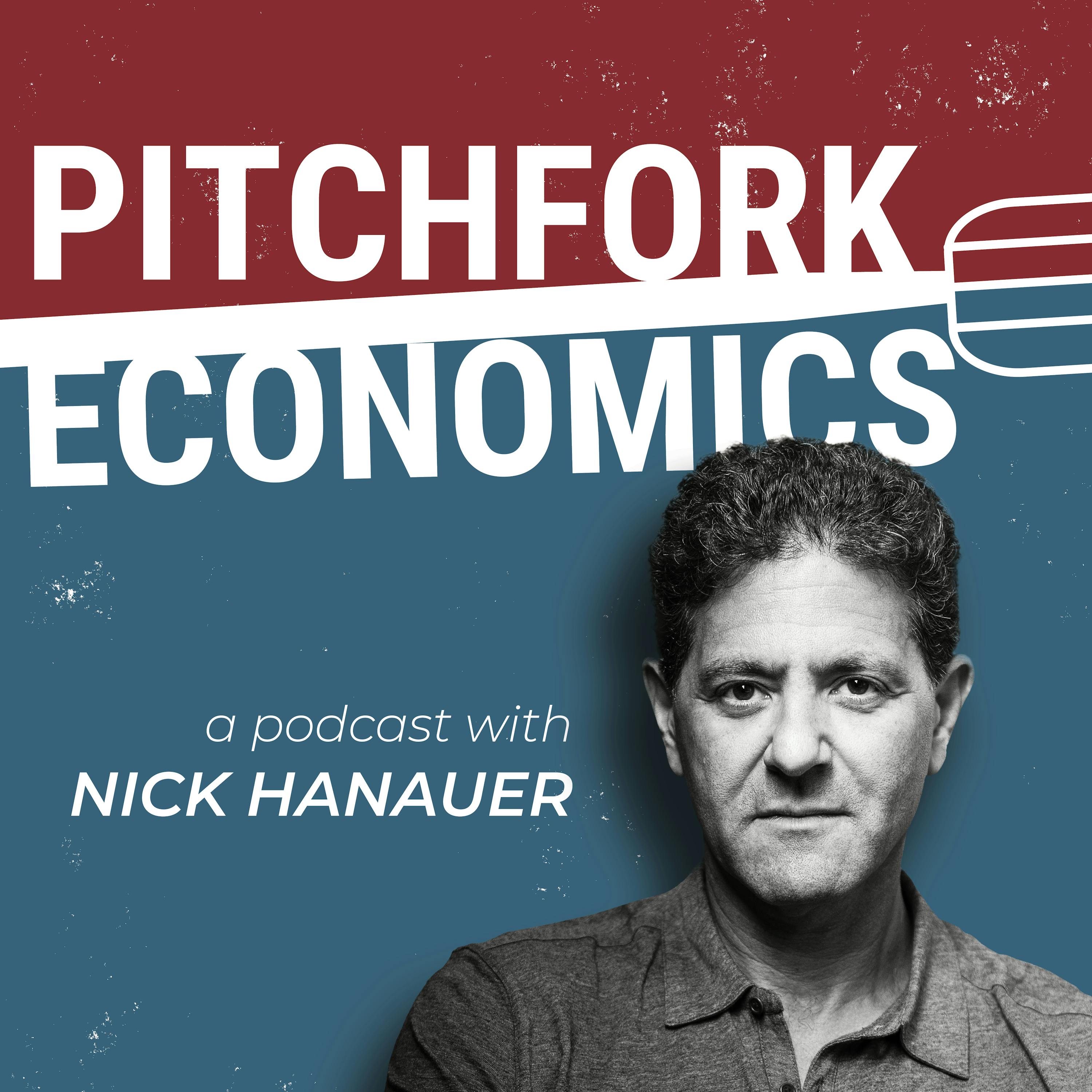
Pitchfork Economics with Nick Hanauer
by Civic Ventures
We are living through a paradigm shift from trickle-down neoliberalism to middle-out economics — a new understanding of who gets what and why. Join zillionaire class-traitor Nick Hanauer and some of the world’s leading economic and political thinkers as they explore the latest thinking on how the economy actually works.
-
438
The Policy Choices That Suppressed American Wages (with Josh Bivens and Larry Mishel)
Why have wages for working Americans stagnated for decades—even as productivity, corporate profits, and the wealth of the people at the top continued to rise? The mainstream explanations are familiar: automation, globalization, education, or simply the unavoidable forces of the market—but wage stagnation was not inevitable. It was the result of policy choices. This week, we’re revisiting a conversation with economists Lawrence Mishel and Josh Bivens about the decisions that reshaped the American economy, weakened worker bargaining power, and made it harder for working people to claim their share of the prosperity they helped create. As we continue sharing more about Market Humanism—the idea that markets are human-built systems shaped by rules and power—this conversation feels especially relevant. The economy we have did not emerge naturally. It was built. And that means it can be rebuilt. This episode originally aired on June 1, 2021. Josh Bivens is the chief economist at the Economic Policy Institute. His research focuses on macroeconomics, inequality, social insurance, public investment, and the economics of globalization. Larry Mishel is a distinguished fellow and former president of the Economic Policy Institute. His research focuses on labor economics, wages and income distribution, industrial relations, productivity growth, and the economics of education. Social Media: @joshbivens-econ.bsky.social @joshbivens_DC @larrymishel.bsky.social @LarryMishel Watch Nick on The Diary of a CEO Nick recently joined Steven Bartlett and entrepreneur Daniel Priestley for a wide-ranging debate about the wealth divide, stagnant wages, artificial intelligence, and whether capitalism can still deliver broadly shared prosperity. Watch the conversation on The Diary of a CEO. Further reading ⬇️ Economic Policy Institute: Identifying the Policy Levers Generating Wage Suppression and Wage Inequality Economic Policy Institute: The Productivity–Pay Gap Economic Policy Institute: Wage Calculator: How Much More Would You Be Making If Pay Had Kept Pace With Productivity? Roosevelt Institute: Democratic Abundance: An Abundance That Works for Workers Roosevelt Institute: From Safety Net to Power Base: Reimagining, Not Restoring, the US Antipoverty System Markets Built for Humans: A Guide for Policy Professionals to the New Economics Website: http://pitchforkeconomics.com Facebook: Pitchfork Economics Podcast Bluesky: @pitchforkeconomics.bsky.social Instagram: @pitchforkeconomics Threads: pitchforkeconomics TikTok: @pitchfork_econ YouTube: @pitchforkeconomics LinkedIn: Pitchfork Economics Twitter: @PitchforkEcon, @NickHanauer Substack: The Pitch
-
437
Market Humanism: A New Operating System for the Economy (with Nick Hanauer)
For the first time in Pitchfork Economics history, Nick Hanauer is on the other side of the mic. Goldy and Paul sit down with Nick to discuss Market Humanism: the emerging economic paradigm he and Eric Beinhocker believe can replace the trickle-down ideas that have shaped American policymaking for the past 50 years. Why have wages stagnated while inequality soared? Why does conventional economics treat policies that help ordinary people as threats to growth? And what changes when we recognize that markets are human-built institutions—not forces of nature? The conversation exposes the failures of the old economic model, how power shapes who gets what and why, and why a fairer economy is also a more prosperous one. Nick Hanauer is a Seattle-based entrepreneur, venture capitalist, and civic leader dedicated to building a more inclusive and sustainable economy. He is the founder of Civic Ventures, a public policy incubator, and co-host of the podcast Pitchfork Economics. A leading voice for “middle-out” economics, his commentary has appeared in The Atlantic, Politico, Bloomberg, and The New York Times. He is the author of The Gardens of Democracy , The True Patriot, and a frequent advocate for policies that put working people at the center of economic growth. Social Media: @nickhanauer.bsky.social @NickHanauer Further reading: Democracy Journal - Market Humanism: A New Paradigm for a New Era The Atlantic - The Economic Experiment That Upended Reality Markets Built for Humans - A Guide for Policy Professionals to the New Economics The Gardens of Democracy The True Patriot Corporate Bullsh*t: Exposing the Lies and Half-Truths That Protect Profit, Power, and Wealth in America Website: http://pitchforkeconomics.com Facebook: Pitchfork Economics Podcast Bluesky: @pitchforkeconomics.bsky.social Instagram: @pitchforkeconomics Threads: pitchforkeconomics TikTok: @pitchfork_econ YouTube: @pitchforkeconomics LinkedIn: Pitchfork Economics Twitter: @PitchforkEcon, @NickHanauer Substack: The Pitch
-
436
What Comes After Neoliberalism? (with Nick Hanauer & Eric Beinhocker)
This week, we’re sharing a special episode from Washington Monthly featuring Pitchfork Economics co-host Nick Hanauer and Oxford professor Eric Beinhocker in conversation with Anne Kim about Market Humanism. For decades, American capitalism has been organized around efficiency, shareholder value, and the idea that prosperity naturally trickles down from the top. But as Nick and Eric explain, that story has failed on its own terms: inequality has exploded, workers have been squeezed, and democracy itself has become more fragile. In this conversation, they make the case for a new economic paradigm they call market humanism: the idea that markets should be built to solve human problems, strengthen democracy, and improve people’s lives—not simply maximize returns for owners of capital. If we want an economy that actually works, the question can’t be “How do we make markets more efficient for the wealthy?” It has to be: “How do we build markets that help people flourish?” Website: http://pitchforkeconomics.com Facebook: Pitchfork Economics Podcast Bluesky: @pitchforkeconomics.bsky.social Instagram: @pitchforkeconomics Threads: pitchforkeconomics TikTok: @pitchfork_econ YouTube: @pitchforkeconomics LinkedIn: Pitchfork Economics Twitter: @PitchforkEcon, @NickHanauer Substack: The Pitch
-
435
The Worker Power Missing From the Abundance Debate (with Kate Andrias and Alexander Hertel-Fernandez)
Everyone wants more housing, more clean energy, more transit, more care infrastructure, and more of the things people need to live good lives. But too much of the “abundance” debate treats workers, unions, environmental review, and community voice as obstacles to building — instead of asking who has power, who benefits, and who gets left out. This week, Goldy and Paul talk with Columbia professors Kate Andrias and Alexander Hertel-Fernandez about their Roosevelt Institute report, Democratic Abundance: An Abundance That Works for Workers. They argue that the problem isn’t too much democracy — it’s too little. If we want to build at the scale this moment demands, we need an abundance agenda that puts workers, communities, and democratic power at the center from the start. Kate Andrias is the Patricia D. and R. Paul Yetter Professor of Law at Columbia Law School, and serves as co-director of both the Columbia Law School Center for Constitutional Governance and the Columbia Labor Lab. Previously, she served as associate counsel and special assistant to President Barack Obama and as chief of staff in the White House Counsel’s Office. Alexander Hertel-Fernandez is an associate professor and vice dean at Columbia University’s School of International and Public Affairs, and serves as co-director of the Columbia Labor Lab. From 2021 to 2023, he served as a deputy assistant secretary in the Department of Labor and a senior fellow in the White House Office of Information and Regulatory Affairs. Further reading: Report: Democratic Abundance: An Abundance That Works for Workers The American Political Economy: Politics, Markets, and Power State Capture: How Conservative Activists, Big Businesses, and Wealthy Donors Reshaped the American States and the Nation Website: http://pitchforkeconomics.com Facebook: Pitchfork Economics Podcast Bluesky: @pitchforkeconomics.bsky.social Instagram: @pitchforkeconomics Threads: pitchforkeconomics TikTok: @pitchfork_econ YouTube: @pitchforkeconomics LinkedIn: Pitchfork Economics Twitter: @PitchforkEcon, @NickHanauer Substack: The Pitch
-
434
How the AI Oligarchy Went Hyperscale (with Tim Murphy)
The AI “cloud” sounds weightless. But behind every chat bot, every prompt, and every promise of a coming AI revolution is a massive physical footprint: hyperscale data centers consuming enormous amounts of land, electricity, water, and public subsidies. This week, Nick and Goldy talk with Tim Murphy, national correspondent at Mother Jones, about his cover story on how the American oligarchy went hyperscale in the age of AI. Murphy has been reporting from communities across the country where residents are watching enormous data centers rise in their backyards, often with little transparency, few long-term jobs, and huge demands on local infrastructure. The result is a familiar story: public risk, private reward. Tech billionaires get the profits. Communities get higher utility costs, depleted resources, tax breaks they may never recoup, and facilities that could become tomorrow’s stranded assets when the AI bubble bursts. AI may be new. But the economic model behind this boom is very old: extract from communities, concentrate power at the top, and call it progress. Tim Murphy is a national correspondent at Mother Jones. Social Media: @timothypmurphy.bsky.social @timothypmurphy @motherjones.com @MotherJones Further reading: Mother Jones - How the American Oligarchy Went Hyperscale Website: http://pitchforkeconomics.com Facebook: Pitchfork Economics Podcast Bluesky: @pitchforkeconomics.bsky.social Instagram: @pitchforkeconomics Threads: pitchforkeconomics TikTok: @pitchfork_econ YouTube: @pitchforkeconomics LinkedIn: Pitchfork Economics Twitter: @PitchforkEcon, @NickHanauer Substack: The Pitch
-
433
Why Philanthropy [STILL] Isn’t the Answer with (with Anand Giridharadas)
Billionaires are shaping everything from elections to education to climate policy—and they want us to believe it's generosity. That’s why we’re re-airing this conversation with Anand Giridharadas, author of Winners Take All, on the power of elite philanthropy—and why it can’t fix the inequality it helps sustain. Giridharadas breaks down how modern philanthropy allows the ultra-wealthy to “give back” on their own terms, while avoiding the kinds of structural changes—like higher taxes, stronger labor standards, and real regulation—that would actually redistribute power and opportunity. Yes, philanthropy can do good. But it can also function as a pressure valve—easing public outrage while leaving the underlying system intact. If you’ve been following the surge in billionaire political spending, debates over wealth taxes, or the outsized influence of private foundations, this conversation will hit differently now, Because the real question isn’t whether the rich should give more. It’s why they get to decide in the first place. Anand Giridharadas is a writer and political analyst focused on inequality, power, and democracy. He is the author of multiple books, including the national bestseller Winners Take All and The Persuaders. Giridharadas is an editor-at-large for TIME, an on-air analyst for MSNBC, and the publisher of the newsletter The.Ink, where he writes about politics, money, and power. He is also a visiting scholar at the Arthur L. Carter Journalism Institute at New York University. Listen to Eric Beinhocker discuss Market Humanism on Hal Singer’s podcast The Slingshot. Social Media: @anandwrites.bsky.social anandwrites @AnandWrites Further reading: Winners Take All: The Elite Charade of Changing the World The Persuaders: At the Front Lines of the Fight for Hearts, Minds, and Democracy Website: http://pitchforkeconomics.com Facebook: Pitchfork Economics Podcast Bluesky: @pitchforkeconomics.bsky.social Instagram: @pitchforkeconomics Threads: pitchforkeconomics TikTok: @pitchfork_econ YouTube: @pitchforkeconomics LinkedIn: Pitchfork Economics Twitter: @PitchforkEcon, @NickHanauer Substack: The Pitch
-
432
How neoliberalism happened (with George Monbiot and Binyamin Appelbaum)
It’s trendy to mock the malicious pervasiveness of neoliberalism now, but have you ever wondered what its origins are? This week, George Monbiot and Binyamin Appelbaum join the show to uncover just where the dominant economic theory of our time came from and how it took hold. This episode was originally recorded and released in October 2019. George Monbiot writes a weekly column for The Guardian and is the author of a number of books, most recently ‘Out of the Wreckage: A New Politics for an Age of Crisis’. As an investigative journalist and self-described “professional troublemaker,” George uncovers the complicated truths behind the world’s most persistent problems. Twitter: @GeorgeMonbiot Binyamin Appelbaum writes about economics and business for the editorial page of The New York Times. From 2010 to 2019, he was a Washington correspondent for the Times, covering economic policy in the aftermath of the 2008 crisis. His new book, ‘The Economists’ Hour: False Prophets, Free Markets, and the Fracture of Society’ is a Wall Street Journal Business Bestseller. Twitter: @BCAppelbaum Further reading: Out of the Wreckage: https://www.indiebound.org/book/9781786632890 The Economists’ Hour: https://www.indiebound.org/book/9780316512329 Neoliberalism - the ideology at the root of all our problems: https://www.theguardian.com/books/2016/apr/15/neoliberalism-ideology-problem-george-monbiot Games Economists Play: http://bostonreview.net/class-inequality/marshall-steinbaum-games-economists-play Website: http://pitchforkeconomics.com/ Twitter: @PitchforkEcon Instagram: @pitchforkeconomics Nick’s twitter: @NickHanauer
-
431
Debunking deficit myths (with Stephanie Kelton)
Modern Monetary Theory is an attempt to accurately describe how government debt and complex financial systems actually work and it can help us responsibly use our resources. No one is more knowledgeable on the subject than returning guest, Professor Stephanie Kelton. On this episode, originally released in 2020, Kelton explains the myths surrounding MMT and what a new understanding of the budget could do for our economy. Stephanie Kelton is a Professor of Economics and Public Policy at Stony Brook University. She is the leading expert on Modern Monetary Theory. Her book, The Deficit Myth: Modern Monetary Theory and the Birth of the People’s Economy, shows how to break free of flawed deficit thinking. Twitter: @StephanieKelton The Deficit Myth: https://www.indiebound.org/book/9781541736184 Learn To Love Trillion-Dollar Deficits: https://www.nytimes.com/2020/06/09/opinion/us-deficit-coronavirus.html Website: http://pitchforkeconomics.com/ Twitter: @PitchforkEcon Instagram: @pitchforkeconomics Nick’s twitter: @NickHanauer
-
430
How the radical right weaponized ideology (with Nancy MacLean)
If it seems to you like the ultimate goal of the most extreme conservatives is to undermine democracy and cripple democratic institutions—well, according to historian Nancy MacLean, you’re right. This week, MacLean unpacks the meteoric rise in popularity of the radical right’s ideas, and offers a way forward for progressives, based on lessons from successful social movements throughout American history. This episode was originally released in July 2020. Nancy MacLean is an award-winning scholar of the twentieth-century U.S. and the William H. Chafe Distinguished Professor of History and Public Policy at Duke University. Her book, Democracy in Chains: The Deep History of the Radical Right’s Stealth Plan for America, was a New York Times bestseller and finalist for the National Book Award, and The Nation magazine named it the “Most Valuable Book” of the year. Twitter: @NancyMacLean5 Democracy in Chains: https://www.indiebound.org/book/9781101980965 Website: http://pitchforkeconomics.com/ Twitter: @PitchforkEcon Instagram: @pitchforkeconomics Nick’s twitter: @NickHanauer
-
429
The hidden costs of banking while poor (with Mehrsa Baradaran and Cate Blackford)
The average family earning $25,000 a year in the U.S. spends about $2,400 on financial transactions. Whether it’s the astronomical interest rates of a payday loan or the costs that come with being unbanked, the extractive practices of the financial services industry are effectively keeping the poor in poverty. Lawyer and author Mehrsa Baradaran and economic mobility expert Cate Blackford join Nick and Steph this week to explain why banking while poor is so expensive, and what states can do to rein in the people who profit from it. This episode was originally released in February 2020. Mehrsa Baradaran is a professor of law at UC Irvine. She writes about banking law, financial inclusion, inequality, and the racial wealth gap. Her scholarship includes the books How the Other Half Banks and The Color of Money: Black Banks and the Racial Wealth Gap. Twitter: @MehrsaBaradaran Cate Blackford was the Director of Outreach and Donor Development at the Bell Policy Center when we recorded this episode, but she is now the Public Policy Director at Maine People’s Alliance. She was the Co-Chair of the 2018 Proposition 111 campaign in CO to limit the interest lenders could charge on payday loans and eliminate fees from payday lending products, which passed with 75% of the vote. Twitter: @catetiller Further reading: Capitol One to end overdraft penalties as CFPB takes aim at ‘exploitative junk fees’: https://www.washingtonpost.com/business/2021/12/01/capital-one-overdraft-fees/ How the Other Half Banks: https://www.hup.harvard.edu/catalog.php?isbn=9780674983960 The Color of Money: https://www.hup.harvard.edu/catalog.php?isbn=9780674237476 If the U.S. Government Treated Poor People as Well as It Treats Banks: https://www.theatlantic.com/business/archive/2015/10/if-the-us-government-treated-poor-people-as-well-as-it-treats-banks/410614/ CO’s Prop 111 explained: https://coloradosun.com/2018/10/22/proposition-111-colorado-2018-explained/ Briefed by the Bell - Predatory Economy: https://www.bellpolicy.org/2018/09/10/predatory-economy/ How Do Payday Loans Work? https://www.incharge.org/debt-relief/how-payday-loans-work/ Website: http://pitchforkeconomics.com/ Twitter: @PitchforkEcon Instagram: @pitchforkeconomics Nick’s twitter: @NickHanauer
-
428
Why is getting out of poverty so hard? (with Felicia Wong)
Roosevelt Institute President Felicia Wong and writer Hanna Brooks Olsen join Nick and Goldy to explore how the intense burdens of poverty make it nearly impossible to even think about climbing the economic ladder. This episode was originally recorded and released in 2019. Sign up for our new weekly newsletter, The Pitch: https://civicventures.substack.com/ Felicia Wong is the President and CEO of the Roosevelt Institute. Twitter: @FeliciaWongRI @rooseveltinst Hanna Brooks Olsen is a writer and the co-host of Spotless, a podcast about cleaning. Twitter: @mshannabrooks Website: http://pitchforkeconomics.com/ Twitter: @PitchforkEcon Instagram: @pitchforkeconomics Nick’s twitter: @NickHanauer
We're indexing this podcast's transcripts for the first time — this can take a minute or two. We'll show results as soon as they're ready.
No matches for "" in this podcast's transcripts.
No topics indexed yet for this podcast.
Loading reviews...
ABOUT THIS SHOW
We are living through a paradigm shift from trickle-down neoliberalism to middle-out economics — a new understanding of who gets what and why. Join zillionaire class-traitor Nick Hanauer and some of the world’s leading economic and political thinkers as they explore the latest thinking on how the economy actually works.
HOSTED BY
Civic Ventures
CATEGORIES
Loading similar podcasts...
Frequently Asked Questions
How many episodes does Pitchfork Economics with Nick Hanauer have?
Pitchfork Economics with Nick Hanauer currently has 11 episodes available on PodParley. New episodes are automatically indexed when they're published to the podcast feed.
What is Pitchfork Economics with Nick Hanauer about?
We are living through a paradigm shift from trickle-down neoliberalism to middle-out economics — a new understanding of who gets what and why. Join zillionaire class-traitor Nick Hanauer and some of the world’s leading economic and political thinkers as they explore the latest thinking on how the...
How often does Pitchfork Economics with Nick Hanauer release new episodes?
Pitchfork Economics with Nick Hanauer has 11 episodes. Check the episode list to see recent publication dates and frequency.
Where can I listen to Pitchfork Economics with Nick Hanauer?
You can listen to Pitchfork Economics with Nick Hanauer on PodParley by clicking any episode. We provide an embedded audio player for direct listening, and you can also subscribe via your preferred podcast app using the RSS feed.
Who hosts Pitchfork Economics with Nick Hanauer?
Pitchfork Economics with Nick Hanauer is created and hosted by Civic Ventures.
URL copied to clipboard!