
PODCAST · history
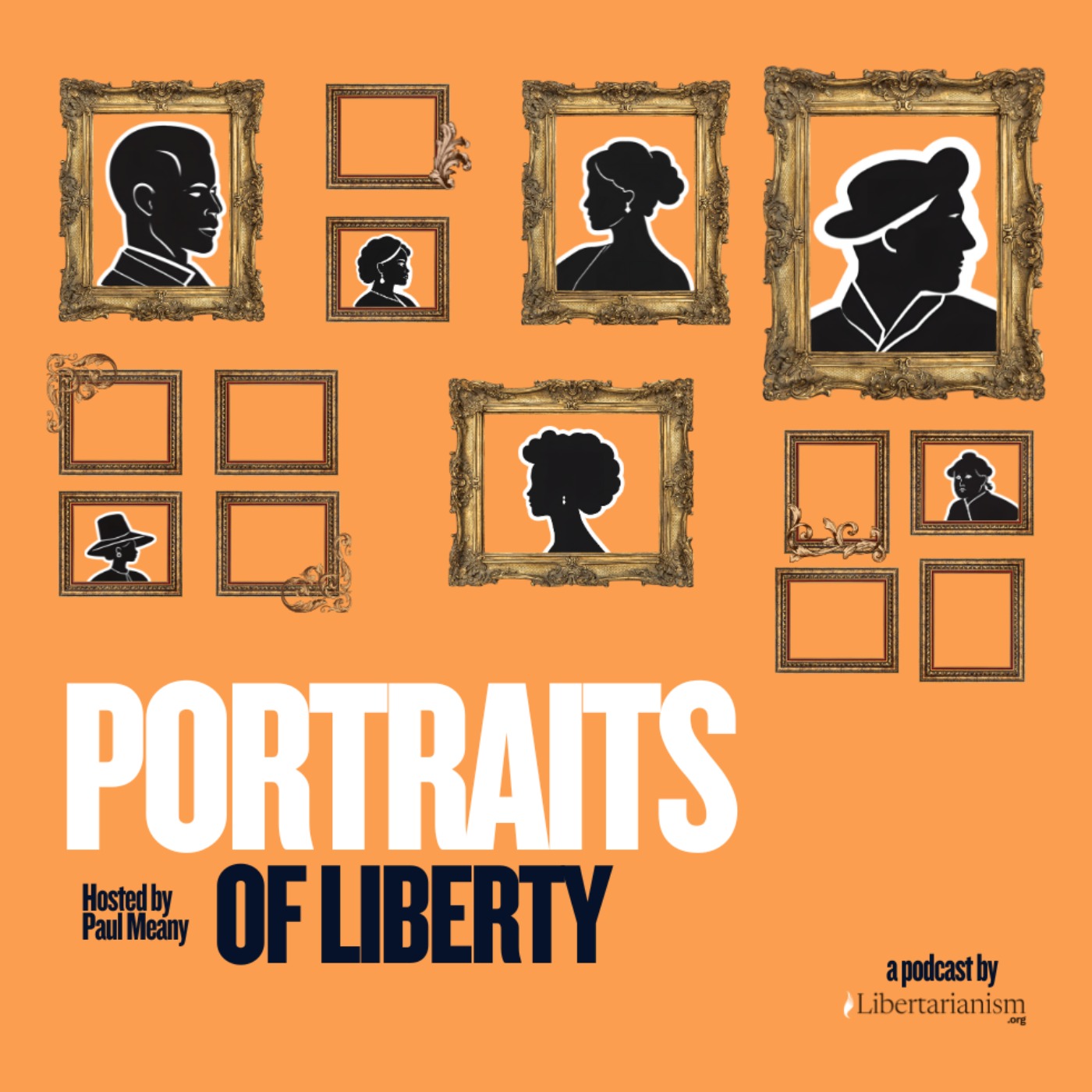
Portraits of Liberty
by Libertarianism.org
Portraits of Liberty investigates the lives and philosophies of thinkers throughout history who argued in favor of a freer world. Hosted on Acast. See acast.com/privacy for more information.
-
86
The Prosecutor of Kings: John Cooke
John Cooke was the English lawyer who dared to prosecute Charles I for tyranny, treason, and bloodshed. In an age when kings claimed to rule by divine right, Cooke argued that even the monarch stood beneath the law. John Cooke, though largely forgotten by history, established one of the most dangerous ideas in political history: rulers can be judged by the people they govern. Hosted on Acast. See acast.com/privacy for more information.
-
85
How to Read Like a Founding Father
The American Founding Fathers did not stumble into liberty by sheer instinct. To understand their world, we must immerse ourselves in their libraries filled with Roman history, biblical texts, Locke, Cato’s Letters, Montesquieu, and Plutarch. This episode explores the reading habits that shaped the American Revolution and asks what it would mean today to recover that tradition. Hosted on Acast. See acast.com/privacy for more information.
-
84
Sociology’s Forgotten Origins: Khaldun, Ferguson, and Spencer
Sociology is often treated by libertarians as a hostile discipline: collectivist, ideological, and drawn toward social control. But its origins tell a more complicated story. From Ibn Khaldun to Adam Ferguson and Herbert Spencer, this older tradition reveals a sociology of spontaneous order, civil society, and limits on political power. Hosted on Acast. See acast.com/privacy for more information.
-
83
A Martyr for Freedom of Speech: Helmuth Hübener
At just sixteen years old, Helmuth Hübener launched a secret anti-Nazi resistance campaign from inside Hitler’s Germany. He exposed Nazi lies by publishing underground pamphlets, knowing it could cost him his life. In this episode, Paul Meany tells the story of the youngest opponent of the Nazi regime. Hübener’s courageous actions reveal the senselessness of censorship and state propaganda, and the moral responsibility to speak the truth. Hosted on Acast. See acast.com/privacy for more information.
-
82
The Making of Modern Japan: Fukuzawa Yukichi
Fukuzawa Yukichi rose from a marginal samurai background in a rigid, hierarchical society to become one of the most important minds behind Japan’s transformation in the nineteenth century. Deeply influenced by his encounters with the West, he championed education, skepticism of authority, and personal independence as the foundations of a free society. Yukichi helped translate Enlightenment ideals into a distinctly Japanese context. Hosted on Acast. See acast.com/privacy for more information.
-
81
Cato’s Letters: Against Tyranny and Corruption
Long before the American Revolution, in the 1720s, a series of newspaper essays known as Cato’s Letters warned readers that power corrupts and liberty survives only through constant vigilance. In this episode of Portraits of Liberty, we explore how John Trenchard and Thomas Gordon’s fiery writings helped shape the American tradition of free speech, self-defense, and resistance to tyranny. Hosted on Acast. See acast.com/privacy for more information.
-
80
A Son of the Forest: William Apess
Born of Pequot descent, William Apess was the first Native American to publish a full-length autobiography. Apess became a Methodist minister and one of the most piercing moral critics of white Christian America’s hypocrisy. Drawing on the Bible, the Declaration of Independence, and the language of natural rights, Apess demanded that liberty, equality, and self-government apply to Native peoples as much as they were to anyone else. From his autobiography, A Son of the Forest, and his fiery essay “An Indian’s Looking-Glass for the White Man” to his leadership in the Mashpee Revolt, Apess held the American republic accountable to its professed creed. Hosted on Acast. See acast.com/privacy for more information.
-
79
The Forgotten Polish Republican: Wawrzyniec Goślicki and the Rights of a Free Commonwealth
In the late sixteenth century, Wawrzyniec Goślicki authored De Optimo Senatore (The Accomplished Senator), a bold argument for a politics grounded in natural law, civic virtue, and the constitutional liberties of the Polish–Lithuanian Commonwealth. Joined by Walker Haskins, our editor for intellectual history, Paul Meany, covers Goślicki’s career as a bishop, diplomat, and political theorist. They discuss Goślicki’s vision of checks on executive power and his rejection of arbitrary rule. Hosted on Acast. See acast.com/privacy for more information.
-
78
A Quiet Rebel: José Castellanos
This episode explores the often overlooked classical liberal tradition of civil disobedience through the remarkable story of José Castellanos Contreras, a Salvadoran diplomat who, during World War II, defied orders and international law to save thousands of Jewish people from Nazi death camps. His story, forgotten for decades, embodies the liberal conviction that moral law supersedes state authority. Hosted on Acast. See acast.com/privacy for more information.
-
77
Japan's Ignored Anarchist: Andō Shōeki
This episode explores the thought of Andō Shōeki, a Japanese philosopher who denounced feudal hierarchies, Confucian dogma, and the samurai class. Shōeki’s vision of a natural, egalitarian society based on voluntary cooperation challenges the notion that anarchist or libertarian thought is uniquely Western. His work is an early critique of state power, anticipating later theories by figures like Franz Oppenheimer. Hosted on Acast. See acast.com/privacy for more information.
-
76
Benjamin Franklin: A Versatile Genius, with Guest Mark Skousen
In this episode, economist and historian Mark Skousen joins us to discuss his latest book, The Greatest American: Benjamin Franklin, The World's Most Versatile Genius. Skousen highlights Franklin’s remarkable range of life experiences from scientist and inventor to statesman, printer, and philosopher—showing why Franklin has long been considered by historians to be the most modern of the Founding Fathers. Skousen reflects on Franklin’s lessons on liberty, enterprise, and the pursuit of a flourishing life. Hosted on Acast. See acast.com/privacy for more information.
-
75
Joseph Hiam Levy: A Forgotten Radical for Liberty, with guest Matt Zwolinski
J.H. Levy was a prominent but now largely forgotten voice in the individualist intellectual circles of Victorian Britain, known for his passionate defense of self-ownership and voluntary social cooperation. Matt Zwolinski introduces listeners to Levy’s life, intellectual context, and the principles that drove his activism in organizations like the Personal Rights Association.This episode is also available to watch on Youtube. Hosted on Acast. See acast.com/privacy for more information.
-
74
Liberty With an Asterisk: Black Americans In the Revolution Era
In this podcast, we revisit the lives of Elizabeth Freeman, Lemuel Haynes, and James Forten, three Black Americans who lived through the contradictions of the Revolutionary era and helped expand its ideals. These three did not passively await emancipation but seized the rhetoric of liberty and used it to reshape law, religion, and civil society. Their stories illuminate the untold Black contribution to the founding vision of the American Republic. Hosted on Acast. See acast.com/privacy for more information.
-
73
The Father of Abolitionism: John Rankin (With Caleb Franz)
An episode interviewing Caleb Franz covering the life of the abolitionist minister John Rankin. From his hilltop home in Ripley, Ohio, Rankin established a safe haven for enslaved people crossing the Ohio River. Over the course of his life, he became one of the most active conductors on the Underground Railroad, helping hundreds of enslaved people escape to freedom. Rankin was a powerful voice for individual liberty. His Letters on American Slavery, published in the 1820s, were among the earliest and most forceful arguments for the immediate abolition of slavery. Hosted on Acast. See acast.com/privacy for more information.
-
72
How Self-Interest Built Societies: Bernard Mandeville
This episode explores the provocative work of Bernard Mandeville, who argued that everything from commerce to civilization itself emerged not from altruism, but from self-interest, vanity, and competition. In his poetic satire and philosophical essays, Mandeville laid the groundwork for understanding society as an evolving system shaped by passions, not perfection. Hosted on Acast. See acast.com/privacy for more information.
-
71
Shyamji Krishna Varma: A Spencerian Radical
Drawing from Hebert Spencer, Shyamji Krishna Varma, an Indian revolutionary and journalist, challenged British colonial rule. From his rise as a Sanskrit scholar to his establishment of India House and the Indian Sociologist in London, his work laid the foundation for a transnational anti-colonial movement. His life is a testament to how classical liberalism and the fight for self-determination were deeply intertwined in the battle against empire. Hosted on Acast. See acast.com/privacy for more information.
-
70
Jeannette Rankin: The Peaceful Outlier
Jeannette Rankin, the first woman elected to Congress, remains one of the most principled pacifists in American political history. She was a vocal opponent of US intervention in European affairs in World War I and was the lone vote against US entry into World War II. Rankin endured harsh criticism for her choice for the rest of her political career. Rankin’s lifelong advocacy for women’s suffrage, social reform, and nonviolence cemented her legacy as a politician guided by conscience rather than political expediency. Hosted on Acast. See acast.com/privacy for more information.
-
69
Olaudah Equiano: The Man Who Transformed the Abolitionist Movement
Born in west Africa and kidnapped into slavery at age eleven, Olaudah Equiano endured the horrors of the Middle Passage before being sold to British and American masters. As an enslaved seaman, he traveled the world, gaining skills and knowledge that would later shape his abolitionist message. After purchasing his freedom, Equiano settled in London, where he became a leading voice against slavery. His autobiography, The Interesting Narrative of the Life of Olaudah Equiano, defied racist assumptions, advocating for economic prosperity through free trade rather than human bondage. By blending personal testimony with political and economic arguments, Equiano helped redefine abolitionist thought, paving the way for the eventual end of the transatlantic slave trade. Hosted on Acast. See acast.com/privacy for more information.
-
68
Revisiting Frédéric Bastiat
From his critique of state-controlled education in “Baccalaureate and Socialism,” to his extensive correspondence with free-trade advocate Richard Cobden, to his independent political career in a tumultuous France, Bastiat’s insights are still applicable today. In this episode, we explore his lesser-known works and his reflections on freedom, self-ownership, and the dangers of state intervention. Hosted on Acast. See acast.com/privacy for more information.
-
67
The Father of the School of Salamanca: Francisco de Vitoria
The 16th-century Dominican theologian Francisco de Vitoria has been hailed as the father of international law. Vitoria's teachings at the University of Salamanca shaped the foundation of modern natural law and human rights, from his pioneering defense of indigenous rights in the New World to his profound contributions to political theory. Hosted on Acast. See acast.com/privacy for more information.
-
66
The Forgotten Austrian: Eugen von Böhm-Bawerk
Born in 1851, Eugen von Böhm-Bawerk distinguished himself as an economist, writing on theories of capital and interest. His work, Karl Marx and the Close of His System, remains one of the most thorough rebuttals of the labor theory of value. But beyond his work as an economist, Eugen von Böhm-Bawerk put theory into practice as a statesman arguing against the rapid fiscal expansion of the Austrian state. Hosted on Acast. See acast.com/privacy for more information.
-
65
The Law of Equal Freedom: Herbert Spencer
Over his 60-year career, English philosopher Herbert Spencer discussed a myriad of topics, including ethics, political philosophy, sociology, and psychology. Central to his intellectual journey, however, was his exploration of evolution—a concept that shaped his vision for a freer world. Though his name may not be widely recognized today, Spencer was once one of the foremost advocates for liberalism across the globe. Hosted on Acast. See acast.com/privacy for more information.
-
64
The German Economic “Miracle”: Ludwig Erhard
Following World War II, Germany's economy was in ruins and was made even worse by ongoing price controls implemented by the state. Ludwig Erhard, an economist from a humble background, immediately abolished all price controls when elected director of economics in occupied Germany. The result is what economists and historians call an economic miracle, but what Erhard himself believed was the natural result of an economy freed from bureaucracy and state intervention. Hosted on Acast. See acast.com/privacy for more information.
-
63
Redefining the Enlightenment: Namık Kemal (with Mustafa Akyol)
An episode interviewing senior fellow Mustafa Akyol about the life and legacy of Namık Kemal, the Ottoman journalist and author. Born into the Ottoman Empire during the 19th century, Namık Kemal became a prolific journalist and reformer who advocated for constitutional government within the Ottoman Empire. His outlook was defined by his commitment to individual rights that are applied equally to everyone. Though exiled by the Ottoman state numerous times, Namık Kemal helped pave the way for constitutional government to take hold. Hosted on Acast. See acast.com/privacy for more information.
-
62
Liberty Further Extended: Lemuel Haynes
Born into poverty and indentured servitude, Lemuel Haynes became the most prominent black preacher of 18th-century America. He combined his experiences as a soldier of the American Revolution and a devout Calvinist to expound the philosophical principles of liberty. From the pulpit, he condemned slavery and upheld the principles of the American Revolution and the Declaration of Independence, that all men are created equal. Hosted on Acast. See acast.com/privacy for more information.
-
61
The Violent Genesis of the State: Franz Oppenheimer
Though obscure today, the German sociologist Franz Oppenheimer crafted a radical theory of the state. In his book The State, he argued that the state's origins were not in public justice or establishing laws but in the reign of a conquering group over their defeated foes. His work influenced libertarian theorists such as Albert Jay Nock, Walter Block, and Murray Rothbard. Hosted on Acast. See acast.com/privacy for more information.
-
60
The Medieval Case Against Taxes: William of Pagula
Despite its reputation as a dark age, the Medieval period was not devoid of intellectual substance. An example of this is William of Pagula, a 14th-century English priest and scholar who wrote The Mirror of King Edward III, a political treatise condemning the king's practice of purveyance and excessive taxation. Using a mixture of Biblical and Classical authorities, William made the moral case against interfering with property rights. Hosted on Acast. See acast.com/privacy for more information.
-
59
No Superior and Few Equals: Elizabeth Freeman
Born into slavery, Elizabeth Freeman gained her freedom in 1781, eighty years before the American Civil War. Freeman did not escape to Pennsylvania as was common at the time. She gained her freedom through the courts. Upon winning her case, she changed her name to Elizabeth Freeman to celebrate her new life. Hosted on Acast. See acast.com/privacy for more information.
-
58
The Soldier Philosopher: Adam Ferguson
Born between the Scottish Lowlands and Highlands, Ferguson made a name for himself writing philosophical history, an early precursor to sociology. In his famous work, An Essay on The History of Civil Society, Ferguson explained how civilization is refined over many generations as society evolves to deal with ever-increasing complexity. Hosted on Acast. See acast.com/privacy for more information.
-
57
The Forgotten Abolitionist: The Black Revolutionary, Industrialist, and Abolitionist James Forten
Despite his upbringing in poverty and vicious racial discrimination, the black freeman James Forten rose to become one of the foremost sailmakers in Philadelphia and a crucial voice in the abolition of slavery. Though largely forgotten today, Forten defied the racial stereotypes of his day and became a symbol of black achievement in the new nation of America. Hosted on Acast. See acast.com/privacy for more information.
-
56
Liberty's Forgotten Man: William Graham Sumner
This month, we examine the often-overlooked legacy of William Graham Sumner, a 19th-century sociologist, economist, and political thinker. Despite his pivotal role in establishing sociology as a discipline at Yale, Sumner's contributions have been overshadowed, partly due to his association with Herbert Spencer, who has been incorrectly labeled a social Darwinist. The episode delves into Sumner's life ideas, covering his critique of imperialism, the Forgotten Man, and the phenomenon of concentrated benefits and diffuse costs. Hosted on Acast. See acast.com/privacy for more information.
-
55
Live like a Libertarian: Karl Hess
Renowned for his larger-than-life character, Karl Hess started as a conservative but slowly shifted away from the Republican party, turning towards the New Left. Eventually seeing the contradictions of both the right and the left, Hess became an anarchist without hyphens. Hosted on Acast. See acast.com/privacy for more information.
-
54
Citizen Jane: Jane Jacobs
Jane Jacobs revolutionized the study of cities. She did not see them as merely areas of high population densities, but as huge laboratories for experimentation making cities the flash points of the history of human progress. Her intellectual career was spent checking the hubris of government officials.Further Reading:A City Cannot Be a Work of Art: Learning Economics and Social Theory From Jane Jacobs by Sanford IkedaMore articles and podcasts from Libertarianism.org:The Rise of Free Cities: Guizot's Seventh LectureThe Harlem Renaissance: Black Cultural Innovation UnleashedImmanuel Kant on Spontaneous OrderInterview with Chelsea Follett – The Liberty ExchangeThe Ethics Of Progress – Building TomorrowWhy More People Means More Wealth – Free Thoughts Hosted on Acast. See acast.com/privacy for more information.
-
53
A Monument to Freedom of Speech: Havel's Place
Celebrating the tenth anniversary of Havel's Place in Georgetown, an episode dedicated to the dissidents of Czechoslovakia responsible for the Velvet Revolution in 1989, overthrowing the brutal Communist regime without violence or bloodshed.Find out more at Libertarianism.org Hosted on Acast. See acast.com/privacy for more information.
-
52
Coming Soon: The Liberty Exchange
Coming soon, a brand new podcast from Libertarianism.org... Hosted on Acast. See acast.com/privacy for more information.
-
51
Why Study History?
A special 50th episode of Portraits about why a layperson should study history. Hosted on Acast. See acast.com/privacy for more information.
-
50
The Highly Visible Hand: Richard Cantillon
Despite his obscurity today, the French Irish economist Richard Cantillon was the first person to put forward a theory of the entrepreneur in the market economy. Hosted on Acast. See acast.com/privacy for more information.
-
49
The Most Popular Economist: Henry George
In 1879, Henry George wrote Progress and Poverty, still one of the bestselling economics books of all time; in it, he argued for the abolition of all kinds of taxes but one. Hosted on Acast. See acast.com/privacy for more information.
-
48
A Feminist before Feminism: Marie De Gournay
Marie De Gournay’s “The Equality of Men and Women” is one of the first books to use equality to define the relationships between the sexes. Hosted on Acast. See acast.com/privacy for more information.
-
47
An Enlightened Entrepreneur: Josiah Wedgwood
Though born into obscurity, Josiah Wedgwood would become a household name across the European continent over the course of his life, representing refinement and taste. Hosted on Acast. See acast.com/privacy for more information.
-
46
The Father of Indian Economics: Kautilya
The ancient Indian writer Kautilya had more knowledge of economic affairs than any thinker for over a thousand years. Hosted on Acast. See acast.com/privacy for more information.
-
45
The Liberal Hero of the Philippines: José Rizal
The life of the subversive novelist José Rizal proves that sometimes the pen really is mightier than the sword. Hosted on Acast. See acast.com/privacy for more information.
-
44
The First Japanese Classical Liberal: Itagaki Taisuke
Born into a middle-ranking samurai family and a volatile political scene, Itagaki Taisuke would become one of the most influential figures in Japanese history. His early exposure to western ideas of liberalism led him to become a fierce advocate of constitutional government. He became the leader of the Freedom and People's Rights Movement, which later developed into Japan's first-ever political party, the Liberal Party. Hosted on Acast. See acast.com/privacy for more information.
-
43
Portraits Winter Break
We are taking a holiday break on the Portraits of Liberty Podcast. Look for new episodes from us come the New Year. In the meantime, be sure to check out our catalog of previous episodes. Hosted on Acast. See acast.com/privacy for more information.
-
42
The Founder of Many Disciplines: Ibn Khaldun
Four hundred before Adam Smith wrote the Wealth of Nations, the 14th-century Andalusian statesman and scholar Ibn Khaldun discussed the division of labor, the benefits of trade, and the optimal rate of taxation. Today, historians consider Ibn Khaldun's work as the precursor to the disciplines o economics, historiography, and sociology. Hosted on Acast. See acast.com/privacy for more information.
-
41
The Colossus of Independence: John Adams (with C. Bradley Thompson)
Despite being the first-ever vice president and second president, until very recently, John Adams was ignored by historians in favor of figures like George Washington, Thomas Jefferson, and Benjamin Franklin. But Adams was one of the practical and philosophical powerhouses of the American Revolution. Without the lifelong dedication of Adams, it is arguable the American Revolution might never have succeeded. C. Bradley Thompson joins Portraits to vindicate why Adams deserves a place amongst the greats of American history. Hosted on Acast. See acast.com/privacy for more information.
-
40
Names Change but Dictators Remain: Luis Cabrera Lobato(with Luis Felipe Barrón Córdova)
Beginning life as the son of a baker, Luis Cabrera Lobato rose to prominence as a lawyer and became one of the sharpest intellects of the Mexican Revolution. At the time, he was Mexico's foremost constitutional. Luis noticed that without the restraint of the law, names change, but dictators remain. Hosted on Acast. See acast.com/privacy for more information.
-
39
Poet Turned President: Václav Havel
Intellectual, poet, and playwright Václav Havel began life on the fringes of Communist Czechoslovakia. Alongside fellow dissidents, Václav played a vital role in the Velvet Revolution, peacefully toppling the communist state and becoming the first president of the newly founded country. Today he is remembered for his moral integrity and biting critique of the spiritual oppression inherent in the communist system. Hosted on Acast. See acast.com/privacy for more information.
-
38
A Martyr for Religious Freedom: Mary Dyer (with Paul Matzko)
Mary Dyer left England to pursue her religious beliefs without persecution in the New World. However, once she arrived, she quickly realized the hypocrisy of the Puritan authorities, who persecuted her, even fashioning her tragic miscarriage as a "monstrous birth" in order to discredit her. Her execution, and that of many religious dissidents like her, carved out the space for the kind of religious freedom we so often take for granted today. Hosted on Acast. See acast.com/privacy for more information.
-
37
Apostle of Cuban Independence: José Martí
Born in Havana in 1853, José Martí witnessed the horrors of slavery at a young age and dedicated his life to fighting against imperialism and racism. Martí many things, a poet, a philosopher, journalist, professor, but above all else a patriot to Cuba. He was an anti-racist and anti-colonial thinker who criticized any form of oppression. Though he failed in his efforts to gain independence for Cuba, Martí has become a heroic figure for liberty in Latin America. Hosted on Acast. See acast.com/privacy for more information.
We're indexing this podcast's transcripts for the first time — this can take a minute or two. We'll show results as soon as they're ready.
No matches for "" in this podcast's transcripts.
No topics indexed yet for this podcast.
Loading reviews...
ABOUT THIS SHOW
Portraits of Liberty investigates the lives and philosophies of thinkers throughout history who argued in favor of a freer world. Hosted on Acast. See acast.com/privacy for more information.
HOSTED BY
Libertarianism.org
CATEGORIES
Loading similar podcasts...
Frequently Asked Questions
How many episodes does Portraits of Liberty have?
Portraits of Liberty currently has 50 episodes available on PodParley. New episodes are automatically indexed when they're published to the podcast feed.
What is Portraits of Liberty about?
Portraits of Liberty investigates the lives and philosophies of thinkers throughout history who argued in favor of a freer world. Hosted on Acast. See acast.com/privacy for more information.
How often does Portraits of Liberty release new episodes?
Portraits of Liberty has 50 episodes. Check the episode list to see recent publication dates and frequency.
Where can I listen to Portraits of Liberty?
You can listen to Portraits of Liberty on PodParley by clicking any episode. We provide an embedded audio player for direct listening, and you can also subscribe via your preferred podcast app using the RSS feed.
Who hosts Portraits of Liberty?
Portraits of Liberty is created and hosted by Libertarianism.org.
URL copied to clipboard!