
PODCAST · news
Power Shift
by Genpolicy
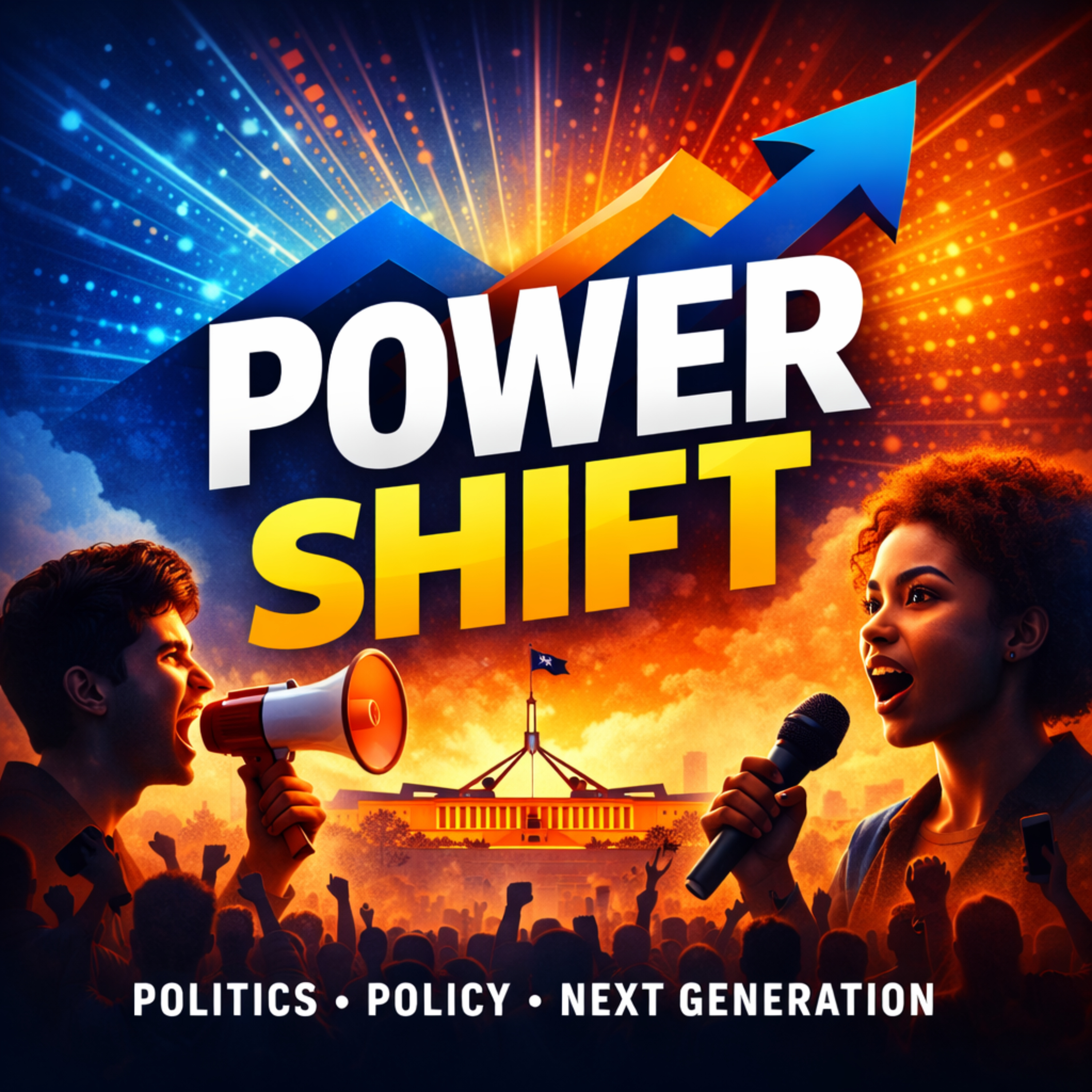
Power Shift is a politics and public policy podcast for a new generation. We unpack elections, policy debates, and leadership trends shaping Australia and the world — without spin or party lines. From housing, climate, and the economy to institutions, voting behaviour, and generational change, Power Shift focuses on how Gen Z and Millennials are entering leadership and influencing decisions at every level. Smart, accessible, and non-partisan, it’s a clear-eyed look at where power is moving next — and why it matters.
-
4
The Blue Horizon Family Episode 1 (1945-1975)
In the aftermath of war, the Nicholsons believed the promise.They reached for what Robert Menzies once described as a horizon worth building toward: security earned, families protected, and a nation shaped by duty, restraint, and steady progress. For Felix and Peggy Nicholson, this was not ideology but architecture—marriage, children, mortgages, church halls, branch meetings, and a quiet faith that history could be made stable.By 1955, the dream appeared complete.Prosperity was real. The ledger balanced. Australia felt orderly, anti-communist, and confident enough to plan for the long term.Then their children grew up.David and Susan Nicholson—the first true boomers—were raised inside that promise, educated by it, protected by it, and restless within it. Susan challenged it openly, questioning authority, gender, war, and obedience itself. She believed the horizon was not merely unfinished, but morally flawed.David went to Vietnam.What the war did to him did not turn him against his parents’ world—it drew him closer to it. Through combat and trauma, David came to understand his father’s generation and why the horizon had been built at all: to impose order after chaos, to give sacrifice meaning, to keep faith with the country that had sent them to war. Seeking stability, he embraced the values his parents defended. It was this understanding that led him to Jennifer Caldwell—a conservative North Shore Liberal, and a partner who shared his belief in continuity, duty, and civic loyalty.Episode One traces how the Blue Horizon reaches its zenith—and begins to fracture not in Parliament, but around the family table. As the upheavals of the 1960s and early 1970s deepen, Susan continues to challenge her parents and her brother, while David stands with Felix and Peggy, convinced the promise must be preserved.All of it leads to November 11, 1975.The Dismissal arrives not as a constitutional abstraction, but as a reckoning—confirmation for some that order must be restored, and proof for others that the promise was broken beyond repair. It is the day the ledger finally tears in two.The Blue Horizon Family begins with a promise articulated in the shadow of war—and ends its first chapter on the day Australia, and one family, must decide whether that promise still holds.
-
3
The Aspirational Class (1975-1996)
Chart the history of the liberals and their relationship with the youth of Gen X and the rise of Howard.
-
2
The Forgotten People’s Children (1945–1975)
Episode 1 begins in 1945, at the moment the Liberal Party of Australia was formed in the shadow of war, reconstruction, and social upheaval. It explores how a party founded in the name of The Forgotten People initially spoke not only to families and small business owners, but to the aspirations of a rising post-war generation.In the three decades that followed, young Australians benefited from extraordinary social mobility. Home ownership expanded rapidly, universities opened to broader sections of society, wages rose, and the promise of a stable, prosperous future felt attainable. The Liberal Party governed through much of this period, presenting itself as the custodian of opportunity, stability, and national progress. For a time, its message resonated with the young — or at least with the conditions that shaped their lives.But beneath that surface alignment, tensions were already forming.As Australia moved into the 1960s and early 1970s, generational expectations began to change faster than political instincts. The expansion of higher education created a more questioning, politically aware youth. Cultural authority weakened. Deference declined. Issues of civil liberties, war, race, gender, and personal freedom moved from the margins to the centre of political life. The Vietnam War and conscription became defining experiences for a generation — not as abstract policy debates, but as deeply personal questions of power, choice, and legitimacy.This episode traces how the Liberal Party struggled to adapt to these shifts. While it had once benefited from youth aspiration, it increasingly found itself on the wrong side of youth experience. Its leadership, instincts, and language remained anchored in an earlier moral and social order, even as young Australians began to see politics less as protection of stability and more as a contest over justice, voice, and autonomy.Importantly, Episode 1 does not argue that the Liberal Party “lost the youth vote” overnight, nor that it was uniquely responsible for the upheavals of the era. Instead, it makes a more difficult claim: that the foundations of today’s under-35s disengagement were laid early, in the party’s formative decades, when it failed to fully reconcile liberal conservatism with the realities of generational change.The Forgotten People’s Children begins to answer the central question of the series: how an eighty-year divorce between the Liberal Party and young Australians took shape — not through a single policy failure or election loss, but through a slow accumulation of distance, misunderstanding, and missed adaptation.It also asks a harder question, one that will echo through every episode that follows: if the disconnect began at the very moment the party was defining itself, can it ever truly be repaired? Or has the Liberal Party’s relationship with under-35s always been conditional — dependent on economic circumstances and social norms that no longer exist?Episode 1 lays the historical groundwork for the series, arguing that to understand why young Australians have turned away from the Liberal Party in the 21st century, we must first understand how — and when — the bond was first strained in the 20th.
-
1
From Nareen to Now (Part 1)
From Nareen to Now (Part 1) traces a single, unsettling journey: the passage of a leader shaped by authority, hierarchy, and constitutional duty through a Liberal Party that now appears structured to resist those very qualities.The essay begins at Nareen, not as nostalgia, but as origin. The values forged in land, stewardship, and responsibility are carried forward into an electorate that no longer speaks that language. Wannon is encountered as it exists now—professionalised, transactional, and fluent in entitlement rather than obligation. The journey is immediate and disorienting. What once anchored Liberal authority has been replaced by a politics of claims. The first question emerges quietly but decisively: if this is the electorate the Party now serves, what kind of leader can survive it?From Wannon, the journey moves inward, into the Liberal Party itself. Preselection is no longer a gateway to command but a filter against it. Fraser is not asked how he would govern, but how he would soften. He is interrogated on tone, reassurance, relatability, and adaptability. The Party does not test judgement; it tests risk. Leadership is treated as a liability to be managed rather than an authority to be exercised.As the factional interrogation unfolds, the distance between Fraser and the modern Party becomes unmistakable. Each faction asks a different question, but all share the same assumption: that authority must now justify itself to sentiment. Moderates demand linguistic caution. Donor blocs demand stability before principle. Conservatives demand force without restraint. Climate modernisers demand affirmation without execution. Fraser answers none of these on their terms. The result is not admiration or rejection, but classification. He is assessed as “unmanageable”.The journey continues into factional bargaining, where the Party’s transformation is laid bare. Unity is no longer built around doctrine or hierarchy, but around mutual fear—fear of voters, fear of donors, fear of headlines. Authority is seen not as necessary, but as dangerous. Conviction is treated as recklessness. Fraser does not attempt to reconcile himself to this logic. Instead, the question sharpens: is the Party still capable of accommodating a leader who does not seek permission to lead?The first part concludes with early campaigning alongside contemporary Liberal figures. Here, the final inversion appears. One wing seeks to weaponise Fraser’s authority without understanding its limits. Another seeks to domesticate it into something marketable. Both approaches misunderstand the same thing: that leadership, as Fraser understands it, is not a style to be adopted but a burden to be carried.From Nareen to Now (Part 1) is not an argument for the past. It is an examination of incompatibility. By the end of this instalment, the central question is unavoidable: if a leader who once governed Australia cannot pass through the Liberal Party of 2025 without being softened, segmented, or neutralised, what does that say about the Party—and what kind of leadership it now permits?Part 2 will follow the journey further, into the federal caucus, the Coalition relationship, and the parliamentary chamber, where the question of authority becomes unavoidable.
We're indexing this podcast's transcripts for the first time — this can take a minute or two. We'll show results as soon as they're ready.
No matches for "" in this podcast's transcripts.
No topics indexed yet for this podcast.
Loading reviews...
ABOUT THIS SHOW
Power Shift is a politics and public policy podcast for a new generation. We unpack elections, policy debates, and leadership trends shaping Australia and the world — without spin or party lines. From housing, climate, and the economy to institutions, voting behaviour, and generational change, Power Shift focuses on how Gen Z and Millennials are entering leadership and influencing decisions at every level. Smart, accessible, and non-partisan, it’s a clear-eyed look at where power is moving next — and why it matters.
HOSTED BY
Genpolicy
Loading similar podcasts...
Frequently Asked Questions
How many episodes does Power Shift have?
Power Shift currently has 4 episodes available on PodParley. New episodes are automatically indexed when they're published to the podcast feed.
What is Power Shift about?
Power Shift is a politics and public policy podcast for a new generation. We unpack elections, policy debates, and leadership trends shaping Australia and the world — without spin or party lines. From housing, climate, and the economy to institutions, voting behaviour, and generational change,...
How often does Power Shift release new episodes?
Power Shift has 4 episodes. Check the episode list to see recent publication dates and frequency.
Where can I listen to Power Shift?
You can listen to Power Shift on PodParley by clicking any episode. We provide an embedded audio player for direct listening, and you can also subscribe via your preferred podcast app using the RSS feed.
Who hosts Power Shift?
Power Shift is created and hosted by Genpolicy.
URL copied to clipboard!