
PODCAST · education
Protecting the Past: Archaeology, Conservation and Tourism in the North of Jordan
by Oxford University
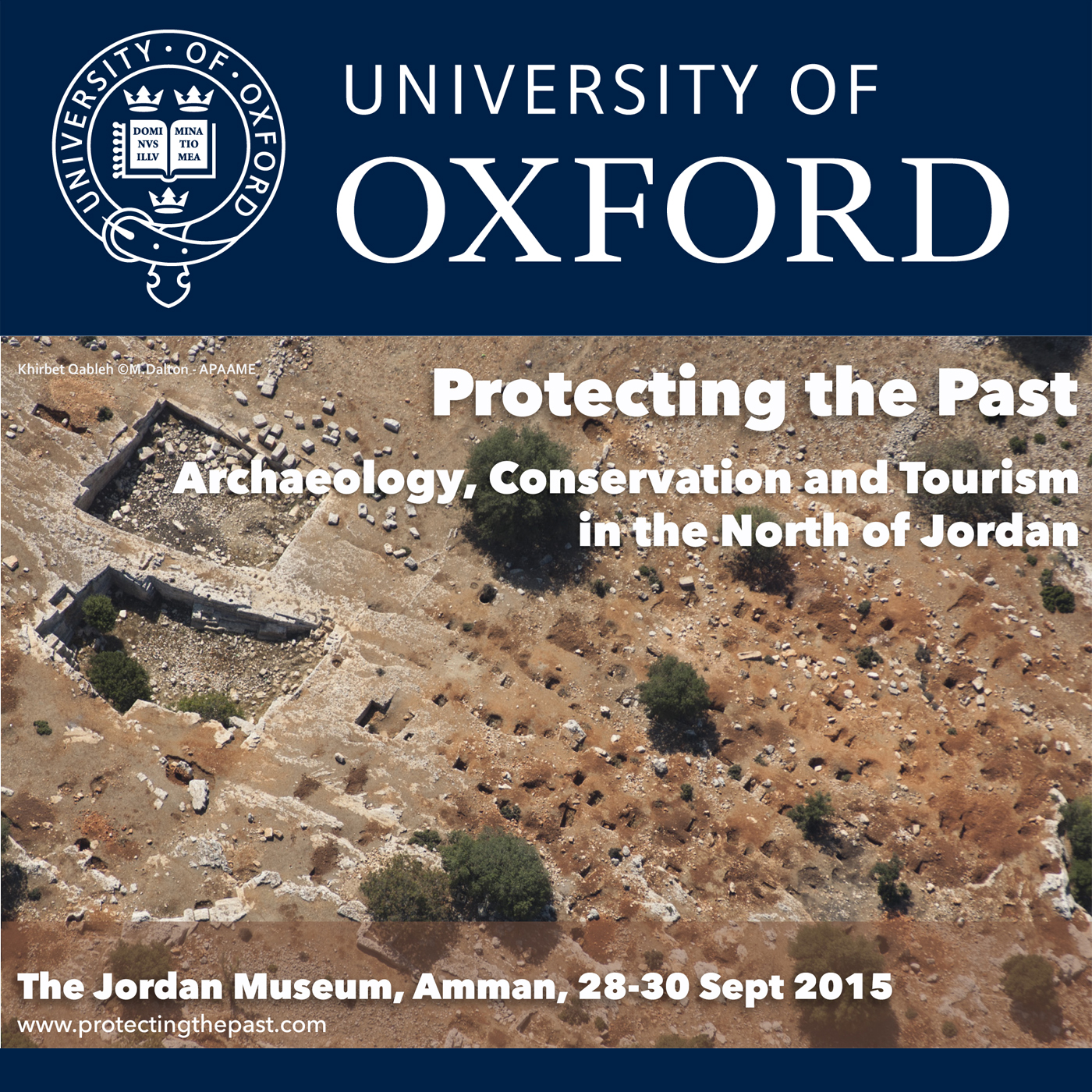
The purpose of this colloquium (28-30 September 2015) was to discuss how recent advances in the archaeological investigation of northern Jordan (Amman) can influence a wider approach to understanding Jordan’s cultural heritage through discovery, re-interpretation and better presentation. The conference gathered international and national specialists from a range of disciplines. These include archaeologists active at multi-period sites and on survey projects, experts in remote sensing and aerial archaeology, geoarchaeologists and geographers. By bringing them together with NGOs and practitioners with a stake in the development of cultural tourism in northern Jordan, we wished to foster better co-operation and collaboration.This inter-disciplinary discussion, focussing on archaeological sites and landscapes, showed that their value is not just historical and cultural but can also be economic, educational and social
-
28
Damage Assessment and Digital 2D -3D Documentation: Selected case studies from the World Heritage Site of Petra, Jordan
Dr Bala'awi (Hashemite University) presents the results of a project of digital heritage documentation at Petra conducted by the Hashemite University
-
27
Introducing SCHEP: Sustainable Cultural Heritage through the Engagement of Local Communities
Dr Addison (SCHEP) talks about SCHEP's approach to engaging host communities in the preservation of cultural heritage resources in Jordan
-
26
Private Ownership or Public Domain? The Cultural Heritage of Tall al-`Umayri at Risk
Dr Clark (LaSierra, Madaba Plains Project) speaks of the issues involved in the protection of Tell 'Umeiri, a multi-period site in the Madaba region (central Jordan)
-
25
Palestinian experience in building a detailed database of archaeological sites
Dr al-Jaradat (Ministry of Tourism and Antiquities, Palestine) speaks of the Palestinian national inventory of cultural heritage sites, for which work began in 2002 and is still ongoing Since the creation of a Palestinian Department of National Register, Palestinian authorities and international partners have work to build a comprehensive database of cultural heritage sites in the West Bank. This database comprises both published and unpublished data, recorded on an ESRI ArcGIS geodatabase. The main purpose of this inventory is to protect the main archaeological sites from ongoing building activities.
-
24
Impact of Jordan online archaeological databases on research and heritage protection as an example of questionnaire survey evaluation
Dr Drzewiecki describes how archaeologists interviewed about the impact of Jordanian heritage databases have responded as regards the role of these databases in heritage protection
-
23
MEGA-Jordan as a Preventive Resource
Mr Haroun (Department of Antiquities, Jordan) tells of how MEGA-Jordan has become the virtual memory of Jordan and the repository of its heritage
-
22
The Jordan Museum’s contribution to protecting cultural heritage in Jordan – the Hijazi Wagon
Dr Kafafi (Jordan Museum) describes the role that the Jordan Museum had in protecting the remains of the Hijaz railway within the framework of the Great Arab Revolt Project
-
21
Governmental role in protecting the cultural heritage of Jordan
Dr al-Khasawneh (Jordan Museum) speaks of the challenges facing Jordanian authorities in protecting the country's rich cultural heritage
-
20
Open access archaeological databases for Jordan – solution or threat?
Dr Drzewiecki has analysed the impact on researchers of online databases of archaeological sites in Jordan Dr Drzewiecki has conducted an opinion poll survey (with more than 100 respondents) of archaeologists with fieldwork experience in Jordan, asking them about the usefulness of resources such as MEGA-Jordan for their research and for the protection of cultural heritage in Jordan. He tells us about his preliminary results in this short speech.
-
19
The role of the community in the long-term site management plan for Umm el-Jimal
Jeff DeKock (OpenHand Studios) reads a paper by Paul Christians (Stanford University) on the long-term involvement of the local community at Umm el-Jimal with the archaeology of the site
-
18
Ancient Umm el-Jimal as seen by the modern community
Mr Hazza (Co-director of the Umm el-Jimal project) speaks about the relationship between the modern community of Umm el-Jimal and the archaeological site
-
17
Culture as a source of resilience: linking cultural assets and rural women in Umm al-Jimal
Dr Atzori (UNESCO) speaks of the opportunities for the local communities of Mafraq (north-eastern Jordan) as connected to the development of cultural tourism at Umm el-Jimal
-
16
Heritage for development. The experience of the Qasr al-Hallabat Project
Dr Arce (former director of the Spanish Archaeological Mission to Jordan) talks about the Qasr al-Hallabat project, particularly with regard to site conservation and presentation
-
15
Archaeology of agriculture. The potential of archaeological restoration for cultural tourism in the north of Jordan
Mr al-Batainah presents the work of restoration of a Roman-Byzantine winery and an Ottoman water mill, and their significance in the promotion of cultural tourism Amjad al-Batainah (Director, Department of Antiquities, Irbid office) describes the study and reconstruction works conducted on two rural archaeological sites: the Roman-Byzantine winery of Kahf al-Messihi (Beit Idis) and a water mill along the wadi al-Rayyan (previously known as wadi al-Yabis). The watermill of wadi al-Rayyan is also described in a video (in Arabic) to be found here:
-
14
A relationship between cultural identity, linear history and tourism in Umm Qais
Muna Haddad introduces Baraka's initiatives in the field of cultural tourism and community engagement, particularly on the site of Umm Qais Muna Haddad (Managing Director, Baraka) outlines the initiatives developed by Baraka in the field of cultural and ecotourism. In this presentation, Ms Haddad introduces Baraka's new project in Umm Qais. Find out more about Baraka here: http://www.experiencebaraka.com/
-
13
The approach of the Jordan Museum in protecting our past
Dr al-'Amri describes the Jordan Museum's ethos to protecting Jordan's past
-
12
Interpreting OSL dates from wadi sediments in the Jabal Harun area, Petra region
Dr Kouki talks about OSL dating Dr Kouki describes the results of OSL (Optically stimulated luminescence) dating on wadi sediments in the area of Jabal Harun (Petra region). Analyses were conducted as part of the Finnish Jabal Harun Project (2007-2014), which excavated a Byzantine monastery on top of Jabal al-Nebi Harun.
-
11
Fourth millennium colonisation of the basalt desert: Jawa and its hinterland
Dr Müller-Neuhof describes findings in the Early Bronze Age site of Jawa and its hinterland Dr Müller-Neuhof describes the results of his projects (2010-2014, 2015-), which aimed at investigating the social and economic background to settlement in the eastern Badia (north-east Jordan) from the 5th to the early-3rd millennium.
-
10
Fluctuations in land use around Pella of the Decapolis in Late Antiquity: evidence and issues
Dr Watson talks about the Pella Hinterland Survey conducted in 1994-1996 in the immediate surroundings of the multi-period site of Pella (Tabaqat Fahl) Dr Watson presents the results of the Pella Hinterland Survey, particularly with regard to land-use in the Late Antique Period
-
9
Late Prehistoric landscapes of Northern Jordan: A perspective from the Jordan Valley
Prof. Hourani discusses the Prehistoric landscapes of the Jordan Valley
-
8
Historical landscape change in northern Jordan: the cases of Abila/Queilbeh and Umm al-Jimal
Dr Lucke describes the results of his work on palaeosoils and its implications for climate change in Byzantine and early-Islamic Abila and Umm el-Jimal
-
7
Landscape character assessment mapping of the Yarmuk river basin: results and planning implications
Prof. Abu Jaber describes the results of the EU-funded international Medscapes project Prof. Abu Jaber describes the findings of the Medscapes project in Jordan. Medscapes is based on the application of LCA (Landscape Character Assessment) to map, visualise and understand landscapes. In Jordan, this project has seen the collaboration between the German Jordanian University and the Royal Society for the Conservation of Nature (RSCN) to study the landscapes of the Yarmuk river basin.
-
6
Landscape archaeology of the 'Ajlun Highlands since the Pleistocene: new insights from the Jarash Valley
Mr Boyer introduces the latest findings of his Jarash Water Project
-
5
Raising the profile of the Islamic period at Jarash, 1980-2015: excavations, restoration, and presentation
Prof. Walmsley describes the work of the Danish-Jordanian Islamic Jarash Project The Danish-Jordanian Islamic Jarash Project was begun in 2002 with the aim of excavating a large early-Islamic congregational mosque and the early-Islamic shops and households in its vicinity. Project Director Prof. Alan Walmsley describes the origins of the project, its development and its future. For more information see: http://miri.ku.dk/projekts/djijp/
-
4
A Conservation Strategy for Umm el-Jimal: Engaging the Modern Community in the Preservation and Protection of the Antiquities
Dr De Vries and Mr DeKock present their holistic approach to the study, conservation and site display of Umm el-Jimal The site of Umm el-Jimal has been the object of more than 40 years of study by Dr Bert De Vries (Calvin College) and his colleagues. In this lecture, Dr De Vries and Mr DeKock (OpenHand Studios) present their approach to site conservation at Umm el-Jimal, and unveil the main features of the Umm el-Jimal virtual museum (www.ummeljimal.org)
-
3
Protecting our past/Protecting our future: the future of Abila of the Decapolis in Northern Jordan
Dr Vila, the director of the American Expedition to Abila,describes the team's work on the site from the 1980s onwards and recent fundraising efforts to protect the site's future
-
2
Whose foundation? The emergence of Hellenistic Pella
Dr Tidmarsh talks about the Hellenistic period at the multi-period site of Pella (Tabaqat Fahl, northern Jordan)
-
1
Endangered Archaeology in the Middle East and North Africa
A talk by Dr R.Bewley (Oxford) introducing the Endangered Archaeology in the Middle East and North Africa project
No matches for "" in this podcast's transcripts.
Loading reviews...
ABOUT THIS SHOW
The purpose of this colloquium (28-30 September 2015) was to discuss how recent advances in the archaeological investigation of northern Jordan (Amman) can influence a wider approach to understanding Jordan’s cultural heritage through discovery, re-interpretation and better presentation. The conference gathered international and national specialists from a range of disciplines. These include archaeologists active at multi-period sites and on survey projects, experts in remote sensing and aerial archaeology, geoarchaeologists and geographers. By bringing them together with NGOs and practitioners with a stake in the development of cultural tourism in northern Jordan, we wished to foster better co-operation and collaboration.This inter-disciplinary discussion, focussing on archaeological sites and landscapes, showed that their value is not just historical and cultural but can also be economic, educational and social
HOSTED BY
Oxford University
CATEGORIES
Loading similar podcasts...
URL copied to clipboard!