
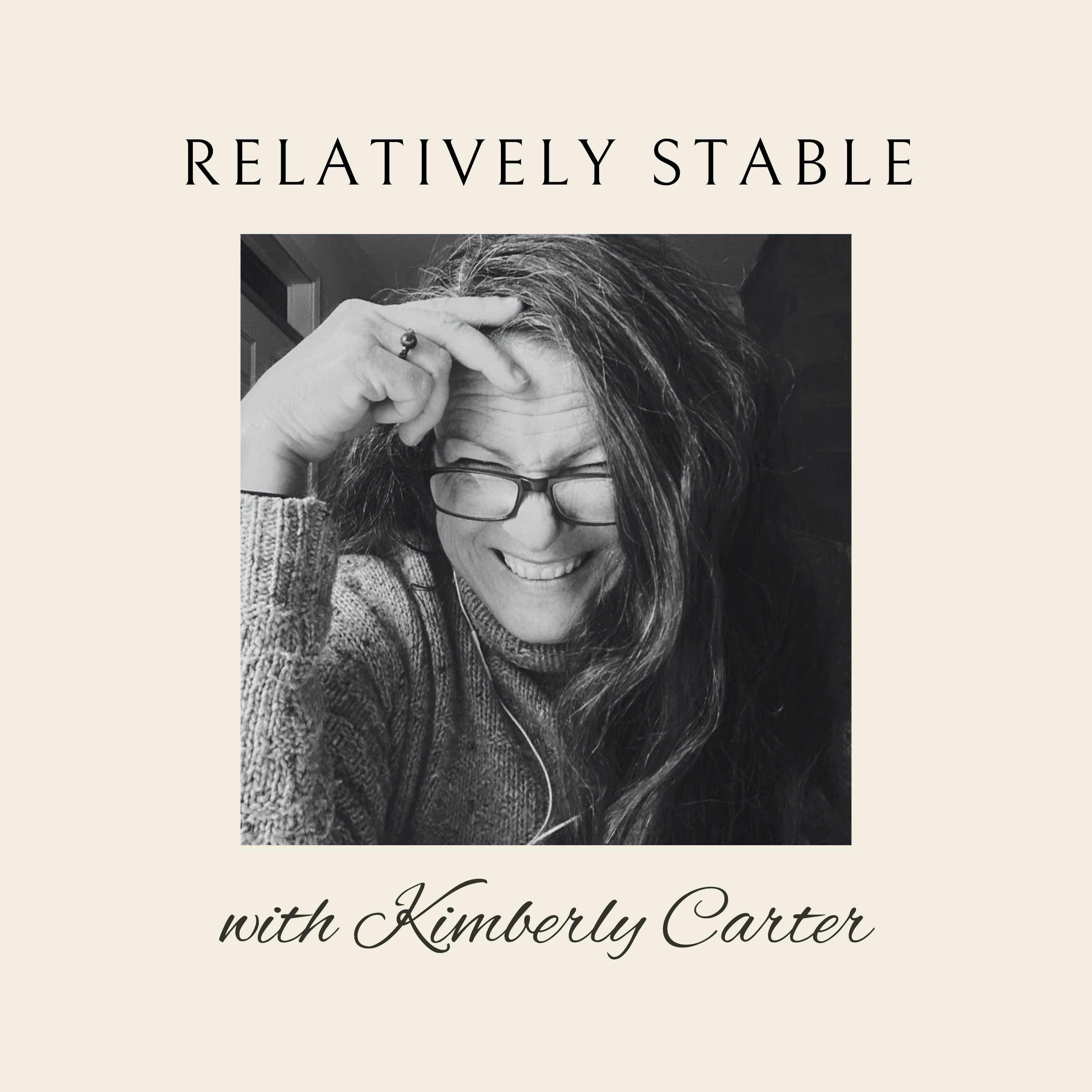
PODCAST · society
Relatively Stable
by Kimberly Carter
In Relatively Stable we delve into the journeys of those who have faced challenges, uncovered their passions, and discovered resilience along the way. Whether you're here for the stories, seeking inspiration, or simply drawn to the wisdom we glean from horses—and life—you’re in the right place. Let’s dive into the narratives that remind us how to stay relatively stable, no matter what comes our way. stableroots.substack.com
-
70
The Joy of Mowing
What if mowing wasn't a chore?This week in Stable Roots, Kim Carter reflects on why climbing onto a tractor has become one of the most restorative parts of life at Lavender Hill. What begins as a story about bush hogging pastures unfolds into a meditation on attention, empowerment, Elizabeth Gilbert's All the Way to the River, the surprising history of lawns, the secret language of roadside ditches, and why Johnson grass might have more to teach us than we'd like to admit.Sometimes the most ordinary work invites us into the deepest conversations—with ourselves, with the land, and with the seasons quietly unfolding around us.Whether you spend your days on a tractor, in a garden, at a workbench, or behind a desk, this episode is an invitation to slow down, pay attention, and discover the unexpected joy hidden in work you can actually finish.In this episode:Why buying a tractor changed more than the way I mowedMeasuring an afternoon in Elizabeth Gilbert instead of hoursBush hogging versus suburban lawnsThe hidden history of the American lawnReading the stories written in ditchesWhat Johnson grass can teach us about land—and ourselvesWhy tangible work quiets a busy mindQuestion for listeners: What work tires your body but fills your spirit? I'd love to hear your answer in the comments.Stable Roots is a weekly essay and narrated podcast exploring horses, historic places, Appalachian culture, faith, human behavior, and the quiet lessons hidden in ordinary life.Subscribe for free or become a paid subscriber to support the work and receive audio narrations, the full archive, and exclusive subscriber content.Written and narrated by Kim CarterBramblewood Stables at Lavender Hill, Simpsonville, SCNew episodes every Thursday. Get full access to Stable Roots at stableroots.substack.com/subscribe
-
69
Granny Magic
Granny Magic: A witness statement from the Blue Ridge MountainsWhat if the old women knew something we've forgotten?This week, I'm taking you back to one hot summer afternoon when I ran into a burning kerosene heater, my cousins called Aunt Daisy, and she "talked the fire" out of my burn with a prayer passed down through generations.That memory opens the door to a much larger conversation about Appalachian folk traditions, the rise of cottagecore and grannycore, the tension between faith and science, and why so many of us are suddenly longing for the wisdom our own grandparents often left behind.Along the way, I share the story of my remarkable Aunt Winchester, explore the rituals that still survive throughout the Blue Ridge Mountains, and offer my own witness statement about mystery, prayer, healing, horses, and the things I've experienced that I cannot explain away.Whether you believe every story or remain wonderfully skeptical, I hope this episode reminds you that paying attention has always been one of humanity's oldest forms of wisdom.Because perhaps the real magic was never in the rituals themselves.Perhaps it was in remembering how to notice.In this episode:- The day Aunt Daisy prayed the fire out of my burn- The mountain women who carried healing traditions through generations- Why cottagecore and grannycore have become cultural movements- The relationship between Appalachian folk practices and Christianity- Talking fire, stopping blood, weather signs, moon lore, dreams, saints, and horses- Why I believe science and mystery belong in the same conversation- My own witness statement about living in a world that is far stranger than we've been taughtIf this episode resonates with you, I'd love to welcome you to Stable Roots, where every week I explore the intersection of horses, history, grief, faith, psychology, and the stories that shape the way we live.Love,Kim Get full access to Stable Roots at stableroots.substack.com/subscribe
-
68
Shut Up and Listen
The Ability to Be TaughtWhy horses care less about what we think we know.What if the most important learning skill isn't intelligence?This week, Kim Carter begins with a one-minute drone video of horses running across a field in Upstate South Carolina and follows an unexpected thread into a much bigger question: What does it mean to pay attention?From horse-crazy barn rats and child labor law research in the pre-internet era to a stubborn girth buckle, fragmented attention, working memory, and the surprising science behind learning styles, this essay explores why children often learn differently than adults—and why horses may be some of the best teachers we have.Along the way, you'll discover:• Why research has largely debunked the idea of visual, auditory, and kinesthetic learners• What psychologists mean by working memory—and why instructions sometimes seem to vanish before we can use them• The surprising reason adults often struggle more than children when learning something new• How modern life trains us to divide our attention into smaller and smaller pieces• Why horses consistently reward curiosity, presence, and the willingness to be a beginnerAt its heart, this isn't a story about riding lessons.It's about competence, attention, and the increasingly rare ability to stop what we're doing long enough to receive new information.Whether you've spent your life around horses or have never touched one, this episode offers a fresh perspective on learning, listening, and why some of the most important lessons in life begin when we're willing to admit we don't already know the answer.Featured topics:Attention • Learning Styles • Working Memory • Neuroplasticity • Horses as Teachers • Child Development • Adult Learning • Focus in a Distracted World • Personal GrowthKey Quote"The best learners are people willing to breathe through their discomfort and listen. And if we're lucky, the horse is patient enough to wait for us to remember how." Get full access to Stable Roots at stableroots.substack.com/subscribe
-
67
A Future Me Problem
What year is your problem from?In this week's Stable Roots, Kim explores a simple thought experiment that came to her in the wee hours between waking and sleeping: What happens when you take a problem you're facing today and place it in another time period?Would a fallen tree have felt different in 1825? What about a dead mouse in a feed bag? Would the problem still exist, or would it reveal itself as a product of modern technology, expectations, and endless decision-making?Through stories from life at Lavender Hill—including a storm-damaged water oak, a Sunday morning botulism scare, and a veterinarian's reminder that knowledge and control are not the same thing—Kim examines why modern life can feel so exhausting even when we have more tools than ever before.Sometimes the problem isn't the problem.Sometimes it's everything we've attached to it.This episode is an invitation to take three steps backward, widen the frame, and ask a different question:What year is my problem from?In This EpisodeThe origin of the phrase "That's a future me problem"Why some modern worries would have made no sense in 1825The hidden burden of endless options and decision-makingA fallen tree, Hurricane Helene, and the cloud of choices surrounding simple problemsWhat a dead mouse in a feed bag taught Kim about uncertaintyThe difference between knowledge and controlWhy waiting has become such a difficult skillA practical exercise for gaining perspective when a problem feels overwhelmingMemorable Quote"Not every problem belongs to today. Some belong to tomorrow. Some belong to the past. And some problems aren't problems at all, but questions that time hasn't answered yet."Stable Roots on Relatively Stable is the audio companion to Kim Carter's weekly Substack essays, recorded from Lavender Hill in Upstate South Carolina, where horses, history, grief, resilience, and ordinary life intersect in unexpected ways.Read and subscribe to Stable Roots.Follow Kim on Facebook. Get full access to Stable Roots at stableroots.substack.com/subscribe
-
66
I'm So Glad I Was Evicted
The best solutions often come at the worst cost.For two decades, Kim grew a business and a life inside the protective casing of fear—terrified of what would happen if she were ever forced to leave the farm she called home. But human time moves fast, and when an eviction notice arrived to signal that the land was being developed, a twenty-year tenancy vanished in a blink.In this audio essay, Kim reflects on the long, overlapping histories we leave on borrowed ground, the difference between a grand illusion and a true sanctuary, and how a sudden uprooting led her to the 200-year-old threshold of Lavender Hill.We are all just passing through, but some evictions force us to transplant our lives into much richer soil.In This Episode:The Ghost of Morpheus: A twenty-something dream of a grand estate in Tryon, NC, and the warning hidden inside a beautiful illusion.Pot-Bound Roots: Navigating twenty years as a "humble apologist" on borrowed land, overshadowed by the footprints of those who came before.Operating on Land Time: The sudden shock of a six-month eviction notice and the confrontation with a geographic clock.Discovering Lavender Hill: An impossible listing beside a prison, two juvenile armadillos acting like puppies, and a hidden meadow that became a love song.The Reality of Sanctuary: Learning to live in a place that demands partnership rather than deference.Notable Quotes:"Like a garden bed filled with mint, my shoots overlapped with the Turk’s broad trunks, and the shared history of other trainers who had come before us in that space, on that land.""It felt like I was walking into a dream, but one that didn’t come with a warning.""To a mountain or a pasture, a twenty-year tenancy is just a blink, a single season in a vast, geologic clock... Every landlord, every trainer, every husband, and every writer is eventually evicted by time itself."Connect with the Farm:If Stable Roots feels like a conversation you'd like to keep having, join our community. Every week, Kim Carter writes about horses, land, grief, belonging, and how we sometimes have to get lost to find ourselves.Read the original essay & see the photos: at Substack.Support the work: Consider upgrading to a paid subscription to directly support the horses, the land, and the stories harvested at Lavender Hill. Get full access to Stable Roots at stableroots.substack.com/subscribe
-
65
The Dreaming
This week's essay started as a dream about a house I didn't know I owned.Then, it became something bigger — an investigation into why the nature of my dreaming changed the moment I moved to Lavender Hill Farm, and what it means that I'm finally, for the first time in my life, sleeping straight through the night.In this episode I'm reading the full essay, which traces the dreaming through the science of REM sleep, the mystery of the Voynich Manuscript — a fifteenth-century illustrated codex full of plants that don't exist and a script no one has decoded in six hundred years — and into the work of Carl Jung, who went into his own basement at thirty-eight and came back with a map.The essay also visits my cousin Janette, a botanist who told me years ago that she no longer daydreamed, which terrified me at the time. It took me decades to understand what she meant — and to recognize that something else was moving in to take daydreaming's place.If you've been paying attention to your own dreams lately, or noticing that something in your interior life has shifted, this one is for you.In this episode:The house as the self — Jung, Bachelard, and why so many of us dream of rooms we didn't know we haveWhat actually happens in the final hours of sleep, and why most of us never stay down long enough to find itThe Voynich Manuscript and the long human tradition of trying to record what lives inside usActive imagination — Jung's practice of going back into the dream and asking the figures what they wantThe second half of life and the gold that's too close to seeLinks and references:The Voynich Manuscript — viewable in full at the Beinecke Rare Book and Manuscript Library, Yale UniversityCarl Jung, The Red Book: Liber Novus, edited by Sonu Shamdasani, W.W. Norton & Company, 2009 (affiliate link)Gaston Bachelard, The Poetics of Space, 1958 (affiliate link)If my work resonates with you:Stable Roots publishes weekly essays on the land, the interior life, and the slow work of paying attention. Free subscribers receive each essay in their inbox. Paid subscribers support the farm and the writing, and get a little more of everything.Stable Roots is written and read by Kim Carter and recorded at Lavender Hill Farm Get full access to Stable Roots at stableroots.substack.com/subscribe
-
64
The Grass Isn't Always Greener
This week's episode is the audio companion to the Stable Roots essay — and it starts with Hero, my little chestnut Quarter Horse, army-crawling under an electric fence in the middle of the night to graze the forbidden rushes by the pond.I thought he was being a pain. Turns out, he was a prophet.What begins as a pasture management problem in the middle of a Foothills drought opens into something much bigger — the difference between forcing compliance and allowing recovery, in the land, in our horses, and in ourselves.In this episode:— Why drought weeds are nature's emergency response team, not a sign of failure— What tall fescue's vault strategy teaches us about resilience— The one-rein stop as a metaphor: compliance isn't the same as willingness— How Hero accidentally saved the topsoil by escaping at night— Why I'm trading a perfectly managed life for a recovery-driven oneRead the full essay and subscribe at Stable Roots. Get full access to Stable Roots at stableroots.substack.com/subscribe
-
63
We Don't Save Old Farms
We Don't Save Old Farms: (They Save Us)In this week’s Stable Roots, Kim Carter traces the layered history of Lavender Hill — the 200-year-old farm in Simpsonville, SC now home to Bramblewood Stables — through old letters, photographs, buried spring stones, and an antique hand plow that may have originated from the land itself.What begins as research into the farm’s past slowly becomes something more intimate: a meditation on stewardship, memory, and the feeling of stepping into a conversation already underway long before your arrival.This episode explores:- The transformation of Holly Springs Acres into Lavender Hill- Charles and Alona Lavender’s restoration of the farm after the Korean War- The excavation of the original spring house- Forgotten infrastructure and old ways of living with the land- And what it means to enter a relationship with a place instead of simply owning itRead the full essay and explore Stable Roots: Stable Roots on SubstackLearn more about Bramblewood Stables at Lavender Hill: Bramblewood StablesSouth Carolina Department of Agriculture listing for Lavender Hill Farm: Lavender Hill Farm and Bramblewood StablesLast week’s companion piece on disappearing farmland in Upstate South Carolina continues the larger conversation around land stewardship, development pressure, and preservation.Follow along with the ongoing restoration and history work at Lavender Hill on Facebook and Instagram. Get full access to Stable Roots at stableroots.substack.com/subscribe
-
62
Your New Neighbors are Costing You a Fortune
In 2020, the world tilted on its axis. For the Upstate of South Carolina, that tilt sent a wave of 100,000 new residents crashing into our pastures. As we cross the milestone of one million neighbors, the infinite horizon of the American South has officially hit a bottleneck.This week, Kim dives into the canyon between agricultural value and development prices. From the ingenious survival strategy of European track systems to the personal desperation of cashing out a retirement to save her farm by purchasing thirty acres, we’re talking about the high cost of holding the line. Is a farm just a vacant lot waiting for a purpose, or is it the essential, self-sustaining lung of a growing city?In this episode, we discuss:The Million-Resident Milestone: The rapid expansion of the Greenville-Anderson-Greer, South Carolina metro area.The Mother of Invention: Why land scarcity in the Netherlands and the UK forced a smarter way to keep horses, and why we’re next.The Hidden Subsidy: The math that proves farms actually lower your taxes, while subdivisions send you the bill.Legislative Victories: A look at the Old White Horse Road Corridor victory and the new SC laws fighting to protect 7 million acres by 2050.Lavender Hill: A raw look at the survival of a 30-acre heart of a 1,100-acre legacy.Once our dirt is buried under six inches of concrete, the conversation is over. The soil doesn’t get a second chance. And neither do we.Connect & Support:Read the full essay and see the data: at Stable Roots on SubstackSubscribe to Stable Roots: Join our community of land stewards and help us hold the line against the asphalt funnel.Follow on Facebook: @kim.carter.equestrianAnd on Instagram: @two_pointAbout Stable Roots: Stable Roots is a weekly exploration of land, legacy, and the grit it takes to keep them both. Hosted by Kim Carter, a farm owner and advocate in the Upstate of South Carolina, we look at the intersections of agriculture, economics, and the equestrian life in an increasingly crowded world. Get full access to Stable Roots at stableroots.substack.com/subscribe
-
61
We Are All Watching the Same Shoreline
We Are All Watching the Same ShorelineThis week I did something I don't usually do — I went down a rabbit hole that started with my clients asking about rain and ended at a United Nations report declaring global water bankruptcy.I work outside every day. I watch the same fields, the same fence lines, the same pond across the street from my kitchen window. And what I've been watching all winter is a shoreline that keeps moving in the wrong direction. Most people around me have no idea we're living inside the driest stretch this region has seen since 1895. They're caring, smart people but their water comes from a tap and their lawn starting to look brown feels like a southern summer rather than a symptom of something much larger.In this episode I'm reading the full piece from this week's Stable Roots. It covers the US Drought Monitor — which was built the same year our pond at Lavender Hill was excavated — the record-breaking drought numbers for the Southeast, what it would actually take to correct the deficit, and why a hurricane may be the only thing that fixes it. From there I zoom all the way out to the UN's January declaration of global water bankruptcy, the shrinking lakes and collapsing aquifers, the cities that are literally sinking, and the Colorado River agreements written for a river that no longer exists.Then I bring it back home. To the rain that fell on Saturday. To the oak grove in the cemetery pasture. To what my grandfather was really afraid of in 1999, and what he couldn't have known to fear. And to the clover fixing nitrogen into dry ground without any help from anyone, because the land is not done.Neither are we.All sources are footnoted in the full piece at Stable Roots. Links below.Read the full piece: Stable Roots on SubstackFollow me on: Facebook | Substack | Instagram |If this episode resonated with you, share it with someone who lives indoors. Get full access to Stable Roots at stableroots.substack.com/subscribe
-
60
You’re Not Lost, You’re Just Relocating
You're Not Lost, You're Just RelocatingWe’ve been taught that running is a sign of weakness, a character flaw, or a symptom of fear. But if we look at the architecture of the horse, we see a different story. A horse doesn't run to disappear; it runs to gain the distance required to turn around and face the threat.In this episode, we dive into the "biology of the turn." We explore why we feel so exhausted by the modern world (it’s not the running—it’s the lack of resolution) and how to distinguish between chronic flight and the sacred movement toward perspective.Whether you are currently in a sprint or standing in the pause, this conversation is an invitation to stop accumulating threats and start gathering meaning.In This Episode:- The Architecture of Go: Why horses are built for speed, but designed for study.- The Ghost in the Graveyard: Reinterpreting Rumi’s advice on facing what haunts us.- Chronic Flight vs. Wise Distance: How to tell if your "running" is healing you or harming your relationships.- The Biology of the Turn: Why we cannot find clarity until we regulate our nervous systems.- Relocating, Not Lost: A reframe for those who have walked away from lives that no longer fit.Join the Greater World of Stable Roots:If this episode resonated with you, there are several ways to plant deeper roots in this community.- The Stable Roots Substack: Read the full essay and join the conversation in the comments.- Support the Farm: Our work is funded by readers and listeners like you. Become a paid subscriber to ensure the horses and humans here have a place to "turn and look."- Work with Kim: If you’re in the middle of a sprint and need someone to hold the wider view while you catch your breath, visit my new digital home.- Bramblewood Stables: See the landscape of the farm and the horses mentioned in today's episode.Connect with Kim:- Instagram: @two-point- Facebook: kim.carter.equestrian"The horse knows something that is immensely hard for people to understand—the body moves before clarity and choices come into focus."Subscribe/Follow on: [Apple Podcasts] | [Spotify] | [YouTube] Get full access to Stable Roots at stableroots.substack.com/subscribe
-
59
The Witness
Bearing Witness — What It Means to Be Seen, to See Others, and to See YourselfThis week in Stable Roots, Kim Carter writes about witnessing — what it truly means to be present for someone, and how our instinct to fix things often gets in the way.After a surprise visit from two of the most important people in her life, Kim found herself thinking about the kitchen table, a hidden drawer full of medicine, and what it looks like when someone actually stays in the field of hard things with you instead of trying to move you through them.In this episode:→ Why our instinct to help is often really our instinct to make our own discomfort stop→ The Old English roots of the word "witness" — and why it was originally about knowing, not watching→ What horses, elephants, and mares can teach us about co-regulation and presence→ The difference between people who love the version of you that's winning and those who can love the version of you that's simply trying→ How to become a witness to your own life while you're still living itThere are witnesses to the medicine. This episode is one of them.—Stable Roots at Relatively Stable is written and hosted by Kim Carter. New episodes every week.Follow along on Substack | Facebook: Kim Carter Get full access to Stable Roots at stableroots.substack.com/subscribe
-
58
The Biological Prayer
The world is talking. It has always been talking. We are the only species that decided, somewhere along the way, to stop transmitting.This week's episode is the second in the Invisible Altar series — and it goes somewhere unexpected. We start in the barn, with the frozen silence of a person who has just been offered a list of options and can't locate, anywhere inside themselves, what they actually want. And we end with humpback whales singing across four hundred miles of open ocean, elephants grieving into the ground, wolves locating each other across valleys and forests, and a horse's hoof picking up seismic signals through the earth.These aren't separate subjects. They're the same one.IN THIS EPISODEWhy consent and choice are the hardest exercises we do at Bramblewood Stables at Lavender Hill — and what that reveals about how far humans have drifted from their own signalThe science of how humpback whales transmit evolving songs across entire ocean basins — and what MIT researchers recently discovered about a sperm whale phonetic alphabetHow elephants grieve through infrasound frequencies the earth carries better than air, sending mourning through the ground from one set of feet to anotherWhat Pacinian corpuscles are, why horses have them in their hooves, and why you have them in your feet — and what it means that both of you have been standing on a transmitting earth this whole timeWhy the leaves coming in at Lavender Hill this week changed the frequency of the entire farm — and what the people who hadn't visited in two weeks felt in their bodies before they understood what had changedWhat happens to the body when we interrupt our own transmission long enough — and how the channel back is shorter than we thinkTHIS WEEK'S PRACTICEAt the end of the episode you'll find an audit and a practice. The short version: find one signal your body has been trying to send this week that didn't get to complete — a breath, a sigh, a walk, a hand on something living — and give it five unwitnessed minutes. The wolves don't explain the howl. You don't have to either.IF THIS EPISODE FOUND YOULast week's episode — the first in the Invisible Altar series — introduced the idea of the farm as a place of practice, and Indigo the cat as an unlikely teacher. If you haven't heard it, it's a good place to start.Next week we go further in: what it means to build a practice around something you can't fully name yet, and why that might be exactly the point.FIND THE FULL ESSAY + SOURCESRead this week's essay on Substack.If Relatively Stable is finding you at the right moment, the best thing you can do is share it with one person who might need it too. Leave a review if your podcast app allows it — it matters more than the algorithms want you to think.And if you want the written version delivered to you each week, Stable Roots is where this all lives. Come find me there.Love, Kim Get full access to Stable Roots at stableroots.substack.com/subscribe
-
57
The Invisible Altar
A few weeks before our cat Indigo was diagnosed with FIP, she started purring constantly.Every night, pressed against me, making biscuits on the duvet. I thought she was finally at peace after the hardest year of our lives. I was wrong.A cat's purr vibrates between 25 and 150 hertz — a frequency clinically shown to stimulate bone density and accelerate tissue repair. She wasn't contented. She was in triage. Her body was running the only repair instrument it had, alone in the dark, while I lay there reading her distress as gratitude.I had been doing the same thing for months.This episode is about the place we go when the performance of wellness finally runs out of gas. Not the meditation cushion version. The real one — unglamorous, unwatched, and the only thing that actually works.It's about what the horses at Lavender Hill know about exhaling that we've largely forgotten. It's about the specific madness of being a nervous system coach while your own perimeter comes apart at the seams. It's about what two hundred years of floorboards sound like before dawn, and a cat named Indigo who fought something ancient and enormous with nothing but the instrument of her own frequency.The episode closes with two practice prompts: an audit for locating where you're performing okay while your nervous system is actually in triage, and a practice for finding the one private gesture that is purely yours — not for the optics, not for the audience, but for the bone-deep necessity of staying whole.This is the first essay in a four-part April series. Each piece stands alone. Together they form a complete arc — from the recognition of the private self, through the body's own repair, through what it means to stay in the room with someone else's hard thing, to the changed person who walks back into ordinary life carrying something new.Week 1 — The Invisible Altar: Who we are when no one is watching Week 2 — The Biological Prayer: What the body does there Week 3 — The Witness: What it means to stay Week 4 — The Return: What we carry backAbout 20 minutes. Best listened to anywhere you don't have to be performing anything for anyone.Read the full essay, subscribe, or share at Stable Roots, a weekly essay and audio publication written from Lavender Hill — a 200-year-old farmhouse and working stable. It lives at the intersection of nervous system work, honest writing, and what the horses keep insisting on teaching. New every Thursday. Get full access to Stable Roots at stableroots.substack.com/subscribe
-
56
The Nutrients of Disruption
The Nutrients of DisruptionWhen we arrived at the new farm, I thought my first responsibility would be to maintain the tidy lawns and pastures that had been carefully tended for generations. My plan was simple: mow early, manage the weeds, and keep the landscape looking orderly.But spring had other ideas.Before I could get the mower started, the fields erupted with plants most people would call weeds—henbit, chickweed, dandelion, wild onion, violets, shepherd’s purse. As I paused long enough to identify them, I discovered that nearly every one of these early plants is edible and nutrient-dense, arriving at the exact moment when bodies—both human and equine—are depleted after winter.The horses noticed long before I did.Watching them move through the pasture like quiet herbalists began to change the way I thought about disruption, not just in the field but in life itself.In this essay, I explore how the natural world uses disturbance to restore balance: fire opening the seeds of pine forests, floodwaters replenishing soil across valleys, wind scattering life across landscapes, and grazing animals renewing grasslands through movement and pressure.What we often experience as destruction can also be part of a much longer cycle of renewal.This piece reflects on the strange wisdom of weeds, the forces of the elements, and the way disruption has shaped both the land and my own life here at the farm.Listen if you’re interested in:- how weeds restore nutrients to depleted soil- the ecological role of fire, flooding, wind, and grazing- what horses can teach us about seasonal nourishment- why disruption is often the beginning of renewalSubscribe to Stable RootsStable Roots is a reader-supported publication exploring the intersection of land, horses, and the deeper lessons that emerge when life refuses to stay orderly.Free subscribers receive each essay in their inbox. Paid subscribers help support the writing and the work unfolding here at the farm. Get full access to Stable Roots at stableroots.substack.com/subscribe
-
55
The Elephant in the Room
The Elephant in the RoomIn this episode, I read a new essay from Stable Roots written in response to an anonymous letter that arrived at our farm.The letter accused me of harming my horses, misusing donations that supported the relocation of Bramblewood Stables, and failing the community that helped make our move possible.Rather than responding through rumor or secondhand conversation, I chose to answer the only way I know how: openly and in writing.This piece explores what transparency actually means when your work is visible, vulnerable, and deeply tied to the lives of animals and people who trust you. It touches on the realities of relocating a working horse farm, the loss of a beloved horse named Sheba, and the labor that continues every day behind the scenes at Lavender Hill.Most of all, it is a reflection on community — the people who showed up when our farm needed them most and who continue to stand beside this work.If you’d like to read the full essay or learn more about the work we are building here, you can find it at Stable Roots, where I document the realities of stewarding land, horses, and a community that continues to grow.Love, Kim Get full access to Stable Roots at stableroots.substack.com/subscribe
-
54
That Time I Bought a Cat
That Time I Bought a Cat (And Then Purchased Another)In this week’s episode, I’m reading my latest Stable Roots essay — a piece about cats, yes, but also about grief, land, financial contraction, hospice care, and the quiet investments that hold us steady when everything else feels uncertain.The year I bought two Siberian cats was the same year my father entered hospice, we lost the farm we had stewarded for two decades, and Christopher and I signed for a historic property that would become Lavender Hill.I had never purchased a cat before. The decision felt indulgent at the time. It turns out it was something else entirely.This episode explores:- Why the Hermitage Museum has cats guarding its galleries- The difference between rescue and presence- What it means to be responsible for everyone elseAnd why sometimes the smallest purchases anchor us through the largest transitionsIf you are building something that depends on you — land, family, business, community — this week's essay may resonate with you. Get full access to Stable Roots at stableroots.substack.com/subscribe
-
53
The Book Beneath the Barn
In this voiceover essay, I trace the long arc from cleaning stalls in the Dark Corner of the Blue Ridge Mountains to stewarding a farm, leading a community, and finally turning toward the book I have been circling for decades.What begins as a reflection on land loss and self-censorship widens into something more foundational: free expression, oral tradition, and the responsibility of carrying forward knowledge that lives in land, animals, and lived experience. I speak candidly about fear, second-guessing, and the temptation to edit myself in a cultural moment that rewards sound bites over substance.This episode explores:- The erosion of expressive freedom — and how self-censorship takes root- What farming teaches about leadership, identity, and endurance- The difference between polished expertise and embodied knowledge- The pandemic-era shift in horsemanship toward connection over control- Why complex, relational work cannot be reduced to a flow chart- The accumulated wealth of oral tradition inside barns and back fields- The decision to stop waiting for a “clean” moment and begin writing the book nowI reflect on the poets and horsemen whose words survived because someone chose to write them down — including 13th-century Sufi mystic Rumi — and ask what stories we are responsible for preserving in our own time.At its heart, this episode is about remembering why we started, reclaiming voice, and meeting one another in the field beyond right and wrong — where land and story endure.Listener Reflection:- What work has been shaping you, even if you didn’t recognize it at the time?- Where are you editing yourself out of your own story?- What knowledge are you carrying that deserves to be written down?Thank you for taking these journeys with me.Love, Kim Get full access to Stable Roots at stableroots.substack.com/subscribe
-
52
Cultivating Empathy
Cultivating EmpathyIn a world that tries to drain it out of youIn this reading of my weekly, Stable Roots, essay, I explore what empathy actually is — and what it isn’t.We hear the word constantly. It’s praised, politicized, misused, and often confused with emotional intensity or moral agreement. But empathy, practiced well, is deeper and more complex than that. It isn’t about absorbing everything or proving how deeply we feel. It’s about listening carefully enough to receive another person’s experience without overtaking it.Through stories of caregiving, frozen pipes, horses, projection, and grief, this piece traces the difference between empathy and assumption — between standing beside someone and bracing against them. It looks at how unchecked empathy can turn defensive, how misdirected responsibility leads to burnout, and why boundaries are not the opposite of care.At its core, this is an exploration of listening. Of what it means to be accurately received. Of how warmth, when applied patiently and in the right place, allows what’s frozen to move again.If you’ve ever felt overwhelmed by the demand to care about everything at once, or if you’ve ever mistaken reaction for connection, or if you’re learning how to stay soft without losing yourself -- you might find something useful in this piece.Love, Kim Get full access to Stable Roots at stableroots.substack.com/subscribe
-
51
Why Not Me?
In this essay, I write from the days surrounding my father’s death and our first quiet Christmas at Lavender Hill Farm. What I expected to be rest turned into a confrontation with how my body and mind responded after months of caregiving, loss, and responsibility, and with an old folk practice that gave language to something I didn’t yet know how to name.Sin Eating weaves together farm work, folklore, and a Christmas Eve medical scare with one of our mares. I reflect on the impulse to take responsibility for loss, to keep internal ledgers, and to hold what feels unbearable in the hope that something else might be spared. The piece moves between grief in the human body and illness in an animal body, asking where responsibility begins, where it ends, and what happens when we try to carry too much.This is an essay about embodied grief, stewardship, inherited wisdom, and leadership fatigue. It’s about how attention and simple acts can become containers in moments of crisis, and how some forms of knowing arrive without explanation—through touch, repetition, and attention.Stable Roots is reader-supported. Subscribing directly supports my writing and the ongoing care of the horses and land at Lavender Hill. Get full access to Stable Roots at stableroots.substack.com/subscribe
-
50
Keeping Vigil
Keeping VigilAt the threshold of the Fire HorseThis piece was written in the slowed time of dying and published at the turning of the year. It traces what happens when clocks stop mattering, when mirrors become witnesses, and when keeping vigil becomes the only meaningful work left. Moving between hospice rooms and hay fields, folklore and neuroscience, agitation and clarity, it asks what it means to stay with someone all the way to the edge—and how to know when staying gives way to letting go.Keeping Vigil explores end-of-life presence, terminal lucidity, the nervous system’s role in dying, and the ancient human instinct to watch so no one crosses alone. It is also a reckoning with control, grief, land stewardship, and the kind of light that follows mourning rather than resolves it.Published on New Year’s Day, at the approach of the Fire Horse year, this piece stands at a threshold—between endings and motion, between what must be released and what insists on moving forward anyway.Thank you for reading, for witnessing, and for being here.Love, KimLinks & ReferencesSubscribe to Stable Roots: Essays, reflections, and field notes from Lavender HillBramblewood Stables at Lavender Hill: The land, the horses, and the work that holds themRelatively Stable Podcast: Conversations about grief, land, horses, and grounding in the midst of chaosFX – Dying for Sex: Nurse Amy’s explanation of the biological stages of dyingTerminal Lucidity (End-of-Life Phenomenon): Overview and research on clarity near deathChinese Zodiac: Year of the Fire Horse: Cultural context and meaning of the Fire Horse cycle Get full access to Stable Roots at stableroots.substack.com/subscribe
-
49
The Practice
The Practice: How repetition, devotion, and the oldest meaning of the word keep us rooted in an unpredictable worldThis week’s essay is an exploration that began with the idea of creative routines and ended somewhere far more human. I'm reading the full piece to you here and bringing you into the fields at Lavender Hill: the old fencing we inherited, the hurricane debris still shaping the horizon, the unexpected gunfire along the geldings’ field, and the small acts that keep us tethered to ourselves when the world slips off its axis.This is what it means to practice.You’ll hear about what it means to practice in the oldest sense of the word—not drilling toward perfection, but returning to the things that keep us present: showing up for horses and humans; speaking up when fear rises, letting kindness shift the outcome. And remembering that practicing humanity is as real and necessary as any repair we take on at the farm.If you’d like to read along or share this piece, the full essay is at Stable Roots. And if the work feeds you in any way, subscribing—free or paid—helps me keep writing and helps Bramblewood Stables at Lavender Hill keep growing into the place we’re building together.Love, Kim Get full access to Stable Roots at stableroots.substack.com/subscribe
-
48
Cats in the Walls
Cats in the WallsInherited ghosts, holiday garland, and being ambushed by forgivenessThis week’s essay didn’t go where I expected it to go. I sat down to talk about shadow work with horses, and instead found myself inside my lived story of hospice care, old family fractures, and forgiveness coming before I'm ready to let go.You’ll hear about the move to Lavender Hill, the grief that followed us there, the ghosts my father is wrestling with, and the ones I’ve carried far too long. You’ll also hear how a single comment from a stranger cracked something open I’d been gripping for decades. And, because life has a sense of humor, you’ll hear about the cats my father swears are walking through the walls.Mostly, this piece is about what happens when the past presses in and the land around you insists on offering another way.If you’re moving through your own shadows right now, you're not alone.If you want these essays and voiceovers delivered each week, you can subscribe to Stable Roots as a free or paid member. I’m glad you’re here. Get full access to Stable Roots at stableroots.substack.com/subscribe
-
47
A Beginner’s Guide to Shadow Work
A Beginner's Guide to Shadow WorkThis week, I’m taking you into the barn aisle at Lavender Hill -- into the fog, the quiet, and the shifting inner landscape we all carry. We talk a lot about showing up for our lives, but we rarely talk about the selves that show up instead of us: the crisis-trained parts, the exhausted parts, the dreamers, the watchers, and the ones bracing for storms that never fully arrive.In this episode, I explore the “crowd inside us”—the sub-selves shaped in childhood, the ones that still pull the strings, and the deeper shadow layers beneath them. We look at why we react the way we do, why certain patterns won’t let go, and how shadow work invites us to name these hidden selves so we can finally lead from a truer place.I talk about the old versions of me that still try to run the show, the grounded self emerging in this new season, and how naming our inner parts becomes a doorway into clarity, compassion, and real change. Together, we look at what happens when we become allergic to our own shadow and how to stay present through the discomfort long enough to learn from it.You’ll also find three simple journaling prompts to begin your own shadow work practice—gentle ways to shine a light into the places we often avoid.If you’re in the Greenville, SC area, I’d love to see you at December’s Rooted Gatherings here at Lavender Hill. And if you’re joining from afar, I’m always here for a private Zoom session.Come stand on the ground with me this week.Let’s reconnect to the selves who rise, the ones who soften, and the shadows asking to be named. Get full access to Stable Roots at stableroots.substack.com/subscribe
-
46
Flagged, Stolen, and Still Not Silenced
Flagged, Stolen, and Still Not SilencedThis week’s essay weaves together two moments, years apart, when something I relied on to hold my words was taken from me: a stolen teenage journal and, more recently, an unexpected stint in Facebook jail after an algorithm misread a comment to my friend.These aren’t the deepest or most dangerous forms of silencing. Many people know far heavier versions. But they did press me back into a familiar question: Where does my voice actually live?I trace the thread from that missing notebook to a restricted account, through fear, inaction, and the horses who keep teaching me how to return to myself. This episode is about noticing, grounding, and remembering that our inner steadiness isn’t something a platform, or a thief, can take.In this episode:• The night my journal disappeared• What happened when Facebook shut me out• Fear as a starting point rather than a threat• How the horses at Lavender Hill model presence and instinct• Reclaiming small forms of personal power for big resultsSupport the WorkBeing flagged reminds me how fragile other platforms can be, so I’m choosing to root more of my work on Substack, where my voice can stay whole. If you want to support the horses, the land, and this writing, here are the ways to join me:Free Subscription — read, share, and help the work travel.Paid Subscription (20% off annual plans) — full access to all audio guides, workbooks, monthly Zooms, and behind-the-scenes updates.Founding Members — everything above + four private coaching calls in 2026.Gift Subscriptions — for everyone on your list who needs grounding and community. Get full access to Stable Roots at stableroots.substack.com/subscribe
-
45
We're Still Standing
In this week’s episode, Kim reads her newest Stable Roots essay, We’re Still Standing — a piece shaped by loss, loyalty, and the beauty of still being here. This is a story about this year where everything shifted: the exits that cracked the foundation, the people who stayed and held the beams in place, and the web of horses, history, and human hands that keeps rebuilding Bramblewood Stables, thread by thread.This essay is a meditation on hope (even for a self-professed catastrophizer), the clearing-out so many have weathered this year, and the raw truth that sometimes losing what we love makes room for the life that finally feels like our own.What You’ll Hear in This Episode:- How a year of upheaval reveals who’s actually in your corner- The illusion of loyalty — and what remains when it falls apart- Why hope is a “weird little animal” worth tending- The story of Michael Ziemer, Julie, and the move that changed everything- Generational ties through Emery, Izzy, and returning riders who help the story circle back- How the web at Lavender Hill keeps weaving itself into something stronger- Why still standing — scorched, bruised, wiser — is its own quiet miracleEvents Mentioned:Rooted: Women’s Gathering at Lavender HillThursday, November 20th, 11 AM–1 PMA time of grounding, reflection, and connection by the pond and in the fields with the herd. Additional dates in December.Stable Roots Zoom Gathering (Paid Subscribers)Tuesday, November 25th, 6:30 PM EDTA virtual circle to reconnect, share stories, and ease back into our monthly rhythm.Black Friday Day Camp for KidsFriday, November 28thA day for the younger ones to meet the herd, play, and remember nature, their strengths, and how to speak horse.Links from the Episode:- Read the full essay: We’re Still Standing- Subscribe to Stable Roots- Learn more about Bramblewood Stables- Listen to past episodes of Stable Roots Get full access to Stable Roots at stableroots.substack.com/subscribe
-
44
From Desperation to Thanksgiving
From Desperation to Thanksgiving: All That Talk of Harvests Isn’t Just PoetryIn this week’s episode, Kim reflects on what it means to move from desperation into gratitude—through fence lines, fallen seasons, and the lessons of the herd. From the haunted stillness of a fallow field to the calm after a lost horse is found, this piece traces how forwardness doesn’t come from pushing harder, but from learning when to pause and listen.Recorded from Bramblewood Stables at Lavender Hill, From Desperation to Thanksgiving weaves together themes of lineage, land, and the long work of repair—reminding us that the harvest we speak of every autumn is not a metaphor, but a daily act of faith.If you’d like to help Kim and the Bramblewood herd through the coming winter as they mend fences and continue rebuilding their new home, you can lend a hand at Save Bramblewood.—Written and read by Kim Carter, founder of Bramblewood Stables and author of Stable Roots. Get full access to Stable Roots at stableroots.substack.com/subscribe
-
43
Don't Look Too Far Into the Woods
Stable Roots:Don’t Look Too Far Into the Woods: Notes from a haunted year at the edge of the treesThis week’s episode moves through fear and faith, fences and timing, and the lessons that live at the edge of the pasture.After a year marked by loss, transition, and rebuilding, Kim reflects on how the land at Lavender Hill continues to reveal its magic through the neighbor who calls at just the right time, the horses who show what it means to study fear instead of running from it, and the people who arrive when they’re needed most.It’s a story about trust, curiosity, and the line between danger and grace.Themes:– Learning to trust timing– How fear reshapes into awareness– Community and connection through crisis– What horses teach us about returning to calmMentioned in this episode:– Bramblewood Stables at Lavender Hill– Hurricane Helene recovery and community rebuilding– The neighbor who saw the Keep Out sign– The field where fear gave way to restSupport the work: This farm wasn’t just found—it was fought for.Help sustain Bramblewood Stables at Lavender Hill by contributing to our GoFundMe.Read or listen to more at: https://stableroots.substack.com Get full access to Stable Roots at stableroots.substack.com/subscribe
-
42
The Cost of Moving On
In this episode, Kim Carter reads her latest essay from Stable Roots—a meditation on land, belonging, and what it means to build something that lasts in a culture obsessed with moving on.As she reflects on the pressure to relocate her horse farm, the rise of rugged individualism, and the quiet wisdom of living beside a herd, Kim traces how our collective disconnection from land mirrors our growing isolation from one another. From Enlightenment philosophy to modern horsemanship, she explores how our definitions of freedom have both liberated and divided us—and why community may be our only way forward.Recorded at Lavender Hill, the new home of Bramblewood Stables, this episode is both a love letter and a call to action: an invitation to help preserve spaces where horses, humans, and land can remember how to belong together.If this work moves you, please consider contributing to the GoFundMe to help keep Lavender Hill alive as a public refuge for connection, education, and belonging.- Read the full piece on Substack: Stable Roots- Support the mission: GoFundMe – Save Bramblewood at Lavender Hill- Learn more: Bramblewood Stables- Connect with Kim on Facebook, Instagram, YouTube Get full access to Stable Roots at stableroots.substack.com/subscribe
-
41
Even the Ordinary Days Are Holy
Even the Ordinary Days are Holy: What the move, the herd, and the sink at Lavender Hill are teaching me about restIn this episode, I explore how the rhythms of work, loss, and renewal intertwine at the new farm — and how tending to the ordinary can become a kind of prayer. From Sheba’s legacy to the clatter of feed scoops and the quiet companionship of chickens, this story circles back to what it means to keep something — and yourself — alive.- Connect with me each week at Stable Roots- Support the herd and the healing work at Lavender Hill- Book a Respite Session: Learn more about reflective horse experiences and private sessions at Bramblewood Stables.- Follow our journey on: Instagram, Facebook, SubstackLove, Kim Get full access to Stable Roots at stableroots.substack.com/subscribe
-
40
The Ghosts of This Farm Speak to Me
In this episode, I read my latest Stable Roots piece, The Ghosts of This Farm Speak to Me — a story about loss, land, and what it means to finally arrive. It begins with Sheba, the brave black mare who didn’t survive the move to our new farm, and unfolds into what she left behind: a lesson in trust, belonging, and the ways the land holds us when we let it.This episode isn’t just about grief. It’s about listening—about what the body knows, what the land remembers, and how even in heartbreak, the right ones find a way to stay.If this story moves you, you can help us honor Sheba by supporting our GoFundMe. The funds raised will help us finish building a safe and permanent home for the Bramblewood herd and pursue justice for Sheba—so no other horse ever meets the same fate.Links & Mentions:Read the full essay: The Ghosts of This Farm Speak to Me on Stable RootsSupport the work: Bramblewood Stables GoFundMe — Honor Sheba and Help Us Build Lavender HillLearn more about the farm: bramblewoodstables.comFollow along on Facebook: Kim CarterListen to or read more installments: Stable Roots on SubstackLove, Kim Get full access to Stable Roots at stableroots.substack.com/subscribe
-
39
The Safe I Can't Unlock
Every day the farmhouse is emptier as the storage containers are packed.What does it mean to move something that feels fixed?What does it mean to move a whole herd, to pack stories like boxes, and to listen for what the new land will say back?This piece traces the weeks leading into our first wedding anniversary, the closing on Lavender Hill, and the beginning of Bramblewood’s move. It holds anxiety, cats in boxes, and white oaks with roots turned skyward. It is about leaving and arriving, about the weight of the past, anxiety for the future, and believing in community when everything feels uncertain.If you’d like to step deeper into this transition:Read the full post: The Safe I Can't UnlockRead Tamar Reno's words about leaving and arriving: Bramblewood Goodbye and HelloHelp the herd makes their move: Save Bramblewood Stables GoFundMeSponsor an Individual Horse: at our campaignPhotos by Jessi Nichols PhotographyBramblewood Stables at Lavender Hill is waiting — and we are almost there.Love, Kim Get full access to Stable Roots at stableroots.substack.com/subscribe
-
38
Hands on the Rope
If you’ve been following our journey, you know Bramblewood Stables is in the middle of a once-in-a-lifetime move to Lavender Hill farm after losing our lease of 20 years. Keeping this herd and this mission intact is not possible without collective effort. This week’s episode is a voiceover of my latest piece, moving through four sections: The Herd, The Land, The Work, and The Hope.It’s about what carries forward when everything else shifts—about belonging in relationship, in time, and in continuity. It’s about the exhaustion of labor, the stubbornness of hope, and what it means to hold a farm in community when one set of hands can’t do it alone.These links are the ways you can put your hand on the rope with us right now:- Save Bramblewood GoFundMe - Rooted in Community Silent Auction (open until Sept 14)- Sponsor a Horse’s Journey- Bramblewood Benefit and Farewell (Sat, Sept 13 | 3–6 PM)Every action, every gift, every share helps us save this public farm.Love, Kim Get full access to Stable Roots at stableroots.substack.com/subscribe
-
37
Hearing our Ghosts
Hearing Our Ghosts: Walking the Threshold from Grief to HopeThis episode is a voiceover essay on living at the edge of loss and still choosing to move forward. From my mother’s kitchen therapy sessions, to memories of my grandfather, to the community angels helping Bramblewood find a forever home — it’s about how grief can open the way toward action, clarity, and hope.In the coming weeks, I’ll be opening a new coaching option, From Grief to Hope, for those ready to walk this passage together.To follow our journey — and join our campaign to save public ridings stables from land loss — visit gofundme.com/savebramblewood. Every share and contribution helps us carry this work forward.Love, Kim Get full access to Stable Roots at stableroots.substack.com/subscribe
-
36
4.3 Acres of Farmland Disappear Every Minute
🎙️ Relatively Stable — Special Voiceover EpisodeThis episode is different. It’s not an interview or a roundtable conversation. It’s a voiceover—me, in the quiet of the barn, speaking from the middle of a transition that has turned my world upside down.Three weeks ago, I learned that Bramblewood, the farm we’ve called home for twenty years, would no longer be ours to lease. In that moment, it felt like the ground dropped out beneath me. But what followed was something I never expected: community rising, voices joining, and a campaign to do something the horse world has never quite imagined before—crowdsource a barn, secure it permanently, and place it under conservation so it can never be lost again.In this episode, I share the heart of what this move means:Why lesson barns matter far beyond the arenaWhat’s really at stake when public stables disappearThe truth about farmland loss in South CarolinaAnd the vision we are building at Bramblewood—one that protects green space, preserves access to horses, and creates belonging for generations to comeIt’s personal. It’s raw. And it’s the most urgent story I’ve ever had to tell.👉 Support Bramblewood’s campaign at GoFundMe Here.👉 Read or listen to the the full essay Here.If this story resonates with you, please share it. One farm saved here means one less story of loss added to the numbers.One farm secured means a future where horses remain within reach—for children yet to come, for families seeking healing, for generations still ahead. Get full access to Stable Roots at stableroots.substack.com/subscribe
-
35
A Last Chance to Save Bramblewood Stables
A Last Chance to Save Bramblewood StablesThe land we stand on is being sold to the highest bidder — and the highest bidder will almost certainly be a developer. For 20 years, Bramblewood Stables has been my home, my work, and my community. Before me, this place served the public as a riding stable for more than 50 years. Before that, it was farmland. Now, it’s at risk of disappearing forever.In this episode, I share the story of the past week: losing Lady, our little black pony; learning the ground beneath us is for sale; and watching news helicopters circle the last public horse farm this close to the city.We have one shot to raise $2 million to buy this land, protect 90 acres under a permanent conservation easement, and keep this space wild, open, and accessible to people from every background.Watch the news coverage:Fox Carolina News || WYFF News 4How you can help:Donate — Search Save Bramblewood Stables: Help us secure a forever home on GoFundMe. Every dollar matters.Share — Post our story, send it to friends, tag public figures who can help amplify it.Be the village — Your words, encouragement, and ideas matter just as much as funds.Bramblewood isn’t just a farm. It’s the last bridge between the city and the horses, forests, and fields that have been here for generations. Once it’s gone, it won’t come back.Let’s not play the last song for Bramblewood just yet.Love, Kim Get full access to Stable Roots at stableroots.substack.com/subscribe
-
34
Caring in a Carefree World
Caring in a Carefree World: A week of colic, caretaking, and unexpected graceThis week in Relatively Stable, I’m reading the latest installment from Stable Roots—a piece that started as a reflection on a colicking pony and turned into something much bigger.It’s about what happens when the boundaries between caregiving and daily life dissolve. When the barn becomes both a hospice and a sanctuary. When Coke becomes a medicine. When the work—the feeding, the cleaning, the showing up—becomes the thing that saves you, again.In this episode, I talk about bringing my father home for hospice care, Lady’s colic, the rhythm of caretaking, and the kind of redemption that happens when you don't run away from the hard things.If you’re in a season where you're showing up for others while trying to stay intact yourself, this one is for you.—Read the full piece in Stable RootsSupport the work and get behind-the-scenes reflections by becoming a subscriberFollow the horses and the rhythm of the farm at Bramblewood StablesMore episodes and stories at Relatively StableConnect with me here -- I would love to hear from you!—Stable Roots is where the stories from the barn meet the stories inside us. You can listen on Spotify, Apple Podcasts, or wherever you tune in. Get full access to Stable Roots at stableroots.substack.com/subscribe
-
33
Instinct is a Language
Instinct is a Language: Reading storms, following cats, and finding safety in our skinsThis week’s essay moves through thorny fields, shifting weather, and how we come back into contact with what our bodies already know. It’s about Gideon—my nine-month-old Siberian cat—and how his instinct kicked in before I even knew I needed help. It’s about late summer, the edge of camp, and Indigo, the new kitten who’s joining us right as everything starts to turn.We look at barometers—human, feline, environmental—and what it means to let ourselves respond instead of ignore. There’s a little history, some monastery cats, a lot of noticing, and the reminder that our bodies already know what they're doing. We’re the ones who forget.You can read the full piece and subscribe at stableroots.substack.com, where I share weekly essays about horses, healing, and the life I’ve built around both.Thanks for listening and for being here with me.Love, Kim Get full access to Stable Roots at stableroots.substack.com/subscribe
-
32
Making Friends With the Wasps
Making Friends with the WaspsThe long, slow work of mending -- From the Stable Roots series | Read-aloud editionThis week’s episode walks gently into the tangled spaces of repair: of family, of land, of self. As my father’s health declines and life asks more questions than it answers, I return—again and again—to the daily work of mending. From the myths we build around our parents to the pencil I offered a wasp, this piece traces the quiet ways we negotiate vulnerability and create safety in places that feel sharp.I'll read you stories of:My complicated relationship with my father’s long withdrawalThe unexpected joy of becoming my mother’s roommateThe fragility of horses and the mythology of resilienceWhy Christopher has never been stung by a beeThe surprising lessons wasps and blueberries can teach us about trustAnd what mowing a cemetery field shows me about the difference between fixing and tending🧭 Whether you're navigating grief, caregiving, rebuilding relationships, or just trying to stay soft in a hard world, this one’s for you.🔗 More from my world:🌾 Visit the farm: Bramblewood Stables📚 Subscribe to my writing: Stable Roots -- A place where stories, horses, land, and memory meet. New posts every Thursday.🎧 Listen to more episodes of the podcast: Relatively Stable Archive💌 Begin the ten-part love story: Ten Times I Said No To Love — A personal narrative about fear, partnership, and finding my way home.📬 If this episode resonated with you, consider subscribing, sharing, or leaving a note.We’re all learning how to mend. Let's do it together.Love, Kim Get full access to Stable Roots at stableroots.substack.com/subscribe
-
31
Not a Mirror, Nor a Mystic
🎙️ Relatively Stable – New EpisodeNot a Mirror, Nor a MysticInside the Unspoken Dynamics of Healing, Projection, and Power in Equine-Assisted Services🧠 In this episode, I explore what happens when we ask horses to fix us—and what they’re forced to carry in the name of human healing. This is a reckoning with transference, containment, and the subtle violence that can live inside even the most well-intentioned equine-assisted work.I reflect on my own evolution from riding instructor to coach, and the moment I realized the projections landing on the horses were spilling over—onto me. With insights from therapists, industry peers, and lived experience, this episode asks: what are we really doing with the horses? And what happens when the mirror refuses to reflect what we came looking for?This is a conversation for anyone working in, participating in, or questioning equine-facilitated programs—and for anyone who’s ever wondered what it really means to love horses.📌 Mentions + Resources🔗 Read the full essay on Substack: Not a Mirror, Nor a Mystic – Stable Roots🎧 Related Podcast Episodes:• My conversation with Kim Walnes, world champion equestrian and animal communicator whose wisdom on pedestal-making and projection shaped this piece.👥 Upcoming Workshop Collaborator: Sarah Finley, LCMHC — Upcountry Counseling: Therapist and equine professional. Co-facilitator of upcoming workshops exploring transference, boundary repair, and the realities of horse-centered work.🎧 Explore the Regathering Audio Series:• The Horse Beside You and The Gate Is Open: These auditory meditations offer a way to arrive—wherever you are—and reconnect with the rhythm of the farm and the animals who live here.📚 Referenced Modalities: EMDR (Eye Movement Desensitization and Reprocessing) is a structured therapy that helps individuals process and release traumatic memories using bilateral stimulation. CBT (Cognitive Behavioral Therapy) focuses on identifying and changing unhelpful thought patterns and behaviors to improve emotional regulation and mental clarity.💌 Support This WorkStable Roots is a reader-supported publication and living archive of essays, sessions, and stories shaped by the horses and humans at Bramblewood Stables. Subscribe for free or become a paid subscriber to access exclusive content and help sustain the farm and its mission:👉 stableroots.substack.comThanks for listening.Let the horse be the horse.Love, Kim Get full access to Stable Roots at stableroots.substack.com/subscribe
-
30
Slow Horsemanship
🎧 Slow Horsemanship, Rooted Systems, Living WorkAn ancient rhythm, a living system, and a slow return to what matters.In this episode, Kim shares the living framework behind her work at Bramblewood Stables—a system shaped by horses, held by land, and rooted in authorship rather than performance.This isn’t a how-to. It’s a manifesto. A map. A reclamation of rhythm and relationship in a world that often rushes past the real work.Whether you're a horse person, a writer, a land steward, a coach, or simply someone searching for a different pace—this episode offers a grounded invitation into a new (but ancient) way of being in the world.Kim walks through the four pillars that support her practice—Respite, Riding, Story, and Coaching—and the three taproots that keep the work honest: nervous system awareness, mutual relationship, and land-based presence.If you’ve felt tired, unseen, or unsure how to keep going in your own work, this is your quiet yes. And if you’re new here, welcome—you don’t have to know horses to feel the current underneath this conversation.🔗 Links:– Read the full piece on Stable Roots– Learn about sessions (in person + virtual)– Support the podcast and farmKim Carter is the founder of Bramblewood Stables and the creative force behind Stable Roots, an exploration of story, horse-guided growth, grief, and transformation. Her work is rooted in a deep reverence for the nervous system, for the land, and for the wisdom of horses as partners—not tools—in the process of becoming more fully human.Kim’s teaching and coaching approaches blend somatic awareness, narrative process, and grounded horsemanship to support clients through seasons of personal change, restoration, and rewilding. After decades of study, teaching, and training—including advanced riding instruction and equine-assisted certifications, financial coaching credentials, and somatic facilitation training in the Compassion Process—she continues to refine a method that is uniquely her own: relational, responsive, and deeply intuitive. Get full access to Stable Roots at stableroots.substack.com/subscribe
-
29
The Boundary is the Lesson
The Boundary is the Lesson: You can't ride every story home, and that's not a failure.What if the bravest thing you could do with a horse is stand still beside it?In this week's episode, I explore what happens when we stop trying to perform our way into belonging — with horses, with others, with ourselves — and start listening instead.You'll hear stories from the farm: a child who built a horse from a pool noodle, a twelve-year-old who chose presence over progress, and teenagers who asked me to write about boundaries instead of boys.This VoiceOver, adapted from the Stable Roots blog, unpacks how groundwork — with horses and with ourselves — isn't a fallback. It's a way forward.Inside:• Why boundaries aren't barricades• What a horse's gaze can teach us about ego and projection• How kids are modeling a more connected way to lead• And why the field — not the saddle — is where the work beginsTo support this work and the horses that make it possible, you can subscribe at Stable Roots on Substack.Paid subscriptions directly fund the farm and help us keep telling these stories.Love, Kim Get full access to Stable Roots at stableroots.substack.com/subscribe
-
28
Where the Wild Roses Grow
Episode Title: Where the Wild Roses Grow (Voiceover)Show Notes: This week, I’m sharing something different, a eulogy in remembrance of a woman who mothered a whole generation of strays.After attending the funeral of Brenda Boozer—my lifelong friend Leland Todd Boozer’s mother and a woman who helped raise more of us than I can count—I couldn’t stop writing. I didn’t speak at her funeral, but the words wouldn’t leave me alone. So I wrote the eulogy anyway.This piece isn’t just about Brenda. It’s about chosen family. About grief and forgiveness. About what remains when the people we love are gone.It’s about doorways, music boxes, roadside vigils, red dresses, and the kind of woman who loved the world harder after it tried to break her.You can read the full piece—and see the photos—on Stable Roots:📖 Read it here:https://your-substack-link.com/where-the-wild-roses-grow🎧 Or listen here, in this episode.Brenda’s roots run deep. And we are still blooming in her name.—#RelativelyStable #StableRoots #WhereTheWildRosesGrow #VoiceoverEssay #LegacyWork #ChosenFamily #GriefAndGrace #SouthernStories #HorsePodcast #NarrativePodcast Get full access to Stable Roots at stableroots.substack.com/subscribe
-
27
Caitlee Greene
Episode 7: Tending the Roots with Caitlee Greene of Greene Roots LLCWhat if healing isn't something we chase, but something we come home to?In this episode of Relatively Stable, Kim is joined by Caitlee Greene of Greene Roots LLC, an equine bodyworker, land steward, and quiet revolutionary whose work reaches far beyond traditional care. Caitlee's approach draws on nervous system awareness, regenerative land practices, and a radical noticing that asks: What if healing isn’t about fixing, but about remembering?Caitlee explores the revolutions that happen when we start to listen to the horses, to the land, and to our own bodies. This conversation is about what it means to come home -- not to a place, but to a knowing, a YES in the bones. This hour is a moment of remembering who we are and what we’re connected to.They talk about:* How horses are designed to lead us back to ourselves.* The emotional toll of burnout and how to walk yourself home again.* Creating spaces where horses—and humans—can exhale and feel safe.* The bodywork practices that rebuild nervous systems, not override them* Why doing what calls to your heart is the only way forward, even when it requires a leap of faith.* The healing power of flipping the script and watching what shifts when we see things in a new light.There’s a collective journey we’re all walking, but each of us has to find our own path home. This episode honors that individual unfolding—of falling back into our own rhythm, our own center, and our own earth.Because no matter the shape or size of the vessel, this is where we are. This is the life we get to inhabit. And horses, in all their grace and honesty, are here to guide us deeper into it.📍 Learn more about Caitlee’s work at greene–roots.com📬 Subscribe to Kim’s ongoing stories and reflections at stableroots.substack.com🎧 Listen and follow wherever you get your podcasts Get full access to Stable Roots at stableroots.substack.com/subscribe
-
26
The Fountain of Youth
The Fountain of Youth: A Praise Song for Water, Horses, and Coming HomeThis week’s VoiceOver is a meditation on the most sacred and overlooked element: water. Kim shares reflections from the foothills of South Carolina, where the horses at Bramblewood drink deeply from ancient wells, and where healing begins with quiet instead of complexity.In this audio essay, you’ll travel from moss-covered fonts to forgotten reservoirs, and through the slow, shimmering return of both horse and human to their true selves. There’s a reason the horses at Bramblewood shine in their third decade, and it has little to do with anything we try to control.This is a story about listening to water, tending what sustains us, and allowing rest to do its work.✨ Topics include:What ancient wells, creeks, and reservoirs can teach usFire ants, busted pumps, and the delicate system of careHow horses reveal themselves (when we let them)Why we’ve normalized sickness in the name of wellnessThe winding, watery paths of healing and return📌 Mentioned in this episode:The upcoming guided audio session The Horse Beside You (coming next week to all subscribers of Stable Roots)Summer Camp season at BramblewoodA shoutout to Laci Olson’s reminder: “You’re doing a good job.”🔗 Stay connected:Subscribe to Stable Roots on Substack to get the full essay, upcoming recordings, and free access to The Horse Beside You— a short, sensory regathering you can return to anytime. Get full access to Stable Roots at stableroots.substack.com/subscribe
-
25
When the Bough Breaks
When the Bough Breaks (The Devil You Didn't See Coming)The sound of a tree limb breaking high overhead has always made me run. This episode is about what happens when you can’t -- or when the things that you prepare for, obsesses over, and worry about endlessly aren't the problems that actually occur.It's the other stuff, the in-between stuff, that gets us.This week, I'm telling a story of storms, trees, horses, and the shifting illusion of control. You’ll hear about the wedding we moved at the last minute, the inland hurricane that reshaped the farm, and the day I stood haltering Moose as a bough, finally, fell.And our last horse show where a storm brought a jogger to danger as we huddled under the barn eaves for safety.The old rules don’t hold anymore.Because as the world falls apart, the horses still drink deep from the well and the land shifts and changes along with the sky.And yet -- we keep going.- -Read along at Stable Roots.Subscribe to support the farm and the horses directly. Get full access to Stable Roots at stableroots.substack.com/subscribe
-
24
Leaving the Arena
🎙️ Leaving the ArenaA horsewoman’s exit from the culture of mastery and the wisdom that followed🪶 Description:In this week’s essay from Stable Roots, I’m tracing the long arc of why I don't ride horses anymore, but will always consider myself a riding instructor and owner of a public riding stable.My story about flipping the script on what mastery looks like. It's about draw reins and side saddles, bruised legs and the existential injuries that take root in the mind. It's about walking away from the old ways and building something sustainably based in listening.From a horse flipping over me to the moment I told my mentor I was finished, Leaving the Arena explores what happens when we stop riding through the pain and start asking why we are riding in the first place.Whether you’re a rider, a teacher, or someone navigating your own unlearning, this episode is for anyone who’s ever questioned the rules they were handed and chose to make space for a better way forward.📚 Mentioned in this episode:Tamar Reno's essay: Derby Hats and Debt ReliefKim's Previous entries: Don’t Skip the Money, The Cost of Entry, and Riding Was Never the Goal📬 Subscribe to the written version at Stable Roots on Substack🐴 Learn more about Kim's work at Bramblewood Stables🎧 Thank you for listening to Relatively StableLove, Kim Get full access to Stable Roots at stableroots.substack.com/subscribe
-
23
Riding Was Never the Goal
RIDING WAS NEVER THE GOAL: A Life Spent Dismounting the Old Story, One Ride at a TimeNot every lesson happens in the saddle.This week in Stable Roots, I’m sharing the latest in a series of pieces about Max — the little red horse who has shaped everything I believe about teaching, riding, and staying.We talk about broken reins, riderless horses, trail ride chaos, and the revolution that begins on the ground. And why, after all these years, I still consider myself a riding instructor — even if I don’t ride much anymore.If you’ve missed the earlier Max stories, you can start here:🐴 Don't Skip the Money: The Spiritual Economy of Care🌀 The Cost of Entry: On privilege, partnership, and the horse that changed everything.And if this story speaks to something in you, you might like Stable Roots —where I share essays like this every week, about horses, resilience, and the life I’ve built from both:🌾 Subscribe or Support Stable RootsThanks for riding with me — or walking beside me, as the case may be.—🎙️ Relatively Stable is an ongoing series of narrated stories, interviews, and reflections from the farm, the field, and everything in between. Available on Substack, Apple, Spotify, and YouTube. Get full access to Stable Roots at stableroots.substack.com/subscribe
-
22
The Cost of Entry
Max turned 30 this month, and it's hard to encapsulate all that he’s carried.This week’s piece isn’t about ribbons or milestones. It’s about the years we spent on the edges of tradition, moving between polished arenas and dusty fields, between what I thought I had to earn and what was already mine.There’s a cost to chasing legitimacy. I didn’t know I was paying it until I started asking different questions.Read the full essay here: https://stables.substack.com/p/the-cost-of-entry Get full access to Stable Roots at stableroots.substack.com/subscribe
-
21
Don't Skip the Money
🎙️ Weekly Essay from Stable RootsEpisode Title: Don't Skip the Money: The Spiritual Economy of CareDescription:This week's voiceover is a tribute to Max — my steady red horse who just turned 30 — and a reflection on what it means to build a life in the wake of storms. As we mark 200 days since Hurricane Helene changed the landscape of the Blue Ridge Mountains, I'm sharing the story of how Max came into my life and how his presence shaped everything that followed.But this isn't just about a horse.It’s about healing through routine, listening to the land, and the quiet power of choosing to stay.In this episode, you'll hear about:• The day I bought Max (and fell for every classic horse seller trick)• What cribbing taught me about addiction, patience, and judgment• How riding bareback in The Dark Corner helped me reclaim my body• The birth of a farm and the unplanned career that followed• The spiritual economy of care — and how a school horse holds it all togetherRead or subscribe to Stable Roots hereThank you for being part of this herd. Get full access to Stable Roots at stableroots.substack.com/subscribe
We're indexing this podcast's transcripts for the first time — this can take a minute or two. We'll show results as soon as they're ready.
No matches for "" in this podcast's transcripts.
No topics indexed yet for this podcast.
Loading reviews...
ABOUT THIS SHOW
In Relatively Stable we delve into the journeys of those who have faced challenges, uncovered their passions, and discovered resilience along the way. Whether you're here for the stories, seeking inspiration, or simply drawn to the wisdom we glean from horses—and life—you’re in the right place. Let’s dive into the narratives that remind us how to stay relatively stable, no matter what comes our way. stableroots.substack.com
HOSTED BY
Kimberly Carter
CATEGORIES
Loading similar podcasts...
Frequently Asked Questions
How many episodes does Relatively Stable have?
Relatively Stable currently has 50 episodes available on PodParley. New episodes are automatically indexed when they're published to the podcast feed.
What is Relatively Stable about?
In Relatively Stable we delve into the journeys of those who have faced challenges, uncovered their passions, and discovered resilience along the way. Whether you're here for the stories, seeking inspiration, or simply drawn to the wisdom we glean from horses—and life—you’re in the right place....
How often does Relatively Stable release new episodes?
Relatively Stable has 50 episodes. Check the episode list to see recent publication dates and frequency.
Where can I listen to Relatively Stable?
You can listen to Relatively Stable on PodParley by clicking any episode. We provide an embedded audio player for direct listening, and you can also subscribe via your preferred podcast app using the RSS feed.
Who hosts Relatively Stable?
Relatively Stable is created and hosted by Kimberly Carter.
URL copied to clipboard!