
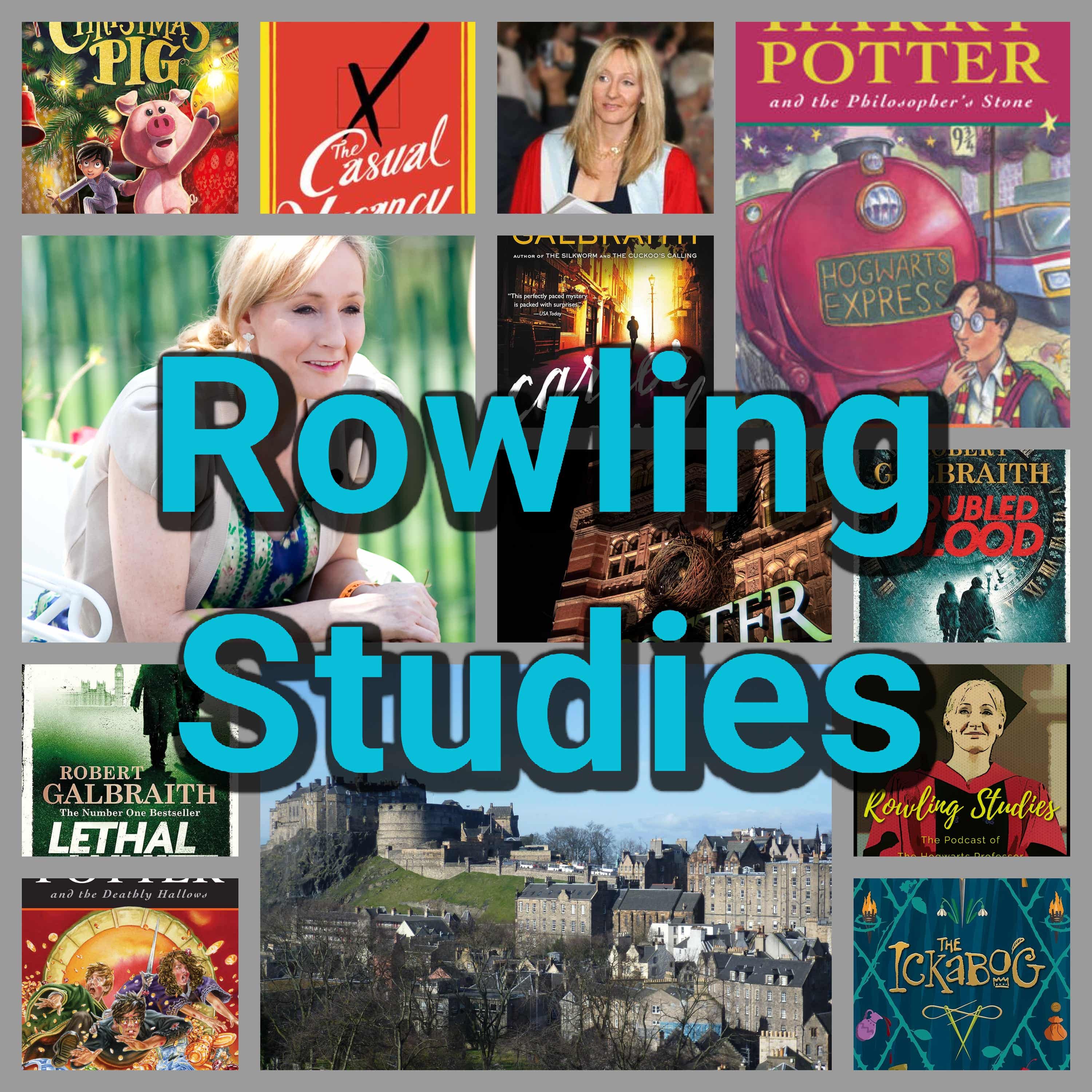
PODCAST · fiction
Rowling Studies The Hogwarts Professor Podcast
by John Granger
The Artistry and Meaning of J. K. Rowling and Other Greats hogwartsprofessor.substack.com
-
76
A Pen to Change the World: Conversation with Solomon Schmidt, Rowling-Galbraith Biographer (Part One)
(Credit: Neil Wilder, Edinburgh 1999, now in National Portrait Galley)Solomon Schmidt, author of A Pen to Change the World: The Life of J. K. Rowling (Skyhorse, June 2026), sat down with us this week to discuss what moved him to write a Rowling biography at the height of her radioactivity as a supposed “transphobe” and the obstacles that Rowling, Inc., puts in the way of unauthorized biographers. He also shares the kindness and circumspection of the people who did agree to speak with him, to include Neil Blair and Jorge Arantes.The necessary links to the book’s Amazon page and to the two Hogwarts Professor reviews are here:* A Pen to Change the World: The Life of J.K. Rowling (Amazon.com)* A Pen to Change the World: The Life of J.K. Rowling (Amazon.co.uk) Uk Edition* A Pen to Change the World – the Biography of J. K. Rowling by Solomon Schmidt (Nick Jeffery)* Book Review: A Pen to Change the World - The Life of J. K. Rowling (John Granger)The second part of our conversation with Mr Schmidt will be posted next week. The first five questions he answered were:1. What moved you to start this project? You've already written a biography of Alan Dershowitz and many more in the History Bites series; what made J. K. Rowling an inviting subject to you? What made it different from the other biographies you've written?2. You wrote in the acknowledgements at book's end that you didn't write the biography as a work of "literary criticism," but you do discuss everything she has written or collaborated on, Philosopher's Stone to Ink Black Heart. What would you have included in those discussions if you had been writing "literary criticism"?3. This is an "Unauthorized" biography which means you were researching and writing outside the gates of Team Rowling, simultaneously shut off from Rowling and her circle of friends and, one would hope, outside her ability to shape the narrative you put together of her life. You did, though, get some push-back from Rowling, Inc.'s legal arm at one point; what was that about?4. You weren't able to interview Rowling, her sister, her husband, her father, her daughter Jessica, Sean Harris, the Sisters of Swing, Michael the boyfriend, Lucy Shepherd, Pearl Biddle, or 'Starsky and Cox.' You did find and scored interviews with Jorge Arantes, Barry Cunningham (the publisher who signed J. K. Rowling to Bloomsbury), Steve Eddy (one of Rowling’s English teachers), Neil Blair (sort of!), and her American cousins, Ben and Bryony Rowling. How did you find these sources and what was it like sitting down to speak with them?5. I said you didn't get to interview Rowling, which is true, but you did have access to all her interviews that she has done 1997 to the present as well as the interviews and articles with her family, friends, fans, and business associates. How did you find, assemble, and sift through those interviews?Please share your thoughts below as well as follow-up questions you wish we had asked! Part Two will be up in a week… This is a public episode. If you'd like to discuss this with other subscribers or get access to bonus episodes, visit hogwartsprofessor.substack.com/subscribe
-
75
The Mysterious Suicides of Leda Strike and Charlotte Campbell Revisited Post Hallmarked Man
‘Fiona F’ is a Hogwarts Professor subscriber in Adelaide, Australia, the truly down under capitol of the South Pacific island-continent. She works as an environmental scientist on the days she isn’t combing through the Cormoran Strike novels of Rowling-Galbraith in search of answers to the over-arching mysteries of that series.The Hogwarts Professor Talking Heads duo invited her to a discussion of her potential solutions to two of the unresolved questions that have to be answered before the epilogue of Strike 10, namely, ‘What really happened in the ruled-a-suicide deaths of Leda Strike and Charlotte Campbell?’ Fiona seems to have broken both cases using information dropped as asides in Hallmarked Man.The Ten Questions that guided their conversation are below with the promised links and Fiona’s time-lines and comments on the Moderator Backchannel they discuss.In brief, about Leda’s death Fiona notes that we learn in Strike 8 that Shanker is familiar with ‘Barnaby’s, the preferred body-disposal business used by the London under-world, to include the Ricci Crime Syndicate. She connects that dot with (1) Strike’s memory of making a drug delivery for Shanker to the Ricci Godfather way back in the day when the two shared a flat and (2) Shanker’s near panicked warnings to Strike not to investigate the Riccis in Troubled Blood. Fiona’s theory? Means, motive, and opportunity point to the possibility that Leda’s heroin overdose was a Ricci ‘message’ to Shanker that he had better not cross them in a drug deal. Readers have missed this possibility because Shanker loved Leda like a mother, which love unfortunately made her a perfect target for the gangsters to ‘get at’ Strike’s adopted brother.And Charlotte’s death? Fiona, unlike much of Strike fandom, accepts the Jeffery hypothesis (see here, here, and here) that Ms Campbell-Ross did not kill herself but was murdered in a staged-suicide (a la Leda Strike, Lula Landry, Jasper Chiswell, and Kevin Pirbright). After a close reading of Hallmarked Man, Fiona realized that Dino Longcaster, whom Tara Campbell married after she had divorced Charlotte’s supposed biological father, may have been, based on his fathering Rupert Fleetwood in an adulterous relationship, Milady Bezerko’s real sperm-donor daddy (and at home molester). Which possible parentage would have made Charlotte and Valentine Longcaster half-siblings. Fiona theorizes from there that the baby Charlotte says was Strike’s was Valentine’s (a la Rupert and Decima’s Lion), that Jago Ross’ children might have been Valentine’s, or both. Valentine, Jago, and Tara shoot to the top of the ‘Charlotte Murder’ suspect list, with Sasha, Rupert, and Amelia as Tara’s agents all possibilities.Fiona, Nick, and John discuss the various Rowling Golden Threads in play with each of these theories — incest, pregnancy traps, staged suicides — and how both Fiona’s Ricci-Shanker and Secret Charlotte theories are textbook illustrations of Rowling misdirection while planting clues in plain sight.John and Nick are grateful to Fiona for getting up as early as she did to chat with them and for sharing her theories here with the Serious Strikers at Hogwarts Professor. Hats doffed with a bow from the waist in admiration and gratitude! The Ten Questions With Links and Notes1. Fiona, you, Nick, and I have been chatting on the moderator back channels since May and we’ve shared your Daddy Dino theory in which Charlotte was another Longcaster child conceived in adultery and Valentine was her incestuous lover and abuser. Nick and I discussed that idea on our ‘Incest Golden Thread’ program. But none of us know who you are really and I just learned you’re living in Central Australia. Tell us about Fiona, a Welsh name?, and what brought you to Serious Striker land?12 April Fiona Comments on Moderator Backchannel:In response to a post by Cheryl Rose Orrocks on 17 Feb 2026, my current theory is that Dino Longcaster is Charlotte’s father and that his son, Valentine Longcaster, will be revealed as her abuser and the possible biological father of Charlotte’s children. Hence the 2nd incest storyline will also involve the Langcaster family. This could be why Charlotte’s mother, Tara, despised Charlotte so much.If Jago Ross is somehow linked to the matter of the DNA test involving Bijou and Strike, it may be because he had Charlotte’s birth children DNA tested to confirm parentage. Maybe Jago discovers he is not the biological father and assumes Strike is, hence the reason he wants to obtain Strike’s DNA results.2. Nick was telling me the other day that he has been re-reading the series and it’s changed his thinking about how he would rank the books, especially in light of Hallmarked Man. I hope he’ll clarify what he means by that – and that you’ll share, Fiona, where Strike 8 is on your list of best to worst Strike novels and if or how it changed your thoughts about the first seven.3. By the time this conversation is posted, I hope to have put up a short summary of your Birthday Party Theory, Fiona, or else it will be the text beneath this conversation. In brief, you lay out the calendar dates after Sacha Legard’s birthday party with respect to Charlotte’s death. Can you tell us why you thought that party had something to do with her death and how you went about setting up the time-line?May 6 Fiona note on Moderator Backchannels:In this video, your comments regarding Rupert Fleetwood and Charlotte’s murder (1:00:17) got me thinking. If Charlotte was murdered, her murderer was likely present at Sacha Legard’s birthday party.After checking out several sources (books (physical copies) 7 TRG and 8 THM, Strike Fans, the Farting Faculty Lounge and Hogwarts Professor) I put together a rough timeline to assemble my thoughts.* Saturday 21 May 2016: Sacha Legard’s birthday. Valentine and Cosima Longcaster are at the party. Rupert Fleetwood gatecrashes and he and Valentine have some kind of confrontation (refer THM Chapter. 36, pages 291 and 292). I presume Charlotte and Amelia would have been at the party as they are Sacha’s half siblings, however I have no evidence to support this.* Friday, 27 May 2016: Strike listens to Charlotte’s voicemail messages. (TRG, Chapter 55, pages 421 and 423).* Tuesday, 14 June 2016: Charlotte is arrested for assault on Landon Dormer (TRG, Chapter 59).* Thursday, 23 June 2016: Strike deletes three voicemails from Charlotte before heading up to his attic flat (Chapter 61). Charlotte Campbell dies (commits suicide?).* Friday, 23 December 2016: When Strike goes to the National Theatre to interview Sacha Legard (THM, Chapter 36, pg. 289). Sacha says he ‘was shooting a film in Mexico (Conquest?) when all this business with him [Rupert] and Dessie happened.’I’m unsure when Sacha was in Mexico (before and/or after his birthday party on 21 May 2016). If he was filming in Mexico after his birthday then he may not have been in London when Charlotte died. If filming in Mexico finished before his birthday, he would have to be on the short-list of murder suspects.As Charlotte loved tension, conflict, and rows, she may have overheard the confrontation between Rupert and Valentine. Presuming the confrontation was about DNA testing and Dino Longcaster being Rupert’s biological father, maybe the DNA results also contained information about other unknown (and related) people with a similar DNA profile to Rupert and the Longcaster’s (Dino, Valentine, Decima and Cosima) and Rupert threatened Valentine with this information. Valentine is scared of his father, Dino, and wouldn’t want the DNA paternity information to reach Dino.If Valentine Longcaster (as possible Charlotte abuser), finds out he is the biological father of Charlotte’s children and realises that Charlotte has found this out, that could be a strong motive for murder, particularly as he was appalled by the incest between Decima and Rupert.It will be interesting to see if Rupert makes an appearance in Book 9.* See Louise Freeman Davis’ Strike and Ellacott Timelines at The Farting Sofa Faculty Lounge.4. Your conclusion is a mind-blower as I’ve written in my notes you to invite you to wake up early down under to talk about it. To skip to the Big Reveal, you think, if Charlotte was at the birthday party or learned from Cosima or Valentine about the Dino-Decima-Rupert genetic conjunction, that Valentine Longcaster has to jump to the top of the Campbell-Ross ‘assisted suicide’ list. How so?5. This is fascinating theorizing, Fiona, and it highlights what Nick has said that the complexity and crowdedness of Hallmarked is a marker of Rowling crafting a “target rich” environment for Books 9 and 10 possibilities. You wrote on 4 June that what if, instead of being molested at home by Trevik, her supposed biological father, she had been abused by a schoolteacher. Why did you think that was possible and how would it color your thinking about her life and death?4 June Fiona CommentHave you considered the possibility that Leda Strike (Peggy Nancarrow) was molested by a school teacher, rather than a victim of incest. Both scenarios are obviously awful. I have been pondering this because Leda/Peggy packed up and moved so often and Cormoran and Lucy never stayed in the same school for very long.6. On 10 June you sent your magnum opus, the Leda Strike life timeline and a ‘Means Before Motive’ examination of her death. Again, why bother and how did you track down the dates?7. What did the data reveal about Leda that you hadn’t seen before?10 June Fiona Timeline for Leda StrikeI have been systematically going back through the Strike books using the JKR finder in an attempt to work out who killed Leda Strike.I am relying on Rowling playing fair and that the answer to the question of Leda’s death and the evidence to support this has already been given to us in the books.My attempt at Leda’s timeline and my murder theory are attached. There are gaps in Leda’s timeline and changing dates in the books. I mostly focused on Leda’s childhood, then the last few years of her life in London. I’d be interested in your thoughts.Constructing Leda’s timeline was also about reaching a conclusion on whether Cormoran Strike was the product of incest. At this stage, I don’t think he was. The timeline doesn’t support the incest theory and I suspect Leda was away from St Mawes from when she married at 18 and left Strike Snr two weeks later until she returned to give birth to Cormoran at Truro hospital at age 20. Too many parties and gigs to go to!I’d be interested in your thoughts.Leda Strike TimelinePeggy (Leda) born in 1954.Ted and Peggy (Leda) mother died when Ted 16 and Peggy (Leda) 2.Peggy (Leda) forcible separation from Ted at the age of two.Peggy (Leda) lived with her paternal grandmother. Ted stayed with their father, Trevik.Ted leaves home for National Service (age 18?)Ted returns from National Service after Trevik dies. (age 25?) Married Joan. Peggy (Leda) (age 11?)Peggy (Leda), at age 18, escapes her paternal grandmother, and runs away with a youth who’d come to Truro with the fair. Changed her name to Leda. Ted (32 years old).Leda married youth from the fair when she was 18 years old. She had run out on her husband after only two weeks and that her sole motivation in marrying Strike Snr. (who, according to Aunt Joan, had arrived in St. Mawes with the fair) had been a new dress, and a change of name.“Leda had never stayed still long enough to present a stable target. Often her children remained in a school for mere weeks before a new enthusiasm seized her, and off they went, to a new city, a new squat, crashing on her friends’ floors or, occasionally, renting. The only people who knew what was going on, and who might have contacted social services, were Ted and Joan.”1990? Leda brought Shanker (age 16), who had been stabbed, home to their squat.1991 Leda Strike met Jeff Whittaker.1992 Nick Herbert and Strike had a joint eighteenth birthday party at the Bell pub in Whitechapel.1992 Leda had fallen pregnant in Strike’s eighteenth year, while he was applying for university.Leda married Jeff Whittaker in 1992.Switch born in December 1992.Leda died in 1994, (age 40?), when Lucy (age 19?) and Strike (age 20?)8. Okay, now that we have Leda’s life in a mental picture, walk us through your Means Before Motive breakdown of the most likely suspects.Fiona’s Theory about Leda’s death: Means before motive* Means: Three Suspects1. Member(s) of Ricci family or Ricci gang member.2. Jeff Whittaker.3. Shanker.All had access to drugs.* Motive1. Unpaid drug debt (Whittaker) and Ricci’s killed Leda as a warning, or2. Rival gang to Shanker’s cousin’s takes revenge (knowing Shanker is close to Leda) and kill Leda as a warning, or3. Drug induced murder by Whittaker.Shanker’s knowledge of organised crime in London is peerless. He knows what happened, blames Whittaker, but has never said anything to Strike. (Refer Troubled Blood, chapter 27, where Strike recalls helping Shanker make a ‘delivery’ in ‘92 or ’93 and Shanker’s reaction to Strike’s recall of that).Maybe Leda was suffocated while she slept (similar to Margot Bamborough’s death), then injected with heroin by her killer.* Opportunity· Jeff Whittaker (lived at squat; a drug user).· Shanker (frequently visited the squat; was close to Leda).· Member(s) of Ricci family or Ricci gang member (local drug dealers) making a delivery.9. So Shanker is both a suspect and a person of knowledge; he either did it or knew who did it? How important is Strike’s memory of the Ricci drug deal delivery for Shanker in all this?10. The beauty of this theory is that it’s been so well set up; who has Shanker who revered Leda on their suspect list when she revered her so – and yet it was just that relationship that would have made her so vulnerable to targeting by the Riccis if Shanker stiffed them… Hence his warning Strike off the Riccis with such care in Troubled Blood and obscuring how he knows about Barnaby is Hallmarked?John Notes 10 JuneI’m intrigued by the Ricci-Shanker connection. Shanker knows about Barnaby’s and that Knowles was dispatched there; Strike sees Marco Ricci later in the story making a delivery to Barnaby’s. If I’m following your notes, Shanker’s panic about Strike investigating the Riccis in Troubled Blood isn’t out of concern for his adopted brother but from the fear that Cormoran will learn of his relationship with the family -- and, as you speculate, that Leda was killed by them as a message to young Shanker not to cross them. Shanker testified against Whittaker to scapegoat him and perhaps because he knew the Riccis would kill him if he told the truth.* Great plot twist and one that explains the whole Knowles plot line in Hallmarked Man and the police interest in Strike’s source of information; Shanker is being presented as a dangerous criminal to readers who are blind (as are Strike and Robin) to the possibility that he was the natural suspect in Leda’s death because of his proximity to nihilist forces. The delivery Strike made for Shanker to Ricci and Shanker’s response to Strike’s memory is a critical catch in all this; well spotted!I don’t think your timeline precludes either Ted being Strike’s father or Trevik molesting Leda as a young woman -- or another possibility. Her birth years and years after Ted’s suggests that Trevik was not her father, that her mother’s death wasn’t natural, and that Ted may have been Leda’s father via an incestuous relationship with his mum, both victims of Trevik’s abuse. Leda’s adoption by her grandmother after her mother died may have been to protect her from Trevik or her simply being cast out by him. Incest is a live issue, I think, in the Cornwall household. This is a public episode. If you'd like to discuss this with other subscribers or get access to bonus episodes, visit hogwartsprofessor.substack.com/subscribe
-
74
The First Seven Strike Novels Paralleled Their Seven Harry Potter Equivalents; What Rowling Work Did The Hallmarked Man Parallel?
Last week Ed Shardlow posted his thoughts about The Hallmarked Man being written in playful but meaningful parallel with Rowling’s “political fairy tale,” ‘The Hallmarked Man Meets The Ickabog.’ Nick Jeffery and John Granger called him up both to congratulate him on Arsenal winning the Premier League Cup — Go, Gunners! — and to learn as much as they could about the parallels he noted. After acknowledging the correspondences with Casual Vacancy, the trio explored Ed’s argument about the Ickabog echoing just beneath the surface of Hallmarked Man, straight up and in inversion.The Ten Questions, Links, and Helpful Notes1. Nick, can you provide some context for this conversation? How did we get to the point that we expected Hallmarked Man to echo in characters, plot points, and themes either Casual Vacancy or The Ickabog? No one thought that was in the cards when Rowling-Galbraith and her publishers locked down the series at ten books.* ‘Parallels Series Idea’ Pillar Post* Evan Willis’ Tetractys Theory: Part 1, Part 2, Part 32. Open subject for the triumvirate to discuss here: there are a bunch of Casual Vacancy parallels in Strike 8 that have to be acknowledged. Name your favorites; I’ll start this ball Rowling…* Ironbridge and Pagford seemed to be sister cities* each book ‘begins’ with the sudden and tragic death of a man who haunts the rest of the novel, Barry Obama Fairbrother and Tyler Powell* The peanut allergy that Tyler and Andrew Price have; and* The incest secret in the Longcaster and Wall families3. Having noted those, Ed, why are you so sure that it’s The Ickabog which is the parallel text with Hallmarked Man? Is the quantity of the parallels you and others have found, their quality, or the overarching feel of the works?* Ed’s Post: ‘The Hallmarked Man Meets The Ickabog’4. I was surprised by your sheep parallel. I know my Ickabog memories are not fresh, but were there a lot of lambs and ewes in Strike 8?* Ed’s Post: ‘The Hallmarked Man Meets The Ickabog’5. And the fish?* Ed’s Post: ‘The Hallmarked Man Meets The Ickabog’6. Is there something akin to the Freemasonry of Hallmarked Man in The Ickabog?* Inversion of ‘Political Fairy Tale’ with modern touches and gritty detective novel and Medieval coloration via Freemasonry symbolism and ritual7. Sandy Hope, our partner in the Group Adventure of charting Hallmarked Man, had a bunch of parallels that she shared in the comment thread to your post:* One of my favorite parallels you mention is the Old Forge and the Ickabog’s cave, in which both Robin and the Ickabog tell tragic stories of birth. The Old Forge also reminds me of the transformation of the dungeon once Mrs. Beamish gets a stove installed and starts baking and feeding the prisoners. Mr. Dovetail’s broken mind is restored by Mrs. Beamish helping him remember better times, and Robin’s own brokenness is soothed by Strike’s transformation from a self-serving, manipulative jerk to a selfless, compassionate listener and genuine friend. In both stories the fire is warm and purifying. Comment Url * One of my favorite parallels was “sticking to the game plan,” the ill-fated idea shared by Strike via Uncle Ted and also Lord Spittleworth. RFM reminds me of Ma Grunter, trying to appear sober when they’re actually drinking on the sly. Dangerous Dick de Lion is not unlike King Fred the Fearless, who both have to learn about being contrite. Robin’s bracelet is rather like Daisy’s bandalore: both gifts are initially a hit but end up secretly hidden or stolen. Comment Url8. My favorite parallels were between the incest and ectopic pregnancy in Hallmarked Man and the Ickabog’s manner of conceiving children and birthing them. Did you laugh out loud when you figured that out? I did when I read your post -- but it bears some explaining --* Ed’s Post: ‘The Hallmarked Man Meets The Ickabog’9. Let’s go around the table again and talk about the connection between the two books we haven’t talked about yet --* Avenging Ghost of Beamish and Powell* Eslanda/Jolanda* Sandy Hope’s Footprint Clue* Image of St George* The monster’s cave, the Old Forge on Sark, and an ectopic pregnancy* Woman talking monster into returning to human society* Ed’s brilliant parallel Character list10. You discuss in your post that you went through two stages before arriving at your conviction that The Ickabog was the model: first the overarching story and then on re-reading The Ickabog for specific detailed parallels. Do you think we should do a re-read of Casual Vacancy -- Nick is always ready for a trip to Pagford -- to see if there aren’t specifics there, too? This is a public episode. If you'd like to discuss this with other subscribers or get access to bonus episodes, visit hogwartsprofessor.substack.com/subscribe
-
73
The Hidden Narratives and Interpretive Ciphers Beneath the Surface Story of Hallmarked Man
In yesterday’s Hallmarked Man Notes: The Christmas Charm Bracelet Decoded, Tod Jameson and the Ectopic Pregnancy, and Venetian Blinds, Ed Shardlow explained three sub-texts within Strike 8 that, though invisible on first and second reading, pop up during structural analysis and in light of other Rowling-Galbraith notes.* The Christmas gift charm bracelet that Strike gives to Robin, for example, appears to be a ring and a key to Hallmarked Man, a meaning that occurred to Ed in light of Rowling’s own bracelet gift to fandom last year as a key to Sleep Tight, Evangeline;* John Granger’s posts about Strike 8’s cryptonyms similarly encouraged Ed to think about the meaning of ‘Todd Jameson’ and how the “egg-shaped” man had several names and seemed to be stuck on the Tube; and* Ed’s efforts to finish his charting of each Part of Hallmarked Man brought up the theme of Robin’s blindness and mental struggles in Part Three’s chapter correspondences.In conversation with Nick and John explore these ideas as well as the potential importance of A. H. Murdoch, a historical figure that Rowling-Galbraith invented whole-cloth, the meaning of his name (‘Alexander Hughson’), and the passages from his book, Secrets of the Craft, which of course are also Rowling-written.Below are relevant links to the subjects the trio discuss and copies of the ten questions John and Nick asked Ed. Enjoy!Links to Conversation Subjects* Hallmarked Man Notes: The Christmas Charm Bracelet Decoded, Tod Jameson and the Ectopic Pregnancy, and Venetian BlindsCharm Bracelets* The Christmas Charm Bracelet of Strike 9 Clues (Part One)* The Christmas Charm Bracelet of Strike 9 Clues (Part Two)* 'Sleep Tight, Evangeline,' Miniature Psalters, and the Head of Persephone: A Conversation with Dimitra FimiCryptonyms of Hallmarked Man* The Allegorical Cryptonyms of The Hallmarked Man, Part One* What do Tyler Powell, Rupert Fleetwood, Jolanda Lindvall, and Lady Jensen Have in Common?* The Allegorical Cryptonyms of The Hallmarked Man, Part Two* Wet Squibs, Islamic Cub Names, the Seven Strike Series Structure Theories, and How a Human Being Reads a Story* The Lost Child Golden Thread in the Work of J. K. Rowling (Kanreki)* The Pre Natal Infanticide Theory Explaining the Lost Child Golden Thread (Kanreki)Rowling as Sacred Artist: A Perennialist Reading* Ray Livingston's 'The Traditional Theory of Literature' (Chapter 1: Preface and Prologue)* Ray Livingston's 'The Traditional Theory of Literature' (Chapter 2: Man, Society, Art )* Ray Livingston's 'The Traditional Theory of Literature' (Chapter 3: The Creative Process)* Martin Lings’ The Sacred Art of Shakespeare* J. K. Rowling’s ‘G-Spot’ and ‘Triple Play:’ The Lake & Shed Secret of Her SuccessThe Ring Readings of Rowling’s Hallmarked Man Chapter Sets* Index to the Group Adventure of Charting Hallmarked Man (scroll to bottom)* Ed Shardlow’s ring notes for Part ThreeA. H. Murdoch’s Secrets of the Craft Excerpt in Hallmarked Man:[Strike skim read the entry under Degree Thirty Two.]The Sublime Prince of the Royal Secret becomes with the degree’s endowment none other than a Christian Knight, the spiritual and legitimate successor of the Knights Templar…When she elevates and illuminates, a pure and chaste woman is as silver, or the moon. The […] Freemason is sure never to mistake base lead for the nobler metal, else he may find himself forever entombed in the dungeons of lust and lasciviousness. (ch 53, pp 400-401)The parenthetic ellipsis is in text, presumably there because “Murdoch’s book hadn’t been properly formatted, but scanned into digital form, so that the occasional word was illegible.” The Ten Questions1. We have a special guest today, Ed Shardlow, the author of a commissioned post that went up this week, one we begged him to write up. It’s a weird post erven for a site that embraces the exotic, weird in the sense that it’s actually three posts rolled into one. What’s up with that, Ed?2. So the three topics are:* The charms on the Christmas gift bracelet Strike gives to Robin;* The meaning of Todd Jameson’s name; and* Robin’s sight and memory issues, ‘Venetian Blinds’Is there a thread running through these ideas?3. Tell us your charm bracelet idea and the meaning you think each charm has --4. And it’s a ring, right? What a hoot. --5. I loved the charm bracelet piece, not only because you read it as a ring and showed that the charms together and separately act as something of a cipher for the book, but because you linked it with Rowling’s Strike 9 charm bracelet. Do you think per Shanker’s advice that Rowling-Galbraith is giving us jewelry as a gift, one that acts as a key to the work in Hallmarked and before Evangeline, because she wants to make up with us for the hardship readers are having with the book?6. True confession, though I was laughing out loud and delighted with your breaking the Todd Jameson cryptonym, I was also pretty disappointed; that name was number 1 on my not-yet-written third cryptonym post. What consoles me is that I doubt I would have picked up on what you saw, which is mind-blowing. Tell us how you figured it out as well as what you found --7. Now this is a new variant of Rowling-Galbraith inserting a text within the text. This ectopic sub-story isn’t a written text, a fairy tale, an epigraph, a song playing in the background, an illustration based on a mad detective’s Tarot card throws, or the story the bad guy is selling that we have to unwind and re-write; we’ve seen those books-inside-the-book before. This is Rowling concealing a narrative inside the narrative with really only the name to act as the cipher for the coded message. Hence her talking up the importance of names in this book (e.g. Jolanda -- violets)?8. You make a fascinating connection with Harry Potter, the Boy Who Lived, and Todd Jameson, the Son Who Killed His Mother (?). Do you think she finally wrote in a Chosen One echo in the Strike series via Jameson?9. I want to leave the board here because I know you have to run -- thank you for joining us on such short notice! -- and talk about something you’ve been sharing on the Moderator’s Back Channels, namely, A. H. Murdock. His Secrets of the Craft is another text within a text, right? Have you thought about his name or why Rowling gave his book that title?10. When will you be done with The Ickabog project? Inquiring minds want to know! This is a public episode. If you'd like to discuss this with other subscribers or get access to bonus episodes, visit hogwartsprofessor.substack.com/subscribe
-
72
A Conversation about Cormoran Strike, Literary Alchemy, and Structural Models for the Ten Book Series
Nick Jeffery and John Granger sat down last weekend to discuss John’s post, The Literary Alchemy of Hallmarked Man: What Do the Structural Models Tell Us? They’d talked about this subject briefly before John had written it up and he came to rather different conclusions in the process of writing and preparing slides for the post, all of which are rolled out in this inquisition.The questions Nick asked are below after the links in the post in case you want to follow up on what is said above about literary alchemy, the sequence of colors and symbols, and about the structural models for understanding the Strike series, especially Extended Play and Tetractys Theory.Enjoy!Links for Follow-Up and Easy Reference: Strike Alchemy* Literary Alchemy – A Primer for Those Interested in J. K. Rowling’s Artistry* ‘Literary Alchemy’ Pillar Post* Metallurgical, Literary, and Psychological Alchemy: Is Jung a Good Guide for Understanding J. K. Rowling’s Artistry and Meaning?* The Literary Alchemy of Hallmarked Man: What Do the Structural Models Tell Us?* , ‘The Connection of Ring Composition and Literary Alchemy in the Layout of the Seven Book Harry Potter Series.’ (William Sprague)* ‘Parallel Series Idea’ Pillar Post* Robin Ellacott and Reverse Alchemy: Transformation Through the First Three Strike Texts (Louise Freeman)* ‘Troubled Blood: Strike’s Transformation’* ‘Water, water everywhere: Baptism, baths, rivers, rain and showers as unifying themes in The Running Grave’ (Louise Freeman)Seven Structural Theories for Strike Ten Book Series* (1) straight up Decalogy, no structural connection between books;* (2) Big Ring Composition, Double Wedding Band (Louise Freeman);* (3) Seven book series with Trilogy finale (Nick Jeffery, John Granger);* (4) Extended Play theory (John Granger per ‘Kathleen’),* (5) Sonnet Corona Form (Robyn Gomillion);* (6) Tetractys theory (Evan Willis with back-up explanations here, follow-up from Evan here); and* (7) Celtic Cross (John Granger) scroll down to bottom).Tetractys Theory in Depth:* Alastair Fowler’s Triumphal Forms* Why the Cormoran Strike Novels are a Ten Book Series: Mythological Clues and Tetractys Parallelism with a Touch of Tarot Reveal the Strike Series Structural Echoes with Rowling’s First Ten Book Set [Evan Willis, 10 July 2023]* Is Tetractys Theory the Best Explanation of Why the Cormoran Strike Series is Ten Books in Length? First Thoughts on Evan Willis’ Numerological Exegesis of Rowling’s Two Ten Novel Series and the Meaning of This Structure [John Granger, 18 July 2023]* Evan Willis: Running Grave Review In which the Tetractis theory is revisited in light of Strike 7 and the Theory is Updated [Evan Willis, 30 September 2023]* See The Literary Alchemy of Hallmarked Man: What Do the Structural Models Tell Us? for excerpts from and discussion of each.* The Tetraktys Tarot Card Spread!The Charts!The Ten Questions and John’s Answers (notes!)1. So, John, you finally got the alchemy post you promised an age ago; what was the hold-up?· Tried to put too much into the posts…· Changed my mind several times as I was writing them!· had to relearn Tetractys ideas!2. You start off this Alchemy of Hallmarked Man discussion with a review of the literary alchemy of the first three Harry Potter novels; why did you have to reach that far back?· Because of the Parallel Series Idea, not alchemy at all, oddly enough.· Rowling seems to be writing Strike decalogy in parallel with Potter to include its alchemical sequences so I reviewed the ‘Reverse Alchemy’ theory, how that worked for Strikes 1-3 but broke down at 6 and 7· To get Hallmarked Man‘s alchemical stage right, I wanted to figure out why Ink Black Heart and Running Grave weren’t the alchemical stages we’d expect3. Some of our listeners may not have the literary alchemy three stages firmly in mind; can you go over what they are and why they’re important in Rowling Studies?· Black, White, Red stages: what each represents in metallurgical and literary alchemy;· Rowling’s one interview comment about alchemy, her PotterMore notes about colors;· Rowling’s use in Harry Potter‘s last three books, fourth book, and first three books;· Galbraith’s use in Strike series’ first three books, fifth book, and six and seven;· Ward on astrology in CSL’s Narniad (’Donegality’); similar use of alchemy in Rowling-Galbraith4. So the alchemical parallelism seemed to stop at Ink Black Heart but the other correspondences continued?· That’s right, the first seven books paralleled their Harry Potter apposite numbers in structure, plot points, and some symbolism but the last two broke from the alchemical pattern;· I decided that the best place to look for a way that the new pattern could be explained would be looking at the seven theories about the Strike-Ellacott series structure;· If a specific structure had a very clear idea about the alchemical stage sequencing in the books, then I’d have a real head-start in what to look for in Hallmarked Man.5. The Seven theories -- last time we talked it was six! Remind me what they are and what each says about the alchemy...· No structure, Big Ring/Double Wedding Band, Septology and trilogy combo, Extended Play, Corona Sonnet, Tetractys, and Celtic Cross (see links above!);· Only Extended Play and Tetractys theories had clear theories about the alchemy; and· Oddly enough, they both explained why Hallmarked Man had to be considered an albedo or white novel even though they disagreed about what Ink Black Heart and Running Grave were...6. We’ve got slides here that help make what seems hopelessly nerdy something you can see. We’ll start way back with the ring structure of The Harry Potter series and work our way toward Evan Willis’ Tetractys ideas.· Harry Potter series, Sprague/Thacker ‘Reverse Alchemy:’ Slides 1 and 2 (see above)7. And via the Parallel Series Idea we should see those same relationships that were found in the Potter books in the Strike series?· Extended Play idea: Slides 3 and 4 (see above)· Where it breaks down -- Running Grave like Troubled Blood an “aquatic Nigredo“8. And you think the Tetractys idea is better. We really need to have Evan on the show to talk about where he learned about this figure, its use in English literature prior to Rowling, and why he thinks Rowling is writing her second ten book series. Can you summarize his two Hogwarts Professor posts on this subject and why Rowling Readers will benefit from learning about this ancient ten point peg board model?· See Tetractys pyramid slides above;· Four levels: meaning of monad, dyad, triad, quaternity symbolism; (first Evan Willis post above)· Pyramid to climb, something akin to four levels of reading and knowledge; [Fowler, Triumphal Forms]· Benefit to Rowling Readers: Willis thinks the second Quaternion parallels Rowling’s first -- and the differences explain the alchemical stage of Running Grave;· It also was used to predict three things about Hallmarked Man: it was all about silver, it would be an albedo or White stage novel, and it would parallel The Ickabog9. Three bullseyes with a special merit badge for figuring out the silver part before the title was announced. Let’s go to the Tetractys slides for the Potter and Strike series:· All above!10. Both the Extended Play and Tetractys theories, then, have Hallmarked Man as an albedo. How will that influence your examination of Strike 8 for its alchemical symbols and sequences as well as your interpretation of them?· I’ll be looking for the alchemical signatures of the second stage, leukosis or the ‘whitening,’· I’ll be looking for evidence that contradicts the albedo dyad idea, and· I’ll be researching if alchemical ideas, as in, say, incest, ‘Jason and the Medea,’ and ‘dog and b***h,’ are best read as white stage tokens This is a public episode. If you'd like to discuss this with other subscribers or get access to bonus episodes, visit hogwartsprofessor.substack.com/subscribe
-
71
Wet Squibs, Islamic Cub Names, the Seven Strike Series Structure Theories, and How a Human Being Reads a Story
Nick Jeffery and John Granger sat down to discuss four Hogwarts Professor posts. Here are links to those posts with an excerpt from each and the most relevant urls embedded in them. Enjoy!What is a Squib, Really? And Where Would Rowling Have Met the Word? (John Granger, 27 April 2026)I confess that I assumed the word for barely magical witches and wizards born into magical families in J. K. Rowling’s Wizarding World, the folk she calls ‘Squibs,’ were given that name because of its onomatopoeic source in fireworks; per the Harry Potter Lexicon invaluable online resource, a squib is English idiom for “a dud firework that will not ignite properly.” It sounds like its meaning (as does “dud”) and a reader can feel in it the disappointment of magical parents when their child turns out not to have the gift that will make them full members of their community.I learned this morning, however, that a squib is not a dud firework, or wasn’t originally though it may have that meaning today, and that it is mentioned more than once in one of Rowling’s known literary influences.* ‘Squibbing’ at the Bridgewater Carnival Fireworks Festival (YouTube video)* Toyohashi Tengu: Japanese Quidditch Team (Harry Potter Lexicon)* Tengu — Japanese Fantastic Beast not in Newt Scamander’s textbook (Wikipedia)* Toyohashi Tezutsu fireworks 2022 (Tezutsu-hanabi — Wikipedia)* Dimitra Fimi’s ‘A Kind of Elvish Craft’ Substack site* The Fireworks of Gandalf: in which ‘squibs’ are discussed (not duds!)* ‘The Slow Lord of the Rings Re-Read’ Prof Fimi’s Tolkien Reading Day Introduction* Reading Rowling as Myth Maker and Myth Re-Writer: A Conversation with Dr Dimitra Fimi * ‘Sleep Tight, Evangeline,’ Miniature Psalters, and the Head of Persephone: A Conversation with Dimitra FimiHogwarts Professor is a reader-supported publication. To receive new posts and support my work, consider becoming a free or paid subscriber.Ray Livingston's 'The Traditional Theory of Literature:’ Chapter 2: Man, Society, Art (John Granger, 30 April 2026)In brief, the Perennialist reading of literature begins with a different idea of what a human being is, which reflects the social environment or society and culture that best fosters his achievement of his end or telos, which reflects what role art in general and story specifically plays in his best life. The human being as primarily spiritual, his end as profound communion with what is most Real, and story as non-liturgical sacred art (not necessarily or even usually ‘religious’) which supports him in his vocation to that end are the premises of the traditional or theocentric understanding of man, society, and art.Which is the title of Livingston’s second chapter and a description of its organization as well as of its contents. It’s not easy reading; the subject matter is quite dense and he covers an enormous amount of ground relatively quickly so he can get to the ‘literature’ in the remaining chapters of the work. Without setting out the premises of the Perennialist understanding with respect to what it means to be human, how a community is designed to make a fully human life possible, and how the art of everyday objects as well as set pieces for appreciation or entertainment — there being no meaningful difference in the value of practical and fine arts here — bring that polity to fruition, discussion of literature from the traditional view would be a waste of time.The Allegorical Cryptonyms of Hallmarked Man, Part 2: Ten More Cratylic Character Names and Best Guesses about their Embedded Meanings (John Granger, 1 May 2026)This is the second part of at least a three part series of articles with supplementary video discussion in which I take a long look at Rowling-Galbraith’s choices for character names in the eighth Strike-Ellacott novel, The Hallmarked Man. For the first posts in this series, in which I explain why this is a worthwhile effort, one critical to Rowling’s intentional artistry and complementary to her other Shed tools, see ‘The Allegorical Cryptonyms of The Hallmarked Man, Part One’ and my conversation with Nick Jeffery about it ‘What do Tyler Powell, Rupert Fleetwood, Jolanda Lindvall, and Lady Jensen Have in Common?’Almost half of today’s ten posts are about characters named ‘Lion’ or variants on the leonine theme. I think the number of lions prowling through Hallmarked Man, not to mention the dogs from Hell and the bears benign and grizzly, deserve their own post, especially to contrast it with the predominant swan symbolism of the first seven books. Or are they conjoined in Jonny Rokeby, whose middle name is the lionesque ‘Leonard’ and who plays the part of a Jovian swan in the Leda mating that produced Cormoran Strike (we think?). [Be sure to check out Ed Shardlow’s full catalogue of the lions afoot in the pages of Hallmarked Man!]* ‘I’m an Essex Girl’ (YouTube video)The Literary Alchemy of Hallmarked Man: What Do the Structural Models Tell Us? Seeking Pointers to the Hermetic Meaning of Strike 8 within (a) the Extended Play and Tetractys Ten Book Series Pictures and (b) the Parallel Series and Reverse Alchemy Ideas (John Granger, 8 May 2026)There are currently seven theories that I have read about of how best to think of the Strike-Ellacott series structure:* (1) straight up Decalogy, no structural connection between books;* (2) Big Ring Composition, Double Wedding Band (Louise Freeman);* (3) Seven book series with Trilogy finale (Nick Jeffery, John Granger);* (4) Extended Play theory (John Granger per ‘Kathleen’),* (5) Sonnet Corona Form (Robyn Gomillion);* (6) Tetractys theory (Evan Willis with back-up explanations here, follow-up from Evan here); and* (7) Celtic Cross (John Granger) scroll down to bottom).The first idea is that there isn’t a series structure worth noting, which is the default position of the great majority of readers. They (we?) enjoy each book and appreciate the over-arching story parts and conflicts without wondering about the author’s intentional narrative scaffolding. Rowling has repeatedly said that special sauce secret of her success is structure but as story organization artistry is very rarely discussed today in English classrooms even Literature wonks neglect it. The other six ideas have their advocates and rather than review each I’ve embedded links above to these proponents’ online arguments in favor of their best guesses.All of these structure theories have advantages and support from previous work we and others have done in the field of Rowling Studies; all of it, however, it must be remembered is laughably speculative guesswork – we’re not going to grasp the series structure with any certainty until it’s done or Rowling actually answers questions about it or shares the information gratis (neither of which is likely given her history). Those of us who give any time to this, not to name those who are pre-occupied with it, are hunting phantom fandom garlands (as well as having a lot of fun).There actually is, however, a reason beyond personal insecurities and a search for redemption for thinking about how the ten book series is organized before all the books are out. If you’re trying to figure out the alchemical quality or stage of a book already in print, understanding the sequence of books should theoretically reveal the sequence of stages (and vice versa). As explained above, Rowling seems to be writing the Strike series in parallel with her Harry Potter seven books. Until we got to the sixth book in Robin and Cormoran’s adventures, those parallels included the alchemical coloration or stage the Potter numerical equivalent had. Other correspondences between the series continued, most notably, the seven book ring structure and playful plot point parallels (see my conclusions post Running Grave here, here, and here). The alchemy did not.In terms of alchemy, the most compelling ideas I think are Extended Play (EP) and Evan Willis’ four-three-two-one pyramid, the Tetractys figure of the ancients, the ‘Great Quaternion.’ Let’s look at each.* Why the Cormoran Strike Novels are a Ten Book Series: Mythological Clues and Tetractys Parallelism with a Touch of Tarot Reveal the Strike Series Structural Echoes with Rowling’s First Ten Book Set [Evan Willis, 10 July 2023]* Is Tetractys Theory the Best Explanation of Why the Cormoran Strike Series is Ten Books in Length? First Thoughts on Evan Willis’ Numerological Exegesis of Rowling’s Two Ten Novel Series and the Meaning of This Structure [John Granger, 18 July 2023]* Evan Willis: Running Grave Review In which the Tetractis theory is revisited in light of Strike 7 and the Theory is Updated [Evan Willis, 30 September 2023]* Literary Alchemy – A Primer for Those Interested in J. K. Rowling’s Artistry* Metallurgical, Literary, and Psychological Alchemy: Is Jung a Good Guide for Understanding J. K. Rowling’s Artistry and Meaning?The Ten Questions!Introduction: It’s been a busy week, John, with posts on traditional reading, cryptonyms, and literary alchemy. I’ve got a bunch of questions about each subject so let’s jump right in -- with some thoughts about Squibs in Bridgewater and Toyohashi, Japan!1. Ray Livingston: You’re sending out a chapter of The Traditional Theory of Literature every week to our Paid Subscribers which I think everyone has access to, at least for one or two chapters. It’s no small effort to type up this public domain book that isn’t available anywhere on the internet, especially with the embedded links to the obscure references in the footnotes; why are you bothering?2. Ray Livingston: The first chapter you sent out went to everyone and included the glossary of terms as well as the Table of Contents, preface, and prologue (chapter one). I’m guessing this is more than throat-clearing and publisher’s data; why does a literary theory text, for example, need a glossary?3. Ray Livingston: The second chapter, ‘Man Society, and Art,’ was a dense read, I confess. Am I right in thinking this was Livingston’s attempt to introduce the Perennialist ‘Theory of Everything’ in one short chapter to lay the foundation for the literature chapters?4. Cryptonyms 2: It’s been a minute since Part One of the Cryptonyms series, why the hold-up?5. Cryptonyms 2: [John] And part of my cryptonym-hesitancy was how much of this post was UK specific, as in the Branfoot = Branson idea and the Essex Girl bit, all of which was new to me. As a Brit living in Wales, should I have resisted the urge to speculate on those subjects? And is the anti-Semitism part of my Hafsa Mohamed interpretation just looking backward from current events?6. Cryptonyms 2: Do we have a Cryptonyms, Part 3, in queue? [Ottolie, ‘Jim Todd’ (‘Jim Philpott,’ Todd Jameson), Calvin ‘Oz’ Osgood, Sofia Medina, Gretchen Schiff, Sapphire Neagle, Susan Iverson, Kim Cochran, Trevik Nancarrow, Peggy (Margaret ‘Leda’) Nancarrow,, Carmen Ellacott (Dirk Ellacott, Barnaby Ellacott), Ralph Lawrence/ John Auclair – Open Invitation to readers to make name-deciphering requests in the comments; there are more than 150 names in Hallmarked Man so tell me the ones you want to hear more about]7. Alchemy (Series) We’ve been writing and talking about ‘how to understand literary alchemy best,’ i.e., by taking a Jungian or a Perennialist perspective on how Rowling uses it, but this latest piece on the Literary Alchemy of Hallmarked Man is much more straight-reading or interpretation, no? And it starts out with how to understand Strike 8 in light of the series sequence of alchemical stages; what’s the struggle with this kind of reading that we’re only getting to this six months after the book came out?8. Alchemy (Hallmarked): How does your reading of specific alchemical images in Hallmarked Man differ from how you read them in, say, Troubled Blood?9. Alchemy (Hallmarked): There were quite a few finds in the ten images you found in Abraham’s Dictionary that resonated with subjects we’ve been talking about -- the mythological backdrop to the story, to incest, to Lions and Masonry. What are we to make of this? Do you think it’s a coincidence that Rowling-Galbraith’s plot points and other artistry reflects these alchemical glyphs or is the hermetic symbolism driving the other elements?10. Coming Week: So what can we expect in the coming week, John? Lots and lots! Please send in your cryptonym deciphering requests — and your ideas for Hogwarts Professor merchandise (AI generated logo designs welcome)!Hogwarts Professor is a reader-supported publication. To receive new posts and support my work, consider becoming a free or paid subscriber. This is a public episode. If you'd like to discuss this with other subscribers or get access to bonus episodes, visit hogwartsprofessor.substack.com/subscribe
-
70
Is Rowling's Incest 'Golden Thread' the Key to Her Cormoran Strike Finale?
Golden ThreadsLast July, Nick Jeffery and I put together a month long review of Rowling’s work in celebration of her 60th birthday, a Kanreki party. Every day we posted conversations about each of Rowling’s works with Nick discussing a ‘Lake’ point, something biographical or bibliographical, and me talking about a ‘Shed’ quality of the work, the author’s traditional tools, artistry, and meaning.That worked great for about twenty days. Then we ran out of books. What to do for the remaining days of the month?We decided to talk about Golden Threads, the plot points, themes, and twists that run through everything Rowling has written. We started out with a survey of the fifteen-plus already identified by Rowling Re-readers and Fourth Generation types (see here and here) and then with more in depth looks at the ones that were controversial or more difficult to see. We closed off the month with the ‘Lost Child’ Golden Thread and the possibility that Rowling’s inspiration for the Harry Potter series was the trauma of pre-natal infanticide (‘abortion’).As disturbing as that Golden Thread was to many Rowling fans and Feminist Gate Keepers, there was another third-rail string we didn’t discuss, namely, the plot point of incest that readers encounter again and again in the Potter and Strike series as well as the stand-alone stories.Incest as Golden ThreadNick and I discuss the Incest Golden Thread on the fly in the conversation above about Strike-Ellacott fandom theories about Sleep Tight, Evangeline and the series finale. Here are some written references if you want to review them by looking at the books in question on your shelf.* Harry PotterThe foundation crime of the Hogwarts Saga is the abuse of Merope Gaunt by her father Marvolo and her brother Morfin. The abuse in question in this children’s book series is not explicitly sexual. As with the abuse of Ariana Dumbledore by the Muggle boys, however, that Merope’s father and brother violated her is there between the lines; her trauma is so great that she loses her capacity for magic (as she does after her Riddle lover leaves her) and the family does not send her to Hogwarts lest their shameful secret be revealed. No broken Merope, no Lord Voldemort, no Potter family murder and orphan Harry — no series. Though the Saga’s foundation crime, the Gaunt family’s abuse of its only young woman, is not revealed until Order of the Phoenix, it is the tragedy on which all the core conflicts of the septology are built.* Casual VacancyStuart ‘Fats’ Wall is the adopted son of Tessa and Colin Wall. A teenager in Vacancy, he and Krystall Wheedon are the star-crossed lovers around whose choices and behaviors the ensemble drama largely turn. Fats at the end of the book claims responsibility for all the Ghost of Barry Fairbrother posts by means of which the secrets of Padford citizens are spilled.In the climax of the Wall family drama after Robbie’s drowning and Krystall’s suicide, Tessa reveals to Fats his personal history. His biological mother was only fourteen when he was born, an age that sadly means it is possible-to-likely that he is the fruit of incest. Tessa, a diabetic woman unlikely to carry a baby to term successfully, compelled her unwilling husband to agree to the adoption despite his mental fragility. Again, the foundation crime of this very involved story is incest, the abuse of a young woman by her family. * Lethal WhiteIn the first of only two Rowling books in which every epigraph was taken from a single work, the fourth Strike novel takes all of its headings from Henrik Ibsen’s Rosmersholm, a play in which suicide and incest go hand in hand, especially in the White Horse finale. The novel parallels its epigraph source in astonishing ways.The Chiswell family has its secrets. The Minister of Culture hires Strike’s agency to find ‘dirt’ on Jimmy Knight and Geraint Winn that can used as counter “bargaining chips” to end their capacity to blackmail him. He shares neither what information they have that they are holding over his head to extort money and revenge nor what Billy Knight witnessed years ago. If Jasper or Izzy Chiswell had told Strike this information in the beginning, it is likely the pater familias would not have been murdered. The biggest secrets, of course, are about the sexual relationship between Raphael and his step-mother and the step-son’s plans to murder father and eventually Kinvarra in order to be free to spend the millions he’ll make from sale of the Stubbs. Not quite incest, a step-mother in bed with her step-son, but something like it.Rosmersholm‘s family secrets are if anything more disturbing. Kroll reveals to Rebecca that Dr. West, her adoptive father, was very likely her biological father as well. It is implied heavily that after her mother’s death Rebecca’s relationship with Dr. West changed from filial to sexual; Kroll’s revelation about this is something of an Oedipus Rex moment. Rebecca realizes that she had been sleeping with her father and the incest taboo crushes her ability to accept Rosmer’s overdue marriage proposal, a proposal for which she had convinced the ailing Mrs Rosmer to commit suicide.* Troubled BloodThe psychopathic murderer and torturer of children that the police and public believe killed Margot Bamborough is Dennis Creed. We learn in chapter 8 of Strike 5 via the Peg-Legged PI reading The Demon of Paradise Park that Creed was the incestuous rape off-spring of Agnes Waite and her step-father Awdry, a man who wanted to kill the child at birth but which the mother prevented (to her eventual regret). Awdry abused the boy all through his childhood, especially after Agnes’ escape as a young woman (reminiscent of Peggy Nancarrow’s flight from St Mawes). Troubled Blood is haunted by the victims of Creed’s madness, all of whose deaths can be traced back to Awdry’s violent sexual violation of his step-daughter.* Hallmarked ManThe mystery Cormoran Strike agrees with no little hesitation to try to solve is ‘What happened to Rupert Fleetwood?’ Decima Longcaster Mullins, mother of Fleetwood’s son Lion, believes her baby-daddy was the unidentifiable murdered man in the Ramsey Silver Vault. We learn before that victim’s identity is revealed that Fleetwood fled the UK after he learned that the woman he loved was his half-sister and his son the product of unwitting incest. Rowling-Galbraith reveals only in the epilogue that Ian Griffiths murdered Tyler Powell because the young man was determined to rescue the young woman living with Griffith as his daughter who was pregnant with his child. Once again, the foundation crimes of a Rowling work turn on the intentional sexual abuse of a girl by a father-figure, here compounded by an Oedipus Rex like incest-in-ignorance episode. Incest Notes* Fantastic BeastsAs in the Harry Potter novels, there are no explicitly incestuous relationships in the Fantastic Beasts screenplays. The conception of Leta Lestrange, however, checks the ‘rape,’ ‘power abuse,’ and ‘inter-family’ boxes of father-daughter incest nightmare. Her mother, Laurena Kama, was desired by Corvus Lestrange III even though she was married to Mustafa and the mother of Yusof. Corvus compelled her by the Imperius Curse to join him and, while she was under his control, which is to say ‘unable to consent or resist his will,’ conceived Leta, who took his name as if her mother had been his wife. Leta unknowingly avenges the Kama family by her switching her younger half-brother Corvus IV with the Dumbledore baby that results in his death by drowning.* IckabogNick Jeffery points out in our conversation that there can be no more incestuous means of conceiving a child than the Ickabog species’ parthenogenic reproduction. If one accepts that as incest, the Ickabog’s death after delivery and the imprinted character of the Ickaboggle by its first contact post partum have to be read allegorically.* Cuckoo’s CallingThere is no mention made in the first Strike novel of John Bristow’s having sexually abused his younger also-adopted sibling-sister, Lula Landry. I’m going to include it in these ‘Incest Notes’ because I think it possible that the man who killed his brother Charlie and envied his sister Lula ‘played’ with her cruelly, which fostered her mental instability. I think this is more than imaginative free association head-canon because of Lula’s successful search for and planned meeting her real sibling brother Jonah Agyeman the night of her death. Bristow-Agyeman, the false and true brothers, are figures of erotic and anterotic love in her life, so much that I don’t think incest is a stretch for John Bristow, the unloved chick in the nest.Hogwarts Professor is a reader-supported publication. To receive new posts and support my work, consider becoming a free or paid subscriber.So what?There has been a real up-tick in speculation about how the Strike series will finish in its last two books with the guess work largely turning on how the Big Unresolved Mysteries will play out. The reason I’ve written up these thumbnail etchings of incest occurrences through Rowling’s work is because several of the theories Nick and I are seeing in the comment boxes here and on the YouTube HogwartsProfessor channel are incest driven.To get that, a Serious Striker, beyond grasping that incest is a ‘thing’ to expect in a Rowling piece like Bad Dad, Divine Mother, Violence Against Women, and at least one Lost Child, has to have in sight at all times three ideas that act as premises:* Closing Trilogy Theory: Hallmarked Man the first of a three book finale which introduces the main characters;There’s a real split in Strike fandom about what to think of Hallmarked Man. The great mass of readers on Reddit I’m told and at least one Substack Sage believe it is “the worst book of the series,” a real stinker. Nick and I — and most of the Hogwarts Professor readers who comment on our posts and conversations — in contrast think it is a brilliant book, one that may eventually be considered one of the best in the Strellacott decalogy.The difference is that the one group reads Strike 8 as if it were just like the first seven books in the series, i.e., a stand alone mystery whose cast of characters will in large part disappear from the stage before the next book begins. That working assumption makes the extraordinarily large cast of players in Hallmarked Man and the five different story-lines just with respect to whom the silver vault corpse might be, not to mention the Strike-Ellacott romance and over arching mysteries clues seem a confusing pile-up of plot points and people, few of which made this book fun-to-read. The author seems like she just lost control of the story and threw everything that occurred to her into the story and cut none of it out.Our working theory disagrees with that Just-Like-All-the-Others assumption and finds the possibility that Rowling has just lost her way very unlikely. Having just finished charting each of Strike 8’s chapter sets or ‘Parts’ and found that each is an intricate ring, as well as those Parts working as a ring, too, believing that the author is asleep at the wheel seems borderline preposterous.We think that the first seven books, each written playfully on the model of its Harry Potter numeric counterpart, are a closed set — and that the last three books in the ten book series are being written as a trilogy in which the Great Mysteries introduced in the first seven will be resolved.Hallmarked Man, as the first book in this three part series, is burdened with introducing all the principal players of this extended finale inside a book whose mystery allows their appearance and character reveal without pointing too obviously to their part in the upcoming drama. Hence Tara, Dino, Valentine, Ralph Lawrence, Sacha, and at long last Rokeby playing the roles they do in this book.* Trilogy will resolve at last the Leda Margaret, Charlotte, and Strike/Ellacott story line mysteries; The end of Strike 10 seems to be a hard stop according to Rowling. She is obliged, consequently, in the next two books to give her readers satisfaction on the many hanging threads in the series, most notably:* The story of Strike’s conception, the IED explosion, and his SIB medal;* Peggy Nancarrow, a.k.a., Leda Strike, why she left St Mawes as she did, why she raised her children as she did, and all the circumstances of her seeming suicide (Where’s Switch?); and* Charlotte Campbell-Ross, sometimes referred to as the Honorable Milady Bezerko, and the baby she claims to have conceived with Strike, her backstage efforts to upend Strike’s relationship with Robin, her break-up with the hotelier billionaire, her suicide note, and, echoing Leda, the circumstances of her seeming suicide.That’s the shortest of lists obviously with nothing about Murphy or Robin or the host of other key players in the series. Given the ending of Hallmarked Man, I’m very much inclined to think that Sleep Tight, Evangeline’s mystery will turn on where Robin went after Strike’s proposal on the stairs which will necessarily involve Murphy, and, forgive me, many of the players from Strike 8 as Rowling-Galbraith begins rolling out the stunning twists hidden beneath the surface of Strike 8. All those fun confrontations with Charlotte’s bizarro family, from Emilia at the end of Grave to Tara, Dino, Valentine, and Sacha? My bet is we’ll learn in the next books how much Strike and Ellacott missed in their meetings with each.* Serious Strikers think incest is at the heart of the Strike, Nancarrow, and Campbell mysteries.Leda’s Conception* Ted’s Daughter with an Unknown WomenA real stretch, I know, but Ted, per the invaluable Cormoran Strike Timeline, was fourteen years older than his younger sister Peggy. If you think it inconceivable that Ted was Leda’s father, you either imagine that just-barely-teenage boys cannot sire children (see George Hamilton’s life for his sexcapades at age twelve with his stepmother) or you make nothing of the fact that Trevik gave up his daughter for his mother’s upbringing when his wife died. Perhaps the cause of the Nancarrow house nightmare and Ted’s departure for the Army “lest murder be done” was because, a la Hamilton, Leda’s mother was not a young lass with whom Ted met outside The Victory but Trevik’s abused wife, Ted’s own mother. Which is to say he was both Leda’s brother and biological father. Hence the otherwise almost inexplicable relationship of Ted, his barren wife, and Peggy-Leda. Just sayin’!Strike’s conception:* Son of Leda and Ted;Leda is 23, give or take a year, at Strike’s conception early in 1974 and her older brother is 37 and married to Joan who cannot have children. It’s possible that Ted is Cormoran’s dad, just as Joan is delighted to hear Strike say he is in Troubled Blood, the only barrier being our being told repeatedly that Ted was a “proper man.” Perhaps that repeated telling is a marker that he wasn’t always that proper but did his best to set his sister (daughter?) up well with the Rokeby paternity evidence. See ‘Uncle Ted It’ for more speculation along these lines.* Son of Leda and Trevik Nancarrow;I’m thinking that if Rowling is pointing to an incest relationship in the Nancarrow family it isn’t with “proper man” Ted, the long-suffering and ever vigilant older brother but to the “pure terror” and “hard-drinking” man despised by sister and brother. You’ll forgive for thinking that anything to which Rowling-Galbraith is clearly hopeful her readers will believe is not the surprise ending of her ten book series.* Rokeby deception If Strike’s or Leda’s conception was incestuous, especially if Ted was the father of either, then Rokeby was deceived about his parentage, I presume with Ted’s SIB-driven assistance. The best motivation I have read about why Leda was murdered and her death staged as a seeming suicide, beyond even the Mad Guillespie theories, is that she tired of this deception, hence her refusal to accept Rokeby’s child support, and intended to tell Cormoran who his father really was. So Ted killed her. Charlotte Conception and Abuse by Father, Relations with Half-Brother:* Tara and Dino’s DaughterFiona wrote to me privately to share her theory that Dino is not only the father of Valentine, Cosima, Decima, and Rupert, but also of Charlotte:In response to a post by Cheryl Rose Orrocks on 17 Feb 2026, my current theory is that Dino Longcaster is Charlotte’s father and that his son, Valentine Longcaster, will be revealed as her abuser and the possible biological father of Charlotte’s children. Hence the 2nd incest storyline will also involve the Longcaster family. This could be why Charlotte’s mother, Tara, despised Charlotte so much.If Jago Ross is somehow linked to the matter of the DNA test involving Bijou and Strike, it may be because he had Charlotte’s birth children DNA tested to confirm parentage. Maybe Jago discovers he is not the biological father and assumes Strike is, hence the reason he wants to obtain Strike’s DNA results.This would need a whole longish post to unfurl but the high points of Fiona’s idea is that, just as with the Fleetwoods, Dino impregnated Campbell’s wife Tara unknown to the father. When the Campbells divorced (he doesn’t seem to have found out?), Dino then became Charlotte’s stepfather in addition to being her biological father.And maybe even the father of her children that she claimed were Cormoran’s and Jago’s? Whew.* Dino’s Sexual AbuseRubes posted her theory on a thread here on 3 March that Dino Longcaster abused Charlotte his step-daughter after his marriage to her then mother, Tara Campbell Longcaster:I think Charlotte got involved with Dino as a teenager (whether willingly or not). That is why she ran away and attempted to kill herself. She told her mother who disbelieved her or knew and it is the source of their conflict. Dino was also maybe the stepfather that tried to have her committed.Dino and his daughter [Cosima] gave me Ivanka and Donald Trump vibes. Maybe he sublimated that incestuous desire with young Charlotte. He is also obsessed with looks and perfection and we know Charlotte as Venus is the epitome of beautyI think Charlotte either extorted him all these years or else continued the on-and-off affair so he would help support her lifestyle.He might even be the father of the twins. It would support both the false paternity and incest themes in THM. We also have multiple examples of (step)fathers grooming/abusing their stepdaughters throughout the series.* Valentine or Sacha relations; Strike child, Ross twinsBoth the ‘Dino Did Her’ theories suggest in turn that, a la the Brockbank twins Noel and Holly, the Longcaster and Legard half-siblings Valentine and Sacha had sexual relationships with their beloved swinging sis Charlotte. Either man could be the father of the mystery baby she told Strike was theirs and either one could also be the baby daddy of Jago Ross’ supposed twins.As Fiona suggests, if the results of Bijou’s DNA testing of Strike winds up in Ross’ hands — perhaps Rowling makes the whole effort Ross-inspired after he discovers the twins are not his? — he is the one who reveals to Strike that neither of them was the father of Charlotte’s only children. If so, I look forward to reading how Rowling has Strike or Robin connect the dots with the incestuous Campbell-Legard-Longcaster family love-pit.ConclusionsDoes incest tie up all the loose threads in this series? No way. I suppose incest or at least cousin-marriage is a way of life in Afghanistan but I don’t see how incest explains for us all the questions surrounding the IED blast.But with respect to the several conception questions we’ve been straddled with, incest definitely throws up some fascinating possibilities (and ‘throws up’ reflects the nausea inducing aspects of this viscerally felt taboo). If you accept the Finishing Trilogy Idea and its corollary that all the mysteries will be resolved in the last three books and that Hallmarked Man has given us our cast of characters, then the possibility that the soft-incest of Decima and Rupert with its sort of happy ending in Strike 8 was an introit to an inbreeding heavy finish in the last two books.Please share your thoughts in the comment boxes below about these theories and about my conversation with Nick in the video above!Hogwarts Professor is a reader-supported publication. To receive new posts and support my work, consider becoming a free or paid subscriber. This is a public episode. If you'd like to discuss this with other subscribers or get access to bonus episodes, visit hogwartsprofessor.substack.com/subscribe
We're indexing this podcast's transcripts for the first time — this can take a minute or two. We'll show results as soon as they're ready.
No matches for "" in this podcast's transcripts.
No topics indexed yet for this podcast.
Loading reviews...
Loading similar podcasts...
Frequently Asked Questions
How many episodes does Rowling Studies The Hogwarts Professor Podcast have?
Rowling Studies The Hogwarts Professor Podcast currently has 7 episodes available on PodParley. New episodes are automatically indexed when they're published to the podcast feed.
What is Rowling Studies The Hogwarts Professor Podcast about?
The Artistry and Meaning of J. K. Rowling and Other Greats hogwartsprofessor.substack.com
How often does Rowling Studies The Hogwarts Professor Podcast release new episodes?
Rowling Studies The Hogwarts Professor Podcast has 7 episodes. Check the episode list to see recent publication dates and frequency.
Where can I listen to Rowling Studies The Hogwarts Professor Podcast?
You can listen to Rowling Studies The Hogwarts Professor Podcast on PodParley by clicking any episode. We provide an embedded audio player for direct listening, and you can also subscribe via your preferred podcast app using the RSS feed.
Who hosts Rowling Studies The Hogwarts Professor Podcast?
Rowling Studies The Hogwarts Professor Podcast is created and hosted by John Granger.
URL copied to clipboard!