
PODCAST · technology
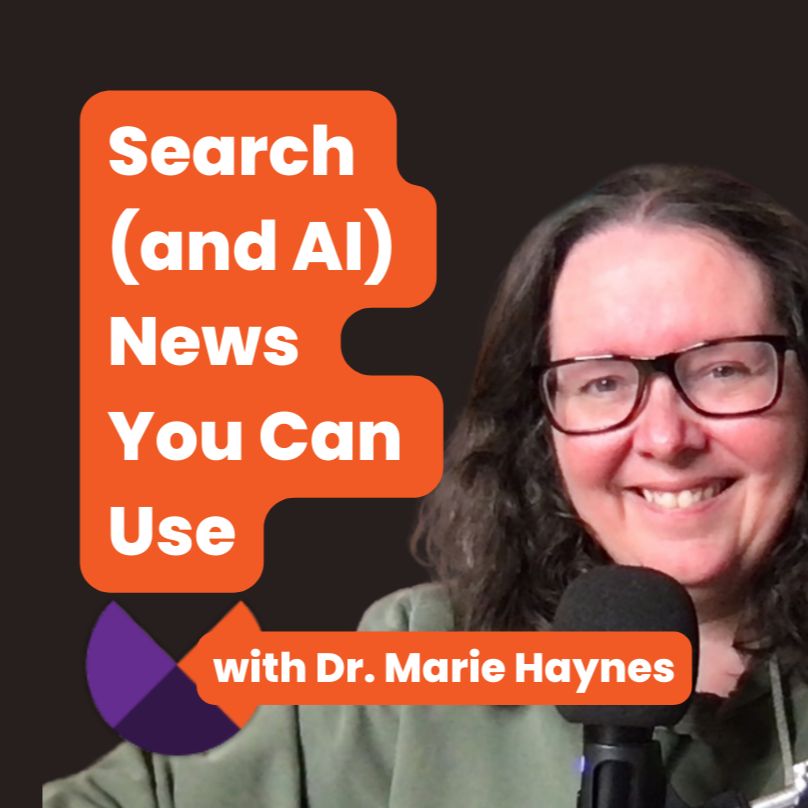
Search News You Can Use - SEO Podcast with Marie Haynes
by Marie Haynes
Search News You Can Use is Marie Haynes' Weekly Podcast where she provides useful advice on Google Algorithm updates, tips and information to help you improve your website. During the podcast she breaks down the most interesting and important changes that have happened in SEO and the world of search!
-
206
Build an OKF brain like mine!
In my last video, I introduced the concept of Google's Open Knowledge Format (OKF). Today, I'm showing you exactly what I've built with it. I have created a personal brain that I use every day to automate complex SEO tasks, generate proposals, and analyze Google search updates. We walk through the structure of an OKF file, including the YAML frontmatter and how it differs from traditional RAG. If you want to make your data and processes agent-ready, my hope is that what I'm building will help you build your own OKF brain.Here's the first video on OKF: https://www.youtube.com/watch?v=MY9F9K7wWX4 To build something similar, give these links to your agent (Claude Code / Cowork, ChatGPT Codex or my favourite, Google's Antigravity) and try this prompt:"I want to build an OKF system similar to Marie's. Read these links and then give me some ideas of what this would look like. Then, ask me questions one at a time so that together, we can decide what we want to build:https://cloud.google.com/blog/products/data-analytics/how-the-open-knowledge-format-can-improve-data-sharing/https://github.com/GoogleCloudPlatform/knowledge-catalog/blob/main/okf/SPEC.md https://gist.github.com/karpathy/442a6bf555914893e9891c11519de94fhttps://www.mariehaynes.com/okf/https://www.youtube.com/watch?v=MY9F9K7wWX4https://youtu.be/esYAIA6lU-s"
-
205
Google's OKF - The New Way to Structure Your Knowledge for Agents
Google just announced the Open Knowledge Format (OKF), a new way to structure your knowledge for AI agents. This standard uses simple Markdown to make business and personal insights accessible to the agentic web. In this video, I break down why this changes SEO, how to build your first OKF bundle, and the potential for selling expert knowledge directly to AI systems.Google's blog post on okf:https://cloud.google.com/blog/products/data-analytics/how-the-open-knowledge-format-can-improve-data-sharing/The Spec.md file for OKF on Github:https://github.com/GoogleCloudPlatform/knowledge-catalog/blob/main/okf/SPEC.mdAndrej Karpathy's LLM-Wiki:https://gist.github.com/karpathy/442a6bf555914893e9891c11519de94fJoin me in my community at the Search Bar:https://community.mariehaynes.comhttps://mariehaynes.com/join - for more on the paid areas.0:00 - Introduction to Google's Open Knowledge Format (OKF)1:03 - How OKF changes SEO and makes businesses accessible to AI agents1:43 - Selling proprietary knowledge and OKF bundles2:21 - How to use NotebookLM and Gemini to learn the new standard3:02 - What is OKF? (Markdown files and the LLM Wiki pattern)4:01 - Breaking down the OKF spec (Human and agent-friendly format)5:03 - Terminology: Creating "Knowledge Bundles" and directories5:51 - Structuring concepts as single Markdown files6:30 - Understanding YAML front matter (Type, title, descriptions, tags)7:18 - Formatting the body, citations, and cross-linking7:40 - Organizing files: Index files, log files, and using Git/Obsidian9:11 - Practical examples: BigQuery data vs. triggered Playbooks11:12 - Andre Karpathy’s LLM Wiki pattern explained13:48 - Letting the LLM write and maintain your knowledge wiki14:34 - Why OKF is the "new schema" and future revenue streams17:15 - How agents discover your OKF (llms.txt) and "Semantic Unbaking"
-
204
How to build an agentic command center with Claude Cowork - with Laura Tobin
You can build an AI dashboard so easily - even if you don't know how to code! In this episode, Laura Tobin from the Search Bar community shares the incredible system of AI agents she built using Claude and Co-work. As a food blogger facing the shifts in AI changing Search, Laura decided to pivot from fighting the technology to using it to become a "one-person content machine."She walks us through her "Command Center," a custom dashboard that manages her entire workflow, from post pipelines to client shoots. We also discuss the "uncanny valley" of AI content and why her audience rejected AI avatars, teaching us a valuable lesson on where AI belongs in your business.The discussion following the webinar is so good. We share the different avenues we are exploring in building an AI brain. Where to connect with Laura Tobin:A free 30 minutes exploratory session:https://calendly.com/laura-tobinfooddigital/30minEmail:[email protected]'s Bloghttps://yourguardianchef.com/Laura's youtube channel:https://www.youtube.com/@yourguardianchefLaura's Instagram account:https://www.instagram.com/yourguardianchefJoin Marie's community, the Search Bar for real time Search and AI News:https://community.mariehaynes.com/Join the Search Bar Pro area so you can join our weekly meetings:https://www.mariehaynes.com/join/Timestamps: 0:01 - Introduction: Meet Laura and her Claude-powered content system.1:02 - Laura's Pivot: Becoming a one-person content machine after Google's update.3:03 - AI Video Testing: Why human authenticity still beats AI avatars.6:07 - System Setup: Centralizing goals and workflows into a "Second Brain."8:34 - The AI Team: Meet Laura's specific agents (Kiara, Francesca, Julia, Rosella).10:25 - Command Center: Walkthrough of her custom dashboard and time-tracking tool.13:48 - Social Batching: Automating schedules and building a reusable content bank.17:04 - Photography Days: Managing recipes, shoot schedules, and client quotes.19:30 - Results: How the system saves time and improves audience engagement.21:46 - Q&A: Moving assets to Google Drive and republishing YouTube Shorts.24:04 - Q&A: Using Claude Co-work and why Notion acts as the system's memory.28:20 - Global Instructions: Using .md files to run agents and saving token costs.32:46 - Getting Started: How Laura built it all without a coding background.36:13 - Choosing an App: Debating Notion, Craft, and Obsidian for data storage.41:06 - The Future: Discussing open-source agents and auto-building systems.46:37 - AI Goals: Using agents for task execution vs. life optimization.48:45 - Conclusion: Wrap-up and how to contact Laura for consulting.
-
203
Big News! AI Overview & AI Mode stats in Google Search Console!
Google has just released a major update to Search Console, providing website owners with dedicated performance reports for Generative AI features including AI Overviews, AI Mode, and Discover AI. In this video, I walk through where to find this new report, why impressions matter even without click data, and the new regulatory changes that forced Google's hand.0:00 - Introduction: Google introduces new AI tracking data within Search Console.0:37 - Official Announcement: Google launches Search Generative AI performance reports.1:22 - Report Walkthrough: Looking at the new report, which tracks impressions only.1:58 - Google's Blog Post: Reviewing Google's updates on AI insights and best practices.2:23 - Links & Sources: Discussing inline citations and how to become a "preferred source."3:11 - AI Guidance: Discussing updated rules regarding LLM.txt and optimizing for AI agents.3:45 - The Opt-Out Toggle: Introducing the setting to block Google from using your site for AI.4:46 - The Risk of Opting Out: Why blocking AI might completely kill your search visibility.5:37 - Personal Story: How the speaker updated her site to correct inaccurate AI information.7:08 - UK Rollout: Explaining why the feature is currently limited to a subset of UK users.7:32 - Regulatory Pressure: How UK regulations forced Google to add these transparency tools.9:11 - Impression Counting: Explaining how unique URLs count as impressions in AI Overviews.11:12 - Missing Query Data: Why complex, multi-modal search inputs make keyword tracking impossible.12:53 - Missing Click Data: Analyzing what content earns clicks vs. ignored "commodity content."15:08 - Brand Value: Why being cited in AI answers is still valuable for brand awareness.16:33 - Analysis Strategy: How to pair impression data with standard metrics to optimize content.
-
202
Is your site Agent Ready? New Lighthouse report from Google.
Google just shared experimental documentation to help us get our websites ready for the agentic web. In this video, I walk through the new Lighthouse report, WebMCP integration, and why you might actually need an LLMS.txt file!Timestamps:0:00 - Google's new agentic readiness info1:00 - How to run the report in Chrome Canary1:45 - Why Cumulative Layout Shift matters for agents2:30 - Understanding the AI Accessibility Tree3:40 - WebMCP: Imperative vs. Declarative tools4:35 - Using Modern Web Guidance to code for agents5:10 - The LLMS.txt controversy explained6:10 - Why agents need Markdown files8:10 - How to stay updated in my communityRead more:https://www.mariehaynes.com/lighthouse-report-for-agents/Resources mentioned:Marie's Agent Readiness Tool: agent-readiness.mariehaynes.com Introduction to Lighthouse from Google: https://developer.chrome.com/docs/lighthouse/overviewChrome Canary: google.com/chrome/canaryJoin the discussion in the Search Bar community: https://community.mariehaynes.comJoin the paid Search Bar Pro community: https://mariehaynes.com/join
-
201
New from Google: How to become a preferred source in Google's AI answers
You can now ask your readers to add you as a preferred source, even if you’re not a news site! This will increase the chances that your audience sees you in AI Overview and AI Mode answers.Google’s blog post on the recent changes to preferred source:https://blog.google/products-and-platforms/products/search/original-high-quality-content-search/Instructions from Google on how to do this:https://developers.google.com/search/docs/appearance/preferred-sourcesMy blog if you want to check out the preferred source widget at the bottom of any of my blog posts:https://mariehaynes.com/blog/?utm_source=youtubeMy newsletter:https://mariehaynes.com/newsletter/My community, the Search Bar:https://mariehaynes.com/join/
-
200
The Google I/O announcements important for SEOs and website owners.
At I/O Google announced Information agents, a new Search Box, Antigravity within Search and Universal Cart which will let you put items in a cart from MULTIPLE merchants and then it will check behind the scenes to tell you if another merchant has a better price and more.Search is changing!Here is my Google doc with all of my notes on Google I/O and the Developer keynote:https://docs.google.com/document/d/1y_lMum8Sd18Y_FII4yQJMZEqMEVi0Ep6g34ovkMTqhM/edit?pli=1&tab=t.0#heading=h.6dm1fxghyeyn
-
199
New from Google: How to Rank in AI Search
Lots of interesting stuff in this new Google document!In this chat we talk about:-the new role of the index-non commodity content-llms.txt and .md filesand my favourite part - the transition to agentic search.Hope you enjoy (and my apologies for the stutter in the video - not sure what happened there, but at least the audio is solid.)Marie
We're indexing this podcast's transcripts for the first time — this can take a minute or two. We'll show results as soon as they're ready.
No matches for "" in this podcast's transcripts.
TOPICS IN THIS SHOW
Loading reviews...
ABOUT THIS SHOW
Search News You Can Use is Marie Haynes' Weekly Podcast where she provides useful advice on Google Algorithm updates, tips and information to help you improve your website. During the podcast she breaks down the most interesting and important changes that have happened in SEO and the world of search!
HOSTED BY
Marie Haynes
CATEGORIES
Loading similar podcasts...
Frequently Asked Questions
How many episodes does Search News You Can Use - SEO Podcast with Marie Haynes have?
Search News You Can Use - SEO Podcast with Marie Haynes currently has 8 episodes available on PodParley. New episodes are automatically indexed when they're published to the podcast feed.
What is Search News You Can Use - SEO Podcast with Marie Haynes about?
Search News You Can Use is Marie Haynes' Weekly Podcast where she provides useful advice on Google Algorithm updates, tips and information to help you improve your website. During the podcast she breaks down the most interesting and important changes that have happened in SEO and the world of...
How often does Search News You Can Use - SEO Podcast with Marie Haynes release new episodes?
Search News You Can Use - SEO Podcast with Marie Haynes has 8 episodes. Check the episode list to see recent publication dates and frequency.
Where can I listen to Search News You Can Use - SEO Podcast with Marie Haynes?
You can listen to Search News You Can Use - SEO Podcast with Marie Haynes on PodParley by clicking any episode. We provide an embedded audio player for direct listening, and you can also subscribe via your preferred podcast app using the RSS feed.
Who hosts Search News You Can Use - SEO Podcast with Marie Haynes?
Search News You Can Use - SEO Podcast with Marie Haynes is created and hosted by Marie Haynes.
URL copied to clipboard!