
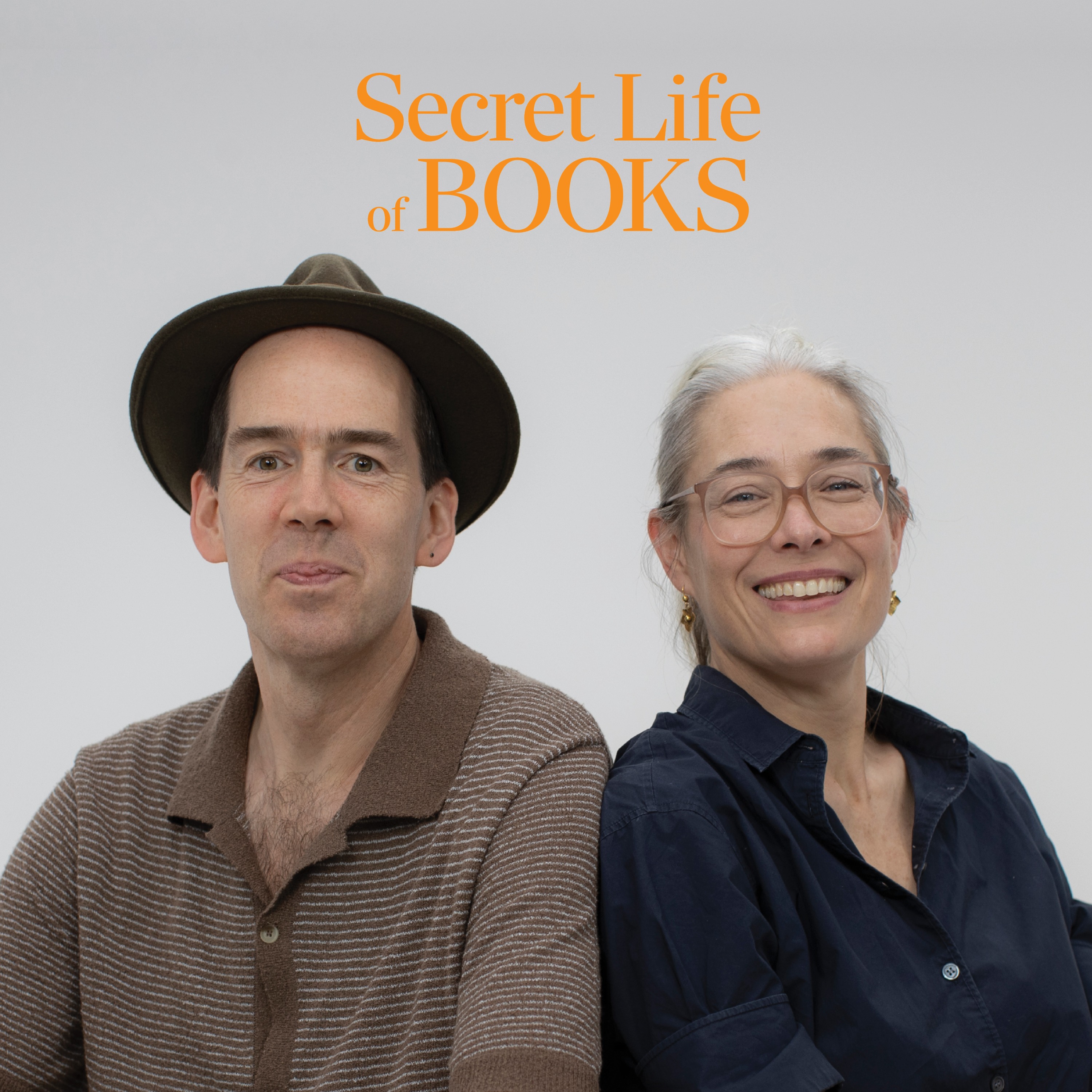
PODCAST · arts
Secret Life of Books
by Sophie Gee and Jonty Claypole
Every book has two stories: the one it tells, and the one it hides.The Secret Life of Books is a fascinating, addictive, often shocking, occasionally hilarious weekly podcast starring Sophie Gee, an English professor at Princeton University, and Jonty Claypole, formerly director of arts at the BBC. Every week these virtuoso critics and close friends take an iconic book and reveal the hidden story behind the story: who made it, their clandestine motives, the undeclared stakes, the scandalous backstory and above all the secret, mysterious meanings of books we thought we knew.-- To join the Secret Life of Books Club visit: www.secretlifeofbooks.org-- Please support us on Patreon to keep the lights on in the SLoB studio: https://patreon.com/SecretLifeofBooks528?utm_medium=unknown&utm_source=join_link&utm_campaign=creatorshare_creator&utm_content=copyLinkinsta: https://www.instagram.com/secretlifeofbookspodcast/youtube: https://www.youtube
-
151
Secret Life of the British Museum
Viriginia Woolf hated it and Karl Marx loved it. Woolf starts her iconic A Room of One’s Own by skewering it as a monument to British patriarchy and toxic masculinity.The inevitable sequel to lunching and dining at Oxbridge seemed, unfortunately, to be a visit to the British Museum, she wrote.Friend of the show George Eliot, author of Middlemarch, wholeheartedly agreed, and usually sent her husband to do her research for her, in order to avoid the British Museum's oppressive vibes. These women were describing their allergic reaction to the Reading Room, which is now the British Library building near Kings Cross. But the vast collection of global antiquities, including the Rosetta Stone, the Elgin Marbles and the Sutton Hoo treasure, have always been, like the Reading Room itself, matters of divided opinion, polarizing controversy and simmering international tensions.Is the British Museum a treasure hoard stolen almost entirely from other nations’ riches (Lord Byron thought so)? Or in bringing these objects together, in a self-conscious display of the power and fallibility of human empires, does the British Museum show something truly profound and sobering about the nature of human endeavor (its founder, Hans Sloane, took this view). Almost every London writer had opinions on the matter, and in this episode Sophie and Jonty retrace their steps and visit a handful of the most controversial treasures in the collection. Love it or hate it, the British Museum has catalyzed some of English iiterature’s greatest moments.With thanks to the Ponder & See Foundation for their support.Become a subscriber by signing up at Apple: http://apple.co/slobOr join our Patreon community here: https://www.patreon.com/c/secretlifeofbookspodcastHosted on Acast. See acast.com/privacy for more information Hosted on Acast. See acast.com/privacy for more information.
-
150
Secret Life of Reading (with Maggie O'Farrell and Ben Alderson-Day)
This episode was recorded at the Edinburgh International Book Festival, with literary superstar Maggie O'Farrell and one of Britain's leading psychologists, Ben Alderson-Day.On the Secret Life of Books, we talk about classic books and the life and times of the people who wrote them. In this conversation we talk about you - the readers. What happens when we read a book? What is going on our minds? Why can the experience of staring at words on a page be so intense, life-changing even? Is it just a case of impressions and ideas transferring from an author’s words into our imagination, or is there something more mystical, nay uncanny, at work too? Maggie and Ben reflect on the experience of being readers, and how that can transform being a writer. Maggie is the author of 10 novels, including the acclaimed and recently adapted Hamnet, and her newest book, Land. Ben is a Professor of Psychology at Durham University, author of Presence: The Strange Science of the Unseen Other, and Director of the Readerbank project - a collaborative research project with the Edinburgh Book Festival into how we read, imagine and understand stories. With thanks to the Ponder & See Foundation for their support.Become a subscriber by signing up at Apple: http://apple.co/slobOr join our Patreon community here: https://www.patreon.com/c/secretlifeofbookspodcastHosted on Acast. See acast.com/privacy for more information Hosted on Acast. See acast.com/privacy for more information.
-
149
Secret Life of Edinburgh
SLOB is in Edinburgh for the International Book Festival. Join us on a walking tour of literary Edinburgh. From Mary Queen of Scots and James VI of Scotland, obsessed with witch hunts and an early anti-tobacco campaigner, to Muriel Spark and slum tourism in The Prime of Miss Jean Brodie. We walk from the gentrified streets of Marchmont and Bruntsfield, across the Meadows, and into the rough and tumble of the Old Town, a maze of cobbled streets and old buildings crowded on the hillside below the Edinburgh Castle. Cameos from Ian Rankin and Kate Atkinson, William Shakespeare, Samuel Johnson and James Boswell, and of course, Sir Walter Scott. Come through Edinburgh with SLOB and relish its very pungent history in a world before modern sanitation.Mr. Johnson and I walked arm-in-arm up the High-street, to my house in James’s court: it was a dusky night: I could not prevent his being assailed by the evening effluvia of Edinburgh. … As we marched slowly along, he grumbled in my ear, ‘I smell you in the dark!’ But he acknowledged that the breadth of the street, and the loftiness of the buildings on each side, made a noble appearance.With thanks to the Ponder & See Foundation for their support.Become a subscriber by signing up at Apple: http://apple.co/slobOr join our Patreon community here: https://www.patreon.com/c/secretlifeofbookspodcastHosted on Acast. See acast.com/privacy for more information Hosted on Acast. See acast.com/privacy for more information.
-
148
Secret Life of Trains 2 (Choo choo!)
This week SLOB went full steam ahead from London to Edinburgh, to appear live at the Edinburgh International Book Festival. We love classic books, and we love trains, so what better way to while away the 6 hour slow-train to Edinburgh than to record our second episode about literary railway journeys. Join Sophie and Jonty as they choose sandwiches at Euston Station, board the 12:40 to Scotland via Wigan and Penrith, and talk about their favorite train lit. Savor the authenticity of the train-talk, while wedged in the gangway between the toilets and the trash bin, periodically interrupted by skeptical passengers en route to the snacks carriage. Choo choo!!A fun bonus - just because.Become a subscriber by signing up at Apple: http://apple.co/slobOr join our Patreon community here: https://www.patreon.com/c/secretlifeofbookspodcastHosted on Acast. See acast.com/privacy for more information Hosted on Acast. See acast.com/privacy for more information.
-
147
Chaucer's Troilus and Criseyde
We’re aware that Chaucer’s epic poem Troilus and Criseyde written in the 1380s might be a tough sell to even the most devoted SLoB listener, but bear with us. Troilus and Criseyde is not a novel, but it bears a lot of features that we associate with novels and reading this novel-length poem takes you into the world and minds of medieval England - albeit transposed to Ancient Troy - by someone who was living there. It has action, betrayal and a racy sex scene. It gives us a new kind of access to characters' inner lives, and it reveals that inwardly people are wildly different from the way they appear. This is a love story that doesn't conform to any of our expectations about medieval love, and a war story that doesn't comply with our expectations of war. There are so many firsts here. We see the invention of the famous British sense of humour captured in real-time by Chaucer, the very guy who invented it. It features the first reconstructed male concerned with consent in literary history and the first dumping by text message - although obviously there’s no phone involved. Become a subscriber by signing up at Apple: http://apple.co/slobOr join our Patreon community here: https://www.patreon.com/c/secretlifeofbookspodcastHosted on Acast. See acast.com/privacy for more information Hosted on Acast. See acast.com/privacy for more information.
-
146
Charlotte Higgins on Ukrainian Lessons: Art in a Time of War
Charlotte Higgins talks to Jonty about her new book, Ukrainian Lessons, which recounts her experiences the last four years reporting on the cultural life of a nation at war. Culture is never far from the front-line in time of conflict, but rarely more so than in Ukraine. Part of Putin’s attempts to legitimise the war lies in an age-old argument that Ukraine is simply an extension, or part of, Russia itself. He has personally written essays explaining his view that Ukrainian language and culture is simply part of a Greater Russia story. Not surprisingly, Ukrainians are proving him wrong with the current flourishing of poetry, writing and art that speaks to the uniqueness and separateness of their culture.Charlotte talks about how she went to Ukraine, what she found and why her belief in the power of poetry and art has never been greater.Charlotte is Chief Culture Writer for The Guardian, a classicist and host of Instant Classics podcast.Content warning: as you might expect from an episode about a contemporary war, some of the stories and experiences that Charlotte recounts are confronting.Become a subscriber by signing up at Apple: http://apple.co/slobOr join our Patreon community here: https://www.patreon.com/c/secretlifeofbookspodcastHosted on Acast. See acast.com/privacy for more information Hosted on Acast. See acast.com/privacy for more information.
-
145
James Joyce 3: Ulysses
Ulysses is a vast novel - over a quarter of a million words. Yet it follows the action of less than 24 hours. To be fair, Joyce packs a lot into that 24 hours. Although our old friend Stephen Daedalus and Leopold Bloom dominate the action, there are over 200 named characters. And, as ever, the most important character is Dublin itself. The story and structure is loosely modelled on The Odyssey with the different chapters named after episodes in Homer’s poem. The first section follows Stephen Daedalus, just as The Odyssey begins with Odysseus’ son Telemachus. Then Leopold Bloom, a 38 year old Jewish advertising canvasser, takes centre stage with Odysseus’ various adventures given modern-day, satirical equivalents. At the climax, Leopold and Stephen are united and return home, where Molly Bloom - the Penelope of the story - has the final word. The word is ‘yes’, although this is one of the rare occasions where one hearkens after a curmudgeonly ‘no’. So… like Odysseus finally reaching Ithaca, we have finally reached Ulysses after referring to it, usually in disparaging terms, over the life of this podcast. And the question is, how are we going to approach it? Are we going to fall to our knees and kiss the shores? Or will we grab bow and arrow and lay waste to the palace? And if you’re concerned we’re sounding just a little too flip, it’s worth remembering that Joyce himself said that Ulysses ‘is fundamentally a humorous work’, filled with word-play, toilet humour and irreverence.Become a subscriber by signing up at Apple: http://apple.co/slobOr join our Patreon community here: https://www.patreon.com/c/secretlifeofbookspodcastHosted on Acast. See acast.com/privacy for more information Hosted on Acast. See acast.com/privacy for more information.
-
144
Greek Lessons by Han Kang
This week we take a – somewhat unplanned – detour from our James Joyce sequence, which we put on pause while we finished reading the book! We're taking the chance to include in our series on modern Odysseys an episode we recorded a while ago on the 2024 Nobel Prize winner Han Kang’s masterly short novel Greek Lessons.Written in Korean and set in Seoul, Greek Lessons is another moment in which a modern writer takes on the characters and preoccupations of the Odyssey and reinvents them to tell a story about Korea's complex history. Greek Lessons is about an Ancient Greek teacher in Seoul who is losing his sight, and a Korean student who has lost her capacity to speak.The title and opening sentences of Greek Lessons take us directly to big, epic stories about prophecy, blindness and insight, referring among others to the blinded prophet Tiresias, who gives Odysseus predictions about what awaits him in his attempt to return to Ithaca. The novel starts with a reference to the great Argentinian writer Jeorg Luis Borges. As his dying wish, Borges requested the epitaph ‘He took the sword and laid the naked metal between them.’ What Han Kang doesn’t tell us (we’re meant to figure it out) is that Borges went blind in his 50s he became Argentina’s national librarian and learned Old English so he could read Beowulf and other Norse sagas. Across all her novels Kang tells stories of pain, loss and suffering as pathways to unexpected transformation and freedom. She connects her themes directly to the long histories of violence in North and South Korea and she also wants readers to know she’s talking about all suffering and violence over human history, including in the archaic Greek past.Become a subscriber by signing up at Apple: http://apple.co/slobOr join our Patreon community here: https://www.patreon.com/c/secretlifeofbookspodcastHosted on Acast. See acast.com/privacy for more information Hosted on Acast. See acast.com/privacy for more information.
-
143
James Joyce 2: Portrait of the Artist as a Young Man
One evening in 1898, the 16-year-old James Joyce lost his virginity with a sex worker on a canal bank in Dublin. The event would become the main event in his autobiographical novel A Portrait of the Artist as a Young Man, published the same year as Dubliners in 1914.Joyce’s sexual awakening prompted both a spiritual crisis and a renewed determination to be a great writer. Portrait tells the story of Joyce’s avatar, Stephen Daedalus, from childhood to graduation. Ultimately, it is about Daedalus’ hard-won rejection of all the baggage of late 19th Century Irish society - religion, morality, English intellectual colonization, and the social stagnation of Dubliners (discussed last week). Daedalus, of course, was the inventor of Greek myth who made himself wings to escape his prison - and the book ends with Stephen escaping the prison of his childhood by turning to the supposed intellectual freedom of Europe. While being well known for its treatment of sexual awakening, the book is also famous for Joyce’s enthusiastic adoption of the stream-of-consciousness technique emerging in European literature, in which the narrative follows the trajectory of the characters thoughts.In this episode, we look at the intellectual journey Joyce took between 1907 - when he started writing Portrait - and 1914, when Ezra Pound had it published.Become a subscriber by signing up at Apple: http://apple.co/slobOr join our Patreon community here: https://www.patreon.com/c/secretlifeofbookspodcastHosted on Acast. See acast.com/privacy for more information Hosted on Acast. See acast.com/privacy for more information.
-
142
Emily Wilson, the Odyssey and Why Epics Matter
We’ve been saving this one up for a special occasion – a live conversation with Professor Emily Wilson, the celebrated translator of Homer’s Odyssey and the version on which Christopher Nolan’s film is said to be based. Emily has long been revered in the academic world, and she’s currently the toast of the internet for remarks about the Nolan adaptation not having enough sex or nice food on display (here on SLOB, we agree!)Back in February 2026, Sophie hosted a conversation live in Princeton, with Emily, and the brilliant academic rising star of epic poems, Prof. Pasquale Toscano. In this crackling discussion, the talk turns quickly to why epics matter, what they mean, and how they pass their brilliance across time and place. Emily and Pasquale say lots of surprisingly, trenchant and thought-provoking things about why epics are such an important form, both then and now.Become a subscriber by signing up at Apple: http://apple.co/slobOr join our Patreon community here: https://www.patreon.com/c/secretlifeofbookspodcastHosted on Acast. See acast.com/privacy for more information Hosted on Acast. See acast.com/privacy for more information.
-
141
A Podcast of One's Own x SLOB: Special Collaboration
For this extra special A Podcast of One’s Own × The Secret Life of Books crossover, former Australian Prime Minister Julia Gillard and Sophie Gee sit down to celebrate their shared love of books and reading.Julia and Sophie compare notes on hosting book podcasts, share their lifelong love of literature, and reflect on their experiences chairing two of the world's leading literary prizes for women and non-binary writers – the Women's Prize for Fiction and the Stella Prize.Hosted by Julia Gillard, A Podcast of One's Own brings listeners extraordinary stories from remarkable women shaping the world through their work. Alongside these conversations, Julia's Book Club – co-hosted by Kathy Lette and Sarah Holland-Batt – celebrates brilliant books by women each fortnight.Hosted by Sophie Gee and Jonty Claypole, The Secret Life of Books uncovers the hidden stories behind the world's most iconic books, revealing the scandalous backstories, secret meanings and surprising histories that have shaped the way we read them.We hope you'll enjoy this conversation as much as we enjoyed having it.Become a subscriber by signing up at Apple: http://apple.co/slobOr join our Patreon community here: https://www.patreon.com/c/secretlifeofbookspodcastHosted on Acast. See acast.com/privacy for more information Hosted on Acast. See acast.com/privacy for more information.
-
140
James Joyce 1: Dubliners
Next in our overview of Odysseys, we embark on an epic journey of our own toward the endless tome masterpiece James Joyce’s Ulysses. No reader comes to Joyce without preconceptions. Was he the greatest literary genius of the 20th century? Or a pretentious drunkard and misogynist? Was he an Irish patriot and torchbearer for Irish cultural revival? Or a Francophile ex-pat who gave Ireland the slip early on?For most of us, though, he’s just a guy in little glasses and a hat who wrote a very long book that is almost impossible to read.So for those who aren’t sure what to make of James Joyce, this is your perfect starter pack.But as befits an Odyssey, we’re not going directly to Ulysses. We’re backing up and looking at Joyce’s two earlier books, also set in Dublin, also deeply indebted to the Odyssey. These are Dubliners, his book of 15 short stories, and A Portrait of the Artist as a Young Man, a novel, both published in 1914, the year in which WWI started.Joyce thought he would publish Dubliners in 1907, but a very fraught, complicated and frankly pretty bratty series of fights between Joyce and his Dublin publisher – along with a lot of other messy life circumstances – meant that it wouldn’t be published for another seven years. As Sophie and Jonty guide listeners through the long and winding — often whining — road to Dubliners, we ask how it’s a version of Homer’s Odyssey, how it lays out Joyce’s creative vision, and what it tells us about the kind of man James Joyce really was.Become a subscriber by signing up at Apple: http://apple.co/slobOr join our Patreon community here: https://www.patreon.com/c/secretlifeofbookspodcastHosted on Acast. See acast.com/privacy for more information Hosted on Acast. See acast.com/privacy for more information.
-
139
The Odyssey 4: Christopher Nolan's Odyssey review
We've been limbering up for 3 weeks now, readying ourselves to take on Christopher Nolan's Odyssey, the cinematic event of the year (if you don't count Wuthering Heights or the Devil Wears Prada 2). In this episode, Sophie and Jonty weigh in with their acerbic but playful critical take on Nolan's version of Homer's epic, recorded just hours after they watched the film on opposite sides of the world.The positives come first. How does Nolan's interpretation give us a powerful epic for our times? What does Matt Damon show us about Odysseus that's fresh, new and timely? In the second half of the episode SLOB goes darker: what gets lost in this 21st Century remaking of the ultimate homecoming epic? What is fundamental to this incomparable masterpiece that the film doesn't manage to capture? Hosted on Acast. See acast.com/privacy for more information.
-
138
The Odyssey 3: Tennyson's Ulysses
Tennyson’s poem “Ulysses” might just be the greatest Odyssey re-write of all time, even though it starts several years after Homer’s mighty epic ends. “Ulysses” is a dramatic monologue in blank verse in which the aging Ulysses prepares to leave Ithaca for one last voyage into the unknown. Its famous last line - to strive, to seek, to find and not to yield - inspired Victorians - and continues to inspire us too. It wasn’t published until later in his writing life, but it was written early on after the unexpected death of his greatest friend, Arthur Hallam. Part of the young Tennyson’s brilliance was the way he reinvented ancient myths and stories to encompass modern ideas as well as his own violently fluctuating mood state. Over the course of his life, he produced a long Arthurian epic, re-popularizing the legends of King Arthur. He also wrote several poems set in the Homeric world of The Odyssey. These include Tiresias - a friend of the show; The Lotus-Eaters and - the subject of this episode - Ulysses. Here in the SLOB studios we were high-fiving and doing victory laps in celebration of Tennyson’s achievement before we even started recording. We might enjoy this version of the Odyssey more than we’re going to enjoy Matt Damon’s version, though obviously we can’t wait to see it. In short, SLOB stands with Prime Minister Robert Peel, who when he first heard the poem said that he recognized a ‘good speech’ when he heard one and awarded Tennyson a much-needed government pension on the spot. Become a subscriber by signing up at Apple: http://apple.co/slobOr join our Patreon community here: https://www.patreon.com/c/secretlifeofbookspodcastHosted on Acast. See acast.com/privacy for more information. Hosted on Acast. See acast.com/privacy for more information.
-
137
The Odyssey 2: How the Odyssey conquered the world
We’re in another SLoB code red. Only months after Wuthering Heights smashed onto our screens, Christopher Nolan is here for the blockbuster event of the season, taking the one of the oldest and still greatest epics of all time - Homer’s Odyssey - and giving it what it always lacked. That is to say: Matt Damon. And not just Matt Damon, but Zendaya, Tom Holland, Anne Hathaway, Travis Scott, Robert Pattinson, Charlize Theron, Lupita Nyong’o, Samantha Morton - and the list goes on. Basically, if you’re an actor and NOT in this film, it’s like discovering you’re the only one in class not invited to a party. If you’re feeling daunted by the scale and import of both this film and the source material - don’t worry. SLoB is here to help you. We’ve donned our scrubs once again. We’ve got our critical defibrillators, suction devices and valve masks and we’re going to deliver you to the cinema ready to take on Homer and Nolan’s Odyssey. We’ve republished the episode we did early in SloB on the Odyssey with Mary Beard. In this episode, we’re going to look at how the Odyssey shaped English literature in a portmanteau episode that will encompass everyone from Shakespeare to Keats, Toni Morrison to Margaret Atwood. In coming episodes, we’re going to take deep dives into Tennyson’s Ulysses and review Nolan’s film. And then, as the dust settles, or the waters meet, we’re going to embark on arguably the greatest Odyssey re-write of all - James Joyce’s Ulysses - in a three part series that will take on each of the works in Joyce’s trilogy of Dubliners, Portrait of an Artist as a Young Man and Ulysses itself. Become a subscriber by signing up at Apple: http://apple.co/slobOr join our Patreon community here: https://www.patreon.com/c/secretlifeofbookspodcastHosted on Acast. See acast.com/privacy for more information. Hosted on Acast. See acast.com/privacy for more information.
-
136
The Odyssey 1: Mary Beard on Homer’s masterpiece
To kick-start our series on the Odyssey, we're republishing a hit episode from early SLOB: a conversation with Dame Mary Beard, the world's favorite classicist.The Odyssey - where stories began. Probably written down around 7th century BC - give or take a few centuries either way - by somebody or somebodies who may or may not have been called Homer. Leaving aside these mysteries, what is the Odyssey really about, why is it so violent and why is Odysseus himself - the lord of the lies - such an unlikeable hero? Who better to navigate this intellectual Scylla and historical Charybdis than Mary Beard? Sophie and Jonty listen in admiration as Mary describes discovering The Odyssey aged 14 - a self-proclaimed swot with aspirations to be scruffy and cool (or, in Sophie’s parlance, a ‘dag’). How it - or at least the several incidents in which Odysseus’ wife Penelope is told to shut up and go to her room by her own son - inspired Mary’s best-selling book Women and Power. And how the whole poem, which begins with the word ἄνδρα (man), is a riff on toxic masculinity millennia before Andrew Tate was even in a twinkle in Zeus’ eye. And listen, pithy mortals, to Jonty as he repeatedly mangles Ancient Greek names, particularly the ‘Laestrygonians’, to Sophie as she - not for the first time in this podcast - tries and fails to make a convincing link to The Reformation, and to all of us as we advocate the benefits of an oil rubdown every evening.Further Reading:Emily Wilson, trans, The OdysseyMary Beard books:Women & Power: A Manifesto by Mary Beard (Profile Books, 2019)Confronting the Classics: Traditions, Adventures and Innovations by Mary Beard (Profile Books, 2013) The Parthenon by Mary Beard (Harvard University Press, 2002) Hosted on Acast. See acast.com/privacy for more information.
-
135
The Declaration of Independence at 250
It’s been called most influential document ever signed. And it’s been called tokenistic and compromising, a piece of writing written by a committee. The great political economist Jeremy Bentham called it “a "hodge-podge of confusion and absurdity in which the thing to be proved is all along taken for granted.” The Declaration of Independence was drafted by the lawyer, philosopher and statesman Thomas Jefferson, and it made the United States of America an independent nation in 1776, throwing off British colonial rule. Its signing triggered waves of similar declarations around the world. By 1826 more than 20 similar declarations had issued forth from Europe, the Caribbean and Spanish America and hundreds of others would follow. It was not the first declaration of its kind at all, but it would become the most famous. This July, American independence turns 250, and it is under scrutiny all over the world as possibly the most complicated and contradictory exercise in nation-building in human history.Join Sophie and Jonty for a deep dive into this landmark political document, which also became an instant literary classic.Become a subscriber by signing up at Apple: http://apple.co/slobOr join our Patreon community here: https://www.patreon.com/c/secretlifeofbookspodcastHosted on Acast. See acast.com/privacy for more information. Hosted on Acast. See acast.com/privacy for more information.
-
134
TS Eliot 2: The Waste Land
After the triumph of Prufrock and other Observations, TS Eliot almost steered the car into the ditch, poetically and personally. Under the influence of his friend, the fascist poet Ezra Pound - a man who later achieved notoriety for his enthusiastic support of Hitler during the Second World War - Eliot’s second collection of poems reveled in antisemitism, misogyny and willful obscurity. He even wrote poems in French. Pretentious, moi? In this episode, we show how just in the time - with the beret almost on his head - Eliot managed to cast it aside, regain control of the wheel, and steer the vehicle away from the boulevards of Paris into the waste land. As ever, our question is: how? In the hyperbolic spirit of a Discovery channel documentary, we think it’s fair to say that The Waste Land, published in two magazines in1922, then by Virginia Woolf’s Hogarth press in 1923, changed the world FOREVER. For readers at the time, Eliot captured the spiritual malaise of Europe after the first World War. Nobody could definitively explain the poem - although many had their theories - but it captured more than any realist novel the spirit of the age. It influenced many of the greatest books of the 20th Century, including The Great Gatsby, Evelyn Waugh’s A Handful of Dust, Raymond Chandler’s The Long Goodbye and many books of poetry. We ourselves are guilty of having written utter bollocks about this poem during our undergraduate years. In consequence of which, we tremble before our microphones for this week’s episode.Become a subscriber by signing up at Apple: http://apple.co/slobOr join our Patreon community here: https://www.patreon.com/c/secretlifeofbookspodcastHosted on Acast. See acast.com/privacy for more information. Hosted on Acast. See acast.com/privacy for more information.
-
133
TS Eliot 1: The Love Song of J. Alfred Prufrock
T.S. Eliot was a mid-west American living in London in the first decades of the 20th century, who wrote Dickens-inflected poems about fog, wind, damp evenings and the general gloom of English life (if you were a young, neurotic, over-educated, American male, that is). Eliot’s remembered in the same breath as Ezra Pound as a founding father of literary Modernism, but while very few people could quote a line from Pound, almost everyone will recognize some of these evergreen phrases from Eliot’s lugubrious output. “April is the cruellest month,” “I have measured out my life in coffee spoons,” “do I dare eat a peach?”; “I grow old, I grow old, I shall wear the bottoms of my trousers rolled” and “this is the way the world ends, not with a bang but a whimper.” But thing about Eliot is that he had an ear for a crowd-pleasing line, which is why he also ended up being one of the most important editors of the 20th century at the publishing house Faber and Faber, making the careers of many poets including WH Auden and Marianne Moore.Today you’ll be hearing about Eliot’s penchant for amateur theatricals, Paris, and the philosophy of Henri Bergson; and his pivot from being a high-minded Philosophy PhD student at Harvard to a wanker-banker at Lloyds in London. Next week we’ll focus on his turbulent relationship with the unhappy and unstable Vivienne, his first wife, his complicated feelings about Victorian and Elizabethan literature, and his conversion to high Anglican Christianity, which caused his good pal Viriginia Woolf to announce, “Tom is dead to me.”We claim whenever possible that all literary roads lead to the 1980s and Andrew Lloyd Webber. TS Eliot’s greatest poetic achievement is neither Prufrock nor The Waste Land, but Old Possum’s Book of Practical Cats, which provided the Cats! Songbook.Genius as Mcavity the Mystery Cat and Rum-Tum Tugger are, TS Eliot’s immortality was truly sealed with the ubiquitous and appalling 80s soft rock ballad “Memory,” sung by Grizabella the once-beautiful feline who has fallen on hard times amid a load of oversized garbage bins. Memory is a mash-up of lines from Eliot’s early poems, and today we’ll find out exactly what it was that so attracted this young American to the burnt out ends of smoky days in early 20C London. Become a subscriber by signing up at Apple: http://apple.co/slobOr join our Patreon community here: https://www.patreon.com/c/secretlifeofbookspodcastHosted on Acast. See acast.com/privacy for more information. Hosted on Acast. See acast.com/privacy for more information.
-
132
Bleak House by Charles Dickens - SLoB Book Club returns! (feat. Bret Walker SC)
SLoB Book Club is back as Sophie and Jonty dive into Charles Dickens’ Bleak House with the help of special guest Bret Walker, SC – one of Australia’s most renowned lawyers.Dickens’ sprawling vision of a nation caught in the fog of corruption, in which human kindness and connection is almost but never quite extinguished, is as relevant today as ever. It contains some of his greatest characters - including the original virtue-signaller Mrs Jellyby, the sinister Mr Krook who collects women’s hair and Inspector Bucket - arguably the first fully-rounded detective in English fiction. It’s a social satire, a murder mystery and a comedy - all tied together by the nefarious Court of Chancery and the interminable case of Jarndyce & Jarndyce. This episode is devoted solely to Chapter 1. Sophie and Jonty look at what Dickens was up to immediately before and during its composition and ask: what exactly is the famous fog drifting over London in the opening lines? In the second half, as the fog curls into the Court of Chancery, we are joined by Bret Walker SC who explains what Chancery is, how it differs from other law courts, why there were real cases like Jarndyce & Jarndyce which lasted many decades, and why Dickens was so incensed by it all. If you want to read along with us over the next four months, then please subscribe – we will release fortnightly episodes from now on.Become a subscriber by signing up at Apple: http://apple.co/slobOr join our Patreon community here: https://www.patreon.com/c/secretlifeofbookspodcastHosted on Acast. See acast.com/privacy for more information. Hosted on Acast. See acast.com/privacy for more information.
-
131
Sucking the Forbidden Fruit: Christina Rossetti's Goblin Market
Nobody expects the Victorian wombats! Given the title, listeners won’t be hugely surprised to hear there are goblins in today’s episode, but wombats!?!?Yes, the sleeper hits of this episode are our round, furry friends from Australia. Or, as the poet Christina Rossetti would put it in a poem to her family pet, gli umobatti. “Goblin Market” is already going to 11 on the weirdness scale, and we’ve said nothing of the fairies, goblins, sexual repression, feminine hysteria, class anxiety and evangelism coming your way. If you’re into High Victorian weirdness then, boy, this is the SLoB episode for you. Christina Rossetti was the daughter of an exiled Italian radical and sister of the famous painter Dante Gabriel Rossetti, and “Goblin Market” is her hit poem from 1862. 1862 was, incidentally, the same year in which, across the Atlantic, Emily Dickinson sent her poems to T.W. Higginson (asking if they breathe) and Charles Dodgson, aka Lewis Carroll, improvised a story about a girl called Alice going underground. “Goblin Market” is a bizarre, rollicking, long poem about a young woman called Laura who “sucked and sucked and sucked” the “fruit globes” of some goblins - which is just an unnecessary erotic way of saying she ate some fruit - and wasted away, until saved by her sister Lizzie in a truly bizarre ceremony in which she licks sticky juice off her face. Rossetti was inspired by John Keats and his theory of negative capability, and she was at the heart of London’s bohemian artistic elite, the Pre Raphaelite Brotherhood. But she was also neurotic, austere and devoutly religious, turning her back on her brother’s louche goings-on in his house in Chelsea, where aesthetes slid naked down the bannisters and cavorted with his collection of exotic pets. But she did not turn her back on Gabriel Rossetti’s pet wombat, Top, named after his great university friend, the radical designer and writer William Morris. Come for the fruit globes, stay for the wombats in this edge-of-your seat SLOB episode.Become a subscriber by signing up at Apple: http://apple.co/slobOr join our Patreon community here: https://www.patreon.com/c/secretlifeofbookspodcastHosted on Acast. See acast.com/privacy for more information. Hosted on Acast. See acast.com/privacy for more information.
-
130
Wings and Things: John Keats' Ode to a Nightingale
In April 1819, the poet John Keats, aged 23, told his brother George that he was done with poetry. A few days later, he smashed out the first poem in what is arguably the greatest streak in literary history, with "La Belle Dame Sans Merci." This was followed in quick succession by four odes, including "Ode to a Nightingale" and "Ode to a Grecian Urn." And then as summer faded, he had a thing to say about the season of mists and mellow fruitfulness in "To Autumn." Throughout this, he also wrote one of his most under-rated longer poems - the mini epic Lamia. All that in six months!God only knows what marvels 1820 might have had in store, but at the start of the year he suffered his first lung haemorrhage, confirming his fears of tuberculosis, and announced to his friend Charles Browne that he was dying - as indeed he was. Not only do Keats' Odes stand amongst the greatest in the English language, but their influence was unparalleled in that century. Tennyson, the Pre-Raphaelites and the Aesthetic Movement that we associate with Walter Pater, William Morris and Oscar Wilde directly descend from Keats’ work, frequently quoting the final lines of "Ode to a Grecian Urn" as their credo: ‘Beauty is truth, truth beauty, - that is all ye know on earth, and all ye need to know’. So the big question in this episode is simply ‘how?’. How did the 23-year-old Keats manage to do it? What was going on in his life and his art, his friendships as well as the world at large to enable this to happen? And what is it that makes these poems so truly unforgettable? We’re going to be talking about madness, revolution and medicine in Regency England. We’re going to run through a brief history of birds - particularly nightingales - in English literature, and explain what an ode is and where it comes from? There’s love, friendship, laughter, despair, and something called Negative Capability, which is more exciting than it sounds.Become a subscriber by signing up at Apple: http://apple.co/slobOr join our Patreon community here: https://www.patreon.com/c/secretlifeofbookspodcastHosted on Acast. See acast.com/privacy for more information. Hosted on Acast. See acast.com/privacy for more information.
-
129
Paths of Glory: Thomas Gray's Elegy Written in a Country Churchyard
In 1751, a little-known Cambridge academic called Thomas Gray published “Elegy Written in a Country Churchyard” and became a household name. His poem was a funeral elegy about the sun going down over the graves of long-forgotten people whom Gray didn’t know. They happened to be buried in the same small country churchyard as his aunt and mother (and, eventually, himself), in the village of Stoke Poges. It was an instant smash, topping the literary charts and going into multiple reprints, editions, and translations - and spawning a minor sub-industry of satires and parodies.If you’ve ever heard of the “graveyard school” of poetry, Thomas Gray is its genius, and “Elegy Written in a Country Churchyard” by far its most famous and influential poem.Gray had a huge impact on the Romantic poets - Wordsworth, Colerdige, Keats and Percy Bysshe Shelley. Tennyson, Browning, T.S. Eliot and Philip Larkin were all indebted to him – and countless others.Generations of British schoolchildren know Gray’s poem by heart, so today Sophie and Jonty are digging up the dirt on this graveyard poem to ask what all the fuss is about. Why is this one of the most important and prized works in English poetry, and which heavy-hitter authors came before Gray, paving the way for this poetic game-changer?Become a subscriber by signing up at Apple: http://apple.co/slobOr join our Patreon community here: https://www.patreon.com/c/secretlifeofbookspodcastHosted on Acast. See acast.com/privacy for more information. Hosted on Acast. See acast.com/privacy for more information.
-
128
Literary Pilgrimage in New York: From the Mixes Up Files of Mrs. Basil E. Frankweiler
A special collaboration between Sophie and the celebrated writer and podcaster Gretchen Rubin, of Happier with Gretchen Rubin, recorded live from New York City. Join Sophie and Gretchen on a literary pilgrimage to the Upper East Side of New York, where they celebrate a shared favourite children's book, From the Mixed Up Files of Mrs. Basil E. Frankweiler, by the extraordinary E.L Konigsburg.Sophie and Gretchen walk out on the streets of Manhattan and through the galleries of the Met, visiting favorite landmarks from the novel, and discussing what makes this children's book so perfect, both a glorious product of its time and place, and an immortalizing of the Met and New York City for future generations of children and their parents.It's part of a series Gretchen and her sister are doing called MOVE 26 in '26, to get readers and listeners exercising for at least 26 minutes a day, during 2026!Check it out here, and sign up:https://gretchenrubin.com/move26in26/And learn more about Gretchen and her work on a happier life here:https://gretchenrubin.com/Become a subscriber by signing up at Apple: http://apple.co/slobOr join our Patreon community here: https://www.patreon.com/c/secretlifeofbookspodcastHosted on Acast. See acast.com/privacy for more information. Hosted on Acast. See acast.com/privacy for more information.
-
127
Canterbury Tales (General Prologue) by Geoffrey Chaucer
Talent shows like The X Factor, Got Talent and their many spin offs began in the 1380s, not the 1980s! They were invented by Geoffrey Chaucer, who wrote his masterpiece The Canterbury Tales at the end of a successful and glamorous diplomatic career in medieval Europe.This is the literary pilgrimage to top all literary pilgrimages, the imagined story of a group of medieval odds and sods, who meet up to in a London pub and walk to Canterbury Cathedral. The owner of the pub, a local MP named Harry Bailey (a real guy), decides that they’ll have a storytelling competition to pass the time while they travel. The winner will get dinner at, you guessed it, Harry's pub.No one had ever written anything remotely like this before, and Chaucer’s version of pub-mike night became a literary sensation.The Canterbury Tales is one of the most famous works of English Literature ever, and a perennial favorite on "Intro to English Lit" syllabuses. It's written in Middle English, which isn't an easy read now, but has a lot of fascinating local color that has disappeared from modern English. In the first installment of our “Long(ish) Poems” series, Sophie and Jonty explain why the Canterbury Tales remains an evergreen literary staple, what makes Chaucer’s characters so brilliant, and what’s important about the "General Prologue" that kick-starts the whole tale cycle. [Editor's note: work on your titles, Geoffrey!]Here is Harvard's easy to use version of the Canterbury Tales in Middle English with a modern English translation: https://chaucer.fas.harvard.edu/pages/general-prologue-0Become a subscriber by signing up at Apple: http://apple.co/slobOr join our Patreon community here: https://www.patreon.com/c/secretlifeofbookspodcastHosted on Acast. See acast.com/privacy for more information. Hosted on Acast. See acast.com/privacy for more information.
-
126
The Other Bennet Sister with author Janice Hadlow
2026 is the year of the Horse. It is also the Year of Classic Literature, thanks to the current crop of high-profile screen adaptations. And, when it comes to the classics, SLOB is all about the small screen. Most film directors have enormous egos. All too often they use a classic as a departure point to - frankly - just show off. To try and show they are as brilliant as the author. And we don’t like it! Or very rarely. Our hearts lie with the small screen. There the classics can unfold faithfully and with all the time they deserve. Think of the BBC’s adaptations of Pride and Prejudice, Middlemarch and Jane Eyre, as well as modern classics like Wolf Hall and Normal People. It’s fair to say that the breakout hit of the hour is the BBC’s adaptation of Janice Hadlow’s The Other Bennet Sister - a bold rewrite of Pride and Prejudice - starring Ella Bruccoleri, Richard E Grant and Ruth Jones. So, we’re delighted to have Janice on the show this week to talk about not only adapting Pride and Prejudice, but having her book in turn adapted for the screen. Anyone familiar with Jane Austen’s Pride & Prejudice will know that Elizabeth Bennet has a very unappealing younger sister called Mary, who - with Austen’s characteristic talent for cruelty - is portrayed as a plain-looking prig, unable to say the right thing, and generally lowering spirits with her moralising comments and sub-par musical performances. You might recall the famous Mr Bennet line spoken about Mary: "That will do extremely well, child. You have delighted us long enough. Let the other young ladies have time to exhibit."In this episode, we're joined by author Janice Hadlow to chat all about Mary, TOBS, and what it looks like when you champion the underdog.Become a subscriber by signing up at Apple: http://apple.co/slobOr join our Patreon community here: https://www.patreon.com/c/secretlifeofbookspodcastHosted on Acast. See acast.com/privacy for more information. Hosted on Acast. See acast.com/privacy for more information.
-
125
Back to School 4: Prep by Curtis Sittenfeld
To round out our series on high school novels we're jumping across the pond (aka the Atlantic Ocean) and skipping several decades to find ourselves in early 1990s Massachusetts. Welcome to the world of East Coast preppy culture, where Laura Ashley dresses, LL Bean canvas tote bags, goldfish crackers, classic rock, pink shorts and ties with whales on them, reign supreme. As with the other three school stories we’ve covered so far, the ultra-elite East Coast boarding school of Curtis Sittenfeld’s 2005 novel Prep is a microcosm of the nation at large - or at least a decent segment of it. Prep is set in the class-conscious world of New England and the boarding schools that are meant to produce the graduates of Harvard, Yale and Princeton. Sittenfeld, who, like her heroine Lee is from the Midwest, picks up the milieu of The Great Gatsby half a century later, and makes the characters are ten years younger. Picture Daisy and Tm Buchanan, Jordan Baker and Nick Caraway in high school, wondering if they should use a different deodorant, and whether they have the right haircut.Prep was The Secret History of American boarding school stories when it came out, an authentic glimpse into what really went on in these ultra privileged high school campuses. Curtis Sittenfeld would take on other iconic American stories in subsequent novels, rewriting the worlds of First Lady Laura Bush and Hillary Rodham Clinton. With Prep she trained her excruciatingly detailed outsider-observer’s eye on the rituals, mores and social markers of America’s white elites. Become a subscriber by signing up at Apple: http://apple.co/slobOr join our Patreon community here: https://www.patreon.com/c/secretlifeofbookspodcastHosted on Acast. See acast.com/privacy for more information. Hosted on Acast. See acast.com/privacy for more information.
-
124
Back to School 3: A Kestrel for a Knave by Barry Hines
Become a subscriber by signing up at Apple: http://apple.co/slobOr join our Patreon community here: https://www.patreon.com/c/secretlifeofbookspodcastHosted on Acast. See acast.com/privacy for more information.In 1969, six years before the Sex Pistols formed and punk broke, a 15 year old boy from Yorkshire called Billy Casper flicked at v-sign at the world. A photograph of that moment became one of the iconic images of late 20th Century Britain, appearing on t-shirts, posters, graffiti, and - of course - a book cover. Billy Casper wasn't a real boy. He is the anti-hero of Barry Hines’ A Kestrel for a Knave, published in 1968. The book is a masterpiece in its own right, but owes its status in part to the film adaptation made immediately after it came out. Director Ken Loach, working with Hines as scriptwriter, decided to make the film exactly where the book is set - in and around Barnsley, a coal-mining town in Yorkshire. The boy in the poster is, in fact, 15-year-old David Bradley - a local working-class boy without any acting experience, whose father worked in the mines. David Bradley and Billy Caspar are almost inseparable in our imaginations. And so that famous photograph, taken on set, became the image used on the cover of future editions of the book. A Kestrel for a Knave changed school stories forever. Billy is a semi-literature child living in a state of neglect on a housing estate. His school is a bad secondary modern, where the pupils are physically and psychologically abused by their depressed teachers. What makes Billy’s life worthwhile is his love of the countryside, and the kestrel hawk he has managed to raise and keep in the garden shed. What Billy wants is to fly his kestrel, but the world keeps getting in the way - his brother, teachers, school bullies, even the Youth Employment Officer. Hence Billy’s iconic v-sign - the ultimate statement of his refusal to participate in anything society has to offer. Barry Hines, A Kestrel for a KnaveKen Loach, Kes Hosted on Acast. See acast.com/privacy for more information.
-
123
Back to School 2: The Prime of Miss Jean Brodie
Published in 1961, The Prime of Miss Jean Brodie tells the story of a charismatic and narcissistic teacher in a girl’s private school in Edinburgh during the 1930s. Miss Brodie, who insists repeatedly that she is in the prime of her life - aka middle-aged - cultivates a ‘set’ of impressionable young girls who she can use as proxies to act out her own desires. On at least one occasion, when she encourages an impressionable young girl to fight for the fascists in the Spanish Civil War, this has fatal consequences. In the end, it is one of her own set who ‘betrays’ her to the headmistress Miss Mackay, providing the necessary intel to ensure her sacking. The character of Miss Brodie isn’t the only thing memorable about this book. The prose is - as you would expect from a writer called Spark - electric. That is to say, both poetic and incredibly funny. She also manages to write an avant-garde non-linear account of Brodie’s supposed ‘prime’ that has its own propulsion. The novel darts around over a thirty year time period with an effortlessness and accessibility that even the greatest writers struggle to achieve. The Prime of Miss Jean Brodie was published first in the New Yorker. It was an immediate hit and reached canonical status when it was adapted into an Oscar winning film in 1969, starring Dame Maggie Smith and directed by Ronald Neame of Poseidon Adventure fame. In this episode, we’re going to find out who betrayed Miss Brodie - and why. We’re also, as ever, going to delve beyond the book into the prime of Muriel Spark herself, uncovering the real Brodies who inspired her, how her earlier career as a biographer helped shape her approach to fiction, and why endings are always just beginnings.Become a subscriber by signing up at Apple: http://apple.co/slobOr join our Patreon community here: https://www.patreon.com/c/secretlifeofbookspodcastHosted on Acast. See acast.com/privacy for more information. Hosted on Acast. See acast.com/privacy for more information.
-
122
Back to School 1: Tom Brown's School Days
Thomas Hughes’ Tom Brown’s School Days (1857) wasn’t the first school fiction novel – that honour goes to a Sarah Fielding, sister of Henry Fielding, who published The Governess, or The Little Female Academy over a hundred years earlier. But, as is so often the case, it’s the man who takes the credit.In this episode, Sophie and Jonty look at how Thomas Hughes’ nostalgic celebration of Rugby School in the 1830s super-charged school fiction as a genre for a century to come. Billy Bunter, Molesworth, St Trinian’s and even Hogwarts owe a large debt to Hughes’ novel.The book tells the story of the eponymous Tom Brown, who goes to Rugby where he excels at rugger and cricket, is bullied by the dastardly Flashman, suffers various torments such as being ‘tossed in a blanket’ and ‘roasted over a fire’, gets the hot for his best friend’s mother and finally discovers evangelical Christianity through the inspiration of his headmaster, Thomas Arnold.Perhaps what is most striking about Tom Brown’s School Days is that it is both familiar - because of the way it continues to influence school fiction today - but deeply, deeply alien. As Thomas Hughes makes clear, the point of England’s so-called public schools in the 19th Century wasn’t to give boys a rounded education but to prepare them for administration of the British Empire. Tom Brown learns a bit of Greek and Latin, but most of all to fight, boss people about, and quote without questioning propaganda about the benefits of colonialism to a subjugated people.Thomas Hughes never quite got over the high-point of his Rugby years, but his enthusiasm makes even the most devout alumnus look half-hearted. In 1880, he founded a Utopian community in Tennessee called… you guessed it… Rugby, complete with croquet court and a ‘university’ named after Rugby’s legendary headmaster Thomas Arnold. Needless to say, the community failed in its intentions, although Rugby, Tennessee still exists. Hosted on Acast. See acast.com/privacy for more information.
-
121
The Secret Life of (Literary) Honeymoons
From the outset, there’s only one kind of honeymoon in classic literature, and it's disastrous. Honeymoons don't become fixed stars in the literary firmament until the early nineteenth century, but they begin as they go on - badly. The first literary honeymoon of the century is Maria Bertram's ill-fated tour with the fatuous Mr. Rushworth in Mansfield Park, with her jealous sister Julia Bertram third-wheeling. Next up we have Victor Frankenstein’s wedding trip to Evian with his bride Elizabeth. No sooner has the couple checked into the hotel and raided the minibar than Frankenstein’s Creature arrives and brutally murders his bride.After that there’s a trio of hideous honeymoons in Bronte novels – Mr. Rochester’s horrific Caribbean jaunt with his first wife; a catastrophic European whirlwind in The Tenant of Wildfell Hall (husband already philandering), and Heathcliff’s revenge honeymoon with Isabella Linton in Wuthering Heights. After that, it's all downhill with Tess of the D'Urbervilles, Middlemarch and The Portrait of a Lady.Join Sophie and Jonty for a romp through some of the least romantic holidays in literary history. And we don’t just cover fictional honeymoons – there are some classic bloopers off the page too, involving the Victorian literati themselves having a bad time.We rank the honeymoons according to our usual rigorous criteria: Tripadvisor rating (location, food, accommodation); Marital Bliss quotient (ie. how was the sex?); Frictionless Travel score and – of course – centrality to the narrative itself.Join us on a 6-honeymoon literary package tour through England and abroad.Become a subscriber by signing up at Apple: http://apple.co/slobOr join our Patreon community here: https://www.patreon.com/c/secretlifeofbookspodcast Hosted on Acast. See acast.com/privacy for more information.
-
120
Beowulf: Inside the Anglo-Saxon mind
'Although he was a brave and noble warrior, he did not often slay his own friends while drunk'. In this episode, Sophie and Jonty dive deep into the manosphere - aka Anglo-Saxon England - to look at one of foundational stones of English literature (although you need a bilingual dictionary to read it in the original). Composed sometime around the 8th Century CE, but not written down until much later, Beowulf is a nostalgic evocation of the north Germanic roots of the Anglo-Saxons. It recounts the adventures of the eponymous hero, who sails south from somewhere in modern-day Sweden to make his name by butchering monsters and telling everyone how great he is.In the first adventure, Beowulf defeats a terrible monster called Grendel who is preventing the Danes from enjoying their mead at night. He succeeds - only to provoke the wrath of Grendel's much more fearsome mother. But in the end, she too is no match for our hero. Smash cut to fifty years later and Beowulf embarks on his last adventure to defeat a dragon who is terrorising his own people, the Geats.Sophie and Jonty situate the Anglo-Saxons as a society, dissect Old English poetic forms, share highlights from the poem, make a total dogs dinner of pronouncing Anglo-Saxon names, and speculate what is really going on behind the carnage. They look at the influence of Beowulf in the works of JRR Tolkien, who took the concepts of Middle Earth, dragon lairs and Golem straight out of this poem. They ALSO look at its influence on - surprise reveal - Toni Morrison, who found Grendel's Mother far more interesting than Beowulf himself.Translations:Maria Dahvana Headley (2020) https://bookshop.org/p/books/beowulf-a-new-translation-maria-dahvana-headley/9892043?ean=9780374110031&next=tSeamus Heaney (1999) https://bookshop.org/p/books/beowulf-a-new-verse-translation-seamus-heaney/e6ac56b104eaeed2?ean=9780393320978&next=tJ.R.R. Tolkein (1926) https://bookshop.org/p/books/beowulf-a-translation-and-commentary-christopher-tolkien/030a3c2a0fa27cea?ean=9780544570306&next=tWe also mention Toni Morrison's essay "Grendel and his Mother" in The Source of Self-Regard (2019) and JRR Tolkein's lecture "Beowulf: The Monsters and the Critics" (1936).Become a subscriber by signing up at Apple: http://apple.co/slobOr join our Patreon community here: https://www.patreon.com/c/secretlifeofbookspodcast Hosted on Acast. See acast.com/privacy for more information.
-
119
"On Morrison": a conversation with Namwali Serpell
To close out our popular series on the great American novelist Toni Morrison, SLOB brings listeners a wonderful discussion with the novelist and Harvard literature Professor Namwali Serpell. Namwali is in the middle of book tour, having just published her highly acclaimed book of essays, "On Morrison," which garnered national and international attention for offering new ways to read and appreciate one of America's most important writers."On Morrison" is based on a class Namwali has been teaching for several years to her undergraduates at Harvard, in which they read many of Morrison's novels over the course of a single semester. In this conversation we talk about why Toni Morrison's novels became instant classics, why it really matters that her writing is often so difficult, what Namwali's experiences teaching Morrison in the classroom shows us about how we can address the reading crisis around the world, and how (as ever) classic literature especially offers us crucial ways forward.Namwali Serpell, "On Morrison." Hosted on Acast. See acast.com/privacy for more information.
-
118
Toni Morrison 3: Beloved
Beloved, published in 1987, was Toni Morrison’s fifth novel and instantly seen to be an all-time landmark of American literature, winning the Pulitzer Prize for fiction. Sophie and Jonty continue their Morrison series by asking what makes Beloved so original, how the novel sets out to depict Black experience as never before, and - a favourite topics on SLOB – what, really, is the ‘ghost’ that haunts the household in this novel?Beloved was inspired by the true story of the Margaret Garner, a woman who escaped slavery in 1857. On being captured, Garner killed her young daughter to save her from a life of enslavement. At the time the story was a mainstream media sensation, used by abolitionists and pro-slavery voices alike. But in Morrison’s extraordinary retelling it becomes a deep, rich, hard to decipher tale of African-American lives and inner experiences of love, grief, pain and joy from the Middle Passage into the late nineteenth century. Set mostly in 1873, with numerous flashbacks, Beloved tells the stories of the inhabitants of 124 Bluestone Road in Cincinnati, Ohio. A mother, her lover, her daughter, a ghost and a mysterious woman called Beloved who appears in the home of the protagonist Sethe and her daughter Denver. Through the novel we piece together the backstories of the characters and the impact of slavery on their lives. Morrison wrote that one intention in the book was to ‘make the slave experience intimate’. To achieve this she reinvents literary Modernism and African-American autobiography, with a novel that is uncompromising, frequently horrifying, and very beautiful. Readings referred to in this episode:Toni Morrison, "Unspeakable Things Unspoken: The Afro-American Presence in American Literature."___ "The Site of Memory."Namwali Serpell, On Morrison, Hogarth Press, 2026.Become a subscriber by signing up at Apple: http://apple.co/slobOr join our Patreon community here: https://www.patreon.com/c/secretlifeofbookspodcast Hosted on Acast. See acast.com/privacy for more information.
-
117
SLoB Goes to the Oscars: Frankenstein vs Hamnet
It’s Oscars week!The golden statues will get dished out on Sunday evening in Los Angeles and the world will be watching. Literary classics are big, yet again. Guillermo del Toro’s Frankenstein and Chloe Zhao’s Hamnet have received multiple nominations, and Jesse Buckley has already won BAFTA and Golden Globe for her performance as Anges, aka Anne Hathaway, Shakespeare’s wife. Where do new adaptations and retellings leave the literary originals? Is the rage for reinterpretations revealing that books matter the most, or replacing books with easier, more exciting consumables?For lovers of Hamnet, does Hamlet still matter and if so, why? Does yet another adaptation of Mary Shelley’s Frankenstein, this time starring Jacob Elordi, the glowed-up Darcified Heathcliff of Emereld Fennell’s recent “Wuthering Heights,” give us new insights? Or does Shelley’s masterpiece sink beneath the icy polar seas of the Hollywood publicity machine, even as Elordi’s new version of the monster is unsinkable?Become a subscriber by signing up at Apple: http://apple.co/slobOr join our Patreon community here: https://www.patreon.com/c/secretlifeofbookspodcast Hosted on Acast. See acast.com/privacy for more information.
-
116
Saved from Fire: the Toni Morrison Archives
As part of our series on the writing of Toni Morrison we’re lucky enough to record a conversation with one of the world’s leading Toni Morrison scholars, Professor Autumn Womack. Autumn has spent more time with the Morrison Papers at Princeton University than pretty much anyone else – except (maybe) Morrison herself.Autumn describes the experience of coming to Morrison’s writing for the first time in high school, returning to it years later to her as a graduate student and finally getting to teach Morrison's novels at Princeton, where Morrison spent the last years of her writing life. We hear about the fire that nearly destroyed all Morrison's records, and the librarians who saved her papers.Autumn explains why archives are anything but boring – and how some discoveries she and her students made can change the way we read Morrison’s great novels.More about Autumn and her workhttps://english.princeton.edu/people/autumn-womackAn essay Autumn mentions: “Rootedness: The Ancestor as Foundation” (1984)Become a subscriber by signing up at Apple: http://apple.co/slobOr join our Patreon community here: https://www.patreon.com/c/secretlifeofbookspodcast Hosted on Acast. See acast.com/privacy for more information.
-
115
Toni Morrison 2: Song of Solomon
Song of Solomon (1977) propelled Toni Morrison into mainstream recognition as a major American writer, not just of her own generation but all generations, past present and to come. Song tackled something close to the “whole” of African American history, weaving multi-generational stories that included Africa itself, the southern landscapes of plantation slavery and the Civil War, and the post-abolition north. It’s a family chronicle, focusing on the life story of the well-to-do Macon Dead III, aka “Milkman,” who grows from boy to man in 1930s and 40s Michigan. The book brilliantly combines mythology, history, domestic and magical realism. Song of Solomon quickly became famous, expressing a growing awareness among American readers in the late 1970s that the Black civil rights movement of the past 3 decades was, at best, a partial success. One of Morrison’s signature qualities was to focus on writing about Black characters for Black readers, in ways that moved beyond the tropes, devices and storylines that white readers could understand and that previous generations of Black writers had been able to immerse themselves in, In this episode, the second in our series on the great Nobel Laureate, we continue the story of how Morrison disrupted virtually all existing expectations about how a Black woman novelist would sound. In Song of Solomon she chose a male protagonist to retell a deep history of African cultural magic, annexing the names, stories and language of the Christian Bible to create a story that refuses to do anything that readers of other American retellings of biblical epics were expecting.Become a subscriber by signing up at Apple: http://apple.co/slobOr join our Patreon community here: https://www.patreon.com/c/secretlifeofbookspodcastHosted on Acast. See acast.com/privacy for more information. Hosted on Acast. See acast.com/privacy for more information.
-
114
The Other Bronte Girl: Anne Bronte's Tenant of Wildfell Hall
With all the fuss and fanfare around Wuthering Heights, we’re worried Emily Bronte is getting more than her fair share of attention. So today we shift the SLOB-light to her younger sister Anne, author of the remarkable The Tenant of Wildfell Hall, published in 1848. Anne wrote it in a whirlwind after the successes of Wuthering Heights and Jane Eyre, determined to prove herself a Bronte in talent and spirit.And though Anne is now the least celebrated of the Bronte trio, Tenant at the time of its publication it was considered the most shocking in the Bronte collective oevre. Anne had fearlessly pulled back the veil on marital infidelity, domestic violence, alcoholism, and the systemic torments of Victorian masculinity and marriage laws.Listeners will spot fascinating overlaps with many of the key scenes and motifs in Emily’s and Charlotte’s writing — like the fact Lord Huntingdon, the violent villain of Tenant, shares his initial with Heathcliff; that he sometimes bears an odd resemblance to Mr. Rochester, and that Wildfell Hall itself has the same initials as Wuthering Heights. But Tenant of Wildfell Hall is also uniquely its own creation, and today Sophie and Jonty get to work unpacking what makes it so extraordinary.To wrap this Bronte mini-series up we ask, should Tenant of Wildfell Hall be classed as peak Bronte, the equal of Wuthering Heights and Jane Eyre? And should Emerald Fennell be making Tenant the next stop on her raunchy, irreverent period adaptation-spree?Become a subscriber by signing up at Apple: http://apple.co/slobOr join our Patreon community here: https://www.patreon.com/c/secretlifeofbookspodcastHosted on Acast. See acast.com/privacy for more information. Hosted on Acast. See acast.com/privacy for more information.
-
113
Jane Austen's Birthday: why everyone wants to party with Jane
A special bonus episode about the blockbuster phenom of Jane Austen’s 250th Birthday celebrations. Sophie’s guest is Professor Devoney Looser, one of the world’s leading Austen scholars, and the author of the brilliant Wild for Austen: A Rebellious, Subversive, and Untamed Jane, about the unscripted, occasionally unhinged world that Jane Austen really knew, and which influenced her writing.We talk about why the Austen obsession has only gone from strength to strength, and Devoney looks ahead to Austenmania in 2026, with new screen adaptations coming to delight the fans.Get the Book:Devoney Looser, Wild for Austen: A Rebellious, Subversive, and Untamed Jane, St Martin’s Press, 2025.More fun coverage:From Alexandra Schwartz, a SLOB guest, in the New Yorker: https://www.newyorker.com/newsletter/the-daily/jane-austens-uncommon-compassionhttps://www.nytimes.com/interactive/2025/12/16/books/jane-austen-250th-birthday.htmlListen to our episode about Mrs. Dalloway with Alex Schwartz Hosted on Acast. See acast.com/privacy for more information.
-
112
Emerald Fennell's "Wuthering Heights": is the hype worth it?
Best Valentine’s Day ever! SLOB’s “Wuthering Heights” watch-party. Sophie and Jonty take it character by character – inanimate characters included — to decide who are the winners and who are the losers in the Fennell-Robbie-Elordi mash-up adaptation of Emily Bronte’s novel. And in the episode’s gripping second half they move onto the really meaty questions: race, class, sex, domestic violence, and pets.As the movie poster says, Come Undone - with SLOB - this Valentine's season.Become a subscriber by signing up at Apple: http://apple.co/slobOr join our Patreon community here: https://www.patreon.com/c/secretlifeofbookspodcastHosted on Acast. See acast.com/privacy for more information. Hosted on Acast. See acast.com/privacy for more information.
-
111
Wuthering Heights: Is this really the greatest love story of all time?
The storm clouds are gathering in anticipation of the Valentine’s Day release of Emerald Fennell’s raunchy film adaptation of Emily Bronte’s Wuthering Heights. The film has been described by one critic as “very horny, very sumptuous, and very demented.” Margot Robbie looks set to change the way we read this beloved classic, well, if not forever, for a few weeks during awards season.It’s fair to say that anyone remotely connected to the world of classic literature is standing by, getting ready to jeer.And it’s also fair to say that the film has propelled Wuthering Heights to become the most read classic of 2026. The New York subway, the London Tube and many other transport systems worldwide are dotted with earnest young people, proudly nose-deep in their Penguin Wuthering Heights.If SLOB has a motto, it’s be prepared. To ready our devoted listeners for the big V. Day release, we’ve recorded a brand-new episode on Wuthering Heights. Emily Bronte’s novel, which may just be the most unhinged, genre-busting, unputdownable classic in English, is back, bigger, better, and balmier than when SLOB recorded our first episode back at the very beginning of this podcast.We drink deep, but always with our trademark cheeky humor, in Emily Bronte’s biography, the secrets behind the book’s writing, and why the Heathcliff-Catherine love-story it is most definitely not GOATED, as the kids say.Become a subscriber by signing up at Apple: http://apple.co/slobOr join our Patreon community here: https://www.patreon.com/c/secretlifeofbookspodcastHosted on Acast. See acast.com/privacy for more information. Hosted on Acast. See acast.com/privacy for more information.
-
110
Frankenstein in Oxford: A Conversation with Richard Ovenden, OBE
Sophie talks to Richard Ovenden, OBE, the 25th Bodley’s Librarian at Oxford, about the manuscript of Frankenstein, one of the most extraordinary, and fascinating, literary treasures of all time. Richard is head of Oxford’s Bodleian, as well as the University's libraries, museums, and even botanical gardens. Though Richard isn’t personally dusting off the attic vases or planting the bulbs, he does still spend huge amounts of time with rare books and manuscripts.In this thrilling bonus episode he talks about how the Bodleian came to own the manuscript of Mary Shelley’s Frankenstein, along with the large, fascinating, and often very weird collection gathered from the Shelley family and their friends over several generations.This is an amazing behind-the-scenes look at what goes on in the world’s great libraries, why old books really matter, and why SLOB was right all along that Percy Bysshe Shelley is bad news.To see the manuscript, go to the Digital Bodleian: https://digital.bodleian.ox.ac.uk/objects/53fd0f29-d482-46e1-aa9d-37829b49987d/Become a subscriber by signing up at Apple: http://apple.co/slobOr join our Patreon community here: https://www.patreon.com/c/secretlifeofbookspodcastHosted on Acast. See acast.com/privacy for more information. Hosted on Acast. See acast.com/privacy for more information.
-
109
Toni Morrison 1: The Bluest Eye
Published in 1970, written by an unknown new writer, The Bluest Eye is the great African American novelist Toni Morrison’s debut. It remains in many ways her most radical. It’s one of the most banned books in America since its publication – for its unflinching, explicit depictions of domestic abuse, racial and sexual violence in small town America. Morrison wrote openly about Black sex and Black violence, challenging the increasingly celebratory tone of American literature in the late 1960s. Reviewing her in the New York Times, the legendary critic John Leonard recognized just how important Morrison’s voice would be. ““The Bluest Eye” is an inquiry into the reasons why beauty gets wasted in this country. The beauty in this case is black; the wasting is done by a cultural engine that seems to have been ‘designed specifically to murder possibilities,” he wrote. “She does it with a prose so precise, so faithful to speech and so charged with pain and wonder that the novel becomes poetry.” Morrison would go on to write many Modernist-inflected literary tours de force, including Song of Solomon and Beloved, and is the first and only Black woman to win the Nobel Prize for Literature. We’ll be taking deep dives into Morrison’s work across four special episodes of SLOB, for Black History Month.Become a subscriber by signing up at Apple: http://apple.co/slobOr join our Patreon community here: https://www.patreon.com/c/secretlifeofbookspodcastHosted on Acast. See acast.com/privacy for more information. Hosted on Acast. See acast.com/privacy for more information.
-
108
Queens of Crime 4: The Tiger in the Smoke by Margery Allingham
A serial killer on the loose in the foggy, battle-scarred streets of London after the Second World War. Margery Allingham's The Tiger in the Smoke (1952) is Bleak House meets 1984 meets Silence of the Lambs. In this last in the current Queens of Crime series, Sophie and Jonty looks at how Allingham - more, perhaps, than the other Queens of Crime - evolved her craft to suit the changing world around her. She dials back the importance of her aristocratic front-man sleuth Campion (who she first introduced in 1929) to focus more on the grizzled, working-class detective Charlie Luke. This book is a stepping stone out of Christieland into the world of PD James and Ruth Rendell.Become a subscriber by signing up at Apple: http://apple.co/slobOr join our Patreon community here: https://www.patreon.com/c/secretlifeofbookspodcastHosted on Acast. See acast.com/privacy for more information. Hosted on Acast. See acast.com/privacy for more information.
-
107
To See or Not to See? Hamnet tune-up session
With the release of Chloe Zhao's rapturously acclaimed film Hamnet, adapted from Maggie O'Farrell's much-loved 2020 novel, SLOB re-releases one of our earliest episodes.Hamnet is a beautiful, lyrical novel about Anne Hathaway, Shakespeare's wife, and the early death of their son, Hamnet. O'Farrell refocussed Shakespeare's story on the women who are usually only glimpsed at the edges of his life, reinventing Anne Hathaway as a vivacious, sexy, creative and compelling full character. In doing so she reimagines Hamlet the play as a mediation on family, love, and loss, organized around Shakespeare's wife.Our Hamnet episode itself is a historical curiosity. #18, in the earliest days of our podcast, it's officially SLOB juvenilia. We've changed and grown in the last year, and we owe everything to our listeners who tell us how it is and how it should be.Please tell us what you think about Hamnet, book or film, by jumping on our Patreon chat: https://www.patreon.com/messages/9473d46b4c7d4e59be6239f82a3e8115?mode=campaign&tab=chatsWhether you plan to see the film or not, this book has stayed in the zeitgeist ever since it was published.Become a subscriber by signing up at Apple: http://apple.co/slobOr join our Patreon community here: https://www.patreon.com/c/secretlifeofbookspodcast Hosted on Acast. See acast.com/privacy for more information.
-
106
Queens of Crime 3: A Murder is Announced by Agatha Christie
A Murder is Announced (1950) was Agatha Christie’s 50th published book. So when better than the 50th anniversary of her death to celebrate one of her greatest works - and introduce Miss Marple into the back SLobalogue? In this third episode in our Queens of Crime series, Sophie and Jonty skip daintily from one side of the Second World War to the other to see if - and how - Agatha Christie’s plots and characters were impacted by the devastation. What we find is an England down-at-heel. Austerity. Rationing. Widespread poverty. Deserters roaming the country. Paranoia and fear of foreigners. When a murder occurs at the (still) charming village of Chipping Cleghorn, the local police are all at sea. The problem is nobody really - truly - knows their neighbours anymore and are people who they say they are? Enter Miss Marple, the Victorian relic with a mind like a sink, to put everything straight - and remind us all that Agatha Christie truly has no peer when it comes to an elegant and rollicking good crime story. Become a subscriber by signing up at Apple: http://apple.co/slobOr join our Patreon community here: https://www.patreon.com/c/secretlifeofbookspodcastHosted on Acast. See acast.com/privacy for more information. Hosted on Acast. See acast.com/privacy for more information.
-
105
Queens of Crime 2: Vintage Murder by Ngaio Marsh
This week, for the second of our episodes on the Queens of Crime, we travel by steamer with Ngiao Marsh and her celebrated detective Roderick Alleyn, who decides to go on holiday in Marsh's native New Zealand — no trivial undertaking for an Englishman in the 1930s. Alleyn comes to NZ for the mountains and rivers, but stays for the bloody and highly innovative murder of a theater impressario, whose company is touring from London with the magnificent leading lady Carolyn Dacres.P.D. James, a second gen Queen of Crime herself, wrote that ‘the method of death in a Ngaio Marsh novel tends to linger in the memory.’ Much about this novel lingers in the memory, including the remarkable descriptions of New Zealand's scenery and perhaps most of all Marsh's decision to bring Maori culture and traditions to the forefront of the story. In Vintage Murder, Marsh creates a tension between three factions - the imperial mentality of the touring theater company, the colonial subservience of the New Zealand police force, and the irrepressible agency of Maori culture. And while Roderick Alleyn has everyone metaphorically sipping together at the end, those tensions remain unresolved. Vintage Murder is a great thriller AND a disturbing portrait of late British imperialism. Become a subscriber by signing up at Apple: http://apple.co/slobOr join our Patreon community here: https://www.patreon.com/c/secretlifeofbookspodcast Hosted on Acast. See acast.com/privacy for more information.
-
104
The Golden Age of Crime with Grantchester's James Runcie
James Runcie is author of the acclaimed Grantchester Mysteries - the focus of six books and a hugely successful ITV television series - following vicar-sleuth Sidney Chambers in his sleuthing career from the early 1950s to the late 1970s. James talks to Jonty about where he finds the gold in the Golden Age of Crime. In particular, Dorothy L Sayers, Agatha Christie and John Dickson Carr. He then talks about the inspiration behind the Grantchester Mysteries, which develops into a conversation about his father - who was Archbishop of Canterbury in the 1980s - and the trials and tribulations of the Church of England in the late 20th Century.The Grantchester Mysteries are:Sidney Chambers and the Shadow of Death (2012)Sidney Chambers and The Perils of the Night (2013)Sidney Chambers and The Problem of Evil (2014)Sidney Chambers and The Forgiveness of Sins (2015)Sidney Chambers and The Dangers of Temptation (2016)Sidney Chambers and the Persistence of Love (2017)The Road to Grantchester (2019)As well as discussing many books from the Golden Age, James and Jonty both enthused about David Kynaston's brilliant and ongoing 'Tales of a New Jerusalem' cycle of history books focused on Britain after the Second World War. The cycle, which started with Austerity Britain (2007), has been a big influence on Grantchester.Become a subscriber by signing up at Apple: http://apple.co/slobOr join our Patreon community here: https://www.patreon.com/c/secretlifeofbookspodcast Hosted on Acast. See acast.com/privacy for more information.
-
103
Queens of Crime 1: Gaudy Night by Dorothy L Sayers
Last year, the SLoBlight lingered briefly on Agatha Christie when we celebrated the centenary of The Murder of Roger Ackroyd from 1925. This book, more than any other, heralded the start of the so-called Golden Age of Detective Fiction between the two world wars. Taught, short and fraught with menace, these novels were in large part a response to the chaos and brutality of the First World War. The public needed order and diversion. Highly regulated games became popular - contract bridge, crosswords, Mah Jong - and so did detective fiction. These games indeed frequently appear in As the initiation ceremony to the Detection Club shows, detective fiction was a sort of literary game - with clear rules of engagement and a puzzle for the reader to unravel. In this mini-series on the Golden Age of Detective Fiction we’re looking at what happened after Roger Ackroyd. As the 1930s darkened with the great depression, the rise of fascism and - dare we say it - the rather bleak view of human nature contained within Freudian psychoanalysis, so too did detective fiction. At the forefront of these changes were the so-called Queens of Crime - Agatha Christie, Dorothy L Sayers, Ngaio Marsh and Margery Allingham.Become a subscriber by signing up at Apple: http://apple.co/slobOr join our Patreon community here: https://www.patreon.com/c/secretlifeofbookspodcast Hosted on Acast. See acast.com/privacy for more information.
-
102
By George (Eliot) She's Done It! The road to Middlemarch
George Eliot’s Middlemarch is the Mount Everest of Victorian fiction. A book so brilliant and monumental that it’s taken us a year of planning to take it on. But as we close out 2025, we’ve established our Middlemarch base camp and started the climb.To put it another way, we’ve recorded an episode in which we treat listeners to the story behind the story of the greatness that is Mary Ann Evans, the woman who became George Eliot. Middlemarch is, in many people’s opinions, the greatest novel in English. To help understand why it’s so amazing, how Eliot learned to write like this, and her life as a reader, writer, daughter and lover (plus, the story behind her pen name), we give you this primer episode.Starting this Friday, we have new subscriber-only episodes every two weeks about Middlemarch itself, going book by book through this magnificent classic. This is how Eliot meant Middlemarch to be read - through 8 stages. One for each of the serialized volumes that ran through 1871 and 1872 before the book was published as a whole in 1874.Join up for the bookclub by becoming a paid subscriber on Patreon, and come along with us for the adventure.Books discussed in this episode:George Eliot, MiddlemarchGeorge Eliot’s translated works: David Friedrich Strauss, The Life of Jesus, Critically Examined; Ludwig Feuerbach’s The Essence of Christianity; Benedictus de Spinoza, EthicsGeorge Eliot, Scenes of Clerical LifeGeorge Eliot, Adam BedeGeorge Eliot, The Mill on the FlossGeorge Eliot, Silas MarnerGeorge Eliot, RomolaGeorge Eliot, Felix Holt, The RadicalGeorge Eliot, Daniel Deronda Become a subscriber by signing up at Apple: http://apple.co/slobOr join our Patreon community here: https://www.patreon.com/c/secretlifeofbookspodcast Hosted on Acast. See acast.com/privacy for more information.
We're indexing this podcast's transcripts for the first time — this can take a minute or two. We'll show results as soon as they're ready.
No matches for "" in this podcast's transcripts.
No topics indexed yet for this podcast.
Loading reviews...
ABOUT THIS SHOW
Every book has two stories: the one it tells, and the one it hides.The Secret Life of Books is a fascinating, addictive, often shocking, occasionally hilarious weekly podcast starring Sophie Gee, an English professor at Princeton University, and Jonty Claypole, formerly director of arts at the BBC. Every week these virtuoso critics and close friends take an iconic book and reveal the hidden story behind the story: who made it, their clandestine motives, the undeclared stakes, the scandalous backstory and above all the secret, mysterious meanings of books we thought we knew.-- To join the Secret Life of Books Club visit: www.secretlifeofbooks.org-- Please support us on Patreon to keep the lights on in the SLoB studio: https://patreon.com/SecretLifeofBooks528?utm_medium=unknown&utm_source=join_link&utm_campaign=creatorshare_creator&utm_content=copyLinkinsta: https://www.instagram.com/secretlifeofbookspodcast/youtube: https://www.youtube
HOSTED BY
Sophie Gee and Jonty Claypole
Loading similar podcasts...
Frequently Asked Questions
How many episodes does Secret Life of Books have?
Secret Life of Books currently has 50 episodes available on PodParley. New episodes are automatically indexed when they're published to the podcast feed.
What is Secret Life of Books about?
Every book has two stories: the one it tells, and the one it hides.The Secret Life of Books is a fascinating, addictive, often shocking, occasionally hilarious weekly podcast starring Sophie Gee, an English professor at Princeton University, and Jonty Claypole, formerly director of arts at the...
How often does Secret Life of Books release new episodes?
Secret Life of Books has 50 episodes. Check the episode list to see recent publication dates and frequency.
Where can I listen to Secret Life of Books?
You can listen to Secret Life of Books on PodParley by clicking any episode. We provide an embedded audio player for direct listening, and you can also subscribe via your preferred podcast app using the RSS feed.
Who hosts Secret Life of Books?
Secret Life of Books is created and hosted by Sophie Gee and Jonty Claypole.
URL copied to clipboard!