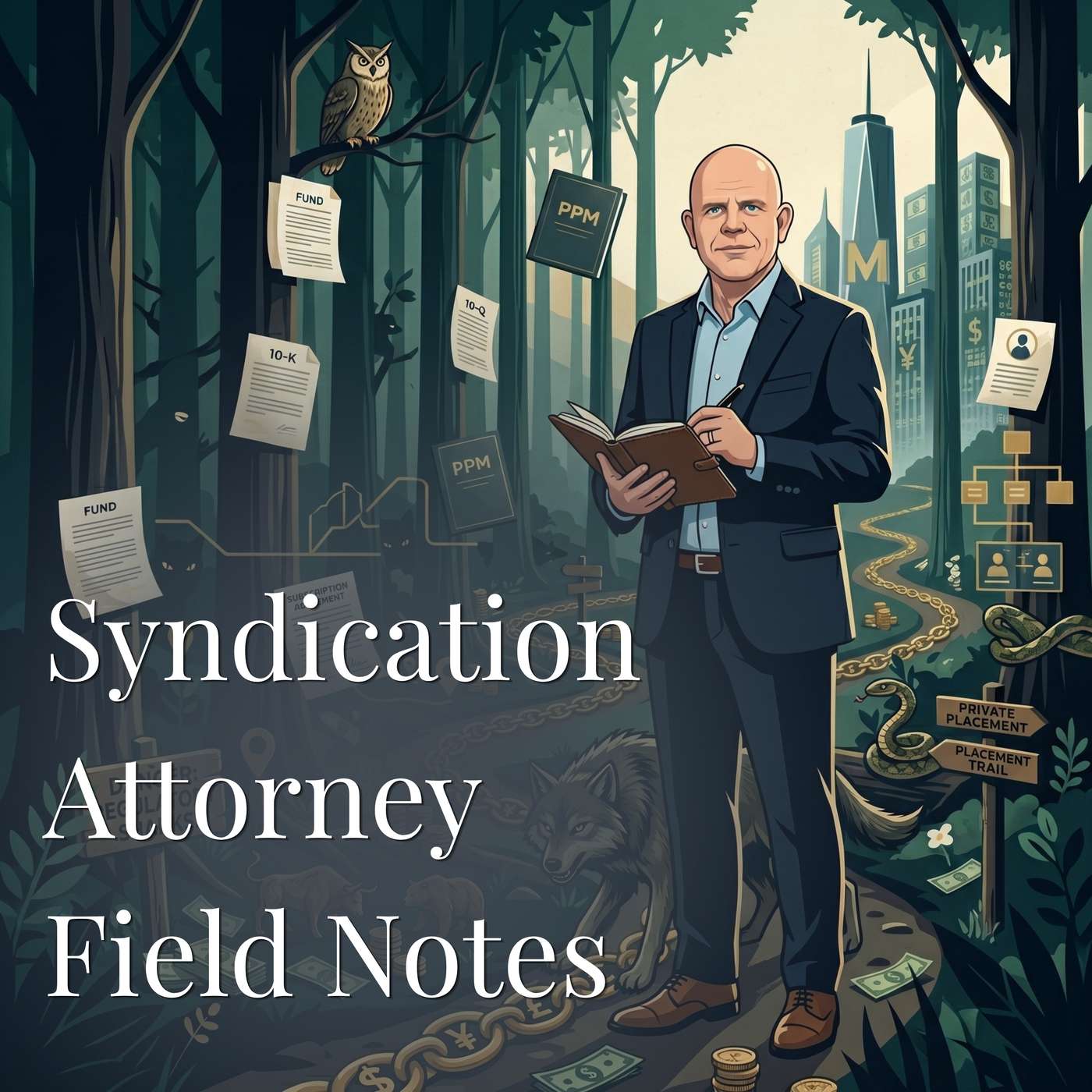
Syndication Attorney Field Notes with Tilden Moschetti
by Tilden Moschetti
Syndication Attorney Field Notes is a short-form educational podcast from Tilden Moschetti for sponsors, real estate syndicators, fund managers, and business owners raising capital through Regulation D offerings, private placements, syndications, and investment funds.Each episode breaks down one issue from the legal notebook: finder’s fees, broker-dealer registration, Rule 506(b), Rule 506(c), investor verification, private placement memorandums, subscription agreements, Form D, Blue Sky filings, fund structure, and the mistakes that show up before the documents are drafted.Plain-English field notes. One issue, one misconception, one practical takeaway. Public education only, not legal advice.
Episodes
-
Why You Don't Need a Prospectus for a Reg D Deal
In a Regulation D syndication, terms like prospectus, offering memorandum, and PPM are often thrown around as if they mean the exact same thing. In this episode, syndication attorney Tilden Moschetti unpacks the core confusion surrounding these disclosure documents. You will learn why a…
more -
How Redemption Rights Actually Work in Open-End Funds
Handling redemption rights in an open-end private fund can create operational challenges if sponsors equate 'open-end' with 'liquid.' In this episode, syndication attorney Tilden Moschetti walks through the realities of the redemption process when dealing with illiquid assets. From notice periods...
-
When a Junior Partner Blocks the GP Buyout: Drag-Along Rights
In this episode of Syndication Attorney Field Notes, Tilden Moschetti addresses a structural oversight that can derail a profitable exit for deal sponsors. While most syndicators focus entirely on investor-facing documents, their own Sponsor LLC operating agreements are often neglected. Tilden...
-
Rolling Funds, Subscription Cycles, and Equalization
Many sponsors view rolling funds as a convenient way to accept investor capital on a continuous basis, but unstructured admissions can inadvertently dilute your earliest investors. As a syndication attorney, Tilden Moschetti often sees the administrative and mechanical realities of rolling…
more -
The Reg D Fund-of-Funds Structure
Sponsors often view a Regulation D fund of funds as the lazy version of running a fund—no assets to operate, no midnight phone calls. But trading away operational friction means picking up structural and compliance friction instead. In this episode, syndication attorney Tilden Moschetti…
more -
Why Your Blind-Pool Mandate Isn't Just Marketing
When launching a blind-pool fund, the investment mandate is often written to sell a vision to potential investors. But once that language is in your Private Placement Memorandum and Operating Agreement, it becomes a strict legal boundary. In this episode of Field Notes, syndication attorney…
more -
The Shortfall Problem: Cumulative vs. Non-Cumulative Preferred Returns
What happens to an investor's preferred return when a fund has a lean year? In this episode, syndication attorney Tilden Moschetti clears up the pervasive confusion surrounding cumulative and non-cumulative preferred returns. Sponsors often assume cumulative structures act as dangerous…
more -
Calculating Preferred Returns: Contributed vs. Unreturned Capital
When syndicators return capital to investors after a refinance, many assume their ongoing preferred return payments will drop automatically. This episode explores why that assumption can create an unexpected cash flow mismatch, and how to prevent it. Key Takeaways: - The crucial difference…
more -
Preferred Equity vs. Mezzanine Debt: Reading the Remedies
When filling a multi-million dollar gap in a syndication capital stack, sponsors often assume that preferred equity is inherently safer than mezzanine debt because it acts as a partnership interest rather than a loan. However, relying on the label at the top of the term sheet can create…
more -
When a Hard Money Lender Becomes a Debt Fund
When a hard money lender starts taking outside capital to fund deals, they cross an invisible line from being just a lender to becoming a securities issuer. In this episode of Syndication Attorney Field Notes, Tilden Moschetti explains the core structural shift between lending your own money and...
-
What a PPM Sample Actually Tells You
First-time sponsors naturally want to review a sample Private Placement Memorandum (PPM) to understand what they are handing to investors under Regulation D. While reviewing samples is a great way to learn the structure of an offering document, assuming a downloaded sample is a fill-in-the-blank...
-
Why 'Managing Partner' Isn't a Real LLC Title
Using the title 'Managing Partner' on a pitch deck is a common habit for real estate sponsors, but dropping that title into an LLC structure can create unexpected friction at the closing table. In this episode of Syndication Attorney Field Notes, Tilden Moschetti unpacks the confusion between...
-
The Fund Launch Sequence: From Economics to First Close
The practical sequence for launching a private fund under Regulation D is frequently misunderstood. Sponsors often assume the process begins with forming an LLC and filing a Form D to secure SEC permission. In this field note, we unpack why that assumption can create unnecessary administrative...
-
Debt vs. Equity Securities: Priority, Control, and Cash Flow
Choosing between debt and equity in a private capital raise is often driven by what sounds easiest to pitch. Sponsors frequently issue promissory notes just because investors like the sound of guaranteed interest. In this field note, we break down the practical differences between offering debt…
more -
The Admin Trap of Setting Your Minimum Investment
Setting the minimum investment for a private fund or syndication is often treated as a marketing strategy. Many sponsors assume a lower barrier to entry means a faster capital raise. In reality, lowering your minimum can create a heavy, long-term back-office burden. In this episode of Syndication...
-
The Promissory Note Trap in Capital Raises
Sponsors often assume that structuring a capital raise as debt rather than equity bypasses securities laws. If it's a promissory note, it's just a loan, right? In this episode, syndication attorney Tilden Moschetti examines the core tension between what a document is called and its actual…
more -
The Sequence from Soft Commitment to Funded Capital
When gathering soft commitments for a Regulation D syndication, sponsors often look at an email or a verbal pledge and assume the capital is secure. But building rigid funds around soft numbers can create significant operational hurdles when some of those pledges inevitably fall away. In this...
-
Why a Blind Pool Fund Isn't Just a Syndication Without an Address
Sponsors often assume a blind pool fund is just a normal syndication with a 'to be determined' property address. This episode explores why you can't simply take an old Private Placement Memorandum and hit delete on the location. When there is no specific asset to underwrite, investors are...
-
Key Person Clauses: Suspension vs. Dissolution
In this field note, syndication attorney Tilden Moschetti examines the mechanics of the Key Person clause in a private fund. Sponsors often confuse this provision with manager removal or treat it as boilerplate death-and-disability language. This episode clarifies the core tension: a Key Person...
-
Cumulative vs. Compounding Preferred Returns
Sponsors often use the terms 'cumulative' and 'compounding' interchangeably when discussing missed distributions with investors. But in a syndication Operating Agreement, mixing up these words has real economic consequences. In this episode, syndication attorney Tilden Moschetti explains how…
more -
Dissecting the Fund Manager Compensation Stack
Structuring fund manager compensation in a Regulation D syndication goes beyond adopting a standard "2 and 20" template. In this field note, syndication attorney Tilden Moschetti breaks down the fund manager compensation stack into three distinct layers: management fees, carried interest, and...
-
Why 'Syndicator' Isn't a Legal Title: Roles, Entities, and Fees
Structuring a Regulation D syndication requires knowing the difference between business labels and legal entities. Sponsors often assume that the title 'syndicator' automatically grants them legal status, liability protection, or the right to collect fees. In this episode, we explore the core...
-
Asset vs. Property Management: The Fee Disclosure Trap
It is common for real estate syndicators to handle both asset management and property management in-house. Because the same team is often doing both jobs, a frequent assumption is that these roles can be bundled into one simple management fee to keep the paperwork clean. However, this approach…
more -
The Danger of Skipping the PPM in Accredited Deals
Sponsors often assume they can save time and money by skipping the Private Placement Memorandum (PPM) when raising a Regulation D offering where every investor is accredited. In this episode, syndication attorney Tilden Moschetti addresses this dangerous assumption. He explains why pitch decks…
more -
Structuring the Sponsor, Issuer, and SPV in Reg D Offerings
Setting up a three-entity structure in a Regulation D offering is standard practice, but it is not a magic shield against personal liability. In this episode, syndication attorney Tilden Moschetti breaks down the specific roles of the Sponsor, the Issuer, and the SPV in a syndication deal. He...
-
Single-Asset vs. Blind Pool: The Real Difference Between Syndications and Funds
The shift from raising capital deal-by-deal to launching a fund is a natural progression for successful sponsors. However, a common assumption is that a blind-pool fund is just a single-asset syndication with the property details deleted from the template. In this field note, we look at the legal...
-
The Investor Questionnaire as a Sponsor Defense
Sponsors often treat the investor questionnaire as an annoying speed bump between the handshake and the check. In this field note, syndication attorney Tilden Moschetti explains why that paperwork is actually your first line of defense. The episode explores the legal role of the questionnaire…
more -
The PPM Discloses, The Operating Agreement Governs
Sponsors often spend weeks perfecting their pitch deck and Private Placement Memorandum (PPM), only to treat the Operating Agreement as generic boilerplate. But in a Regulation D syndication, the PPM only explains the deal—the Operating Agreement is the actual contract that runs the company. In...
-
Document Hierarchy: PPM vs. Operating Agreement vs. Subscription Agreement
Sponsors often treat their offering documents as one big stack of legal paperwork—one giant PDF they just call 'the PPM.' But treating your Private Placement Memorandum, Operating Agreement, and Subscription Agreement as a single entity can create unexpected mismatches in execution. In this…
more -
The Rulebook of the Fund: What an LPA Actually Does
In a private fund, sponsors spend months perfecting their pitch decks and Private Placement Memorandums, often treating the Limited Partnership Agreement (LPA) as standard, boilerplate paperwork to simply sign and file away. But while the PPM describes your deal to investors, the LPA is the…
more -
Form D vs. the PPM: Notice vs. Disclosure
Filing a Form D for a Regulation D syndication does not mean the SEC has approved your deal or protected you from investor lawsuits. In this episode, we unpack the critical difference between keeping the government informed and keeping your capital raise secure. We cover: • Why an accepted EDGAR...
-
Form D vs. the PPM: Notice vs. Disclosure
In this field note, syndication attorney Tilden Moschetti addresses a common point of confusion for sponsors raising capital under Regulation D. After successfully filing a Form D on EDGAR, some sponsors assume they are registered and protected, leading them to skip drafting a Private Placement...
-
Form D Deadlines: When Does the 15-Day Clock Actually Start?
Are you waiting until your syndication round closes to file your Form D? You might be accidentally missing your federal deadline. Under Regulation D, sponsors have 15 calendar days from the "first sale" to file a Form D with the SEC. But what exactly qualifies as a first sale? In this episode, we...
-
The First Sale Trigger: Calculating Your Form D Deadline
Filing a Form D for a Regulation D syndication often trips up sponsors who assume the paperwork is due when the fund closes. In this field note, syndication attorney Tilden Moschetti explains why the SEC clock actually starts much earlier. You will learn how to identify the 'first sale' trigger,...
-
Blue Sky Notice Filings: The Rule 506 State Fee Trap
When running a Rule 506 offering, many sponsors assume that federal preemption means they don't have to worry about state-level compliance. In reality, preemption only prevents states from reviewing the merits of your deal. They can—and do—still require notice filings and fees. In this episode,...
-
The Subscription Agreement as a Purchase Contract
The Subscription Agreement in a Regulation D syndication is often treated as a generic form or a simple receipt for wired funds. But treating it as an afterthought is a mistake. In this field note, syndication attorney Tilden Moschetti explains the actual legal function of the Subscription...
-
LLC vs. LP for Reg D Syndications
The choice between a Limited Liability Company (LLC) and a Limited Partnership (LP) in a Regulation D syndication often creates unnecessary paralysis for sponsors. In this episode, syndication attorney Tilden Moschetti clears up the confusion surrounding entity selection, explaining why the...
-
The Reg D Legal Package: PPM vs. Operating Agreement vs. Subscription Agreement
Sponsors often look at their Regulation D legal package and assume it's just repetitive red tape. If the Private Placement Memorandum states that voting rights are restricted, and the Operating Agreement says the exact same thing, it's easy to assume the information is just redundant. The…
more -
Why a Questionnaire Doesn't Protect Your 506(c) Offering
In this episode of Syndication Attorney Field Notes, Tilden Moschetti breaks down the critical difference between self-certification under Rule 506(b) and reasonable verification under Rule 506(c). Many sponsors mistakenly believe that a detailed accredited investor questionnaire, signed under...
-
Why Rule 144A is Usually the Wrong Tool for Mid-Market Syndicators
Sponsors frequently ask if they should structure their deals under Rule 144A to give investors a secondary trading market. The assumption is that 144A is just a more liquid version of Regulation D. In this episode, syndication attorney Tilden Moschetti explains the practical reality of Rule 144A...
-
The Joint Venture Unregistered Security Trap
Can you avoid syndication paperwork by calling your capital raise a joint venture? Many sponsors assume that if they only have a few investors, a simple JV agreement will suffice. In this episode, syndication attorney Tilden Moschetti explains why the legal reality is determined by the facts, not...
-
Structuring Convertible Promissory Notes for Early Capital
Convertible promissory notes for bridging early capital in a Regulation D syndication can solve a specific sequencing problem, but they aren't a marketing gimmick. Syndication attorney Tilden Moschetti breaks down how these notes work, the earnest money gap they fill, and the crucial drafting...
-
Why We Isolate Syndication Deals in Single Purpose Entities
Isolating real estate assets in a Regulation D syndication is a core structural requirement, yet sponsors frequently ask if they can reuse an existing LLC to save on formation costs. In this episode, syndication attorney Tilden Moschetti explains why commingling multiple properties in one entity...
-
Transitioning a Hedge Fund Incubator to a Regulation D Offering
Moving from trading your own money in an incubator to taking outside capital under Regulation D is a major shift. In this field note, syndication attorney Tilden Moschetti explains why accepting an outside check into your existing trading account can create an unregistered securities offering. We...
-
The Order-Taker Trap: Evaluating Counsel for Your Regulation D Offering
Sponsors often assume that hiring legal counsel for a syndication simply involves handing over a term sheet and waiting for the compliant documents to return. In this field note, we explore the hidden danger of hiring an 'order-taker' attorney—someone who ensures SEC compliance but fails to…
more -
Raising Foreign Capital: Coordinating Reg S and Reg D
Raising capital from foreign investors comes with a common misconception: because the money is offshore, U.S. securities rules don't apply. In this episode of Syndication Attorney Field Notes, Tilden Moschetti explains why the SEC pays close attention to a U.S. issuer's domestic marketing. Learn...
-
The 'Exempt' Trap for Reg D Fund Sponsors
Do you qualify for a private fund adviser exemption? For many Reg D fund sponsors, the word 'exempt' creates a false sense of security, leading to the assumption that no paperwork or filings are required. In this episode, syndication attorney Tilden Moschetti explains why 'exempt' rarely means...
-
The Disclosure Trap in Ground-Up Development Raises
Structuring a Regulation D equity raise for ground-up development requires a different mindset than buying a cash-flowing apartment building. In this episode, syndication attorney Tilden Moschetti examines the trap of using interest reserves to fund immediate preferred returns on dirt projects....
-
506(b) vs. 506(c): The Marketing and Verification Tradeoff
Structuring a Regulation D capital raise under Rule 506(b) or Rule 506(c) forces sponsors to make a fundamental choice between public marketing and private relationships. Can you run digital ads for your fund and still include your sophisticated, non-accredited investors? In this episode, we…
more -
The Evergreen Fund Trap: Closed-End vs. Open-End Reality Check
Structuring a private equity fund and matching it to the liquidity of your assets requires a clear understanding of capital flow. In this episode of Syndication Attorney Field Notes, we examine the common assumption that an open-end "evergreen" fund simply means an infinite runway for capital...
About this show
Syndication Attorney Field Notes is a short-form educational podcast from Tilden Moschetti for sponsors, real estate syndicators, fund managers, and business owners raising capital through Regulation D offerings, private placements, syndications, and investment funds.Each episode breaks down one issue from the legal notebook: finder’s fees, broker-dealer registration, Rule 506(b), Rule 506(c), investor verification, private placement memorandums, subscription agreements, Form D, Blue Sky filings, fund structure, and the mistakes that show up before the documents are drafted.Plain-English field notes. One issue, one misconception, one practical takeaway. Public education only, not legal advice.
Hosted by
Tilden Moschetti