
PODCAST · sports
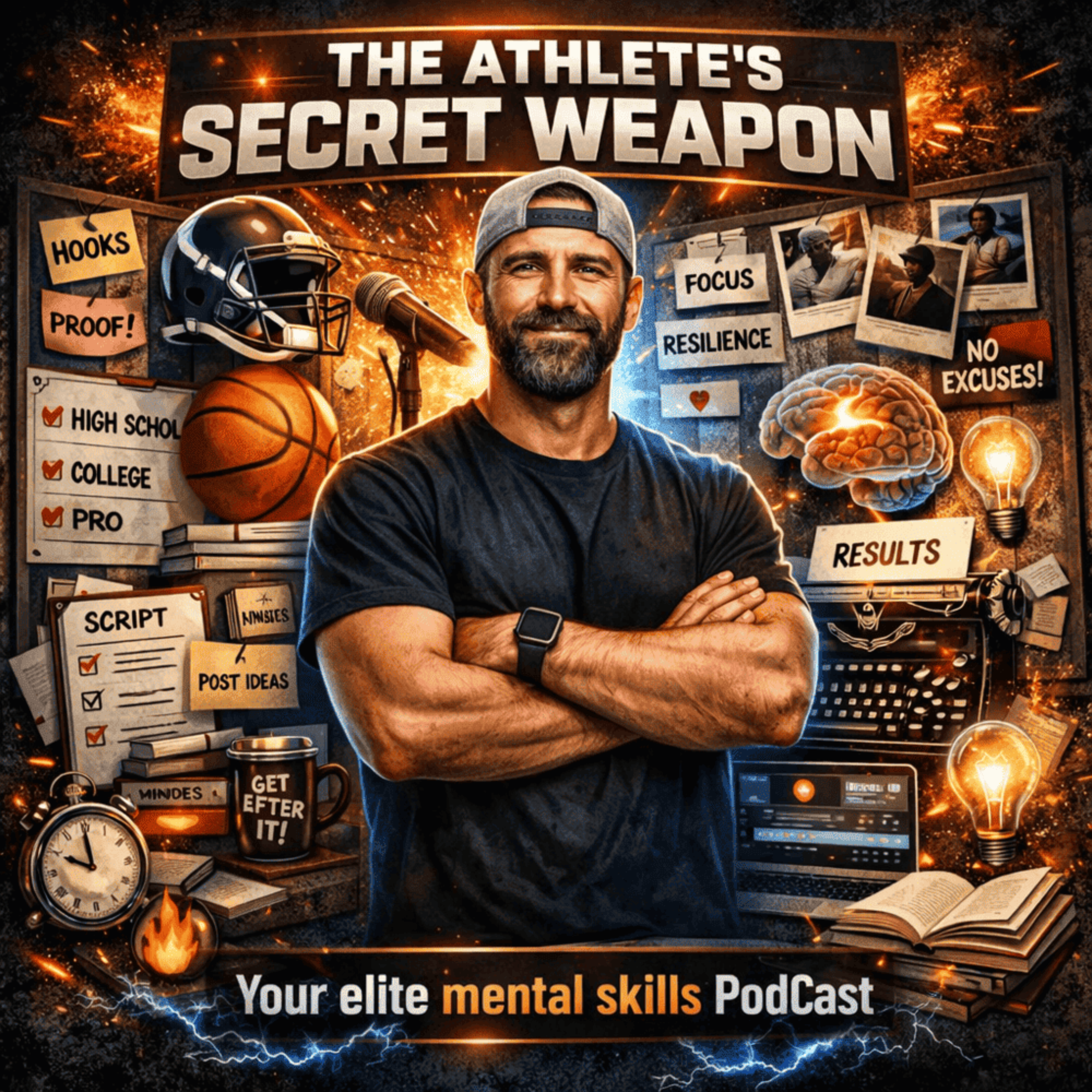
The Athlete's Secret Weapon
by Ryan Hadlock
You don’t even realize it… but the athletes beating you already have this, and it’s not talent. **The Athlete’s Secret Weapon** is for competitors who are done choking under pressure, overthinking, and letting one moment define them. This show breaks down the exact mental skills elite athletes use to stay locked in, bounce back fast, and perform when it matters most, so you stop leaving your performance up to chance and become the one everyone trusts when the game is on the line.
-
38
I tighten up when I get tired
You know the feeling: legs feel heavy, movements get robotic, and everything you normally do easily suddenly looks awkward. This episode gives you one simple, science-friendly micro-routine designed for the late-game energy drain. In under 90 seconds you'll use breathing cadence, a grounded weight-shift, and a tactile anchor to release protective tension, reset your nervous system, and cue the motor patterns you trained in practice. No long meditations, no psychology jargon—just a portable somatic sequence you can use on the sideline, during a timeout, or at the break to restore looseness, sharpen focus, and keep your instincts trusted when it matters most. I’ll walk you step-by-step through the routine, show how to pair it with a single cue word, and give one quick drill to train it into automatic so fatigue stops stealing your game.
-
37
I freeze when everyone's watching — 60‑Second Crowd‑Cage to Reclaim Your Play
You know the feeling: the stands are loud, the coach leans in, and suddenly your body snaps shut. This episode breaks down why social evaluation turns your nervous system into a cage—and gives you one portable 60‑second routine to unlock it immediately. I'll show you the Crowd‑Cage sequence: a 3-step somatic release, a tactile anchor you can carry into any moment, and a short identity phrase that reorients your attention from ‘judged’ to ‘doing.’ No long visualizations, no empty pep talk—just one usable tool you can practice in warmups and call up during timeouts, substitutions, or at the line. By the end you’ll be able to notice the freeze faster, dissolve the social pressure in under a minute, and step back into play with the same looseness you have in practice. Practical, field-tested, and built for athletes who are done letting an audience steal their best moments.
-
36
I get too emotional during games — 60-Second Surge Control to Turn Anger into Focus
You know that feeling: a bad call, a mistake, or a shift in momentum and suddenly your chest tightens, your jaw clenches, and every decision becomes louder — and worse. This episode gives you one precise, 60‑second somatic protocol (Surge Control) that athletes can use immediately to stop emotional surges from hijacking performance. I'll show you why emotion escalates performance errors, how a short body-first sequence resets your nervous system, and exactly how to practice the cue so it becomes automatic in competition. No fluff, no long meditations — a single, repeatable chain of breath, grounding movement, and a tactile anchor that turns reactive energy into narrow aggression and focus. By the end you'll have a portable tool to keep your composure, shorten the emotional arc after a trigger, and get back to playing like you practiced.
-
35
Generated Episode Idea
{"title":"I go blank halfway through the game — 60‑Second Refocus Relay to Reset and Finish Strong","one_liner":"A field-ready, 60-second somatic sequence that pulls you out of mid-game fog, reconnects your senses to your body, and gives you a single-cue reset so you can finish the next play like practice.","description":"You know that moment: the second half starts, the pace picks up, and suddenly your head goes fuzzy — decisions slow, timing slips, and you feel miles away from the player who dominated practice. This episode gives you a simple, research-backed short routine you can do in 60 seconds — anywhere on the sideline, during a timeout, or between whistles — that re-syncs attention, calms overload, and primes explosive, instinctive action. I walk you through the Refocus Relay: Orient (sensory scan), Ground (tactile anchor + breath), and Prime (triggered movement rehearsal). No long meditations, no mental pep talk — just one portable somatic sequence and a single cue word to make focus automatic under fatigue and pressure. Finish this episode with a micro-drill to lock it in, plus how to practice it so it becomes your immediate fallback when the game gets foggy.","why_now":"Athletes will always hit mid-game fatigue and cognitive overload; having a portable, body-first reset is timeless because attention breaks under pressure regardless of trends.","target_audience":"Competitive athletes who lose mental clarity mid-game and need a fast, portable somatic reset to regain focus and perform like they do in practice.","episode_type":"monologue","estimated_runtime_s":540,"outline":["00:00-01:00 — Hook: Quick gut-level grab — describe the mid-game blank moment so listeners feel seen and hooked.","01:00-02:30 — Call Out the Problem: Paint the experience (slow decisions, foggy timing, frustration) and why standard advice ('focus harder') fails.","02:30-04:00 — Break the Lie: Reframe the issue as a nervous-system and sensory-disconnection problem, not a willpower failure.","04:00-07:00 — Teach the Tool: The 60‑Second Refocus Relay — Step 1 Orient (10s sensory scan), Step 2 Ground (30s tactile squeeze + paced exhale), Step 3 Prime (20s micro-movement rehearsal) with exact cues and demo language athletes can use.","07:00-08:30 — Practice Prescription: How to rehearse the 60s Relay in training so it becomes automatic under fatigue; progressive reps and micro-challenges to accelerate learning.","08:30-09:00 — Paint the Future + CTA: Picture playing the final quarter clearheaded; challenge listeners to try the Relay in their next practice and post a 15s clip/tag on social @YourHandle to share wins.","tags":["somatics","focus","nervous-system","flow","reset"],"duplication_check":{"nearest_match_title":"I lose my rhythm when the game's sped up","similarity_score":0.42,"decision":"distinct"},"risks":["Athletes forget steps under pressure and fail to execute the full 60s routine.","Players dismiss it as a gimmick and never practice it so it won't stick.","Certain movements or tactile anchors could be uncomfortable after recent injuries."],"mitigations":["Simplify to a 20-second micro-version (orient + single breath + one-word cue) until the full Relay becomes automatic.","Include a 3-rep practice prescription in training and encourage teammates/coaches to run it so it becomes normalized.","Offer alternative, non-loading anchors (hand on thigh, breath count) and advise consulting medical staff before using any movement after injury."]}
-
34
I lose my rhythm when the game's sped up
You know the feeling: the clock shrinks, the crowd gets loud, and suddenly your timing's gone — feet heavy, decisions late, movement robotic. This episode teaches a single, portable tool you can use in the tunnel, on the bench, or between plays to re-sync your body to the game's tempo in 60 seconds. The 'Tempo Tap' combines paced diaphragmatic breaths, a subtle two-count foot tap, and a tightening-release cue to downshift anxiety while preserving readiness. I'll explain the nervous-system science in plain language, walk you through exactly how to practice it in drills and in-game pockets, and give two quick progressions so the tool grows with you. Walk away with a one-minute ritual that prevents rushing, restores rhythm, and anchors you to action instead of reaction — so you start moving like practice when the whistle blows.
-
33
My head won’t shut up — 45-Second Flip-Script to Trust Your Body
You know that panicked, running commentary in your head the moment the pressure hits? It turns you from an athlete into a critic—and the longer it talks, the slower you move. In this episode the Coach (host) names that inner voice, reframes why it shows up, and teaches a single 45-second Flip-Script: a tactile anchor + micro-breath + phrase + shoulder release that interrupts the critic, moves attention from story to sensation, and hands control back to your body. I’ll walk you through one clear practice to rehearse in warm-ups, one in-game cue to trigger it, and how to scale it from training to the heat of competition. You’ll finish with a realistic rehearsal plan so this stopgap becomes instinct—so when the whistle blows your body moves first and your mind follows.
-
32
I don't trust my body after injury — 60-Second Tap-Trace-Trust to Play Bold Again
You come back from injury ready to prove yourself — but your brain and body are still protecting the weak link. This episode gives one clear, field-tested routine athletes can use in the locker room, on the sideline, or before a drill to rebuild visceral trust in a repaired limb. Coach breaks down the Tap-Trace-Trust sequence: a 60-second somatic flow that uses gentle percussion, slow movement mapping, and a tactile anchor to re-map sensation, de-threaten the injured area, and create a reliable cue you can call under pressure. You’ll get the simple script to run it, when to use it across a practice-to-game timeline, and a single identity phrase to stitch the new feeling to who you are as an athlete. No long meditations — just a portable practice that re-teaches your nervous system to expect safe, powerful action.
-
31
I’m confident in practice… not in games — 30-Second Practice Replay to Bring Practice Confidence into Play
You know the feeling: flawless reps in practice, then the whistle blows and that confidence disappears. This episode teaches a single, repeatable 30-second process—the Practice Replay—that pairs a vivid sensory memory from practice with a discreet physical anchor and a rhythm breath so you can summon practice-level confidence under pressure. I break down the neuroscience behind memory retrieval and embodied states, walk you through the exact steps (pick the rep, amplify sensory detail, choose a subtle touch anchor, pair with a micro-movement and exhale), and give precise instructions for when and how to use it on the sideline, bench, or in-between plays. This is designed for athletes who want one simple tool they can train in practice and rely on instantly in games to close the gap between how they perform in training and how they show up when it matters.
-
30
One mistake ruins everything — 40-Second Drop & Drive to Bounce Back Instantly
This episode gives you a field-ready, 40-second micro-routine that turns "one mistake" into just one play—not a whole game. I walk you step-by-step through the 'Drop & Drive': a quick somatic drop (jaw and shoulders), a two-count exhale to downshift adrenaline, a one-word naming to contain the thought, a tiny physical anchor, and an immediate micro-commit movement to re-engage your body. You’ll hear why each move works—how it interrupts rumination, resets your nervous system, and restores motor confidence—plus when to use it, how to personalize the anchor, and a simple drill to make it automatic between reps or on the sideline. No long breathing or visualization required—this is a practical, coachable tool you can do in the locker room, at the bench, or in the split second after a turnover. Use it so one mistake stops being a storyline and becomes the launch point for the next play.
-
29
My heart races before every game — 45-Second Ground & Reset to Calm Your Nervous System
You know the feeling: heart pounding, hands sweaty, and every instinct replaced by doubt before the first whistle. This episode gives you one simple, science-informed tool—a 45‑second Ground & Reset—to physically downshift an overloaded nervous system so your skills show up when it matters. I break down why pre-game panic isn’t failure of character but a body-state you can train, then guide you through an exact script: a paced belly-to-rib breath, anchored exhale with a fingertip press, slow shoulder rolls to release upper-body tension, and a feet-to-ground sensory check that reconnects you to movement. No jargon, no visualization marathon—just one practical sequence you can rehearse now and use before every game, timeout, or set. By the end you’ll have a repeatable micro-routine that builds trust in your body, reduces wasted adrenaline, and brings practice-level calm to competition.
-
28
My hands freeze when the game's on — 30-Second Name‑Feel‑Move to Reconnect and Act
You know the moment: the ball's coming, the crowd tightens, and your hands or limbs go slow—your body stops trusting itself. This 60-second monologue teaches a single, portable tool: the 30-Second "Name‑Feel‑Move" reset. I open by naming the pain athletes feel, then reframe the freeze as a loss of sensory connection (not lack of skill). You get a step-by-step micro-routine: 1) Name the dominant sensation quietly (pressure, tightness, numb), 2) Feel contact/weight/breath for three counts to re-anchor the nervous system, 3) Make one tiny intentional movement with a physical anchor (tap wrist, squeeze palm) and an action cue word to restart automatic motor patterns. I explain exactly when to use it—between plays, before a free throw, or at the break—and how to train it so it becomes reflexive. No equipment, sport-agnostic, and built to restore confidence and speed in seconds.
-
27
I play tight in games — 40-Second Soft‑Eyes & Loose‑Hips Reset to Move Like Practice
You know the feeling: perfect in practice, locked up in the game. This episode gives you one simple, repeatable 40‑second routine—no breathing apps, no long meditations—that directly targets the body tension that steals your speed, rhythm, and confidence. I’ll show you how to use a ‘soft eyes’ attention shift to quiet overthinking, then pair a tiny hip‑release movement with a long exhale and a discreet physical anchor so your body remembers loose movement under pressure. Practice it once in warm‑ups, then deploy it between plays or on the sideline. It’s somatic, fast, and designed to be invisible to opponents and coaches. By the end you’ll have a field-ready tool that helps your nervous system loosen, your movement return to practice speed, and your instincts reappear—so you stop letting tightness decide the game.
-
26
I’m burned out and don’t enjoy the game anymore: 60-Second Micro-Joy Reset
You don’t need another pep talk, you need a portable reset that restores curiosity and quiets the grind. In this 60-second episode the Coach walks you through the Micro-Joy Reset: a tight, repeatable somatic sequence that pairs a short movement (grounding foot taps + shoulder loosen), a vivid 3‑word memory recall of a joyful moment in sport, and a tiny physical anchor you can use between plays. This is built for athletes who feel numb, exhausted, or ‘over it’ but still want to perform. You’ll get one concrete script to use now, why it works (nervous-system downshift + positive memory priming), and how to fold it into warm-ups, timeouts, or bus rides so the love of the game becomes a habit again — not a surprise. No long therapy, no jargon, just one short practice that shifts how you show up immediately.
-
25
I'm thinking too much during games — 18‑Second Binary Trigger to Stop Hesitating
You feel it: the ball's coming, your head gets loud, and suddenly you hesitate. That hesitation isn't about skill — it's decision overload. This episode gives you one compact, somatic-backed tool you can use between plays to convert thinking into instant doing. In 18 seconds you'll learn to: (1) reduce options to two clear choices, (2) anchor the choice with a discreet tactile tap, (3) sync a paced exhale with a one-word action cue and a micro-movement commit. The Binary Trigger blends simple decision rules with body-based commitment so your motor system leads and your mind stops second-guessing. Use it in attack or defense, before a free throw, or when a mistake hangs in your head. Repeat it and the nervous system learns to prefer action over analysis — practice-level instincts show up when the moment gets big.
-
24
I get too emotional during games — 30-Second Humming Anchor to Turn Anger Into Focus
You know the feeling: a bad call, a turnover, and suddenly you’re louder, tighter, and playing for revenge instead of the next play. This episode gives you one concrete 30-second tool—called the Humming Anchor—that uses simple somatics to convert emotional energy into calm, focused action. I walk you through why a low hum engages your vagal system, how a tiny hand anchor creates a physical cue to own the reset, and the exact breath timing to pair it with so your body calms fast. This isn’t visualization or pep talk—this is nervous-system work you can do in the corner of the field, at the line, or between innings. Practice it in warm-ups, then use it the moment heat rises so you stop reacting and start responding. By the end you’ll have one portable micro-routine that keeps you composed, explosive, and in control when emotions threaten to steal your game.
-
23
I lose focus during games — 22-Second Heart‑Lead Reset to Anchor Attention
You feel your head drifting mid-game: thinking about the last play, worrying about the next call, or replaying a mistake. The Heart‑Lead Reset is a quick, field-ready somatic routine that uses three simple signals—touch, breath, and a tactile trigger—to move attention from the noisy mind back into the body so you can act from training, not reaction. In 22 seconds you place a hand on your chest, take a controlled inhale and a longer exhale while counting, tune into the heartbeat for two beats to downshift arousal, and finish with a firm fingertip press (your anchor) plus a one-word cue like “Now.” It’s discreet, doable on the sideline, and designed to be repeated between plays or right after a mistake. Use it to stop mind‑wandering, collapse negative loops, and return instantly to the athlete who practices, not the player stuck in their head.
-
22
I can't get into the zone — 25-Second Sensory Funnel to Drop Into Flow
You know the feeling: your head is loud, your body locks, and the rhythm you have in practice disappears. This episode teaches a single, 25-second sensory funnel athletes can use between plays, at the break, or before a rep to shift from scattered thinking into embodied, automatic performance. The routine moves from wide sensory input to focused internal cues—quick external sound counts, a two-point body check, a targeted breath, and one-word action anchor—to reduce cognitive load, downshift tension, and prime the nervous system for instinctive movement. No visualization, no long breathing exercises, just a repeatable sequence that trains your brain to stop chewing on the past and instead land in the next moment. Built for team sports and individual athletes, this micro-tool is covert, repeatable, and designed to be practiced until it becomes the reflex you need when the whistle blows.
-
21
Jaw-Down, Eyes-Soft: The 7-Second Somatic Reset That Stops Choking
Elite athletes use tiny body signals to anchor performance; most players never notice them until it’s too late. In this interview episode Coach sits with a somatic performance coach and a pro athlete to unpack a single, repeatable 7-second routine—jaw down, eyes soft, one paced exhale—that interrupts the brain’s panic loop and restores the body’s practiced motor program. We translate neuroscience and pressure-state mechanics into a tool you can use between plays, at halftime, or before a clutch moment. You’ll hear why jaw tension and narrowed focus escalate mistakes, a live demo with guided practice you can use today, and the practical cues to train this into habit so it’s automatic when it matters. This episode gives one actionable micro-routine that turns your next stress spike into trust in your training—no long meditations, no pep talks, just a portable, reliable reset.
-
20
Heartbeat Anchor: Use Your Pulse to Own the Moment
What if the thing that always spikes under pressure is also the easiest thing to use? In this episode Coach interviews a somatic performance coach and a pro athlete who both use the same simple tool: the heartbeat anchor. We break down why your pulse is the most honest signal you have, how a 5–8 second pulse-sync routine re-centers the nervous system, and how to practice it so it becomes automatic between plays. This episode focuses on one repeatable skill—pulse touch + paced exhale + micro-movement—that athletes can use today to stop spirals, shorten recovery after mistakes, and get back to playing like practice. Expect a short live demo, real-game examples, and a clear practice progression you can train in warm-ups, timeouts, and post-mistake moments. By the end you’ll have a single on-the-field habit that converts a spiking heart into a steady engine for elite performance.
-
19
The Teammate Tap: Using Shared Anchors to Stop Spirals and Rebuild Trust
Imagine a moment when one mistake snowballs into a collapse: your chest tightens, your head floods with what-if’s, and every play after that feels heavier. In this episode Coach interviews a team captain and a sports psychologist who built a simple, repeatable "shared anchor"—a one-second touch, synchronized breath, and two-word cue—that teammates use mid-game to interrupt the spiral, restore the practiced motor pattern, and rebuild interpersonal trust instantly. You’ll hear the science behind why social-tied anchors disarm the threat response faster than self-talk alone, a step-by-step script for teaching the cue in practice, and real-game stories of teams that flipped momentum with one tap. This episode gives one clear tool you can rehearse today with teammates, plus a short practice progression to make it automatic under pressure. By the final minute you’ll see how a micro-social ritual becomes your secret team weapon.
-
18
Generated Episode Idea
{"title":"Scent Anchor: The Olfactory Reset That Stops Choking","one_liner":"Teach athletes a one-step olfactory reset—a tiny scent anchor plus posture and breath—that interrupts overthinking, reclaims automatic movement, and returns you to practice-level performance between plays.","description":"Most athletes obsess over technique, strategy, and breathing—but they miss one powerful, portable nervous-system lever: smell. In this interview Coach sits down with a sports neuroscientist and an elite athlete to reveal the Scent Anchor: a simple, nonverbal reset that uses an intentional, neutral scent paired with a micro-posture and breath to flip your nervous system from reactive to ready. You’ll hear the science behind why olfactory cues access emotion and memory faster than words, watch a step-by-step demonstration you can use in practice and competition, and get a realistic 60-second drill to train the anchor until it becomes automatic. This episode gives one tool—clear, safe, and immediately usable—that turns mistakes into momentum, shrinks the gap between practice and pressure, and makes you the teammate coaches trust when the moment gets real.","why_now":"Athletes still undertrain the senses that automatically access emotion and memory; scent anchoring is timeless, low-resource, and effective whenever you need a rapid nervous-system reset.","target_audience":"Competitive athletes who perform well in practice but tighten under pressure, want one simple mental tool to stop spirals and regain control, and prefer somatic, actionable techniques they can apply today.","episode_type":"interview","estimated_runtime_s":900,"outline":["00:00-01:00 — Hook: Ryan opens with a visceral scene—missed free throw, replay in your head—and asks: what if a smell could stop that loop?","01:00-03:00 — Call Out the Problem: Guest and Ryan describe the familiar spiral—tight body, loud mind, one mistake that multiplies—and why standard advice (“stay positive,” “next play”) fails.","03:00-06:00 — Break the Lie: Authority moment—this isn’t about confidence or effort; it’s about how sensory access (olfaction) drives emotional state and motor retrieval under pressure.","06:00-10:00 — Teach the Scent Anchor: Step-by-step demo of the tool—selecting a neutral scent, micro-application, anchor posture, inhale-exhale timing, and a single-word mental tag; how to use between plays.","10:00-12:30 — Practice Drill: A 60-second, repeatable training protocol to condition the scent with calm performance and a 2-minute in-practice progression to fold it into game routines.","12:30-14:00 — Paint the Future: Describe the identity shift—calm in chaos, trusted by coaches, mistakes that defuse instantly—and contrast with staying stuck.","14:00-15:00 — Ownership + Close + CTA: Ryan charges the listener to train the anchor daily, explains social CTA (share your Scent Anchor practice and tag the show), and ends with the identity frame: be the athlete who shows up.","tags":["somatics","pressure","reset","olfactory","performance"],"duplication_check":{"nearest_match_title":"The Gear-Triggered Edge: Kinesthetic Memory Markers to Perform Under Pressure","similarity_score":0.42,"decision":"distinct"},"risks":["Allergic or sensory sensitivity to scents; some venues may restrict fragrances; athletes may rely solely on the scent and neglect broader skill integration."],"mitigations":["Recommend hypoallergenic, neutral essential oils at minimal doses; test anchors in practice and with medical clearance if needed; pair scent anchor with a non-olfactory backup cue (wrist touch or breath) and embed into regular training so it complements, not replaces, skills."]}
-
17
The Prosodic Anchor: Use Your Voice to Reset Under Pressure
Most athletes think words are just thoughts. They forget voice is a tool that changes the body. In this episode Coach interviews a sports speech therapist and a performance psychologist to reveal the Prosodic Anchor: a repeatable 6–10 second vocal-somatic cue (tone + rhythm + breath) athletes can use between plays to drop anxiety, reclaim motor control, and move from rumination to execution. You’ll hear the science behind why pitch and timing affect the vagus nerve, exactly how to craft your personal two-part phrase (tone + snap), and a three-step training drill you can use today. The episode focuses on one tool, with case stories from athletes who turned late-game tightness into consistent performance. Walk away with a practice plan, on-field examples, and a simple way to test the anchor in your next practice so the next time the moment gets big, your voice—and your body—lead the play.
-
16
The Gear-Triggered Edge: Kinesthetic Memory Markers to Perform Under Pressure
Elite athletes don’t just train skills—they build touch-points that call those skills back under pressure. In this episode Coach interviews a sports physical therapist and former pro athlete about 'kinesthetic memory markers'—simple tactile cues embedded in equipment (a seam, wristband, glove, helmet strap) that reconnect your nervous system to practiced movement and calm the mind in a heartbeat. You’ll hear the science behind tactile recall, concrete examples for field, court, and combat sports, and a step-by-step practice prescription: how to design a marker, train it in practice, test it in low-stake games, and scale it to high pressure. This isn’t superstition—it’s about building embodied triggers that shift attention from anxious thinking to automatic, trusted action. Walk away with one in-game marker you can use today, and a 4-week drill plan to make it reliable when it matters most.
-
15
The 3-Second Motor Prime: Use Movement to Stop Choking
You know the moment: a mistake happens, your head gets loud, and your body forgets what it knows. In this episode Coach interviews a sports neuroscientist and an elite athlete to teach one simple, trainable tool—the 3-Second Motor Prime. This isn’t breathing or pep talk; it’s a targeted, sub-threshold movement that briefly engages the exact motor pattern you need so your body takes over and your mind quiets. We break down the nervous-system science, show sport-specific demo variants (throwing, shooting, swing), and give a progressive practice plan so you can use it between plays or after a mistake. By the end you’ll have a concrete warm-up you can use today to convert shame into momentum, stop spirals, and trust your body when it matters.
-
14
Peripheral Frame Reset: Expand Your Field to Shrink the Pressure
This episode teaches a single, accessible mental skill—the Peripheral Frame Reset—a short visual and somatic routine elite competitors use to quiet the inner critic, stop motor tightening, and return to trained instincts. Coach interviews a sports vision coach and a performance neuro-somatic practitioner to show why narrowing attention under pressure is the silent thief of performance, and how a simple 20–30 second routine (soften gaze, widen peripheral awareness, anchor with a thumb press and outgoing breath) flips your nervous system from reactive to ready. Listeners get: a step-by-step demo they can use between plays, sport-specific adaptations (contact sports, precision sports, team settings), and a 7-day drill plan to train this skill into automaticity. By the end athletes leave with one concrete, repeatable reset they can use TODAY to stop overthinking, move from freeze to flow, and play like practice when it matters most.
-
13
Slow the Clock: The Micro-Tempo Anchor That Gives You More Time Under Pressure
In this interview Coach sits down with a sports neuroscientist and a former pro athlete to unpack a single, trainable secret: the Micro-Tempo Anchor. Instead of chasing confidence or positive talk, this episode shows why rhythm and timing directly reset your nervous system and expand subjective time—so your body can execute instead of panic. We cover the simple neuroscience (timing networks and motor planning), a step-by-step 60-second tempo routine athletes can use between plays, and two practice drills to make the effect stick under real stakes. You’ll hear a candid story from an athlete who used tempo to stop spirals mid-game, and leave with a precise, sport-specific routine you can try today. No fluff, no 10-step programs—one tool, immediate impact, and the coaching cues to train it into your muscle memory.
-
12
The Contract Cue: A 3-Word Self-Agreement That Stops Choking
You know the moment: one mistake, and your head runs the rest of the game. In this episode Coach interviews a sport psychologist and an elite pro athlete who both use a tiny, ritualized self-agreement—what we call the 'Contract Cue'—to stop spirals and reconnect to their practiced skills. This is not positive talk or pep-talk fluff. It’s a quick, embodied promise you make to yourself that shifts ownership, reduces self-judgment, and frees your body to do what you’ve trained. We break down why a micro-contract works (neuroscience + somatics), how to craft one that fits your identity, and exactly when to use it in competition. You’ll leave with a clear step-by-step drill to create, rehearse, and test your Contract Cue so you can convert mistakes into momentum and become the athlete coaches trust in tight moments.
-
11
Micro-Story Reset: The 10-Word Narrative That Stops Spirals
You’re better than your worst moment—but the moment keeps winning. In this episode Coach interviews a performance psychologist and a pro athlete to teach a precise, trainable tool: the Micro-Story Reset. It’s a 10-word, first-person, present-tense micro-story paired with a 3-second breath and a one-touch anchor that rewires how your nervous system interprets pressure. You’ll hear the science behind why short narratives change threat perception, a live walkthrough creating sport-specific micro-stories, and a quick in-practice protocol you can use today between plays. This episode gives one clear, repeatable routine that replaces overthinking with an identity-forward cue, stops spirals cold, and trains your body to expect performance instead of panic. Walk away with templates for offense, defense, and individual sports, a short practice progression, and the exact words to start using this week—so one mistake never becomes a bad game again.
-
10
Hum to Win: The 30-Second Vagal Hum That Resets Pressure
You feel the moment tighten: jaw clenches, vision narrows, thoughts speed up—and everything you know about your game slips away. In this episode Coach interviews a neuroscientist and ex-pro athlete about a counterintuitive, evidence-informed tool that uses your voice to down-shift the nervous system instantly. The guest explains why low-frequency humming stimulates the vagus nerve, reduces heart rate, and reconnects breath, body, and motor control—without needing long breathing exercises or visible rituals. Ryan breaks the technique into a single 30-second routine (how to hum, posture, jaw and tongue cues, where to place intention) you can train today, plus practice progressions for game situations and teammates. By the end you'll have a discreet, replicable reset that dissolves spirals, restores fluid movement, and makes pressure feel manageable—not paralyzing. This is practical, somatic, and designed so athletes can use it between plays, at the line, or at halftime.
-
9
Pressure-Proof Practice: Why Changing the Rules Builds Composure
Most athletes try to fight pressure by forcing more focus or positive self-talk—but the secret elite athletes use is simpler and more durable: they practice being uncomfortable. In this episode Coach interviews a coach-scientist who has turned constraint-led practice into a mental-edge tool. You’ll hear why predictable practice creates brittle performance, how small, controlled changes in rules, equipment, or timing teach your brain to adapt instead of panic, and one immediately trainable drill—The 60-Second Constraint Flip—you can use today to make your body the boss under pressure. This episode gives one clear tool, evidence-backed rationale, and a training progression so you can move from shaky in games to steady in the clutch. Walk away with a practice tweak that makes composure automatic, not optional.
-
8
Team Sync: The Two-Beat Micro-Ritual That Converts Team Tension Into Trust
Most mental tools in sports are framed as solo hacks. This episode flips that: we teach a single, trainable team-based micro-ritual that uses social synchrony to dissolve pressure in three seconds. Coach interviews a sports psychologist and a pro team captain to show exactly how a short shared pattern (two beats, a breath, and a word) aligns arousal, collapses the inner critic, and hands performance back to training. You’ll get the science-lite explanation, the step-by-step rehearsal drill you can run at practice, and a live demo you can copy tomorrow. By the end you’ll know how to install a reliable 'Team Sync' that prevents one player’s mistake from infecting the group, creates trust in real time, and makes your squad the team coaches rely on in clutch moments.
-
7
Ground Line Reset: The Four-Point Foot Anchor That Kills Spirals
You’ve tried breathing, cues, and telling yourself ‘next play’—but nothing stops the spiral like reconnecting your body to the ground. In this interview episode Coach sits with a somatic performance coach and a former pro athlete to teach the Ground Line Reset: a four-point foot-pressure sequence combined with a micro-breath and visual anchor that recalibrates your nervous system in under a minute. You’ll learn why shifting pressure across toes, ball, arch, and heel collapses the loud brain and restores automatic motor memory, how to practice it so it becomes automatic between plays, and a two-week progression to thread it into warm-ups and post-mistake routines. This episode gives one tool you can use today, evidence-based reasons it works, a real-athlete demo, and clear drills so the next time pressure spikes you don’t just survive—you perform.
-
6
The Threshold Routine: Own the Seconds Between Plays
Every athlete knows the sticky seconds between plays—the walk to the mound, the pause before the serve, the bench-to-field moment—when confidence evaporates and overthinking sneaks in. In this episode Ryan Hadlock interviews Dr. Maya Chen, a sports neuroscientist and former pro, to reveal the "Threshold Routine": a repeatable 20–45 second somatic reset designed specifically for those transition windows. You’ll get the science behind why short, ritualized thresholds change nervous system state, a live walkthrough you can use today, and a practice plan to train the routine so it becomes automatic under pressure. This episode focuses on one tool, simple drills to embed it into practice, and sport-specific variations for basketball, baseball, tennis, and soccer. Walk away with a practical, identity-shifting habit that turns transitions from risk to advantage—so you stop letting tiny gaps define big moments.
-
5
Legacy Minute: The 90-Second Identity Anchor That Turns Mistakes Into Momentum
Athletes choke because one moment becomes a story that rewrites everything that follows. In this interview episode Ryan Hadlock sits down with a former pro and a somatic performance coach to teach a single, science-rooted tool: the Legacy Minute — a 90-second micro-ritual that anchors who you are to how you breathe, move, and speak in the seconds after a mistake. You’ll learn the exact posture, phrase, and breath sequencing that elite performers use to rewrite the internal narrative, stop the spiral, and prime the motor system for the next action. This episode walks you through why identity matters under pressure, how the body stores ‘failure,’ and how a three-part Legacy Minute (Posture → Phrase → Reset Breath) becomes a trainable habit that turns slip-ups into momentum. Practical, repeatable, and usable today—so one mistake doesn’t become your game.
-
4
Kinesthetic Replay: The 30-Second Motor Reset That Stops Spirals
This episode teaches athletes one powerful, research-backed mental skill: Kinesthetic Replay. In a focused interview, Ryan Hadlock and a sports neuroscientist/elite performer break down a single 30-second routine that combines slow, sensory-rich motor imagery with a tiny, repeatable postural cue to reset your nervous system after mistakes or during pressure. Listeners learn why replaying the exact felt-sensation of a correct movement (not just the outcome) quickly overrides the scramble of anxiety, how to layer breath and posture to make the reset reliable, and a simple practice plan to train it into habit. The episode is practical, somatic, and immediately usable—athletes will walk away with a tool they can use between plays, at halftime, or during timeouts to stop spirals and access what they do in practice when it counts.
-
3
The Peripheral Reset: Use Your Vision to Short-Circuit Choking
This episode teaches one powerful, underused secret: your eyes change how your nervous system reacts to pressure. Coach interviews a sports neurophysiologist and an elite competitor to explain why tunnel vision and a loud inner voice are the real culprits behind choking, then walks athletes through the Peripheral Reset — a simple 45–60 second practice that widens gaze, pairs a grounding exhale with a tiny motor cue, and creates a reliable anchor you can use in warm-ups, timeouts, or right after a mistake. The conversation mixes concise neuroscience, a live guided demo the listener can follow, and a training plan to turn the reset into habit. Listeners leave with a single, immediately usable tool plus progressions so this stops being a trick and becomes part of how they perform under pressure.
-
2
Fact-Feeling Flip: Stop Choking by Naming It and Moving On
You know the loop: one mistake, a spike of panic, replaying it in your head until the whole game unravels. In this episode Coach interviews a sports psychologist and an elite athlete to teach the Fact-Feeling Flip—a short, repeatable cognitive micro-routine that separates objective reality from emotion so your nervous system can stop amplifying mistakes. We coach a live demo, show how to rehearse it in practice, and give a weekly drill to make it automatic under pressure. This isn’t therapy jargon; it’s a field-ready tool: 1) state the observable fact, 2) label the feeling without judgment, 3) pick one specific next action and commit. By the end you’ll know how to use the Flip in real-time, why it calms your physiology, and how to train it so you don’t just tell yourself to “move on”—you actually do.
-
1
The Trust Loop: Train Your Body to Override Your Brain
You know what it feels like: one mistake spins into a full meltdown, or your hands tighten the instant the crowd leans in. In this episode Ryan Hadlock interviews a somatic performance coach and a pro athlete who used a short, repeatable sequence to stop spirals and rebuild trust in the body. We break down the neuroscience behind why the first impulse after a mistake is rarely helpful, then teach the Move•Settle•Commit routine—an embodied micro-loop that uses an intentional micro-movement, a sensory settle, and a one-word motor cue to shift control from anxious thought to practiced action. You’ll get a live demo, a progressive practice plan you can test today (and in warmups), and coachable ways to scale the loop for different sports or injured athletes. Practical, immediate, and trainable—this is a tool you can use in the locker room, on the sideline, and in the clutch.
-
0
The 10-Second Intent Anchor: Train Your Next Move Before It Happens
When pressure compresses time, athletes freeze or overthink—and talent won’t save the moment. In this interview Ryan Hadlock sits down with a performance coach and a pro athlete to teach one actionable tool you can use between plays: the 10-Second Intent Anchor. This episode breaks down why it works on the nervous system and motor memory, walks you through an exact script and tactile anchor, and guides a live practice you can steal and use today. You’ll learn how a 10-second sequence—touch, single-word intention, and a crisp forward-focus visual—shifts physiology, shuts off rumination, and primes your body to do what you already trained. No fluff, no long mindfulness sessions—just a repeatable micro-routine that closes the gap between practice and pressure. By the end you’ll have a drill to practice, a way to measure it, and a plan to make it automatic in games.
-
-1
Countermove Reset: The Opposite-Movement Anchor to Break Pressure
When pressure spikes your body tightens and your brain hijacks a motor you’ve practiced a thousand times. In this interview Ryan Hadlock sits down with Dr. Maya Chen, a somatic performance coach and former pro athlete, to teach one counterintuitive, evidence-backed tool: the Countermove Reset. You’ll learn why activating the muscles opposite the ones that tighten under stress creates a rapid proprioceptive interrupt that shuts down rumination and re-enables the motor program you trained in practice. This episode walks athletes through a sport-specific 3–5 second sequence, how to practice it so it becomes automatic, and exactly when to use it during a game. The result: fewer spirals, faster recoveries after mistakes, and more consistent performance when it counts. Practical, immediate, and practice-ready—use it today, see it in minutes, train it into games.
We're indexing this podcast's transcripts for the first time — this can take a minute or two. We'll show results as soon as they're ready.
No matches for "" in this podcast's transcripts.
No topics indexed yet for this podcast.
Loading reviews...
ABOUT THIS SHOW
You don’t even realize it… but the athletes beating you already have this, and it’s not talent. **The Athlete’s Secret Weapon** is for competitors who are done choking under pressure, overthinking, and letting one moment define them. This show breaks down the exact mental skills elite athletes use to stay locked in, bounce back fast, and perform when it matters most, so you stop leaving your performance up to chance and become the one everyone trusts when the game is on the line.
HOSTED BY
Ryan Hadlock
CATEGORIES
Loading similar podcasts...
Frequently Asked Questions
How many episodes does The Athlete's Secret Weapon have?
The Athlete's Secret Weapon currently has 40 episodes available on PodParley. New episodes are automatically indexed when they're published to the podcast feed.
What is The Athlete's Secret Weapon about?
You don’t even realize it… but the athletes beating you already have this, and it’s not talent. **The Athlete’s Secret Weapon** is for competitors who are done choking under pressure, overthinking, and letting one moment define them. This show breaks down the exact mental skills elite athletes use...
How often does The Athlete's Secret Weapon release new episodes?
The Athlete's Secret Weapon has 40 episodes. Check the episode list to see recent publication dates and frequency.
Where can I listen to The Athlete's Secret Weapon?
You can listen to The Athlete's Secret Weapon on PodParley by clicking any episode. We provide an embedded audio player for direct listening, and you can also subscribe via your preferred podcast app using the RSS feed.
Who hosts The Athlete's Secret Weapon?
The Athlete's Secret Weapon is created and hosted by Ryan Hadlock.
URL copied to clipboard!