
PODCAST · history
The Breaking Point
by Podcaster
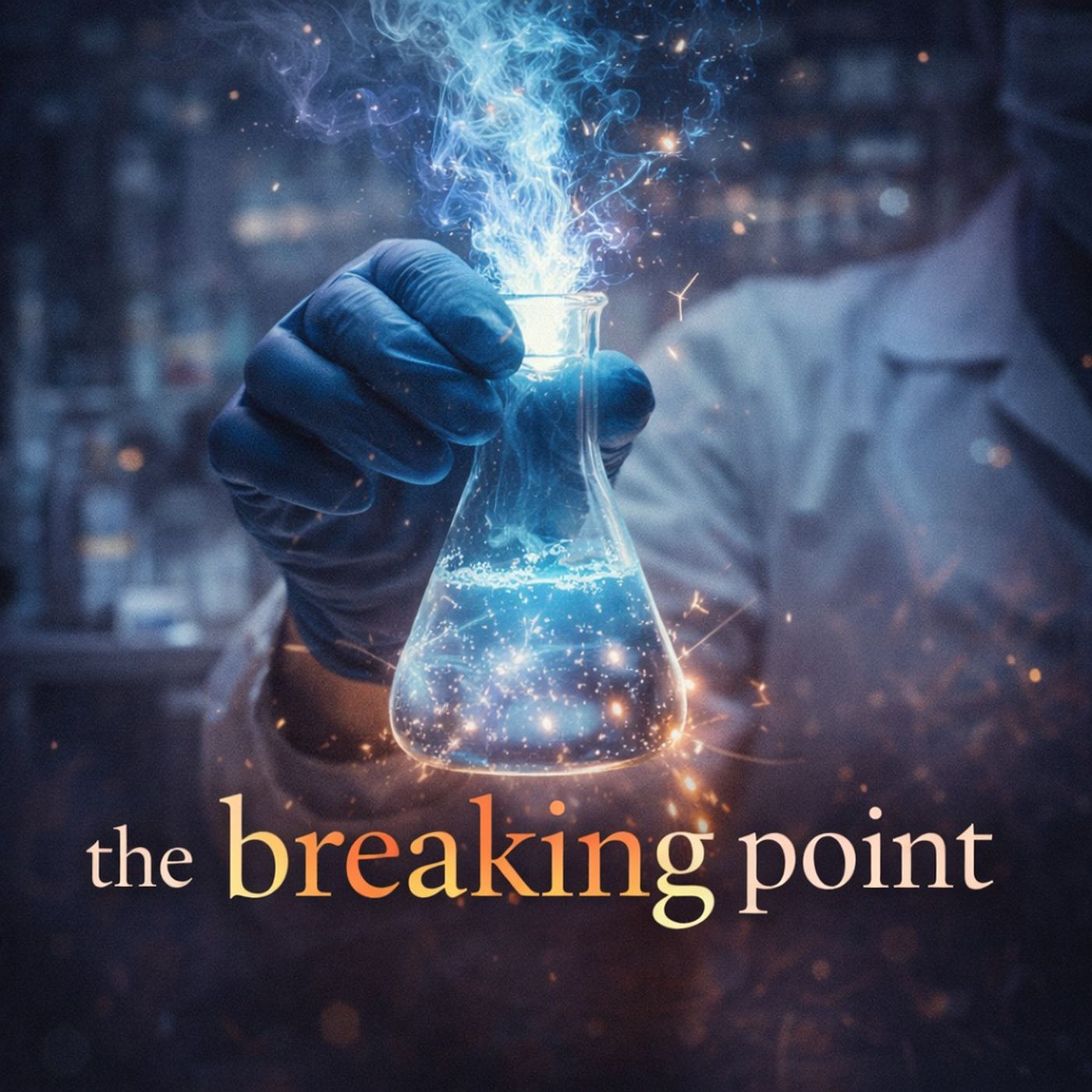
Every scientific breakthrough has a moment when everything changes forever. Join us as we dive deep into the exact moments when human understanding shattered and reformed, from the split second discoveries that rewrote textbooks to the quiet epiphanies that transformed civilization.
-
53
The Woman Who Caught Lightning in a Test Tube
In 1938, a physicist named Lise Meitner was taking a winter walk in the Swedish woods when she realized her former colleagues had accidentally split the atom—and didn't even know it. Her insight, scribbled in the snow with a stick, would unlock the nuclear age and change the course of human history. Hosted by Simplecast, an AdsWizz company. See https://pcm.adswizz.com for information about our collection and use of personal data for advertising.
-
52
The Magnet That Swallowed Physics
In 1820, a Danish professor's lecture demonstration went sideways when a compass needle twitched near a wire—and suddenly electricity and magnetism weren't separate forces anymore. This accident didn't just unite two phenomena; it revealed that light itself is an electromagnetic wave, setting the stage for everything from radio to quantum mechanics. Hosted by Simplecast, an AdsWizz company. See https://pcm.adswizz.com for information about our collection and use of personal data for advertising.
-
51
The Sound of Stars Dying
In 1967, a Cambridge graduate student noticed something odd in her radio telescope data—a signal so regular it seemed artificial. What Jocelyn Bell Burnell discovered wasn't aliens, but something far stranger: the lighthouse beams of collapsed stars spinning 700 times per second, revealing the most extreme physics in the universe. Hosted by Simplecast, an AdsWizz company. See https://pcm.adswizz.com for information about our collection and use of personal data for advertising.
-
50
The Fever That Saved Us
In 1928, Alexander Fleming left a petri dish uncovered by accident and returned to find something extraordinary: a mold that could kill bacteria. But the real story of penicillin isn't about one eureka moment—it's about a decade of failed experiments, a desperate wartime race, and the unlikely team of scientists who turned Fleming's moldy dish into the drug that would save more lives than any other in human history. Hosted by Simplecast, an AdsWizz company. See https://pcm.adswizz.com for information about our collection and use of personal data for advertising.
-
49
The Woman Who Mapped the Stars
In 1925, a young graduate student's careful measurements of starlight revealed that our entire universe was far stranger and more vast than anyone imagined. Henrietta Swan Leavitt's meticulous work with variable stars became the cosmic ruler that would forever change how we measure the heavens—and accidentally opened the door to discovering that everything around us is flying apart. Hosted by Simplecast, an AdsWizz company. See https://pcm.adswizz.com for information about our collection and use of personal data for advertising.
-
48
The Mold That Saved the World
In 1928, Alexander Fleming returned from vacation to find his bacterial cultures contaminated by a mysterious mold—and nearly threw them away. Instead, his curiosity about this 'failed' experiment led to penicillin, launching the antibiotic age and saving hundreds of millions of lives. Hosted by Simplecast, an AdsWizz company. See https://pcm.adswizz.com for information about our collection and use of personal data for advertising.
-
47
The Ghost in the Signal
In 1965, two Bell Labs scientists thought bird droppings were ruining their antenna. Instead, they'd stumbled upon the leftover whisper of creation itself—the cosmic microwave background radiation that would revolutionize our understanding of the universe's birth. Sometimes the most profound discoveries hide in what we mistake for noise. Hosted by Simplecast, an AdsWizz company. See https://pcm.adswizz.com for information about our collection and use of personal data for advertising.
-
46
The Mold That Saved the World
In 1928, Alexander Fleming returned from vacation to find his bacterial cultures ruined by a mysterious mold. Most scientists would have thrown the contaminated dishes away—but Fleming's curiosity about this 'failed' experiment led to penicillin, the discovery that would save more lives than any other in human history. Hosted by Simplecast, an AdsWizz company. See https://pcm.adswizz.com for information about our collection and use of personal data for advertising.
-
45
The Light That Shattered Time
In 1887, two physicists expected to measure Earth's speed through space and instead broke physics itself. The Michelson-Morley experiment—designed to detect the invisible 'ether' that light supposedly traveled through—found absolutely nothing, launching Einstein toward relativity and revealing how our most profound discoveries often come disguised as failures. Hosted by Simplecast, an AdsWizz company. See https://pcm.adswizz.com for information about our collection and use of personal data for advertising.
-
44
The Fever That Built Civilization
In 1928, Alexander Fleming forgot to clean a petty dish before leaving for vacation. What grew in that abandoned lab would accidentally save more lives than any discovery in human history—but the real story involves a forgotten woman, a decade of failure, and a desperate race against time during World War II. Sometimes the most important breakthroughs happen when we're not even looking. Hosted by Simplecast, an AdsWizz company. See https://pcm.adswizz.com for information about our collection and use of personal data for advertising.
-
43
The Hole in Everything
In 1998, two rival teams of astronomers expected to measure how gravity was slowing down the universe's expansion. Instead, they discovered something that defied everything we thought we knew—the universe is accelerating, driven by a mysterious force we call dark energy. Twenty-five years later, we still don't know what 70% of our universe actually is. Hosted by Simplecast, an AdsWizz company. See https://pcm.adswizz.com for information about our collection and use of personal data for advertising.
-
42
The Invisible Architect
In 1951, a soft-spoken British chemist named Rosalind Franklin captured an X-ray photograph that would unlock the secret structure of life itself—then watched as others claimed the Nobel Prize for DNA's double helix. This is the story of Photo 51, the image that revealed how genetic information spirals through every living cell, and the brilliant scientist whose precision made it all possible. Hosted by Simplecast, an AdsWizz company. See https://pcm.adswizz.com for information about our collection and use of personal data for advertising.
-
41
The Sound of Starlight
A janitor's curiosity about strange radio noise led to the discovery that the universe itself is singing—a faint whisper from the Big Bang still echoing 13.8 billion years later. This is the story of how Arno Penzias and Robert Wilson stumbled upon cosmic microwave background radiation while trying to eliminate interference, and accidentally proved our universe had a beginning. Hosted by Simplecast, an AdsWizz company. See https://pcm.adswizz.com for information about our collection and use of personal data for advertising.
-
40
The Map Makers of Inner Space
In 1953, a forgotten X-ray crystallographer named Rosalind Franklin captured a photograph that would unlock the secret architecture of life itself. But the race to decode DNA's double helix reveals how scientific truth emerges not from lone genius, but from a complex web of competition, collaboration, and contested credit. Hosted by Simplecast, an AdsWizz company. See https://pcm.adswizz.com for information about our collection and use of personal data for advertising.
-
39
The Invisible Architect
In 1928, a messy lab bench and a discarded petri dish changed the course of human history. The accidental discovery of penicillin reveals how the greatest breakthroughs often emerge from chaos, contamination, and a scientist's ability to see wonder where others see waste. Hosted by Simplecast, an AdsWizz company. See https://pcm.adswizz.com for information about our collection and use of personal data for advertising.
-
38
The Mapmaker's Gamble
In 1912, a meteorologist with no geology training proposed that continents drift across Earth's surface—and was ridiculed by the scientific establishment for 50 years. Alfred Wegener's revolutionary idea about our restless planet would eventually reshape our understanding of earthquakes, evolution, and life itself, but only after his death in the Greenland ice. Hosted by Simplecast, an AdsWizz company. See https://pcm.adswizz.com for information about our collection and use of personal data for advertising.
-
37
The Chemist Who Caught Lightning
In 1938, Lise Meitner sat on a snow-covered log in Sweden and scribbled calculations that would unlock the secret of nuclear fission—then watched as history wrote her male colleagues into the Nobel Prize instead. Her story reveals how one woman's brilliance cracked open the atomic age, and why the most powerful discovery of the 20th century almost went unrecognized. Hosted by Simplecast, an AdsWizz company. See https://pcm.adswizz.com for information about our collection and use of personal data for advertising.
-
36
The Woman Who Moved the Stars
In 1925, a young graduate student's careful analysis of photographic plates revealed that our entire galaxy was just one of countless others scattered across an unimaginably vast universe. Henrietta Swan Leavitt's discovery of how certain stars pulse with clockwork precision gave Edwin Hubble the cosmic yardstick he needed to rewrite our place in existence. Hosted by Simplecast, an AdsWizz company. See https://pcm.adswizz.com for information about our collection and use of personal data for advertising.
-
35
The Light That Ate Time
In 1887, two scientists built a machine to catch the universe cheating—and instead broke our understanding of time itself. The story of how the Michelson-Morley experiment, designed to detect an invisible cosmic wind, accidentally revealed that light doesn't follow the rules, setting Einstein on a collision course with reality. Hosted by Simplecast, an AdsWizz company. See https://pcm.adswizz.com for information about our collection and use of personal data for advertising.
-
34
The Fever That Built Our World
In 1928, a contaminated lab dish led to the discovery of penicillin—but that's only half the story. The real breakthrough came during WWII when a desperate search for mass production methods transformed Alexander Fleming's curiosity into the weapon that would save more lives than any general's strategy. Hosted by Simplecast, an AdsWizz company. See https://pcm.adswizz.com for information about our collection and use of personal data for advertising.
-
33
The Sound of Stars Dying
In 1967, a graduate student noticed something impossible on her radio telescope data: perfectly timed pulses from deep space, so precise they seemed artificial. What Jocelyn Bell discovered wasn't aliens—it was something even stranger, the lighthouse beams of collapsed stars spinning 700 times per second. Hosted by Simplecast, an AdsWizz company. See https://pcm.adswizz.com for information about our collection and use of personal data for advertising.
-
32
The Mapmaker's Ghost
In 1912, Alfred Wegener proposed that continents drift across Earth's surface—a radical idea that made him a scientific pariah for half a century. His evidence was compelling, his timing was catastrophic, and his vindication would require technology he couldn't have imagined. Hosted by Simplecast, an AdsWizz company. See https://pcm.adswizz.com for information about our collection and use of personal data for advertising.
-
31
The Woman Who Touched the Stars
Cecilia Payne-Gaposchkin figured out what stars are made of in 1925, only to be told her revolutionary discovery was 'clearly impossible.' Her thesis would later be called the most brilliant in astronomy history, but it took decades for the scientific establishment to accept that a 25-year-old woman had unlocked one of the universe's fundamental secrets. Hosted by Simplecast, an AdsWizz company. See https://pcm.adswizz.com for information about our collection and use of personal data for advertising.
-
30
The Mold That Saved the World
In 1928, Alexander Fleming returned from vacation to find his bacterial cultures ruined by a stray mold—and nearly threw away what would become penicillin. This is the story of how one man's messy lab habits led to the antibiotic revolution, and why the scientists who actually made penicillin a reality remained in Fleming's shadow for decades. Hosted by Simplecast, an AdsWizz company. See https://pcm.adswizz.com for information about our collection and use of personal data for advertising.
-
29
The Shadow That Changed Everything
In 1895, Wilhelm Röntgen was experimenting with electrical discharge tubes when he noticed something impossible—an eerie glow coming from across his darkened laboratory. Within weeks, his accidental discovery of X-rays would let humanity see inside the human body for the first time, revolutionize medicine, and accidentally kickstart the atomic age. Hosted by Simplecast, an AdsWizz company. See https://pcm.adswizz.com for information about our collection and use of personal data for advertising.
-
28
The Clock That Shouldn't Tick
In 1938, a rejected physicist turned to cleaning glassware in a lab where he accidentally discovered nuclear fission—the splitting of atoms that would reshape civilization. But Otto Hahn's discovery came with a devastating realization: he had unlocked a force that could either power cities or obliterate them. Hosted by Simplecast, an AdsWizz company. See https://pcm.adswizz.com for information about our collection and use of personal data for advertising.
-
27
The Universe's Missing Weight Problem
In the 1970s, astronomer Vera Rubin pointed her telescope at distant galaxies and discovered something impossible: they were spinning too fast to exist. Her observations revealed that 85% of all matter in the universe is completely invisible to us, launching the greatest mystery in modern physics. Hosted by Simplecast, an AdsWizz company. See https://pcm.adswizz.com for information about our collection and use of personal data for advertising.
-
26
The Mapmaker's Impossible Ocean
In 1977, geologist Marie Tharp hand-drew the first complete map of the ocean floor—and accidentally revealed a hidden world that rewrote our understanding of Earth itself. Her meticulous sketches uncovered the largest mountain range on our planet, sparked the plate tectonics revolution, and showed us that the ground beneath our feet is far more restless than we ever imagined. Hosted by Simplecast, an AdsWizz company. See https://pcm.adswizz.com for information about our collection and use of personal data for advertising.
-
25
The Woman Who Touched the Stars
Cecilia Payne's revolutionary 1925 dissertation proved that stars are made mostly of hydrogen—but her male advisors forced her to call her own discovery 'spurious.' Decades later, it became the foundation of modern astrophysics. This is the story of how a 25-year-old woman solved one of the universe's biggest mysteries, only to be told she was wrong about her own groundbreaking work. Hosted by Simplecast, an AdsWizz company. See https://pcm.adswizz.com for information about our collection and use of personal data for advertising.
-
24
The Mold That Saved a Billion Lives
In 1928, Alexander Fleming returned from vacation to find his bacterial cultures contaminated by a peculiar mold—and nearly threw them away. That moment of scientific curiosity over annoyance led to penicillin, the antibiotic that would revolutionize medicine and turn infections from death sentences into minor inconveniences. Hosted by Simplecast, an AdsWizz company. See https://pcm.adswizz.com for information about our collection and use of personal data for advertising.
-
23
The Radio That Heard the Universe's Birth Cry
In 1965, two Bell Labs engineers were plagued by an annoying hiss in their radio antenna that threatened to derail their satellite communication project. That 'noise' turned out to be the cosmic microwave background radiation—the afterglow of the Big Bang itself, still echoing through space 13.8 billion years later. Sometimes the most groundbreaking discoveries come disguised as problems you're desperately trying to solve. Hosted by Simplecast, an AdsWizz company. See https://pcm.adswizz.com for information about our collection and use of personal data for advertising.
-
22
The Molecule That Shouldn't Exist
In 1985, three scientists accidentally created a soccer ball-shaped molecule that defied everything chemistry textbooks said about carbon. The discovery of buckminsterfullerene—or 'buckyballs'—happened during what was supposed to be a completely different experiment about space dust, launching the entire field of nanotechnology and earning a Nobel Prize along the way. Hosted by Simplecast, an AdsWizz company. See https://pcm.adswizz.com for information about our collection and use of personal data for advertising.
-
21
The Sound of Stars Colliding
In 2015, a ripple in spacetime arrived at Earth after traveling for 1.3 billion years—carrying the death song of two black holes locked in their final dance. This is the story of how humanity learned to hear the universe's most violent whispers, and the scientists who spent decades building instruments sensitive enough to detect a distortion smaller than 1/10,000th the width of a proton. Hosted by Simplecast, an AdsWizz company. See https://pcm.adswizz.com for information about our collection and use of personal data for advertising.
-
20
The Molecule That Forgot to Die
In 1951, Henrietta Lacks died of cervical cancer, but her cells achieved something no human cells had ever done before—they became immortal. The accidental discovery of HeLa cells revolutionized medicine, enabling breakthroughs from the polio vaccine to cancer treatments, while raising profound questions about ethics, consent, and what it means to be human. Hosted by Simplecast, an AdsWizz company. See https://pcm.adswizz.com for information about our collection and use of personal data for advertising.
-
19
The Sound of Invisible Fire
In 1965, two Bell Labs engineers were trying to eliminate mysterious static from their radio antenna when they accidentally detected the afterglow of the Big Bang itself. This is the story of how cosmic background radiation was discovered by accident, confirmed our understanding of the universe's origin, and why we can still 'hear' the echo of creation in every direction we look. Hosted by Simplecast, an AdsWizz company. See https://pcm.adswizz.com for information about our collection and use of personal data for advertising.
-
18
The Map That Shouldn't Exist
In 1929, a Turkish naval officer discovered a 500-year-old map that seemed to show Antarctica's coastline—centuries before it was officially discovered and without the ice that had covered it for millennia. We dive into the Piri Reis map mystery and explore how modern satellite technology is rewriting our understanding of ancient geographical knowledge. Hosted by Simplecast, an AdsWizz company. See https://pcm.adswizz.com for information about our collection and use of personal data for advertising.
-
17
The Woman Who Cracked the Code of Life
Rosalind Franklin was just 51 X-ray diffraction photographs away from solving the structure of DNA when her data was shown to competitors without her knowledge. Her story reveals how the most elegant discovery in biology emerged from a web of ambition, collaboration, and betrayal—and why the double helix almost remained a mystery. Hosted by Simplecast, an AdsWizz company. See https://pcm.adswizz.com for information about our collection and use of personal data for advertising.
-
16
The Man Who Saw Time Stand Still
In 1905, a 26-year-old patent clerk imagined riding alongside a beam of light—and in that thought experiment, he shattered our understanding of reality itself. We explore how Albert Einstein's special theory of relativity emerged not from a laboratory, but from pure imagination, and why his radical ideas about space and time were so disturbing that even he struggled to accept all their implications. Hosted by Simplecast, an AdsWizz company. See https://pcm.adswizz.com for information about our collection and use of personal data for advertising.
-
15
The Woman Who Bottled Lightning
In 1898, Marie Curie scraped through tons of pitchblende ore in a freezing shed, chasing a mysterious energy that glowed in the dark. Her obsessive hunt for radium didn't just earn her two Nobel Prizes—it cracked open the atom and revealed that matter itself could transform, overturning centuries of scientific certainty. Hosted by Simplecast, an AdsWizz company. See https://pcm.adswizz.com for information about our collection and use of personal data for advertising.
-
14
The Map That Broke Medicine
In 1854, a London doctor drew dots on a map and accidentally invented epidemiology, proving that cholera wasn't spread by 'bad air' but by something far more mundane—and revolutionizing how we hunt invisible killers. John Snow's simple act of visualization didn't just solve a deadly mystery; it gave us the tools we still use today to track everything from COVID-19 to cancer clusters. Hosted by Simplecast, an AdsWizz company. See https://pcm.adswizz.com for information about our collection and use of personal data for advertising.
-
13
The Woman Who Touched the Stars
Cecilia Payne figured out what stars are made of in 1925, but her groundbreaking discovery was dismissed as 'clearly impossible' by the leading astronomers of her time. It took decades for the scientific community to realize she had unlocked one of the universe's most fundamental secrets—and changed everything we thought we knew about the cosmos. Hosted by Simplecast, an AdsWizz company. See https://pcm.adswizz.com for information about our collection and use of personal data for advertising.
-
12
The Accident That Saved Millions
In 1928, Alexander Fleming left his lab messy and went on vacation. When he returned, a contaminated petri dish would reveal the world's first antibiotic. But the real story isn't about luck—it's about a mind trained to see opportunity in failure, and the decades-long race to turn moldy bread into medicine. Hosted by Simplecast, an AdsWizz company. See https://pcm.adswizz.com for information about our collection and use of personal data for advertising.
-
11
The Universe's Missing Mass
In the 1970s, astronomer Vera Rubin pointed her telescope at distant galaxies and discovered something impossible: they were spinning too fast to exist. Her observations revealed that 85% of all matter in the universe is completely invisible to us, launching the greatest mystery in modern cosmology. Hosted by Simplecast, an AdsWizz company. See https://pcm.adswizz.com for information about our collection and use of personal data for advertising.
-
10
The Mold That Changed Everything
In 1928, Alexander Fleming returned from vacation to find his bacterial cultures contaminated by a mysterious mold—and nearly threw them away. Instead, his curiosity about this 'failed' experiment led to penicillin, saving millions of lives and launching the antibiotic age that would reshape medicine forever. Hosted by Simplecast, an AdsWizz company. See https://pcm.adswizz.com for information about our collection and use of personal data for advertising.
-
9
The Universe in a Coffee Cup
In 1965, two Bell Labs engineers thought pigeons were messing with their radio antenna. The annoying static they couldn't eliminate turned out to be the echo of the Big Bang itself—cosmic microwave background radiation that had been traveling through space for 13.8 billion years. This is the story of how the most important discovery in cosmology happened while trying to make better phone calls. Hosted by Simplecast, an AdsWizz company. See https://pcm.adswizz.com for information about our collection and use of personal data for advertising.
-
8
The Mold That Changed Everything
In 1928, Alexander Fleming returned from vacation to find his bacterial cultures contaminated by a mysterious mold—and nearly threw them away. Instead, his curiosity about this 'ruined' experiment led to penicillin, saving more lives than any other medical discovery in history. Hosted by Simplecast, an AdsWizz company. See https://pcm.adswizz.com for information about our collection and use of personal data for advertising.
-
7
The Sound of Silence
In 1965, two Bell Labs engineers were just trying to eliminate noise from their radio antenna when they stumbled upon the afterglow of creation itself—the cosmic microwave background radiation. This accidental discovery would provide the smoking gun evidence for the Big Bang theory and forever change our understanding of the universe's origin story. Hosted by Simplecast, an AdsWizz company. See https://pcm.adswizz.com for information about our collection and use of personal data for advertising.
-
6
The Thief in the Telescope
In 1995, astronomer Michel Mayor was hunting for failed stars when his instruments detected something impossible: a planet orbiting another star in just four days, blazing at 1000°C. This wasn't the Earth-like world anyone expected to find first—it was a 'hot Jupiter' that shattered every theory about how solar systems form and launched the greatest treasure hunt in astronomy. Hosted by Simplecast, an AdsWizz company. See https://pcm.adswizz.com for information about our collection and use of personal data for advertising.
-
5
The Sound That Ate Itself
In 1964, two Bell Labs engineers trying to eliminate mysterious static from their radio antenna accidentally discovered the leftover whisper of the Big Bang itself. This is the story of how cosmic background radiation was found by accident, and why the universe still hums with the echo of its own birth 13.8 billion years later. Hosted by Simplecast, an AdsWizz company. See https://pcm.adswizz.com for information about our collection and use of personal data for advertising.
-
4
The Map That Broke Biology
In 1951, a brilliant X-ray crystallographer captured Photo 51—a blurry black and white image that would unlock the secret architecture of life itself. But Rosalind Franklin's crucial evidence for DNA's double helix structure was shared without her knowledge, leading to one of science's most controversial Nobel Prizes and raising questions we're still grappling with today about collaboration, credit, and the hidden figures who shape our understanding of the world. Hosted by Simplecast, an AdsWizz company. See https://pcm.adswizz.com for information about our collection and use of personal data for advertising.
We're indexing this podcast's transcripts for the first time — this can take a minute or two. We'll show results as soon as they're ready.
No matches for "" in this podcast's transcripts.
No topics indexed yet for this podcast.
Loading reviews...
ABOUT THIS SHOW
Every scientific breakthrough has a moment when everything changes forever. Join us as we dive deep into the exact moments when human understanding shattered and reformed, from the split second discoveries that rewrote textbooks to the quiet epiphanies that transformed civilization.
HOSTED BY
Podcaster
Loading similar podcasts...
Frequently Asked Questions
How many episodes does The Breaking Point have?
The Breaking Point currently has 50 episodes available on PodParley. New episodes are automatically indexed when they're published to the podcast feed.
What is The Breaking Point about?
Every scientific breakthrough has a moment when everything changes forever. Join us as we dive deep into the exact moments when human understanding shattered and reformed, from the split second discoveries that rewrote textbooks to the quiet epiphanies that transformed civilization.
How often does The Breaking Point release new episodes?
The Breaking Point has 50 episodes. Check the episode list to see recent publication dates and frequency.
Where can I listen to The Breaking Point?
You can listen to The Breaking Point on PodParley by clicking any episode. We provide an embedded audio player for direct listening, and you can also subscribe via your preferred podcast app using the RSS feed.
Who hosts The Breaking Point?
The Breaking Point is created and hosted by Podcaster.
URL copied to clipboard!