
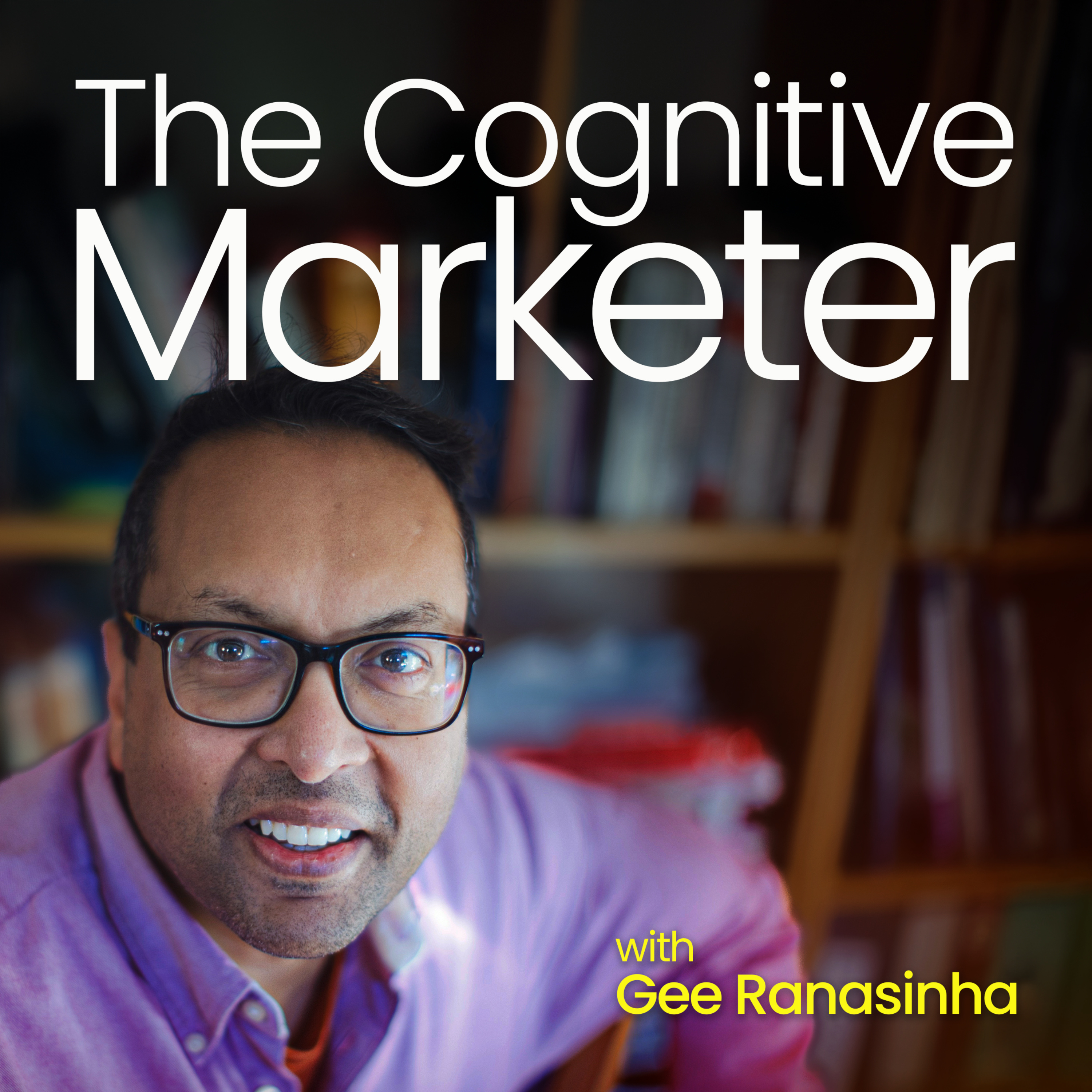
PODCAST · business
The Cognitive Marketer
by Gee Ranasinha
A B2B Marketing podcast about how business strategy, marketing, and behavioral science thinking intersect, to deliver a resonant and sustainable commercial outcome for startups and small businesses. Host Gee Ranasinha, CEO of marketing agency and behavioral science practice KEXINO, shares fresh perspectives on what makes customers tick, why certain messages work, and how to build marketing that actually moves the needle. This isn't about tactics, trends, or "the next shiny thing." It's about understanding underlying psychological buying triggers to create more effective business results.
-
42
Our main competitor is buyer inaction
Most lost sales don't go to the competition. They die because the buyer decided living with the problem is easier than solving it.A buyer who's been tolerating a problem for months or years has already built workarounds, adjusted expectations, and normalized the cost. That 'pain tolerance' is our actual competition - the status quo. No amount of us promising rainbows and unicorns will overcome that inertia if the pain of staying feels less than changing things.We keep assuming the prospect already knows how much the problem is costing them, but there's often unaware because the cost accumulates in places they're not tracking.We're trying to sell a cure to someone who's forgotten they're sick.We think being positive and aspirational is what motivates buyers. And in certain contexts it does - but only once they've already committed to solving the problem.But before that commitment exists, outcome-selling is just noise.The Cognitive MarketerThe premier B2B Marketing Podcast brought to you by KEXINO - https://kexino.com/Find out more about us at these places:LinkedIn: https://www.linkedin.com/company/kexinoInstagram: https://instagram.com/wearekexinoYouTube: https://www.youtube.com/c/KexinoThreads: https://www.threads.net/@wearekexinoBlueSky: https://bsky.app/profile/kexino.comGee Ranasinha public speaking website: https://gee-speaks.com
-
41
We're trying to sell to a buyer that no longer exists
We've spent the last decade obsessing over what we sell, while ignoring how people actually buy from us.When revenue numbers disappoint, our de facto reaction is to blame plausible external factors. We reach for these explanations because they don't require us to look at our own contribution to the current situation, which should probably tell us something.The underlying logic of how we actually engage buyers probably hasn't been seriously pressure-tested in at least a decade.The Cognitive MarketerThe premier B2B Marketing Podcast brought to you by KEXINO - https://kexino.com/Find out more about us at these places:LinkedIn: https://www.linkedin.com/company/kexinoInstagram: https://instagram.com/wearekexinoYouTube: https://www.youtube.com/c/KexinoThreads: https://www.threads.net/@wearekexinoBlueSky: https://bsky.app/profile/kexino.comGee Ranasinha public speaking website: https://gee-speaks.com
-
40
Which page is your homepage? All of them.
Which page is your homepage?When someone types a query into Google, or into AI, the algorithm goes looking for whichever page most closely matches what that person's looking for.It could be a blog article on our site written 3 years ago. Something so old and located so deep that we’ve probably forgotten it was still there.But the visitor lands there directly, with no preamble, and we have no say in it.This has been true for as long as there’s been search, and most businesses still haven’t really factored this into their information architecture maps, sitemaps, UX, or content strategy.In effect our homepage isn’t (just) the homepage. EVERY page is the homepage.The Cognitive MarketerA B2B Marketing Podcast brought to you by KEXINO - https://kexino.com/Find out more about us at these places:LinkedIn: https://www.linkedin.com/company/kexinoInstagram: https://instagram.com/wearekexinoYouTube: https://www.youtube.com/c/KexinoThreads: https://www.threads.net/@wearekexinoBlueSky: https://bsky.app/profile/kexino.comGee Ranasinha public speaking website: https://gee-speaks.com
-
39
Your business has an immune system that's killing great ideas
Many businesses have an "immune system" that treats new ideas in a similar way to how our bodies deal with a virus.Something gets proposed, but before anyone gets a chance to evaluate whether it'll work, the organizational antibodies kick in.Within these kinds of businesses ideas don't get killed, as much as studied and pulled apart until there's nothing left.The cultural response to an idea within an organization often matters more than the idea itself. We keep looking for better ideas when we might have a better-ideas problem, but most of us will never know which one we have.The Cognitive MarketerBrought to you by KEXINO - https://kexino.com/LinkedIn: https://www.linkedin.com/company/kexinoInstagram: https://instagram.com/wearekexinoYouTube: https://www.youtube.com/c/KexinoThreads: https://www.threads.net/@wearekexinoBlueSky: https://bsky.app/profile/kexino.comGee Ranasinha public speaking website: https://gee-speaks.com
-
38
Innovation Cosplay: When "new" isn't really new at all
Most of the time, what gets marketed as "breakthrough innovation" isn't anything of the sort. Strip away the glossy packaging and press release verbiage, you're left with marginal improvements to a product that already exists.It's what I call "Innovation Cosplay".The human memory doesn't work by cataloging marginal differences between similar options. The mind remembers things by noticing breaks in a particular pattern.When we make our offering slightly better than competitors in predictable ways, we're making it harder for buyers to remember us, not easier.We want to be the ‘different’ that repels the wrong buyers, and appeals to right ones. If our product doesn't force buyers to think differently about what they're solving, we’re competing on everyone else's terms.The Cognitive MarketerBrought to you by KEXINO - https://kexino.com/LinkedIn: https://www.linkedin.com/company/kexinoInstagram: https://instagram.com/wearekexinoYouTube: https://www.youtube.com/c/KexinoThreads: https://www.threads.net/@wearekexinoBlueSky: https://bsky.app/profile/kexino.comGee Ranasinha public speaking website: https://gee-speaks.com
-
37
Every buyer interaction either confirms or contradicts what we claim about ourselves.
Whether accidentally or deliberately, we're training buyers to distrust us. Then we wonder why our conversion rates are tanking.Organizations build entire departments around managing customer perception, while continuing to ignore the actual experience. The gap between what we claim and how we actually behave is where trust goes to die.Someone can have the sharpest value proposition ever written, but if the experience of trying to buy from them introduces unnecessary obstacles or confusion, none of that matters.The Cognitive MarketerBrought to you by KEXINO - https://kexino.com/LinkedIn: https://www.linkedin.com/company/kexinoInstagram: https://instagram.com/wearekexinoYouTube: https://www.youtube.com/c/KexinoThreads: https://www.threads.net/@wearekexinoBlueSky: https://bsky.app/profile/kexino.comGee Ranasinha public speaking website: https://gee-speaks.com
-
36
Nobody buys boring
Far too many businesses insist on leading with the same BS checklist: better features, lower prices, free trials.It's as though they think buyers carefully weigh-up the pros and cons of every product in the category, before making a deliberate, labored, conscious buying decision.But that isn't what happens. It isn't even close to what happens.People buy stories. Specifically, they buy stories about who they become after the purchase. Our product may solve a problem, but it's our story that solves the identity crisis.Customers aren't waiting for better features. They're waiting for a better version of themselves.The Cognitive MarketerBrought to you by KEXINO - https://kexino.com/LinkedIn: https://www.linkedin.com/company/kexinoInstagram: https://instagram.com/wearekexinoYouTube: https://www.youtube.com/c/KexinoThreads: https://www.threads.net/@wearekexinoBlueSky: https://bsky.app/profile/kexino.comGee Ranasinha public speaking website: https://gee-speaks.com
-
35
Trying to be everything to everyone, means ending up as nothing to anyone
We’re too full of our own ego.We’re talking about ourselves, when the buyer is trying to solve something that has nothing to do with us yet.Most times, the answer to the buyer's specific problem actually exists. But it gets buried under corporate speak and generic positioning because of a fear that getting too specific narrows the market.Everyone is saying the same thing because everyone is afraid of saying something that might turn someone away.The Cognitive MarketerBrought to you by KEXINO - https://kexino.com/LinkedIn: https://www.linkedin.com/company/kexinoInstagram: https://instagram.com/wearekexinoYouTube: https://www.youtube.com/c/KexinoThreads: https://www.threads.net/@wearekexinoBlueSky: https://bsky.app/profile/kexino.comGee Ranasinha public speaking website: https://gee-speaks.com
-
34
Price isn't simply a number. It's a feeling.
Underpricing based on mistaking "customer acquisition" for "business growth" might be the most common strategic error in business.When we set a price, we're not picking a numbers of the air. We’re not simply adding up costs per unit, slapping a percentage on top, and calling it a day.We’re doing far more than that.We're choosing our positioning. We’re defining what type of game we play, the buyers we’ll attract, and which competitors we’ll face. To an accountant, economist, or a business owner, price is simply a number. But to a buyer, price is a feeling.The Cognitive MarketerBrought to you by KEXINO - https://kexino.com/LinkedIn: https://www.linkedin.com/company/kexinoInstagram: https://instagram.com/wearekexinoYouTube: https://www.youtube.com/c/KexinoThreads: https://www.threads.net/@wearekexinoBlueSky: https://bsky.app/profile/kexino.comGee Ranasinha public speaking website: https://gee-speaks.com
-
33
We're prompt-engineering our way to mediocrity
The use of AI tools in marketing opens up possibilities that we couldn't have imagined a few years ago. But it's also allowed us to produce lazy, sloppy, junk that reflects badly on how buyers view our brand.Rather than use AI to make us and our brands "better" (whatever that means) we're focusing on its use to make us faster, even if our standards of quality take a nosedive as a result.Poorly-produced AI-generated images are the clipart of the 2020s (don't know what "clipart" is? Ask your parents).What we're doing is teaching people to recognize the corners we choose to cut. Every obviously AI-generated piece of content contributes to pattern recognition for our audience. After enough exposure, they don't need to consciously spot the signs. They can feel it, in the same way they learned to feel that a generic, overused stock image isn't trustworthy.The Cognitive MarketerBrought to you by KEXINO - https://kexino.com/LinkedIn: https://www.linkedin.com/company/kexinoInstagram: https://instagram.com/wearekexinoYouTube: https://www.youtube.com/c/KexinoThreads: https://www.threads.net/@wearekexinoBlueSky: https://bsky.app/profile/kexino.comGee Ranasinha public speaking website: https://gee-speaks.com
-
32
Charging off in the wrong direction
The problems we faced when we were building our business are very different to the problems we face as we continue to grow the business.When a business gets to a certain size, a wave of complacency sets in. We con ourselves into thinking that we're worked out how this "business" thing works, and how to keep the plates spinning to keep generating revenue, pay the bills, and keep the lights on.What got us here, won't get us there.This is often where a combination of "doing what worked before", combined with a touch of blind panic and a sudden interest in religion, gets its way.We try harder and harder to do what worked before, even though it's clear that it's not working. But since we don't have any new cards up our sleeves (and are too scared to try them anyway) we carry on looking in places we've already looked.The Cognitive MarketerBrought to you by KEXINO - https://kexino.com/LinkedIn: https://www.linkedin.com/company/kexinoInstagram: https://instagram.com/wearekexinoYouTube: https://www.youtube.com/c/KexinoThreads: https://www.threads.net/@wearekexinoBlueSky: https://bsky.app/profile/kexino.comGee Ranasinha public speaking website: https://gee-speaks.com
-
31
Do you like pineapple on your pizza?
Margherita pizza exists because it offends no-one. It’s the choice you make when you don't know what everyone wants.Pineapple pizza, on the other hand, is polarizing. People either love it or hate it. Which is why it works as positioning - the people who love it really love it.When we try to appeal to everyone, we create messaging that could apply to anyone. We put out content that avoids taking any position that might be controversial. In short, we become a collection of platitudes.But buyers don't choose platitudes. Our commercial opportunity exists in the margins, not the middle. It exists in being specific about who we serve and how we serve them. Not in a niche-for-the-sake-of-niche way, but in a way that makes our point of view clear.Pineapple on a pizza? No way. But it's not made for someone like me. It's made for someone else. And that's OK.The Cognitive MarketerBrought to you by KEXINO - https://kexino.com/LinkedIn: https://www.linkedin.com/company/kexinoInstagram: https://instagram.com/wearekexinoYouTube: https://www.youtube.com/c/KexinoThreads: https://www.threads.net/@wearekexinoBlueSky: https://bsky.app/profile/kexino.comGee Ranasinha public speaking website: https://gee-speaks.com
-
30
If they've not heard of us, they won't buy from us
We're wasting time and budget chasing people who won't buy from us today, instead of looking at people who may buy from us tomorrow.Future buyers are forming opinions right now about which brands seem familiar, credible, and worth remembering for the future. When they eventually need whatever we're selling, they'll begin with the brands they know and have already heard of. They'll start with whatever names already sit in their head because that's how brains work.Yes, we can call it "brand building" in whatever vague way that's come to mean today. But at the end of the day It's about having us pop-up in someone's memory before that person needs to make a buying decision.The Cognitive MarketerBrought to you by KEXINO - https://kexino.com/LinkedIn: https://www.linkedin.com/company/kexinoInstagram: https://instagram.com/wearekexinoYouTube: https://www.youtube.com/c/KexinoThreads: https://www.threads.net/@wearekexinoBlueSky: https://bsky.app/profile/kexino.comGee Ranasinha public speaking website: https://gee-speaks.com
-
29
We're either moving forward through action, or falling behind by inaction
Too many business owners suffer from loss aversion. They tend to avoid a possible less, by sticking with the status quo - what’s worked in the past that got them to where they are.However, that also means they’re risking possible gain, by trying something new. Markets continue to do what they’re going to do, and won’t put things on hold for us while we try to catch up.Because if we won't disrupt what we've built, someone else will do it for us.The Cognitive MarketerBrought to you by KEXINO - https://kexino.com/LinkedIn: https://www.linkedin.com/company/kexinoInstagram: https://instagram.com/wearekexinoYouTube: https://www.youtube.com/c/KexinoThreads: https://www.threads.net/@wearekexinoBlueSky: https://bsky.app/profile/kexino.comGee Ranasinha public speaking website: https://gee-speaks.com
-
28
We're building websites backwards
We're optimizing for subjective appeal rather than commercial effectiveness.Of course design, UX/UI, etc are all important. But they're not the *most* important. Buyers don't buy from us just because our website looks pretty.The main reason why a page converts is because of the copy. Yet we're apparently OK to spend thousands on frameworks, design engines, and brand guidelines while considering copywriting as though an afterthought.We're optimizing for looking professional instead of being interesting. While "professional" gets us in the door, it's "interesting" that actually converts.Yet we keep confusing the two.The Cognitive MarketerBrought to you by KEXINO - https://kexino.com/LinkedIn: https://www.linkedin.com/company/kexinoInstagram: https://instagram.com/wearekexinoYouTube: https://www.youtube.com/c/KexinoThreads: https://www.threads.net/@wearekexinoBlueSky: https://bsky.app/profile/kexino.comGee Ranasinha public speaking website: https://gee-speaks.com
-
27
We're still trying to solve problems that no longer matter to buyers
Buyers can't tell the difference between our widget and the competitor's widget because functionally there isn't one.We're perfecting features that look really cool in a demo but that the average user wouldn’t ever use.But these so-called “improvements” do nothing more than keep us in the game. They don't provide us with ways to win.I’m not saying that substance no longer matters and marketing can now do all the work. I’m saying that In markets where products 'just work' and any functional differences between them are minimal, perception becomes substance.
-
26
Buyers can't tell our messaging apart from our competitors.
We've professionalized ourselves into sameness. Bland messaging costs more than we think. Every generic touchpoint trains buyers to tune us out. We're not “building awareness”. We're teaching the market that our category doesn't deserve attention.We complain about commoditization. But we’re the ones who created it.Who actually breaks through? The businesses that are willing to sound like somebody instead of like a committee. The Cognitive MarketerBrought to you by KEXINO - https://kexino.com/LinkedIn: https://www.linkedin.com/company/kexinoInstagram: https://instagram.com/wearekexinoYouTube: https://www.youtube.com/c/KexinoThreads: https://www.threads.net/@wearekexinoBlueSky: https://bsky.app/profile/kexino.comGee Ranasinha public speaking website: https://gee-speaks.com
-
25
'Online Marketing' isn't 'Marketing Online'.
Marketing departments are full of people who can explain TikTok's algorithm but not what their company actually does, or what problem our product solves for our customer. We keep hoping the next tactic works. That the next hire cracks it. That there's some kind of a shortcut we haven't found yet.But there isn't one and, in our heart of hearts, I think we know that. The Cognitive MarketerBrought to you by KEXINO - https://kexino.com/LinkedIn: https://www.linkedin.com/company/kexinoInstagram: https://instagram.com/wearekexinoYouTube: https://www.youtube.com/c/KexinoThreads: https://www.threads.net/@wearekexinoBlueSky: https://bsky.app/profile/kexino.comGee Ranasinha public speaking website: https://gee-speaks.com
-
24
Your business is competing with Apple
You're also competing against Coca-Cola,and Nike,and Disney,and Amazon,and every other brand that delivers an outstanding customer buying experience.The biggest brands in the world are setting the standard for how we, as consumers, expect to be treated.But this also means that your business is being judged by the same standard.Your eCommerce site's search function, product descriptions, images, delivery options, and returns policy.The quality of your hardware, software, user experience, and packaging.The text of your emails. The design of your invoice.How you answer the telephone, or respond on social media.If customers don’t think their buying experience matches up with what they’re expecting, don’t be surprised if they choose to buy from someone else.
-
23
Making our marketing a mirror for our customers
Most teams publish more and get less. The fix isn’t another tool or bigger budget. It’s making our marketing a mirror that our buyers recognize. In this episode, we unpack how to find and use customer language, the few insights that actually move conversion, and why qualitative research beats “more content” in B2B.
-
22
We're selling customers the permission to want something
Customers make purchasing decisions emotionally and construct elaborate post-hoc justifications after the fact.As marketers, the reason we exist is to sell them permission to want something.Buyers purchase the elimination of doubt. They pay for the comfort of knowing they won't look foolish or have to explain themselves later.Managing how a product is perceived relative to other options matters far more than optimizing the product itself.Our job is to manufacture plausible excuses for emotional purchases.
-
21
Who's In Charge Of Your Marketing? It's Not Who You Think
Who’s really running your marketing? Is it you? Or is it your boss?Too many businesses (and business owners, to be honest) confuse marketing leadership with marketing operations.Making ads, posting on social, recording podcasts, organizing events. All of this stuff is promotions. It's marketing operations.That's not to say ops isn't important. Of course it is. But ops is tactical. It's the result of Strategy, Research, Objective, etc.If you're not doing that high-level strategic stuff, and spend all your time ordering stress balls and building email sequences, you're not in charge of marketing. Your boss is.More effective marketing: kexino.com
-
20
The 95:5 Rule. Marketing To People Who Don't Want To Buy (Yet).
Here we are in Q4 and most marketing budgets are being wasted, as we stupidly continue to chase people who have zero intention in buying this quarter.Professor John Dawes from the Ehrenberg-Bass Institute put numbers to this back in 2021, which has now become known as the 95:5 rule: Only around 5% of B2B buyers are actually looking to buy at the time they see our messaging. The other ±95% aren't in market and may not buy for weeks, months, or even years into the future.Yet most businesses continue to throw everything they've got at converting that 5%, leaving the 95% with pretty much nothing.We keep optimizing for the 5% because it shows up in this quarter's forecast. Meanwhile the 95% (i.e. the people determining whether we're still relevant next year) get stuck with whatever's left over.More effective marketing: kexino.com
-
19
Strategy without story is busywork in a suit.
In most mature markets, we face rivals with the same tools, the same data, the same benchmarks. Features blur. Margins shrink. What decides outcomes is the frame through which decisions get made, and that frame is narrative.We treat story as decoration. That’s costly. A clear narrative sets priorities, filters bets, and shapes how our product is judged before a demo starts. It turns pricing, onboarding, service, and the way we show up on LinkedIn into one coherent signal. Not flair. Coherence.Innovation still matters. It rarely decides the category on its own. Capability is cheap. Distinctiveness is not. When options look interchangeable, brand becomes the decision shortcut. Not a logo. A system of meaning built from positioning, language, and cues we repeat until they feel inevitable.There’s the awkward bit. We can spend millions making the product “better” and still lose the frame that steers choice. Or we can own it and let the market do some work for us.If we ignore the story, the market will return the favor.
-
18
Contrast persuades. Everything else is overhead.
When a new option lands, our baseline moves.We stop measuring parts and start noticing how the old choice now feels slow or awkward. The product hasn't changed ,but our reference point certainly has.Markets price expectations, not features. The first mover resets what counts as acceptable and captures attention at a discount. The rest of us inherit a tougher comparison set.Margin gets squeezed. Churn ticks up.The story in the buyer’s head updates without asking our permission.Innovation’s real return is reframing power. We are not only building utility. We are rewriting what normal looks like. That is why small experience shifts have oversized effects. They change comparisons, not just capabilities.There is a cost we avoid admitting. Expectations compound faster than our budgets. Once people see a higher bar, promotions and loyalty points cannot pull the category back to yesterday’s frame.Our job is to design the reference point and defend it. Because competing with an outdated baseline is not conservative. It is a slow bleed.
-
17
Brands don’t die from being disliked. They die from being ignored.
It seems that many businesses would rather bore everyone than risk offending anyone.Even though we know we need to differentiate ourselves from others in our category, we end up crafting communications so benign they could work for anyone.Years of focus groups, legal oversight, and risk-aversion has made us sand off any sharp edge that might give someone a reason to walk away.We've become so afraid of excluding people, we've forgotten how to attract them.But trying to create communication that resonates with everyone, resonates with no one. Just as we're specific about who we serve, we should be equally specific about who we don't.This means being comfortable that some people will look at our messaging and decide we're not for them.Clear positioning doesn't drive away buyers. It drives away people who were never going to buy from us in the first place, while making it easier for actual customers to find us.
-
16
Trying to solve new problems with old solutions
Persistent problems often require us to question our basic assumptions about how markets, customers, or organizations actually behave.This is one reason why breakthrough innovations often come from market outsiders rather than incumbent players.Outsiders don't know what 'no' means.They haven't been preconditioned to avoid "obviously wrong" approaches that sometimes turn out to be obviously right.
-
15
'Marketing' isn't the same thing as 'Promotion'
Marketing optimizes for long-term value creation. Promotion optimizes for immediate response. Marketing asks "How do we help them succeed?"Promotion asks "How do we get them to buy?"
-
14
What do customers hate about us?
Most purchases aren't about finding the perfect solution—they're about avoiding the worst problems. Buyers pick the option that annoys them least, not the one that delights them most.Understanding customer dislikes isn't just useful research—it's often the fastest path to growth. Sometimes the best way forward is removing what holds people back.
-
13
Badly done AI is the clipart of the 21st century
If our audience can tell our message has been created using AI tools, we've already lost their trust.Most businesses don’t need an “AI strategy”. They need a business strategy that (might) use AI. Without that, it’s all smoke and mirrors without any tangible impact. Real wins come when our solution plugs into the messy irrationality of human workflows: intake, service, follow-up.
-
12
We're thinking about marketing timing in the wrong way
We've been trained to think in terms of campaign cycles: we launch, we measure, we optimize, rinse and repeat.But markets don't pause between our initiatives. They're not on a break, waiting for us to get ready for the next round to begin.While we're still stuck analyzing last quarter's performance, prospects are making purchase decisions without us.The brands winning in competitive categories treat marketing like infrastructure - always on and always working, even when no one's measuring immediate returns.
-
11
Price isn't a number. It's a feeling.
What we call a "rational pricing strategy" is actually applied behavioral science.We’re not setting a price, as much as architecting an experience that begins the moment someone sees our price sticker, or rate card.
-
10
It's less about the creative, than it is about the message
Creative styles in marketing are not just a matter of personal preference. They are strategic tools that add (or take away) from communications effectiveness.In the attention-based economy that we have today, the scarcest resource isn't budget, but cognitive processing power. How we deploy that resource through creative choices becomes the primary determinant of campaign effectiveness.
-
9
What we say vs. what they hear
Our communication doesn't occur when the message is sent. It occurs when the recipient constructs meaning from it. Not only that, but our audience's interpretation of our message is inherently subjective, significantly contextual, and heavily dependent on their emotion state at that particular time.It's a good job no-one ever told us this was going to be easy, right?
-
8
It's not about adding, it's about taking away.
Most marketing failures begin not with poor execution, but with muddled thinking disguised as sophistication.The real challenge isn't simplification. True simplicity requires starting with coherent ideas, not reducing existing complexity.When each department adds its terminology and every stakeholder demands their language, we create intellectual exhibitionism masquerading as expertise.Successful businesses match communication complexity to their audience's decision-making needs. Whatever we think, buyers don't equate complexity with expertise.The pursuit of sounding impressive often sacrifices the clarity that drives action.
-
7
This isn't a 'knowledge' problem
Most business leaders believe their customers just need more information.Wrong product feature? Add more bullet points. Low conversion rates? Create longer presentations. Objections? Deploy bigger fact sheets.The problem isn't that people don't know enough about what we're' selling. They don't care about what we care about.And they don't care because they don't believe what we believe.When did you last change your mind about something important because someone read you a spec sheet? We don't buy from people who inform us. We buy from people who get us.Our customers already have enough information to make a decision. What they lack is trust. ➜ Trust that we understand their world. ➜ Trust that our solution actually matters. ➜ Trust that wer'e not just another vendor pushing features nobody asked for.What happens when we stop trying to educate and start trying to connect? The best salespeople don't win arguments. They win trust. The question is: how do we earn it?
-
6
We're not selling what we think we're selling
Spoiler alert: no one’s reading your fine print.They’re not basing their decision on your mission statement or your polished pitch.They’re watching. With the sound off. Trust is primal. It's earned through action, not declaration.
-
5
'Good enough' is no longer good enough
Most marketing today plays it safe. It’s inoffensive, generic, and built not to ruffle feathers>That means that, while it’s unlikely to get anyone fired, it's also unlikely to move the needle.
-
4
A sales process that's stuck in the past
Still selling like it’s 2012? That might be your biggest problem. The way many businesses approach sales is outdated, outmoded, and flat-out ineffective.Today’s buyers are a different breed. They're educated, empowered, and already halfway down the funnel before they ever speak to sales. They've done their research, compared you to competitors, read the reviews, and maybe even made up their minds — all before you’ve had a chance to show them your PowerPoint slides.
-
3
Buyers don't purchase "the best"
It's often not the "best" product that wins, as opposed to the one that seems the least risky . A surprising truth behind enterprise buying behavior: decision-makers aren't always chasing innovation, performance, or even value. They're looking for safety.B2B buyers lean toward what's familiar, trusted, and defensible, even if it isn't technically superior.
-
2
Sell the hole, not the drill
The best salespeople are not trying to persuade someone to come to their point of view.They’re giving customers relevant and pertinent information affecting the purchasing decision, based upon what they understand to be the most important considerations for the buyer.
-
1
The 2 ways of creating value
Customers don't buy what we're selling. Price is unrelated to the value we're bringing.Price is not just a number. Price is a feeling.Just about everything we buy, that we value, comes with a story included.And yet, most marketers don't invest enough, don't take enough care, and don't persist enough in making sure the story is worth what was paid for it.
We're indexing this podcast's transcripts for the first time — this can take a minute or two. We'll show results as soon as they're ready.
No matches for "" in this podcast's transcripts.
No topics indexed yet for this podcast.
Loading reviews...
ABOUT THIS SHOW
A B2B Marketing podcast about how business strategy, marketing, and behavioral science thinking intersect, to deliver a resonant and sustainable commercial outcome for startups and small businesses. Host Gee Ranasinha, CEO of marketing agency and behavioral science practice KEXINO, shares fresh perspectives on what makes customers tick, why certain messages work, and how to build marketing that actually moves the needle. This isn't about tactics, trends, or "the next shiny thing." It's about understanding underlying psychological buying triggers to create more effective business results.
HOSTED BY
Gee Ranasinha
Loading similar podcasts...
Frequently Asked Questions
How many episodes does The Cognitive Marketer have?
The Cognitive Marketer currently has 42 episodes available on PodParley. New episodes are automatically indexed when they're published to the podcast feed.
What is The Cognitive Marketer about?
A B2B Marketing podcast about how business strategy, marketing, and behavioral science thinking intersect, to deliver a resonant and sustainable commercial outcome for startups and small businesses. Host Gee Ranasinha, CEO of marketing agency and behavioral science practice KEXINO, shares fresh...
How often does The Cognitive Marketer release new episodes?
The Cognitive Marketer has 42 episodes. Check the episode list to see recent publication dates and frequency.
Where can I listen to The Cognitive Marketer?
You can listen to The Cognitive Marketer on PodParley by clicking any episode. We provide an embedded audio player for direct listening, and you can also subscribe via your preferred podcast app using the RSS feed.
Who hosts The Cognitive Marketer?
The Cognitive Marketer is created and hosted by Gee Ranasinha.
URL copied to clipboard!