
PODCAST · history
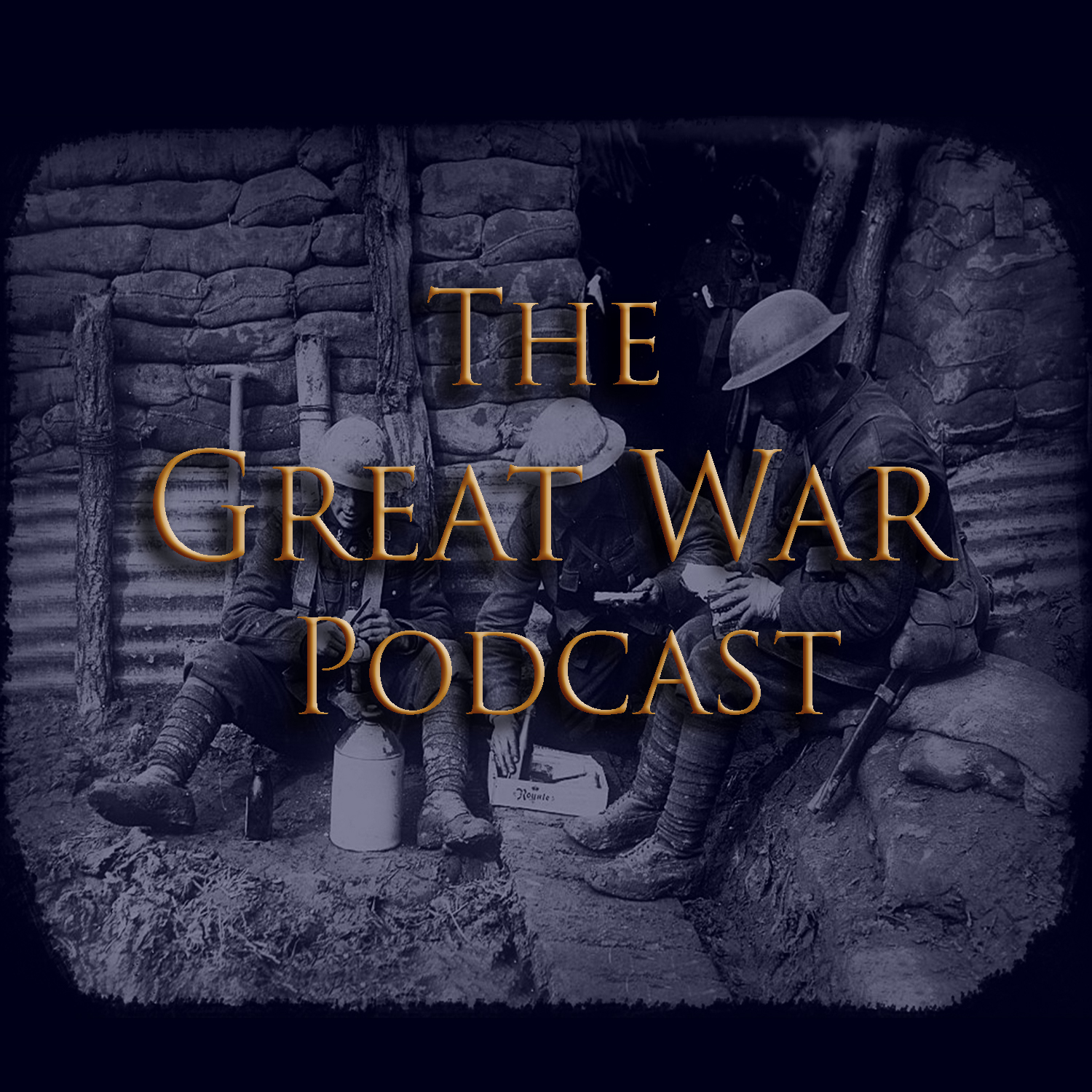
The Great War Podcast
by Daniel Clark
Surveying the period of 1890-1920, The Great War Podcast examines the roots, battles and consequences of the First World War. Rate and review us here, and be sure to follow our Twitter account: @GreatWarPodcast for any important announcements and updates! This is an independent production. All episodes are researched, written and recorded by Daniel Clark. Any errors are my fault alone. Any discrepancies will be addressed. Email: [email protected]!
Episodes
-
October Update
TLDL: No episode this month. Will be back in November.
-
101: Ludendorff's Folly
Instead of attacking the British, Ludendorff attacks the French and gets stuck.
-
100: Backs to the Wall
When your back is against the wall, you can retreat no further.
-
99: Devil's Orchestra
The Great German Offensive of 1918 is underway. Captured British during Operation MICHAEL
-
98: Awaiting The Storm
The Allies knew something was brewing...just not where or when.
-
97: A Dark Curtain
Ludendorff's Great Gamble of the Great War
-
96: The Fourteen Points
Woodrow Wilson presents his Fourteen Points to the world. Full text of the Fourteen Points Source: https://www.archives.gov/milestone-documents/president-woodrow-wilsons-14-points I. Open covenants of peace, openly arrived at, after which there shall be no private international understandings of...
-
95: The January Strikes
1918 begins with a wave of labour unrest across Austria-Hungary and Germany
-
94: The Year That Will Be
A preview of what 1918 has in store for us.
-
93B: The Year That Was
A review of 1917, focusing mainly on Germany and Austria-Hungary.
-
93A: The Year That Was
A 20 minute recap of 1917, focusing on the Entente.
-
92: The Otranto Straits
An Austro-Hungarian raid on the Otranto Barrage turns into the Adriatic's most dramatic engagement.
-
91: War in a Narrow Sea
A look at the naval war in the Adriatic from 1914-1916.
-
90: Russia Exeunt
Russia's time in the Great War comes to an end.
-
89: The October Uprising
The Bolsheviks make their move, marking the beginning of the end of Russia's Great War.
-
88: Operation Albion Part 2
The German invasion of the Baltic Islands goes off without a hitch.
-
88: Operation Albion Part 1
Eager to bring down Russia, the Germans launch an amphibious invasion of three Baltic islands.
-
87: The Battle of Cambrai
Things went well at first, but then everything came crashing down.
-
86: 'Tuesday Flanders'
After the Flanders Campaign, the British Third Army prepares to raid Cambrai. They're going to use tanks...lots of tanks.
-
85: Catastrophe at Caporetto
A combined Austrian and German force sends the Italians reeling.
-
84: The Road to Caporetto
The Austrians and Germans plan a devastating strike against the Italians.
-
83: The Battle for Flanders: Part 5 of 4
Haig, Lloyd George, historiography and an assessment of Third Ypres.
-
83: The Battle for Flanders Part 4 of 4
The bloody fight for Passchendaele Ridge begins.
-
83: The Battle for Flanders: Part 3 of 4
Herbert Plumer takes over at Ypres, and delivers three straight victories. Map for reference: Right click to view in larger format.
-
83: The Battle for Flanders Part 2 of 4
The Battle of Third Ypres got underway...but then it rained.
-
83: The Battle for Flanders Part 1 of 4
After a year of waiting, Haig finally gets his Flanders campaign.
-
82: The Kornilov Affair
Kerensky's government survives a 'scare', leaving it ripe for the picking. Kornilov arrives at the Moscow Conference, 1917
-
81: Maria Bochkareva and the Women's Battalion of Death
The life of Maria Bochkareva and the 1st Women's Battalion of Death.
-
80: The Kerensky Offensive
A post-Tsarist Russia wanted to make its mark...it ended poorly.
-
79: The Battle of Messines Ridge
The first stage of Haig's long awaited Flanders Offensive began on June 7th, 1917.
-
78: Lafayette, We Are Here
John J Pershing leads the first American troops to France in June 1917.
-
77: Only in Catastrophes
The French army grapples with widespread unrest after the Nivelle Offensive
-
76: Bloody April
April was a deadly month for the Royal Flying Corps. Dicta Boelcke 1. Try to secure advantages before attacking. If possible, keep the sun behind you. 2. Always carry through an attack when you have started it. 3. Fire only at close range, and only when your opponent is properly in your sights.…
more -
75: The Nivelle Offensive
Robert Nivelle's magic solution to the deadlock leaves the French army on the brink of mutiny.
-
74: The Battle of Arras
The British launch a successful set piece on the eve of the Nivelle Offensive.
-
73: The Abdication of Tsar Nicholas
When your people protest, it's best not to ignore them.
-
72: The Overt Acts
It took the United States 65 days to go from committed neutral to full blown participant.
-
71: The Arsenal and the Bank
By the end of 1916, neutrality had left the United States in a precarious spot. Life Magazine, February 1916.
-
70: America
Germany's decision to unleash the torpedoes would have adverse consequences
-
69: Neptune's Empire
For the second time in the war, Germany turns to unrestricted submarine warfare.
-
68B: Fateful Decisions - The Allies - From the Aisne to Vladivostok
A look at the Entente during the winter of 1916-1917.
-
68A: Fateful Decisions - The Central Powers - From Alberich to Zimmermann
A look at the Central Powers during the winter of 1916-1917.
-
SE: The Life and Death of Mata Hari
The life and career of everyones favourite exotic dancer turned convicted spy.
-
TGWAC - Part 3 of 3: Aces High
The Great War Aircast - A miniseries on the air war from 1914-1916. Part 3 of 3.
-
TGWAC - Part 2: Violent Adolesence.
The Great War Aircast - A miniseries on the air war from 1914-1916. Part 2 of 3.
-
TGWAC - Part 1: The Infancy of Airpower
The Great War Aircast - A miniseries on the air war from 1914-1916. Part 1 of 3.
-
66: New Dawns
With 1916 coming to a close, the belligerents looked ahead to 1917.
-
65: In Winter's Grip
The battle of the Somme comes to an end.
-
64: Golgotha Hill
Beginning on October 24th, a French counter attack liberates the forts Douaumont and Vaux, signalling the end of the battle of Verdun.
-
63: Leviathans
With winter approaching on the Somme, Haig hoped to deliver a substantial blow to Germany's forces.
We're indexing this podcast's transcripts for the first time — this can take a minute or two. We'll show results as soon as they're ready.
No matches for "" in this podcast's transcripts.
No topics indexed yet for this podcast.
Loading reviews...
ABOUT THIS SHOW
Surveying the period of 1890-1920, The Great War Podcast examines the roots, battles and consequences of the First World War. Rate and review us here, and be sure to follow our Twitter account: @GreatWarPodcast for any important announcements and updates! This is an independent production. All episodes are researched, written and recorded by Daniel Clark. Any errors are my fault alone. Any discrepancies will be addressed. Email: [email protected]!
HOSTED BY
Daniel Clark
CATEGORIES
Loading similar podcasts...
Frequently Asked Questions
How many episodes does The Great War Podcast have?
The Great War Podcast currently has 120 episodes available on PodParley. New episodes are automatically indexed when they're published to the podcast feed.
What is The Great War Podcast about?
Surveying the period of 1890-1920, The Great War Podcast examines the roots, battles and consequences of the First World War. Rate and review us here, and be sure to follow our Twitter account: @GreatWarPodcast for any important announcements and updates! This is an independent production. All...
How often does The Great War Podcast release new episodes?
The Great War Podcast publishes regularly with 120 episodes available. Check the episode list for the typical release schedule.
Where can I listen to The Great War Podcast?
You can listen to The Great War Podcast on PodParley by clicking any episode. We provide an embedded audio player for direct listening, and you can also subscribe via your preferred podcast app using the RSS feed.
Who hosts The Great War Podcast?
The Great War Podcast is created and hosted by Daniel Clark.
URL copied to clipboard!