
PODCAST · society
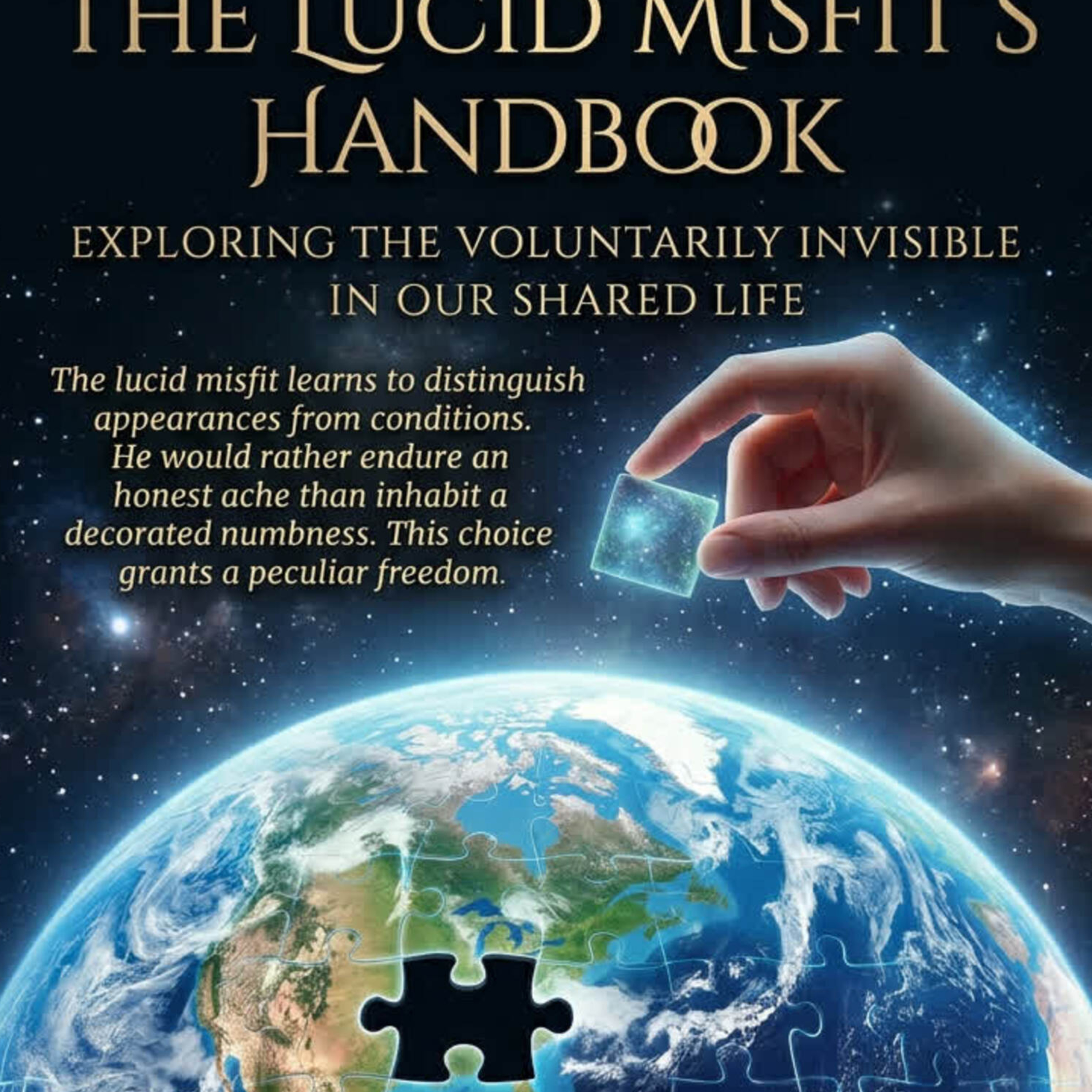
The Lucid Misfit's Handbook - by Pablo E.M.G Exploring the Voluntarily Invisible in Our Shared Life
by Pablo E.M.G.
We live in an era which, rather than expanding our horizons, seems increasingly intent on narrowing the life of the mind. We have, in effect, returned to a digital telegraph: curt lines flung across glowing screens.----------The author is Pablo Mera, - Pablo E.M.G. to the English-speaking world—though a few old friends still call him “Trompo.” He adores Metallica and Oasis, he is still a rugger at heart, blood type A+, and he published over 13,000 posts upon his blog: http://pablomera.blogspot.com.You may write to him at mailto:[email protected]
-
16
The Lucid Misfit's Handbook -The review of my Book in Voice
Only on Amazon:https://www.amazon.com/product-reviews/B0GYNYJFD5/ref=cm_cr_dp_d_show_all_top?_encoding=UTF8&ie=UTF8&reviewerType=all_reviewsPablo Mera a.k.a. as Pablo E.M.G. is a Uruguayan-born writer and longtime resident of Paraguay whose life has moved through sport, business, reinvention, family devotion, setbacks, observation, andpersistent hope.A former rugby player, entrepreneur, culturalparticipant, and lifelong student of human behavior, he writes with unusual candor about dignity, masculinity, suffering, resilience, love, and the architecture of a meaningful future.His style blends philosophical reflection, lived experience, sharp humor, emotional honesty, and practical wisdom.The Lucid Misfit’s Handbook is his first major English-language work.ToVanina."Life is astonishing, sometimes, in the wayit works. Not in the grand, providential sense of the word — I amnot speaking of miracles or destinies — but in the smaller,stranger sense of how it occasionally assembles two people who havebeen scarred by identical wounds and places them in each other'sorbit, and then watches, with what I can only imagine is somethinglike satisfaction, as those two people discover that their wounds,rather than multiplying each other's pain, have made them peculiarly,precisely, and unexpectedly equipped to offer each other somethingrare."There are books written to entertain. There are books written toinstruct. There are books written to flatter the spirit withtemporary comfort. And then, on rare occasions, there are bookswritten because a human being has wrestled long enough with life toowe the truth something.The Lucid Misfit’s Handbook belongs to that rarer category.Its author writes not as a theorist insulated from consequence, butas a participant in the beautiful disorder of ordinary existence. Heknows disappointment without worshipping it. He knows hope withouttrivializing struggle. He understands that dignity is costly, freedomis internal, and identity cannot be outsourced to applause.These pages speak to those who have felt strangely awake in a culturedevoted to distraction. To those who have sensed that conformityoften comes dressed as success. To those who have suffered, stumbled,rebuilt, and quietly continued.What makes this work distinctive is not merely its insight, but itstone: humane without sentimentality, masculine without hardness,reflective without paralysis, wounded without self-pity, and hopefulwithout naïveté.The lucid misfit, as presented here, is not an exile from life. He isoften its clearest witness.Read this book slowly. Mark its sentences. Argue with it wherenecessary. Return to it when seasons change. Its best passages willmeet you differently each time.Some books decorate a shelf. Others accompany a life.This one intends the latter.
-
15
Manhattan and the Probability of an Encounter
New York City is enormous. Its metropolitan area is home to nearly twenty million people.Yet there is a fascinating detail: the island of Manhattan alone concentrates roughly two million inhabitants— one of the most intense human densities on the planet.So today I shall employ a somewhat unusual unit of measurement. Not kilometres. Not millions.I shall use the Manhattan Unit.An island full of people walking, talking, dreaming, and occasionally colliding with destiny at every corner.Because large numbers—the truly large ones—present a curious problem: we pronounce them with ease… yet we almost never grasp their true dimension.For instance. to avoid confusion, we shall speak in thousands of millions.Now let us attempt a small mental experiment.Imagine South America composed entirely of Manhattan islands placed side by side, each with the same population density.We would obtain approximately 502 thousand million people living there.Yes. Only in South America.And if we filled the whole surface of South America, Central America, and North America with Manhattans, the number would climb to 1.213 thousand million people.Large numbers begin to feel strange, do they not?...In 2016, one of the most serious calculations estimated that the observable universe contains roughly two trillion galaxies.If each galaxy were a person… the Milky Way would be one individual walking across a thousand Manhattans placed together.And when we speak of potentially habitable planets across all those galaxies… numbers cease to be comparable with any island.We are speaking of tens of trillions of planets— numbers with eighteen zeros.Between twenty and eighty trillion, according to that study.And quite possibly more today, ten years later.Planets that may have experienced their own mass extinctions. Their own biological resets. Their own evolutionary experiments.It would be rather unreasonable to imagine that technological intelligence occurred only once in all that vastness.What may indeed be extraordinarily rare… is coincidence.Perhaps the great silence of the universe is not an absence of life.Perhaps it is simply a matter of timing.The cosmos may be full of voices… yet each one speaks in different centuries.And so we arrive at one final reflection.That, in a small corner of the Milky Way, a species emerged capable of thinking, building telescopes, writing poetry, and wondering about its own origin…that alone is already a statistical miracle.But that somewhere else there might exist another intelligent civilisation, on another planet… that survived its own cataclysms… passed through its own dark ages… invented its own science and technology…and that at this very cosmic instant is sufficiently close and sufficiently alive to hear us…That would not be winning a lottery.That would be winning every lottery in the universe simultaneously.Because the problem is not only the distance between the stars.The real problem… is time.The universe may be filled with civilizations. But each arrives at the door at a different moment.And curiously…something very similar occurs in human life.The possibilities are many. People are many.Some more mature. Others still in formation.But the truly improbable thing… is not that they exist.The truly improbable thing is to coincide.I am merely an ordinary human being.One more person walking across his own small personal Manhattan.Yet I have had the statistical—almost cosmic—fortune of encountering someone who is far from ordinary.And since then, even after the inevitable cataclysms of life…I continue to believe in the same principle the universe itself seems to follow:the natural evolution of things, the meeting of different worlds, and the mysterious beauty of improbable coincidences.Because sometimes…when two stories meet in the same place and at the same instant…something rare does not happen.Something astronomically improbable happens.And yet…it happens.
-
14
The Black Sheep, the Work-Centric Society, and Pre-Adamic Civilisations . Published: February 6, 2026
Feb 14 , 2026Barack Obama made recent comments about UAPs and aliens on February 14, 2026,during a podcast interview with Brian Tyler Cohen. In a rapid-fire segment, he responded to the question "Are aliens real?" by saying, "They're real, but I haven't seen them."Feb 19, 2026 President Donald Trump announced on February 19, 2026, that he will direct the Pentagon, the Secretary of War, and other federal agencies to begin identifying and releasing government files related to unidentified aerial phenomena (UAP), UFOs, and extraterrestrial life. He cited "tremendous interest shown" as the reason for the disclosure push. ..............................................................................................................The Black Sheep, the Work-Centric Society, and Pre-Adamic Civilisations . Published: February 6, 2026 We live in a work-centric society.So profoundly work-centric that, before asking how you are, people ask what you are.And what you are always means the same thing:— What do you do for a living?— What did you study?— What are you going to work as?How you feel is irrelevant.Which is why the question “How are you?” is almost always answered with a courteous lie:“Very well, thank you.”In this society, there are three great groups.The first:Those who have never worked six hours a day for a continuous monthbecause they were born exceedingly wealthy.They are admired by some, envied by others,and forgiven by everyone.The second:Those who have never worked six hours a day for a continuous monthbecause they were born desperately poor.They are neither admired nor envied.They are invisible…or worse: inconvenient.And the third group is us.The rest of us.Those who do work.Those who hold the scenery upright.As the eight-hour workday begins to fracture,I shall use six hours a day as a reasonable average.Six hours of life surrendered each day.Six hours multiplied by months.By years.By decades.And here emerges the central paradox of the work-centric society:the two groups who do not work are permitted everything.They may be brilliant geniusesor profoundly mediocre.They may think, speak, rant, create, fail.But the group that does work…is permitted almost nothing.It is convenient — rather like pest control —that this vast group think as little as possible.And if it thinks, that it speaks little.And if it speaks, that it does so quietly.This is why football — or soccer — in much of the world,the NBA, the NFL and the MLB in the United States,rugby and cricket in countries once colonised by England,function as the first restraintagainst the most dangerous risk to power structures:thinking…and saying what one thinks.If that proves insufficient, religion follows.And if prayer fails,we fill your home with alcoholor your pockets with drugs.Thus it becomes clear why speaking in platitudes is so well regarded,and why refusing to do so is so poorly received.As an antidote, this podcast exists.Manual of the Lucid Misfit was designed to articulate the discomforts of ordinary life,so that being the black sheep of the familyor of the neighbourhoodis not such a solitary experience.And I am increasingly certain of something even more unsettling:at any moment now, there will be an official presentationof at least one superior non-human race.I do not know whether it comes from beyond the planetor from deep layers of time.But it exists.From pre-Adamic eras.A race that has always accompanied human evolutionand has already designed a communication agendaso that, when it appears,it does not overly impresseither those who never worked six hours a dayor those of us who did.The author offers more than 13,000 posts drawn from his personal history on his blog, freely accessible at http://pablomera.blogspot.comAnd he invites listeners to write to him at [email protected].]
-
13
Football (soccer) , meritocracy and voice-over in anime
Football (soccer) remains one of the last true sanctuaries of meritocracy.There, no narrative can save you. It does not matter whether the best team wins or loses, because if you are poor… you do not play. If you are unfit for purpose… you watch from the sidelines.No solemnity can conceal a mistake, no title can excuse mediocrity. The body speaks. And it speaks plainly.The same applies to other sports, regardless of the size or shape of the ball, but football is the king.What happens in political power is altogether different. And not only there.Society accepts authorities even when merit is absent, because power—once accumulated—ceases to be a tool and becomes an object of worship. It no longer matters whether actions are good, bad, or indifferent. Power itself becomes unquestionable.Family. Work. Government.The setting is irrelevant: it is always easier to adapt to harmful, unjust, or downright deranged rules than to pause and challenge them.I am still struck— by that peculiar solemnity imposed in certain circles with a single purpose: to invalidate any question or to disguise the absence of merit.That shameful excess of reverence. Almost choreographed. Particularly visible in some academic hierarchies and in certain religious groups that no longer venerate ideas, but themselves. A reverence bordering on the militarised.Sixty-six years ago, in his brief and razor-sharp text “Borges and I,” Jorge Luis Borges quoted Spinoza: “Everything desires to persist in its own being; the stone eternally wishes to be stone, and the tiger, a tiger.”Thus, the tepid become superficial. The self-interested, accommodating. And the cowardly, devoid of dignity.That perfect cocktail creates the ideal climate for despots, ignoramuses, and manipulators to ascend to the status of authority.My analogy today crosses cultures. Japan and Spain.There is a condescension towards the other that wounds. It wounds as much as those Japanese or Spanish series in which a voice-over explains the plot as though the viewer were incapable of understanding it unaided.That same condescension seeps into everyday life. When that character appears—black suit, round bowler hat— an anime-born stereotype demanding our attention and instructing us what to think and when to applaud.But not all of us require a voice-over. Some of us still trust our ability to understand, to doubt, and—above all— not to adapt docilely to that which does not deserve respect.And that is precisely what this manual is about.You have just listened to the first episode of the third season of The Lucid Misfits Handbook by Pablo Mera— Pablo E. M. G. to the English-speaking world, and simply “Trompo” to those of us who knew him long before the name travelled.Today, he introduces one of his newest analogies— almost delirious at first glance, yet ultimately revealing itself not to be so.His podcasts travel the world and are available on all major platforms.The author offers more than 13,000 posts drawn from his personal history on his blog, freely accessible at http://pablomera.blogspot.comAnd he invites listeners to write to him at [email protected].]
-
12
Deus ex-machina: War ,Charlie Kirk and Dunning-Kruger effect -Seeing the unseen and moving on-S02E06
How simple it would be, would it not, to remain blissfully unaware of things. To carry on regardless. To flee into the safe havens of traditional escapisms. Yet alas, such a path is not mine to tread. I lack the capacity to turn a blind eye to what unfolds before me. Neither do I claim to possess the ultimate truth in all that I think or say. But I am keenly aware of this: we are living through a bellicose moment in history, a time when two major wars rage simultaneously, alongside several lesser conflicts across Africa—wars scarcely mentioned, eclipsed by those deemed greater, louder, and more geopolitically “significant.”For in both traditions, as taught in their more orthodox forms, pleasure and delight were not to be sought for their own sake. Sacrifice was the path. Pleasure was treated with suspicion. From this sprang the stoic culture that many today proudly embrace, declaring with a certain grim satisfaction: “I am stoic, I can withstand anything.” Yet sooner or later, the mind cracks.And yet, another way of approaching life does exist. I do not speak of naïve notions that “peace and love” are sufficient to mend all wounds. Rather, I speak of a path distinct from stoicism and perpetual sacrifice. For to limp forward in constant self-pity, never pausing to savour one’s moments of freedom, is profoundly unhealthy. Epicureanism, by contrast, proposed quite the opposite: to seek refined pleasures, serenity of soul, the absence of pain, the exchange of ideas through peaceful dialogue. A vision wholly opposed to our present, where life seems but an endless battle to be right, to proclaim one’s truth as absolute.…This relentless spirit finds expression in the rigidity of our daily reasoning. Matters must be settled swiftly, in the manner of a social media post—quick, shallow, digestible—because, it is said, there is “no time” to read anything longer. And in reducing everything thus, one loses the very flavour of life itself. I see a culture that applauds simplism, while sneering at deep analysis. To pause, to think, is no longer in fashion.Here I must mention Fabián C. Barrio, a contemporary Spanish philosopher and writer whose videos on YouTube I find quite excellent. He suggests that facile praise is often the weapon of the untrustworthy, a means to win our confidence, to manipulate, and ultimately to dispossess us of our own judgement.Of course, we are not all the same, no matter how insistently some argue for a “natural equality.” We are not. As Dr. HC Ruth Rosental, the distinguished Argentine psychomotor therapist and director of C.E.I.A.C., reminds us in her award-winning book Bullying: “We are not all the same. We are all different.” Each individual is endowed with unique traits. There is no universal formula for sameness.And finally, I cannot help but recall the so-called Dunning–Kruger effect: those who know least are most convinced that they know the most. That, I daresay, says everything. At such times one is tempted to invoke divine intervention. That well-worn Latin phrase—Deus ex machina—suddenly takes on real meaning. For if all is left in the hands of humankind, nothing, I fear, shall ever change.☆The author is Pablo Mera, or Pablo E.M.G. to the English-speaking world—though a few old friends still call him “Trompo.” He adores Metallica and Oasis, he is still a rugger at heart, blood type A+, and his podcasts can be found across every platform. Pablo published over 12,950 posts upon his blog: http://pablomera.blogspot.com.You may write to him at mailto:[email protected]
-
11
1977: Space, Galaxies and time machines-Seeing the unseen and moving on -Pablo E.M.G -S02E05
I remember quite vividly attending the premiere of Star Wars: Episode IV – A New Hope back in 1977.It was screened in one of those grand old cinemas, the kind that seated two thousand souls, majestic halls that scarcely exist today. The queue stretched endlessly, with unfortunate stragglers left outside. One had to arrive early, line up with patience, and wait one’s turn to enter.So much has been lost, for nowadays the cinema has migrated into our very homes. Films and series are consumed at will—on demand, streaming, summoned at the mere press of a button. It was not so then. And truthfully, it was not so very long ago, merely a recent yesterday in the span of history.I recall Star Wars itself with crystalline clarity. The saga endures to this day, scattered across countless platforms, with younger generations convinced it is a creation of their own era. Yet it was a sophisticated mind indeed, back in ’77, that glimpsed the contours of the future, of technology, and dared to shape it upon the screen. A mind, perhaps like mine, still resonating with the profound shock of the 1969 Moon landing—when my generation bore witness to humanity’s first step upon that distant sphere. It was deeply moving for us all. And, not long after, equally moving was the premiere of Star Wars—as electrifying, in its own way, as the unveiling of Jaws, now re-released for a new audience.Returning to Star Wars: the companions of the humans were two peculiar figures. One, a golden humanoid named C-3PO, who spoke in a clipped, mechanical manner. The other, small and squat, like a bedside cabinet upon wheels—R2-D2, whose name to my ear rang rather like “Arthur.”Their speech was strange, indecipherable. Were they imagined in today’s terms, of course, they would converse flawlessly, for artificial intelligence would already dwell within their circuits. The creators of Star Wars could scarcely have foreseen the velocity at which our world would accelerate.And 1977 was, in truth, an astronomical year. In that very September, two probes were launched: Voyager 2 and, a mere fortnight later, Voyager 1. To my astonishment—and that of the scientific community—those probes remain active still, transmitting signals from realms so distant they defy description: one hundred and sixty-six times the span between Earth and the Sun. Imagine that distance, multiplied again and again—there you find them, in the interstellar dark.They travel at a staggering speed. If I were to sit at a football match beneath the night sky, and by some miracle they orbited the Earth, I should see them streak overhead twice during the ninety minutes, such is their swiftness. Sixty-one thousand kilometres an hour—while the Earth’s circumference is but forty thousand. A revolution and a half each hour!What astonishes me most is that this is technology of 1977—conceived in ’69, perhaps born in the fertile imagination of the ’60s. Technology that belongs to my generation.The author is Pablo Mera, or Pablo E.M.G. to the English-speaking world—though a few old friends still call him “Trompo.” He adores Metallica and Oasis, he is still a rugger at heart, blood type A+, and his podcasts can be found across every platform. Pablo published over 12,950 posts upon his blog: http://pablomera.blogspot.com.You may write to him at mailto:[email protected]
-
10
Finding authentic connection in an Artificial World-Seeing the unseen and moving on-Pablo EMG-S02E04
We now inhabit a world in which the artificial has quietly supplanted the real.Almost without noticing, we have relinquished the habit of physical presence: of sitting together at a table, of looking one another in the eye, of sustaining a conversation that lasts longer than four fleeting seconds. This is not a lamentation, but merely an observation of the age in which we are compelled to live.And so, uncertainty grips me. How does one board this train that hurtles forward at bewildering speed? For if we fail to embark, we risk being cast adrift, excluded from the whole.And should we decline to consume what is being consumed today, then we must invent a parallel universe —an existential VPN, if you will— a world within a world, simply to survive the one that rushes past and over us.The bombardment of information is relentless. Meta-analyses gather together thousands of studies —an achievement inconceivable a century ago— bringing forth remarkable advances, yes, but also an unrelenting mental exhaustion. This avalanche drives us towards escapism: at times physical, but most often digital.Thus emerge the four-second fragments of content, for even five seconds now seem intolerable. Messages, if too long, are left unread. Voice notes, if they exceed a minute, are consumed at double speed —their tones distorted into false voices, as contrived as avatars, as hollow as the artificial intelligence that mimics humanity without its flaws, without its hesitations, without the rough and stuttering truth of an authentic voice.Artificiality seeps into everything. Faces filtered into unreality. Fashions that unite, yet in the same breath divide. Intelligence branded as “artificial” while the natural appears to fade.And here am I, amidst it all, possessed of an intact memory, rich with recollections, brimming with gifts I long to bestow. Yet I find myself the victim of ageism. I have so much to offer, and yet, at times, I feel pushed aside, left trailing by the relentless velocity of the modern world.This, then, is why this podcast exists. It is born of necessity. I shall speak plainly: I need to feel useful.If but one person listens, if one soul takes these words and claims them as their own, and someday tells me so, it shall suffice.It may be my children —from whom I have long been estranged, for reasons I still cannot grasp.It may be someone I once harmed, unwittingly, and for whom I never found the moment to make amends. I carry that weight within me, and I ask the universe —God, or the force that propels me onwards— to grant me time. Time to prove, through deed rather than word, that I can repair what was once broken.I am Pablo Mera —or Pablo E.M.G. to the English-speaking world— though some friends still call me “Trompo”. A rugger at heart, blood type A+, a devotee of Metallica and Oasis.This is my space: The Manual of the Lucid Misfit. My words, as ever, are available on every platform.Thank you for the gift of your time.I have written more than 12,950 posts, all to be found at http://pablomera.blogspot.com.And should you wish to write to me, here I am: mailto:[email protected].
-
9
The moon, the wolf and a reflection on loneliness-Seeing the unseen and moving on -Pablo EMG-S02E03
"Why is the moon so lonely?"... Because she used to have a lover...His name was Kuekuatsheu and they lived in the Spirit World together...And every night, they would wander the skies together, but one of the othe spirits was jealous.Trickster wanted the moon for himself, so he told Kuekuatsheu that the moon has asked for flowers. He told him to come to our world and pick her some wild roses, but Kuekuatsheu, taking the shape of a dog, didn't know that once you leave the Spirit World, you can never go back. And every night, he looks up in the sky and sees the moon and howls her name. But - he can never touch her again. "She added that Kuekuatsheu meant "the wolverine."..to this day the beasts of the earth still cry to the moon baying out their sorrows to their love of whom is now intangible"From an Innu LeyendThe Innu were one of the first North American peoples to encounter European explorers.I have come to understand something recently—something deceptively simple, yet as searing as a naked truth: we all carry sorrowful stories. It matters little what fortune has smiled—or frowned—upon us; life always conceals a corner of shadows.I am Pablo Mera, or Pablo E.M.G. to the English-speaking world—though a few old friends still call me “Trompo.” I adore Metallica and Oasis, I am a rugger at heart, blood type A+, and my podcasts can be found across every platform.Darkness, I have discovered, is no fleeting spectre; it is a silent hound that follows us everywhere. We fancy, at times, that we have outrun it—but when we turn the corner, there it is, waiting faithfully. For, in truth, it belongs to us.The digital realm—that mirage of endless connections—invites us to believe that an army of algorithms might offer refuge, conjure answers, dispense technological comfort to questions we cannot even articulate. And yet, loneliness remains—patient, unwavering, true to its nature.Ignorance and loneliness… sisters in silence. Ignorance shields you so long as you remain unaware of what you do not know; loneliness, so long as you still have someone to whom you may whisper your reasons.The cure, if such a thing exists, may be as unadorned as learning to sit at table with oneself. To converse with our own ideas, to wrestle with our feelings, even when they appear as adversaries.Meanwhile, we seek our diversions: the forbidden—drink, narcotics, gambling; and the sanctified—sporting fanaticism, religious fervour, the bacchanalia of Black Friday, or even the labour that consumes us. All in the desperate hope of escaping the most daunting conversation of all: the one with ourselves.For the unvarnished truth is this: until the cure arrives, the commonest sedative is simply not to think. Yet one cannot cease thinking whilst forever fleeing from oneself.Perhaps the great lesson is this: to teach our children how to spend time in their own company, to endure that seemingly unbearable boredom and transform it into fertile ground. This is not a sentence of solitude, but an invitation to savour the art of one’s own presence. For if we should ever grow weary of ourselves, we imperil our very self-worth—and that is a price no one should be asked to pay.I have published over 12,950 posts upon my blog: http://pablomera.blogspot.com.You may write to me at mailto:[email protected].
-
8
The Absent Father and His Seventeen Years in the Desert -TheLucidMisfit's Handbook-Pablo EMG-S02E02
Seventeen years ago, three years after I had ceased to share a roof with her and her siblings, my eldest daughter, Agustina, turned fifteen.I was not there. I was not invited.Just a few days ago, Valentina, my youngest daughter, was married.I was not there either.I was not invited either.Between those two moments—the fifteenth birthday of one, and the wedding of the other—there stretched a desert: I was never part of any of the milestones in the lives of my four children. Not a single one.I am Pablo Mera. Pablo E.M.G. for the English-speaking world. Some friends still call me “Trompo.” I love Metallica and Oasis; I was once a rugbier, I am A+ blood, and my podcasts are available on every platform.I am not perfect—far from it. Yet I can stand tall and say this: I do not drink, I do not smoke, I do not take substances, and I have never been, nor will I ever be, an instrument of domestic violence. I believe myself to be a good man, a loving father, a faithful friend. And Vani, my wife of more than fifteen years, confirms it each day with her unwavering love.So then… why?Why was I shut out of my children’s lives?My conclusion—painful, bitter, but inevitable—is this: it has everything to do with what it means to “be someone” in our society.If you no longer possess the money to sustain the lifestyle you once had—even if you work with dignity—you are deemed a disaster.If you have just enough but lack a conventional job, you are a kept man.If you lack both money and a “proper” job, you are dismissed as idle.And if life suddenly grants you a stroke of fortune through some unorthodox venture, you will surely be branded a swindler… or a drug trafficker.I was called both.The first time was in the 1990s, when an old rugby friend visited my home in Paraguay and could not believe the way I lived.The second… the second shattered me, for it came from someone I had seen come into this world.I was also branded a swindler. More than once.But here lies the irony: for people to truly believe you are a trafficker or a fraudster, you must be wealthy. Extremely wealthy.If you are not, you are simply a failure.I am not infallible; I have never been close to it. Yet I have never harboured the will to harm another soul.This I learnt the hard way:Money, when abundant, buys forgiveness.It forgives you for being a trafficker, for being a swindler, for being a bad father, a bad husband, a poor excuse of a man.But the absence of money is never forgiven.That temporary poverty turns into a permanent sentence.Until—should you ever succeed again—they forgive you once more… only to call you a trafficker or a swindler all over again.And yet, life is astonishing when it brings together two people scarred by the same wound, and shapes them into a couple brimming with love and joy in spite of it all.This episode continues in spanish with Episode 6 of Season 2, voiced by my wife, Vanina Vergara . please visit https://bit.ly/4fmf5qMIt is, without doubt, the most precise description I have ever heard to this day.I hope it may be of use to someone else.◇ There are 12,950+ posts available at:http://pablomera.blogspot.comand I do read the letters mailto:[email protected]
-
7
The Return of the Telegraph and the Simplified Society-The LucidMisfit's Handbook- Pablo EMG -S02E01
The Return of the Telegraph and the Simplified SocietySeason 2 · Episode 1I am Pablo Mera —or Pablo E.M.G. to the English-speaking world— though some friends still affectionately call me Trompo. At heart, I am a rugby man, blood type A+, and a fervent admirer of Metallica and Oasis. My podcasts, as ever, can be found on all major platforms.We live in an era which, rather than expanding our horizons, seems increasingly intent on narrowing the life of the mind. A glance at the street suffices: most cars are white, grey, or black. Why? Because choosing colour, it seems, is now considered a burden. Politics follows the same anaemic script, reduced to a counterfeit dichotomy — left or right, male or female, wealthy or poor. Everything, it appears, must be rendered in black and white.Communication, too, has regressed in curious ways. Though free video calls are readily available, most people default to text messages. We have, in effect, returned to a digital telegraph: curt lines flung across glowing screens. And should one dare to send a voice note —heaven forbid it be lengthy!— for the recipient will likely play it at double speed, as though even the human voice has been demoted to a mere administrative chore.As for knowledge, the search is no longer among people. Today, any doubt is swiftly answered by some artificial intelligence model. Wisdom has been distilled into code; the teacher transfigured into an algorithm.And what, one asks, endures? Hypocrisy. Not merely of the social or domestic variety, but the sentimental as well. Disguise remains acceptable —indeed, celebrated. Many couples choose to harbour clandestine companions, as though secrecy were a legitimate release, a valve against routine, an antidote to the erosion of passion.Thus society legitimises the behaviour of those who proclaim “I love you” only beyond closed doors. Families, in the name of stability, transform betrayal into a Pyrrhic victory: an escape, cleverly painted over, dressed as politically correct, all within the framework of the necessary monogamy which still props up the ideal of the traditional family.◇ Over 12,950 posts are available at http://pablomera.blogspot.comI also read letters sent to [email protected]
-
6
The Architecture of a Happy Destiny - Seeing the unseen and moving on-Lucid Misfit's Handbook S01E02
The Architecture of a Happy DestinyLife has led me to believe.Not in rigid dogma or exact formulae, but in the good, the miraculous, the unexpected that plants itself amidst the chaos with the face of possibility.I have learnt that, much like one's country or religion are personal constructs shared amongst those who also choose to believe, so too is a happy destiny an intimate architecture, built brick by brick with desire, with sorrow, with faith.My name is Pablo Mera a.k.a. Pablo E.M.G, and some friends call me "trompo." I follow Metallica and Oasis, I am a rugby player, my blood is A+, and I stutter, and none of the above will ever change.I have chosen to construct a stable, pleasant future, full of gentle pauses and joyful discoveries. Not because the world has promised it to me, but because I have desired it enough to make it so.Pure stoicism, with its cult of endurance, has not saved me. Nor has the draconian, with its cult of punishment. Not me, nor those whom I hold dear.Stiglitz said that the financial level of the 99% does not change. And perhaps he is right. But I maintain that there is a crack in that statistic, a margin where the improbable blossoms. Therein resides the strength of desire, the faith that asks no permission, and the daily miracle of continuing to believe in the impossible.For though the system was not designed for me, I, in fact, was designed for hope.Pablo Mera◇ There are 12,950+ posts available at http://pablomera.blogspot.com and I read emails sent to mailto:[email protected]• Pablo E.M.G. is the artistic name of Pablo Mera ,a man who has lived many lives in one. Born in Montevideo and shaped in Asunción, he has been an entrepreneur, cultural curator, soul DJ, keen observer of human nature, and emotional architect of language. Today, he writes, reflects, and creates from the threshold between memory and desire.His work — be it in words, music, or thought — delves into the subtleties of human behaviour, the unseen forces that shape the tangible world, and the quiet beauty found in contradiction. With an urban sensitivity and a cosmopolitan spirit, Pablo E-M weaves past, future, and the miraculous into each phrase he pens and every idea he sets free.He believes in what cannot be seen, but can be felt.And in that which goes unspoken, yet moves the world.
-
5
The Unthinking Mandate - Seeing the unseen and moving on -The Lucid Misfit's Handbook S01E06
I'm Pablo E.M.G a.k.a. Pablo Mera and some chums call me "trompo". A bit of an odd duck, I suppose—a stutterer with A+ blood, a rugger man who loves Metallica and Oasis, and not a single one of those things is about to change.The following text is a reflection on the subtle tyranny of our upbringing, a kind of inherited intellectual chloroform. It’s a bit of a personal one, so bear with me.We've been utterly bamboozled by the prevailing commandments of our time. It’s a generational affliction, a mental straightjacket woven from well-worn platitudes: "Boys don't cry," "Girls are this, girls are that." Life, utterly and brutally simplified. But that simplicity, you see, was nothing short of devastating.It was, of course, far easier not to think. Absolutely. Especially for those of us who came of age in an era where certain questions were strictly verboten, and obedience was the order of the day.Then, one day, with the passing of time, a dreadful realisation dawned upon us: "What if everything we've been told is a complete and utter lie?" Some of us managed to reboot. Others, sadly, remain trapped in an inescapable labyrinth of these inherited mandates, clutching onto a life that isn't quite real.As Mariano José de Larra so astutely put it: "The heart of man needs to believe something, and it believes lies when it finds no truths to believe."And so, mental health became just another taboo—another item on the endless list of tools used to manipulate us. Because if you think, if you question, if you dare to feel pain... well, you're just a bother, aren't you?We dutifully honoured the philosophies of our elders because "one simply must obey." Fathers, grandfathers, priests, vicars, professors... If they were alive today, if they had to face the dizzying complexity of this world, they wouldn't have a clue where to begin.Yet, the record plays on repeat: "Boys don't cry, girls are such and such." And so, many choose ignorance, others numb themselves with drink and drugs, and those who think too much find themselves drowning in their own mental tempest.Because, at the end of the day, the command remains the same: DON'T THINK.My name is Pablo Mera—Pablo E.M.G to the Anglophone world—and some chums call me "trompo." I'm rather fond of Metallica and Oasis, I play rugby, I'm A+, and I stutter, and none of the above is ever going to change.◇ There are 12,950+ posts available at http://pablomera.blogspot.com and I read emails sent to mailto:mailto:tromp@[email protected] • Pablo E-M is the artistic name of Pablo Mera ,a man who has lived many lives in one. Born in Montevideo and shaped in Asunción, he has been an entrepreneur, cultural curator, soul DJ, keen observer of human nature, and emotional architect of language. Today, he writes, reflects, and creates from the threshold between memory and desire.His work — be it in words, music, or thought — delves into the subtleties of human behaviour, the unseen forces that shape the tangible world, and the quiet beauty found in contradiction. With an urban sensitivity and a cosmopolitan spirit, Pablo E-M weaves past, future, and the miraculous into each phrase he pens and every idea he sets free.He believes in what cannot be seen, but can be felt.And in that which goes unspoken, yet moves the world.
-
4
The Intangible and Its Brutal Hold on the Tangible - Seeing the unseen and moving on - S01E05
Today, ego and comparison govern the lives of several generations, on Earth as it is in the Matrix. They are the new invisible forces: a religion with no gods, yet with algorithms.Ego—that digital cocaine we snort with every scroll—has us addicted to vapid validation, to the desperate need to appear beautiful, happy, and successful in the treacherous mirror of social media. And comparison, that shadow constantly whispering, "look what the other chap has," pushes so many into reckless decisions, into running races with no finish line, into attempting to reach standards designed to be utterly unattainable.But this didn’t begin with the Internet, oh no.Back in the '70s and '80s, long before Wi-Fi and Instagram filters, the television series Little House on the Prairie was peddling a fantasy just as toxic: the ideal family of Charles and Laura Ingalls, eternal love, the exemplary father, and the obedient mother. Its script, as simplistic as the Westerns that influenced our grandparents, was an emotional blueprint for an entire generation. Sweet, yes... but lethal.Because in that perfect postcard, so many of us felt we were outside the frame, impure, mistaken, incomplete.And that, my dear reader, is where the great disconnection began.Today, all of that still vibrates, only multiplied tenfold. Social media—which are neither social nor truly networks—have woven an invisible and sticky web where the real, the imagined, and the fake are all tangled up. Many of us live there, dancing on a stage of hypocrisy, pretending that everything is perfectly fine while being devoured by the hunger to be someone else.And thus, the intangible—the image, the appearance, the empty promise—continues to have a brutal effect on the tangible: the body, mental health, our choices, our very lives.And without us even noticing, happiness has become a private spectacle that no one truly feels, but everyone applauds.My name is Pablo Mera—Pablo E.M.G to the Anglophone world—and some chums call me "trompo." I'm rather fond of Metallica and Oasis, I play rugby, I'm A+, and I stutter, and none of the above is ever going to change.◇ There are 12,950+ posts available at http://pablomera.blogspot.com and I read emails sent to mailto:mailto:tromp@[email protected] Pablo E-M is the artistic name of Pablo Mera ,a man who has lived many lives in one. Born in Montevideo and shaped in Asunción, he has been an entrepreneur, cultural curator, soul DJ, keen observer of human nature, and emotional architect of language. Today, he writes, reflects, and creates from the threshold between memory and desire.His work — be it in words, music, or thought — delves into the subtleties of human behaviour, the unseen forces that shape the tangible world, and the quiet beauty found in contradiction. With an urban sensitivity and a cosmopolitan spirit, Pablo E-M weaves past, future, and the miraculous into each phrase he pens and every idea he sets free.He believes in what cannot be seen, but can be felt.And in that which goes unspoken, yet moves the world.
-
3
The Triumph of Forgetting -Seeing the unseen and moving on -The Lucid Misfit's Handbook S01E04
If we dare—even for a moment—to step into the protagonist's shoes, I sometimes find myself convinced that certain cognitive ailments aren't a curse, but a sophisticated prize that evolution, in its obscure wisdom, bestows upon us.A keen memory, once one reaches a certain stage in life, can become a rather elegant trap. For memories never arrive alone: they're bound by thick threads to emotions, and those aren't always sweet. Some memories burst open like rusty tins; others fester with unbidden nostalgia. Thus, almost without warning, we become prisoners in a time that no longer exists. We cling to a fashion, a rhythm, an ideology like castaways from our own history, unable to release that floating piece of driftwood, even when it's utterly riddled with termites.And that, you see, is where forgetting appears not as an adversary, but as an emergency exit. A sort of merciful amnesia, a slow anaesthetic for the soul. The only non-surgical door out of the labyrinth of perpetual resignation.I believe the secret, then, is to live as well as possible with what we're given, to give thanks even through gritted teeth, and to look forward… and upward. For on the day we must depart—as I understand is the case—death will arrive like someone who's been waiting for us for a long time. It will take us from one state to another without us barely noticing. Without a sound. Without any prior warning.The pain or the relief, in any case, will linger for a while—just for a brief moment—in the memories of the few who are still alive... and happen to remember us.My name is Pablo Mera . I love Metallica and Oasis, I'm a rugby player, A+ blood type and a stutterer, and none of that is ever going to change.◇ There are 12,950+ posts available at http://pablomera.blogspot.com and I read emails sent to mailto:mailto:[email protected] * Pablo E.M.G is the artistic name of Pablo Mera ,a man who has lived many lives in one. Born in Montevideo and shaped in Asunción, he has been an entrepreneur, cultural curator, soul DJ, keen observer of human nature, and emotional architect of language. Today, he writes, reflects, and creates from the threshold between memory and desire.His work — be it in words, music, or thought — delves into the subtleties of human behaviour, the unseen forces that shape the tangible world, and the quiet beauty found in contradiction. With an urban sensitivity and a cosmopolitan spirit, Pablo E-M weaves past, future, and the miraculous into each phrase he pens and every idea he sets free.He believes in what cannot be seen, but can be felt.And in that which goes unspoken, yet moves the world.
-
2
The Stutter and Other Strengths-Seeing the unseen and moving on - The Lucid Misfit's Handbook S01E03
My name is Pablo Mera I'm a rugby man, blood group A+, a stutterer, and a great admirer of both Metallica and Oasis. None of this is likely to change.In my time, I've had my share of successes, but I have also, I'm afraid, committed nearly every mistake imaginable. This is precisely why I write: so that some small part of what I have learned, through countless stumbles, might serve another soul. Or, at the very least, to serve as a record that one can live with all of these burdens and still, against all odds, continue to dream.Just last night, I had an extraordinarily vivid dream—almost cinematic in its scope. In it, a thought struck me with the force of a revelation. And upon waking, I knew with absolute certainty that I must share it.The idea itself is rather straightforward, yet it holds a certain power: that we all develop, almost organically, certain strengths that arise to compensate for our inherent weaknesses. The secret, you see, isn't in denying our shortcomings or becoming obsessed with being the best at things we were simply not built for. The real secret lies in accepting our shadows… and learning to truly shine in what we were.An epiphany, indeed. And while it may sound rather self-evident, I assure you, it is anything but.In my particular case, this epiphany has a name: the stutter. For many years, it was my cross to bear, a private torment. Every word was a battle, every conversation a minefield. I trained myself in the rather dark art of avoiding certain phrases, certain sounds, certain social situations. And so, almost without realising it, I began to build alternative bridges to the shores of understandingPablo Mera◇ There are 12,950+ posts available at http://pablomera.blogspot.com and I read emails sent to mailto:mailto:[email protected] Pablo E.M.G is the artistic name of Pablo Mera ,a man who has lived many lives in one. Born in Montevideo and shaped in Asunción, he has been an entrepreneur, cultural curator, soul DJ, keen observer of human nature, and emotional architect of language. Today, he writes, reflects, and creates from the threshold between memory and desire.His work — be it in words, music, or thought — delves into the subtleties of human behaviour, the unseen forces that shape the tangible world, and the quiet beauty found in contradiction. With an urban sensitivity and a cosmopolitan spirit, Pablo E-M weaves past, future, and the miraculous into each phrase he pens and every idea he sets free.He believes in what cannot be seen, but can be felt.And in that which goes unspoken, yet moves the world.
-
1
Seeing the unseen and moving on - The Lucid Misfit's Handbook - by Pablo E.M.G - S01E01
The Lucid Misfit's HandbookOne doesn't partake, you see, in the usual trifles: no smoking, no tippling, no illicit substances. Nor does one seek refuge in the raucous clamour of football, or dissolve into those bellowing throngs, all to paper over some existential void. The latest gadget? Utterly beside the point. Catalogued "experiences"? One finds them rather… vulgar. One takes care of oneself, of course. Not out of some tiresome moralistic bent, but purely, you understand, for self-preservation.My singular indulgence — if one must insist on having one — is to think. To read. To doubt. To investigate. To scratch beneath the surface until it quite frankly burns. I know, I know how it sounds: frightfully elitist, terribly solemn, utterly insufferable. But no, not at all. There's no plinth here, no ivory tower. There's the grit of the street, the very skin of experience, and the rather fetching dark circles under one's eyes from philosophical insomnia.One did try, mind you. Years spent masquerading as "normal," donning the guise of levity, forcing affiliations that pinched like an ill-fitting suit. I sampled insouciance, and it gave me rather ghastly indigestion. A resounding failure, then, in the art of feigning indifference.And I've come to realise it's not some grand act of bravery or rebellion. It's simply an incapacity for anaesthesia. I cannot not feel, not think, not question. And in this rather peculiar world that applauds the distracted and quite simply punishes the intense, to be thus is almost a criminal act.But here I am. No shortcuts. No tiresome charades. With consciousness as my sole addiction. Ready, as ever, to bring another challenge to a successful conclusion.My name is Pablo Mera.A rugger bugger, A+ blood group, and, well, a bit of a stammerer. None of which, you'll be pleased to hear, is likely to change.In this life, I've had a few rather splendid successes… but I've also managed to commit nearly every conceivable blunder. And that, my dear fellow, is precisely why I write: so that some modicum of what I've learned, often through the sheer force of repeated stumbles, might serve someone else. Or, at the very least, to leave a record that one can indeed live with all this baggage, and yet, quite remarkably, continue to dream.Pablo Mera◇ There are 12,950+ posts available at http://pablomera.blogspot.com and I read emails sent to mailto:mailto:[email protected] • Pablo E.M.G is the artistic name of Pablo Mera ,a man who has lived many lives in one. Born in Montevideo and shaped in Asunción, he has been an entrepreneur, cultural curator, soul DJ, keen observer of human nature, and emotional architect of language. Today, he writes, reflects, and creates from the threshold between memory and desire.His work — be it in words, music, or thought — delves into the subtleties of human behaviour, the unseen forces that shape the tangible world, and the quiet beauty found in contradiction. With an urban sensitivity and a cosmopolitan spirit, Pablo E-M weaves past, future, and the miraculous into each phrase he pens and every idea he sets free.He believes in what cannot be seen, but can be felt.And in that which goes unspoken, yet moves the world.
We're indexing this podcast's transcripts for the first time — this can take a minute or two. We'll show results as soon as they're ready.
No matches for "" in this podcast's transcripts.
No topics indexed yet for this podcast.
Loading reviews...
ABOUT THIS SHOW
We live in an era which, rather than expanding our horizons, seems increasingly intent on narrowing the life of the mind. We have, in effect, returned to a digital telegraph: curt lines flung across glowing screens.----------The author is Pablo Mera, - Pablo E.M.G. to the English-speaking world—though a few old friends still call him “Trompo.” He adores Metallica and Oasis, he is still a rugger at heart, blood type A+, and he published over 13,000 posts upon his blog: http://pablomera.blogspot.com.You may write to him at mailto:[email protected]
HOSTED BY
Pablo E.M.G.
CATEGORIES
Loading similar podcasts...
Frequently Asked Questions
How many episodes does The Lucid Misfit's Handbook - by Pablo E.M.G Exploring the Voluntarily Invisible in Our Shared Life have?
The Lucid Misfit's Handbook - by Pablo E.M.G Exploring the Voluntarily Invisible in Our Shared Life currently has 16 episodes available on PodParley. New episodes are automatically indexed when they're published to the podcast feed.
What is The Lucid Misfit's Handbook - by Pablo E.M.G Exploring the Voluntarily Invisible in Our Shared Life about?
We live in an era which, rather than expanding our horizons, seems increasingly intent on narrowing the life of the mind. We have, in effect, returned to a digital telegraph: curt lines flung across glowing screens.----------The author is Pablo Mera, - Pablo E.M.G. to the English-speaking...
How often does The Lucid Misfit's Handbook - by Pablo E.M.G Exploring the Voluntarily Invisible in Our Shared Life release new episodes?
The Lucid Misfit's Handbook - by Pablo E.M.G Exploring the Voluntarily Invisible in Our Shared Life has 16 episodes. Check the episode list to see recent publication dates and frequency.
Where can I listen to The Lucid Misfit's Handbook - by Pablo E.M.G Exploring the Voluntarily Invisible in Our Shared Life?
You can listen to The Lucid Misfit's Handbook - by Pablo E.M.G Exploring the Voluntarily Invisible in Our Shared Life on PodParley by clicking any episode. We provide an embedded audio player for direct listening, and you can also subscribe via your preferred podcast app using the RSS feed.
Who hosts The Lucid Misfit's Handbook - by Pablo E.M.G Exploring the Voluntarily Invisible in Our Shared Life?
The Lucid Misfit's Handbook - by Pablo E.M.G Exploring the Voluntarily Invisible in Our Shared Life is created and hosted by Pablo E.M.G..
URL copied to clipboard!