
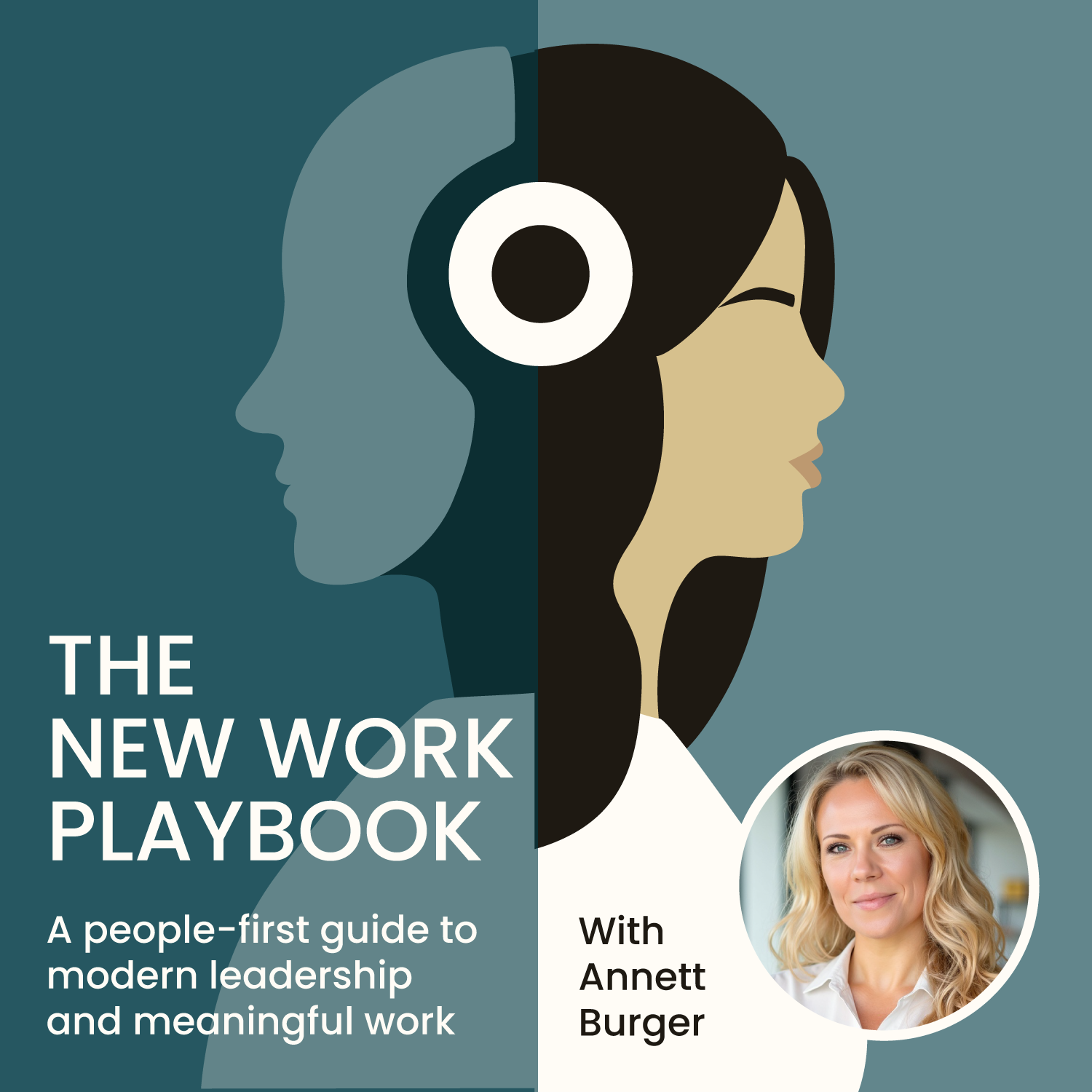
PODCAST · business
THE NEW WORK PLAYBOOK
by Annett Burger
Most of what we consider to be leadership is about managing resources, not leading humans. AI is about to make that impossible to ignore.The leadership practices that would actually make work better for us are not new. They've just never been trained and practised well enough. Instead we focused on efficiency, control and output. That's management. Now AI can handle all of that much better. What's left for us?I think this is the defining question of our time. Instead of asking if AI will replace leaders, we should ask whether we'll finally build the kind of leadership that deserves to stay.The New Work Playbook is a weekly podcast for anyone who believes that work gets better because people matter. Monday episodes explore why something matters for leadership in the age of AI. Friday reflection episodes give you something practical to try. Hosted by Annett Burger, a leadership practitioner with twenty years of experience in executive search, leadership development, and consulting.
-
14
The Broken Spine
What happens when trust collapses at every layer of our world? When companies replace thousands with AI, when politicians are serving their personal interests, and the AI race runs faster than the questions it should answer first? In this episode I look at why trust as the spine of our society is broken. Why even the right kind of leaders are subject to the pressures that make trust collapse. And why the answer to bringing trust back may not start where most listeners expect. I tell the story of the people who walked away from OpenAI in 2021 to build something different, ask what their decision tells us about the kind of leadership that builds trust, and make the case that the leadership we are getting is the cumulative effect of millions of trust choices we are making every day. Can we bring trust back, especially in the age of AI? The episode answers that question but the answer requires more from us than from the leaders we want to follow.
-
13
Reclaiming Our Curiosity
We were told humans now have shorter attention spans than goldfish. That's a myth turned into popular knowledge. The story has been useful to industries that profit from us believing we are smaller than we are. This reflection episode looks at how diminished beliefs about us shape the environments we accept, and what curiosity has to do with rebuilding them. A private reflection on the times you were certain and turned out to be wrong. The practice of "Keep Asking" when AI hands you the surface answer. And two ways leaders bring curiosity back into their teams. When did you last let yourself wonder?
-
12
The End of Why
When was the last time you let yourself wonder about something for more than a few minutes, instead of reaching for an answer? This episode is about what curiosity actually is, why most organisations have been quietly destroying it for decades, and what that means now that AI is walking on stage. From a 1995 computer science classroom, to two CEOs who took the opposite path, to research published earlier this month: what are we actually trading away when we hand our thinking to machines? This episode connects directly to The Confidence Trap and sets up the next episode on trust.
-
11
The Confidence Check
How quickly does your brain jump to an answer? Do you recall your success stories as they were, or how you would like them to sound? Do your opinions about others run your conversations with them? This reflection episode will put your confidence to the test. Two reflections to catch your patterns, and two practices you can start using right away.
-
10
The Confidence Trap
We tend to trust confident people. We follow them, hire them, promote them. But what happens when that confidence isn't grounded in actual competence? This episode is about the two directions from which we can fall into the confidence trap: Falling for the confidence of others, and falling for our own. I share my most painful personal experience of overconfidence, explain the Dunning-Kruger effect, and go deeper into the area where I've seen overconfidence do the most damage in business.
-
9
The Pull of Power
This is the companion episode to The Power Paradox. Power doesn't corrupt us all at once. It works on us slowly, in small choices we don't notice making. This reflection walks you through the three areas where the pull is strongest: Your relationship with feedback. How you talk about people who aren't in the room. How you handle advantages and favours. I also share three signs that the political games of someone above have started reaching you. And I give you the strategy that keeps me grounded.
-
8
The Power Paradox
Do you like the feeling of others having power over you? Power shapes everything, leadership, companies, and the societies we live in. What we rarely question is what drives people to seek it in the first place. Not everyone wants a leadership position with the same intent. Some step into it to take responsibility and build something meaningful. Others are primarily drawn to power itself and how they can use it to advance themselves. That difference is hard to detect in hiring, but over time it defines the kind of leadership we get. Power also shifts the behaviour of even the most well-intentioned leaders. Which leads to the question: Why do the wrong people end up in charge? Resources mentioned: Dacher Keltner, The Power Paradox: How We Gain and Lose Influence (2016) Amy Edmondson, The Fearless Organization: Creating Psychological Safety in the Workplace for Learning, Innovation, and Growth (2018)
-
7
Training Your Respect Muscles
Three days after We Are Losing Respect, it's time to turn what you noticed into practice. What did the post-its show you? In this reflection session, we work with your Respect Stacking patterns to find what sits underneath them. I share five practices you can start using immediately. Three daily habits to build the foundation of grounded respect. Two countermeasures for the moments when your triggers hit. Short, practical, and designed to make a difference.
-
6
We Are Losing Respect
Most of us consider ourselves respectful. But what happens to that respect when we're stressed, tired, or in a hurry? When we're talking to someone we don't need anything from? When the person in front of us is slowing us down? This episode is about why respect collapses under pressure. What research tells us about the cost of disrespect at work, and why respect that isn't grounded in our values is just performance. I also share Respect Stacking, an exercise I built for myself to uncover the patterns most of us don't see. Try it for three days before the reflection episode on Friday.
-
5
The Beliefs Running Your Leadership
This is a guided reflection on the beliefs that shape your leadership. It will help you uncover what impacts your thinking about the role of a leader and show you where a review and update could be valuable. In this 10-minute reflection episode, you will walk through the five-stage framework from the Leadership Belief Audit (Mirror, Origin, Test, Cost, Rewrite) applied to your beliefs about your role as a leader. This episode is designed to be done, not just listened to. Pause where prompted. Answer honestly. If you want to go deeper across more areas, download the full Leadership Belief Audit for free at thenewworkplaybook.com. Link in the show notes.
-
4
The Lazy Human
A room of over 100 leaders is asked to get creative and draw something in pairs. They reach for safe little landscapes with houses, trees, the sun in the corner. Then the brief changes, and the same room produces something completely different. This episode is about how our beliefs shape environments and produce outcomes that confirm those beliefs, but may not be what we wanted. What happens when modern expectations meet outdated assumptions about human motivation? And what does that mean for engagement, innovation, and the kind of leadership we actually need? Includes an invitation to run your own leadership belief audit. Free download in the show notes.
-
3
THE NEW WORK PLAYBOOK
What if the biggest threat to the future of human work isn't AI, but what most organisations believe about the meaning of work in our lives? Over the past 20 years, my work has taken me through different industries, countries, and companies. What I've seen again and again is that organisations fall into two categories: those that treat people like any other resource, and those that see people as the reason their business exists. The future of work depends on the right leadership, not just technology. That is what The New Work Playbook is about. Monday episodes explore why something matters for leadership in the age of AI. Friday reflection episodes give you something practical to try. This podcast is for leaders who understand that work gets better when people matter.
No matches for "" in this podcast's transcripts.
No topics indexed yet for this podcast.
Loading reviews...
ABOUT THIS SHOW
Most of what we consider to be leadership is about managing resources, not leading humans. AI is about to make that impossible to ignore.The leadership practices that would actually make work better for us are not new. They've just never been trained and practised well enough. Instead we focused on efficiency, control and output. That's management. Now AI can handle all of that much better. What's left for us?I think this is the defining question of our time. Instead of asking if AI will replace leaders, we should ask whether we'll finally build the kind of leadership that deserves to stay.The New Work Playbook is a weekly podcast for anyone who believes that work gets better because people matter. Monday episodes explore why something matters for leadership in the age of AI. Friday reflection episodes give you something practical to try. Hosted by Annett Burger, a leadership practitioner with twenty years of experience in executive search, leadership development, and consulting.
HOSTED BY
Annett Burger
CATEGORIES
Loading similar podcasts...
URL copied to clipboard!