
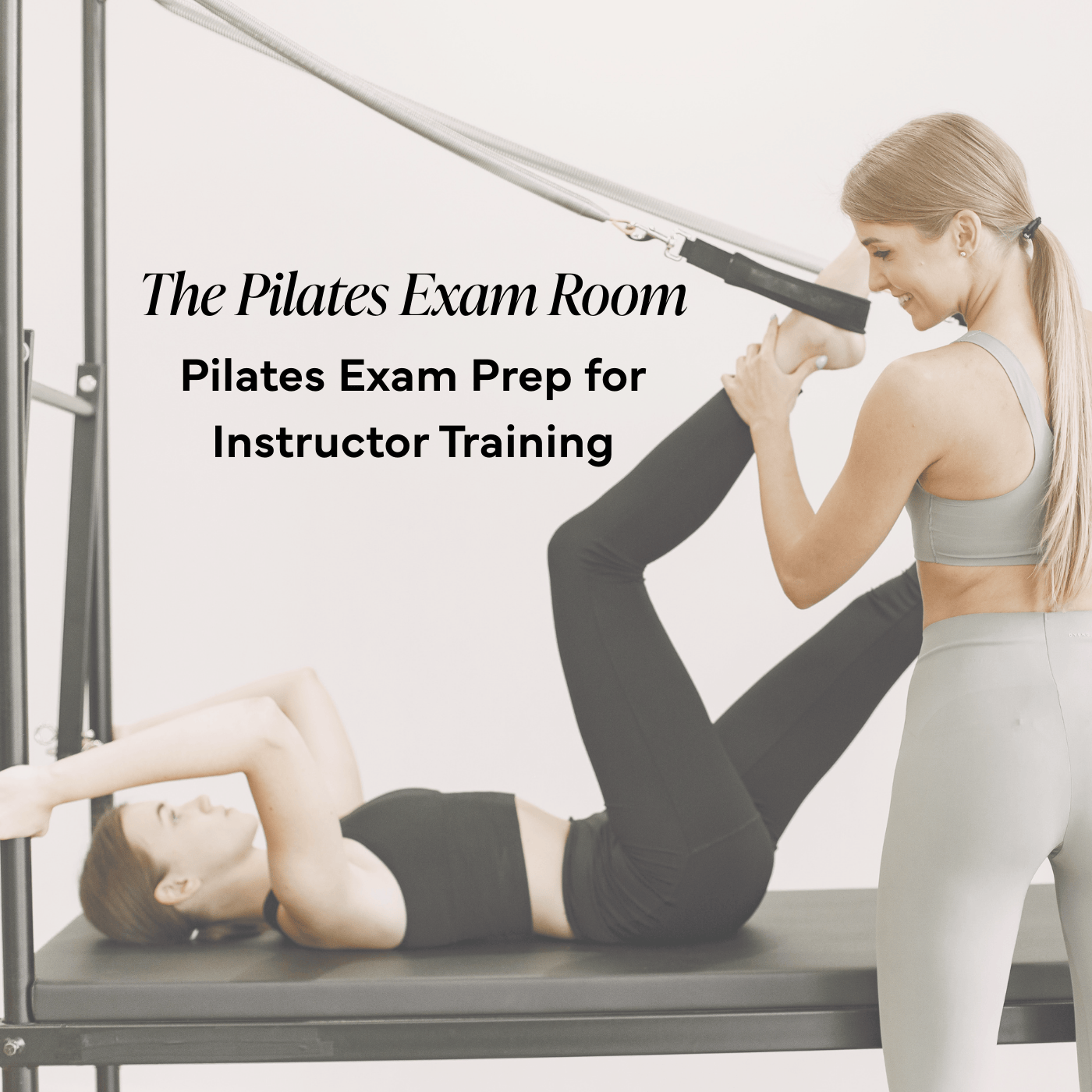
PODCAST · health
The Pilates Exam Room
by The Studio
A deep dive educational conversation for Pilates pros—A calm, practical chat for instructors: exam-prep conversations -aligned objectives, linking repertoire, movement science, and rehab principles to help you pass boards and stay sharp across the lifespan. Educational only, not medical advice.
-
77
Teaser Series Deep Dive Discussion
Understanding the benefits and steps to the teaser variation.
-
76
The Secret Language of Movement
Visual Cueing for Instructors
-
75
Meet The Rhomboids
The Dynamic Duo
-
74
-
73
-
72
From Passion To Practice
Taking your pilates professional.
-
71
-
70
-
69
-
68
How To Plan A Pilates Class - For Instructors
Guideline and tips to remove the stress.
-
67
Core Uncovered
Torso & Spine Demystified Chapters (00:00:00) - The Core of Your Body: Anatomy 101(00:00:58) - What is a body's connective tissue?(00:02:21) - Anatomy 5, Agonists, Integrists, Mobil(00:05:02) - Anatomy 4, Breathing(00:06:50) - The Secret Soldiers of the Spine(00:09:16) - Is Your Spine More Mobile Than Mine?(00:10:22) - External Obliques and Rectus abdominis(00:12:32) - Muscles of the Back: Extensions and stabilizers(00:14:11) - An Overview of Psoas and iliacus(00:17:05) - Th thoracolumbar fascia: a soup can of(00:19:20) - An Intimate Dance Through Your Spine
-
66
Beyond The Six Pack
A deep dive into core and more. Chapters (00:00:00) - Your Core: The Real Story(00:00:50) - Understanding the Body's Connective Tissues(00:01:58) - Your Inner Core
-
65
Your Body's Secret Symphony
The Musculoskeletal System from Head to Toe Chapters (00:00:00) - A New Look at Your Body's Muscles(00:01:19) - What is a muscle? (Myology 101)(00:04:48) - How to Flex Your Neck(00:06:51) - Anatomy 4, The Core(00:10:10) - The iliopsoas(00:11:16) - Anatomy 6, Stability and Mobility(00:14:09) - Head and Shoulder Muscles(00:15:27) - Anatomy 4, The hip, thigh, knee(00:18:50) - What are hip flexors and the sartorius muscle?(00:19:42) - Hamstrings 6, Leg extensors(00:20:35) - Anatomy 4, Leg and knee movements(00:23:43) - An Intimate Look at Your Body
-
64
3 Steps Guide to Cueing
A look at Ginny Massie's 3 Step Guide to Empowering Communication
-
63
Benefits of Pilates on Depression, Anxiety, and Stress
An Observational Study Comparing People Practicing Pilates to Non-Active Controls
-
62
-
61
Your Body's Hidden Architecture
Unpacking the Musculoskeletal System Chapters (00:00:00) - The Most Important Muscle in Your Body(00:02:28) - Inside Your Body: The Core and Mobilizers
-
60
-
59
The Skeleton
The Body's Blueprint Chapters (00:00:00) - A Skeleton: The Living Architecture(00:01:01) - Myology 6, Your Living Framework(00:04:14) - A Skeleton's Framework and Joints
-
58
Pilates Certification Training
The episode highlights the essential steps for aspiring Pilates instructors to gain certification and become effective teachers. Key themes include the importance of understanding anatomy and biomechanics, the need for comprehensive training, and the benefits of Pilates for health and well-being. This information is highly relevant to the general public, particularly those interested in pursuing a career in Pilates or enhancing their personal practice.
-
57
Rocking
An advanced prone thoracic extension with bilateral knee flexion holding the ankles/shins and a gentle forward–back rocking about the lower ribs/upper abdomen. It integrates spinal extensors + glute–ham synergy + anterior hip length while maintaining quiet ribs/pelvis and a long neck.
-
56
Lobster
A prone thoracic extension drill with coordinated arm and leg abduction/adduction (“open/close”) performed at a small hover. Trains posterior chain endurance, scapular organization, hip line control, and breath under rhythmic load—without dumping into the lumbar spine.
-
55
One Leg Kick and Double Leg Kick Explained
Both drills are prone posterior-chain exercises. One Leg Kick emphasizes hamstring curl + hip extension on a Sphinx/forearm support with thoracic lift. Double Leg Kick adds bilateral knee flexion pulses with a coordinated thoracic extension reach (hands behind back). They balance flexion-heavy ab blocks, pattern glute–ham synergy, and train scapular organization with a quiet pelvis.
-
54
-
53
Heel Squeeze
A prone posterior-chain activation that targets the deep hip external rotators, hamstrings, and glute max while the pelvis stays heavy and quiet. Trains organized turnout and hip extension without dumping into the lumbar spine. Also called Heel Squeeze Prone; a great bridge between Half Swan/Superman and more dynamic prone work.
-
52
Swimming
Swimming is a prone contralateral extension drill: alternating arm/leg lifts that train thoracic extension, posterior oblique sling (lat ↔ glute), and breathing under rhythmic load, while the pelvis stays heavy and the neck stays long.
-
51
Body Language
Understanding how we move. Chapters (00:00:00) - Learning to Move Your Body(00:00:57) - Anatomy 4, Movement(00:02:35) - Anatomy: Parts, Actions, Vocabulary
-
50
Breast Stroke
A prone thoracic extension series that coordinates scapular organization with a flowing arm stroke pattern. You create axial length, then layer extension and arm circles while the pelvis stays heavy and quiet.
-
49
Swan Dive Series
Swan Dive is an advanced prone thoracic extension with a rhythmic rocking “bow” about the lower ribs/upper abdomen. It integrates spinal extensors + glute-ham synergy + scapular organization while the pelvis stays heavy/quiet and the neck stays long.
-
48
Superman
A prone, global back-extension pattern that integrates thoracic extension, glute-ham co-contraction, and scapular organization while the pelvis stays heavy and quiet. Think of it as a cousin to Swan/Dart, skewed toward a long-lever isometric hold rather than a press-up.
-
47
The Half Swan
A prone thoracic extension series that teaches you to create axial length and segmental extension from the mid-spine while the pelvis stays heavy and quiet. It balances the flexion-heavy ab work, restores posture, and trains scapular organization.
-
46
Beyond Scaffolding
Your Bones, Joints, and the Suprising Engineering of Movement Chapters (00:00:00) - Your Skeleton(00:00:58) - The Role of Bones in Your Body(00:04:38) - How Do Your Ligaments Flex?(00:06:20) - Anatomy 3, The skeleton(00:07:03) - Your spine(00:08:47) - How Spinal Mobility Is Made(00:09:55) - Anatomy 4, Head, Neck, Rib Cage(00:11:31) - The pelvis(00:12:26) - The shoulder is a masterclass in mobility(00:13:25) - Fooled by Nature: The forearm(00:14:27) - Anatomy 4, The foundations of your body
-
45
Teaser Series
Teaser is an advanced segmental thoracic flexion to a balanced V-sit with controlled lever management (legs/arms) and an articulate return. It integrates rib–pelvis organization, hip dissociation, and breathing under load.
-
44
The Neck Pull
Neck Pull is an advanced Roll-Up family exercise performed with hands behind head, elbows wide, increasing lever length and load across the anterior chain while demanding thoracic flexion control and—in the second variation—flat-back hinge competency. It’s a posture re-educator: length first, then segment.
-
43
The Roll-Up Explained
A segmental spinal flexion (and extension on the return) performed supine → seated → forward flexion, then reversing to articulate down. Trains rib–pelvis integration, eccentric control, and breathing under load. It’s the poster child for peel, don’t yank.
-
42
Obliques 1 & 2
Obliques (aka Criss-Cross family) train segmental thoracic flexion + rotation while the pelvis stays quiet. They build rotational trunk endurance, hip dissociation, and breath coordination—core skills for gait, sport, and daily turning.
-
41
-
40
One Leg Circle
A hip-centric circumduction drill done supine that trains hip dissociation (femur moving in the socket) while the pelvis and rib cage stay quiet. Builds control through multiple planes (sagittal ↔ frontal ↔ transverse) with modest range.
-
39
Classical Ab Series: Single Leg Stretch, Double Leg Stretch, Scissors and More
These are core pieces of the Classical Ab Series. They train segmental thoracic flexion and hip dissociation while the trunk stays organized (anti-extension, anti-rotation). Breath shapes the abdomen from the inside—your “free core brace.”
-
38
The Language of Movement
Your body's user manual: unpacking movement and why natural isn't always neutral. Chapters (00:00:00) - What Really Happens Inside My Body(00:03:27) - Basic anatomical terminology for muscles, fascia, and more(00:06:47) - Anatomy 6, Anatomical Neutrality(00:09:15) - Body Physiology: Deep, Superficial and Intermediate(00:10:08) - Body Movement 6, Planes of Motion(00:14:19) - What is Neutral and Natural Posture?(00:17:50) - The Neutral Posture
-
37
The Hundreds
The Hundred is a dynamic thoracic flexion hold with rhythmic arm pumps and breath patterning (5 counts in, 5 counts out × 10 cycles = 100 pumps). It builds heat, increases respiratory efficiency, and trains global endurance while you stabilize the lumbopelvic region.
-
36
Toe Taps
Toe Taps teach hip dissociation (moving at the hip without the pelvis/lumbar spine joining the party) while training deep core stability and breath control. They’re a cornerstone for progressing toward dead bugs, ab series, and double-leg lower lifts—without poking the low back.
-
35
The Pilates Half Curl
The Half Curl (aka “chest lift prep”/“ab prep”) is a segmental thoracic flexion in supine. You maintain a stable pelvis/ribs, then curl the head/shoulders until the inferior tips of the scapulae are just light on the mat. Range is modest; quality is everything.
-
34
The Healthy Chaos of Movement
Why Pilates Needs Non Linear Science
-
33
Pilates and The Perfect Movement Myth
Why Variability is Your Body's Secret Weapon Chapters (00:00:00) - Pilates: The Science of Movement Variability(00:04:33) - The Surprising Science of Pilates(00:07:50) - Pilates and Movement Variability(00:15:03) - What Is True Movement Mastery?
-
32
Beyond The Mat
A discussion about the history of Pilates and Joseph Pilates story.
-
31
Cueing Tips for Instructors
A 3-Step Process
-
30
From Pilates Student to Pilates Instructor
Preparing for Pilates Teacher Training and Ditching Perfection
-
29
Your Trapezius: The Unsung Giant
Deep Dive into Your Trapezius and How to Master Your Anatomy
-
28
Your Muscles: The Architects of Movement
The Master Architects of Movement, Heat, and Hidden Strength
We're indexing this podcast's transcripts for the first time — this can take a minute or two. We'll show results as soon as they're ready.
No matches for "" in this podcast's transcripts.
No topics indexed yet for this podcast.
Loading reviews...
ABOUT THIS SHOW
A deep dive educational conversation for Pilates pros—A calm, practical chat for instructors: exam-prep conversations -aligned objectives, linking repertoire, movement science, and rehab principles to help you pass boards and stay sharp across the lifespan. Educational only, not medical advice.
HOSTED BY
The Studio
Loading similar podcasts...
Frequently Asked Questions
How many episodes does The Pilates Exam Room have?
The Pilates Exam Room currently has 50 episodes available on PodParley. New episodes are automatically indexed when they're published to the podcast feed.
What is The Pilates Exam Room about?
A deep dive educational conversation for Pilates pros—A calm, practical chat for instructors: exam-prep conversations -aligned objectives, linking repertoire, movement science, and rehab principles to help you pass boards and stay sharp across the lifespan. Educational only, not medical advice.
How often does The Pilates Exam Room release new episodes?
The Pilates Exam Room has 50 episodes. Check the episode list to see recent publication dates and frequency.
Where can I listen to The Pilates Exam Room?
You can listen to The Pilates Exam Room on PodParley by clicking any episode. We provide an embedded audio player for direct listening, and you can also subscribe via your preferred podcast app using the RSS feed.
Who hosts The Pilates Exam Room?
The Pilates Exam Room is created and hosted by The Studio.
URL copied to clipboard!