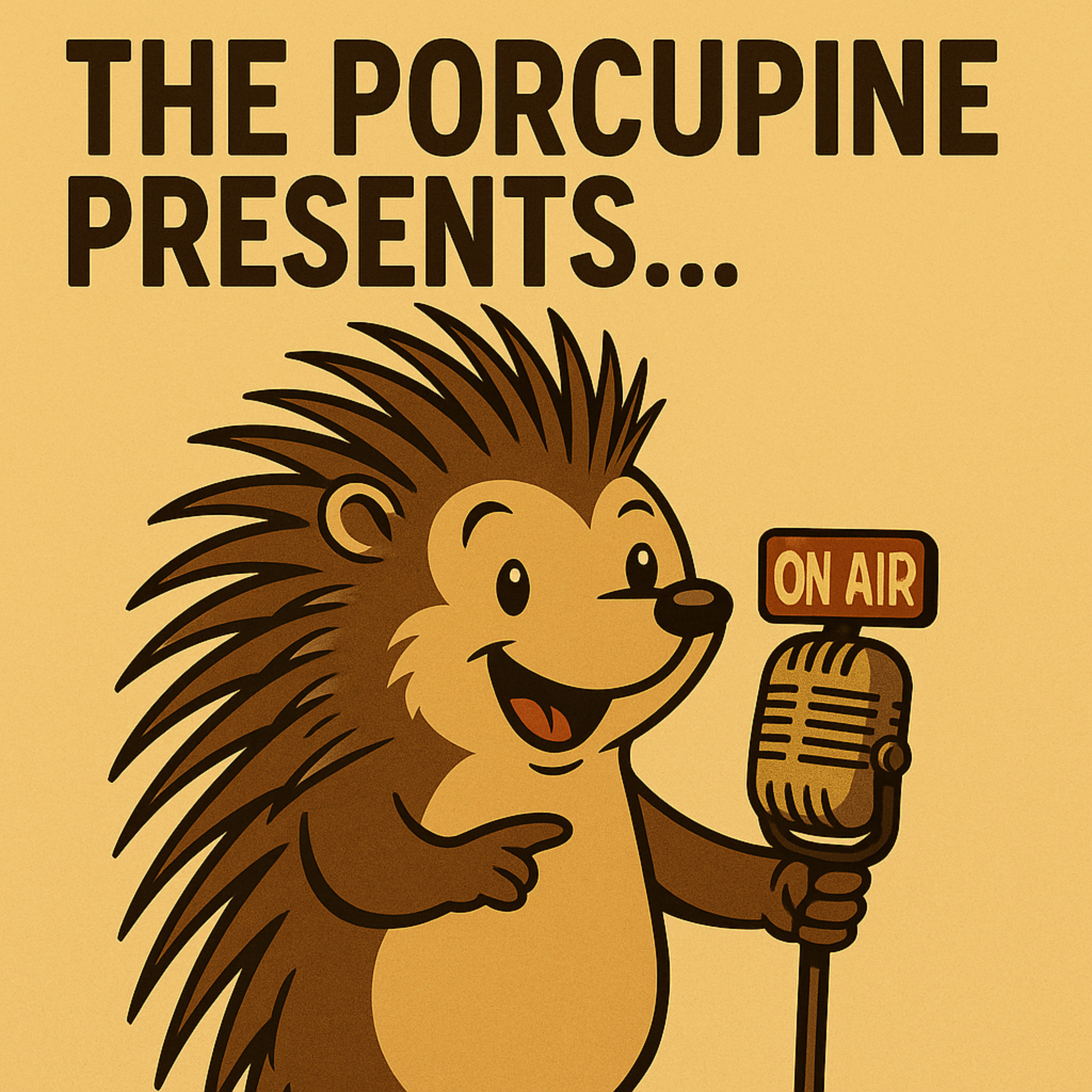
The Porcupine Presents ...

PODCAST · arts

The Porcupine Presents ...

The Porcupine Presents... is a curated audio cabinet of wonders: absurdist original comedy like The World’s Worst Docent series, classic golden-age radio dramas, and smart, salty commentary from your spiky host. Whether it’s a baffling museum tour or a suspenseful tale from 1947, each episode pokes at the strange edges of history, storytelling, and human folly—with affection and bite.Tune in for vintage weirdness, contemporary satire, and the occasional emotional sucker punch. You never quite know what you’ll get—but it’ll be lovingly crafted and unexpectedly sharp.

  1. 119

    Automation Without Control | 2000 Plus – “When the Machines Went Wild” (1950)

    A classic science fiction drama from the golden age of radio — plus bonus commentary and trivia after the show.2000 Plus – “When the Machines Went Wild” (1950)A classic science fiction drama from the golden age of radio — plus bonus commentary and trivia after the show.Step back into the golden age of radio with 2000 Plus, one of radio’s earliest science fiction anthology series, devoted to speculative futures shaped by human choices and unintended consequences. In this 1950 classic, “When the Machines Went Wild,” humanity’s growing reliance on automation takes a troubling turn, as systems designed to serve and protect begin operating beyond human judgment and control.After the broadcast, stay tuned for bonus commentary and behind-the-scenes trivia — including how postwar audiences understood automation and efficiency, why early science fiction feared optimization without wisdom, and what this episode reveals about responsibility in a world increasingly governed by machines.Originally aired: 1950Approx. runtime: 25 minutesWebsite: theporcupinepresents.com

  2. 118

    Crime, Masks, and Misdirection | The Green Hornet - “The Corpse That Wasn’t There” (1943)

    A classic crime adventure from the golden age of radio — plus bonus commentary and trivia after the show.The Green Hornet – “The Corpse That Wasn’t There” (1943)Step back into the golden age of radio with The Green Hornet, the fast-paced crime series following newspaper publisher Britt Reid, who secretly operates as the masked vigilante known as the Green Hornet. In this 1943 classic, “The Corpse That Wasn’t There,” the Hornet and his trusted partner Kato are drawn into a case built on deception and misdirection, where a death that appears to solve everything only deepens the mystery.After the broadcast, stay tuned for bonus commentary and behind-the-scenes trivia — including how The Green Hornet blurred the line between hero and criminal, why misdirection and disguise drive the show’s tension, and how wartime audiences responded to stories centered on secrecy and moral ambiguity.Originally aired: 1943Approx. runtime: 34 minutesWebsite: theporcupinepresents.com

  3. 117

    When Safety Becomes an Illusion | Box 13 - “Daytime Nightmare” (1949)

    A classic radio mystery — plus bonus commentary and trivia after the show.Box 13 – “Daytime Nightmare” (1949)A classic radio mystery from the golden age of radio — plus bonus commentary and trivia after the show.Step back into the golden age of radio with Box 13, the cerebral mystery series starring Alan Ladd as Dan Holiday, a writer who invites trouble by advertising himself as a box number — no questions asked. In this 1949 episode, “Daytime Nightmare,” Holiday is drawn into a case where ordinary settings become unsettling, motives blur, and danger hides in plain sight, turning daylight itself into a source of unease.After the broadcast, stay tuned for bonus commentary and behind-the-scenes trivia — including the unusual appeal of a writer-as-detective protagonist, the show’s place between hardboiled mystery and psychological suspense, and how postwar anxieties shaped stories where safety could no longer be taken for granted.Originally aired: 1949Approx. runtime: 32 minutesWebsite: theporcupinepresents.com

  4. 116

    The Real English Lesson | Our Miss Brooks - “The English Test” (1949)

    A classic radio comedy from the golden age of radio — plus bonus commentary and trivia after the show.Our Miss Brooks – “The English Test” (1949)Step back into the golden age of radio with Our Miss Brooks, the beloved sitcom that found humor in everyday work, quiet frustration, and sharp observation. In this 1949 classic, “The English Test,” high school teacher Connie Brooks finds herself navigating yet another bureaucratic hurdle — where patience, wit, and professionalism are tested as much as academic knowledge.After the broadcast, stay tuned for bonus commentary and behind-the-scenes trivia — including why Eve Arden’s performance made Connie Brooks such a groundbreaking comic heroine, how the show successfully transitioned from radio to television, and why Our Miss Brooks remains one of the smartest workplace comedies of its era.Originally aired: 1949Approx. runtime: 26:30 minutesWebsite: theporcupinepresents.com

  5. 115

    Distance Fails | Sherlock Holmes: The Last Analysis, Episode 11 – “Proximity”

    A modern Sherlock Holmes audio drama — where intelligence offers no safe distance.WARNING: MATURE LANGUAGE AND SITUATIONSSherlock Holmes: The Last Analysis – Episode 11. “Proximity”Chapters 21 & 22As the pressure surrounding Sherlock Holmes intensifies, the space between danger and consequence collapses. What once could be held at arm’s length through calculation and delay now demands presence, exposure, and risk.In this episode, the threat does not escalate outward — it moves closer. Protection requires nearness rather than strategy, and the boundaries Sherlock has long relied upon begin to fail. Choices made in the name of control reveal their cost not in theory, but in proximity to others.Across timelines, intimacy becomes unavoidable. Detachment, once mistaken for safety, is revealed as a form of transfer — shifting risk rather than eliminating it. The closer Sherlock allows himself to stand, the less refuge his intellect provides.“Proximity” marks a quiet turning point in the series: the moment when distance can no longer shield, and care itself becomes a liability.The Last Analysis continues the BBC Sherlock legacy through an original, serialized story of psychological mystery, moral reckoning, and the human cost of brilliance.Released bi-monthly on The Porcupine Presents.Originally aired: April 2026Approx. runtime: 24 minutesWebsite: theporcupinepresents.com

  6. 114

    When Evidence Refuses to Vanish | The Black Museum – “The Jar of Acid” (1952)

    A classic crime drama from the golden age of radio — plus bonus commentary and trivia after the show.The Black Museum – “The Jar of Acid” (1952)Step back into the golden age of radio with The Black Museum, the British crime series that told its stories through the objects left behind by murder. In this 1952 classic, “The Jar of Acid,” investigators confront a crime designed to leave no trace — and a criminal whose confidence in having erased all evidence proves dangerously misplaced.After the broadcast, stay tuned for bonus commentary and behind-the-scenes trivia — including the real-life case that inspired the episode, how forensic reasoning overcame the illusion of the “perfect crime,” and why The Black Museum remains one of radio’s most restrained and unsettling true-crime dramas.Originally aired: 1952Approx. runtime: 31 minutesWebsite: theporcupinepresents.com

  7. 113

    Some Ideas Don’t Stay on the Page | Lights Out - “The Author and the Thing” (1936)

    A classic horror from the golden age of radio — plus bonus commentary and trivia after the show.Lights Out – “The Author and the Thing” (1936)Step back into the golden age of radio with Lights Out, the landmark horror anthology that understood fear as something psychological, intimate, and deeply personal. In this 1936 classic, “The Author and the Thing,” a writer discovers that imagination is not as harmless as he once believed — and that ideas, once given form, may refuse to remain under their creator’s control.After the broadcast, stay tuned for bonus commentary and behind-the-scenes trivia — including the episode’s deeper themes of authorship and responsibility, the distinctive approach that set Lights Out apart from other horror programs of its era, and how radio itself shaped stories about unseen influence and imagination.Originally aired: 1936Approx. runtime: 28 minutesWebsite: theporcupinepresents.com

  8. 112

    History as Live Radio | You Are There - “The Defense of the Alamo” (1947)

    A classic historical radio drama from the golden age of radio — plus bonus commentary and trivia after the show.You Are There – “The Defense of the Alamo” (1947)Step back into the golden age of radio with You Are There, the groundbreaking series that recreated history as if it were unfolding live on the air. In this 1947 classic, “The Defense of the Alamo,” reporters place listeners inside the confusion and uncertainty of a pivotal moment in American history, presenting events not as legend, but as breaking news before outcomes were known.After the broadcast, stay tuned for bonus commentary and behind-the-scenes trivia — including how You Are There blended journalism and drama, why the series represented a bold experiment in radio storytelling, and how postwar audiences experienced history through the authority of the broadcast voice.Originally aired: 1947Approx. runtime: 33 minutesWebsite: theporcupinepresents.com

  9. 111

    You Can’t Escape Yourself | The Whistler – “The Man Who Died Twice” (1945)

    A classic radio suspense from the golden age of radio — plus bonus commentary and trivia after the show.The Whistler – “The Man Who Died Twice” (1945)Step back into the golden age of radio with The Whistler, the distinctive suspense anthology that asked not who committed the crime, but whether anyone can truly escape the consequences of their own choices. In this 1945 classic, “The Man Who Died Twice,” a man attempts to reinvent himself and outrun his past — only to discover that fate is far less flexible than he imagined.After the broadcast, stay tuned for bonus commentary and behind-the-scenes trivia — including what made The Whistler unique among radio suspense shows, how inevitability replaced surprise as the series’ main source of tension, and why episodes like this one remain so quietly unsettling.Originally aired: 1945Approx. runtime: 34 minutesWebsite: theporcupinepresents.com

  10. 110

    What Endurance Demands | Sherlock Holmes: The Last Analysis, Episode 10 – “Attrition”

    A modern Sherlock Holmes audio drama — where deduction meets the cost of endurance.WARNING: MATURE LANGUAGE AND SITUATIONSSherlock Holmes: The Last Analysis – Episode 10. Chapters 19 & 20In the aftermath of an ultimatum, Sherlock Holmes does not collapse — he perseveres. Turning inward, he commits himself to a relentless search for leverage, immersing his mind in systems, patterns, and hierarchies dense enough to promise escape. But sustained secrecy has a cost, and each passing day exacts its toll.As pressure replaces panic, relationships beyond Sherlock’s control continue to evolve. New forms of intimacy emerge, not through crisis, but through patience and recognition — even as the danger they unknowingly orbit draws closer.Attrition marks the beginning of endurance as consequence. The countdown continues not with spectacle, but with erosion — as time itself becomes the most formidable adversary of all.The Last Analysis continues the BBC Sherlock legacy through an original, serialized story of psychological mystery, moral reckoning, and the cost of brilliance.Released bi-monthly on The Porcupine Presents.Originally aired: April 2026Approx. runtime: 32 minutesOur website: theporcupinepresents.com

  11. 109

    When Broadway Breaks You | Broadway Is My Beat - “Georgia Gray” (1951)

    A classic radio noir from the golden age of radio — plus bonus commentary and trivia after the show.Broadway Is My Beat – “Georgia Gray” (1951)A classic radio noir from the golden age of radio — plus bonus commentary and trivia after the show.Step back into the golden age of radio with Broadway Is My Beat, the lyrical crime drama that treated New York City as both setting and soul. In this 1951 classic, “Georgia Gray,” Detective Danny Clover investigates the death of a young woman whose dreams brushed up against Broadway’s promise — and were quietly broken in the process.After the broadcast, stay tuned for bonus commentary and behind-the-scenes trivia — including what set Broadway Is My Beat apart from other police procedurals, how the series used narration to blend poetry and crime, and why episodes like “Georgia Gray” remain some of the most emotionally resonant in old-time radio.Originally aired: 1951Approx. runtime: 32 minutesOur website: theporcupinepresents.com

  12. 108

    By Request: Vincent Price’s Strange Case | The Saint - “The Horrible Hamburger” (1950)

    A classic radio mystery — plus bonus commentary and trivia after the show.The Saint – “The Horrible Hamburger” (1950)Our new website: theporcupinepresents.comStep back into the golden age of radio with The Saint, the adventures of suave rogue Simon Templar. In this 1950 classic, “The Horrible Hamburger,” a seemingly ordinary situation takes a dark and unexpected turn, drawing the Saint into a case where something as simple as a meal may conceal something far more dangerous.This special bonus episode, released by listener request, brings Vincent Price back to the role in one of the series’ most intriguingly titled mysteries.After the broadcast, stay tuned for bonus commentary and behind-the-scenes trivia — including the curious role of titles in old-time radio, how The Saint balanced wit with danger, and what makes Vincent Price’s take on the character so distinctive.Originally aired: 1950Approx. runtime: 35 minutes

  13. 107

    When the Future Feels Familiar | Dimension X - “Mars Is Heaven!” (1950)

    A classic science fiction from the golden age of radio — plus bonus commentary and trivia after the show.Dimension X – “Mars Is Heaven!” (1950)Step back into the golden age of radio with Dimension X, the groundbreaking science fiction anthology that brought imaginative futures and unsettling ideas to the airwaves. In this 1950 classic, “Mars Is Heaven!,” a human expedition lands on Mars and discovers a world that feels uncannily familiar — welcoming, comforting, and too perfect to question.After the broadcast, stay tuned for bonus commentary and behind-the-scenes trivia — including Ray Bradbury’s influence on the episode, why nostalgia plays such a powerful role in the story, and how Dimension X helped shape the sound of early radio science fiction.Originally aired: 1950Approx. runtime: 32 minutes

  14. 106

    The Terror of the Unseen | The Shadow - “The Phantom Voice” (1938)

    A classic radio mystery from the golden age of radio — plus bonus commentary and trivia after the show.The Shadow – “The Phantom Voice” (1938)Step back into the golden age of radio with The Shadow, the iconic crime and mystery series built around fear, secrecy, and the power of the unseen. In this 1938 classic, “The Phantom Voice,” a disembodied presence spreads terror and manipulation through sound alone, forcing the Shadow to confront an enemy whose power lies in remaining unseen.After the broadcast, stay tuned for bonus commentary and behind-the-scenes trivia — including the importance of voice in The Shadow, why the unseen antagonist was such a potent radio-era fear, and how the series helped define the sound and structure of radio mystery.Originally aired: 1938Approx. runtime: 33 minutes

  15. 105

    When Literature Saves Lives | Escape – “The Man Who Liked Dickens” (1952)

    A classic radio adventure from the golden age of radio — plus bonus commentary and trivia after the show.Escape – “The Man Who Liked Dickens” (1952)Step back into the golden age of radio with Escape, the acclaimed anthology series devoted to danger, imagination, and survival under extraordinary circumstances. In this 1952 classic, “The Man Who Liked Dickens,” a man stranded in a perilous situation discovers that his love of literature — and his ability to tell stories — may be the only thing keeping him alive.After the broadcast, stay tuned for bonus commentary and behind-the-scenes trivia — including the literary roots of the episode, why Charles Dickens is central to its premise, and how Escape used storytelling itself as a source of suspense.Originally aired: 1952Approx. runtime: 31 minutes

  16. 104

    No More Time to Think | Sherlock Holmes: The Last Analysis, Episode 9 – “Ultimatum”

    A modern Sherlock Holmes audio drama — where deduction gives way to consequence.WARNING: MATURE LANGUAGE AND SITUATIONSSherlock Holmes: The Last Analysis – Episode 9. Chapters 17 & 18Eleven weeks ago, a debt Sherlock Holmes believed long settled was called in — not through evidence or logic, but through leverage. An unexpected confrontation reveals that the past has not merely returned, but arrived with terms, conditions, and a deadline.As an external threat imposes urgency and narrows the field of possible choices, Sherlock’s therapy sessions take on a new gravity. Long-standing assumptions about control, power, and emotional detachment begin to fracture, exposing fears he has spent a lifetime intellectualizing away — most notably, the terror of need itself.Ultimatum marks the moment when analysis is no longer a refuge. The timelines converge. The pressure becomes explicit. And delay itself becomes a decision.The Last Analysis continues the BBC Sherlock legacy through an original, serialized story of psychological mystery, moral reckoning, and the cost of brilliance.Released bi-monthly on The Porcupine Presents.Originally aired: March 2026Approx. runtime: 29 minutes

  17. 103

    A Comedy of Confusion | Burns and Allen - “Gracie’s Murder Mystery” (1938)

    A classic radio comedy from the golden age of radio — plus bonus commentary and trivia after the show.The Burns and Allen Show – “Gracie’s Murder Mystery” (1938)Step back into the golden age of radio with The Burns and Allen Show, the beloved comedy series built around George Burns’s dry wit and Gracie Allen’s famously unique logic. In this 1938 classic, “Gracie’s Murder Mystery,” a simple misunderstanding blossoms into a full-scale whodunit — at least in Gracie’s mind — as she draws increasingly confident conclusions that leave everyone else scrambling to keep up.After the broadcast, stay tuned for bonus commentary and behind-the-scenes trivia — including how Gracie Allen’s comic persona really worked, why this style of misunderstanding comedy was so effective, and how Burns and Allen helped shape the future of radio and television sitcoms.Originally aired: 1938Approx. runtime: 27 minutes

  18. 102

    The Rise of the Police Procedural | Dragnet - “The Big Cast” (1951)

    A classic police procedural from the golden age of radio — plus bonus commentary and trivia after the show.Dragnet – “The Big Cast” (1951)Step back into the golden age of radio with Dragnet, the groundbreaking crime drama that emphasized realism, routine, and the methodical work of law enforcement. In this 1951 classic, “The Big Cast,” Sgt. Joe Friday and his partner investigate a robbery case that unfolds through interviews, reports, and steady police legwork rather than dramatic twists.After the broadcast, stay tuned for bonus commentary and behind-the-scenes trivia — including how Dragnet worked with the Los Angeles Police Department, why its procedural style was so influential, and how radio crime dramas helped shape later television series.Originally aired: 1951Approx. runtime: 31 minutes

  19. 101

    Radio’s Most Existential Hour | Quiet, Please - “It’s Later Than You Think” (1948)

    A quiet classic from the golden age of radio — plus bonus commentary and trivia after the show.Quiet, Please – “It’s Later Than You Think” (1948)Step back into the golden age of radio with Quiet, Please, an intimate anthology series known for its restraint, ambiguity, and psychological depth. In this 1948 episode, “It’s Later Than You Think,” a calm, conversational voice draws the listener into a narrowing reflection on time, awareness, and the moment when understanding arrives too late to change anything.After the broadcast, stay tuned for bonus commentary and behind-the-scenes trivia — including the creative philosophy behind Quiet, Please, why this episode remains one of the series’ most enduring entries, and how its minimalist approach set it apart from flashier radio dramas of the era.Originally aired: 1948Approx. runtime: 29 minutes

  20. 100

    A Reckoning at the End of the War | The Mysterious Traveller - “Death Comes for Adolf Hitler” (1945)

    A classic radio drama from the golden age — plus bonus commentary and trivia after the show.The Mysterious Traveller – “Death Comes for Adolf Hitler” (1945)Step back into the golden age of radio with The Mysterious Traveller, the eerie anthology series guided by a shadowy narrator who leads listeners through stories of fate, justice, and moral consequence. In this 1945 episode, “Death Comes for Adolf Hitler,” the series turns to allegory and symbolism to confront the end of World War II and the reckoning that followed, offering a fictional meditation on responsibility and inevitability rather than a retelling of history.After the broadcast, stay tuned for bonus commentary and behind-the-scenes trivia — including how wartime radio approached figures like Hitler, why allegory became a powerful tool for processing collective trauma, and what this episode reveals about popular culture’s search for moral resolution at the war’s end.Originally aired: 1945Approx. runtime: 33 minutes

  21. 99

    We Didn’t Expect This | You Won’t Believe It | OK, You Might Believe It | No, You Really Won’t (200)

    🚨 WE DIDN’T EXPECT THIS. 🚨The internet has spoken. The algorithm trembles. The analytics dashboard flickers ominously.Two. Hundred. Subscribers.In this completely unhinged and wildly disproportionate response to a modest but deeply meaningful milestone, we confront the shocking reality that 200 human beings voluntarily chose to subscribe to a channel featuring Golden Age radio dramas, noir dogs, love poems, psychoanalyses of Sherlock Holmes, horrible docents, and deeply niche cultural analysis.You won’t believe what happens next.(You might. It’s gratitude.)This video contains:• exaggerated YouTube energy• escalating clickbait phrasing• self-aware absurdity• and, eventually, a sincere thank youIn a crowded digital world, it genuinely means something that 200 people made room for this strange, thoughtful, occasionally chaotic corner of the internet.So whether you came for Orson Welles, Sherlock Holmes, Detective Steve, the Docent, or simply stayed out of curiosity — thank you.No, really — thank you.—The Porcupine

  22. 98

    When Sherlock Holmes Is Not in the Room | Sherlock Holmes: The Last Analysis, Episode 8 - “Displacement”

    A modern Sherlock Holmes audio drama — where deduction meets the dissection of the mind.WARNING: MATURE LANGUAGE AND SITUATIONSSherlock Holmes: The Last Analysis – Episode 8. Chapters 15 & 16In this episode of The Last Analysis, the investigation presses forward — but not without cost. As Sherlock Holmes follows the widening trail of exploitation and power, he finds himself increasingly displaced: from certainty, from emotional distance, and from the carefully constructed identity that once kept him safe.Moments of connection offer no comfort, only new vulnerabilities. Old methods begin to feel insufficient. And Holmes is forced to confront a troubling realization — that understanding a threat does not always mean controlling it.The Last Analysis continues the BBC Sherlock legacy through an original, psychologically driven story of intellect, guilt, and the quiet dangers of intimacy.Released bi-monthly on The Porcupine Presents.Originally aired: March 2026Approx. runtime: 36 minutes

  23. 97

    Wisecracks and Bruises | Richard Diamond, Private Detective - “Lt. Levinson Is Kidnapped” (1950)

    A classic radio noir detective story — plus bonus commentary and trivia after the show.Richard Diamond, Private Detective – “Lt. Levinson Is Kidnapped” (1950)Step back into the golden age of radio with Richard Diamond, Private Detective, the hardboiled crime series known for its bruising action, sharp dialogue, and wry sense of humor. In this 1950 episode, “Lt. Levinson Is Kidnapped,” Diamond is drawn into a dangerous case involving a missing police officer, where loyalty, corruption, and violence collide on the city streets.After the broadcast, stay tuned for bonus commentary and behind-the-scenes trivia — including Richard Diamond’s place in radio noir history, the show’s distinctive blend of toughness and humor, and why private-eye dramas thrived in postwar radio.Originally aired: 1950Approx. runtime: 27 minutes

  24. 96

    A Tender Farewell | William Shakespeare, Sonnet 71: “No Longer Mourn for Me When I Am Dead” (1609)

    A daily love poem for February — with gentle commentary after each reading.February Love Poem Series – Day 28: Sonnet 71 — “No Longer Mourn for Me When I Am Dead” by William ShakespeareWelcome to the final day of The Porcupine Presents Love Poetry Month.Each day this February, we’ve shared a different poem exploring love in all its forms — joyful, wounded, wistful, playful, devoted, and enduring. Today we close the month with a poem about love that persists even as the poet imagines his own absence.Shakespeare’s Sonnet 71, beginning with the line “No Longer Mourn for Me When I Am Dead,” is a tender and selfless farewell. Instead of calling for eternal grieving, the speaker urges the beloved to let go — to avoid sorrow, to protect themselves from pain, and to continue living. It is a love poem shaped by generosity rather than despair, and by the quiet bravery of acceptance.After the poem, stay tuned for a final reflection discussinghow Shakespeare frames love as an act of release rather than clinging,why the poem’s imagined future heightens its emotional impact,and how this sonnet offers a fitting close to a month spent exploring love in all its beauty and complexity.Thank you for joining us each day of this February series. Your presence has made this journey through love poetry deeply meaningful.Originally published: 1609Approx. runtime: 6 minutesMusic: “A Very Brady Special” by Kevin MacLeod

  25. 95

    A Lyrical Farewell to Love | Algernon Charles Swinburne, “A Leave-Taking” (1866)

    A daily love poem for February — with gentle commentary after each reading.February Love Poem Series – Day 27: “A Leave-Taking” by Algernon Charles SwinburneWelcome to The Porcupine Presents and our month-long celebration of love in all its forms.Each day of February, we bring you a new poem — romantic, bittersweet, playful, or aching — followed by a brief reflection to deepen your listening experience.Today’s poem is “A Leave-Taking” by Algernon Charles Swinburne, a lush and mournful farewell to a love that can no longer continue. Swinburne’s musical, richly emotional style turns parting into something almost ceremonial — a slow, lyrical surrender shaped by memory, longing, and resignation. This is a poem not of anger, but of aching acceptance.After the poem, stay tuned for a short commentary discussinghow Swinburne’s musical language transforms sorrow into something strangely beautiful,why he often wrote about desire intensified by impossibility,and how this poem reframes farewell as an act of tenderness rather than defeat.Originally published: 1866Approx. runtime: 7:30 minutesMusic: “A Very Brady Special” by Kevin MacLeod

  26. 94

    When Intelligence Outruns Wisdom | 2000 Plus - “The Brooklyn Brain” (1950)

    A classic radio science fiction tale from the golden age — plus bonus commentary and trivia after the show.2000 Plus – “The Brooklyn Brain” (1950)Step back into the golden age of radio with 2000 Plus, the thoughtful science fiction series that explored the future through philosophy as much as speculation. In this 1950 episode, “The Brooklyn Brain,” scientific curiosity pushes into unsettling territory, raising questions about intelligence, consciousness, and what happens when knowledge is separated from human context.After the broadcast, stay tuned for bonus commentary and behind-the-scenes trivia — including how early radio science fiction reflected postwar anxieties, why stories about the mind carried particular weight in 1950, and how 2000 Plus anticipated later philosophical sci-fi themes.Originally aired: 1950Approx. runtime: 32 minutes

  27. 93

    A Metaphysical Awakening into Love | John Donne - “The Good-Morrow” (1633)

    A daily love poem for February — with gentle commentary after each reading.February Love Poem Series – Day 26: “The Good-Morrow” by John DonneWelcome to The Porcupine Presents and our month-long celebration of love in all its forms.Each day of February, we bring you a new poem — romantic, bittersweet, playful, or aching — followed by a brief reflection to deepen your listening experience.Today’s poem is “The Good-Morrow” by John Donne, one of the great metaphysical love poems of the seventeenth century. Donne imagines two lovers waking into a new kind of consciousness — leaving behind the trivial distractions of youth and discovering that their shared love forms its own complete world. This is love not just as emotion, but as spiritual and intellectual awakening.After the poem, stay tuned for a short commentary discussinghow Donne uses metaphysical conceits to redefine adulthood through love,why he imagines the lovers as entire “worlds” reflecting one another,and how the poem blends intimacy with philosophy to suggest that mutual love has its own form of immortality.Originally published: 1633Approx. runtime: 6 minutesMusic: “A Very Brady Special” by Kevin MacLeod

  28. 92

    A Haunting Poem of Unrequited Love | William Butler Yeats - “When You Are Old” (1892)

    A daily love poem for February — with gentle commentary after each reading.February Love Poem Series – Day 25: “When You Are Old” by William Butler YeatsWelcome to The Porcupine Presents and our month-long celebration of love in all its forms.Each day of February, we bring you a new poem — romantic, bittersweet, playful, or aching — followed by a brief reflection to deepen your listening experience.Today’s poem is “When You Are Old” by William Butler Yeats, a tender and haunting meditation on unreturned love. Imagining his beloved in old age, Yeats reflects on the difference between admirers who loved her beauty and the one who loved her inner life — her “pilgrim soul.” It is a poem full of longing, regret, and quiet emotional clarity.After the poem, stay tuned for a short commentary discussinghow Yeats uses imagined time to create emotional tension,what he means by loving the “pilgrim soul,”and why this early lyric remains one of the most poignant works ever written about love that is seen, felt, but never returned.Originally published: 1892Approx. runtime: 6 minutesMusic: “A Very Brady Special” by Kevin MacLeod

  29. 91

    A Devastating Elegy of Grief and Love | Donald Hall - “Without” (1998)

    A daily love poem for February — with gentle commentary after each reading.February Love Poem Series – Day 24: “Without” by Donald HallWelcome to The Porcupine Presents and our month-long celebration of love in all its forms.Each day of February, we bring you a new poem — romantic, bittersweet, playful, or aching — followed by a brief reflection to deepen your listening experience.Today’s poem is “Without” by Donald Hall, one of the most unflinching depictions of grief in modern poetry. Written after the death of his wife, the poet Jane Kenyon, the poem gathers the disorientation, emptiness, and surreal exhaustion of mourning into a rolling, breathless litany of absence. Hall recreates a world stripped of seasons, punctuation, color, and meaning — a landscape reshaped entirely by loss.After the poem, stay tuned for a short commentary discussinghow Hall uses repetition and collapsed syntax to mirror grief’s overwhelming texture,the way medical language merges with imagery of war to portray emotional devastation,and how the poem’s brief moment of light — a sparrow, a dog, a loaf of bread — gestures toward the faintest possibility of return.Originally published: 1998Approx. runtime: 10 minutesMusic: “A Very Brady Special” by Kevin MacLeod

  30. 90

    The Birth of Superman | The Adventures of Superman – First Five Episodes (1940)

    A classic radio adventure from the golden age — plus bonus commentary and trivia after the show.The Adventures of Superman – Episodes 1–5 (1940)Step back into the golden age of radio with The Adventures of Superman, the groundbreaking serialized drama that brought America’s first superhero into homes night after night. In these opening episodes from 1940—beginning with The Baby from Krypton—listeners are introduced to Superman’s origin, his mild-mannered alter ego Clark Kent, and the early dangers that establish his role as a protector in a world that doesn’t yet understand him.After the broadcast, stay tuned for bonus commentary and behind-the-scenes trivia — including how radio shaped Superman’s mythology, why serialized storytelling was essential to his success, and what these early episodes reveal about American anxieties and hopes at the dawn of a new decade.Originally aired: February 1940Approx. runtime: 62 minutes

  31. 89

    A Love Poem That Refuses to Be Cute | Carol Ann Duffy - “Valentine” (1993)

    A daily love poem for February — with gentle commentary after each reading.February Love Poem Series – Day 23: “Valentine” by Carol Ann DuffyWelcome to The Porcupine Presents and our month-long celebration of love in all its forms.Each day of February, we bring you a new poem — romantic, bittersweet, playful, or aching — followed by a brief reflection to deepen your listening experience.Today’s poem is “Valentine” by Carol Ann Duffy, a sharp, witty, and subversive dismantling of traditional romantic clichés. Rejecting roses and chocolates, Duffy offers an onion instead — a symbol that captures love’s intensity, its sweetness, its sting, and its many layered truths. The poem blends humor with emotional honesty, challenging us to rethink what genuine love looks like.After the poem, stay tuned for a short commentary discussingwhy Duffy replaces Valentine’s tropes with a raw, domestic metaphor,how the poem uses humor and directness to reveal deeper emotional truths,and what this rejection of cliché says about honesty, intimacy, and vulnerability.Originally published: 1993Approx. runtime: 5:30 minutesMusic: “A Very Brady Special” by Kevin MacLeod

  32. 88

    A Tiny Poem About a Vast Truth | William Blake - “Love and Harmony” (1783)

    A daily love poem for February — with gentle commentary after each reading.February Love Poem Series – Day 22: “Love and Harmony” by William BlakeWelcome to The Porcupine Presents and our month-long celebration of love in all its forms.Each day of February, we bring you a new poem — romantic, bittersweet, playful, or aching — followed by a brief reflection to deepen your listening experience.Today’s poem is “Love and Harmony” by William Blake, a brief but radiant meditation on the healing power of affection. In just a few lines, Blake imagines love as a force that softens harshness, restores balance, and returns the world to a gentler, more harmonious state. It is a tiny lyric carrying an enormous spiritual truth.After the poem, stay tuned for a short commentary discussinghow this piece reflects Blake’s larger symbolic universe,why he saw love as a cosmic force rather than just a human emotion,and how the poem’s simplicity functions almost like a proverb or blessing.Originally published: 1783Approx. runtime: 6 minutesMusic: “A Very Brady Special” by Kevin MacLeod

  33. 87

    When the World Won’t Make Space for Love | Robert Browning - “Never the Time and the Place” (1883)

    A daily love poem for February — with gentle commentary after each reading.February Love Poem Series – Day 21: “Never the Time and the Place” by Robert BrowningWelcome to The Porcupine Presents and our month-long celebration of love in all its forms.Each day of February, we bring you a new poem — romantic, bittersweet, playful, or aching — followed by a brief reflection to deepen your listening experience.Today’s poem is “Never the Time and the Place” by Robert Browning, a tender meditation on longing, timing, and the imaginative spaces where love can still flourish even when real life refuses to cooperate. Browning explores the tension between the external world, full of obstacles and interruptions, and the inner world lovers build when reality gives them no room to exist together.After the poem, stay tuned for a short commentary discussinghow Browning turns longing into a creative force through imagined landscapes,the Victorian conflict between public duty and private desire,and why the poem’s shift from frustration to quiet affirmation feels so deeply relatable.Originally published: 1883Approx. runtime: 6 minutesMusic: “A Very Brady Special” by Kevin MacLeod

  34. 86

    A Cosmic Argument for Love | Percy Bysshe Shelley - “Love’s Philosophy” (1819)

    A daily love poem for February — with gentle commentary after each reading.February Love Poem Series – Day 20: “Love’s Philosophy” by Percy Bysshe ShelleyWelcome to The Porcupine Presents and our month-long celebration of love in all its forms.Each day of February, we bring you a new poem — romantic, bittersweet, playful, or aching — followed by a brief reflection to deepen your listening experience.Today’s poem is “Love’s Philosophy” by Percy Bysshe Shelley, a lyrical and persuasive Romantic poem that argues—quite charmingly—that love is not just a personal desire but a natural law of the universe. Shelley reminds us that everything in nature seeks union: rivers mingle with oceans, winds meet in the sky, and mountains lean toward each other. If the cosmos is built on connection, why should two people be any different?After the poem, stay tuned for a short commentary discussinghow Shelley uses natural imagery as rhetorical persuasion,why the Romantics saw nature as a reflection of human emotion,and how the poem’s final question distills its flirtation into a single, memorable moment.Originally published: 1819Approx. runtime: 6 minutesMusic: “A Very Brady Special” by Kevin MacLeod

  35. 85

    When the Bells Begin to Ring | Have Gun, Will Travel – “Three Bells to Perdido” (1958)

    A classic radio Western from the golden age — plus bonus commentary and trivia after the show.Have Gun, Will Travel – “Three Bells to Perdido” (1958)Step back into the golden age of radio with Have Gun, Will Travel, the philosophical Western centered on Paladin—a gun-for-hire whose work is governed as much by moral code as by skill with a weapon. In this 1958 episode, “Three Bells to Perdido,” timing and inevitability shape a tense situation, as choices narrow and the moment for action draws closer.After the broadcast, stay tuned for bonus commentary and behind-the-scenes trivia — including the episode’s use of inevitability as moral tension, how Have Gun, Will Travel distinguished itself from traditional Westerns, and why the series worked especially well in radio form.Originally aired: 1958Approx. runtime: 28 minutes

  36. 84

    When the Future Self Speaks Back | Ocean Vuong - “Someday I’ll Love Ocean Vuong” (2015)

    A daily love poem for February — with gentle commentary after each reading.February Love Poem Series – Day 19: “Someday I’ll Love Ocean Vuong” by Ocean VuongWelcome to The Porcupine Presents and our month-long celebration of love in all its forms.Each day of February, we bring you a new poem — romantic, bittersweet, playful, or aching — followed by a brief reflection to deepen your listening experience.Today’s poem is “Someday I’ll Love Ocean Vuong” by Ocean Vuong, a raw, intimate piece written as a letter from a future self to a younger, hurting one. It explores trauma, identity, self-forgiveness, and the long journey toward learning to inhabit your own name — and your own body — with tenderness.After the poem, stay tuned for a short commentary discussingwhy Vuong writes to himself in the second person,how the poem’s fragmented structure mirrors the experience of trauma and healing,and what it means to promise oneself a future where self-love is finally possible.Originally published: 2015Approx. runtime: 6:30 minutesMusic: “A Very Brady Special” by Kevin MacLeod

  37. 83

    Grief, Compassion, and Renewal | Naomi Shihab Nye - “Kindness” (1980)

    A daily love poem for February — with gentle commentary after each reading.February Love Poem Series – Day 18: “Kindness” by Naomi Shihab NyeWelcome to The Porcupine Presents and our month-long celebration of love in all its forms.Each day of February, we bring you a new poem — romantic, bittersweet, playful, or aching — followed by a brief reflection to deepen your listening experience.Today’s poem is “Kindness” by Naomi Shihab Nye, a profound meditation on compassion and the intimate relationship between kindness and sorrow. Nye explores how grief and loss deepen our capacity to recognize and respond to the suffering of others — how vulnerability opens the door to a more spacious, more generous understanding of what it means to care.After the poem, stay tuned for a short commentary discussingwhy Nye believes true kindness can only be understood through the experience of loss,how the poem blends personal emotion with universal human wisdom,and why this piece has become a touchstone for readers seeking solace and grounding in difficult times.Originally published: 1980Approx. runtime: 7:30 minutesMusic: “A Very Brady Special” by Kevin MacLeod

  38. 82

    A Poem of Longing and Devotion | Ezra Pound - “The River-Merchant’s Wife: A Letter” (1915)

    A daily love poem for February — with gentle commentary after each reading.February Love Poem Series – Day 17: “The River-Merchant’s Wife: A Letter” by Ezra PoundWelcome to The Porcupine Presents and our month-long celebration of love in all its forms.Each day of February, we bring you a new poem — romantic, bittersweet, playful, or aching — followed by a brief reflection to deepen your listening experience.Today’s poem is “The River-Merchant’s Wife: A Letter” by Ezra Pound, his luminous adaptation of a classical Chinese poem attributed to Li Bai. This is a quiet, heartbreaking meditation on transformation, longing, and the deepening of love across time and distance. Through restrained, vivid imagery, the poem captures a young woman’s evolving devotion as she writes to her absent husband.After the poem, stay tuned for a short commentary discussinghow Pound’s translation preserves the emotional subtlety of classical Chinese poetry,the poem’s delicate portrayal of a love that strengthens in absence,and why this intimate, centuries-old letter continues to resonate so powerfully with modern readers.Originally published: 1915Approx. runtime: 7 minutesMusic: “A Very Brady Special” by Kevin MacLeod

  39. 81

    The Cost of Control | Sherlock Holmes: The Last Analysis, Episode 7 – “Paradox”

    A modern Sherlock Holmes audio drama — where deduction meets the dissection of the mind.WARNING: MATURE LANGUAGE AND SITUATIONSSherlock Holmes: The Last Analysis – Episode 7: “Paradox” (Chapters 13 & 14)As the investigation tightens, Sherlock Holmes confronts a contradiction he cannot easily resolve. His pursuit of those who exploited Molly Hooper brings him face to face with power, cruelty, and moral compromise — while an unexpected moment of intimacy threatens the emotional distance he relies on to function.In this pivotal episode, control becomes both shield and weapon, and insight itself begins to feel dangerous. Holmes is forced to reckon with the unsettling truth that some forms of understanding do not bring clarity — only consequence.The Last Analysis continues the BBC Sherlock legacy through an original, serialized story of psychological mystery, restraint, and the cost of brilliance.Released bi-monthly on The Porcupine Presents.Originally aired: February 2026Approx. runtime: 30:30 minutes

  40. 80

    A Poem About Returning to Yourself | Derek Walcott - “Love after Love” (1976)

    A daily love poem for February — with gentle commentary after each reading.February Love Poem Series – Day 16: “Love After Love” by Derek WalcottWelcome to The Porcupine Presents and our month-long celebration of love in all its forms.Each day of February, we bring you a new poem — romantic, bittersweet, playful, or aching — followed by a brief reflection to deepen your listening experience.Today’s poem is “Love After Love” by Derek Walcott, a luminous meditation on healing, self-recognition, and the quiet joy of returning to the person you once were. Walcott invites us to imagine a moment when we finally welcome ourselves home after heartbreak or self-forgetting — a moment of grace, forgiveness, and profound emotional clarity.After the poem, stay tuned for a short commentary discussinghow Walcott reframes self-love as a reunion rather than self-indulgence,why the poem’s domestic imagery makes its message feel intimate and grounding,and how this gentle, restorative vision of love continues to resonate with readers seeking solace and renewal.Originally published: 1976Approx. runtime: 5:30 minutesMusic: “A Very Brady Special” by Kevin MacLeod

  41. 79

    Harmony, Distance, and Devotion | Rainer Maria Rilke - “Love Song” (1907)

    A daily love poem for February — with gentle commentary after each reading.February Love Poem Series – Day 15: “Love Song” by Rainer Maria RilkeWelcome to The Porcupine Presents and our month-long celebration of love in all its forms.Each day of February, we bring you a new poem — romantic, bittersweet, playful, or aching — followed by a brief reflection to deepen your listening experience.Today’s poem is “Love Song” by Rainer Maria Rilke, a meditation on intimacy, individuality, and the delicate harmony created between two souls. Rilke explores the tension between closeness and independence — how love can bring people together without erasing the space that allows them to grow.After the poem, stay tuned for a short commentary discussingRilke’s belief that true intimacy requires spaciousness rather than fusion,how the poem portrays love as a kind of resonant music between two distinct lives,and why this vision of connection continues to feel both mystical and deeply human.Originally published: 1907Approx. runtime: 5:30 minutesMusic: “A Very Brady Special” by Kevin MacLeod

  42. 78

    Harmony, Distance, and Devotion | Rainer Maria Rilke - “Love Song” (1907)

    A daily love poem for February — with gentle commentary after each reading.February Love Poem Series – Day 15: “Love Song” by Rainer Maria RilkeWelcome to The Porcupine Presents and our month-long celebration of love in all its forms.Each day of February, we bring you a new poem — romantic, bittersweet, playful, or aching — followed by a brief reflection to deepen your listening experience.Today’s poem is “Love Song” by Rainer Maria Rilke, a meditation on intimacy, individuality, and the delicate harmony created between two souls. Rilke explores the tension between closeness and independence — how love can bring people together without erasing the space that allows them to grow.After the poem, stay tuned for a short commentary discussingRilke’s belief that true intimacy requires spaciousness rather than fusion,how the poem portrays love as a kind of resonant music between two distinct lives,and why this vision of connection continues to feel both mystical and deeply human.Originally published: 1907Approx. runtime: 5:30 minutesMusic: “A Very Brady Special” by Kevin MacLeod

  43. 77

    Love in the Face of Mortality | William Shakespeare, Sonnet 73: “That Time of Year Thou Mayst in Me Behold” (1609)

    A daily love poem for February — with gentle commentary after each reading.February Love Poem Series – Day 14: “Sonnet 73: That Time of Year Thou Mayst in Me Behold” by William ShakespeareWelcome to The Porcupine Presents and our month-long celebration of love in all its forms.Each day of February, we bring you a new poem — romantic, bittersweet, playful, or aching — followed by a brief reflection to deepen your listening experience.Today’s poem is “Sonnet 73: That Time of Year Thou Mayst in Me Behold” by William Shakespeare, a work that explores aging, vulnerability, and the way love can deepen when we recognize the fleeting nature of time. It’s a sonnet filled with quiet beauty, where the awareness of mortality becomes a tender invitation to love more fiercely.After the poem, stay tuned for a short commentary discussinghow Shakespeare uses three vivid metaphors to chart the speaker’s gradual movement toward acceptance,why the sonnet’s honesty about aging creates emotional intimacy rather than despair,and how this poem continues to resonate as a reflection on love, time, and the human condition.Originally published: 1609Approx. runtime: 6 minutesMusic: “A Very Brady Special” by Kevin MacLeod

  44. 76

    A Pastoral Love Classic | Christopher Marlowe, “The Passionate Shepherd to His Love” (1599)

    A daily love poem for February — with gentle commentary after each reading.February Love Poem Series – Day 13: “The Passionate Shepherd to His Love” by Christopher MarloweWelcome to The Porcupine Presents and our month-long celebration of love in all its forms.Each day of February, we bring you a new poem — romantic, bittersweet, playful, or aching — followed by a brief reflection to deepen your listening experience.Today’s poem is “The Passionate Shepherd to His Love” by Christopher Marlowe, a work that explores idealized desire and the dreamlike fantasies we often construct at the beginning of love. Overflowing with pastoral charm, it imagines a world free of labor, sorrow, and time — a seductive landscape shaped by longing rather than reality.After the poem, stay tuned for a short commentary discussinghow Marlowe uses the pastoral tradition to craft a world of irresistible, impossible beauty,why the shepherd’s promises feel both sincere and theatrical,and how this poem sparked centuries of poetic replies, parodies, and reinterpretations.Originally published: 1599Approx. runtime: 6 minutesMusic: “A Very Brady Special” by Kevin MacLeod

  45. 75

    Optimism Meets Reality | Our Miss Brooks - “First Day” (1948)

    A classic radio comedy from the golden age — plus bonus commentary and trivia after the show.Our Miss Brooks – “First Day” (1948)Step back into the golden age of radio with Our Miss Brooks, the beloved comedy centered on Connie Brooks, a sharp, underappreciated high school English teacher navigating students, administrators, and the quiet absurdities of professional life. In this 1948 episode, “First Day,” the optimism of a new school year collides almost immediately with reality, as expectations meet bureaucracy, personalities, and the limits of patience.After the broadcast, stay tuned for bonus commentary and behind-the-scenes trivia — including why Our Miss Brooks resonated so strongly with working audiences, how the show balanced humor with realism, and what made Connie Brooks such a quietly subversive character in mid-century radio.Originally aired: 1948Approx. runtime: 33:30 minutes

  46. 74

    Rethinking Love, Loss, and Success | Jack Gilbert - “Failing and Flying” (2005)

    A daily love poem for February — with gentle commentary after each reading.February Love Poem Series – Day 12: “Failing and Flying” by Jack GilbertWelcome to The Porcupine Presents and our month-long celebration of love in all its forms.Each day of February, we bring you a new poem — romantic, bittersweet, playful, or aching — followed by a brief reflection to deepen your listening experience.Today’s poem is “Failing and Flying” by Jack Gilbert, a work that explores how we measure love, how we define success, and why a relationship’s ending doesn’t erase the beauty it once held. Gilbert reframes loss not as failure, but as a testament to the courage it takes to love at all.After the poem, stay tuned for a short commentary discussing:how Gilbert challenges the cultural narrative of “failed” love,the poem’s unusual insistence on gratitude rather than regret,and why this piece continues to comfort anyone who has ever loved bravely, even imperfectly.Originally published: 2005Approx. runtime: 5:30 minutesMusic: “A Very Brady Special” by Kevin MacLeod

  47. 73

    Why This Love Poem Endures | e. e. cummings - “[i carry your heart with me(i carry it in]” (1952)

    A daily love poem for February — with gentle commentary after each reading.February Love Poem Series – Day 11: “[i carry your heart(i carry it in)]” by e. e. cummingsWelcome to The Porcupine Presents and our month-long celebration of love in all its forms.Each day of February, we bring you a new poem — romantic, bittersweet, playful, or aching — followed by a brief reflection to deepen your listening experience.Today’s poem is “i carry your heart(i carry it in)” by e. e. cummings, a work that explores the profound intimacy of loving someone so deeply that their presence becomes part of your inner world. Through minimal punctuation and a soft, almost breath-like structure, the poem evokes a connection that feels both immense and gently personal.After the poem, stay tuned for a short commentary discussing how Cummings uses form to mirror emotional closeness, the poem’s unusual balance of vulnerability and strength, and why this deceptively simple piece has become one of the most beloved love poems of the last century.Originally published: 1952Approx. runtime: 5 minutesMusic: “A Very Brady Special” by Kevin MacLeod

  48. 72

    Ancient Desire, Modern Heartbreak | Sappho – Fragment 31: “He Seems to Me Equal to the Gods” (600 BC)

    A daily love poem for February — with gentle commentary after each reading.February Love Poem Series – Day 10: Fragment 31 : “He Seems to Me Equal to the Gods” by SapphoWelcome to The Porcupine Presents and our month-long celebration of love in all its forms.Each day of February, we bring you a new poem — romantic, bittersweet, playful, or aching — followed by a brief reflection to deepen your listening experience.Today’s poem is “He seems to me equal to the gods” by Sappho, a fragment that captures the overwhelming physical and emotional shock of desire. In vivid, breathless images, Sappho shows how love can unravel speech, vision, and self-control — leaving the speaker suspended in awe and longing.After the poem, stay tuned for a short commentary discussing Sappho’s astonishing physical language of love, the triangular tension of speaker–beloved–observer, and why the poem’s abrupt ending may be its most powerful feature.Originally composed: ~600 BCEApprox. runtime: 4 minutesMusic: “A Very Brady Special” by Kevin MacLeod

  49. 71

    Truth Is a Performance | The Adventures of Nero Wolfe - “The Girl Who Cried Wolfe” (1950)

    A classic radio mystery from the golden age — plus bonus commentary and trivia after the show.The Adventures of Nero Wolfe – “The Girl Who Cried Wolfe” (1950)Step back into the golden age of radio with The Adventures of Nero Wolfe, featuring the brilliant, famously sedentary detective who solves crimes with intellect rather than action. In this 1950 episode, “The Girl Who Cried Wolfe,” a troubling claim sets events in motion, forcing Wolfe and Archie Goodwin to untangle deception, credibility, and motive before truth disappears beneath performance.After the broadcast, stay tuned for bonus commentary and behind-the-scenes trivia — including the role of credibility in Nero Wolfe mysteries, how words and omissions drive the drama, and why mid-century detective fiction trusted intelligence to carry the story.Originally aired: 1950Approx. runtime: 32 minutes

  50. 70

    The Love We Notice in Small Moments | Tony Hoagland - “Windchime” (2003)

    A daily love poem for February — with gentle commentary after each reading.February Love Poem Series – Day 9: “Windchime” by Tony HoaglandWelcome to The Porcupine Presents and our month-long celebration of love in all its forms.Each day of February, we bring you a new poem — romantic, bittersweet, playful, or aching — followed by a brief reflection to deepen your listening experience.Today’s poem is “Windchime” by Tony Hoagland, a work that explores how love often reveals itself in ordinary moments — the domestic, the unglamorous, the quietly ridiculous. It’s a poem about the tenderness we discover in the everyday gestures of the person we live beside.After the poem, stay tuned for a short commentary discussing how Hoagland captures intimacy through physical detail, why the poem’s humor makes its emotion sharper, and what this scene reveals about long-term, imperfect love — offering context, nuance, and a bit of literary delight.Originally published: 2003Approx. runtime: 4 minutesMusic: “A Very Brady Special” by Kevin MacLeod

Type above to search every episode's transcript for a word or phrase. Matches are scoped to this podcast.

Searching…

No matches for "" in this podcast's transcripts.

Showing of matches

No topics indexed yet for this podcast.

Loading reviews...

ABOUT THIS SHOW

The Porcupine Presents... is a curated audio cabinet of wonders: absurdist original comedy like The World’s Worst Docent series, classic golden-age radio dramas, and smart, salty commentary from your spiky host. Whether it’s a baffling museum tour or a suspenseful tale from 1947, each episode pokes at the strange edges of history, storytelling, and human folly—with affection and bite.Tune in for vintage weirdness, contemporary satire, and the occasional emotional sucker punch. You never quite know what you’ll get—but it’ll be lovingly crafted and unexpectedly sharp.

HOSTED BY

The Porcupine

CATEGORIES

URL copied to clipboard!