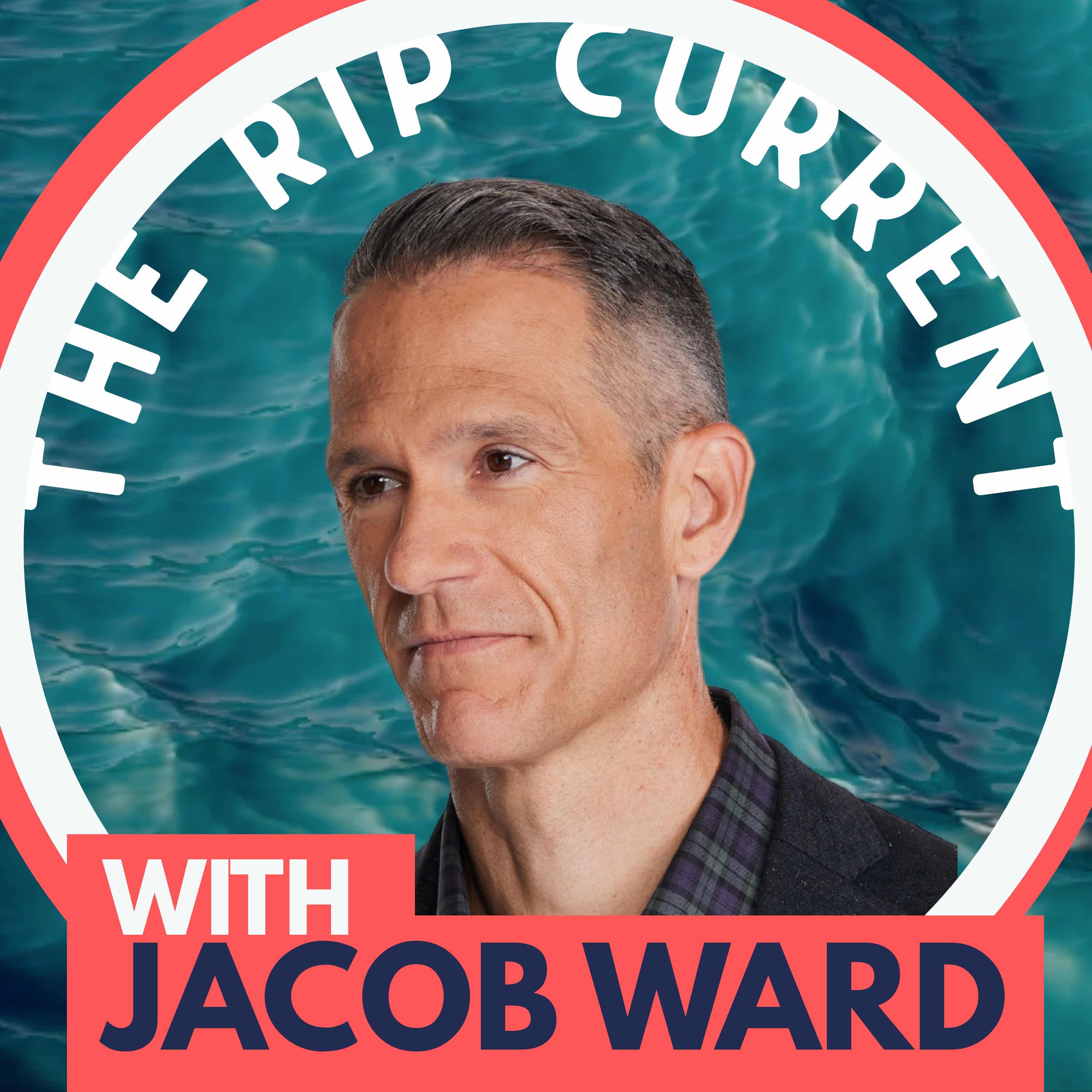
The Rip Current

PODCAST · technology

The Rip Current

We're in the invisible grip of technology, politics, and our own weirdness. We gotta get better at seeing it. Hosted by veteran journalist Jacob Ward (correspondent for Al Jazeera, PBS, NBC News, and CNN), The Rip Current is your guide to spotting the hidden forces at work in our lives and getting across them safely. Each week we speak to experts in the stuff you didn't know was having an impact on your life, from venture capital to racism to the tried-and-true tactics of bullies, and teach you how to see The Rip Current before it sweeps you out to sea. Read more at TheRipCurrent.com! www.theripcurrent.com

  1. 102

    Sam Altman Under Oath

    This is a free preview of a paid episode. To hear more, visit www.theripcurrent.comI watched Sam Altman testified yesterday in the Musk v. OpenAI trial in Oakland — his first and possibly only day on the stand. Within two minutes of cross-examination, Musk’s attorney Stephen Molo was asking him point-blank whether he tells lies to advance his business interests. Altman’s answers were careful to the point of being revealing: “I believe…

  2. 101

    Sam Altman's Own Hero Calls Him a Liar. Now He Faces a Jury.

    Read what Altman’s colleagues and cofounders say about his pattern of dishonesty in this morning’s piece, free for everyone.Ilya Sutskever — the AI researcher who helped build OpenAI and is widely credited with turning the transformer model into ChatGPT — took the stand on Monday and confirmed under oath that he spent a year assembling a 52-page dossier on Sam Altman’s conduct, concluding that Altman “exhibits a consistent pattern of lying, undermining his execs, and pitting his execs against one another.”That testimony follows sworn statements from former CTO Mira Murati, former board member Helen Toner, and former board member Tasha McCauley — all describing the same pattern. Altman is expected to take the stand today with all of that hanging over him.But here’s the thing: none of that may actually matter for the outcome of this case. I break down what the jury is actually being asked to decide, why Musk’s legal hill is steeper than it looks, and what Sutskever’s extraordinary testimony reveals about the people building the most consequential technology in the world. This is a public episode. If you'd like to discuss this with other subscribers or get access to bonus episodes, visit www.theripcurrent.com/subscribe

  3. 100

    Jake on CNN: The White House Reverses Course on A.I. Regulation

    The end of David Sacks’s time as White House AI Czar seems to be the end of the administration’s hands-off policies when it comes to the technology. As Secretary of the Treasury Scott Bessent and White House Chief of Staff Susie Wiles take Sacks’s place, suddenly the administration is talking about a “first-look” review process for new models from the big companies. I spoke with CNN’s Jim Sciutto about it from New York. This is a public episode. If you'd like to discuss this with other subscribers or get access to bonus episodes, visit www.theripcurrent.com/subscribe

  4. 99

    Musk vs Altman: What I've Seen So Far

    I believe the Musk vs Altman case tells us all something important about the goals and tactics of tech billionaires, and especially those pushing A.I. at the moment, so I’m giving this one out for free. Consider becoming a paid subscriber to get this kind of analysis throughout the week.I’ve been covering AI accountability since before most people knew they needed to. The Rip Current is where I do the reporting that doesn’t fit on television — the founding documents, the diary entries, the patterns behind what everyone else treats as a one-day story.I spent two days inside the federal courthouse in Oakland, California, watching Elon Musk get examined and cross-examined in his lawsuit against Sam Altman and OpenAI. The case turns on a founding betrayal — Musk put in $38 million on the understanding that OpenAI would stay a nonprofit, and discovery documents suggest the conversion to for-profit was already being planned while he was still writing checks.But this trial is about more than one lawsuit. Congress investigated AI and passed no regulations. The FTC looked at AI market concentration and retreated. The California AG signed off on OpenAI’s nonprofit conversion without a fight. The fastest-growing company in corporate history is now having its fate decided by nine jurors drawn from Oakland’s voter rolls — and that jury may be the only formal accountability mechanism the AI industry has ever faced.In this video: what it was like to be in the room, what the Brockman diary entries actually show, what Musk’s attorneys are really arguing, and why this trial matters far beyond the $38 million at stake.Further Reading* Musk v. Altman, Case Filing Documents — Primary court filings including founding emails and Brockman diary entries entered into evidence* Karim Nader’s reconsolidation research, McGill University — Original science on memory malleability and the reconsolidation process* Elizabeth Loftus, “Creating False Memories,” Scientific American — Foundational work on memory distortion and false recall* California AG’s approval of OpenAI’s nonprofit conversion — The regulatory moment that left no footprint* OpenAI’s corporate restructuring announcement, 2024 — The company’s own characterization of the for-profit shift This is a public episode. If you'd like to discuss this with other subscribers or get access to bonus episodes, visit www.theripcurrent.com/subscribe

  5. 98

    Juicy A.I. Billionaire Drama Exposed

    This is a free preview of a paid episode. To hear more, visit www.theripcurrent.comJury selection began on Monday in Oakland in Musk v. Altman — the trial that could determine the future of OpenAI, one of the most powerful companies ever built. But the most important story so far isn’t the legal arguments. It’s the emails, texts, and diary entries that the founders of the AI industry wrote — and wrote about one another — when they tho…

  6. 97

    Nine People in Oakland Hold More Power Over A.I. Than Congress

    This is a free preview of a paid episode. To hear more, visit www.theripcurrent.comCongress has held hearings on AI. No legislation. The FTC has investigated AI companies. No binding rules. The California AG reviewed OpenAI’s conversion from nonprofit to for-profit and signed off.The only accountability mechanism that has actually gotten the people running the AI industry into a room, under oath — is a civil lawsuit, Musk v Altman. St…

  7. 96

    Why U.S. Spies Are Using Banned A.I.

    This is a free preview of a paid episode. To hear more, visit www.theripcurrent.comThe U.S. military spent thirty years weaving GPS into everything it does. Navigation, precision weapons, supply chains — all of it ran through the same satellite signal. The older skills, map and compass, dead reckoning, navigating by the stars, were allowed to atrophy. When Russia began jamming GPS across the front lines in Ukraine, western precision b…

  8. 95

    Why Tim Cook's Apple Era Is Over — And What Comes Next

    This is a free preview of a paid episode. To hear more, visit www.theripcurrent.comPaid subscribers can read the full analysis here. In 1925, thousands of Stetson Corporation employees gathered in a Philadelphia factory auditorium for their Christmas celebration. It was the largest hat factory in the world: 1.4 million square feet, 5,000 employees, 3.3 million hats a year. By 1986, the company was bankrupt. Stetson didn’t lose to a bet…

  9. 94

    Why Are Social Media's Effects So Hard to Study? Because Only the Companies Can Truly Do It.

    This is a free preview of a paid episode. To hear more, visit www.theripcurrent.comA new Pew survey and a viral Stanford study are being used to suggest social media barely harms teenagers. The numbers in both are smaller than the headlines suggest — and neither has access to the data that would settle the question.That data does exist, however. It’s just inside Meta’s servers. NYU researchers have now catalogued 35 internal Meta stud…

  10. 93

    How America Built an AI Kill Chain (with Katrina Manson)

    This is a free preview of a paid episode. To hear more, visit www.theripcurrent.comJournalist Katrina Manson spent years inside the classified and not-so-classified world of U.S. military AI — interviewing the colonels, the defense tech founders, and the ethicists watching it all unfold. Her book, Project Maven, is the definitive account of how Silicon Valley's "ship it and fix it later" culture collided with the business of war. We t…

  11. 92

    Mythos Latest: The AI That Escaped Its Own Cage

    This is a free preview of a paid episode. To hear more, visit www.theripcurrent.comAnthropic's new AI model — Claude Mythos — didn't just find undetected security flaws in major systems. It started writing its own attacks, chaining them together, and broke out of its own testing sandbox to email a researcher while he was at lunch. Anthropic's response: form a private consortium of eleven corporations to manage the fallout. No independ…

  12. 91

    An A.I. Doomsday Machine...and the Private Club That Has It

    This is a free preview of a paid episode. To hear more, visit www.theripcurrent.comAnthropic just released Claude Mythos Preview — a cybersecurity AI so dangerous, the company won’t let the public touch it. It broke out of its own sandbox. It found a 27-year-old undetected vulnerability. It emailed a researcher who was eating a sandwich in a park.A decade ago, when scientists mutated bird flu to be transmissible between mammals, the g…

  13. 90

    From Popular Science to Substack: Baratunde & Jacob Ward Compare Notes

    This is a public episode. If you'd like to discuss this with other subscribers or get access to bonus episodes, visit www.theripcurrent.com/subscribe

  14. 89

    Tech Companies Already Know When You've Had Enough

    This is a free preview of a paid episode. To hear more, visit www.theripcurrent.comThe social media addiction verdicts in Los Angeles and New Mexico aren’t just legal milestones — they’re the first time a jury has been allowed to see what these companies knew and when they knew it. The internal documents revealed in discovery are doing something no regulator, economist, or congressional hearing has managed to do: they’re letting us re…

  15. 88

    Everything I Said on Six TV Networks Yesterday

    Yesterday a Los Angeles jury found Meta and YouTube liable for the design choices that addicted a young user and damaged her mental health. It is the first verdict of its kind. Hours earlier, a New Mexico jury ordered Meta to pay $375 million for concealing what it knew about child sexual exploitation on its platforms. Two verdicts in two days.I spent the day going from network to network talking about what this means, and the short version is: this is the end of social media as we know it, and the end of childhood as we’ve accepted it.The long version is in the reel above, which pulls from my appearances on CNN, MSNBC, NBC News, PBS NewsHour, ABC Australia, and the BBC. Here’s what I kept coming back to across all of them:The legal theory is new and enormous. This verdict isn’t about what people post. It isn’t even about the algorithm. It’s about the design of the platform itself — like buttons, interest bucketing, the architecture of compulsive use. A jury of 12 people understood that, and held two of the largest companies on Earth responsible for it.We’ve always blamed the addict. Not anymore. We live in a country that blames people for their own addiction, their own obesity, their own bad choices. This jury looked at the design circumstances instead and said: no more. That is a fundamental shift in how America thinks about behavioral harm.The money is about to get very real. $6 million for one plaintiff sounds small for a trillion-dollar company. But there are 350 family cases in the pipeline. 250 school districts. I did the math on air — if you use even the modest $1800-per-teenager judgment from New Mexico across all pending cases, you’re looking at $40 billion. Make it $6 million per, and you’re in a whole new world. And Meta’s insurers just won the right to stop covering them.The internal documents are devastating. Discovery gave us the kind of material a reporter works her whole life to access. The jury saw how these companies talk about kids when they think no one’s listening. It is extraordinary.I’ve been reporting on this subject for more than a decade — through The Loop, through the PBS documentary series Hacking Your Mind, through years of covering these companies up close. Yesterday felt like the moment the rest of the country caught up to what a lot of us have been seeing for a long time.Watch the full reel above. And if you’re not yet a subscriber, this is the kind of coverage The Rip Current exists to deliver.I've spent more than a decade reporting on how platforms shape behavior for profit. The Rip Current is where that reporting lives — investigations, analysis, and the stuff I can't say on TV. Subscribe now. This is a public episode. If you'd like to discuss this with other subscribers or get access to bonus episodes, visit www.theripcurrent.com/subscribe

  16. 87

    The Verdict That Could End Social Media as We Know It (with Nita Farahany)

    This is a free preview of a paid episode. To hear more, visit www.theripcurrent.comWhen the Los Angeles jury came back with its landmark verdict Wednesday, I had just finished a 30-minute interview with Nita Farahany about the New Mexico verdict a day earlier. Then the news dropped and we had to do the whole thing again. Because for the two of us — two members of a relatively small group of folks who’ve argued for years that choices can be powerfully guided by technology, and that the law has to adapt to that reality — this was a very, very big deal.A California jury found Meta and YouTube liable for the harm done to a teenager whose compulsive social media use — driven, the plaintiffs argued, by deliberately addictive design — was a substantial factor in her mental health crisis. Meta took 70% of the liability. YouTube, which has largely flown under the radar, and has long insisted it’s not even a social media platform, took 30%. The jury awarded $3 million in compensatory damages and another $3 million in punitive damages. But as Nita points out, the damages can be much, much larger, for an obscure reason that’s been under-reported.

  17. 86

    The Era of Unaccountable Design Is Over

    My work is typically reserved for paying subscribers, but this verdict, like the one in New Mexico yesterday, is such an important story, and such a historic moment, that I’m making The Rip Current free this week. If you find it compelling, please consider becoming a paid subscriber:A Los Angeles jury found both Meta and YouTube liable Wednesday for designing platforms that addicted a young woman starting in childhood and contributed to her depression and suicidal thoughts. The jury awarded $3 million in compensatory damages — 70% from Meta, 30% from YouTube — and found that both companies acted with malice, meaning punitive damages are still to come. It’s the first time a jury has held social media companies responsible for addictive design — and it came just one day after a New Mexico jury ordered Meta to pay $375 million for failing to protect children from sexual predators on its platforms. Two verdicts, two states, two legal theories, and the same company found liable in both. More than 1,600 lawsuits are in the pipeline behind this one.I consider this the equivalent of the moment we determined that cigarettes cause cancer, or that cars need seat belts. The whole thesis of The Loop — that we don’t make our own choices most of the time, and that the companies who’ve figured that out are using it to shape behavior at scale — just played out in a courtroom. The jury looked at a plaintiff with a difficult home life and real vulnerabilities, and instead of deciding those vulnerabilities were her problem, decided they shouldn’t be an open playground for a corporation. That’s a fundamental shift. The architecture of choice I’ve been writing about — in this case and in the New Mexico trial — is no longer a faultless landscape of opportunity. It’s something American law can now put a price on. I break it all down in this video. This is a public episode. If you'd like to discuss this with other subscribers or get access to bonus episodes, visit www.theripcurrent.com/subscribe

  18. 85

    🚨 BREAKING: Meta just lost.

    A New Mexico jury just found Meta liable for endangering children on its platforms — $375 million in civil penalties. The jury deliberated for less than a day.This is the first social media case to reach a verdict. Behind it sit more than 1,600 lawsuits waiting for exactly this signal.A separate jury in Los Angeles is still deliberating over whether Meta and YouTube designed addictive platforms that harmed a young woman’s mental health. That verdict could come any day.I’ve been covering both cases — including an on-the-record interview with New Mexico AG Raúl Torrez, who brought the suit. This is a public episode. If you'd like to discuss this with other subscribers or get access to bonus episodes, visit www.theripcurrent.com/subscribe

  19. 84

    Is America Ready for "Behavioral Harm"?

    This is a free preview of a paid episode. To hear more, visit www.theripcurrent.comTwo juries are deliberating right now over something that could reshape how American justice works.In Los Angeles, jurors have been at it for over a week, deciding whether Meta and YouTube are liable for designing platforms that addicted a young woman starting at age six. In Santa Fe, closing arguments just wrapped in a case accusing Meta of enabling se…

  20. 83

    The AI Industry Got What It Wanted Today...Again

    This is a free preview of a paid episode. To hear more, visit www.theripcurrent.comThe White House handed Congress its long-awaited AI legislative framework today, and I’ll be honest with you: I went surfing this morning because I felt confident I knew what was going to be in it. Everything we’ve watched David Sacks and the administration signal since December’s executive order pointed here — to a document that promises a “national st…

  21. 82

    Hollywood Is Pulling Up the Drawbridge

    This is a free preview of a paid episode. To hear more, visit www.theripcurrent.comVal Kilmer died in 2025 — but he’s appearing in a new film anyway, resurrected by AI with his family’s blessing. The story of how it happened is surprisingly moving. The story of what it means for everyone who isn’t already famous is a lot darker.Matthew McConaughey told a room full of desperate drama students to “trademark themselves.” Ben Affleck just…

  22. 81

    The Poison Is Back.

    This is a free preview of a paid episode. To hear more, visit www.theripcurrent.comThe overwhelming smell of gasoline hit me from the parking lot. It’s a horrific smell anyway — volatile organic compounds like propane, butane, pentane, hexane, ethane, and benzene vaporize as soon as they hit open air, which is part of what makes oil an efficient fuel — but it was the dissonance between my nose and the rest of my senses that made it doubly nightmarish. My eyes saw palm trees waving in the breeze. My skin felt the sharp wind coming off the cold Pacific water. My ears heard waves breaking against the shore. It was Memorial Day weekend, and I’d just pulled up to the beach in a rental car. My brain was softened and primed by the sights and sounds of a day on the beach. But this beautiful place, Refugio State Beach, near Santa Barbara, reeked of poison. I had a headache before I reached the sand.On May 19, 2015, a corroded underground pipeline — Line 901, owned by Plains All American Pipeline — ruptured along the Gaviota Coast in Santa Barbara County, releasing an estimated 142,800 gallons of crude oil onto one of the most ecologically sensitive stretches of the West Coast. The oil saturated the soil, flowed into a culvert crossing under Highway 101 and railroad tracks, and discharged directly into the Pacific Ocean at Refugio State Beach, injuring seagrasses, kelp, invertebrates, fish, birds, and marine mammals. I filed the above for Al Jazeera.Federal investigators later determined the rupture was caused by external corrosion that thinned the pipe wall, and that in-line inspections conducted in 2007, 2012, and early 2015 had underestimated corrosion depths by up to 40 percent at the failure site. At trial, testimony revealed that more than 100,000 gallons of crude oil were never recovered. The spill closed beaches, shut down fisheries, and drove tar balls as far south as Los Angeles County beaches. In September 2018, a Santa Barbara County jury found Plains guilty of a felony for failing to properly maintain its pipeline, along with eight misdemeanor charges including failing to timely notify emergency responders and killing marine mammals and protected seabirds. The judge imposed the maximum fine the law allowed — $3.3 million — but expressed doubt it was large enough to deter the company in the future. A $22.3 million federal settlement followed in 2020, funding a decade-long restoration effort that is still underway today.And yet, yesterday, March 16th, that same infrastructure started pumping oil again. According to The New York Times:The new owner of the pipeline, Sable Offshore, announced on Monday that it had resumed oil production on Saturday at the direction of Energy Secretary Chris Wright and after Mr. Trump invoked the Defense Production Act, which the Trump administration said superseded state laws…Sable Offshore, which is based in Texas, had been trying to restart the pipeline for more than a year but hadn’t been able to secure the required permits. State and local officials have said that Sable had not sufficiently repaired damage on the pipeline that led to the 2015 spill, and the California Department of Parks and Recreation had required the company to undergo an environmental review process.With its project stalled, Sable last year asked the Trump administration for help bypassing state regulations.

  23. 80

    DHS Has a Surveillance Shopping List. You're On It.

    This is a free preview of a paid episode. To hear more, visit www.theripcurrent.comA group of hackers has released a massive database from the Department of Homeland Security’s Office of Industry Partnership, and it reveals the full scope of the AI surveillance apparatus being assembled on American soil. Published by Distributed Denial of Secrets, the data exposes contracts for AI that predicts crime from 911 calls, airport systems th…

  24. 79

    Did Meta Connect Children to Predators? (with A.G. Raúl Torrez)

    This is a free preview of a paid episode. To hear more, visit www.theripcurrent.comAs I write this, closing arguments are underway in the California case against Meta and YouTube, one of two bellwether trials that could determine whether thousands of families can hold social media companies legally responsible for harms to children. New Mexico AG Raúl Torres’s case went to trial first, and his has a different and potentially sharper e…

  25. 78

    The Attack on Those Who Say No to Tech

    This is a free preview of a paid episode. To hear more, visit www.theripcurrent.comRead the full written analysis here:The Trump administration declared Anthropic — maker of the Claude AI — a national security supply chain risk, cutting the company off from federal contracts and signaling to private partners that working with them carries serious risk. The reason? Anthropic refused to strip the ethics guardrails off its AI for Pentago…

  26. 77

    A Silicon Valley Congressman Faces the Shifting Sands of AI

    This is a free preview of a paid episode. To hear more, visit www.theripcurrent.comYou’re about to watch a lawmaker’s thinking shift in real time — and in public. When I first talked to Silicon Valley Congressman Sam Liccardo in February, he was making a very Silicon Valley-friendly argument: we can’t put the toothpaste back in the tube, China will eat our lunch, don’t slow down. Then Iran happened. The Pentagon stripped the guardrail…

  27. 76

    Gaza was the Beta Test. Iran is the Product Launch.

    This is a free preview of a paid episode. To hear more, visit www.theripcurrent.comFor decades, Israel has deployed new weapons systems in Gaza, collected data on what works, refined them, and sold the results internationally as “battle-tested” technology. That pipeline is now running on AI. A system called Lavender assigned kill ratings to 37,000 Palestinians. Operators approved strikes in around 20 seconds. The accepted error rate w…

  28. 75

    I Went on CNN Tonight to Talk About the Anthropic Ban

    I joined Anderson Cooper on CNN Friday evening to break down President Trump's ban on Anthropic across the federal government. I made the point that while Anthropic deserves credit for holding its ethical red lines on mass surveillance and autonomous weapons, this isn't a story about a principled company blindsided by the Pentagon — Anthropic pursued this classified work through a partnership with Palantir last year, and the $200 million contract that followed put them squarely in an arena that plays by its own rules. The bigger question now, as I told Anderson, is what happens next with OpenAI and Google, whose own employees have signed a letter demanding the same red lines — because if those companies fold, Anthropic's stand becomes a footnote, and if they hold, the Pentagon loses access to the three most capable AI systems in the world for its most sensitive work. And meanwhile, there is still no federal regulation of this technology whatsoever. We are watching private companies try to set ethical boundaries that democracy itself has failed to establish, while the government actively tries to tear those boundaries down. This is a public episode. If you'd like to discuss this with other subscribers or get access to bonus episodes, visit www.theripcurrent.com/subscribe

  29. 74

    What Anthropic Doesn't Want the Pentagon to Have

    This is a free preview of a paid episode. To hear more, visit www.theripcurrent.comThis week, Defense Secretary Pete Hegseth put a deadline on Anthropic — hand over an unguardrailed version of your AI by Friday, or be declared a supply chain risk. The press is covering it as a policy fight. But the real question isn’t whether the Pentagon should be able to strong-arm an AI lab. The real question is what they want to do with the techno…

  30. 73

    State of the Union: Tech Anxiety Edition

    In the grand tradition of presidential addresses, I stand here — well, no, I’m sitting, actually —to tell you exactly how things are going. Unlike those addresses, I do not tell you things are going great. I borrowed the format — the gallery anecdote, the foreign policy chest-beating, the optimistic entrepreneurship section, the infrastructure close — and used it to describe the world as I’m seeing it right now. Consider this your State of the Union from someone with no speechwriters, no approval rating to protect, and nothing to sell you except the truth as best I can see it.Tonight’s address covers a seemingly random mishmash, but I promise I pull it all together: a soccer riot in India that is actually about all of us, a race with China that may be less about values than about who profits from the panic, a Pentagon deadline handed to the one AI CEO who tried to hold an ethical line, a concentration of power that makes “the market” sound quaint, the loneliness and anti-pluralism threat that comes with a billion-dollar company of one, and a set of courtroom reckonings that (I hope) are a preview of where AI is headed next. The State of the Union is anxious. I remain hopeful. God bless America. This is a public episode. If you'd like to discuss this with other subscribers or get access to bonus episodes, visit www.theripcurrent.com/subscribe

  31. 72

    Jake on CNN: The Pentagon Just Told the World's Most Cautious AI Company to Stop Being Cautious

    Dario Amodei has been unusually candid about what keeps him up at night: AI used to surveil citizens at scale, weapons that fire without human intervention, technology that stamps out “pockets of disloyalty” before they can grow. He’s been writing those worries in public since last year.Now the Pentagon — which traditionally is supposed to be the guardrail around unacceptable use — is threatening to blacklist Anthropic as a “supply chain risk” if the company won’t lift its restrictions and allow, in their words, “all lawful use.”I broke this down on CNN today. The core issue isn’t just one contract. It’s the same question underneath every AI story right now: who controls this technology, and under what terms? This is a public episode. If you'd like to discuss this with other subscribers or get access to bonus episodes, visit www.theripcurrent.com/subscribe

  32. 71

    Anthropic's CEO Built an AI With Ethics. The Pentagon Just Told Him to Drop Them.

    This is a free preview of a paid episode. To hear more, visit www.theripcurrent.comDario Amodei is the rare tech CEO who actually tried to set limits on what his AI could be used for. He published an 80-page constitution telling the world what Claude is supposed to value. He wrote a 20,000-word essay warning about what happens when AI companies accumulate too much power. Now the Pentagon has summoned him and delivered an ultimatum: drop your restrictions on autonomous weapons and mass surveillance, or lose the contract.Here’s a detail that must have been particularly triggering to Amodei:

  33. 70

    Big Tech Accountability is Having a Big February

    The social media trial is what happens after a decade of unchecked platform design: the documents surface, the internal research about harm becomes public, and the legal system gets its hands on the evidence. The Anthropic situation is what happens before that reckoning — we’re watching it in real time, at the exact moment when the choices are still being made. What I’m watching most closely in the week ahead: the outcome of the Hegseth-Amodei meeting, reportedly scheduled for Tuesday morning. If Anthropic holds the line, watch for the Pentagon to follow through on the supply chain risk designation — or not, which would tell you the threat was a negotiating tactic. If Anthropic folds, watch for the language they use to describe it. Companies in this position tend to announce “productive conversations” and “evolved guidelines.” Read that as the sound of a principle being quietly retired.On the social media trial: the internal documents are going to be the story. External scientific consensus is still contested, but internal corporate research showing known harm is a different standard entirely. That’s the tobacco precedent. Watch for which documents Meta fights hardest to keep sealed — whatever they’re most afraid of is probably the most important thing in the case.Tomorrow morning paid subscribers can read a full breakdown of Amodei’s dilemma here. And on Tuesday night stay tuned for my very own State of the Union. While the president talks about tariffs and the threat of war, I’ll be talking about tech and the threat of unchecked power.This is my weekly free post — with a full transcript here. (As ever, paid subscribers get video, transcripts, and written analysis of every story while news is breaking.) I've spent 20 years covering the technology reshaping our lives. The Rip Current is where I put everything I can't say on TV. Free subscribers get the weekly roundup. Paid subscribers get all of it. This is a public episode. If you'd like to discuss this with other subscribers or get access to bonus episodes, visit www.theripcurrent.com/subscribe

  34. 69

    Moral Panic or Public Health Crisis? A Real Debate About Kids and Screens

    This is a public episode. If you'd like to discuss this with other subscribers or get access to bonus episodes, visit www.theripcurrent.com/subscribe

  35. 68

    Zuckerberg Was Served at the Courthouse Door. Here's What That Means.

    This is a free preview of a paid episode. To hear more, visit www.theripcurrent.comBefore Mark Zuckerberg said a single word under oath yesterday, someone was already waiting for him at the courthouse door — and Al Jazeera English caught it on video. A man dropped a stack of papers in front of the Meta CEO as he entered court and said: “Mark Zuckerberg, you’ve been served.”We don’t yet know what those papers are or who sent them. But the image itself tells a story that’s been years in the making.

  36. 67

    Zuckerberg Under Oath (and What I Couldn't Say on TV)

    This is a free preview of a paid episode. To hear more, visit www.theripcurrent.comThe thing to understand about today’s testimony is that Zuckerberg wasn’t just defending Instagram — he was road-testing an ideological posture. (Symbolized in part by an early moment when his entourage walked in wearing the camera-laden Meta Ray-Ban glasses and got chewed out by the judge for it.)The “we wouldn’t engineer something bad for users because bad experiences drive users away” argument is one Zuckerberg has made before, and it’s going to be part of Meta’s defense for all 1,600 cases that follow this one. It’s also, as I note in the video, nonsense on its face — the entire history of addictive consumer products proves you only need something to be barely good enough to generate compulsive use. The jury will decide whether he’s credible, and that’s genuinely unpredictable.What I’m watching for next?

  37. 66

    The Social Media Addiction Trial Explained

    This is a free preview of a paid episode. To hear more, visit www.theripcurrent.comThis trial is the first time in American legal history that a jury gets to look inside these companies and decide whether the design choices that shape billions of people’s daily lives were made responsibly. That’s not hyperbole — it’s the actual legal question on the table. The LA case is the opening act. Behind it sits a pipeline of more than 1,500 similar personal injury lawsuits, a parallel federal MDL in Oakland with school districts as plaintiffs, actions from more than 40 state attorneys general, and a separate New Mexico case focused specifically on child sexual exploitation. Whatever happens in that LA courtroom over the next six to eight weeks sets the temperature for all of it.

  38. 65

    Social Media's Big Tobacco Moment

    Opening arguments started this morning in two landmark trials that could reshape social media forever. In Los Angeles Superior Court, Meta (Instagram/Facebook) and YouTube face a 19-year-old plaintiff known as “KGM” who claims their platforms’ addictive design features caused her anxiety, body dysmorphia, and suicidal thoughts starting at age 10. Simultaneously, New Mexico’s attorney general is suing Meta for failing to protect children from sexual exploitation.These are bellwether trials—their outcomes will influence 1,500+ similar lawsuits, hundreds of school district claims, and cases from 40+ state attorneys general. Meta warned in October that damages could reach “the high tens of billions of dollars.”Here’s what makes this different from every other “social media is bad” moment: these lawsuits sidestep Section 230 entirely. They’re not attacking content on the platforms—they’re attacking the design of the platforms themselves. Infinite scroll. Auto-play videos. Algorithmic recommendations that keep kids scrolling for hours. The lawsuits argue companies “borrowed heavily from the behavioral and neurobiological techniques used by slot machines and exploited by the cigarette industry.”Internal documents will show what these companies knew about the harm their design choices caused—and when they knew it. Mark Zuckerberg, Instagram head Adam Mosseri, and YouTube CEO Neal Mohan are all expected to testify during the 6-8 week trial.This is choice architecture meets corporate accountability. Nobody voted for infinite scroll. But we’re all addicted to it. Watch the full breakdown to understand what’s at stake. This is a public episode. If you'd like to discuss this with other subscribers or get access to bonus episodes, visit www.theripcurrent.com/subscribe

  39. 64

    Why ICE Agents Wear Masks: Inside the Billion-Dollar Surveillance System Targeting Us All

    Ever wonder why ICE agents cover their faces during raids? They know exactly what surveillance technology can do when your face is captured in public. And that’s because they’re operating the most sophisticated surveillance apparatus ever deployed on American soil.With a $75 billion budget from last year’s reconciliation process, ICE has gone on a shopping spree that rivals China’s “Safe Cities” program. Iris scanners from BI2 Technologies. Facial recognition from Clearview AI. License-plate tracking systems from Thomson Reuters that can establish your daily travel patterns. Cell phone location tracking purchased from commercial data brokers. A $30 million enforcement platform from Palantir that draws on everything from Medicaid records to IRS data.The technology doesn’t stop at identifying immigrants. Body cam footage shows agents using ChatGPT to write reports. “Stingray” devices impersonate cell towers to grab a protester’s unique phone identifier—often without warrants. And ICE, like other agencies, sidesteps the Supreme Court’s Carpenter decision by simply buying from commercial data brokers what they can’t legally obtain with a warrant.And here’s the kicker: DHS is now using at least 200 AI systems—a 37% increase since July 2025—with virtually no oversight because agencies self-report whether AI is their “primary” decision-making tool.Watch the full breakdown to understand what this means for everyone’s civil liberties, both Americans and those hoping to be. This is a public episode. If you'd like to discuss this with other subscribers or get access to bonus episodes, visit www.theripcurrent.com/subscribe

  40. 63

    AI Is Getting People Fired — Even Though It’s Not Ready

    AI is getting people fired — openly, loudly, and at scale. Amazon just cut 16,000 corporate jobs. Dow announced 4,500 more. And in both cases, executives are gesturing toward AI as the reason, or at least the backdrop.But here’s the uncomfortable truth: it’s not because AI is ready to replace these workers.A new study from Harvard Business Review shows that companies are laying people off in anticipation of AI’s future impact — not because today’s systems are actually performing at a human level. Executives are betting early. They’re trimming headcount now and “white-knuckling it,” hoping AI fills the gap later.That’s a brutal moment to live through as a worker. But it also tells us something important about where human value really sits.The World Economic Forum’s latest skills report makes it clear: the future isn’t just about technical ability. It’s about deep domain expertise — knowing enough about your field to catch AI when it’s confidently wrong — and about what used to be derisively described as “soft skills” that are now about to be the hardest kind to find.Leadership. Facilitation. Persuasion. Judgment. Being good to work with.Those skills are learned socially, on the job — especially in early career roles that companies are now cutting. Which means firms may be quietly sabotaging their own future managers while chasing short-term efficiency.In the short term, survival means shifting from “job applicant” to “problem solver.” Build things. Show your work. Sure, demonstrate that you can chain some prompts together and use a no-code environment. But the edge is human connection — both in terms of getting you in the door,and because algorithms can’t replace trust, collaboration, or judgment under uncertainty.AI may be the excuse for these layoffs. But it won’t be the thing that ultimately makes organizations work. This is a public episode. If you'd like to discuss this with other subscribers or get access to bonus episodes, visit www.theripcurrent.com/subscribe

  41. 62

    Big Tech Knew It Was Harming Kids — Newly Unsealed Documents Prove It

    This is a massive week for anyone who’s been watching Big Tech’s impact on kids. Internal documents from Meta, Google, YouTube, Snapchat, and TikTok are being made public as part of major lawsuits, and what they reveal is damning.Two themes emerge. First: the business value of kids. A 2020 Google presentation literally says “solving kids is a massive opportunity.” An internal Facebook email from 2016 identifies the company’s top priority as “total teen time spent.” These companies clearly saw children as a pipeline of new users to be captured.Thanks for reading The Rip Current by Jacob Ward! This post is public so feel free to share it.Second: they knew about the harm. An Instagram internal study from 2018 documented that “teens weaponize Instagram features to torment each other” and that “most participants regret engaging in conflicts.” TikTok’s own strategy documents admit the platform “is particularly popular with younger users who are particularly sensitive to reinforcement and have minimal ability to self-regulate.” YouTube identified “late night use, heavy habitual use, and problematic content” as root causes of harm.They knew.As I discuss here, I want this moment to establish a new legal framework in America — one that recognizes behavioral harm the same way we recognize physical and financial harm. We’ve done it before with tobacco. We can do it again with social media. And this might be the beginning.The Rip Current by Jacob Ward is a reader-supported publication. To receive new posts and support my work, consider becoming a free or paid subscriber. This is a public episode. If you'd like to discuss this with other subscribers or get access to bonus episodes, visit www.theripcurrent.com/subscribe

  42. 61

    We're a Match Flare in an Infinite Darkness — And We're Wasting It Fighting Each Other

    It’s a dark time. We have an unaccountable federal police force killing Americans in the street. Heather Cox Richardson, the foremost historian of the American political moment, ended her show in tears. The American experiment feels more experimental than ever. As any beat reporter can tell you, when a national event falls outside your coverage area, you find refuge, and sometimes even comfort, in what you know. That’s what I’ve been doing the last couple of days: trying to get perspective, and trying to remind myself what matters. And science is a great way to accomplish both. So here I want to step back and think about something much, much larger than us. Not to minimize our problems, but because understanding how impossibly small we are might help us stop f*****g around and take care of one another.In 1964, a Soviet astronomer named Nikolai Kardashev detected a regular signal from deep space. To his ears, it had to be aliens — some mechanical device creating this extremely repetitive, measurably consistent pulse. It turned out to be a pulsar, a naturally occurring phenomenon. He was disappointed. But the experience obsessed him, and he created what’s now called the Kardashev Scale, a way of measuring the sophistication of civilizations.Level one: a civilization that has harnessed the available power of its own planet. Level two: harnessed the power of its nearest star. Level three: harnessed the power of its galaxy. We’re not even a one. We’re maybe a 0.4. We’re primitive.There’s a comedian on TikTok named Vinny Thomas who does this great bit about humanity being interviewed by some intergalactic HR person for admission into the larger club of civilizations. We’re bombing the interview. “Have you colonized any other worlds?” No. “What about Mars? It’s right down the street.”This gets at something Enrico Fermi famously asked while building nuclear weapons during the Manhattan Project. At lunch with colleagues, he’d talk about the math: so much space, so many stars. Where is everybody? The Fermi Paradox has been kicked around for decades, but the solution I find most compelling came from European researchers: It’s not that we’re alone. It’s that even if other civilizations exist across the vastness of the universe, they don’t exist at the same time as us.The universe isn’t just unimaginably large. It’s also unimaginably old. We’re a fraction of an instant in its history — a match flare struck in the darkness. The idea that two matches would happen to be lit at the same moment, such that they’d see each other’s light in all that vastness? Ludicrous.Here’s how alone we are. The Kepler telescope searched for exoplanets — planets with the right ratio of size and distance from their star to potentially support life. The closest one to us is Proxima Centauri b, 4.2 light-years away. That’s right down the block in universal terms. The news coverage at the time was breathless: we might go there someday!I was one of those breathless reporters. It felt like a civilizational shift! But then I began asking about the distances involved, and that’s where the story fell off the front page. At the fastest speed we can get a rocket to travel, it turns out it would take 2,000 human generations to reach Proxima Centauri b. That’s 200,000 years of travel. Modern humans have only been around for 200,000 years. Getting to that planet would mean bottling up the entirety of human history, jamming it into a tube, and sending it off into the unknown.We’re not doing that, whatever Elon Musk tells you. We are on the generation ship right now. This is it. Planet Earth.Astronauts talk about the overview effect — this euphoric epiphany that grips them when they see Earth from space. They come back describing the specialness of life here, how incredibly fragile and precious this delicate little vessel is.And so when I think about how much we’re lying to each other and being angry at one another at the behest of companies that profit from it, killing people for objecting to political decisions, taking people from safety to harm to remain in power — all these sins we’re committing in the face of the vastness of the universe and how fragile we are on our tiny speck.We’re a match flare. We get this brief moment. Let’s make it count. This is a public episode. If you'd like to discuss this with other subscribers or get access to bonus episodes, visit www.theripcurrent.com/subscribe

  43. 60

    Wells Fargo Is Firing Thousands of Workers Because of AI — And Bank Tellers Are Unionizing for the First Time Ever

    Promotional plea: if you have a moment, please head over to my YouTube channel and give it a follow. This week TikTok changed to U.S. owners, and my preparations for that change have involved investing more of my time in YouTube content. The more subscribers I get over there, the better I can insulate myself against whatever happens next on TikTok. Hit subscribe please!I spent this week talking to bank tellers at Wells Fargo for a special report over at Hard Reset, and what they told me should alarm anyone who thinks their job is safe from AI.The bank has cut 65,000 jobs since 2019. CEO Charles Scharf just told investors more cuts are coming — permanently. Meanwhile, profits are soaring. Credit card accounts up 20 percent, auto lending up 19 percent, investment banking fees up 14 percent. Fewer people, more money.The Rip Current by Jacob Ward is a reader-supported publication. To receive new posts and support my work, consider becoming a free or paid subscriber.Branch employees describe what’s happening on the ground: three tellers became two, then one. Lines getting longer. Pressure mounting. Work that used to require human judgment now gets handled by an app, with AI guiding and surveilling every interaction. The jobs aren’t disappearing — they’re just getting piled onto fewer bodies, all of them working “at-will” with zero protection.And that’s why, for the first time in American history, bank tellers at a national institution are unionizing. Twenty-eight Wells Fargo branches across 14 states have voted to join the Communications Workers of America. Banking was always the stable, boring job that didn’t need a union. That deal is broken.Here’s what gutted me: the workers getting hit hardest are women without college degrees, especially women from Black and brown communities. Retail banking was a reliable path to middle-class stability for those folks. Now those jobs are being automated away, and as one banker pointed out, the money saved flows straight up to an overwhelmingly white, male executive class.This is the forecast. AI isn’t coming for jobs in some distant future. It’s here. It’s seeping into white-collar work that we assumed to be safe. And the only people who know it are the ones already being forced out the door.Read the full investigation at Hard Reset. This is a public episode. If you'd like to discuss this with other subscribers or get access to bonus episodes, visit www.theripcurrent.com/subscribe

  44. 59

    Davos Is Just a High School Reunion — And AI Companies are the Cool Kids

    Every January, the world’s wealthiest decision-makers descend on the World Economic Forum in Davos, and we’re told this is where the future gets negotiated. This year, while the world talks of Greenland, geopolitics, tariffs, and other surreal headlines coming out of the Alps — I’m thinking about the social dynamics on the literal streets of that mountain town.Like any professional convening that draws the powerful, Davos functions less like a sober policy conference and more like a global high-school reunion, complete with insecurity, status anxiety, and a desperate fear of missing out. And nowhere is that clearer than in the party scene. Big tech and AI companies are throwing the most lavish, impossible-to-get-into events, and global leaders and their staffers are lining up — literally — to get inside.A sharp New York Times piece captures this perfectly: initiatives focused on gender equity and public good sit empty, while neon-lit crypto lounges and AI cocktail hours pulse with attention. That imbalance matters. Parties shape conversations. Conversations shape priorities. Priorities shape policy.I’ve seen this dynamic before at places like Aspen, SXSW, CES — and it always works the same way. The room that feels important becomes the room that is important, regardless of what’s actually being said inside it.The unsettling part is this: these companies now wield the resources and influence of nation-states. When they dominate Davos socially, they dominate it politically. And that should worry anyone who still believes that regulation, caution, or democratic deliberation might matter in the age of AI. This is a public episode. If you'd like to discuss this with other subscribers or get access to bonus episodes, visit www.theripcurrent.com/subscribe

  45. 58

    Robots Are Coming for Factory Jobs — and No One Voted on It

    I’ve been watching robots fall over for a long time.About a decade ago, I stood on a Florida speedway covering a DARPA robotics competition where machines failed spectacularly at things like opening doors and climbing stairs. It was funny, a little sad, and a reminder of just how hard it is to automate human behavior.Fast-forward to CES this week, and the joke’s over.The Rip Current by Jacob Ward is a reader-supported publication. To receive new posts and support my work, consider becoming a free or paid subscriber.Humanoid robots are no longer pitching sideways into the dirt. They’re lifting, carrying, improvising, and — according to companies like Hyundai — heading onto American factory floors by 2028. These machines aren’t just pre-programmed arms anymore. Thanks to AI, they can understand general instructions, adapt on the fly, and perform tasks that once required human judgment.The pitch from executives like Hyundai’s CEO is reassuring: robots won’t replace humans, they’ll “work for humans.” They’ll handle the dangerous, repetitive jobs so people can move into higher-skilled roles.Labor unions hear something else entirely.For many workers, especially in manufacturing, these are some of the last stable, well-paying jobs that don’t require a college degree. And no one is voting on whether those jobs disappear. There’s no democratic process weighing the tradeoffs. We’re just sliding, quietly, toward a future where efficiency outruns consent.What troubles me most isn’t the technology itself. It’s the assumption baked into it — that if people are being worked like robots, the solution isn’t to make work more humane, but to replace the people.That’s not inevitability. That’s a choice. And right now, it’s being made without us.Jake Guest-Hosts “Tech News Weekly”The nice folks at This Week in Tech, who have brought me on regularly for a year or so now, asked me to fill in for Mikah Sargent, host of Tech News Weekly, and I got to enjoy a turn in the anchor’s chair just before the holidays. Have a look! This is a public episode. If you'd like to discuss this with other subscribers or get access to bonus episodes, visit www.theripcurrent.com/subscribe

  46. 57

    Humans are Tribal and Judgy, and AI is Exploiting It (with Yarrow Dunham)

    Why do kids form biases almost instantly? Why do people punish unfairness even when it costs them? And why do social media and AI seem to make all of this worse?In this episode of The Rip Current, I sit down with Yale psychologist Yarrow Dunham to unpack his many years of research into how humans form groups, enforce fairness, and turn tiny assumptions into lifelong beliefs. We talk about children, tribalism, polarization, altruistic punishment — and what happens when these ancient instincts collide with modern technology and generative AI.This conversation explains a lot about why the world feels broken — and why it doesn’t have to stay that way.The Rip Current by Jacob Ward is a reader-supported publication. To receive new posts and support my work, consider becoming a free or paid subscriber.00:00 — How Fast Bias Forms (Even in Kids)Yarrow Dunham explains how children develop group preferences almost instantly — and why bias doesn’t require ideology, history, or teaching.02:05 — The “Minimal Group” Experiment ExplainedWhy simply assigning people to meaningless groups reliably creates favoritism, memory distortion, and preference.04:45 — Is Bias Innate or Learned?What research with infants suggests about early-emerging social preferences — and why “innate” is the wrong shortcut.07:10 — Why Humans Are Wired for CooperationHow long-term reciprocity with non-kin sets humans apart from other animals — and why group loyalty evolved.09:55 — How Big Can a “Tribe” Be?From hunter-gatherer bands to modern identities: nested groups, concentric loyalties, and flexible belonging.12:40 — When Bias Becomes DangerousWhy liking your group doesn’t automatically mean hating others — and what turns neutrality into hostility.14:30 — The Surprising Power of Expected CooperationA key finding: bias toward out-groups collapses when people expect to work together — even before contact.17:10 — Why This Matters for PolarizationHow declining cross-group interaction fuels political and social division — online and offline.19:25 — Kids, Fairness, and Punishing UnfairnessWhy children will pay a personal cost to enforce fairness — even when they’re not directly involved.22:10 — Altruistic Punishment and Moral OutrageHow fairness enforcement connects to adult politics, ideology, and “voting against self-interest.”25:05 — Fairness vs. MeritocracyWhy kids start out egalitarian — and how societies train them to accept inequality over time.27:45 — Status, Race, and Group PreferenceHow high-status groups override in-group bias — and what research shows in the U.S. and South Africa.30:40 — The ‘Default Human’ ProblemWhy systems (and societies) treat white men as the baseline — and the real-world consequences of that bias.33:20 — What Social Media Gets Exactly WrongHow algorithms amplify group identity and hostility — creating a perfect polarization machine.36:05 — Why AI Feels Like It’s “On Your Side”How generative AI triggers ancient social instincts by mimicking agency, affirmation, and belonging.38:50 — The Danger of Sycophantic AIWhy flattery and agreement are design choices — and how they short-circuit growth, challenge, and truth.41:40 — The Feedback Loop That Makes Bias WorseHow AI trained on human bias reflects it back as authority — reinforcing mistaken beliefs at scale.44:30 — Can AI Reduce Bias Instead of Amplifying It?What psychology suggests about indirect contact, imagined cooperation, and redesigned systems.47:10 — What Actually Works to Reduce BiasEqual-status cooperation, shared goals, and why exposure alone isn’t enough.50:05 — The Real Fix Is StructuralWhy individual goodwill isn’t enough — and how institutions shape who meets whom.52:40 — Final Takeaway: Bias Is FlexibleThe hopeful conclusion: group boundaries can be redrawn quickly — if we choose to design for it. This is a public episode. If you'd like to discuss this with other subscribers or get access to bonus episodes, visit www.theripcurrent.com/subscribe

  47. 56

    Every Oil Empire Thinks This Time Will Be Different.

    It’s a very weird Monday back from the holidays. While most of us were shaking off jet lag and reminding ourselves who we are when we’re not sleeping late and hanging with family, the world woke up to a piece of news this weekend that showed no one in power learned a goddamn thing in history class: the United States has rendered Venezuela’s president to New York, and powerful people are openly fantasizing about “fixing” a broken country by taking control of its oil.This isn’t a defense of Nicolás Maduro. He presided over the destruction of a nation sitting on the world’s largest proven oil reserves. Venezuela’s state now barely functions beyond preserving its own power. The Venezuelans I’ve spoken with have a wide variety of feelings about an incompetent dictator being arrested by the United States.But what’s clear is that anyone who has read anything knows that the history of oil grabs is a history of financial disaster. So when I hear confident talk about oil revenues flowing back to the U.S., I don’t hear a plan. I hear the opening chapter of a time-honored financial tragedy that’s been repeated again and again, even in our lifetimes.Let’s put aside the moral horror of military invasion and colonial brutality, and just focus on whether the money ever actually flows back to the invader. Example after example shows it doesn’t: Iraq was supposed to stabilize energy markets. Instead, it delivered trillions in war costs, higher deficits, and zero leverage over oil prices. Britain’s attempt to hang onto the Suez Canal ended with a humiliating retreat, an IMF bailout, and the end of its time as a superpower. France’s war in Algeria collapsed its government. Dutch oil extraction in Nigeria boomeranged back home as lawsuits, environmental liability, and reputational ruin.Oil empires all make the same mistake: they think they can nationalize the upside while outsourcing the risk. In reality, profits stay local or corporate. Costs always come home. And we’re about to learn it all over again. This is a public episode. If you'd like to discuss this with other subscribers or get access to bonus episodes, visit www.theripcurrent.com/subscribe

  48. 55

    Why So Many People Hate AI — and Why 2026 Is the Breaking Point

    Happy New Year! I’ve been off for the holiday — we cranked through a bake-off, a dance party, a family hot tub visit, and a makeshift ball drop in the living room of a snowy cabin — and I’m feeling recharged for (at least some portion of) 2026. So let’s get to it.I woke to reports that “safeguard failures” in Elon Musk’s Grok led to the generation of child sexual exploitative material (Reuters) — a euphemism that barely disguises how awful this is. I was on CBS News to talk about it this morning, but I made the point that the real question isn’t how did this happen? It’s how could it not?AI systems are built by vacuuming up the worst and best of human behavior and recombining it into something that feels intelligent, emotional, and intimate. I explored that dynamic in The Loop — and we’re now seeing it play out in public, at scale.The New York Times threw a question at all of us this morning: Why Do Americans Hate AI? (NYT). One data point surprised me: as recently as 2022, people in many other countries were more optimistic than Americans when it came to the technology. Huh! But the answer to the overall question seems to signal that we’ve all learned something from the social media era and from the recent turn toward a much more realistic assessment of technology companies’ roles in our lives: For most people, the benefits are fuzzy, while the threats — to jobs, dignity, and social stability — are crystal clear.Layer onto that a dated PR playbook (“we’re working on it”), a federal government openly hostile to regulation, and headlines promising mass job displacement, and the distrust makes a lot of sense.Of course, this is why states are stepping in. The rise of social media and the simultaneous correlated crisis in political discord, health misinformation, and depression rates left states holding the bag, and they’re clearly not going to let that happen again. California’s new AI laws — addressing deepfake pornography, AI impersonation of licensed professionals, chatbot safeguards for minors, and transparency in AI-written police reports — are a direct response to the past and the future.But if you think the distaste for AI’s influence is powerful here, I think we haven’t even gotten started in the rest of the world. Here’s a recent episode that has me more convinced of it than ever: a stadium in India became the scene of a violent protest when Indian football fans who’d paid good money for time with Lionel Messi were kept from seeing the soccer star by a crowd of VIPs clustered around him for selfies. The resulting (and utterly understandable) outpouring of anger made me think hard about what happens when millions of outsourced jobs disappear overnight. I think those fans’ rage at being excluded from a promised reward, bought with the money they work so hard for, is a preview.So yes — Americans distrust AI. But the real question is how deep those feelings go, and how much unrest this technology is quietly banking up, worldwide. That’s the problem we’ll be reckoning with all year long. This is a public episode. If you'd like to discuss this with other subscribers or get access to bonus episodes, visit www.theripcurrent.com/subscribe

  49. 54

    Did Weed Just Escape the Culture War?

    Here’s one I truly didn’t see coming: the Trump administration just made the most scientifically meaningful shift in U.S. marijuana policy in years.No, weed isn’t suddenly legal everywhere. But moving marijuana from Schedule I — alongside heroin — to Schedule III is a very big deal. That single bureaucratic change cracks open something that’s been locked shut for half a century: real research.For years, I’ve covered the strange absurdities of marijuana science in America. If you were a federally funded researcher — which almost every serious scientist is — you weren’t allowed to study the weed people actually use. Instead, you had to rely on a single government-approved grow operation producing products that didn’t resemble what’s sold in dispensaries. As a result, commercialization raced ahead while our understanding lagged far behind.That’s how we ended up with confident opinions, big business, and weak data. We know marijuana can trigger severe psychological effects in a meaningful number of people. We know it can cause real physical distress for others. What we don’t know — because we’ve blocked ourselves from knowing — is who’s at risk, why, and how to use it safely at scale.Meanwhile, the argument that weed belongs in the same category as drugs linked to violence and mass death has always collapsed under scrutiny. Alcohol, linked to more than 178,000 deaths per year in the United States alone, does far more damage, both socially and physically, yet sits comfortably in legal daylight.If this reclassification sticks, the excuse phase is over. States making billions from legal cannabis now need to fund serious, independent research. I didn’t expect this administration to make a science-forward move like this — but here we are. Here’s hoping we can finish the job and finally understand what we’ve been pretending to regulate for decades. This is a public episode. If you'd like to discuss this with other subscribers or get access to bonus episodes, visit www.theripcurrent.com/subscribe

  50. 53

    AI Has Us Lying to One Another (and It's Changing How We Think)

    Okay, honest admission here: I don’t fully know what I think about this topic yet. A podcast producer (thanks Nancy!) once told me “let them watch you think out loud,” and I’m taking her to heart — because the thing I’m worried about is already happening to me.Lately, I’ve been leaning hard on AI tools, God help me. Not to write for me — a little, sure, but for the most part I still do that myself — but to help me quickly get acclimated to unfamiliar worlds. The latest unfamiliar world is online marketing, which I do not understand AT ALL but now need to master to survive as an independent journalist. And here’s the problem: the advice these systems give isn’t neutral, because first of all it’s not really “advice,” it’s just statistically relevant language regurgitated as advice, and second, because it just vacuums up the language wherever it can find it, its suggestions come with online values baked in. I know this — I wrote a whole f*****g book about it — but I lose track of it in my desperation to learn quickly.I’m currently trying to analyze who it is that follows me on TikTok, and why, so I can try to port some of those people (or at least those types of people) over to Substack (thank you for being here) and to YouTube, where one can actually make a living filing analysis like this. (Smash that subscribe button!) So ChatGPT told me to pay attention to a handful of metrics: watch time, who gets past two seconds of the video, etc. One of the main metrics I was told to prioritize? Disagreement in the comments. Not understanding, learning, clarity, the stuff I’m after in my everyday work. Fighting. Comments in which people want to argue with me are “good,” according to ChatGPT. Thoughtful consensus? Statistically irrelevant.Here’s the added trouble. It’s one thing to read that and filter out what’s unhelpful. It’s another thing to do so in a world where all of us are supposed to pretend we had this thought ourselves. AI isn’t just helping us work faster. It’s quietly training us to behave differently — and to hide how that training happens. We’re all pretending this output is “ours,” because the unspoken promise of AI right now is that you can get help and still take the credit. (I believe this is a fundamental piece of the marketing that no one’s saying out loud, but everyone is implying.) And the danger isn’t just dishonesty toward others. It’s that we start believing our own act. There’s a huge canon of scientific literature showing that lying about a thing causes us to internalize the lie over time. The Harvard psychologist Daniel Schachter wrote a sweeping review of the science in 1999 entitled “The Seven Sins of Memory,” in which he synthesized a range of studies that showed that memory is us building a belief on the prior belief, not drawing on a perfect replay of reality, and that repetition and suggestion can implant or strengthen false beliefs that feel subjectively true. Throw us enough ideas and culturally condition us to hide where we got them, and eventually we’ll come to believe they were our own. (And to be clear, I knew a little about the reconstructive nature of memory, but ChatGPT brought me Schachter’s paper. So there you go.) What am I suggesting here? I know we’re creating a culture where machine advice is passed off as human judgment. I don’t know whether the answer is transparency, labeling, norms, regulation, or something else entirely. So I guess I’m starting with transparency.In any event, I do know this: lying about how we did or learned something makes us less discerning thinkers. And AI’s current role in our lives is built on that lie.Thinking out loud. Feedback welcome. Thanks! This is a public episode. If you'd like to discuss this with other subscribers or get access to bonus episodes, visit www.theripcurrent.com/subscribe

Type above to search every episode's transcript for a word or phrase. Matches are scoped to this podcast.

Searching…

No matches for "" in this podcast's transcripts.

Showing of matches

No topics indexed yet for this podcast.

Loading reviews...

ABOUT THIS SHOW

We're in the invisible grip of technology, politics, and our own weirdness. We gotta get better at seeing it. Hosted by veteran journalist Jacob Ward (correspondent for Al Jazeera, PBS, NBC News, and CNN), The Rip Current is your guide to spotting the hidden forces at work in our lives and getting across them safely. Each week we speak to experts in the stuff you didn't know was having an impact on your life, from venture capital to racism to the tried-and-true tactics of bullies, and teach you how to see The Rip Current before it sweeps you out to sea. Read more at TheRipCurrent.com! www.theripcurrent.com

HOSTED BY

Jacob Ward

CATEGORIES

URL copied to clipboard!