
PODCAST · business
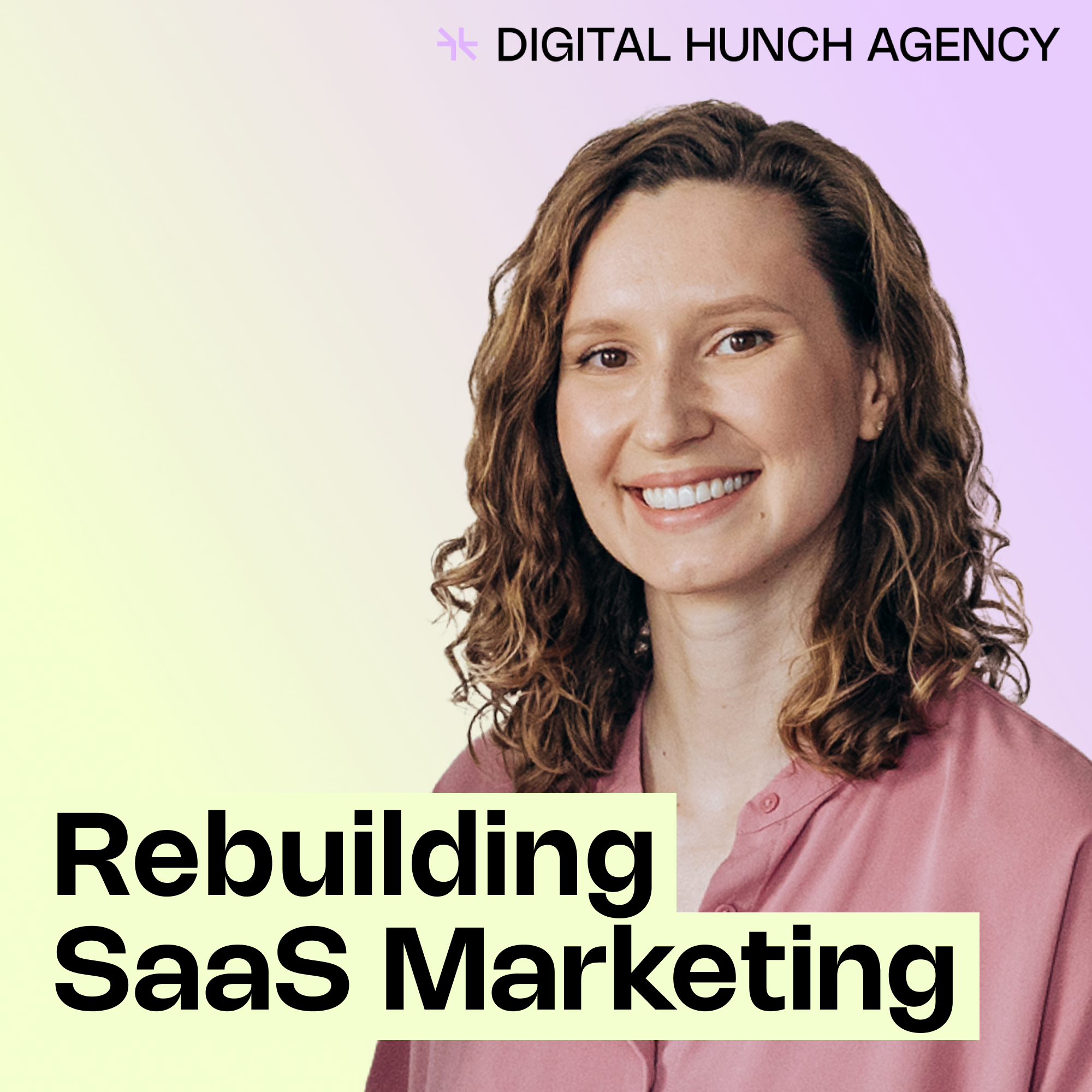
The SaaS Growth podcast: Rebuilding SaaS Marketing in the AI era
by Digital Hunch
The SaaS Growth podcast about marketing & GTM strategies. Rebuilding SaaS marketing foundations with Digital Hunch.AI is rewriting the rules of marketing, and founders are learning to rebuild from scratch. Proven playbooks no longer work. They’re slow, expensive, and built for a world that no longer exists. New approaches are still emerging — often messy, improvised, and driven by founders who figure things out in real time.This podcast is for those founders.Each episode features a real story of a SaaS company learning to grow in the AI era: how they built demand from zero, fixed what was broken, and tested their way to traction.What you’ll hear:Real Founder Stories: Practical insights on SaaS marketing strategies and overcoming growth plateaus.AI & Tactics: Deep dives into AI marketing tools, automation, and new growth mechanics.Expert Insights: Hosted by Renata Zinnatullina, fractional CMO and co-founder of Digital Hunch (A
-
3
Userpilot: Why SEO stopped being enough, and how they rebuilt acquisition with ABM in 2026
This episode focuses on Emilia, who runs marketing at Userpilot — a product growth platform now at eight-figure revenue, 80+ people, and 1,200+ customers from Adobe and DHL down to early-stage SaaS. She wrote a book on content marketing and built Userpilot's engine on exactly that: organic and SEO that peaked at 235,000 blog visitors a month. Then she co-built an ABM platform, Zen ABM, because the channel that made the company couldn't take it where it needed to go.Two things happened at once. First, the business outgrew the channel: as Userpilot moved upmarket and raised pricing, inbound SEO traffic became impossible to steer — you can't choose whether a large enterprise or a two-person startup searches your keyword, and conversion rates from organic were declining. Second, the channel itself started shrinking: the blog peaked at 235,000 visitors a month in May 2024 and then, in Emilia's words, "started declining and declining" as AI Overviews and Google algorithm changes took traffic. Emilia needed a predictable way to land larger accounts before conversions followed the traffic down. She spent three months researching ABM before spending a dollar, hired two specialists, and ran the whole program through LinkedIn rather than display. The first deals opened in about two and a half months; by day 90 there was $600K in pipeline from accounts that had never touched Userpilot before. ACV from ABM reached ~22K and is now ~26K, against ~8–10K from legacy inbound.On AI, her take is unfashionably skeptical. You can automate landing pages and a lot of blog production — she ships landing pages in minutes via a Claude skill. But you can't automate the input. A year of building an AI cold-outreach process still failed, because outreach is one line and one shot. The work that decides the outcome stays human. Emilia shares what actually shifted their results — and what she'd rebuild from day one: ↳ The two reasons SEO stopped working — the business outgrew it AND traffic started declining ↳ How AI Overviews and Google algorithm changes ended a 235K-visitor-a-month peak — and why conversions didn't fall as fast as traffic ↳ Why the ABM decision was strategic, not tactical — same channels can serve inbound or account-based ↳ Why she ran ABM entirely through LinkedIn and avoided display advertising ↳ The over-engineering trap — separate campaign layers per awareness stage that LinkedIn can't run (300-member minimum audience) ↳ Why one-to-many converts at a 0.58% deal-open rate — and what that means for list size ↳ Why one-to-one ABM only makes sense above six-figure contracts — and why a 22–26K ACV doesn't justify it ↳ Last-touch attribution is "like saying the reason I got home today was the door" — and the 180-day window they use instead ↳ The metric she stopped caring about: leads — downloading an e-book is not a buying signal ↳ Why thought leader ads and influencer posts outperform display — B2C tactics for B2B buyers ↳ How LinkedIn now shows up inside Google AI Overviews — where inbound and ABM accidentally overlap ↳ Why she built Zen ABM — RevOps and attribution were brutal, and the CRM data sat unused ↳ Where AI helps (landing pages, blog drafts) and where it fails (cold outreach) — and why you can't automate the input
-
2
Product Fruits: They hit $2M ARR on PPC alone, and rebuilding around AI broke the playbook
This episode focuses on Karel Papík, co-founder of Product Fruits — a product experience platform that sits as an invisible layer between an application and its users, handling onboarding, adoption, support, and churn prevention. Karel comes from video games, which is where he learned what adoption actually takes. He got Product Fruits to $2M ARR and 1,300 paying companies almost entirely on paid search — no 30-person content team, no founder-led enterprise sales motion, deliberately avoiding the usual founder-sales-then-hire-a-sales-chief trajectory. He runs an AI company, and he still thinks AI is "just the spice." Then two things broke at once. PPC ran into its natural ceiling — only so many people are searching at any given time. And when the company rebuilt its product around AI, marketing got harder, not easier: search volume for "AI onboarding" and "AI adoption" is almost nonexistent, so the company sells AI but has to run lead gen on old-world terms. Customers arrive asking for one thing and buy something different once they understand what's possible. As the product grew more complex, PLG stopped converting — free-trial conversion declined, and the decline tracked almost exactly with the added complexity. The fix wasn't a better channel. Product Fruits disbanded its CSM department, which Karel saw pushing upsells without real value, and replaced it with implementation engineers who help customers actually stand up complex use cases. The motion moved from marketing-led to sales-led. On AI, Karel's framing is blunt for someone who sells it: most companies don't need AI, they need processes and standards first. AI improves a working dish; it doesn't cook one. The flip side — a product without AI generally won't raise venture money right now, because investors fund what they recognize. His advice there is to keep bootstrapping rather than chase a round that isn't coming. Karel shares what actually shifted their results, and what he'd rebuild from day one: ↳ Why they bet on PPC over SEO — $400K raised, 10–12 months of runway, and SEO too slow to prove numbers ↳ The "harvesting" strategy — let well-funded competitors educate the market with content, then capture the comparison shoppers ↳ Why PPC hit a ceiling at ~$2M ARR — only so many people are searching ↳ Why rebuilding around AI broke lead gen — search volume for "AI onboarding" and "AI adoption" barely exists ↳ Why PLG stopped working as the product got complex — and the shift to a sales-led motion ↳ Why he disbanded the CSM department — and replaced it with implementation engineers who actually deploy ↳ The LinkedIn obsession that cost him salespeople — and why he no longer counts it as real lead gen ↳ Why ABM "didn't work at all" — and the affiliate program that returned pure zero despite loyal customers ↳ What happens after sign-up — over half of leads vanish on day one, most within 90 seconds ↳ Why you shouldn't always listen to customers — they ask for small upgrades; the big ideas you have to dream up first ↳ Why AI is "just the spice" — companies need processes first, and no-AI products won't raise from VCs ↳ His one piece of advice — try a pivot and fail fast instead of slowly feeding a dead horse
-
1
ChartMogul: What happens when a sales leader takes over marketing at a B2B SaaS company
This episode focuses on Sara Archer, Chief Revenue Officer at ChartMogul — a subscription analytics platform used by over 6,000 SaaS companies. Sara joined in 2018 as employee number one on the commercial side, couldn't build a forecast for the CEO on day two because the CRM data was useless, and has spent seven years inheriting more responsibility — from rebuilding the sales stack to now running both sales and marketing as a unified function. She believes demand generation is the hardest non-technical problem in SaaS and that most marketing systems that look healthy on paper are actually dead weight.ChartMogul built and shipped a revenue recognition product at the customers' request. The sales team dreaded every demo. Support tickets piled up. The product domain — accounting compliance — didn't match anyone's expertise. They decommissioned it. Years later, they built CRM capabilities inside ChartMogul instead, and the difference was immediate: it was fun to sell, customers adopted it naturally, and it made sense as an expansion lever. The lesson wasn't "don't build a second product" — it was that choosing the wrong problem set splits a small engineering team across two intellectual domains and erodes the quality of everything.On the AI front, Sara's team uses it heavily for data analysis — turning 25 raw sales call transcripts into an objection report in hours, compressing case study production from a week to two and a half hours. But they tried an AI email response tool for product questions and shut it off. It could answer the technical question but couldn't understand why the customer was asking — what business problem sat behind the query. Sara calls this "layers of theory of business" that AI can't yet replicate. She also flagged the "AI tourist" phenomenon from ChartMogul's data: users who sign up for AI products experimentally, with no intent to recur, inflating churn rates across the category.Sara shares what actually shifted their results — and what she'd rebuild from day one:↳ What separates the 3.5% of SaaS companies that reach $20M — adaptability and willingness to reinvent, not a better strategy↳ Why her first move at ChartMogul was rebuilding the CRM — and whether that was the right call or just her comfort zone↳ The revenue recognition product mistake — how a second product split engineering focus and created a domain expertise gap↳ How to know it's the wrong product: sales dreads the demo, support tickets take longer, and retention drops↳ When to move from founder-led sales — and why you should always hire two reps, not one↳ Why adding sales at low price points creates friction — and how to reverse-engineer the buying process instead↳ AI for commercial teams — case studies in 2.5 hours, automated call coaching twice a day, and objection trend reports from raw transcripts↳ Where AI fails in sales — it answers the question but doesn't understand the business reason behind it↳ The "AI tourist" problem — why experimental signups inflate churn and what to separate in your metrics↳ Why she dismantled marketing that looked healthy — conferences, content, panels — because it wasn't moving trial numbers↳ Pricing as a muscle — review it every two to three months, even if the answer is "do nothing"↳ The simplest scaling advice: listen to three customer calls and the problem becomes obvious
-
0
SalesScreen: Why B2B marketing stays reactive and what strategic demand gen looks like in 2026
This episode focuses on Sabih Ahmed, Director of Demand Generation at SalesScreen — a sales gamification platform built for revenue teams. Sabih came from B2C marketing, where continuous testing, creative iteration, and audience obsession weren't a methodology — they were just how things worked. When he moved into B2B during COVID, he found a world running on playbooks, intent tools, and the kind of patience for results that B2C would never tolerate.He spent five years inside SalesScreen rebuilding how demand generation actually works. What he found is that most B2B teams are optimizing the wrong thing: they chase intent signals, automate outreach, and run bottom-of-funnel campaigns at people who aren't close to buying.In his view, the fix isn't a better stack. It's doing the slow work most founders skip — understanding not just who fits your ICP on paper, but how they behave, what they're actually looking for, and when they're ready to move. Everything else — creativity, AI, channel strategy — only works once that foundation is real.Sabih shares what actually shifted their results, and what he'd rebuild from day one:↳ Why B2B marketing defaults to reactive, and why that's a behavior problem, not an AI problem ↳ What the 5% vs. 95% model actually means ↳ Why G2 intent signals aren't "ready to buy" signals, and the campaign failure that proved it ↳ What Sabi borrowed from B2C: weekly testing cycles, hook-first copy, and why creativity outperforms any playbook ↳ Why he killed TOFU/MOFU/BOFU, and what Awareness, Consideration, Conversion looks like when rebuilt around engagement signals ↳ How ad likes and LinkedIn video completion rates became more useful than pricing page visits ↳ Why you can't control a buyer journey, and what "control the controllables" actually means in practice ↳ The ICP mistake most B2B companies make: firmographics only, and how adding a behavioral layer changed their conversion rate ↳ How to use AI as an advisor, not an executor, and why the real failure is always the input, not the output ↳ Why strategy documents don't change execution, and where exactly the connection between vision and campaign breaks down ↳ Why small wins are the only realistic path from $3M to $10M, and how to start with auditing what already worked
-
-1
Plurio by Elly Analytics: why B2B SaaS breaks and how AI-agents replace it
They entered the US market with no brand, no partners, and no margin for mistakes. Instead of chasing “one more channel”, they spent a year running brutal research, 150+ calls per quarter. The conclusion was uncomfortable; the product sold, but there was no scalable way to grow sales.So they rebuilt the product into an AI agent. One that connects directly to real business data, explains what’s happening across the funnel, and takes action inside ad platforms.This episode is also about becoming an AI-first company in practice. Every team, marketing, product, analytics, and sales, works inside Cursor as a shared system. Knowledge base, onboarding, strategy, and daily decisions live in one place and default to AI.This episode focuses on Eveline Ogorodnikova, Head of Marketing at Elly Analytics and Plurio. As the first marketer in the team, Eveline led Elly through four years of market expansion, failed scaling attempts, and a strategic shift from analytics dashboards to an AI-native performance marketing agent.Eveline shares what actually worked, what didn’t, and how to run an AI-first company day-to-day:Why they made 150+ calls per quarter, and still couldn’t scale revenueHow interview funnels outperformed classic demo funnels in outboundWhy dashboards stopped working, and why “answers + actions” became the only scalable modelHow the team rebuilt performance marketing around an AI agent that optimizes campaigns based on revenue, not clicksWhat it really means to build an AI agent that connects to trusted business data, explains changes across the funnel, and takes action inside ad platforms without human micromanagementHow every team works inside Cursor as an operating system: onboarding, strategy, research, decisions, and context all live in one placeWhy Cursor replaced onboarding docs, internal wikis, and most sync meetingsHow AI changes roles inside the company, fewer manual operators, more strategic thinkersWhy AI-first companies still need humans, but in completely different jobs than beforeIf you’re building a complex B2B SaaS, selling to marketers or founders, and feel stuck between “the product works” and “growth doesn’t scale”, this episode will hit close to home.Watch on YouTube: https://www.youtube.com/@Digital-HunchOr listen wherever you get your podcasts.Learn more about Elly Analytics: https://ellyanalytics.com/Connect with Eveline on LinkedIn: https://www.linkedin.com/in/eveline-ogorodnikov/Follow Renata Zinnatullina on LinkedIn: https://www.linkedin.com/in/renatazinnatullina/Visit our site: https://digital-hunch.com
-
-2
“We don’t need 15 people anymore”: what modern SaaS marketing looks like when you cut the team to the bone
They entered HR tech at the worst possible moment: the remote-work boom was over, the category was overcrowded, and every keyword was already taken. Yet BuddiesHR still managed to grow, because they tested every hypothesis so radically that, at one point, they even built a competitor to themselves.This episode focuses on J.Y. Delmotte, the co-founder of BuddiesHR. He explains how they chose to bootstrap after raising $6M in VC funding.J.Y. shared his sharpest insights — what they did, why they did it, and what results it led to:how they entered one of the most overcrowded HR markets in 2023 — when the remote-work boom was over, Slack apps looked interchangeable, and every relevant keyword was already dominatedwhy they stayed a two-founder team in a market where everyone hires early — and how this constraint forced them to design a cleaner, faster GTMwhy they spoke to more than 40 HR leaders before writing a single line of codehow a tiny birthday-automation app became their entry point — and why this lightweight product helped them break through marketplace noisehow cold outreach collapsed for them from day onehow Slack Marketplace became their strongest early channel — and why this ecosystem rewarded focus, not breadthhow they crafted a meme first, a culture-driven tone of voice that speaks only to their best HR buyers, something radically unusual in the corporate HR tools spacewhy their AI SEO strategy backfired — thousands of programmatic pages that hurt domain health — and how switching to topic clusters revived their organic traffichow their first Google Ads attempt resulted in ~$500 per signup with no ROI, and why their later shift to competitor-keyword campaigns and “X vs BuddiesHR” pages finally started showing early positive signalshow they improve messaging by watching real visitors interact with the site and letting a 10-member ICP board critique the copyhow they divide marketing and product between two founders — and why this structure prevents slowdowns even with zero full-time hireshow ChatGPT became a practical tool for editing, clarity, and risk-control — and why they use it selectively to avoid brand damagewhy they rely on small, fast experiments instead of big, resource-heavy bets — and how this mindset keeps their growth steady while staying fully bootstrappedConnect with J.Y. on Linkedin. Learn more at BuddiesHR.com
We're indexing this podcast's transcripts for the first time — this can take a minute or two. We'll show results as soon as they're ready.
No matches for "" in this podcast's transcripts.
No topics indexed yet for this podcast.
Loading reviews...
ABOUT THIS SHOW
The SaaS Growth podcast about marketing & GTM strategies. Rebuilding SaaS marketing foundations with Digital Hunch.AI is rewriting the rules of marketing, and founders are learning to rebuild from scratch. Proven playbooks no longer work. They’re slow, expensive, and built for a world that no longer exists. New approaches are still emerging — often messy, improvised, and driven by founders who figure things out in real time.This podcast is for those founders.Each episode features a real story of a SaaS company learning to grow in the AI era: how they built demand from zero, fixed what was broken, and tested their way to traction.What you’ll hear:Real Founder Stories: Practical insights on SaaS marketing strategies and overcoming growth plateaus.AI & Tactics: Deep dives into AI marketing tools, automation, and new growth mechanics.Expert Insights: Hosted by Renata Zinnatullina, fractional CMO and co-founder of Digital Hunch (A
HOSTED BY
Digital Hunch
Loading similar podcasts...
Frequently Asked Questions
How many episodes does The SaaS Growth podcast: Rebuilding SaaS Marketing in the AI era have?
The SaaS Growth podcast: Rebuilding SaaS Marketing in the AI era currently has 6 episodes available on PodParley. New episodes are automatically indexed when they're published to the podcast feed.
What is The SaaS Growth podcast: Rebuilding SaaS Marketing in the AI era about?
The SaaS Growth podcast about marketing & GTM strategies. Rebuilding SaaS marketing foundations with Digital Hunch.AI is rewriting the rules of marketing, and founders are learning to rebuild from scratch. Proven playbooks no longer work. They’re slow, expensive, and built for a world that no...
How often does The SaaS Growth podcast: Rebuilding SaaS Marketing in the AI era release new episodes?
The SaaS Growth podcast: Rebuilding SaaS Marketing in the AI era has 6 episodes. Check the episode list to see recent publication dates and frequency.
Where can I listen to The SaaS Growth podcast: Rebuilding SaaS Marketing in the AI era?
You can listen to The SaaS Growth podcast: Rebuilding SaaS Marketing in the AI era on PodParley by clicking any episode. We provide an embedded audio player for direct listening, and you can also subscribe via your preferred podcast app using the RSS feed.
Who hosts The SaaS Growth podcast: Rebuilding SaaS Marketing in the AI era?
The SaaS Growth podcast: Rebuilding SaaS Marketing in the AI era is created and hosted by Digital Hunch.
URL copied to clipboard!