
PODCAST · arts
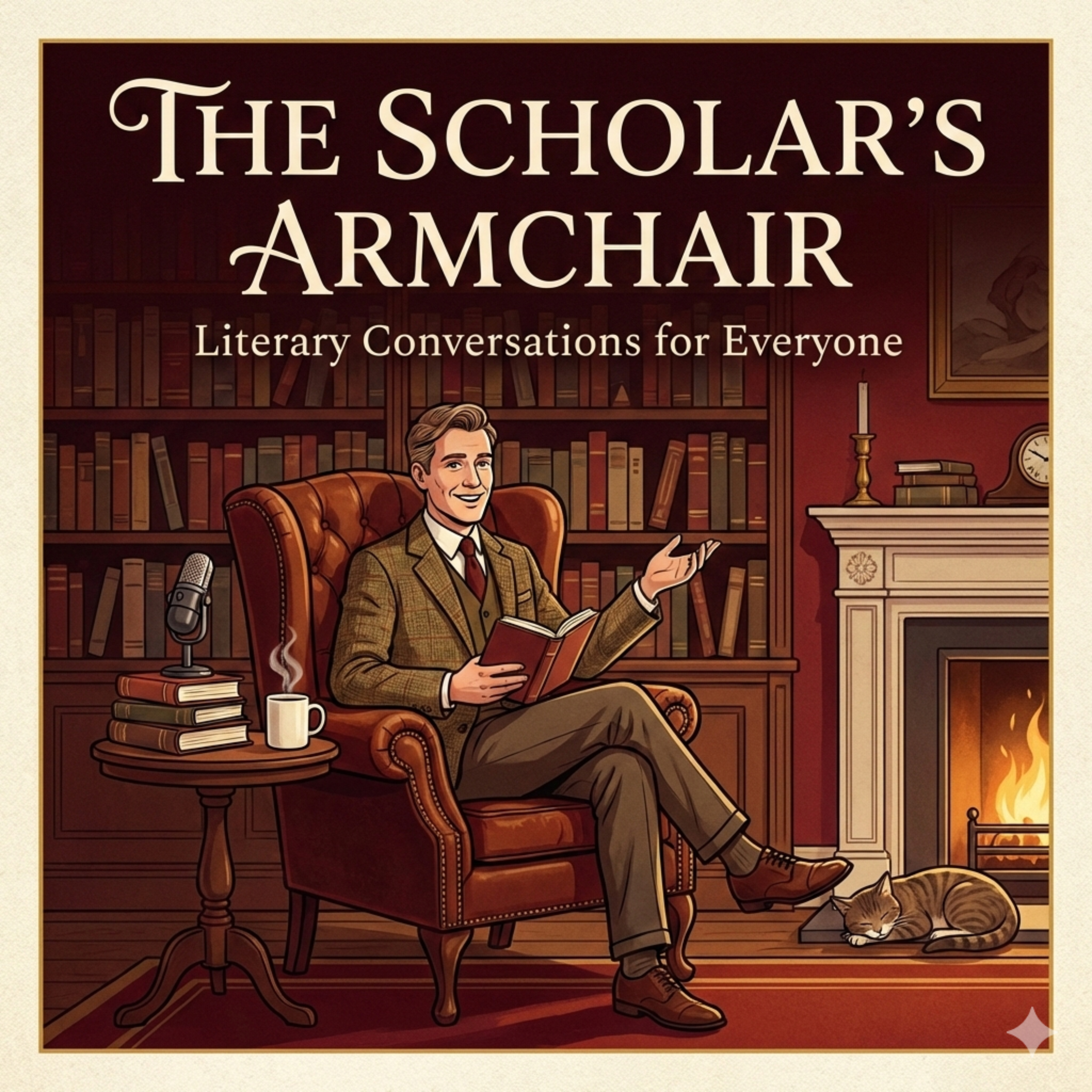
The Scholar's Armchair
by Dr. John Burton
Conversations with literary scholars on their area of expertise for a general audience. Less like a lecture, more a conversation with an expert.Check us out on YouTube!
-
13
How ORWELL makes the mundane meaningful | Professor Nathan Waddell
We think we know George Orwell. The author of 1984. The prophet of surveillance, propaganda, and political control.But what if that version of Orwell is only part of the story?In this conversation, I’m joined by Nathan Waddell to discuss his book A Bright Cold Day: The Wonder of George Orwell. Rather than focusing on Orwell’s big ideas alone, Waddell invites us to see something often overlooked: Orwell as a writer of the everyday, of habits, routines, small observations, and the quiet textures of ordinary life.Together we explore a different way of reading Orwell, one that shifts attention away from grand political abstractions and toward the lived experience that underpins them. From the role of attention and memory, to the emotional life behind Nineteen Eighty-Four, this discussion asks a simple but important question:Have we been reading Orwell wrong?This is a conversation about literature, but also about how we live, about how meaning is found not only in the large forces that shape history, but in the small details that shape our days.🔍 Topics discussed-Why Orwell is more than a political writer-The importance of the everyday in literature-Rethinking Nineteen Eighty-Four-Attention, memory, and lived experience-The relationship between the ordinary and the political-Which of Orwell’s other forgotten novels we should read📚 LinksA Bright Cold Day: The Wonder of George Orwell by Nathan Waddell https://oneworld-publications.com/work/a-bright-cold-day/Nathan’s profile page (and links to his other works): https://www.birmingham.ac.uk/staff/profiles/english/waddell-nathan🎙️ About the channelThe Scholar’s Armchair brings academic ideas into conversation with a wider audience. Each episode explores literature, criticism, and thought in a way that is accessible, reflective, and grounded in close reading.
-
12
Lone Genius? SHAKESPEARE’S Influences and Collaborators | Dr Darren Freebury-Jones
Did Shakespeare really write alone… or was he borrowing from the greatest playwrights of his time?In this episode of The Scholar’s Armchair, I speak with Darren Freebury-Jones about his fascinating book Shakespeare’s Borrowed Feathers, which rethinks one of the biggest myths in literary history.We explore the world Shakespeare actually lived and worked in: a vibrant, competitive theatre scene filled with extraordinary writers like Christopher Marlowe, Thomas Kyd, Ben Jonson, and Thomas Middleton. Far from being a solitary genius, Shakespeare emerges as a playwright shaped by collaboration, rivalry, and creative borrowing.Together, we discuss:* The meaning behind the famous “upstart crow” insult* Whether Shakespeare collaborated on early plays like Henry VI and Titus Andronicus* How writers like Marlowe and Kyd influenced Shakespeare’s dramatic style* The role of modern attribution studies and stylometry in uncovering authorship* The legendary “wit combats” between Shakespeare and Jonson* What truly made Shakespeare ShakespeareThis conversation offers a fresh and accessible way into one of the most exciting areas of literary scholarship today: the idea that Shakespeare’s genius lies not just in originality, but in his extraordinary ability to absorb and transform the work of others.If you love Shakespeare, theatre history, or the hidden stories behind great literature, this episode will change the way you think about the world’s most famous writer.==========================Darren’s Books:📖Shakespeare’s Borrowed Feathers: https://manchesteruniversitypress.co.uk/9781526177346/📖Reading Robert Greene: Recovering Shakespeare’s Rival: https://www.routledge.com/Reading-Robert-Greene-Recovering-Shakespeares-Rival/Freebury-Jones/p/book/9781032154091📖Shakespeare’s Tutor: The Influence of Thomas Kyd: https://manchesteruniversitypress.co.uk/9781526164742/👨🏫Darren’s website: https://darrenfj.wordpress.com/⸻
-
11
How Jane AUSTEN Conquered The World | Professor Juliette Wells
How did Jane Austen go from a little-known novelist to a global phenomenon?In this episode of The Scholar’s Armchair, I’m joined by literary scholar Professor Juliette Wells, author of Reading Austen in America, Everybody’s Jane, and A New Jane Austen: How Americans Gave Us The World’s Greatest Novelist to explore the remarkable story of Austen’s rise to fame.We tend to assume that great writers become famous simply because of their genius. But Wells reveals a much more surprising story — one shaped by readers, collectors, critics, and fans across two centuries. From the first American edition of Emma in 1816 to the explosion of Austen adaptations, fandom, and literary tourism, this conversation uncovers how Austen’s reputation was built over time.We also explore the role of early American readers, the influence of figures like William Dean Howells, and the unexpected ways ordinary readers helped turn Austen into one of the most beloved authors in the world.If you’ve ever wondered why Austen’s novels continue to resonate today — and what her story reveals about how literary reputations are formed — this conversation offers a fascinating answer.==================================Professor Wells’ Books:📖A New Jane Austen: How Americans Gave Us the World’s Greatest Novelist: https://www.bloomsbury.com/uk/new-jane-austen-9781350365537/📖Reading Austen In America: https://www.bloomsbury.com/uk/reading-austen-in-america-9781350012066/📖Everybody’s Jane: Austen in the Popular Imagination: https://www.bloomsbury.com/uk/everybodys-jane-9781441111166/📖Juliette’s overview of the Morgan Library exhibition at JASNA’s open access website: https://jasna.org/publications-2/persuasions-online/volume-46-no-1/wells/🧑🏫Juliette's profile page at Goucher College: https://www.goucher.edu/faculty/juliette-wells🔍Explore the Morgan Library exhibition including letters written by Austen: https://www.themorgan.org/exhibitions/lively-mind-jane-austen-250=================================
-
10
The SALEM Witch Children | Dr Kristina West
The Salem witch trials weren’t just about witches. They were about children—and what adults needed them to be.What role did children really play in the Salem witch trials? In this conversation, Dr Kristina West reveals how the figure of the child sits at the centre of the panic, challenging our assumptions about innocence, guilt, and history itself.We discuss her book The Salem Witch Child and explore her current project on perceptions of witches and magic in American culture. 📖 Read Krissie’s book: https://www.waterstones.com/book/reading-the-salem-witch-child/kristina-west/9783030493066🧑🏼🏫 Krissie’s profile at Royal Holloway: https://pure.royalholloway.ac.uk/en/persons/krissie-west/
-
9
The METAMODERN Shift in Contemporary Fiction | Dr Usha Wilbers & Dr Dennis Kersten
What comes after postmodernism? In this interview, Dr Usha Wilbers and Dr Dennis Kersten of Radboud University explore metamodernism as a new cultural “structure of feeling” emerging in contemporary literature.Moving from modernism’s search for meaning to postmodernism’s irony and scepticism, we ask what it means to read and write fiction today in a world that no longer fully believes in either. Drawing on their research into reader responses to novels like NW and How to Be Both, as well as their forthcoming book Glocal Metamodernisms, Wilbers and Kersten reveal how sincerity, irony, and hope coexist in twenty-first-century culture.Is metamodernism a new era, or simply what it feels like to live after meaning has fractured?=======================================References:📖Read Usha and Dennis' book 'Glocal Metamodernisms' (out May 2026): https://www.bloomsbury.com/us/glocal-metamodernisms-9798216276289/📖Read their article 'Down the Metamodernist Plain' (2020): https://www.researchgate.net/publication/386531627_Down_in_the_Metamodernist_Plain_Tracing_a_Twenty-First-Century_Structure_of_Feeling_in_the_Reception_of_NW_and_How_to_Be_BothTheir University ProfilesUsha Wilbers: https://www.ru.nl/en/people/wilbers-uDennis Kersten: https://www.ru.nl/en/people/kersten-dVermeulen and van den Akker's article 'Notes on Metamodernism' (2010): https://www.researchgate.net/publication/233894749_Notes_on_MetamodernismSee also: https://www.metamodernism.com/
-
8
What SHAKESPEARE’S Mirrors Are Really Showing Us | Dr Valentina Finger
What are the many mirrors of the Shakespearean stage really showing us? In this episode of The Scholar’s Armchair, I speak with literary scholar Dr. Valentina Finger of LMU Munich about her new book Mirrors in Shakespeare and Early Modern English Drama: Power, Gender and the Magic of the Theatre. Together, we explore how mirrors in plays like Richard II, Macbeth, The Duchess of Malfi, and The Alchemist do far more than reflect reality—they expose it, distort it, and sometimes shatter it completely.We discuss how mirrors on the early modern stage were used to explore: • The fragility of kingship and political power • The construction of identity and the “two bodies” of the king • Gender, cosmetics, and female agency in Jacobean drama • Magic, science, and theatrical illusion in the RenaissanceDrawing on history, philosophy, and close reading, this conversation reveals how Shakespeare and his contemporaries used mirrors to turn theatre itself into a space of reflection, inversion, and revelation.If you’re interested in Shakespeare, early modern drama, literary theory, gender studies, or the history of theatre, this episode offers a fresh way of seeing familiar plays.📖Read Valentina’s book for FREE: https://www.bloomsburycollections.com/monograph?docid=b-9781350535381🙋♀️ Valentina’s profile at LMU: https://www.anglistik.uni-muenchen.de/personen/wiss_ma/finger/index.htm
-
7
How GEORGE ELIOT Invented the Victorian Novelist | Prof Alessandra Grego
Read Alessandra's book The Myth of George Eliot: https://www.routledge.com/The-Myth-of-George-Eliot-How-Marian-Evans-Invented-the-Victorian-Novelist/Grego/p/book/9781032551128🙋 Prof Alessandra Grego's profile and further links to her work: https://www.johncabot.edu/directory/alessandra-grego==============================Description:Did George Eliot secretly challenge the myths of Victorian society — while writing behind a myth of her own?In this episode of The Scholar’s Armchair, I speak with literary scholar Professor Alessandra Grego of John Cabot University about her fascinating book The Myth of George Eliot. Together we explore one of the most intriguing questions in literary history: how Marian Evans, writing under the male pseudonym George Eliot, used the realist novel to challenge the “common sense” assumptions of Victorian culture.Grego argues that George Eliot was not simply a pen name but a carefully constructed authorial persona — a myth that allowed Evans to question the myths of her own society. From the ideals of the Victorian gentleman and the “damsel in distress” to the cultural expectations placed on women’s bodies and ambitions, Eliot’s novels quietly dismantle the stories Victorian society told about itself.We discuss how Eliot’s great heroines — Dorothea Brooke, Maggie Tulliver, Gwendolen Harleth and others — disrupt these inherited narratives. Grego describes them as “towering women”: characters whose moral and intellectual aspirations exceed the narrow roles society offers them. Through these figures, Eliot exposes how cultural myths shape our understanding of gender, power, and social possibility.Topics we explore include:• Why “George Eliot” may be a mythic authorial identity• How realist fiction can challenge cultural “common sense”• The Victorian myths of the knight and the damsel• Eliot’s complex and powerful female characters• Why some of Eliot’s heroines seem “too big” for the worlds they inhabitThis conversation offers a fresh way of thinking about one of the greatest novelists in English literature — not simply as a moral voice of Victorian realism, but as a writer who reimagined the stories society tells about itself.
-
6
Trailer — The Scholar’s Armchair
Welcome to The Scholar’s Armchair, where each week Dr. John Burton sits down for an informative insightful conversation with a leading literary scholar about the big ideas behind the big books that have shaped our world.
-
5
Interpretive Reading with LIVE Reading of Rilke | Dr Neil Cocks
What happens when you take a short text — and read it slowly, live, without a script?In this wide-ranging and intellectually electric conversation, I’m joined by literary critic Dr Neil Cocks of the University of Reading (no less!) to explore the art of close reading, the role of theory, and what it really means to “work through” a text rather than simply affirm it.==============================================Bibliography and links from Neil:Children’s Literature intro: Jacqueline Rose. 1984. The Case of Peter Pan, or, The Impossibility of Children’s Fiction. Basingstoke: Macmillan.Karin Lesnik-Oberstein. 1994. Children’s Literature: Criticism and the Fictional Child. Oxford: Clarendon.Rudd, David. 2020a. The Theory Wars Revisited: Rose and the Reading Critics vs. the Liberal Humanists. The Lion and the Unicorn 44:89–109.Marah Gubar. 2013. Risky Business: Talking about Children in Children’s Literature Criticism. Children’s Literature Association Quarterly 38: 450–57As part of the discussion of coming out and Frozen:The Butler I reference in terms of ‘I am a lesbian’:· Judith. Butler. 1993. Gender Imitation and Insubordination. In The Lesbian and Gay Studies Reader. Edited by Henry Abelove, Michele Aine Barale and David M. Halperin. London: Routledge, pp. 307–20.The ‘coming out in Neo-liberal times’:· Stephanie D. Clare. 2017. ‘Finally, She’s Accepted Herself!’: Coming Out in Neoliberal Times. Social Text 1: 17–38.There are many examples of the straightforward social media queer advocacy work on Frozen I mention, but see:· Geek and Sundry Vlogs, Disney’s Frozen and the LGBT Community, https://www.youtube.com/watch?v=n_r0QTzg6Bw· Queer Kids Stuff, Give Else a Girlfriend, https://www.youtube.com/watch?v=-cTFGkEI4Rc I take the riff on neuroscience and brain scans from:· Jan De Vos. 2020. The Digitalisation of (Inter)Subjectivity: A Psy-critique of the Digital Death Drive. London: Routledge.I keep referring to an idea of fixing or defending identity, even as that identity is called into question. I have in mind here especially Daniel Baker and Paul Ryan’s ‘Mirror Mirror’, a video artwork for the first Roma Pavillion at the 2011 Venice Biennale. Baker and Ryan work to secure a distinct Roma identity and aesthetics, but in such a way that engages with what they term a necessary ‘provisionality’ also. Their work takes the opposite approach to my own (its broadly against linguistic approaches), but seems to me exemplary of ethical and rigorous practice in the area of identity and ethnicity. · Baker and Ryan. 2011. Mirror Mirror. https://www.youtube.com/watch?v=iieQf9o-xW0I found it so inspiring, that a reading of it forms a central chapter in my new book.· Neil Cocks. 2026. Reading the Racial Encounter in Multi-Media Texts. London: Routledge.Close reading:The person I mention in relation to Levinas is Timothy Secret. He has, again, just about the opposite approach to Theory to me, but I find his work incredibly inspiring and clarifying.· Timothy Secret. 2015. The Politics and Pedagogy of Mourning: On Responsibility in Eulogy. London: Bloomsbury.==================================Timestamps:00:00 Introduction03:57 Ideology Applies to Us Too (Sensitivity to Framing)10:40 The Critique of the Framing of Childhood14:00 The Framing of Voice16:00 The Complexities of Otherness in Texts18:37 Returning to the Text20:21 Paul de Man and Resistance to Theory23:37 Problems with Freud and Lacan25:17 The Drive to Interpret Can be The Block27:00 How Encountering Texts is Always Based on Prior Experience30:50 Our Framing is Always Operational31:39 Frozen and the Complexities of the Coming Out Narrative38:38 Problems of Securing Identity by Appeal to Exterior Simplicity44:48 Peripheral Identities and Texts54:46 Live Reading of Rilke
-
4
Female Identities: PLATH, Magazines, and the Politics of the Kitchen | Prof Caroline Smith
Sylvia Plath, Chick Lit, and the Politics of the Kitchen | Interview with Dr Caroline J. SmithLINKS:Check out Caroline's book Cosmopolitan Culture and Consumerism in Chick-Lit here: https://www.routledge.com/Cosmopolitan-Culture-and-Consumerism-in-Chick-Lit/Smith/p/book/9780415806268Check out Caroline's book Season to Taste: Rewriting Kitchen Space in Contemporary Women’s Food Memoirs here: https://www.upress.state.ms.us/Books/S/Season-to-TasteCheck out my video on Sylvia Plath's The Bell Jar here: https://youtu.be/SwYPkRBI7r8?si=BcgMIGcUAmjEPFUz=====================================In this in-depth literary interview, I speak with Dr Caroline J. Smith of George Washington University about her groundbreaking work on Sylvia Plath, women’s magazine culture, consumerism, chick lit, and contemporary food memoir.We begin with Plath’s The Bell Jar and Dr Smith’s influential essay, “The Feeding of Young Women”, exploring how 1950s magazines like Mademoiselle shaped cultural ideals of femininity, domesticity, and consumption — and how those pressures inform Esther Greenwood’s identity crisis.From there, we move to Dr Smith’s book Cosmopolitan Culture and Consumerism in Chick Lit, examining how modern “chick lit” both embraces and critiques consumer culture. What does it mean when shopping, lifestyle, and food become tools for constructing female identity?Finally, we discuss her latest book, Season to Taste: Rewriting Kitchen Space in Contemporary Women’s Food Memoirs (2023), where she explores how writers such as Julie Powell and Ruth Reichl reclaim the kitchen — transforming it from a site of confinement into a space of authorship, pleasure, and power.Topics include:Sylvia Plath and The Bell JarMademoiselle magazine and 1950s femininityConsumer culture and women’s identityCosmopolitan magazine and chick litFood, gender, and feminist literary criticismContemporary women’s food memoirThe politics of kitchen spaceIf you’re interested in feminist literary criticism, women’s writing, food studies, or modern literature, this conversation offers rich insight into how cultural scripts around femininity continue to shape — and be reshaped by — women writers.Subscribe for more interviews on classic and contemporary literature.Music for The Scholar’s Armchair by [email protected]#SylviaPlath #TheBellJar #FeministCriticism #ChickLit #FoodStudies #LiteraryInterview #WomenWriters #Cosmopolitan #FoodMemoir
-
3
FRANKENSTEIN: Reading, Revolutions, and Reasoning | Dr Luis Othoniel Rosa
📖Check out Luis Othoniel Rosa's novel Animal Spiral: https://charcopress.com/bookstore/animal-spiral💡Check out more from Luis: https://luisothonielrosa.com/🎯Check out my video on Frankenstein: https://youtu.be/wtV8vT8g_5Y?si=cEBtg1fGScO-GBPj=============================================In this wide-ranging interview, Dr John Burton discusses Mary Shelley, Frankenstein, historicity, the Haitian revolutions, and ways of reading and interpreting with eminent Latin American scholar Professor Luis Othoniel Rosa. We discuss reading as a revolutionary act, Luis' own theories and ideas about Frankenstein and its correspondence with the Haitian revolutions, and how the novel helped develop a Gothic tone in Latin American literature. "So often you find in the literatures of other people the key to understanding your own", so says Dr Rosa -- poet, novelist, and academic.Music for The Scholar’s Armchair by [email protected]
-
2
The WUTHERING HEIGHTS Interview | Hilary Newman
In this wide-ranging interview, Brontë scholar Hilary Newman joins The Scholar’s Armchair to explore Wuthering Heights in depth—its unsettling characters, narrative complexity, violence, grief, religion, haunting, and radical departures from the Victorian novel. We discuss Heathcliff and sympathy, Emily Brontë’s narrative strategy, the problem of adaptation, alternative endings, authorship controversies, and modern critical approaches including grief theory. Along the way, we compare Wuthering Heights with Jane Eyre, The Tenant of Wildfell Hall, Dickens, and Virginia Woolf’s criticism of the Brontës.If you’ve read Wuthering Heights, this interview will give you some crucial new insights into the novel. If you’ve yet to read it, this interview will give you some key tips for getting the most out of it.=========================================================================Link to Hilary's book: https://www.amazon.co.uk/Virginia-Woolf-Lives-Afterlives-Bront%C3%ABs/dp/1666940224Link to Hilary's paper 'Death and its Aftermath in Wuthering Heights': https://www.academia.edu/107752600/Death_and_its_Aftermath_in_Wuthering_HeightsLink to the Brontë Society: https://www.bronte.org.uk/about-us/the-bronte-society
No matches for "" in this podcast's transcripts.
No topics indexed yet for this podcast.
Loading reviews...
Loading similar podcasts...
URL copied to clipboard!