
PODCAST · history
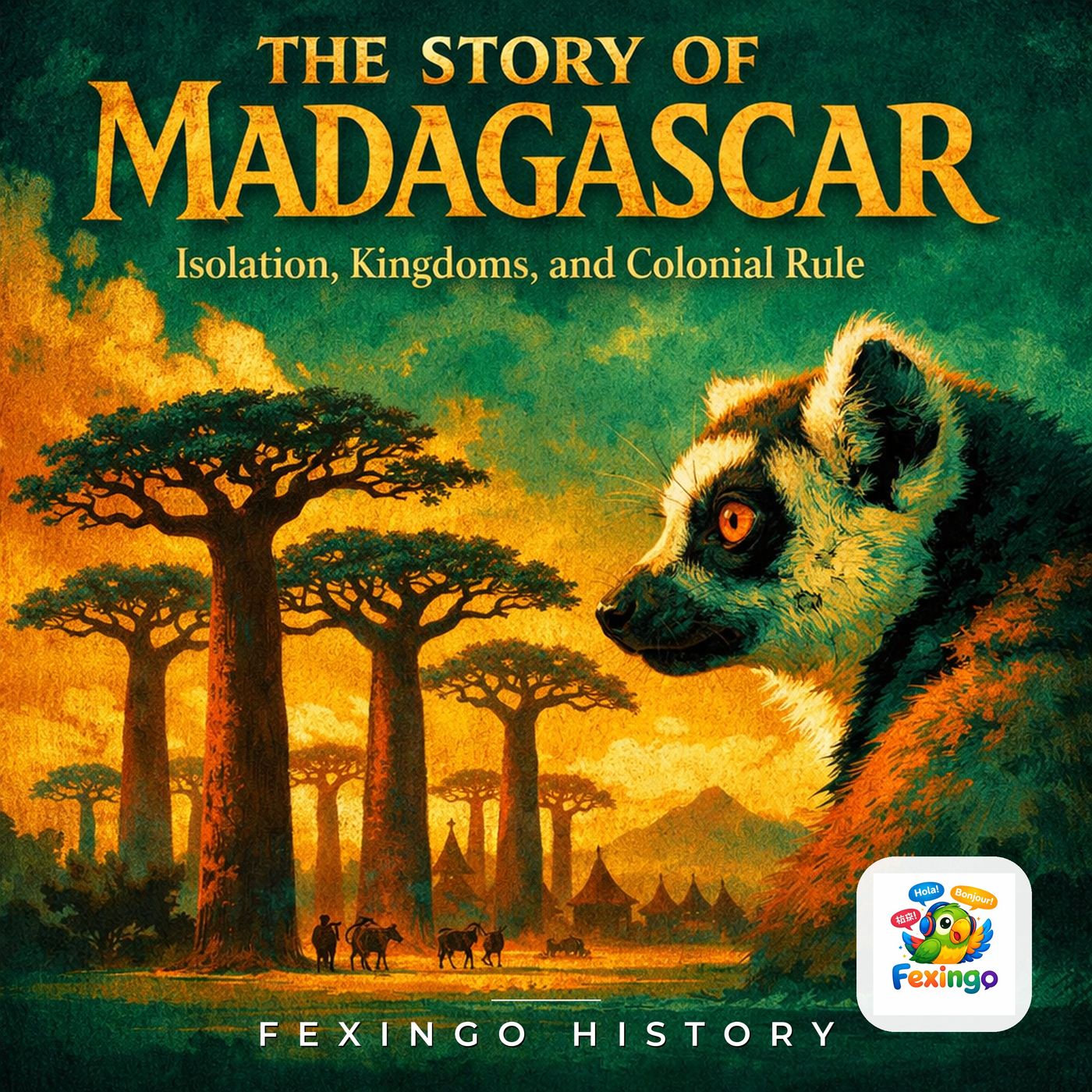
The Story of Madagascar: Isolation, Kingdoms, and Colonial Rule — Fexingo History
by Fexingo
Madagascar, the world's fourth-largest island, holds a history as distinct as its famed baobabs and lemurs. Separated from Africa by the Mozambique Channel for 88 million years, its human story began only 2,000 years ago with Austronesian settlers who brought a language, culture, and crops from across the Indian Ocean. Over centuries, these Vazimba and later Merina highlanders built kingdoms that would shape the island's destiny. Lucas and Luna trace this arc from the rise of the Merina Kingdom under Andrianampoinimerina, who unified the central highlands in the late 18th century, to the reign of his son Radama I, who opened Madagascar to European influence. They explore the tragic reign of Queen Ranavalona I, a fierce isolationist who expelled Europeans and persecuted Christians, and the subsequent transformation under her son Radama II and Prime Minister Rainilaiarivony, who modernized the state while navigating French encroachment. The Franco-Hova Wars, the 1895 French invasion, and
-
34
The Maroserana Dynasty: Madagascar's Sakalava Empire Builders
This episode traces the rise of the Maroserana dynasty, the founders of the Sakalava kingdoms of Menabe and Boina that dominated western Madagascar from the 16th to 19th centuries. Lucas and Luna explore how these rulers claimed descent from the Zafiraminia Muslims, built power through control of the slave and cattle trades, and resisted Merina expansion. Key figures include Andriamandazoala, the legendary first Maroserana king, and Queen Binao, who fought French colonization. The episode also examines the role of tromba spirit possession in legitimizing Sakalava rule, the use of aloalo funerary posts as historical records, and the lasting impact of Maroserana political structures on modern Madagascar. #Maroserana #Sakalava #Menabe #Boina #MadagascarHistory #Andriamandazoala #QueenBinao #Zafiraminia #Tromba #Aloalo #Merina #SlaveTrade #IndianOcean #Dynasty #OralTradition #History #FexingoHistory #EastAfrica Keep every episode free: buymeacoffee.com/fexingo
-
33
Madagascar's Famine: The Nationalist Resistance Strategy of the 1940s
In the 1940s, Malagasy nationalists faced a dilemma: French colonial rule was entrenched, and open revolt seemed impossible. Their solution was a calculated economic weapon — a widespread refusal to grow cash crops for export, particularly rice and coffee, to starve the colonial economy. This episode examines the 'famine strategy' (hetsy or tsy fanariana) deployed by the Mouvement Démocratique de la Rénovation Malgache (MDRM) and its allies. We look at how farmers in the Betsileo highlands and the coastal lowlands coordinated crop destruction and hoarding, how the French administration responded with forced requisitions and collective punishments, and the human cost — an estimated 10,000 to 20,000 deaths from hunger between 1943 and 1946. The strategy ultimately failed to achieve independence but set the stage for the 1947 uprising. We also discuss the ethical debates within the nationalist movement itself: was starving the colonizer worth starving your own people? #Madagascar #MalagasyUprising #Hetsy #TsyFanariana #MDRM #FrenchColonialism #NationalistResistance #Betsileo #Antananarivo #Famine #Rice #Coffee #1940s #ColonialEconomics #CivilResistance #History #FexingoHistory #EastAfrica Keep every episode free: buymeacoffee.com/fexingo
-
32
Madagascar's Antalaotra: Muslim Traders of the Swahili Coast
In this episode, Lucas and Luna explore the Antalaotra, the Muslim trading communities that connected Madagascar to the Swahili Coast and the Indian Ocean world. They trace the origins of these traders, their settlements at Mahilaka and Boina, and their use of sorabe (Arabic script). The conversation covers the Antalaotra's role in the Sakalava kingdom, their influence on Malagasy culture and religion, and the eventual decline of their maritime networks. Lucas highlights the blending of Islamic and local traditions, the significance of the Antalaotra in spreading literacy, and the legacy of their trade in slaves, textiles, and spices. The episode also touches on the Antalaotra's interactions with European powers and the gradual erosion of their dominance. This is a deep dive into a lesser-known but crucial piece of Madagascar's history. #Antalaotra #Mahilaka #Sorabe #Sakalava #Maroserana #Boina #SwahiliCoast #Madagascar #IndianOceanTrade #Islam #Zafiraminia #Antemoro #NosyBe #MozambiqueChannel #Tromba #EastAfrica #History #FexingoHistory Keep every episode free: buymeacoffee.com/fexingo
-
31
Madagascar's Antalaotra: Muslim Traders of the Swahili Coast
In this episode, Lucas and Luna explore the Antalaotra, the Muslim trading communities who shaped Madagascar's northwest coast from the 13th century onward. They discuss the Antalaotra's origins in the Swahili city-states, their role in the Sakalava kingdoms, the unique sorabe manuscripts they produced, and their decline under French colonial rule. Learn about the port of Mahilaka, the Antalaotra's use of the Arabic script for Malagasy, and their complex relationship with the Maroserana dynasty. This episode sheds light on a little-known but influential group that bridged Africa and the Indian Ocean. #Madagascar #Antalaotra #SwahiliCoast #IslamInAfrica #Mahilaka #Sakalava #Maroserana #sorabe #IndianOceanTrade #NosyBe #Boina #Tromba #FrenchColonial #13thCentury #15thCentury #EastAfrica #History #FexingoHistory Keep every episode free: buymeacoffee.com/fexingo
-
30
The Antandroy: Southern Madagascar's Cattle-King Warriors
In the deep south of Madagascar, the Antandroy people built a fiercely independent society around zebu cattle, sacred tombs, and ancestral taboos. This episode explores their origins as descendants of the Zafiraminia, their resistance against Merina expansion in the 19th century, and their unique cultural practices like the aloalo funerary sculptures and the tromba spirit possession ceremonies. We focus on the figure of Kotavy, the legendary Antandroy rebel leader who united clans against French colonial forces in the early 1900s, and the devastating 1947 rebellion that saw the Antandroy rise up against French rule. The conversation also covers their arid landscape, the importance of fady (taboos) in daily life, and the decline of their traditional way of living under modern pressures. #Antandroy #Kotavy #Madagascar #Zebu #Aloalo #Tromba #Fady #FrenchColonialism #1947Uprising #Zafiraminia #Androy #Toliara #Merina #Resistance #SouthernMadagascar #CattleCulture #History #FexingoHistory Keep every episode free: buymeacoffee.com/fexingo
-
29
The Bara: Madagascar's Cattle-Raiding Warriors and Taboo
In this episode, Lucas and Luna explore the Bara people of southern Madagascar, a semi-nomadic pastoralist society known for their fierce independence, elaborate cattle raiding, and strict taboos. Centered on the Isalo massif, the Bara never unified under a single kingdom, instead organizing into clans like the Bara-be and Bara-tsi-nahavaly. Lucas explains the practice of dahalo cattle rustling, the significance of the zebu in bride price, and the unique burial traditions involving large stone tombs decorated with aloalo carvings. The conversation touches on the Bara's resistance to Merina and French rule, including the 1897 rebellion led by the prophetess Ramanakatra. Lucas describes the 'famorana' circumcision ritual and the role of the tromba spirit possession. The episode also covers the food taboos (fady) that forbid eating certain animals, including a surprising ban on chicken for pregnant women. Lunar interjects with curiosity about zebu wealth and the afterlife. The hosts close with a reflection on how the Bara's conservatism preserved their culture through colonial disruption. #Bara #Madagascar #Isalo #zebu #dahalo #cattle #pastoralists #aloalo #fady #tromba #Ramanakatra #Famorana #1897Rebellion #Merina #FrenchColonialism #BridePrice #History #FexingoHistory Keep every episode free: buymeacoffee.com/fexingo
-
28
The Barren Isles and Madagascar's Forgotten Maritime Pearl
Off the west coast of Madagascar, the Barren Isles — Nosy Barren, Nosy Maroantaly, and others — were once a key hub in the Indian Ocean trade network, linking the island to the Swahili coast, the Comoros, and the Middle East. This episode explores their rise as a center for the Antalaotra Muslim traders, their role in the slave trade, and their eventual decline under the Sakalava and French colonial rule. We follow the story of the legendary Antalaotra sailor and merchant, Sheikh Alawi, who established a trading post on Nosy Maroantaly in the 17th century, and examine the islands' unique cultural fusion of Malagasy, Arab, and Swahili traditions. The episode also delves into the ecological transformation of the islands, from dense baobab forests to sparse grasslands, a result of centuries of resource extraction. Learn how these tiny islands once commanded a vast network, and why they are now largely forgotten, overshadowed by Nosy Be and other more prominent ports. #BarrenIsles #Antalaotra #SheikhAlawi #NosyMaroantaly #MadagascarHistory #IndianOceanTrade #SwahiliCoast #SlaveTrade #Sakalava #Comoros #BaobabForests #IslamicTraders #MaritimeHistory #FrenchColonialism #Madagascar #EastAfrica #History #FexingoHistory Keep every episode free: buymeacoffee.com/fexingo
-
27
The Malagasy Royal Diviners: Ombiasy, Sampy, and the Politics of Prophecy
In this episode, Lucas and Luna explore the role of royal diviners—ombiasy—in Madagascar's history, focusing on how they wielded spiritual power through sampy talismans and sorabe texts. The conversation centers on the legendary ombiasy Andriamandazoala of the Sakalava kingdom and his influence over King Andriamisara, as well as the controversial diviner Ramanakatra who served Queen Ranavalona I. They discuss how ombiasy shaped political decisions, legitimized rulers, and sometimes fell from favor. The episode also touches on the destruction of sampy under Ranavalona II's conversion to Christianity and the lingering legacy of divination in Malagasy culture. Specific terms covered include ombiasy, sampy, sorabe, tromba, and hasina. #Madagascar #Ombiasy #Sampy #Sorabe #Andriamandazoala #Ramanakatra #RanavalonaI #Sakalava #Merina #Divination #MalagasyHistory #AfricanSpirituality #Tromba #Hasina #Andriamisara #RanavalonaII #History #FexingoHistory Keep every episode free: buymeacoffee.com/fexingo
-
26
The Vezo: Madagascar's Sea Nomads and Their Maritime World
In this episode, Lucas and Luna explore the Vezo, the semi-nomadic fishing people of Madagascar's southwest coast, known as 'the people of the sea.' Despite sharing the island with powerful inland kingdoms like the Sakalava and Merina, the Vezo maintained a distinct identity rooted not in ethnicity or territory, but in a way of life — one defined by outrigger canoes, open-water fishing, and an intimate knowledge of the Mozambique Channel's currents and seasons. We discuss their unique social structure, where status comes from skill at sea rather than lineage, their spiritual relationship with the ocean through ancestors and the dangerous tromba spirits, and how their culture has adapted to modern pressures like overfishing and climate change. Along the way, we touch on the Vezo's role in the broader Indian Ocean world, from pre-colonial trade networks to the slave trade, and how they managed to stay largely autonomous even under French colonial rule. The episode also considers the fragility of their way of life today and what it means to be 'coastal' in an era of environmental change. #Vezo #Madagascar #SeaNomads #IndianOcean #OutriggerCanoe #MozambiqueChannel #Tromba #Fishing #ClimateChange #Sakalava #Morondava #Toliara #AncestorVeneration #MaritimeHistory #OralTradition #IndigenousKnowledge #History #FexingoHistory Keep every episode free: buymeacoffee.com/fexingo
-
25
The Zafimaniry: Madagascar's Living Woodcarver Community
Deep in Madagascar's eastern rainforest, the Zafimaniry people have preserved a woodcarving tradition unlike any other on Earth. This episode explores their intricate geometric art, which UNESCO has recognized as a Masterpiece of the Oral and Intangible Heritage of Humanity. Lucas and Luna discuss how Zafimaniry carvers use only native hardwoods like palisandre and hazomena, passing down patterns and techniques through generations. We learn about the taboos surrounding certain forest trees, the meaning behind their distinctive sunburst and spiral motifs, and how the community's isolation in the highlands near Ranomafana protected their craft from outside influence. The conversation also touches on the Zafimaniry's relationship with the broader Betsileo culture, the impact of deforestation on their materials, and how modern tourism both threatens and sustains their art. With no written language for their designs, every carved panel tells a story of ancestry, nature, and spiritual belief. #Zafimaniry #Madagascar #Woodcarving #UNESCO #IntangibleHeritage #Betsileo #Ranomafana #Palisandre #Hazomena #EastAfrica #Craftsmanship #Rainforest #Taboo #Fady #Tradition #CulturalHeritage #History #FexingoHistory Keep every episode free: buymeacoffee.com/fexingo
-
24
Madagascar's Antsihanaka: The Lake Alaotra Rice Kingdom
In this episode of Fexingo History, Lucas and Luna explore the Antsihanaka people and their kingdom around Lake Alaotra, the largest lake in Madagascar. The Antsihanaka, whose name means 'those of the lake,' built a society based on intensive rice cultivation, fishing, and water buffalo herding. We delve into their unique political structure under the Andriantsihanaka rulers, their resistance to Merina expansion under Radama I in the 1820s, and the brutal reprisals that followed. We also examine the ecological importance of Lake Alaotra, home to the endangered Alaotra grebe and lemur species, and how French colonial policies transformed the region's agriculture. The episode touches on the Antsihanaka's distinct cultural practices, including their tromba spirit possession and the role of sampy talismans. Learn about key figures like Andrianampoinimerina's general Ravoninahitriniarivo and the legendary queen Ranavalona I's punitive campaigns. This is a story of a resilient people shaped by water, rice, and resistance against encroaching empires. #Antsihanaka #LakeAlaotra #Madagascar #RiceCultivation #MerinaExpansion #RadamaI #RanavalonaI #Tromba #Sampy #FrenchColonialism #AlaotraGrebe #WaterBuffalo #Andriantsihanaka #Ravoninahitriniarivo #Betsimisaraka #EastAfrica #History #FexingoHistory Keep every episode free: buymeacoffee.com/fexingo
-
23
Madagascar's Royal Coup: The Military and Hova Overthrow Queen Ranavalona II
In the late 19th century, Madagascar's Merina monarchy faced a turning point. After Queen Ranavalona II's conversion to Christianity in 1869, the old sampy idols were burned, and a new political order emerged. But the real power lay not with the queen but with her prime minister and husband Rainilaiarivony, a Hova commoner who had already orchestrated the downfall of two monarchs. This episode unpacks the quiet coup that transformed the Merina court: How Rainilaiarivony rose from a scribe to become the de facto ruler of Madagascar, sidelining the queen and concentrating power in the hands of the Hova elite. We explore his marriage alliance with Ranavalona II, his purge of the sampy guardians, and the military and administrative reforms that created a centralized state—but also sowed the seeds of resentment. Listeners will encounter the political maneuvering of the Hova, the decline of the Andriana nobility, and the foundations of the Franco-Hova Wars. A story of ambition, faith, and the quiet violence of state-building. #Rainilaiarivony #RanavalonaII #Merina #Hova #Madagascar #Sampy #Christianity #Coup #19thCentury #AfricanHistory #RoyalPolitics #Andriana #PrimeMinister #StateBuilding #ColonialEra #Rainivoninahitriniony #MilitaryReform #FexingoHistory #MerinaKingdom #Austeronesia Keep every episode free: buymeacoffee.com/fexingo
-
22
Madagascar's Tromba: Spirit Possession and the Ancestors
In this episode of The Story of Madagascar, Lucas and Luna explore the spiritual practice of tromba—spirit possession that has shaped political power and cultural identity across the island for centuries. They trace its origins among the Sakalava kingdoms, where living rulers were believed to channel the spirits of deceased kings, and show how the Merina elites later adopted and adapted tromba to consolidate their own authority. The conversation covers the role of elder women as mediums, the famous tromba possession case involving the last Sakalava king Tsimiharo II, and how the practice survived French colonial bans—still thriving today in ceremonies that connect communities to their ancestral past. Lucas explains the difference between tromba and the sacred sampy idols discussed in earlier episodes, and how both systems gave rulers legitimacy. The episode also touches on the spread of tromba to other ethnic groups like the Betsileo and the Vezo, and the way spirit possession has recently become a symbol of cultural revival. Specific names and terms include Tsimiharo II, Andriandahifotsy, and the Sakalava Menabe region. #Tromba #SpiritPossession #SakalavaKingdom #MadagascarHistory #AncestorVeneration #TsimiharoII #Andriandahifotsy #Menabe #Merina #Betsileo #Vezo #ColonialResistance #CulturalRevival #OralTradition #Anthropology #FexingoHistory #EastAfrica #History #Madagascar #MerinaKingdom Keep every episode free: buymeacoffee.com/fexingo
-
21
Madagascar's Merina Kingdom and the Sampy Crisis
In this episode, Lucas and Luna explore the pivotal moment when Madagascar's Merina kingdom faced a spiritual crisis of its own making. After decades of relying on sacred talismans known as sampy—objects believed to hold divine power to protect the kingdom—King Andrianampoinimerina's successors began to question their authority. The episode focuses on the reign of Radama II and the subsequent destruction of the sampy during the reign of Ranavalona II, when Queen Rasoherina and Prime Minister Rainilaiarivony converted to Christianity. Lucas explains how these talismans were not just religious symbols but political tools, used by Merina kings to consolidate power and control the population. He details the ritual of fanompoana, forced labor tied to the sampy, and the moment when the most powerful sampy, Kelimalaza, was publicly burned. The conversation also touches on the role of the Menalamba uprising, which sought to restore the sampy after French colonization. Specific figures like Andrianampoinimerina, Radama I, Ranavalona I, and Rainilaiarivony are discussed, along with locations like Ambohimanga and Antananarivo. This episode offers a nuanced look at how belief systems, politics, and colonial pressures collided in 19th-century Madagascar. #MerinaKingdom #Sampy #MadagascarHistory #Andrianampoinimerina #RadamaII #RanavalonaII #Rainilaiarivony #Kelimalaza #Ambohimanga #Antananarivo #Fanompoana #Menalamba #ChristianityMadagascar #Rasoherina #Imerina #AfricanHistory #History #FexingoHistory #Madagascar #Austeronesia Keep every episode free: buymeacoffee.com/fexingo
-
20
The Antalaotra: Muslim Traders of the Swahili Coast in Madagascar
Long before the Merina kingdom or the French colony, Madagascar was already part of a vast Indian Ocean trading network. This episode focuses on the Antalaotra—Muslim traders from the Swahili coast who settled on the northwest coast of Madagascar, establishing port towns and introducing Islam, writing, and new commercial systems. We explore their origins in the 13th and 14th centuries, their trade in slaves, ivory, and spices, and their relationship with the Sakalava kingdoms. We'll also discuss the legendary figure of Ali Mohamed, the Antalaotra's cultural influence, and how their legacy is still visible in place names and traditions today. This is a side of Madagascar's history often overshadowed by the highland kingdoms. #Antalaotra #SwahiliCoast #MadagascarHistory #IndianOceanTrade #IslamInAfrica #Sakalava #AliMohamed #SlaveTrade #IvoryTrade #Tanzania #MozambiqueChannel #Mahilaka #NosyBe #KingdomsOfMadagascar #FexingoHistory #History #13thCentury #TradeNetworks #Madagascar #MerinaKingdom Keep every episode free: buymeacoffee.com/fexingo
-
19
Madagascar's Menalamba Uprising: The People's Revolt Against French Rule
In 1895, French forces captured Antananarivo and exiled Queen Ranavalona III, but they didn't conquer Madagascar. Almost immediately, a grassroots resistance erupted across the highlands: the Menalamba uprising. This episode explores who the Menalamba were—peasants, ex-soldiers, and rural nobles who rejected French domination and the Christianized Merina elite who collaborated with it. We delve into their tactics, their use of the sampy (sacred idols) as spiritual rallying points, and the brutal French crackdown led by General Gallieni that included mass executions and the destruction of villages. We also examine the rebellion's legacy: how it shaped Malagasy nationalism and was later remembered as a heroic, if doomed, struggle for independence. Along the way, we touch on the role of the Rova (the royal palace) and the complex motivations of figures like Rainandriamampandry, a prince executed for his alleged involvement. This is the story of a people fighting for their land, their culture, and their sovereignty against a colonial power determined to crush all resistance. #Menalamba #Madagascar #FrenchColonialism #Gallieni #Rainandriamampandry #Sampy #Rova #Antananarivo #Merina #Hova #RanavalonaIII #Resistance #Uprising #History #FexingoHistory #EastAfrica #ColonialWars #MalagasyHistory #MerinaKingdom #Austeronesia Keep every episode free: buymeacoffee.com/fexingo
-
18
The Vezo People and Maritime Madagascar
While earlier episodes have explored Madagascar's highland kingdoms and coastal slave trade, the Vezo people of the southwest represent a distinct maritime culture that has often been overlooked. In this episode, Lucas and Luna dive into the history and traditions of the Vezo, a semi-nomadic fishing community whose identity is tied to the sea rather than the land. They discuss the Vezo's unique relationship with the ocean, their expert canoe building from baobab and other woods, and their role in the Indian Ocean trade networks long before European contact. The conversation also touches on how the Vezo resisted Merina expansion in the 19th century, their interactions with French colonial authorities, and how their culture has survived into the modern era. Key locations include the Mozambique Channel, the city of Toliara, and the coral reefs of the southwest coast. This episode offers a fresh perspective on Madagascar's diverse peoples and challenges the land-centric view of the island's history. #Vezo #Madagascar #MaritimeHistory #IndianOcean #FishingCulture #Toliara #MozambiqueChannel #CanoeBuilding #OralTradition #MerinaExpansion #FrenchColonialism #SouthwestMadagascar #CulturalIdentity #OceanTrade #Seafaring #History #FexingoHistory #IslandPeoples #MerinaKingdom #Austeronesia Keep every episode free: buymeacoffee.com/fexingo
-
17
Madagascar's Last Queen: Ranavalona III in Exile
After the Franco-Hova Wars, Madagascar's last sovereign, Queen Ranavalona III, was exiled to Réunion and later Algeria. This episode traces her journey from Antananarivo's Rova palace to a villa in Algiers, where she lived under French surveillance with her adopted daughter and a small retinue. We explore the political calculations behind her removal, the international protests it sparked, and the quiet dignity with which she maintained Merina royal traditions abroad. Drawing on letters from her exile and accounts from French colonial officials, we uncover how Ranavalona III became a symbol of Malagasy resistance while navigating life as a deposed monarch. The episode also examines her efforts to reclaim her kingdom through diplomacy—including a petition to the League of Nations—and the French refusal to let her return. Her death in 1917 and the eventual repatriation of her remains in 1938 close a chapter on Madagascar's monarchy that continues to resonate in the island's national identity. #RanavalonaIII #MadagascarHistory #ExiledQueen #MerinaKingdom #FrenchColonialism #Antananarivo #Rova #RUnion #Algiers #LeagueOfNations #Monarchy #AfricanHistory #ColonialExile #MalagasyResistance #FexingoHistory #History #EastAfrica #QueenInExile #Madagascar #Austeronesia Keep every episode free: buymeacoffee.com/fexingo
-
16
The Rise and Fall of the Merina Kingdom's Sampy
In this episode, Lucas and Luna explore the fascinating role of the sampy—sacred royal talismans that were central to Merina statecraft and spirituality. Lucas explains how Andrianampoinimerina and his predecessors used these objects to consolidate power, legitimize rule, and unify the highlands of Madagascar. He shares specific examples like the Kelimalaza and the Ramahavaly, and describes how King Radama I later dealt with the sampy as he modernized the kingdom. The conversation also touches on the transition from paganism to Christianity under Queen Ranavalona II, when many sampy were destroyed. Listeners will learn about the political and religious significance of these relics, the priests who guarded them, and the lingering respect for them in rural Madagascar today. #Merina #Sampy #Andrianampoinimerina #Madagascar #RadamaI #Kelimalaza #Ramahavaly #Imerina #Ambohimanga #SampyPriests #RoyalTalismans #MerinaKingdom #MadagascarHistory #AncestorVeneration #Tromba #EastAfrica #History #FexingoHistory #Austeronesia #IndianOcean Keep every episode free: buymeacoffee.com/fexingo
-
15
Madagascar's Fanompoana: Forced Labor and the Merina State
This episode of Fexingo History's Madagascar series examines the fanompoana, a system of forced labor that was the backbone of the Merina kingdom and later exploited by French colonial rule. Lucas and Luna trace its origins under Andrianampoinimerina, who used it to build the Betsimitatatra rice paddies and expand his domain. They discuss how the system evolved under Radama I and Ranavalona I, becoming a tool for massive public works like the Rova of Antananarivo. The episode also covers the role of the sampy (royal talismans) in legitimizing the labor demands, and how the fanompoana persisted into the French era as the prestation, deeply resented by the Malagasy. Key figures include Rainilaiarivony and Queen Ranavalona III, and the episode touches on the Menalamba uprising as a response to forced labor and colonial impositions. Specific terms like 'corvée', 'kanter', and 'Mpanjaka' are explained, offering listeners a clear understanding of this exploitative yet foundational institution. #Fanompoana #Merina #Andrianampoinimerina #Betsimitatatra #Rova #RanavalonaI #Rainilaiarivony #Menalamba #ColonialMadagascar #ForcedLabor #Sampy #Antananarivo #HistoryOfMadagascar #FexingoHistory #Prestation #CorvE #Madagascar #EastAfrica #MerinaKingdom #Austeronesia Keep every episode free: buymeacoffee.com/fexingo
-
14
Madagascar's Merina Conquest: Andrianampoinimerina's Rise
This episode dives into the consolidation of the Merina Kingdom under Andrianampoinimerina in the late 18th and early 19th centuries. Lucas and Luna explore how this ambitious ruler unified the warring Merina principalities, built a sophisticated administrative and military system, and expanded from the highlands of Imerina to dominate much of Madagascar. They discuss his use of diplomacy, marriage alliances, and the controversial practice of fanompoana (forced labor) to build roads, irrigation, and defenses. The episode also touches on his successor Radama I's opening to European influence, setting the stage for the kingdom's eventual confrontation with France. Key locations include Antananarivo, Ambohimanga, and the Betsimitatatra plains. Listeners will learn about the Merina social hierarchy, the role of sampy (royal talismans), and how Andrianampoinimerina's legacy shaped modern Malagasy identity. #Andrianampoinimerina #MerinaKingdom #Imerina #Antananarivo #Ambohimanga #Fanompoana #Sampy #RadamaI #Betsimitatatra #MadagascarHistory #MerinaConquest #18thCentury #19thCentury #AfricanKingdoms #ForcedLabor #Diplomacy #History #FexingoHistory #Madagascar #Austeronesia Keep every episode free: buymeacoffee.com/fexingo
-
13
Madagascar's Royal Alliance: The Marriage of Radama II and Rasoherina
This episode dives into the short, turbulent reign of Radama II and the pivotal marriage that shaped Madagascar's fate. Lucas and Luna explore how Radama II, son of the isolationist Queen Ranavalona I, reversed his mother's policies, opening Madagascar to French influence. His progressive reforms and secret treaties with French envoy Joseph-François Lambert led to widespread resentment among the Merina aristocracy, culminating in his assassination in 1863. Lucas details the 'men's coup' that placed his widow, Queen Rasoherina, on the throne under a constitutional contract limiting royal power. The conversation examines the Lambert Charter, the role of Prime Minister Rainilaiarivony, and how this marriage alliance transformed Madagascar from an absolute monarchy into a constitutional one—setting the stage for future colonial conflict. Learn how Rasoherina navigated the treacherous waters of French ambition and internal Merina politics, and why her reign marked a turning point in Madagascar's history. This episode fills a crucial gap between the closed kingdom of Ranavalona I and the Franco-Hova Wars. #RadamaII #Rasoherina #LambertCharter #Merina #MadagascarHistory #Rainilaiarivony #Antananarivo #FrenchColonialism #RoyalAssassination #ConstitutionalMonarchy #19thCentury #AfricanHistory #IslandNation #RoyalMarriage #ColonialHistory #FexingoHistory #Madagascar #History #MerinaKingdom #Austeronesia Keep every episode free: buymeacoffee.com/fexingo
-
12
Madagascar's Antemoro: Muslim Scribes and the Sorabe Manuscripts
When we think of Madagascar's history, we often picture Merina kings or Sakalava warriors — but what about the island's Muslim scribes? The Antemoro people, descendants of 15th-century immigrants from the Swahili coast, brought Islam and literacy to southeastern Madagascar. They wrote in Arabic script, producing manuscripts called sorabe — which recorded everything from magic and astrology to royal genealogies and Islamic prayers. This episode explores how the Antemoro became keepers of sacred knowledge, diviners using sikidy (sand geomancy), and advisors to Merina kings. We discuss their rise at Vohipeno, their role in spreading literacy, and their quiet survival through the colonial era. Their manuscripts remain Madagascar's oldest written texts — some hidden, some in European archives, many still unpublished. Lucas and Luna delve into who they were, why they kept their knowledge secret, and what their legacy means today for Madagascar's history. #Antemoro #Sorabe #Sikidy #Madagascar #Vohipeno #Merina #IslamInAfrica #SwahiliCoast #Manuscripts #Geomancy #ColonialEra #Andrianampoinimerina #Rainilaiarivony #SoutheastMadagascar #History #FexingoHistory #MadagascarHistory #AfricanHistory #MerinaKingdom #Austeronesia Keep every episode free: buymeacoffee.com/fexingo
-
11
Madagascar's Queen Bity and the Malaria Experiment
In the 1840s, Queen Ranavalona I of Madagascar faced a new European threat—not from cannons or treaties, but from a French doctor named Charles Mévil who offered to test a radical theory: could malaria be controlled by draining swamps? This episode uncovers the little-known story of the Queen's cautious alliance with Mévil, the construction of a model village called Soanierana, and the complex interplay of traditional medicine (fanafody gasy), French colonial ambition, and the island's unique disease ecology. We explore how Mévil's experiment ultimately failed, why Ranavalona's suspicion of Europeans was vindicated, and how malaria itself became a silent ally for Madagascar's independence—keeping colonizers at bay long after the French invasion. Through primary accounts from Mévil's journals and Merina court records, we reveal a pivotal moment where science, sovereignty, and survival collided. #Madagascar #RanavalonaI #CharlesMVil #Malaria #Soanierana #FanafodyGasy #MerinaKingdom #FrenchColonialism #19thCentury #MedicalHistory #DiseaseEcology #Antananarivo #Toamasina #IndigenousMedicine #ColonialResistance #TropicalMedicine #History #FexingoHistory #Austeronesia #IndianOcean Keep every episode free: buymeacoffee.com/fexingo
-
10
Madagascar's Pirate Republic: The Libertalia Experiment
In the late 17th century, a motley crew of pirates, escaped slaves, and Malagasy locals established a short-lived utopian settlement on Île Sainte-Marie, off Madagascar's east coast. This episode explores the legend of Libertalia—a would-be pirate republic where all men were supposedly equal, property was communal, and justice was swift. Lucas and Luna examine the historical evidence behind the famous account by Captain Charles Johnson (generally believed to be Daniel Defoe), the real-life pirate leaders like James Misson and Thomas Tew, and how the settlement blended European pirate democracy with Malagasy customs. They discuss the role of the Betsimisaraka people, the impact on regional trade, and why Libertalia ultimately failed—but why its myth has endured as a symbol of radical freedom. #Libertalia #PirateRepublic #IleSainteMarie #JamesMisson #CaptainJohnson #DanielDefoe #ThomasTew #Betsimisaraka #PirateUtopia #17thCentury #IndianOcean #SlaveTrade #MadagascarHistory #PirateDemocracy #ColonialEra #History #FexingoHistory #EastAfrica #Madagascar #MerinaKingdom Keep every episode free: buymeacoffee.com/fexingo
-
9
The Zafy Ibrahim: Madagascar's Muslim Mercenaries
In this episode of The Story of Madagascar, Lucas and Luna explore the shadowy world of the Zafy Ibrahim — Muslim mercenaries and traders from the Swahili coast who shaped the island's political landscape long before European colonization. They trace the arrival of these skilled warriors and scribes in the 16th century, their role as kingmakers among the Sakalava and Merina, and their lasting cultural footprint in the form of sorabe (astrological texts) and Islamic ritual. Lucas unpacks how the Zafy Ibrahim leveraged their literacy and military expertise to secure positions of power, intermarrying with local nobility and influencing court life from the Menabe kingdom to Antananarivo. The conversation also examines their decline as European firearms and Christianity shifted the balance of power, and the contested legacy of their presence — were they mercenaries, missionaries, or something in between? Along the way, Luna prompts Lucas to clarify how the Zafy Ibrahim differed from the Antaimoro, and whether they left genetic or linguistic traces. This episode paints a vivid picture of a little-known chapter in Madagascar's complex history, blending trade, warfare, and cultural exchange across the Indian Ocean. #ZafyIbrahim #MadagascarHistory #SwahiliCoast #Mercenaries #Sakalava #Merina #Antaimoro #Sorabe #IslamMadagascar #IndianOceanTrade #Menabe #Antananarivo #16thCentury #Kingmakers #CulturalExchange #AfricanHistory #History #FexingoHistory #Madagascar #MerinaKingdom Keep every episode free: buymeacoffee.com/fexingo
-
8
The Antankarana Kingdom and the Cave of the Ancestors
In this episode, Lucas and Luna explore the history of the Antankarana kingdom of northern Madagascar, whose name means 'people of the rocks' for their refuge in the limestone tsingy and caves. We focus on the mid-19th century when King Tsimiharo II led his people into the great cave of Ankarana to escape Merina armies. The conversation covers the sacred drum of the kingdom, the cave's stalactites and stalagmites that held water and stored food, the role of the tromba spirit possession in resisting assimilation, and the 1905 French decree that stripped the Antankarana monarchy of its authority. We also discuss the legacy of the Antankarana today, including their annual Tsikafara pilgrimage to the caves. A gripping story of survival, faith, and cultural persistence against imperial conquest. #Antankarana #Madagascar #History #FexingoHistory #TsimiharoII #Ankarana #MerinaExpansion #CaveRefuge #Tsikafara #Tromba #SpiritPossession #ColonialResistance #IndigNat #FrenchEmpire #Sakalava #Limestone #Tsingy #IslandOfSainteMarie #MerinaKingdom #Austeronesia Keep every episode free: buymeacoffee.com/fexingo
-
7
The Antaimoro: Madagascar's Muslim Scribes and Papermakers
Long before European contact, a small community of Muslim scholars settled on Madagascar's southeast coast. The Antaimoro brought Arabic script, papermaking, and Islamic astrology to an island shaped by Austronesian and African traditions. In this episode, Lucas and Luna explore how the Antaimoro became the island's scribes and chroniclers, producing the sorabe manuscripts that record Malagasy dynasties, rituals, and divination. They discuss the Antaimoro's origins in the Swahili world, their role in the Betsimisaraka and Merina courts, and how their papermaking techniques—using mulberry bark and rice paste—survived into the 20th century. The conversation touches on the syncretism of Islamic and Malagasy beliefs, the political power of scribes, and the fragile preservation of these manuscripts today. From the port of Vohipeno to the Merina capital, this episode uncovers a hidden strand of Madagascar's history that challenges the narrative of total isolation. #Antaimoro #Sorabe #Madagascar #SwahiliCoast #IslamicHistory #Papermaking #Scribes #Vohipeno #Merina #Betsimisaraka #Astrology #Manuscripts #EastAfrica #Syncretism #IndianOcean #MalagasyHistory #History #FexingoHistory #MerinaKingdom #Austeronesia Keep every episode free: buymeacoffee.com/fexingo
-
6
The Betsimisaraka: Pirates, Slaves, and a Coastal Confederacy
This episode explores the rise and fall of the Betsimisaraka Confederacy, a powerful alliance of coastal peoples in eastern Madagascar forged in the 18th century by Ratsimilaho, son of an English pirate and a Malagasy princess. Lucas and Luna delve into the confederacy's role in the Indian Ocean slave trade, its complex relationship with European pirates like Thomas Tew and William Kidd, and its eventual decline under Merina expansion. They discuss the unique Betsimisaraka culture of piracy, slave raiding, and maritime trade, and how this coastal kingdom differed from the highland Merina state. The episode also touches on the Betsimisaraka's legacy in modern Madagascar and the contested memory of Ratsimilaho. Key figures, dates, and terms abound: Ratsimilaho, Thomas Tew, William Kidd, the Betsimisaraka Confederacy (c. 1710-1790), the port of Foulpointe, and the slave trading post of Île Sainte-Marie. #Betsimisaraka #Ratsimilaho #MadagascarHistory #Piracy #IndianOceanSlaveTrade #ThomasTew #WilliamKidd #Foulpointe #IleSainteMarie #MerinaExpansion #18thCentury #CoastalConfederacy #MalagasyHistory #ColonialAfrica #EastAfricanHistory #History #FexingoHistory #PirateHistory #Madagascar #MerinaKingdom Keep every episode free: buymeacoffee.com/fexingo
-
5
Madagascar Under French Rule: The Making of a Colony
In this episode, Lucas and Luna explore the first decades of French colonial rule in Madagascar after the Franco-Hova Wars. They discuss how General Gallieni pacified the island, abolished the Merina monarchy, and exiled Queen Ranavalona III to Réunion and later Algeria. The conversation covers the brutal repression of the Menalamba uprising, the introduction of the indigénat legal code, and the transformation of Tananarive into a colonial city. They also examine the economic exploitation through the French-owned Compagnie Lyonnaise de Madagascar and the impact of forced labor on Malagasy communities. Lucas explains the legacy of the 1896 annexation law and the resistance led by figures like Ralaimongo. The episode ends with a reflection on how colonial policies reshaped Madagascar's social and political landscape, setting the stage for the nationalist movements of the 20th century. #Madagascar #FrenchColonialism #Gallieni #RanavalonaIII #Menalamba #IndigNat #Tananarive #CompagnieLyonnaise #ForcedLabor #Ralaimongo #1896 #ColonialHistory #AfricanHistory #Empire #Resistance #History #FexingoHistory #Podcast #MerinaKingdom #Austeronesia Keep every episode free: buymeacoffee.com/fexingo
-
4
The Sakalava Kingdom and the Slave Trade
In this episode, Lucas and Luna explore the rise and fall of the Sakalava Kingdom, a powerful empire that dominated western Madagascar from the 16th to the 18th centuries. They delve into the kingdom's origins under Andriamisara and his son Andriandahifotsy, who expanded Sakalava rule through conquest and strategic alliances. The conversation highlights the pivotal role of the slave trade with European merchants, particularly the Portuguese, Dutch, and French, which enriched the Sakalava but also destabilized the island. Lucas explains the unique Sakalava concept of royal power, centered on the sacred 'dady' relics, and the kingdom's decline due to internal divisions and the rise of the Merina. The episode also touches on the impact of the slave trade on Madagascar's demographics and economy, the maroon communities of runaway slaves, and the legacy of Sakalava resistance. A nuanced look at a lesser-known kingdom that shaped Madagascar's history. #Sakalava #Madagascar #SlaveTrade #Andriamisara #Andriandahifotsy #Merina #Portuguese #Dutch #French #Dady #Maroon #IndianOcean #17thCentury #18thCentury #Kingdom #Colonialism #History #FexingoHistory #MerinaKingdom #Austeronesia Keep every episode free: buymeacoffee.com/fexingo
-
3
The Franco-Hova Wars: Madagascar's Fight Against Colonization
In Episode 3 of The Story of Madagascar, Lucas and Luna dive into the Franco-Hova Wars—the brutal conflict that ended the Merina monarchy and turned Madagascar into a French colony. They explore the reign of Queen Ranavalona III, the last sovereign of the island, and her prime minister Rainilaiarivony, who tried to modernize the kingdom while fending off European imperialism. The episode covers the causes of the First Franco-Hova War (1883–1885), including French demands for land and trade rights, and the Treaty of Tamatave that ceded Antsiranana (Diego Suarez). It then moves to the Second Franco-Hova War (1894–1895), where a French expeditionary force marched on Antananarivo, facing malaria and fierce Merina resistance. Lucas describes the fall of the capital, the exile of Ranavalona III to Réunion and later Algeria, and the dissolution of the Merina kingdom. The conversation also touches on the Menalamba rebellion—a grassroots uprising against French rule—and the lasting legacy of colonization on Madagascar's identity. Specific terms like "Hova," "Rainilaiarivony," "Menalamba," and "Toamasina" are woven into the narrative. #FrancoHovaWars #QueenRanavalonaIII #Rainilaiarivony #MerinaKingdom #FrenchColonialism #MenalambaRebellion #MadagascarHistory #ScrambleForAfrica #Antananarivo #Toamasina #Antsiranana #TreatyOfTamatave #19thCentury #Imperialism #ColonialResistance #AfricanHistory #History #FexingoHistory #Madagascar #Austeronesia Keep every episode free: buymeacoffee.com/fexingo
-
2
Queen Ranavalona I and the Closed Kingdom
Madagascar's isolation took a dramatic turn in the 19th century. After the Merina king Andrianampoinimerina unified the highlands, his son Radama I opened the island to European influence. But when Radama died in 1828, his wife Ranavalona I seized power—and reversed course. This episode explores her 33-year reign: how she expelled foreigners, persecuted Christians, revived traditional customs, and fiercely defended Madagascar's sovereignty against French and British encroachment. We discuss the 'tangena' poison ordeal, the fate of European artisans and missionaries, and the pivotal 1845 Franco-British naval attack on Tamatave. Ranavalona's legacy is contentious—was she a xenophobic tyrant or a nationalist hero? We weigh both sides, drawing on Malagasy oral tradition and contemporary accounts. A story of resistance, cruelty, and the high cost of keeping a kingdom closed. #RanavalonaI #MerinaKingdom #MadagascarHistory #ClosedKingdom #Tangena #Tamatave1845 #ChristianPersecution #RadamaI #FrenchColonialism #BritishEmpire #Malagasy #19thCentury #Sovereignty #Antananarivo #Queen #ColonialResistance #History #FexingoHistory #Madagascar #Austeronesia Keep every episode free: buymeacoffee.com/fexingo
-
1
Madagascar's Isolation: Lemurs, Baobabs, and the Lost Megafauna
In the pilot episode of The Story of Madagascar, Lucas and Luna explore the island's extraordinary natural history and human settlement. They begin with a scene at Cap Sainte Marie in 1666, meeting French explorer François Gouyer as he encounters the elephant bird, a towering three-meter-tall flightless bird. The conversation then pulls back to Madagascar's geological birth 88 million years ago, its isolation leading to unique species like lemurs, fossas, and baobabs. They discuss the first human arrivals around 500 CE, likely from Borneo, and the formation of early kingdoms like the Antalaotra trading settlements. The episode previews future topics: the rise of the Merina kingdom in the highlands, the slave trade, and French colonization. Lucas emphasizes how Madagascar's isolation shaped its biology and human history, raising questions about its people's dual heritage from Southeast Asia and East Africa. #Madagascar #Lemurs #ElephantBird #Baobab #CapSainteMarie #FranOisGouyer #Austronesian #Merina #Antalaotra #Fossa #SlaveTrade #IndianOcean #EastAfrica #Borneo #IslandBiogeography #Megafauna #History #FexingoHistory #MerinaKingdom #Austeronesia Keep every episode free: buymeacoffee.com/fexingo
We're indexing this podcast's transcripts for the first time — this can take a minute or two. We'll show results as soon as they're ready.
No matches for "" in this podcast's transcripts.
No topics indexed yet for this podcast.
Loading reviews...
ABOUT THIS SHOW
Madagascar, the world's fourth-largest island, holds a history as distinct as its famed baobabs and lemurs. Separated from Africa by the Mozambique Channel for 88 million years, its human story began only 2,000 years ago with Austronesian settlers who brought a language, culture, and crops from across the Indian Ocean. Over centuries, these Vazimba and later Merina highlanders built kingdoms that would shape the island's destiny. Lucas and Luna trace this arc from the rise of the Merina Kingdom under Andrianampoinimerina, who unified the central highlands in the late 18th century, to the reign of his son Radama I, who opened Madagascar to European influence. They explore the tragic reign of Queen Ranavalona I, a fierce isolationist who expelled Europeans and persecuted Christians, and the subsequent transformation under her son Radama II and Prime Minister Rainilaiarivony, who modernized the state while navigating French encroachment. The Franco-Hova Wars, the 1895 French invasion, and
HOSTED BY
Fexingo
Loading similar podcasts...
Frequently Asked Questions
How many episodes does The Story of Madagascar: Isolation, Kingdoms, and Colonial Rule — Fexingo History have?
The Story of Madagascar: Isolation, Kingdoms, and Colonial Rule — Fexingo History currently has 34 episodes available on PodParley. New episodes are automatically indexed when they're published to the podcast feed.
What is The Story of Madagascar: Isolation, Kingdoms, and Colonial Rule — Fexingo History about?
Madagascar, the world's fourth-largest island, holds a history as distinct as its famed baobabs and lemurs. Separated from Africa by the Mozambique Channel for 88 million years, its human story began only 2,000 years ago with Austronesian settlers who brought a language, culture, and crops from...
How often does The Story of Madagascar: Isolation, Kingdoms, and Colonial Rule — Fexingo History release new episodes?
The Story of Madagascar: Isolation, Kingdoms, and Colonial Rule — Fexingo History has 34 episodes. Check the episode list to see recent publication dates and frequency.
Where can I listen to The Story of Madagascar: Isolation, Kingdoms, and Colonial Rule — Fexingo History?
You can listen to The Story of Madagascar: Isolation, Kingdoms, and Colonial Rule — Fexingo History on PodParley by clicking any episode. We provide an embedded audio player for direct listening, and you can also subscribe via your preferred podcast app using the RSS feed.
Who hosts The Story of Madagascar: Isolation, Kingdoms, and Colonial Rule — Fexingo History?
The Story of Madagascar: Isolation, Kingdoms, and Colonial Rule — Fexingo History is created and hosted by Fexingo.
URL copied to clipboard!