
PODCAST · history
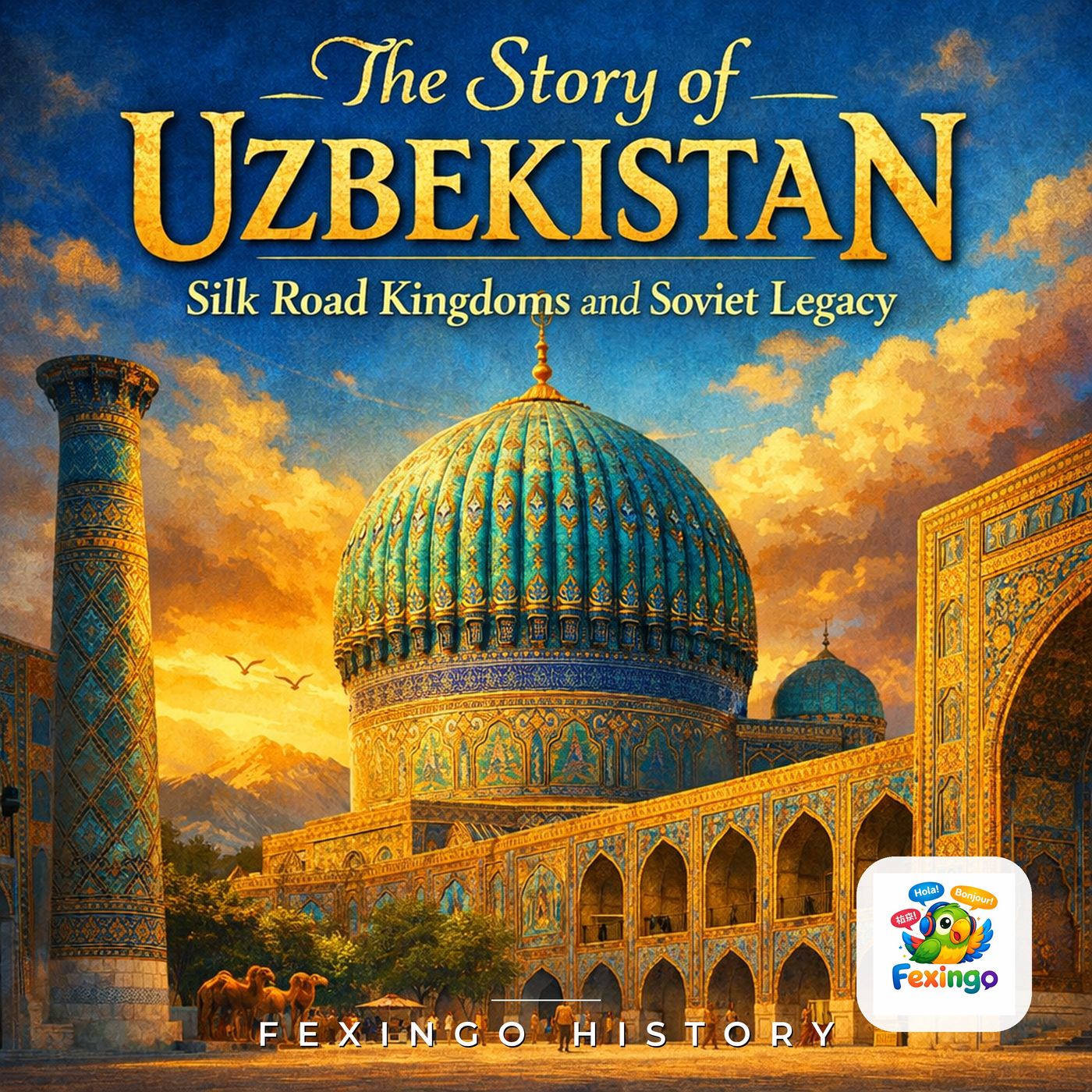
The Story of Uzbekistan: Silk Road Kingdoms and Soviet Legacy — Fexingo History
by Fexingo
In this series, Lucas and Luna journey through the layered history of Uzbekistan, a land where Silk Road caravans once traversed the Kyzylkum Desert and where the blue-tiled domes of Registan Square still echo the glory of the Timurid Empire. From the Sogdian merchants who thrived under Achaemenid and then Hellenistic rule, to the Arab conquests that brought Islam and the Samanid Renaissance, each episode traces the rise and fall of kingdoms that shaped Central Asian identity. The show delves into the rule of Amir Timur (Tamerlane) in Samarkand, the shaybanid Uzbek khanates, and the brutal Russian imperial expansion in the 19th century. It then tackles the Soviet era: the cotton monoculture that drained the Aral Sea, the jadid reformist movement, and the legacy of Stalin’s purges. Post-independence, the hosts explore the authoritarian nation-building under Islam Karimov, the revival of Silk Road tourism, and simmering tensions in the Fergana Valley. Through primary sources like Babur’s
-
34
Uzbekistan's Aral Sea Disaster: An Environmental Catastrophe
The Aral Sea was once the world's fourth-largest inland lake, a vast blue expanse in the heart of Central Asia. Today, it's nearly gone—a dry, toxic desert called the Aralkum. This episode of The Story of Uzbekistan dives into one of the most shocking environmental disasters of the 20th century: the deliberate destruction of the Aral Sea. We trace its origins to Soviet irrigation projects that diverted the Amu Darya and Syr Darya rivers for cotton farming in the 1960s. We discuss the human cost—the fishing communities of Moynaq that lost their livelihood, the respiratory illnesses from salt-laden dust storms, and the displacement of entire towns. We also look at recent restoration efforts on the Small Aral in Kazakhstan and the complex politics of water in Central Asia, including tensions over upstream dams in Tajikistan and Kyrgyzstan. Lucas and Luna explore the legacy of Soviet resource mismanagement and ask whether any of the damage can be reversed. This is the story of a sea that disappeared—and the people left behind. #AralSea #Aralkum #Moynaq #AmuDarya #SyrDarya #CottonMonoculture #SovietEcology #Uzbekistan #Karakalpakstan #EnvironmentalDisaster #CentralAsia #WaterCrisis #SovietUnion #History #FexingoHistory #ClimateChange #Desertification #Fisherman Keep every episode free: buymeacoffee.com/fexingo
-
33
Uzbekistan's Samarkand Declaration: The Birth of the Silk Road
In Episode 100, Lucas and Luna explore the Samarkand Declaration of 1380, a little-known but pivotal moment when Tamerlane formalized the Silk Road's security and trade policies. They delve into the document's origins, its impact on Central Asian commerce, and how it set the stage for the Timurid Renaissance. Along the way, they discuss the role of the Chagatai Khanate, the importance of the saurani system, and the legacy of this early attempt at international cooperation. This episode offers a fresh perspective on Tamerlane's legacy, focusing on his administrative and diplomatic achievements rather than his military conquests. #SamarkandDeclaration #Tamerlane #Timurid #SilkRoad #CentralAsia #ChagataiKhanate #Saurani #TimuridRenaissance #Uzbekistan #Samarkand #1380 #TradePolicy #Diplomacy #History #FexingoHistory #EmpireBuilding #GlobalTrade #MedievalHistory Keep every episode free: buymeacoffee.com/fexingo
-
32
The Ferghana Valley Horses: Silk Road Steeds That Shaped Empires
Long before the Silk Road carried silk and spices, it carried horses. In this episode, Lucas and Luna explore the Ferghana Valley's legendary 'Heavenly Horses' — the prized bloodstock that Tang dynasty emperors waged wars to acquire, that Alexander the Great coveted, and that became a symbol of power from China to Persia. Learn how the region's unique breeding traditions, nurtured by Sogdian merchants and later Turkic dynasties, produced mounts that could outrun, outlast, and outfight any rival. From the Han dynasty's bloody campaigns to secure them to the Timurid era's equestrian pageantry, the Ferghana horse shaped political borders and artistic imaginations. Along the way, we discuss the Silk Road's horse trade networks, the role of the Yuezhi and Kushan nomads in spreading equine bloodlines, and why modern Karabair horses still carry that ancient lineage. A fresh look at Central Asia's most influential export. #FerghanaHorses #HeavenlyHorses #SilkRoad #Uzbekistan #FerghanaValley #TangDynasty #HanDynasty #AlexanderTheGreat #Sogdians #Yuezhi #Kushan #Timurid #Karabair #HorseBreeding #EquineHistory #CentralAsia #History #FexingoHistory Keep every episode free: buymeacoffee.com/fexingo
-
31
The Bukhara Emirate Last Emir Alim Khan
When the Russian Empire collapsed in 1917, Central Asia's ancient emirates saw a chance to break free. Emir Alim Khan of Bukhara, who had ruled under Russian protection since 1911, faced an impossible choice: align with the reformist Jadids, resist the Bolsheviks, or cling to absolute power. This episode traces Alim Khan's rule from his early reforms to his flight to Afghanistan in 1920, the siege of Bukhara by Mikhail Frunze's Red Army, and the violent end of the Manghit dynasty. We explore the emir's controversial legacy, the brutal suppression of the 1918 Kolesov campaign, and the fate of his family. Why did a ruler who initially supported modernisation become a symbol of reactionary tyranny? And what does his story tell us about the Soviet conquest of Turkestan? Along the way, we encounter the Jadid reform movement, the Young Bukharan party, the Treaty of Kiat, and the Kagan enclave. A story of revolution, betrayal, and the death of a thousand-year-old monarchy. #Bukhara #EmirAlimKhan #ManghitDynasty #RussianRevolution #Bolshevik #Jadid #YoungBukharans #MikhailFrunze #KolesovCampaign #Turkestan #CentralAsia #Uzbekistan #SovietHistory #1920SiegeOfBukhara #Kagan #AfghanistanExile #History #FexingoHistory Keep every episode free: buymeacoffee.com/fexingo
-
30
The Tillya Tepe Gold: Afghanistan's Bactrian Treasure
In 1978, a Soviet-Afghan archaeological team led by Viktor Sarianidi uncovered a cache of over 20,000 gold objects at Tillya Tepe, or 'Golden Hill,' in northern Afghanistan. Dating to the first century BCE, these treasures belonged to a nomadic Saka or Parthian elite and blend Hellenistic, Chinese, Indian, and Siberian artistic traditions. This episode traces the discovery, the artistry of the six tombs, and the extraordinary journey of the Bactrian Gold through the Soviet war in Afghanistan, Taliban looting attempts, and its eventual display in Kabul. We discuss the golden crown, the Aphrodite clasp, and the dagger with its sheath, and how the treasure reflects the Silk Road's cultural crosscurrents. The collection's survival and recent exhibitions in Uzbekistan and beyond reveal a shared Central Asian heritage that transcends modern borders. #TillyaTepe #BactrianGold #ViktorSarianidi #Afghanistan #SilkRoad #Kushan #Saka #Parthian #HellenisticArt #NomadicArt #Archaeology #CentralAsia #AfghanTreasures #KabulMuseum #Taliban #Gold #History #FexingoHistory Keep every episode free: buymeacoffee.com/fexingo
-
29
The Kokand Autonomy: Central Asia's Brief Democratic Dream
In the chaos following the 1917 Russian Revolution, a remarkable experiment in self-rule emerged in the Ferghana Valley. The Kokand Autonomy, proclaimed in November 1917, aimed to establish a democratic, secular state for Turkestan's Muslim peoples. Led by progressive intellectuals and Jadid reformers like Mustafa Chokay, the government introduced Arabic-script schools, women's education, and land reforms. But its existence was precarious: Bolshevik forces from Tashkent, hostile to both nationalism and democracy, besieged and destroyed Kokand in February 1918. The massacre of thousands and the burning of the old city extinguished the autonomy and radicalized many Central Asians, pushing some into the Basmachi resistance. This episode explores the short-lived state's achievements, its brutal suppression, and its legacy as a forgotten alternative to Soviet rule. #KokandAutonomy #MustafaChokay #Turkestan #FerghanaValley #Jadid #RussianRevolution #Bolshevik #CentralAsia #Uzbekistan #1917 #Kokand #Basmachi #SovietHistory #MuslimNationalism #DemocraticRepublic #History #FexingoHistory #Podcast Keep every episode free: buymeacoffee.com/fexingo
-
28
The Tashkent Metro: Uzbekistan's Underground Soviet Marvel
In this episode of The Story of Uzbekistan, Lucas and Luna descend into the Tashkent Metro, a stunning underground network that serves as both a transit system and a repository of Soviet-era art and propaganda. Opened in 1977 after the devastating 1966 earthquake, the metro's stations like Alisher Navoiy, Pakhtakor, and Kosmonavtlar are adorned with intricate mosaics, chandeliers, and marble — each telling a story of Uzbek history, cotton cultivation, and Soviet space ambitions. Lucas explains how the metro was built by workers from across the USSR, the symbolism embedded in its designs, and how it became a symbol of resilience after the earthquake. The conversation also touches on the post-Soviet renaming of stations, debates over Soviet nostalgia, and the metro's role in Tashkent daily life today. This episode offers a unique lens on Uzbek identity through an underground architectural masterpiece. #TashkentMetro #Uzbekistan #SovietArchitecture #Tashkent #1966Earthquake #AlisherNavoiy #Kosmonavtlar #Pakhtakor #SovietArt #Mosaic #CentralAsia #Metro #History #FexingoHistory #SovietLegacy #UzbekHistory #Underground #PropagandaArt Keep every episode free: buymeacoffee.com/fexingo
-
27
Tamerlane's Tower of Skulls: The Decisive Battle of Ankara
In 1402, outside Ankara, two of the medieval world's greatest conquerors clashed: Timur (Tamerlane) and the Ottoman Sultan Bayezid I. This episode follows the dramatic buildup, the brutal battle, and the enormous pyramid of severed heads Timur left behind. We explore Timur's innovative tactics, his use of war elephants, and the psychological warfare that made his army feared from the Mediterranean to the Indus. Lucas explains how Bayezid's swift rise and siege of Constantinople provoked Timur, and how the Battle of Ankara reshaped the Ottoman state, delaying its conquest of Byzantium by decades. We also examine the aftermath: Bayezid's capture and death, the Ottoman Interregnum, and the enduring legend of Timur's cruelty. This story covers not only the battle itself but the leadership, strategy, and legacy of two titans whose rivalry defined an era. #BattleOfAnkara #Timur #Tamerlane #BayezidI #OttomanEmpire #TimuridEmpire #WarElephants #PyramidOfSkulls #Ankara #1402 #MedievalWarfare #Conquerors #OttomanInterregnum #SiegeOfConstantinople #CentralAsia #Anatolia #History #FexingoHistory Keep every episode free: buymeacoffee.com/fexingo
-
26
The Khorezmian Campaign: Genghis Khan's Invasion of Uzbekistan
In this episode, Lucas and Luna revisit the catastrophic Khorezmian Empire and its collision with Genghis Khan's Mongol war machine in the early 13th century. They examine the fateful decision of Shah Muhammad II to execute a Mongol trade envoy at Otrar, sparking a campaign that would devastate Central Asia's Silk Road cities, including Samarkand and Bukhara. The conversation explores the brilliant Mongol siege tactics, the Shah's disastrous strategy of dispersing his forces, and the aftermath that reshaped the region for centuries. Key figures include Genghis Khan, Shah Muhammad II, his son Jalal al-Din, and the Mongol generals Subutai and Jebe. The episode also touches on the destruction of irrigation networks that led to the decline of cities like Merv and the lasting demographic and cultural impact on Uzbekistan. #GenghisKhan #KhorezmianEmpire #OtrarIncident #Samarkand #Bukhara #MongolInvasion #CentralAsia #Uzbekistan #SilkRoad #Subutai #Jalal al-Din #SiegeWarfare #Merv #Transoxiana #MongolEmpire #History #MilitaryHistory #FexingoHistory Keep every episode free: buymeacoffee.com/fexingo
-
25
The Cotton Monoculture: How Uzbekistan Became a Cotton Colony
In Episode 84 of The Story of Uzbekistan, Lucas and Luna explore how the Soviet Union transformed Uzbekistan into a cotton monoculture, a decision that reshaped the region's economy, ecology, and society. They trace the roots of this shift to the 1920s and 1930s, when Moscow prioritized cotton self-sufficiency, forcing collective farms to dedicate over 90% of arable land to 'white gold.' The episode covers the brutal mechanism of the cotton quota system, the role of Sharof Rashidov (Uzbekistan's long-serving party boss who inflated harvest figures), and the devastating environmental consequences—including the drying of the Aral Sea. Lucas explains how the cotton monoculture led to soil salinization, water overuse from the Amu Darya and Syr Darya rivers, and a dependency that persists today. The conversation also touches on the human cost: forced labor during harvest season, especially in the 1930s and again in the post-independence era. This episode connects the dots between Soviet economic planning, environmental collapse, and the lingering legacy in modern Uzbekistan. Perfect for listeners who want to understand one of the most consequential—and destructive—economic policies in Central Asian history. #CottonMonoculture #UzbekCotton #SovietEconomicPolicy #AralSeaDisaster #SharofRashidov #WhiteGold #ForcedLaborUzbekistan #AmuDarya #SyrDarya #Collectivization #CottonQuota #SovietCentralAsia #EnvironmentalHistory #History #FexingoHistory #CentralAsia #UzbekistanHistory #SovietLegacy Keep every episode free: buymeacoffee.com/fexingo
-
24
The Zarafshan Valley: Uzbekistan's Silk Road Lifeline
In this episode of The Story of Uzbekistan, Lucas and Luna explore the Zarafshan Valley, the riverine artery that watered Samarkand and Bukhara for millennia. They trace the Zarafshan from its glaciers in the Pamirs to its disappearance in the Kyzylkum desert, and discuss how its waters shaped the region's history—from Sogdian irrigation to Soviet cotton monoculture. Along the way, they cover the ancient cities of Panjikent and Varakhsha, the role of the Zarafshan in the Arab conquest, and the controversial 20th-century canal projects that transformed Central Asian agriculture. They also touch on the valley's shrinking glaciers and the looming water crisis, tying the past to present-day environmental challenges. #Zarafshan #Samarkand #Bukhara #Sogdia #Panjikent #Varakhsha #SilkRoad #Cotton #Soviet #Irrigation #KarakumCanal #AmuDarya #CentralAsia #Uzbekistan #WaterCrisis #Glacier #History #FexingoHistory #TimuridEmpire #SamanidDynasty Keep every episode free: buymeacoffee.com/fexingo
-
23
The Khanate of Kokand: Central Asia's Last Independent Kingdom
In this episode, Lucas and Luna explore the fascinating rise and fall of the Khanate of Kokand, one of the last independent states in Central Asia before the Russian conquest. They begin with its founding in the early 18th century by the Mingbashi dynasty, tracing how a small Uzbek tribal confederation grew into a powerful khanate controlling the fertile Ferghana Valley and key Silk Road trade routes. Lucas explains Kokand's cultural renaissance under rulers like Umar Khan, who patronized poets and built madrasas, and its unique multi-ethnic society of settled Uzbeks, Kyrgyz nomads, and Tajik artisans. The conversation then shifts to its fatal rivalry with the neighboring Emirate of Bukhara, which weakened both states and left them vulnerable to Russian expansion. Lucas details Kokand's last desperate resistance under Alimqul, who fought off a Russian assault on Tashkent but was killed in battle, leading to the khanate's annexation and the creation of the Ferghana Oblast. Along the way, they discuss lesser-known aspects like Kokand's sophisticated irrigation systems, its role as a center of Sufi Islam, and the fate of its last khan, Khudayar Khan. This episode offers a vivid portrait of a kingdom that once rivaled Bukhara and Khiva but which history has largely forgotten. #KhanateOfKokand #FerghanaValley #CentralAsia #UzbekHistory #Alimqul #RussianConquest #Mingbashi #UmarKhan #KhudayarKhan #SilkRoad #SufiIslam #Tashkent #19thCentury #KokandRenaissance #Irrigation #History #FexingoHistory #Podcast #Uzbekistan #TimuridEmpire Keep every episode free: buymeacoffee.com/fexingo
-
22
The Shashmaqam: Uzbekistan's Lost Court Music
In this episode of The Story of Uzbekistan, Lucas and Luna explore the rich tradition of Shashmaqam, the classical court music of Central Asia that flourished in Bukhara, Samarkand, and Khiva. They trace its origins to the 10th-century scholar Abu Nasr al-Farabi, its golden age under the Bukharan Emirate, and its near-erasure during Soviet times when religious and courtly arts were suppressed. Lucas explains how the maqam system, with its six melodic modes, was preserved orally by Jewish and Muslim musicians, and why the Soviet regime allowed a sanitized version to survive as 'national heritage' while purging its Sufi and Persian roots. He tells the story of the great 19th-century court musician Shokh Burkhan, the revival efforts of the 20th-century maestros like Yunus Rajabi, and the modern challenges of keeping this UNESCO-recognized tradition alive in independent Uzbekistan. Luna asks about the instruments and the eerie beauty of the music, drawing out details on the tanbur, dutar, and doira. Together they reflect on how Shashmaqam is a living archive of Uzbekistan's multicultural past, and why its survival matters today. #Shashmaqam #Uzbekistan #Bukhara #Samarkand #Khiva #CentralAsianMusic #Maqam #SufiMusic #PersianHeritage #UNESCO #YunusRajabi #ShokhBurkhan #Tanbur #Dutar #Doira #AbuNasrAlFarabi #History #FexingoHistory #SilkRoad #TimuridEmpire Keep every episode free: buymeacoffee.com/fexingo
-
21
The Khorezm Oasis: Where Alexander Almost Died and the Ghost of Khiva Still Walks
In this episode, Lucas and Luna explore the ancient Khorezm oasis—a fertile region along the lower Amu Darya that was home to the Khwarezmian Empire, the legendary city of Kath, and the fortress of Toprak Kala. They discuss how Alexander the Great's campaign against the Scythians nearly ended in disaster here, the Zoroastrian fire temples that dotted the landscape, and the devastating Mongol invasion that toppled the Khwarezm Shah in 1220. The conversation moves to the rise of Khiva as a new capital under the Arabshahid dynasty, the architectural splendor of the Ichon-Qala, and the role of the Khanate in the Russian conquest. They also touch on the discovery of the Khorezmian language in the 20th century—a forgotten Eastern Iranian tongue preserved in Sogdian script. This episode fills a gap in the show's arc by focusing on the region that predated Timur, the Jadids, and the Soviet era: the ancient heart of Uzbekistan's civilization along the Amu Darya. #Khorezm #Khwarezm #Khiva #AlexanderTheGreat #AmuDarya #Zoroastrianism #MongolInvasion #KhwarezmianEmpire #ToprakKala #IchonQala #Arabshahid #Scythians #CentralAsia #Uzbekistan #History #FexingoHistory #SilkRoad #AncientCivilizations #TimuridEmpire #SamanidDynasty Keep every episode free: buymeacoffee.com/fexingo
-
20
Jadids vs Qadims: The Battle for Uzbekistan's Soul
In the early 1900s, a cultural war erupted in Turkestan between Jadid reformers, who wanted to modernize Islam and education, and Qadim traditionalists, who saw change as a threat. This episode zooms in on the Jadid-Qadim conflict, a bitter struggle that shaped Uzbekistan's path to modernity. We meet Mahmudhoja Behbudiy, the Jadid firebrand who toured the Ottoman Empire and brought back the idea of usul-i jadid — the new method — teaching geography and history alongside the Quran. And we explore the Qadim response: fatwas, riots, and the assassination of a Jadid teacher in Kokand. By the 1910s, the Jadids had founded newspapers like Samarkand and schools that taught girls, but the Qadims fought back through the clergy and traditional madrasas. This is not a simple story of progress versus reaction; both sides had valid fears, and both lost when the Soviets came. A nuanced look at a forgotten battle over the future of Central Asia. #Jadid #Qadim #MahmudhojaBehbudiy #UsulIJadid #Turkestan #CentralAsia #Uzbekistan #Kokand #Samarkand #Reform #Islam #Education #Modernity #1900s #Colonialism #History #FexingoHistory #Podcast #SilkRoad #TimuridEmpire Keep every episode free: buymeacoffee.com/fexingo
-
19
The Tashkent Oasis: Russia's Forgotten Colony
In this episode of The Story of Uzbekistan, Lucas and Luna explore the lesser-known story of how Tsarist Russia transformed Tashkent from a medieval Islamic city into a colonial capital. After the Russian conquest in 1865, General Konstantin von Kaufman implemented a policy of indirect rule, preserving Islamic courts and waqf endowments to avoid rebellion. But beneath the surface, the city became a laboratory for colonial experiments: from the construction of a European 'New City' with wide boulevards and parks, to the introduction of Russian education, to the emergence of a class of intermediaries—the 'Sarts.' We trace the rise of the Tashkent City Duma, where a handful of Uzbek merchants and intellectuals began to test the limits of imperial power. The episode also uncovers the story of the 'Tashkent Commission' that surveyed land for cotton cultivation, setting the stage for the monoculture that would devastate the Aral Sea. Through the eyes of travelers like Eugene Schuyler and the diaries of local chroniclers, we see a city caught between tradition and empire—a tension that would explode in the 1916 revolt. A rich, nuanced look at a pivotal era, drawing on Russian, Turkic, and Western sources. #Tashkent #RussianEmpire #KonstantinVonKaufman #CentralAsiaColonialism #Sart #NewCityTashkent #RussianTurkestan #EugeneSchuyler #TashkentCityDuma #CottonColony #Waqf #IslamicCourts #IndirectRule #1916Revolt #UzbekHistory #SilkRoad #FexingoHistory #History #Uzbekistan #TimuridEmpire Keep every episode free: buymeacoffee.com/fexingo
-
18
The Khiva Slave Trade: Central Asia's Forgotten Human Market
Long before Russian conquest, the Khanate of Khiva was infamous across Eurasia as the epicenter of a vast slave trade. In this episode, Lucas walks Luna through the origins of Khiva's slave markets, the raiding networks that captured Persians, Russians, and steppe nomads, and the staggering scale of human trafficking that defined the region for centuries. We explore how slaving shaped Khiva's economy, its brutal system of slave labor in the Karakum desert, and the often-overlooked role of Turkmen tribes as both traders and raiders. We also discuss the Russian campaigns to suppress the trade, the Abolition Edict of 1873, and the long shadow this history casts on modern Central Asia. Along the way, we meet figures like Muhammad Rahim Khan I, the Persian slave poet Sayyid Yaghma, and the Russian abolitionist N.P. Ignatyev. This is the story of a market in human lives that connected the Caspian to the Hindu Kush — and the slow, painful end of an institution that shaped Khiva for centuries. #KhivaSlaveTrade #KhanateOfKhiva #CentralAsianHistory #SilkRoad #TurkmenRaiders #RussianConquest #SlaveMarkets #MuhammadRahimKhan #SayyidYaghma #KarakumDesert #PersianSlaves #Ignatyev #Abolition #1873Khiva #History #FexingoHistory #Uzbekistan #Slavery #TimuridEmpire #SamanidDynasty Keep every episode free: buymeacoffee.com/fexingo
-
17
The Basmachi Revolt: Central Asia's Last Stand Against Bolshevism
In the aftermath of the Bolshevik conquest of Bukhara and Khiva, a fierce guerrilla resistance known as the Basmachi movement erupted across Central Asia. This episode explores the origins, key figures like Ibrahim Bek and Enver Pasha, and the brutal suppression that followed. We delve into the mix of Islamic fervor, tribal loyalties, and anti-colonial sentiment that fueled the revolt, and how the Soviet Red Army, under commanders like Mikhail Frunze, eventually crushed it through a combination of military force, divide-and-rule tactics, and economic pressure. The episode also touches on the legacy of the Basmachi in modern Uzbek and Tajik national identity, and the controversial figure of Enver Pasha, the Ottoman war minister who died fighting alongside the rebels. A gripping tale of resistance, betrayal, and the end of an era for Central Asia. #Basmachi #EnverPasha #IbrahimBek #MikhailFrunze #Bukhara #Khiva #Bolshevik #CentralAsia #Uzbekistan #Tajikistan #SovietHistory #GuerrillaWarfare #IslamicResistance #RedArmy #RussianCivilWar #Dushanbe #History #FexingoHistory #SilkRoad #TimuridEmpire Keep every episode free: buymeacoffee.com/fexingo
-
16
The Last Emir: Bukhara's Alim Khan and the Bolshevik Conquest
In this episode of The Story of Uzbekistan, Lucas and Luna explore the final years of the Emirate of Bukhara under the last Manghit ruler, Emir Alim Khan. They trace his rise to power in 1910, his fraught relationship with the Jadid reform movement, and the growing influence of Young Bukharan revolutionaries. The conversation delves into the Bolshevik invasion of Bukhara in 1920, the Red Army's assault on the Ark fortress, and Alim Khan's flight to Afghanistan — where he died in exile in 1944. Along the way, they examine the brutal suppression of the Basmachi revolt, the fate of Bukharan Jews and merchants, and the strange alliance between the emir and anti-Bolshevik forces. Specific names include Alim Khan, the Ark, the Red Army under Mikhail Frunze, the Young Bukharans led by Fayzulla Xo‘jayev, and the Basmachi leader Ibrahim Bek. The episode offers a nuanced look at the end of an era, blending military history with the human stories of those caught between empire, reform, and revolution. #AlimKhan #EmirateOfBukhara #Manghit #BolshevikConquest #Basmachi #YoungBukharans #ArkOfBukhara #Frunze #FayzullaXojayev #IbrahimBek #CentralAsia #Uzbekistan #History #FexingoHistory #1920 #RedArmy #SovietInvasion #AfghanExile #SilkRoad #TimuridEmpire Keep every episode free: buymeacoffee.com/fexingo
-
15
Bukhara's Jewish Legacy: The Silk Road's Other Faith
In this episode, Lucas and Luna explore the thousand-year history of the Bukharan Jews, one of Central Asia's oldest and most distinctive communities. From their origins along the Silk Road to their role as merchants and craftsmen under the Emirate of Bukhara, Lucas traces how a small Jewish population thrived in a Muslim khanate — building synagogues, preserving their unique Judeo-Persian language (Bukhori), and navigating shifting tides of tolerance and persecution. The conversation covers the legendary 'Red Synagogue' of Samarkand, the 18th-century decree that nearly forced them to convert, and the tragic story of the 1910 'blood libel' in Bukhara. Lucas also explains how Soviet rule brought both emancipation and cultural erasure, forcing Bukharan Jews to abandon their traditions or flee. The episode ends with a reflection on the community's near-total exodus to Israel after 1991, leaving a ghost of a once-vibrant culture in Uzbekistan's ancient cities. Specific names include Yosef Maman, Rabbi Shimon Hakham, and the scholar Eliezer Ben-Yehuda's surprising connection to Bukhara. #BukharanJews #SilkRoad #Bukhara #Samarkand #JudeoPersian #Bukhori #RedSynagogue #EmirateofBukhara #SovietUnion #YosefMaman #RabbiShimonHakham #CentralAsia #JewishHistory #Uzbekistan #History #FexingoHistory #Diaspora #BloodLibel #TimuridEmpire #SamanidDynasty Keep every episode free: buymeacoffee.com/fexingo
-
14
The Manghits of Bukhara: How a Dynasty Outlasted Empires
The Emirate of Bukhara was one of the longest-lasting independent states in Central Asia, ruled by the Manghit dynasty for over 200 years. In this episode, Lucas and Luna explore how the Manghits rose from tribal leaders to absolute monarchs, skillfully playing off the decline of the Khanate of Bukhara, the rise of the Russian Empire, and the chaos of the Great Game. We dive into the reign of Emir Nasrullah, known as 'the Butcher,' who executed his own brothers to secure power and faced down British spies. We follow the dynasty's survival through the Russian conquest, the Jadid reforms, and the tragic end under the Bolsheviks, when the last emir, Alim Khan, fled to Afghanistan. Along the way, we uncover the Manghit legacy in architecture, with the still-standing Ark of Bukhara and the Chor Minor mosque, and in politics, as their balancing act between the British and the Russians foreshadowed modern Central Asian geopolitics. #ManghitDynasty #EmirateOfBukhara #Nasrullah #AlimKhan #ArkOfBukhara #ChorMinor #GreatGame #RussianConquest #Jadid #BolshevikRevolution #CentralAsia #Bukhara #KhanateOfBukhara #History #FexingoHistory #Podcast #Uzbekistan #SilkRoad #TimuridEmpire #SamanidDynasty Keep every episode free: buymeacoffee.com/fexingo
-
13
The Tashkent Tsar: Russian Turkestan's First Governor-General
In this episode, Lucas and Luna explore the life and legacy of Konstantin von Kaufman, the first Governor-General of Russian Turkestan, who ruled from Tashkent from 1867 to 1882. They discuss how Kaufman's 'enlightened' colonialism sought to modernize the region while suppressing Islamic institutions, including his controversial abolition of the waqf system and his patronage of Russian-style education. The episode delves into Kaufman's harsh suppression of the 1875 Kokand rebellion, his efforts to conquer the Khanate of Khiva in 1873, and how his policies of indirect rule and co-opting local elites set the stage for the Jadid reform movement. It also examines the 'Kaufman Code' of laws that governed Turkestan, blending Russian imperial law with local customs, and how his legacy is remembered today in Uzbekistan, including the statue of him in Tashkent that was removed after independence. The conversation navigates the complex narrative of a man who saw himself as a reformer but whose actions often reinforced imperial domination. #KonstantinVonKaufman #RussianTurkestan #Tashkent #GovernorGeneral #Colonialism #CentralAsia #UzbekistanHistory #KhanateOfKhiva #KokandRebellion #Waqf #Jadid #ImperialRussia #GreatGame #FexingoHistory #History #19thCentury #Empire #Reform #Uzbekistan #SilkRoad Keep every episode free: buymeacoffee.com/fexingo
-
12
The Great Game's Forgotten Front: Khiva 1873
In 1873, Tsar Alexander II's army marched through frozen desert to conquer the Khanate of Khiva, a Silk Road stronghold so remote that even the British hesitated to touch it. This episode goes inside the Khiva campaign — the brutal winter march, the fall of the city, and the strange aftermath where a Russian general restored a khan to his throne. We meet the charismatic Kazakh leader Kenesary Kasymov, whose rebellion shaped Russian strategy, and we explore how the conquest of Khiva became a turning point in the Great Game, forcing reforms and setting the stage for the cotton monoculture that would later devastate the Aral Sea. Lucas and Luna unpack the politics, the personal dramas, and the ironies of an empire that destroyed a state only to try to preserve it. #Khiva1873 #GreatGame #RussianEmpire #KhanateOfKhiva #KenesaryKasymov #CentralAsia #Uzbekistan #TsaristRussia #Karakalpakstan #SilkRoad #CottonColony #MilitaryHistory #Colonialism #KonstantinKaufman #YomudTurkmen #AralSea #History #FexingoHistory #TimuridEmpire #SamanidDynasty Keep every episode free: buymeacoffee.com/fexingo
-
11
The Tamerlane Chessboard: How Timur Rebuilt an Empire
This episode shifts focus from the familiar Silk Road glory of Samarkand to the lesser-known military and administrative genius of Amir Timur (Tamerlane). Lucas and Luna discuss Timur's rise from a nomadic chieftain in Transoxiana, his use of sophisticated siege warfare, and his controversial policy of relocating artisans to his capital. They explore the Battle of Ankara (1402) against the Ottoman Sultan Bayezid I, and how Timur's patronage of the arts created a cultural golden age that outlasted his empire. The conversation also touches on the contested historical records—Timur's own memoirs versus hostile Persian and Arab chroniclers—and the enduring legacy of his architectural projects in Samarkand. No cotton, no Soviet era, no Jadids—just the raw story of a conqueror who shaped Central Asia. #Timur #Tamerlane #AmirTimur #Samarkand #Transoxiana #BattleOfAnkara #BayezidI #OttomanEmpire #SiegeWarfare #SilkRoad #MongolInvasions #ChagataiKhanate #GurEAmir #Registan #CentralAsia #MedievalHistory #History #FexingoHistory #Uzbekistan #TimuridEmpire Keep every episode free: buymeacoffee.com/fexingo
-
10
The Karakalpak Alphabet: How Four Scripts Erased a Culture
In this episode, Lucas and Luna explore one of the most dramatic cultural erasures in Soviet history: the forced alphabet changes imposed on the Karakalpak people. Over just 50 years, Karakalpak was written in Arabic, Latin, a modified Cyrillic, and finally a unified Cyrillic — each change severing the population from its literary heritage, religious texts, and historical memory. They discuss the 1928 Latinization campaign under the Soviet Union's ‘korenizatsiya’ policy, the abrupt 1940 shift to Cyrillic ordered by Stalin, and the long-term consequences: a generation that couldn't read its own grandparents' books, the loss of medieval manuscripts, and the struggle to revive the Latin script after independence in 1991. The episode zooms in on the Karakalpak linguist and poet Berdaq, whose 19th-century epics are now taught in three different scripts depending on the textbook. Lucas and Luna also touch on the parallel destruction of the Arabic-script education system in madrasas across Khiva and Nukus, and the quiet resistance of elders who kept teaching the old alphabet at home. This is a story about how writing systems become weapons — and how a culture survives when its alphabet keeps changing. #Karakalpak #Alphabet #SovietLinguistics #Berdaq #Cyrillic #Latinization #Korenizatsiya #Stalin #Nukus #Khiva #ArabicScript #CentralAsia #LanguagePolicy #CulturalErasure #Uzbekistan #FexingoHistory #History #WritingSystems #SilkRoad #TimuridEmpire Keep every episode free: buymeacoffee.com/fexingo
-
9
The Jadids: Uzbekistan's Forgotten Reformers
In the early 20th century, a movement of Muslim intellectuals known as the Jadids emerged in Central Asia, seeking to modernize education, culture, and politics. This episode focuses on Uzbekistan's Jadid leaders, like Mahmudhoja Behbudiy and Abdulla Avloniy, who founded new-method schools, published newspapers, and advocated for social reform under Russian imperial rule. We explore their struggle against conservative clergy, their brief alliance with the Bolsheviks, and their tragic fate under Stalin's purges. The episode reveals how the Jadids envisioned a modern, independent Turkestan and why their legacy remains contested in Uzbekistan today. Rich with details on their writings, schools, and political organizations, this conversation sheds light on a pivotal but often overlooked chapter in Central Asian history. #Jadids #MahmudhojaBehbudiy #AbdullaAvloniy #NewMethodSchools #Turkestan #RussianEmpire #Bolsheviks #StalinPurges #CentralAsia #UzbekistanHistory #MuslimReform #UsulIJadid #ChagataiLiterature #TatarInfluence #Bukhara #Tashkent #History #FexingoHistory #Uzbekistan #SilkRoad Keep every episode free: buymeacoffee.com/fexingo
-
8
The Andijan Uprising of 1898 and the Rise of Dukchi Ishan
In May 1898, a Sufi mystic named Muhammad Ali ibn Sulton, better known as Dukchi Ishan, led a rebellion in the Ferghana Valley that briefly rattled Russian colonial rule in Turkestan. This episode explores the religious, economic, and political currents that fueled the uprising — from the dispossession of local landholders by Russian cotton plantations to the millenarian expectations surrounding a holy man who claimed to have visions of the Prophet. We trace the attack on the Russian garrison at Andijan, the swift suppression by General Nikolai Korolkov, and the show trial that followed. Dukchi Ishan was hanged, but his movement foreshadowed the larger 1916 revolt and revealed the deep fractures in tsarist governance. We also examine how Russian ethnographers and officials interpreted the uprising through the lens of 'fanaticism' versus legitimate grievances, and the legacy of the Andijan revolt in Uzbek national memory under Soviet rule and today. #AndijanUprising #DukchiIshan #FerghanaValley #RussianEmpire #Turkestan #1898 #SufiRebellion #CottonColony #TsaristRepression #IslamicMillenarianism #CentralAsia #Uzbekistan #History #ColonialResistance #ShowTrial #NationalMemory #FexingoHistory #SilkRoadLegacy #SilkRoad #TimuridEmpire Keep every episode free: buymeacoffee.com/fexingo
-
7
The Karakalpakstan Tragedy: Drying of the Aral Sea
In this episode, Lucas and Luna explore the environmental and human catastrophe of the Aral Sea's desiccation, focusing on Uzbekistan's autonomous republic of Karakalpakstan. They discuss the Soviet-era irrigation projects that diverted the Amu Darya and Syr Darya rivers for cotton monoculture, turning the world's fourth-largest lake into a toxic desert. Lucas explains how the once-thriving fishing port of Muynak now sits miles from the water, surrounded by rusting ships and salt-laden dust storms that cause respiratory diseases and cancer. The conversation touches on the region's unique culture, including the Karakalpak language and the epic poem 'Qirq Qiz', and reflects on the ongoing efforts to restore parts of the sea, like the North Aral Sea in Kazakhstan. Lucas also recounts the 1985 'cotton affair' that exposed massive corruption in the Uzbek SSR, and the long-term health and economic impacts on local communities. The episode ends with contemplation of climate change and water management challenges in arid Central Asia today. Keywords: Aral Sea, Karakalpakstan, Muynak, Amu Darya, Syr Darya, cotton monoculture, environmental disaster, Soviet irrigation, dust storms, 'cotton affair', North Aral Sea, Qirq Qiz, Nukus, Karakalpak language, desertification, respiratory diseases, water management, Central Asia. #AralSea #Karakalpakstan #Muynak #AmuDarya #SyrDarya #CottonMonoculture #EnvironmentalDisaster #SovietIrrigation #DustStorms #CottonAffair #NorthAralSea #QirqQiz #Nukus #KarakalpakLanguage #Desertification #History #FexingoHistory #Uzbekistan #SilkRoad #TimuridEmpire Keep every episode free: buymeacoffee.com/fexingo
-
6
The Jizzakh Cholera: When Empire Met Epidemic in Turkestan
In 1892, a cholera epidemic swept through Russian Turkestan, triggering a brutal confrontation in the small city of Jizzakh. This episode unpacks the clash between imperial medicine and local resistance, the role of the Russian doctor who tried to understand Uzbek beliefs, and the legacy of suspicion that outlasted the Tsar. We explore the Jizzakh uprising, the exile of Dr. Nikolai Kirillov, and how a disease became a mirror for colonial power. #Jizzakh #Cholera #RussianEmpire #Turkestan #1892 #NikolaiKirillov #ColonialMedicine #Uzbekistan #Epidemic #Uprising #Imperialism #PublicHealth #CentralAsia #History #FexingoHistory #Quarantine #Resistance #Suspicion #SilkRoad #TimuridEmpire Keep every episode free: buymeacoffee.com/fexingo
-
5
The Cotton Crusade: How Uzbekistan Became a Soviet Cotton Colony
In this episode, Lucas and Luna explore the dramatic transformation of Central Asia under Soviet rule, focusing on Uzbekistan's forced shift to monoculture cotton farming. They trace the story from the 1920s land reforms through the construction of the Ferghana Canal and the vast irrigation networks that turned the Hungry Steppe into farmland. Lucas explains how Moscow's cotton quota system—dubbed the 'white gold' plan—led to environmental catastrophe, including the shrinking of the Aral Sea and widespread soil salinization. They discuss the role of collectivization, the 1937 purges of Uzbek intellectuals like Fayzulla Xo‘jayev, and the brutal suppression of the 1916 Central Asian Revolt. Luna asks about the human cost: the millions of uzbek farmers forced into collective farms, the rise of child labor, and the enduring legacy of economic dependency. The conversation ends with a reflection on how this Soviet experiment shaped modern Uzbekistan's struggles with water scarcity and authoritarian governance. Keywords: Soviet Union, Central Asia, cotton monoculture, Aral Sea, collectivization, Hungry Steppe. #CottonMonoculture #SovietUnion #Uzbekistan #AralSea #CentralAsia #HungrySteppe #FerghanaCanal #WhiteGold #FayzullaXojayev #Collectivization #1916Revolt #Stalin #JosephStalin #WaterScarcity #Environment #History #FexingoHistory #UzbekSovietSocialistRepublic #SilkRoad #TimuridEmpire Keep every episode free: buymeacoffee.com/fexingo
-
4
The Russian Conquest of Tashkent and the Fall of the Khanates
In this episode of The Story of Uzbekistan, Lucas and Luna explore the pivotal moment when the Russian Empire turned its gaze to Central Asia. They discuss the fall of the Khanate of Kokand in the 1860s, the siege of Tashkent led by General Mikhail Chernyayev in 1865, and the subsequent establishment of Russian Turkestan. The episode delves into the motivations behind Russian expansion, the strategic importance of the Syr Darya line, and the resistance of local leaders like Alimqul. Lucas also explains the administrative changes under Governor-General Konstantin von Kaufman and the impact on the Silk Road trade routes. The conversation touches on the controversial burning of the Tashkent library and the cultural shifts that followed. This episode sets the stage for understanding the Soviet era that would follow, providing a nuanced look at a transformative period in Central Asian history. #RussianConquest #TashkentSiege #MikhailChernyayev #KhanateofKokand #Alimqul #KonstantinvonKaufman #RussianTurkestan #SyrDarya #CentralAsiaHistory #UzbekistanHistory #19thCentury #ImperialExpansion #SilkRoad #ColonialHistory #TashkentLibrary #History #FexingoHistory #Podcast #Uzbekistan #TimuridEmpire Keep every episode free: buymeacoffee.com/fexingo
-
3
The Khan Who Built an Empire Under the Radar
While the world remembers Timur, another ruler shaped Uzbekistan’s history from the shadows. This episode dives into the life of Shaybani Khan, the sixteenth-century Uzbek leader who toppled the Timurid dynasty and established the Khanate of Bukhara. We explore his nomadic origins among the Dasht-i Qipchaq, his alliance with the scholar Fazlallah Ruzbihan Khunji, and his brutal wars against Babur and the Safavids. We also uncover the forgotten intellectual renaissance he fostered in Transoxiana, where Persian and Turkic culture thrived under his patronage. Discover how Shaybani Khan’s court at Samarkand became a hub for historians, poets, and theologians, even as he engaged in ruthless power struggles. The episode grapples with his complex legacy: was he a barbaric conqueror or a visionary state-builder? Join Lucas and Luna as they sift through the chronicles of Mirza Muhammad Haydar and Khwandamir to separate fact from legend. #ShaybaniKhan #KhanateOfBukhara #Transoxiana #TimuridDynasty #DashtIQipchaq #Babur #Safavids #FazlallahRuzbihanKhunji #Samarkand #MughalHistory #CentralAsia #SilkRoad #NomadicEmpires #16thCentury #UzbekHistory #PersianateCulture #History #FexingoHistory #Uzbekistan #TimuridEmpire Keep every episode free: buymeacoffee.com/fexingo
-
2
The Registan's Secret: How Samarkand Shaped the World
In this pilot episode of The Story of Uzbekistan, we begin at dawn on the Registan in Samarkand, the most iconic square in Central Asia. Lucas and Luna explore how this single plaza—flanked by madrasas covered in blue tile—holds the entire history of the Silk Road, from Alexander the Great's invasion in 329 BCE to the rise of Timur (Tamerlane) in the 14th century. We meet the Sogdians, the forgotten merchant people whose language became the lingua franca of the Silk Road, and dive into the bloody founding of the Timurid Empire. Future episodes will trace the Mongol destruction, the Russian conquest, and the Soviet legacy, but today we ask: what makes this place so magnetic that every empire had to control it? The answer lies in the tiles—and the stories they tell. #Samarkand #Registan #SilkRoad #Timur #Sogdians #CentralAsia #Uzbekistan #Tamerlane #AlexanderTheGreat #Mongols #TimuridEmpire #Madrasa #History #FexingoHistory #AncientTrade #Archaeology #CulturalHeritage #Podcast #SamanidDynasty #SovietUnion Keep every episode free: buymeacoffee.com/fexingo
We're indexing this podcast's transcripts for the first time — this can take a minute or two. We'll show results as soon as they're ready.
No matches for "" in this podcast's transcripts.
No topics indexed yet for this podcast.
Loading reviews...
ABOUT THIS SHOW
In this series, Lucas and Luna journey through the layered history of Uzbekistan, a land where Silk Road caravans once traversed the Kyzylkum Desert and where the blue-tiled domes of Registan Square still echo the glory of the Timurid Empire. From the Sogdian merchants who thrived under Achaemenid and then Hellenistic rule, to the Arab conquests that brought Islam and the Samanid Renaissance, each episode traces the rise and fall of kingdoms that shaped Central Asian identity. The show delves into the rule of Amir Timur (Tamerlane) in Samarkand, the shaybanid Uzbek khanates, and the brutal Russian imperial expansion in the 19th century. It then tackles the Soviet era: the cotton monoculture that drained the Aral Sea, the jadid reformist movement, and the legacy of Stalin’s purges. Post-independence, the hosts explore the authoritarian nation-building under Islam Karimov, the revival of Silk Road tourism, and simmering tensions in the Fergana Valley. Through primary sources like Babur’s
HOSTED BY
Fexingo
Loading similar podcasts...
Frequently Asked Questions
How many episodes does The Story of Uzbekistan: Silk Road Kingdoms and Soviet Legacy — Fexingo History have?
The Story of Uzbekistan: Silk Road Kingdoms and Soviet Legacy — Fexingo History currently has 33 episodes available on PodParley. New episodes are automatically indexed when they're published to the podcast feed.
What is The Story of Uzbekistan: Silk Road Kingdoms and Soviet Legacy — Fexingo History about?
In this series, Lucas and Luna journey through the layered history of Uzbekistan, a land where Silk Road caravans once traversed the Kyzylkum Desert and where the blue-tiled domes of Registan Square still echo the glory of the Timurid Empire. From the Sogdian merchants who thrived under Achaemenid...
How often does The Story of Uzbekistan: Silk Road Kingdoms and Soviet Legacy — Fexingo History release new episodes?
The Story of Uzbekistan: Silk Road Kingdoms and Soviet Legacy — Fexingo History has 33 episodes. Check the episode list to see recent publication dates and frequency.
Where can I listen to The Story of Uzbekistan: Silk Road Kingdoms and Soviet Legacy — Fexingo History?
You can listen to The Story of Uzbekistan: Silk Road Kingdoms and Soviet Legacy — Fexingo History on PodParley by clicking any episode. We provide an embedded audio player for direct listening, and you can also subscribe via your preferred podcast app using the RSS feed.
Who hosts The Story of Uzbekistan: Silk Road Kingdoms and Soviet Legacy — Fexingo History?
The Story of Uzbekistan: Silk Road Kingdoms and Soviet Legacy — Fexingo History is created and hosted by Fexingo.
URL copied to clipboard!