
PODCAST · business
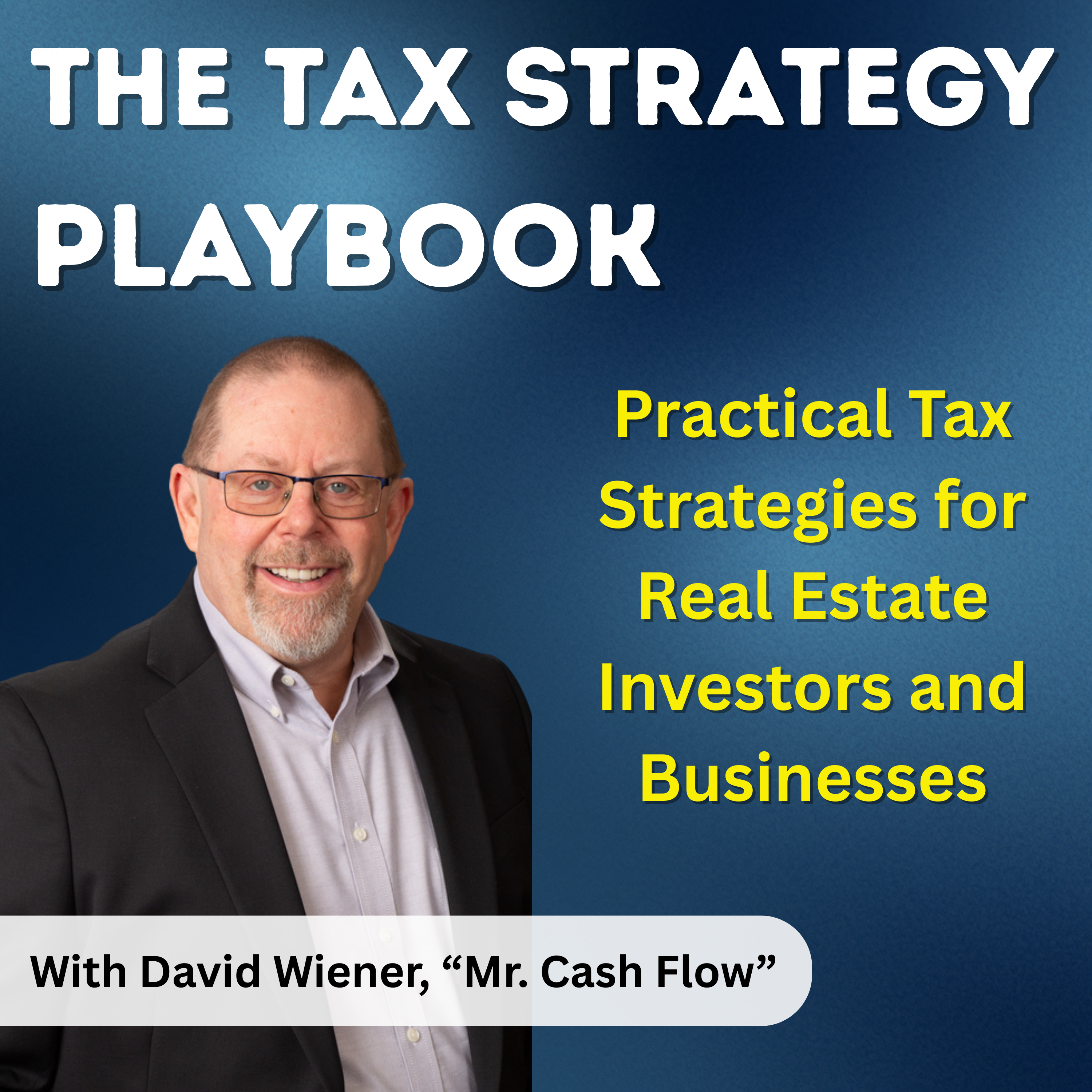
The Tax Strategy Playbook
by David Wiener, "Mr. Cash Flow"
The Tax Strategy Playbook is where real estate investors and business owners learn how to stop overpaying the IRS and turn taxes into an opportunity center instead of an annual pain point. Each episode, host David Wiener (“Mr. Cash Flow”) sits down with CPAs, tax attorneys, cost segregation experts, and top investors to break down complex tax rules into clear, step‑by‑step strategies you can actually use.You’ll hear real case studies, before‑and‑after numbers, and practical checklists on things like cost segregation, bonus depreciation, real estate professional status, short‑term rental strategies, entity structure, and more—without legalese or fluff. Expect straight talk, tactical advice you can hand to your CPA, and simple action items at the end of every show so you always know what to do next.
-
10
$100K+ R&D Tax Credit You’re Leaving on the Table (No Lab Coats Needed) 2026
$100K+ R&D TAX CREDIT 2026 EXPOSED – The Secret Dollar-for-Dollar IRS Tax Credit You’re Quietly Donating Every Year! Construction Tax Credits, Manufacturing Tax Credits, Software Development Tax Credit, Architecture & Engineering Tax Savings, Winery R&D Credits, Brewery Tax Credits, Law Firm Tax Hacks & More – NO Lab Coats, NO Patents, NO Billion-Dollar Tech Company Needed! Business Owners & Entrepreneurs Are Claiming Massive Tax Strategy Wins in 2026! Are you accidentally leaving $100,000 or more in legal R&D tax credits on the table every year? Most business owners have no idea they qualify — even if they run a construction company, manufacturing plant, software business, architecture or engineering firm, winery, brewery, law firm, or any company where smart people solve hard problems daily. In this explosive episode of The Tax Strategy Playbook, David Wiener (Mr. Cash Flow) teams up with R&D expert Brian Broussard to reveal exactly how everyday innovation turns into huge dollar-for-dollar tax credits in 2026. You’ll discover:• The simple 4-part test that determines if you qualify (plain English, no jargon)• Real $600,000 R&D credit case study from a patent law firm’s in-house software• The 3 buckets that create the credit (wages, supplies & contractors)• How to claim up to 3 prior years of missed credits• Why R&D credits are now even more powerful after the 2025 amortization repeal• State R&D credits that can DOUBLE your savings If your team designs, tests, improves processes or develops anything technical, you’re probably sitting on serious untapped cash flow. Part 2 of our 179D Energy Efficient Building Deduction mini-series — watch last week’s episode first! Grab your FREE R&D Tax Credit Playbook + 2026 Tax Planning Guide at taxstrategyplaybook.com Drop a in the comments if you think your business might qualify and we’ll send you the link to book a no-cost strategy call with David and Brian. Subscribe for weekly tax strategies that boost cash flow and slash taxes for real estate investors, business owners & entrepreneurs. Turn the tax code into your biggest competitive advantage. VIDEO CHAPTERS00:00 - $100K+ R&D Tax Credit You're Quietly Losing Every Year 02:15 - Welcome Back: Brian Broussard Returns 02:48 - What Is the R&D Tax Credit in Plain English? 03:22 - Who Actually Qualifies? (Construction, Manufacturing, Software & More) 04:08 - Wineries, Breweries & Craft Beer: Real R&D Examples 05:34 - The 4-Part Test That Determines If You Qualify 08:56 - $600,000 R&D Credit Case Study (Patent Law Firm) 11:16 - How Big Can the Credit Actually Be? (10% Rule + Base Analysis) 12:51 - The 3 Buckets That Create Your R&D Credit (Wages, Supplies, Contractors) 14:32 - What Does NOT Qualify (Travel, Reverse Engineering & More) 15:25 - Everyday Activities That Qualify (Even If They Don't Feel Like R&D) 18:28 - Documentation You Need to Survive an IRS Audit 21:52 - 2026 R&D Credit Landscape: Amortization Repealed & Why It Matters 24:52 - Claiming 3 Prior Years of Missed Credits 27:28 - First 3 Steps to Claim Your R&D Credit Today 28:45 - Exact Process & Timeline for New & Prior-Year Claims 30:09 - 4 Big R&D Myths Busted (Including "It's Only for Big Tech") 32:31 - State R&D Credits That Can Double Your Savings 33:45 - Your Next Step: Free R&D Playbook + Strategy Call 35:23 - Final Thoughts & CTA#RDTTaxCredit #TaxCredits2026 #RDTTaxCredit2026 #BusinessTaxSavings #TaxStrategy #CashFlow #ConstructionTaxCredits #ManufacturingTaxCredits #SoftwareTaxCredit #MrCashFlow #TaxStrategyPlaybook
-
9
Section 179D Tax Deduction Ends June 30 2026: Unlock $1M+ Savings Before It's Gone!
In this eye-opening episode of the Tax Strategy Playbook, David Wiener (Mr. Cash Flow) sits down with 179D expert Brian Broussard to reveal how commercial building owners, developers, and designers can still claim massive Section 179D energy-efficient tax deductions before the June 30, 2026 deadline under the One Big Beautiful Bill. Discover who qualifies, how the deduction works on new builds and renovations, real-world six- and seven-figure success stories, and how pairing 179D with cost segregation studies can supercharge your first-year tax savings. Whether you own offices, hotels, warehouses, or design government/non-profit facilities, this is the window to turn energy upgrades into serious cash-flow. Watch now + grab your free 179D Playbook and eligibility checklist
-
8
This Tax Strategy Could Save You More Than Your Next Deal Makes
Real estate investors: stop writing massive checks to the IRS!Learn how a 1031 like-kind exchange lets you sell property, defer 100% of capital gains tax + depreciation recapture, and roll every dollar into bigger, better deals — forever. Dave Foster (The 1031 Investor) reveals the exact rules, timelines, strategies, and generational wealth hacks every investor needs to know.
-
7
You Don't Have a Tax Problem—It's a STRATEGY Problem Killing Cash Flow
Landlords Don’t Have a Tax Problem—It's a STRATEGY Problem Killing Cash FlowMost landlords think they’re overpaying taxes. The truth? Their properties, tenant laws, and tax code are all pulling in opposite directions — quietly destroying cash flow and passive income.In this episode of The Tax Strategy Playbook, David Wiener sits down with top real estate broker Christian Walsh to expose the biggest rental portfolio mistakes investors make nationwide — from the dangerous “never sell” myth to silent cash-flow killers like insurance, HOA fees, property taxes, poor management, and terrible returns on equity.You’ll learn:How to evaluate your entire rental portfolio and stop accepting 2% returnsThe exact questions to ask before your next 1031 exchange (most investors get this wrong)How to build your Landlord A-Team (tax strategist + broker + QI + cost segregation expert)A simple 5-year plan to turn accidental landlords into professional real estate investorsOne overlooked tax strategy that can boost your after-tax cash flow immediatelyIf you own rental properties and want to stop leaking money, fix your portfolio, and build real passive income, this is the episode you’ve been waiting for.Subscribe to The Tax Strategy Playbook for weekly real estate tax strategies that actually move the needle.CHAPTERS:00:00 Why Most Landlords have a strategy problem, not a tax problem02:41 The #1 worst advice in real estate06:46 Hidden cash flow killers no one talks about09:50 How tenant laws quietly destroy value12:52 Designing a bulletproof portfolio from day one14:56 Strategic Decisions in High Regulation Markets17:28 Timing and Strategy for Selling Properties19:43 1031 exchange questions everyone must ask23:41 Building Your Landlord A-Team26:57 Crafting a Five-Year Plan for serious investors31:35 One tax move to make right away33:15 Navigating Market UncertaintyGuest: Christian Walsh | WIRE [email protected]://www.youtube.com/@WIREassociates/podcastsYour host: David Wiener, "Mr. Cash Flow"[email protected] the Tax Strategy Playbook Podcast:https://www.taxstrategyplaybook.com/newsletter/
-
6
2025 Tax Bill: How ‘One Big Beautiful Bill’ Helps Small Businesses & Real Estate Investors
Most business owners and real estate investors are about to sleepwalk past the biggest tax opportunity of the decade—and the IRS is counting on it.In this episode of The Tax Strategy Playbook, host David Wiener breaks down the 2025 “One Big Beautiful Bill” and shows you, step by step, how to turn this new tax law into a weapon instead of a hammer.If you own a business, rentals, or both, this is not another boring tax update. It’s a playbook you can literally take to your CPA.🎯 In this episode you’ll learn:• How the 2025 tax bill actually works for small businesses and real estate investors (not just W‑2 earners)• Why the 20% QBI deduction just became a long-term planning tool—and how the wrong entity or salary mix can quietly kill it• How 100% bonus depreciation and cost segregation can turn trucks, equipment, and property renovations into massive year-one write-offs• The new rules of debt and interest deductions—and why using old assumptions could wreck your deal underwriting• What’s really behind the “no tax on tips and overtime” and higher SALT cap headlines (and who can actually benefit)• The 7 specific plays to review with your tax strategist in the next 30–60 days so you don’t leave five or six figures on the table💡 Who this is for:• Small business owners (LLCs, S corps, partnerships, solopreneurs)• Real estate investors (single-family, small multifamily, BRRRR, value-add, syndications)• Anyone who’s serious about building wealth and keeping more of what they earn—legally.If you’re tired of feeling in the dark about tax law changes—and you’d like the government to be your silent partner instead of your biggest expense—hit play, take notes, and save this episode for tax season.Now is the moment most people will either lock in a decade of advantages or regret ignoring this law. Which side do you want to be on?
-
5
Your Rental Losses Might Be Useless Unless You Know This IRS Rule
Most real estate investors assume a cost segregation study automatically creates a tax win. But if the IRS sees your rental as passive, those losses may not offset your W-2 or business income the way you expected. In this episode, David Wiener and Gabriel Virdaru break down passive vs. active real estate in plain English, explain real estate professional status, and show how material participation can unlock serious tax savings.We also cover:• What counts as passive income vs. active income.• Why many investors misunderstand real estate professional status.• How material participation works in the real world.• What short-term rental investors need to know.• Common CPA and bookkeeping mistakes that trigger bad tax outcomes.If you own rental property, do cost segregation, or want to know whether your losses can actually help you, this episode is a must-watch.Subscribe for more tax strategy content for real estate investors.#RealEstateInvesting #TaxStrategy #CostSegregation #PassiveIncome #RealEstateProfessionalStatus #MaterialParticipation #ShortTermRental #W2Income #TaxSavings #RealEstateTax
-
4
LLC vs S Corp: The Entity Mistakes Costing Real Estate Investors Thousands
You’re about to find out whether your LLC or S corp is quietly costing you thousands in taxes.In this episode of The Tax Strategy Playbook, host David Wiener sits down with Matt Bontrager, CPA, managing partner of TrueBooks, a firm that works almost exclusively with real estate investors and entrepreneurs. Matt has seen hundreds of real‑world structures—good, bad, and ugly—and he pulls back the curtain on how entity decisions actually impact your tax bill, liability protection, and future flexibility.🔑 In this episode, you’ll learn:Why most investors misuse LLCs and think they’re a tax strategy (they’re not).When an S corp actually makes sense—and when it becomes an expensive headache.Why putting rentals inside an S corp can backfire and trigger surprise taxable events.Whether you should use one LLC or many for multiple properties (and how Matt thinks about risk vs admin costs).How married couples, flippers, wholesalers, and small business owners should approach entity selection differently.Matt’s simple 2‑entity starting setup for people who feel totally overwhelmed.If you’ve ever copied a friend’s entity structure, formed an LLC because “that’s what everyone does,” or wondered whether you’re leaving money on the table with the wrong setup…this conversation could literally be worth five figures to you over the next few years.📌 Resources & Next Steps:Work with David on cost segregation and advanced tax strategy: [email protected] more about Matt and TrueBooks: https://truebookscpa.comSubscribe for more real estate tax strategy episodes and playbooks.👍 If this episode helps you, hit like, subscribe, and drop a question in the comments about your current entity setup—we may answer it in a future episode.
-
3
Stop Overpaying Taxes: Cost Segregation and Bonus Depreciation Explained
This episode delves into the concept of cost segregation and bonus depreciation in real estate, explaining how it works, its benefits, myths, and considerations for choosing a quality cost segregation firm. The episode provides practical insights for property owners and investors to optimize their tax planning and cash flow.TakeawaysCost segregation and bonus depreciation can significantly improve after-tax returns and free up capital for property owners and investors.Choosing a quality cost segregation firm is crucial for ensuring a high-quality engineering-based study and robust audit support.
-
2
Why Tax Strategy Is the Real Wealth Multiplier (and How Real Estate Investors Actually Use It).
Stop letting the IRS be your biggest business partner. In this first episode of The Tax Strategy Playbook, host David Wiener (“Mr. Cash Flow”) sits down with tax strategist Greg Taylor to unpack the real reasons real estate investors and business owners quietly overpay the IRS year after year—and what to do about it.Greg is the founder of Taylor Tax Strategy, where he helps investors and entrepreneurs use proactive planning to legally reduce their tax bill and keep more cash working inside their portfolios.In this conversation, Greg shares his journey into real‑estate‑focused tax strategy, the “lightbulb moment” that changed how he views the tax code, and the top mistakes he sees even experienced investors make.You’ll hear:• The 3 biggest ways investors and operators routinely overpay in taxes• How proactive planning (vs. once‑a‑year filing) can dramatically change your cash flow• A real client story where better strategy meant a major tax savings• The one action you should take in the next 7 days if you suspect you’re overpaying.If you’re ready to stop writing unnecessary checks to the IRS and start using the tax code as a wealth‑building tool, this episode is your starting point.Connect with Greg Taylor:• Website: https://taylortaxstrategy.com• LinkedIn: https://www.linkedin.com/in/gregtaylorConnect with your host, David “Mr. Cash Flow” Wiener:• Website: https://taxstrattegyplaybook.com• LinkedIn: https://www.linkedin.com/in/cashflowstrategies/Hit play, take notes, and then send this episode to one investor or business owner you know is probably overpaying in taxes.
We're indexing this podcast's transcripts for the first time — this can take a minute or two. We'll show results as soon as they're ready.
No matches for "" in this podcast's transcripts.
No topics indexed yet for this podcast.
Loading reviews...
ABOUT THIS SHOW
The Tax Strategy Playbook is where real estate investors and business owners learn how to stop overpaying the IRS and turn taxes into an opportunity center instead of an annual pain point. Each episode, host David Wiener (“Mr. Cash Flow”) sits down with CPAs, tax attorneys, cost segregation experts, and top investors to break down complex tax rules into clear, step‑by‑step strategies you can actually use.You’ll hear real case studies, before‑and‑after numbers, and practical checklists on things like cost segregation, bonus depreciation, real estate professional status, short‑term rental strategies, entity structure, and more—without legalese or fluff. Expect straight talk, tactical advice you can hand to your CPA, and simple action items at the end of every show so you always know what to do next.
HOSTED BY
David Wiener, "Mr. Cash Flow"
Loading similar podcasts...
URL copied to clipboard!