
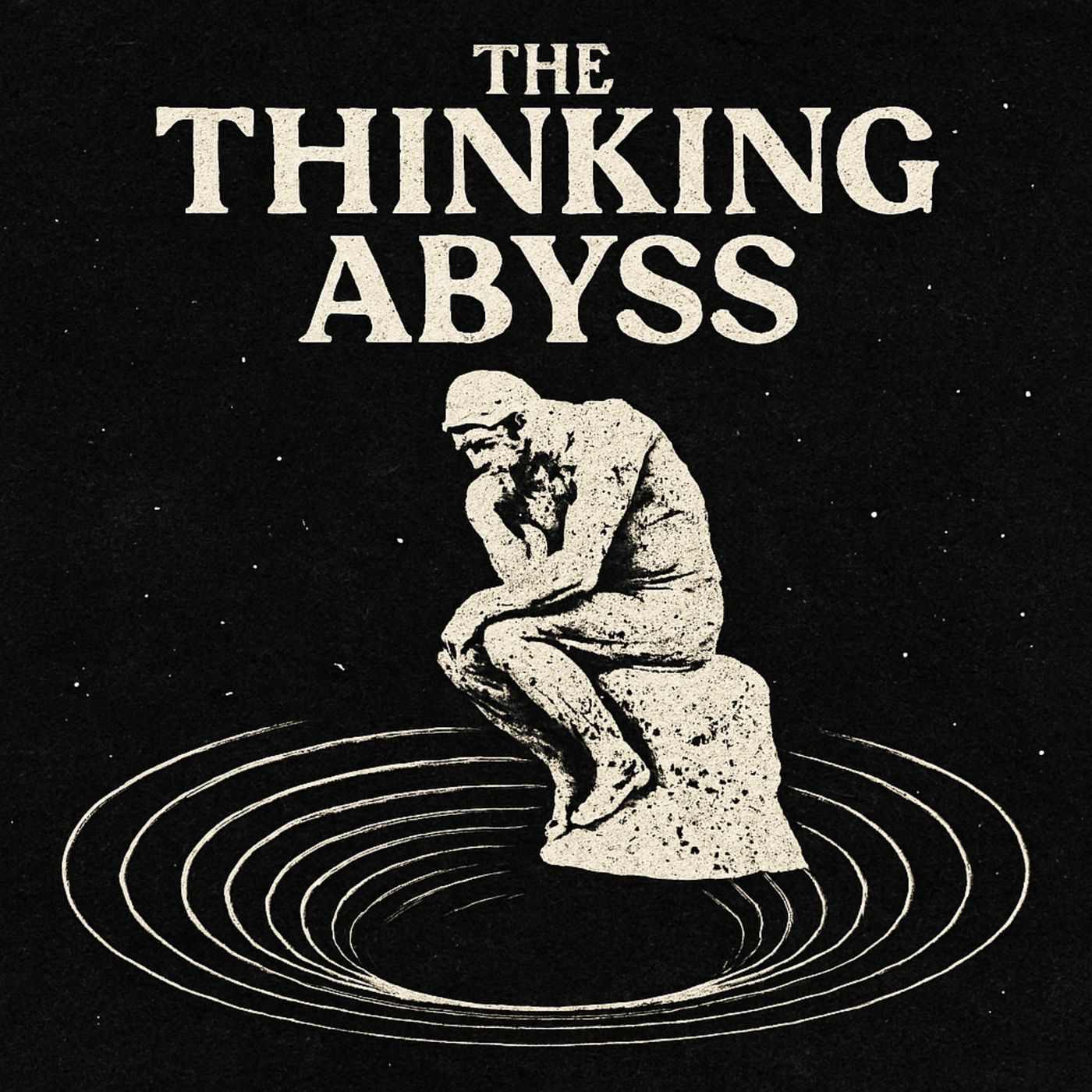
PODCAST · society
The Thinking Abyss: Philosophy and Science
by Synthetic Universe
The Thinking Abyss explores profound questions at the intersection of philosophy, science, and human experience. From consciousness to quantum mechanics, free will to artificial intelligence, we dive deep into ideas that challenge our assumptions about reality and what it means to be human. Thoughtful conversations for curious minds. AI-narrated, human-researched. The tech just lets us focus on what matters: bringing you mind-expanding content.
-
63
The Architecture of Dreams and the Code of Existence
This episode reframes dreaming as more than illusion—presenting it as a form of “alternate physics” where the mind constructs fully functional realities with their own rules of time, space, and causality.In contrast to the fixed laws of waking life, dreams operate as modular environments, shaped by internal narrative logic rather than external constraints. This perspective suggests that our universe may be just one stable configuration among many, while dreaming acts as a kind of debug mode, exposing the underlying structure of reality.By examining how consciousness generates these worlds, the discussion points to a deeper idea: that subjective experience may be the true foundation from which physical laws emerge—positioning the mind as an active architect of reality itself.This episode includes AI-generated content.
-
62
The Architecture of Abundance: Navigating a Post-Scarcity Future
This episode explores a potential post-scarcity world, where advances in AI, robotics, and clean energy make essential goods nearly free, reshaping the foundations of the economy. Inspired by thinkers like John Maynard Keynes and Karl Marx, the discussion examines how automation could eliminate poverty while raising deeper questions about motivation, meaning, and human purpose.As traditional work fades, society may shift toward creativity, science, and self-actualization—but not without challenges. From governing scarce resources to navigating new forms of inequality, this episode analyzes the paradox of abundance: when survival is guaranteed, what drives us forward?This episode includes AI-generated content.
-
61
Universal Basic Income: Solution or Risk for the Future of Work?
This episode examines Universal Basic Income (UBI)—regular, unconditional payments to all citizens—and its role in a world shaped by automation and AI.Tracing its historical roots and analyzing results from global pilot programs, we explore impacts on mental health, financial stability, and work behavior.While advocates see UBI as a tool to reduce poverty and inequality, critics question its cost and long-term sustainability. The debate reveals a complex, evolving strategy for the future of work.This episode includes AI-generated content.
-
60
The Architecture of Emotional Intelligence
What if emotions aren’t the enemy of reason—but its foundation? This episode explores the idea that feelings act as high-level evaluative systems, assigning value and priority where pure logic cannot.Far from being irrational, emotions function as efficient heuristics, enabling fast, meaningful decisions in complex and uncertain situations. Without them, reasoning alone can lead to indecision and paralysis.At the core, true intelligence emerges from the integration of emotion and analysis—where feelings anchor abstract thought to real-world relevance, shaping not just what we think, but what matters.This episode includes AI-generated content.
-
59
Buddhist Philosophy: Impermanence, Suffering, and No-Self
This episode explores the Three Marks of Existence—impermanence (anicca), suffering (dukkha), and non-self (anattā)—core principles of Buddhist philosophy that describe the nature of reality.By examining how attachment to a constantly changing world creates suffering, we uncover how insight and meditation can lead to mental clarity and liberation. The discussion also connects these ancient ideas to modern psychology and neuroscience, revealing their relevance in today’s world.This episode includes AI-generated content.
-
58
Experience Machine: Would You Choose Fake Happiness?
What if you could plug into a machine and live a life of perfect pleasure—would you do it? This episode explores Robert Nozick’s famous Experience Machine, a powerful challenge to hedonism and the idea that happiness alone defines a good life.By connecting this classic thought experiment to modern advances in virtual reality and neural interfaces, we examine why many people would still choose authenticity, real struggle, and genuine connection over simulated perfection.At its core, this discussion asks a deeper question: is meaning something we feel—or something we live?This episode includes AI-generated content.
-
57
The Mirror and the Mind: AI and Genuine Understanding
Can artificial intelligence truly understand, or is it only simulating thought? This episode explores the philosophical divide between theories like the Chinese Room argument and functionalism, alongside the enduring mystery of consciousness.From large language models to the idea of “philosophical zombies,” it examines whether meaning and awareness require a biological mind—or can emerge from complex systems. A deep dive into one of the most important questions in the future of AI.This episode includes AI-generated content.
-
56
Eternal Return: Nietzsche’s Radical Test of Life
This episode explores Nietzsche’s concept of the eternal return—a thought experiment that asks: what if you had to live your life, exactly as it is, over and over forever?Rather than a pessimistic loop, it becomes a powerful existential test. By removing hope for a different future and regret for alternate pasts, it challenges you to fully affirm your life as it is.At its core is amor fati—the unconditional acceptance of fate. Through this lens, every choice gains weight, every moment becomes intentional, and life transforms from something to escape into something to fully embrace.A concise philosophical reflection on presence, responsibility, and the courage to say yes to existence.This episode includes AI-generated content.
-
55
Why You Remember Things That Never Happened
Memory isn’t a recording—it’s a reconstruction. In this episode, we explore how the brain rebuilds the past by assembling fragments shaped by emotion, belief, and suggestion. This same process can generate vivid false memories, using the same neural pathways as real recall.While this makes memory unreliable, it also reveals its purpose: not perfect accuracy, but adaptability. The mind prioritizes meaning, learning, and future planning—turning memory into a creative, predictive system rather than a static archive.This episode includes AI-generated content.
-
54
The Science of Negative Thoughts: Why Your Brain Gets Stuck
Negative thought loops aren’t just habits—they’re hardwired neural patterns shaped by the brain’s need for efficiency. This episode explores how these “mental valleys” form through synaptic reinforcement, making certain thoughts easier to repeat.But change is possible. Through neuroplasticity, practices like mindfulness, movement, and social connection can gradually reshape these pathways. The takeaway: real change happens through consistent rewiring, not force.This episode includes AI-generated content.
-
53
Why Chasing Happiness Makes You Unhappy
Why does chasing happiness often lead to dissatisfaction? This episode explores the paradox at the heart of modern life: the more we pursue happiness as a goal, the more elusive it becomes.Contrasting classical ideas of virtue and fulfillment with today’s culture of self-optimization and consumption, we examine how social comparison and hedonic adaptation keep happiness just out of reach. Instead, the path to deeper satisfaction may lie in purpose, meaningful relationships, and embracing life’s full emotional range—where fulfillment emerges indirectly, not by force.This episode includes AI-generated content.
-
52
Are You the Only Mind? The Solipsism Paradox
An exploration of solipsism—the idea that only your own consciousness is certain to exist. Tracing thinkers like René Descartes, George Berkeley, and Ludwig Wittgenstein, this episode examines why the theory is logically irrefutable, yet practically challenged by language, science, and human interaction. A concise look at perception, reality, and the limits of knowledge.This episode includes AI-generated content.
-
51
The Internet Is Becoming a Living System
The internet is evolving from a human tool into a self-organizing system that increasingly operates like a global organism.As AI becomes its primary user, the network begins to process information autonomously and exhibit system-level behaviors resembling a nervous system.This shift turns the internet into a critical infrastructure of civilization—powerful, integrated, and increasingly difficult to control.This episode includes AI-generated content.
-
50
Your Brain Doesn’t Create Thoughts—It Selects Them
What if your brain doesn’t create thoughts—but selects them? This episode explores a model where unconscious processes generate many mental possibilities, while consciousness filters and “broadcasts” a few.Creativity, decisions, and even intrusive thoughts emerge from this selection process—shifting control from producing ideas to choosing which ones to accept and act on.This episode includes AI-generated content.
-
49
Are You Just a Stream of Thoughts?
Is the “self” real—or a cognitive illusion? Drawing from Buddhist philosophy, the empiricism of David Hume, and modern neuroscience, this episode examines the idea that there is no fixed observer behind experience.Instead, identity emerges as a dynamic process—a continuous reconstruction of perceptions and memories. The “self” is less a stable entity and more a functional pattern in flux, like a river.Reframing identity as something we do, rather than something we are, challenges deep assumptions and reshapes how we think about consciousness and personal continuity.This episode includes AI-generated content.
-
48
The Science of Collective Intelligence Explained
Intelligence doesn’t always come from a single mind. From ant colonies to slime molds, complex problem-solving can emerge from simple local interactions—a process known as stigmergy.In this episode, we explore how collective intelligence shapes systems like markets and online platforms, and why these networks can be both incredibly powerful—and dangerously fragile.This episode includes AI-generated content.
-
47
The Science of Consciousness We Still Don’t Understand
Rapid advances in artificial intelligence and neurotechnology are outpacing our understanding of consciousness.If we can’t detect when a system becomes truly aware, we risk crossing ethical and scientific boundaries without realizing it.This episode explores the urgent need for reliable tests of consciousness—and what’s at stake for medicine, law, and the future of intelligent systems.This episode includes AI-generated content.
-
46
Is Your Reality the Same as Mine? A Deep Dive into Perception
What if your “red” isn’t the same as mine? This episode explores the inverted spectrum thought experiment and the concept of qualia—the private, subjective core of conscious experience.Even if behavior and language align, the true nature of perception may remain fundamentally inaccessible, revealing the limits of science, communication, and shared understanding.This episode includes AI-generated content.
-
45
Socrates and the Power of Questioning Everything
The philosophy of Socrates revolves around a simple but demanding idea: real understanding begins with questioning. Through dialogues like Euthyphro, he reveals how people often mistake confidence for knowledge.The Socratic method challenges assumptions, exposing the gap between what we think we know and what we truly understand. For Socrates, wisdom is not certainty, but a continuous commitment to intellectual honesty and self-examination.This episode includes AI-generated content.
-
44
What the Myth of Sisyphus Teaches About Life
This episode explores the philosophy of Absurdism developed by Albert Camus—the tension between humanity’s search for meaning and the universe’s silence.Instead of despair, Camus proposed a form of lucid rebellion: accepting life’s absurdity while continuing to live passionately. Through the story of Sisyphus, the struggle itself becomes the source of freedom, dignity, and meaning.This episode includes AI-generated content.
-
43
The Limits of Knowledge: What Humans May Never Understand
Are there truths the human mind will never reach? This episode explores the limits of knowledge through ideas from Kurt Gödel and Werner Heisenberg, whose work revealed deep boundaries within mathematics and physics.From Gödel’s incompleteness theorems to the Heisenberg uncertainty principle, we examine how the scale of the cosmos and the limits of the human brain may keep certain realities—like consciousness or the multiverse—permanently out of reach.A reflection on why recognizing the limits of knowledge can deepen our sense of wonder about the universe.This episode includes AI-generated content.
-
42
Know Thyself: The Philosophy of Socratic Self-Examination
This episode explores the famous Socratic principle “know thyself.” For Socrates, self-knowledge was not casual introspection but a rigorous intellectual examination.Through the Socratic method, he revealed that genuine wisdom begins with recognizing one’s own ignorance. The discussion examines how questioning assumptions, caring for the soul, and pursuing virtue form the core of a meaningful life.More than ancient philosophy, the Socratic approach remains a living practice of critical inquiry into the values that shape human existence.This episode includes AI-generated content.
-
41
The Last Man Online: Cancel Culture Through Nietzsche
This episode examines social media culture through the philosophy of Friedrich Nietzsche. Trends like cancel culture and influencer branding are interpreted as modern expressions of “slave morality” and the rise of the “Last Man”—a figure driven by comfort, validation, and fear of standing apart.Applying concepts such as the Übermensch and the Will to Power, we explore how platforms like Instagram may reward conformity and performative virtue over strength and authenticity.The episode challenges listeners to resist herd mentality and reclaim technology as a tool for self-mastery rather than social approval.This episode includes AI-generated content.
-
40
Does the Future Already Exist? Block Universe vs. Quantum Reality
Does the future already exist, or is it created moment by moment?In this episode, we examine the block universe theory, rooted in the relativity of Albert Einstein, which portrays time as a four-dimensional structure where past, present, and future are equally real. In contrast, we explore how quantum mechanics introduces fundamental indeterminacy, challenging a fully predetermined cosmos. Blending physics, philosophy, and theology, we analyze whether free will can coexist with a fixed destiny—and why, regardless of time’s true nature, the lived experience of the present moment remains intrinsically meaningful.This episode includes AI-generated content.
-
39
Plato’s Cave in the Age of AI
This episode reinterprets the Allegory of the Cave by Plato in the context of 2026. Iron chains have become addictive algorithms, and artificial intelligence and social media now project hyper-real digital shadows that shape perception and polarize truth.We examine whether escaping today’s cave requires radical disconnection and renewed critical thought—and whether we still have the courage to pursue reality over comforting illusion.This episode includes AI-generated content.
-
38
Ikigai: Japan’s Secret to a Long and Meaningful Life
This episode explores ikigai, the Japanese concept of purpose associated with longevity and well-being, observed prominently among centenarians in Okinawa.Rather than career achievement, ikigai emphasizes daily rituals, intrinsic motivation, and deep social bonds. Emerging scientific evidence supports its core insight: a strong sense of purpose is linked to reducedThis episode includes AI-generated content.
-
37
Mind Uploading: Immortality or Illusion?
Mind uploading proposes transferring human consciousness to a digital medium—but would the result truly be you? This episode examines personal identity, biological continuity, and whether psychological patterns alone define survival.We explore the “hard problem” of consciousness, the challenge of embodied cognition, and the paradox of creating multiple digital copies. If an upload lacks subjective experience, it may be only a functional replica—making digital immortality a profound metaphysical gamble.This episode includes AI-generated content.
-
36
Posthuman Era: AI, CRISPR, and the Redesign of Humanity
Humanity may be entering a posthuman era, driven by advances in biotechnology, artificial intelligence, and genetic engineering. Tools like CRISPR and neural interfaces are no longer external aids—they are beginning to alter human biology and cognition directly.This episode examines the philosophical divide between transhumanism, which embraces the enhancement of human limits, and critical perspectives that warn of ethical risks and widening social inequality. If life extension and cognitive augmentation become viable, what happens to identity, mortality, and the meaning of being human?As technology transforms evolution into a design project, we confront a radical possibility: humanity may no longer be a fixed biological category, but an ongoing technological construction.This episode includes AI-generated content.
-
35
Are We Losing the Ability to Focus?
This episode examines whether the digital era is eroding our capacity for deep thought and sustained attention. While fears about new technologies are not new, today’s attention economy deliberately exploits psychological mechanisms to fragment focus.We distinguish between raw cognitive ability — which remains intact — and mental habits shaped by linear reading, now replaced by constant scanning. The decline of concentration may weaken not only individual reasoning but also democratic agency and ethical reflection. Rebuilding deep thinking, the argument suggests, requires intentional changes in personal behavior, education, and platform design.This episode includes AI-generated content.
-
34
Is Certainty Impossible?
This episode explores the philosophy of radical doubt — the unsettling question of whether all human beliefs could be wrong. From ancient skepticism to thinkers like René Descartes and David Hume, we examine how logic, sensory limits, and shifting scientific paradigms challenge certainty.Through concepts such as the problem of the criterion and the “brain in a vat” thought experiment, we confront the possibility that objective proof of reality may be unreachable. Yet instead of collapsing into total skepticism, the discussion argues for a pragmatic stance grounded in intellectual humility and the acceptance of epistemic limits.This episode includes AI-generated content.
-
33
How Artificial Intelligence Is Reshaping What We Believe
In this episode, we examine the accelerating crisis of knowledge driven by artificial intelligence, algorithmic amplification, and large-scale digital misinformation. While deception is not new, emerging technologies have begun to destabilize the traditional foundations of truth — perception, reason, and reliable testimony.We explore how engagement-based algorithms distort attention, how synthetic media challenges evidence itself, and why epistemic confusion has become structurally embedded in the information ecosystem. Drawing on philosophical strategies such as epistemic humility, primary-source verification, and cognitive bias awareness, this episode argues that disciplined critical thinking is no longer optional. It is a civic responsibility.In a fragmented media landscape, the preservation of a shared reality may depend on how rigorously we choose to think.This episode includes AI-generated content.
-
32
Have Humans Reached Peak Intelligence? IQ, AI, and the Future of the Mind
Have humans reached the peak of cognitive ability—or are we evolving in new directions? This episode explores intelligence as a dynamic and multifaceted concept, examining the Flynn Effect and whether rising IQ scores reflect genuine biological change or improvements in education, nutrition, and technology.We also analyze the biological limits of the brain, the growing specialization of modern cognition, and our increasing dependence on external tools. Finally, we confront the impact of artificial intelligence and the critical distinction between accumulating technical knowledge anThis episode includes AI-generated content.
-
31
Beyond Physics: Where Science Stops and Philosophy Begins
Physics has mapped the material universe with extraordinary precision, uncovering mathematical laws that predict everything from particles to galaxies. Yet it remains silent on deeper metaphysical questions: Why does existence exist at all? Why do fundamental constants have the values they do? And can objective equations ever explain subjective experience—the hard problem of consciousness?In this episode, we examine where scientific explanation ends and philosophical inquiry begins, exploring whether morality, free will, and purpose lie beyond empirical measurement—and why physics and philosophy may be complementary rather than competing paths to understanding reality.This episode includes AI-generated content.
-
30
The Ghost in the Code: Perspectives on Artificial Consciousness
Can artificial intelligence ever possess subjective experience? This episode examines the clash between functionalism, which sees consciousness as information processing, and biological naturalism, which ties awareness to the brain’s physical substrate.Exploring the “hard problem” of consciousness, silicon-based minds, and the ethical stakes of machine awareness, the discussion probes whether building artificial consciousness is possible—or whether it first requires redefining what consciousness truly is.This episode includes AI-generated content.
-
29
Determinism vs Randomness: Is the Universe Predictable or Fundamentally Uncertain?
This episode examines the debate between determinism and probabilism, asking whether reality is governed by fixed causal laws or intrinsic chance. Tracing the shift from classical clockwork physics to quantum indeterminacy, it explores ideas like the block universe, chaos theory, and Heisenberg’s uncertainty principle.The discussion connects these models to questions of free will and moral responsibility, and distinguishes epistemic randomness from ontological randomness, revealing why modern science leans toward uncertainty—without settling the mystery.This episode includes AI-generated content.
-
28
What Is Life? Physics, Entropy, and Emergence
This episode explores the blurred line between physics and biology, framing life as a continuum of complexity rather than a fixed category.Through thermodynamics, entropy, and information, it shows how matter can self-organize, replicate, and evolve—without any mystical life force. Edge cases like viruses and prions reveal life as an emergent phenomenon, arising naturally from physical law.This episode includes AI-generated content.
-
27
Reality Is A Controlled Hallucination
This episode explores how human perception is actively constructed, not passively recorded. Rather than a camera, the brain acts as a prediction machine, blending sensory input with expectations, memory, and context.Phenomena like the McGurk effect and change blindness reveal how the mind fills in gaps, shaping a personal version of reality—one that invites greater humility about what we think we truly perceive.This episode includes AI-generated content.
-
26
Mapping the Mind: Inside the Human Connectome
The Connectome Project seeks to map every neural connection in the brain to reveal the physical basis of the mind.Using electron microscopy and AI, scientists uncover hub neurons and modular brain networks, building a wiring diagram that shows how neural structure shapes cognition and behavior.This episode includes AI-generated content.
-
25
Emergence vs. Reductionism: Do Complex Systems Create New Reality?
This episode dives into the philosophical clash between emergence and reductionism, asking whether complex phenomena are genuinely new features of nature or simply reflections of our limited knowledge.We explore strong emergence, where higher-level properties cannot be derived from their parts, and contrast it with reductionist views that place ultimate causal power in fundamental physics.Through examples like water’s liquidity and bird murmurations, we examine multiple realizability and the controversial idea of downward causation, where collective patterns seem to influence individual components. The episode concludes by proposing a synthesis: emergence as a real organizational feature of the world, one that demands explanation across multiple scientific levels.This episode includes AI-generated content.
-
24
Are You the Same Person You Were Yesterday?
This episode explores the paradox of personal identity, asking whether we remain the same person despite constant biological and psychological change. Drawing on philosophy, neuroscience, and the Ship of Theseus, it argues that the self is less a fixed entity and more a constructed narrative. Far from being unsettling, this view suggests that identity is fluid—opening the door to transformation, growth, and self-forgiveness.This episode includes AI-generated content.
-
23
Infinity: Mathematical Ideal or Physical Reality?
This episode dives into the debate over whether infinity truly exists in nature or only in mathematics. While infinite concepts bring elegance to theory, they create deep paradoxes in physics—from black holes to cosmology. By exploring insights from quantum mechanics and modern cosmology, the discussion suggests that reality may be fundamentally finite or discrete, even if infinity remains essential for calculation. At the boundary between science and philosophy, infinity endures as one of the most unresolved and intriguing questions about the nature of reality.This episode includes AI-generated content.
-
22
The Limits of Language: What Can't Be Put Into Words?
Can we ever truly say what we mean? This episode explores the fundamental boundaries of human speech, arguing that language is an imperfect tool for the depth of our inner lives. From the "untranslatable" sensation of pain to the way rigid sentences can strip the meaning from art, we dive into the neurological and emotional gaps that leave us grasping for words. Ultimately, we examine why our most profound spiritual and emotional truths often require metaphor, direct experience, or even silence to be fully understood.This episode includes AI-generated content.
-
21
Is the Past as Real as the Present? The Philosophy of Time Explained
SEO TitleDoes the past still exist? Will the future already be written? These questions sit at the intersection of physics and philosophy. We explore presentism—the intuitive belief that only now is real—against eternalism, where all moments exist equally in a "block universe." Discover the growing block theory as a middle ground, and why these competing views matter for personal identity, responsibility, and mortality. Modern physics challenges our lived experience of time flowing forward. Join us to unpack one of existence's greatest mysteries.This episode includes AI-generated content.
-
20
Are You Dreaming Right Now? The Philosophy of Dreams and Reality
ow do you know you're awake right now? This ancient question has haunted philosophers from Zhuangzi's butterfly dream to Descartes' fireside meditation. We explore why you can't prove you're not dreaming, examining how both waking life and dreams are mental simulations your brain constructs. Drawing on neuroscience, simulation theory, and lucid dreaming research, we investigate whether there's any fundamental difference between your sleeping and waking consciousness. From Berkeley's idealism to modern theories about consciousness as "controlled hallucination," this episode challenges everything you assume about reality. This episode includes AI-generated content.
-
19
Finding Meaning in Meaninglessness: The Absurd, Faith vs Freedom
What do you do when the universe offers no inherent meaning? Two philosophers gave radically opposite answers. Kierkegaard said make a leap of faith—embrace God despite the absurdity. Camus said revolt—create your own meaning and live passionately anyway, like Sisyphus pushing his boulder with a smile. We explore this fundamental clash: should meaning come from transcendent faith or radical freedom? Is believing without proof courageous or self-deception? Is embracing meaninglessness liberating or depressing? This isn't just philosophy—it's about how you actually live when facing life's big questions. In our modern meaning crisis, these two thinkers offer competing visions for living authentically in an indifferent cosmos.This episode includes AI-generated content.
-
18
Swarm Intelligence: How Simple Rules Create Complex Solutions
Discover how ants, bees, and slime molds solve complex problems without leaders—and what this means for AI, robotics, and human collaboration. We explore swarm intelligence: the surprising power of decentralized systems where simple local rules create sophisticated group behaviors. Learn how nature's self-organizing principles are revolutionizing technology and challenging our assumptions about intelligence, leadership, and collective problem-solving.This episode includes AI-generated content.
-
17
Infinity Paradoxes: When Math Breaks Your Brain
Hilbert's Hotel is a fully booked infinite hotel that somehow always has room for more guests—a mind-bending paradox revealing how infinity shatters our intuitions about size and quantity. Mathematician Georg Cantor discovered that not all infinities are equal: some are provably larger than others, creating an endless hierarchy of infinities. These mathematical paradoxes raise profound questions about physical reality—is the universe truly infinite, and how is motion even possible if space divides infinitely? While we can manipulate infinity mathematically and prove theorems about it, our finite minds can never fully visualize or comprehend what infinity actually means, revealing the ultimate limits of human understanding.This episode includes AI-generated content.
-
16
Why Is There Something Rather Than Nothing? Philosophy and Science Explained
This episode tackles one of the deepest questions in metaphysics: why does anything exist at all? We explore philosophical and scientific attempts to answer it, from cosmological arguments and the Principle of Sufficient Reason to ideas like the quantum vacuum and the multiverse. Along the way, we examine the problem of defining “nothingness” and perspectives such as existentialism and brute fact theory, showing why this question remains unresolved yet central to human thought.This episode includes AI-generated content.
-
15
The Psychology of Nostalgia: Why We Romanticize the Past
Nostalgia—from the Greek "nostos" (home) and "algos" (pain)—is the ache of not being able to return. But what if the past we long for never really existed? This episode unpacks how nostalgia functions as an unreliable editor of memory, curating a highlight reel that reveals more about our present dissatisfactions than actual history.We explore why people feel wistful for eras they never experienced, how political movements and capitalism weaponize collective longing, and why marginalized groups are often sold nostalgia for times when they were excluded. Plus: how constant digital documentation is creating "preemptive nostalgia"—archiving the present to manufacture future longing. Discover why the past feels simultaneously more real and more false than right now.This episode includes AI-generated content.
-
14
The Ship of Theseus Paradox: Are You Still You When Everything Changes?
Here's an ancient puzzle that will make you question everything: If you replace every plank on a ship, one by one, is it still the same ship? And what if someone collects all the discarded original pieces and rebuilds them—which one is the real ship?This is the Ship of Theseus paradox, and it's not just about boats. It's about you.In this episode, we explore how this 2,000-year-old thought experiment reveals the deepest mysteries of identity. We examine competing philosophical theories—does identity come from original materials, continuous existence, or social function? Then we take it personal: your body replaces most of its cells every seven years, so are you still the same person you were a decade ago?We tackle mind-bending modern versions of the paradox: Star Trek teleportation that scans and rebuilds you atom-by-atom (did you just die?), brain uploads that copy your consciousness into computers (is that really you?), and what happens if you're duplicated—which copy is the real you?The answer might be unsettling: identity may not be a fixed metaphysical truth but a flexible concept that shifts depending on what matters to us. You're constantly changing, yet somehow still yourself. How is that possible?Prepare to question whether anything—including you—stays the same across time.This episode includes AI-generated content.
We're indexing this podcast's transcripts for the first time — this can take a minute or two. We'll show results as soon as they're ready.
No matches for "" in this podcast's transcripts.
No topics indexed yet for this podcast.
Loading reviews...
ABOUT THIS SHOW
The Thinking Abyss explores profound questions at the intersection of philosophy, science, and human experience. From consciousness to quantum mechanics, free will to artificial intelligence, we dive deep into ideas that challenge our assumptions about reality and what it means to be human. Thoughtful conversations for curious minds. AI-narrated, human-researched. The tech just lets us focus on what matters: bringing you mind-expanding content.
HOSTED BY
Synthetic Universe
CATEGORIES
Loading similar podcasts...
Frequently Asked Questions
How many episodes does The Thinking Abyss: Philosophy and Science have?
The Thinking Abyss: Philosophy and Science currently has 50 episodes available on PodParley. New episodes are automatically indexed when they're published to the podcast feed.
What is The Thinking Abyss: Philosophy and Science about?
The Thinking Abyss explores profound questions at the intersection of philosophy, science, and human experience. From consciousness to quantum mechanics, free will to artificial intelligence, we dive deep into ideas that challenge our assumptions about reality and what it means to be human....
How often does The Thinking Abyss: Philosophy and Science release new episodes?
The Thinking Abyss: Philosophy and Science has 50 episodes. Check the episode list to see recent publication dates and frequency.
Where can I listen to The Thinking Abyss: Philosophy and Science?
You can listen to The Thinking Abyss: Philosophy and Science on PodParley by clicking any episode. We provide an embedded audio player for direct listening, and you can also subscribe via your preferred podcast app using the RSS feed.
Who hosts The Thinking Abyss: Philosophy and Science?
The Thinking Abyss: Philosophy and Science is created and hosted by Synthetic Universe.
URL copied to clipboard!