
PODCAST · education
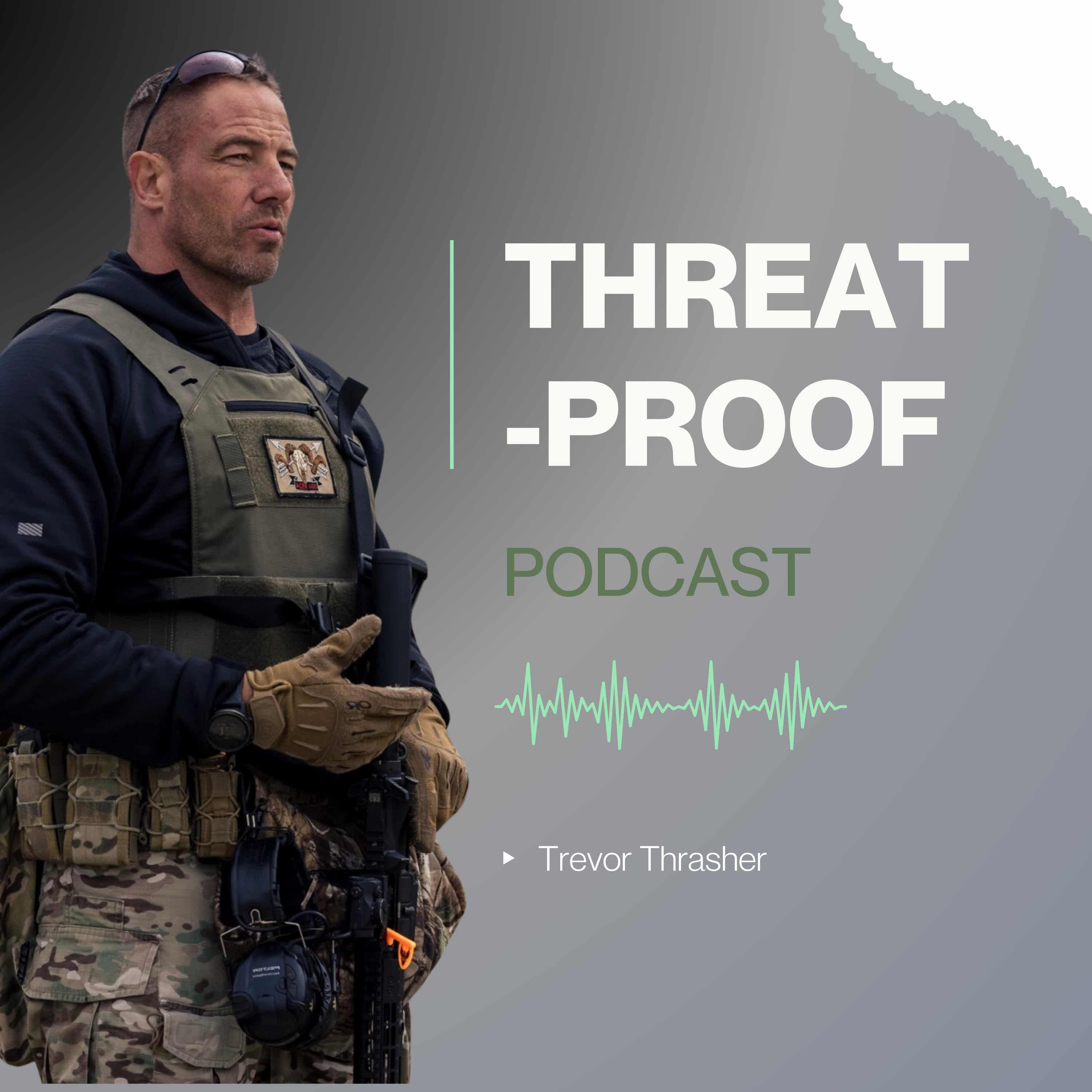
The Threat-Proof Podcast
by Trevor Thrasher: Green Beret, SWAT/Street Officer, Body Guard and CT Contractor
Ditch the Victim Nation and become a victor. The Threat-Proof Newsletter delivers no-fluff safety insights, real-world threat breakdowns, and practical tips to help you protect yourself and your family in an unpredictable world. Builds Grit, Capability, and Confidence for Operative-Level Self-Security in the Face of Danger. Tips from a spec ops, C.T., and a law enforcement man-at-arms. threatproof.substack.com
-
15
College Safety for Young Women: The Conversations Most Parents Never Have
This is a free preview of a paid episode. To hear more, visit threatproof.substack.comTrevor Thrasher has spent more than thirty years in personal protection and violence response — Army Special Forces, law enforcement, SWAT, and counter-terrorism work across multiple agencies and countries. He's trained thousands of women, wrote The Everyday Defender, and built the Freshman 15 after relatives and friends with college-bound daughters kept asking him for something specific.Most of the risk to young women comes from people they already know, and "be careful" doesn't cover it. In this episode Trevor breaks down what a "freshman" actually is (it's broader than you think), the three vulnerabilities that come with being new somewhere, and the two rules that make every other tactic work.Then he runs the Samantha Josephson case through the three questions he uses on every real-world incident: what was the first easy opportunity, what was the last opportunity, and what 60-second lesson would have made the biggest difference.In this episode:Why "freshman" means anyone from a high school freshman to a woman in her twenties starting overThe three vulnerabilities of being new somewhereNever trade your safety for your social statusNever fly alone: what a wingman actually doesThe trusted adult and the family code wordRideshare rules you can teach in under a minuteWhy early action is cheaper than late action, in training and in consequencesDo this today: Call her. Match the plate, match the make and model, make the driver say her name before her hand touches the door. Takes a minute.Free Freshman 15 Quickstart — all fifteen conversations plus a printable checklist:https://freshman15.threatprooflife.comMore at threatprooflife.com · Newsletter at threatproof.substack.com
-
14
The Deadly In-N-Out Burger Shooting Part 2
Episode title: Hard Luck and Heroism: 25 Lessons from the Twin Falls In-N-Out ShootingDescription:Police released the full timeline video of the August 1 attack at the Twin Falls, Idaho In-N-Out Burger. Three people were killed and ten were shot. I walk the footage and pull twenty-five lessons out of it, in the order they happen.All five responses show up in this one event — alert, run, hide, fight, and aid — along with a former officer who ran toward gunfire in the wrong state and paid for it, an armed citizen engaging a rifle at nearly a hundred yards with a pistol, a woman who took the attacker's gun and couldn't run it, and four officers who all looked the same direction.In this episode:Setting your TEMP state before you approach danger, and what it costs when you don'tThe three selfs: self-defense, self-extract, self-treatThe plus one rule, and why the attacker came back to the windowScene safety before treatment, and where the danger returns toBarricade or evade, and how to decide when you don't know where they areHandgun against rifle at extreme distance, and what "pressure" is actually worthAvoiding friendly fire when police arrive into a lot full of drawn gunsDrive, signs, and stimulusLinks:Full written notes with all 25 lessons: [threatproof.substack.com]The Threat-Proof Family, the five-day program to run with your kids: threatprooffamily.threatprooflife.comTrevor Thrasher | High Threat Training Group LLC | threatprooflife.com This is a public episode. If you'd like to discuss this with other subscribers or get access to bonus episodes, visit threatproof.substack.com/subscribe
-
13
The Stick or the Snake
This is a free preview of a paid episode. To hear more, visit threatproof.substack.comOn June 22nd, a man in camouflage ambushed police officers outside a hotel in Montreal’s Côte-des-Neiges neighborhood. He fired more than two dozen rounds in under a minute. Constable Mohamed Lamine Benredouane, 34 years old, a father with a pregnant wife, was shot and killed — the first Montreal officer to die in the line of duty in 24 years. His partner was shot and critically wounded. A 68-year-old bystander named Michel Mizrahi was also killed. A video circulating online appears to show him being shot by an officer as he approached her position mid-gunfight. Quebec’s police watchdog is investigating, and the police chief has said plainly that he does not know who shot Mizrahi.That hasn’t stopped the internet from reaching its verdict.The officer panicked. The officer wasn’t up to the job. She should have been trained better. Some went further and made it about her sex. I’ve spent more than three decades across Army Special Forces, law enforcement and SWAT, and counter-terrorism work, and as a use-of-force expert witness. So let me tell you what the people typing those verdicts don’t understand — and more importantly, what this tragedy can teach you and your family.Your brain was built for this decision — and that’s the problemPicture one of your ancestors walking a dark path. Something long and squiggly lies across it. In the span of a single footstep, the brain has to decide: stick or snake? Step, freeze, or jump?The bloodlines that decided “stick” and threw caution to the wind eventually got bitten out of existence. The bloodlines that flinched — that decided “snake” first and were relieved to be wrong — survived long enough to become us. Under mortal stress, with no time and no information, the human brain prioritizes the most threatening interpretation of what it sees, deals with that first, and sorts out the details later. That’s not cowardice or incompetence. That’s the operating system, and every one of us is running it. Now, it simply doesn’t really care what the result might be later. It only cares about this fraction of a second.Now put yourself behind that planter in Montreal. Your partner is dead a few feet away. Rounds are still coming. Your entire world has compressed to one threat axis. And suddenly, a shape closes the distance on your position in nearly exactly the same way the gunman who is trying to kill you does a few moments later.Stick or snake?Her brain answered the way human brains have answered for three hundred thousand years. Keep in mind that it is not verified at this time that the officer shot the bystander, but the discussion points still hold.Split-second syndrome, and what the Supreme Court understood that the internet doesn’tIn my tactical courses, I teach officers about what’s often called split-second syndrome — the trap identified by a police lieutenant years ago in an article in the now-defunct Police Marksman magazine. The U.S. Supreme Court described it in Graham v. Connor, recognizing that use-of-force decisions occur in circumstances that are “tense, uncertain, and rapidly evolving.”I break that into what I call the SIT factors. Safety — the situation is dangerous, so you are short on safety. Information — it’s uncertain, so you must act without the full picture, which means you can be wrong. Time — it’s rapidly evolving, so the decision must be made in a fraction of a second.Here’s the part I hammer in training: good tactics are largely the art of manipulating those three factors in your favor — using distance, cover, angles, and patience so you never have to make the stick-or-snake decision in the first place. Poor tactics force that decision on you, and the results are suboptimal at best and tragic at worst. I hold officers to a high standard on this, and I’ve written before about avoiding friendly fire and blue-on-bystander/victim disasters (4 Successful Disarms, 4 Tragic Results), because I want officers and others to prevail and go home.But there are times when no tactic on earth gets a vote — when the stick-or-snake is simply thrown at you. An ambush by a rifleman who has already killed your partner is exactly that.I don’t say this from the cheap seats. I teach active threat courses for law enforcement at the instructor level — the people who go back and train their departments. Threat identification and avoiding friendly fire get covered in my courses at a depth I have not seen matched anywhere else, because I believe the deadliest seconds in these events are the ones where good people misread each other. In fact, when this incident hit my newsfeed, I had just finished teaching a church safety group how to distinguish an active threat from everyone else — using the visual frisk and the ABCDEs of awareness that run through all of my material. So when I tell you what training can and cannot do, it’s not a guess. It’s my job. By the way, Paid members of The Threat Proof Newsletter can download my Active Threat Awareness Module, which I present in many of my courses to police, military personnel, civilians, church groups, and others. (Find it below the pay line)And I’ll say this as clearly as I can: there is no training program at any department level, anywhere, that reliably makes an average officer — or even a fairly good one — perform like a superhero in an outgunned, partner-down, worst-case ambush. Anyone who claims otherwise has never had to make that decision and never will. High-stress performance training helps at the margins, and the margins matter. But the people demanding perfection from that officer are demanding something that does not exist.I have tried to clip a few videos together of the incident below. You can see that after the encounter with the bystander, the officer is directly assaulted by the shooter coming around the barrier nearly the same way. She has a blink-of-an-eye time period to decide what to do. It is hard to tell, but she appears to be able to duck out of the full-force attack and may or may not have fired at the shooter. Luckily, it appears that the shooter needs to reload or clear a malfunction, and he is engaged by officers and stopped, dead right where the officer previously was positioned. I believe the female officer was severely wounded, but Canada holds its information tight. I am not sure if she hesitated or fired in that split-second, but it shows both sides of the stick or snake, maybe shoot a bystander (coming around in a near attack pattern in the middle of a gunfight), maybe get shot by the gunman and die with no second chances. Hesitation or survival.As for Michel Mizrahi — those who knew him say he was directing people away from the gunfire when he was killed. I don’t know exactly what happened in his final seconds; nobody does yet. But take the reports at face value and you have something the internet’s version can’t hold: two good people, both acting on brave and fundamentally human instincts, colliding in the worst possible way. Nobody in that frame is the villain except the man with the rifle.Now the part that’s for youBecause here’s the truth: someday you might be the one running from gunfire toward the uniforms — or toward a capable civilian defender. Do it wrong, and two right instincts collide again. So learn this now, calmly, while there’s time — the same way I teach it in my seminars.Hands up. Open. Empty. The three words I drill in every seminar. Nothing in your hands — not a phone, not keys, not anything that reads as a weapon in a quarter-second glance. If you’re armed and police may be arriving, your weapon goes down and out of sight before they see you.Use your voice, loudly and repeatedly. “Officer! My hands are up! My hands are up!” or “Officer — help me!” — or if it’s an armed neighbor instead of a uniform, “Don’t shoot! It’s me..!” Under extreme stress, auditory exclusion is one of the most commonly reported effects — they may barely hear you. Say it anyway, keep saying it or whatever fits the situation. I have some code words I teach that may be useful here for avoiding friendly fire. You’re trying to buy one beat of recognition in a brain that’s locked on a threat.Understand that they may literally not see you. Tunnel vision is real. The formal term is inattentional blindness: under threat, the brain drives all attention to the danger and deletes everything else. There’s a famous experiment where people counting basketball passes fail to notice a person in a gorilla suit walking through the middle of the frame (watch it yourself — count the passes first, no cheating). You can be directly in front of an officer or defender mid-gunfight and functionally not exist. Act accordingly.Never surprise anyone with a gun in their hand. Don’t burst around corners. Don’t sprint up behind or beside a position. The single most dangerous moment for this is exploding out of a building’s exit into a parking lot where officers are set up — you appear suddenly, at speed, at close range. That is the stick-or-snake, weaponized against yourself.Stay out of the line of fire — offset, then move. In the military we call the principle bounding overwatch: if you expect someone to protect you while you move, you must keep their lane of fire open. Don’t run a straight line between the defender and the threat. And don’t take the other wrong path either — a long sprint across open ground toward safety that never was. A few quick steps at an angle — putting cover between you and the threat, and clearing their view of the gunman — beats forty feet in a straight line every time. Break line of sight with the shooter first. Then move directly away.If “bounding overwatch” sounds like some crazy commando tactic that has no place in an active shooter conversation, consider this: you’re fighting with an intruder at your own front door. Your secondary defender — your wife, your husband, whoever in the house can get armed and come to your aid — does exactly that. Do you break away and run straight at them? The tendency when people get scared is to run to their savior. But now your body is exactly between their muzzle and the threat. Instead: break away from the attacker, move loudly a few steps to the side, and hand your defender a clean line of fire and a clean angle to use whatever tool is in their hands. Same principle at your front door as in that Montreal street. Offset, then move.And if the fight is still on around you: get behind real cover and proactively look for your next move. Hide means being hard to see and hard to reach, not frozen without awareness or readiness. Then be ready to provide aid — to yourself or the person next to you — because every officer on that scene is fighting for their life, and it may be a while before anyone can get to you.If you’ve followed my work, you’ll recognize the shape of that sequence: Alert, Evade, Hide, Fight, Aid. The same responses I teach families apply here, reverse-engineered from a tragedy. None of it is complicated. All of it has to be decided before the moment — because as Montreal just proved, the moment doesn’t leave room to think.Sit down with your family this week and talk through one question: if we ever hear gunfire in public, what do we do — and what do we do when the police arrive? Thirty minutes at a kitchen table. That’s where these decisions belong. If you want the complete system — the full family emergency action plan I’ve built from a life spent on the other side of these calls — it’s here: tacticaltwos.threatprooflife.comTwo men died in Montreal doing their duty as they understood it. Honor them by being ready.Be responsible, capable, and confident.Trevor ThrasherThreatprooflife.comFor paid subscribers: how to spot the threat firstEverything above is about surviving the moment once it’s unfolding. But the earlier you see a threat coming, the more of these decisions you make on your terms instead of in a half-second of panic.That’s the rest of this: the Awareness Module from my instructor-level Active Threat Interdiction course — the same system I teach the people who train their departments, and walked a church security team through days before Montreal.Inside: the ABCDEF framework for reading a person in six lanes, the Rule of Threes (one cue means watch, three means act), and the Visual Frisk — the two-second read that tells you if the person in front of you is a threat, adapted from Paul Howe (former CAG/Delta) and built for flash-picture speed. Plus the body-map every student keeps.Real course material, not repackaged internet content — useful whether you’re an everyday defender, running church security, or wearing a badge. If that’s worth a few dollars a month, come on in. Either way, thank you for reading — and be responsible, capable, and confident.
-
12
Two Terror Attacks. One Day. Is Your Family Ready?
The ThreatProof Podcast — Guest appearance on News Radio 1110 KFAB with Chris BakerThe ThreatProof Podcast — Guest appearance on News Radio 1110 KFAB with Chris BakerAbout This EpisodeThis week I joined Chris Baker in studio at News Radio 1110 KFAB in Omaha to break down what’s happened since my original Iran threat assessment — and what it means for your family this weekend.We had two terrorist attacks on American soil in a single day. We’ve had four ideologically driven attacks since the Iran strikes began. St. Patrick’s Day weekend is here. And most families still don’t have a plan.That’s what this conversation is about.What We Cover* The four-tier threat model — and how every tier has now confirmed* Why two attacks in one day didn’t get the media coverage it deserved* Vehicle attacks: why they produce the highest casualties in the shortest amount of time, and why ISIS literally publishes a how-to guide targeting events like St. Patrick’s Day parades* The Tactical Twos framework — the same planning system used in special operations, applied to a night out this weekend* What to have in your car’s medical kit right now (and why a box of Band-Aids doesn’t count)* Church and synagogue security: why you have to be your own first responders, and why most events are over before police arrive* The poll that should alarm every American: what percentage of fighting-age men say they’d actually defend this country* Why the weapon is never the problem — and why that conversation matters more than everKey Takeaways* Four attacks. Fourteen days. Every tier of the original threat assessment has produced a real-world event. This is no longer theoretical.* Ideological violence doesn’t need a direct tie to Iran. The attackers don’t need orders from Tehran. They need a trigger for hate that was already there. The Iran strikes provided that trigger.* You are the first responder. The majority of active threat events are over within five minutes — before police can arrive. The people who stopped these recent attacks were right there, and they were prepared.* Vehicle attacks are the highest casualty-producing threat. More people can be injured and killed by a vehicle in less time than almost any other method. ISIS publishes guidance on exactly how and where to do it. St. Patrick’s Day events are the kind of target they name.* The Tactical Twos in practice. Two rally points. Two alert signals — one overt, one covert. Two places to barricade. Two places to find medical aid. A serious trauma kit in your car. This is not complicated. It’s just not being done.* Stop the Bleed saves lives. A tourniquet and wound-packing material fit in a bag or at your ankle. A two-hour class gives you the skills. Most people won’t do it. Be the exception.* Only 45% of men aged 18–34 say they’d stay and fight if the U.S. was invaded. If you don’t think that has implications for how we handle domestic threats, think again.Behind the ScenesChris asked me on short notice after two attacks happened on the same day — and what struck me was that most of the coverage treated them as separate, unrelated events. They’re not. The pattern I laid out in my original assessment is confirming faster than I expected, and that’s exactly what I told Chris on air.The caller who mentioned that ROTC students at UNL are being told not to wear their uniforms on campus — that hit home. That’s force protection. That’s a real signal about the threat environment we’re operating in right now, right here in Nebraska.If you’re heading out this weekend, have a quick conversation before you go. Pick a rally point. Know where your medical kit is. Stay 99% in the moment and enjoy yourself — but run 1% of your attention in the background. That’s not paranoia. That’s just what a responsible person does.Check out The Threat-Proof Family Guide and prepare your loved ones for nearly any crisis: Threat-Proof Family The Chris Baker Show on KFAB: https://www.iheart.com/podcast/53-chris-baker-323959657/episode/ideological-attacks-a-threat-to-every-american-326736583?app=listen This is a public episode. If you'd like to discuss this with other subscribers or get access to bonus episodes, visit threatproof.substack.com/subscribe
-
11
Minneapolis Mayhem and Mindset
Real-World Lessons from Recent EventsBy Trevor (OSS | Street Smarts | Threat-Proof Coaching)Minneapolis, January 2026.The recent fatal shooting involving federal agents (ICE/Border Patrol) in our own backyard is a stark reminder: high-stress law enforcement encounters can escalate in seconds. Whether the command is lawful or not, the priority is survival—not winning the argument in the moment.If you carry a gun every day (open or concealed), these basics are non-negotiable. They’re drawn directly from John Farnam’s “Rules of Stupid” and decades of practical training in personal protection.John Farnam’s Rules of Stupid (The Foundation)WHY DO I HAVE TO KEEP REPEATING THIS!Don’t set yourself up for trouble before it starts:* Don’t go to stupid places* Don’t associate with stupid people* Don’t do stupid things* (Often added: Don’t do them at stupid times)These rules prevent 90% of the avoidable problems armed citizens face. Stupid varies by person and context, but following them keeps you out of the wrong place at the wrong time with the wrong people.The 3 Core Rules for Police Encounters* Comply clearly and slowly When police give a command (lawful or unlawful), follow it purposefully. No sudden movements. Survival comes first—any dispute gets resolved later in court, not on the street.* Never make motions toward your weapon Any hand movement toward your waistline, pockets, holster, or anywhere that could be misinterpreted as reaching for a gun is a high-risk trigger in a tense encounter. Keep hands where officers can see them. Period.* Disclose you’re armed when appropriate If the situation allows (e.g., during a pat-down or traffic stop), calmly and clearly say: “I am legally armed.” Hands still visible, no sudden moves. It’s not always required by law, but it’s often very smart—it reduces misunderstandings.When to Actually Resist The PoliceThis can be a deep subject with so many if’s that I only dare touch upon it. You'd better only do it as a measure of last resort to save your life or that of another clear innocent against unlawful (or perhaps horrible) conduct by the police without other reasonable recourse. Some states allow reasonable resistance against clearly unlawful arrest, but you will often see the myth that people think they can use deadly force when law enforcement is infringing on their rights or arresting them in circumstances they feel are unconstitutional. It’s far from that clear. Many states will not allow resistance to arrest, even if the arrest is unlawful, short of a very specific need to protect yourself immediately from serious harm.Very importantly, the lawfulness of the encounter is never judged in the street. You can still end up very dead and even innocent, or very much a criminal, dead or alive. The Bottom LineThe only person responsible for your survival in that encounter is you.I carry nearly every single day.I’ve never once worried about getting shot by police because I generally follow Farnam’s Rules…generally, and I take measures to make sure everyone knows I am the good guy. See my previous posts on the subject here:Follow these basics—Farnam’s rules + clear compliance + no reaching—and you won’t have to worry either short of some very extreme situations. Why This Matters NowThe Minneapolis incident (January 24, 2026) highlights how quickly things can go sideways during federal operations or routine contacts. Video analysis and official statements show conflicting accounts, but the outcome was tragic.These rules aren’t about blame—they’re about stacking the odds in your favor so you go home.Want More?If you’re serious about responsible carry and threat response:* Subscribe for free updates* Want to master the basics to keep you safer from crime, armed or not? Check out my 30-Day Street Ready Challenge Course: https://academy.threatproofcommunity.com/streetready30Be capable. Be safe. Go out there.TrevorOSS | Threat-Proof Coachingthreatproof.substack.com This is a public episode. If you'd like to discuss this with other subscribers or get access to bonus episodes, visit threatproof.substack.com/subscribe
-
10
Don't Become a Danger Sandwich and How Not to Make Kidnapping Easier
The face of crime has changed. Ten years ago, staying out of trouble meant staying out of bad neighborhoods, avoiding gangs, and not involving yourself in criminal activity. That simple formula no longer works.Today, police are increasingly handcuffed by policies that protect criminals over victims. Drug addicts are subsidized. The mentally ill roam free until—as one newscaster grimly observed—”every mentally ill person gets to slaughter one innocent person before they do something with them.” Active threat incidents have increased several hundred percent over the last decade. Random violent attacks against completely innocent people have become routine.This isn’t fear-mongering. This is the hybrid threat environment I’ve been warning about. And if you’re not prepared for it, you’re failing yourself and everyone who depends on you.The Numbers Don’t LieConsider these statistics:1.2 million violent crimes are reported annually in the U.S. Eight out of ten people will be victimized by violent crime in their lifetime. One in ten households will experience property crime in a single year.But here’s what should really alarm you: only 41.5% of violent crimes and 31% of property crimes are actually reported. Most crimes are unreported and unsolved. If your safety plan depends on criminals being caught and prosecuted, you’ve already lost.Your primary goal is never to get the criminal captured. That’s a side benefit at best. Your primary goal is to defend yourself and your loved ones—first and foremost.The Protector Code: 1% Effort for 100% SafetyI developed what I call the Protector Code: dedicate just 1% of your life to personal safety and security.One percent of a week is about 1.5 hours. That’s it. Fitness, training, education, watching videos, developing a home defense plan, organizing equipment in your car—small investments that compound into massive protection.If you won’t do this for yourself, and you refuse to do it for your family, you’re failing them. Period.What I’ve found, through decades of training law enforcement and military personnel, is that small doses of safety can increase your protection by 100% or more. The 1% effort is the place to start—but not the place to finish.One Minute Lessons That Save LivesThe news is filled with stories where I think: A one minute lesson could have saved that person.These aren’t complex tactical maneuvers requiring years of training. They’re simple principles that, once understood, become patterns and frameworks you can apply flexibly across countless situations.The Florida School Shooting: Students were killed as an attacker stood outside a classroom doorway, looked in, saw them standing in the middle of the room, and opened fire. They knew it was an active threat situation. They just had no idea what to do.If their parents had given them a one minute lesson—barricade the door, get in the corner out of view from the hallway, grab a weapon, be ready—those children would be alive today.As a father, that’s the kind of regret that keeps me up at night. It’s why I do this work.Don’t Become a Danger SandwichOne Minute to a Safer Commute: When standing in public—especially around transit—put your back to something solid. Keep everything potentially dangerous in front of you.Don’t stand in front of active train tracks, staring at your phone, with your back turned to everyone walking past. That makes you a danger sandwich—vulnerable from multiple directions with no awareness of what’s approaching.The subway attack video shows exactly this failure. A man in black approaches an unsuspecting rider from behind and shoves him onto the tracks in front of a train. The victim is now in critical condition.The one-minute to safety lesson: Position all danger in front of you. Glance at your phone if you must—you’re human—but maintain awareness of your surroundings. That simple adjustment could have prevented this tragedy.The Capability AssessmentWorkplace Safety Scenario: An 18-year-old store employee in Florida saw a man shoplifting. Her response? Block his path to the door.Ask yourself: What did she hope to achieve physically by standing between a full-grown adult male and the exit? The answer is nothing. All she did was put herself at risk.In fact, she likely made the crime easier. The suspect had cased the store earlier, saw an unprotected, unaware, smaller female alone—and returned. When she positioned herself at the door, she essentially delivered herself to him.I call this the Capability Assessment: Before you act, ask yourself what you actually hope to achieve with your physical resistance, and whether you’re capable of achieving it.This young woman’s actions were legal. But tactically? A disaster. Morally? Debatable—risking your life over property rarely makes sense.She did some things right: she drew massive attention to herself, and when he tried to force her into a vehicle, she fought like hell to stay out of it. As a former police officer, I can tell you that loading an unwilling person into a car is one of the hardest things to do if they truly resist. But I see people kidnapped all the time who clearly didn’t fight with everything they had.The one minute lesson: If someone tries to take you to a secondary location, fight with 100% commitment. Whatever they might do to you there is worse than the risk of fighting here.Neo-Barbarism: The Hybrid Threat RealitySome call this “assassination nation,” but that’s too simplistic. What we’re experiencing is neo-barbarism—a society so over-civilized it can no longer protect itself from those who choose to act like barbarians.In that subway video, four people appear. Three of them are committing crimes—jumping turnstiles, random assault. Only one is obeying the law. And he’s the victim.Our Constitution, as John Adams noted in 1798, “was made only for a moral and religious people. It is wholly inadequate to the government of any other.” The whale is through the net. The barbarians are inside the gates.The systems we’ve built work for people who are generally law-abiding and moral, with occasional capacity to deal firmly with sociopaths and criminals. Today? The suspects are treated as victims, and society itself is blamed.This isn’t a political statement. It’s operational reality. And your survival depends on recognizing it.For more on the hybrid threat environment and case studies of recent attacks, read: The Whale is Through the Net and The Barbarians Are Inside the GatesYour AssignmentThe patterns I’ve outlined here—situational positioning, capability assessment, commitment to resistance—aren’t the end of your training. They’re the beginning.Over time, you won’t need a massive collection of one minute lessons. These principles become internalized frameworks that allow you to respond appropriately across a broad variety of situations.But you have to start.Take the first stepFor individuals and families: Sign up for my Street Ready 30 Day Challenge. You’ll get an ebook, video lessons, real-world examples, and a workbook with specific tasks to improve your safety by 100%—with just 1% effort. This is the perfect starting course for you or anyone in your family.For groups and organizations: Bring the Street SMAARTS Seminar to your workplace, church, school, or community group. This is the full framework delivered live—ideal for teams who want to build a culture of readiness together.Go out there. Be safe. Be ready.Trevor This is a public episode. If you'd like to discuss this with other subscribers or get access to bonus episodes, visit threatproof.substack.com/subscribe
-
9
A PREDICTABLE DEATH IN MINNEAPOLIS AND THE NEW NORMAL OF TRIBALISM, POLITICS, AND EMOTION IN PLACE OF REASON
The Minneapolis ICE Shooting: Put Your Thinking Cap OnThe shooting of Renee Nicole Good by an ICE agent in Minneapolis is generating enormous heat. Predictably, most of the conversation is driven by tribalism, politics, or emotion. This event was 100% predictable after we had witnessed rising violence and the use of vehicles to obstruct agents, with shots fired, and people already wounded and killed. See my earlier article after the first attacks on ICE here: I’m asking you to do something different.Instead of reacting, I want you to examine this incident through the lens of physics and human factors—from the officer’s perspective at the moment force is used.Human Reaction Time: Starting and StoppingMost people don’t understand that reaction time works in both directions. It takes time to perceive a threat and initiate a response. But it also takes time to stop a response once it’s started.Studies show the average reaction time to a simple stimulus is around 0.25 seconds. But that’s under ideal conditions in a lab—not on a snowy street with a vehicle accelerating toward you. Complex decision-making under stress takes longer. And once you’ve committed to pressing a trigger, there’s a lag before your brain can send the signal to stop, your body processes that signal, and your finger actually ceases its action.Shots fired after a threat has passed aren’t necessarily evidence of malice—they may be evidence of basic human physiology.Limited Attention: You Can’t See EverythingHuman attention is finite and selective. Under stress, it narrows further—a phenomenon known as perceptual tunneling. We simply cannot see and process everything that is happening. Our short-term memory capacity is limited, and we can visually track only a few objects at a time. At times, our focus on the threat is so complete that even things that would be clearly in front of us on video are never even recognized. Check out the “Invisible Gorilla” on YouTube if you want a dose of that reality. Armchair quarterbacks watching video footage can pause, rewind, and zoom in on details like the exact angle of the tires, the precise position of other officers, and the vehicle’s speed. Of course, their perspective today often goes through an emotional and tribal filter, altering the very facts they see, just like stress alters what we see. They can analyze frame by frame, with the benefit of hindsight, rewind, slow motion, and zoom in. An officer in the moment cannot. He’s processing movement, sound, shouted commands, potential threats to himself and others—all in fractions of a second. He doesn’t have the luxury of freeze-frame analysis. The question isn’t “what does the video show?” The question is “what did the officer reasonably perceive in real time?”Stick or Snake: The Survival ResponseHere’s a principle you need to understand: in survival situations, humans don’t have time to verify—they react to patterns.If you’re walking through tall grass and see a curved shape on the ground, you jump first and determine whether it’s a stick or a snake second. That’s not a flaw. That’s millions of years of evolution keeping you alive. The cost of assuming “stick” when it’s actually a snake is death. The cost of assuming “snake” when it’s actually a stick is a momentary spike of adrenaline.Officers confronting a vehicle moving toward them are operating on this same survival wiring. The brain is screaming “threat” and initiating a response before the conscious mind can complete a full analysis. The legal and tactical question is whether that perception was reasonable given the circumstances—not whether it was correct in hindsight.What Factors Are You Weighing?I want you to engage your high brain here—not your tribal brain.Consider:* Limits of human perception* Limits of human reaction time* Limits of human performance in situations that are tense, uncertain, and rapidly evolvingWhat factors are you weighing in your assessment? Drop them in the comments below.I’ll be adding comments with specific data points as I continue to review the available footage and information.Thinking hat required. Stay safe. Be reasonable and rational; others won’t.Trevor This is a public episode. If you'd like to discuss this with other subscribers or get access to bonus episodes, visit threatproof.substack.com/subscribe
-
8
Sydney Terror Attack at Bondi Beach: You Are the True First Responder
Title: Sydney Terror Attack at Bondi Beach: Key Early TakeawaysBecause the next event could happen in minutesRetired Green Beret Trevor Thrasher breaks down the December 14, 2025, Bondi Beach Hanukkah attack—11 dead, dozens wounded—and pulls no-punches lessons from early reports.What You'll Get:The Ostrich Effect and why open-space events are prime targetsWindows of opportunity: How one bystander became a heroPlus-One Rule: What to do after you disarm an attackerWeapon familiarity & misidentification risksYou are the true first responder—own those critical minutesQuick family talk points to review tonightHolidays mean higher risk. Don’t wait for the next headline.By Trevor ThrasherRetired Green Beret · Former SWAT & Street Officer · Counter-Terror Contractor · Executive Protection Specialist & Tactical Trainer This is a public episode. If you'd like to discuss this with other subscribers or get access to bonus episodes, visit threatproof.substack.com/subscribe
-
7
A 60-Second Holiday Event Plan That Beats Panic
Vehicle-as-Weapon Attacks: What I Saw at a Christmas Parade (And How We Stayed Safe)Just days after I warned about holiday vehicle-ramming risks on LinkedIn (Dec 2024), the New Orleans Bourbon Street attack happened on Jan 1, 2025.Last weekend I took my family to a packed mall Christmas parade and tree-lighting. Zero barriers, perfect channelized roads, thousands of backs turned; textbook soft target.This is the exact 20-minute segment from my Vehicle Defense Seminar that was running through my head that night.You’ll learn:Why vehicles are still the #1 mass-casualty weapon worldwideHow my family used the Tactical Twos in under 2 minutesSimple positioning tricks that buy you seconds when seconds countReal-world event breakdown with photos from the paradeNo paranoia, no internet-commando nonsense; just practical skills so you can enjoy the holidays AND go home safe.Full 90-minute seminar + live Q&A coming in January for my paid newsletter crew.👉 Join the newsletter: https://threatproof.substack.com#VehicleAttack #SituationalAwareness #ActiveKiller #HolidaySafety #TacticalTwos #FamilyPreparedness #ConcealedCarry #ChristmasParadeStay alert, stay alive, still have fun.Trevor | OSS | Threat-Proof Podcast────────────────── This is a public episode. If you'd like to discuss this with other subscribers or get access to bonus episodes, visit threatproof.substack.com/subscribe
-
6
Forced Entry: Why Victims Lower the Drawbridge
This is the first part of my home-defense lecture: a fast, hard look at the reality of burglaries and violent break-ins, and the practical mindset and actions that keep families alive. Read this to get the big points — then tune in for the next Home Defense installment where I’ll cover the major dos and don’ts and walk you through four immediate-action drills every household must have. The numbers are blunt. In the U.S. there are roughly 3.5 million burglaries a year. Over a lifetime, about 80% of homes will be burglarized or invaded. In roughly 25% of break-ins, someone is home; in about 25% of those cases, a resident is assaulted. Home defense situations are common and have high consequences.A few pattern points you need to know:* Familiarity matters. Offenders are known to occupants in about one-third of burglaries and in roughly two-thirds of violent home invasions. Ruses and targeted entries happen more often than random smash-and-grabs. The known home invader incidents usually happen due to one of my major “Don’ts” I will cover in the next installment. * Most enter unarmed — but they will arm themselves. About 60% of offenders don’t carry weapons at entry; many find knives, tools, or unsecured firearms inside. That’s why secure storage and reducing accessible tools matters. 12% carry firearms. * Injury rates don’t map neatly to compliance. Studies show similar injury rates whether victims comply or resist. When it comes to resisting in the home, half-hearted resistance is a poor choice — flailing, hesitating, or trying to “do a little” of everything usually makes things worse. The clearest, best options are simple: non-violent responses (draw attention, flee, barricade and call 911) when they’re faster and viable, or decisive, committed armed violence if lethal force is the only option — for example, a committed defensive firearm use that’s intended to stop the threat. The data from the lecture supports this: weak, indecisive resistance causes more injury; fully committed options — whether escape or force — are the actions that actually produce better outcomes.* How they get in: front door ~34%, first-floor windows ~23%, back door ~22%, unlocked doors about 12%, garages ~9%. Second-floor entries are rare (~2%) — the movies lie.Watch the DoorDash ruse example in the video. There are multiple layered cues — a light disguise, an odd bag, no vehicle placement consistent with a delivery, a daylight knock when no order was placed, along with the mask and gloves — that should have raised suspicion. But when you are out of touch with your gift of fear and have lost your survival sense without a single moment of home defense training under your belt, you will just be an easy victim. In fact, you might even open the door for the criminal to make it easier for them. See my full article on this home invasion here: Any of you with family at home should ask yourself if you have truly done anything to prepare your family for a home invasion. Instead, a door was opened, the attacker rushed in, the daughter was restrained, and the children were endangered, leading to an officer being shot during a shootout. Small checklist habits at the door could have prevented that encounter. This is the 1% effort - 100% safer training I often focus on.So what do you do right now? The short list:* Reinforce your front and back access points and secure garage pull-tabs. I cover these actions more later in the lecture. * Practice a “no-unverified-open” rule for doors and an interrogation/verification method for deliveries. Go to Condition Orange, have a phone and weapon ready, check from a safe position, and only open it after deliberate verification.* Harden obvious places where a thief can operate privately (backyard fences, hedges) or gain quick entry. Understand the pros and cons of privacy fencing.* Lock and store weapons securely; treat any unsecured tool or knife as a potential risk. This should inform you that if you arrive home and sense a break-in, your first action (without loved ones in danger) should be to get to safety and call 911 rather than explore. * Teach family members simple, repeatable, immediate actions — barricade, escape route, call plan, and who moves kids where.When I cover Home Defense again, I’ll break down the critical dos and don’ts and give you four immediate action drills to build into your home plan — simple, repeatable routines you can practice in 20 minutes and actually use under stress. I’ll also provide a PDF of this entire presentation (slides, framework, checklists — videos excluded) to paid members so you can build your own home-defense plan from the structure I use in seminars.A note on value: This material is delivered in a corporate lunch-and-learn or private seminar format that typically costs $1,000s. I’m putting core lessons here on Substack so that every day families can easily put out the 1% efforts that produce outsized safety gains.For paid subscribers: You can download a PDF of the full Home Defense Seminar (excluding videos) in the post Free Resources For Paid Members. You can use it as a basis for your preparation. My Home Defense Online Course is coming soon. Tell me what else you want covered in the home-defense series, and I’ll fold it into the next home-defense lecture. Make yourself more threat-proof this week.– TrevorGrey Group LLC | High Threat Systems LLCGreen Beret | SWAT Cop | Counter-Terrorism Contractor | InstructorHere is the link to the .pdf: Home Defense Seminar PDF Oct 2025 This is a public episode. If you'd like to discuss this with other subscribers or get access to bonus episodes, visit threatproof.substack.com/subscribe
-
5
A Father's Grip Saves a Child from a Violent Kidnapper – Being Your Family’s Bodyguard
A Father’s Quick Grip Saves the DayOn a Saturday afternoon in November 2024, a family in Crown Heights, Brooklyn, was walking to a Shabbat gathering when a masked 28-year-old man, Stephan Stowe, suddenly lunged at their 6-year-old son. Surveillance video captured the suspect yanking the boy so forcefully that his feet lifted off the ground. Fortunately, the father maintained his grip, pulling the child back. One media story said the father “punched” the abductor in the stomach, but it was far from anything I would recognize as a punch. No words were exchanged during the brief encounter, and the suspect fled the scene. The child was uninjured, but the event highlights the brazen nature of such threats in everyday settings. Stowe, a member of the G-Stone Crips gang with 33 prior arrests (25 of which are sealed), was quickly apprehended early the next day and charged with second-degree attempted kidnapping, acting in a manner injurious to a child (endangering the welfare of a child), and harassment. He was ordered held without bail following his arraignment. His extensive criminal history includes an August 2024 arrest for strangling his girlfriend, leading to charges of third-degree assault, criminal mischief, criminal trespass, and harassment; an April 2023 arrest for possession of firearms, ammunition, drugs, a credit card skimmer, and a police radio; and a 2019 arrest for criminal possession of a weapon. Imagine that an emboldened criminal is left free to attack your children. “The whale is through the net,” in the words of John Adams, who also said, “Our Constitution was made only for a moral and religious people.” This criminal deserves neither the Constitution nor its protections. Read more about the new criminal normal and why you can’t afford to put any hope in the justice system here: The Whale is Through the Net. This incident, caught on video by the Crown Heights Shomrim Patrol, occurred just days after a related event where two young girls had their scooter stolen in the same neighborhood, leading to arrests of the suspect and his associates.Key Awareness Principles: Spotting Baselines vs. AnomaliesDrawing from my courses and training, after getting your mindset straight, the core of self-protection starts with observation. Always scan for what’s normal (baselines) versus what’s off (anomalies). In this case:* Abnormal Positioning: The suspect was walking in the street while everyone else stuck to the sidewalk—a clear red flag.* The ABCDs of Threat Recognition:* Appearance: The ski mask screamed trouble. It’s the “uniform” of potential criminals—signaling someone who’s antisocial, intimidating, or mid-crime.* Behavior: Watch for “vectoring,” where a person abruptly changes direction or speed toward you. Here, the attacker zeroed in on the family. I just worked on an attempted murder case, where the handgun-armed attacker’s final vector towards an innocent third party was a key point in the defendant’s self-defense case after he used his own handgun to disable the attacker. * Communication: Prolonged or intense eye contact (target lock) often precedes an attack. Though not fully visible in the video, it’s likely at play here. Some adult staring at one of your children should cause alarm.* Display of Hands/Weapons: In this case, the attacker appeared to be unarmed. But in the case of an attack on a helpless child, a grown man’s personal weapons are all that is needed to do serious bodily injury. A kidnapper should be dealt with accordingly. Most states allow deadly force as a form of resistance against kidnapping attempts. These layers help you filter threats before they escalate and give you a chance to act early.Immediate Action Drills: Shield, Respond, EvacuateThe father at least acted instead of freezing, and did well by instinctively positioning himself between the threat and his children— a fundamental protection principle. To build on this:* Create Distance: Move your protectee (your loved ones) away from danger. Depending on the situation, you may evacuate with them or meet the threat. When they are old enough, they should know how to self-evacuate and have an idea of where to go. * Position between the greatest threat and your protectees: Become a shield and a sword that the threat must deal with first. Block their path, foil their attack, or counterattack viciously to take pressure off your protectee. This should be done at the first sign of danger, not after an attack. If the father had positioned himself properly, his children would not have been within easy reach. Notice, I didn’t just say “shield.” You have to have that aggression/offensive switch ready to go to full “on” position. I don’t think this father was prepared to do much beyond what he did here. Other than taking a moment of disbelief delay to convince myself that some evil scumbag attempted to snatch my child out of my arms, I am not sure you could stop me from a full-on immediate assault, and the law would be on my side. Regardless, you aren’t getting near my kids with a frikkin ski mask on in non-winter conditions.* Use of Force Considerations: In most states, an attempted kidnapping justifies deadly force to protect yourself or others. This suspect is lucky the father wasn’t armed, but remember: Legal, tactical, and moral factors always apply. Advanced training is essential if firearms are involved, especially near loved ones. I just completed a home defense course for a group of corporate employees, and I used a home invasion that led to the wife confronting an attacker who was pistol-whipping her husband as an example of the high level of skill needed to deal with situations you could have otherwise avoided using mindset, awareness, and avoidance measures. To be brief, the husband left his gun and went around exploring for an outside intruder, exposing his family when the intruder gained entry and held him at gunpoint. In the end, the intruder was killed, and the husband was permanently paralyzed by errant rounds from his wife, who was doing her best to save him in a hostage rescue shooting scenario. Something even most tactical teams never feel completely comfortable with. * Family Safe Haven Plan: Develop an “immediate action” protocol. Teach age-appropriate kids commands like “Red Alert!” or “Run to Safe Haven!” Designate spots like fire stations, open stores, hospitals, or trusted neighbors. In a crisis, send them there while you handle the threat—or have a secondary defender assist.Your Action Plan: Build Resilience Today* Review the incident video with your family (see the provided footage)* Map safe havens in your frequent locations—such as parks, schools, fire stations, and stores. Note them in new locations or during unique events. * Practice a few bodyguard drills in condition orange and red scenarios. In orange, calmly position between the potential threat and loved ones. In red, act decisively and become the sword and shield that the attacker must deal with first. Have them evac to the next point of cover or safe haven, then meet up.* Go through my other articles and pick out scenarios where family members were attacked and use those as material for your exercises. Start here: Your Job Is to Die: The Brutal Truth About The Protector’s Role. This case also reviews your bodyguard plan and includes a secondary defender. I’ve gotten some really good feedback from several people who share these articles with their family members and others. Please feel free to share. Let’s boost the subscribers and make our families and communities stronger and safer. Stay threat-proof and be capable and confident in a crisis.– Trevor Thrasher, Man at ArmsNext up, home defense…. This is a public episode. If you'd like to discuss this with other subscribers or get access to bonus episodes, visit threatproof.substack.com/subscribe
-
4
Mother’s Grief Exposes a Crowd’s Deadly Survival Sense Blind Spot
A Tragic Reminder of Hybrid ThreatsIn June 2024, in North Olmsted, Ohio, Bionca Ellis, 34, stole knives from a thrift store and followed 3-year-old Julian Wood and his mother, Margot, out of a Giant Eagle grocery store. In a random attack lasting seconds, Ellis stabbed both in the parking lot; Julian tragically died from his injuries, while Margot survived a shoulder wound. A jury found Ellis guilty of aggravated murder and related charges this week, with sentencing set for October 27, potentially life without parole. The Wood family expressed gratitude for community support, stating, “This was for him today.”This horrific, unprovoked incident underscores the hybrid threat environment we face today: emboldened criminals, untreated mentally ill individuals, morally corrupted actors, and ideological extremists who may strike without warning, using any tool—or none at all. As responsible citizens, we must prepare to match potential brutality, but always proportionally and legally. This isn’t about blame—attacks like this are devastating and unpredictable—but about learning to reduce risks. “And I have to ask, what makes you think you could not encounter something like this on your daily shopping trip? And if you accept that it can happen to anyone, including you, how have you prepared for it?”* Emboldened Criminals: Repeat offenders who target vulnerable victims without fear, often escalating quickly.* Untreated Mentally Ill: Individuals acting unpredictably and violently due to unchecked health issues.* Morally Corrupted Individuals: Those justifying antisocial behavior through extreme acts for validation.* Ideological Extremists: Motivated groups or individuals using violence to impose beliefs.Key Awareness IssuesThe video highlights how threats often go unnoticed in everyday settings. In this case, Ellis walked through a busy store with a large knife visible, yet no one intervened. Predator behaviors, like turning to follow or multitasking to surveil a target, vectoring to close distance, were missed. I talk about all of these things in my courses. Sharpening your “survival sense”—scanning for anomalies and establishing baselines—can help spot these early. From my training, after mindset, awareness is the second most critical foundation; without it, even advanced skills are useless.* Lost Survival Sense: People in public spaces often fail to notice obvious threats, like someone carrying a weapon openly. They have never even considered the possibility of a deadly threat in their day to day lives.* Predator Behaviors: Watch for 180-degree turns, pacing, or feigned multitasking and vectoring to approach targets.* Baseline Development: Regularly scan your environment to detect anomalies before they escalate.Avoiding Victim PitfallsMany survivors describe a too-familiar sequence: not seeing it coming, disbelief that it’s happening, uncertainty about what to do, and freezing from internal fear. Margot Wood testified to feeling it came “out of nowhere” and being overwhelmed by speed and shock. This aligns with common victim mindsets, where inaction stems from never anticipating such events. Shifting to a “victor” mindset—believing threats can occur, spotting them early, knowing decisive actions, and focusing externally on solutions—can make a difference.* Victim Mindset: Didn’t believe it was happening; didn’t see it coming; didn’t know what to do; internally focused on fear; stuck in compliance or frozen.* Victor Mindset: Believe it’s happening immediately; see threats early; know what to do and act decisively; externally focused on problem-solving; respond with intent, toughness, and teamwork.* Problem People Mindset: Compromised by ego, revenge, or delusion; underestimate threats, overestimate abilities; think they know what to do but are mistaken; ultimately make situations worse.Briefly, this ties into the OODA Loop (Observe, Orient, Decide, Act): a cycle to process situations faster than an adversary, restarting with each action for an edge.* Observe: Detect stimuli or threats in your environment through active scanning.* Orient: Make sense of observations based on knowledge and beliefs to build a mental map.* Decide: Commit to a course of action based on available information and time.* Act: Execute the decision, generating new data to restart the loop.Speed and accuracy in this cycle provide a decisive advantage over opponents.The Dimmer and On/Off SwitchIn hybrid threats, your response needs flexibility. The “dimmer switch” allows measured aggression—escalating or de-escalating to match the threat, avoiding legal issues. But for life-threatening moments, flip the “on/off switch” to full commitment: hands, improvised items (pens, keys), purpose-built tools (pepper spray, knives), or firearms where legal. Layer your capabilities: start with empty-hand skills, build to proficiency in all levels. Don’t leave loved ones unprepared—equip them with tools and training for a serious response if needed. My wife took my youngest daughter on an outing today, and just before she left, I made sure she had some significant capability with her. She was already prepared, and it didn't take anything away from her ability to be a mother and enjoy her time with her child. * Dimmer Switch: Calibrate aggression to measure and control violence proportionately to the threat.* On/Off Switch: Instantly commit to overwhelming, decisive force in extreme, life-threatening scenarios.* Layered Capability:* Empty-Hand Skills: Master self-defense, martial arts, and close-quarters combat for de-escalation and control.* Improvised Weapons: Use everyday objects like pens, keys, or umbrellas when built tools are unavailable.* Purpose-Built Tools: Train with knives, batons, or alarms, understanding deployment and legal implications.* Firearms Proficiency: Safe, responsible use with rigorous training, legal knowledge, and judgment for life-threatening situations.Note: These are only effective with situational awareness and threat recognition. You can find more on my 1-2 second and 3-5 second rule here: The 3-5 Second RuleFinal Thoughts: 1% Efforts for 100% More SafetyThis was a nightmare no one should face, and our hearts go out to the Wood family. By applying these lessons—tuning awareness, adopting a proactive mindset, and building layered defenses—we honor such tragedies by becoming harder targets. It’s about enjoying life while keeping protection on standby. Watch the full video below for deeper insights, including real footage analysis and practical tips.Subscribe for more on threat-proof living, including awareness checklists, free training guides, and how-to videos. Stay safe out there—small habits yield big protections. With membership comes access to over $100 worth of training, with more to come. Paid Member ResourcesYour Threat-Proof Coach– TrevorGrey Group LLC | High Threat Systems LLCGreen Beret | SWAT Cop | Counter-Terrorism Contractor | Instructor This is a public episode. If you'd like to discuss this with other subscribers or get access to bonus episodes, visit threatproof.substack.com/subscribe
-
3
Street-Smart or Street-Dead: The Choice Is Yours
Inspired by John Farnam’s “Rules of Stupid” and real-life mugger insights, this edition draws from my Street S.M.A.A.R.T.S. framework and seminar, which I deliver to businesses nationwide– honed through years of coaching and urban threat training. We’re diving into dodging danger with the 7-Second Rule, criminal mindsets, resistance realities, and valuables protection to keep you safe.Enjoy the video, even though Substack wants me to only provide a short preview, but I provided the whole clip. Spend less than the price of a good cup of coffee each month and become a paid subscriber. The Rules of Stupid: Farnam’s Golden TrioJohn Farnam’s Rules of StupidI give full credit to John Farnam for this one. He said:“Don’t go to stupid places, with stupid people, doing stupid things.”It’s funny, until it’s not.Let me tell you about my cousin Todd. He once called me in a panic from a hotel room. Said a biker gang was after him. I asked what happened. Turns out he got drunk in Sturgis, ran his mouth to the wrong guy, and suddenly found himself in a real problem, stuck in a hotel room, far from home, with a Glock on the phone being chastised by me.Todd took a class from me years ago where I literally taught this exact principle. He became a slide example—immortalized under the heading: “Don’t Be Stupid.”The Foundation: Everything is Risk AssessmentRisk is everywhere. But so is choice. You don’t need to live in fear, but you do need to be honest about your environment and your behavior.* Going to a sketchy bar at midnight? Increased risk.* Carrying visible valuables while distracted? Increased risk.* Getting drunk with strangers in unfamiliar territory? Todd-level risk.If you’re going to do something risky (and sometimes, let’s face it, fun), mitigate the danger:* Climbing? Wear a helmet and rope in.* Carrying cash? Use a decoy wallet.* Walking alone? Look like you’re hard to follow and harder to surprise.* Jumping from or climbing into helicopters, especially when doing so from or into water? Better do some rehearsals and equipment checks. By the way, that is one of my favorite pictures of my team in training, taken with just an iPhone. You’re in the risk management business—whether you like it or not, and in the fun business too. Both have their place. A problem avoided is often a problem solved. Follow everyday procedures to keep yourself and goods safe. Everything in life is a risk assessment. When doing things that are more dangerous (and often more fun), my simple advice is to mitigate the risk.Understanding the Rational Criminal: Their Risk AssessmentMost criminals aren’t mindless—they’re rational actors running their own risk calculations. They evaluate potential targets carefully, choose optimal time and location, achieve surprise, assess your defensive capabilities, and only attack when success seems likely.Read that last part again. They have conceived of all of your defenses and have planned around them and decided they won’t matter. Their motivations? Obtain value with minimal effort, minimize personal risk and exposure, and escape without injury or capture. Deal with rational criminals if you must—they’re predictable. Irrational ones? Avoid at all costs; they’re the wild cards.By flipping the script and red-teaming yourself like a criminal would, you spot your own vulnerabilities and adjust.The 7-Second Rule: You’re Judged FastCriminals size you up in under 7 seconds, in much the same way that we make first impressions, evaluating four key factors:* Awareness: Head up, scanning, making appropriate eye contact.* Purposeful Stride: Strong, confident walk—slightly faster than others, not arrogant.* Confidence & Capability: Body language that says you can handle yourself without desiring confrontation.* Street Sense: Awareness of surroundings and personal space control.If mobility’s limited by injury, fake it till you make it: Chest up, chin up, project strength without arrogance or cockiness. Studies confirm: They pick the unaware, unconfident, and weak-looking first.Mugger Tactics: Know the PlaybookFrom real mugger confessions: They sometimes start with a test—like asking for the time—to drop your guard, then grab and demand. Targets? Alone, weak—elderly or women (but screams deter). Over 70% carry weapons at least some of the time.Counters they suggest:* Distance & Movement: Answer from afar, keep walking—don’t break stride.* Noise: Whistles, air horns, or screams disrupt.* Mace: In hand, not purse—it’s painful and forces flight.They believe fighting will mostly get you hurt more, and they are right, with some caveats. There is a lot of thought and moral decision-making that should go into resistance. The Reality of ResistanceThe critical question: What do you hope to achieve with violence?Ask yourself:* Is your resistance going to work?* Do you truly have the capability to succeed?* Is it just going to get you more hurt?* (Unasked but implied) Is there a moral line where you accept the risk anyway?Against a career offender, possibly armed? Odds are low for many. However, decide smartly—resistance may be a best resort, it is not always a last resort. With skill and precision, it may be the thing that saves you from further harm, or the thing that stops dangerous criminals in their tracks. Here is a feel-good story about an armed citizen taking out two robbers. Some of the witnesses and citizens had mixed feelings about it, with some praising the man and others believing people should never engage or resist. Those who say never don’t understand that with freedom comes risk, in my opinion, a measured risk, but one nonetheless. As someone who has made that moral leap to risk my life for others far beyond any reward I could gain, I feel like we need more responsible defenders to do what our legal system often fails to do: take out the trash. Sorry, I meant to provide compassion and rehabilitation for those who are misunderstood. Again, there are caveats; weigh the risks from a legal, tactical, and moral standpoint. Having the capability for meaningful resistance gives you options at the very least. On the other end of the spectrum, in the Bel Air follow-home robbery, risking life and limb, grabbing the cash led to a body slam and permanent injury. Comply if overpowered, separate from valuables, and escape, but have that back-up plan and capability ready.Protecting Your ValuablesYour life is worth more than your property—keep that principle in mind. Risking safety for stuff often becomes a moral decision to accept more risk.* Conceal Expensive Items: Hide jewelry, electronics, cash—especially in high-risk spots. Avoid flashing wealth unnecessarily.* Strategic Positioning: Carry bags away from traffic, position phones and other valuables out of easy reach, keep purses zipped and close. Avoid easy-grab setups and let someone else be the target.* Prepare to Let Go: When confronted, distance yourself from valuables immediately. Instinct says grab; training says separate and survive.Your Move: Red Team YourselfAct like a criminal evaluating you. Spot weaknesses—slow stride, distracted scrolling—and adjust. Build awareness, confidence, and readiness into every step. I will have a lot more on the rules of resistance in the future. Stay sharp out there.Trevor Thrasher High Threat Systems LLCI just completed a Street SMAARTS Seminar for a group of employees working in a dangerous downtown area. On my short five-block walk from my hotel to the seminar site, I literally walked past a police officer with a subject face down in cuffs. It wasn’t a great area. I was also eyed by numerous drug addicts, mentally unstable people, sidewalk dwellers, and bus stop urban campers on my way there, and saw them using drugs in the open on the way back. There were also a few people, including some with children, sadly just trying to catch a bus and avoid any trouble. I thought about how scared or “head in the sand, ostrich effect” people must be when they are forced to take that path. I was well armed, aware, and ready, but even I am not 100% safe; we all share the risk of a collapsed society. What you can be is 100% safer, more responsible, and capable. I’ll do my best to help. Become a paid member, and on top of other free training courses and guides, get the Everyday Defender, my #1 New Release on Amazon, my guide to personal protection, FREE!. Or click below to order directly. Also available on Amazon.https://everydaydefender.threatprooflife.comThreat-Proof Newsletter is a reader-supported publication. To receive new posts and support my work, consider becoming a free or paid subscriber. This is a public episode. If you'd like to discuss this with other subscribers or get access to bonus episodes, visit threatproof.substack.com/subscribe
-
2
Street-Smart Safety: Safe Walking Tactics from a Veteran Cop, Spec Ops Soldier, and Counterterrorism Operative
First, make sure to download the free checklist below!My mission is to provide specialized insights and actionable plans to improve your personal safety and that of your loved ones. I call it OSS, or Operative Self-Security, derived from my extensive experience in personal safety coaching, special operations, law enforcement, bodyguard work, and counterterrorism contracting. It's not about special ops commitment; "operative" in this sense means practical or functional, but about providing the everyday defender some specialized capability for unique situations and crises. And, yes, there is some homage to the OSS of the past that recruited high-performing people often in normal occupations and prepared them in a relatively short period of time for high-risk missions, helping the modern-day CIA and special forces. No precaution guarantees safety, but you can stack the odds in your favor, remove paranoia, and replace it with sound preparation. From my time at the tip of the spear in violent environments, I've learned that crises always leave you short on time. A bit of planning and awareness provides a tactical edge. Perfection isn't required either; what you generally need is to do the big picture things right, avoid the major pitfalls, and have some operative (functional) level of capability to respond. With that, through a little meaningful effort, you will be ahead of 99% of people in a crisis. You owe it to yourself and your loved ones to put forth that effort. I’m to help. This edition highlights a simple yet meaningful and often overlooked topic: walking safety tips and tactics—practical strategies for any outing, whether it's a quick errand or a family stroll.I'm fortunate to have a wife who actually enjoys a little bit of preparedness at times, is willing to do some additional, sometimes challenging training, and will definitely, if the need arises, become that mama bear to protect against any attacker. I don’t have to drag her to training or coerce her to practice…most of the time. One of my young children is starting at a new school, and we walk him to school every day. Recently, we used my walking safety checklist as a family safety exercise, which not only reinforced our safety habits together but was also fun and engaging, and we learned a few things. Training should not feel like a chore; make it meaningful, challenging, and enjoyable, and certainly include loved ones in an age-appropriate way.I'm developing a comprehensive safety package on driving, parking, and walking, combined with some operative-level awareness training that will include videos and activities to build real skills, not just reliance on memorized lists. It will be free for Operative Level Subscribers and discounted for other paid members. With countless safety tips out there, I focus on essentials drawn from bodyguard basics, counterterrorism maneuvers, special operations route planning, and more, combined into a practical checklist. Central to this is the "Tactical Twos"—a special operations system ensuring primary and alternate methods for key actions like alerting, running, hiding, fighting, and aiding.Above is my video lecture introducing these walking safety tips and tactics. I hope you find at least one actionable takeaway. Here is the checklist. Let me know what you think.Free Walking Safety Tips and Tactics ChecklistIf you want a massive quick-start to your personal safety, click here for my Everyday Defender Guide (Free for Paid Subscribers; Find It In The Paid Subscribers Freebie Post): THE EVERYDAY DEFENDERStay threat-proofTrevor Thrasherthreatprooflife.comPaid subscribers get exclusive access to beta-test the complete walking safety module, designed for capability-building with minimal effort, and all three checklists for driving, parking, and walking. * PDF Checklist: Walking, Driving and Parking Safety Tips and Tactics Checklist* Critical Task Exercises: Step-by-step drills for solo or family practice, low-effort and high-impact must do’s.* Opportunity Training Exercises: Simple on-the-go capability building for unexpected situations. * Real-World Incident Analysis: Study a real-world incident, review it, and develop a plan. Then, mentally or physically rehearse what you would do. Upgrade to a paid subscription for this and future premium content, including the upcoming driving/parking/walking package.Lesson: Walking Safety** Download The Walking Safety Tips and Tactics Checklist: Overview:Walking seems simple, but it’s one of the most vulnerable activities because you’re exposed, predictable, and often distracted. Attackers frequently target walkers who appear unaware or easy to approach. By using awareness, posture, and a few protective habits, you can turn yourself from an easy mark into a hard target.Key Points:* Criminals choose victims who look distracted, weak, or unaware.* Your stride, posture, and bag placement can deter selection.* Awareness of safe havens and exits gives you options.* Provocative maneuvers help confirm (or dismiss) suspicious behavior.Mission Critical Task (MCT): Checklist WalkTake the provided Walking Safety Checklist with you on at least two different walks (e.g., school run, evening walk, trip to the store). Go through each point as it applies and make adjustments.Opportunity Training Exercises (OTE):* Hard Target Check – Before walking, run through your checklist:* If using earphones, keep them in transparency mode or leave one ear free.* Keep your head up and stride confident.* Carry your bag close to deter attack.* Ensure any defensive tool is ready and can be accessed in 3–5 seconds.* Safe Haven Spotting – On your route, identify at least two safe havens (businesses, schools, fire stations, etc.) where you could retreat in an emergency.* Provocative Maneuver Drill – Practice one maneuver safely to test if someone might be following you. Again, this is practice, no one needs to be following you , but maybe a person trails behind. You will see how obvious it would be if they followed you across:* Cross the street unexpectedly.* Make a sudden direction change.* Re-enter a store or building you just left.* For driving, test with a safe U-turn or parking re-entry (covered in Driving).Real-World Lessons (RWL):* Park Mugging (Video)In this case, the victim was attacked in broad daylight with plenty of people around. The attacker still chose him specifically. Watch carefully: Why was he selected? What signals made him look like the easy mark?👉 Watch here* Safety Tips From the Muggers ThemselvesThis video interviews criminals who explain exactly how they select victims and why. It’s essentially “red celling” your own walk, straight from the offender’s perspective.👉 Watch here This is a public episode. If you'd like to discuss this with other subscribers or get access to bonus episodes, visit threatproof.substack.com/subscribe
-
1
The Victim, The Victor, and The Idiot
In this hard-hitting episode of The Threat-Proof Podcast, retired Green Beret and SWAT officer Trevor Thrasher dives into the three mindsets that define how you face danger: victims, victors, and those problem people (or, as he bluntly puts it in not-so-mixed company, idiots). Drawing from decades of analyzing incidents—bank robberies, street crimes, and active threats like the recent Boulder firebombing—Trevor breaks down why victims get stuck, saying they “didn’t believe it was happening,” “didn’t see it coming,” and “didn’t know what to do.” Using real-world examples like an ATM robbery where a woman’s lack of awareness landed her in a trunk, he exposes how disbelief delay, normalcy bias, and zero prep leave you frozen or flailing. Worse, some idiots make things worse with ego-driven stunts, like the guy who kicked an armed robber and got shot for it. Trevor shares no-BS insights from his Street S.M.A.A.R.T.S. framework and OSS coaching, showing how to shift to a victor mindset with simple mental rehearsal—like visualizing your response to an explosion nearby. If you want more, see the blogpost here and become a subscriber: Plus, he rants on bystanders filming chaos instead of acting, quoting his buddy Kurt Sorys: “Real men don’t record—they respond.” Tune in to learn how to reprogram your brain, ditch the victim trap, and stay threat-proof. This is a public episode. If you'd like to discuss this with other subscribers or get access to bonus episodes, visit threatproof.substack.com/subscribe
We're indexing this podcast's transcripts for the first time — this can take a minute or two. We'll show results as soon as they're ready.
No matches for "" in this podcast's transcripts.
No topics indexed yet for this podcast.
Loading reviews...
ABOUT THIS SHOW
Ditch the Victim Nation and become a victor. The Threat-Proof Newsletter delivers no-fluff safety insights, real-world threat breakdowns, and practical tips to help you protect yourself and your family in an unpredictable world. Builds Grit, Capability, and Confidence for Operative-Level Self-Security in the Face of Danger. Tips from a spec ops, C.T., and a law enforcement man-at-arms. threatproof.substack.com
HOSTED BY
Trevor Thrasher: Green Beret, SWAT/Street Officer, Body Guard and CT Contractor
CATEGORIES
Loading similar podcasts...
Frequently Asked Questions
How many episodes does The Threat-Proof Podcast have?
The Threat-Proof Podcast currently has 15 episodes available on PodParley. New episodes are automatically indexed when they're published to the podcast feed.
What is The Threat-Proof Podcast about?
Ditch the Victim Nation and become a victor. The Threat-Proof Newsletter delivers no-fluff safety insights, real-world threat breakdowns, and practical tips to help you protect yourself and your family in an unpredictable world. Builds Grit, Capability, and Confidence for Operative-Level...
How often does The Threat-Proof Podcast release new episodes?
The Threat-Proof Podcast has 15 episodes. Check the episode list to see recent publication dates and frequency.
Where can I listen to The Threat-Proof Podcast?
You can listen to The Threat-Proof Podcast on PodParley by clicking any episode. We provide an embedded audio player for direct listening, and you can also subscribe via your preferred podcast app using the RSS feed.
Who hosts The Threat-Proof Podcast?
The Threat-Proof Podcast is created and hosted by Trevor Thrasher: Green Beret, SWAT/Street Officer, Body Guard and CT Contractor.
URL copied to clipboard!