
PODCAST · history
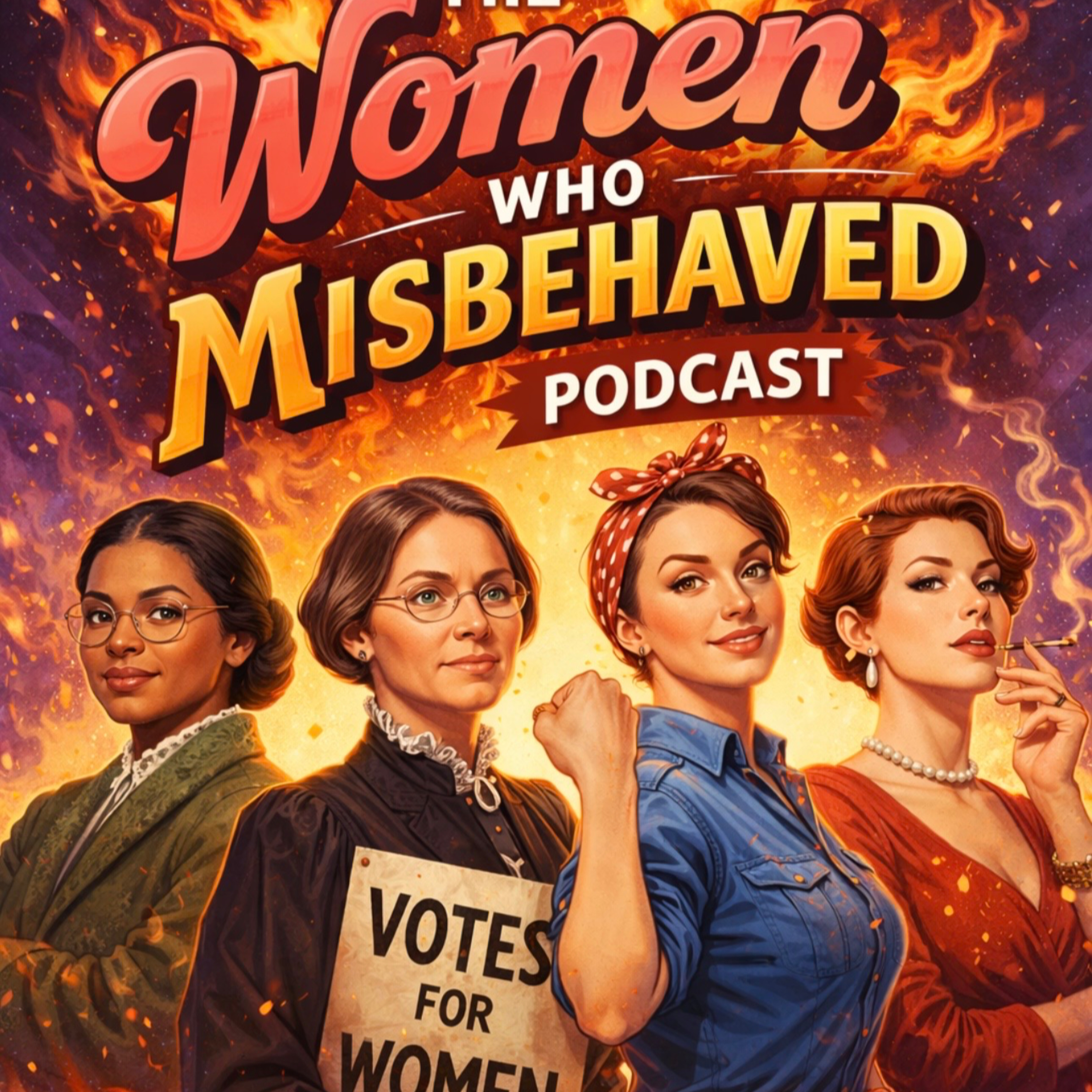
The Women Who Misbehaved
by Christie Fairbourn
We’ve all heard the phrase: "Well-behaved women seldom make history, " coined by Historian Laurel Thatcher Ulrich. In order to be remembered, women need to challenge traditional gender roles. So much of history is told of men by men, and has minimized countless women's contributions. This podcast aims to correct this imbalance by unearthing the authentic, complex, and astonishing stories of women—the pioneers, heroes, and revolutionaries—whose legacies have unjustly faded. I seek to illuminate these deserving, non-conforming women.
-
14
S1 E14 Cornelia Crosby
Today's mini-episode discusses Cornelia Crosby. The mid-1800s saw a massive cultural shift toward nature, driven by a growing romanticization of the wilderness in America. Influenced by urbanization and new scientific curiosity, people pursued hiking, botany, and a recognition of wilderness as a key part of national identity. During this era, one of the US’s most prominent "outdoorsmen" was actually a woman. Her name was Cornelia Crosby, an iconic American journalist and outdoorswoman who played a central role in establishing Maine's tourism sector. Writing under the pen name "Fly Rod," she achieved national fame for her expertise in fly fishing and her passionate advocacy for the Maine woods. A fiercely independent woman who never wed, she was known for challenging the social norms of her era, once telling a journalist, "I would rather fish any day than go to heaven."
-
13
S1 E 13 Elizabeth Packard
In the 19th century, mental health was weaponized to control women by framing non-conformity as madness. Psychiatrists and families used diagnoses like “hysteria” or “moral insanity" to justify institutionalizing women who defied traditional submissive gender roles, often allowing husbands to commit their wives without evidence. Any behavior deemed unnatural, such as intellectual pursuits, public speaking, or strong emotions were labeled as “hysteria”, a catchall term that pathologized normal female experiences. Women were committed to asylums for reasons including religious excitement, suppressed menstruation or for simply being too independent. This system of medical misogyny was designed to suppress female autonomy, reducing women to dependent, domestic roles by threatening them with the loss of freedom if they defied the era’s social expectations.Elizabeth Packard was a 19th-century mental health reformer and advocate for married women's rights who became a national figure after her husband, a Calvinist minister, had her committed to the Illinois State Hospital for the Insane simply for disagreeing with his religious and marital views. Despite being held against her will for three years, she used her time to document the abuses and neglect within the asylum system and, following her release, successfully lobbied the Illinois legislature to pass landmark laws, which helped to reform these practices. Thank you for joining today’s episode where I’ll tell the story of Elizabeth Packard.
-
12
S1 E 12 Margaret Ann Bulkley
One of the most fascinating cases of a woman who "misbehaved" and defied societal norms is that of Margaret Ann Bulkley who, during the victorian era, achieved the rank of Inspector General of Hospitals in the British Army, an extraordinary accomplishment for anyone at the time, let alone a woman secretly living as a man.Living under the name James Barry, her 46 year medical career was marked by progressive reforms and a fiery temper. As a military surgeon, Barry championed better sanitation, improved diet, and humane treatment for soldiers and the indigenous populations in the colonies. Barry performed one of the first successful Caesarean sections in Africa by a British doctor where both mother and child survived.Her life epitomizes the extreme lengths women were forced to go to gain access to education and professional life in the Victorian era, proving that in many cases, making history required a complete rejection of one's assigned identity.
-
11
S1 E 11 Jenny Leigh
One of the magical places on earth is Grand Teton National Park and if you’ve ever been there, its very likely you made a visit to Jenny Lake. Situated at the base of the Teton Range, the serene blue water surrounded by stunning jagged mountains is a major hub for visitors, offering boating, hiking trails, and access to stunning views of the towering peaksThe lake serves as a beautiful and enduring memorial to Jenny Leigh, a quiet reminder of the complex lives and contributions of Indigenous people interwoven with the history of the American West.Jenny Leigh, was a Shoshone woman who, along with her family, lived in the Teton region for years. While the precise details of her life are scarce, she is one of the few women from that era who became associated with a major landmark, solidifying her place in the landscape's history. It’s a small step in recognizing the many Indigenous women who were instrumental, yet often uncredited, in the early history of the American West.
-
10
S1 E 10 Mary Secole
The name Mary Seacole has mostly been lost to history. Mary was a Creole woman who eagerly answered the call to support British troops during the Crimean War. She brought with her decades of practical experience and a fearless spirit. Yet, she was denied a position by every organization, including the official nursing contingent led by Florence Nightingale. Undeterred, Mary financed her own organization offering food, supplies, and most importantly, her dedicated medical attention. She didn't stay behind the lines; however she routinely rode out to the battlefields, often under fire, to tend to the wounded directly. To the British soldiers whose lives she saved, she was lovingly known as "Mother Seacole." Her determination to serve, despite being systematically excluded, makes her the perfect icon for the women who refused to behave.
-
9
S1 E9 Joan of Arc
Born a peasant girl in 15th-century France, Joan of Arc defied every expectation of her era to became a martyr and potent symbol of the French Resistance. At the young age of 18 dressed in men's armor and carrying her banner, she led the charge that lifted the English siege—a turning point in the debilitating Hundred Years' War.
-
8
S1 E8 Cleopatra
Cleopatra remains one of history's most compelling figures. The myths and legends surrounding her often paint her as a cunning seductress and she is frequently mythologized in art and literature as a "femme fatale" whose primary influence lay in her relationships with Julius Caesar and Mark Antony. This emphasis, however, diminishes the true source of her strength, which was not her beauty or manipulative charm, but her formidable intellect and political acuityIn this episode, I'll trace her rise to power, her perilous survival of internal family conflicts, her alliances that shook the Roman Republic, and the dramatic final stand that cemented her place in legend—not as a failed temptress, but as a queen who fought fiercely for her empire's independence until the very end.
-
7
S1 E7 Martha Allen Carrier
Martha Carrier was one of the first women to be accused and convicted during the Salem Witch Trials, her challenge to societal norms preceded the accusations. She was an independent, outspoken woman known for quarreling with neighbors and openly expressing contempt for authority, behaviors considered highly inappropriate for a Puritan woman. Martha Carrier's case powerfully demonstrates how religious fanaticism and social disorder converged to fuel a deadly frenzy. Please join me as I recount the tragic story of Martha Allen Carrier.
-
6
S1 E 6 Josephine Baker
The 1920s were a time of immense cultural upheaval and transformation, often referred to as the "Roaring Twenties. Following the devastation of World War I, a widespread sense of liberation and a desire for novelty swept across the Western world, particularly in the major cities of the United States and Europe. This decade was characterized by rapid technological advancement, economic prosperity, and a noticeable shift in social norms.It was during this era that Josephine baker rose to stardom. Hers was a true rags to riches story. She came from poverty and the segregated American Midwest to become a dazzling international star and an unexpected hero. After finding limited opportunity in the U.S. due to pervasive racism, she moved to Paris in 1925, where her electrifying, boundary-defying performances made her a celebrated icon.
-
5
S1 E 5 Agnes Randolph, Countess of Dunbar
Agnes Randolpn, the Countess of Dunbar, famously known as "Black Agnes" she secured her legendary status in Scottish history during the Second War of Scottish Independence. In 1338, she demonstrated extraordinary resolve and wit by heroically commanding the defense of the strategically vital Dunbar Castle. With her husband away fighting, Agnes faced a five-month siege by English forces under the Earl of Salisbury. She famously thwarted the English efforts through mockery and unwavering defiance, repelling siege engines and refusing to surrender. Her successful and unyielding defense ultimately forced the English to abandon the siege, providing a major morale victory for the cause of Scottish independence and cementing her legacy as an enduring symbol of Scotland's spirit.
-
4
S1 E4 Sybil Ludington
Every American school child has learned of Paul Revere's famed twelve-mile midnight ride warning the City of Boston that British troops were coming. But very few have been taught of, Sybil Ludington - a brave 16-year-old girl who took her own all-night horseback ride to rally militiamen at the beginning of the US Revolutionary War. Join me as I tell the story of Sybil Ludington and her famed midnight ride.
-
3
S1 E3 Ching Shih
The popular image of the pirate is largely a romanticized creation shaped by 20th-century literature and films. Most modern lore centers on the Caribbean and the high-profile figures of this era, such as Blackbeard, Captain Kidd, and Calico Jack. The mythology of the pirate endures because it represents an ultimate escape from civilization, a life of freedom, danger, and the pursuit of fortune outside the law. When we hear of pirates, how many of us envision a woman at the helm?Ching Shih was one of history's most successful and powerful pirates. Operating primarily in the South China Sea in the early 19th century, she commanded the massive Red Flag Fleet, a confederation of over 1,800 ships and an estimated 60,000 to 80,000 pirates. The historical record concerning Ching Shih's earliest years is sparse and fragmented, largely derived from contemporary accounts that sought to demonize or romanticize her. Join me as I piece together her historical sketch.Also, as I’m a native english speaker, please be patient with me as I attempt to correctly pronounce the names of people and places.
-
2
S1 E2 Bessie Coleman
There’s few people who don’t know the story of Amelia Earhart, from her historic flights to her famous disappearance, but how many of us know the story of Bessie Coleman, a brave woman who came before Earhart. A young woman of black and indigenous ancestry, she famously broke barriers in a segregated era by earning her pilot's license and becoming a celebrated stunt pilot.
-
1
S1 E1 Molly Goodnight
Thank you for joining me for my first episode, where I’ll be telling the story Molly Goodnight - a woman who singlehandedly saved the plains bison from extinction.The history of the American West is riddled with these omissions—tales of fortitude, ingenuity, and profound compassion, like Molly’s, that were either minimized or lost entirely because they didn't fit the dominant narrative of male conquest and enterprise. Not much is written about Molly, especially her early years, and I’ve done my best to piece together the narrative of her life.
We're indexing this podcast's transcripts for the first time — this can take a minute or two. We'll show results as soon as they're ready.
No matches for "" in this podcast's transcripts.
No topics indexed yet for this podcast.
Loading reviews...
ABOUT THIS SHOW
We’ve all heard the phrase: "Well-behaved women seldom make history, " coined by Historian Laurel Thatcher Ulrich. In order to be remembered, women need to challenge traditional gender roles. So much of history is told of men by men, and has minimized countless women's contributions. This podcast aims to correct this imbalance by unearthing the authentic, complex, and astonishing stories of women—the pioneers, heroes, and revolutionaries—whose legacies have unjustly faded. I seek to illuminate these deserving, non-conforming women.
HOSTED BY
Christie Fairbourn
CATEGORIES
Loading similar podcasts...
Frequently Asked Questions
How many episodes does The Women Who Misbehaved have?
The Women Who Misbehaved currently has 14 episodes available on PodParley. New episodes are automatically indexed when they're published to the podcast feed.
What is The Women Who Misbehaved about?
We’ve all heard the phrase: "Well-behaved women seldom make history, " coined by Historian Laurel Thatcher Ulrich. In order to be remembered, women need to challenge traditional gender roles. So much of history is told of men by men, and has minimized countless women's contributions. This podcast...
How often does The Women Who Misbehaved release new episodes?
The Women Who Misbehaved has 14 episodes. Check the episode list to see recent publication dates and frequency.
Where can I listen to The Women Who Misbehaved?
You can listen to The Women Who Misbehaved on PodParley by clicking any episode. We provide an embedded audio player for direct listening, and you can also subscribe via your preferred podcast app using the RSS feed.
Who hosts The Women Who Misbehaved?
The Women Who Misbehaved is created and hosted by Christie Fairbourn.
URL copied to clipboard!