
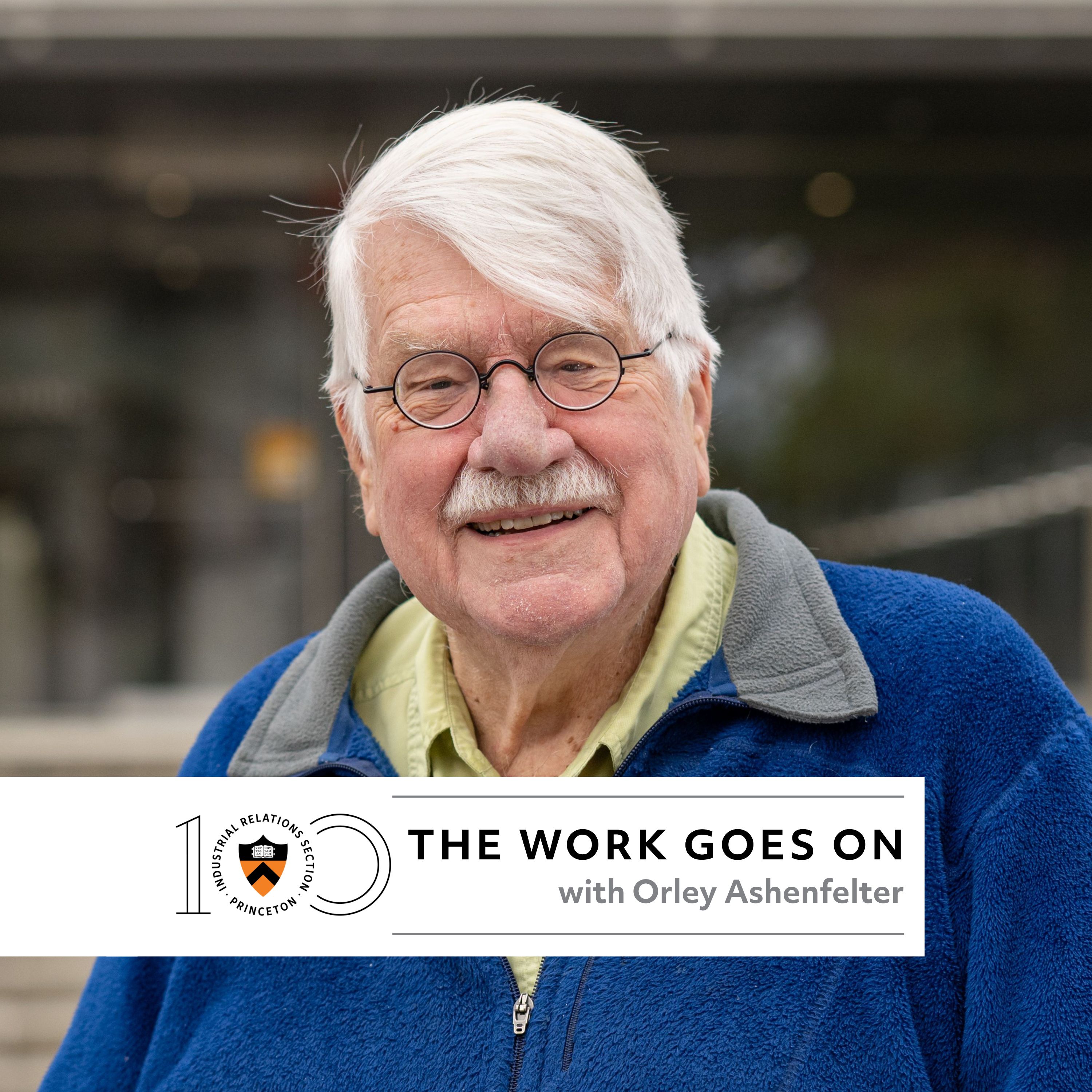
PODCAST · society
The Work Goes On: An Oral History of Industrial Relations and Labor Economics with Princeton’s Orley Ashenfelter
by Industrial Relations Section, Princeton University
Podcast by Industrial Relations Section, Princeton University
-
53
Truman Bewley on why some firms prefer to “get the misery out the door” instead of cutting pay
Truman Bewley, the Alfred C. Cowles Professor Emeritus of Economics at Yale University, discusses his academic background, his work on economic theory and shift to empirical economics, and his studies on wage rigidity and price setting of commodities and differentiated products that involved hundreds of interviews with employers and workers over many years. Read a transcript of the podcast here: https://irs100.princeton.edu/sites/default/files/2026-05/053-TWGO_Bewley_transcript.pdf For more details on this episode, visit: https://irs100.princeton.edu/podcasts/truman-bewley-2026
-
52
Andrew Zimbalist on the economics of baseball, mixed martial arts, and college sports
Andrew Zimbalist, the Robert A. Woods Professor Emeritus of Economics, emeritus at Smith College, discusses his academic background, the economics of sports, especially baseball, his thoughts on the monopsony power of the Ultimate Fighting Championship (UFC), and how college sports might be reorganized to prioritize the education and well-being of student athletes. Read a transcript of the podcast here: https://irs100.princeton.edu/sites/default/files/2026-04/052-TWGO_%20Zimbalist_%20transcript.pdf For more details on this episode, visit: https://irs100.princeton.edu/podcasts/andrew-zimbalist-2026
-
51
John Kennan on the cost of restricting immigration
John Kennan, Juli Plant Grainger Distinguished Chair in Economics at the University of Wisconsin at Madison, discusses his early years in Dublin, Ireland, his academic background, and his research on the economic effects and political challenges of migration, especially the impact of open borders on existing workers’ wages. Read a transcript of the podcast here: https://irs100.princeton.edu/sites/default/files/2026-03/051-TWGO_Kennan_transcript.pdf For more details on this episode, visit: https://irs100.princeton.edu/podcasts/john-kennan-2026
-
50
V. Joseph Hotz on women’s labor supply & fertility and balancing data privacy & use
V. Joseph Hotz, Research Professor at the Harris School of Public Policy at the University of Chicago and Arts and Sciences Distinguished Professor of Economics and Public Policy Emeritus at Duke University, discusses his research on life cycle models of labor supply and fertility, the challenges of balancing data disclosure risk with data usability, and the child tax credit’s impact on child poverty. Read a transcript of the podcast here: https://irs100.princeton.edu/sites/default/files/2026-03/050-TWGO_Hotz_transcript.pdf For more details on this episode, visit: https://irs100.princeton.edu/podcasts/v-joseph-hotz-2026
-
49
Solomon Polachek on why men and women have different wages via the human capital model
Solomon Polachek, Distinguished Professor of Economics at Binghamton University, State University of New York, discusses his academic career, his teaching awards, his past and ongoing research on the gender wage gap, and his role as Dean of Harpur College at Binghamton University. Read a transcript of the podcast here: https://irs100.princeton.edu/sites/default/files/2026-02/049_Polachek_transcript.pdf For more details on this episode, visit: https://irs100.princeton.edu/podcasts/solomon-polachek-2026
-
48
John Abowd on the AKM method and the importance of a ‘non-controversial’ U.S. Census
John Abowd, Edmund Ezra Day Professor Emeritus of Economics, Statistics, and Data Science at Cornell University, reflects on his academic career, his research on worker and firm effects on wages, employing a model that became known as the “AKM model,” and his U.S. Census Bureau tenure, focusing on 2020 Census controversies and the implications of adding a citizenship question. Read a transcript of the episode here: https://irs100.princeton.edu/sites/default/files/2026-02/048-TWGO_Abowd_transcript.pdf For more details on this episode, visit: https://irs100.princeton.edu/podcasts/john-abowd-2026
-
47
John Bound, a “latecomer” to economics, on the impact of disability on labor force activity
John Bound, George E. Johnson Collegiate Professor Emeritus of Economics, emeritus at the University of Michigan, discusses his varied academic career, the mentors who played significant roles in his life, and his pioneering research on the impacts of health and disability payments on the labor market. Read a transcript of the podcast here: https://irs100.princeton.edu/sites/default/files/2025-12/047-TWGO_Bound_transcript.pdf For more details on this episode, visit: https://irs100.princeton.edu/podcasts/john-bound-2025
-
46
Richard Murnane on the importance of quality education for upward mobility
Richard Murnane, Thompson Research Professor at the Harvard Graduate School of Education and research associate at the National Bureau of Economic Research, discusses his early education, his studies on the relationship between a quality education and upward mobility, and his thoughts for equipping children to thrive in a changing economy. Read a transcript of the podcast here: https://irs100.princeton.edu/sites/default/files/2025-11/046-TWGO%20Murnane_transcript.pdf For more details on this episode, visit: https://irs100.princeton.edu/podcasts/richard-murnane-2025
-
45
Eric Hanushek on what test scores indicate about teacher effectiveness and national growth, and more
Eric Hanushek, Paul and Jean Hanna Senior Fellow at the Hoover Institution at Stanford University, discusses his significant contributions to educational policy, his work on the economic returns to educational quality, the impact of No Child Left Behind, and how teacher effectiveness is best measured by student outcomes. Read a transcript of the podcast here: https://irs100.princeton.edu/sites/default/files/2025-10/045-TWGO%20Hanushek_transcript.pdf For more details on this episode, visit: https://irs100.princeton.edu/podcasts/eric-hanushek-2025
-
44
Judy Gueron on "never quitting" as a female economist and her groundbreaking work at MDRC
Judy Gueron, President Emerita at Manpower Demonstration Research Corporation (MDRC), discusses her education at Radcliffe and Harvard, her pioneering work utilizing randomized field trials at the MDRC, her research on welfare reform, and the challenges of pursuing a career in economics as a woman. Read a transcript of the podcast here: https://irs100.princeton.edu/sites/default/files/2025-10/044-TWGO-Gueron_transcript.pdf For more details on this episode, visit: https://irs100.princeton.edu/podcasts/judy-gueron-2025
-
43
Morris Kleiner on the public policy effects of his work on labor migration & occupational licensing
Morris Kleiner, professor and AFL-CIO Chair in Labor Policy at the Humphrey School of Public Affairs at the University of Minnesota, discusses his academic background, his research on state-to-state labor migration and occupational licensing, and his impact on public policy. Read a transcript of the podcast here: https://irs100.princeton.edu/sites/default/files/2025-09/043-TWGO-Kleiner_transcript.pdf For more details on this episode, visit: https://irs100.princeton.edu/podcasts/morris-kleiner-2025
-
42
Charles Brown on pay gaps, unions, productivity, and the firing of the BLS Commissioner
Charles Brown, professor of economics and research professor of the Survey Research Center, emeritus at the University of Michigan, discusses his upbringing in Ohio, his academic studies at Boston College and Harvard, his work on labor economics, and his time as director of the Panel Survey of Income Dynamics (PSID). Read a transcript of the podcast here: https://irs100.princeton.edu/sites/default/files/2025-09/042-TWGO-Brown_transcript.pdf For more details on this episode, visit: https://irs100.princeton.edu/podcasts/charles-brown-2025
-
41
William B. Gould IV on chairing the NLRB & honoring his great-grandfather, a black Civil War sailor
William B. Gould IV, the Charles A. Beardsley Professor of Law, emeritus at the Stanford University Law School, discusses his work on labor relations, his chairmanship at the National Labor Relations Board, and a remarkable great-grandfather who escaped slavery and joined the Union Navy in the Civil War. Read a transcript of the podcast here: https://irs100.princeton.edu/sites/default/files/2025-05/041-TWGO-Gould_transcript.pdf For more details on this episode, visit: https://irs100.princeton.edu/podcasts/william-gould-iv-2025
-
40
Michael Moskow on his path from Paterson, NJ to “…one of the best jobs you can have in Washington”
Michael Moskow, the vice chair and distinguished fellow, global economy at the Chicago Council on Global Affairs, discusses his work on labor relations, collective bargaining, and his numerous posts in both the private and public sectors, including at the U.S. Labor Department, and the Council of Economic Advisers. Read a transcript of the podcast here: https://irs100.princeton.edu/sites/default/files/2025-04/040-TWGO-Moskow_transcript.pdf For more details on this episode, visit: https://irs100.princeton.edu/podcasts/michael-moskow-2025
-
39
Gavin Wright on the Civil Rights Revolution through the eyes of an economic historian
Gavin Wright, William Robertson Coe Professor of American Economic History, emeritus, at Stanford University, discusses his work on the economics of slavery, Black mobility patterns after the Civil War, and his thoughts on the current state of Black economies in the American South. Read a transcript of the podcast here: https://irs100.princeton.edu/sites/default/files/2025-04/039-TWGO-Wright_transcript.pdf For more details on this episode, visit: https://irs100.princeton.edu/podcasts/gavin-wright-2025
-
38
Heidi Hartmann on equal pay, family leave, and gender equity in the field of Economics
Heidi Hartmann, distinguished economist in residence at American University and emeritus founder and president of the Institute of Women’s Policy Research, discusses her work in the public policy arena, especially her studies on the gender gap and equal pay, and her on-going thoughts on women and the economics profession. Read a transcript of the podcast here: https://irs100.princeton.edu/sites/default/files/2025-03/038-TWGO-Hartmann_transcript.pdf For more details on this episode, visit: https://irs100.princeton.edu/podcasts/heidi-hartmann-2025
-
37
Michael Reich on how political polarization has impacted debate on the minimum wage
Michael Reich, professor of economics at the University of California, Berkeley, discusses his studies of labor market segmentation, the beneficial effects of the minimum wage on the economy, the current climate of political polarization, and his belief that the 2024 elections indicate a marked transition for the U.S. economy. Read a transcript of the podcast here: https://irs100.princeton.edu/sites/default/files/2025-02/037-TWGO-Reich_transcript.pdf For more details on this episode, visit: https://irs100.princeton.edu/podcasts/michael-reich-2025
-
36
Harry Katz on his push for a more cooperative environment in labor-management relationships
Harry Katz, the Jack Sheinkman Professor of Collective Bargaining at Cornell University’s School of Industrial and Labor Relations, discusses his academic background, his studies of collective bargaining, his work with the United Auto Workers (UAW), and his ongoing thoughts on how to make labor negotiations more inclusive and cooperative. Read a transcript of the podcast here: https://irs100.princeton.edu/sites/default/files/2024-12/036-TWGO-Katz_transcript.pdf For more details on this episode, visit: https://irs100.princeton.edu/podcasts/harry-katz-2024
-
35
Henry Farber on his path from Teamster to one of the preeminent researchers of labor economics
Henry Farber, Hughes-Rogers Professor of Economics emeritus at Princeton University, discusses his early life growing up in an industrial, working-class town in New Jersey, his early interest in labor unions and his nearly fifty-year-long study of labor economics. Read a transcript of the podcast here: https://irs100.princeton.edu/sites/default/files/2024-11/035-TWGO-Farber_transcript.pdf For more details on this episode, visit: https://irs100.princeton.edu/podcasts/henry-farber-2024
-
34
George Borjas on his journey from Cuba to Harvard and his work on the “hot” topic of immigration
George Borjas, the Robert W. Scrivner Professor of Economics and Social Policy at the Harvard Kennedy School, discusses his early life in Cuba, his experiences as an immigrant in the United States, his schooling at Columbia University, and his thoughts on the current immigration debate in the United States. Read a transcript of the podcast here: https://irs100.princeton.edu/sites/default/files/2024-11/034-TWGO-Borjas_transcript.pdf. For more details on this episode, visit: https://irs100.princeton.edu/podcasts/George-Borjas-2024.
-
33
Robert Moffitt on his “rewarding” career integrating economics, sociology and public policy
Robert Moffitt, the Krieger-Eisenhower Professor of Economics at Johns Hopkins University, discusses his early education, his interest in labor economics, applied microeconometrics, and welfare policy, and how his work has influenced major debates in public policy, especially the economics of low-income populations in the United States. Read a transcript of the podcast here: https://irs100.princeton.edu/sites/default/files/2024-10/033-TWGO-Moffitt_transcript.pdf For more details on this episode, visit: https://irs100.princeton.edu/podcasts/robert-moffitt-2024
-
32
Samuel Bowles on his deep interest in the causes of inequality & his work to transform economics
Samuel Bowles, Emeritus Professor of Economics at the University of Massachusetts and Research Professor and Director of the Behavioral Sciences Program at the Santa Fe Institute, discusses his deep-rooted interest in economic inequality and how his work has challenged many of the conventional assumptions of modern economic theory. Read a transcript of the podcast here: https://irs100.princeton.edu/sites/default/files/2024-10/032-TWGO-Bowles_transcript.pdf For more details on this episode, visit: https://irs100.princeton.edu/podcasts/samuel-bowles-2024
-
31
Marjorie McElroy on a long academic career and navigating the economics profession as a woman
Marjorie McElroy, Professor of Economics at Duke University, joins the podcast to discuss her long and varied academic career, her research on the economics of marriage and the family, and, especially, the challenges and gender discrimination she faced as, at the time, one of the few female economists pursuing a traditionally male-dominated profession. Read a transcript of the podcast here: https://irs100.princeton.edu/sites/default/files/2024-09/031-TWGO-McElroy_transcript.pdf For more details on this episode, visit: https://irs100.princeton.edu/podcasts/marjorie-mcelroy-2024
-
30
Orley Ashenfelter on the “irresistible” pull of policy evaluation & why the IR Section is so special
For the 30th episode of "The Work Goes On", we flipped the script and asked our long-time host Orley Ashenfelter, the Joseph Douglas Green 1895 Professor of Economics, Emeritus at Princeton University and former director of Princeton’s Industrial Relations Section (IR Section), to start answering questions instead of asking them. Janet Currie, the Henry Putnam Professor of Economics and Public Affairs at Princeton and one of Orley’s former students, joins us in this episode as a special guest host. Read a transcript of the podcast here: https://irs100.princeton.edu/sites/default/files/2024-09/030-TWGO-Ashenfelter_transcript.pdf. For more details on this episode, visit: https://irs100.princeton.edu/podcasts/orley-ashenfelter-2024
-
29
Ernst Stromsdorfer on studying vocational training in academia, government, and the private sector
Ernst Stromsdorfer, Emeritus Professor of Economics at Washington State University, joins the podcast to discuss his impressive body of research on the impact of labor market programs on different groups of people, and his wide-ranging career across academia, the private sector, and state and federal governments. Read a transcript of the podcast here: https://irs100.princeton.edu/sites/default/files/2024-06/029-TWGO-Stromsdorfer_transcript3.pdf For more details on this episode, visit: https://irs100.princeton.edu/podcasts/ernst-stromsdorfer-2024
-
28
David Lewin on employee voice in a capitalist economy and the re-emergence of unionization
David Lewin, the Neil Jacoby Emeritus Professor of Management and Human Resources at UCLA’s Anderson Graduate School of Management. joins the podcast to discuss what sparked his interest in unions and grievance procedures, the Federal Trade Commission's new plan to ban noncompete agreements, and why unionization will re-emerge in the U.S. south and elsewhere. Read a transcript of the podcast here: https://irs100.princeton.edu/sites/default/files/2024-05/028-TWGO-Lewin_transcript.pdf For more details on this episode, visit: https://irs100.princeton.edu/podcasts/david-lewin-2024
-
27
Robert Michael on collecting specialized data to inform public policy
Robert T. Michael, the Eliakim Hastings Moore Distinguished Service Professor Emeritus and Dean Emeritus at the University of Chicago Harris School of Public Policy, joins the podcast to discuss his path to the University of Chicago, why he loves teaching, and the challenges of collecting vital data on sensitive topics like human sexual behavior. Read a transcript of the podcast here: https://irs100.princeton.edu/sites/default/files/2024-04/027-TWGO-Michael_transcript.pdf For more details on this episode, visit: https://irs100.princeton.edu/podcasts/robert-michael-2024
-
26
Barry Chiswick on immigration, the American Jewish experience, and how to measure discrimination
Barry Chiswick, Professor of Economics and International Affairs at George Washington University, joins the podcast to discuss his wealth of research on immigration and what he learned studying Jewish Americans in the labor market. Read a transcript of the podcast here: https://irs100.princeton.edu/sites/default/files/2024-03/026-TWGO-Chiswick_transcript.pdf For more details on this episode, visit: https://irs100.princeton.edu/podcasts/barry-chiswick-2024
-
25
Robert Flanagan on boosting union membership and why orchestras struggle financially
Robert Flanagan, the Matsushita Professor of International Labor Economics and Policy Analysis Emeritus at Stanford’s Graduate School of Business, joins the podcast to discuss what he’s learned both studying and working for unions, how his time in a musician’s union inspired him to research financial difficulties in the performing arts, and more. Read a transcript of the podcast here: https://irs100.princeton.edu/sites/default/files/2024-03/025-TWGO-Flanagan_transcript-edit2.pdf For more details on this episode, visit: https://irs100.princeton.edu/podcasts/robert-flanagan-2024
-
24
Bob Gregory on how polio changed his life–and inspired him as a student
Bob Gregory, Professor Emeritus at the Research School of Economics at Australian National University, joins the podcast to discuss how getting polio at fourteen years old affected his life trajectory, why he fell in love with economics, and his many contributions as a public servant. Read a transcript of the podcast here: https://irs100.princeton.edu/sites/default/files/2024-02/024-TWGO-Gregory_transcript.pdf For more details on this episode, visit: https://irs100.princeton.edu/podcasts/bob-gregory-2024
-
23
Stephen Nickell on his journey from math teacher to the Bank of England’s Monetary Policy Committee
Sir Stephen John Nickell, Honorary Fellow of Nuffield College, Oxford, joins the podcast to discuss his many mentors at the London School of Economics, how an invite to meet Gordon Brown in Aspen helped put a labor economist on the Bank of England’s Monetary Policy Committee, and his lasting impact on the field of labor economics and economic policy in the UK. Read a transcript of the podcast here: https://irs100.princeton.edu/sites/default/files/2024-02/023-TWGO-Nickell_transcript.pdf For more details on this episode, visit: https://irs100.princeton.edu/podcasts/stephen-nickell-2024
-
22
Robert Willis on jumping ship from trade to study fertility and demographics
Robert Willis, Professor of Economics Emeritus at the University of Michigan, joins the podcast to discuss his time as a seaman working the Washington State Ferries, his path to economics, and the origins of the Health and Retirement Study at the University of Michigan. Read a transcript of the podcast here: https://irs100.princeton.edu/sites/default/files/2024-02/022-TWGO-Willis_transcript.pdf For more details on this episode, visit: https://irs100.princeton.edu/podcasts/robert-willis-2024
-
21
Robert Pollak on the “two career problem” and modeling the economics of the family
Robert Pollak, the Hernreich Distinguished Service Professor of Economics at the Washington University in St. Louis, joins the podcast to discuss his work modeling economic decisions and bargaining within families and how he and his wife, an English professor and American poetry scholar, navigated the “two career problem.” Read a transcript of the podcast here: https://irs100.princeton.edu/sites/default/files/2023-12/021-TWGO-Pollak_transcript.pdf For more details on this episode, visit: https://irs100.princeton.edu/podcasts/robert-pollak-2023
-
20
Bruno Contini on life under Mussolini and the Italian labor market today
Bruno Contini, Professor Emeritus of the University of Turin and Honorary Fellow of the Collegio Carlo Alberto, joins the podcast to discuss his childhood under fascism, his experience studying and teaching in the United States, and his expertise on Italian labor markets. Read a transcript of the podcast here: https://irs100.princeton.edu/sites/default/files/2023-11/020-TWGO-Contini_transcript.pdf For more details on this episode, visit:https://irs100.princeton.edu/podcasts/bruno-contini-2023
-
19
Myra Strober on women, work, and feminist economics
Myra Strober, Professor Emerita at the School of Education at Stanford University, joins the podcast to discuss her path as a trailblazing female labor economist and the first president of the International Association for Feminist Economics. Read a transcript of the podcast: https://irs100.princeton.edu/sites/default/files/2023-11/019-TWGO-Strober_transcript.pdf. For more details on this episode, visit: https://irs100.princeton.edu/podcasts/myra-strober-2023
-
18
Ray Marshall on his path from an orphanage in Mississippi to U.S. Secretary of Labor
Ray Marshall, Professor of Economics emeritus and Rapoport Centennial chair in Economics and Public Affairs at the University of Texas at Austin, joins the podcast to discuss his childhood in a Mississippi orphanage, how the GI bill helped him become an economist, and his experience as Secretary of Labor in the Carter administration. Read a transcript of the podcast here: https://irs100.princeton.edu/sites/default/files/2023-10/018-TWGO-%20transcript.pdf. For more details on this episode, visit: https://irs100.princeton.edu/podcasts/ray-marshall-2023
-
17
W. Craig Riddell on his Path from the Canadian Navy to Labor Economics
W. Craig Riddell, Professor Emeritus of Economics at the Vancouver School of Economics at the University of British Columbia, joins the podcast to discuss his early life in small-town Ontario, his brief stint in the Canadian Navy, and how he discovered a passion for labor economics. Read a transcript of the podcast here: https://irs100.princeton.edu/sites/default/files/2023-09/016-TWGO-Kochan_transcript.pdf For more details on this episode, visit: https://irs100.princeton.edu/sites/default/files/2023-10/017-TWGO-transcript.pdf
-
16
Thomas Kochan on the United Auto Workers strike and the need for a new social contract at work
Thomas Kochan, the George Maverick Bunker Professor Emeritus of Management at the Sloan School of Management at the Massachusetts Institute of Technology, joins the podcast to discuss his life’s work studying unions, arbitrating labor disputes, and advocating for the restoration of a social contract that rewards the contributions of workers. Kochan and Ashenfelter also discuss the “deep economic dimensions and deep political dimensions” of the currently ongoing United Auto Workers strike. Read a transcript of the podcast here: https://irs100.princeton.edu/sites/default/files/2023-09/016-TWGO-Kochan_transcript.pdf For more details on this episode, visit: https://irs100.princeton.edu/podcasts/thomas-kochan
-
15
Bob Hall on his role in the Brookings Papers, the NBER Business Cycle Dating committee, and more
Bob Hall, the McNeil Joint Hoover Senior Fellow and Professor of Economics at Stanford University, joins the podcast to discuss how an interest in policy inspired him to study economics and his many contributions to applied economics. Read a transcript of the podcast here: https://irs100.princeton.edu/sites/default/files/2023-09/015-TWGO-Hall_transcript-B.pdf For more details on this episode, visit: https://irs100.princeton.edu/podcasts/bob-hall-2023
-
14
Michael Piore on internal labor markets, immigration, innovation, and more
Michael Piore, the David W. Skinner Professor of Political Economy, Emeritus at the Massachusetts Institute of Technology, joins the podcast to discuss his wide-ranging expertise across different areas of labor economics, including the function of internal labor markets, the labor market implications of immigration and migration, manufacturing and product innovation, and the social forces and structures that affect economic activity. Read a transcript of this interview: https://irs100.princeton.edu/sites/default/files/2023-06/014-TWGO-Piore_transcript.pdf For more details about this episode, visit: https://irs100.princeton.edu/podcasts/michael-piore-2023 After a summer break, we will resume in September, when Orley’s next guest is Bob Hall.
-
13
Francine Blau and Lawrence Kahn on labor market inequalities and the future of the gender wage gap
Francine Blau and Lawrence Kahn, both of whom are professors of economics at Cornell University, join the podcast to discuss what inspired them to study economics, why they like working together, and the current state of gender inequities in the U.S. labor market. Read a transcript of this interview: https://irs100.princeton.edu/sites/default/files/2023-05/013-TWGO-Blau-Kahn_transcript.pdf For more details about this episode, visit: https://irs100.princeton.edu/podcasts/francine-blau-lawrence-kahn-2023
-
12
John Pencavel on growing up in London’s West End and his sympathy for workers and unions
John Pencavel, the Levin Professor of Economics, Emeritus at Stanford University, joins the podcast to talk about his early life in London’s West End, his most popular research, and his perspective on recent efforts to unionize workers at Amazon, Starbucks, and other companies in the U.S. Read a transcript of this interview: https://irs100.princeton.edu/sites/default/files/2023-05/012-TWGO-Pencavel_transcript.pdf For more details about this episode, visit: https://irs100.princeton.edu/podcasts/john-pencavel-2023
-
11
Reuben Gronau on his many contributions to Israeli economic policy
Reuben Gronau, Professor of Economics Emeritus at the Hebrew University of Jerusalem, joins the podcast to talk about what inspired his interest in labor economics and his many contributions to Israeli economic policy. Read a transcript of this interview: https://irs100.princeton.edu/sites/default/files/2023-04/011-TWGO-Gronau_transcript.pdf For more details about this episode, visit: https://irs100.princeton.edu/podcasts/reuben-gronau-2023
-
10
James Heckman on his early academic career and the work that makes him proud
James J. Heckman, Henry Schultz Distinguished Service Professor in Economics at the University of Chicago, joins the podcast to discuss graduate school at Princeton, why an often overlooked paper on the effect of civil rights laws is his favorite, and much more. Read a transcript of this interview: https://irs100.princeton.edu/sites/default/files/2023-04/010-TWGO-Heckman%20transcript.pdf For more details about this episode, visit: https://irs100.princeton.edu/podcasts/james-heckman-2023
-
9
Daniel Hamermesh on the overhyped four-day work week and a lifetime of labor economics research
Daniel Hamermesh, the Sue Killam Professor of Economics Emeritus at the University of Texas at Austin, joins the podcast to talk to Princeton’s Orley Ashenfelter about “the promise” of the four-day work week, how physical appearance affects compensation, and his lifetime of contributions to the field of labor economics. Read a transcript of this interview: https://irs100.princeton.edu/sites/default/files/2023-03/009-TWGO-Hamermesh%20transcript.pdf For more details about this episode, visit: https://irs100.princeton.edu/podcasts/daniel-hamermesh-2023
-
8
Frank Stafford on the origins of the Panel Study of Income Dynamics (PSID)
Frank Stafford, Professor of Economics Emeritus at the University of Michigan, joins the podcast to talk to Princeton’s Orley Ashenfelter about the origins of the Panel Study of Income Dynamics (PSID) and his research on labor supply, income volatility, household finances, and more. Read a transcript of this interview: https://irs100.princeton.edu/sites/default/files/2023-03/008-TWGO-Frank%20Stafford%20transcript.pdf For more details about this episode, visit: https://irs100.princeton.edu/podcasts/frank-stafford-2023
-
7
Robert Solow on growing up in Brooklyn, fighting Nazis, and everything that came after
In a wide-ranging interview, Robert Solow joins the podcast to talk about the origins of his remarkable career, covering everything from his being “a child of the Great Depression” to leaving Harvard to fight in WWII to his time serving in President Kennedy’s Council of Economic Advisors. Read a transcript of this interview: https://irs100.princeton.edu/sites/default/files/2023-03/007-TWGO-Robert%20Solow%20transcript.pdf For more details about this episode, visit: https://irs100.princeton.edu/podcasts/robert-solow-2023
-
6
Richard Freeman on the state of unions in the U.S., why few Americans pursue STEM degrees, and more.
Richard Freeman, who holds the Herbert Ascherman Chair in Economics at Harvard University, joins the podcast to talk to Princeton’s Orley Ashenfelter about the early influences of Martin Segal and John Dunlap on his career, who pursues careers in STEM and why, and whether we can expect inequality at the bottom of the wage distribution, which shrunk during the pandemic for the first time in recent history, to continue its decline. Read a transcript of this interview: https://irs100.princeton.edu/sites/default/files/2023-02/006-TWGO-Richard%20Freeman%20podcast%20transcript_0.pdf For more details about this episode visit: https://irs100.princeton.edu/podcasts/richard-freeman-2023
-
5
Robert McKersie on his lifelong study of labor negotiations and the state of unions today
Robert McKersie, Professor of Management Emeritus at MIT's Sloan School of Management, joins the podcast to talk to Princeton’s Orley Ashenfelter about his path from being the son of an International Workers of the World (IWW) member in Paterson, NJ to becoming one of the leading global experts on labor negotiations. In this episode, McKersie and Ashenfelter discuss: • McKersie’s early academic career at the University of Chicago, where he worked with George Shultz, Joel Seidman, Al Rees, and Gregg Lewis. • McKersie’s perspective on the recent railway workers labor negotiations. • McKersie’s role in helping negotiate an agreement to end the culinary workers strike at Harvard in 2016. • The importance of the Black Lives Matter movement and how it compares to the civil rights movement in the 1960s. • McKersie’s latest book, “A Field in Flux.” McKersie earned an MBA and a DBA from Harvard Business School in 1959. "The Work Goes On"—a podcast produced as Princeton's Industrial Relations Section (IR Section) celebrates its 100th anniversary—is an oral history of industrial relations and labor economics hosted by Princeton's Orley Ashenfelter. Read the transcript of this interview: https://irs100.princeton.edu/podcasts/robert-mckersie-2023 • McKersie, Robert B. “A Field in Flux: Sixty Years of Industrial Relations.” Ithaca, NY: Cornell University Press, 2019. • McKersie, Robert B. “A Decisive Decade: An Insider's View of the Chicago Civil Rights Movement During the 1960s.” Carbondale: Southern Illinois University Press, 2013. • Kochan, Thomas A., Adrienne E. Eaton, and Robert B. McKersie. “Healing Together: The Labor-Management Partnership at Kaiser Permanente.” Ithaca, NY: Cornell University Press, 2013.
-
4
Claudia Goldin on her journey from the Bronx to Harvard–with groundbreaking research in between
Claudia Goldin, the Henry Lee Professor of Economics at Harvard University, joins the podcast to talk to Princeton’s Orley Ashenfelter about growing up as an “inner city kid” in the Bronx, how her famous study on the impact of blind auditions at orchestras came to be, and her life’s work on “the single most important change in the labor force” for almost every country: women’s labor force participation. In this episode, Goldin and Ashenfelter discuss: • Goldin’s upbringing in the Bronx and the role of several economists–including Fred Kahn, Sam Peltzman, Les Telser, Ron Coase, Gary Becker, and Bob Fogel–on her education and career. • Goldin’s early research on slavery in the U.S. south and the economic costs of the U.S. civil war–as well as her famous study, conducted with Princeton’s Cecilia Rouse, on blind auditions and gender discrimination in orchestras. • The evolution of her work on female labor force participation and gender inequalities in the labor force. • The consequences of the COVID-19 pandemic on women’s labor force participation. • Goldin’s experience as one of few female labor economists in the 1970s. Goldin earned her Ph.D. from the University of Chicago in 1972. She joined the faculty at Harvard in 1990, becoming the first woman to be tenured in the economics department. "The Work Goes On"—a podcast produced as Princeton's Industrial Relations Section (IR Section) celebrates its 100th anniversary—is an oral history of industrial relations and labor economics hosted by Princeton's Orley Ashenfelter. Read the transcript of this interview: https://irs100.princeton.edu/sites/default/files/2023-02/004-TWGO-Claudia%20Goldin%20episode%20transcript%202.0.pdf References Goldin, Claudia Dale. “Career & Family: Women's Century-Long Journey Toward Equity.” Princeton: Princeton University Press, 2021. Goldin, Claudia Dale, and Lawrence F Katz. “The Race Between Education and Technology.” Cambridge, Mass.: Belknap Press of Harvard University Press, 2008. Goldin, Claudia Dale. “Understanding the Gender Gap: An Economic History of American Women.” New York: Oxford University Press, 1990.
No matches for "" in this podcast's transcripts.
No topics indexed yet for this podcast.
Loading reviews...
Loading similar podcasts...
URL copied to clipboard!