
PODCAST · education
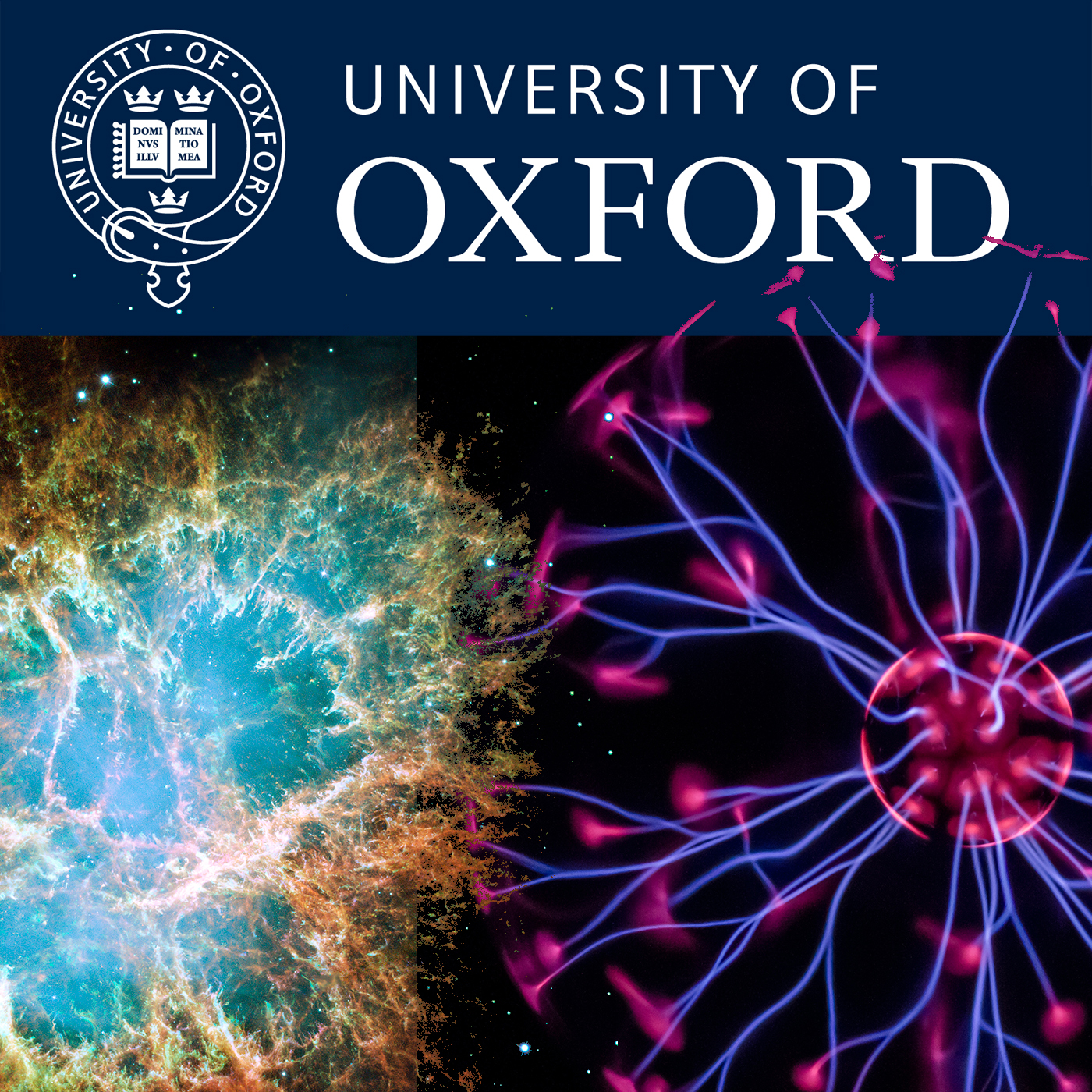
Theoretical Physics - From Outer Space to Plasma
by Oxford University
Learn about quantum mechanics, black holes, dark matter, plasma, particle accelerators, the Large Hadron Collider and other key Theoretical Physics topics. The Rudolf Peierls Centre for Theoretical Physics holds morning sessions consisting of three talks, pitched to explain an area of our research to an audience familiar with physics at about second-year undergraduate level.
-
97
Nonlinear dynamics of active particles
Dr Rahil Valani provides an introduction to active matter (a field focusing on active particles' nonlinear dynamical behaviors) exploring the active system of superwalking droplets that can exhibit hydrodynamic quantum analogs. Active particles are non-equilibrium entities that consume energy from their environment and convert it into directed motion. They can be living organisms such as cells, bacteria, animals and birds, or inanimate entities such as colloidal particles or robots. A large collection of active particles, known as active matter, exhibits emergent collective phenomena such as bird flocks, mammalian herds, bacterial colonies and swarming robots. In this talk, I will provide an introduction to active particles and active matter -- a rapidly growing field of physics, focusing on the nonlinear dynamical behaviors of such particles. We will explore in particular the active system of superwalking droplets that can exhibit hydrodynamic quantum analogs.
-
96
The physics of “flat” electrons
Dr Dumitru Călugăru explores the main strategies for engineering flat band materials, discusses band topology concepts and their relevance to flat band physics, and highlights the role of strong interactions in these materials. Landau’s Fermi liquid theory, a cornerstone of condensed matter physics, explains why electrons in most metallic crystalline solids behave as free fermions with renormalized parameters at low enough temperatures. However, the most exotic phases of quantum matter emerge when this framework breaks down—typically when electron-electron interactions become strong enough to surpass the perturbative regime. Such interactions are naturally enhanced in flat band materials, where suppressed kinetic energy allows electron-electron repulsion to dominate. In this talk, I will explore the main strategies for engineering flat band materials, with an emphasis on conventional crystalline systems while briefly touching on engineered heterostructures. I will also introduce key concepts from band topology in an intuitive manner and discuss their relevance to flat band physics. Finally, I will highlight the role of strong interactions in these materials and survey recent experimental realizations.
-
95
How to program a quantum computer
Dr Dominik Hahn explains how a quantum computer is built, discusses how quantum operations are programmed in a way similar to classical computing, and showcases examples of quantum programs running on superconducting devices. Quantum computers have the potential to solve certain problems much faster than classical computers, including simulating quantum systems and optimizing complex processes. In this talk, I will explain how a quantum computer is built, using superconducting quantum processors as an example. I will discuss how quantum operations are programmed in a way similar to classical computing, and how these instructions are executed on real hardware. Finally, I will showcase practical examples of quantum programs running on superconducting devices, illustrating how theory translates into real-world computation.
-
94
A New Twist on Topology: The Rise of “Moiré Materials”
Prof Sid Parameswaran discusses how quantum condensed matter physics has been revolutionized by “moiré materials”, made by stacking individual atomically thin layers such as graphene with a relative twist/offset between layers. The world of quantum condensed matter physics has recently been revolutionized by the advent of “moiré materials”, made by stacking individual atomically thin layers such as graphene (a two dimensional form of carbon) with a relative twist or offset between the layers. Electrons see a long-wavelength potential as they scatter from the positive ions in the different layers, leading to the formation of a new type of two-dimensional electron gas. In certain circumstances, the resulting electronic states are analogous to the Landau levels that lie at the heart of the quantum Hall effect, but form without an external magnetic field. This has led to the experimental realisation of the long-sought “fractional Chern insulator” state of matter, and has triggered an ongoing worldwide effort to explore other effects of the interplay of topology and interactions in this new setting. I’ll discuss the origins of the moiré phenomenon, and survey the exciting developments in the field, including some with links to Oxford.
-
93
Anyons: New Types of Particles in Quantum Physics
While it was originally believed that only bosons and fermions were allowed by quantum mechanics, in fact, when objects are restricted to move on a two-dimensional plane, new types of particles called "anyons" can emerge. For much of the last century it was believed that the only types of particles allowed by quantum mechanics are bosons (such as photons, phonons, pions, Higgs, etc.) and fermions (such as electrons, muons, quarks, etc.). This rule of only two particle types turns out to be a reflection of the dimensionality of space. When objects are restricted to move on a two-dimensional plane, new types of particles, called "anyons" can emerge. While originally just a theoretical fantasy, such particles have recently been observed in several different types of experiments. I will discuss the history of this field, why it is viewed as important, and recent progress.
-
92
Topology in the Physics of Condensed Matter
Prof Shivaji Sondhi explains how topology is applied to understanding properties of condensed matter systems, providing an introduction to topics including defects & solitons, the quantum Hall effect, and topological insulators. The mathematics of topology has been applied with increasing success to understanding the properties of condensed matter systems. Indeed, it is fair to say that over the past couple of decades, it has revolutionized our understanding of what forms of order are possible in quantum matter. In this talk, I will provide a brief, pedagogical introduction to some of the most well-known applications of topological ideas. These will include topics such as defects & solitons, the quantum Hall effect, and topological insulators.
-
91
The Hubble Tension
Professor Prateek Agrawal discusses the ongoing crisis in cosmology regarding the measurement of the Hubble parameter by two separate probes in this Morning of Theoretical Physics talk from 9th November, 2024 Professor Prateek Agrawal discusses the Hubble tension. Cosmology has matured into a precision science over the last couple of decades. We are now in a position to test cosmological models to percent level precision, and cracks in our understanding of the universe have emerged. I will show how the measurement of the Hubble parameter by two separate probes has become an ongoing crisis in cosmology, and discuss some of the proposed solutions.
-
90
Cosmic strings and gravitational waves from the early Universe
Professor Edward Hardy discusses how the network of cosmic strings that occurs in some theories of the early Universe evolves and emits gravitational waves in this Morning of Theoretical Physics talk from 9th November, 2024. Professor Edward Hardy discusses cosmic strings and gravitational waves from the early Universe. Cosmic strings are one-dimensional objects that often arise if a symmetry is spontaneously broken, as occurs in the early Universe in many theories of physics beyond the standard model. I will describe how the resulting network of strings evolves and in the process emits gravitational waves. These gravitational waves might be detectable in spectacularly precise searches today, and if discovered could give us information about physics at extremely high energies, far beyond any that could be explored directly e.g. in particle colliders.
-
89
Chirality in living systems
Prof Alexander Mietke discusses recent findings in this field that have linked chirality in living systems to the formation of a left-right body axis in organisms and to a new kind of elasticity that is found in crystals formed by starfish embryos. Chirality describes objects and features that are distinct from their mirror image, a property that can be found in many biological systems ranging from spiral patterns of seashells over helical swimming paths of sperm cells to the shape of our hands and feet. This is rather surprising, given that most organisms develop from a single, round cell which shows no obvious signs of chirality. The physics of chirality in biological systems is a research area within the modern field of living matter that aims to identify the physical principals that underlie how chirality emerges during organism development and how the chiral nature of biological materials contributes to their highly unconventional mechanical properties
-
88
Imaging living systems
Dr Adrien Hallou presents a new methodology called 'spatial mechano-transcriptomics', which allows the simultaneous measurement of the mechanical and transcriptional states of cells in a multicellular tissue at single cell resolution. Over the last 10 years, advances in microscopy and genome sequencing have revolutionised our understanding of how molecular programmes contained in the genome control cellular behaviours such as cell division, differentiation or death, and how these behaviours are influenced by biochemical and mechanical signals from the cell environment. In this talk, I will present a new methodology called 'spatial mechano-transcriptomics', which allows the simultaneous measurement of the mechanical and transcriptional states of cells in a multicellular tissue at single cell resolution. This new framework provides a generic scheme for exploring the interplay of biomolecular and mechanical cues in tissues in a variety of contexts, such as embryonic development, tissue homeostasis and regeneration, but also in diseases such as cancer.
-
87
Statistical physics of living systems
Professor Julia Yeomans describes how mechanical models are being extended to incorporate the unique properties of living systems Epithelial tissues cover the outer surfaces of the body and line the body’s internal cavities. The motion of epithelial cells is key to many life processes: turnover of skin cells, embryogenesis, the spread of cancer and wound healing. Much remains to be understood about the ways in which cells interact and move together. I will describe how mechanical models are being extended to incorporate the unique properties of living systems.
-
86
The Miracle of Quantum Error Correction
In this talk, Benedikt Placke introduces QEC and explains how the unique interplay between the classical and the quantum world enables us to efficiently correct errors effecting such systems. Quantum computing is a new model of computation that holds the promise of significantly improved performance over classical computing for some problems of interest. However, by its very nature quantum computers are sensitive to disturbance by external noise, most likely necessitating the use quantum error correction (QEC) for useful application. Furthermore, Benedikt Placke comments on the deep connection between QEC and questions in condensed matter physics.
-
85
Simulating physics beyond computer power
In this talk Alessio Lerose discusses the seminal idea of simulating Nature via a controllable quantum system rather than a classical computer. He discusses recent advances that brought us closer to the ultimate goal of a universal quantum simulator. Since their birth computers proved invaluable tools for physics research. Quantum mechanics, however, fundamentally challenges the possibility for computers to simulate dynamics of matter. In fact, solving the quantum-mechanical law of motion requires to account for contributions of all possible joint configuration histories of all constituents of a system: a task that quickly becomes unbearable for any imaginable computer. Our understanding of complex phenomena involving important quantum-mechanical effects, such as chemical reactions, high-temperature superconducting materials, as well as the primordial universe evolution, is obstructed by this fundamental technological limitation.
-
84
A liquid of quarks and gluons
Jasmine Brewer covers recent progress on studying the properties of the quark-gluon plasma, and describe how we can capitalize on lessons learned from high-energy physics to provide new insights on this novel material. Quarks and gluons are the fundamental constituents of all matter in the universe, but they have the unique property that they are always confined inside hadrons. The only situation in which quarks and gluons are deconfined is in extremely high-energy collisions of heavy nuclei, where the temperature is so high that nuclei “melt” into a new phase of matter called the quark-gluon plasma. This exotic state of matter provides a gateway to study the rich many-body physics of free quarks and gluons, including their rapid thermalization to form the most perfect liquid ever observed.
-
83
Possible sources for the gravitational wave background
Dr Yonadav Barry Ginat - Possible sources for the gravitational wave background The detection of gravitational waves from the coalescence of black holes has opened a new window for astronomy. Besides individual mergers, one can study the stochastic gravitational-wave background, i.e. the sum of all gravitational waves arriving at Earth, which are not from resolved sources. In this talk I will give an overview of the current predictions for this background, over a range of frequencies -- from binary neutron stars at 100 Hz to the mergers of super-massive black holes at 10^(-8) Hz, and even further to primordial gravitational waves generated during inflation. Of these, none have so far been detected, save for a signal consistent with a background from super-massive black hole coalescences. I will touch on how background sources are modelled, and on how these can be used to extend our understanding of physics.
-
82
Searching for the origin of black hole mergers in the Universe with gravitational waves
Prof Bence Kocsis - Searching for the origin of black hole mergers in the Universe with gravitational waves The direct detection of gravitational waves by LIGO and VIRGO and pulsar timing arrays has recently opened a new window to observe the Universe. We can now detect objects which are completely invisible in traditional electromagnetic surveys including black holes and possibly dark matter. The observations show a very frequent rate of black hole mergers in the Universe with unexpected properties. In this talk I will review the astrophysical processes that may be responsible for the formation of the observed events. I will show that the standard astrophysical merger pathways are already in tension with LIGO/VIRGO observations. New ideas may be needed to explain the origin of the detected sources. I will discuss several exotic possibilities including the hypothesis that if dark matter is in part made up of black holes in galaxies they may contribute to the observed events or the possibility that stellar mass black holes may be teeming around supermassive black holes at the centres of galaxies, which may be a possible sight to produce gravitational wave events.
-
81
Gravitational radiation: an overview
Prof Steven Balbus - Gravitational radiation: an overview General Relativity, Einstein’s relativistic theory of gravity, predicts that the effects of gravitational fields propagate across the Universe at the speed of light. This is very much in the spirit of Maxwell’s theory of electrodynamics, the first fully relativistic theory to enter physics. Einstein’s theory is more complicated, however, because waves of gravity are themselves a source of gravitational radiation! But when the waves are small in amplitude, as they are in contemporary observations, their effects may be understood in terms of concepts very familiar to us: they cause small tensorial distortions of space, carrying energy and angular momentum which can measurably change the orbits of binary stars. First studied by Einstein in 1916, gravitational waves were detected directly in 2015, after a century of technical advancement allowed these incredibly tiny (a fraction of a proton radius!) wave distortions to be measured. In the last eight years, gravitational wave detection has become a powerful tool used by astrophysicists to reveal previously unknown populations of black holes, and perhaps something about the earliest moments of the birth of the Universe.
-
80
How the weird and wonderful properties of magnetised laser plasmas could ignite fusion-energy research
Archie Bott explains how a promising scheme for fusion relies on a novel feature of hot laser-plasmas: introducing a magnetic field of the correct strength alters the plasma’s fundamental properties in a highly counterintuitive yet beneficial manner. One key scientific breakthrough of 2022 was the achievement of fusion ignition; using the world’s largest laser facility, physicists created a plasma in which nuclear fusion reactions generated around 50% more energy than the laser energy required to get those reactions going. Arguably the hottest question in laser fusion-energy research right now is how to surpass this result.
-
79
Stellarators: twisty tokamaks that could be the future of fusion
Georgia Acton introduces stellarators, discusses the features that distinguish them from tokamaks, highlight the challenges we currently face, and discusses how we might overcome them. Tokamaks have been at the forefront of fusion research for the last 50 years. Despite significant improvements over this time we have yet to produce a device that is a sustainable, reliable power source capable of net energy output. In this talk Georgia hopes to convince you that stellarators are the future of fusion, capable of overcoming many of the fundamental problems of tokamaks; crucially offering a reliable and continuously operating source of fusion power that can be used to power humanity forward.
-
78
Magnetic confinement fusion: Science that’s hotter than a Kardashian Instagram post
Michael Barnes introduces the basic concepts behind magnetic confinement fusion, he describes why it is so challenging and discusses possibilities for the future. One gram of hydrogen at 100 million degrees for 1 second: This is (roughly) what is needed to produce net energy from magnetic confinement fusion. Scientists have been working towards this goal for over half a century, applying strong magnetic fields to contain a hot, ionised gas long enough for a significant number of fusion reactions to occur. However, there has been a recent surge in interest and optimism surrounding fusion as a terrestrial energy source.
-
77
The spaghettification of stars by supermassive black holes: understanding one of nature’s most extreme events
The spaghettification of stars by supermassive black holes: understanding one of nature’s most extreme events - Andrew Mummery On a rare occasion an unfortunate star will be perturbed onto a near-radial orbit about the supermassive black hole in its galactic centre. Upon venturing too close to the black hole the star is destroyed, in its entirety, by the black hole’s gravitational tidal force, a process known as “spaghettification”. Some of the stellar debris subsequently accretes onto the black hole, powering bright flares which are observable at cosmological distances. In this talk I will discuss recent theoretical developments which allow us to describe the observed emission from these extreme events in detail, allowing them to be used as probes of the black holes at their centre. I am a Leverhulme-Peierls Fellow in the Department of Physics and Merton College. I completed both my undergraduate degree and DPhil at Oxford, working for my DPhil in the astrophysics department under the supervision of Steven Balbus. I work on astrophysical fluid dynamics, with a particular focus on the behaviour of fluids when they are very close to black holes.
-
76
Extreme value statistics and the theory of rare events
Extreme value statistics and the theory of rare events - Francesco Mori Rare extreme events tend to play a major role in a wide range of contexts, from finance to climate. Hence, understanding their statistical properties is a relevant task, which opens the way to many applications. In this talk, I will first introduce extreme value statistics and how this theory allows to identify universal features of rare events. I will then present recent results on the extreme values of stochastic processes, including Brownian motion and active particles. I moved to Oxford in October 2022 to take the position of Leverhulme-Peierls Fellow at the Department of Physics and New College. Previously, I was a PhD student at Paris-Saclay University, working with Satya Majumdar. During my PhD, I worked on extreme value statistics of stochastic processes. I am interested in out-of-equilibrium physics, extreme value theory, and large-deviation theory. In particular, I am currently applying ideas from statistical physics to study living systems.
-
75
Inflation and the Very Early Universe
Inflation and the Very Early Universe - Georges Obied The universe we observe seems to have come from surprisingly fine-tuned initial conditions. This observation is at the heart of two of the most important puzzles in cosmology, called the horizon and flatness problems. To explain these puzzles, cosmologists invoke a period of accelerated expansion in the early universe (called inflation). As a bonus inflation, when considered with quantum mechanics, produces fluctuations in the energy density that become the galaxies, planets and other structures we see around us. In this talk, I will explain the motivation and physics of the inflationary paradigm. I am Leverhulme-Peierls Fellow at New College. Before coming to Oxford, I completed my PhD at Harvard University under the supervision of Prof. Cumrun Vafa. My research interests lie at the interface of particle physics, string theory and cosmology. At this junction, I work on various aspects of dark energy, dark matter and early universe cosmology from a fundamental physics point of view.
-
74
Axion Searches from Black Holes to the Basement
Professor John March-Russell talks about the search possibilities for axions including many current and near future ultra-precise quantum `table top' experiments in the Beecroft basement. The QCD-axion, and its `axion-like-particle' generalisations, lead to new physical effects in an extraordinarily diverse range of settings including cosmology, astrophysical objects like stars and black holes, electromagnetic systems, atoms, molecules, and nuclei. He outlines how this leads to a correspondingly huge range of search possibilities for axions (and even axion dark matter) varying from those involving observations of solar-mass and supermassive black holes and a form of `gravitational atom’, to many current and near future ultra-precise quantum `table top' experiments in the Beecroft basement and others worldwide.
-
73
Axion Electrodynamics in Solid-State Materials
Professor Siddharth Parameswaran gives the second talk on Axions. Over the past decade, topological ideas have played an increasingly important role in a surprising setting: the problem of understanding the properties of insulating crystals. This has led to the identification of “topological insulators”, bulk insulating materials which are characterised by unusual surface phenomena, unconventional responses to applied electric and magnetic fields, or both. In particular, the motion of electrons in some three-dimensional solids can generate axion-like electrodynamics in the solid state. He explains how the ideas leading to the prediction of this “axion insulator” flow naturally from a deeper understanding of the electrodynamics of dielectric media and their link to topological ideas, and survey some of their unusual consequences for experiment.
-
72
The Axion: How Angles Become Particles
Professor Joseph Conlon introduces the general idea of axions: particles associated to fields which are valued on a circle rather than a real line. He describes the still unresolved strong CP problem of the Standard Model, for which the so-called QCD axion provides the most plausible solution. He explains the typical coupling of particle physics axions to electromagnetism and how this leads to axion-photon conversion in magnetic fields and potential search strategies for axions.
-
71
Fluid-gravity duality and hydrodynamics of black holes
Holography explains why black hole horizons have thermodynamic and hydrodynamic properties and inspires researchers to re-visit foundations and explore limits of relativistic hydrodynamics Since the work of Bekenstein, Hawking and others in the early 1970s, it was known that the laws of black hole mechanics are closely related if not identical to the laws of thermodynamics. A natural question to ask, then, is whether this analogy or the correspondence extends beyond the equilibrium state. The affirmative answer, given by various authors during the 1980s and 90s, became known as the "black hole membrane paradigm". It was shown that black hole horizons can be viewed as being endowed with fluid-like properties such as viscosity, thermal conductivity and so on, whose values remained mysterious. The development of holography 15-20 years ago clarified many of these issues and has led to the quantitative correspondence between Navier-Stokes and Einstein equations. It became possible to study the long-standing problems such as thermalization and turbulence by re-casting them in the dual gravity language. We review those developments focusing, in particular, on the issue of the "unreasonable effectiveness" of hydrodynamic description in strongly interacting quantum systems. Final remarks, Prof Julia Yeomans FRS, Head of Rudolf Peierls Centre for Theoretical Physics
-
70
Hydrodynamics of Quantum Many-Body Systems Out of Equilibrium
Can we apply hydrodynamics to systems with extensively many conservation laws Can we apply hydrodynamics to systems with extensively many conservation laws
-
69
Why Hydrodynamics?
What is hydrodynamics and why does it apply over 20 orders of magnitude in energy and length. Welcome, Prof Julia Yeomans FRS, Head of Rudolf Peierls Centre for Theoretical Physics Why Hydrodynamics? Prof Steve Simon
-
68
Strings and Fields
Will strings be the theory of everything?, presented by Prof Luis Fernando Alday.
-
67
Classical and Quantum Black Holes
Prof March-Russell explains our latest understanding of black holes, some of the most mysterious objects in the Universe.
-
66
Why is Quantum Gravity so hard?
A pressing question in our quest to understand the Universe is how to unify quantum mechanics and gravity, the very small and the very large.
-
65
Machine learning techniques in modern quantum-mechanics experiments
In this talk, Dr Elliott Bentine shall discuss how recent experiments have exploited machine-learning techniques, both to optimize the operation of these devices and to interperet the data they produce. Modern table-top experiments can engineer physical systems that are deeply into the quantum mechanical regime. These cutting-edge instruments provide new insights into fundamental physics, and a pathway to future devices that will harness the power of quantum mechanics. They typically require complex operations to prepare and control the quantum state, involving time-dependent sequences of magnetic, electric and laser fields. This presents experimental physicists with an overwhelming number of tunable parameters, which may be subject to uncertainty or fluctuations.
-
64
Machine Learning and String Theory
Professor Andre Lukas will discuss how string theorists have started to use methods from data science - particularly machine learning - to analyse the vast landscape of string data.
-
63
An Introduction to deep learning
Professor Ard Louis gives a basic introduction to deep learning for physicists and addresses a few questions such as: Is the hype around deep learning justified, or are we about to hit some fundamental limitations? In less than ten years, machine learning techniques based on deep neural networks have moved from relative obscurity to central stage in the AI industry. Large firms such as Google and Facebook are pouring billions into research and development of these new technologies. The use of deep learning in physics is also growing exponentially. Can physics help us understand why deep learning works so well? And conversely: How can deep learning provide new insight into the world around us?
-
62
Welcome by Ian Shipsey Head of the Department of Physics
Ian Shipsey give an update on the department and introduces the next three talk on 'AI in Physics'.
-
61
Cosmic acceleration revealed by Type la supernovae?
In this talk Subir Sarkar will explain how deflagration supernovae have been used to infer that the Hubble expansion rate is accelerating, and critically assess whether the acceleration is real and due to `dark energy’.
-
60
Supernova Explosions and their Role in the Universe
In this talk, Philipp Podsiadlowski will explain how this energy (sometimes) creates a visible fireball, before going on to explain the role of supernovae in the production of the heaviest elements in the periodic table.
-
59
What makes stars go bang?
In this talk, James Binney will outline the physics that leads to prodigeous release of energy in core-collapse and deflagration supernovae.
-
58
... from collisions to the Higgs boson
To study the Higgs boson at the LHC we also need to understand how highly energetic quarks and gluons interact, among themselves and with the Higgs. These interactions are described by quantum field theory, a beautiful mathematical framework that combines quantum mechanics with Einstein’s theory of special relativity. In recent years, our understanding of quantum field theory has progressed significantly, allowing us to develop a new generation of accurate theoretical predictions for key LHC reactions. In this talk, I will highlight some of the ideas behind this progress, and illustrate how they are being applied to investigate the Higgs sector at the LHC.
-
57
From protons to collisions…
We learn about the Higgs Boson and its interactions at the LHC by examining the debris produced by colliding protons head-on at unprecedented high energies. However, we know from our theory of strong interactions - quantum chromodynamics (QCD) - that protons themselves are highly complex bound states of more fundamental 'quarks', held together by the force carriers of QCD, the 'gluons'. The question is then: how do we go from the collision of these complicated protons to a theoretical prediction that we can use to test the properties of the Higgs boson itself? In this talk, I will discuss what we know about the proton, and how we apply this to LHC collisions and our understanding of the Higgs sector.
-
56
What the Large Hadron Collider is telling us about the Higgs sector and its new interactions
Over the past two years, CERN’s Large Hadron Collider (LHC) has started to directly probe a qualitatively new class of interactions, associated with the Higgs boson. These interactions, called Yukawa interactions, are unlike any other interaction that we have probed at the quantum level before. In particular, unlike the electromagnetic, weak and strong forces, they have an interaction strength that does not come in multiples of some underlying unit charge. Yukawa interactions are believed to be of fundamental importance to the world as we know it, hypothesised, for example, to be responsible for the stability of the proton, and so the universe and life as we know it.
-
55
Why the world is simple - Prof Ard Louis
The coding theorem from algorithmic information theory (AIT) - which should be much more widely taught in Physics! - suggests that many processes in nature may be highly biased towards simple outputs. Here simple means highly compressible, or more formally, outputs with relatively lower Kolmogorov complexity. I will explore applications to biological evolution, where the coding theorem implies an exponential bias towards outcomes with higher symmetry, and to deep learning neural networks, where the coding theorem predicts an Occam's razor like bias that may explain why these highly overparamterised systems work so well.
-
54
Topology in Biology - Prof Julia Yeomans FRS
Active systems, from cells and bacteria to flocks of birds, harvest chemical energy which they use to move and to control the complex processes needed for life. A goal of biophysicists is to construct new physical theories to understand these living systems, which operate far from equilibrium. Topological defects are key to the behaviour of certain dense active systems and, surprisingly, there is increasing evidence that they may play a role in the biological functioning of bacterial and epithelial cells.
-
53
Welcome from the Head of the Physics Department
Ian Shipsey delivers the welcome speech for the Saturday Mornings of Theoretical Physics.
-
52
Entropy from Entanglement
Siddharth Parameswaran, Associate Professor, Physics Department. The usual picture of entropy in statistical mechanics is that it quantifies our degree of ignorance about a system. Recent advances in cooling and trapping atoms allow the preparation of quantum systems with many interacting particles isolated from any external environment. Textbook discussions of entropy — that invoke the presence of a “large” environment that brings the system to thermal equilibrium at a fixed temperature --- cannot apply to such systems. Sid Parameswaran will explain how “entropy” of subsystems of such isolated quantum systems arises from quantum entanglement between different parts of the system, and how their approach to thermal equilibrium is best described as the `scrambling’ of quantum information as it is transferred to non-local degrees of freedom.
-
51
Entropy: two short stories
John Chalker, Head of Theoretical Physics, gives a talk on entropy. Thermodynamics and statistical mechanics give us two alternative ways of thinking about entropy: in terms of heat flow, or in terms of the number of micro-states available to a system. John Chalker will describe a physical setting to illustrate each of these. By applying thermodynamics in a realm far beyond its origins, we can use the notion of an ideal heat engine to find the temperature of a black hole. And by applying combinatorial mathematics to hydrogen bonding, we can find the entropy of ice.
-
50
Entropy: Gaining Knowledge by Admitting Ignorance
Alexander Schekochihin, Professor of Theoretical Physics, gives a talk on entropy. When dealing with physical systems that contain many degrees of freedom, a researcher's most consequential realisation is of the enormous amount of detailed information about them that she does not have, and has no hope of obtaining. It turns out that this vast ignorance is not a curse but a blessing: by admitting ignorance and constructing a systematic way of making fair predictions about the system that rely only on the information that one has and on nothing else, one can get surprisingly far in describing the natural world. In an approach anticipated by Boltzmann and Gibbs and given mathematical foundation by Shannon, entropy emerges as a mathematical measure of our uncertainty about large systems and, paradoxically, a way to describe their likely behaviour—and even, some argue, the ultimate fate of the Universe. Alex Schekochihin will admit ignorance and attempt to impart some knowledge.
-
49
Networked Quantum Information Technologies
This talk reviews the developments in quantum information processing.
-
48
Quantum logic with trapped-ion qubits
This talk reviews testing and developing ideas in quantum computing using laser-manipulated trapped ions.
We're indexing this podcast's transcripts for the first time — this can take a minute or two. We'll show results as soon as they're ready.
No matches for "" in this podcast's transcripts.
No topics indexed yet for this podcast.
Loading reviews...
ABOUT THIS SHOW
Learn about quantum mechanics, black holes, dark matter, plasma, particle accelerators, the Large Hadron Collider and other key Theoretical Physics topics. The Rudolf Peierls Centre for Theoretical Physics holds morning sessions consisting of three talks, pitched to explain an area of our research to an audience familiar with physics at about second-year undergraduate level.
HOSTED BY
Oxford University
CATEGORIES
Loading similar podcasts...
Frequently Asked Questions
How many episodes does Theoretical Physics - From Outer Space to Plasma have?
Theoretical Physics - From Outer Space to Plasma currently has 50 episodes available on PodParley. New episodes are automatically indexed when they're published to the podcast feed.
What is Theoretical Physics - From Outer Space to Plasma about?
Learn about quantum mechanics, black holes, dark matter, plasma, particle accelerators, the Large Hadron Collider and other key Theoretical Physics topics. The Rudolf Peierls Centre for Theoretical Physics holds morning sessions consisting of three talks, pitched to explain an area of our research...
How often does Theoretical Physics - From Outer Space to Plasma release new episodes?
Theoretical Physics - From Outer Space to Plasma has 50 episodes. Check the episode list to see recent publication dates and frequency.
Where can I listen to Theoretical Physics - From Outer Space to Plasma?
You can listen to Theoretical Physics - From Outer Space to Plasma on PodParley by clicking any episode. We provide an embedded audio player for direct listening, and you can also subscribe via your preferred podcast app using the RSS feed.
Who hosts Theoretical Physics - From Outer Space to Plasma?
Theoretical Physics - From Outer Space to Plasma is created and hosted by Oxford University.
URL copied to clipboard!