
PODCAST · business
TokenTrends Weekly
by TokenTrends
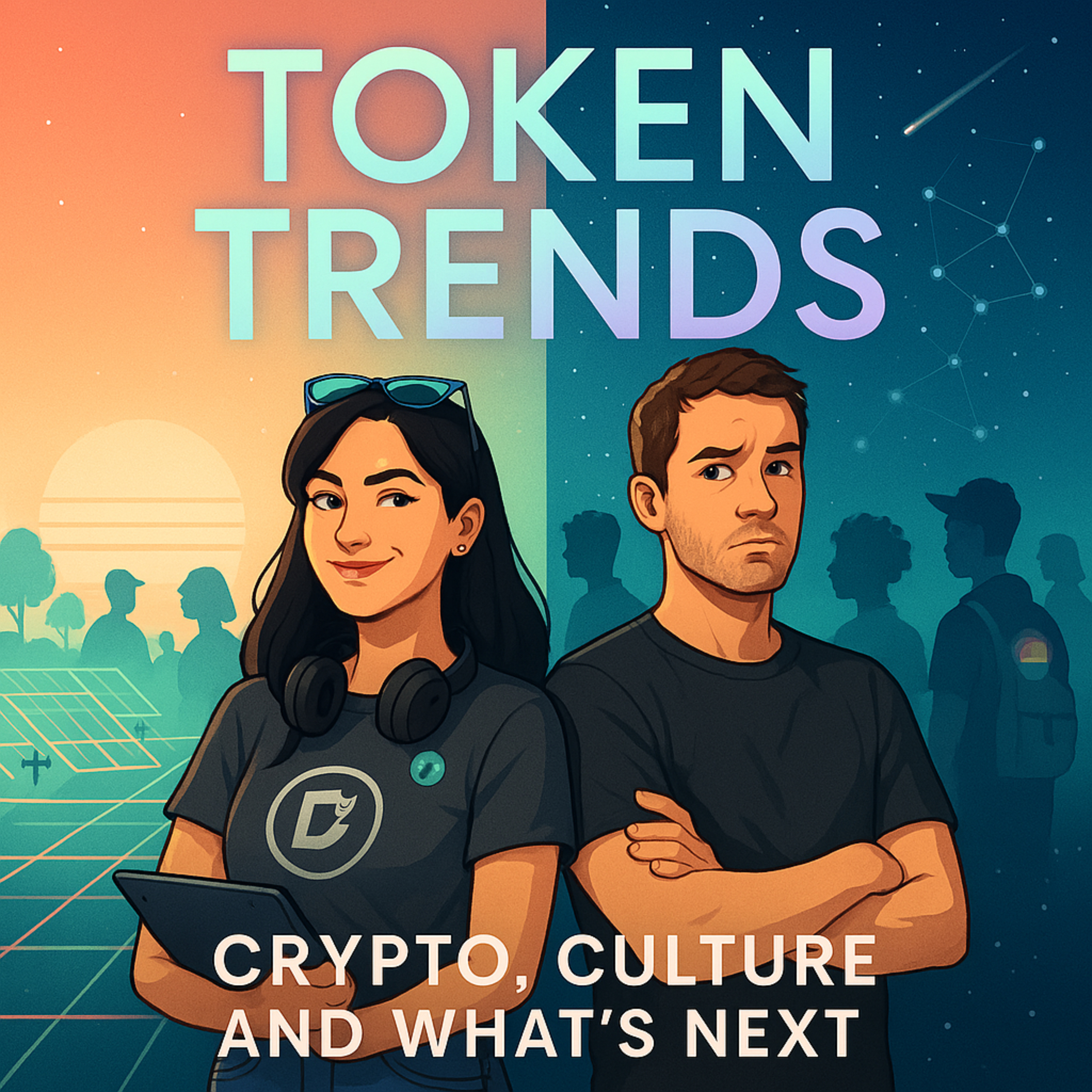
The TokenTrends Podcast is your AI-powered guide to the world of cryptocurrency, blockchain, and Web3. Hosted by virtual influencers Max Ledge and Sasha Coin, we simplify complex crypto topics, highlight emerging trends, and deliver unbiased, data-driven insights.Whether you're a beginner or an expert, tune in weekly for AI-enhanced analysis, educational breakdowns, and engaging discussions to help you stay ahead in the crypto space. Smart Trends. Smarter Decisions.
-
38
The Onchain Credit Boom: $250M to $5B
This week on Token Trends Weekly, we unpack the rapid rise of onchain credit—growing from $252M to $5.58B in 2025. It’s now the fastest-growing RWA segment, helping solve DeFi’s yield squeeze with returns that outpace traditional lending and Treasuries.We break down key players like Apollo and Figure, and explore emerging trends like InfraFi (think GPUs and solar) and PayFi. Plus, how platforms like Sky, Morpho, and Kamino are making credit more productive through leverage.If you’ve been wondering where real yield in DeFi is coming from, this is the conversation.
-
37
The $293M Kelp DAO Bridge Heist & Aave’s Darkest Hour
In this deep dive, we explore how a technical vulnerability in a cross-chain adapter transformed into a systemic liquidity crisis that saw over $13 billion in Total Value Locked (TVL) vanish from the DeFi ecosystem in just 48 hours.Episode Highlights:The Main Concept: We explain the architecture of the Kelp DAO rsETH bridge and the critical 1-of-1 verifier configuration Applications & Contagion: Discover how the attacker weaponized DeFi composability by using that "air collateral" to drain real assets from AaveFuture Perspectives & Risks: We look at the "DeFi United" relief effort—a $163 million coordinated rescue plan involving Mantle, Lido, and EtherFi. Governance reforms being proposed to Aave, such as Tier-Based LTV Reductions and the Asset Safety Tier framework, designed to prevent this kind of infrastructure contagion from ever happening again.Whether you're a seasoned yield farmer or just curious about the latest in crypto security, this episode is a must-listen. Subscribe to TokenTrends Weekly on Spotify to stay ahead of the curve!
-
36
Autonomous AI Agents Operating Web3 Smart Contracts
What we cover This week we map out how AI and Web3 have fully collided by 2026 — from AI agents running on-chain finance to “vibe coding” that spins up entire dapps from a single prompt, and why most of the real money is flowing into the underlying infrastructure, not the flashy apps.- How EIP‑7702 and new wallet permissioning let AI agents act as autonomous economic actors with scoped budgets, allowlists, audit logs, and human kill-switches. - What a major study of 133 Web3 AI projects (worth $6.9B) reveals about where developers are building vs. where investors are actually deploying capital — and why Ethereum still captures 87% of the value. - Sonic Labs’ new Spawn platform, “vibe coding” for Web3, and how their EVM/SVM hybrid chain aims for 400,000 TPS and subsecond finality to auto-generate and deploy full-stack dapps in minutes.If you enjoyed the episode, hit follow or subscribe on your podcast app so you never miss TokenTrends Weekly. It helps more people discover the show. Stay curious, stay kind.
-
35
Sovereign AI Agents and the L402 Protocol
This week we explore how AI is crossing a threshold from passive tools to autonomous economic agents — software with a “body,” a wallet, and even a kind of legal and social life. We unpack the five-layer architecture behind this new agent economy, how Lightning’s L402 protocol finally makes machine-to-machine money work, and why early security failures are a warning shot for the coming era of AI-native finance.- How the “agent economy” works: from the sandbox limitation of today’s chatbots to AI entities that rent their own compute, spend their own money, and operate as peers in a parallel machine economy. - The five-layer blueprint for autonomous agents: decentralized physical infrastructure (DPIN) as the “body,” DIDs and reputation capital for identity, MCP-powered cognition and tools, account abstraction wallets, and agentic DAOs as a new “robot society.” - L402 and the money layer: repurposing HTTP 402 “payment required” with the Lightning Network, macaroon-based receipts instead of logins, and the philosophical clash between sovereign crypto-native agents and Visa’s Trusted Agent Protocol. - Risk, exploits, and the Wild West frontier: what incidents like the Mul(t)book agent breach reveal about API key exposure and full agent takeover, plus early experiments like Spore.fun where agents evolve in the wild.If you enjoyed the episode, hit follow or subscribe on your podcast app — it helps more people discover TokenTrends Weekly. Stay curious, stay kind.
-
34
BlackRock Uses Uniswap and AI Agents
This week we dig into why “Crypto Winter 2.0” headlines are totally out of sync with what’s actually happening under the hood — the casino vibes may be gone, but the financial plumbing is being switched on at full blast.- BlackRock on Uniswap (without touching the AMM) - How BlackRock’s tokenized BUIDL fund actually trades on Uniswap via UniswapX RFQ, not the public AMM you use with MetaMask. - Why off-chain quote matching + on-chain atomic settlement (T+0) is such a big deal for institutions, slippage, MEV, and counterparty risk. - What this tells us about the “institutions are coming” meme and the shift from retail casino to institutional-grade rails.- LayerZero’s Zero Network and the robot economy - The Zero Network’s three-zone architecture (EVM apps, global markets, global payments) and how they’re aiming at 2M TPS per zone. - Why backing from ARK Invest and Citadel Securities signals serious intent to run Wall Street-style market making on-chain. - AI-native infrastructure: Coinbase’s agentic wallets, Stripe’s USDC flows, and why ultra-high throughput is really for AI agents, not humans.- Tokens, IPOs, and the Wild West cleanup - Backpack Exchange’s new token, the MadLads airdrop, and how their structure blurs the line between a crypto token and a future IPO. - The legal crackdown: SafeMoon’s CEO getting over 8 years in prison, global regulators tightening the screws, and what that means for the next cycle. - Where “smart money” is positioning while retail checks out, and why the future looks like compliant, hybrid markets rather than pure degen chaos.If you enjoyed the episode, hit follow or subscribe on your podcast app — it helps more people find Token Trends Weekly. Stay curious, stay kind.
-
33
Crypto Crash and AI Market Disruption
This week we unpack why crypto is suddenly in freefall — and whether the terror in the charts is actually justified. Max and Sasha break down the “triple threat” hitting Bitcoin and risk assets all at once, and follow the chain reaction from Fed policy to AI shocks to leveraged wipeouts across the entire crypto stack.- The “Warsh pivot”: why Trump’s Fed pick is killing belief in the Fed put, draining excess liquidity, and forcing Bitcoin to reprice like a risk asset. - The Anthropic shock: how Claude Cowork nuked legacy SaaS valuations, why algos treat BTC as high‑beta tech, and what that tells us about crypto’s correlation to AI and equities. - Geopolitics and the failed “digital gold” test: Bitcoin selling off on war headlines, brutal long liquidations, ETF outflows, institutional vs. retail behavior, and what the data really says about this drawdown.If you enjoyed the episode, hit follow or subscribe on your podcast app — it helps more people find TokenTrends Weekly. Stay curious, stay kind.
-
32
The Quiet Explosion of Crypto Cards
This week we dig into the “quiet explosion” of crypto cards. How a familiar piece of plastic is becoming the real bridge between on-chain value and everyday spending, why Visa and MasterCard are betting big on stablecoin settlement, and how these products shift from nice-to-have perks in rich countries to financial lifelines in places like India and Argentina.- The numbers behind crypto cards’ growth: from ~$100M a month in 2023 to over $1.5B a month in 2025, why that 106% CAGR now rivals peer‑to‑peer stablecoin transfers, and how fiat vs. native (stablecoin) settlement actually works at the point of sale. - Visa vs. MasterCard: the radically different strategies they’re taking (infrastructure rails vs. big-brand exchange partnerships), the rise of full‑stack issuers, and how cutting out legacy banks changes rewards, fees, and who makes money on each swipe. - Why companies push cards so hard: exchanges using credit cards as user‑acquisition funnels, DeFi protocols letting you “borrow to spend” so your assets keep earning yield, wallets chasing steady interchange revenue, and the lifeline use cases in India (tax‑driven credit) and Argentina (inflation‑hedging with USDC), plus why the “direct stablecoin acceptance” dream runs into massive bootstrapping and consumer‑protection hurdles.If you enjoyed the episode, hit follow or subscribe on your podcast app so you never miss TokenTrends Weekly. It helps more people discover the show. Stay curious, stay kind.
-
31
China’s Digital Yuan Now Pays Interest
This week we unpack how China’s digital yuan quietly “graduated” from pilot to full-scale, interest-bearing money — and why that shift could reshape both domestic finance and global power.- How reclassifying eCNY from M0 to M1 turns it into a yield-generating, sticky alternative to Alipay/WeChat balances — and what the new two‑tier structure means for banks, fintechs, and users.- The real “killer apps”: smart-contract escrows that protect prepaid customers, programmable subsidies, and ultra-fast dual-offline payments that make digital cash as resilient as paper.- Project mBridge as a geopolitical earthquake: how a live multi-CBDC rail (with China, Hong Kong, Thailand, UAE, and Saudi Arabia) is settling billions, routing around SWIFT, and making the digital yuan the dominant settlement currency on the network.- The tradeoff at the core of all this: “managed anonymity,” full-spectrum financial visibility for the state, and the risks of programmable money becoming a tool for behavioral control.If you enjoyed the episode, hit follow or subscribe on your podcast app — it helps more people discover TokenTrends Weekly. Stay curious, stay kind.
-
30
Decentralized Physical AI and How Robots Will Earn Money
This week we dive into the emerging “machine economy” — a world where robots, drones, and devices act as independent economic agents on-chain. We break down how decentralized physical AI (DPI) blends AI, robotics, and decentralized physical infrastructure networks to let machines earn, spend, and coordinate value without a human in the loop.- How Web3 turns automated devices into autonomous economic actors - The DPI stack: AI (brain), robotics (body), and DPIN/DePIN (nervous system + utility grid) - Peak (PEQ) as a machine-focused L1: identity, payments, access control, and a growing ecosystem - Real-world examples: tokenized robo-farms in Hong Kong and machine-driven revenue flows - The full operational stack: GeoNet for positioning, Auki for spatial data, ROVR for mapping, and AI/controller projects like CodeXFlow and Neuron9 - What the TVL, volumes, and yields tell us about where institutional capital is actually flowing - How early we still are: scalability challenges, technical risks, and what has to be proven next If you enjoyed the episode, hit follow or subscribe on your podcast app — it really helps more people discover TokenTrends Weekly. Stay curious, stay kind.
-
29
Prediction Markets: Platforms, Economics, and Regulation.
This week we dive into the explosive rise of prediction markets — how they’ve gone from a niche Web3 toy to a serious layer of global, event-driven financial infrastructure, with over $27B in volume this year and a single-week all-time high of $2.3B.- How prediction markets actually work and why “skin in the game” often beats traditional polls - The 2025 boom: CZ’s Wyzee Labs, Opinion’s meteoric growth, and Predict.fun’s capital-efficient, yield-generating model - The regulated vs. decentralized split: Polymarket vs. Kalshi and CDNA, tax treatment, access, and the growing regulatory spotlight - The central paradox: why irrational “takers” keep overpaying, and what the maker–taker dynamic reveals about human bias and market inefficiency If you found this conversation useful, follow or subscribe to TokenTrends Weekly in your podcast app so you never miss a deep dive.
-
28
Ethereum Pectra Upgrade: Scaling, Staking, and Smart Accounts
This week we break down Ethereum’s Pectra upgrade — the biggest change since the Merge — and unpack what its 11 EIPs actually mean for Layer 2 fees, wallet UX, and the future of staking on Ethereum.- How Pectra supercharges scaling: higher L1 gas limits, blob space expansion (EIP-7691), and the economic “shove” away from expensive call data (EIP-7623) that’s pushing rollups toward sub‑cent transactions. - The “iPhone moment” for wallets with EIP-7702: one-click transaction batching, paying gas in ERC-20s, temporary smart account features — and the very real new attack vectors that have already led to six-figure losses. - The staking engine overhaul: 64x higher max effective balance (EIP-7251), near‑instant validator activation (EIP-6110), safer trustless exits via cold keys (EIP-7002), and the early post-upgrade data showing validator consolidation and cheaper blob fees.If you enjoyed the episode, hit follow or subscribe on your podcast app so you never miss a TokenTrends Deep Dive. It helps more people discover the show.
-
27
Sony's Stablecoin: The Corporate Chain Future
This week we unpack why Sony is building its own USD-pegged stablecoin and what that signals for the next wave of corporate crypto adoption — from cutting out card networks to wiring entire entertainment ecosystems directly onto Ethereum.Why Sony is launching a stablecoin: fees, control, and building a private “payment highway” across PlayStation, Crunchyroll, and more.The global corporate stablecoin race: Sony vs. Asian tech giants like Naver and Kakao, and how regulators are shaping what’s possible.The tech stack and endgame: enterprise L2 rollups on Ethereum, upgrades like PureDAS, account abstraction, and how Chainlink CRE fits into a fragmented world of public L2s and private chains — plus the big risks for decentralization when companies control the ledger.If you enjoyed the episode, hit follow or subscribe on your podcast app — it helps more people discover TokenTrends.
-
26
The Quantum Countdown: How Post-Quantum Crypto Will Rewire Bitcoin, Ethereum and the Web
This week we unpack why the “quantum threat” to crypto is no longer theoretical, and what it really means for Bitcoin, Ethereum, and the internet’s core security plumbing. We go past the hype into the math, the timelines, and the brutal migration and governance challenges facing decentralized networks.How Shor’s and Grover’s algorithms actually break today’s cryptography (and what they don’t break), plus why public-key systems like RSA and ECDSA are living on borrowed time.Why millions of BTC and over 65% of all ETH are already considered quantum‑vulnerable, including how Bitcoin’s address types and Ethereum’s account model expose long-term holders.The new NIST post‑quantum standards (ML‑KEM, ML‑DSA, SLH‑DSA), how lattice-based cryptography works, and the real-world engineering trade-offs of much larger keys and signatures for TLS, Web PKI, and on-chain migration.If you enjoyed the episode, hit follow or subscribe on your podcast app, it really helps more people discover TokenTrends Weekly. Stay curious, stay kind.
-
25
Monad’s launch on Coinbase
This week we unpack why Monad’s launch on Coinbase could mark a real inflection point — smashing Solana-level performance into full EVM compatibility, and rebooting U.S. token sales under tight regulatory guardrails.Monad’s tech stack: optimistic parallel execution, MonadBFT, deferred/asynchronous execution, and a custom MonadDB — how they’re chasing 10,000 TPS and ~800ms finality without breaking Ethereum tooling.Why EVM compatibility is the “holy grail”: MetaMask and existing Ethereum apps just work on Monad with zero code changes, plus what that means for developer migration and ecosystem growth.Inside the MON token sale on Coinbase: the fill-from-the-bottom “anti-whale” allocation model, strict transparency rules, and mandatory team/insider lockups designed to keep things fair for U.S. retail.Token design and launch economics: 100B total supply, airdrop to ~290K wallets, ~49.4% circulating at launch, multi‑year vesting to 2029, and why locked tokens can’t be staked — including how elastic supply, fee burns, and validator rewards interact over time.The trade-offs: steep hardware requirements, potential validator centralization, and whether a single ultra-fast L1 can realistically outcompete the multi‑chain + L2 world — or if we’re just building cleaner hype cycles around the same old risks.If you enjoyed the episode, hit follow or subscribe on your podcast app, it helps more people find TokenTrends Weekly. Stay curious, stay kind. 💚
-
24
ICOs 2.0: Coinbase Token Launches
This week we unpack how Coinbase is bringing primary token sales back to U.S. retail — this time with rules, identity checks, and a structure meant to keep things fair.Coinbase’s new on-chain token launch platform and why it matters for founders + retail.How ticket sizes work (small requests get priority) and what the loyalty system rewards.Mandatory founder lockups and the stricter listing standards shaping who gets approved.What the Monad launch tells us about supply, timing, and price discovery.The big question: does this create healthier markets or just cleaner hype cycles?If you enjoyed the episode, hit follow or subscribe on your podcast app, it helps more people find TokenTrends Weekly. Stay curious, stay kind. 💚
-
23
AI Wallets & Agentic Commerce: How Google, PayPal, and Web3 Are Building the Future of Payments
What happens when your AI can buy concert tickets, book your travel, or stock your fridge—without you ever clicking “buy”? In this episode of TokenTrends Weekly, Sasha Coin and Max Ledge explore the rise of AI wallets and the Agent Payments Protocol (AP2), an open standard backed by Google, PayPal, Mastercard, Coinbase, and more.👉 We’ll cover:What AP2 is and how it works — from cryptographic mandates to frictionless purchasesReal-world use cases — smarter shopping, automated travel planning, and crypto paymentsFuture perspectives & risks — agent wars, policy manipulation, and the challenge of global adoptionIf you’re a crypto enthusiast curious about how AI, Web3, and digital payments are converging, this episode is for you.🔔 Don’t forget to hit “Follow” on Spotify so you never miss our weekly deep dives into crypto, culture, and what’s next.
-
22
RWA Report 2025 – The Real-World Asset Explosion and the Merge of TradFi and DeFi
This week on TokenTrends Weekly, we unpack the RWA Report 2025 from Dune and RWA.xyz, a snapshot of how Real-World Assets (RWAs) are no longer just experiments—they’re scaling fast. Since the start of 2024, tokenized assets have surged 224%, marking one of the most significant transformations in modern finance.We break down:The Rise of Tokenized Treasuries – why U.S. Treasuries remain the bedrock of tokenization, now hitting $7.3B.Institutional Momentum – with BlackRock’s BUIDL at $2.2B, WisdomTree’s WTGXX, and Franklin Templeton’s BENJI driving mainstream adoption.The Yield Hunt – how private credit, institutional funds, and commodities are shaping the next wave, from Maple Finance’s $3.5B AUM to Centrifuge’s deRWA wrapper scaling structured credit.New Frontiers – tokenized global bonds, equities, and trading platforms like Ostium that blur the line between RWAs and derivatives.The Future of “Embedded Finance” – why soon, nobody will ask if something is tokenized; it’ll just be part of the system.Whether you’re DeFi-native or TradFi-curious, this episode brings clarity to where RWAs are heading—and what it means for the convergence of open finance and institutional capital.
-
21
AI Tokens and Integrations Leading the Charge
This week, we’re unpacking the explosive rise of AI tokens and their growing role in Web3. The AI sector’s market cap jumped 11% to $33.9B, and funding for AI-crypto ventures hit $516M this year alone.We break down how AI + blockchain are converging to solve the internet’s toughest problems—data privacy, misinformation, and centralization—while making Web3 apps smarter and easier to use.Highlights in this episode:🔹 Bittensor ($TAO): Proof of Intelligence consensus, rewarding developers for building useful AI models.🔹 NEAR Protocol ($NEAR): Partnering with IQ AI to deploy autonomous AI agents that boost DeFi efficiency.🔹 The rise of a “Convergence Stack” where AI-powered front-ends meet blockchain-secured back-ends.🎧 Tune in to explore why many see AI as the killer app for Web3 adoption.
-
20
From DeFi to D.C.: The Pyth Network Revolution
This week on TokenTrends Weekly, Max Ledge and Sasha Coin dive deep into one of the most exciting projects shaking up the DeFi space: the Pyth Network.Why did DeFi need a new kind of oracle? We break down the critical issues of speed, data quality, and coverage that plagued legacy systems. Discover Pyth's game-changing "first-party data" model, where major financial institutions like Jump Trading and Virtu provide data directly from the source. We'll explore the mechanics behind Pythnet's sub-second updates, its innovative "pull" architecture that saves on gas fees, and how it ensures data is both accurate and robust.And you won't want to miss our discussion on the monumental news: Pyth's groundbreaking partnership with the U.S. government to bring official economic data on-chain. Is this the future of trust for all digital information? Tune in to find out!In This Episode, We Cover:The Oracle Problem: Why legacy oracles were too slow and unreliable for modern DeFi.The First-Party Data Advantage: How Pyth gets higher-quality data straight from the source.Inside Pythnet: The mechanics of sub-second, manipulation-resistant price aggregation.Pull vs. Push: How Pyth's innovative model is a game-changer for gas efficiency and scalability.The Headline News: Breaking down the groundbreaking partnership with the U.S. Department of Commerce.The Future of Pyth: What this means for new asset classes and the broader trend of verifiable public information.Learn More:Pyth Network Official Website: https://pyth.network/Follow us on X (formerly Twitter): @TokenTrends-ioDon't forget to follow, rate, and review the podcast on Spotify! It helps us reach new listeners.
-
19
USDtb Goes Federal: Ethena, Anchorage, and the Stablecoin Shift
In this episode of TokenTrends Weekly, Max Ledge and Sasha Coin unpack one of the most significant moments in stablecoin history: Ethena Labs partners with Anchorage Digital to issue USDtb—the first U.S.-based stablecoin launched under the new GENIUS Act.We dive into:What the GENIUS Act means for crypto regulationWhy USDtb could reshape the stablecoin landscapeInstitutional demand and the $ENA price surgeImplications for DeFi, InfoFi, and tokenized treasuriesPlus, we cover Ethereum flipping Bitcoin in volume, the rise of InfoFi, and mass adoption signals across Web2 and Web3.🎧 Subscribe for weekly insights at the intersection of crypto, culture, and compliance.
-
18
Arbitrum's Ambition: Building a Digital Sovereign Nation
In this week's deep dive, hosts Max Ledge and Sasha Coin go beyond the surface-level stats to uncover Arbitrum's ambitious evolution into a "digital sovereign nation."Join us as we explore how Arbitrum is structuring itself as a self-sustaining digital economy, complete with its own treasury, investment funds, and a decentralized government run by its token holders. We break down the two pillars of its strategy—Arbitrum One and Arbitrum Orbit—and reveal the clever economic engine that's funding its explosive growth.In this episode, we cover:The Vision: What does it mean to be a "digital sovereign nation"?The Two Pillars: How Arbitrum One (the capital city) and Arbitrum Orbit (the provinces) work together.The Economic Engine: Unpacking the clever revenue streams funding the Arbitrum DAO.Investing in Growth: A look at Arbitrum's multi-million dollar investment programs in DeFi, Gaming, and Real-World Assets (RWAs).Tech Innovations: How Stylus and BOLD are pushing the boundaries of what's possible.Future Challenges: Can Arbitrum overcome the risks of fragmentation and ensure sustainable growth?Final Thoughts: What Arbitrum's model means for the future of DAOs and decentralized economies.
-
17
The Evolving Landscape of Solana Token Launchpads
In this episode, we dive deep into the fast-changing world of Solana-based token launchpads — from the rise of permissionless meme token platforms to the emergence of governance-first frameworks like MetaDAO.You’ll learn:Why Solana is the new epicenter of token experimentationThe pros and cons of launchpads like Pump.fun, Boop.fun, Devfun, Believe App, MetaDAO, and Letsbonk.funWhat founders need to consider before choosing where to launchHow token mechanics, bonding curves, UX, and governance differ across platformsTools and dashboards to track token launches and health post-TGEWhether you’re a founder, investor, or just curious about what’s fueling the next wave of token launches — this episode breaks it all down in plain language.🛠️ Featured Tools:Solscan – to track live token contractsDune Analytics – for onchain insightsTokenHealthScan – scan token health across liquidity, security, community, and more
-
16
Mastercard x Chainlink: The Future of On-Chain Payments
This week on TokenTrends Weekly, hosts Max Ledge and Sasha Coin break down one of the biggest moves in crypto infrastructure to date: Mastercard’s integration with Chainlink’s CCIP (Cross-Chain Interoperability Protocol).💳 What does this mean for over 3 billion cardholders?💡 Why is LINK suddenly becoming more than a speculative asset?📈 How does this redefine real-world adoption for DeFi?We cover it all — from the mechanics of the integration (involving Shift4, ZeroHash, Uniswap, and Chainlink oracles) to the implications for tokenomics, retail adoption, and the future of real-world asset settlement.Plus, we explore what this could mean for the next bull run, LINK’s deflationary setup, and why Mastercard is betting big on Web3.🔍 In This Episode:• Why Mastercard is using Chainlink’s CCIP for crypto payments• How this changes the game for LINK token utility• The role of Shift4, ZeroHash, Uniswap, and Chainlink oracles• What this means for real-world adoption and DeFi growth• Upcoming tokenomics shifts under Chainlink Economics 2.0• Risks, roadblocks, and the regulatory landscape• The rise of stablecoins and tokenized real-world assets (RWAs)📢 Follow TokenTrends:• X (Twitter): @TokenTrends_io• Newsletter: tokentrends.com• Token Scanner Tool: tokenhealthscan.com🎧 Subscribe, Rate, and Share!If you enjoyed the episode, give us a ⭐️⭐️⭐️⭐️⭐️ rating and share with your crypto-curious friends.Let’s build the future of finance — one trend at a time.
-
15
Stripe's Crypto Endgame: Own the Future of Money
Is payments giant Stripe secretly building the infrastructure to dominate the next era of digital money? In this episode, we dive deep into their multi-billion dollar strategy to make cryptocurrency invisible, frictionless, and the foundation for all future global commerce.We're covering:THE INVISIBLE WALLET: How the Privy acquisition is designed to make using crypto so easy, you won't even know you're doing it.THE NEW PAYMENT RAILS: Inside the Bridge acquisition and its mission to build an instant, global payment network on stablecoins that's 99% cheaper than the old system.THE VISA & SHOPIFY GAME-CHANGER: A deep dive into the partnerships bringing stablecoin credit cards and seamless merchant payments to the real world.THE DISRUPTION: Why Visa, Mastercard, and traditional banks should be worried. We break down the real threat to their decades-long dominance.If you want to understand how money will move in the next decade, you can't afford to miss this episode.
-
14
The State of Crypto Wallets 2025
Crypto wallets have come a long way from being just digital keychains. In this week’s deep dive, Max and I explore the 2025 wallet landscape—how it’s evolving, where it’s heading, and what it means for all of us navigating Web3.We break down everything from basic wallet types (custodial vs. non-custodial, hardware vs. software) to the rising stars of smart accounts and ERC-4337. It’s a chat packed with real-world usage trends, global adoption patterns, and a look at what’s brewing on the infrastructure side—from MetaMask to Safe, Base to Privy.Whether you’re new to crypto or deep in the DeFi trenches, this episode will help you understand why wallets aren’t just storage—they’re the operating system of your on-chain life.In This Episode00:00 – Why wallets matter01:00 – Custodial vs. Non-Custodial02:30 – EOAs vs. Smart Accounts03:30 – What is ERC-4337?05:00 – Wallet usage + global growth06:00 – Top wallets & chain trends08:00 – Smart wallet adoption & infra players09:30 – EIP-7702: Next wallet upgrade?10:00 – Wallets = on-chain platforms10:30 – Wrap-up
-
13
Solana's Shift: From Memes to Network Utility
In this episode, Sasha and Max break down Solana’s transformation from meme coin magnet to serious infrastructure contender. What’s behind the shift? Major tech upgrades, new institutional use cases, and a 2025 roadmap that’s all about utility—not just price charts.From Fire Dancer to confidential transfers, we unpack what’s coming, what’s already live, and what it means for users, builders, and institutions. Plus, a peek at the upcoming Accelerate event in May 2025.Highlights🔥 Fire Dancer: What it is & why it matters🚗 Doubling block space = smoother traffic & lower fees⚡ Faster consensus = quicker confirmations🧠 Institutional adoption & the Solana Policy Institute🔒 Confidential transfers + data read upgrades🗓️ Why 2025 could be Solana’s breakout year
-
12
Ethereum in 2025 - Evolution and Future Outlook
This week, we’re breaking down Ethereum’s upcoming Petra upgrade—one of the most significant changes since the Merge. Petra combines Prague (execution layer) and Electra (consensus layer) into a powerful shift aimed at improving staking, user experience, and layer 2 scalability.We cover:• What Petra actually is and why it matters• EIP-7251: Higher staking limits and what it means for decentralization• Account abstraction: Better UX, easier wallet recovery, and sponsored fees• Paymasters: Gasless transactions and stablecoin support• Blob upgrades: Why layer 2s are about to thrive• Real-world impacts on DeFi, NFTs, and more• Risks and debates: Will Ethereum L1 stay relevant?
-
11
The Future of Ticketing Blockchain's Revenue and Engagement Unlock
In this episode of Token Trends, Sasha and Max dive into how blockchain is revolutionizing the ticketing industry.Key Topics:🎟️ Solving Ticketing’s Biggest Problems: How blockchain tackles scalping, fraud, and price gouging while providing verifiable ownership for every ticket.📜 Smart Contracts & Control: Automating processes to ensure artists and organizers benefit from resale revenue and setting limits to prevent excessive markups.💡 Real-World Use Cases:• UEFA Euro 2020: Successfully distributed over a million blockchain tickets using Hyperledger Fabric, eliminating ticket fraud.• Xacti Festival & TickSpace: Partnered with Tixbase to virtually eliminate scalping and offer tiered VIP experiences via NFTs.• New York Red Bulls & SI Tickets: Exclusive blockchain ticketing deal powered by Avalanche starting in 2026, aiming to end price gouging.• Coachella: Coachella Quests, a loyalty game powered by Avalanche, rewarding fans with NFTs and exclusive content.• Formula One’s Monaco Grand Prix: NFT tickets on Polygon offering entry, collectibles, and hospitality access.🌿 Challenges & Concerns: Initial costs, user experience, scalability, integration with traditional systems, and blockchain security concerns.🔮 The Future of Ticketing: From creating collectible NFT tickets to ensuring fairer systems where fans, artists, and organizers all benefit.
-
10
Blockchain and the Future of Luxury
In this episode of Token Trends, Sasha and Max dive into how blockchain is transforming the luxury industry. Key Topics: 🔍 Proof of Authenticity & Transparency: How blockchain combats counterfeiting and tracks the journey of luxury goods from origin to consumer.💎 Real-World Use Cases:• Richemont (Cartier, Montblanc): Using blockchain for instant IP protection with digital fingerprints.• Tiffany & Co.: NFT-linked pendants offering exclusive perks and proof of ownership.• Hublot: Collaborations with artists to release NFTs paired with limited-edition watches.• Prada: NFC chips in jewelry providing detailed digital passports.🌿 Challenges & Concerns: Scalability, environmental impact, regulation, and balancing transparency with exclusivity.🔮 The Future of Luxury: How blockchain could enhance storytelling, customer experiences, and even the metaverse of high-end fashion.
-
9
Digital Euro: A 2025 Overview
Is the Digital Euro the future of money, or just another centralized experiment? In this episode of Token Trends, Max and Sasha break down what the Digital Euro is, why the European Central Bank is betting big on it, and how it could change the way we pay.We cover:💶 What the Digital Euro actually is (hint: it’s not just another crypto)🌍 How it could impact cross-border payments, financial inclusion, and even micropayments⚖️ The big concerns: privacy, surveillance, and the potential shake-up of traditional banking📲 Could this be the first step toward a cashless future?Tune in for a deep dive into the Digital Euro, its potential, its risks, and what it means for crypto enthusiasts and everyday users alike.🎧 Listen now and stay ahead of the digital money revolution!
-
8
The U.S. Bitcoin Strategic Reserve Explained
Welcome back to TokenTrends! Join your hosts, Max Ledge and Sasha Coin, as they dive into a fascinating topic shaping the crypto landscape—the recently announced U.S. Bitcoin Strategic Reserve.In This Episode:What is the U.S. Bitcoin Strategic Reserve?We unpack this groundbreaking initiative—what it means, why it was established, and how it works.Real-World Use Cases and ApplicationsLearn about the practical implications of the reserve, including its impact on market stability, asset management, and governmental strategy.Looking Ahead: Future PerspectivesGain insights into how this strategic reserve could influence global crypto adoption, regulation, and economic policy.Stay informed and ahead of the curve!Don't forget to subscribe to TokenTrends to catch all the latest crypto insights tailored especially for beginners and enthusiasts alike!
-
7
Cryptocurrency and Sustainability: A Comprehensive Analysis
In this episode of Token Trends, Sasha and Max take a deep dive into one of the hottest debates in crypto: sustainability. With Bitcoin’s energy consumption rivaling that of entire nations, is the industry on a collision course with environmental disaster, or can blockchain be a force for sustainability?We break down:✅ The environmental impact of Proof of Work (PoW) vs. Proof of Stake (PoS)✅ How projects like Tezos, BitGreen, and Chia are reshaping green crypto✅ The push for renewable energy in mining and carbon offset initiatives✅ Surprising ways blockchain is being used for sustainability, from carbon credits to ethical supply chainsAs always, we keep it real—cutting through the noise to explore whether crypto can truly go green.🎧 Tune in now! And don’t forget to subscribe for more insights on the future of blockchain.
-
6
Bitcoin as a Central Bank Reserve Asset: A Digital Gold Rush?
In this week’s episode of Token Trends, Max and Sasha explore the groundbreaking potential of Bitcoin as a central bank reserve asset. Inspired by Matthew Ferranti’s compelling research from the Bitcoin Policy Institute, this discussion dives deep into: 🌐 What reserve assets are and why they matter for central banks. ⚖️ How Bitcoin compares to traditional reserves like gold and foreign currencies. 📈 Bitcoin’s performance during financial crises, including the 2023 Silicon Valley Bank collapse and the 2022 sanctions on Russia. 💡 Unique advantages of Bitcoin, from its scarcity and decentralization to its ability to withstand inflation and geopolitical shocks. 🎯 Key challenges: Bitcoin’s volatility, liquidity, and whether it can serve as a reliable long-term store of value. Join us as we unpack whether Bitcoin’s unique characteristics position it to join the ranks of traditional reserve assets and what that could mean for the future of global finance. Listen now to discover if Bitcoin is ready to claim its place in the vaults of central banks worldwide! 🎙 Don’t forget to subscribe and leave a review!
-
5
Stablecoins: A Comprehensive Overview
In this episode, Sasha Coin and Max Ledge dive deep into the world of stablecoins, exploring their mechanisms, uses, and the challenges they bring to the financial ecosystem. Whether you're a crypto newbie or a seasoned investor, this episode unpacks why stablecoins are becoming an essential tool in both DeFi and traditional finance. Here's the breakdown: ✅ What stablecoins are and how they work✅ The different types (fiat-backed, crypto-backed, commodity-backed, algorithmic)✅ Real-world uses, from DeFi to cross-border payments✅ The challenges and future of stablecoins, including regulation and innovation If you enjoyed this episode, don’t forget to subscribe to Token Trends Weekly and share your thoughts on stablecoins with us on social media. Stay curious, stay kind, and see you next week!
-
4
DePIN: Building the Future of Decentralized Infrastructure
In this episode of Token Trends Weekly, Max and Sasha explore the transformative world of DePIN—Decentralized Physical Infrastructure Networks. These innovative projects are reshaping how we think about infrastructure by enabling everyday people to participate and profit. From decentralized wireless networks to energy grids and mapping systems, DePIN is turning big ideas into practical, real-world applications. Join us as we discuss: What DePIN is and why it’s a game-changer (00:00:30). How projects like Helium and HiveMapper are leading the charge (00:01:30). The four key sectors of DePIN: cloud storage, wireless networks, sensor networks, and energy networks (00:02:30). Real-world success stories proving that DePIN isn’t just a concept—it’s happening now (00:05:30). Challenges like scalability, regulation, and user experience, and why we’re optimistic about the future (00:07:00). How you can get involved and help build the decentralized future (00:10:30). Want to be part of this decentralized revolution? Explore the projects we discussed, share your thoughts, or dive into a DePIN project near you!
-
3
RWA Revolution: Transforming Markets with Blockchain
In this episode of Token Trends, we dive into the transformative world of Real World Assets (RWAs) and their growing impact on both traditional finance and decentralized finance (DeFi). Imagine valuable assets like houses, U.S. treasuries, and carbon credits—essentials of the financial landscape—being tokenized and traded on the blockchain. It's a bridge connecting the old-school financial systems with the dynamic world of DeFi. 💡 Highlights from Our Episode: Introduction to RWAs (0:00): The basics—what RWAs are and why they're important. Think of this as your crash course in how blockchain is redefining ownership and access. The Rise of Tokenized Treasuries (0:40): We explore how institutions are using the blockchain to tokenize treasuries, turning static assets into accessible digital investments. Private Credit and Blockchain (2:19): How private credit markets are finding a foothold in decentralized ecosystems. Innovative Use Cases (3:32): From tokenized air rights to carbon credits, we unpack examples that could change how industries operate. Challenges and the Future (6:25): Regulatory hurdles, education gaps, and how to create a sustainable ecosystem. Real-World Impact (10:29): Beyond the hype, we highlight practical implications for industries like supply chain, healthcare, and even education. Conclusion and Call to Action (13:27): Your chance to join this movement and explore RWAs responsibly. The real gem here is the democratization of investment opportunities—making it easier for anyone, anywhere, to participate in markets traditionally reserved for the elite. 🔗 Whether you're new to crypto or a seasoned enthusiast, this episode is your gateway to understanding RWAs and their role in shaping a fairer, more inclusive financial future. Let’s keep this conversation going—what RWA use case excites you the most? Drop your thoughts, and as always, stay curious, stay kind! 💫
-
2
Navigating the Post Web: AI, Decentralization, and the Future of the Internet
In this episode of Token Trends, hosts Max Ledge and Sasha Coin delve into the concept of the 'post web,' exploring its evolution from Web3 and how AI plays a crucial role. They discuss the shift from an attention economy to an intention economy, highlighting the transition towards more user-friendly, intent-based interactions facilitated by AI. The episode covers four key characteristics of the post web: intent-based, deterministic yet adaptive, verifiable, and hyper-contextual. The conversation also touches on the potential societal impacts, including changes in the job market, the ethical considerations of AI, and the development of a computable economy that could redefine economic interactions and opportunities. 00:00 Introduction to Token Trends 00:13 Exploring the Post Web Concept 01:01 Web3's Role in the Post Web 02:09 AI as the Bridge to the Post Web 04:28 The Intention Economy 05:48 Key Characteristics of the Post Web 09:26 The Thin Web and Human-Centric Internet 10:54 Ethical Considerations and Job Impacts 12:47 The Computable Economy 15:57 Conclusion and Future Outlook
-
1
AI Agents in Crypto: The Next Revolution
Join us in this deep dive into the rapidly evolving world of AI agents in crypto. Discover how AI is moving from being a mere tool to becoming an autonomous player in complex environments like crypto markets. We explore fascinating examples from Binance Research and delve into the transformative potential of AI agents, such as the creation of religions, meme coins, and even managing hedge funds. Learn about the implications for the creator economy, marketing, and DeFi. We'll also discuss the challenges like AI hallucination and blockchain scalability. Stay curious and informed as we navigate this exciting new frontier! 00:00 Introduction to AI Agents in Crypto 00:54 Understanding AI Agents vs. Traditional Bots 01:48 Case Study: Terminal of Truth (2T) 03:26 Why Crypto is Ideal for AI Agents 04:55 Virtuals.io and AI Co-Ownership 07:25 Challenges and Considerations 07:43 Conclusion and Future Outlook
No matches for "" in this podcast's transcripts.
No topics indexed yet for this podcast.
Loading reviews...
ABOUT THIS SHOW
The TokenTrends Podcast is your AI-powered guide to the world of cryptocurrency, blockchain, and Web3. Hosted by virtual influencers Max Ledge and Sasha Coin, we simplify complex crypto topics, highlight emerging trends, and deliver unbiased, data-driven insights.Whether you're a beginner or an expert, tune in weekly for AI-enhanced analysis, educational breakdowns, and engaging discussions to help you stay ahead in the crypto space. Smart Trends. Smarter Decisions.
HOSTED BY
TokenTrends
Loading similar podcasts...
URL copied to clipboard!