
PODCAST · history
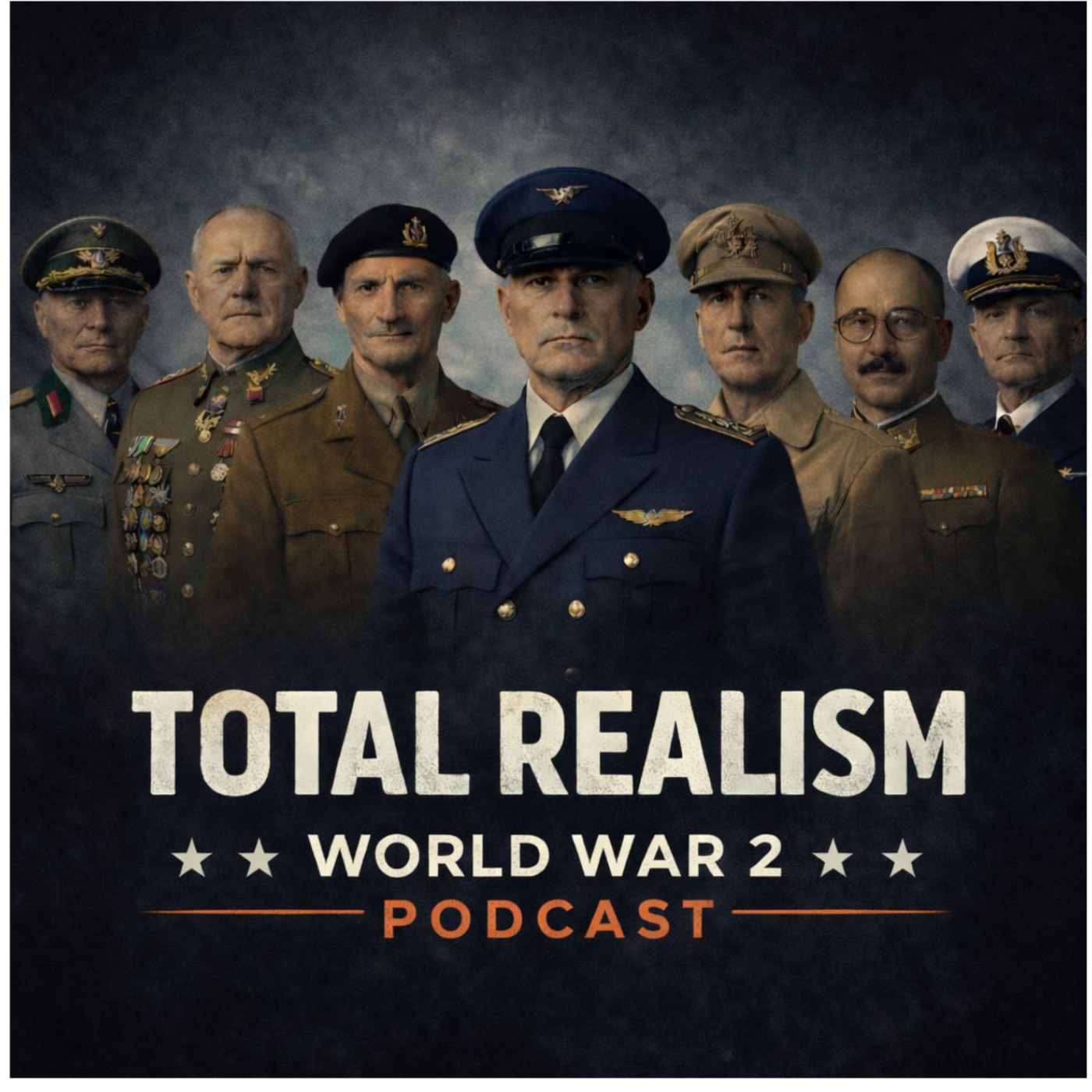
Total Realism: World War 2
by ROD INOJOSA
*Total Realism: World War 2* is a cinematic documentary podcast dedicated entirely to the Second World War.Each episode brings the conflict to life through immersive narration, dramatic atmosphere, and historically grounded storytelling. From the political tensions that ignited the war to the decisive battles across Europe, Africa, and the Pacific, this series explores the strategies, leaders, technology, and human choices that shaped the course of history.This is not a dry recounting of dates and numbers. It is World War II experienced as a living narrative — tense, emotional, and deeply strategic.Through carefully crafted sound design and cinematic pacing, Total Realism transforms history into an immersive journey across the most devastating global conflict of the twentieth century.If you seek depth, realism, and powerful storytelling — this is World War II as it was meant to be understood.
-
4
Ōnishi: He Created the Kamikaze. Then Left a Note Asking the Survivors Not to Follow Him.
He invented the kamikaze. He sent four thousand young men to die in it. And on the night the second world war ended, he sat alone in a room, refused help, and chose a death that lasted fifteen hours.This is the story of Vice Admiral Takijirō Ōnishi — the Japanese naval officer who created the Tokkō special attack corps in October 1944, in a small airfield north of Manila, with six days to spare before the American invasion. He believed in what he was building. Then, somewhere in the spring of 1945, he stopped believing. And couldn't stop the machine he had started.The note he left for the survivors asked them not to follow him. It asked them to live. It asked them to build Japan in peace. Some pilots who were planning collective suicide read that note and didn't go through with it. We don't know the total. We know the number is greater than zero.This documentary is not about fanaticism. It is about a man who was capable of seeing clearly, obeyed when his clarity was overruled, and spent the last hours of his life trying to understand what that had cost.CHAPTERS00:00 — Cold Open: Fifteen Hours04:06 — The Japanese Admiral Who Opposed Pearl Harbor08:22 — Why Japan Was Losing the Air War by 194410:35 — The Night the Kamikaze Was Born: Mabalacat, October 194412:30 — The First Kamikaze Mission: USS St. Lo, October 25, 194415:51 — How the Kamikaze Program Killed 4,000 Japanese Pilots16:35 — Did Ōnishi Believe in What He Built?22:00 — The Day Japan Surrendered: August 15, 194523:17 — The Death Ōnishi Chose: Fifteen Hours Without Help26:44 — The Note That Saved Kamikaze Survivors From Suicide30:23 — What Ōnishi Left Behind — and What He Could Not Undo—If this is the kind of history you're looking for — SUBSCRIBE. There's always another story waiting. ——No ads. No sponsors. Just research and a lot of coffee (and beer): https://buymeacoffee.com/theww2grognard —For the full cinematic experience — with historical photographs and archival footage — watch this episode on YouTube:https://www.youtube.com/@TheWW2Grognard—RESEARCH SOURCESPrimary:Rikihei Inoguchi & Tadashi Nakajima — The Divine Wind: Japan's Kamikaze Force in World War II (Naval Institute Press, 1958)https://amzn.to/4u60zJXDenis Warner & Peggy Warner — The Sacred Warriors: Japan's Suicide Legions (Van Nostrand Reinhold, 1982)https://amzn.to/4echtSDAlbert Axell & Hideaki Kase — Kamikaze: Japan's Suicide Gods (Longman, 2002)https://amzn.to/48ZmWsvU.S. Strategic Bombing Survey — The Campaigns of the Pacific War, Appendix: Kamikaze Operations (1946)https://amzn.to/4cPwcRhSecondary:Emiko Ohnuki-Tierney — Kamikaze Diaries: Reflections of Japanese Student Soldiers (University of Chicago Press, 2006)https://amzn.to/4tCLQqjMax Hastings — Retribution: The Battle for Japan, 1944–45 (Knopf, 2008)https://amzn.to/4vUrSsxNaval History and Heritage Command — Kamikaze Attacks of World War II: A Complete HistoryHistoryNet — The First Kamikaze: Yukio Seki and the Shikishima UnitAsia-Pacific Journal: Japan Focus — Ōnishi Takijirō and the Ethics of the Special AttackWikipedia — Takijirō Ōnishi, Kamikaze, Tokubetsu Kōgekitai, Battle of Leyte Gulf, USS St. LoNational WWII Museum — nationalww2museum.orgNote: This documentary covers historical events of World War II and does not address current events.MUSICAlmost in F — Tranquillity by Kevin MacLeodLicensed under Creative Commons Attribution 4.0https://creativecommons.org/licenses/by/4.0/Source: http://incompetech.com/Loss by Kevin MacLeodSource: YouTube Audio LibraryPRODUCTION TRANSPARENCYScript & Research: Human-authored | Narration: AI-generated (ElevenLabs v3) | Narrator: Charles Mercer | Images: U.S. National Archives, Japanese National Diet Library, NHHC, Wikimedia Commons — public domain
-
3
Halsey Got the Fifth Star. Spruance Won the War. The Admiral America Forgot.
Admiral Raymond Spruance won the Battle of Midway, commanded the Fifth Fleet, and refused to be a hero. While Halsey got the fifth star and the headlines, Spruance got Pebble Beach, a garden, and a schnauzer named Peter. This is the story of the U.S. Navy's most underrated commander of World War II — the admiral who out-thought the Imperial Japanese Navy at Midway and the Philippine Sea, then walked away from the spotlight he never wanted.In June 1942, with William Halsey hospitalized, Admiral Chester Nimitz chose Spruance to command Task Force 16 against four Japanese aircraft carriers near Midway Atoll. Spruance had no carrier command experience. He won anyway. Four Japanese fleet carriers — Akagi, Kaga, Soryu, Hiryu — were destroyed in a single morning. The Pacific War turned on his decision to launch at maximum range.Two years later at the Battle of the Philippine Sea, Spruance made the most controversial call of his career: he refused to chase Admiral Ozawa's retreating fleet, choosing instead to protect the Saipan landings. His own carrier admirals — Mitscher, Burke, Towers — believed he had let the war's greatest opportunity slip. He never publicly defended himself. Not in 1944. Not in 1969 when he died. He simply went home to Pebble Beach, gardened, and walked ten miles a day until the end.—CHAPTERS00:00 — Cold Open: The Night He Didn't Celebrate02:45 — Chapter 1: The Child Who Was Given Away05:06 — Chapter 2: The Silent Cadet07:06 — Chapter 3: Seven Years of Silence08:34 — Chapter 4: Between Two Wars11:04 — Chapter 5: Halsey's Rash That Changed the War13:13 — Chapter 6: The Morning of June 4 — Midway16:23 — Chapter 7: The Admiral Who Walked Alone19:00 — Chapter 8: The Night He Said No — Philippine Sea23:15 — Chapter 9: The Fifth Star That Never Came25:29 — Chapter 10: The Embassy in Manila27:32 — Chapter 11: The Garden at Pebble Beach29:51 — Chapter 12: The Friends Buried Together31:55 — Chapter 13: December 13, 196933:39 — Epilogue: The Man the Camera Never Liked—If this is the kind of history you're looking for — SUBSCRIBE. There's always another story waiting.—No ads. No sponsors. Just research and a lot of coffee (and beer): https://buymeacoffee.com/theww2grognard—For the full cinematic experience — with historical photographs and archival footage — watch this episode on YouTube:https://www.youtube.com/@TheWW2Grognard—RESEARCH SOURCESPrimary:Thomas B. Buell — The Quiet Warrior: A Biography of Admiral Raymond A. Spruance (Naval Institute Press, 1974)https://amzn.to/3OKSVWnE.B. Potter — Nimitz (Naval Institute Press, 1976)https://amzn.to/4vOCr06Samuel Eliot Morison — History of United States Naval Operations in World War II, Vols. IV & VIII (Little, Brown)https://amzn.to/4sYulQahttps://amzn.to/4sWQeiDJohn B. Lundstrom — Black Shoe Carrier Admiral: Frank Jack Fletcher at Coral Sea, Midway, and Guadalcanal (Naval Institute Press, 2006)https://amzn.to/41VbKtaSecondary:U.S. Naval History and Heritage Command — Raymond A. Spruance PapersNaval War College Review — Vol. 62, No. 4 (Autumn 2009) Andrew K. Blackley — Wielding the Trident: Admiral Raymond A. Spruance and America’s Victory in the Pacifichttps://amzn.to/3QtBWZnHistoryNet — The Quiet Admiral Who Won at MidwayWarfare History Network — Spruance vs. Halsey: The Two Faces of American Naval CommandWikipedia — Raymond A. Spruance, Battle of Midway, Battle of the Philippine Sea, Marianas Turkey Shoot, Fifth FleetNational WWII Museum — nationalww2museum.orgNote: This documentary covers historical events of 1942–1969 and does not address current events.MUSICAlmost in F — Tranquillity by Kevin MacLeodLicensed under Creative Commons Attribution 4.0https://creativecommons.org/licenses/by/4.0/Source: http://incompetech.com/Loss by Kevin MacLeodSource: YouTube Audio LibraryPRODUCTION TRANSPARENCYScript & Research: Human-authored | Narration: AI-generated (ElevenLabs v3) | Narrator: Charles Mercer | Images: U.S. National Archives, NHHC, Wikimedia Commons — public domain
-
2
The Unknown Hero Who Charged a Battleship With a Destroyer — and Saluted by the Enemy
The unknown captain who charged a Japanese battleship fleet with a single American destroyer. Ernest E. Evans, USS Johnston, Battle off Samar, October 25, 1944 — and the enemy salute that ended his fight.Off the island of Samar. A half-Cherokee captain from Pawnee, Oklahoma stands on the bridge of a single Fletcher-class destroyer and sees twenty-three Japanese warships — including four battleships — coming straight at him. He has three minutes to decide. He turns toward them.This is the story of Ernest Edwin Evans, the first Native American naval officer to receive the Medal of Honor, and the destroyer USS Johnston (DD-557) — found in 2021 four miles deep at the bottom of the Philippine Sea, with her guns still pointed toward where the Japanese fleet once was.--CHAPTERS00:00 — Cold Open: Off Samar, October 25, 194402:39 — Chapter 1: The Boy from Pawnee04:35— Chapter 2: The Quiet Decade06:59 — Chapter 3: "I Intend to Go in Harm's Way"08:06 — Chapter 4: The Training Year09:28 — Chapter 5: The Night the Door Was Left Open11:31 — Chapter 6: Many Masts14:02 — Chapter 7: Ten Torpedoes16:14 — Chapter 8: Small Boys, Attack17:37 — Chapter 9: Between the Battleship and the Carrier18:48 — Chapter 10: The Destroyers That Turned Away19:32 — Chapter 11: The Circle21:29 — Chapter 12: The Salute22:45 — Chapter 13: What Happened Next24:27 — Chapter 14: San Pedro, 194526:03 — Chapter 15: Four Miles Down28:06 — Chapter 16: Epilogue: Still on Station—If this is the kind of history you're looking for — SUBSCRIBE.There's always another story waiting.—No ads. No sponsors. Just research and a lot of coffee (and beer):https://buymeacoffee.com/theww2grognard—For the full cinematic experience — with historical photographs and archival footage — watch this episode on YouTube:https://www.youtube.com/@TheWW2Grognard—RESEARCH SOURCESPrimary:U.S. Naval History and Heritage Command — Johnston (DD-557) Official Pagehttps://www.history.navy.mil/browse-by-topic/ships/modern-ships/johnston.htmlUSS Johnston (DD-557) Action Report — 14 November 1944, Lt. Robert C. Hagen, Senior Surviving OfficerRobert C. Hagen — "We Asked for the Jap Fleet — and Got It" (The Saturday Evening Post, May 1945)Medal of Honor Citation — Commander Ernest Edwin Evans (presented 28 September 1945)Samuel Eliot Morison — History of United States Naval Operations in World War II, Vol. XII: Leyte, June 1944–January 1945 (Little, Brown, 1958) https://amzn.to/4sXM5euNHHC Wreckage Confirmation — USS Johnston (DD-557) (April 2021)https://www.history.navy.mil/news-and-events/news/2021/wreckage-confirmed-as-heroic-uss-johnston--dd-557-.htmlSecondary:James D. Hornfischer — The Last Stand of the Tin Can Sailors (Bantam, 2004) https://amzn.to/3P1INZBThomas J. Cutler — The Battle of Leyte Gulf: 23–26 October 1944 (HarperCollins, 1994) https://amzn.to/3R0xqBDThe National WWII Museum — Eyewitness to the Battle off Samar and the Loss of the USS St. LoUSNI News — Wreck of Famed WWII Destroyer USS Johnston May Have Been Found (October 2019)Destroyer History Foundation — USS Johnston (DD-557), Fletcher-class destroyer in World War IIhttps://destroyerhistory.org/fletcherclass/ussjohnston/NHHC The Sextant Blog — Surface Warrior: Remembering Ernest EvansU.S. Naval Academy Virtual Memorial Hall — Ernest E. Evans, Cmdr., USNWikipedia — USS Johnston (DD-557), Battle off Samar, Ernest E. Evans, Battle of Leyte Gulf, Clifton Sprague, Taffy 3National WWII Museum — nationalww2museum.orgNote: This documentary covers historical events of October 1944 and does not address current events.MUSICAlmost in F — Tranquillity by Kevin MacLeodLicensed under Creative Commons Attribution 4.0https://creativecommons.org/licenses/by/4.0/Source: http://incompetech.com/No. 4 Piano Journey by Esther AbramiSource: YouTube Audio LibraryPRODUCTION TRANSPARENCYScript & Research: Human-authored | Narration: AI-generated (ElevenLabs v3) |Narrator: Charles Mercer | Images: U.S. National Archives, NHHC,Wikimedia Commons — public domain— FOR HISTORY ENTHUSIASTS —The WW2 Grognard delivers cinematic Pacific War documentaries — history told without Hollywood myths. Subscribe for new episodes every week.#WW2 #PacificWar #USNavy #BattleOffSamar #USSJohnston
-
1
Leyte: He Declared Victory While His Men Were Still Dying — The Ground War
MacArthur declared victory on December 26th, 1944.His men were still dying in those mountains five months later.Three men. One island. A battle history buried under the naval legend.The general who conquered Singapore in 70 days — exiled for being too popular,then executed for crimes he didn't order.The American commander who actually won Leyte — whose name you've never heard.And the Japanese general left behind by his own army in those mountains,still fighting long after Tokyo had written him off.This is the ground war at Leyte. The one MacArthur said was over before it was.—CHAPTERS00:00 — The Battle That Decided the Pacific02:35 — Chapter 1: The Tiger In Exile - Yamashita06:25 — Chapter 2: Walter Krueger - The Man Who Won The Battle And Disappeared 11:31 — Chapter 3: Into The Valleys - The First Weeks12:55 — Chapter 4: Breakneck Ridge15:35 — Chapter 5: Ormoc Beach17:48 — Chapter 6: The General´s Last Battle - Suzuki20:00 — Chapter 7: The Filipinos22:17 — Chapter 8: The Tigers Trial - Yamashita25:44 — Epilogue: The Announced Victory And The Unannounced War—If this is the kind of history you're looking for — SUBSCRIBE.There's always another story waiting.—No ads. No sponsors. Just research and a lot of coffee (and beer):https://buymeacoffee.com/theww2grognard—For the full cinematic experience — with historical photographs and archival footage — watch this episode on YouTube:https://www.youtube.com/@TheWW2Grognard—RESEARCH SOURCESPrimary:U.S. Army Center of Military History — Leyte: The Return to the Philippineshttps://amzn.to/4cAU62ENathan N. Prefer — Leyte 1944: The Soldiers' Battle (Casemate, 2012)https://amzn.to/4cH8AxYKevin Holzimmer — General Walter Krueger: Unsung Hero of the Pacific War (University Press of Kansas, 2004)https://amzn.to/3OWuLIHU.S. Strategic Bombing Survey — Interrogation of General Tomoyuki Yamashita (October 1945)https://amzn.to/4sTWxUeSecondary:Warfare History Network — The Liberation of the PhilippinesWarfare History Network — Doughboy White: The Lost Battalion of LeyteAsia-Pacific Journal: Japan Focus — Last Words of the Tiger of Malaya (Yuki Tanaka)HistoryNet — Translating for Yamashita: The Tiger's TrialEBSCO Research — Japanese General Yamashita Convicted of War CrimesWikipedia — Battle of Leyte, Tomoyuki Yamashita, Walter Krueger, Sosaku Suzuki, Battle of ManilaNational WWII Museum — nationalww2museum.orgNote: This documentary covers historical events of October 1944 and doesnot address current events.MUSICAlmost in F — Tranquillity by Kevin MacLeodLicensed under Creative Commons Attribution 4.0https://creativecommons.org/licenses/by/4.0/Source: http://incompetech.com/Loss by Kevin MacLeodSource: YouTube Audio LibraryPRODUCTION TRANSPARENCYScript & Research: Human-authored | Narration: AI-generated (ElevenLabs v3) |Narrator: Charles Mercer | Images: U.S. National Archives, NHHC,Wikimedia Commons — public domain
-
0
Leyte: The Largest Naval Battle in History — And the Decision Nobody Can Explain
Leyte Gulf - The largest naval battle in history was decided not by firepower — but by a single decision no one can fully explain.October 1944. Four Japanese fleets are converging on the Philippines from different directions. MacArthur's invasion force is on the beach. The only thing standing between the landing fleet and the most powerful surface force Japan ever assembled is a handful of escort carriers and destroyer escorts — ships that were never meant to fight battleships.And the admiral who was supposed to protect them just took the entire Third Fleet and disappeared over the horizon.This is the story of Leyte Gulf: the admirals who knew they were sailing to their deaths, the fleet commander who took the bait, the tiny ships that faced the impossible — and the decision at the center of it all that history still cannot explain.—CHAPTERS00:00 — The Battle That Decided the Pacific02:46 — Chapter 1: Japan's Last Gamble05:15 — Chapter 2: The Admiral Who Sailed to His Own Death11:17 — Chapter 3: The Most Powerful Fleet in History — Under Attack15:09 — Chapter 4: Halsey Chases the Bait18:32 — Chapter 5: The Southern Force — Sailing Into a Trap19:55 — Chapter 6: Tiny Ships Against a Battleship Fleet26:13 — Chapter 7: Why Did Kurita Turn Back?29:50 — Chapter 8: The Decoy That Worked32:22 — Chapter 9: What Leyte Gulf Changed Forever35:34 — Epilogue: Three Admirals, One Morning, Three Fates—If this is the kind of history you're looking for — SUBSCRIBE. There's always another story waiting.—No ads. No sponsors. Just research and a lot of coffee (and beer):https://buymeacoffee.com/theww2grognard—For the full cinematic experience — with historical photographs and archival footage — watch this episode on YouTube:https://www.youtube.com/@TheWW2Grognard—RESEARCH SOURCESPrimary:Thomas J. Cutler — The Battle of Leyte Gulf (Naval Institute Press)https://amzn.to/4cCrLZNC. Vann Woodward — The Battle for Leyte Gulf (Macmillan, 1947)https://amzn.to/3OCcobKSamuel Eliot Morison — History of United States Naval Operations in World War II, Vol. XIIhttps://amzn.to/4cAw1ZJSecondary:James D. Hornfischer — The Last Stand of the Tin Can Sailors (Bantam, 2004)https://amzn.to/4tZ1kVbAnthony Tully & Jon Parshall — Shattered Sword (Potomac Books, 2005)https://amzn.to/494ps0zNational WWII Museum — nationalww2museum.orgWikipedia — Battle of Leyte Gulf, Halsey, Kurita, Taffy 3Note: This documentary covers historical events of October 1944 and does not address current events.MUSICAlmost in F — Tranquillity by Kevin MacLeodLicensed under Creative Commons Attribution 4.0https://creativecommons.org/licenses/by/4.0/Source: http://incompetech.com/American Frontiers by Aaron KennySource: YouTube Audio LibraryNo.4 Piano Journey by Esther AbramiSource: YouTube Audio LibraryPRODUCTION TRANSPARENCYScript & Research: Human-authored | Narration: AI-generated (ElevenLabs v3) | Narrator: Charles Mercer | Images: U.S. National Archives, NHHC, Wikimedia Commons — public domain
-
-1
Fuchida: He Cried "Tora! Tora! Tora!" at Pearl Harbor. 15 Years Later, He Was Preaching Jesus in Kentucky.
Pearl Harbor pilot Mitsuo Fuchida launched the attack that started WWII in the Pacific. He survived Midway, Hiroshima — and found forgiveness in America.This is the most extraordinary life I've researched for this channel. Not a war story. A story about a man who spent forty years running from himself — and the moment he finally stopped. Destruction, reconstruction, and forgiveness. In that order.Fuchida led 183 aircraft into Pearl Harbor on December 7, 1941. His plane was hit 21 times. A single fraying cable kept him alive. Six months later, an appendectomy kept him off the planes at Midway — the pilots who flew in his place died when Japan lost four carriers in six minutes. A last-minute phone call pulled him out of Hiroshima the day before the atomic bomb. He went back the next day. Every man beside him died of radiation poisoning. Fuchida did not get sick.He had no explanation for any of it.After the war he became a farmer. He went to Uraga Harbor to prove Americans had been as brutal to prisoners as Japan had been. Instead, he found Peggy Covell — a young woman whose missionary parents were beheaded by Japanese soldiers in the Philippines. She spent the postwar years serving Japanese prisoners with love and forgiveness. Because that is what her parents would have wanted.Then a stranger at Shibuya Station pressed a pamphlet into his hands. I Was a Prisoner of Japan — written by Jacob DeShazer, a Doolittle Raider who had spent 40 months in Japanese prisons. Beaten, starved, tortured. He came back to Japan as a missionary.Fuchida bought a Bible. He came to Luke 23. Father, forgive them. For they know not what they do.On April 14, 1950, the man who launched Pearl Harbor accepted Christ. One month later he knocked on DeShazer's door. Former enemies became lifelong friends.This is that story.--00:00 — Tora! Tora! Tora! — The Man Who Started the War03:04 — Japan 1902 — The Boy from Nara07:30 — Pearl Harbor — The Plan That Should Have Been Stopped10:03 — December 7, 1941 — The Attack15:19 — Midway 1942 — The Day He Lived by Accident16:51 — 1942–1945 — Watching Japan Lose18:39 — August 1945 — Hiroshima and the Defeat22:53 — Uraga Harbor — The Story of Peggy Covell26:38 — Shibuya Station 1948 — The Pamphlet30:20 — Osaka 1950 — The Meeting with DeShazer32:40 — America — Going to the Enemy35:59 — The Shadow — What the History Books Got Wrong38:09 — 1960–1976 — The Last Years40:11 — Epilogue: For That One Day--If this is the kind of history you're looking for — SUBSCRIBE. There's always another story waiting.--No ads. No sponsors. Just research and a lot of coffee (and beer):https://buymeacoffee.com/theww2grognard—For the full cinematic experience — with historical photographs and archival footage — watch this episode on YouTube:https://www.youtube.com/@TheWW2Grognard—RESEARCH SOURCESPrimary:Fuchida, Mitsuo — For That One Day (eXperience Inc., 2011) https://amzn.to/3OLqkAnFuchida, Mitsuo — From Pearl Harbor to Calvary (Sky Pilots Press, 1953)https://amzn.to/3OviWciDeShazer, Jacob — I Was a Prisoner of Japan (Bible Literature International, 1950)Mitsuo Fuchida papers, 1905–1979 — Hoover Institution Library & Archives, Stanford UniversityFuchida, Mitsuo — Midway : The Japanese Storyhttps://amzn.to/4vw8W3jSecondary:Prange, Goldstein, Dillon — God's Samurai: Lead Pilot at Pearl Harbor (Brassey's, 1990)https://amzn.to/4mKnWGDParshall & Tully — Shattered Sword (Potomac Books, 2005)https://amzn.to/4ep8I7JNelson, Craig — Pearl Harbor: From Infamy to Greatness (Scribner, 2016)https://amzn.to/4mTK15TBennett, T. Martin — Wounded Tiger (Emanate Books, 2013)https://amzn.to/41AkaGaSymonds, Craig — The Battle of Midway (Oxford University Press, 2011)https://amzn.to/4dUcNAHNational WWII Museum — nationalww2museum.org--Note: This documentary covers historical events of 1902–1976 and does not address current events.--MUSICAlmost in F – Tranquillity by Kevin MacLeod — CC Attribution 4.0https://creativecommons.org/licenses/by/4.0/Source: http://incompetech.com/No.4 Piano Journey by Esther Abrami — YouTube Audio LibraryPRODUCTION TRANSPARENCYScript & Research: Human-authored | Narration: AI-generated (ElevenLabs) | Images: U.S. National Archives, Hoover Institution Archives, Library of Congress, Wikimedia Commons — all public domain#PearlHarbor #MitsuoFuchida #ToraToraTora #WW2Documentary #PacificWar #WWII #WW2History #ImperialJapan #JacobDeShazer #DoolittleRaid
-
-2
Iwo Jima: Three of the Six Men Who Raised the Flag on Iwo Jima Died in The Next 12 Days
The Battle of Iwo Jima, one of the bloodiest battles of World War II in the Pacific, is remembered through Joe Rosenthal's Pulitzer Prize-winning photograph of six men raising the American flag on Mount Suribachi — but the real story is far more brutal. Taken on Day 4 of a 36-day battle in February 1945, that iconic image captured a moment, not the reality. By the end of the fighting, 6,821 U.S. Marines were dead, and three of the six flag raisers in the photograph did not survive the island.Beneath that flag, deep inside a network of volcanic tunnels dug into Mount Suribachi and the southern plateau, Japanese commander Lieutenant General Tadamichi Kuribayashi had spent months preparing a defensive system designed to inflict maximum American casualties. Having lived in the United States — studying at Harvard and serving as a military attaché in Washington — Kuribayashi understood exactly what he was fighting, and still prepared to hold the island to the last man. On the American side, Gunnery Sergeant John Basilone, a Medal of Honor recipient from Guadalcanal, had been safely back in the United States selling war bonds when he volunteered to return to combat. He was killed within hours of landing on Iwo Jima on February 19, 1945.The Battle of Iwo Jima continued for 31 days after Rosenthal's photograph was taken — a brutal Pacific War campaign of tunnel warfare, hidden bunkers, and close-quarters fighting across volcanic terrain. By the time the U.S. Marine Corps declared the island secured on March 26, 1945, 27 Medals of Honor had been awarded — the most for any single battle in American military history. The flag did not end the battle. It barely interrupted it.--CHAPTERS00:00 — The Photograph You Think You Know02:41 — Chapter 1: The Man Who Knew the Enemy (Kuribayashi in America, 1928)05:38 — Chapter 2: "Only You Among All the Generals" (The Assignment, 1944)09:39 — Chapter 3: The Man Who Came Back (Basilone, Guadalcanal, and the Return)14:23 — Chapter 4: The Island That Swallowed Light (D-Day, February 19, 1945)15:52 — Chapter 5: Manila John, Red Beach II (Basilone's Last Day)18:32 — Chapter 6: The Flag That Isn't What You Think22:12 — Chapter 7: The Meatgrinder (Northern Iwo Jima)25:34 — Chapter 8: Underground (Kuribayashi's Final Weeks and His Poems)27:38 — Chapter 9: The Last Night (March 25–26, 1945)29:33 — Chapter 10: What It Cost31:27 — Chapter 11: The Men They Were33:53 — Epilogue: The Photograph, One More Time—If this is the kind of history you're looking for — SUBSCRIBE. There's always another story waiting.—No ads. No sponsors. Just research and a lot of coffee (and beer):https://buymeacoffee.com/theww2grognard—For the full cinematic experience — with historical photographs and archival footage — watch this episode on YouTube:https://www.youtube.com/@TheWW2Grognard—RESEARCH SOURCESPrimary:Kuribayashi, Tadamichi — Picture Letters from the Commander in Chief (Gyokusai sōshikikan no etegami). Compiled posthumously.https://amzn.to/4mAFMfi Basilone, John — Medal of Honor and Navy Cross Citations, USMC Historical Archive Robert E. Allen — The First Battalion of the 28th Marines on Iwo Jima: A Day-by-Day History from Personal Accounts and Official Reportshttps://amzn.to/4tMB7cpSecondary:Donald Yates — U.S. Marine Corps Remembering Iwo Jimahttps://amzn.to/4tI821HKakehashi, Kumiko — So Sad to Fall in Battle (Presidio Press / Ballantine Books, 2007)https://amzn.to/4mMioeZBradley, James — Flags of Our Fathers (Bantam, 2000)https://amzn.to/4elzoGtHammel, Eric — Two Flags over Iwo Jima (Zenith Press, 2018)https://amzn.to/4dGapNTAlexander, Joseph H. — Closing In: Marines in the Seizure of Iwo Jima (USMC Historical Center, 1994)National WWII Museum — nationalww2museum.orgWikipedia — Battle of Iwo Jima, Tadamichi Kuribayashi, John Basilone, Joe Rosenthal, Raising the Flag on Iwo JimaNote: This documentary covers historical events of February–March 1945 and does not address current events.MUSICAlmost in F — Tranquillity by Kevin MacLeod is licensed under a Creative Commons Attribution 4.0 International License.https://creativecommons.org/licenses/by/4.0/Source: http://incompetech.com/music/royalty-free/index.html?isrc=USUAN1500002Artist: http://incompetech.com/American Frontiers by Aaron KennySource: YouTube Audio LibraryNo.4 Piano Journey by Esther AbramiSource: YouTube Audio LibraryPRODUCTION TRANSPARENCYScript & Research: Human-authored | Narration: AI-generated | Images: U.S. National Archives, USMC Historical Archive, Library of Congress, Wikimedia Commons — public domainWhat happened after the photograph is the real story.
-
-3
Pearl Harbor From the Japanese Side: The Admiral Who Planned It Knew It Was a Mistake
The Attack on Pearl Harbor (December 7, 1941) was the most successful surprise naval strike in history. In less than two hours, Japan crippled the U.S. Pacific Fleet — 21 ships damaged or destroyed, 2,403 Americans killed.This WW2 documentary covers Pearl Harbor from the Japanese perspective, focusing on Admiral Isoroku Yamamoto, his opposition to the war, and the strategy behind the attack.Inside this video:Pearl Harbor attack 1941Isoroku Yamamoto strategyKido Butai (Japanese carrier strike force)Mitsuo Fuchida and “Tora Tora Tora”Admiral Nagumo decision makingThird wave debate (fuel tanks, dry docks, oil reserves)USS Arizona wreck and legacyBattle of Surigao Strait connectionFDR Pearl Harbor conspiracy theoryPacific War originsDiscover how a perfect tactical victory became a strategic disaster for Japan — and changed the course of World War II.CHAPTERS00:00 — Pearl Harbor: The Perfect Attack That Lost the War02:07 — Chapter 1: The Man Who Didn't Want the War04:52 — Chapter 2: The Gamble — Yamamoto's Plan vs. the Naval General Staff08:55 — Chapter 3: The Wrong Man — Who Was Really in Command10:54 — Chapter 4: The Crossing — 10 Days of Radio Silence15:22 — Chapter 5: Tora Tora Tora — The Attack on Pearl Harbor21:05 — Chapter 6: The Question Above the Harbor — Why There Was No Third Strike23:45 — Chapter 7: The Sleeping Giant — America's Industrial Response29:05 — Chapter 8: The Men It Made — Yamamoto, Nagumo, and Fuchida After Pearl Harbor29:46 — Epilogue: What Remains — The Oil Still Rising from the Arizona--If this is the kind of history you're looking for — SUBSCRIBE. There's always another story waiting.--No ads. No sponsors. Just research and a lot of coffee (and beer):https://buymeacoffee.com/theww2grognard—For the full cinematic experience — with historical photographs and archival footage — watch this episode on YouTube:https://www.youtube.com/@TheWW2Grognard—RESEARCH SOURCESPrimary:Prange, Gordon W. — At Dawn We Slept: The Untold Story of Pearl Harbor (McGraw-Hill, 1981)https://amzn.to/4vquWfFPrange, Gordon W. — Pearl Harbor: The Verdict of History (McGraw-Hill, 1986)https://amzn.to/48fXoqXGoldstein, Donald / Dillon, Katherine / Prange, Gordon W. — God's Samurai: Lead Pilot at Pearl Harbor (Brassey's, 1990)https://amzn.to/41pd1sfProceedings — "The Inside Story of the Pearl Harbor Plan" (U.S. Naval Institute, December 1951)https://amzn.to/47UzmS7Hiroyuki Agawa — The reluctant admiral: Yamamoto and the Imperial Navyhttps://amzn.to/3NV7S8cSecondary:Lord, Walter — Day of Infamy (Henry Holt, 1957)https://amzn.to/3OATGRQStinnett, Robert — Day of Deceit: The Truth About FDR and Pearl Harbor (Free Press, 2000)https://amzn.to/3QyvtfvWikipedia — Attack on Pearl Harbor, Isoroku Yamamoto, Mitsuo Fuchida, Chuichi Nagumo, USS Arizona;Naval History and Heritage Command;National WWII Museum;Pearl Harbor National Memorial (NPS).Note: This documentary covers historical events of December 1941 and does not address current events.MUSICAlmost in F — Tranquillity by Kevin MacLeod is licensed under a Creative Commons Attribution 4.0 International License.https://creativecommons.org/licenses/by/4.0/Source: http://incompetech.com/music/royalty-free/index.html?isrc=USUAN1500002Artist: http://incompetech.com/American Frontiers by Aaron KennySource: YouTube Audio LibraryNo.4 Piano Journey by Esther AbramiSource: YouTube Audio LibraryPRODUCTION TRANSPARENCYScript & Research: Human-authored | Narration: AI-generated | Images: U.S. National Archives, Naval History and Heritage Command, Library of Congress, Wikimedia Commons — public domain
-
-4
Chester Nimitz: The Man Who Won the Pacific War Never Left His Desk
Fleet Admiral Chester W. Nimitz commanded the largest naval force in history during World War II. From Pearl Harbor (1941) to the Japanese surrender (1945), he led the U.S. Pacific Fleet across the most complex naval campaign ever fought.This WW2 documentary explores the full biography of Chester Nimitz — from his early career and court-martial, to his leadership in the Pacific Theater, including Midway, Guadalcanal, and the final japanese surrender aboard USS Missouri.Discover how Nimitz used intelligence to outmaneuver Japan, managed 700 warships, 6,500 aircraft, and 1.5 million personnel, and made critical wartime decisions that shaped the outcome of WWII.CHAPTERS00:00 — Introduction: Pearl Harbor, Christmas Morning02:11 — Fredericksburg: The Sea in the Blood04:56 — Court-Martial and Submarines08:50 — December 1941: The Call10:21 — Rebuilding the Pacific Fleet13:31 — Coral Sea: The Intelligence Gamble15:32 — Battle of Midway17:52 — Guadalcanal20:11 — The Letters to Catherine22:34 — Island-Hopping: 1943–194424:58 — Okinawa and the Bomb35:52 — USS Missouri: The Signing38:19 — After the War40:08 — Epilogue: What Calm Costs--If this is the kind of history you're looking for — SUBSCRIBE. There's always another story waiting.--No ads. No sponsors. Just research and a lot of coffee (and beer):https://buymeacoffee.com/theww2grognard—For the full cinematic experience — with historical photographs and archival footage — watch this episode on YouTube:https://www.youtube.com/@TheWW2Grognard—RESEARCH SOURCESPrimary:Best Beloved: The Wartime Letters of Fleet Admiral Chester W. Nimitz to His Wife, Catherine — Ed. Bamford & Hulver, Naval History and Heritage Command, 2024https://www.history.navy.mil/research/publications/publications-by-subject/best-beloved.htmlPotter, E.B. — Nimitz (Naval Institute Press, 1976)https://amzn.to/4cpA0bLSymonds, Craig L. — Nimitz at War: Command Leadership from Pearl Harbor to Tokyo Bay (Oxford University Press, 2022)https://amzn.to/4cl7UhwSecondary:The Strategic Leadership of Admiral Chester W. Nimitzhttps://amzn.to/4ebMCFKSpector, Ronald H. — Eagle Against the Sun (Free Press, 1985)https://amzn.to/4u1uLGrPrange, Gordon W. — Miracle at Midway (McGraw-Hill, 1982)https://amzn.to/4sx6sPoWikipedia — Chester W. Nimitz, Battle of Midway, Guadalcanal campaign, Battle of the Philippine SeaNaval History and Heritage CommandNational WWII MuseumAtomic Heritage FoundationNote: This documentary covers historical events from 1885 to 1966 and does not address current events.--If you want a real look at the Pacific War — not the polished, comfortable version — go watch THE PACIFIC - It’s one of the few things Hollywood got right.--MUSICAlmost in F — Tranquillity by Kevin MacLeod is licensed under a Creative Commons Attribution 4.0 International License.https://creativecommons.org/licenses/by/4.0/Source: http://incompetech.com/music/royalty-free/index.html?isrc=USUAN1500002Artist: http://incompetech.com/American Frontiers by Aaron KennySource: YouTube Audio LibraryNo.4 Piano Journey by Esther AbramiSource: YouTube Audio LibraryPRODUCTION TRANSPARENCYScript & Research: Human-authored | Narration: AI-generated | Images: U.S. National Archives, Naval History and Heritage Command, Wikimedia Commons — public domain
-
-5
Midway 1942: How Was the Largest Fleet in the Pacific Destroyed in 5 Minutes? | Full Documentary
Japan sent the most powerful carrier fleet ever assembled in the Pacific to Midway in June 1942. By sunset, four of its carriers were burning. This is the full story of the Battle of Midway — told from inside the Japanese fleet.This WW2 documentary covers the Battle of Midway 1942 from the Japanese perspective: Vice Admiral Nagumo's impossible dilemma on the morning of June 4th, the rearming decisions that turned his carriers into floating armories, and the torpedo squadrons that died without hitting anything — and saved the battle anyway.We go inside the WW2 Pacific War intelligence operation that America won before a single plane took off — the fake water shortage that confirmed Midway as the target, the 72-hour miracle repair of the USS Yorktown, and the JN-25 codebreaking that gave Nimitz the one advantage that mattered.The "five minutes" myth is examined and challenged. The B-26 that nearly killed Nagumo on the bridge of the Akagi. The destroyer Arashi that accidentally pointed Wade McClusky and his SBD Dauntless dive-bombers directly at the fleet it was trying to rejoin. And the post-battle cover-up that kept Japan's own people in the dark about the worst naval defeat in its history.This isn't the Midway of Hollywood. This is what actually happened.CHAPTERS00:00 — The Battle of Midway: How It Really Ended01:41 — Chapter 1: Why Japan Had to Attack Midway04:16 — Chapter 2: The Code Breaker Who Saved the Pacific War06:45 — Chapter 3: USS Yorktown — Repaired in 72 Hours07:53 — Chapter 4: Mitsuo Fuchida — Pearl Harbor's Pilot at Midway10:12 — Chapter 5: Nagumo's Fatal Decision — The Rearming of the Carriers12:47 — Chapter 6: Torpedo Squadron 8 — The Sacrifice That Changed Everything15:22 — Chapter 7: The Destroyer Arashi — The Ship That Betrayed the Fleet17:02 — Chapter 8: The Dive Bomber Attack — Three Carriers in Five Minutes19:13 — Chapter 9: Nagumo Abandons the Akagi20:36 — Chapter 10: Japan's Midway Cover-Up — What Tokyo Hid from Its People22:34 — Chapter 11: Why Japan Could Never Replace What It Lost at Midway23:53 — Epilogue: The Wreck of the Kaga — Found in 2019--If this is the kind of history you're looking for — SUBSCRIBE. There's always another story waiting.--No ads. No sponsors. Just research and a lot of coffee (and beer):https://buymeacoffee.com/theww2grognard—For the full cinematic experience — with historical photographs and archival footage — watch this episode on YouTube:https://www.youtube.com/@TheWW2Grognard—RESEARCH SOURCESPrimary:A Documentary History of the Battle of Midway: The Official US Combat Reports From the Naval Action Against Japan in June 1942 - United States Defense Departmenthttps://amzn.to/3OfNuP9Parshall, Jonathan and Tully, Anthony — Shattered Sword: The Untold Story of the Battle of Midway (Potomac Books, 2005)https://amzn.to/4dzat1XSymonds, Craig L. — The Battle of Midway (Oxford University Press, 2011)https://amzn.to/47So3txFuchida, Mitsuo and Okumiya, Masatake — Midway: The Battle That Doomed Japan (Naval Institute Press, 1955)https://amzn.to/4vm1VleSecondary:Lord, Walter — Incredible Victory (Harper & Row, 1967);https://amzn.to/4ebsqnhWikipedia — Battle of Midway, Chuichi Nagumo, Mitsuo Fuchida, Wade McClusky, Torpedo Squadron 8;Naval History and Heritage Command;National WWII Museum;Britannica.Note: This documentary covers historical events of June 1942 and does not address current events.MUSICAlmost in F — Tranquillity by Kevin MacLeod is licensed under a Creative Commons Attribution 4.0 International License.https://creativecommons.org/licenses/by/4.0/Source: http://incompetech.com/music/royalty-free/index.html?isrc=USUAN1500002Artist: http://incompetech.com/American Frontiers by Aaron KennySource: YouTube Audio LibraryNo.4 Piano Journey by Esther AbramiSource: YouTube Audio LibraryPRODUCTION TRANSPARENCYScript & Research: Human-authored | Narration: AI-generated | Images: U.S. National Archives, Naval History and Heritage Command, Wikimedia Commons — public domain
-
-6
Yamamoto: He Lost Two Fingers at Tsushima. He Studied at Harvard. Then He Planned Pearl Harbor
He spent years living among Americans — studying at Harvard University from 1919 to 1921, playing poker with oil executives in New York, driving through the American South, reading Hemingway. Isoroku Yamamoto didn't just understand America. He admired it. And more than any admiral in the Imperial Japanese Navy, he feared it.While Japanese generals argued about battleships and samurai honor, Admiral Yamamoto was calculating American oil reserves, Detroit auto factories, and Texas steel output. He had sat across the table from American industrialists in high-stakes poker games — and won. Not by luck. By learning to think exactly like them.That knowledge would haunt him for the rest of his life. Because when the Japanese government ordered him, as Commander-in-Chief of the Combined Fleet, to destroy the U.S. Pacific Fleet at Pearl Harbor, Admiral Yamamoto already knew the truth no one in Tokyo wanted to hear: Japan could not win a long war against the United States.The attack on Pearl Harbor on December 7, 1941 wasn't a battle plan. It was history's greatest strategic bluff — designed by the one Japanese admiral who understood exactly what he was betting against. Six months later, at the Battle of Midway, his prediction would begin to come true. Eighteen months after that, American P-38 fighters would shoot his plane out of the sky over Bougainville in Operation Vengeance.This is the story of Marshal Admiral Isoroku Yamamoto — the man who planned Pearl Harbor knowing Japan would lose, and who lived just long enough to watch his warning come true.CHAPTERS:00:00 — Chapter 1: Pearl Harbor — The Attack That Won Nothing05:30 — Chapter 2: Harvard, 1919 — The Enemy He Studied for Decades11:20 — Chapter 3: The Geisha, the Letters, and the Eight Fingers16:26 — Chapter 4: Tsushima, 1905 — The Battle That Made Him19:51 — Chapter 5: Washington, D.C. — Studying the Country He Would Fight22:44 — Chapter 6: The General Who Planned Pearl Harbor Didn't Want the War26:29 — Chapter 7: The Three Carriers That Weren't There28:47 — Chapter 8: Midway — The Day Japan Lost the Pacific31:46 — Chapter 9: "My Life Will End in the Next Hundred Days"34:10 — Chapter 10: Operation Vengeance — The Ambush Over Bougainville36:12 — Chapter 11: Hiroshima — The War He Predicted to the Month--If this is the kind of history you're looking for — SUBSCRIBE. There's always another story waiting.--No ads. No sponsors. Just research and a lot of coffee (and beer):https://buymeacoffee.com/theww2grognard—For the full cinematic experience — with historical photographs and archival footage — watch this episode on YouTube:https://www.youtube.com/@TheWW2Grognard—RESEARCH SOURCESPrimary: Agawa Hiroyuki — The Reluctant Admiral: Yamamoto and the Imperial Navy (Kodansha, 1979); https://amzn.to/41S30DXJohn B. Lundstrom — The First Team: Pacific Naval Air Combat from Pearl Harbor to Midway (Naval Institute Press, 1984); https://amzn.to/4sWVHqqGordon W. Prange — At Dawn We Slept: The Untold Story of Pearl Harbor (McGraw-Hill, 1981).https://amzn.to/4bVbmRcSecondary: Wikipedia — Isoroku Yamamoto, Attack on Pearl Harbor, Battle of Midway, Operation Vengeance; Naval History and Heritage Command;National WWII Museum; History.com.Note: This video covers historical events of the period 1884–1943 and does not address current events.MUSICAlmost in F — Tranquillity by Kevin MacLeod is licensed under a Creative Commons Attribution 4.0 International License.https://creativecommons.org/licenses/by/4.0/Source: http://incompetech.com/music/royalty-free/index.html?isrc=USUAN1500002Artist: http://incompetech.com/PRODUCTION TRANSPARENCYScript & Research: Human-authored | Narration: AI-generated (ElevenLabs) | Images: U.S. National Archives, Naval History and Heritage Command, Wikimedia Commons — public domain#Yamamoto #PearlHarbor #WWII #WW2Documentary #IsorokuYamamoto #PacificWar #WW2History #TheWW2Grognard #WorldWarII #Midway #JapaneseNavy #OperationVengeance #ImperialJapan #WW2
-
-7
Göring Was 265 Pounds When Captured. He Lost 75 in Prison. Then He Beat the Hangman.
He was Hitler's designated successor — the second most powerful man in Nazi Germany. He built the Gestapo, commanded the Luftwaffe, and signed the authorization that set the Holocaust in motion. He looted an entire continent's art and housed it in a palace built in a dead woman's name. He stood trial at Nuremberg — and beat the hangman anyway.This is the complete story of Hermann Wilhelm Göring, Reichsmarschall of the Third Reich. From a medieval castle in Bavaria to the highest offices of Nazi Germany. From the cockpit of a WWI fighter pilot — wounded in the Beer Hall Putsch and addicted to morphine ever after — to the dock at the Nuremberg Trials. From the Pour le Mérite to a cyanide capsule in a prison cell, two hours before his scheduled execution.When Göring was captured by American forces in May 1945, he weighed 265 pounds and was taking 40 pills of paracodeine a day. Eighteen months later — thinner by 75 pounds, clean of morphine, and condemned to hang — he took his own life in a way that stunned the Allied prosecution. How he obtained the cyanide capsule inside a maximum-security American prison remains contested to this day.If you watched our documentary on the Nuremberg psychiatrist Douglas Kelley — this is the man Kelley spent eleven months trying to understand. This is what he found.CHAPTERS:00:00 — Opening: Nuremberg, October 194604:04 — The Boy in the Castle (1893–1914)07:14 — The Ace (1914–1918)10:05 — The Exile (1918–1927)13:17 — The Putsch and the Morphine (1923)16:24 — The Rise (1928–1933)22:43 — The Night of the Long Knives (1934)28:24 — The Reichsmarschall (1935–1940)29:34 — The Battle of Britain (1940)34:01 — The Authorization (July 1941)35:57 — Stalingrad (1942–1943)40:47 — The Long Decline (1943–1945)46:14 — Camp Ashcan → Nuremberg → The Last NightIf this is the kind of history you're looking for — SUBSCRIBE. No ads. No sponsors. Just research and a lot of coffee (and beer):https://buymeacoffee.com/theww2grognard—For the full cinematic experience — with historical photographs and archival footage — watch this episode on YouTube:https://www.youtube.com/@TheWW2Grognard—RESEARCH SOURCESPrimary: Hermann Göring — testimony before the International Military Tribunal, Nuremberg, March 1946.International Military Tribunal — Trial of the Major War Criminals, Vol. IX (Nuremberg, 1947). https://amzn.to/3QwC4Y0Douglas M. Kelley — 22 Cells in Nuremberg (Greenberg, 1947). https://amzn.to/3OjTA16Gustave M. Gilbert — Nuremberg Diary (Farrar, Straus, 1947). https://amzn.to/4d3zu4sLeon Goldensohn — The Nuremberg Interviews, ed. Robert Gellately (Knopf, 2004). U.S. https://amzn.to/4mT9i00Holocaust Memorial Museum — Einsatzstab Reichsleiter Rosenberg documentation (encyclopedia.ushmm.org).Secondary:Richard J. Evans — The Third Reich in Power (Penguin, 2005) | https://amzn.to/4mT9mNiRichard J. Evans — The Third Reich at War (Penguin, 2008) https://amzn.to/3QuRiN9Ian Kershaw — Hitler: 1889–1936 Hubris (Norton, 1998) https://amzn.to/48jsqOwIan Kershaw — Hitler: 1936–1945 Nemesis (Norton, 2000) https://amzn.to/4epyaKDRoger Manvell & Heinrich Fraenkel — Göring (Simon & Schuster, 1962) https://amzn.to/3OZ6sd5Jack El-Hai — The Nazi and the Psychiatrist (PublicAffairs, 2013) → [Amazon link] https://amzn.to/3QrNM6gWikipedia — Hermann Göring, Battle of Britain, Stalingrad, Night of the Long Knives, Carinhall, Einsatzstab Reichsleiter Rosenberg History.com | USHMM Encyclopedia | Britannica | National WWII Museum | nuremberg.media.Note: This video covers historical events of the period 1893–1946 and does not address current events.MUSICAlmost in F — Tranquillity by Kevin MacLeod is licensed under a Creative Commons Attribution 4.0 International License.https://creativecommons.org/licenses/by/4.0/Source: http://incompetech.com/music/royalty-free/index.html?isrc=USUAN1500002Artist: http://incompetech.com/No.4 Piano Journey by Esther AbramiFree to use — YouTube Audio LibraryArtist: https://www.youtube.com/channel/UCOFrldzxeKGG8fTpN5_d75QPRODUCTION TRANSPARENCYScript & Research: Human-authored | Narration: AI-generated (ElevenLabs) | Images: Bundesarchiv, U.S. National Archives, Wikimedia Commons — public domain#HermannGöring #NurembergTrials #WWII #WW2Documentary #NaziGermany #WW2History #Nuremberg #TheWW2Grognard #WorldWarII #Luftwaffe #BattleOfBritain #Stalingrad #ThirdReich #HitlerInnerCircle #WW2
-
-8
Nuremberg Psychiatrist: The Man Who Searched for Evil — And Found Something Worse
In 1945, the U.S. Army sent a young psychiatrist into a prison in Nuremberg with one mission: determine whether 22 of the most powerful men in Nazi Germany were sane enough to stand trial. What Dr. Douglas Kelley found — after hundreds of hours alone in those cells with Hermann Göring, Rudolf Hess, Albert Speer, and the rest — was not what he expected. And not what anyone wanted to hear.This documentary tells the full story of the man who came closer to the Nazi mind than any doctor in history. A psychiatrist who administered Rorschach tests and IQ exams to the architects of the Holocaust — and concluded that none of them were monsters. That they were, in his clinical assessment, disturbingly normal. That the same personality types existed in every country, in every era, and always would.His conclusion destroyed his career, his marriage, and eventually his life.On January 1, 1958, Douglas Kelley died by ingesting potassium cyanide — the same substance Hermann Göring had used to cheat the hangman twelve years earlier.CHAPTERS: 00:00 — Opening: Berkeley, 1958 02:41 — The Assignment Nobody Wanted 04:33 — Camp Ashcan: The First Look 08:20 — The Twenty-Two Cells 11:17 — The Man in Cell Sixteen: Hermann Göring 13:42 — The Question That Could Not Be Answered 17:34 — What He Took Home 20:03 — The Descent 22:25 — The Question Kelley Left Behind 26:40 — The Last Detail 29:59 — Epilogue: What Nuremberg EstablishedIf this is the kind of history you're looking for — subscribe. There's always another story waiting. The next documentary starts right after this one.No ads. No sponsors. Just research and a lot of coffee (and beer): https://buymeacoffee.com/theww2grognard —For the full cinematic experience — with historical photographs and archival footage — watch this episode on YouTube:https://www.youtube.com/@TheWW2Grognard—RESEARCH SOURCESPrimary: Douglas M. Kelley — 22 Cells in Nuremberg (1947); Gustave M. Gilbert — Nuremberg Diary (1947); Leon Goldensohn — The Nuremberg Interviews, ed. Robert Gellately (2004); U.S. Holocaust Memorial Museum — Manuscript of Douglas M. Kelley.Secondary: Jack El-Hai — The Nazi and the Psychiatrist (PublicAffairs, 2013); Wikipedia — Douglas Kelley, Gustave Gilbert, Leon Goldensohn, Hermann Göring; History.com; Scientific American; Biography.com; All That's Interesting; Sky History; Psychology Today; Time Magazine; Listverse; Psychiatric News Online; nuremberg.media.Note: This video covers historical events of the period 1945–1958 and does not address current events.MUSICAlmost in F — Tranquillity by Kevin MacLeod is licensed under a Creative Commons Attribution 4.0 International License.https://creativecommons.org/licenses/by/4.0/Source: http://incompetech.com/music/royalty-free/index.html?isrc=USUAN1500002Artist: http://incompetech.com/PRODUCTION TRANSPARENCYScript & Research: Human-authored | Narration: AI-generated (ElevenLabs) | Images: U.S. National Archives and Wikimedia Commons — public domain#NurembergTrials #WWII #WW2Documentary #HermannGöring #NaziGermany #WW2History #Psychiatry #Nuremberg #TheWW2Grognard #WorldWarII #NaziLeaders #WW2 #SecondWorldWar #NurembergPsychiatrist #DouglasKelley
-
-9
Tirpitz: Hitler’s Last Battleship [A Cinematic WWII Documentary]
Tirpitz: Hitler’s Last Battleship is a cinematic World War II documentary about one of the most powerful battleships of WWII, the German Navy’s greatest threat in the Battle of the Atlantic.In the years following the Treaty of Versailles, Germany began rebuilding its naval power, pushing beyond imposed limits to create a new generation of warships.Among them was Tirpitz.Sister ship of the infamous Bismarck, Tirpitz was a massive battleship — heavily armored, heavily armed, and capable of threatening entire Allied fleets.But unlike many warships of World War II…Tirpitz would shape the war not through battle, but through fear.Stationed deep within the Norwegian fjords, hidden among mountains and protected waters, the battleship became a constant threat to Allied operations.Convoys were rerouted.Fleets were deployed.Strategies were rewritten.Across the Arctic, supply convoys carrying vital Lend-Lease materials to the Soviet Union sailed under the shadow of a ship that rarely left port — yet forced the Royal Navy to commit enormous resources to counter it.This cinematic documentary explores the full story of Tirpitz, the Arctic theater of war, and the long campaign to eliminate one of Nazi Germany’s most dangerous naval assets.Through historical narration and cinematic reconstruction, this film reveals:• the origins of Tirpitz and the rebuilding of the German Navy• the concept of a “fleet in being” and its strategic impact• the threat posed to Arctic convoys and Allied supply lines• the catastrophic consequences of decisions influenced by Tirpitz• the relentless British operations to destroy the battleship• and the final mission that brought the giant warship to its endFor years, Tirpitz never needed to fire its guns to influence the war.Its presence alone was enough.A silent threat.A strategic weapon.Until the moment it was finally destroyed.Topics covered in this documentary:• The German battleship Tirpitz• The Bismarck class battleships• Arctic Convoys to Murmansk• The Lend-Lease supply route• Convoy PQ-17• The Royal Navy vs Kriegsmarine• Operation Source and midget submarines• The Tallboy bomb and the sinking of Tirpitz• Naval warfare in World War II--This WWII documentary is part of a cinematic historical series exploring naval warfare, submarine operations, and the global conflict across all fronts of World War II.
-
-10
PQ-17 The Arctic Hell [A Cinematic WWII Documentary]
In 1942, Convoy PQ-17 sailed through the Arctic carrying vital Allied supplies to the Soviet Union. After a controversial order to scatter, the convoy was left exposed to U-boats, Luftwaffe attacks, and the threat of the battleship Tirpitz.Out of 35 ships, only 11 reached their destination.A cinematic documentary about one of the greatest naval disasters of World War II.
-
-11
The Hunted - Fall of the U-Boats (1943-45) | Cinematic WWII Documentary
At the height of World War II, the tide beneath the Atlantic began to turn.The Hunted tells the story of the dramatic shift in the Battle of the Atlantic — when the once-dominant U-boat fleet found itself increasingly outmatched by evolving Allied technology, air power, and coordinated naval strategy. From 1943 to 1945, the hunters became the hunted.This cinematic documentary explores how radar, long-range aircraft, escort carriers, intelligence breakthroughs, and industrial superiority slowly dismantled Germany’s submarine campaign. What was once a silent and devastating force beneath the waves became a desperate struggle for survival.Through immersive narration, atmospheric sound design, and a human-centered perspective, this episode follows the commanders, crews, and critical decisions that defined the final years of the Atlantic war.This is not only a story about strategy and technology — but about adaptation, resilience, and the brutal cost of a war fought across endless grey waters.🎙️ Cinematic WWII storytelling⚓ Naval warfare & strategic turning points🌊 The fall of the U-boat campaignIf you enjoy cinematic historical storytelling and want to support the creation of future documentaries, you can become part of the project below:🎖 Support the project (Patreon):https://patreon.com/TotalRealismWorldWar2🎬 Watch the cinematic version on YouTube:https://www.youtube.com/channel/UC10nfpAtPXv7gR_vWdOcFGAFollow the show to receive future cinematic WWII documentaries.New episodes released regularly.
-
-12
The Hunters — Rise of the U-Boats (1939–43) | Cinematic WWII Documentary
At the dawn of World War II, a silent threat emerged beneath the Atlantic waves.The Hunters tells the story of the early years of the U-boat campaign — when Germany’s submarine fleet transformed naval warfare and brought the Allied supply lines to the brink of collapse. From secret strategic planning and rapid expansion to the first devastating convoy attacks, this cinematic documentary explores how a small submarine force became one of the most feared weapons of the war.Through immersive narration, atmospheric sound design, and a human-centered perspective, this episode follows the sailors, commanders, and decisions that shaped the Battle of the Atlantic between 1939 and 1943.This is not only a story about machines and strategy — but about young crews entering an uncertain war beneath the ocean’s surface.🎙️ Cinematic WWII storytelling⚓ Naval history & strategy🌊 The beginning of the Atlantic warIf you enjoy cinematic historical storytelling and want to support the creation of future documentaries, you can become part of the project below:🎖 Support the project (Patreon):https://patreon.com/TotalRealismWorldWar2🎬 Watch the cinematic version on YouTube:https://www.youtube.com/channel/UC10nfpAtPXv7gR_vWdOcFGAFollow the show to receive future cinematic WWII documentaries.New episodes released regularly.
We're indexing this podcast's transcripts for the first time — this can take a minute or two. We'll show results as soon as they're ready.
No matches for "" in this podcast's transcripts.
No topics indexed yet for this podcast.
Loading reviews...
ABOUT THIS SHOW
*Total Realism: World War 2* is a cinematic documentary podcast dedicated entirely to the Second World War.Each episode brings the conflict to life through immersive narration, dramatic atmosphere, and historically grounded storytelling. From the political tensions that ignited the war to the decisive battles across Europe, Africa, and the Pacific, this series explores the strategies, leaders, technology, and human choices that shaped the course of history.This is not a dry recounting of dates and numbers. It is World War II experienced as a living narrative — tense, emotional, and deeply strategic.Through carefully crafted sound design and cinematic pacing, Total Realism transforms history into an immersive journey across the most devastating global conflict of the twentieth century.If you seek depth, realism, and powerful storytelling — this is World War II as it was meant to be understood.
HOSTED BY
ROD INOJOSA
CATEGORIES
Loading similar podcasts...
Frequently Asked Questions
How many episodes does Total Realism: World War 2 have?
Total Realism: World War 2 currently has 17 episodes available on PodParley. New episodes are automatically indexed when they're published to the podcast feed.
What is Total Realism: World War 2 about?
*Total Realism: World War 2* is a cinematic documentary podcast dedicated entirely to the Second World War.Each episode brings the conflict to life through immersive narration, dramatic atmosphere, and historically grounded storytelling. From the political tensions that ignited the war to the...
How often does Total Realism: World War 2 release new episodes?
Total Realism: World War 2 has 17 episodes. Check the episode list to see recent publication dates and frequency.
Where can I listen to Total Realism: World War 2?
You can listen to Total Realism: World War 2 on PodParley by clicking any episode. We provide an embedded audio player for direct listening, and you can also subscribe via your preferred podcast app using the RSS feed.
Who hosts Total Realism: World War 2?
Total Realism: World War 2 is created and hosted by ROD INOJOSA.
URL copied to clipboard!